




Abstract
This article considers the cross-media dynamics related to controversies surrounding the Tour de France 2017. It posits sports controversies are prime cases for studying how mainstream media and online platforms impact each other. Based on a large data set of tweets and combining a digital methods approach with a close reading of tweets, we show how the often discussed potential of sports’ live events to synchronize different media becomes intensified in case of controversies, which trigger an influx of users and spawn additional moments of shared attention. Additionally, controversies in sports incite visual activities of fans using and augmenting material from different sources to support their take on the issue. We suggest to understand this as an example of ‘forensic fandom’ and show how it entangles different temporal and visual affordances: the liveness of television, the ad hoc publics of Twitter and the archival function of YouTube. Adding to prior cross-media and cross-platform research, we argue that media (including their seemingly specific temporal and visual qualities) are always dependent on and shaped by particular cultural practices, topics and events that trigger connections between different media and platforms.
Keywords
Introduction
During an early stage of 2017’s Tour de France, an annual 3-week long bicycle race, the British rider Mark Cavendish crashed just before the finish line. Televised slow motion replays suggested the crash might have been caused by an elbow check from his Slovakian competitor Peter Sagan. This immediately provoked a fierce controversy across different media platforms involving fans, riders and official organizations, who harnessed a torrent of forensically scrutinized visuals to prove Sagan’s guilt – or innocence (for a typical example, see Figure 1).
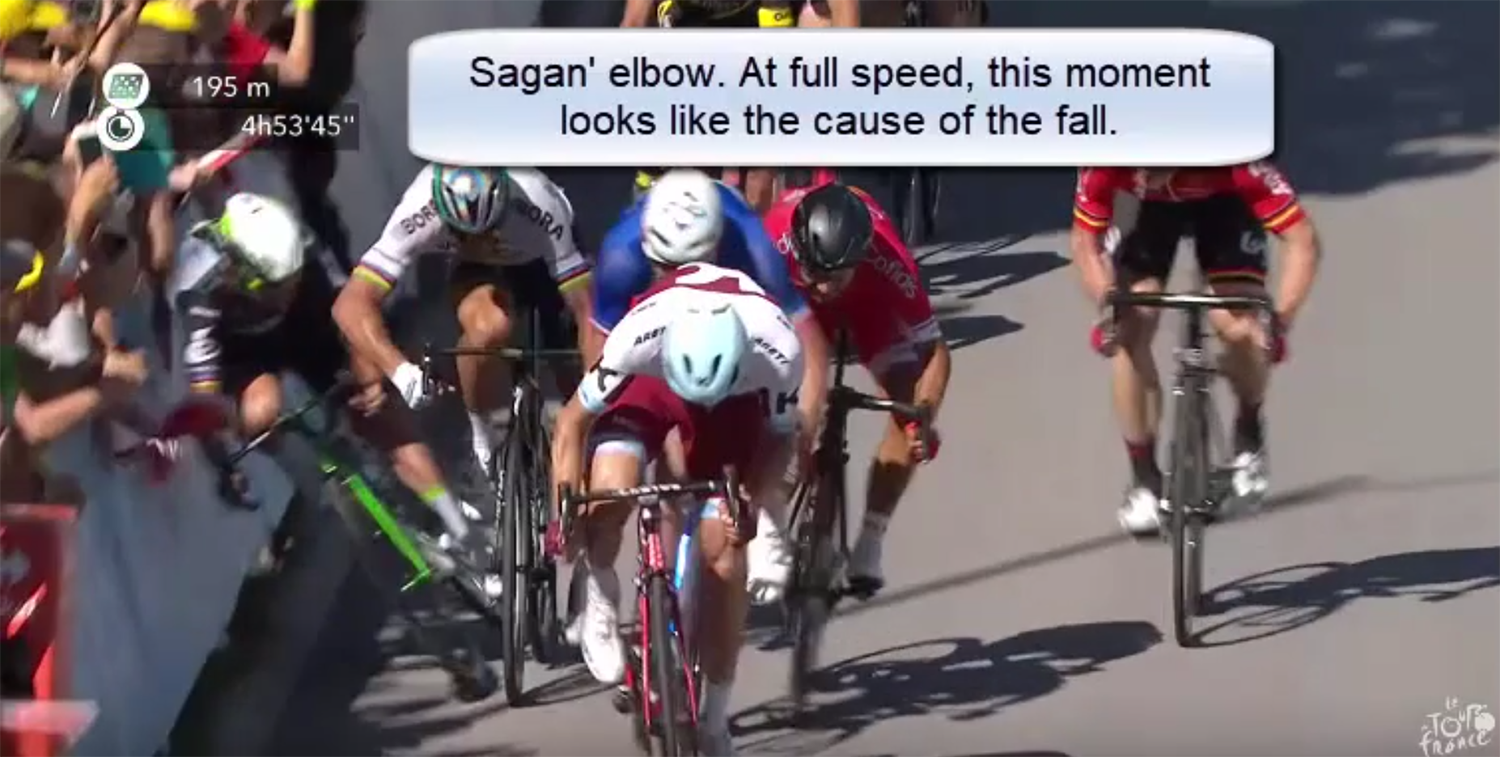
A still from an annotated video analysing a crash between Peter Sagan and Mark Cavendish in the fourth stage of the Tour de France 2017. 1
Sports-related controversies like the Sagan–Cavendish crash prompt questions on how the visual rhetoric and temporality of one medium – live television – are embedded and reconfigured on another – Twitter. Prior research suggests that analysing controversies helps to get a sense of the specific affordances of individual online platforms (Marres and Moates, 2015). Combining this approach with the recent interest in cross-platform analysis (e.g. D’Andrea et al., 2015; Langlois and Elmer, 2018; Rogers, 2018; Venturini et al., 2018), we want to use the Tour de France controversy to get a better understanding of emerging interrelations between different media. However, going beyond the usual ‘new media’ focus of cross-platform analysis, we also involve ‘old media’ (broadcast TV), which allows for a more comprehensive analysis of what we call ‘cross-media dynamics’.
Throughout the past 100 years, sport was notoriously important content in all successive media, from newspapers to radio and television, and was strategically harnessed by the media industry to introduce new technologies and to guide audiences across different platforms (e.g. Johnson, 2009). While perhaps dwindled, the influence of the older ‘established’ media has not disappeared. Already a cursory look at tweets discussing the Sagan–Cavendish crash discloses how much its participants are in sync with established media (especially television) and how much they enrol, modify and comment on images and videos taken from television. Globally broadcasted and live-streamed sports events like the Tour de France still shape a collective temporality across a number of platforms, even if platforms like Twitter add their own distinct pace to the mix.
While there is a multitude of research on sports and Twitter (for an early critical overview see Wenner, 2014), most research focuses on the changing relationship between organizers, athletes and fans (e.g. Bruns et al., 2013; Highfield, 2013; Hutchins and Mikosza, 2010; Sanderson and Kassing, 2011) or on the instrumental use of Twitter by media companies (e.g. Hutchins, 2014). The little research on controversies focuses on scandals and on political controversies during Olympics or other mega events (e.g. Brown and Billings, 2013; D’Andrea et al., 2015; Meier et al., 2019; Lünich et al., 2019). Going beyond this, we want to show that sports systematically produces controversies and thus triggers what in the context of fictional content has been called ‘forensic fandom’ (Mittell, 2012, 2015), referring to how fans use, scrutinize and modify available media material to create evidence and to prove a point. These forensic practices are an important and so far neglected contribution to emerging cross-media dynamics. Similar to some forms of political communication, sports controversies and the related forensic fandom create ‘pockets of interdependence’ that, according to Andrew Chadwick (2017), combine the logics of different media (old and new) in surprising ways. 2
To illustrate this, our analysis combines a quantitative, digital methods approach (Rogers, 2013) with a more qualitative, textual analysis of significant cross-media entanglements. While we are thus concerned with the interrelation between media, we take Twitter as an initial focus point to analyse how the temporality and the visual rhetoric on this platform are shaped by the entanglement with other media. Using a collection of 484.082 tweets from 4 days during the Tour de France 2017 (4 July to 8 July), 3 we first identify patterns regarding tweet frequencies and most shared images. Using these, we offer a critical close reading of significant posts to examine what visual elements appear and whether and how they are entangled with different media. The first part (comprising the sections ‘Cross media pace’ and ‘The pace of controversy’) analyses how the ‘pace’ of Twitter communication is shaped both by the characteristic liveness of sports events (and thus by television coverage) and by individual tweets of relevant actors. In a second step (comprising the subsequent three sections), we will introduce the concept of ‘forensic fandom’ to explain why and how tweets deploy media items from TV, newspapers and so on as ‘allies’ (Latour, 1990) and thus infuse Twitter’s visual rhetoric with cross-media dynamics. In the final section, we show how both the temporalities and the forensic attitude of the Sagan–Cavendish controversy connect the liveness of TV/Twitter with the archival function of YouTube.
Because each of the sections will introduce some new concepts to discuss specific aspects of the case, we abstain from a separate section introducing the theoretical framing and will instead discuss relevant research in each of the sections. Ultimately, we hope that the case study delivers insights beyond the realm of sports, as the pace and the arguments of online communication generally are intensively shaped by cross-media entanglements. Moreover, by virtue of its cross-media focus, we expect the text will relate to participatory dynamics beyond Twitter. Especially since controversies trigger a creative, critical, reflexive connection between different media, they always transcend the affordances of a single platform.
Cross media pace
Before analysing in detail how controversy-related communication on Twitter creates connections between different media and platforms, we want to zoom out for a moment and look at the basic temporal pattern of tweeting during the 4-day period. We will first describe more generally why sport is a relevant example to understand cross-media temporality. Then, we will focus on the Sagan–Cavendish crash: How does the controversy drive the amount of tweeting and how does the ‘pace’ of tweeting during a controversy result from the overlap of television and Twitter?
Tweet frequencies and liveness
From a ‘medium-specific perspective’ (Weltevrede et al., 2014), each social media platform, through its combinations of front end features (update, pull, push etc.) and back end features (new content, new indexing etc.), establishes its own ‘pace’ for information, that is ‘the rhythm through which it is found, retrieved, sorted and displayed’ (Weltevrede et al., 2014: 136). On the other hand, cultural practices, special events and controversies add their own temporal patterns as an additional layer, and thereby entangle the pacing of each platform with cross-media dynamics. In the context of pre-planned and announced events (e.g. award ceremonies, press conferences, elections debates and, of course, sports events; see Bruns and Moe, 2013: 24), social media often function as ‘second screens' or ‘backchannels' for TV content (Blake, 2017; Bruns and Stieglitz, 2013: 79). In cases of surprising events, especially catastrophes, social media – at least at the start – react more quickly and set the pace (and sometimes the agenda) for mass media journalism (e.g. Murthy, 2011; Revers, 2014: 7).
The seasonal succession of live sport events has often been described as one of the remaining temporal patterns that still synchronize attention across a heterogeneous media landscape that otherwise seems to tend towards individual access (Hutchins and Sanderson, 2017; Johnson, 2009). Its mix of serially organized mega events with heightened contingency also adds collectively synchronized ‘bursty’ and ‘newsy’ dynamics to Twitter feeds (Rieder, 2012; Rieder et al., 2018). Year after year, sports events are consistently present in the rankings of most tweeted moments. As a consequence, the temporality of Twitter, for example, during the Olympic Games, largely follows from the ‘rigid temporal linearity’ of the event it references and thus is mostly ‘reliant on the schedule of the live television coverage’ (Hutchins and Sanderson, 2017: 37).
As seen in Figure 2, the frequency of tweets during four stages of the Tour de France 2017 indeed follows a clear and unsurprising pattern that results from the temporalities of the event itself. Each day there is a clear peak of tweets at the end of the stage (most days around 5 pm 4 ). While a Tour de France stage often takes between 4 and 6 h, the increasing speculation about the impending outcome and the celebration or evaluation of the eventual result are reliable catalysts for tweets. While some of the increased tweet frequency results from reactions to tweets (examples for that below), the spikes seem mainly provoked by an ‘influx of active users’ (Bruns and Stieglitz, 2013: 72) reacting to and expressing opinions about the events they witness via TV images. The tweets per user are quite distributed, with most users only tweeting once, with an average of three tweets per user in the data set. As such, the event seemed to incite comments by a diverse group of users who are energized by decisive moments.
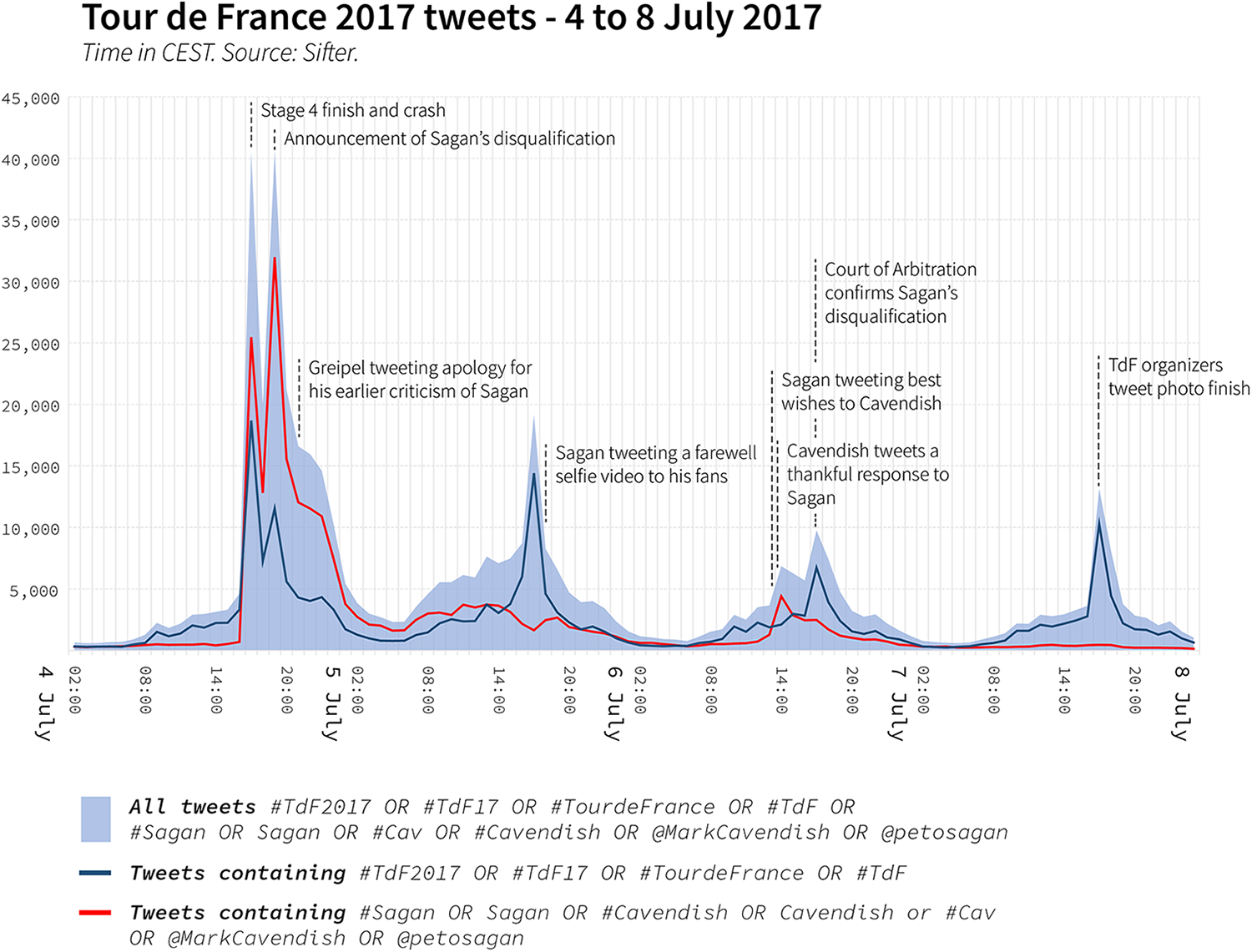
The frequency of tweets in the data set, annotated with key events.
The pace of controversies
More than other live events, the example of sports emphasizes how controversies augment such cross-media dynamics. The abundance of surprising, controversial moments not only creates higher tweet frequency spikes but, as this section discusses, also adds to the cross-media circulation of images and arguments. Due to sports’ competitiveness, partisanship and the emotional involvement of sports fandom, each decisive moment is potentially controversial: ambivalent situations with high consequences need to be judged immediately in front of a savvy audience. Most observers have an allegiance with a team or an athlete, often solidified by regional or national identity. The resulting controversies had always been an important part of sports’ media coverage in print journalism and on television. Yet with social media, the controversies become not only more visible but also include more voices and more heterogeneous sources in support of contesting claims.
This entanglement of voices points not only to a reconfiguration of engagement with sports in a different medium but also to how such engagement can lay bare how actors collectivise online. Building on earlier insights from science and technology studies (e.g. Callon, 1984; Jasanoff and Kim, 2009; Pinch and Bijker, 1984), media studies take advantage of the traceability of controversies online to ‘map’ the formation of collectives and issues in an instable or ‘magmatic’ state (Venturini 2009, see also Latour, 2005: 52). Additionally, the analyses of controversies deliver important insights concerning the characteristics of different media platforms (e.g. Burgess et al., 2016), respective ‘device cultures’ (Borra and Weltevrede, 2016) and what Noortje Marres more broadly calls ‘media bias’ (Marres, 2015). Adding to this line of thinking, we want to argue that sport is a great example to understand how controversies do not only speak to the specific platforms hosting and co-producing the debates but are also markedly cross-media. While there is some research on political controversies in the context of mega events in sports (e.g. D’Andrea et al., 2015; Girginova, 2015; Lünich et al., 2019; Meier et al., 2019) or on moral or political missteps of teams and players (e.g. Brown and Billings, 2013), the cross-media dynamics of sports’ competition-related controversies is under-researched.
Coming back to our case study, it is quite obvious that controversies intensify the Twitter communication on sports’ decisive moments. As clearly observable in Figure 2, the spike of the controversial fourth stage (4 July) is much higher than the ones of the other three stages. Still, this is somewhat remarkable, because the following fifth stage was the first mountain stage of the 2017 Tour, and therefore much more consequential for the overall Tour win. Stage 4, just like 6 and 7, was a flat stage, and since all three were decided in final sprints, could be expected to have generated similar buzz. As also indicated by the large percentage of tweets that reference either Sagan or Cavendish, stage 4’s higher tweet frequency is thus a result of the crash. The fact that this controversy generated increased buzz is also visible in the reactions to the daily tweets of the organizer’s account, @LeTour. When announcing the results for stages 3, 5 and 6, @LeTour’s tweets gained between 300 and 1100 retweets, whereas the tweet reporting stage 4’s crash gained 2500.
So far, the controversial moments we discussed are very much defined by the event itself or rather by its television coverage. Long before the ascent of social media, such moments would have been extensively discussed by TV, newspapers and, of course, by fans. Thus, it is not surprising that such controversies also intensify online communication. Beyond the synchronization across different media, though, controversies also offer a fertile environment for the emergence of intense ‘Twitter-native’ communication. Posts by organizations, athletes and fans can provoke intense moments of debate that do not result from the pacing of the TV transmission but become their own micro-event.
This is especially visible in the timeline of stage 4’s tweets, which is conspicuously different from the three following stages because it shows a second peak 2 h after the stage finish. This is triggered by @LeTour’s tweet announcing Sagan’s disqualification at 7:03 pm. With more than 3.600 likes and 3.700 retweets, it provoked even more engagement than their post with footage from the crash 2 h earlier. Contrary to the stage 4 finish, however, the moment of disqualification was not covered by live television anymore, suggesting @LeTour’s tweet was the main ‘Twitter-native’ trigger for this peak. Like all planned events, the Tour de France has a pretty stable ‘built-in audience’. The unexpected controversies of sports, though, also play into the emergence of ‘spontaneous’ (Highfield et al., 2013) or ‘ad hoc issue publics’ (Bruns and Moe, 2013: 18) that develop and organize their shared attention through emerging, trending hashtags. Indeed, the red line in Figure 2, indicating specific Sagan- and Cavendish-related tweets, contributes a bigger share to the overall numbers than the generic Tour de France-related hashtags.
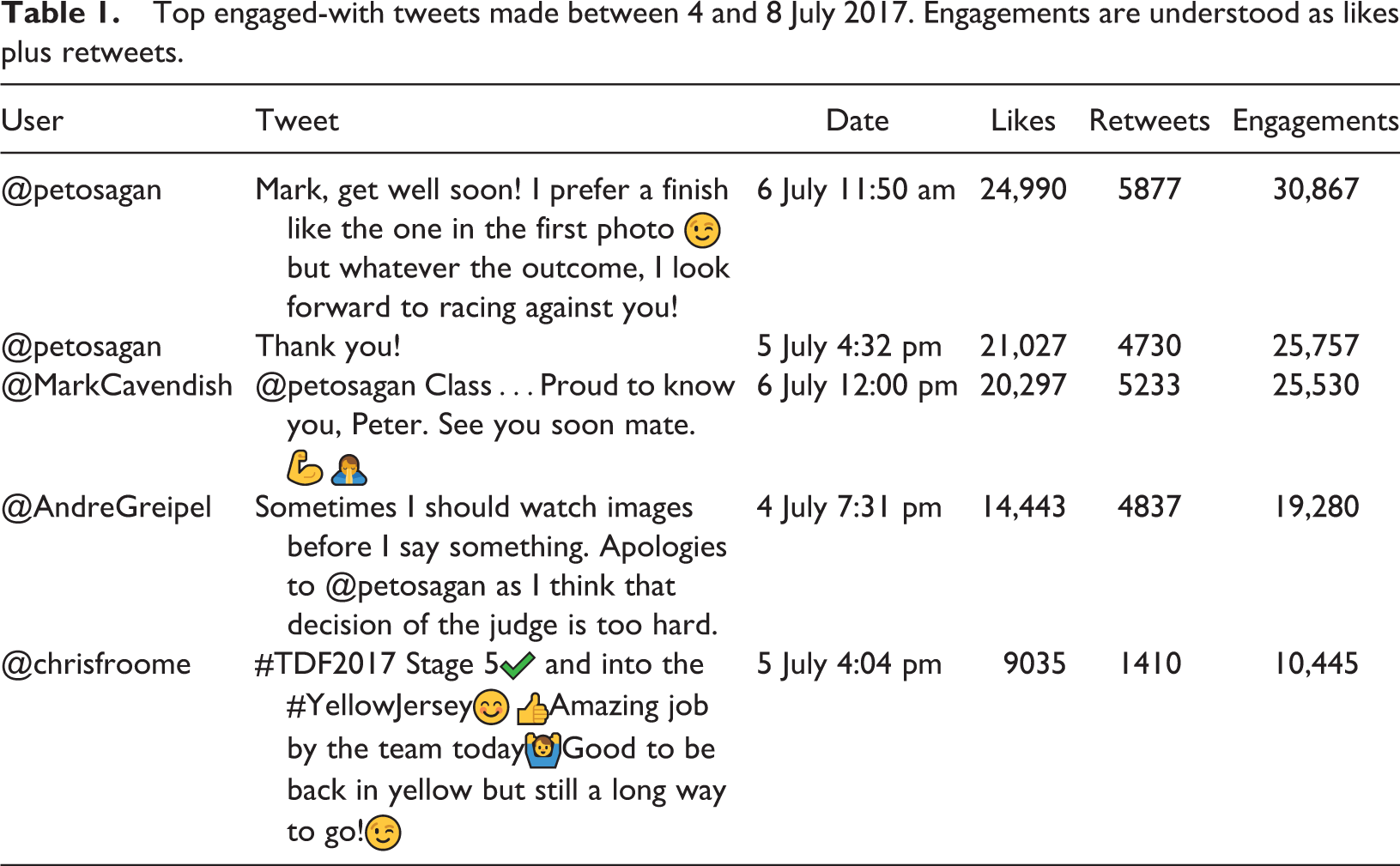
As soon as sports’ cross-media coverage establishes a controversy, the platform dynamics of Twitter, especially the co-presence of fans and stars without the traditional gatekeepers (Frederick et al., 2014; Highfield, 2013), stimulate further momentum. In the 2 days following Sagan’s disqualification, the biggest spikes are the respective stage finishes. Yet, there is an additional spike on 6 July that isn’t triggered by the live competition nor by a decision of its organizers. Instead, the spike is caused by tweets from Cavendish and Sagan, the protagonists – or antagonists – from the stage finish 2 days prior. Already on 5 July (6:32 pm), the disqualified Peter Sagan thanks his fans by posting a short selfie video. With around 21.000 likes, this is the second-most popular tweet in our data set. In a subsequent tweet on the sixth (at 01:50 pm), he addresses Cavendish, who had to drop out due to the injury from the crash: ‘Mark, get well soon’. 5 With more than 30.000 engagements, this is the most liked and retweeted Tweet in our data set. Moreover, Mark Cavendish’s friendly reply 10 min later – ‘Class…Proud to know you, Peter. See you soon mate’ 6 – is the third most popular tweet (Table 1). At times, sports-related Twitter communication thus switches from being driven by TV coverage to creating its own temporal dynamic.
Top engaged-with tweets made between 4 and 8 July 2017. Engagements are understood as likes plus retweets.
Concluding from our first two sections, we can see how during the Tour de France 2017, the pace of related tweets is temporally aligned with the rhythm of the competition, spiking at decisive moments and even more so when these are controversial. Controversial moments of sports events thus synchronize collective attention across different media. While TV still acts as main driver and pacer of online communication, some controversies can create a framing and heightened sensitivity that equip some tweets with special relevance and dynamic within the platform.
Even during these additional ‘Twitter-native’ spikes, though, the participants of the controversy constantly enrol and augment visual material from television, newspapers and YouTube to add weight to their statements. Beyond this circulation of visuals, the cross-media aspects of the debate moreover entangle Twitter with the affordances of other media. In the next section, we will move attention from tweet frequency as a measure of cross-media dynamics to media objects – images, videos and GIFs – in order to scrutinise the quasi-forensic attitude that makes all sports controversies decidedly cross-media. While still focusing on Twitter as a point of departure, we will trace how communication on this platform is not only shaped by the appropriation of material from television but also shapes communication on other online platforms.
Cross media forensics
In the second part of this article, we will discuss how sport-related controversies intensify the circulation of images across different media. This section first elaborates on the concept of ‘forensic fandom’, which we then use to scrutinize fans’ visual activities and their contribution to sports’ cross-media dynamics.
Sports’ forensic fandom
Even more than other fan groups, sports fans spend a lot of time in pre- and post-event communication (Gantz 1981; Gantz et al. 2006). Already before the establishment of social media, the ubiquity of sports news on TV, in journalism and in popular culture made sports fandom a decisively cross-media activity. With social media however, images have become a default, everyday manner of communication and expression, as evidenced by the saturation of selfies and memes (Jurgenson, 2019). While sports communication is still very much organized around the official footage from established channels, these same images now become entangled in the rich vernacular forms of visual culture online. Especially in the case of controversies, fans use and re-appropriate visuals from different sources as ‘allies’ (Latour, 1990): they try to convince others through the display, reinterpretation and augmentation of existing media footage that adds emphasis and evidence to their arguments.
The concept of ‘forensic fandom’ was originally coined to describe the media industry’s new strategy of creating committed fans for television drama; the intentionally convoluted and opaque storytelling of TV series like Lost (ABC 2004–2010) triggered fans to go online to search for and discuss hidden insights, allusions and their possible meaning (Mittell, 2012, 2015). Indeed, most fan cultures develop around a shared attachment to a set of media objects, which also implies a careful scrutiny of these objects, their implicit meanings and hidden interrelations. The level of engagement and the depth of knowledge is often used to gain reputation within the community and to distinguish the ‘real’ fan from the mere casual consumer (Jenkins 2013; Sandvoss, 2003). The industry’s endeavours to create forensic fandom through narrative riddles, ‘easter eggs’ and online extensions caters to such inclinations of fan culture, but also aims to nudge the casual viewer into a more fan-like attitude – and thus into long-term, cross-media attachment (Evans, 2011; Gillan, 2010). The prompt to scrutinize a text (instead of just consuming it) is a great incentive for the combined and interrelated use of different media, which all might offer a different perspective or a different piece of the puzzle. Such forensic practices are furthermore popularized in TV procedurals like CSI (Collins and Evans, 2012; Jermyn, 2007). Additionally, with the general growing relevance of social media, their endless stream of documents and the availability of tools to re-appropriate them, vernacular forensics have become a more common cultural practice – from citizen journalism like Bellingcat to conspiracy theorists on 4chan (Tuters et al., 2018).
Sports might offer the most developed and oldest example for ‘forensic fandom’, though. On the one hand, detailed knowledge and critical scrutiny is even more appreciated in sports fandom than in other fan cultures (Gantz et al., 2006). For instance, the masculinity of sports fandom is often safeguarded through doubting female fans’ knowledgeability and the authenticity thereof (Sandvoss, 2003). On the other hand, the use of media technologies to evaluate the performance and to take (or evaluate) official decisions is a characteristic aspect of competitive sports’ visual culture. More than most other objects of fandom, sports integrate forensics in their basic procedures. From the establishment of instantaneous photography and film at the end of the 19th century, to video, slow motion replay and digital graphics, sport did take advantage of visual records not only to create spectacle and entertainment but as ‘forensic media’ too: images are scrutinized and modified to reconstruct events and to understand their causality (Siegel, 2014).
In sports, as in a courtroom, the mediated evidence has two interwoven objectives: allowing professionals to come to a binding decision and convincing a broader audience (Engell, 2019: 241). Sports’ combination of, on the one hand, officials needing to come to quick decisions and, on the other, the availability of various media coverage offering alternative perspectives to a largely partisan audience systematically provokes the accumulation and comparison of evidence from different media in controversies. While this was already a characteristic of sports coverage in print and on television, which enrolled among others diagrams, still photography, slow motion and a number of witnesses and experts to comment on the footage, the broader participation in forensic activities online creates surprising new cross-media dynamics: fans review and discuss the available footage, add context, perspective and more media footage to make a point about what exactly happened and why – and how it is to be evaluated (Stauff, 2018).
Forensic fandom as cross-media dynamic
In the 4 days of our case study, the most liked and shared images on Twitter come from official channels or the riders themselves. Figure 3 shows the 20 most-liked tweets with a media item (images, videos and GIFs) posted between 4 July and 8 July as a treemap. The aforementioned interaction between Sagan and Cavendish and their selfie videos are the most prominent ones. Further down, we find @LeTour’s announcement to disqualify Sagan and their video of the crash. Next to that, there is the typical mix of competition-related and funny content, like Chris Froome’s tweet on his overall lead after stage 5, a prominent cyclist riding with a banana in his mouth and the Astana team doing the Macarena. One exception to the official imagery shows how user-generated content can add its own visual dynamic: the image mid-right in Figure 3 shows a letter written by ‘Bethany, age 7’, arguing ‘You shouldn’t of disqualify Sagan because he didn’t mean to hurt Cav’, 7 receiving over 2000 likes.
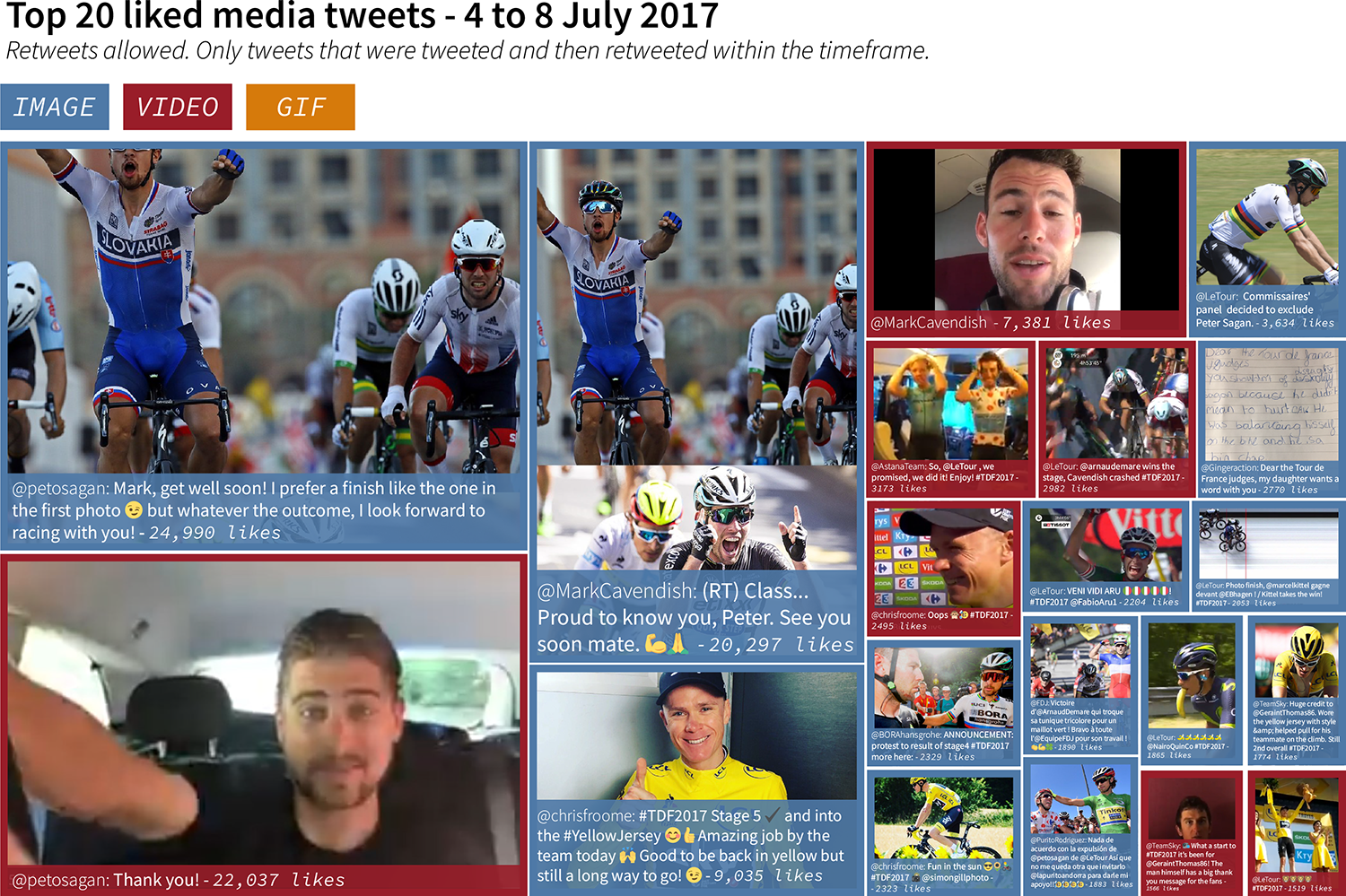
Top 20 liked Tour de France 2017 tweets containing a media item (image, video or GIF) from 4 July to 8 July 2017. 8
When zooming in on controversies, however, the media items posted by official channels or superstars become more and more complemented by the circulation and reuse of forensic media objects. A straightforward example of such vernacular objects, and how they interweave with official televised footage, comes from another contentious sprint finale. After a narrow sprint at the end of stage 7, the race organizers posted a finish line photograph next to the usual footage from the final moments. With more than 1000 retweets within 30 min after the stage finish, it is the most retweeted and the second-most liked image during the aftermath of the race that day (Figure 4). The treemap additionally indicates a high engagement with visual derivations of the finish lime image. Moreover, the comments appearing alongside these derivations explicitly debate its truth claim. Users, for example, point out the ambiguity of the evidence to question the organizer’s decision:
As also visible in Figure 4, some users create optical enlargements of the part of the image showing the tires of the two cyclists in front, for example, commenting ‘How is this not a tie!!!!!’. 12
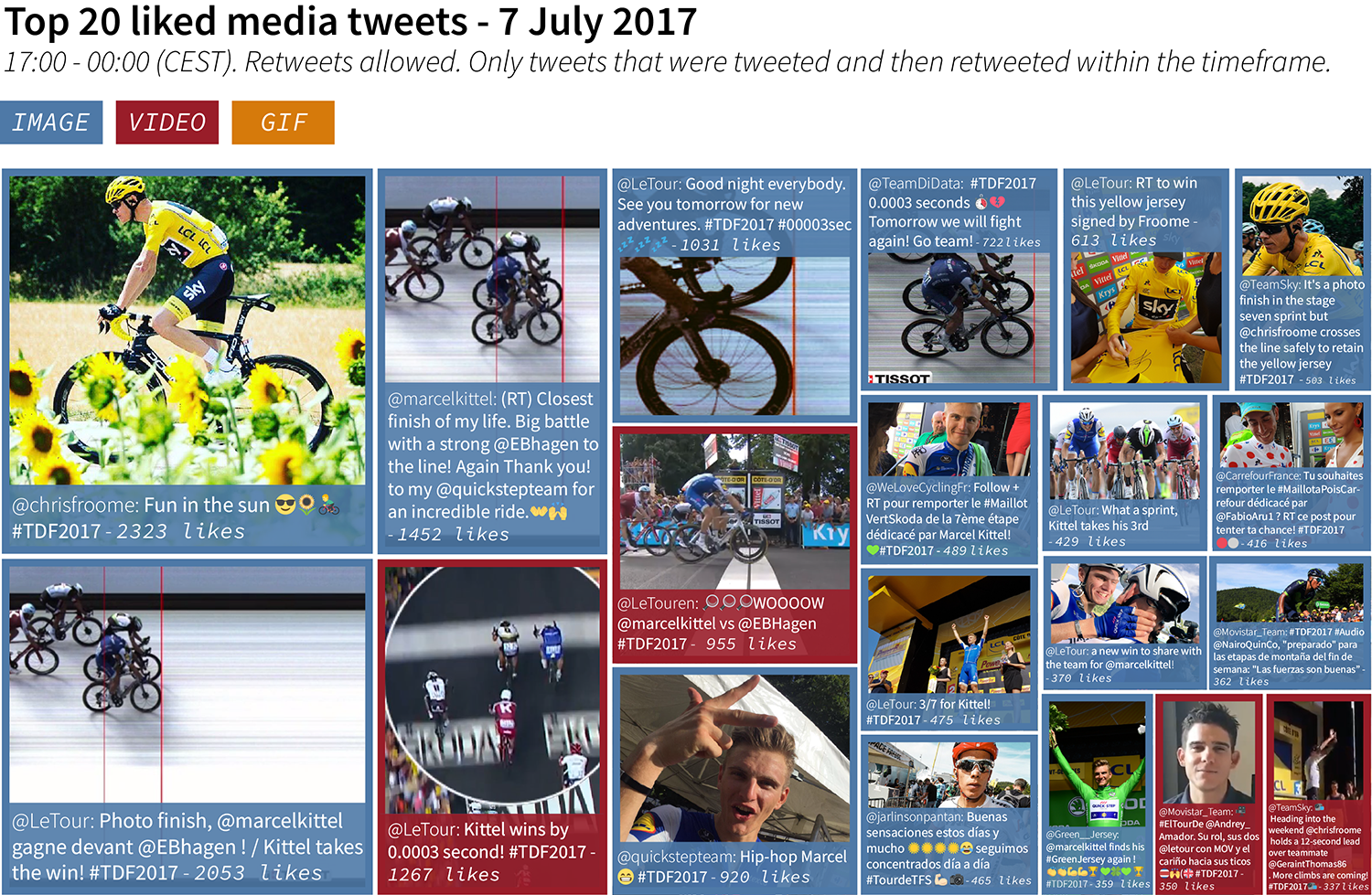
Top 20 liked Tour de France 2017 tweets containing a media item (image, video or GIF) on 7 July 2017 between 17:00 and 00:00 CEST (photo finish at 17:27).
Here, we see how communication on Twitter becomes entangled with cross-media dynamics. In this case, sports’ forensic fandom is shown to enrol anything from newly created memes to newspaper articles and YouTube videos into the participants’ quest for evidence. Even more so than after stage 7’s photo-finish, this is clearly visible after the crash of stage 4. Even if the photo finish image didn’t offer conclusive evidence, it was clearly the best perspective on the situation one could get. For stage 4, though, different camera perspectives gave alternative impressions of the course of events. 13 Additionally, instead of the mere factual question (‘Which wheel is ahead of the other?’), the crash moved the interpretation of human behaviour and intentions to centre stage. After stage 4, TV stations and the organizers of the race offered several ‘forensic media’ examples like slow motion replays from several camera angles. Fans and social media users built on that to add not only their own opinion but their own visual evidence, ranging from screenshots of decisive moments to elaborate forensic videos.
Illustrating this, the treemap in Figure 5 shows the top-liked media on 4 July from tweets that mention Sagan or Cavendish. Twitterers quickly started discussing the details of the crash in replies to the short clip posted by @LeTour: who of the two riders impeded and touched the other first? What alternative options would they have had? What were their original intentions? Several tweets in the treemap include close-ups of the contact between Sagan and Cavendish noting, for instance: ‘Cav going down already before Sagan puts his elbow out. He had know where to go. Decision very harsh. Hope Cav can live with himself’, 14 ‘From this footage it looks like Cav was already going down after going into #Sagan Really bad call!’ 15 and ‘Full head/shoulder contact before the elbow ever comes out. Sagan playing defense. Jury is off its rocker’. 16 In other tweets, the rhetoric is similarly one of visible evidence (‘if you look carefully’ etc.) but also reflects on the limitations thereof, for instance noting the ‘need to see few seconds before the contact’ 17 or ‘u cant tell that from this pic imo’. 18
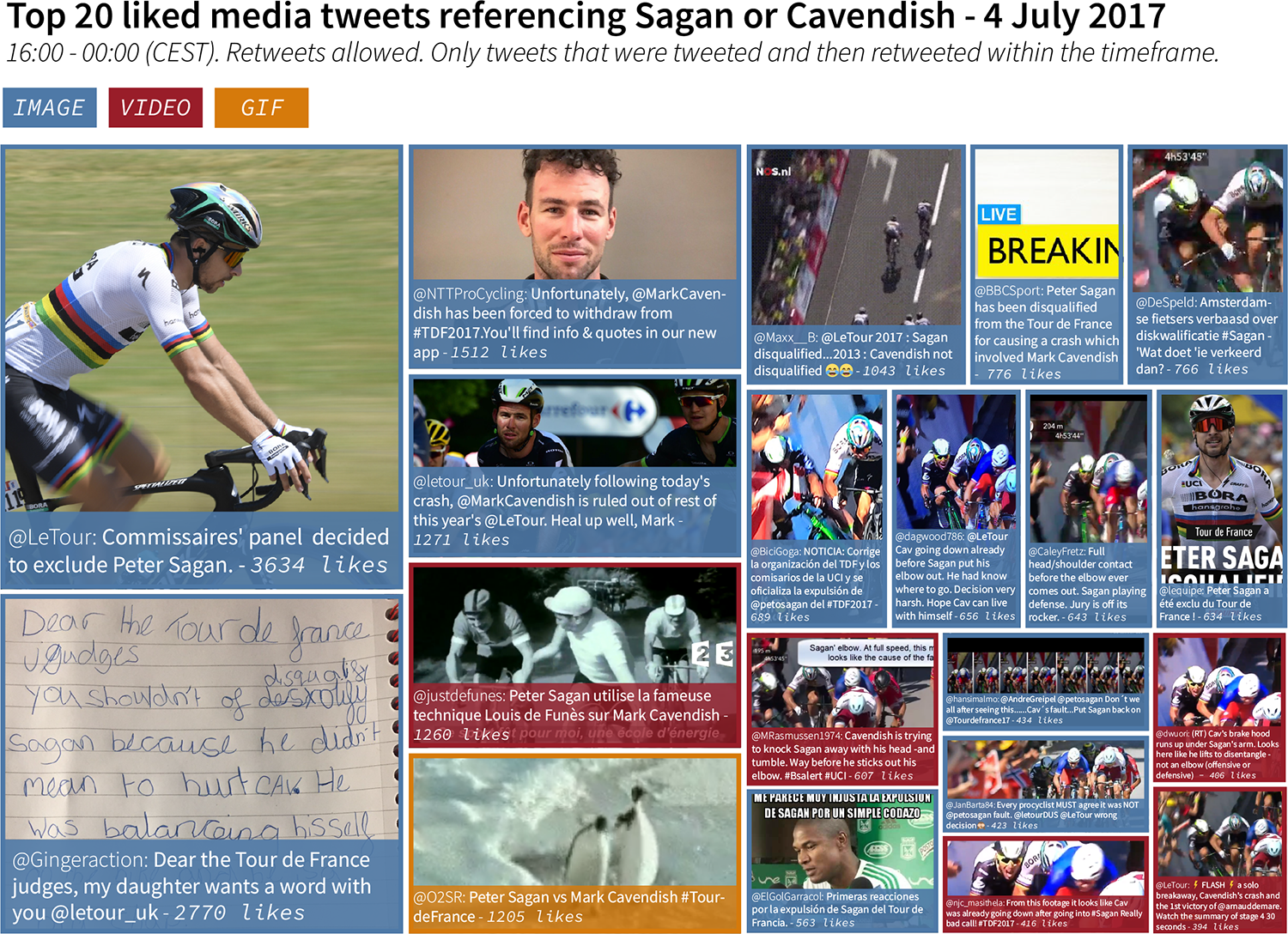
Top 20 liked Tour de France 2017 tweets containing a media item (image, video or GIF) on 4 July 2017 between 16:00 and 00:00 CEST (crash at 17:12).
Refracting the issue through visual practices
While it would be interesting to analyse the rhetoric of visual evidence further, we here will focus on the actual visual (and forensic) practices to show how strategies of augmenting and enhancing TV images shape the dynamics of the debate on Twitter. The debate, of course, starts by scrutinizing the TV images at hand. As our treemap overview (Figure 5) shows, the official announcement of the disqualification and of Cavendish’s injury are top-liked items above the forensic imagery. Videos posted by established media like the BBC, The Guardian and ESPN, which often include quasi-forensic replays or freeze frames, are highly popular too. Considering the overlap between sports’ forensic fandom and social media’s vernacular image culture, it is not surprising that users soon start posting a huge number of additional media items and augment them to express their moods and to support their arguments. Quickly, the forensic practices become more complex and include, for example, time series of up to six consecutive pictures, reminding of the early photographic ‘motion studies’ of Eadweard Muybridge from the 1880s and various annotations of televised footage (Figure 6). We also see the annotated video from the opening anecdote, with repetitive freezing of frames and inserted captions to carefully direct the attention of the observer. Images related to the crash by far outnumber the images of the victor of the stage, which usually dominate after less controversial stage finishes. Moreover, the crash-related media items get posted and engaged with for at least 3 days.
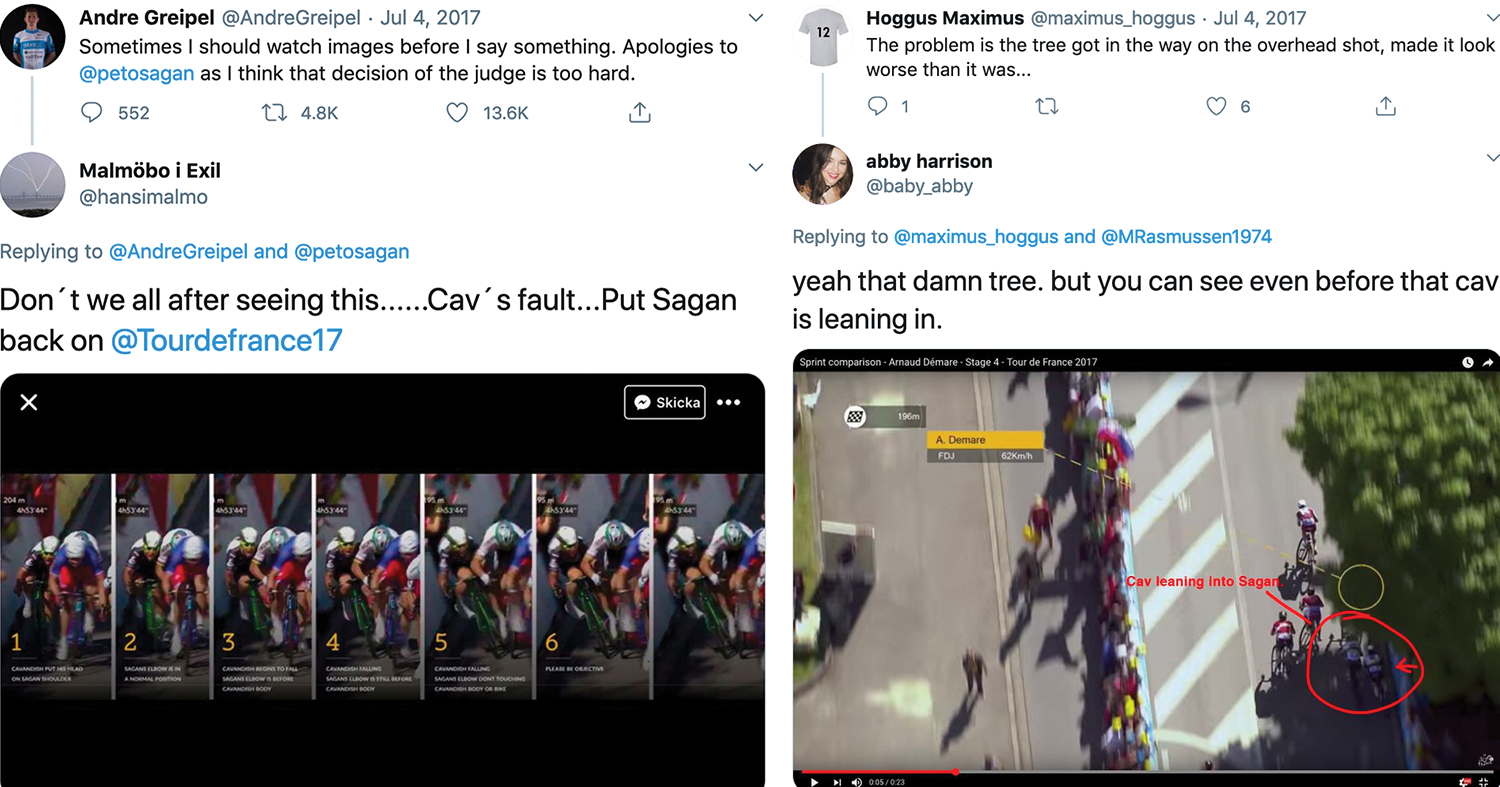
Examples of user-generated forensics of the Sagan–Cavendish crash, 4 July 2017. 19
Some of these frequently retweeted, user-generated media items can be considered Internet memes since they are part of circulating groups of digital artefacts that build on and reference each other, often for comedic purposes (Shifman, 2013). As seen in the Figure 5 treemap, one of the earlier, highly engaged-with memes is a GIF made from an old French comedy movie to make a point about the rogueness of Sagan’s riding style. Nearly as popular is a GIF of a penguin knocking down a fellow penguin with its flipper. 20 In a way, the sport context enrols even the memes into the forensic approach: most of them are used to underline the gravity or the obviousness of the alleged misdemeanour. Yet, while the memes are popular, more traditional ways of displaying, reading and enhancing images as allies of arguments ultimately outnumber them.
One notable case for the cross-media dynamics and the forensic attitude is a tweet by a participating cyclist: shortly after the finish of the race, fellow sprinter Andre Greipel harshly criticized Sagan for taking down Cavendish. However, 4 h later, obviously after watching additional TV or online footage, Greipel revised his original take on the situation in a tweet (see Figure 6 above): ‘Sometimes I should watch images before I say something. Apologies to @petosagan as I think that decision of the judge is too hard’. 21 With nearly 5000 retweets and 14.000 likes it is the fourth most popular tweet during the 4-day period we cover here (see Table 1). Like the tweets of Sagan and Cavendish, it earned a lot of replies that mix forensics with praise for his honesty and fairness, proving once more that any more centralized voice triggers a new cycle of statements that regularly create cross-media connections.
Instead of actively participating in the discussion, the accounts of organizers and riders rather act to instigate further visual productivity. Their initial involvement thus contributes to the awareness of and reflection on mediated visuality, but stops there. Neither do the amateur sleuths reach a consensus in the ‘debate’. Therefore, not so different from political discussions online (e.g. Quinlan et al., 2015), the Sagan–Cavendish controversy does not really proceed as a debate at all on Twitter. Instead of a structured exchange with consecutive or developing arguments, there is rather a deluge of comments, evaluations and opinions; the ‘ad hoc issue public’ is organized around the shared attention for a particular case and the extensive critical scrutiny of visual material.
Thus, neither the diffusion of information nor the structured exchange of arguments is the dominant mode of communication here. In this case, we rather see what Bernhard Rieder (2012) describes as a ‘refraction chamber’: the spreading of information that sits in between identical reproduction and total heterogeneity, whereby the information ‘refracts’ per appearance. Since the Sagan–Cavendish crash was a singular moment, attention was focused on central issues and similar questions. Yet, with each successful meme, each visual proof and each celebrity statement, the trajectory of the issue gets slightly refracted: it can switch from the factual order of events, to the character of an athlete, to an allegedly biased organizational decision. This regularly happens when tweets mobilize different cultural contexts to give an issue a new twist and thus moral or political valence (Rieder, 2012). Especially in the case of sport-related controversies, such refractions create (and are created by) cross-media dynamics. By modifying and interpreting visual material, forensic practices contribute to this refraction.
So far, in this section we have discussed how tweets concerning controversial sports moments testify to cross-media dynamics by borrowing and transforming visual items from other media, constituting a ‘forensic fandom’ that subsequently refracts discussion. In the final part, we want to show how forensic practices can extend this cross-media dynamic beyond the immediate moment of the controversy by retrieving contextual and historical footage, weaving YouTube and other media platforms into the debate.
Enrolling YouTube and forensic memory work
As we have argued, the Sagan–Cavendish controversy on Twitter enrols, depends on and shapes other media. This rings especially true for video footage televised or posted elsewhere. References to ESPN and other established media appear regularly in the data set. Most dominant, though, are YouTube videos. On a basic level, YouTube acts as an infrastructure and intermediary for Twitter’s engagement with the controversy. To explore what videos became associated with the fans’ forensics, Figure 7 shows the YouTube videos that were tweeted most often in our data set. 22 Aptly illustrating the previous section is the second most-mentioned video: a clip from The Guardian’s YouTube account that forensically scrutinizes the incident. With more than 2.5 million views, it is the most watched YouTube video in our Twitter data set as well as in the controversy-related videos we retrieved through YouTube Data Tools (see footnote 3). 23 In the latter data set, most videos do not originate from media organizations, though, but are user-generated content in one form or the other. Within a few minutes after the stage finish, users uploaded video fragments showing the crash and then embedded these clips on Twitter. Other users might then retweet or directly embed the video from YouTube in their own tweets. Some videos are just filmed off the TV screen or consist of one still image with an added forensic voice-over. It takes less than an hour before enhanced and modified footage with advanced forensics is uploaded. 24
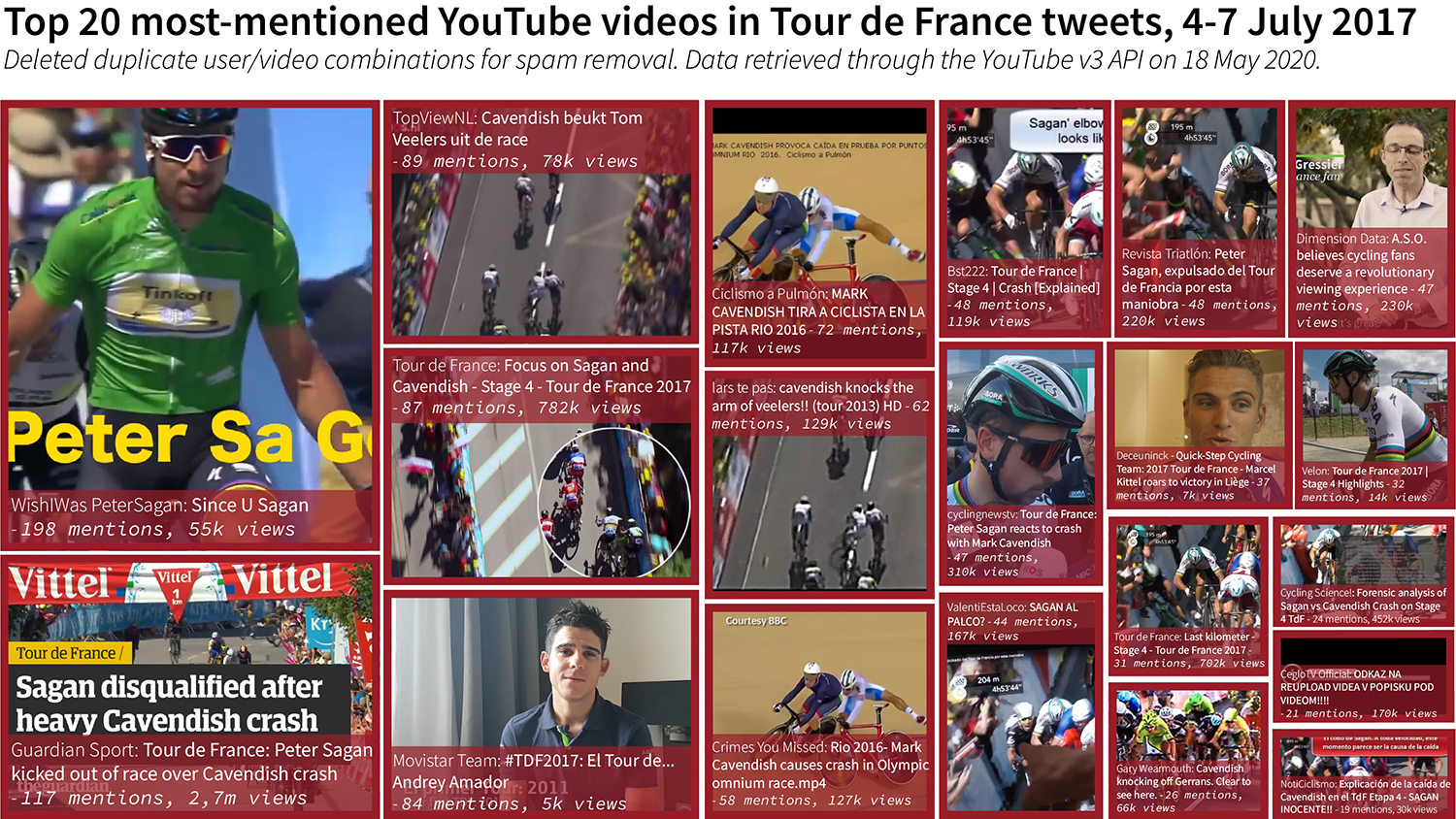
The top 20 most-mentioned YouTube videos in Tweets from our Tour de France 2017 Twitter data set. Video metadata retrieved through the YouTube v3 API on 18 May 2020.
A day after the crash, on 5 July, there are several elaborate forensic analyses on YouTube that become widely shared and discussed on Twitter. One popular video with half a million views, appropriately called ‘Forensic analysis of Sagan vs Cavendish Crash on Stage 4 TdF’ (mid-right in Figure 7), uses The Guardians’ footage and more layers of slow motion, captions and explanations. 25 Other examples, in different languages, show vloggers discussing the visual evidence, often combining images of the vloggers with screencasts of their forensic procedures. 26
The examples so far already exemplified the paradox of visual evidence: it assumes that something is unequivocally given by looking at an image, while at the same time, this evidence needs constant scaffolding (e.g. Cartwright, 1995; Coopmans et al., 2014). Characteristically, the most linked-to videos from our Twitter data set guide the viewer’s attention with freeze frames, slow motion, arrows and captions. Additionally, evidence is manufactured through contextualization and comparison. A somewhat speculative but very common rhetoric in our data set explains the crash on the basis of long-running character traits and habits of the riders, for instance tweeting: ‘Cav was leaning into Sagan from behind, before elbow was out to check balance. Cav has a long history of leaning from behaving like an ass’.
27
Similarly, past decisions by officials can be mustered as a benchmark. This often happens in very general terms: ‘Sagan should be reprimanded. Cav has been punished for far less in the past’.
28
The more forensic approach, though, enrols historical media footage as ‘allies’ (Latour, 1990) in its quest for evidence and compares the current incident to similar situations in the past. Such comparisons are common in all kinds of forensics. In sports, though, the serialized organization of competitions guarantees that huge numbers of comparable moments are ready at hand. The access to and remediation of past events through social media platforms become integrated in cultural memory practices more generally (Merrill et al., 2020b) and add to already existing forensic memory work in sports.
The use of historical footage can be clearly seen in our treemap (Figure 7), as well as in several tweets. For instance, only 15 min after @LeTour tweeted the short video fragment from the crash, a user replied by quoting a tweet from 2014 with a photo that graphically highlights Cavendish pushing another rider in a similar manner as he got pushed by Sagan.
29
The following day, in the context of the announcement of Cavendish’s injury, a user replied to two different tweets with a link to a The Guardian headline from the 2013 Tour de France, stating ‘Cavendish exonerated after sprint collision’. In one reply the user adds: ‘Lets NOT forget, #Mark Cavendish has a history of being dangerously aggressive and has never been disqualified. Not fair for @petosagan  ’.
30
This receives a reaction from another user who links to a Telegraph article from 2009, reminding Cavendish was actually disqualified in that year’s Tour de France as well.
31
Such discussion of past events confirms a pattern we saw before: Twitter controversies enrol heterogeneous media items, recent and historic, as allies for their arguments.
32
’.
30
This receives a reaction from another user who links to a Telegraph article from 2009, reminding Cavendish was actually disqualified in that year’s Tour de France as well.
31
Such discussion of past events confirms a pattern we saw before: Twitter controversies enrol heterogeneous media items, recent and historic, as allies for their arguments.
32
Next to such footage from newspapers, YouTube forms an easily accessible and especially rich archive for such forensic memory work. At 7:03 pm, just 16 min after the official announcement of Sagan’s disqualification, a user posted a GIF based on Tour de France footage from 2013 that shows Cavendish causing a crash of fellow rider Tom Veelers. The user dryly adds the comment: ‘2017: Sagan disqualified…2013: Cavendish not disqualified  ’.
33
With 700 retweets and hundreds of replies within 24 h, this historical argument forms an important contribution to the controversy. The 2013-comparison is also taken up by two users who independently embedded two different YouTube clips of slow motion replays. Similarly, two others referenced a track racing match at the 2016 Olympics when, again, a contender crashed after Cavendish came in his way. These also appear in the most linked-to videos in Figure 7. In total, 5 of the 20 videos in the treemap are references to past matches.
’.
33
With 700 retweets and hundreds of replies within 24 h, this historical argument forms an important contribution to the controversy. The 2013-comparison is also taken up by two users who independently embedded two different YouTube clips of slow motion replays. Similarly, two others referenced a track racing match at the 2016 Olympics when, again, a contender crashed after Cavendish came in his way. These also appear in the most linked-to videos in Figure 7. In total, 5 of the 20 videos in the treemap are references to past matches.
These and many more early videos find a new audience at different moments and are revisited for different reasons. 34 One user even replied with a list of four YouTube links accompanying an angry tweet: ‘Arrogant. Here’s the proof #NoSaganNoTour’, referencing multiple crashes with Cavendish being involved. 35 In reply to one of the first posts mustering the 2013 case, several users referenced a comparable historical situation either by linking to YouTube or by quoting a tweet discussing the respective video 36 ; others answer with a forensic version of the 2017 Tour crash. In this case, forensic fandom can thus be seen to collectivize visual argumentation from various platforms and various time periods, expanding the already pretty hybrid set of sources that characterized the Tweet activity.
While YouTube can be seen to work as an ‘archive’ for Twitter, it only does so because of the active memory work performed by sports fans – made possible and encouraged by sports’ serialization. Furthermore, beyond acting as a repository for visual evidence, YouTube adds its own dynamics and affordances to the event while itself becoming entangled with the synchronized temporality of the event and that of Twitter. The already mentioned ‘Forensic analysis…’-clip is a good example of how the YouTube activity is primarily driven by the event’s temporality, with the video being uploaded shortly after the event itself and the 500+ comments mostly dating from a few days after the crash. However, older videos can also be seen to receive a spike in activity, with a considerable number of comments dating from July 2017 and little comments prior to this date.
Some of this is enabled by the characteristics of the networked public as described by danah boyd (2007: 126): persistence, searchability and replicability make it easy to compare current events with earlier ones. This is also what happens to politicians when their current statements on an issue contradicts what they said earlier – and with respect to Donald Trump, this has arguably developed into a sub-genre of political tweeting. More generally, memory work has become an important part of social media activism (Merrill et al., 2020a). Yet here again, sports’ systemic controversies and the related forensic fandom highlight how much the temporalities and the materialities of different media get entangled and shaped in this process. The archival affordances of one platform (YouTube) are combined with the ‘real-time’ tendencies of others (Twitter and broadcast television). Sports’ combination of planned liveness (‘built-in audience’) and an unplanned controversy (‘ad hoc issue publics’) thus creates ‘pockets of interdependence’ (Chadwick, 2017) between different media, both through temporal synchronization and through cross-referencing to support arguments. 37
Conclusion
This article focused on the pace, cross-media dynamics and forensic fandom surrounding the Tour de France 2017. By only offering insights into the particular dynamics of this specific event, the findings might differ with other topics and practices. Nonetheless, we hope our analysis offers inspiration beyond the case of sports, since we aimed to add to the broader and more conceptual debate on the cross-media (or cross-platform) dynamics of the current media landscape. Media (including their seemingly specific temporal and visual qualities) are always dependent on and shaped by particular cultural practices, topics and events that combine affordances of different media. We hope that our specific case has helped to identify these general dynamics.
In summary, we have seen how sports events synchronize attention and activity across different media and how controversies intensify this cross-media dynamic but also establish a sensitivity that allows for the creation of additional ‘eventfulness’ within a platform –for example, a tweet that reheats but also ‘refracts’ an ongoing controversy. The forensic activity of fans, partly paced by what people see on television, creates combinations of media items from different sources and brings them in conversation with each other. In that process, not only the visuality but also the temporality of media is moulded: Twitter users reactivate old (and otherwise irrelevant) newspaper articles and YouTube videos. In that context, YouTube and other platforms attain both an archival function as well as getting entangled with the controversy in real time. It is partly the live character of the sports event (and its TV coverage), and partly the forensic activity on Twitter that equip YouTube videos with urgency and new comments at a very specific moment. Neither the temporality (or pace) nor the visual rhetoric of a medium or a platform can be defined independent of the cultural practices that trigger one or the other connection between different media and platforms.
If we focus more on the specific contributions of sports, it is plausible to consider such sport controversies as a key contribution to what Matthew Kirschenbaum (2008) calls the ‘forensic imagination’ – the idea that different media offer specific ways of giving access to the truth and the individuality of past events. The focus on the forensic aspect of sports and sports’ fandom highlights the extent to which all kinds of media are harnessed and combined in the quest to not only reconstruct what happened but to also equip this truth with weight to convince a non-expert, often partisan public. Next to the hyperbole, cynicism and mischievousness that characterizes much online communication, the controversy also displays remarkable levels of media-savviness and reflexivity.
While a forensic approach was common in sports media and sports fandom from early on, social media now highlights their versatility and prominence. The forensics of sports are an often overlooked contribution to wider cross-media dynamics. They complement the top-down cross-media strategies of the sports media industry and are at least as fertile as the forensic fandom of fictional content. At least in the case of the Tour de France 2017, the forensic approach seems to dominate other forms, like memes, that have become key examples for the circulation of topics and the expression of opinions. For further research, it could be interesting to add semantic and sentiment analysis to the methodological set up to get a better understanding of how the different media are equipped and ‘refracted’ (Rieder, 2012) with meaning, evidence and emotion.
Supplemental material
Supplemental Material, sj-csv-1-con-10.1177_13548565211010481 - Enhancing #TdF2017: Cross-media controversies and forensic fandom during live sports events
Supplemental Material, sj-csv-1-con-10.1177_13548565211010481 for Enhancing #TdF2017: Cross-media controversies and forensic fandom during live sports events by Sal Hendrik Hagen and Markus Stauff in Convergence: The International Journal of Research into New Media Technologies
Supplemental material
Supplemental Material, sj-csv-2-con-10.1177_13548565211010481 - Enhancing #TdF2017: Cross-media controversies and forensic fandom during live sports events
Supplemental Material, sj-csv-2-con-10.1177_13548565211010481 for Enhancing #TdF2017: Cross-media controversies and forensic fandom during live sports events by Sal Hendrik Hagen and Markus Stauff in Convergence: The International Journal of Research into New Media Technologies
Supplemental material
Supplemental Material, sj-csv-3-con-10.1177_13548565211010481 - Enhancing #TdF2017: Cross-media controversies and forensic fandom during live sports events
Supplemental Material, sj-csv-3-con-10.1177_13548565211010481 for Enhancing #TdF2017: Cross-media controversies and forensic fandom during live sports events by Sal Hendrik Hagen and Markus Stauff in Convergence: The International Journal of Research into New Media Technologies
Supplemental material
Supplemental Material, sj-csv-4-con-10.1177_13548565211010481 - Enhancing #TdF2017: Cross-media controversies and forensic fandom during live sports events
Supplemental Material, sj-csv-4-con-10.1177_13548565211010481 for Enhancing #TdF2017: Cross-media controversies and forensic fandom during live sports events by Sal Hendrik Hagen and Markus Stauff in Convergence: The International Journal of Research into New Media Technologies
Footnotes

References
Supplementary Material
Please find the following supplemental material available below.
For Open Access articles published under a Creative Commons License, all supplemental material carries the same license as the article it is associated with.
For non-Open Access articles published, all supplemental material carries a non-exclusive license, and permission requests for re-use of supplemental material or any part of supplemental material shall be sent directly to the copyright owner as specified in the copyright notice associated with the article.
