



Abstract
Existing research on intermedia agenda-setting within the hybrid media system has primarily focused on political communication. This study extends prior work by examining how a scientific controversy circulated across legacy and social media platforms. Specifically, it investigates the debate over hydroxychloroquine (HCQ) as a potential COVID-19 treatment and explores whether, and how, legacy media and social media set each other’s agendas. We conducted a cross-media and cross-platform analysis using data from legacy media (broadcast, cable news, and national newspapers; N = 2,276) and social media (Twitter, N = 416,087; Facebook, N = 28,566). Combining time-series analysis with large language model-assisted framing analysis, the results reveal a complex relationship across platforms: overall, coverage of HCQ did not exhibit consistent agenda-setting effects between legacy and social media. However, framing patterns diverged significantly. Legacy media emphasized Conflict and Public-Risk frames, while social media discourse was dominated by polarized Conflict and Economic-Consequences frames. These findings contribute to the literature on networked agenda-setting in the hybrid media system by providing empirical evidence from science communication, extending the framework beyond its predominant focus on political communication.
Keywords
Introduction
Scientific controversies present a fundamental yet underexamined challenge for contemporary agenda-setting research. Unlike many political issues, scientific debates unfold under conditions of epistemic uncertainty, evolving evidence, and expert disagreement, making them especially susceptible to shifting narratives and contested interpretations (Cooke, 2017; van der Bles et al., 2019). In such contexts, media platforms play a critical role not only in disseminating information but also in shaping which scientific claims receive sustained attention, how long they persist in public discourse, and how they are interpreted across media systems (Ophir & Jamieson, 2021). Understanding how issue attention surrounding scientific controversies travels across media platforms is therefore essential for extending agenda-setting theory beyond its traditional political focus.
Classic agenda-setting theory posits that news media influence public attention by making certain issues more salient than others (McCombs & Shaw, 1972). However, agenda formation today no longer unfolds within a simple, hierarchical media environment (Zhang & Cho, 2025). Instead, it occurs within a hybrid media system in which legacy media and digital platforms coexist, compete, and interact (Chadwick, 2017). In this environment, issue attention may originate from multiple sources, diffuse rapidly across platforms, and fluctuate in response to elite cues and platform-specific incentives (Gilardi et al., 2022; Langer & Gruber, 2021). As a result, agenda-setting processes are increasingly shaped by intermedia dynamics, whereby media platforms influence one another’s issue salience over time.
Intermedia agenda-setting research has made substantial progress in documenting these dynamics, but it has done so primarily within political and electoral contexts, examining whether traditional media lead social media agendas or vice versa (Harder et al., 2017; Meraz, 2009; Yoo, 2024). This political emphasis has generated important insights into cross-platform influence under conditions of partisan competition and elite contestation (Zhang & Cho, 2025). However, it has also left a significant theoretical gap: whether and how intermedia agenda-setting operates when the issue at stake is scientific rather than overtly political. Scientific controversies differ from political issues in ways that matter for agenda-setting theory. Scientific knowledge advances through iterative testing and revision, often producing provisional or conflicting findings before consensus is reached (Cooke, 2017). Journalistic norms emphasizing timeliness and novelty incentivize early coverage of emerging scientific claims, even when evidence remains uncertain (Ophir & Jamieson, 2021; Tuchman, 1973).
At the same time, digital platforms accelerate the spread of both expert assessments and speculative or misleading interpretations, frequently bypassing traditional journalistic gatekeeping (Gillespie, 2018; Napoli, 2019; Scheufele & Krause, 2019). These dynamics raise important theoretical questions about whether intermedia agenda-setting processes observed in political contexts generalize to scientific controversies, or whether scientific issues exhibit distinct cross-platform and cross-media patterns of attention and influence.
This study zooms in on the hydroxychloroquine (HCQ) controversy during COVID-19 as a case study to investigate intermedia agenda-setting within a hybrid media system beyond political communication. HCQ emerged as a highly visible and publicly amplified scientific controversy in early 2020, when preliminary lab findings and small, methodologically limited studies were amplified as evidence of a “breakthrough,” attracting wide public attention before strong clinical evidence existed (Gould & Norris, 2021). Politicians, most visibly U.S. President Donald Trump, publicly promoted HCQ as a potential “game changer,” which further politicized the issue, fueled partisan conflict in news coverage and social media, and encouraged demand even as medical experts urged caution (Niburski & Niburski, 2020). As larger randomized trials accumulated, they found no meaningful clinical benefit for hospitalized patients (RECOVERY Collaborative Group, 2020), and major health authorities moved to stop or revoke authorizations and trial arms (U.S. Food and Drug Administration, 2020; World Health Organization, 2020). Accordingly, we approach HCQ not as a case in which all visible contestation reflected equally rigorous scientific disagreement, but as a scientific controversy whose public salience was shaped by the interaction of preliminary evidence, political endorsement, media amplification, and subsequent scientific correction.
In addition to tracing the temporal diffusion of issue attention surrounding the HCQ debate, this study also examines how this scientific controversy is framed across media platforms during the COVID-19 pandemic. This analysis provides supplementary evidence for intermedia agenda-setting patterns and advances our understanding of how platforms and media differ in constructing discourse around a scientific controversy. Agenda-setting processes shape not only whether issues receive attention but also how they are defined and interpreted (McCombs, 2005). Platform-specific norms, audience incentives, and algorithmic curation may encourage divergent framings of the same scientific issue (Ophir et al., 2024).
Using a cross-platform and cross-media approach, this study integrates time-series analysis with a comparative large language model-assisted framing analysis across legacy and social media platforms to examine intermedia agenda-setting dynamics and framing patterns surrounding the HCQ controversy during the COVID-19 pandemic. First, it advances intermedia agenda-setting theory within hybrid media systems by demonstrating its applicability to scientific controversies, a domain that has received comparatively less scholarly attention than political communication. Second, it provides empirical evidence on how legacy media and social media interact in covering contested scientific claims under conditions of uncertainty. Third, it highlights the joint role of attention diffusion and framing in shaping the public visibility and interpretation of scientific issues.
Intermedia Agenda-Setting and Framing in the Hybrid Media System
The proliferation of digital platforms has reshaped the agenda-setting process, in which news media shape public priorities by elevating the salience of particular issues (McCombs & Shaw, 1972). Importantly, the transformation is not simply that “more voices” can now participate. Rather, agenda formation now occurs within a hybrid media system where legacy and digital media logics coexist and actively interact, producing new pathways through which attention is initiated, amplified, and sustained (Chadwick, 2017; Zhang & Cho, 2025). In such environments, issue salience is increasingly structured by cross-media and cross-platform dynamics: attention can circulate among legacy outlets, platformed publics, and strategically positioned elites, with feedback loops that can accelerate issue takeoff, prolong controversy, or rapidly redirect attention (Langer & Gruber, 2021). As a result, the agenda-setting process is less adequately described as a linear, top-down transfer from elite media to audiences and more accurately understood as a distributed and temporally contingent system of interdependencies across platforms.
Within this context, intermedia agenda-setting provides a useful framework for explaining how issue attention moves across media platforms over time. Intermedia agenda-setting shifts the analytical focus away from media-to-public effects toward cross-media influence, asking whether heightened attention on one platform predicts subsequent attention on others, and which platforms tend to lead, follow, or amplify within a broader media ecology (Harder et al., 2017; Meraz, 2009). This perspective is especially valuable in hybrid media systems because it treats agenda formation as a dynamic process in which multiple media arenas compete for attention while simultaneously responding to one another’s signals (Zhang & Cho, 2025).
Early intermedia research often assumed that elite news organizations drove the agendas of other media in a relatively linear manner (e.g., Vliegenthart & Walgrave, 2008). More recent scholarship shows that intermedia influence is conditional, varying with issue characteristics, political context, and platform affordances (Gilardi et al., 2022; Harder et al., 2017; Langer & Gruber, 2021). Digital platforms have intensified these contingencies by accelerating diffusion, increasing the visibility of engagement cues, and enabling elites to bypass or pressure traditional gatekeepers through direct-to-public communication (Wang & Zhang, 2025). At the same time, legacy media frequently retain agenda-setting power through professional routines, institutional credibility, and the capacity to generate sustained coverage that anchors attention across the wider media system (Harder et al., 2017). In this sense, hybrid media systems can produce both disruption and continuity: social platforms can elevate issues quickly, but legacy outlets may still determine which issues stabilize into sustained public agendas (Gilardi et al., 2022).
Consistent with this view, empirical evidence on the direction of intermedia influence remains mixed. Some studies suggest that social media agendas, especially when driven by political actors, can shape subsequent news coverage (Gilardi et al., 2022; Yoo, 2024). Other work finds that traditional outlets often remain central agenda setters, particularly during high-salience periods when institutional journalism coordinates attention across outlets and audiences (Harder et al., 2017; Langer & Gruber, 2021). Comparative research thus cautions against expecting a single “dominant” platform. Instead, intermedia agenda-setting appears to reflect issue- and context-specific leadership, with different platforms exerting influence under different conditions (Langer & Gruber, 2021).
These patterns are further reinforced by the distinct institutional and technological logics governing different platforms. Legacy media rely on professional news routines and institutionalized judgments of newsworthiness (Tuchman, 1973). Social media, by contrast, operate under platform governance and algorithmic curation that reward engagement and can privilege emotionally resonant, polarizing, or identity-affirming content (Gillespie, 2018; Napoli, 2019). Although social platforms expand participation, the distribution of visibility is neither neutral nor evenly accessible; it is shaped by governance choices, corporate incentives, and the regulatory environment in which platforms operate (Gorwa, 2019; Wang et al., 2024). Together, these dynamics suggest that agenda-setting in a hybrid media system is best understood as a temporal process of cross-platform influence, rather than as a purely networked or decentralized exchange of meanings. Intermedia agenda-setting theory thus offers a coherent framework for examining how issue attention emerges, spreads, and stabilizes across legacy and digital media in contemporary public discourse.
The Case of Scientific Controversy: Hydroxychloroquine as a COVID-19 Treatment
The public debate over hydroxychloroquine (HCQ) as a COVID-19 treatment offers a theoretically useful case for examining intermedia agenda setting under conditions of scientific controversy. Intermedia agenda-setting research in hybrid media systems has largely centered on political communication, including elections, partisan conflict, and activist mobilization (e.g., Harder et al., 2017; Meraz, 2009). Related network-oriented approaches similarly concentrate on political media ecologies and platform-based contestation (Hsiao & Hindman, 2026). By contrast, scientific controversies have received comparatively less attention, despite the fact that they pose distinctive challenges for cross-platform agenda formation: evidence develops unevenly, expert claims may conflict, and institutional guidance can shift as knowledge accumulates (Jensen & Hurley, 2012; Schneider et al., 2022). This study extends intermedia agenda-setting research in the hybrid media system to a domain where uncertainty and evolving evidence are central features of the information environment.
For most citizens, news media remain primary channels for learning about science, placing journalists and media organizations in a pivotal position in shaping how scientific claims enter and persist in public discourse (Ophir & Jamieson, 2021). Yet journalistic incentives toward novelty and timeliness can elevate emerging findings before consensus is established, making science coverage especially vulnerable to volatility when subsequent studies challenge earlier claims (Jensen & Hurley, 2012). Experimental research further shows that communicating scientific uncertainty can meaningfully shape public trust and decision making, underscoring why instability in evidence can translate into instability in attention and interpretation across platforms (Schneider et al., 2022).
Social media intensifies these dynamics by accelerating diffusion, weakening traditional gatekeeping, and amplifying elite and influencer cues through engagement-driven and algorithmically curated distribution (Gillespie, 2018; Napoli, 2019). During the COVID-19 pandemic, these dynamics contributed to an “infodemic” in which contested and misleading claims circulated rapidly across networks (Cinelli et al., 2020). Prior work demonstrates that prominent media figures can measurably influence public health attitudes among their audiences, illustrating how attention can be redirected outside institutional scientific channels (Stecula et al., 2022).
HCQ provides an especially useful case because it rapidly evolved from a provisional medical hypothesis into a highly visual public controversy. The principal claims under debate concerned whether HCQ could prevent COVID-19 infection, reduce disease severity, or serve as an effective treatment for infected patients. In the early phase of the controversy, these claims gained visibility through preliminary laboratory findings, small and methodologically weak clinical studies, and high-profile political and media endorsement. Public attention accelerated in mid-March 2020 following online promotion by prominent figures, President Trump’s endorsement of HCQ as a “game changer” (Solender, 2020), and the publication on March 20 of a small French study reporting a 100% cure rate among COVID-19 patients treated with HCQ (Gautret et al., 2020). However, skepticism emerged quickly. By April 3, the journal’s sponsoring society stated that the study did not meet expected standards (Voss, 2020), and when the FDA issued an Emergency Use Authorization for HCQ on March 28, senior health officials still described the evidence as anecdotal and warned about adverse effects (Hamblin, 2020).
Over the following months, the controversy evolved rather than remaining a stable dispute. Widely circulated preprints and publications were challenged, withdrawn, or retracted, including a May 11 preprint that was withdrawn 10 days later and the May 22 Lancet study that was subsequently retracted (Horby & Landray, 2020; Mehra et al., 2020). At the same time, more robust randomized trial evidence increasingly failed to show meaningful clinical benefit by the summer and early fall of 2020 (Samuels & Kelly, 2020). Yet public and political endorsement did not disappear entirely. As late as August 3, Trump continued to claim that “Hydroxy has tremendous support” (Bump, 2020). In this sense, the HCQ episode was not a single, stable dispute, but an evolving scientific controversy in which claims about treatment were repeatedly amplified, contested, and revised across scientific, media, political, and institutional arenas.
Although the HCQ debate emerged during the pandemic, we use it here primarily as a theoretically informative case of how contested scientific claims become politicized and amplified within a hybrid media system. The involvement of public figures and political actors drew substantial attention from both news media and social media, including the circulation of misinformation (Mackey et al., 2021). More broadly, similar dynamics can be observed in other scientific controversies. In the vaccine-autism controversy, for example, media narratives helped structure how the MMR debate was publicly understood, while cross-platform information flows further amplified its visibility. Jang and colleagues (2019) show that Twitter influenced mainstream news agendas in vaccine-autism coverage across the United States, Canada, and the United Kingdom, and Mann (2019) demonstrates that online news coverage relied on recurring autism narratives that shaped the controversy’s public meaning. The STAP cell episode offers a related example of how claims framed as transformative scientific breakthroughs can attract rapid cross-media attention before adequate validation. In that case, discussion on Twitter emerged earlier than in newspapers and may have contributed to the public unraveling of the claim (Sugawara et al., 2017).
Beyond tracing how attention diffuses across platforms, examining how the controversy is framed on each platform provides an important supplementary perspective on how HCQ discourse differs within the hybrid media system. Agenda setting shapes not only issue salience but also the attributes and interpretive lenses attached to an issue (McCombs, 2005). Framing research, by contrast, is more directly concerned with how issues are defined, causally interpreted, and morally evaluated across communicative contexts (Entman, 1993). Because platform logics and incentives vary, hybrid media systems may produce divergent frames even when attention spikes are synchronized (Suk et al., 2025). To capture these distinct dimensions, this study combines time-series analysis of intermedia agenda dynamics to examine the diffusion of attention with comparative large language model-assisted framing analysis to examine the construction of meaning surrounding a contested scientific claim:
RQ1: How did legacy media and social media influence one another’s agendas in the coverage and discussion of HCQ during the key period of public controversy (from March 1 to October 30, 2020)? RQ2: How did the framing of HCQ vary across media platforms during the key period of public controversy (from March 1 to October 30, 2020)?
Method
Data Collection
Data were collected from both legacy media outlets and social media platforms during March 1 to October 30, 2020, which covers both the early amplification of HCQ as a promising treatment and the later period in which accumulating evidence and institutional actions increasingly challenged that narrative. For both legacy and social media, a keyword-based approach was implemented, using both “hydroxychloroquine” and its common abbreviation “hydroxy.” All retrieved records underwent multi-stage filtering. Automated relevance screening removed duplicates and blank entries, followed by temporal verification to confirm inclusion within the March to October 2020 timeframe. A manual review of a random sample validated the accuracy of the automated filtering. For consistency, the analysis was limited to English-language content.
Legacy media outlets were collected across three categories: broadcast television news, cable news networks, and national newspapers. This categorization reflects long-standing differences in news production processes and agenda-setting dynamics, allowing us to examine whether traditional intermedia influence persists in today’s hybrid media environment (Gans, 2004a, 2004b; Vliegenthart & Walgrave, 2008). In total, n = 136 full-text transcripts were collected from the three major U.S. broadcast networks—ABC World News Tonight, CBS Evening News, and NBC Nightly News—through the Internet Archive’s Television News Archive, 1 a comprehensive repository of broadcast content. From cable news networks, n = 2,029 segments were collected from CNN, MSNBC, and Fox News, representing distinct editorial perspectives, also accessed through the Internet Archive. National newspaper data consisted of n = 111 items, including news reports, editorials, and opinion pieces from The New York Times, The Wall Street Journal, and The Washington Post, which were retrieved through the Nexis Uni 2 and ProQuest Central databases. 3
Social media data were collected from Twitter (now X) and Facebook using the same keyword strategy. From Twitter, n = 416,087 tweets were collected via the Johns Hopkins University COVID-19 Social Media Data Archive, which curates posts from verified accounts, high-engagement tweets, and representative samples from the broader Twitter ecosystem during the study period (Hua et al., 2022). From Facebook, n = 28,566 posts 4 were retrieved through CrowdTangle, Facebook’s now-deprecated research tool for analyzing public content, which provided access to posts from verified public pages, news organizations, and high-engagement accounts discussing HCQ.
We further examined the extent to which the nine legacy media outlets represented in the Facebook dataset. Of the 28,566 posts, only 31 (0.11%) originated from the official Facebook pages of the legacy outlets, indicating that cross-posting from those outlets did not meaningfully shape the composition of the social media data.
Analysis
Time Series Modeling
To examine the agenda-setting dynamics of HCQ coverage across media platforms, we employed a Vector Autoregression (VAR) model. VAR is designed to capture interdependencies among multiple time series by modeling each endogenous variable as a function of its own lags and the lags of other variables in the system. This approach is particularly effective for identifying potential feedback loops between legacy and social media coverage (Suk et al., 2025; Wells et al., 2020).
Lag selection followed by a two-stage diagnostic process. First, we conducted bivariate Granger causality tests at lag 1 through lag 3 across all platform pairs to identify temporal precedence relationships (Meraz, 2011; Vargo et al., 2014; see Appendix A.2). Partial autocorrelation functions provided additional guidance on within-series persistence for each platform. These two diagnostic approaches indicated that significant cross-media effects are present, primarily at lag 1 and lag 2, supporting VAR(1) as the primary specification, consistent with daily news production cycles in which platforms respond to one another within a 24-hour window (Vliegenthart & Walgrave, 2008).
HCQ coverage followed a distinct temporal pattern, increasing during early efficacy claims (March to April), peaking amid scientific and political controversy (May to June), and declining as evidence accumulated against its therapeutic value (July to October). To remove deterministic trends while preserving short-term variation, all series were linearly detrended (Hamilton, 2020). The resulting detrended VAR(1) model estimates how deviations from the overall narrative trend in one media channel predict deviations in others, isolating immediate spillover effects. For the time-series analysis, each platform’s daily count of HCQ-related items served as the unit of analysis, aggregated across all outlets within that platform category.
We focus on immediate (lag-1) spillover coefficients, which capture how coverage on one platform at time t predicts coverage on another platform at time t + 1, net of other variables, representing a next-day effect. Key coefficients were highly consistent across specifications: effects from cable news to broadcast news ranged from 0.96 to 1.04, whereas effects from broadcast news to cable news ranged from −0.34 to −0.42. Spillover effects from social media to legacy media were weak or nonsignificant throughout.
Diagnostic tests indicated instability across all model specifications examined, including VAR models with alternative lag structures, differencing strategies, and vector error correction models (VECM). The detrended VAR(1) produced an eigenvalue exceeding the stability threshold of 1.0 (Lütkepohl, 2013), precluding reliable estimation of multi-period impulse response functions and forecast error variance decompositions. This instability was primarily driven by cable news’ high autoregressive coefficient, indicating near-unit-root behavior. Following prior methodological guidance, we therefore restrict inference to immediate (lag-1) spillover coefficients, which remain interpretable and robust even in the presence of unit roots (Gospodinov et al., 2013). Estimates in levels are preferred over differencing or pretesting strategies, which may introduce bias and discard substantively meaningful information (Box-Steffensmeier et al., 2014; Sims et al., 1990).
Framing Analysis
To systematically identify frames in media content, this study used an automated frame analysis with OpenAI’s GPT-4o-mini language model. Prior research has demonstrated GPT’s reliability in text analysis, particularly in terms of accuracy (Hackl et al., 2023; Rathje et al., 2024). We selected seven framing categories spanning scientific interpretations (public risk, breakthrough, patient experience) and political and social interpretations (conflict, responsibility, economic consequences, human interest), drawing on existing health communication research (Jones-Jang et al., 2020; Ogbodo et al., 2020), to examine not just whether conflict framing appeared but also how interpretive emphasis varied across platforms with distinct institutional logics (Entman, 1993; Gillespie, 2018). We instructed the model to use these categories for text classification: conflict, economic consequences, human interest, responsibility, public risk, breakthrough, and patient experience (see Table 1).
Frames and Definitions.
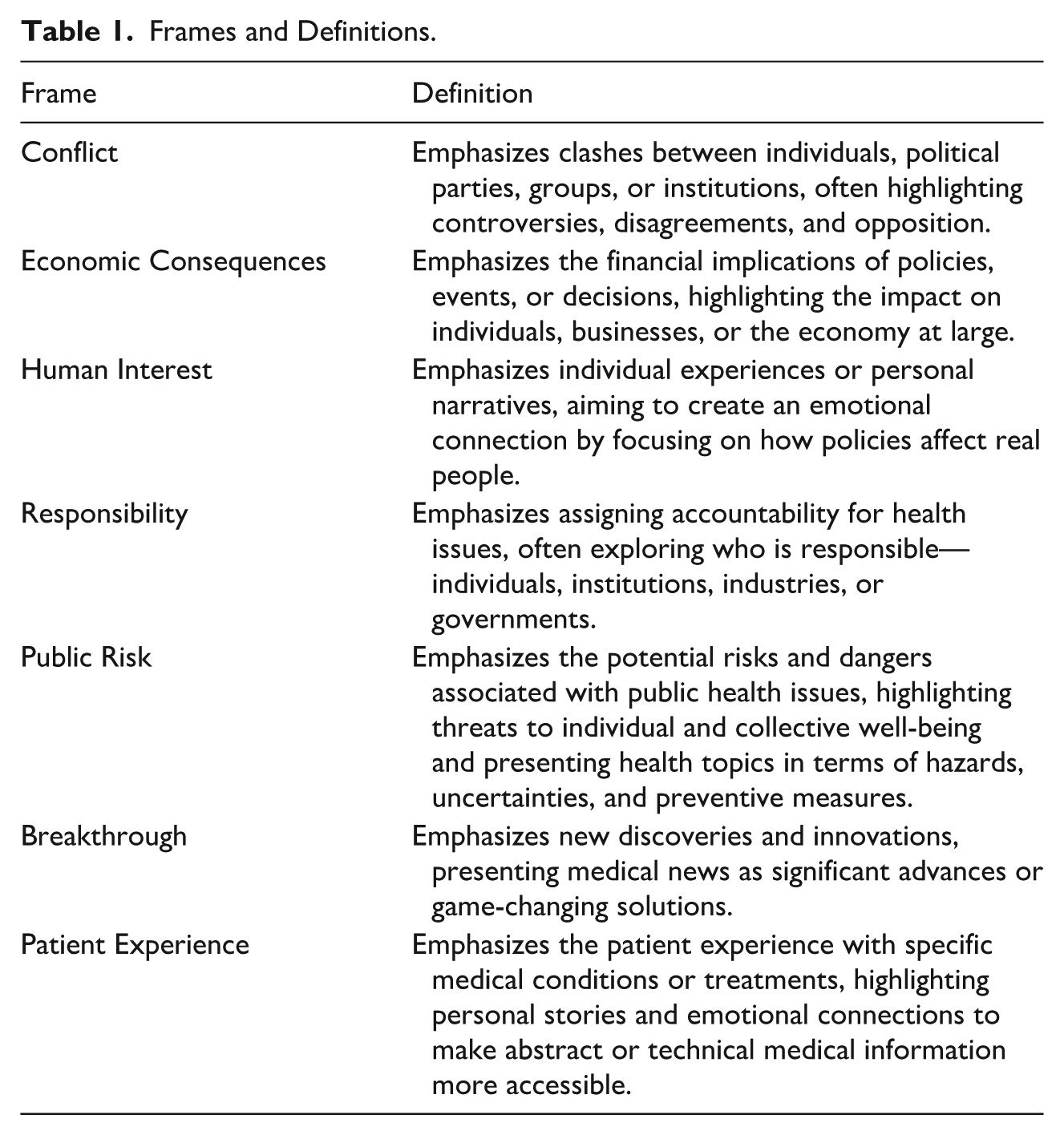
For the framing analysis, the unit of analysis was the individual document; for example, a broadcast transcript, newspaper article, or social media post, where each document was classified into one of seven predefined frames. 5 This procedure was applied individually to documents from each media platform.
After several iterations of prompt refinement, the final prompt used in the analysis was:
Based on the following definitions of frames, choose the most appropriate frame for the body of text. Choose only one frame as output. (List of frame definitions above)Text: [text]Frame: [model output]
To further validate the model’s performance, we randomly stratified 200 samples across all media platforms. Two authors independently labeled the frames based on the predefined coding scheme. Intercoder reliability among the two human coders and the AI coder was first assessed using Fleiss’ kappa (κ), which reached 0.90, indicating excellent agreement (Fleiss, 1971). Pairwise comparisons using Cohen’s κ further showed high agreement between each human coder and the AI coder (κ = 0.87), as well as between human coder 1 and human coder 2 (κ = 0.86 and κ = 0.98, respectively). Together, these results demonstrate the reliability of the final prompting strategy and the robustness of the model’s performance.
Results
We first describe HCQ coverage and discussions across all media platforms. Overall, legacy media covered HCQ far less extensively than social media, an expected pattern given the differences in content production and dissemination across media systems. Although coverage volume varied substantially by platform, temporal patterns were characterized by periods of relative stability punctuated by sharp spikes. As shown in Figure 1, despite marked differences in overall volume, major spikes were largely synchronized across platforms, whereas Facebook exhibited a comparatively more stable trend than other platforms.
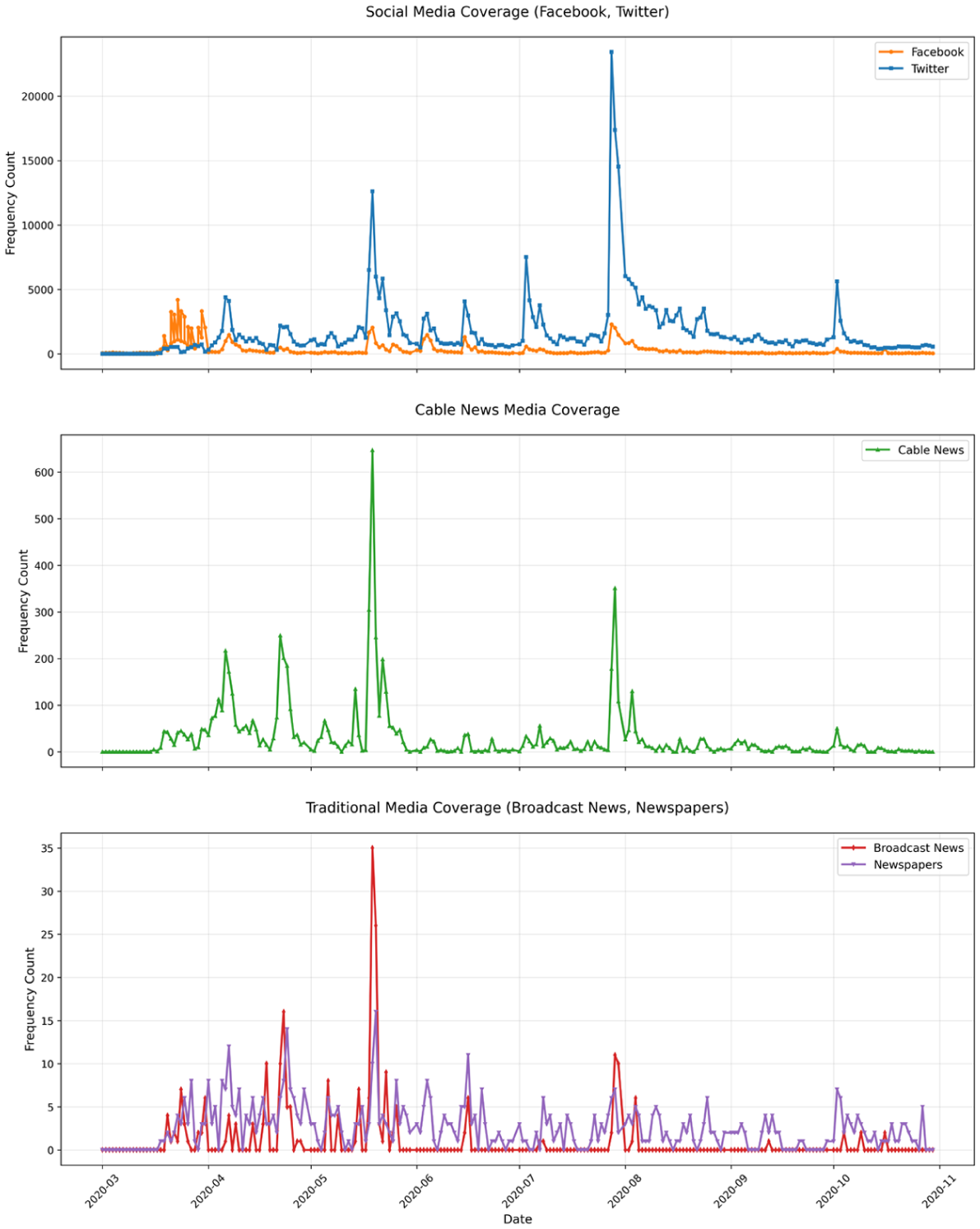
Daily count of news content and social media discussions of HCQ.
One notable spike occurred in mid-to-late May 2020 across all platforms. This surge coincided with two highly salient events: on May 18, President Trump disclosed that he was personally taking HCQ as a preventive measure, and on May 22, a high-profile observational study published in The Lancet reported increased mortality risks associated with HCQ, a finding that was later retracted. These events generated particularly strong responses in cable news and broadcast news relative to social media platforms. Another spike emerged between the end of July and early August 2020, most prominently on Twitter. Some key events include NIH’s NIAID announcement of Phase 3 testing of COVID-19 vaccine on July 27 on CNN, and Dr. Fauci appearing before a House panel expressing “cautious” optimism about vaccine availability, which was covered by Fox News on July 31. In response, Twitter’s conversations centered around escalating controversy around COVID-19 treatments, especially HCQ, following renewed viral circulation of videos and claims by physicians promoting its effectiveness. More specifically, a viral event on July 28, 2020, catalyzed a video from “America’s Frontline Doctors,” where the video featured high-profile political actors and subsequently produced a sharp spike in attention and discussions around medical authority, censorship, and trust.
RQ1 examined how legacy media and social media set the agenda for one another in the context of HCQ coverage and discussion. Although some instability remained across model specifications, as shown in Table 2, the detrended VAR(1) results revealed clear temporal patterns both within and across media channels. Cable news exhibited the strongest persistence (β = 0.85, p < .001) and led subsequent increases in broadcast news (β = 0.98, p < .001) and newspaper coverage (β = 0.46, p < .001), underscoring its central agenda-setting role within legacy media. Broadcast news showed moderate self-dependence (β = 0.67, p < .001) but tended to signal the daily closure of the HCQ news cycle, followed by declines in other outlets (e.g., cable: β = −0.37, p < .001; Twitter: β = −0.17, p = .01). Social media displayed weaker and more independent dynamics: Twitter maintained ongoing discussion (β = 0.71, p < .001) with limited influence on legacy media, while Facebook showed modest and short-lived effects on broadcast news (β = 0.17, p < .001) and newspapers (β = 0.15, p = .004). No significant immediate effects from cable to social media were found. Overall, these results indicate that legacy media were temporally synchronized and mutually reinforcing, whereas social media operated on a slower and more autonomous rhythm.
Temporal Intermedia Influences From VAR(1) Models With Detrended Data.
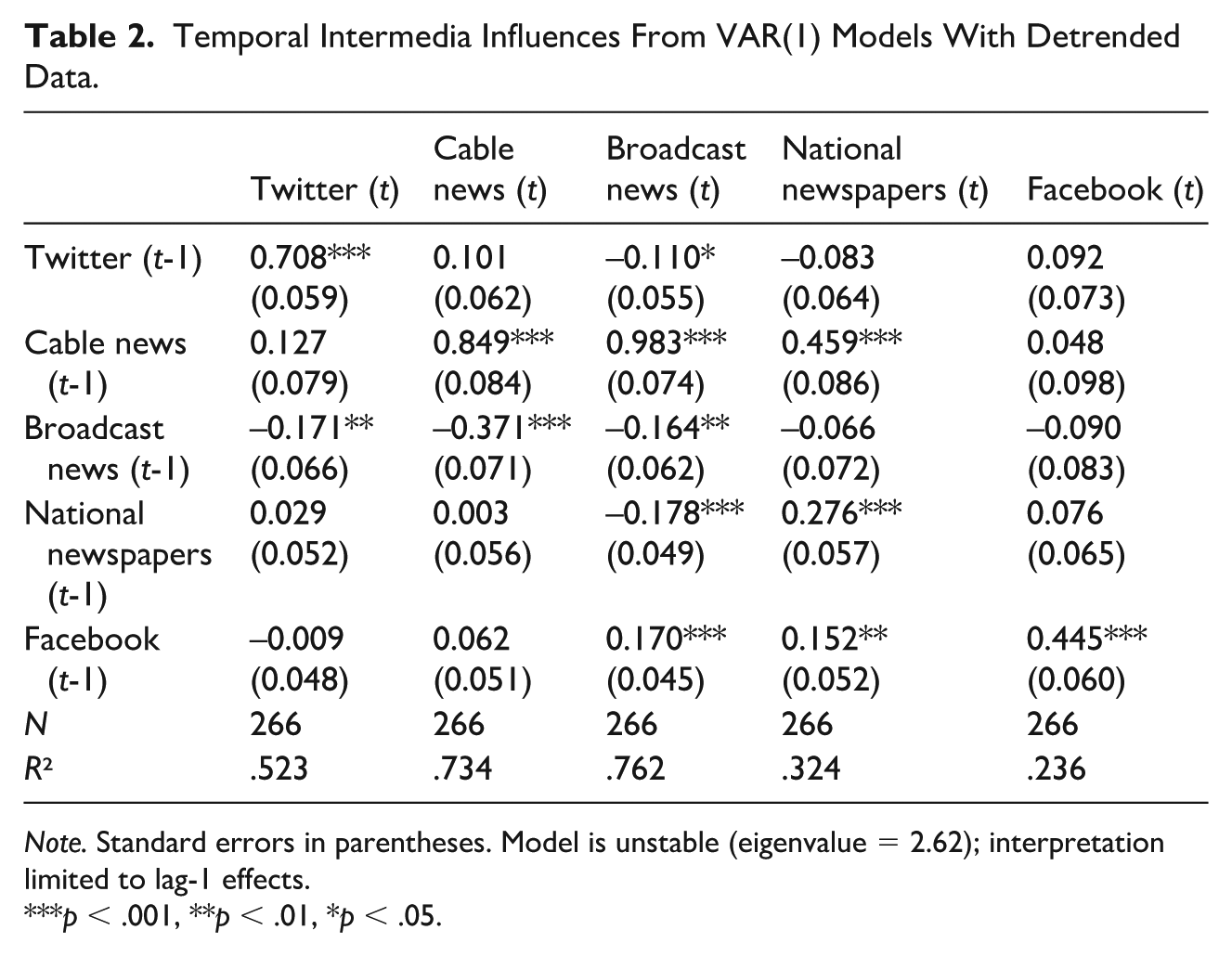
Note. Standard errors in parentheses. Model is unstable (eigenvalue = 2.62); interpretation limited to lag-1 effects.
p < .001, **p < .01, *p < .05.
RQ2 examined how the framing of HCQ varied across media platforms. As shown in Table 3, overall, the distribution of frames reveals both convergence and divergence across legacy and social media (Table 3). Legacy media, cable news, broadcast news, and national newspapers showed broadly similar framing patterns, with a balanced emphasis on Conflict and Public Risk frames. Cable news and broadcast news each featured substantial attention to both Conflict (27.7% and 28.5%) and Public Risk (27.8% and 23.8%), indicating a dual focus on political contention and the health implications of HCQ. National newspapers most frequently used the Public Risk frame (32.4%), underscoring a more science- and health-oriented orientation relative to television outlets. Facebook’s framing was more mixed across both scientific and political-social interpretive lenses. While Conflict was its most prevalent frame (28.8%), substantial emphasis on Breakthrough (17.4%) and Public Risk (12.3%) frames distinguished it from Twitter and aligned it more closely with the scientific and health orientation of legacy media. Twitter, on the other hand, differed from all other platforms, dominated by the Conflict frame (50.0%), while scientific interpretive frames were notably lower, with Public Risk (6.2%) and even Breakthrough (15.3%), reflecting the platform’s role in politicizing the HCQ debate and amplifying political and contentious discourse over scientific deliberation.
Distribution of Frames Across Media Platforms.
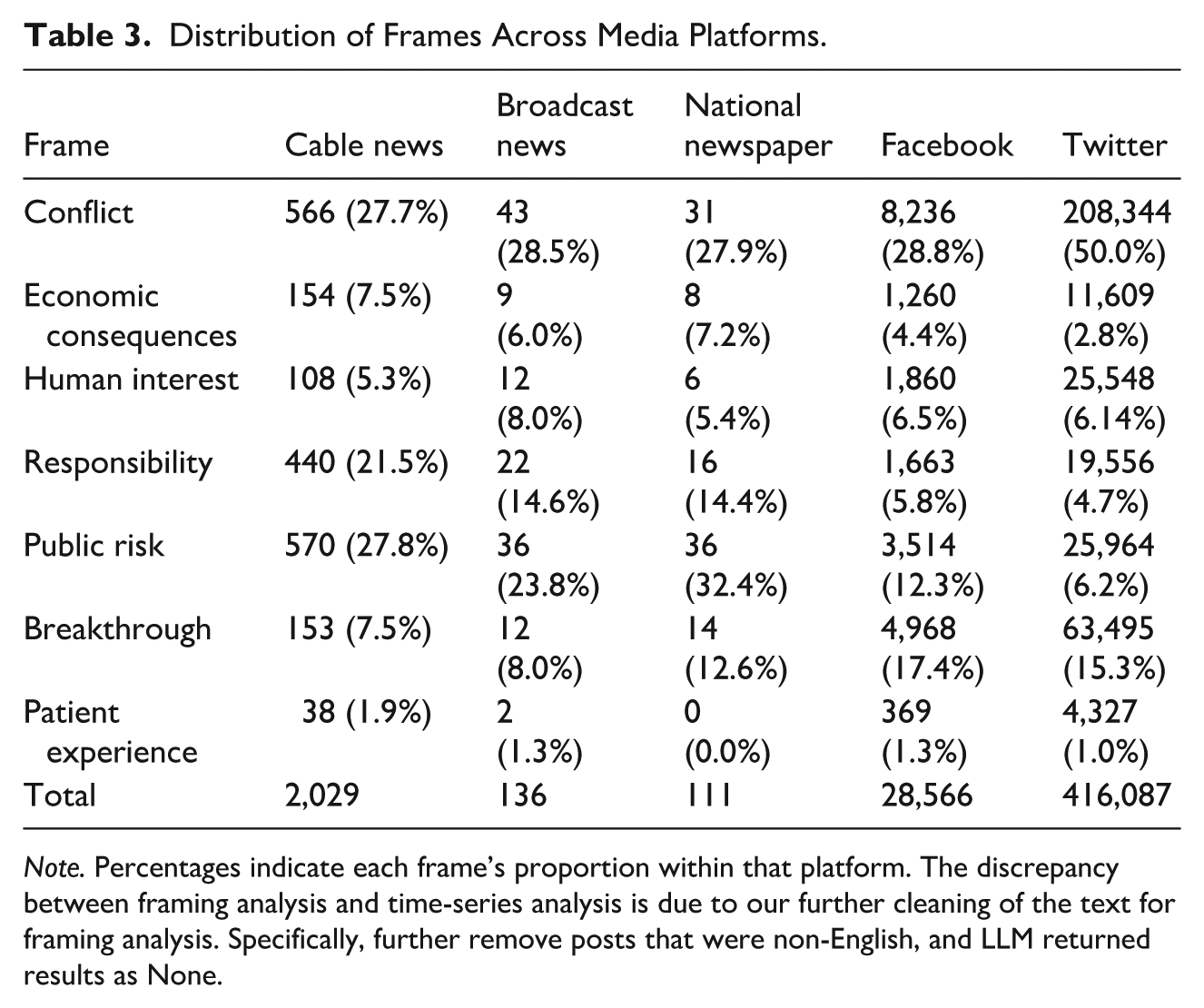
Note. Percentages indicate each frame’s proportion within that platform. The discrepancy between framing analysis and time-series analysis is due to our further cleaning of the text for framing analysis. Specifically, further remove posts that were non-English, and LLM returned results as None.
Discussion
This study extends intermedia agenda-setting theory within the hybrid media system beyond its traditional political focus by examining a scientific controversy, using the public debate over hydroxychloroquine (HCQ) during COVID-19 as an empirical case. By adopting a cross-media and cross-platform design and integrating time-series analysis with large language model-assisted framing analysis, the findings demonstrate that intermedia agenda-setting in the context of scientific controversy is neither unidirectional nor consistently reciprocal. Instead, agenda dynamics appear to follow a more platform-specific ecosystem, in which each platform exhibits its own patterns of attention and discourse. This suggests that, rather than operating through clear leader–follower relationships, agenda formation in scientific controversies is shaped by parallel responsiveness across platforms combined with divergent interpretive logics.
First, the findings complicate a straightforward application of intermedia agenda-setting theory to scientific controversies unfolding within a hybrid media system. Although attention to HCQ exhibited synchronized spikes across legacy and social media platforms, the time-series results do not support a robust pattern of cross-media agenda-setting in which attention in one domain (legacy or social media) systematically precedes and predicts attention in the other. Instead, the system appears to be characterized by punctuated, event-driven bursts that activate multiple platforms simultaneously, followed by platform-specific persistence patterns. This dynamic is consistent with the hybrid media system perspective, which emphasizes that contemporary agenda formation is shaped by interactions among legacy and digital media logics, but that influence is not necessarily reciprocal, stable, or evenly distributed across issues (Suk et al., 2025). In the context of scientific controversies, salient “system inputs,” such as elite cues, institutional statements, and highly visible scientific claims, may function as common triggers that compress cross-platform lags and reduce the observable role of platform-to-platform agenda transfer.
Within legacy media, the results indicate strong internal reinforcement, with cable news showing substantial persistence and predicting next-day increases in broadcast news and newspapers. This pattern aligns with scholarship arguing that legacy outlets can remain structurally central in hybrid systems, particularly for high-salience topics that invite conflict-based narrative production and rapid interpretive updates (Harder et al., 2017; Langer & Gruber, 2021). Yet the same evidence also suggests that this legacy media leadership does not translate into cross-domain agenda-setting vis-à-vis social media. Neither cable news nor other legacy outlets produced reliable next-day increases in Twitter or Facebook attention, and social media signals did not consistently precede legacy attention. In this sense, the case provides a boundary condition for intermedia agenda-setting: even when platforms are clearly co-attending to the same issue, the mechanism may be less agenda transfer than parallel responsiveness, where multiple arenas react to the same external events but follow distinct temporal rhythms afterward. This pattern may have been especially pronounced in the early COVID-19 context, when unusually high public attention, intensive news monitoring, and elevated social media engagement likely made multiple platforms simultaneously responsive to the same major developments (Budak et al., 2023). Future research should investigate whether this pattern generalizes to other scientific controversies, or whether the exceptional media environment of the early COVID-19 period intensified cross-platform convergence in ways that may not be replicable under more routine conditions. Comparative analyses across issue domains and time periods would help clarify the boundary conditions of intermedia agenda-setting in contexts of scientific uncertainty.
This pattern also suggests that, in the context of scientific controversies, even when they are highly politicized, actors within the hybrid media system may not follow each other’s agendas in the same way as they often do in electoral or partisan contexts (e.g., Conway-Silva et al., 2018; King et al., 2017). Instead, newspapers, cable news, and social media may attend to the same focal issue while emphasizing different frames and interpretive angles, shaped by their audience compositions, institutional roles, and platform norms. In other words, agenda convergence does not necessarily imply discourse convergence, and shared attention can coexist with divergent meaning-making processes across platforms.
This helps explain why descriptive trends show generally synchronized spikes in HCQ attention while lagged intermedia coefficients do not indicate robust cross-platform leadership. Much of the intermedia agenda-setting literature has been developed and tested in political domains, where strategic communication, campaign dynamics, and partisan issue entrepreneurship can generate clearer leader–follower relationships (Gilardi et al., 2022; Meraz, 2009). By contrast, scientific controversies often evolve through episodic credibility shocks and revisions, including new findings, counter-findings, retractions, and regulatory changes, which can reorganize attention across the system in near real time. Under such epistemic volatility, agenda dynamics may be better characterized as event-synchronized rather than platform-sequenced, reducing the extent to which lagged cross-platform influence is empirically detectable. This interpretation is consistent with prior research showing that uncertainty and changing evidence shape public trust, interpretation, and information seeking, thereby contributing to the volatility of mediated attention (Jensen & Hurley, 2012; van der Bles et al., 2019).
The pattern associated with broadcast news is also theoretically informative. Negative spillovers from broadcast news to cable news and Twitter suggest that broadcast coverage may function less as an engine of continuing amplification than as an institutionalized punctuation of the news day, after which attention contracts across other arenas. Such an interpretation resonates with classic work on news routines and the production of “newsworthiness” through professional cycles, formats, and narrative closure (Tuchman, 1973). In the hybrid media system, these routines can coexist with, and at times countervail, engagement-driven amplification logics on platforms, generating asymmetric temporal roles across media types rather than uniform intermedia influence (Chadwick, 2017).
The framing evidence further underscores why synchronized attention does not imply shared meaning, and why agenda-setting processes in scientific controversies should be evaluated alongside interpretive construction. Legacy media converged on a dual emphasis on conflict and public risk, with newspapers leaning more heavily toward risk-oriented framing, consistent with institutional incentives to foreground expertise, harms, and public implications in health-related coverage. Facebook’s profile resembled legacy media more than Twitter’s, with relatively greater emphasis on breakthrough and public risk. Twitter, by contrast, was dominated by conflict framing and exhibited minimal attention to public risk. This divergence is consistent with the claim that platform architectures shape not only what becomes visible but what kinds of interpretive packages are rewarded and recirculated (Entman, 1993; Napoli, 2019). In particular, algorithmic curation, engagement incentives, and platform governance can privilege contentious, identity-reinforcing, or polarizing narratives, even when the underlying issue is scientific (Gillespie, 2018). The result is a hybrid system in which platforms may synchronize around the same events but diverge sharply in interpretive emphasis, an outcome that is especially consequential for public understanding of science, where contested frames can amplify perceptions of inconsistency and fuel misinformation dynamics (Scheufele & Krause, 2019).
Taken together, these findings support a more qualified theoretical conclusion: in the case of scientific controversy, intermedia agenda-setting across legacy and social media is not strongly operative as a platform-to-platform diffusion process. The agenda did not clearly “travel” from one arena to another through predictable lagged influence. Rather, attention was jointly organized around shared external triggers, while persistence and interpretation varied by platform and media logic. This does not imply that a hybrid media system is irrelevant to scientific controversies; instead, it clarifies that hybridity may manifest through co-attention and divergent meaning-making rather than through stable intermedia agenda-setting pathways. For scholarship seeking to extend intermedia agenda-setting beyond political topics, these results suggest that scientific controversies may require models that explicitly incorporate institutional signal streams and epistemic authority structures as drivers of synchronized attention, alongside platform-specific amplification logics that shape framing after attention is activated.
This study has several limitations that should be acknowledged. First, the analysis focuses on short-horizon dynamics (lag-1), which is well suited to examining immediate spillover effects but cannot capture longer-lag influence or slower agenda-building processes. As a result, more gradual forms of cross-platform influence may be underestimated. Second, framing classifications rely on a single large language model. Given the rapid development and iteration of AI models, future research should compare results across different models to assess robustness and potential model-specific biases. Third, the study focuses on a limited set of major news outlets. While this allows for clearer cross-platform comparisons, it may not fully capture the diversity of media ecosystems, particularly across ideological orientations. Future research should incorporate a broader range of outlets across the political spectrum to examine whether agenda dynamics differ by partisan alignment or audience composition.
In conclusion, this study suggests that a scientific controversy in a hybrid media system can produce highly synchronized attention spikes without exhibiting strong intermedia agenda-setting between legacy and social media. The system appears to be organized by common triggers and platform-specific meaning-making rather than by consistent leader–follower diffusion across domains. This pattern both extends and constrains intermedia agenda-setting theory: it extends the agenda-setting conversation into scientific controversy while indicating that cross-platform agenda-setting may be weakest precisely when epistemic uncertainty is high and institutional signals reorganize attention across the system. In such cases, the hybrid media system may be best characterized not by intermedia agenda transfer, but by synchronized co-attention paired with divergent framing trajectories.
The findings also have practical implications for science communication. In hybrid media systems, synchronized attention to a scientific controversy does not guarantee shared interpretation across platforms. Communicators should therefore attend not only to the volume of attention an issue receives, but also to the platform-specific meanings attached to it. For journalists, practitioners, and scientists, this suggests the importance of platform-sensitive communication strategies that contextualize uncertainty, evolving evidence, and public health consequences as controversies unfold. More broadly, the results suggest that responding effectively to scientific controversies requires monitoring both cross-platform attention and cross-platform framing, rather than assuming that one message will circulate or resonate uniformly across media environments.
Supplemental Material
sj-docx-1-scx-10.1177_10755470261450584 – Supplemental material for Intermedia Agenda-Setting of a Scientific Controversy in the Hybrid Media System: A Cross-Media and Cross-Platform Analysis of Hydroxychloroquine During COVID-19
Supplemental material, sj-docx-1-scx-10.1177_10755470261450584 for Intermedia Agenda-Setting of a Scientific Controversy in the Hybrid Media System: A Cross-Media and Cross-Platform Analysis of Hydroxychloroquine During COVID-19 by Rui Wang, Dobin Yim and Elliot King in Science Communication
Footnotes
Ethical Considerations
Not applicable.
Author Contributions
Rui Wang contributed to the conceptualization of the study and led the writing and editing. Dobin Yim contributed to the conceptualization of the study and conducted the data analysis. He also contributed to the writing and editing. Elliot King contributed to the conceptualization of the study and the data collection. He also contributed to the writing and editing of the manuscript.
Funding
The authors received no financial support for the research, authorship, and/or publication of this article.
Declaration of Conflicting Interests
The authors declared no potential conflicts of interest with respect to the research, authorship, and/or publication of this article.
Data Availability Statement
The data that support the findings of this study are available from the corresponding author upon reasonable request.
Notes
Author Biographies
 ) is an assistant professor in the Department of Communication and Media at Loyola University Maryland. She studies communication technology, political communication, and social media. Combining computational methods and quantitative methods, her work focuses on the examination of politicization and polarization within online public discourses. She also examines the psychological factors of public perceptions toward the application of artificial intelligence (AI).
References
Supplementary Material
Please find the following supplemental material available below.
For Open Access articles published under a Creative Commons License, all supplemental material carries the same license as the article it is associated with.
For non-Open Access articles published, all supplemental material carries a non-exclusive license, and permission requests for re-use of supplemental material or any part of supplemental material shall be sent directly to the copyright owner as specified in the copyright notice associated with the article.
