



Abstract
The Glowing Divide (2015) is an interactive documentary exploring the topic of social isolation in young people. Created by a group of young adults at Knowle West Media Centre in Bristol, the project follows three teenagers with the aim to change perceptions of social isolation. This interactive documentary was used as a resource in a Critical Media Literacy intervention which deployed the methodology of Participatory Action Research and took place in Coventry in partnership with the creative production company Imagineer. Based on the outcomes of this research, I argue towards a Pedagogy of Difference 2.0, which is a new and more nuanced approach to teaching and learning with interactive media in complex environments. This innovative pedagogy embraces the limitations of interactivity on young people’s media production and does not take young people’s familiarity with technology for granted. In this regard, Pedagogy of Difference 2.0 acknowledges the contextual nature of teaching and learning, moving beyond the often abstract discourse of Critical Pedagogy.
Introduction
Digital interactive technology has infiltrated and transformed most aspects of everyday life, including education, entertainment, communication and healthcare. The rise of digital technology has been accompanied by claims related to the democratic promise of interactivity, which foreground the empowering potential it might hold for users. These assumptions range from providing interactive audiences with more power within ‘the new knowledge culture’ (Jenkins, 2006: 136) to creating a generation of ‘Digital Natives’ (Prensky, 2001) who process information in different ways due to the growth of the use of digital technology. The findings of this research interrogate such claims, by combining participatory interactive tools with participatory interactive pedagogies. The attempt to mobilise the supposed empowering potential of using interactive media in community-based programmes revealed the complexity of this confluence.
This article presents the findings of a Critical Media Literacy intervention designed as part of my doctoral research, which provides empirical evidence of the challenges of delivering the benefits of interactivity in a complex lived environment. Critical Media Literacy aims at providing young people with the skills for the interpretation of the various meanings of media texts, enabling them to have more critical responses to ‘socially constructed forms of communication’ (Kellner and Share, 2007: 5). This model has been significantly influenced by the educational legacy of Brazilian educator Paulo Freire (1921–1997). In his seminal book Pedagogy of the Oppressed (1996), originally published in 1968, Freire advocated his ‘problem-posing’ educational strategy aiming at raising people’s ‘critical consciousness’. He defined the concept of ‘critical consciousness’ as ‘learning to perceive social, political and economic contradictions and to take action against the oppressive elements of reality’ (1996: 17).
My doctoral research aligns with what Andrejevic (2009) framed as Critical Media Studies 2.0, offering a critique of the theoretical discourse of Critical Pedagogy, namely promoting student voice and empowerment. Andrejevic questioned the impact of interactivity on power relations (2009: 36) and highlighted the necessity of developing new critical practices responding to the changing media landscape. Critical Media Studies 2.0 1 explore approaches that are relevant to the contemporary media environment, by questioning the assumption ‘that because media have transformed, social relations have too’ (2009: 36). Additionally, concepts such as Jenkins’s Participatory Culture have been questioned on the basis of failing to address issues of exploitation in discussing the creativity and activity of Internet users, which conceal the commodification of the users’ activities (Fuchs, 2011: para. 5). Fuchs calls for a more direct connection of participation with the political notion of participatory democracy theory including ownership of platforms, collective decision-making, profit and class (2011: para. 10).
In a similar vein, this article calls for the need to contextualise a Pedagogy of Difference 2.0, in relation to the framework of Critical Media Studies 2.0. Pedagogy of Difference 2.0 is a new approach to teaching and learning with interactive media and emerged from the findings of a Participatory Action Research (PAR) project engaging young people in Bristol and Coventry. The research question explored in this article concerns the extent to which this intervention reconfigures a Pedagogy of Difference, a concept often found in Critical Pedagogy 2 discourse. I was inspired by the conceptualisation of a Pedagogy of Difference in Post-structural feminist discourses which promote the rejection of the ‘universal subject’. The epistemology of Post-structural feminism is based on a radical concept of difference as constitutive of all identity positions and which acknowledges the contextual character of knowledge. Carmen Luke (1994: 38) defines a Pedagogy of Difference as including ‘teaching for and about difference not only in terms of gender and sexual identity, but intersecting differences of class, ability and able-bodiedness, race, ethnic, religious and national identity’ (italics in original). This pedagogy encourages students to critically analyse discourses in order to ‘interrogate the socio-cultural and historical contingencies of difference, exclusion and marginalisation’ (Luke, 1994: 44).
A Pedagogy of Difference 2.0 is based on empirical evidence suggesting that young people engaged with interactive media in various ways and that this engagement placed high demands on them. Some of the results of this project could be perceived as indications of student silence instead of student voice, even though this intervention was designed with the aim to enable young learners to find their voice.
Background of the project
This research offers a critique of the concept of ‘student voice’, which is often discussed in Critical Pedagogy literature in terms of its links to education as a dialogical process. My research was initially influenced by discourses 3 which foreground the ‘voice’ of young people and had a significant impact on the design of the fieldwork and its aim to help participants with articulating their concerns. In practice, realising this aim was challenging as I will outline in the following sections. One of the PAR cycles was incomplete (only one participant finished their documentary in the Imagineer cycle) and I did not manage to collect the data from all participants as I initially planned. Some participants withdrew from the project, whereas others were possibly discouraged by the technical problems that came up. A Pedagogy of Difference 2.0 acknowledges those indications of student silence and aims at finding ways to meaningfully engage young people in critical dialogue, in line with Post-structuralist feminism critiques of ‘student voice’. 4
A qualitative multi-method approach was adopted for approaching this article’s research question, which focuses on the reconfiguration of Pedagogy of Difference in the context of the contemporary media landscape. The methodology of PAR was used for data collection and provided the practical means guiding a series of Interactive Documentary 5 workshops, which served as cycles of action and reflection. Action Research seemed to be a suitable methodological approach that would be in harmony with the initial emancipatory character of the interventions, as this research was theoretically anchored in the liberatory pedagogy championed by Paulo Freire. The most recent generation of Action Research emerged in the connection between critical emancipatory Action Research and PAR that had developed in the context of social movements in the developing world, linking to the work of Freire. PAR promotes shared ownership of research projects, community-based analysis of social problems and is oriented towards community action (Kemmis and McTaggart, 2005: 560).
In terms of this research, the first cycle of PAR with young adults was endorsed by Knowle West Media Centre (KWMC) in Bristol. 6 KWMC is an arts organisation and charity and has been using digital media to engage with communities since 1996. A second cycle of PAR with young adults took place in conjunction with Imagineer, which is a creative production company in Coventry. In 2015, Imagineer launched a co-creation/performance programme for young people aged 18–25 who were not in employment, education or training, aiming to develop their confidence. The Interactive Documentary workshops for this research ran in parallel with this programme and participants comprised unemployed young people, young mothers and young people with learning difficulties.
Participants 7 were chosen on the basis of Critical Media Literacy discourse, which claims to empower people who are ‘marginalised or misrepresented’ (Kellner and Share, 2007: 9). I was interested in investigating the different articulations of ‘oppression’, as stemming from young people’s alternative media production, therefore Critical Media Literacy provided a pertinent framework for this intervention.
While the young people who took part in this study did not experience the specific forms of ‘oppression’ that Freire analysed in his writings, such as the consequences of colonisation and illiteracy, their socio-economic status was in line with the aims of such interventions. Participants’ backgrounds are illuminated through the organisations which recruited the young people who participated in the workshops, KWMC and Imagineer. Furthermore, one of the initial purposes of my doctoral research was to ‘emancipate’ participants following a liberatory pedagogy inspired by Freire, which I problematised while doing fieldwork due to the challenges that emerged from the implementation of interactive documentary in a democratising pedagogy.
The following section illuminates some of the aspects of Critical Pedagogy which shaped the design of this intervention.
Critical Pedagogy and links to media literacy
The theoretical discourse of Critical Pedagogy places emphasis on the ‘voice’ of learners and is exemplified in Critical Media Literacy research literature, which started growing during the 1980s and 1990s (Alvermann and Hagood, 2000: 194). Critical Media Literacy can be defined in many ways, depending on the perspective or theoretical frame. I was influenced by Kellner and Share (2005: 371), who see Critical Media Literacy as valuing student’s voice for deconstructing and making media and offering tools for marginalised people to express their concerns. Critical Media Literacy is also seen as providing learners with power over their culture and encouraging them to create their own meanings and to transform the material and social conditions of their culture.
This discourse had a significant impact on the design of my fieldwork, as I was initially aiming to encourage participants to articulate their concerns regarding oppressive situations they were potentially experiencing. I had decided to reach young people from disadvantaged communities in an informal context which was often voluntaristic. This proved to be more complex than I had anticipated and it was difficult to maintain participants’ engagement, as some of them struggled to commit to the project.
Within this discourse, I am particularly interested in the concept of Pedagogy of Difference. Kathleen Weiler (1994) elaborates on feminist Pedagogy of Difference, suggesting that a feminist pedagogy acknowledges and validates difference and as such provides a more complex realisation of Paulo Freire’s vision of fighting against oppression, although both pedagogies encourage social transformation and see human beings as subjects. Bill Green (1998) further discusses difference as an essential resource for learning and teaching. He presents the work of what he called the ‘London’ tradition (namely the work of J Levine and D Buckingham), which provides accounts of practices, institutions and discourses of mainstream schooling. In this tradition, learning is discussed in terms of the production and engagement of difference and teaching is seen as contextual rather than causative with regards to learning (1998: 179). Finally, Alexander (2018) sees Pedagogy of Difference as a new concept of criticism for education in open and democratic societies which relies on a dialogical process. This pedagogy works on two levels, encouraging a sense of the self through primary identity and engaging with alternative perspectives.
In the case of this intervention, the power imbalance between researcher and researched could not be eradicated and came to be something I saw as inscribed in the relations of difference within these contexts, as participants were conscious of our respective roles within the research context. The unevenness of power between researcher and researched could be located in the levels of education and expertise in the field of Interactive Documentary. Having completed postgraduate studies in documentary film and conducting this research at doctoral level, I had an advanced knowledge of Interactive Documentary and my initial aim was to raise participants’ ‘critical consciousness’ and understanding of this field through a learning process involving the creation of interactive documentaries. Participants in this research had minimal (or no) prior knowledge of Interactive Documentary before the workshops, which immediately initiated an asymmetry of power. This premise challenged one of the assumptions of Critical Media Literacy with regards to promoting empowerment as a major aspect of transformative education, through a democratic pedagogy which involves teachers sharing power with students (Kellner and Share, 2005).
Interactive documentary appeared to be the ideal platform for addressing the purposes of this Critical Media Literacy intervention, such as foregrounding a democratic pedagogy, due to its potential to create ‘spaces in which individuals can speak for themselves’ (Nash, 2014: 51).
Interactive Documentary and educational research
Interactive Documentary is an evolving field, the educational potential of which is under-researched. I followed Aston and Gaudenzi’s definition of interactive documentary as ‘any project that starts with an intention to document the “real” and that uses digital interactive technology to realise this intention’ (2012: 125). Participants were asked to document ‘real’ situations of social isolation, reflecting on their own experiences. The digital interactive technology that was selected for the creation of The Glowing Divide was a combination of HTML and CSS 8 languages to build an interactive website with the RGBD toolkit. The toolkit is an open-source platform for volumetric film-making, which uses a depth sensor attached to a DSLR camera.
There is lack of empirical research regarding the pedagogical potential of interactive documentary and its use in complex/informal educational environments. The work of the Spanish researcher Arnau Gifreu suggests some possibilities offered by interactive fiction and non-fiction as pedagogic tools and teaching materials. Interactive documentary has been theorised as a new learning system, promoting the student’s deeper immersion in the subject (Gifreu, 2012: 4990). Some of the advantages of digital learning systems are considered to be the creation of networks of learning, the encouragement of collaboration between learners and the facilitation of publication (Gifreu, 2012: 4988). In addition, Gifreu analysed interactive documentaries as means that increase student motivation and offer experiences that combine entertainment with education (2012: 4994), providing new ways of gaining and connecting knowledge (Gifreu and Moreno, 2014).
The results of this intervention suggest that some of the above-mentioned educational benefits of interactive documentary, such as freedom of dissemination and immediacy in the communication process, could not be delivered in an informal Critical Pedagogy context, although Interactive Documentary theoretically aligns with the principles of Critical Media Literacy. An informal pedagogic context was chosen for this study, due to the lack of empirical evidence concerning the efficacy of interactive documentary outside formal settings (Gifreu’s, 2012 study focuses on students in Higher Education). Informal contexts tend to be less structured than formal ones, thus adding to the complexity of designing and delivering pedagogical interventions. The withdrawal of the interactive storytelling tool that I was planning to use in the Imagineer workshops, Mozilla’s Popcorn Maker, and limited resources, such as laptops, hindered the processes of creativity and communication, as I will illustrate in the ‘Findings’ section. Before expanding on the challenges of this intervention, I will outline the methodological approach I took.
Methods
A qualitative research approach was deployed, due to its interpretive nature and its grounding in the lived experiences of people (Marshall and Rossman, 2011: 2). I used Visual Research Methods within PAR for data collection, including Participatory Video 9 and Video Elicitation interviews. The method of Discourse Analysis was deemed suitable for analysing the data as a means to explore the discursive construction of participants’ experiences. Data were collected in the form of the documentaries created by the participants, the interviews with the participants and my own research diary. I transcribed the interviews and the audio of the documentaries in order to use these transcripts as data. I analysed the data using Gill’s (2000) Discourse Analysis framework and followed the steps she suggests, thus adopting a broad Discourse Analysis approach.
Data collection
Although Visual Research Methods are often linked to Action Research, this research is innovative in terms of introducing interactive documentaries as data in youth research, in contrast with verbal or written methods that are mostly used in this kind of research. Following the tradition of PAR, this research was designed to promote the co-creation of meanings, a process which turned out to be challenging. The methodology of PAR seemed to be in harmony with the initial emancipatory character of the interventions due to its links to the liberatory pedagogy championed by Paulo Freire. 10 The key features of PAR are planning a change, acting and observing the process of the change, reflecting on these processes, replanning, acting and observing again, similarly to the self-reflective spiral that Kemmis (1988: 178) outlines with regards to Action Research. 11
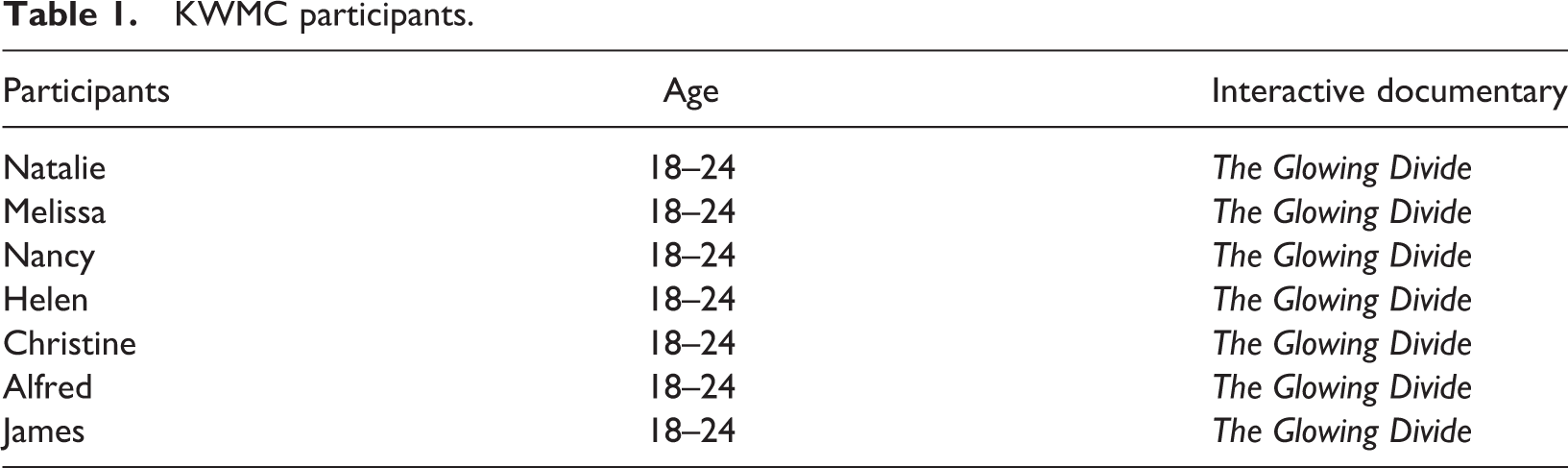
In terms of this research, each series of Interactive Documentary workshops corresponded to a cycle of PAR. The groups of participants can be seen in Tables 1 and 2. I only conducted two workshops with KWMC participants and met them again for the interview session. This was due to the fact that my workshops were incorporated in an already existing KWMC training project which was already structured when I contacted the centre. KWMC recruited eight young adults on this interactive video and data project, in order to explore young people’s dependence on technology and its links to social isolation.
KWMC participants.
Imagineer participants.
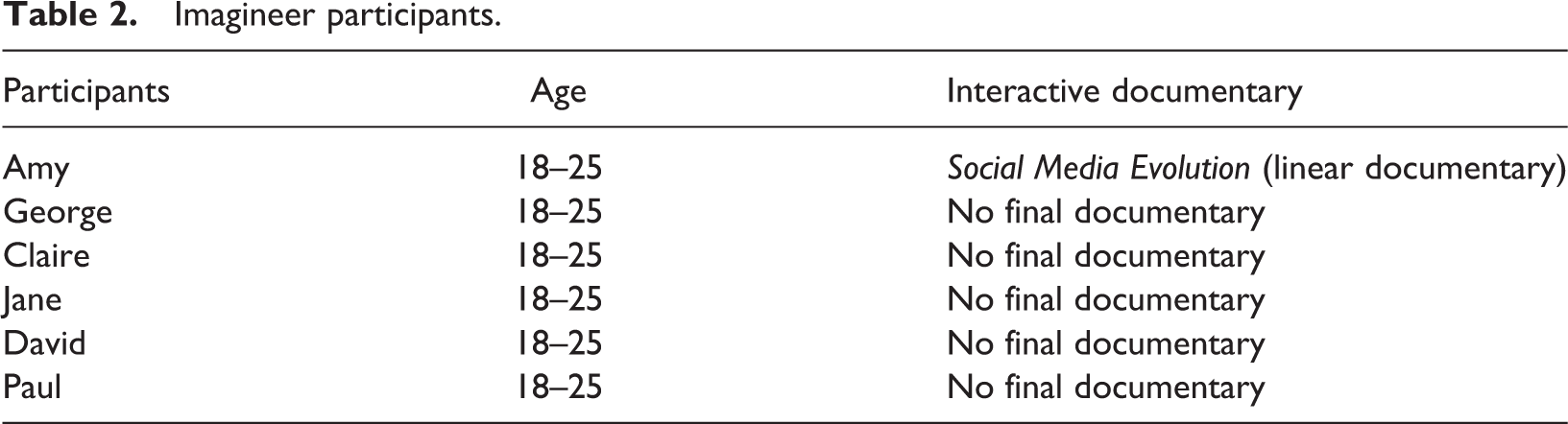
The second cycle of PAR with young adults was delivered in parallel with Imagineer’s co-creation performance programme for young people who were not in employment, education or training. Six of the young adults who were recruited to participate in the Imagineer performance started attending the workshops. The group comprised young mothers, unemployed and young people with learning difficulties, who were invited to create interactive documentaries on the topic of social isolation that emerged from the KWMC cycle. Five of six participants did not complete the cycle, as they had other commitments. The participant who completed the cycle, Amy, could not take part in the final interview as she started a new job shortly after completing her linear documentary entitled Social Media Evolution.
The first cycle of PAR was based on the spiral of planning, acting, observing and reflecting. Replanning, acting and observing again happened in the second cycle. I was responsible for the stage of planning, as I designed the lesson plans and teaching materials for the weekly workshops. All the lesson plans can be found on the blog which I created for the workshops 12 (https://expandingopenpedagogies.wordpress.com). The two workshops which I conducted at KWMC focused on exploring fiction and truth in documentary film since its inception and introduced participants into interactive documentary. This structure was deemed useful as the use of interactivity has further complicated the relationship between fiction and truth in documentary film. Interactivity has provided users with the ability to change and/or shape the content of a documentary, thus raising new questions about the ‘objective’ representation of reality and facts (Favero, 2013: 262).
The Imagineer cycle was longer (7 weeks), therefore the sessions had a different structure. The first session aimed at introducing myself and the project and getting to know participants. The second session expanded on exploring participants’ understanding of documentary film and the third focused on developing ideas for participants’ interactive films. The following sessions revolved around editing, starting with an editing tutorial and allowing time for participants to add interactive elements to their documentaries. The final sessions could not be delivered as planned due to the withdrawal of the majority of participants as mentioned above. I will elaborate on the implications of this development in the ‘Discussion’ section.
Video Elicitation was used as a method to ‘provide a basis for reflection’ (Roth, 2009 cited in Jewitt, 2012: 3) as I asked participants to watch their films and express their feelings and thoughts about them. This process turned out to be challenging for participants, because they were asked to step out of their role as makers and position themselves as viewers of their documentaries. However, the Video Elicitation interview enabled the young people to ‘step back from immediate experience’ (Buckingham, 2010: 299), so that they could analyse their own media production. This allowed them to express an analytical awareness from a maker’s perspective, which would have otherwise not been possible.
Data analysis
In this research, I used a PAR approach to think about the generation of objects (artefacts, field notes, interviews), which I then analysed using Discourse Analysis. 13 The three forms of data collected during fieldwork (participants’ documentaries, interviews with participants and researcher’s field notes) are treated as discourses. The documentaries and the interviews of participants are considered to be discourses in the sense that they represent participants’ ‘systems of thoughts’ (Lessa, 2006: para. 5), regarding aspects of their lives and how these construct their identities. The documentaries are treated as media texts, following McKee’s (2003: 4) argument that ‘a text is something that we make meaning from’. Finally, the field notes are discourses conveying my ‘systems of thoughts’ and their impact on shaping my role and position as researcher.
In the analysis stage, I transcribed the interviews which I recorded with participants and I looked at my field notes. I also transcribed the audio part of participants’ films. I first looked for themes in the transcripts and then interpreted the meanings emerging from the data. As it was not possible to address everything that participants mentioned in their interviews or included in their interactive documentaries, I made choices in response to the themes identified as important to the research question of this article, which concerns the extent to which this intervention contributes to reconfiguring a Pedagogy of Difference thus enhancing research in the area of interactive media as a tool for developing media literacy.
Ethics
This research setting posed specific ethical challenges as it sits at the intersection of youth research and arts-based research. In terms of arts-related research, trustworthiness is linked to the researcher’s pursuit of gaining trust, instead of establishing ‘truth’, and plausibility to establishing quality across the research (Savin-Baden and Wimpenny, 2014: 89). Plausibility in this research is grounded in interpreting the data, in line with the chosen methods of data collection and analysis which form my researcher’s stance towards the evidence. The results of my analysis were critically discussed with my supervisory team, which addressed trustworthiness. For future research involving participatory practices, it is intended that the analysis will be shared with participants, as an approach to further enhance trustworthiness and allow participants to provide feedback on the findings. In the context of this project, it was not possible for participants to have control to remove any of the content/film/data interpretation, however potential risks are minimised due to the fact that their anonymity is preserved. Keeping in touch with the majority of the participants proved to be difficult and I lost contact with them after the end of the workshops, further attesting to the challenges of delivering such interventions. There were no other incentives for participants, apart from their involvement in a series of documentary workshops and gaining media skills linked to the creation of interactive films.
Findings
This section presents the findings that resulted from a participatory process of meaning making with participants and from my subsequent interpretation of the data. I was influenced by Gill’s approach to discourse analysis, according to which ‘a discourse analysis is an interpretation, warranted by detailed argument and attention to the material being studied’ (Gill, 2000: 188). The process of interrogating my own assumptions turned out to be complex, as my views on discourses and emancipatory education changed throughout conducting fieldwork and analysing the data. The critical reflective practice of (re)writing enabled me to reflect these changes as part of interpreting the data. More specifically, this section contains extracts from interviews with participants which I transcribed and then interpreted in light of my research question, exploring the extent to which this intervention reconfigures a Pedagogy of Difference. Reiterating the epistemological underpinnings of this research, according to which knowledge is ‘provisional, open-ended and relational’ (Luke and Gore, 1992: 7), it is important to recognise that other ways of interpretation are possible and that my methodological and analytical position provided me with particular perspectives of the data.
Engaging with interactive technology
The outcomes of this intervention suggest that interactive media place high demands on participants which can result into pushing them out of their comfort zones. As such, this research provides insights into young people’s relationship with Interactive Documentary which differs from the representation of that engagement in literature celebrating Prensky’s (2001) concept of ‘Digital Natives’, thereby critiquing claims regarding young people’s affiliation with technology. Literature arguing in favour of ‘Digital Natives’ disregards some of the under-researched consequences deriving from young people’s dependence on technology, which were explored during this intervention.
The interactive documentary The Glowing Divide portrays three teenagers who are socially isolated, Charlie, Ella and Kyle, aiming to explore the links between technology and social isolation. Viewers can navigate through the documentary by choosing different options. The data that the KWMC participants collected from young people in local schools and colleges for the purposes of The Glowing Divide showed that there was an increasing reliance on technology, as the majority of the young people stated that they would prefer to contact their friends online than going out. Nancy from KWMC followed up on this: Ella (…) said she finds it scary if the Internet did not exist, maybe it would push you to go outside because there was no alternative, if you can’t turn off your computer and you’re still managing to talk to people you think you’re not missing out much. (Nancy, Video Elicitation interview)
In addition, participants at KWMC faced some technical constraints while making The Glowing Divide. The RGBD toolkit was used to create a 3D effect in some of the shots through the use of a depth sensor which was attached to a DSLR camera. Natalie, one of the participants at KWMC, commented on the problems they experienced with using the RGBD toolkit software to manipulate images: We tried to film every scene as well as on a normal camera but sometimes it wasn’t practical, but we did try to use the footage wherever we could. The editing software for that was kind of in Beta mode so it would keep crashing a lot, we tried installing it in different places and it was a bit of a nightmare so I think we would have used more footage of that (…), if we could work the software better, which just had to do with what we could manage without crashing. (Natalie, follow-up interview)
Participants in the Imagineer cycle had no prior experience of filming and the majority of them were involved in acting/performing in front of the camera. The only exception was Amy who attended media classes at school and used cameras and editing tools for her final year project at college, where she studied Dance. Amy was the only participant in the Imagineer cycle who completed a documentary, although she said that she felt being ‘rubbish with technology’. She was hesitant when I suggested recording her interview via Skype, as she said that she did not know how to use it. The editing sessions took place at Coventry University where we had access to computers, due to lack of resources that Imagineer could provide. Amy found Apple computers ‘confusing to use’, so for the process of editing, I used the editing tool and Amy selected the materials and decided on the structure of the documentary. This has implications on the potential of Critical Media Literacy interventions to foreground issues of empowerment and voice, which I will pick up in the ‘Discussion’ section.
Amy’s documentary is not interactive. It starts with the title Social Media Evolution on black background and Amy’s voice-over narration: ‘I’ve recently watched a few documentaries on the effects of social media on this day and age, showing how the youth of today can be led into feeling isolated, depressed and lonely’. Amy here refers to watching The Glowing Divide, which was used as a resource for the Imagineer workshops. Amy’s voice-over accompanies a series of still images throughout the film, as she goes on to talk about using social media when she was younger, in contrast with how they are used today.
Despite the fact that Amy could be presumed to be one of Prensky’s Digital Natives (2001), as she was in her early 20s when she took part in this research, she demonstrated a different perception of social media and the use of technology, suggesting that not all young people interact with the Internet in the same way. Amy sees social media as being threatening to human relationships and potentially harmful, which she finds intimidating. Towards the end of the documentary, she shares her feelings about the future of social media: ‘If this is how social media is now, (…) then I don’t want to think about the future with it, it’s a scary thought. Social media has definitely taken over quicker than you think’. The final session, which would focus on adding the interactive elements to the documentary and recording the final interview, was cancelled, as Amy started a new job and despite numerous efforts I was unable to interview her, thus limiting evidence for this cycle to my field notes and her final film.
Amy’s views align with a developing body of literature critiquing Prensky’s theory (Bennett et al., 2008; Kennedy et al., 2008; Koutropoulos, 2011, White, n.d.). For example, Jenkins (2007) argues that the term ‘Digital Natives’ fails to acknowledge the different levels of young people’s access and familiarity with emerging technologies. He points out that the emphasis on the divide between the generations could reinforce views against the restructuring of education to create spaces where adults and young people can learn from each other. Jenkins contends that we need new metaphors to address the changing educational requirements of today’s youth, which resonates with the underpinnings of this research.
Overall, these findings paint a complex picture of young people’s engagement with technology. Some young people in this research felt confused and unconfident with using technology. The different levels of confidence that young people demonstrated links to how their use of technology is normalised within their usual social context. While some of them used technology for recording or for just sharing their views, purposefully creating a meaningful text seemed to be outside their experience. Those new demands placed on young people need to be acknowledged in designing new pedagogies involving interactive media to reduce anxiety and create more space for creativity.
The pursuit of participation
The second PAR cycle at Imagineer generated evidence regarding the complexity of pursuing engagement, as it remained incomplete and did not produce the outcomes which I expected. This led me to problematise the methodological underpinnings of this research, which were initially selected to enable a participatory process of developing dialogue between the researcher and the researched.
The Imagineer cycle illuminates some of the challenges of maintaining engagement. I gained access to the Imagineer group of participants through a Coventry-based charity, which put me in touch with the team behind Imagineer. Participants had responded to an invitation from Imagineer to get involved in a performance project, which concerned young people (18–24), who were not in education, employment or training. This had implications in terms of their commitment to my research project. The tone was set from the first session, when Amy said that she did not have the time to watch films, as she had a little boy. Also, the Imagineer participants were simultaneously taking part in rehearsals for the performance, so I had to make sure that the workshops did not clash with these rehearsals. I also had to use the Daimler factory in Coventry for the Interactive Documentary workshops, as this was the space where the rehearsals took place. This obstructed the smooth running of the workshops, because the space was also used by several people who were involved in various tasks in preparation for the performance.
Overall, Imagineer participants experienced difficulties in keeping pace with the project. David was unemployed at the time he joined the workshops but started an apprenticeship shortly after, so he was unable to continue. The workshops failed to engage the two participants with learning difficulties, George and Paul, who were also part of the team.
Claire’s case illustrates the complexity of engaging young people in community-based participatory initiatives and uncovers the scope of challenges which might emerge throughout such processes. Claire decided to withdraw before the editing sessions and sent me an email explaining that she did not feel comfortable with working on her interactive project, as she felt very stressed. At first, Claire had the idea to make an interactive documentary about her own experiences of social isolation. She eventually found this process to be stressful and was struggling with expressing her ideas, as she did not know where to start. During the workshops, I tried to support Claire with the ideation process, by suggesting ways to develop her story, but unfortunately my efforts to support her were not fruitful.
I was cautious not to put more pressure on her so I replied to her email reiterating that her participation in the project was voluntary and that she had the right to withdraw at any time (she provided permission to use the data I had already collected during the first sessions). In my role as researcher and facilitator of the workshops, I tried as much as I could to support participants, but I was not able to manage anxieties such as the ones that Claire expressed. Such challenges need to be highlighted in reimagining pedagogies, as the discourses of Digital Natives and Critical Media Literacy have failed to address that young people might be in situations confronting them with multiple conflicts.
Overall, the outcome of this research suggests that eradicating the power imbalance between researcher and participants was not entirely possible. In one of the Imagineer editing sessions, Amy said that she was nervous about recording the voice-over, as she was thinking about the outcome of the research project: ‘it’s me but I needed to sound good because you want it to sound effective, like to mean something to someone who wants to listen to it’. Amy’s anxiety to ‘sound effective’ was linked to her awareness of participating in this research and her wish not to disappoint me, in terms of how she would share her experience. I emphasised that her narration was powerful, as it was a genuine testimony of a young person talking about experiencing social media, and that she did not have to change anything. Amy was also hesitant about scripting and narrating the voice-over for her documentary, as she thought she was not very good at writing. We rehearsed the voice-over several times before recording it and in the end, she was pleased with the outcome and became more confident, attesting to the transformative potential of the workshops.
These instances reveal the complexity of realising the mission of Critical Media Literacy in terms of ensuring participation. A reconfigured Pedagogy of Difference needs to be sensitive to the different experiences of participants and to encourage informal learning which can be engaged with, in order to address the empowering potential of Critical Pedagogy.
The design of new approaches to pedagogy should be premised on the idea of providing learners with teaching and learning experiences which help alleviate the anxiety that can be caused by new technologies. This project required specific technical skills from a group of inexperienced makers and asked them to provide additional time which they could not afford, thus creating a sense of anxiety. As discussed in previous sections, Natalie expressed her unease with handling interactive technology ‘because (interactivity) drives you insane’. Claire experienced anxiety in the process of developing her interactive documentary and decided to withdraw from the project. The new pedagogies should also acknowledge the diverse backgrounds and lived experiences of young people, in line with Orner’s (1992) critique of ‘student voice’. This research project, more specifically, pointed to instances of ‘student silence’ as some of the participants did not manage to create their own interactive documentaries, others withdrew from the project and expressed anxiety and frustration, and some participants were more empowered than others.
Finally, it is important to enhance the self-confidence of young people. In the context of Pedagogy of Difference 2.0, this is accomplished by placing emphasis on the relationships that developed among participants. The participants became more appreciative of their peers, through the process of making their documentaries and interviewing each other, and also strengthened bonds with each other. These new friendships empowered participants in terms of becoming more self-aware. Also, teamwork had a positive impact on the relationships among participants, as for some people the process of making collective decisions was new.
Apart from the above-mentioned challenges, this research resulted in some positive aspects too, which aligned with the focus of Critical Media Literacy on analysing the constructed nature of media and on raising participants’ awareness.
Raising awareness
Raising consciousness/awareness is a concept often found in Critical Pedagogy discourse, which came up in my interviews with participants. Participants at KWMC referred to raising awareness as one of the reasons why they decided to make a film on the topic of social isolation. The young makers felt that the project could help teenagers to understand what social isolation is about and to get more people interested in it, such as parents and organisations. They also pointed to the suitability of documentaries for disseminating information: It gets a message across in a way that people are comfortable with, maybe not with interactivity, but the sense of a documentary they have chosen to watch, it comes across in a way which is not abnormal. (Melissa, Video Elicitation interview)
Natalie mentioned the ‘5daydisconnect’ challenge as one of the benefits of interactivity in their documentary, which was designed as a means to further raise awareness, although it did not turn out to be effective in engaging audiences. This video invited viewers to participate in one of the challenges that the teenagers had to do as part of the project, asking them to disconnect from social media for 5 days. The challenge proved to be ineffective in terms of audience engagement. In an online search that I conducted on Twitter using the relevant hashtag (#5daydisconnect), there was no evidence of audience members undertaking the challenge. Similarly, on the KWMC YouTube channel, there are only two videos in the #5daydisconnect playlist, which were both created by Charlie, one of the teenagers portrayed in The Glowing Divide.
The project enhanced participants’ understanding of social isolation and helped them to comprehend this phenomenon more fully. Natalie explained that this was a complicated issue to tackle, due to the fact that it is not easily diagnosed: ‘people who are socially isolated are probably the last ones to admit, there is a difference between this and loneliness, it goes deeper than that’. Natalie’s comment demonstrates her enhanced insights into social isolation, which emerged from her engagement with The Glowing Divide. Alfred was one of the participants who had a better understanding of the challenges that socially isolated young people face before working on the project, as he could empathise with them. Participants became more aware of the link between social anxiety and social isolation and realised that the issue could influence young people.
Overall, participants acknowledged that The Glowing Divide project was a positive and transformative experience for them. Natalie and Nancy felt the need to act in a way that would benefit the teenagers involved in the documentary. Helen reflected more on her own relationship with social media and learned new skills while working on this community engagement project. Christine thought that the project improved her confidence and Natalie found the project to be empowering for both documentary makers and participants. She highlighted that she was very pleased with the positive effects of the project on the portrayed teenagers: ‘probably the nicest part of the whole documentary is that it made an impact on them, seeing their change is the best thing’. In our follow-up interview, I asked Natalie about the most important thing that she took away from the project: I’d say confidence myself (…) I’ve done some filming things before but I’ve never directed anything and I had no intention of directing it, (…), I’ve obviously gone on to direct other things since, just confidence and new knowledge about social isolation, new friends and it was a good insight for me because I only moved to Bristol last year so it was a good way of seeing a part of Bristol that you would not necessarily see. (Natalie, follow-up interview)
Finally, some of the findings of this research point to the positive effects of the workshops on young people’s understanding of documentary and the constructed nature of media messages. Participants at Imagineer demonstrated many of the characteristics common to conventional understanding, such as simply associating documentaries with reality. Jane had difficulties with understanding the representation of real events in documentaries and she asked if one could make a documentary about something that is not real. Jane further commented: ‘I don’t get how it’s a documentary if it’s not real. I get it for a film, but I don’t get it why you are trying to tell people information about something that is not real’. This initial confusion was later replaced by a more critical understanding of documentary. In a subsequent session, she realised: ‘I’m never going to believe a documentary again! Is that the point?’ This analytical awareness could have been further cultivated if Jane had got involved in editing her own documentary, which did not happen in the end as she withdrew from the project.
Discussion
Based on the above-mentioned findings, I argue for the development of a Pedagogy of Difference 2.0, which reflects the complexity of teaching and learning in the contemporary interactive media landscape and acknowledges the challenges of community-based informal educational projects, such as the contextual character of teaching, the pursuit of participation and raising awareness. This article has presented that the combination of participatory interactive tools with participatory interactive pedagogies does not necessarily result in improving participants’ engagement, as the combination of the theoretical discourses that accompany interactive tools and pedagogies would suggest.
Firstly, it is worth examining the ways in which Pedagogy of Difference 2.0 challenges the positivistic culture with regards to pedagogy. Positivism refers to a way of ‘knowing’ which reduces experience to measurable facts, with little consideration for purpose, meaning and ethical implications (Kincheloe, 2011: 11). As such, it is seen as extending a passive model of learning. A positivistic approach did not lend itself to exploring the pedagogical issues that emerged from this research and which are centred around the perspectives of participants. Pedagogy of Difference 2.0 addresses various dimensions of participants’ experiences in search of meaning, as it foregrounds an understanding of the context in which those experiences take place. These dimensions are associated with the relational, technological, discursive and experiential aspects of the interventions. Instead of extending passivity, Pedagogy of Difference 2.0 encourages an active process of learning which engages participants in a contextual examination of information.
A Pedagogy of Difference 2.0 seeks to explore the ways in which learners make meaning from their daily lives, thus shedding light on their feelings and perceptions about key aspects of their societies. This pedagogy provided insights into young people’s understanding of aspects of their lives such as technology and social isolation. Issues related with engaging groups of disadvantaged participants need to be foregrounded and concepts like ‘student voice’ and ‘empowerment’ should not be used as unproblematic. Overall, it was evident that engaging with interactive media placed high demands on participants and the levels of engagement with this technology varied.
Participants at KWMC highlighted the empowering outcomes of their project for both documentary makers and subjects, whereas participants at Imagineer were unable to produce any interactive films or to be interviewed about them, due to their early withdrawal from the research project. On the other hand, this pedagogy is also premised on the positive results that participatory educational interventions can have on young people, exemplified in the ways in which the workshops enriched young people’s understanding of documentary and interactive documentary.
The Pedagogy of Difference 2.0 emerging from this research acknowledges the limitations of interactivity on young people’s media production, as technological constraints which might occur in using open-source interactive tools and limited resources, such as laptops, hindered its educational potential. The second PAR cycle resulted in a linear, instead of interactive documentary. The process of adding interactive elements to the documentary required a number of additional critical resources such as extra time, skills, confidence and contextual awareness.
The reconfigured Pedagogy of Difference foregrounds the notion of engagement and takes into account the challenges and difficulties that emerged from engaging a vulnerable group of young people in an informal Critical Media Literacy context. The workshops did not succeed in engaging some of the participants in the long-term, thus suggesting a different kind of contextual pedagogy which can be sensitive to the different lived experience of participants and seeks to find numerous other ways to establish informal learning experiences which can be engaged with. This pedagogy is also based on young people’s understanding of the disadvantages of interactivity as creating confusion and anxiety compared with traditional viewing practices. A more contextual approach to teaching interactive media could contribute towards making the experience more meaningful and less overwhelming.
This can be achieved through designing teaching and learning experiences which embrace the lived experiences of young people and the range of feelings which young people might express in engaging with interactivity. The pedagogy that emerged from this research also promotes reflective practices in teaching and learning, which can help young people to enhance their analytical understanding of media production. These practices are exemplified in the process of Video Elicitation interviews, which encouraged participants to watch their documentaries and comment on them. This proved to be useful in terms of providing participants with an analytical awareness as media makers and could be further used in media literacy interventions to promote reflection.
Educators interested in engaging young people in alternative media production need to be wary of approaches taking young people’s familiarity with technology for granted. The levels of young people’s engagement with Interactive Documentary technology differed profoundly, depending on their backgrounds, previous experiences with media production and socioeconomic factors such as education. Therefore, different styles and approaches to using technology are required to enable young people to benefit from learning new tools. Placing emphasis on group work can be beneficial, as learners can support each other in engaging with technology. Educators also need to fully apprehend the affordances and limitations of the technologies prior to utilising them in students’ projects, which leads to an in-depth understanding of the contextual pedagogic advantages and limitations of each tool.
A Pedagogy of Difference 2.0 also prioritises the relationships that developed between researcher and participants. It suggests that power imbalance is inevitable in any participatory research project and this proved to be the case in this research project. Even though I made an effort to detach from my preconceptions of concepts such as ‘oppression’, and to become more critical of Freire’s emancipatory framework which influenced this intervention, participants were aware of the research context and our roles within it. It is also important for researchers to be clear about the boundaries of their role, acknowledging the challenges of achieving participation.
Although my role was not to help participants with their problems, I tried to be as supportive as possible throughout our interactions in the workshops, so that all participants felt that their views were valued. In some cases, responding to certain challenges which emerged from working with vulnerable participants surpassed my role, for example, managing Claire’s anxiety regarding making her documentary and providing participants with emotional support. This research revealed a scope of challenges which I was not qualified to manage, as it turned out that participants found some of the concepts and practices to be confusing in certain cases. Therefore, a reimagined Pedagogy of Difference needs to be contextually sensitive to the experiences and challenges of young people.
It is recommended that researchers who work with young people in need of additional psychological support are familiar with resources that can support young people so that they can signpost them. This recommendation is in line with literature suggesting that young peoples’ lack of knowledge about mental health services can be a barrier to help-seeking (Gulliver et al., 2010).
Finally, a Pedagogy of Difference 2.0 encourages educators/researchers, alongside learners, to have a more critical engagement with the concepts and ideas that frame their approach. Looking back at the project as a whole and its impact on myself as researcher and educator, it has certainly been beneficial in terms of my increased awareness of (and a more critical stance towards) the theoretical discourses which pertain to the fields of Critical Media Literacy and Interactive Documentary. In this sense, this research raised my own ‘critical consciousness’ about how discourses operate.
Conclusion
This article explored the extent to which a Critical Media Literacy intervention introducing young people in creating interactive documentaries could contribute to reconfiguring a Pedagogy of Difference, a concept which is often found in Critical Pedagogy literature and is used to denote ‘teaching for and about difference’ (Luke, 1994: 38, emphasis original). I argued towards Pedagogy of Difference 2.0, a more complex approach to teaching and learning with interactive documentaries, which is rooted in empirical evidence. Although the theoretical discourses of Critical Pedagogy emphasise its democratising and transformative potential, which I sympathise with, it is important to bring attention to the nuances and intricacies of such interventions in order to realise their transformative potential.
This research illuminates a gap in literature, as there is scarcity of empirical data about the use of New Media in Critical Media Literacy contexts and there is no previous research on the use of Interactive Documentary in such contexts. This new pedagogical approach challenges claims about young people’s digital fluency. Different groups of young people engaged with technology in heterogeneous ways, therefore different teaching and learning techniques are required to address their needs. The process of introducing participants to interactive technology placed additional demands on them, in terms of time, skills, confidence and contextual understanding. This resulted in feelings of anxiety and confusion and in hindering creativity. Pedagogy of Difference 2.0 is sensitive to the different lived experience of participants and seeks to find ways to establish informal learning experiences which can be engaged with.
Some of the findings of this research question the efficacy of interactive documentary as a new learning system promoting student motivation. While the interventions were designed with the aim to empower participants through articulating their concerns, some participants did not complete their documentaries and did not participate in the interviews, which could be perceived as indications of student silence. Ultimately, this research makes a contribution to literature exploring the potential of interactive media as tools to develop media literacy and presents empirical evidence related to the combination of interactivity with Critical Pedagogy practices.
The need for Critical Pedagogy approaches that will develop learners’ critical thinking skills becomes pressing, as we are entering a period of international upheaval. For Critical Pedagogy to be relevant to educators, some of the assumptions which accompany its theoretical discourse need to be challenged at the level of practice, through empirical research. With regards to Critical Media Literacy, emphasis could be placed on the integration of interactive media, due to their ubiquity, and their potential to enhance the principles of Critical Pedagogy. There is also a need for further empirical evidence on the educational potential of interactive documentaries in other education settings, including secondary, further and higher education. More studies could contribute to defining and redefining a Pedagogy of Difference using interactive technology, which is becoming increasingly present in many aspects of our lives.
