



Abstract
During settlement, migrant youth negotiate between various transitional spaces, which include educational, mediated and transnational spaces. To what extent can critical media literacy education acknowledge and strengthen young migrants’ resilience? In this article, we evaluate the Netherlands-based participatory action research project Critical media literacy through making media. Gathered empirical data include participant observation in two classes, in-depth interviews with 3 teachers and 19 students, as well an 18-minute film reflection. The focus is on how understandings, procedures and affectivity shape young migrants’ mindful media literacy practice. In order to develop media literacy education which works for all, we need to move away from a one-size-fits-all model based on the norms of Western, educated, industrialized, rich and democratic societies. Drawing on our experiences of co-creating, practicing and evaluating a curriculum with teachers and migrant students, we demonstrate the urgency of situated, reflexive, flexible, culture and context-aware critical media literacy education.
Keywords
Introduction
Our president made a video … I really think that’s expert propaganda. He made everyone believe he was there on his own. All alone, walking in the streets, without his people. [I don’t believe him], but maybe people who love him will – Jad
While growing up in Syria during the civil war (2011-now), young people like Jad experience a complex media landscape shaped by propaganda and rumours. Demonstrating resilience, Jad developed a critical awareness of misinformation. He was forced to flee and arrived in the Netherlands as a refugee, after which he entered an international transition classes (ISK) Dutch language school. During our interview, Jad described himself as an ‘active young man. I love singing and drawing. I’m into everything having to do with arts. Yes, I also love to create stuff in Photoshop.’ Although his parents prefer him to become a car mechanic, Jad ‘wants to work in the media’ in the future, or ‘become a singer.’ He describes the workings of Syrian government propaganda by reflecting on videos spread in spring 2018 that framed Syrian President Bashar al-Assad as if he was driving by himself to the civil war’s front line outside Damascus in Eastern Ghouta. ‘The road is open… everything is running now in the city and in Syria,’ the president states in the video addressing the camera while being filmed from the passenger seat of his car. ‘The situation could be solved in a short time,’ the president adds (Daventry, 2018). In this article, we explore how in strategizing how to live through civil war, forced migration and settlement, young people traverse various media landscapes and may develop a variety of distinctive critical media literacy competencies.
After the 2016 Brexit vote in Europe and the election of Donald Trump in the United States, media literacy is increasingly championed in the West as an important tool to train citizens’ ‘sense-making practices’ and to ‘build resilience’ (McDougall et al., 2018: 9) which are needed to assess misinformation. Those who are forced to migrate are increasingly digitally ‘connected migrants’ (Diminescu, 2020) and smart phones and social media are absolutely vital, for example to navigate dangerous journeys (Gillespie et al., 2018). We observed that upon arrival, young migrants’ media literacy competencies include a deliberate usage of social media apps directed at certain selected audiences living close by and overseas; heightened awareness of the pitfalls and intricacies of digital identity, privacy, representation; discrimination; as well as tactic media use and non-use for emotion-management to deal with loss, trauma, anxiety and insecurity. The question arises how young migrants’ media literacy competencies may play a role in how they experience their settlement and navigate expectations of socio-cultural integration upon arrival? What can we, media researchers and media literacy educators based in North-western Europe, learn from the media practices and media literacy skills of young migrants? And vice-versa, can media literacy education contribute to acknowledge and strengthen the resilience of these young people?
In this article, we tease out how the distinctive critical media literacies of young migrants align with dominant frameworks that were developed for young people growing up in WEIRD ‘Western, educated, industrialized, rich, democratic’ societies (Alper et al., 2016: 107). Secondly, we explore how such literacies may be recognized, developed further and mobilized as a means to potentially improve their position in Dutch society. The first allows us to expose the limits of normative media literacies in order to expand them. We champion situated, reflexive, flexible, culture- and context-aware critical media literacy education. The latter is particularly urgent, when considering that with the retreat of the Dutch welfare state, refugees and migrants are increasingly expected to become self-resilient as part of their required integration into Dutch society.
The present article evaluates the second year of our Media literacy through making media (MMM) participatory action research project. We draw on experiences of co-creating and practicing a media literacy curriculum with teachers and students at Ithaka ISK – one of the largest ‘International Transition Classes’ (in Dutch: Internationale Schakel Klassen, ISK) course providers in the Netherlands. Offering a ‘transitional home’ (Leeuwestein and Bokhorst, 2018), these classes prepare young people new to the Netherlands to enter regular Dutch education in two to three years. Inclusion, capacity-building and agency are key commitments as we aim to co-create a curriculum for and with young migrants and their teachers. However, in the first year of developing the program with 100 students and their teachers, we realized these are sometimes contradictory ideals (Leurs et al., 2018). Our empirical analysis draws on a triangulation of participant observations of working with 2 classes of 50 students in total and their 4 teachers, in-depth interviews with 3 teachers and 19 students, the revised curriculum as well an 18-minute film reflection (MMM, 2018).
Given that we agree that critical media literacy education can promote ‘mindful practice’ with media (Redmond, 2016), we interpret the empirical data through the lens of media practice theory. According to Antoni Roig Telo, this perspective is particularly beneficial to study participatory media processes: ‘practice theory proves useful for observing and identifying expectations, motivations for engagement, intrinsic rules, tacit normativity, and routinization as well as innovation, compromise, and negotiation between the creative agents involved’ (2013: 2312). Our focus is on three components that together constitute media practice: ‘understandings,’ ‘procedures’ and ‘affectivity’ (Telo, 2013). Understandings include personal interpretations, definitions and meanings assigned to practices; procedures revolve around norms, routines, and rules of practices, while affectivity refers to the broad set of emotions, intensities, moods, feelings linked to a practice. Being subject-centred, the media practice perspective allows for an evaluation of the lived experience of students, teachers and ourselves inductively.
This article is structured as follows: first we situate our approach in media literacy education literature, provide the context of the study and offer methodological considerations. The empirical analysis is structured on the basis of the three-fold understanding of media practice as understandings, procedures and affectivity, respectively.
Critical media literacy education for/with young migrants
In this section, we first briefly sketch developments observed in international and national media literacy education contexts, and subsequently offer our proposal for critical media literacy education for young migrants as a mindful practice. As scholars in the United States and Europe emphasize, the impetus of standardization and privatization is threatening to erode the democratic, emancipatory, civic and common good ideal of media literacy education (Kellner and Share, 2007; Redmond, 2016; Sefton-Green, 2017). In the Netherlands, media literacy education developed in response to the 2005 Dutch Council for Culture statement on ‘media wisdom’ (in Dutch: mediawijsheid) as a requirement for societal participation. Media wisdom was defined as: ‘the whole of knowledge, skills and mentality with which citizens can consciously, critically and actively engage in a complex, changeable and fundamentally mediatized world’ (Council for Culture, 2005: 18, our translation). While this definition champions critical skills, these are not yet structurally safeguarded because media literacy has not been recognized as a separate subject yet in the Netherlands. As this recognition has been expected for some time now, a variety of initiatives, platforms, steering-groups, committees have been set up, leading to a fragmentation of perspectives and curricula offerings (Deuze, 2018: 237–238).
For example, on its website, the Dutch media literacy network organization Mediawijzer.net links over 1000 partners which commonly share digital media and media consumption orientations. Various curricula, methods and pedagogical approaches are developed in parallel, commonly without the consultation of young people. Most are not made available in the public domain. In addition, an observed over-emphasis on sexting, identity theft, copyrights and privacy concerns reflects reactive tendencies (responding to sensational news) which commercially exploit fears of adults (educators, parents). Secondly, the interests of hard-to-reach niche groups present corporations with financial risks which could also explain why ‘little attention is given to migrant and socially excluded families’ (Mira Media, 2017: 5). Common one-size-fits-all media literacy education programs overlook needs and experiences of non-mainstream communities. This is an important omission, as we hypothesize media literacy education may offer means for ‘schools [to] create spaces for refugee students to demonstrate their knowledge, values, and skills’ (Due et al., 2016: 33).
Taking as key prompts the critical questions ‘what is media literacy education for?’ (Sefton-Green, 2017: viii) and ‘critical media literacy: who needs it?’ (Browne and Brennan, 2018: 1), we propose critical media literacy education for/with young migrants as a mindful practice. Our intervention is inspired by Theresa Redmond’s understanding of ‘media literacy as mindful practice’, to focus on how students may become ‘aware’ and ‘reflect on the meaning’ of media messages to be able to make ‘informed choices that are most consistent with their own values’ (2016: 1–2). We combine a focus on visual media, media-making with smart phones students already own and raising critical consciousness (Leurs et al., 2018).
During our collaboration, we learned Ithaka teachers were generally apprehensive about the normative, cautionary, linear goal-oriented and Dutch language and culture-centric media literacy education programs on offer. Rob Bekker, a long-term Dutch as a-second-language teacher who took the initiative to partner up with us offers a corrective to dominant media literacy education practices in the Netherlands: Of course it sounds very elevated, [media] wisdom, then you are immediately in the domain of philosophy, while it is actually very practical. It is not a theoretical exercise, so in a sense it is not a philosophy at all. It is all about learning to deal with what is in the world and what the world does to you. At this very moment, that’s very often digital, visual and very fast. Thus it is about overcoming barriers, taking control of your own [destiny], and avoiding things you do not want – Rob Bekker, ISK teacher
Alongside Bekker, the recently amended Audiovisual Media Services Directive (EUR-Lex, 2018), which governs European Union-wide national legislations offers fresh impetus to think through media literacy as a mindful practice. It champions cooperation between relevant stakeholders, and the promotion of media literacy ‘for all sections of society’ (EUR-Lex, 2018): ‘Media literacy’ refers to skills, knowledge and understanding that allow citizens to use media effectively and safely. In order to enable citizens to access information and to use, critically assess and create media content responsibly and safely, citizens need to possess advanced media literacy skills. Media literacy should not be limited to learning about tools and technologies, but should aim to equip citizens with the critical thinking skills required to exercise judgment, analyse complex realities and recognise the difference between opinion and fact (EUR-Lex, 2018).
Researching media literacy as a situated media practice
Media practice theory focuses on ‘what are people doing that is related to media’ (Couldry, 2012: 35). The perspective was first developed in social theory, and subsequently media theorists brought it to bear on media (e.g. Couldry, 2012) and anthropologists developed it through media ethnographies (Bräuchler & Postill, 2010). The perspective enables us to draw out the specificities of how young migrants learn to actively make decisions between a ‘media repertoire [of] cross-media practices’ (Hasebrink and Hepp, 2017) and for example connect with family and friends in their homelands. For analytical purposes, we follow Antoni Roig Telo’s distinction between three components of media practice: understandings, procedures and affect (2013).
1. Understandings refers to norms, conventions and expectations, which we take up to disentangle how media literacies are cultural constructions shaped by various actors including teachers, students, academics, policy-makers and journalists at a specific moment and place. These actors all normatively frame ‘how we should live with media’ (Couldry, 2012: 34). Here, the ‘umbrella term’ of media literacy (Wilson et al., 2011), for example encompasses various frameworks including critical media literacy but also visual literacy, data literacy, or media and information literacy, developed by actors who all have particular normative understandings of the role of media, platforms, producers and audiences.
2. Procedures refer rituals, conventions and rules. Through constant performance, a set of expectations emerges that solidify media practices into a recognizable ‘public ritual’ (Swidler, 2001: 87). For displaced populations who have to learn to navigate between various media landscapes, getting insight into diverging conventions of mediation is crucial. This is particularly evident from the situation of ‘information precarity’ (Wall et al., 2017) which migrants and refugees have to negotiate: information is directed at them from a great variety of sources, but while moving from one media landscape to another people might have to develop capacities to make sense of what sources and information they should trust.
Alongside understandings and procedures, media practices are also shaped through. 3. Affect and emotions. Affect – a bodily response such as a shiver, sweaty palms or a feeling in one’s gut may be triggered for example from viewing content on the screen of a smartphone. These sensations, also commonly referred to as bodily intensities, reveal a distinctive ‘cultural politics of emotion’ (Ahmed, 2004). This reminds us media practices – such as the circulating propaganda video discussed by Jad – can be deeply negatively and positively felt in individual bodies, and when assigned meaning they become emotions which may trigger collective responses. Affect is an entry-point to understand encounters between people and media technologies to explore how ‘media practices partake in the distribution of affects and feelings’, which may ‘affect facilitate political action, recognition, and dialogue, and bring about social change?’ (Zarzycka and Olivieri, 2017: 529).
Methodological standpoints and research contexts
Self-reflexivity, intercultural sensitivity and positionality are crucial in conducting engaged and ethically reflective research with vulnerable groups including refugees and migrants, as well as children and young people. Safeguarding their safety, dignity and voice are imperative (Block et al., 2012). MMM builds on a long established collaboration with Ithaka ISK, and the team combines expertise as filmmakers, visual anthropologists and media researchers; a social justice engagement as well as for example shared experiences and being an insider to the community under study (we discuss this dynamic at greater length in Leurs et al., 2018). We see ourselves as media literacy education facilitators. This ‘professional term of practice’ can be taken to refer to adult intermediaries (often practitioners) who are committed to collaboration and engagement while aiming to be reflexive about their positions (Blum-Ross, 2015: 310). The term is also indicative of our commitment to Paulo Freire’s critical pedagogy which seeks to challenge unidirectional power relations between ‘teachers’ as the authoritative knowledge bearers and providers of knowledge and ‘students’ as unknowledgeable and dependent receivers (Freire, 1970/2000). In mobilizing a participatory approach, we seek to be attentive to the ‘messy, unpredictable, real world of children’s and young people’s lives’ (Water, 2018: 38). We draw on participatory video principles: We choose to use video for its unique qualities as a documentation and communication tool, particularly where language or literacy is a barrier. The richness of the exploration, analysis and reflection that precedes the production of a Participatory Video; the effect of the collaborative filmmaking itself; and the impact of the results being watched by the intended audience, is of far greater importance to our work than is the aesthetic quality of the videos produced (InsightShare, 2017: 1).
We operate within the space of Ithaka ISK, the largest international transition classes school provider, with three locations in the Utrecht region in the centre of the country. International Transition Classes target migrant youth (between 12 and 18 years old) who have recently arrived. Most start a few weeks after arriving, they can enrol until maximum two years after their arrival. The course runs for two to three-years as a way to prepare newcomers to enter regular secondary education, college or the labour market. The curriculum is mostly oriented towards Dutch language training, but also includes broader attention to facilitate students’ socio-cultural integration. In principle, the courses are open to all newcomers; however, young refugees have been the majority population at Ithaka ISK, particularly young people from Syria. Over the course of the 2017–2018 school year, the population fluctuated between around 400 students at the beginning of the year and 800 students towards the end, as a result of ever-changing migration flows as well as asylum and border policies.
As emphasized in its educational philosophy, the school seeks to cater to the specific needs and situations of their population: Ithaka strives to realize the three pedagogical functions of education (qualification, socialization and personal development) as fully as possible. Ithaka therefore feels responsible for a pedagogic climate or a school ethos that motivates learning, that makes culture and society familiar and that each pupil recognizes himself as a unique opportunity, as wholesome, valued, connected and responsible. The process of learning and development that is assumed here is an interactive process in which young people and adults are jointly responsible to varying degrees (Ithaka, 2019).
Operating within this school context has its benefits, but also limitations. While teachers could choose to run the MMM module, students involved followed the lessons as part of their formal, obligatory training. Collaborating with the school also implies we are implicated in and legitimate the school praxis. This is important to realize because in recent years’ international transition classes in the Netherlands in general have been scrutinized for the lack of rules and regulations as well as governmental control (Schoonderwoerd, 2015). The challenges they face are varied and multiple, these include: (1) a desire for professionalization in the face of ad hoc operations; (2) a push for further flexibility to attend to the great internal differentiation for example between students with severe trauma’s, students who still have to learn the Latin script and older students who have more difficulty learning a new language; (3) a demand for additional skilled Dutch as a second language teachers, (4) a need for stronger competences in (detecting) international trauma; (5) a need for updated educational materials. These obstacles result from and grow from limited budgets (Education Council of the Netherlands, 2017; Leeuwestein and Bokhorst, 2018).
Drawing on our evaluative experiences in 2017 (Leurs et al., 2018), we revised our curriculum. Rather than one half day per week for 10 weeks, in 2018 the training was intensified over five full school days in April, which respectively thematically focused on (1) introducing media and film principles, (2) news, fact and fiction, (3) digital identity, (4) representation, and (5) presentation. Two groups participated and the four Ithaka ISK teachers could pick and choose from 22 different 75 minute lessons we had prepared. While in the first year of our collaboration, we took the lead in teaching the media literacy courses, in the second year, Ena and Hemmo came in as assistants or thematic (and practice) experts to address specific details. A vlogger gave a guest lecture. After brief theoretical introductions, the main emphasis was on practical media making assignments, which included conducting an interview, a vlog, shooting a propaganda video and recording a video-curriculum-vitae. The materials students made were shown and discussed in class through peer-to-peer feedback mechanisms. Discussions aimed to trigger critical reflection on narrative choices, unforeseen obstacles and ethical dilemmas.
Meet the youth informants
The process was documented and evaluated through participant-observation by Ena and Hemmo, Sanne’s 18-minute film reflection which includes interviews with 3 teachers and in-depth interviews with 19 students conducted by Hemmo, Ena and Koen. People appearing in the video-report were asked to confirm consent after seeing a rough cut. Interviewees also provided written consent. The 19 interviews were conducted in school settings, which included one-on-one interviews but also interviews with pairs – which were either mixed or all male or all female – at the request of participants. Interviewers had built some report with the students before conducting the interviews, as they were also facilitators and participant–observers in the classrooms the weeks before.
The young migrants involved are a heterogeneous group. Interviewees include 8 young females and 11 males and range in age between 15 and 19 years old. We learned the majority of participants hailed from Syria, but backgrounds also include Eritrea, Morocco, Indonesia, Turkey and Egypt. Besides their country of origin, three students identified as Palestinian and one as Kurdish. Eleven students identified as Muslim, one as Christian. Two informants decided not to share their age, and three preferred not speaking about their country of origin. Participants had been living in the Netherlands for one to three years. Most currently live together with their family, some still have siblings or parents living in their country of origin, while one of our participants mentioned her fiancée lives abroad. Three participants arrived as unaccompanied minors, the remainder joined through family reunification schemes. Most lived in big cities in their country of origin such as Aleppo or Damascus, while most currently live in small villages. Several describe their place of residence as boring. We are wary and critical of the social sorting of mobile populations. For this purpose, we include self-identification labels when quoting informants.
All participants avidly use social media. Most owned smart phones, including often recent models such as Apple iPhone 6 and 7, Samsung S7 or Samsung Galaxy Note. Several noted they acquired new phones in the Netherlands, as previous phones got stolen or seized. Eminy who fled from Eritrea laments he does not have photos taken with his friends in Eritrea, nor from the countries he traversed on his way to the Netherlands: ‘in Ethiopia, my phone was an iPhone,’ a soldier ‘with guns… found me, took me … and took my phone.’ Participants use their phones extensively and are online a lot of their time. Some share they are online between 12 and 16 hours in a day. Smartphones have become a bodily extension. As Jad notes, ‘I love my phone, it is my friend’.
Most frequently used applications are Instagram, WhatsApp, Facebook, Snapchat, playing games, YouTube and listening to music. Instagram is clearly the most popular platform. ‘Instagram and WhatsApp I use quite a lot,’ Kylian, a 15-year-old with mixed Egyptian, Algerian and Eritrean heritage notes. Facebook in contrast with his parents is used ‘just a bit, for a quarter of an hour, and I’m done.’ Participants prefer looking at photographs and videos rather than posting them, which they do only sporadically. Several mention to enjoy going ‘live’: starting a livestream to broadcast their activities. Chatting and calling with friends and family – who frequently reside abroad in their country of origin – is seen as very important.
The following three empirical sections ground media literacy as mindful media practice as respectively understandings, rituals and affects.
Situating media literacies understandings
Some people think we haven’t learned anything in Syria. That we do not have culture… Some people ask me, did you have television in Syria? of course. It was a country like any other. This bothers me sometimes – Riem and Sarah
Sarah and Riem are two 16-year-old women from Syria. They like listening to music. Sarah identifies as Muslim, Riem as Christian. While Sarah is committed to helping others, particularly refugees, Riem is into basketball, reading and swimming. Riem and Sarah’s statement – alongside Jad’s description of Syrian government propaganda discussed above – encapsulates how young migrants challenge dominant understandings of media literacies. During the course, at several moments, young migrant’s practices disrupted conventions of teachers and us facilitators. Young people displayed a variety of soft skills, technical knowledge and critical literacies, which they themselves did not yet recognize as media literacies. Before being able to champion those, educators and facilitators involved also needed to recognize them, and thereby they had to challenge also their own normative understandings of what critical media literacies are. Also they had to accept they were actually in several cases lacking skills of photographing, recording, editing and hacking students already had. In the words of Petra, one of the four teachers involved: I had the idea, they will have a disadvantage if you compare it with our students [who were born and raised in the Netherlands]. But during the project I had the idea […] that many students were much more informed, knew a lot more, well, than myself and then that I expected.
However, we realized that many young migrants involved in the training did not use their real names online, had setup multiple accounts on social media platforms, owned multiple phones to connect with multiple groups, and knew how to hack other accounts. From the perspective of the teachers, Rob reflected: They are young people and they are in the middle of a maelstrom. Their phones have become an extension of their hand. This does not distinguish them from Dutch pupils [born and raised in the Netherlands […] What I observe among my students is that they use pseudonyms more often, in a way that I cannot even tell who is whom. For them it’s already like I do not want to draw extra attention on me in a way I don’t like, so perhaps they are already unconsciously involved in practices which you may call media literacy.
The teachers and facilitators ‘didn’t know 100% about the topic. So they did their best to learn…so they have learned, and we have learned’, according to Abdelsaid, which is an evaluative finding we cherish: ‘when they stumble upon a problem, they just had to call me.’ Here, Abdelsaid felt valued as an equal participant in the educational process, signalling the aims, actors, contexts and intensities necessary for participation (Literat et al., 2018) were at that moment in sync with his experience. Teachers emphasize the importance for youth to realize there is value in being ‘media literate in a sense of understanding what kind of material do I already have [on my own phone?]’ as Renée asserted this can be triggered with simple questions such as prompting students ‘What kind of skills do I already have?’ She added that training students to take a reflective stance is important: ‘the critical perspective they acquire, I think, is very valuable’. However, students also contest this critical praxis. For example, Abdelsaid, lamented an increased critical awareness impacted on his pleasure of watching movies: after I took the class on camera’s and filming, I saw a movie. Then, yes, I didn’t like it anymore. I was looking for how they film things and stuff. I got another feeling, and I was focusing on other things.
Expanding media literacy rituals
Yesterday I received some short videos from someone in Syria. My home is completely destroyed. All the buildings in my street are destroyed. The city is destroyed. No more buildings left. Wait I’ll show you one short video. To see what the city looks like – Mohammad
Mohammad is a 17-year-old Syrian young man with a ‘Palestinian background’ who is into horse riding and rap. During a follow-up on-camera interview co-author Ena conducted with Mohammad following the MMM training, he spoke about transnational digital connectivity to keep in touch with family members and friends living in Syria. He showed Ena videos he received that documented the destruction of his city (Figure 1).
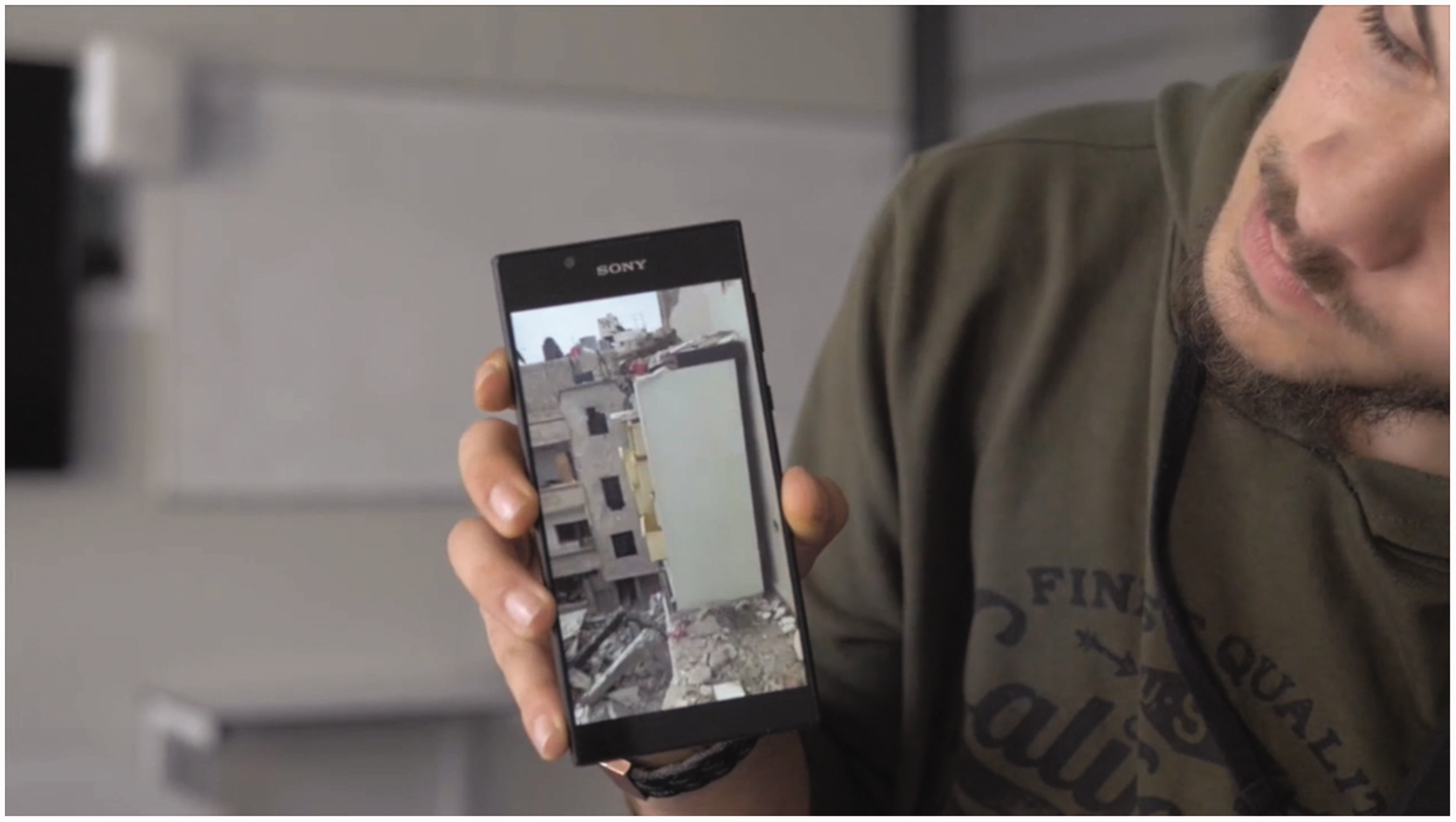
Smart phone pocket archive Mohammad.
As young connected migrants, collaborating youth display a compulsion to remain connected with family members and friends abroad. Transnational connectivity is a common media ritual for all migrant youth involved, but it has particular relevance for refugees who fled from civil war and conflict. In the words of Abdelsaid, ‘When I’m awake, my phone is in my pocket, or in my hand. So while I’m in class, or while I’m talking to someone. It’s always in my hand, just to chat, or to watch videos. It’s always active.’ All young people involved used smartphones to connect with their country of origin, as most have family and friends living there. Preferred apps include Facebook Messenger, WhatsApp, Skype and Imo. Frequency of contact is weekly, sometimes more often. For parents, frequency of contact is often even higher. For example, as Safe Tichana reported ‘my dad uses Facebook and WhatsApp too much. Because my uncle and grandma are in Syria, it is a bit dangerous there. He has to talk every day in order to know if they are all right’. Alongside a felt obligation to sustain a constant ‘connected presence’ (Diminescu, 2020: 74), young migrants commonly also serve as important local points of contact for entire households. Because of their young age, and being enrolled in the intensive international transition classes training, they commonly acquire Dutch language skills quicker than their parents. As a result, they often have to translate when communicating with officials, for example from the local municipality, but also while banking, making doctor visits as well as with communicating with immigration officials. As a consequence of their felt compulsion to connect transnationally, desires to connect with their peers in addition to being a translator for their households during procedures and communication with officials and governments, they feel a pressure to keep their phones close and are mindful to be always online.
This commonly shared practice also demands to be acknowledged from a situated media literacy perspective. Illustratively, Petra realized only over the course of teaching the program the distinctive and particular importance of smart phones and social media in the lives of her students: during the project we realized that they use social media extensively to keep in contact with their country of origin, with their friends over there, with their family over there and with the news. For us [as teachers] it is sometimes very difficult that students always want to have their phone at hand, but after this project it’s become clear [to me] that for a lot of students it’s become a lifeline with what happens in their country of origin, and you can imagine they want to hold on to their phones and keep them close. Because at any moment they can receive news, receive a message about something that happened in their country of origin, or that there is something going on with their family. If you try to imagine yourself in that position, you would like to do that too. If I would know my mum would be in a dismal situation, I would also would like to keep my phone close. While, I would say for students here, Dutch students in a regular school, put your phone away. News can wait. For our students, phones do play a different role. I have many friends in my country who share news […] I have trust in my friends. Say, I’ve been friends for 11 years with someone. We had the same family, in one street. And we are [from] Arabic countries, so we have a lot of contact with each other. And when I hear something from him about my country, I do believe him.
Affective media literacies
I’m here in the Netherlands, I don’t have any family, I have nothing. In my free time, I can only be on the internet to talk with my girlfriend, alone. That’s why it’s important to me […] I can talk with my family in Syria via the internet - Riem
For Riem and fellow informants, smart phones and social media use trigger intense reactions in their bodies. Nour similarly shares ‘when I’m without my phone, I’m sad. I don’t feel well. I feel I miss something.’ Samier adds ‘I use it almost all the time. It’s not entirely good for me, but I need it so much.’ The affective responses most commonly revolve around transnational connectivity, which make up their day-to-day media ritual, sustaining a distinct transnational ‘community of practice’ (Wenger, 1998). However, also particular strong affective responses are noted when creating content in response to receiving news about atrocities in their home country, as well as creating content in response to stereotypes and discrimination.
Mark, an 18-years-old young man from Syria who is into ‘free running’ notes ‘I don’t like news. Bad things and so on. Yes about the war. I prefer actually not to watch it, or hear […] Because when you see it, you get sad.’ Similarly, Rita a 17-year-old girl from Aleppo who is into ‘reading,’ ‘football,’ and ‘acting’ mentions ‘I don’t want to hear it… I get sad. Why? I don’t want to hear anything about Syria or something.’ Such practices of ‘non-news’-consumption have also been observed among other forced migrant populations, Alexandra Greene observed that among refugee women waiting for resettlement in a refugee camp in Greece, this is a way of affectively ‘making-do’ with anxieties and ambivalences (2019).
As a result, many young refugees, like Nour, choose not to post about the war: ‘there are many people, hundred people [may] see my story. They get a bit sad. If I remember it stays in my heart. I do not have to make other people remember.’ However, for many young participants from Syria, the 2017 bombing of Aleppo by the Syrian regime became a turning point after which they actively began to post. In the words of Mo I feel it is very bad. I want to show the people that know me, that this is the city where I lived, where my sisters live, where my family also lives. They are in danger. They are not safe. That I became sad, that this happened’.
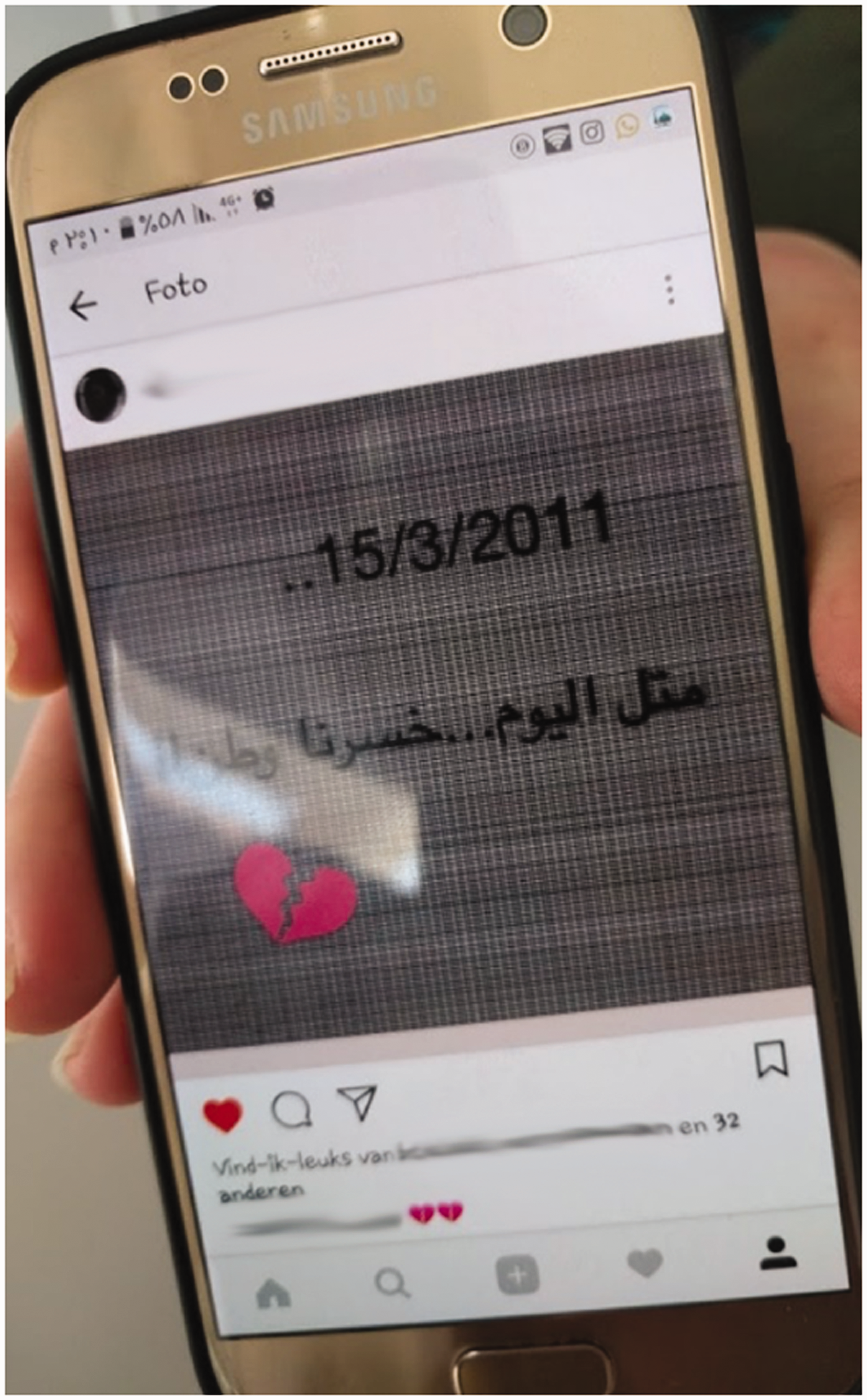
Instagram post Riem ‘On this day we’ve lost our country’.
Experiences in young people’s country of settlement can also trigger mindful media production. Youth are conscious about negative sentiments towards migrants and refugees. And several shared negative experiences in public spaces, or being called out for their (Muslim) identity. Rita for example shares, ‘yes I come to school on my bike. And Dutch people, they called me bad names,’ however she adds That’s not going to change anything, because I’m like this and I will stay like this. Maybe they think my head-scarf is weird, but yes we wear one. This is our faith, and I’m a Muslim. I’m gonna stay that way. when somebody writes on my account [negatively] I will say to him: what did we do to you? What did we do to your country? If there is one man from Syria, and he’s bad, this does not mean that all people are bad. I cannot remain silent.
Conclusions
During settlement, migrant and refugee youth negotiates between various transitional spaces, which include educational, mediated and transnational spaces. As they commonly use social media and smart phones, they have become ‘connected migrants’ (Diminescu, 2020: 74), and they also have to learn how to straddle different media landscapes. In their resilience, they may be expected to develop critical media literacy competencies on their own, but also community-specific ‘media-related needs’ may emerge (Bellardi et al., 2018: 25). In this article, we present a distinctly situated case study of co-creating a critical media literacy education curriculum with a distinctive group of young migrants and their teachers in the Netherlands. Drawing on this process, we propose to re-consider media literacies as a mindful practice, and advocate for stronger recognition of agency, inclusion, engagement, cultural diversity and critical media making. Particularly, young refugees have for example developed distinctive media practices in strategizing how to survive living through civil war, forced migration and settlement. In this article, we champion greater recognition of these practices as critical media literacies, which can be mobilized to further increase their capacities. This move also allows us to intervene in dominant broad understandings of media literacy theory and education.
Our argument draws from in-depth interviews with 3 teachers and 19 students, as well as an 18-minute audio-visual reflection report. The media literacy as a mindful media practice focus was operationalized on the basis of the distinction between ‘understandings,’ ‘rituals,’ and ‘affect’, as proposed by Telo (2013). In an increasingly privatized and commodified media literacy education context, all youth are considered as uniform and equal, which means differences between groups are not acknowledged. Engaging with literacy and the particular practices of this particular young people reveals media literacy assumptions are mostly based on the lives of Western, educated, industrialized, rich, democratic (WEIRD) societies (Alper et al., 2016). These normative frameworks partly align but also proved to be at odds with their digital identification, self-censoring, civic-engagement and (non)-news consumption. These findings demonstrate the urgency of situated, reflexive, flexible, culture and context-aware critical media literacy education. There is a strong need to provide a flexible media literacy education program with space to recognize needs of communities involved, and room for adjusting the program towards these needs.
Approaching critical media literacy as a mindful practice may offer an analytic lens to understand other non-mainstream or marginalized communities, including homeless people, LGBT’s or people with disabilities. Conceptually, the approach may be further developed to become attuned to power differentials by connecting to the black feminist framework of intersectionality to attend to how axes of difference including race, gender, nationality, sexuality impact upon mediated forms of identification, subordination and contestation (Crenshaw, 1991; Noble & Tynes, 2016). We are for example interested to pursue further ‘how can teachers use digital media with a queer critical media literacies framework to read gender and sexuality?’ (Van Leent and Mills, 2017). In the future, we will seek to direct our attention to the difficulties of establishing meaningful contact with fellow Dutch youth as experienced by migrant and refugee youth. The European Migrant Advisory Board (EMAB), a group of advisors with refugee and migrant backgrounds, in their recent Ask the people report similarly advised local governments to ‘bolster programs that improve interaction between the host community and newcomers’ (2018: 4). Future media literacy education programs targeting young migrants, or seeking to enhance intercultural dialogue between majority and minority youth should seek to incorporate means for sustained interaction and networking. An educational community-oriented, open source and iterative approach involves teachers acting as facilitators and coaches in order to recognize expertise and interests of students. Thus, in order to develop a media literacy which works for all we need to move away from a one-size-fits-all model of media literacy theory and education and reflexively embrace a situated, co-creation approach. In taking our MMM as an illustration: next year the program will not be incorporated as an obligatory part of the curriculum as a result of teachers’ decisions, but students in dialogue with teachers and us facilitators collectively will have a chance to decide whether and if so how they want to engage with media literacy as a mindful practice.
Footnotes
Acknowledgements
We are grateful to the students and teachers of Ithaka ISK for collaborating with us. The input received during the ‘From Fragmentation to Integration. Addressing the role of communication in refugee crises and (re)settlement processes’ pre-conference held at the International Communication Association conference in Prague (Czech Republic) in May 2018, the October ‘18 UNESCO ‘Global Media and Information Literacy Feature Conference’ in Kaunas (Lithuania) and the ‘Expert meeting media literacy for migrants and intercultural dialogue’ organized at Utrecht University (the Netherlands), in March 2019 proved valuable in sharpening our focus. Thank you Sara Miellet and Çiğdem Bozdağ for your engaged and detailed feedback. A final word of thanks to the reviewers and the special issue editors Amanda Paz Alencar and Noemi Montes Mena for their patient guidance.
Declaration of Conflicting Interests
The author(s) declared no potential conflicts of interest with respect to the research, authorship, and/or publication of this article.
Funding
The author(s) disclosed receipt of the following financial support for the research, authorship,and/or publication of this article: National Research Agenda Start Impulse funding for ‘Media literacy through making media: A key to participation for young newcomers?’ (2017– 2019). In addition, the contribution of Koen Leurs was supported by the Netherlands Organisation for Scientific Research (NWO) Veni grant ‘Young connected migrants. Comparing digital practices of young asylum seekers and expatriates in the Netherlands’, project reference 275-45-007 (2016–2019). For more information see the project blog at  .
.