




Abstract
Various scholars have studied the relationship between music and politics. Most, however, focus on how governments and political parties on the one hand and movements and activists on the other use music for political outcomes and in doing so they often ignore the more latent forms of political participation music can lead to. This article, therefore, focuses on how people give meaning to political music in informal conversational settings by exploring the reception of Pussy Riot on YouTube. New media platforms like YouTube are ubiquitous in the West and as ‘third spaces’ they allow audiences to publicly reflect on everyday newsworthy events and activism. We combine the computerized methods of topic modelling and semantic network analysis to study both quantitatively and qualitatively how Pussy Riot’s punk protests afford political participation by (Western) YouTube users. Results show that the comments mostly address (1) the geopolitical boundaries of activism, (2) the legitimacy and commitment of the activists, (3) the political content of the protests and (4) the relationship between the protests and religion. For the YouTube users in our study, the political music of Pussy Riot thereby serves as a vehicle to discuss politics beyond the protests themselves.
Introduction
The relationship between music and politics has been studied by scholars from multiple disciplines. However, most of their studies focus on the different ways in which music has been used, throughout history, to directly influence political outcomes, that is, manifest political participation (Ekman and Amnå, 2012). First, governments and political parties have used music to influence (parliamentary) governmental politics, for example, through policies to foster social cohesion and national identities (Everitt, 2001) or for propagandistic purposes (Street, 2003). Second, music has been approached as (extra-parliamentary) political action (Mattern, 1998) by affording political expression beyond the conventional governmental arena. Street (2012) and Wicke (1992) give accounts of cases in which repressed or censored musical genres are performed as acts of resistance and thereby become a source of subversive political discourse. Other studies highlight the use of protest music in social movements (Eyerman and Jamison, 1998; Roy, 2010), in which songs help to inform members and keep them directed towards a specific political outcome.
These studies illustrate how different political actors use music to either solidify or change the status quo in a given societal context. Few studies, however, have empirically examined how the political use of music is received by people and how they express their views on such music in informal, conversational and public settings. We argue that everyday conversations about politics between ‘ordinary’ people are already a form of political participation. These conversations involve informal political talk and take place in the context of the home, work or online public spaces but nonetheless can lead to political action (Graham et al., 2016). Studying this level of reception, thereby, provides insights into the more latent rather than manifest forms of political participation (Ekman and Amnå, 2012), including the sharing of political views rather than directly influencing politics within the formal governmental arena or through activism. However, whereas the latter has been studied quite extensively (e.g. Eyerman and Jamison, 1998; Mattern, 1998; Roy, 2010; Street, 2012), reception of the political use of music in the more informal everyday settings remains understudied.
We therefore take a case of contemporary explicitly political music by studying the Russian punk activist group Pussy Riot. By staging hit-and-run punk performances in public spaces and uploading the recordings of these acts to the new media platform YouTube, the group protested against the Russian government and institutions of political and social power (Steinholt, 2013). Pussy Riot uses explicit and subversive lyrics and expresses these in punk music, which is conventionally associated with rebellion and – often – manifest politics (Street, 2012). Particularly since the arrest and imprisonment of some of its members following their Punk Prayer performance in 2012, the group has gained widespread (media) attention, resulting in the expression of solidarity (Weij et al., 2015) from people throughout the world. This case of activism through punk music, therefore, constitutes a good contemporary example of the political use of music, which has simultaneously led to many people getting involved in the political discussions that Pussy Riot has instigated and thereby allows us to study the reception of political music. Furthermore, as new media platforms like YouTube are ubiquitous in the West and allow for activism to travel fast and to reach many people, they provide an interesting empirical window to collect rich data on political reception. Although this platform is not necessarily intended for political use, it becomes a political ‘third space’ (Graham et al., 2016) when YouTube users publicly express their political ideas and opinions – here in the form of comments to Pussy Riot’s videos. In other words, YouTube user comments offer a relatively large data set that involves public and everyday political conversations, thereby providing insights into the more informal and latent forms of political participation (Ekman and Amnå, 2012) in relation to the political use of music.
For reasons of language and to stay close to the existing, mostly Western-focused, studies and theory, we address the following research question: how do the punk protests of Pussy Riot afford political participation by (Western) YouTube users? This article offers two main contributions to existing research on the politics of music. First, by empirically studying the reception of Pussy Riot, we demonstrate how (particular) audiences actively use music for latent political participation, instead of how music can create a space for political participation. Second, we show the value of computerized methods to study audience reception, extending our knowledge on the method of topic modelling in combination with semantic network analysis. Combining the two provides us with an interesting empirical window to see, both quantitatively and qualitatively, how people in mainstream society use musical activism as a vehicle for political participation.
The politics of music
Music affords political participation to its listeners and users and is often perceived to be more effective than conventional political participation as it engages people and allows for political actors to communicate with people (Martiniello and Lafleur, 2008; Street, 2012). But what do we mean when we say political music? When does music become political? Having substantively written about the intersection of music and politics, Street (2012) follows Hay (2007) in stressing the social dimension of the political: something is political when it requires decisions to be taken that affect not just the individual but others too and when political meaning is given to it by the politician or the activist as well as the ones on the receiving end, such as voters or constituencies. For music to be political, then, not only is the context in which it is produced or performed important, it is also the context in which it is listened to that determines whether music affords a space for politics. Ekman and Amnå (2012), in providing a useful typology of involvement, engagement and participation in politics, likewise stress that political participation not only includes political party or social movement membership but also voters and people discussing politics in informal settings. A workable definition of political music, therefore, includes the reception of it by people beyond the formal politics of governments and activists. Along this line, Street (2012: 44) argues that political music ‘self-consciously recognises the ideological content and seeks to draw the viewers’ attention to it’ and that it needs to ‘inspire forms of collective thought and action’ (Street, 2012: 8) rather than simply serve as mere private reflection and entertainment, further emphasizing the importance of reception. In other words, mapping its reception is essential in order to say something about the politics of music.
In asking whether and how YouTube users give political meaning to Pussy Riot’s punk performances, a good starting point is to study the extent in which they consider the artists to be legitimate political actors that are ‘allowed’ to take part in politics. In other words, should one listen to – and believe – Pussy Riot when it comes to politics to begin with? From a reception perspective, the concept of authenticity becomes useful in studying how YouTube users give political meaning to Pussy Riot and its punk protests. We build on Moore’s (2002) typology by distinguishing between the authenticity of the artists and of the punk protests. There is a general consensus in sociological literature that authenticity is never located in the object itself but is socially constructed; the criteria for authenticity are different in different contexts and for different objects (Moore, 2002). Put differently, we – listeners, viewers and audiences – ascribe authenticity to the object and/or the producer. Studying the reception of political music by looking at how audiences ascribe (political) authenticity to it, we argue, gives insight into the everyday conversations concerning the politics that the music raises and thereby into the (latent) political participation that it affords.
With regard to Pussy Riot’s punk protests, two types of authenticity are important. First, for the artists, conveying an impression of integrity is needed to achieve authenticity of expression. This is a common criteria in the arts and refers to a type of authenticity that is about purity and honesty, which Moore (2002: 214) refers to as ‘first-person authenticity’. Taken into the context of politics, this is about staying ‘true to the self’ and to the political music, instead of giving in to commercial (self-)interests. Particularly when considering political music, the music is an attempt to communicate with an audience, to direct the viewers’ attention and action to a particular topic. When first-person authenticity is achieved, music can become a source of knowledge – bearing truth (Eyerman and Jamison, 1998: 23–24). In terms of the reception of Pussy Riot, then, we expect audiences to view and judge the artist-protestors for the ‘all-or-nothing’ commitment to their punk protests.
Second, Moore (2002: 218) defines ‘third-person authenticity’ in terms of regarding the artist as accurately representing others – staying ‘true to the group’ and the traditions or conventions within a particular genre. When we apply this to the political use of music, we can argue that in order to command moral authority (Kane, 2001) and to convince others to follow or back up a political cause, Pussy Riot is to be regarded as a representative of that political cause. The protesting artists of Pussy Riot should aim to represent a constituency of people (e.g. the gay community in Russia) in order to be seen as legitimate representatives who are accepted to speak on behalf of this constituency. Therefore, we expect audiences to discuss and judge the punk protests in light of the groups of people on whose behalf the activists of Pussy Riot are protesting.
Audiences and the politics of music: YouTube reception
As performing activism is not just about spreading a message into the world but also about being heard, we need an empirical window to study its reception. Although Pussy Riot has appeared on various mainstream media platforms, particularly in the United States, we know very little about the reception of its protests. To shed some light onto the reception of Pussy Riot’s activism in Western mainstream society, we will look at media audiences on the media platform YouTube. Pussy Riot itself has made use of this medium to upload its recorded punk performances. For activists, digital media platforms facilitate the development of collective identities and through these platforms the meanings of protests are negotiated (Thorson et al., 2013). More importantly, by looking at the reception of Pussy Riot on such a new media platform, we look at everyday communicative processes of audiences.
YouTube, as a user-generated content platform, allows users to upload and watch videos, to which they then can react through a commenting infrastructure. Although a large majority of users are passive viewers (van Dijck, 2009), anyone with a Gmail account is able to comment on videos. As such, YouTube users share and express ideas on a commercially run – yet, rather public – platform (Bennett and Segerberg, 2012). Political science scholars therefore view new media platforms like YouTube as ‘third spaces’; next to the spaces of the home and work, these platforms too afford everyday political conversations. Even though political videos are not among the most viewed on YouTube, they do often attract many replies in contrast to other videos (Thelwall et al., 2012). Yet, the videos of Pussy Riot that were uploaded to YouTube rapidly gained thousands of views and allowed many YouTube users to publicly reflect on them, and to share, as a way of personal expression, their views with other users. They furthermore concern both music and politics and whereas the former often yields positive comments, the category of activism videos predominantly yields negative comments (Thelwall et al., 2012). Pussy Riot’s recorded punk performances therefore potentially render an interesting contrast of discursive reactions.
Platforms like YouTube often trigger international news media coverage (Bennett and Segerberg, 2012) and have demonstrated to play an important role in the spread of recent protest movements (Howard and Hussain, 2011), inviting users to express and justify their views on protests through comments (Halpern and Gibbs, 2013). Although there is no clear and up-to-date research that provides estimates as to how many people in Western countries frequently use the medium for commenting, the number of views to both amateur and professional YouTube content that can run into the millions suggests the platform is widely used. Furthermore, the platform has been adopted by a variety of age groups, with a high percentage of users being above 35 years of age (Gueorguieva, 2008) and a large part being from the United States (Thelwall et al., 2012). Even though Neumayer and Svensson (2016) suggest that activism expressed in the digital realm allows for marginalized and excluded voices to be heard, the voices – comments – of users of such platforms should not necessarily be considered as marginalized too. Rather, new media platforms afford digitally enabled action networks through which political advocacy can travel and spread quickly (Bennett and Segerberg, 2012) and allow for people in mainstream society to participate in political discussions by taking notice of and reacting to activism. These characteristics and affordances render new media platforms like YouTube interesting sites to tap into audience reception. 1 It fits, additionally, in the trend of citizens who are not necessarily apathetic towards politics but want to feel involved in politics in different ways than directly engaging with the state through, for example, party membership (Marsh, ‘t Hart and Tindall, 2010).
Data
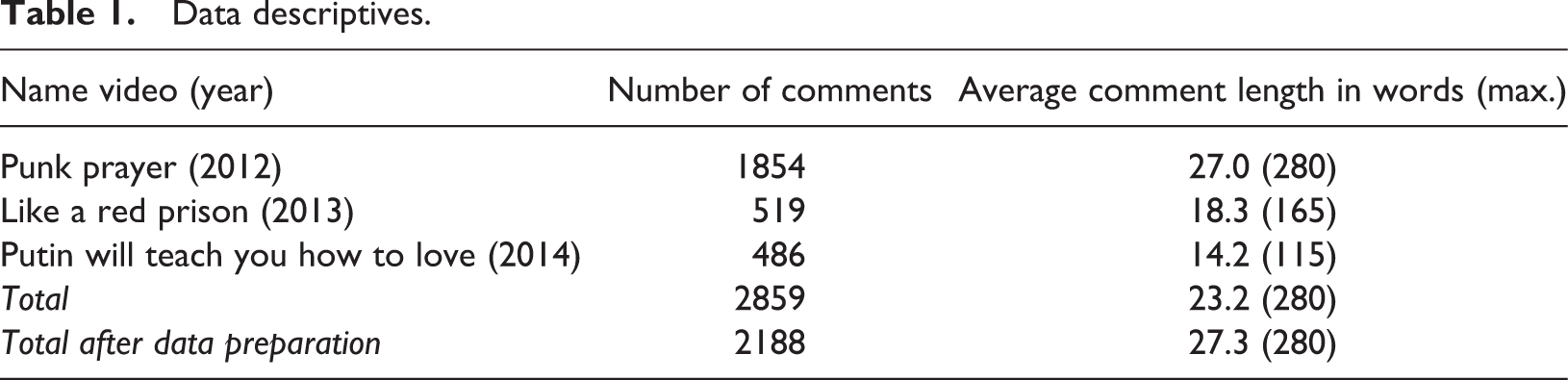
Our data were compiled by collecting YouTube user comments from three Pussy Riot YouTube videos Punk prayer (2012), Like a red prison (2013) and Putin will teach you how to love (2014), which together received well over 3 million views. At the time of the data collection, these recordings of Pussy Riot’s characteristic hit-and-run performances accounted for most views and comments of all their videos. User comments were scraped from the video webpages. While YouTube’s infrastructure allows for comments both on videos and on other user comments, the latter often involves sideline discussions in which users do not react to the video itself. As such, we included only initial comments on the videos in our sample. User comments were collected into a single data set and then prepared for analysis. First, to ensure a focus on the Western reception, we excluded all non-English comments and those by users with usernames in non-Latin alphabets. While providing no guarantee, it does, practically, allow us to minimize the presence of YouTube users from non-Western countries. Second, we removed all comments shorter than three words as these are difficult to interpret meaningfully. Third, in order to clean our data, words that bear low meaning (various forms of the verb ‘to be’, pronouns, etc.) were deleted from our analysis (DiMaggio et al., 2013). Table 1 highlights the general descriptives of the data set.
Data descriptives.
Method
Topic modelling was used to discover meaningful topics in the data set. This method allows us to examine a large collection of texts – here: each individual YouTube user comment is treated as a single text – and find dominant themes among these texts, by uncovering clusters of words that ‘occur together more frequently than one would expect by chance’ (DiMaggio et al., 2013: 578). We adopted the software program Mallet, which uses a topic modelling algorithm that assumes a relational approach to texts, that is, the meaning of words within these texts emerges from their use in the context of other words (Mohr and Bogdanov, 2013). The output of our topic modelling analysis is twofold: (1) a topic solution that consists of list of words for the requested amount of topics along with their respective scores in terms of frequency and probability of occurrence and (2) an overview of the principal topic for each text along with probability scores. As such, we can navigate back and forth between a quantitative level – words that occur together frequently forming a topic – and a qualitative level – individual comments that score relatively high for the presence of that particular topic. The full topic solution is provided in the Appendix.
There is no statistical test to assess the optimal amount of topics. Rather, one constantly requests a number of topics until meaningful topics emerge. This means that it is not necessary to optimize the output so that each topic is substantively meaningful (DiMaggio et al., 2013). We can, however, calculate a score for each word within each topic based on its frequency within a given topic. For example, the word ‘putin’ in topic 1 scores relatively high as it occurs 325 times within that topic, in which a total of 252 unique words occur 1046 times. Attributing weights to words in this manner gives some insight into the distribution of words within a given topic. Furthermore, in order to provide well-grounded interpretations of the topics in our model, we will discuss the topics in tandem with individual YouTube comments for which the respective topic scores are high. For reasons of space and of interpretability, we will discuss those topics that yield the most meaningful interpretations.
Topic modelling provides the tools to assess semantic contexts of words in a given body of texts. Some words will be included in two or more topics, indicating such semantic nuances. In other words, the occurrence of some words in multiple topics means that they are used either in a different or in a related semantic context. Topic modelling, then, provides us with the output to analyse the extent in which topics relate to one another through a semantic network analysis on the basis of word overlap, which further builds on the assumption that the meaning of words depends on their semantic contexts (Dreiger, 2013). Not only does this strengthen our interpretation of the topics, it aids greatly in the visualization of them. We used Gephi to analyse what clusters of topics emerge (see Figure 1). The nodes in the graph represent the topics of our topic model. The ties between the nodes represent the extent in which topics share particular words. 2 Furthermore, Gephi includes a modularity algorithm that calculates whether certain nodes have high interconnectedness in terms of the weights of their ties relative to other nodes, resulting in groups of nodes that are closely related. This allows us to group topics in metatopics, each highlighting a theme on a higher level of abstraction. Although the modularity score for our semantic network analysis is low 3 (0.23), the four metatopics still contribute to the interpretation as some topics within groups have strong ties. Below we will discuss our findings by interpreting the main topics within each metatopic, high scoring YouTube comments within each topic and the position of each metatopic within the network as a whole.
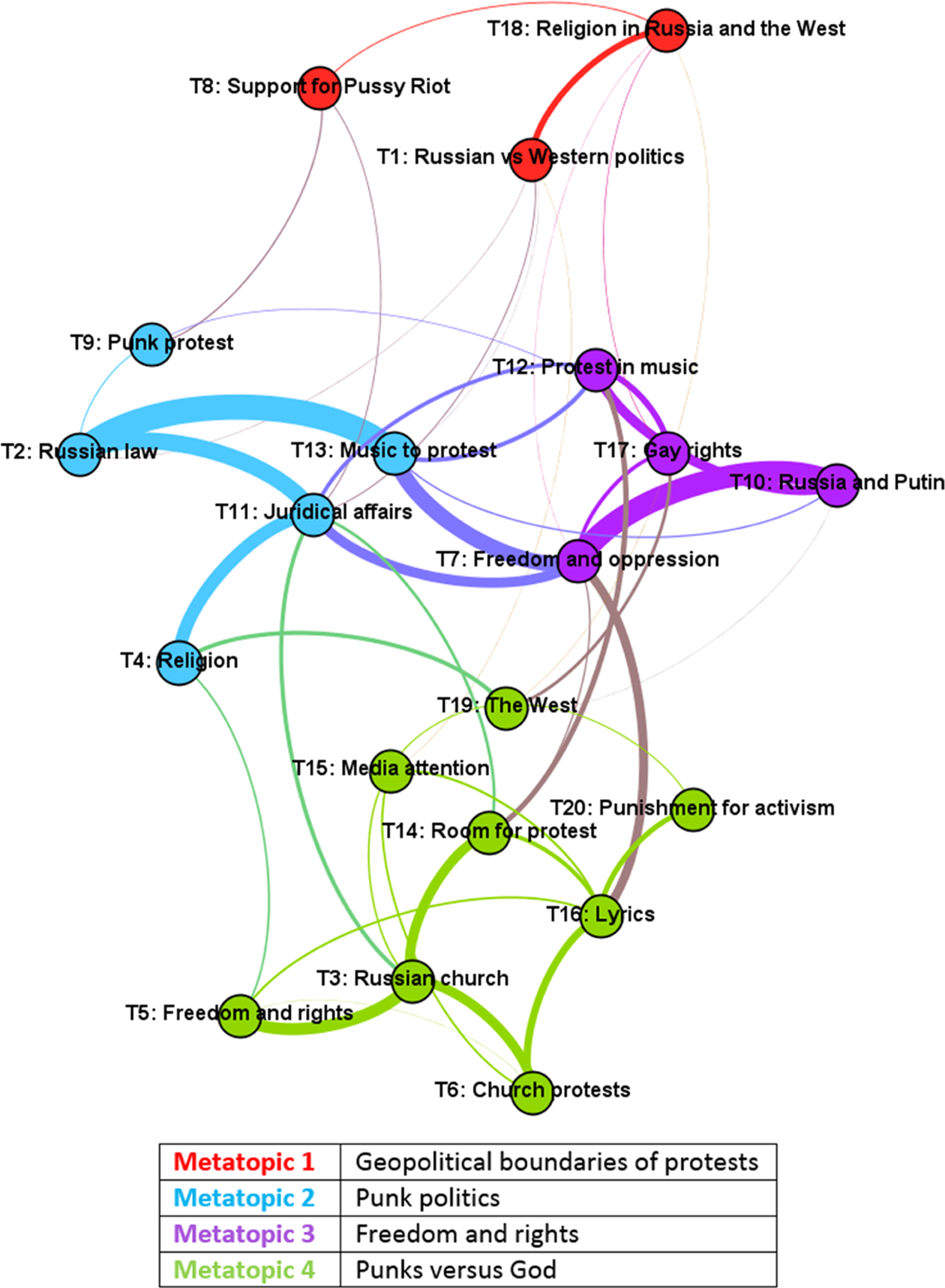
Network graph, imported from Gephi and filtered on edge weights (only ties with weights above the average tie weight are shown).
Analysis
Metatopic 1: Geopolitical boundaries of protests
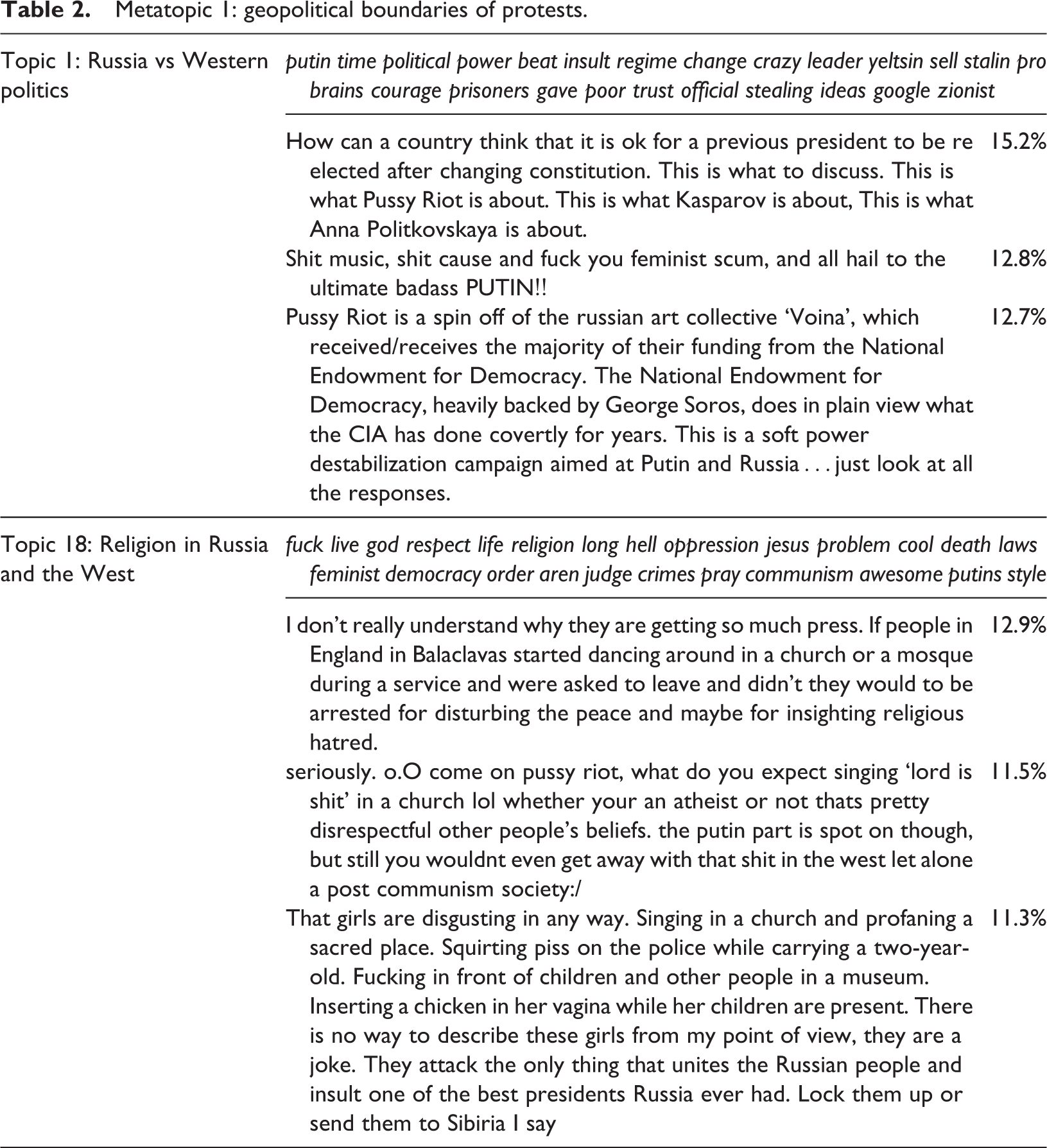
The first metatopic includes topics that discuss the legitimacy of Pussy Riot’s punk protests by often contrasting Russia to the West. Two topics in particular display a relatively strong tie and both score high in YouTube comments that pertain to Western affairs (Table 2). In topic 1 (Russian vs. Western politics), several words refer to Russian politics (‘yeltsin’, ‘stalin’) and the word ‘putin’ scores particularly high in terms of frequency of occurrence over the other words. The comments in which this topic is highly prevalent convey more clearly that Russian politics are discussed, often in relation to the West. They bring into discussion the legitimacy of the protest by backing the cause (‘How can a country think that it is ok for a previous president to be re-elected after changing constitution’) or by highlighting possible ulterior motives of that cause (‘funding from the National Endowment for Democracy’). In topic 18 (Religion in Russia and the West), we find clearer references to the West, in the form of drawing boundaries with regard to the form of the protests. Although the words within this topic mainly pertain to religious affairs, displayed by words like ‘god’, ‘religion’ and ‘jesus’, the comments in which this topic is prevalent show that users mention that one would also be arrested when protesting in a church or mosque in the West.
Metatopic 1: geopolitical boundaries of protests.
The position of this metatopic within the network further illustrates that it has a specific focus: it seems largely unconnected to the other metatopics. This indicates that a specific group of YouTube users use Pussy Riot’s punk protests as a vehicle for geopolitical engagement. These users do not explicitly raise what Pussy Riot is protesting against but instead refer to the West when discussing the boundaries of political protests in terms of form. For them, Pussy Riot’s commitment to its protests appears to be irrelevant. What is more important to them is Pussy Riot’s representation – supported because the group protests against a supposedly undemocratic president and rejected for their ulterior motives and mainly because people consider the protests to be unacceptable in their form. Since Pussy Riot’s activism can be considered a form of manifest political participation (Ekman and Amnå, 2012), these users imply that this form of participation should not be taken seriously when it breaches conventional forms.
Metatopic 2: Punk politics
The second metatopic consists of topics that make reference to both music and politics, the latter being more dominant. Even though none of the comments (Table 3) explicitly address the relationship between the music and the politics in Pussy Riot’s political music, it does seem that users feel that the political side to the protests is more important than the music. They mention words related to music now and then (‘lyrics’, ‘sung’, ‘punk’, ‘song’, ‘sing’) but pay more attention to the politics of it, by mentioning the oppression (topic 2), the sentencing (topic 11) and knowledge about politics (topic 13).
Metatopic 2: punk politics.
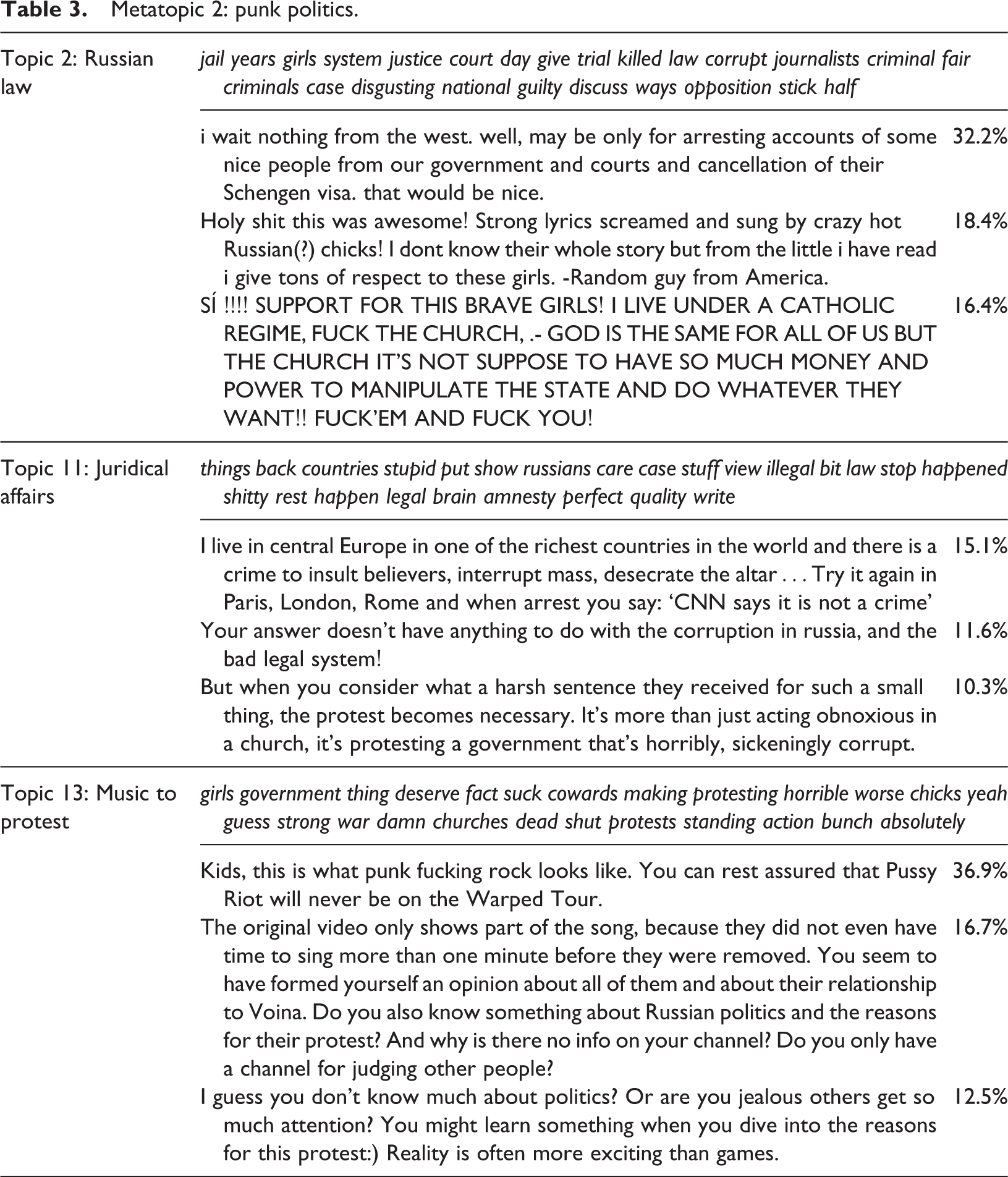
Considering several members of Pussy Riot were sentenced to jail in the aftermath of the Punk Prayer protest (and the corresponding video received most comments), a strong focus on legal affairs is not very surprising. However, rather than focusing on the use of punk music specifically, users emphasize the all-or-nothing commitment of Pussy Riot to its acts of activism. It is therefore interesting that topic 13 addresses more specifically Moore’s (2002) concept of first-person authenticity. One comment in particular (scoring 36.9%) stresses how Pussy Riot epitomizes the punk genre (‘this is what punk fucking rock looks like’). The comment underneath addresses more concretely how the protest that underlies the punk performance is important and how Pussy Riot is committed to that protest even though ‘they did not even have time to sing more than one minute before they were removed’. Both these comments stress that the protesters showed such commitment that they even faced sanctions, by stating that they could not even finish the protest and will not be invited to the mainstream music festival the Warped Tour in the United States.
This metatopic is strongly tied to the third one (Freedom and rights). In fact, these two metatopics display the strongest connection in the network. From the perspective of the second metatopic, the link with the third metatopic is indicative of the attention YouTube users give to the authenticity of Pussy Riot as musical protestors committed to issues of freedom and oppression. Users display political participation by discussing Pussy Riot’s commitment to its protests in the context of prosecution and sanctioning. By displaying first-person authenticity (Moore, 2002) in such a way, it seems that for this group of users it is important to consider the protesters as committed and legitimate activists. In other words, the punk protests invite them to discuss the legitimacy of activism in terms of commitment rather than form as seen in the previous metatopic.
Metatopic 3: Freedom and rights
With the third metatopic, we turn more to the content of the protests. Two topics in particular stand out. Topic 7 (Freedom and oppression) and topic 10 (Russia and Putin) are very strongly connected and both include discussions on freedom, oppression and rights (Table 4). In these two topics, users seem to express their support for – but also critique against – Pussy Riot. Most users here show support by sharing anecdotes of oppression or directly addressing the way Putin treats Russians. One particular user, however, shares his or her firm criticism of Pussy Riot by questioning the fight for civil rights. For example, one comment elaborates on how you are ‘brainwashed by propaganda’ if you still support Putin, while another user criticizes the fight for women rights when emphasizing that ‘women create the myth of oppression because they have fuck all else to do’. They thereby touch upon Pussy Riot’s third-person authenticity (Moore, 2002) by bringing into question its representation of oppressed people in Russia that finds resonance when users elaborate on oppression in Russia and resistance when users criticize the fight for women rights.
Metatopic 3: freedom and rights.
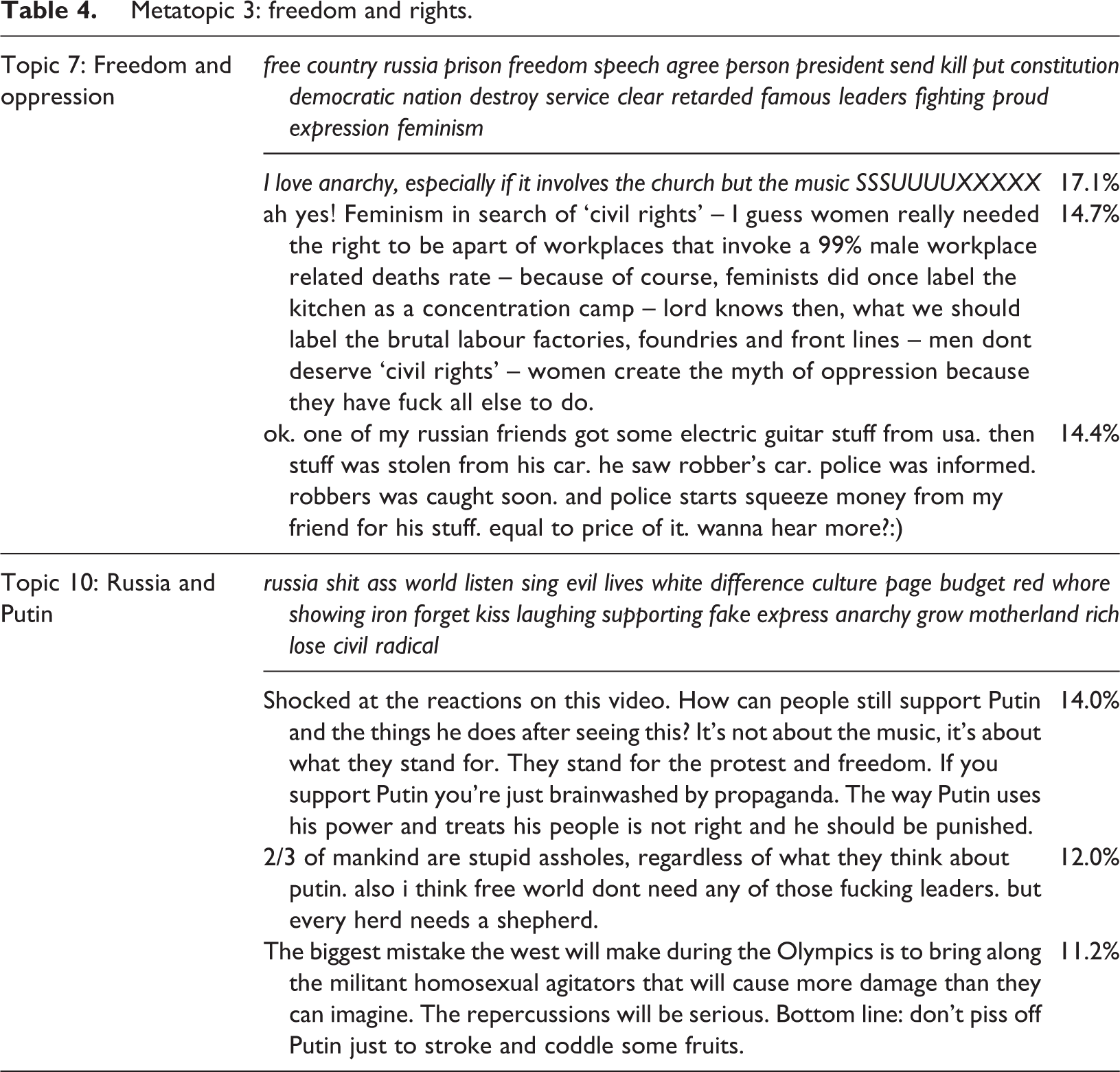
We have already seen that the second and third metatopic are strongly related. Both focus on Pussy Riot’s commitment to its punk protests, yet there is an important difference between the two. In the third metatopic, users stress the activists’ commitment for the content of the protests; whereas in the second metatopic, users stress commitment for the act of protesting. In other words, this metatopic illustrates that there is a group of YouTube users who engage more specifically with the political issues that Pussy Riot addresses in its punk activism. For these users, the protests invite them to discuss online the political content rather than the political context of the punk protests.
Metatopic 4: Punks versus God
The fourth metatopic least clearly conveys a single theme, containing matters that are also present in the other metatopics – a Western focus (topic 19), media attention (topic 15), punishment for activism (topic 20), room for protest (topic 14), verbal content of the lyrics (topic 16) and freedom and rights (topic 5). Nonetheless, if there is one theme that stands out here it is the relationship between the protests and religion. Topic 3 seems to include both words and comments that address religion. The high frequency of the word ‘Russian’ leads us to think that the centre of gravity in this topic revolves around the Russian Orthodox Church. However, only in the first comment in which this topic is visible (Table 5) does it appear, when a user addresses the church in which Pussy Riot held one of its protests and mentions the Punk Prayer protest. This does to some extent explain why topic 3 and topic 6 have a relatively strong tie. Topic 6 (Church protest) too addresses religion. More specifically, the comments in which this topic is visible seem to address the same Punk Prayer protest by referring to the ‘russian orthodox church’ and including several mentions of ‘God’. Throughout these, users convey that the protests should be possible (‘[Mary] shouldn’t have any problems with a few nice lovely innocent girls singing and dancing in her son’s fancy crib’) and raise important matters. In other words, users here seem to address third-person authenticity (Moore, 2002) most dominantly. They bring into discussion whether Pussy Riot is hurting religious people and the political and social power of the Russian Orthodox Church. They thereby raise Pussy Riot’s representation by discussing the extent to which the protests resonate well with people in Russia.
Metatopic 4: punks vs. God.
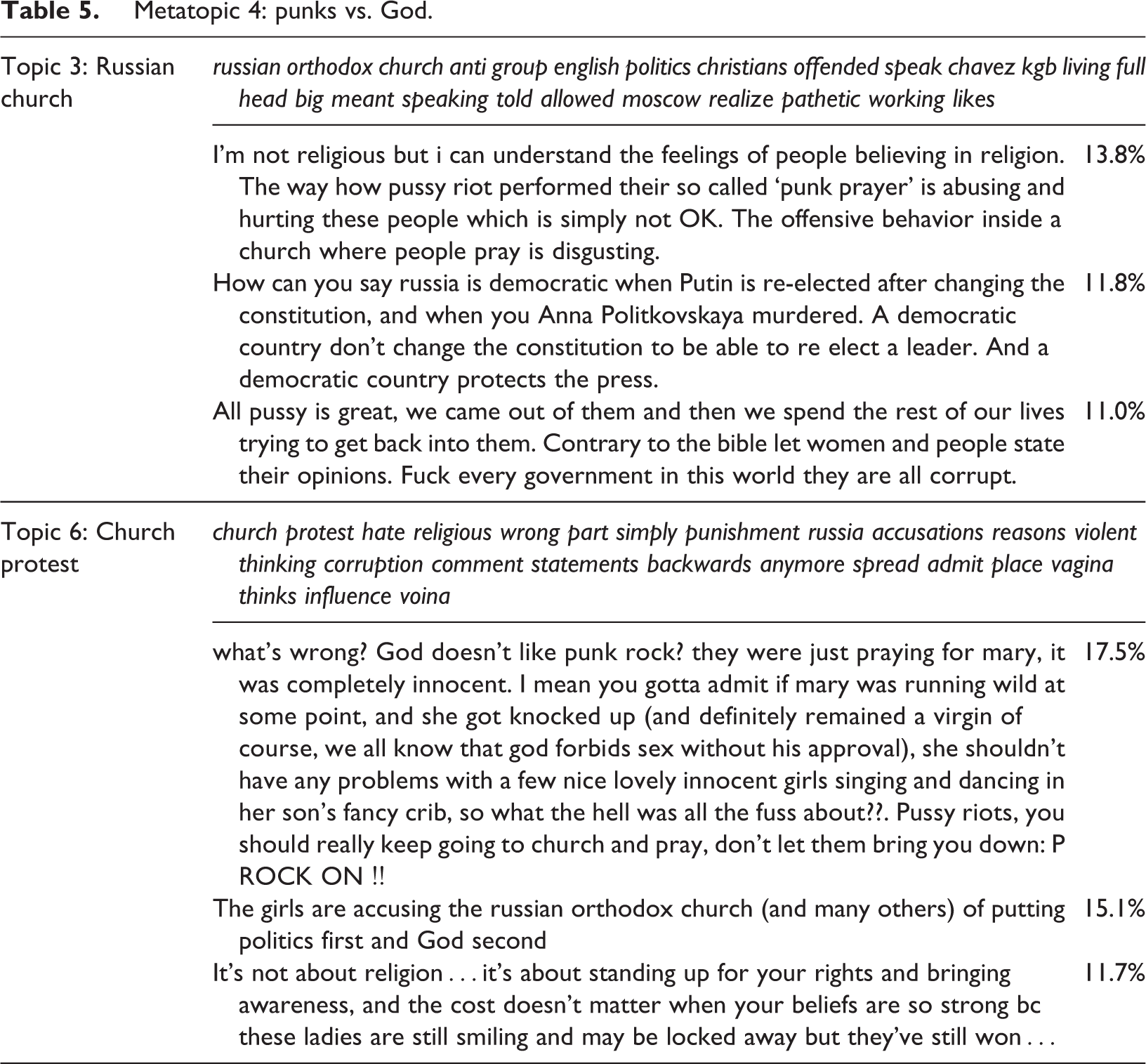
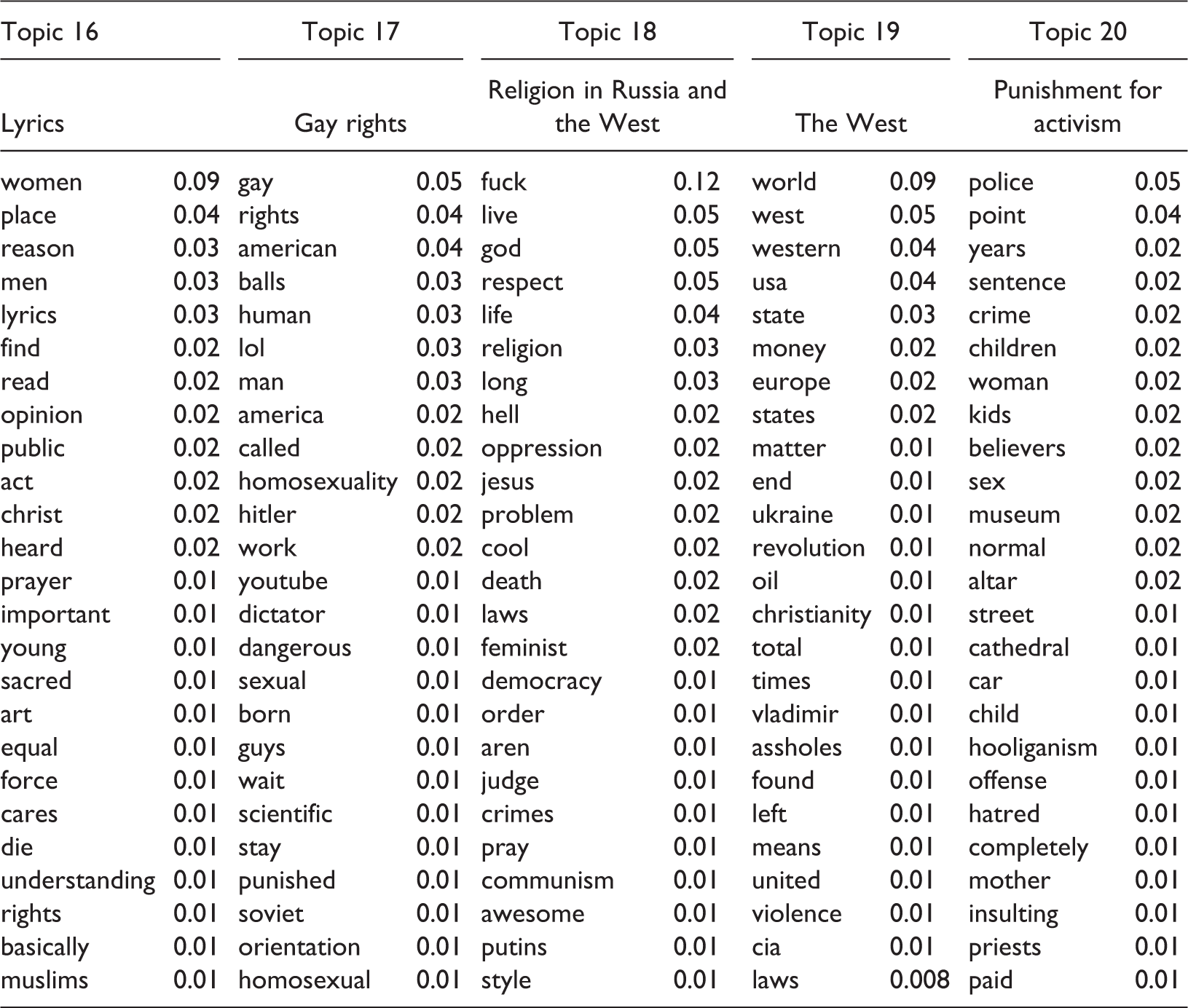
Although topic 16 displays an interesting tie with topic 7 (Metatopic 3), the comments and words in topic 16 do not strongly convey a single clear theme. Metatopic 4 further only has weak links with the other metatopics. Therefore, we can only conclude, with some caution, that this metatopic illustrates that there is a group of YouTube users concerned with the relationship between the punk protests and religion. Not everyone necessarily agrees with Pussy Riot’s protests against the Russian Orthodox Church, but the social position of the church (or religion in general) does constitute an important discussion topic. In other words, here too users focus more on content rather than on form or context in sharing their views.
Conclusion
The aim of this article has been to study how the punk protests of Pussy Riot afford political participation in the online space of new media. We have analysed how an audience of YouTube users attributed or questioned the authenticity of Pussy Riot’s activism in terms of commitment to activism and representation of constituencies. Their comments on Pussy Riot conveyed four recurring themes that we identified through metatopics that each tell a story about how users express their views in relation to the activism of Pussy Riot. The first metatopic illustrates that the punk protests made audiences discuss geopolitical affairs, particularly by drawing boundaries in which users emphasized that the protests in their form would also meet resistance in the West. Tied closely together, the second and third metatopics display attention to sanctions for and the content of the punk protests, respectively. Within the context of these two forms of attention, comparisons between Russia and the West are visible even though the second and third metatopics do not display strong connections to the first metatopic. Finally, the fourth metatopic includes many of the issues the other three metatopics convey and displays a (although less clear) focus on discussions about the relationship between the protests and religion.
Thus, we mapped the (political) meaning YouTube users give to the punk protests of Pussy Riot. On the one hand, these users often brought into discussion Pussy Riot’s commitment to the act of protesting rather than to the music of the punk protests. While some users emphasize that Pussy Riot uses the punk genre correctly and thereby convey that the genre is expected to be politically provocative, others express their dislike of the music. Indeed, even though punk as a genre conventionally includes politics, politically explicit songs are often ranked low in music charts (Street, 2012). However, both the music and the protests of Pussy Riot’s activism received a mixture of positive and negative comments, providing some nuances to the strict divide between music and political YouTube videos (Thelwall et al., 2012). A strong focus on commitment to the protests of Pussy Riot, therefore, indicates a variation of Moore’s (2002) notion of first-person authenticity. On the other hand, users often discussed Pussy Riot’s representation of a constituency of people (third-person authenticity), by discussing the position of various social groups in Russia. They did so by referring to how the group has protested – mainly in terms of genre and location – and to what is being protested against – in terms of content. These users, therefore, bring into discussion the political relevance of this form of activism and the protestors’ representation of others.
Even though we were unable to tightly demarcate our population of YouTube users in terms of location and motivation, our study does illustrate that Pussy Riot’s punk protests are more than just acts of protest. Political music can lead to (latent) political participation, even when largely unconnected to the music. For YouTube audiences, political music is first and foremost a vehicle to discuss politics on levels beyond what is actually raised in the music. Users take from a protest what they deem important and frame it in a context that is meaningful to them. Even though YouTube users overall displayed little support for Pussy Riot, they commented on a wide variety of contextual or content-related issues with regard to the punk protests. To that extent, these users display a latent form of political participation mostly in line with the typology of Ekman and Amnå (2012) where they engage in political discussions in the third space of new media platforms (Graham et al., 2016) without being clearly set on influencing political outcomes. Yet, they seem to have clear views on various political issues, ranging from their ideas on what form of activism is unacceptable to their views on civil rights. While these users might not aim to actively influence governmental politics, they do contribute to establishing what kind of activism is accepted (or not) in terms of authenticity. In other words, we demonstrate that studying latent political participation by looking at the reception of political music provides us with fruitful insights into the use of music in manifest political participation.
However, we do not aim to generalize our findings to audience reception on a higher level of abstraction. More research is needed on the use and relevance of political music for people in mainstream society and on the link between latent and manifest political participation. Second, it remains difficult and time-consuming to get the right number of meaningful topics. We thereby stress that our results should be interpreted with some caution as not all topics, particularly in the fourth metatopic, yield single easily interpretable themes. Third, although the element of trolling – so often prominent throughout comments on new media platforms (McCosker, 2014) – remained relatively invisible in our data, we know very little about our users’ motivations for commenting. We contend, however, that combining topic modelling with semantic network analysis provides us with the tools to not just qualitatively interview a small group of people or to quantitatively survey a larger group without the possibility of deeper qualitative understanding, but to study on a large scale how audiences give shape to political participation.
Footnotes
Funding
The author(s) disclosed receipt of the following financial support for the research, authorship, and/or publication of this article: We gratefully acknowledge support for this article's research by the Netherlands Organization for Scientific Research (NWO, project number PGW-15-23).
Notes
Appendix
| Topic 16 | Topic 17 | Topic 18 | Topic 19 | Topic 20 | |||||
|---|---|---|---|---|---|---|---|---|---|
| Lyrics | Gay rights | Religion in Russia and the West | The West | Punishment for activism | |||||
| women | 0.09 | gay | 0.05 | fuck | 0.12 | world | 0.09 | police | 0.05 |
| place | 0.04 | rights | 0.04 | live | 0.05 | west | 0.05 | point | 0.04 |
| reason | 0.03 | american | 0.04 | god | 0.05 | western | 0.04 | years | 0.02 |
| men | 0.03 | balls | 0.03 | respect | 0.05 | usa | 0.04 | sentence | 0.02 |
| lyrics | 0.03 | human | 0.03 | life | 0.04 | state | 0.03 | crime | 0.02 |
| find | 0.02 | lol | 0.03 | religion | 0.03 | money | 0.02 | children | 0.02 |
| read | 0.02 | man | 0.03 | long | 0.03 | europe | 0.02 | woman | 0.02 |
| opinion | 0.02 | america | 0.02 | hell | 0.02 | states | 0.02 | kids | 0.02 |
| public | 0.02 | called | 0.02 | oppression | 0.02 | matter | 0.01 | believers | 0.02 |
| act | 0.02 | homosexuality | 0.02 | jesus | 0.02 | end | 0.01 | sex | 0.02 |
| christ | 0.02 | hitler | 0.02 | problem | 0.02 | ukraine | 0.01 | museum | 0.02 |
| heard | 0.02 | work | 0.02 | cool | 0.02 | revolution | 0.01 | normal | 0.02 |
| prayer | 0.01 | youtube | 0.01 | death | 0.02 | oil | 0.01 | altar | 0.02 |
| important | 0.01 | dictator | 0.01 | laws | 0.02 | christianity | 0.01 | street | 0.01 |
| young | 0.01 | dangerous | 0.01 | feminist | 0.02 | total | 0.01 | cathedral | 0.01 |
| sacred | 0.01 | sexual | 0.01 | democracy | 0.01 | times | 0.01 | car | 0.01 |
| art | 0.01 | born | 0.01 | order | 0.01 | vladimir | 0.01 | child | 0.01 |
| equal | 0.01 | guys | 0.01 | aren | 0.01 | assholes | 0.01 | hooliganism | 0.01 |
| force | 0.01 | wait | 0.01 | judge | 0.01 | found | 0.01 | offense | 0.01 |
| cares | 0.01 | scientific | 0.01 | crimes | 0.01 | left | 0.01 | hatred | 0.01 |
| die | 0.01 | stay | 0.01 | pray | 0.01 | means | 0.01 | completely | 0.01 |
| understanding | 0.01 | punished | 0.01 | communism | 0.01 | united | 0.01 | mother | 0.01 |
| rights | 0.01 | soviet | 0.01 | awesome | 0.01 | violence | 0.01 | insulting | 0.01 |
| basically | 0.01 | orientation | 0.01 | putins | 0.01 | cia | 0.01 | priests | 0.01 |
| muslims | 0.01 | homosexual | 0.01 | style | 0.01 | laws | 0.008 | paid | 0.01 |