




Abstract
This article evaluates the contemporary state of radical participatory online news network Indymedia. After examining criticisms levelled at Indymedia from within critical communications and social movement studies, it provides a tabulated overview of current network activity and then develops a theoretical analysis of problems faced by Indymedia centres in a range of regions (focusing on centres in Latin and North America, Africa, West Asia and Western Europe). Finally, the article concludes by discussing how activists have attempted to overcome these problems and emphasizes the ongoing legacy of Indymedia within contemporary social movements such as Occupy. I argue that although there has been a steep decline in the number of active centres from 2010 onwards, the existence of flourishing centres in Latin America, Oceania, Western Europe and the United States and continued importance of practices pioneered by Indymedia in contemporary social movements are indicative of the ongoing value of radical participatory online media for activists.
Keywords
Radical participatory media news network Indymedia has been sidelined in recent analyses of activist media ecologies 1 due to infrastructural and ideological problems that have seen it labelled a ‘failure’ (Lovink and Rossiter, 2009). These internal problems have been compounded by a perceived shift to Web 2.0 platforms on the part of activists (Castells, 2012; Lievrouw, 2011; Uzelman, 2011), with the problems associated with these new platforms – in turn – leading to broader pessimism about the value of digital media for social movements (Dean, 2009, 2010, 2012). It is important not to neglect Indymedia entirely, however, as concerns about corporate and governmental actors exploiting Web 2.0 media for surveillance or commercial ends (Curran et al., 2012; Morozov, 2011) actually point to the ongoing need for activist media. An emerging body of research has also foregrounded the role of practices pioneered by Indymedia in the work of more contemporary social movements, such as Occupy, which illustrate the network’s ongoing legacies (Costanza-Chock, 2012; Feigenbaum et al., 2013; Juris, 2012; Stringer, 2013). It is thus important to determine what lessons can be learned from Indymedia to inform future attempts to craft radical participatory media, especially initiatives seeking to be internationally scalable. To this end, this article addresses three questions: Has the network really declined (to ascertain whether allegations of its failure are accurate)? If so, what are the reasons for this decline? Finally, what insights for contemporary movements can be gleaned from problems faced by ‘the Indymedia experiment’ (Garcelon, 2006)?
Why Indymedia?
The need for a contemporary overview
Revisiting Indymedia is both theoretically and practically useful, in light of recent assessments of digitally mediated activism. In theoretical terms, building on work that synthesizes social movement studies and communications theory (Cammaerts et al., 2013; Downing, 2008; Kavada, 2013; Pickerill, 2003a), to undertake a fresh evaluation of Indymedia, is conceptually valuable in challenging the recent ‘communist turn’ in critical communication theories (identified by Hands, 2013). This refers to a body of work (epitomized by Jodi Dean), which argues digital media intrinsically undermines activist aims by leading to ‘communicative capitalism’, where dissent is recuperated as soon as it is expressed, due to enriching the commercial networks through which it is disseminated, and displacing political action with virtual ‘clicktivism’. A fresh look at Indymedia contributes to work that, instead, foregrounds the ongoing importance of the online media cultures that were central to the global justice movement in the early 2000s, within the complex activist media ecologies of contemporary social movements (Cammaerts et al., 2013; Juris, 2012).
There is already a large body of work about Indymedia, which uses interviews, ethnography and participant observation to grasp its practices on a micro-sociological level (Garcelon, 2006; Pickard, 2006a, 2006b; Pickerill, 2003b, 2007), but little material that provides an overview of the contemporary state of the network. To address its core questions, therefore, this article firstly maps Indymedia’s current activity on a global scale to assess whether it has declined before, secondly, identifying specific problems facing different regions and then concluding by offering suggestions for ameliorating some of these problems. It ultimately points towards Indymedia’s legacy within contemporary activism.
Provisional findings
The argument derived from this overview is that whilst the network as a whole has declined, this does not necessarily amount to a failure. Indymedia continues to thrive in some regions (Latin America, Oceania, Western Europe and certain US sites), the need for secure, non-commercial media platforms remains and knowledge-making practices central to the network play an important role in contemporary activist praxis, even if different media are being used. It is important, however, not to dismiss problems that have contributed to a steep decline in the number of active Indymedia centres (IMCs), especially in light of the cultural afterlife of its core practices. The most serious overarching problem indicated is an erosion of the radical participatory principles which were originally central to Indymedia (principles defined in more depth below, but which essentially entail both the production of media by its audience and the radical democratic organization of this production). Ironically, in certain cases, this was due to structures intended to maximize inclusivity congealing as ideal models of what democratically organized media ‘should’ look like (Wolfson, 2012). This led to problems of informal hierarchies on both a local (Uzelman, 2011) and a global (Frenzel et al., 2010) scale, resulting in some IMCs becoming what John Downey and Natalie Fenton dub ‘radical ghettos’ relevant only to activists (2003: 190). To overcome these problems, several tactics are posited as valuable: reengaging with grass-roots movements and focusing on alliance building, drawing on local hackerspaces, creating more flexible membership structures and ensuring that network-wide organizational structures are not only visible but open to challenge by local collectives.
The value of Indymedia, however, cannot be measured solely by its capacity to ‘solve’ these problems and maintain itself in its existing form but also in its legacy for contemporary protest movements. Despite the network’s ongoing importance in certain regions, perhaps its broader significance lies in insights it can provide for contemporary protest movements in terms of how to develop flexible – yet sustainable – communication networks to support radical political praxis.
Methodology
In line with the principle that theoretical, statistical and case-study methodologies can complement one another in conceptualizing, evaluating and refining explanatory frameworks (George and Bennett, 2005: 20), two interrelated approaches are used to examine the contemporary state of, and problems faced by, Indymedia. After developing an overview of debates within the literature, current activity across the network as a whole is tabulated in order to assess whether the theoretical criticisms correspond with a material decline in IMC activity. The findings of this initial overview are then used to guide the selection of a much smaller theoretical sample of IMCs, which act as case studies, to examine how some of these problems manifest themselves in practice and how activists have negotiated any difficulties faced.
Tabulating network activity
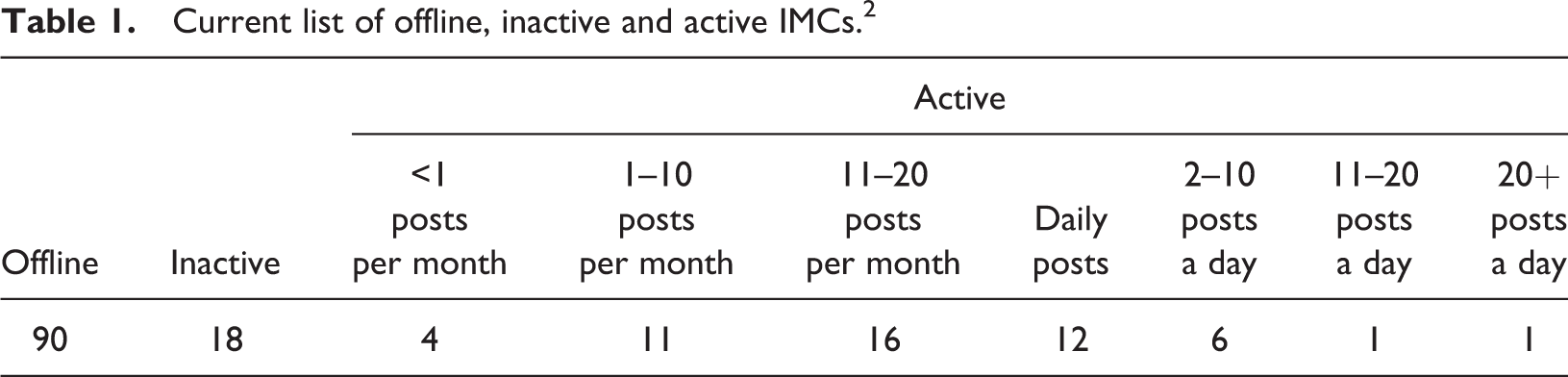
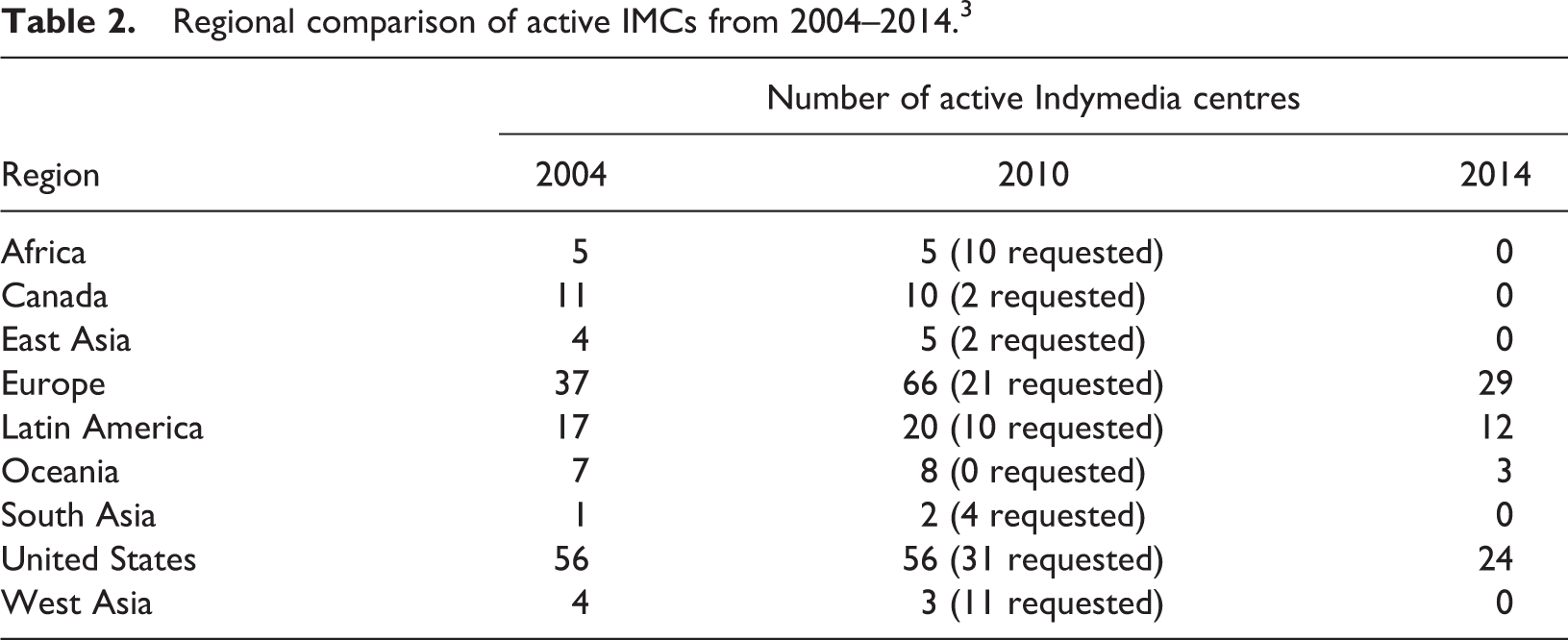
Academic and activist literature about Indymedia attribute the network’s difficulties to a range of factors, including informal hierarchies, lack of inclusivity and shifts to Web 2.0 media. Despite the limitations of quantitative methods for analysing complex phenomena such as social movements (Melucci, 2003: 56), as these were general claims being made about the network it was useful to provide a snapshot of the current state of Indymedia to explore their saliency by tabulating current IMC activity. The entire list of IMCs (as set out on indymedia.org) was therefore used as the sample and coded in line with the following criteria: whether the site still existed, the date of the last post, the thematic content of the last post, the site’s posting frequency and the existence of notable issues (such as spam or viruses). In the process of gathering this basic data, any self-reflexive reports about Indymedia itself were also collated (located using active sites’ ‘tagging’ systems) to aid in identifying further problems and inform the selection of case studies; this revealed two further issues, anxiety over surveillance and unwieldy bureaucratic mechanisms. When gathering these materials, IMCs were grouped by area, using Indymedia’s categorization of regions rather than strictly political definitions, in line with the principle that it is important to use activists’ own definitions of what they do (Della Porta and Diani, 1999). This enabled both a general tabulation of network activity (Table 1) and regional breakdowns (Table 2). The initial overview was valuable not only in revealing new problems, however, but in suggesting that – whilst general claims made in the literature about the network’s decline were accurate (with some of these problems manifested in the wholesale loss of IMCs in particular regions) – some of the more pessimistic claims were not borne out, due to the highly active and engaged IMCs in Latin America, Oceania, Western Europe and certain parts of the United States.
Current list of offline, inactive and active IMCs. 2
Regional comparison of active IMCs from 2004–2014. 3
Theoretical case-study analysis
Due to case studies being a useful means of refining claims made in the literature (George and Bennett, 2005), a theoretical sample of IMCs was then selected according to the two factors emerging as significant in shaping the activities of individual centres: region and problem type. After problems that needed further exploration had been identified, therefore, examples from each region were selected for further study. As theories of collective action have been central to conceptualizing the work of new social movements more broadly (Melucci, 1996) and Indymedia, in particular (Pickard, 2006a, 2006b; Pickerill, 2003b, 2007), tracing how controversies surrounding particular IMCs were navigated by activists proved a useful means of exploring specific theoretical problems.
Activists’ self-reflexive analyses of the network gathered in the overview were used in identifying IMCs at the centre of controversies, locating controversies that weren’t discussed in the literature and in gathering materials pertinent to these debates. For instance, the (highly active) French IMC, Nantes, were critical of London IMC’s reasons for ceasing publishing and this dialogue led to the selection of UK Indymedia as a means of exploring these internal tensions in more depth. In turn, heated debates between the collective running UK Indymedia and the international network, about the bureaucracy involved in setting up new IMCs, included links to documentation about problems in setting up an IMC in Cairo. This, combined with the large number of ‘requested’ IMCs in West Asia in 2010 as revealed by the overview (in contrast with the lack of any active IMCs in the region in 2014), led to Egypt being used as a case study for this area. Once the sample had been selected, the case studies were explored in more depth by synthesizing research from activist ethnographers about these IMCs with primary materials gathered from archived email lists and published material from the IMCs themselves that had been uncovered when tracing these controversies. There is no space here to discuss every region, so those with problems (or responses to these problems) that overlap with other regions are not discussed at this time; the case studies are thus intended to be a heuristic exploration of how specific problems have manifested themselves in a range of minority and majority world contexts, without claiming to be exhaustive. 4 Further ethnographic research would be valuable, however, for exploring regional issues in more depth and developing more sustained analysis of individual cases.
Theoretical discussions and debates about Indymedia
Indymedia as radical participatory media
Indymedia was an early form of digitally enabled participatory media, with content produced by ordinary people rather than professional journalists, but was distinct from contemporary media that rely on user-generated content. This is because Indymedia did not have to conform to standards set by the commercial media platforms that are increasingly becoming ‘infomediaries’ in the news production process (Siapera, 2013). The network instead used (and indeed uses) its own servers and tailors open source content-management systems to suit the needs of its user community, enabling it to exist as an autonomous media network that did not (theoretically) have to be commercially viable, concerned with flak from state or corporate actors, or reliant on technology owned by third parties.
As Chris Atton (2002) suggests, the network instead heralded from a tradition of alternative media, which is designed to offer alternative political perspectives to the mainstream media. More specifically, it belonged to the participatory tradition that is integral to this form of media: which (in line with Carpentier et al., 2013: 288) is not about participation ‘through the media’ but ‘in the media’, ‘in the production of media output (content-related participation) and in media organizational decision-making (structural participation)’. The network, therefore, offered both a platform for non-mainstream content, whilst encouraging non-professionals to become involved in the production and organization of this content. This is not to say that the network was wholly autonomous from the mainstream media, as it also acted as an important platform for activist-produced counter-publicity that was intended to reframe issues or give material perceived as un-newsworthy new resonance (Downey and Fenton, 2003). As will be explored in more depth in the conclusion, the material practices of Indymedia ‘in the field’ also illustrated the role of the network in coordinating activist responses to the mainstream media (Feigenbaum et al., 2013; Stringer, 2013).
This alternative participatory tradition is still reflected in the sites’ content today, which include everything from broadly socialist material to more radical anticapitalist perspectives, stemming from the network's origins as a platform for the alter-globalization movement (Pickard, 2006b). After the launch of the first IMC to document events surrounding the 1999 anti-World Trade Organization protests in Seattle, new IMCs were established throughout Africa, Canada, East Asia, Latin America, South Asia, the United States and West Asia, reaching its peak in the mid-2000s, with over 170 regional IMCs globally (Garcelon, 2006).
What was unique about the site was not simply its radical content, but – to go back to Carpentier et al.’s discussion of participatory media – its organization. The Indymedia network embodied the ‘prefigurative politics’ that characterized the alter-globalization movement, allowing activists to experiment with developing a type of media that put their non-hierarchical political principles into practice (Frenzel et al., 2010). Not only did the network encourage people to participate in the process of news production, it also attempted to structure this process in line with horizontal principles (Pickerill, 2007). What this meant in practice was that the network was not simply a space for values of direct democracy to be articulated, but was also organized along these principles – which is what added the radical dimension to the network’s participatory media practices.
Fleshing out how these non-hierarchical principles were implemented has been central to academic work about Indymedia, and whilst there is no space to go into these attributes in depth here (see Platon and Deuze, 2003; Pickard, 2006b; or Kavada, 2013 for a more general overview of horizontal media praxis), key processes are the use of consensus decision-making processes and values of openness.
Consensus and openness in Indymedia
Consensus decision-making involves issues being resolved not through voting but through reaching a decision through (sometimes extensive) processes of discussion and debate. In Indymedia, this occurs on a global scale via email lists as well as at the level of local IMCs (Pickard, 2006a). The other key principle of the network (as identified by both Pickard and Pickerill, 2003b, 2007) is openness, epitomized by the site’s use of open publishing, openness to alternative perspectives and open forms of organization. As Tish Stringer suggests (2013), ironically it is by ‘hiding’ behind pseudonyms that activists are enabled to be open, with unmoderated and anonymous posting available to protect those posting contentious topics (328). Openness is also a principle of any Indymedia collective meeting (anyone can technically come to meetings and participate in a regional site’s organization). In addition, one of the criteria for new IMCs is that outreach is made to those beyond the activist community in order to involve more marginalized social groups in media making. Pickerill’s ethnographic work with IMCs in Australia, for instance, reveals the concerted effort made to engage with Aboriginal communities (2003b, 2007). Finally, openness exists on a technological level, with the network using its own servers (to secure anonymity, due to user data not belonging to commercial organizations) and open source software.
Differences from Web 2.0 platforms: participation versus aggregation
These attributes make the network different both from commercial Web 2.0 platforms and from libertarian open source software initiatives. Lincoln Dahlberg (2011), for instance, uses Indymedia as an example when he contrasts radical engagements with technology (to craft counter-public discourse and autonomous praxis) from liberal individualist forms of digital democracy (where technology is used as a platform for alternative perspectives or to expand access to information, without moving beyond this into supporting protest movements). The use of Facebook by Occupy would seem to belie this argument but, as Jeffrey Juris (2012) points out, although the potential for Web 2.0 and mobile communications to create mass mobilizations has been celebrated since the early 2000s (Rheingold, 2003; Shirky, 2008), these protests have been spectacular but often transient. Indeed, he suggests that social networks and mobile communications support an entirely different mode of protest – based on the logic of aggregation rather than networking. For Juris individuals are brought together (in both virtual and physical spaces), and actions take place, due to the aggregation of individual interests without these individuals always being meaningfully or sustainably connected in a way that facilitates movement building (Juris, 2012: 267).
Problems with participation in Indymedia
This is not to say Indymedia provides unproblematic solutions to these issues of sustainability. Even though both Juris and Constanza-Chock, for instance, foreground the ongoing use of practices pioneered by Indymedia within Occupy (for further discussion, see the concluding sections), they also emphasize continued issues with consensus decision-making processes, and difficulties in making truly participatory media, due to the emergence of informal hierarchies. As Pickard suggests, these problems have deep historical roots, with the issue most famously expressed in Jo Freeman’s Tyranny of Structurelessness (1984; originally published 1972). Freeman identified how non-hierarchical organizations often develop informal hierarchies of their own, which in turn become difficult to challenge as no one has the authority to do so.
This is borne out by Pickerill’s ethnographic work with Australian IMCs (2003b, 2007) and Pickard’s discussion of similar problems at the level of the global network, where the use of consensus decision-making was complicated by the difficulties of reaching a decision in large online discussions. This often led to inaction or undue weight given to the perspective of certain actors (2006b). More recently, Todd Wolfson (2012) has argued the network acquired a prescriptive model of what democracy ‘looked like’ (consensual and open) from the Zapatistas: ‘looking to the Zapatista Army of National Liberation to find or justify a set of ideologically pure laws regarding what it means to be part of the indymedia movement’ (2012: 153). He suggests, moreover, that this is what has prevented the network expanding beyond the activist community. He even sees it as ultimately contributing to Indymedia's decline – by failing to acknowledge regional specificities that might limit how these values can be realized.
The key problems posited in existing research, therefore, are of horizontality congealing as a rigid ‘model’ (which undermines its own aims through limiting participation) and of consensus models of decision-making leading to informal hierarchies. More broadly, however, there has been pessimism about the value of radical participatory digital media in the wake of widespread activist uses of commercial Web 2.0 platforms.
Displaced by Web 2.0 platforms?
Radical activist media projects such as Indymedia gave momentum to a celebratory narrative that foregrounded the participatory potential of digital media (see, e.g. Allan, 2006; Castells, 1997; Gilmor, 2006), but the network’s position in that narrative has since been displaced with discourses of ‘Twitter revolutions’ (Castells, 2012). Not only are these participatory logics leveraged as selling points for social networks (Cammaerts, 2008; Gillespie, 2010), Uzelman suggests they also yield a source of ‘cheap and even free labour’ for profit-making news sites (2011: 283). This commercialization of ‘participation’ has resulted in the emergence of a counter-narrative, which points to capitalism’s ability to recuperate dissent in the communicative realm (Dyer-Witheford and de Peuter, 2007) to the extent that communication is argued to be totally ‘captured’ by capital (Dean, 2010: 4). The outlook for radical participatory online media, therefore, has been portrayed as bleak, but it is important to assess whether this pessimistic outlook is warranted.
The present state of Indymedia
General overview
In examining activity across the current network (see Tables 1 and 2), it becomes clear that whilst Lovink and Rossiter’s assessment of Indymedia as a failure is an exaggeration, it is true the network has faced a dramatic decline.
The high proportion of IMCs on the central list that are offline/inactive (69%), and low proportion with daily posts or greater (12%), holds even greater significance when placed in a global context.
Whilst a decline seems obvious, this picture is more complex than it would initially seem, as – despite Indymedia’s ‘death’ being proclaimed in 2009 – the network was relatively stable between 2004 and 2010, with notable European growth and a large number of requested IMCs. 5 There is, moreover, no neat divide between the minority and majority world (in terms of the relative success of IMCs), as certain analyses have inferred. To examine the significance of these findings in more depth, therefore, it is now useful to turn to specific examples within each region. These specifics reveal both problems within the literature (rigid models of horizontality, informal hierarchies, inclusivity problems, and shifts to Web 2.0 platforms) and more complex issues facing the network (bureaucracy surrounding new IMCs and anxieties over surveillance).
Problems across the global network
Horizontality as a model and informal hierarchies: Indymedia Africa and Canada
These regions currently have no online IMCs, other than the inactive Canaria (last post 2010) and Estrecho, which only has monthly postings. This lack of activity made it difficult to locate ‘live’ controversies about these sites, but their problems can be elucidated through drawing on academic–activist analyses of these regions; Frenzel et al.’s analysis of Indymedia South Africa (2010) and Uzelman’s analysis of the problems of Vancouver Indymedia (2011), for instance, reveal a set of problems that support Wolfson’s critical assessment of the network’s model of horizontality.
As illustrated by the current list of IMCs the highest concentration of centres is in the Global North, but in 2004 attempts were made to organize a conference in Senegal to remedy this. Frenzel et al. outline that these attempts faced ideological problems (due to the ‘colonial undertone’ of the notion of ‘bringing’ Indymedia to Africa; 2010: 1182) and financial problems (with request for the global network to fund plane tickets for delegates blocked by Uruguay ‘on the grounds that linking the creation of new IMCs to a transfer of funds from the global Indymedia would create “dependent” rather than “independent” media’ (2010: 1182)). Despite these barriers, conferences were held in Senegal (2004), Mali (2006) and Kenya (2007). Further tensions emerged, though, due to asymmetries in funding and resources between IMCs in different regions. This ultimately led to African IMCs using funding from non-governmental organizations (NGOs), with the Mali meeting even taking place in governmental buildings.
This scenario illustrates the dangers of radical participatory practices morphing into an inflexible, overly general model of horizontality. For instance, Northern activists suggested that African meetings should take place in slum locations, whereas their Southern counter-parts claimed this was an ineffective strategy that simply ‘glorified poverty’; they also argued that their comparative lack of resources necessitated connections with NGOs (Frenzel et al., 2010: 1183). These issues thus epitomize Wolfson’s critique of the network’s application of Zapatista values, derived from a specific context, to a radically different environment where these values can be difficult to implement and even inhibit engagement with activists in different contexts.
This issue of certain participatory values becoming a model was not restricted to the majority world, with comparable problems in the other key region seeing a wholesale loss of IMCs: Canada. In the Vancouver collective’s case, Uzelman argues this was a particular problem with the site’s anonymous publishing (which allowed spam and ‘trolling’) and the openness of the editorial collective itself (which refused to address issues of sexism due to a reluctance to exclude problematic individuals, which resulted in female members leaving). Uzelman contends this was due to two problems that undermined the site; first, the collective (and the network more broadly) ‘confused open access regimes with democratically regulated resources (i.e. commons); second, some within the collective reified the technologies we used’ (2011: 286). In other words, there was an assumption that free access to information, and freedom for anyone to post anonymously, intrinsically produced radically democratic social relations; Uzelman argues, however, that this logic does not necessarily follow. By making the site vulnerable to hate speech and spam, and the collective vulnerable to informal hierarchies (or worse), these attributes actually undermined the potential for radically democratic praxis.
Both the African and Canadian examples, therefore, bear out Wolfson’s argument that horizontality has become an overly rigid model in some parts of the network, with these regions pointing in particular towards the difficulties in implementing open posting and sustaining collectives that are genuinely open (and do not result in informal hierarchies that cannot be challenged or allow patriarchal or racist relations to emerge through ‘the back door’).
To combat these issues, Uzelman suggests that IMCs need to establish a clearer relationship with the communally produced and regulated resources generated by the network (its commons). Whilst there is no space to go into his extensive discussion of the commons here, his central argument is that a sustainable ‘commons require[s] that those behaviors, desires, beliefs, and habits that would disrupt sustainable forms of regulation be limited or excluded such that commoner subjective dispositions might prevail’ (2011: 297). What this means in practice, is that a much clearer idea of what ‘openness’ looks like – and how to secure it – needs to be developed dialogically between IMC members, in order to establish a framework for democratically managing the Indymedia commons: as opposed to letting open source technologies or open meetings suffice in themselves (an argument developed in more depth in the Conclusion section).
Bureaucracy and inclusivity issues: Indymedia Egypt
Issues surrounding prescriptive models of horizontality are also borne out in other contexts; for instance, in West Asia all IMCs are currently offline, except for Beirut which has had no posts since 2007. This is significant both in light of uses of Web 2.0 media during the Arab Spring and the problems that have been levelled at these platforms; notably Evgeny Morozov’s (2009, 2011) argument that uses of Twitter in the 2009 Iranian demonstrations led to the surveillance and arrest of protestors. Table 2 indicates, however, that despite no active IMCs existing in this region in 2014, in 2010 there were not only active centres but a high demand for new collectives.
In early 2011, activists in Egypt perceived the need for an independent media source that was not a privatized media platform, yet were frustrated in their attempts by the demands of the application process. All collectives who wish to form a new local Indymedia site have to compose a membership application that explains how the collective will uphold Indymedia’s values (see Indymedia, 2009 for the full set of guidelines). The applications are then read by the international new IMC working group, discussed on their email list, and – in line with the principles of consensus decision-making – any member of the working group can block an application (which then has to be revised and resubmitted).
Attempts to launch Cairo IMC were initially blocked by a member of the working group who objected to Israel IMC not being listed on the Egyptian collective’s home page. Then, after this was resolved (with the Israel collective themselves supporting Cairo’s decision, due to understanding the difficulties of regional Internet censorship), on 1 March 2011, a member of the would-be Cairo IMC sent the following email in the new IMC list: ‘We have sent our application for Indymedia Cairo some time ago. As mentioned in an earlier email, we have agreed to the Principles of Unity, CNIMC Mission Statement and the Membership criteria. Where shall we go from here?’ (Mortada, 2011). The email was referring to the rules of the application process, which demands direct collaboration with existing IMC members – a rule that, theoretically, should ensure that all the IMCs across the network follow the Indymedia guidelines that are designed to secure horizontality. Yet a month later another email was sent from Cairo activists: It seems since no one jumped forward to be our liaison, I see no other way than following the steps ourselves without a ‘helper’, so we will be writing to IMC-Process and IMC-Communication and waiting for their response. If it is not what people feel is ok, please let us know, and please propose a way for us to move forward. Tomorrow there is a high chance we squat Tahrir Square again, and we would have liked to have Indymedia up and running. but. but. but! (Mortada, 2011)
Whilst these exchanges illustrate Wolfson’s argument, they also foreground a new danger of bureaucracy undermining new IMCs. The lack of flexibility in terms of the rules designed to secure horizontality lead (paradoxically) to a lack of sensitivity to regional politics. Similarly, rules designed to foster solidarity and mutual understanding – such as having helpers – means that the process of applying to join Indymedia could take several months. This makes it difficult for activists facing direct political pressures to publicize their situation immediately. (Indeed, this was not an isolated case, with similar debate arising over the length of time it took to certify a new IMC occurring with a proposed El Paso IMC, and a much earlier attempt to launch a Cairo IMC in 2002–2003 breaking down entirely; see Evodkas, 2003 and Jimdog, 2011).
Whilst this paints a bleak picture, it does illustrate the demand for autonomous media spaces (despite the problems in realizing these demands), an issue that has also been illustrated by the recent protests in Gezi Park, Turkey, where Turkish citizens have been arrested after posting on Twitter (Harding and Letsch, 2013), but Istanbul IMC continues to publish regular footage of the protests regardless of this fact. This is not to say that Indymedia is invulnerable to state interference. In Greece, for instance, Indymedia was blocked by the government in April 2013 and Istanbul IMC itself was blocked in 2008 (Istanbul Indymedia, 2008) 6 – but ongoing uses of Indymedia, coupled with the demand for new IMCs in the region, suggest the need for non-commercial, open and anonymous media spaces despite these difficulties.
Surveillance and anxiety: Indymedia United Kingdom and European Union
In Europe, 34 sites are offline or inactive (leaving 29 active), but it is still flourishing in certain regions in the United Kingdom (Bristol, Nottingham and Scotland); France (Grenoble, Paris and Nantes); Poland (national site); Portugal (national site); Spain (Barcelona); Belgium (Brussels); Germany (national site and Linksunten); Ireland (national site) and the Netherlands (national site). Difficulties leading to closures of sites across Europe are similar to those raised by the wider network, including financial troubles (Italy) and a decline both in editorial volunteers and in the global justice movement more broadly (Hungary and London). Reflections about these difficulties on several European sites (London Indymedia, 2012; Nantes Indymedia, 2013; Notts Indymedia, 2013), however, pointed to a further problem, of concern over state intervention and surveillance leading to more hierarchical modes of organization.
In early 2011, differences between regional UK IMC collectives led to a fork in the network, with one group (the Mayday collective) seeking to maintain the UK site as it was, whilst another collective (Be the Media) wanted to act as aggregators for local IMCs across the United Kingdom. Whilst the reason for the fork is too convoluted to delve into (see Mayday Indymedia, 2011, for more detail), both sides of the division illustrated tendencies that have ultimately facilitated the recuperation of dissent.
Be the Media’s aim was admirable. It wanted to remove editorial hierarchies 7 by acting as an aggregator for regional IMCs without assuming editorial agency over this content. By functioning as an aggregator for preexisting regional sites, however, the notion of activist media as a dialogical space was lost, as articles on the ‘main site’ just exist as hyperlinks to local sites there is no ability to comment on the national website itself (see Be the Media, 2010a). This model, therefore, removed the option for people to publish stories directly to the UK site, or flag particular issues as nationally important. Public input into the central hub of the Be the Media network was therefore precluded, making it difficult for local groups to frame their demands as having resonance beyond their localities. Instead it embodied the individualizing aggregative logic Juris ascribed to Web 2.0 platforms. This relates to a problem raised by Paul Chatterton and Jenny Pickerill (2010), who suggest that a key difficulty with horizontal networks is their difficulty in scaling from local to global. With the shift to acting as an aggregator, the risky and uncertain project of forging relations between regional IMCs to facilitate scalability without hegemony is further inhibited. Another problem is that in replicating a ‘Web 2.0 aesthetic’, complete with a constantly updated list of ‘trending’ topics and a sister microblogging site (see Be the Media, 2012b), the site resonates with Chatterton and Pickerill’s concerns that such forms of ‘professionalization’ are a form of recuperation in itself (2010: 480).
Mayday Indymedia, in contrast, demonstrates a more worrying shift from being an experiment in direct democracy to simply acting as an activist media platform. Like the Cairo IMC proposal, the UK Indymedia site faced difficulties in the new IMC process. Mayday’s response, however, revealed a different problem: one that Indymedia structures were intended to guard against (for the full debate, see Mayday Indymedia, 2011). The new IMC working group were particularly concerned about Mayday’s defence of using a server that, in 2010, had been revealed as storing the Internet Protocol (IP) addresses of Indymedia users; this contravened the principles of openness through anonymous publishing (as outlined by Stringer, 2013). Mayday defended this by arguing that it was to protect against government attacks, but refused to acknowledge – ironically – that this action could itself leave activists vulnerable to state surveillance. They also did not acknowledge the observations from their new IMC liaison that governmental IP addresses did not automatically equate to surveillance (and could be civil servants, hospital workers or people working in educational institutions). As a result, for the UK network at least, core values of participation lost out to the desire for a specifically activist media, with the commons no longer regulated according to communally defined parameters but by an activist minority. This also reveals potential dangers in Uzelman’s solution of managing the commons in a more structured way. What is indicated by the problems faced in the UK, is that any structures need to genuinely reflect the collective’s values and be not only visible but able to be contested, to prevent the ideas of a dominant minority undermining the site’s inclusivity.
Engagement with grass-roots and indigenous movements: Indymedia Argentina
Latin America has also shown an overall decline in terms of the number of IMCs. active centres nonetheless pose a challenge to the assessment of Indymedia as a failure, since all of the active sites in the region had daily or more frequent postings. As the most active IMC in the network (the only one with 20+ posts per day), it is useful to turn to the central Argentina site to gauge the reasons for this success. IMCs in Europe cited the decline in the global justice movement as leading to the closure of centres. In response, local collectives (notably Nantes, 2013; Nottingham, 2013) posted reflections about the network which suggested engagement in regional struggle and class-based politics were necessary to counter Indymedia’s decline (Notts Indymedia, 2013); this is an argument supported by the success of the network in Argentina.
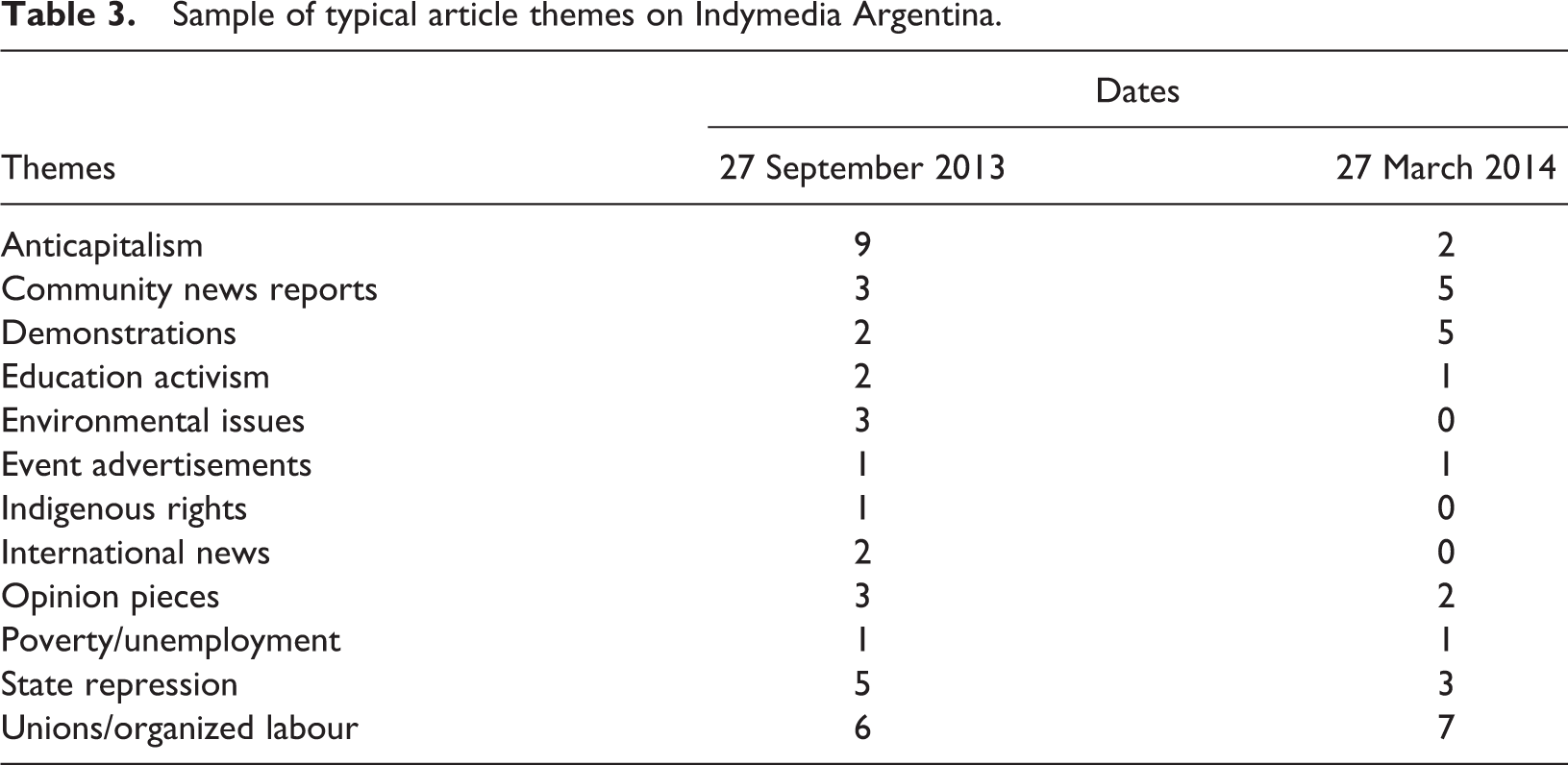
Argentina had a shaping role in the network from the outset, which demonstrates their close relation to grass-roots protest movements. Controversy over whether the Urbana IMC should accept a grant from the Ford Foundation in 2004, for instance, is often cited as an instance of the network’s ideals of direct democracy and consensus decision-making being realized in practice (Pickard, 2006b; Sullivan et al, 2011). Although Wolfson points out that this is indicative of tensions between regional specificity and the needs of the network as a whole (2012: 416), Argentina’s stance was because of Ford’s historical support of the Pinochet regime. They therefore felt that support from the foundation would ‘irreparably damage the role of IMC Argentina with local organizations, for they would lose credibility within the communities with which they were working’ (Wolfson, 2012: 416). This rejection has been attributed to Indymedia in this region evolving with radical workers’ movements such as the piqueteros (Chatterton and Gordon, 2004), with the network countering perceived mainstream media bias against these movements (Garcelon, 2006: 68). These analyses suggest, therefore, that connections with grass-roots movements, coupled with the mainstream media's perceived lack of credibility, are what give Indymedia Argentina its ongoing value. Most of these debates, however, stem from the early 2000s, so it is useful to turn to the present-day site to determine whether these claims are still relevant. Due to the site being successful, the approach taken to discussing previous case studies was impracticable as there were no IMC-threatening controversies to be traced! Current content on the site, however, is indicative of strong links existing between the network and a range of social movements.
This snapshot of article themes on typical days (taken 6 months apart) illustrates a wide range of daily stories from grass-roots groups ranging from labour movements and squatters to education and food protests (Table 3). Such a widespread engagement is thus indicative of ongoing connections between local protest movements and Indymedia in Argentina. Although this is partly due to regional specificity, with highly active grass-roots movements compensating for the decline of the global justice movement, Indymedia’s ongoing relevance to these groups is still notable in comparison with IMCs in the Global North.
Sample of typical article themes on Indymedia Argentina.
Web 2.0 activism: Indymedia US and Occupy’s media ecologies
Despite a number of highly active IMCs, with 22 functioning and several with daily posts (or greater), including New York, Portland, Austin, Bay Area San Fransisco, Washington DC, Chicago and Santa Cruz, there was also a huge decline in US centres. Thirty-six sites were offline or defunct including the original Seattle centre. The problems that led to the decline of Indymedia in Canada were also evident, with some sites inundated with spam (Texas and Rochester), with Chicago even disabling open publishing due to this issue. Other sites cited lack of time and resources, resulting in publishing being disabled (Baltimore, Pittsburgh and Buffalo).
Two related difficulties have been raised in reflections by US activists about the network: technological backwardness and the way this discouraged contemporary activist movements from using the site. In debates about the state of the UK network, for instance, where problems with open source content-management systems and difficulties for activists in maintaining the pace of commercial sites were raised, activists from Philadelphia, San Diego, San Francisco and Chicago shared similar experiences. These activists also pointed out difficulties in creating mobile-friendly media – in contrast with setting up desktop servers – but still stressed the importance of non-corporate alternatives (Behind the Mask, 2013). A San Diego commenter, for instance, described how ‘our crew reported and kept up with the ongoings of OccupySD and tried to support when possible, [but] the local occupy activists themselves chose not to use Indymedia, opting instead for Facebook, Twitter and Livestream. Whilst the movement as a whole was overwhelmingly using new media, very little of it is archived and easily accessible now’ (Brian, San Diego IMC in Behind the Mask, 2013). At stake for these activists was how to make use of contemporary technologies to keep the site user-friendly, whilst still making non-commercial, sustainable, archivable and secure media. Technological changes were therefore posited as one way of drawing activists back to the network, with activists pointing to the value of collaboration with local hackerspaces.
Indymedia has a long history of collaborating with hackers or coordinating its own hacklabs, to share technical expertise (Garcelon, 2006; Pickerill, 2003b). Recently though critics have noted a decline in the politically engaged hacklabs that rose to prominence in tandem with Indymedia, and a greater prevalence of less politicized hackerspaces (Maxigas, 2012 ). The rise in new politically engaged hacker movements, who share activists’ resistance to neoliberalism (Söderberg, 2013), could – however – renew opportunities for activists to engage with a community that has the technical knowledge to experiment with cheap, secure, but accessible infrastructures to support media production.
Indymedia’s ‘success’ or failure should not be measured on the basis of whether activists can find technological solutions to prevent the shift to commercial platforms, however, as this ignores its more enduring legacy for contemporary social movements. Indeed, this is why understanding social movement media as part of complex ecologies is so important. As Stringer argues: Indymedia catalyzed change in the media landscape as we know it, making it more multimedia driven, interactive and populated with first person reporting. These actors are the seeds that drive long-term changes to the fabric of society. The changes bear fruit slowly and may not have been the movement’s goals from the outset, but through the lens of long-term engagement and hindsight we can see the results. (2013: 332)
Much has been made of Occupy’s use of social media, for instance, but more significant is the way these platforms are part of increasingly complex networks of online and offline media, many of which (such as listservs and physical media tents) are underpinned by practices derived from Indymedia. As touched on above, Commercial platforms are seen as problematic due to their ‘logic of aggregation’ (Juris, 2012) inhibiting activist media practices that were theorized over the previous decades as a means of explaining the power of the global justice movement (e.g. Hands, 2010). These theories positioned the recognition of shared interests and the development of mutually beneficial tactics at the micro-sociological level (via processes of deliberation and dialogue) as integral to realizing autonomy from capitalism. The aggregative media cultures enabled by Web 2.0 media, in contrast, are not as helpful in facilitating the processes of deliberation and recognition necessary for activist networks to expand. Individuals are instead loosely brought together (as the 99%, for instance) without forming the sustainable ties necessary for movements to collaborate around specific issues or cohere as large-scale protest networks. Indeed, This was one of the sources of the accusations about the transitory nature of Occupy from both the left and right; Dean, 2012; Roberts, 2012.
It is for this reason that both Juris and Constanza-Chock point towards the legacy of Indymedia and listservs in creating a more sustainable dimension to the work of Occupy. This legacy is illustrated by dialogical processes that occurred on an interpersonal level, and via internal email lists, to make decisions that provide more sustainable structures for the movement (as epitomized by Occupy Wall Street’s collectively produced ‘principles of solidarity’ [2011]). These processes of dialogue are integral to enabling movements to scale, by engendering a ‘politics of connections’ (Carroll and Hackett, 2006: 93), where disparate groups and individuals are brought together in a manner that enables more sustainable ties to be forged between solidarity groups. From this perspective, despite pessimism over the ephemeral nature of Occupy, (which has – ironically – been attributed to its links with the communicative cultures of radical democratic movements; Dean, 2012), the decision-making processes and communicative infrastructures pioneered by Indymedia can be seen as valuable in countering this ephemerality.
A critical focus on online media alone, moreover, neglects the material practices that are central to activist media ecologies. Deliberation for Indymedia did not just occur online and IMCs were an integral part of the infrastructure of protest camps and convergence sites throughout the 2000s. IMCs were thus vital both in communicating activist perspectives and as exercises in activists’ political imaginaries. As Juris describes, IMCs were often highly affective locations that fostered solidarity between individuals ‘where anti-corporate globalisation activists come together to practice grassroots media activism, socialise informally and exchange ideas, information and resources’ (2008: 268). Activist media spaces have since become the norm in these contexts, with dedicated media tents now ubiquitous in protest camps (Feigenbaum et al., 2013: 102–111). Radical participatory media has also played a vital role as counter-publicity that communicates these imaginaries to the public, from the live coverage of demonstrations that was pioneered by activists during the nascent days of Indymedia (in the J18 protests and ‘Battle of Seattle’) to the live streaming of present-day activist camps (Feigenbaum et al., 2013: 108).
Even though Indymedia itself may have been underused by Occupy, the value of activist produced media remained pivotal to the movement. In its internal communication (such as listservs), decision-making processes (consensus), emphasis on the value of alternative media for articulating activist imaginaries, and use of physical media spaces as a hub for producing and responding to media, the legacy of Indymedia was evident.
Conclusion
The overview of activity across Indymedia revealed a huge decline in the number of active IMCs, with some regions currently left without any centres at all. Key problems put forward in the literature were also borne out within both the broad overview and more specific analysis of regions and individual centres (such as informal hierarchies, an inadvertent lack of inclusivity, and shifts to Web 2.0 platforms). In addition, further issues were identified, including bureaucracy surrounding new centres and anxiety over surveillance. This is not to say, however, that pessimistic diagnoses of either Indymedia itself, or radical participatory online media more broadly, are warranted. Indymedia’s legacies within Occupy, for instance, indicate that its core media-making practices are still important in alliance building, crafting activist imaginaries and experimenting with what these imaginaries could ‘look like’ in practice. Conversely, Indymedia UK’s shift to acting as an exclusionary activist platform, foregrounds the danger in calls for more vertically oriented media. The ongoing demand for centres in regions facing repression (as revealed in the analysis of Egypt), or where a platform for diverse social movements is necessary in the face of mainstream media bias (Argentina) also suggest the practical need for autonomous, and anonymous, media in certain contexts.
This is not to say, though, that Indymedia’s problems can be sidelined. Although solutions can be posited to several of these issues, such as renewed engagement with local hackspaces and grass-roots protest movements, certain difficulties still need to be addressed. As touched on previously, problems of informal hierarchies within open groups have been identified since the 1970s. Uzelman’s suggestion of organizing the Indymedia commons in a more transparent way is akin to Freeman’s original argument that structures should exist to prevent dominant individuals holding undue influence. These structures, however, should be dialogically formulated and visible so that they can be opened to challenge in the future. This process is not straightforward; indeed, Rodrigo Nunes argues that the global justice movement has already experimented with Freeman’s solutions, but that these hierarchies have persisted. Like Wolfson, he attributes this to certain structures being fetishized, as particular attributes what direct democracy, or horizontality, should look like: ‘By deciding on an ideal model of what [direct democracy] should be like, all we are doing is creating a transcendent image that hovers above actual practices’ (2005: 310–311). In other words, whilst these transparent structures have been established, they have not been open to dialogical revision in a manner that enables negotiation with the needs of regional IMCs. This has been manifested by the level of bureaucracy involved with establishing new centres, which failed to take pressing political needs into account (as in Egypt and El Paso). The lack of understanding that certain IMCs might need to form what the Turbulence Collective (McLeish, 2010) describe as ‘diagonal’ relations with NGOs to maintain themselves (as in Mali) is also evident. A potential means of negotiating these issues could, therefore, be to pare down which rules are vital for Indymedia membership (to enable faster initial connections with the network) before dialogically engaging in discussion about how to realize other values in a manner that recognizes local difficulties.
Whilst the Indymedia network itself might still prove a useful resource in certain regions, in others it needs to be adapted to overcome persistent problems. In some contexts, moreover, it is not the network itself, but its core practices that prove useful for developing more sustainable activist media ecologies. Thus, although a steep decline IMC activity reveals the network’s failings, it is important not to dismiss it as an outright failure. We can learn from its legacy.
Footnotes
Acknowledgements
Many thanks to everyone at the Centre of Critical Theory, University of Nottingham, particularly members of the Technology and Resistance research strand. Special thanks to Jen Birks, for providing invaluable insight and advice. Thanks too to the three anonymous reviewers and to Carolyn Guertin and Angi Buettner, Convergence special issue editors, whose incredibly helpful and supportive feedback was much appreciated.