




Abstract
While it is increasingly acknowledged that travel participation is affected not only by travel constraints but also by the personal importance of travel, the drivers of this perceived travel importance are still poorly understood. Using data from the German Socio-Economic Panel (1990–2021), this paper offers first exploratory evidence on the socio-demographic and psychological determinants of personal importance of travel. Travel importance increases with household income and decreases with ill health and the number of children. Women, first- and second-generation migrants, risk lovers, and those scoring higher on the personality traits of openness and extraversion also consider travel more important. The application of the age-period-cohort model suggests that the personal importance of travel declines with age and displays some variation across generations. These findings provide insights for tourism practitioners and policymakers seeking to understand which population groups consider travel more important and, consequently, are more likely to undertake travel.
Keywords
Introduction
The fact that a significant proportion – between a quarter and a third – of people in high-income countries do not undertake leisurely travel has motivated a burgeoning literature on the determinants of non-travel (Haukeland, 1990; Litvin et al., 2013; McKercher, 2009; McKercher and Chen, 2015; McKercher et al., 2022; Popp et al., 2024; Smith and Carmichael, 2005; Smith et al., 2009). While this literature has acknowledged the role of travel constraints, such as the lack of time, high costs and family commitments, it has also suggested that some people do not travel because they lack the travel bug, are not interested or willing to travel, or do not think that travel is a life priority or an activity important enough to pursue. A consensus is emerging that such underlying/latent willingness to travel, as well as the importance people attach to the activity of travel, constitute key preconditions for actual travel participation (McKercher, 2009; McKercher and Chen, 2015; McKercher et al., 2022; Popp et al., 2024). Put differently, even when people possess the capability to travel, some will choose not to do so because they lack the aspiration to travel and/or do not regard travel as sufficiently important.
If the importance attached to travel shapes travel decisions and behaviours, it becomes essential to understand who considers travel important and who does not. Is travel importance an innate characteristic, akin to a personality trait and therefore relatively stable, or does it vary with personal and family circumstances? How does it change with age, and does it remain consistent across generations? Addressing these questions is valuable for anyone seeking to understand the factors that influence the importance people assign to travel and, consequently, their actual travel participation. Key stakeholders include firms in the tourism industry, which are generally keen to increase their customer base. Knowing who is considers travel important and how this importance changes over time can help target tourist products more successfully. Such information could also be useful for governments and decision-makers wishing either to promote travel (for example, due to the benefits it brings to travellers (Chen and Petrick, 2016) or host societies (Ivlevs and Smith, 2024)) or restrict it (for example, because of its potentially negative environmental impact or adverse societal effects).
This study aims to provide comprehensive evidence on the socio-demographic and psychological determinants of the importance that individuals place on the activity of travel. Theoretically, the study draws on the attitude importance model (Chen et al., 2019; Chen and Petrick, 2016; Howe and Krosnick, 2017), as well as various theoretical explanations, such as cognitive dissonance and social desirability bias, for why people may misreport how important travel is to them (Chen and Petrick, 2016; McKercher, 2009). These theoretical frameworks, together with the related empirical literature, guide the selection of explanatory variables, which include changes in income, employment shocks, health, family formation, education, immigration background, personality traits, risk attitudes, and age–cohort effects. Empirically, the study uses data from the German Socio-Economic Panel (SOEP) – a reputable, large, longitudinal, nationally representative and publicly available survey of German residents conducted every year since 1984. The survey started collecting information about the personal importance of travel in 1990, providing a unique opportunity to study its variation and determinants both between and within individuals, over three decades.
This study makes several contributions to the literature. First, it provides a detailed socio-demographic and psychological profile of people who consider travel important, the understanding of which is crucial for understanding why people undertake travel. Earlier studies have examined the relationship between the importance people attach to travel and perceived travel benefits and constraints (Chen and Petrick, 2016), as well as its association with key socio-demographic variables of age, gender, education and income (McKercher et al., 2022); however, a comprehensive analysis that incorporates a broader range of individual-level characteristics, including personality traits, and investigates whether the importance of travel changes over time has yet to be undertaken. Relatedly, the paper contributes to the broader literature on the antecedents of attitude importance, which has highlighted self-interest, social identification, and values as primary determinants of attitude importance (see e.g., Howe and Krosnick (2017) for a review of this literature and Chen et al. (2019) for an application of this framework to explain travel importance and travel behaviour).
Second, the paper adds to the related literature on non-travel, further “unpacking the disinterested tourist” (McKercher et al., 2022) through the lens of the personal importance of travel. Among other things, this literature has contended that people, when asked about reasons for non-travel, would report constraints, such as the lack of time or high cost, rather than reveal the underlying lack of interest in travel, the mention of which may be considered socially unacceptable (McKercher, 2009). At the same time, when the reasons for non-travel are not probed, the personal unimportance of travel is reported more widely. Given that the survey used in this study does not ask respondents for reasons for their non-travel (or indeed about their travel participation/behaviour), the analysed importance of travel would arguably align closer with the true underlying willingness to travel. Finally, the paper contributes to the debate on the effects of age and birth cohorts on travel-related variables (Lin et al., 2023; McKercher, 2023, and references therein) and offers the first quantitative application of the age-period-cohort model to distinguish between the age and generation effects for the personal importance of travel.
Theoretical underpinnings and related literature
Importance of travel as a determinant of travel behaviour
The model of attitude importance – a well-established theoretical framework in social psychology – contends that the degree of importance people attach to objects, places or ideas shapes decision-making and behaviour (Boninger et al., 1995; Howe and Krosnick, 2017; Petty and Krosnick, 1995). Selective exposure, knowledge accumulation and cognitive elaboration are the key mechanisms driving this relationship: individuals who consider an issue important are more likely to seek relevant information and to attend to, engage with and elaborate on it, thereby influencing subsequent attitude-related action (Holbrook et al., 2005; Howe and Krosnick, 2017).
Chen and Petrick (2016) and Chen et al. (2019) were the first to apply this framework to the travel domain, arguing that it is particularly suitable for explaining travel decisions because the attitude–behaviour link is stronger under deliberative information processing (Boninger et al., 1995; Howe and Krosnick, 2017): as tourism products are intangible, their purchase typically involves deliberative processing using internal and external information. Using data from an online US survey, Chen and Petrick (2016) identified strong relationships between travel importance, cognitive elaboration and travel behaviour, concluding that travel importance affects behaviour through cognitive elaboration. These findings were corroborated cross-culturally by Chen et al. (2019), who showed that travel importance has both direct and indirect (via travel knowledge) effects on travel behaviour among US and Taiwanese respondents.
The importance of travel – alongside closely related concepts such as interest in travel, willingness to travel, travel bug and wanderlust – has also been evoked to explain travel non-participation. This literature has developed in response to the observation that between a quarter and a third of people in high-income countries do not participate in leisurely travel (Litvin et al., 2013; McKercher, 2009; Popp et al., 2024; Smith et al., 2009). Traditionally, non-travel has been explained through the leisure constraints framework, which assumes that everyone is willing to travel but some do not because they cannot overcome constraints such as limited time, high costs, health issues or a lack of companions. Comprehensive constraint structures – such as economic/social (Haukeland, 1990; Smith et al., 2009) or intrapersonal/interpersonal/structural (Crawford et al., 1991; Karl et al., 2020; Nyaupane and Andereck, 2008) – have been developed, implying that once constraints are removed, everyone will travel (Litvin et al., 2013; McKercher, 2009).
However, many scholars have argued that non-travel cannot be explained by constraints alone. In his seminal work on social/economic constraints dichotomy, Haukeland (1990) called for a “broader understanding” and the identification of “hidden reasons” for staying at home, noting that for some people non-travel may be “the most tempting alternative regardless of prevailing circumstances” (Haukeland, 1990: 177). McKercher (2009) found that two-thirds on non-travellers in Hong-Kong did not consider pleasure travel important, concluding that non-travellers “simply do not have the travel bug”. McKercher and Chen (2015) further challenged the constraints model by showing that travel behaviour is strongly related to the importance attached to tourism, particularly relative to other life domains. Similarly, McKercher et al. (2022) demonstrated that Australians who consider travel more important are more likely to travel and to see themselves as experienced tourists. Finally, Popp et al. (2024), analysing German non-travellers, identified motivated and non-motivated (voluntary) non-travellers, with motivation captured by the importance of holidays and their contribution to happiness and life enrichment.
To synthesise the above studies, Figure 1 proposes a categorisation that combines their key insight – that the importance of travel is a central determinant of travel behaviour – with a traveller and voluntary/involuntary non-traveller typology. The horizontal axis represents the underlying or latent willingness or aspiration to travel, captured by concepts such as the personal importance of travelling, travel as a life priority, interest in travel, travel bug, wanderlust or urge for travel. While these notions differ subtly, they arguably correlate with underlying willingness to travel and are often used interchangeably in the literature (e.g., McKercher, 2009; McKercher et al., 2022). The vertical axis represents the capability to travel, defined by the extent to which individuals can overcome, or do not face, travel constraints. This 2 × 2 framework yields four categories: travellers, who are willing and unconstrained; involuntary non-travellers, who are willing but face high travel constraints; voluntary non-travellers, who are unwilling but face few or no constraints (corresponding to the non-motivated non-travellers in Popp et al., 2024); and non-travellers who are neither willing nor able to travel.
1
Willingness/aspiration and capability to travel: 2 × 2 categorisation.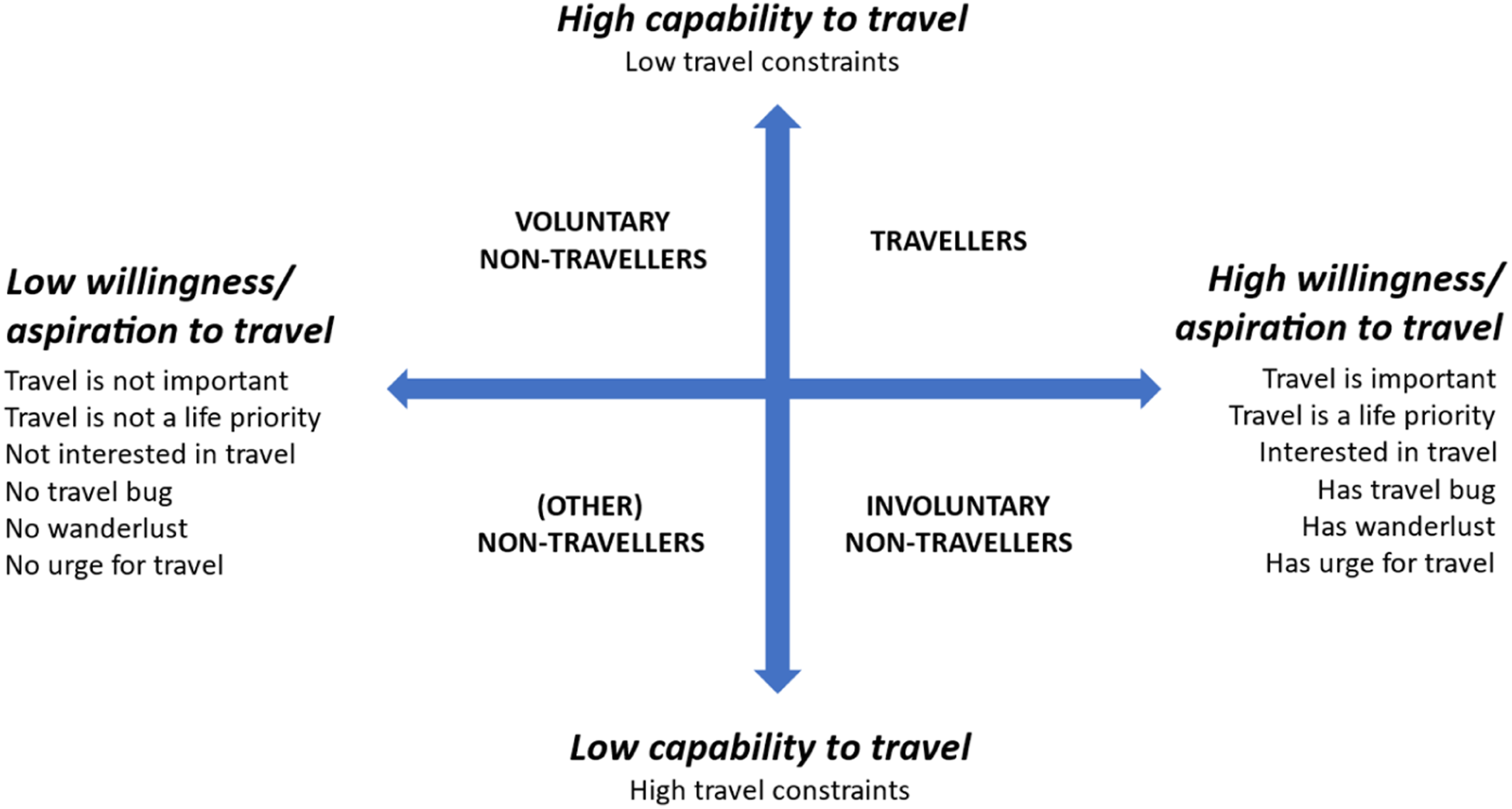
What explains the importance of travel?
Having recognised that both the personal importance of travel and travel constraints are key determinants of travel behaviour, it is crucial to understand what factors shape them. While a substantial literature examines travel constraints (see e.g., Karl et al. (2020) for a review), far less is known about the determinants of the personal importance of travel. In particular, evidence on its socio-demographic determinants is limited. The only study to date, McKercher et al. (2022), shows that Australians who consider travel important (“interested tourists”) have similar median age and gender distributions to those who do not, but tend to have higher income and education levels.
Taking a broader perspective, the social psychology framework of attitude importance posits that the importance people place on an object depends on three key factors: self-interest (personal benefits), social identification (whether reference groups or individuals consider it important) and values (relevance to underlying social values) (Boninger et al., 1995; Howe and Krosnick, 2017). Applied to travel, Chen and Petrick (2016) and Chen et al. (2019) show that perceived travel benefits, social influence and value relevance are all significant antecedents of travel importance. The relative strength of these factors is culture-dependent: for example, value relevance has a stronger effect for Americans, while self-interest matters more for Taiwanese respondents (Chen et al., 2019).
Returning to the importance of travel, a key insight from the literature is that people may struggle to report its true importance because of cognitive dissonance or social desirability bias. Cognitive dissonance theory suggests that people adjust beliefs to avoid discomfort when attitudes conflict with circumstances (Chen and Petrick, 2016; Festinger, 1957). For instance, individuals who view travel as beneficial but lack time or money may report it as less important, implying that travel constraints directly affect reported importance and lead to under-reporting of latent travel importance (Chen and Petrick, 2016). 2 By contrast, social desirability bias may cause over-reporting, as admitting that travel is not a life priority can be socially unacceptable in some contexts (McKercher, 2009; McKercher and Chen, 2015; McKercher et al., 2022). In such cases, people may rationalise non-travel by reporting both high travel constraints and high travel importance, even when both are low.
Remarkably, the social desirability bias is more likely to manifest itself when people are asked about specific reasons for their non-travel. For example, in a study of non-travel motivations in Hong Kong, McKercher (2009) found that two-thirds of non-travellers said they did not consider taking pleasure trips important. However, when asked about barriers to non-travel, lack of interest or low importance of travel were seldom mentioned, while socially acceptable constraints, such as family and work commitments, featured more prominently. From this perspective, the current study is likely to deal with a good approximation of the true underlying importance of travelling, as respondents in the SOEP survey were not asked about their travel behaviour or reasons for non-travel.
Potential socio-demographic-psychological determinants of the importance of travel
The objective of the present study is to establish the socio-demographic-psychological profile of people who consider travel important. While such an exercise could remain exploratory and entail, for example, regressing a measure of travel importance on a set of standard personal characteristics, the existing literature offers guidance on what explanatory variables one could use to predict the personal importance of travel.
First, the cognitive dissonance argument, whereby people downgrade the importance of travel when facing high travel constraints (Chen and Petrick, 2016), suggests that individual characteristics affecting the ability to overcome constraints, such as higher income or job loss, will be associated with changes in the personal importance of travel. Other characteristics, such as poor health, represent direct constraints and thus have a negative effect on travel importance. Still others may have ambiguous effects: for example, marriage or cohabitation can relax interpersonal constraints (having a companion) but also raise them (constraints linked to a partner’s work commitments).
Second, changes in personal attributes or circumstances may shift life priorities and, consequently, the importance of travel. For instance, the birth of children can increase the importance of family and parenting at the expense of travel. At the same time, parents who value travel may wish to transmit such worldviews to their children, in which case the importance of travel may strengthen or become more salient after childbirth.
Third, several individual-level characteristics may affect travel importance through changes in social identification and underlying values, as suggested by the attitude importance framework (Boninger et al., 1995; Howe and Krosnick, 2017). For example, upward income mobility may change social networks and increase the salience of travel if it is valued by the new reference group. Education may similarly raise travel importance through shifts in social identification and personal values. However, education may also foster pro-environmental values and perceptions of travel as environmentally harmful, potentially reducing the personal importance of travel.
While the personal characteristics discussed so far (income, job loss, health, marital status, having children, education) can change over time, some determinants of the personal importance of travel may be largely stable. Immigrants and their descendants, for example, are often involved in diaspora tourism (Balli et al., 2023; Li and Chan, 2020), visiting relatives and friends in their countries of origin and (re)discovering these places. This may increase the importance of travel, consistent with both the values argument ((re)connecting with family or home country is important) and social identification (travel is what others in my reference group do). At the same time, immigrants may face relatively high travel constraints (Smith and Carmichael, 2005), which could reduce the importance of travel in line with the cognitive dissonance argument (Chen and Petrick, 2016).
Another characteristic that generally changes little over time is personality. The personal importance of travel may be related to personality traits such as the Big Five (openness to experience, extraversion, neuroticism/emotional instability, agreeableness and conscientiousness) and attitudes towards risk. Social psychology research suggests that traits such as neuroticism and openness to change can affect the importance, extremity and ambivalence of attitudes towards various objects and issues (Britt et al., 2009; Howe and Krosnick, 2017). Personality and risk attitudes have also been linked to travel participation and expenditure (Gedecho et al., 2023; Lin et al., 2023), travel motivation (Crompton and Petrick, 2024), novelty seeking (Blomstervik and Olsen, 2022) and destination preferences (Hardt and Glückstad, 2024). The present study will examine whether these factors are also antecedents of the personal importance of travel.
Finally, a key question is whether the personal importance of travel changes over time, both with age and across generations. Age is generally negatively associated with travel participation (Bernini and Cracolici, 2015; Lin et al., 2023), potentially reflecting lower willingness to travel and higher constraints. In cross-sectional data, however, age effects cannot be separated from cohort effects (Lin et al., 2023; McKercher, 2023). Panel data enable the application of age–period–cohort models. Following Lin et al. (2023), who applied this approach to tourism participation and expenditure, this study uses it to analyse time-related effects on the personal importance of travel.
Method
Data
The empirical analysis draws on the German Socio-Economic Panel (SOEP), a nationally representative panel survey of approximately 19,000 households (32,000 individuals) in Germany, conducted annually since 1984 (with respondents from the former Democratic Republic of Germany added in 1990). The survey covers a wide range of topics and is one of the most extensive and well-established socioeconomic surveys in the world. SOEP employs multi-stage, regionally clustered random samples, with respondents (households) selected by random walk or register sample. The face-to-face interviews are based on a set of pre-tested questionnaires, administered to all members of a survey household. Detailed information on the survey design and implementation is available on the survey webpage (https://companion.soep.de/).
Given the availability of data for the key outcome variable (importance of travel), this study draws on the 1990–2021 span of the survey. The analysis uses version 38 of the survey dataset (10.5684/soep.core.v38.1eu), which is publicly available and can be accessed from the survey webpage (https://www.diw.de/en/diw_01.c.601584.en/data_access.html).
Variables
The personal importance of travel is captured by the question: “Is the following currently important for you: Seeing the world and travelling extensively?”, with possible answers “very important”, “important”, “less important”, and “quite unimportant”. 3 The answers are reverse-coded from 1 to 4, with higher values corresponding to greater personal importance of travel.
The set of explanatory variables includes age/birth year, gender, marital status (single, married, divorced, widowed), number of children in the household, education (primary, secondary, tertiary), unemployment status (registered as unemployed), objective and subjective income measures (log of annual household income per capita and satisfaction with household income (0-low, …, 10-high)), satisfaction with health (0 – low, …, 10 – high), first-generation migrant (born abroad), second-generation migrant (born in Germany but at least one parent born abroad), the Big Five personality traits (openness to experience, extraversion, neuroticism/emotional instability, agreeableness, conscientiousness), 4 and risk attitudes (0 – risk averse, …, 10 – fully prepared to take risks). The survey questions used to construct these variables, as well as the summary statistics of all the variables included in the analysis, are provided in Table S1 of the Online Supplement.
Estimation strategy
While SOEP is a panel/longitudinal dataset (the same individuals interviewed year after year), not all respondents participated in all waves of the survey (unbalanced panel), and information on some variables of interest was collected only in specific waves. Crucially, the question on the importance of traveling was asked in 1990, 1992, 1995, 2004, 2008, 2010, 2012, 2016 and 2021. 5 Given that travel importance is the dependent/outcome variable, our analytical sample is restricted to these 9 years. The information on the explanatory variables is available in all waves of the survey, except for the questions used to construct the Big Five personality traits (they overlap with the importance of traveling question only in 2012) and the risk attitude question (which overlaps with the importance of traveling question in 2004, 2008, 2010, 2012, 2016 and 2021).
The empirical analysis will start with an overall picture of the correlates of the personal importance of travel by estimating a series of pooled-cross-section regression models. The first model will use only the explanatory variables that are available in all waves (thus excluding the Big Five personality traits and risk attitudes) as well as the survey-year-fixed effects:

The risk attitude variable is then added to model (1), confining the analytical sample to the six years where the risk measure is available:

The last pooled estimation adds the Big Five personality traits, confining the sample to 2012:

Next, a model with individual fixed effects will be estimated, allowing to determine whether within-person changes in explanatory variables are associated with within-person changes in the personal importance of travel. A crucial advantage of this estimation method is that it minimises the risk of endogeneity due to omitted variables (unobserved, time-invariant individual characteristics that might influence both the outcome variable and the regressor), which is a common drawback of between-person estimations based on cross-sectional data (including pooled cross-sections, such as models 1–3 above). By construction, time-invariant regressors (in our case, gender and immigrant background) cannot be included in a fixed-effects estimation. Additionally, a joint inclusion of the age variable and year-fixed effects is not possible due to perfect collinearity; therefore, the estimation will retain the year-fixed effects, with the influences of age and birth cohorts addressed separately.

Finally, the age-period-cohort model will be estimated using the proxy variable approach (Dohmen et al., 2017; Heckman and Robb, 1985; Murray et al., 2023). 6 Given that the joint inclusion of age, birth cohort and period effects would lead to perfect collinearity, Heckman and Robb (1985) recommend replacing either the cohort or the period variable with a proxy that fulfils two conditions: (1) the proxy must capture the relationship between the dependent variable (importance of travel) and the excluded variable, and (2) the proxy and the excluded variable cannot be linearly dependent. In our case, given the focus on age and cohort effects, the period effects will be substituted with the proxy variable annual GDP growth. For condition 1, the assumption is that people prioritise leisure activities, such as travel, more during economic booms, and less during recessions, when other needs, such as job security, food and shelter, take precedence; the empirical analysis will show if this condition is satisfied. Condition 2 is likely to be satisfied as GDP growth generally follows a cyclical pattern rather than a linear trend.
A linear version of the age-period-cohort model will first be estimated, using continuous age and cohort (year of birth) variables (Model 5). In addition, following Murray et al. (2023), both the age and cohort effects will be estimated using sets of 2-year dummies, which provides a more flexible functional form (relative to the linear model) and allows detecting non-linearities:


Given the categorical and ordered nature of the dependent variable (importance of travel), non-linear models such as ordered logit or probit would be suitable estimation techniques. However, due to the challenges of estimating non-linear models with fixed effects, OLS (pooled and fixed-effects) will be used throughout, ensuring ease and consistency in result interpretation. The results of the corresponding ordered probit and logit estimations – where possible to use – are consistent with the results of the linear models and are available in Tables S3 and S4 of the Online Supplement. Finally, to account for the interdependencies in the importance of travelling reported by the same individuals over time, all regressions use standard errors clustered at the individual level.
The econometric analysis was conducted using the Stata (Stata/SE 17) software. The replication code for the analyses can be found at https://osf.io/cxpyg/overview.
Results
Importance of travelling, by year.
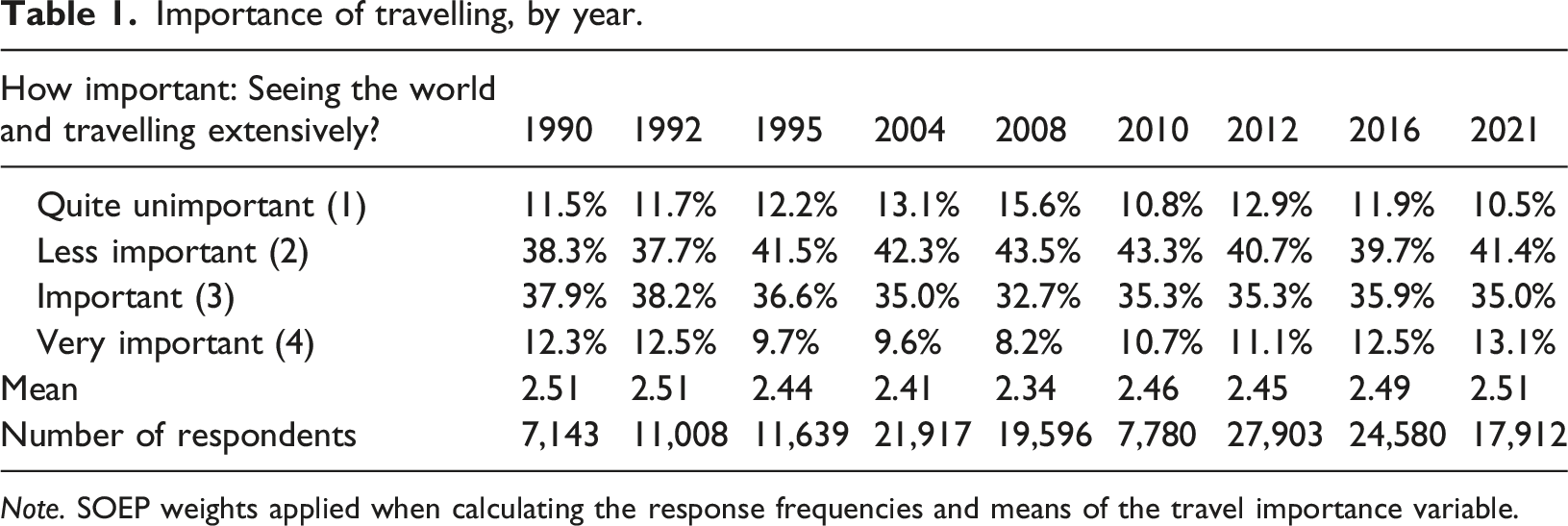
Note. SOEP weights applied when calculating the response frequencies and means of the travel importance variable.
Correlates of the importance of travel.
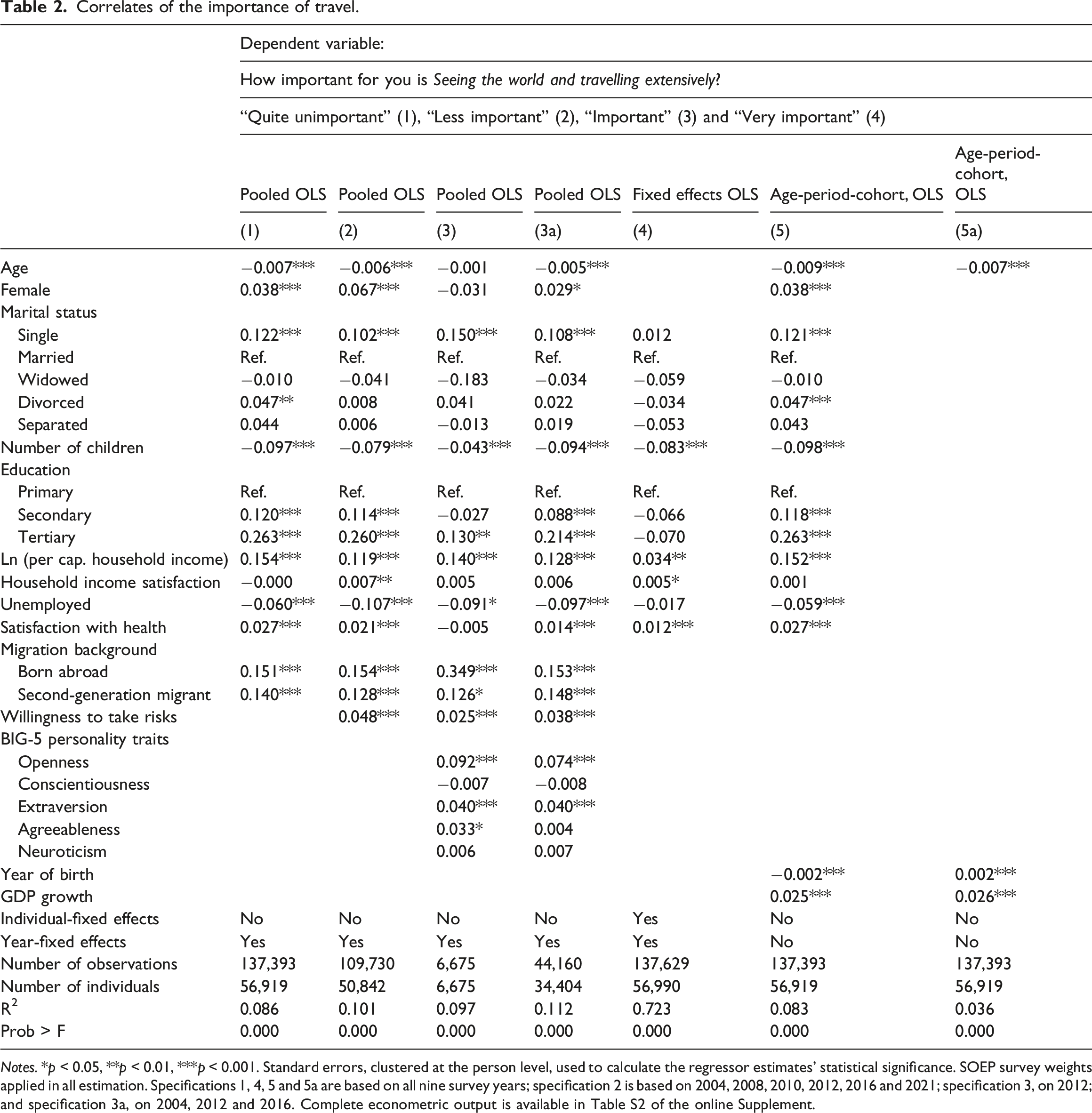
Notes. *p < 0.05, **p < 0.01, ***p < 0.001. Standard errors, clustered at the person level, used to calculate the regressor estimates’ statistical significance. SOEP survey weights applied in all estimation. Specifications 1, 4, 5 and 5a are based on all nine survey years; specification 2 is based on 2004, 2008, 2010, 2012, 2016 and 2021; specification 3, on 2012; and specification 3a, on 2004, 2012 and 2016. Complete econometric output is available in Table S2 of the online Supplement.
The next specification (Model 2) adds the willingness to take risk variable (and also reduces the sample size to years when the risk question was asked). The coefficient is positive and statistically significant: people willing to take risks report higher personal importance of travel. Column 3 adds the Big Five personality traits, further restricting the sample size to the year 2012 (the only year when both the travel importance and the Big Five questions overlapped). Respondents scoring higher on openness, extraversion, and, to a lesser extent, agreeableness are all more likely to consider travel important. Given that the results of this specification are based on a single-year sample, as a robustness check, an additional model was estimated, based on two extra survey years – 2004 and 2016 – for which the Big Five indicators from the adjacent years (2005 and 2017) were used. The results, reported in Column 3a, confirm that higher scores on the personality traits of openness and extraversion are associated with greater personal importance of travel, while agreeableness is no longer statistically significant. 7 Note that relative to Model 1, the inclusion of the risk and Big Five measures does not have a major impact on the sign and statistical significance of other variables, with the exception of age, gender and satisfaction with health, which become statistically insignificant in Model 3, and the divorced variable, which is no longer statistically significant in Models 2-3a.
Next, we turn to the individual-fixed effects estimation (within estimates; recall that only time-variant regressors can be used in such estimations). The results, reported in Model 4 of Table 2, show that the personal importance of travel increases as people become better off (both higher actual income and greater satisfaction with income) and report greater health satisfaction, and decreases as more children are born in the household. Importantly, several variables – being single, higher education levels and becoming unemployed – that were statistically significant in the (pooled) cross-sectional estimations are no longer statistically significant in the individual-fixed-effects model. This points to the presence of omitted variable bias in cross-sectional regressions: certain unobserved characteristics are likely to drive both the regressor and personal importance of travel; once all such characteristics are captured/accounted for by individual fixed effects, the regressor loses statistical significance. For example, a specific personality trait (different from Big Five, which can be accounted for) may be driving both the personal importance of travel and the desire to obtain higher levels of education (hence, positive between-person correlation), but the importance of travel does not necessarily increase as the person obtains more education (no within correlation).
The final set of estimations aims at disentangling the effects of age, birth cohort and period on the personal importance of travel, using the age-period-cohort model. Recall that our proxy variable candidate for the period effects is the annual GDP growth. Figure 2 shows that it is indeed a suitable proxy: the importance of travel tends to be greater at times of higher economic growth, supporting the assumption that people prioritise travel more important at times of higher economic growth. Importance of travel and GDP growth.Source: Importance of travel – author’s calculation based on the SOEP data; GDP growth – World Bank World Development Indicators. Note. SOEP weights applied when calculating the annual means of the travel importance variable (1 – quite unimportant, …, 4 – very important).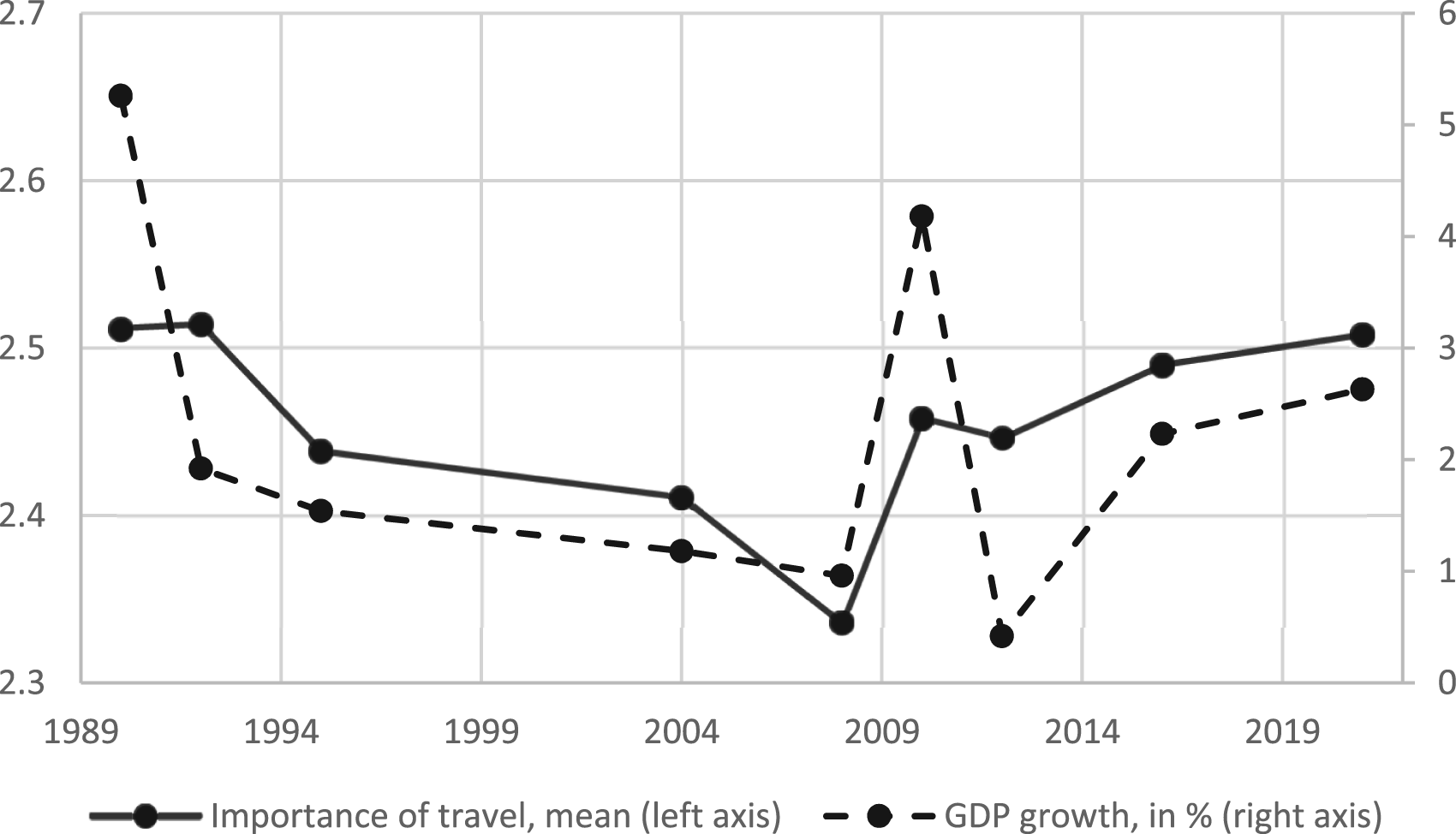
Specification 5 of Table 2 reports the results of the age-period-cohort model, where both the age and year-of-birth variables are treated as continuous. All three variables of interest are statistically significant: consistently with Figure 2, higher GDP growth is associated with greater personal importance of travel; the effect of age is negative, meaning that, as people get older, they consider travel less important; and the effect of birth cohort is also negative, suggesting that, other things equal, younger generations consider travel less important than older generations. Note that the estimate of age is 4.5 times higher than the estimate of birth cohort, meaning that the personal importance of travel is much more responsive to age than the year of birth. As a sensitivity check, a model without control variables was estimated (Column 5a of Table 2). While there is little change in the effects of age and GDP growth, the coefficient of the birth year changes the sign from negative to positive, implying that younger generations place greater importance on travel than older generations. This discrepancy could be explained by the correlation between the cohort variable and control variables.
The discrepancy could also be due to non-linearities in the age and cohort effects. To check whether this is the case, the final model captures age and birth year effects through two sets of 2-year dummies rather than continuous variables. The results are presented in Figure 3 in the form of predicted values of the importance of travel variable for different regressor groups. Panels a and b are based on an estimation with control variables included. The importance of travel decreases almost monotonically with age, with the rate of change being higher for younger and older respondents. As for the cohort effects, people born before WWII report noticeably higher importance of travel, while those born between 1950 and 1985 report lower importance. An estimation without controls (panels c and d) draws a similar picture, even if the negative effect of age is now less monotonic (the importance of travel is almost unchanged for the age group 40–55) and there is a discernible upward trend in the importance of travel for cohorts born from 1960 onwards. To provide additional insights, I have substituted 2-year cohorts with five generations (as defined in McKercher (2023)). The results, presented in panels e and f of Figure 3, confirm that (controlling for age) the pre-baby boom generation reported higher personal importance of travel than both baby-boomers and Generation X (the difference is statistically significant), and that Generation Z tended to report higher importance of travel than both Generation X and Millennials. Note, however, that the absolute differences in the average importance of travel between generations (ranging from 2.4 to 2.6 on a scale of 1 to 4) are relatively small compared to the effect of age (approximately 2.8 for youngest respondents and 1.9 for the oldest). In summary, the results of the age-period-cohort model suggest that personal importance of travel decreases with age and exhibits some variation across generations. Age, cohort and generation effects.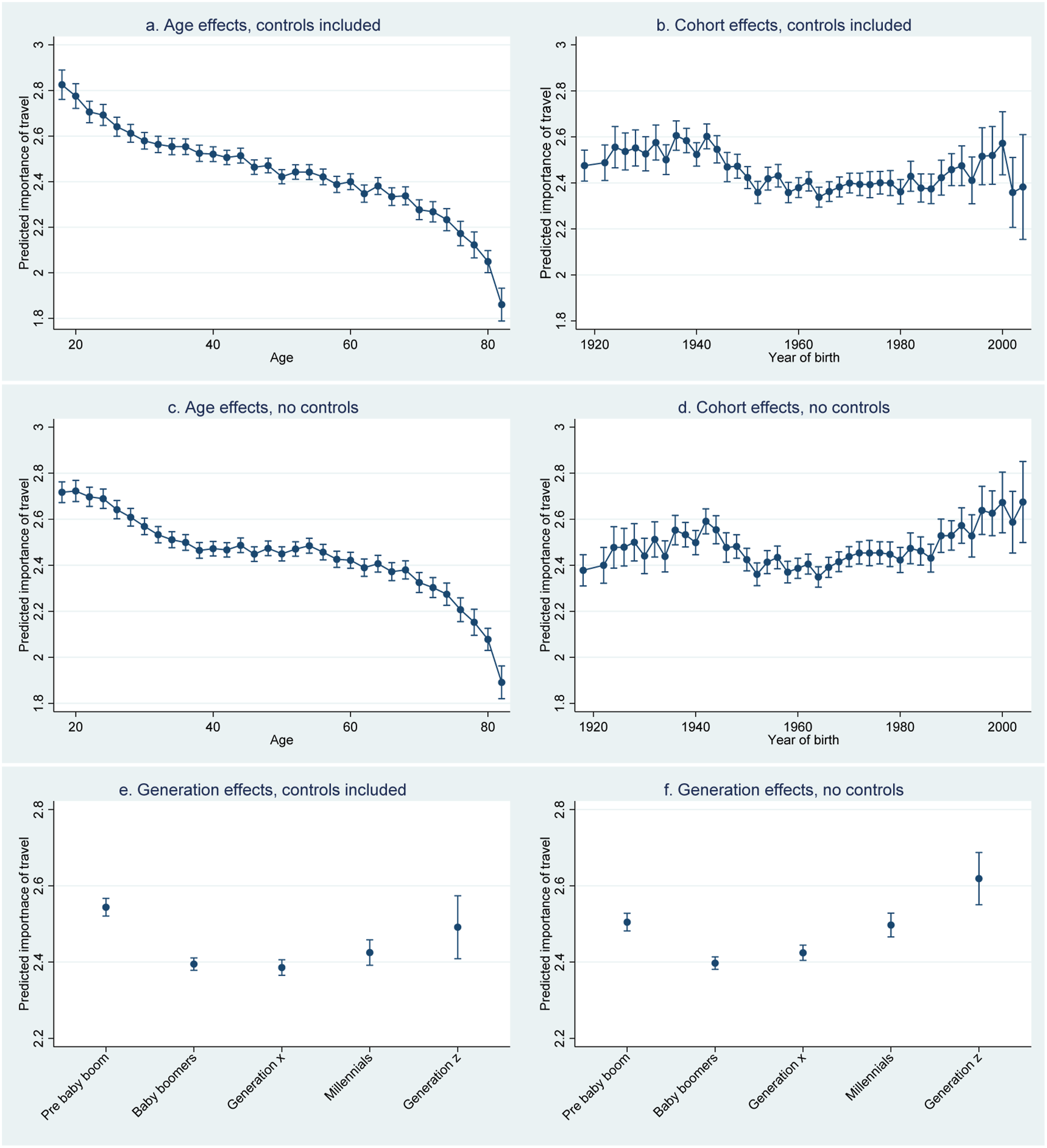
Discussion and conclusion
Conclusions
This paper set out to explore the determinants of the personal importance of travel, motivated by the growing realisation in the literature that travel participation is affected not only by travel constraints but also by the importance people attach to travel. While the determinants and structure of travel constraints have been studied extensively, little is known about the individual-level determinants of the personal importance of travel – a gap this paper aimed to fill.
Using survey data from the German Socio-Economic Panel spanning more than three decades (1990–2021), I found that the personal importance of travel is shaped by both time-invariant and time-varying individual characteristics. Among time-invariant attributes, women and immigrants report higher personal importance of travel. Among characteristics that are generally stable over time, higher importance is reported by risk-takers and individuals scoring higher on the Big Five personality traits of openness and extraversion. Among time-varying characteristics, increases in household income and improvements in health raise the personal importance of travel, while the birth of children has the opposite effect. Several time-varying factors – education, unemployment status and marital status – are significant predictors in between-person but not within-person analyses. This discrepancy may suggest that endogeneity is present, caused either by reverse causality (e.g., people who consider travel important may be more likely to pursue higher education) or unobserved characteristics (e.g., factors affecting both travel importance and educational attainment). The longitudinal setting also allowed age effects to be distinguished from cohort effects. Results from the age-period-cohort model suggest that the personal importance of travel declines with age and varies modestly across generations, with people born before WWII and the most recent cohorts (Generation Z) considering travel more important than those in between.
These results substantially extend the limited literature on individual-level determinants of the personal importance of travel. To the best of my knowledge, the only closely related study is McKercher et al. (2022), who analyse cross-sectional survey data from the Australian state of Queensland. They find that “disinterested tourists” (i.e., individuals who do not consider taking a pleasure trip every year important) do not differ from “interested tourists” in terms of their median age group or gender but have lower income and education levels. Consistent with McKercher et al. (2022), I also find that higher income and education are associated with greater personal importance of travel. However, education becomes statistically non-significant in within-person estimations, suggesting that the observed association in cross-sectional analyses may be driven by unobserved individual characteristics that jointly influence both educational attainment and the importance attached to travel. In contrast to McKercher et al. (2022), the present study finds that women report a higher personal importance of travel and that travel importance declines with age. These differences may reflect variation in geographical context (Australia vs Germany), differences in the conceptualisation of travel importance (the importance of “taking a pleasure trip every year” vs “seeing the world and travelling extensively”), or, particularly for age effects, differences in variable measurement (broad age groups vs exact age in years).
Theoretical and practical implications
These findings have several theoretical implications. First, they shed light on the relative stability of the personal importance of travel. One might initially assume that it changes little over time, akin to a personality trait. This study provides partial support for such a view: more than one-third of the explained cross-sectional variation in travel importance is attributable to psychological traits (openness and extraversion) and attitudes to risk – factors that are generally temporally stable. However, age and changes in life circumstances, particularly the birth of children and changes in health and household income, also influence whether people consider travel important. These findings lend support to the cognitive dissonance argument, whereby people reduce the importance they attach to travel when faced with significant travel constraints (Chen and Petrick, 2016) – in this case, poor health, low income and child-related responsibilities – and more broadly highlight close links between travel constraints and the personal importance of travel.
The positive relationship between income and travel importance may also reflect social identification, as posited by the attitude importance framework (Boninger et al., 1995; Chen et al., 2019; Chen and Petrick, 2016; Howe and Krosnick, 2017). Higher incomes may lead individuals to “upgrade” the importance of travel because “that is what richer people do.” Similar mechanisms may explain the role of migration status. Immigrants and their descendants consider travel more important because visiting the country of origin is what others in their reference group do (social identification) and because maintaining ties with the home country, and thus travel, is important (values).
The findings have practical implications for businesses, organisations and institutions seeking to understand travel intentions and participation. Tourism providers can benefit from identifying groups that attach greater personal importance to travel, as this signals a stronger latent willingness to travel even when constraints are present. Such insights can complement traditional market segmentation based on income, age or past travel behaviour. For example, individuals scoring higher on openness, extraversion and risk tolerance report higher travel importance, suggesting that products and marketing targeting these consumers could emphasise novelty, exploration and social interaction. While personality cannot be observed directly, proxy indicators (such as preferences for specific types of experiences) can be integrated into customer relationship management systems to provide more personalised communications.
The results also highlight demographic and life-course factors that shape travel importance and can inform more targeted strategies. For example, immigrants and their descendants report above-average importance of travel, likely reflecting the need to maintain transnational social ties and visit countries of origin. Tourism providers and transport operators could therefore tailor services to these motivations, for example through culturally targeted marketing, multilingual services or flexible travel options during key holiday periods. At the same time, migrants often face relatively high travel constraints (Smith and Carmichael, 2005), suggesting that reducing informational, financial or logistical barriers could activate a segment with high intrinsic travel motivation. Life-course events are also relevant: the birth of children is associated with a decline in travel importance, indicating the potential value of family-oriented products that reduce the burden of travelling with children (flexible accommodation configurations, child-inclusive itineraries, family rooms and play areas in transport hubs, stroller-friendly infrastructure), while improvements in income or health may create opportunities to target individuals undergoing positive life transitions. Ageing and cohort results further imply value in life-stage-compatible products (e.g. slower-paced itineraries, rail-based scenic routes, and multi-generational travel) while digital-first, sustainability-centred, experience-oriented offers may resonate particularly with Generation Z, who report relatively high travel importance.
Beyond the private sector, the results are also relevant for tourism development organisations and policymakers. Understanding which groups attach greater importance to travel can help anticipate how different populations respond to policies aimed at either encouraging tourism for economic reasons or managing its environmental and social impacts. For instance, policies that increase travel costs or restrict certain forms of mobility may face stronger resistance among individuals for whom travel is particularly important, suggesting the need to promote lower-impact alternatives such as rail travel, closer destinations or off-peak travel. The findings also have implications for equity in tourism participation: the positive relationship between income and travel importance indicates that financial barriers may discourage lower-income groups from valuing travel. Initiatives such as social tourism programmes and improved affordability of transport may therefore help broaden participation and sustain travel opportunities across different life stages and socio-economic backgrounds.
Limitations and directions for future research
Despite providing novel insights, the study has limitations that suggest directions for future research. First, more in-depth investigations are needed to explain why specific characteristics affect travel importance. While this paper links individual characteristics to social identification and travel constraints, more comprehensive analyses would be required to fully explain effects related to gender, age, cohort and psychological traits. Furthermore, although this study draws on longitudinal data – thereby mitigating endogeneity concerns related to omitted, time-invariant respondent characteristics – future research could more thoroughly examine the causal effects of individual variables on travel importance, by addressing other sources of endogeneity (e.g., reverse causality) and using instrumental-variable approaches or exploiting exogenous shocks.
Second, the measure of travel importance is based on the survey question concerning the importance of ‘seeing the world and travelling extensively.’ This aligns well with concepts such as wanderlust and the travel bug but may not capture individuals who lack strong travel aspirations yet still value occasional holiday travel, weekend trips or local excursions. This distinction highlights the need to examine different ‘shades’ of personal importance attached to travel. At the same time, it is important to recognise the strength of the measure in the context of the dataset: the measure is available for a large nationally representative sample observed over the period of 30 years, enabling a unique view of how travel importance varies across individuals and over time. Future research could build on this foundation by developing broader or multidimensional measures of travel importance, by distinguishing between extreme attitudes (e.g., travel being ‘very important’) and more moderate preferences, or by comparing experiential priorities (importance of travel) with material ones (e.g., importance of homeownership).
Third, the survey does not measure actual travel or non-travel behaviour and the reasons behind it. While this may reduce social desirability bias in reported travel importance (McKercher, 2009), it would be valuable to confirm the well-established relationship between travel importance and travel behaviour. More generally, future research should develop novel approaches to capturing people’s underlying importance of travel alongside behaviour and constraints, and to exploring their interrelationships. Finally, as the evidence is drawn from a single country (Germany), caution is warranted when generalising the findings. National and cultural contexts may shape the determinants of travel importance (Chen et al., 2019), and future research could explore whether these determinants vary across geographical, cultural and economic settings where suitable data are available.
Supplemental material
Supplemental material - Who considers travel important (and why it matters)?
Supplemental material for Who considers travel important (and why it matters)? by Artjoms Ivlevs in Tourism Economics
Footnotes
Acknowledgements
I thank the Editor and the two anonymous referees for their insightful and constructive feedback.

Funding
The author received no financial support for the research, authorship, and/or publication of this article.
Declaration of conflicting interests
The author declared no potential conflicts of interest with respect to the research, authorship, and/or publication of this article.
Supplemental material
Supplemental material for this article is available online.
Notes
Author biography
References
Supplementary Material
Please find the following supplemental material available below.
For Open Access articles published under a Creative Commons License, all supplemental material carries the same license as the article it is associated with.
For non-Open Access articles published, all supplemental material carries a non-exclusive license, and permission requests for re-use of supplemental material or any part of supplemental material shall be sent directly to the copyright owner as specified in the copyright notice associated with the article.
