




Abstract
Sex tourism is a persistent and complex dimension of global mobility, often operating in legal and enforcement grey zones. Using a two-stage mixed-effects gravity model on a 1995–2018 dyadic panel (150+ countries), we estimate residual tourism flows unexplained by standard economic, geographic, and cultural factors. We find that destinations identified as sex tourism hubs attract significantly more inbound tourists than predicted. This effect is strongest where sex work is legal but weakly enforced. Economic inequality between origin and destination countries amplifies these dynamics. Interactions show that stronger rule of law attenuates excess flows, while permissive legality combined with low enforcement magnifies them. By isolating “excess” arrivals beyond structural determinants, we provide empirical evidence that sex tourism is shaped by institutional ambiguity and global income gaps. Policy implications point to coordinated, harm-reduction regulation that targets governance capacity and cross-border enforcement rather than legality alone.
Introduction
Tourism is one of the most dynamic sectors of the global economy, shaped by economic opportunity, cultural exchange, mobility technologies, and the institutional frameworks that govern cross-border movement. Over the past three decades, trade liberalisation, cheaper air travel, and the rapid diffusion of digital platforms have expanded international mobility and reduced the frictions associated with searching, booking, and coordinating travel. Tourism now accounts for roughly 10% of global GDP and about one in 10 jobs worldwide (World Tourism Organization, 2024). This expansion is not simply a market outcome; it is also a product of institutional arrangements that enable movement, such as visa waiver agreements, bilateral air service treaties, and regional blocs. Visa facilitation alone can raise arrivals by 5–25%, particularly where latent demand is high (Neumayer, 2010; World Tourism Organisation & World Travel and Tourism Council, 2012).
A growing literature shows that institutions shape tourism performance by affecting perceived safety, predictability, transaction costs, and the credibility of regulatory environments. Institutional quality – often proxied by governance, rule of law, and control of corruption – is consistently associated with stronger tourism outcomes (Alvarez and Campo, 2014; Arezki et al., 2009). Importantly, institutions also condition tourism’s resilience to shocks: when uncertainty rises, destinations with stronger governance frameworks appear better able to sustain arrivals. Recent evidence shows that good governance can moderate the negative effect of global uncertainty on tourism demand (Koçak and Cobanoglu, 2025), and that democratic institutions similarly mitigate the adverse effects of pandemic-induced uncertainty on tourism demand (Kizilkaya et al., 2024). Together, this work motivates a core theoretical premise that guides our empirical design: institutional quality influences tourism not merely by shifting demand up or down, but by structuring the conditions under which mobility and market exchange occur, including risk, trust, information, and enforcement credibility. These mechanisms are likely to be most consequential for tourism segments that rely on discretion and regulatory ambiguity, implying that institutional environments should predict systematic deviations from gravity-based ‘expected’ flows rather than only average differences in arrivals.
This perspective also implies that institutions shape not only the volume of tourism but also its composition, influencing whether travel is oriented toward leisure and business tourism or toward more contested and informal niches (Richter, 1989; Williams and Hall, 2000). Consistent with this view, recent research indicates that tourism development may alter the balance between formal and informal economic activity and produce heterogeneous distributional outcomes across development contexts, underscoring that tourism’s broader consequences are conditioned by the institutional and developmental settings in which it is embedded (Kahyalar et al., 2024; Xu and Lv, 2023). Many tourism-related activities operate partly outside formal regulation, and the gap between “rules on the books” and “rules in practice” can change the visibility, organisation, and profitability of activities that sit in regulatory grey zones. In these settings, formal legality is not sufficient to characterise market conditions: the same legal code can generate very different market realities depending on enforcement intensity, corruption, and state capacity (Helmke and Levitsky, 2004). This is especially relevant for niches where discretion and selective enforcement may shape both perceived risk and expected costs for visitors and intermediaries.
Sex tourism is a clear case where legality, enforcement discretion, and governance capacity can jointly structure market conditions. Tourism economies often coexist with informal and illicit activities operating in regulatory grey zones ranging from unlicensed guiding and street vending to drug markets, commercial sex, and trafficking (Crick, 2012). In such contexts, institutions do not simply permit or prohibit activity; they determine the degree of ambiguity and risk faced by prospective buyers and sellers. Where enforcement is inconsistent, institutions can inadvertently create conditions that increase discretion, reduce perceived risk, and lower expected costs, particularly when cross-country income differences increase purchasing power abroad and expand the economic incentives for transactional exchanges (Helmke and Levitsky, 2004; Oppermann, 1999). This is particularly plausible in ‘grey zone’ settings where formal rules and on-the-ground enforcement diverge. For example, some jurisdictions prohibit commercial sex on paper but tolerate it in practice through selective enforcement; others permit parts of the market while restricting solicitation, advertising, third-party facilitation, or venue licensing. In such environments, discretion and uncertainty can create informality rents, shaping where and how visitors perceive access and risk. These features should matter for travel niches that rely on ambiguity, weak oversight, and intermediated access.
We use the Centres for Disease Control and Prevention (CDC) definition of sex tourism as travel planned primarily for sexual services, often to destinations characterised by permissive legality or permissive enforcement (Lu et al., 2020). Sex tourism spans male and female markets, heterosexual and same-sex markets, and includes child sex tourism in its most exploitative forms (Brents and Hausbeck, 2007; Cabezas, 2008; Graburn, 1983; Richter, 1989; Rivera, 2015; Taylor, 2006). While often framed as a contemporary phenomenon, sex tourism is historically and structurally linked to commercial sex markets that provide the infrastructure for transactional encounters (Salom, 2008). Digital platforms and social media can further reduce search and coordination frictions by connecting travellers to venues and service providers and embedding commercial sex within broader mobility networks (Lu et al., 2020). These dynamics raise important policy and public health concerns and intensify ethical dilemmas where tourism demand intersects with coercion, exploitation, and harm affecting vulnerable groups. Although this study does not directly measure individual harms, the institutional environments that enable discretionary enforcement and low accountability are frequently those in which worker protections and safeguarding capacity are most limited.
Despite an extensive qualitative literature on motivations, identities, and local consequences, important theoretical and empirical limitations remain. First, existing research is stronger at describing demand-side motives, participant profiles, and case-specific dynamics than at explaining why sex tourism systematically concentrates in particular destinations and not others. Second, prior work often treats legal status as a key explanatory feature, yet formal legality alone may not adequately characterise market conditions where enforcement is selective, informal, or weak. In such contexts, the gap between rules on the books and their implementation in practice may be more consequential than legality itself. Third, because sex tourism is partially hidden and difficult to observe directly, the literature has lacked a tractable macro-comparative strategy for identifying its structural correlates across countries. A complementary macro-institutional account suggests that cross-border transactional sex is more likely to concentrate where purchasing power gaps between origin and destination are large, where commercial sex market infrastructure is present, and where legal status interacts with enforcement capacity to create permissive or ambiguous regulatory environments that reduce expected costs and increase perceived access.
This study addresses these gaps by providing internationally comparative evidence on how institutions, legality, enforcement capacity, and global economic asymmetries shape sex tourism patterns embedded within broader tourism flows. Using a dyadic panel of bilateral tourist arrivals and a two-stage approach, we first estimate expected tourism flows using a structural gravity framework and then analyse the residual (“excess”) of bilateral tourist arrivals that remains after accounting for standard gravity determinants such as economic size, geography, and cultural proximity. We then test whether these excess inflows are systematically associated with sex-tourism market indicators and whether these associations are conditioned by legality, enforcement capacity, and cross-border inequality. In doing so, the study contributes to both the tourism and institutional literatures in two ways. First, it reframes sex tourism as an institutionally structured component of tourism composition, shaped not simply by individual demand or formal legality alone, but by the interaction of market infrastructure, regulatory ambiguity, and enforcement discretion. Second, by isolating excess flows beyond structural tourism determinants, it offers a tractable macro-empirical strategy for studying a sector that is difficult to observe directly, while generating testable implications about how governance and legality jointly condition contested tourism niches.
Background
Scholarship over the past three decades has generated important insights into sex tourism’s drivers, consequences, and intersections with gender, class, race, exploitation, public health, and policy (Hillis et al., 2022; Nørfelt and Kock, 2024). However, this literature remains stronger at documenting participation patterns, harms, and case-specific dynamics than at providing an integrated explanation of why sex tourism systematically concentrates in particular destinations. To clarify the mechanisms most relevant to the present study, this section reviews five themes of scholarship: empirical and measurement constraints, demand-side participation patterns, documented harms and ethical dilemmas, institutional and legal grey-zone mechanisms, and the role of global inequality in structuring directional flows. Taken together, these themes motivate an account of sex tourism as embedded in broader tourism systems, institutional conditions, and political economy asymmetries.
Empirical constraints and measurement challenges
Empirical progress has been constrained by the industry’s covert nature. Much of the evidence base relies on ethnographies, case studies, and surveys, with relatively limited cross-country quantitative research on system-level drivers (Lu et al., 2020). Two constraints are central. First, commercial sex markets are illegal or partially illegal in many jurisdictions, restricting observability and increasing reporting bias. Second, where commercial sex is tolerated, enforcement can be discretionary, shifting activity into “grey zones” that are difficult to capture in official data. Consequently, a large share of research has focused on rights, exploitation, and the economic pressures shaping participation by states and individuals (Leheny, 1995), alongside measurement problems inherent in informal and illicit markets (Hall and Brown, 1996). These constraints motivate approaches that infer sex tourism-related patterns from broader mobility data rather than attempting to observe the sector directly.
Demand-side mechanisms and participation patterns
The micro-level literature often describes sex tourists as disproportionately male, frequently travelling for work or long stays (e.g., military or business travel), and sometimes engaging in higher-risk behaviours such as heavy alcohol or drug use (Lu et al., 2020). Importantly, sex tourism is not always the sole purpose of travel. Rivera (2015) notes that some participation is opportunistic and occurs alongside general tourism, implying that sex tourism can be embedded within and amplified by mainstream tourism flows. Consistent with this, sex travel motivations overlap with broader tourism motives such as novelty seeking, unmet preferences at home, emotional longing, and convenience, rather than constituting a completely distinct category of travel (Hakim, 2015; Svensson et al., 2018). This is important for macro analysis: if sex tourism is partially nested within ordinary travel, then destinations associated with sex tourism may exhibit tourism volumes that exceed structural expectations even after controlling for conventional determinants.
Consequences, externalities, and ethical dilemmas
Beyond motivations, the literature emphasises substantial externalities associated with sex tourism. In many destinations, sex tourism is discussed alongside risks of coercion and exploitation of vulnerable cohorts, and in some contexts, sex tourism and trafficking are intertwined, particularly where institutions are weak and protective services are limited (Oppermann, 1999; Thanh-Dam, 1983). Public health concerns such as STI transmission risk, condom negotiation, and access to prevention and care are recurrent themes, especially where stigma and informality reduce health service access (Hillis et al., 2022; Lu et al., 2020). At the community level, the distribution of benefits and harms can be uneven: tourism revenues may accrue to intermediaries and venue owners while risks are borne by sex workers, particularly in informal settings with limited labour protections (Hall and Brown, 1996). These realities generate ethical dilemmas for policy: prohibition can push markets further underground and increase vulnerability, while permissive frameworks without enforcement capacity may enable exploitative segments to persist. This study does not estimate these harms; rather, it identifies the economic and institutional conditions under which sex-tourism-associated excess travel is more likely, contexts that prior work links to elevated health, exploitation, and human rights risks.
Institutions, legality, and enforcement as market-shaping mechanisms
A core theme of the sex tourism literature is that the institutional environment shapes the structure and visibility of commercial sex markets and, by extension, sex tourism. Legal status alone is rarely determinative; what matters is the interaction between legality, regulatory design, and enforcement capacity. Where sex work is legal or tolerated, but enforcement is weak, markets may become more visible and commercially organised; where sex work is illegal but weakly enforced, markets may persist in informal forms with greater discretion. These “grey zone” dynamics help explain why sex tourism can concentrate in locations where legal ambiguity and enforcement discretion reduce perceived risks for visitors and intermediaries while simultaneously limiting protections for workers. This broader emphasis on governance is consistent with Sou and Vinnicombe (2023), who argue that governance influences tourism not only through direct demand-side effects, but also through the wider supply-side environment by shaping investment conditions and destination competitiveness. Cross-national legal asymmetries may also matter, travellers may seek destinations where the expected costs of participation are lower and anonymity is higher, or where markets offer specialised or stigmatised services not available at home (Ying et al., 2022; Ying and Wen, 2019). Evidence from China, for instance, points to convenience and time constraints as drivers for some travellers purchasing sex abroad (Ying et al., 2022; Ying and Wen, 2019). More broadly, institutional arrangements governing mobility, such as visa facilitation, may interact with these markets by reducing access costs and expanding the pool of potential tourists.
Global inequality and the political economy of directional flows
Inequality is a consistently identified structural theme in the sex tourism literature. Travellers from wealthier origins can convert purchasing power advantages into status and access in lower-income destinations, creating conditions conducive to transactional relationships (Brennan, 2001; Lu et al., 2020). This is consistent with broader tourism research showing that tourism’s effects are not uniform, but vary with underlying development conditions, with tourism growth affecting inequality differently across economic contexts (Camacho and Ramos-Herrera, 2025; Wang and Tziamalis, 2023). From a behavioural ecology perspective, Kock (2021) argues that economic and social “fitness” constraints at home can be offset by travelling to poorer markets, increasing access to partners. These mechanisms help explain why many well-known sex tourism destinations are located in developing or lower-income countries and why flows often run from higher-income origins to lower-income destinations.
At the destination level, tourism can be central to development strategies, but local attitudes toward sex tourism are frequently ambivalent and shaped by hardship and opportunity constraints (Lu et al., 2020; Taylor, 2006). In such settings, households may rely on sex work income, often in informal markets with lower pay and higher risk (Lu et al., 2020; Rivera, 2015). The literature also documents relationship pathways linked to economic mobility such as marriage with foreign clients (Jaisuekun and Sunanta, 2021; Sunanta and Angeles, 2013) or transactional romantic relationships involving female tourists and economically marginalised men (Bindel, 2003; Weichselbaumer, 2012). These dynamics reinforce the view that sex tourism is embedded in broader inequalities rather than being driven solely by individual preferences.
Synthesis and implications for the present study
Taken together, the literature suggests that sex tourism is patterned rather than idiosyncratic, arising from the conjunction of economic incentives, market infrastructure, and institutional-legal configurations. In particular, sex-tourism-related activity is more likely where (i) cross-country income differentials generate purchasing power advantages for travellers, (ii) commercial sex markets and related adult-service infrastructure provide the organisational basis for transactional exchange, and (iii) formal legal status interacts with enforcement capacity and governance quality to produce permissive, discretionary, or ambiguous regulatory environments. Yet because sex tourism is frequently embedded within informal or semi-illicit markets and is rarely observed directly in official statistics, macro-comparative evidence on these mechanisms remains limited.
This study advances the literature by providing dyadic cross-national tests of these propositions. Using a two-stage gravity framework, we first benchmark expected bilateral arrivals based on standard structural determinants and then examine whether systematic deviations from this benchmark are associated with sex-tourism indicators and conditioned by sex-work legality, institutional quality as a proxy for enforcement capacity, and global inequality. This synthesis also underscores the policy relevance of an institutional perspective: to the extent that excess inflows are associated with regulatory ambiguity and weak or selective enforcement rather than legality per se, effective policy responses are likely to require improvements in governance capacity, enforcement consistency, and worker protections, complemented by cross-border coordination, rather than reliance on binary legal classifications alone.
Data
To examine the relationship between sex tourism-related characteristics and international tourism flows, we assemble a dyadic (origin – destination - year) panel of bilateral tourist arrivals covering 1995–2018. The dataset includes more than 150 origin and destination countries and is structured to support directional analysis of flows from origin i to destination j in year t. Our dependent variable is the annual number of arrivals from i to j, sourced from the United Nations World Tourism Organization (UNWTO), which reports arrivals by destination and country of origin (World Tourism Organization, 2024). Following standard practice in tourism gravity modelling, arrivals are transformed using the natural logarithm to reduce skewness and heteroskedasticity and to facilitate semi-elasticity interpretations.
As sex tourism is not captured in standard international statistical systems, we construct a sex tourism destination indicator using a transparent triangulation protocol. We first compiled candidate destinations through systematic web-based searches using predefined keywords (e.g., “sex tourism destinations”, “sex tourism hotspot”, “where to go for sex tourism”). We then cross-validated candidates across multiple source types, including travel journalism, travel industry sources, and peer-reviewed research. A destination is coded as a sex tourism destination if it is identified as such in at least three independent sources. When sources conflicted or classifications were ambiguous, destinations were cross-checked against the academic literature and the country’s legal context to ensure consistent classification. This approach recognises that sex tourism status is not mechanically implied by legality: some countries have legal sex work without being widely identified as sex tourism hubs, whereas other destinations remain prominent in both popular and academic accounts despite formal legal restrictions. In robustness checks, we assess sensitivity to classification by varying the inclusion threshold (e.g., ≥2 sources), excluding destinations identified only by non-academic sources, and excluding high-profile destinations one at a time to ensure results are not driven by a small number of cases.
To proxy sex tourism infrastructure, we construct a destination-level measure of adult-oriented venue density using OpenStreetMap’s LoveMap API (Skowron, 2014). We extract counts of adult-oriented venues such as brothels, strip clubs, erotic massage parlours, love hotels, and adult entertainment shops. Venue counts are normalised by population and log-transformed to address skewness. This measure is intended to capture structural differences in the presence of adult-service infrastructure that may support sex tourism demand. We acknowledge two limitations. First, OpenStreetMap coverage varies across countries. Second, the venue data are not consistently time-varying over the study period, and therefore cannot capture openings, closures, or short-run shocks. We interpret the measure as a structural proxy rather than a precise dynamic indicator.
Sex tourism regions, status, and type.
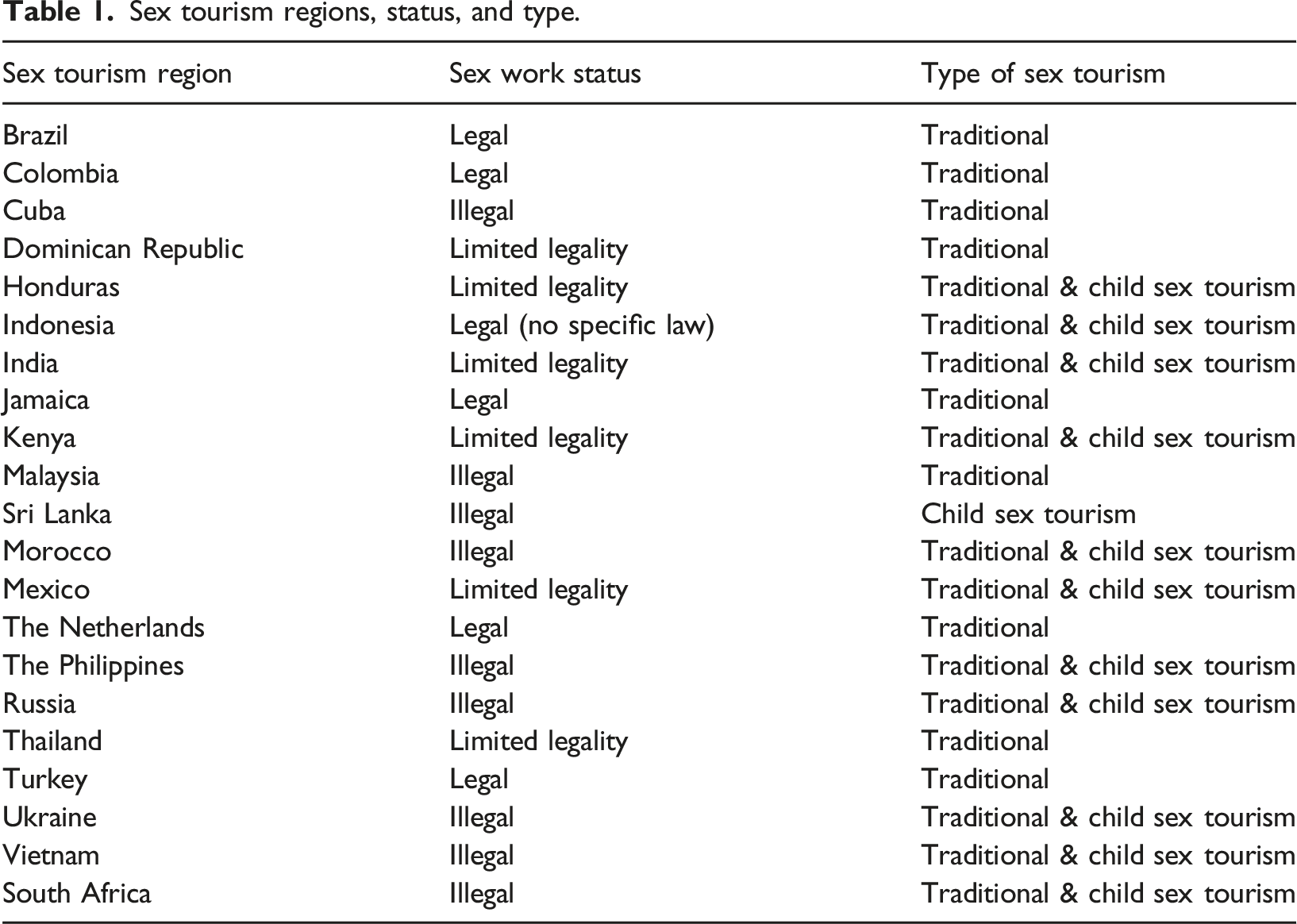
To isolate sex tourism-related patterns from standard determinants of tourism, we include a comprehensive set of controls commonly used in the gravity literature. Economic conditions are captured via GDP per capita (current USD) for both origin and destination countries, log-transformed, alongside the official exchange rate (local currency per USD), averaged annually and logged (World Bank, 2024, 2025). We additionally include a common currency indicator to reflect reduced transaction costs and a Gini coefficient measure to account for domestic inequality, which may be associated with the structure and informality of service sector markets, including commercial sex (World Bank, 2023). Destination attractiveness is proxied using counts of UNESCO World Heritage Sites (cultural and natural), which capture baseline tourism appeal unrelated to sex tourism (UNESCO, 2025). In robustness checks, we also incorporate inbound international students and migrant stocks (International Migration Portal) to account for non-leisure travel motives such as education and family visitation (International Organization for Migration (IOM), 2025).
Variable roles in the empirical framework.
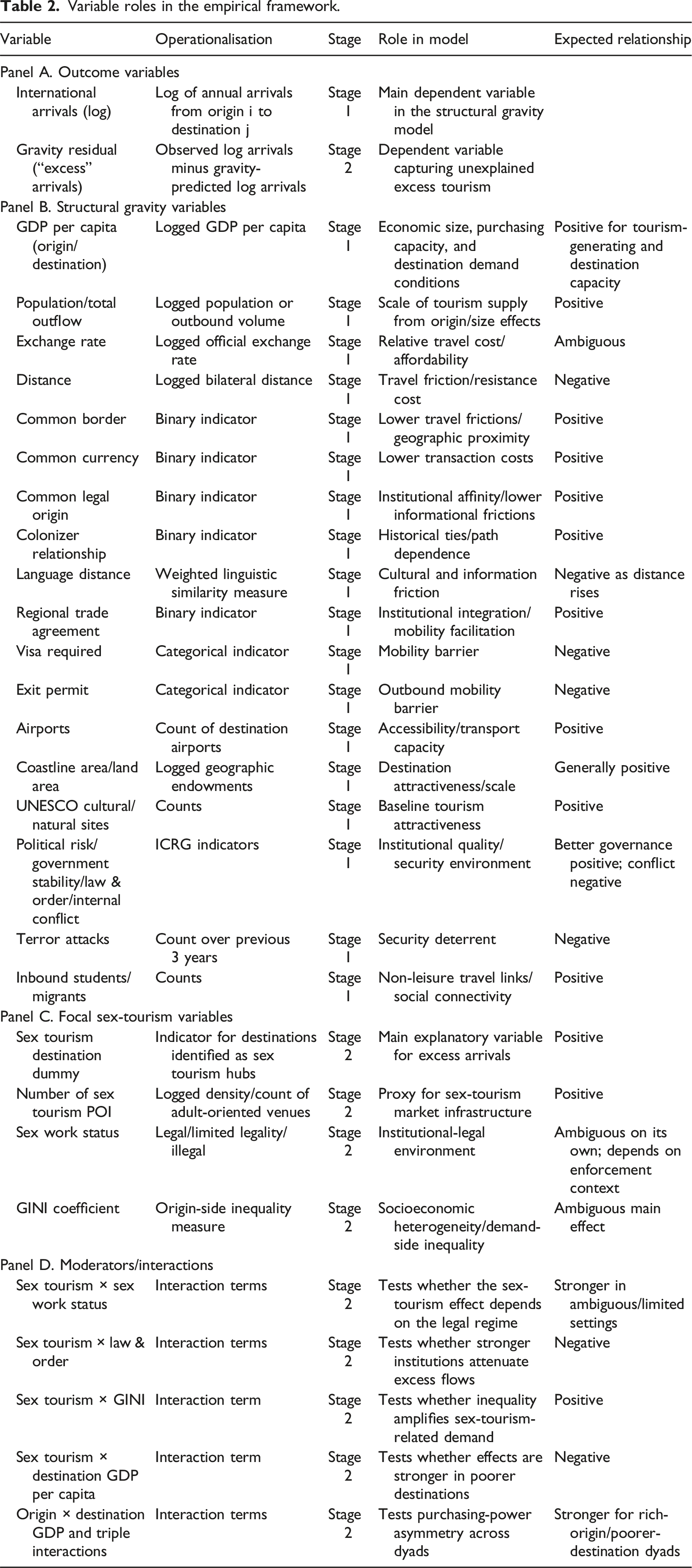
Together, these data are used to form a multidimensional dyadic panel suitable for estimating a first-stage structural gravity model of expected tourism flows, and for testing whether residual (“excess”) arrivals are systematically associated with sex tourism indicators, sex work legality, enforcement capacity, and cross-country inequality. For transparency and reproducibility, we have uploaded the complete dataset and all analysis files in an OSF repository (https://osf.io/juw87/overview?view_only=77dd02ecb582437bbe8c9903ada30bf7).
Method
This study adopts a two-step structural gravity framework with dyadic tourism data to investigate whether sex tourism-related characteristics and prostitution status are systematically associated with international tourism flows. Because sex tourism is partially clandestine and not directly captured in international statistical systems, the empirical strategy first estimates expected bilateral arrivals using a gravity benchmark and then examines whether systematic deviations from that benchmark align with theoretically motivated measures of sex tourism market presence and the institutional legal environment. Dyadic data capture outcomes generated by pairwise relationships between sampled units, such as tourist flows between origin and destination countries, where both partners jointly shape the observed outcome (Graham, 2020). Drawing on the structural gravity model originally developed in the context of trade, this study adopts a two-stage approach to assess sex tourism and international tourism flows (Rosselló Nadal and Santana Gallego, 2022; Tinbergen, 1963).
Gravity models have been applied extensively to tourism demand due to their strong empirical performance in accounting for bilateral frictions and multilateral influences that shape dyadic flows (Rosselló Nadal and Santana Gallego, 2022). The original model proposed by Tinbergen (1963) posits that bilateral flows are positively related to economic size and negatively related to “resistance” between countries, such as distance and cultural barriers. Gravity models have produced reliable and interpretable estimates across trade, migration, and tourism applications (Frankel et al., 1996; Silva and Tenreyro, 2006; Yotov et al., 2016). Building on this framework, our approach isolates sex-tourism-specific drivers beyond general tourism determinants. In Stage 1, we estimate a gravity model of bilateral tourism arrivals using a linear mixed-effects regression to recover expected flows between origin and destination countries based on standard structural determinants. In Stage 2, we analyse the residual deviations from this benchmark to test whether excess tourism is systematically associated with sex tourism indicators and whether these associations vary with sex work legality and institutional quality.
In Stage 1, tourism demand is modelled using a linear mixed-effects regression. The model captures variation in logged international arrivals from origin i to destination j in year t as a function of observed covariates and common time shocks:
The fitted values from the first-stage model represent gravity-predicted tourism flows conditional on observed covariates. Residual (“excess”) arrivals are computed as:
These residuals capture the extent to which observed arrivals deviate from gravity-based expectations: positive residuals indicate more arrivals than predicted, while negative residuals indicate underperformance. In Stage 2, we examine whether these deviations are systematically associated with sex tourism-related indicators and their interactions with the legal and institutional context:
Results
The results present a series of linear mixed-effects regressions examining whether destinations associated with sex tourism receive systematically higher inbound international tourism flows than would be predicted by conventional determinants. The dependent variable in all specifications is the Stage 1 gravity residual (i.e., the deviation of observed log arrivals from gravity-predicted log arrivals). Descriptive statistics for all variables, along with baseline first-stage gravity estimates used to generate residuals, are reported in the Online Appendix.
Mixed effects regression of random intercept residuals.
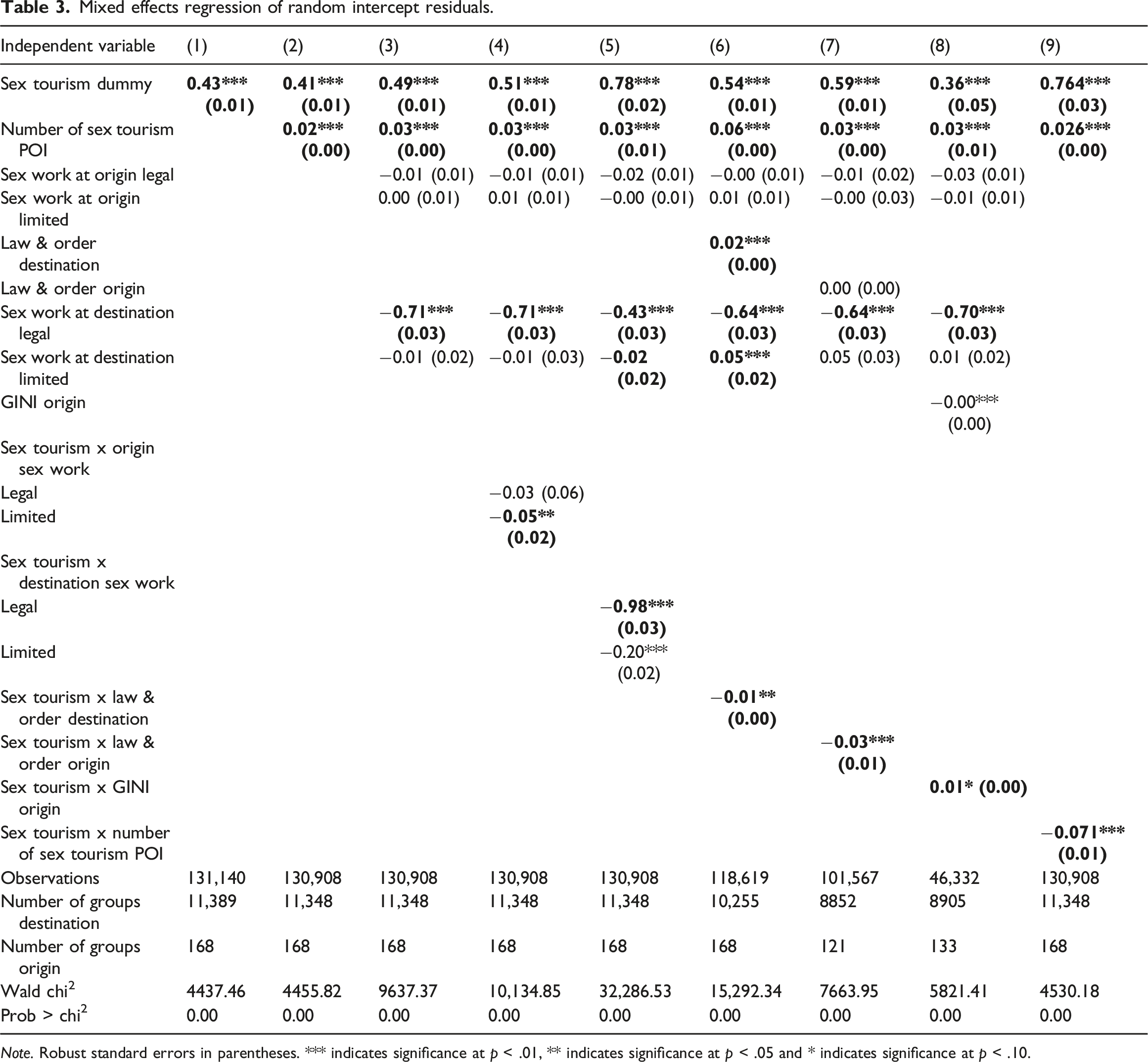
Note. Robust standard errors in parentheses. *** indicates significance at p < .01, ** indicates significance at p < .05 and * indicates significance at p < .10.
Model 2 adds a proxy for sex tourism infrastructure: the logged density of sex tourism-related points of interest (e.g., brothels, strip clubs, erotic massage parlours, and love hotels). This measure is positive and statistically significant across specifications, with a modest magnitude (approximately 0.02–0.06). The result is consistent with the view that observable adult service infrastructure, reflecting market presence and visibility, contributes to excess arrivals alongside the destination’s broader classification as a sex tourism hub (Lu et al., 2020; Oppermann, 1999).
Models 3–8 introduce sex work legal status and interaction terms to examine whether the association between sex tourism hubs and excess arrivals varies by legal and institutional context. A notable pattern is that fully legal sex work at the destination is associated with lower residual arrivals, and the interaction terms indicate that excess arrivals linked to sex tourism hubs are smaller in fully legal settings than in limited or ambiguous regimes. This finding complicates a simple legalisation-tourism narrative and is consistent with an institutional interpretation in which regulatory design and enforcement discretion shape market conditions. In particular, demand may be strongest in environments characterised by legal ambiguity or partial tolerance, where discretion and informality are more salient. By contrast, fully legal regimes may be associated with more formalised market structures and regulatory oversight, potentially reducing the “grey zone” conditions that underpin some segments of sex tourism-related demand. In contrast to destination legality, origin-country legal status does not show a consistent association with outbound residual tourism, suggesting that destination-specific conditions, market structure, availability, and governance environment are more salient.
Institutional quality further moderates these relationships. In Models 6 and 7, interactions between sex tourism and law and order are negative and statistically significant, indicating that stronger law and order reduces the magnitude of excess arrivals associated with sex tourism destinations. Substantively, excess inflows to sex tourism hubs are attenuated where institutions are more effective and enforcement is more consistent. A comparable moderation pattern is observed for origins: tourists from higher law-and-order contexts exhibit weaker unexplained travel to sex tourism destinations, consistent with the view that origin institutional environments can shape participation in informal or contested travel niches.
Model 8 incorporates origin-country income inequality (GINI) and its interaction with the sex tourism indicator. The standalone GINI coefficient is negative and statistically significant, indicating that higher inequality in the origin is associated with lower residual outbound tourism overall. However, the positive interaction between GINI and the sex tourism indicator suggests that, conditional on travel to sex tourism destinations, origins characterised by greater internal inequality exhibit stronger excess flows. This pattern is consistent with accounts linking inequality to transactional and status-oriented consumption abroad and highlights that demand-side conditions may be shaped not only by cross-country differences but also by within-country socio-economic structure.
Mixed effects regression of random intercept residuals.
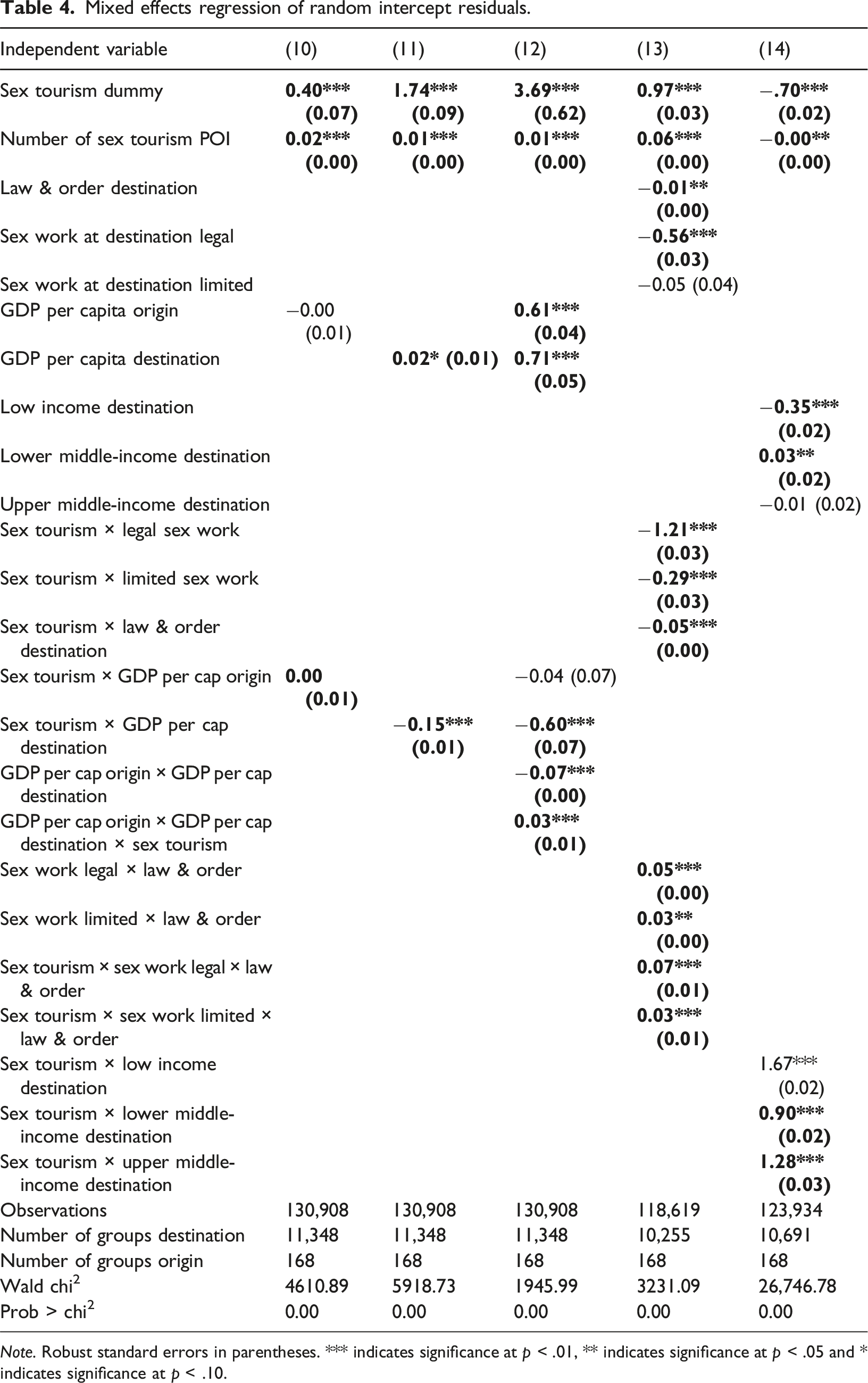
Note. Robust standard errors in parentheses. *** indicates significance at p < .01, ** indicates significance at p < .05 and * indicates significance at p < .10.
Model 14 introduces interactions between the sex tourism indicator and World Bank destination income groups, allowing the association between sex tourism hubs and excess arrivals to vary by development tier. With high-income destinations as the omitted reference category, the main-effect coefficient on the sex tourism indicator reflects the association within high-income destinations, while the interaction terms capture how this association differs in low- and middle-income destinations.
The interaction terms are positive and statistically significant for low- and middle-income destinations, indicating that excess arrivals associated with sex tourism hubs are substantially larger outside high-income settings. This heterogeneity pattern complements the GDP interaction results by showing that the concentration of sex-tourism-related excess arrivals is not merely a function of income levels in isolation, but is systematically stronger in development tiers where purchasing power differentials and institutional ambiguity are more likely to coincide.
Finally, Model 12 introduces a three-way interaction between sex tourism, destination sex work legality, and law and order. The interaction structure indicates that enforcement context conditions how legality relates to excess inflows, supporting the broader conclusion that sex tourism is shaped not by legal status alone but by the interplay between legality, perceived risk, and enforcement capacity. This is consistent with the ‘ambiguity/discretion’ mechanism: excess travel is greatest where market access is feasible but governance is discretionary, whereas fully formalised and regulated regimes may reduce informality rents and the demand for under-the-radar intermediated access. Taken together, the results point to a consistent mechanism: sex tourism-related excess tourism is strongest where adult market infrastructure is present and where the institutional and legal environment creates conditions of discretion or selective enforcement, and it is amplified in dyads characterised by sizeable income asymmetries.
Conclusions
Our results indicate that sex-tourism-related excess arrivals are patterned and systematically associated with economic asymmetries, institutional capacity, and the legal environment. Destinations identified as sex tourism hubs receive inbound tourism flows that exceed gravity-based expectations even after controlling for a wide set of economic, geographic, institutional, and cultural determinants. Taken together, the evidence is consistent with sex tourism operating as a “shadow” segment embedded within formal tourism flows, one that is amplified by uneven development, adult market infrastructure, and regulatory conditions characterised by discretion or selective enforcement.
This study advances the literature in three related ways. First, it provides macro-comparative evidence that institutions shape not only the volume of tourism but also its composition, helping to explain why contested or informal niches may manifest as systematic deviations from structurally “expected” tourism flows. Second, it clarifies that legality alone is not sufficient to characterise market conditions: across specifications, fully legal sex work at the destination is not associated with higher excess arrivals and is often associated with lower excess inflows relative to limited or ambiguous regimes. This pattern supports an institutional “grey zone” mechanism in which the interaction of legal status with enforcement capacity and governance practices conditions the expected costs, discretion, and informality rents associated with participation. Third, by applying a two-stage, residual-based structural gravity framework to dyadic arrivals data, the analysis contributes a tractable empirical strategy for studying clandestine or weakly measured sectors linking deviations from predicted flows to theoretically motivated indicators of sex tourism market presence, institutional quality, and inequality.
Our heterogeneity results further strengthen these inferences. Excess arrivals associated with sex tourism hubs are shown to be substantially larger outside high-income destination settings. They are amplified in dyads characterised by purchasing power asymmetries, consistent with political economy accounts in which cross-border income gradients expand the scope for transactional exchange and shape the direction and intensity of demand.
Although the analysis does not directly observe individual harms or motivations, the findings are still practical and ethical. That is, the institutional conditions associated with larger sex tourism-related excess inflows are frequently those shown to be linked in prior work to elevated exploitation risks, weaker worker protections, and public health vulnerabilities. Two clear implications follow. Firstly, policy responses should avoid treating reform as a binary choice between prohibition and legalisation. Instead, the results suggest that regulatory design and enforcement credibility are central: where enforcement is weak, discretionary, or selectively applied, markets may remain both permissive and informal, expanding conditions conducive to sex-tourism-related activity while limiting protections. Strengthening institutional capacity through consistent enforcement, clearer regulatory boundaries, and anti-corruption measures, along with effective oversight of intermediaries, may reduce harmful segments of demand without merely displacing activity into less visible and potentially riskier settings. Secondly, safeguarding-oriented interventions remain important regardless of legal status. Improving access to health and support services, strengthening reporting and protection mechanisms, and coordinating cross-border information sharing and targeted policing of exploitative practices can help mitigate adverse externalities in contexts where demand is shaped by international income asymmetries and enforcement capacity constraints. For the tourism sector, ethical tourism initiatives and due diligence standards for platforms and intermediaries can naturally complement and support public policy where market access and coordination increasingly occur through digital channels.
Several limitations of the current study should be acknowledged. Firstly, residual-based outcomes capture deviations from predicted flows and may reflect unobserved drivers beyond sex tourism. Secondly, to state the obvious, sex tourism, like all illicit behaviours, is difficult to measure directly. The destination classification and venue-based infrastructure proxy necessarily approximate a clandestine phenomenon, and as such may not capture temporal changes in market size or organisation. Thirdly, cross-national legality classifications simplify complex and sometimes subnational legal environments, and general institutional indicators may not fully capture sector-specific enforcement relevant to commercial sex markets. And finally, macro dyadic data cannot identify traveller motivations or distinguish purposive from opportunistic participation. Future research could extend this framework by integrating micro-level evidence on travel motivations and behaviour, incorporating qualitative fieldwork in key destinations, and developing improved time-varying measures of sex tourism market presence. Further work could also distinguish more explicitly between legalisation and decriminalisation regimes and evaluate whether institutional reforms or enforcement shocks alter the magnitude or composition of excess inflows over time.
Overall, our findings suggest that sex tourism is not random or purely individual-level; it is systematically shaped by economic gradients and institutional-legal configurations. By providing cross-country macro evidence on these mechanisms, our study contributes to tourism economics and the broader literature’s understanding of informal economies by showing how regulatory ambiguity, enforcement capacity, and inequality jointly structure contested tourism niches within global mobility.
Supplemental material
Supplemental Material - Economics and legal influences on sex tourism
Supplemental Material for Economics and legal influences on sex tourism by Ella Hugo, Steve Bickley, Ho Fai Chan, Benno Torgler and Stephen Whyte in Tourism Economics.
Footnotes

Author contributions
Funding
The authors received no financial support for the research, authorship, and/or publication of this article.
Declaration of conflicting interests
The authors declared no potential conflicts of interest with respect to the research, authorship, and/or publication of this article.
Data Availability Statement
The data that support the findings of this study are available from the corresponding author upon reasonable request.
Supplemental material
Supplemental material for this article is available online.
Author biographies
References
Supplementary Material
Please find the following supplemental material available below.
For Open Access articles published under a Creative Commons License, all supplemental material carries the same license as the article it is associated with.
For non-Open Access articles published, all supplemental material carries a non-exclusive license, and permission requests for re-use of supplemental material or any part of supplemental material shall be sent directly to the copyright owner as specified in the copyright notice associated with the article.
