




Abstract
This paper is one of the first which provides an in-depth quantitative analysis of how the development of the tourism industry impacts on the size of the shadow economy of a specific destination. The paper employs time-series techniques and annual data from 1960 to 2018 from Turkey. First, the size of the shadow economy is estimated using the electricity consumption method. The estimates are then used to assess the effect of tourism development on the size of the shadow economy. The findings show that there is a negative relationship between the two. A 1% increase in international tourism arrivals leads to a 0.21% and 0.316% fall in the size of the shadow economy in the short-run and long-run respectively. It implies that as the tourism sector develops, it becomes instrumental in modernising the Turkish economy leading to the movement of resources from the shadow economy to the formal sector. In the long-run the effect of the tourism industry in reducing the size of the shadow economy surpasses that of the financial sector of Turkey.
Introduction
The informal economy also referred to as the shadow economy or the underground economy is an important sector in most countries around the world (see, for example, Aggrey, 2012; Chen, 2012; Medina and Schneider, 2019; Kahyalar et al., 2018). Smith (1994) defines it as production of goods and services that does not enter GDP accounting irrespective of being legal or not. According to Wahnschafft (1982; pp 431), the formal sector is made up of production units which operate under licences and are registered for tax purposes. They are covered government policies, able to lobby and are eligible for incentives provided by authorities. Informal production units are not recognised by authorities, and they escape the recognition and protection that a formal status provides. Enterprises and their employee in the shadow economy on the other hand, miss out on governmental subsidies and protection.
In the context of tourism, Crick (1994) states that the shadow sector occurs on a wide scale. It constitutes of individuals who interact with the tourist whether they are hawkers selling produce to tourists or part of the darker side of the shadow economy involving illegal activities such as dealing in drug, prostitutions, and trafficking. The literature on the economic impact of tourism investigates the contribution of the tourism industry to the economy of the destinations and has focused only on the official sectors of the economy. However, due to the existence of the shadow sectors the contribution of the industry may be underestimated. The extent to which livelihoods are dependent on the industry is not known and this is important in matters of policy implementation. The existence of a linkage between the tourism industry and the shadow economy implies that the expansion or contraction of the former will have a bearing on the size of the latter.
It is noteworthy that the relationship between the shadow economy and the tourism industry has not been scrutinised more deeply although anecdotally, it is widely acknowledged that there is a link between the two. Currently, there are six papers which quantified this relationship. While they offer invaluable insights, they are mostly utilise panel data sets and they are restricted in their time span due to the availability of published data on the size of the shadow economy. The current research proposes to address this limitation by first estimating the size of the informal sector using the electricity consumption method. In so doing, it provides an important contribution to the literature and opens a new avenue of research related to the tourism sector. The estimates are then used to provide a critical analysis of the role of tourism expansion on the magnitude of the informal economy using data expanding from 1960 to 2018 from Turkey. The techniques applied may be replicated for other mature destinations with similar characteristics as Turkey.
Turkish data are used because tourism is one of the pillars of its economy (see Gunduz and Hatemi, 2006; Gokovali, 2010; Aslan, 2014) and the shadow economy which is fairly large is an area of concern for the country (see Erdinc, 2012; Elgin and Oztunali, 2012). Because Turkey is a mature destination, data is available for 59 years which allows for the study of the evolution of the relationship over time. Another pillar of the Turkish economy is the financial sector (Capasso and Jappelli, 2013). This sector also impacts on the size of the shadow economic activities therefore, to obtain robust estimates financial development and the real exchange rate (EXR) are used as control variables. The paper will thus, provide a unique contribution to the literature on tourism by introducing a method for measuring the impact of tourism on the informal sector of a destination which has the protentional for improving the accuracy of economic impact studies of the sector which has thus far ignored the informal sector in their assessment.
The rest of the paper is organised as follows: Section 2 provides a brief review of the literature. Section 3 explains the methodology. The statistical testing and results are reported in Section 4. Section 5 interprets and discusses the implications of the findings. The paper ends with a brief conclusion in Section 6.
Review of the literature
There are four main theories on the existence of informality. The dualist approach assumes that the informal economy exists only temporarily because economic growth creates opportunities in the formal sector encouraging labour to move from the informal to the formal sector. The structuralist approach also known as the Neo-Marxist theory posits that the formal economy is unable to create sufficient formal jobs giving place for the informal economy to grow. The two sectors are interlinked and co-exist (Sahu, 2020; Meagher, 2016). According to the neo-liberal or legalist approach, the informal economy is a consequence of the burdensome regulations and complex tax systems. Countries with a high tax burden and heavy regulations like Turkey have a high level of informality (Schneider, 2012; Jonasson, 2012; Williams, 2013). The voluntarist approach proposes that the informal sector exists because individuals choose to operate informally after weighing the cost and benefits of participating of doing so. This is an indication of low tax morale.
The shadow economy has been the subject of many empirical scholarly articles, most of which focus on the causes and consequences of its size which is summarised in Scheinder and Enste (2000). According to Hirschman (1970), the size of the shadow economy increases when a rise in regulations and taxes cause individuals to exit the formal economy. Scheinder and Ernse (2000) add that labour market policies which shorten working hours and lower retirement age motivate individuals to move to the informal sector. Other contributing factors are weakening loyalty towards the establishment; failing tax morale and the presence of heavy administrative procedures and red tape (Schneider, 2016).
A factor which causes labour to operate in the informal sector is tightening labour laws. For example, increasing social security contribution for employees may cause labour to move to the informal sector thereby, the tax base of the economy is narrowed putting even more fiscal pressures on a shrinking formal economy leading to higher deficit and creating a vicious circle (Olson, 1982). Another consequence of a large shadow economy is that it affects the accuracy of official macroeconomic statistics, because the size of the actual labour force and their contribution and consumption is not accounted for. Devising and implementing policies based on these inaccurate data is likely to be lacking in effectiveness and may not have the desired effects on the economy Scheinder and Enste (2000). On a positive note, however, the income generated in the shadow economy is spent in the formal economy benefitting the society (Scheinder and Enste, 2000).
With respect to the tourism sector, Sørensen and Babu (2008) observe that there is a myriad of small businesses which include service providers such as guides, shoe shiners, money changers, owners of accommodation and others involved in the supply chain of the sector operate informally. While the degree to which each tourist interact with the shadow sector differs (see Sørensen and Babu, 2008), it is widely accepted that tourism development is strongly related to the shadow economy.
One of the earlier papers which study this phenomenon is Timothy and Wall (1997) who argue that the informal sector is seen as a problem by tourism planners. They study the behaviour of street vendors in Yogyakarta, Indonesia and find that the distinction between the formal and informal sector is not clear. Formal business entities may behave with a certain degree of informality in different circumstances. Çakmak et al. (2013) state that shadow tourism activities create more employment opportunities by providing jobs particularly to the disadvantaged groups and therefore, may reduce poverty. Cukier-Snow and Wall (1993) find that in Bali, the informal sector has led to social transformation by creating employment opportunities for women. These are, however, low productivity, low skilled jobs which require long working hours. Truong et al. (2020) observe that rickshaw drivers in Hanoi operate both formally and informally. Saayman et al. (2020) explain that the informal sector supports the livelihoods of migrant selling handicrafts.
Williams and Horodnic (2017) study the issues that have emerged from the growth of the informal economy as a result of the surge of the sharing economy. They find that 23% of hotels and restaurants in Eastern Europe and Central Asia report compete against unregistered or informal operators, and 13% view these informal competitors as major or severe obstacles. Larger establishments are more likely to consider the informal sector as the biggest hindrance to their business. The study advocates the regulation of the sharing economy and proposes that authority exerts both direct and indirect control on informal business in order to reduce unfair competition and the attractiveness of the informal sector to consumers. The issue of informality and competition in the accommodation sector is exacerbated with the advent of successful platforms such as the AirBnB which allows individual to rent out a room in their residence to tourist. Guttentag (2015) considers the business model and products of AirBnB as a disruption in accommodation sector of destinations and comment on the illegality of a proportion of those provisions and their implications for tax revenue from the sector.
The literature presented above mostly indicates the strong link that exists between the tourism industry and the informal sector. These studies look at specific industries in specific geographical locations within the tourism sector of the destination and the findings are not replicable to other industries within the sector. They analyse distinct problems and issues. The findings of such studies cannot be replicated and therefore, their applications while useful are limited in scope. To be able to formulate policies at national level, it is argued here that there is a need for an economy wide understanding of the size of the informal economy at national level and its evolution as the tourism industry grows and matures.
Tourism and the shadow economy – empirical evidence.
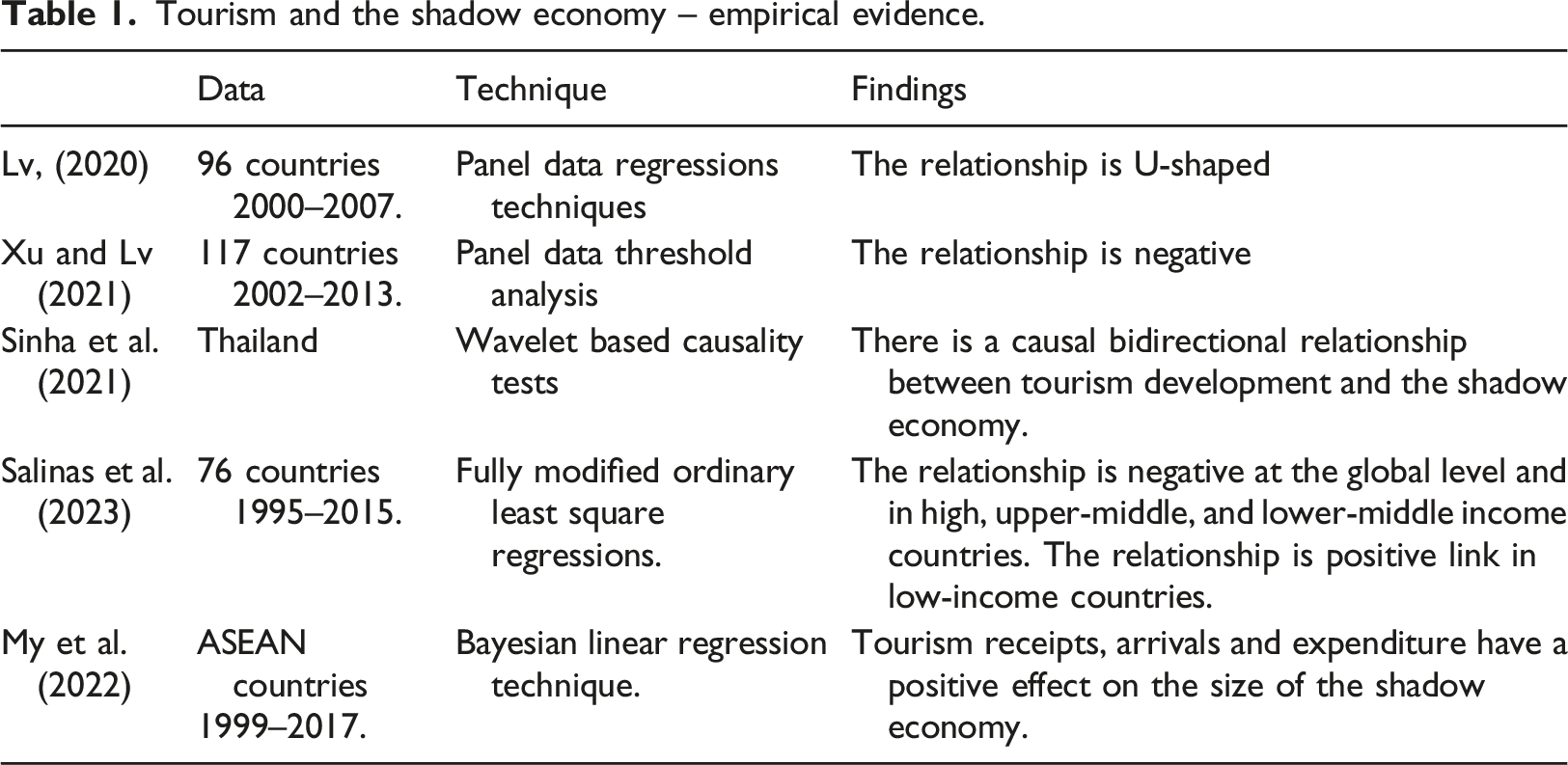
These papers provide useful insights on the relationship between tourism development and the size of the shadow economy. But for Sinha et al. (2021), they focus on groups of countries and rely on the published data which has a maximum time span of 20 years. The current paper proposes to investigate one specific destination. It considers 59 years and is able to provide more depth in the understanding of this relationship as it evolves over the years.
Methodology
Turkey is a mature destination with a thriving tourism sector and its economy has undergone major transformations over the last six decades. Following important financial and economic reforms aiming at achieving macroeconomic stability and reducing its budget deficits, the country has moved from an import substitution strategy for development to taking first steps towards neo-liberal development in the early 1960’s which has placed a growing importance on export as source of economic growth and development. Like most economies of the world, Turkey has suffered severely from the global financial crisis of 2008. During this time period, the size of the shadow economy has remained a concern for the government World Bank (2010a).
The consequences for a large shadow sector can be detrimental to the national economy. According to Scheinder and Enste (2000), a large shadow economy means that the size of GDP of the country is underestimated, and a large proportion of economy activities are not recorded. Furthermore, official statistics and measures are not reliable which create inefficiencies in the implementation of economic policies and distortions in the effect on the macroeconomy. It means that there is a short fall in tax revenue leading to underfunding of public services or to make up for lack of funding governments may choose to lay a higher burden on the formal sector leading to a fall in private investment and productivity Scheinder and Enste (2000). The existence of the informal sector also has implications for exploitation of labour who work underground and therefore, do not benefit from the same protections and rights that labour from the formal sector enjoy. Finally, a large informal sector implies a large section of illegal operations involving the drug trade, prostitutions and other illicit activities leading to increasing crimes rates (Scheinder and Enste, 2000).
World Bank (2010b) discusses the Turkish case and reveals that in Turkey informality exist mainly because of underreporting of revenues, wages and non-registration of workers with the social security system. It purports that informality tends to be widespread among small and micro enterprises in Turkey. There are very few cases of non-registration of firms. The Turkish government has taken several measures to fight informality and treats it as a priority in its Ninth Development Plan (2007–2013). Several measures have been taken recently by the Turkish authorities to limit its expansion. The two key actors are the Ministry of Labour and Social Security specifically aimed at the employment of illegal foreign workers and the Revenue Administration which promote and encourage formal activities by advocating its benefits and by strengthening the capacity for audits Government of Turkey (2006). According to Medina and Schneider (2019) although the size of the informal sector in Turkey remains high it has decreased from 36% in 1991 to 27.4% in 2015.
Conceptual framework
The theoretical framework assumes that a significant relationship exists between the shadow economy and tourism development, and this is supported by the empirical evidence discussed in Section 2. The theoretical model can be described as follows:


Measuring the size of the shadow economy
A common problem in the analysis of the informal economy is the measurement of the size of the informal economy which is unknown. Several methods can be used to estimate it. These methods can be classified into two main categories: direct methods (microeconomic approach) and indirect methods (macro-economic approach) (Scheinder, 2016). It is important to emphasise that each method has its own distinct advantages and disadvantages. There is no ideal method to estimate the size of the informal economy (see the discussion on methods, problems and open questions in Schneider and Buehn, 2016).
This study applies the method Kaufmann and Kaliberda (1996), who use electricity consumption as a proxy to calculate the size of the shadow economy. This method is used in the paper because of the ease of access of good quality data on electricity consumption and production in Turkey for the time period under study. The size of the shadow economy is calculated by using real GDP, electricity production and electricity export. The electricity that is exported is deducted from gross production to obtain the net production of the country to assess domestic use. The official real GDP figures are used to calculate the annual GDP growth rate. Electricity production is used as a proxy measurement for all the economic activities (TEA) with electricity to GDP elasticity is assumed to be close to one. The official GDP is used as a proxy measurement of the official economy. In line with Kaufman and Kaliberda (1996), the size of the shadow economy is estimated as the difference between TEA and official economic activities. This method requires the establishment of a base year for the size of the shadow economy to determine its absolute size. Here, 1960 is the base year and the size of the shadow economy in 1960 is obtained from Elgin and Oztunali (2012). Applying the approach of Kaufmann and Kaliberda (1996), the formula to estimate the size of the shadow economy is described below:


Model estimation
This study employs the GLS-based unit root test from Carrion-i-Silvestre et al. (2009) to take multiple breakpoints in the time series into account. Multiple breaks may have a permanent impact on time-series (Byrne and Perman, 2006). Therefore, testing unit root with multiple breaks may prevent biased results (Glynn et al., 2007). Following Pesaran et al. (2001) and Pesaran and Pesaran (2009) in the next stage, the bounds test procedure has been carried out to search for any long-run nexus based on equation (2). The results of the bounds test show that there is a long-term relationship between shadow economy and tourism and finance sectors. Following Shin and Pesaran (1999) and Pesaran et al., (2001) and Pesaran and Pesaran (2009) error correction models under the auto regressive distributed lag (ARDL) system have been estimated to detect short-term coefficients in equation (3) and the rate at which shadow economic activities in the Turkish economy adjust towards long run level by the channels of tourism and finance sectors. Finally, the causality test has been conducted to see if there exists any causality between shadow economic activities and its regressors. For further details of these tests see Carrion-i-Silvestre et al. (2009) and Pesaran et al. (2001).
Statistical testing
Descriptive statistics results.
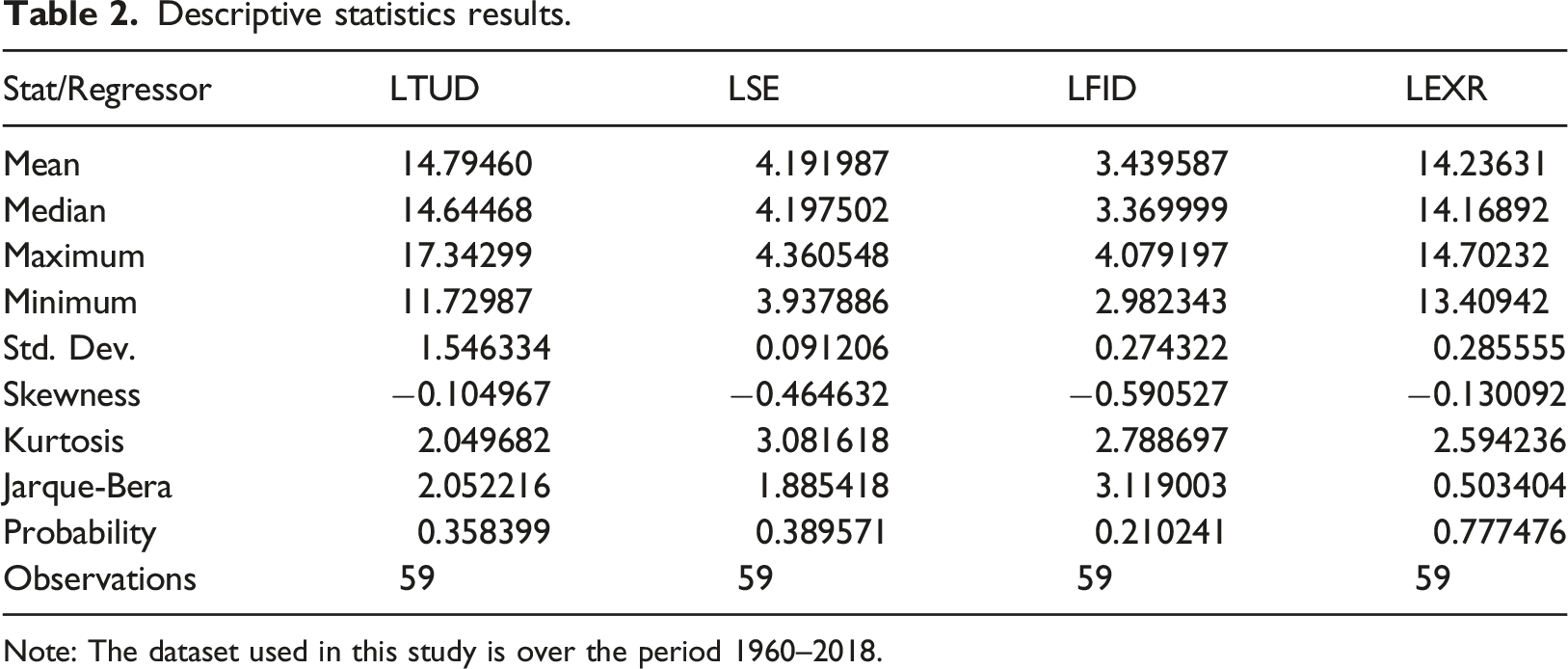
Note: The dataset used in this study is over the period 1960–2018.
Correlation coefficients of matrix.
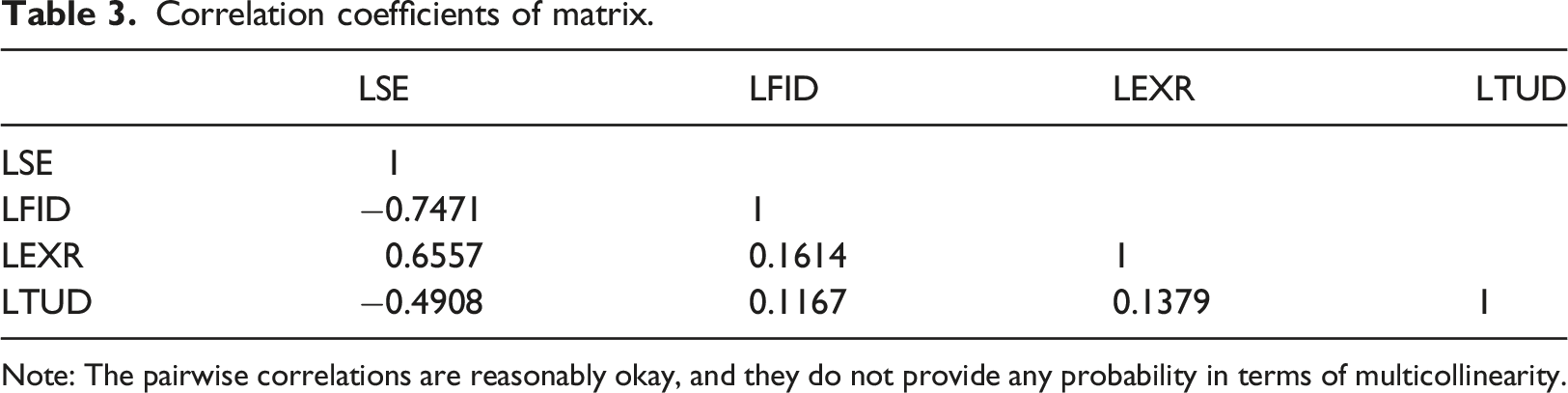
Note: The pairwise correlations are reasonably okay, and they do not provide any probability in terms of multicollinearity.
The GLS-based unit root model is employed to examine integrating properties of the variables under inspection. See Carrion-i-Silvestre et al. (2009) for more information.
Results of the GLS-based Unit Root Model.
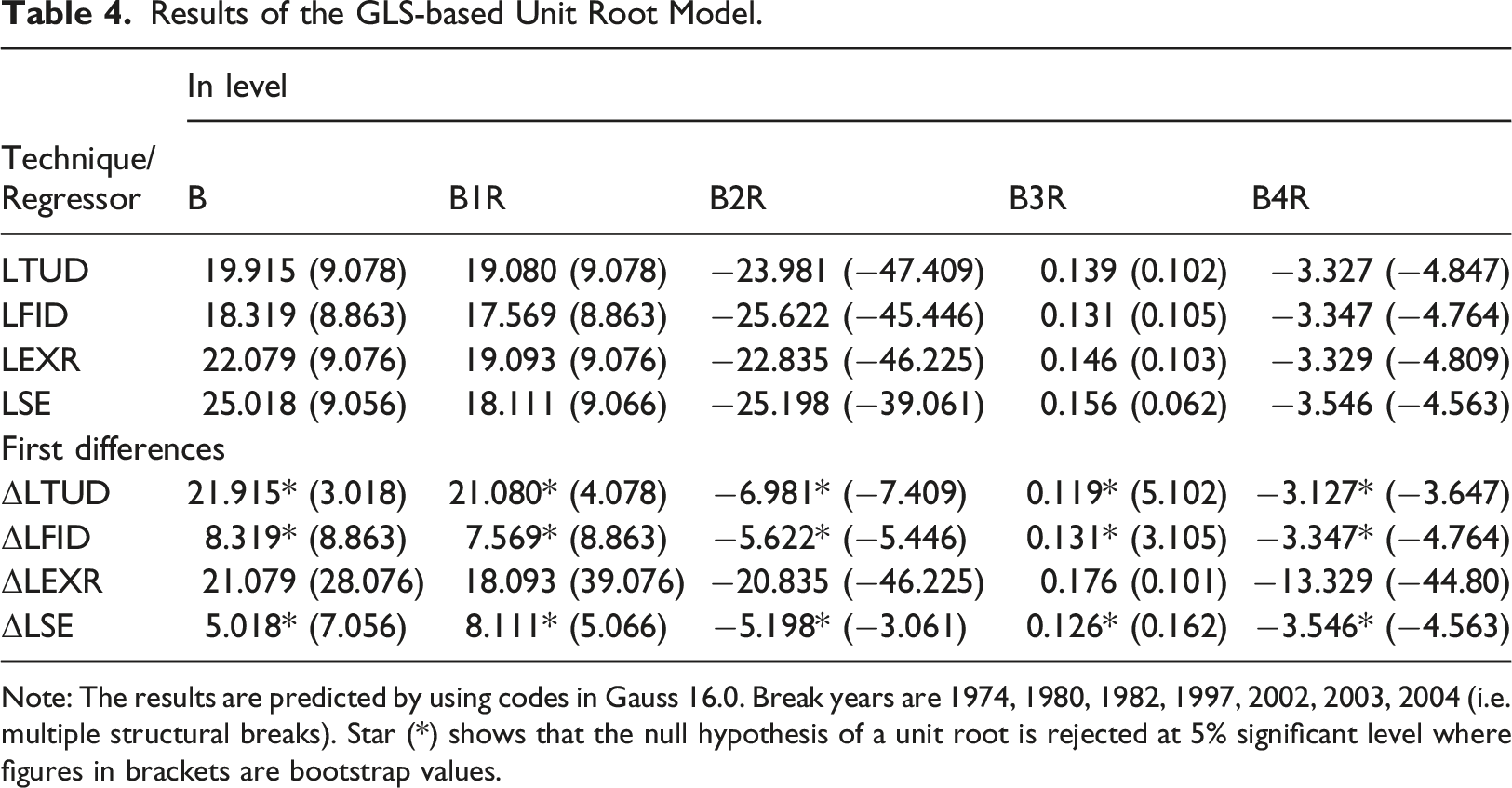
Note: The results are predicted by using codes in Gauss 16.0. Break years are 1974, 1980, 1982, 1997, 2002, 2003, 2004 (i.e. multiple structural breaks). Star (*) shows that the null hypothesis of a unit root is rejected at 5% significant level where figures in brackets are bootstrap values.
Bounds test results. EQ:
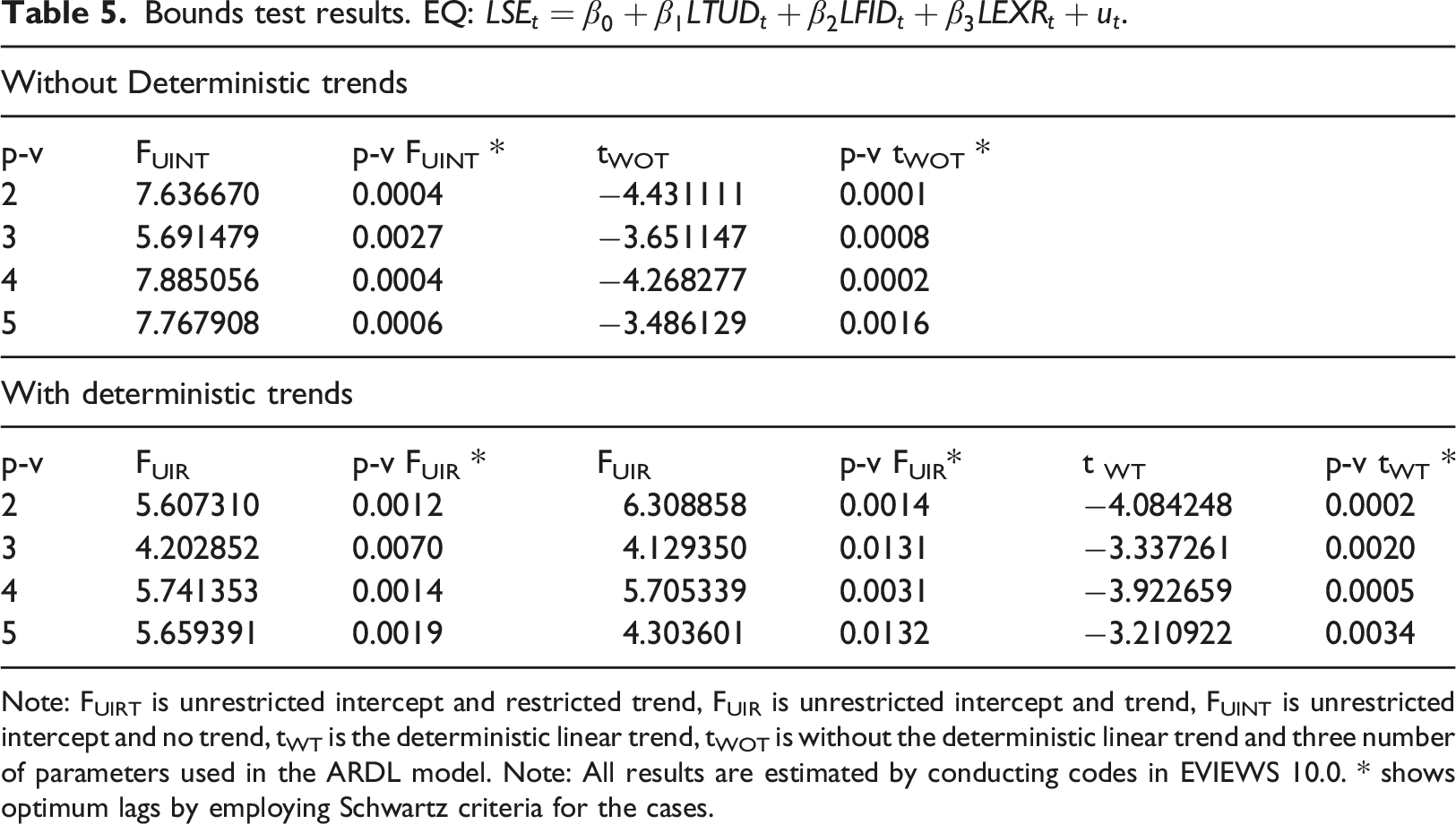
Note: FUIRT is unrestricted intercept and restricted trend, FUIR is unrestricted intercept and trend, FUINT is unrestricted intercept and no trend, tWT is the deterministic linear trend, tWOT is without the deterministic linear trend and three number of parameters used in the ARDL model. Note: All results are estimated by conducting codes in EVIEWS 10.0. * shows optimum lags by employing Schwartz criteria for the cases.
Section 4: interpretation of findings
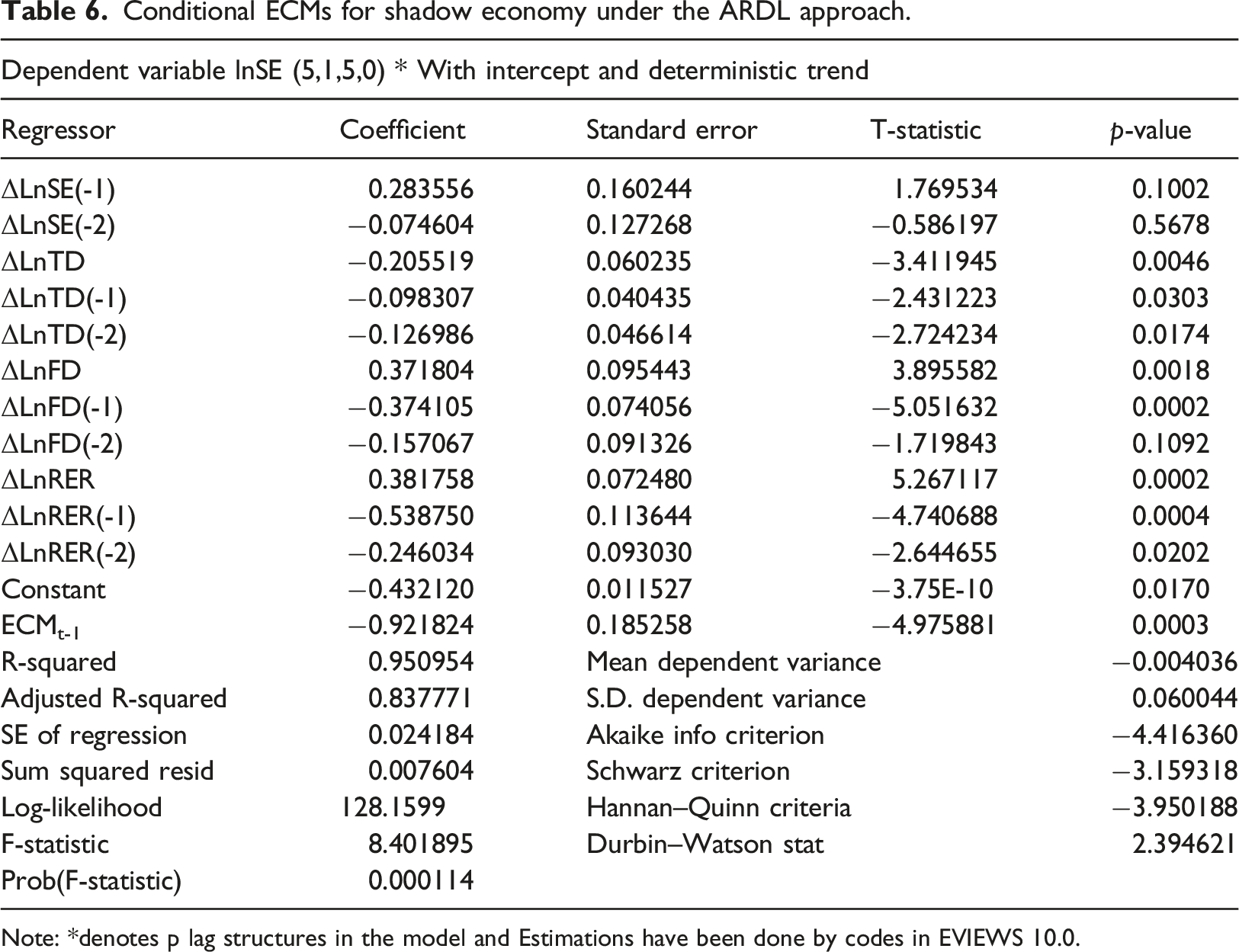
Conditional ECMs for shadow economy under the ARDL approach.
Note: *denotes p lag structures in the model and Estimations have been done by codes in EVIEWS 10.0.
The dependent variable is the size of the shadow economy, and the error correction term is given by ECMt-1. Here the ECMt-1 is high (−0.9218). It is statistically significant, and negative. This implies that the shadow economy adjusts to its long-term equilibrium through the channels of tourism development, financial development, and real EXR at the rate of 92.18%. 92.18% of last period’s disequilibrium is corrected after 1 year. It gives further evidence that the variables are co-integrated. The appropriately signs and significant error correction term confirms the findings that tourism development, financial development, and real EXR have a long-term effect on the shadow economy. The effect of tourism development on the size of shadow economy is consistently negative. In contrast, the short-term coefficients of financial development and real EXR variables are mixed across different lag structures in the short-term period. They are positive in the first period and become negative as from the second period. The findings from the control variables show that financial development and EXR appreciation tend to lead to an immediate increase in the size of the shadow economy but eventually the effect is reversed.
According to Njangang (2018) financial development reduces governmental control on the sector and should discourage individuals from engaging with the shadow economy. In Turkey, this happened with a one period lag. Initially, individuals may prefer to go underground due to potential lack of trust in institutional changes implemented but increasing trust in subsequent years bring them back to the formal economy. The situation gets worse before it gets better. A one percent increase in either financial development or appreciation of the EXR leads to an immediate rise of 0.4% in the size of the shadow economy. The size of the effect is higher than that of the tourism sector. The short-term coefficient of tourism development is statistically significant and consistently negative for the three time periods reported. The short-term elasticity of −0.21 shows that initially as the tourism industry grows by 1% the size of the shadow economy is reduced by 0.21%. This result is consistent with the findings presented in Table 1. For example, Lv (2020) obtained an elasticity value of −0.398. Both studies find a negative, significant and inelastic relationship between the shadow economy and tourism development. The findings here show that the expansion of the tourism sector had led to a reduction in the size of the shadow economy in Turkey.
This is because to be eligible for government incentives, businesses need to be registered and employees need to be working formally. This creates incentives for labour and investment to move to the formal sector. Furthermore, at the initial level of development government often offers tax incentives to the industry to encourage inflows of foreign direct investment and investment from local businesses. As discussed above, high taxes are one of the main causes of growth in the informal sector. Reduction of taxes in the form of expansionary fiscal policies will lead to an adverse reaction.
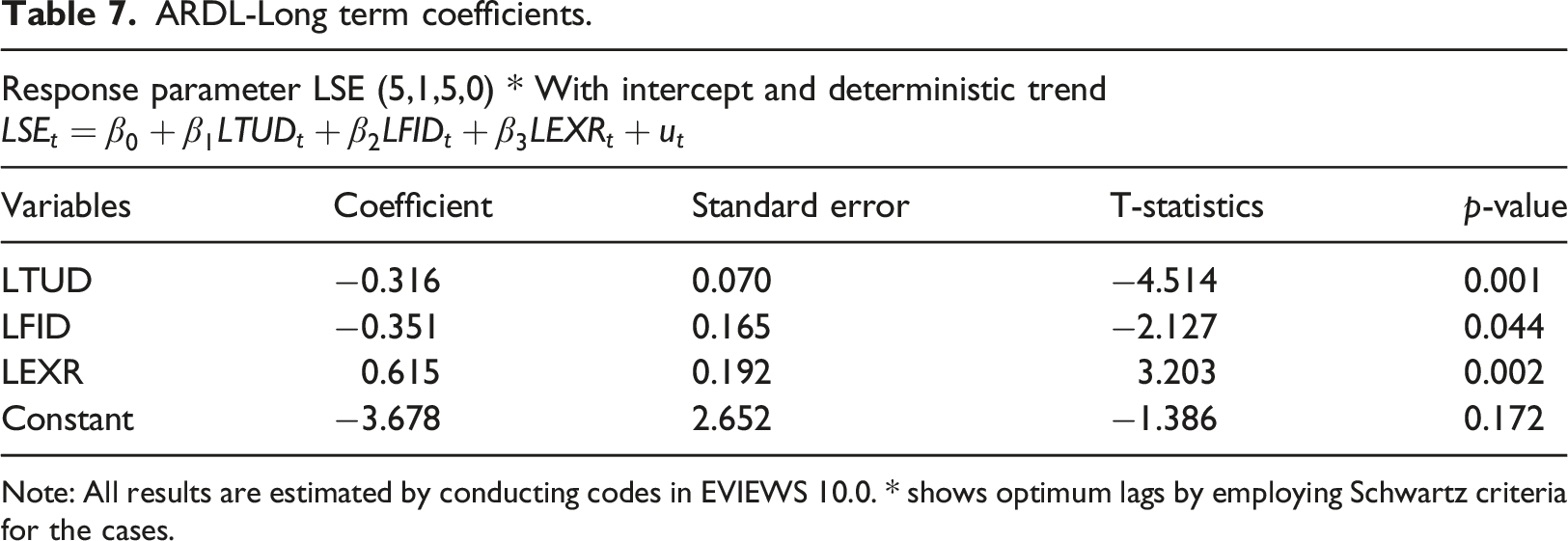
ARDL-Long term coefficients.
Note: All results are estimated by conducting codes in EVIEWS 10.0. * shows optimum lags by employing Schwartz criteria for the cases.
The findings indicate that there is a negative long-run relationship between the shadow economy and tourism and financial development, but the effect of the EXR is positive. It is seen here that the effect of the EXR is highest. In the long run, financial development which reduces control and cost of transactions in the formal sector leads to a fall in the size of the shadow economy. These findings are consistent with Gharleghi and Jahanshani (2020) whose analysis is based on a panel 29 developed and developing countries over the period of 1975–2015. They find that financial development which brings improvement in accessibility to finance and the credit market especially in developing countries reduces the size of the shadow economy. Table 7 also reports that the size of the shadow economy is negatively related to changes in the value of the Turkish Lira in the long run. When the value of the Turkish Lira falls, people are more likely to try to get better rates in underground markets and avoid paying the bank and legal fees by using informal money changers.
Tourism development has a significant negative impact on the shadow economy on the long run. A one percent increase in tourism development leads to a 0.316% fall in the size of the shadow economy. It indicates that as Turkey has matured as a destination, it has created opportunities in the formal sector reducing the size of the shadow economy. This finding contradicts that of Lv (2020) who finds that in the long run as tourism continues to grow the size of the informal sector is likely to increase but fully support those of Xu and Lv (2021).
Variance decomposition analysis.
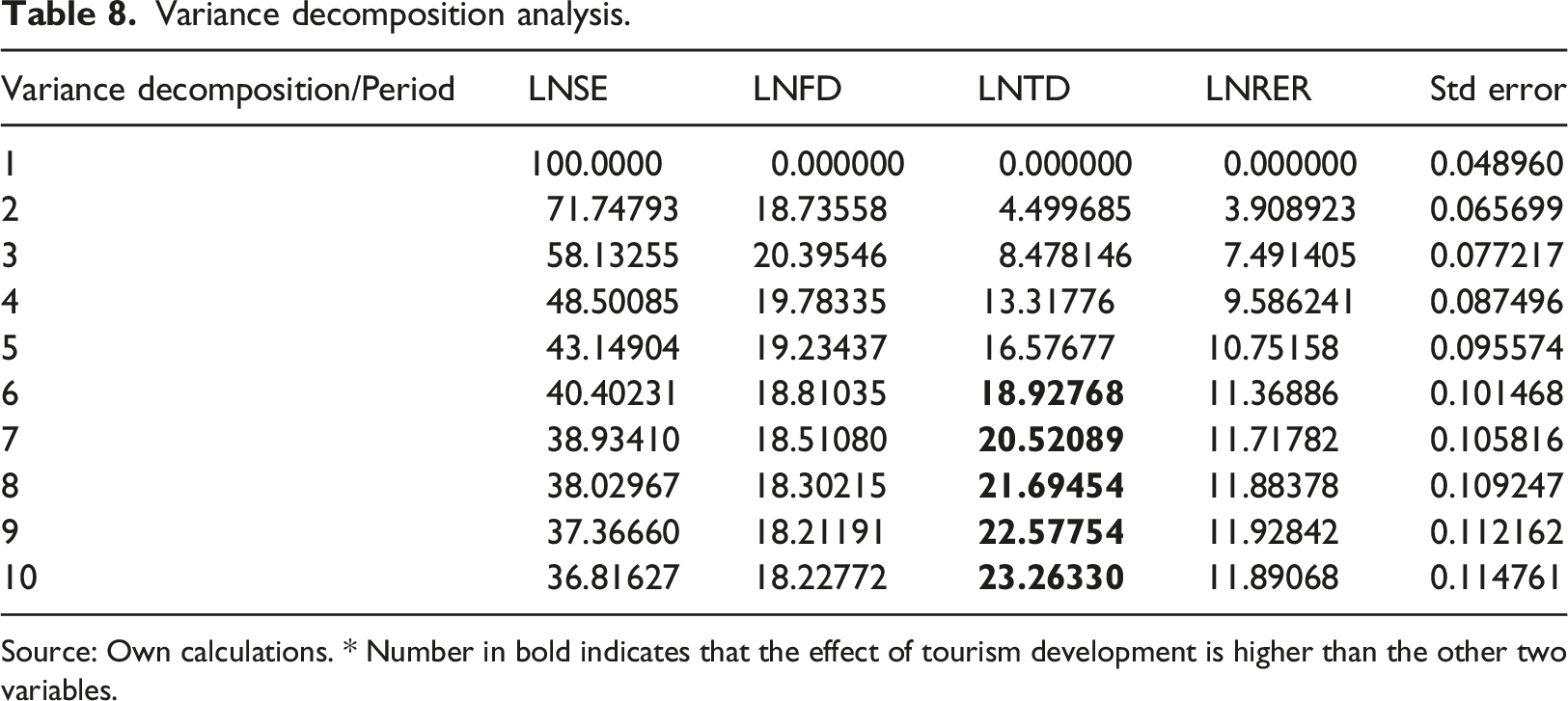
Source: Own calculations. * Number in bold indicates that the effect of tourism development is higher than the other two variables.
Tourism Development and the Shadow Economy
This study is the first to estimate the size of the shadow economy and quantify the relationship between informal sector and the development of the tourism sector using data from a mature destination spreading over several decades. In Turkey, the tourism industry is instrumental in reducing the size of the shadow economy in the short run and this effect increases in the long-run. In the long term a 1% increase change in international tourism arrivals to Turkey leads to a 0.316% decrease in the size of the shadow economy with a speed of adjustment of 92.18%. The negative relationship observed shows that the growth of the tourism sector has over the years reduced the size of the shadow economy in Turkey by moving resources to the formal sector. The findings are indicating that the nature of demand and the consumer behaviour of the industry do not support the informal sector. As the tourism industry has developed in Turkey, not only it has reduced the size of the shadow economy but its relative importance in doing so has increased over the years surpassing that of the reform of the financial sector.
According to the World Bank (2010b), in Turkey, businesses in general tend to be compliant with registration rules. Informality arises when businesses fail to report all sales and purchases and register their employees. Failure to report transactions is enabled by the widespread use of cash as the preferred means of payment. According to Schneider and Kearney (2013), because they are difficult to trace, cash payments promote the informal sector. Businesses dealing in cash are able to underreport their revenue and profits to pay lower taxes. Cash transactions, however, is becoming rarer among travellers. Modernisation of means of payment implies that that travellers are less likely to carry foreign exchange and cheques for use during their trip. They do not need to incur cumbersome transaction costs while exchanging currencies or financial controls at home or at their destinations. Financial liberalisation and development over the last decade which increased the reliance on electronic and plastic money due to ease of use and falling fees, have considerably reduced the need for travellers to use cash. This effect is further accelerated by the popularity of the newer forms of payment using mobile telephone applications such as Google Pay or Apple Pay. To accommodate travellers’, changing needs and preferences, the tourism industry in Turkey may have had to introduce innovative payment methods and promote their usage motivating local businesses to invest in the required technology leading to a spill over to the rest of the economy. Furthermore, the growing trend of online shopping and purchase of tours, booking shows and other events require credit card and electronic means of payment reducing the use of cash by the tourists. This limits the businesses’ ability to avoid disclosing sales and reduces the volume of transactions of informal local money changers.
The tourism industry may also have had a negative effect on the informal economy because it increases the demand for better quality of services and products which require high skill content in production and therefore, favours the employment of a trained labour force. To access the relevant training provided and related subsidies from the government and local authorities, workers need to be registered, hence, reducing the attraction of operating informally. In Turkey, subsidies for training are provided to employees in the tourism sector Government of Turkey (n.d.). In spite of a larger number of non-registered immigrants working in the sector, the scheme has meant that a proportion of the employees have chosen be registered and take advantage of the subsidies, which include reimbursement of the transport cost to the training centre. This will have encouraged workers from the informal tourism sector to move to the formal sector. An undesired outcome of this scheme, however, can be a growing inequality among those are able to access the training and eventually, enjoy better income and work environment compared to those who are not able to take advantage of it for various reasons.
A priori the findings of this study seem to support the dualist school of thought because the development of the tourism industry has led to a reallocation of resources from the informal to the formal sector as the capacity for the later to absorb employment has increased over the years. This paper extends the theory by showing that the effect is faster in the long run. However, it can also be argued that in Turkey the informal economy has existed for a long time and is still very significant. After 59 years the shadow economy is still strong and thriving although smaller in size indicating that it is co-existing with the formal sector and can even be part of its supply chain as proposed by the structuralists.
Conclusion
Knowing the size of the shadow economy enables more targeted approaches to policy implementation. Lack of information on the shadow economy will reduce the effectiveness of responses to crises whereby, some of the most vulnerable people of society who are working underground are left out. This has macroeconomic consequences for the destination because the extent of unemployment and losses incurred as a consequence of the global pandemic may be underestimated if a large proportion of the businesses and labour force of the sector was operating informally and are unaccounted for in the statistics.
Despite a wide-ranging volume of research on the shadow economy and its determinants, few studies have sought to assess the magnitude between tourism development and shadow economy. Sectoral analysis within the tourism industry, however, has clearly identified and discussed the role of tourism and the informal provision of good and services to the industry. This study has empirically investigated the impact of tourism development on economy wide informal economic activities in Turkey using robust econometric techniques and data over a large time span covering the period from 1960 to 2018. This study estimates the size of the informal sector using the electricity consumption method. This is a first in the tourism literature. The estimated size of the shadow economy is used to obtain respective short-term and long-term tourism development elasticities. A one percent increase in international tourist arrivals to Turkey will reduce the size of the shadow economy by 0.21% in the short run and 0.32% in the long run. The findings of this study, while based on data from Turkey are applicable to destinations with similar development paths and economic incentives.
There are other factors which influence the size of the shadow economy such as trade openness, labour markets conditions, and education level of the labour force. In this study, it was not possible to consider them as control variables. It is suggested that future research take these into account when modelling the relationship between tourism development and the shadow economy.
Footnotes
Declaration of conflicting interests
The author(s) declared no potential conflicts of interest with respect to the research, authorship, and/or publication of this article.
Funding
The author(s) received no financial support for the research, authorship, and/or publication of this article.
