




Abstract
This paper examines the impact of the 2015-2016 national security events on inbound tourism in Turkey. Using the Synthetic Control Method (SCM), the study reveals significant and persistent causal effects on tourism metrics: Between 2015 and 2019, international tourist arrivals were 36% lower, overnight stays 41% lower, and expenditures 18% lower, on average, than in a “synthetic” Turkey constructed as a counterfactual. Although increased security stabilization from 2018 onwards helped Turkey’s tourism recover, tourism activities were still far below their counterfactuals even in 2019. This highlights a substantial negative long-term impact of severe security incidents on international tourism.
Introduction
Tourism and security are directly linked. Most tourists prefer destinations where they feel safe, as any perception of risk can significantly deter travel. The impact of political conflict and terrorism on tourism has been widely studied. Findings consistently indicate that both lead to substantial declines in international tourist arrivals and expenditures (e.g., Asongu and Nwachukwu, 2019; Akamavi et al., 2023, among others), with political conflict often exhibiting a more severe impact than terrorism (Saha and Yap, 2014). Negative effects may occur immediately or with delay, depending on seasonality (Karl et al., 2017), and are particularly pronounced among Western tourists visiting Islamic countries (Neumayer and Plümper, 2016). While terror is not always related to political conflict in the country or region where the attacks occur (e.g., the 9/11 terrorist attacks in the United States), it is often linked to unresolved political issues or disputes in the area where it arises or impacts directly. This has been the case in Turkey and the Middle East.
The aim of this paper is to quantify the causal impact of the national security events of 2015-2016 on inbound tourism in Turkey using the Synthetic Control Method (SCM). SCM is a well-established quantitative approach that allows researchers to estimate the causal effects of interventions or events by comparing a treated unit (e.g., a country) with an optimally weighted “synthetic” counterfactual (Abadie, 2021). Thus, using SCM the paper provides an evidence-based approach to assess the short- and long-term impacts of these security events, including a failed coup d’état, on one of the world’s most popular tourism destinations.
Three papers have studied the relationship between terrorism and tourism in Turkey for earlier periods. Drakos and Kutan (2003), Feridun (2011) and Ulucak et al. (2020) identified significant negative correlations between terrorism and tourist activities but did not quantify the magnitude of the impacts. Further, Bilgel and Karahasan (2017) used SCM to quantify the impact of PKK terrorism on regional economic output, revealing a real GDP gap of about 7% during 1988 to 2001 for the provinces of Eastern and Southeastern Anatolia. By quantifying the causal impact of recent major security events on tourism, the present paper offers crucial insights for policymakers and the tourism industry.
Data and methodology
SCM makes it possible to construct credible counterfactual developments for a country of interest. The identifying assumption here is that tourism in the country in which security incidents have occurred (Turkey) would have developed in the same way as in the synthetic counterfactual situation in a hypothetical world without this treatment. This counterfactual scenario, which is unobservable, is calculated as a weighted average of the non-treated countries in the donor pool such that it closely matches actual developments in the pre-treatment period. The difference in the outcome variable analysed between Turkey and its synthetic counterfactual post-treatment measures the causal effect of the incidents.
Donor countries used to construct the synthetic Turkey must meet two crucial prerequisites to avoid bias in the results (Abadie, 2021): Firstly, countries in the control group must be driven by the same structural process as the treatment country Turkey, and the outcome variables must not be subject to structural changes during the pre-treatment period. Secondly, countries that may be affected by spillover effects from the events in Turkey have to be excluded from the control group. For the former reason the pool of donor countries is restricted to OECD countries, which exhibit comparable economic development and are predominantly stable economies. Among those, a country is excluded if it shows structural breaks or gaps in the time series of the relevant tourism variables. For the latter reason Greece, Israel, Italy, Portugal, and Spain, each of which could have benefited from positive spillover effects in tourism due to the unstable situation in Turkey, are excluded from the analysis. The donor pool of countries and their respective weights in the SCM analysis are illustrated in Table A.1 in the Online Appendix.
The number of arrivals, overnight stays, and expenditure by international tourists are used to analyse how the events affected tourism development. Tourism data is available from the UNWTO database from 1995 to 2022. Due to the Covid-19 pandemic, which caused a global tourism crisis lasting until 2022, the analysis only covers the period 1995-2019. SCM analysis is carried out using the scul command in Stata (Greathouse, 2022). 1
Terrorist activities in Turkey 1995-2019.
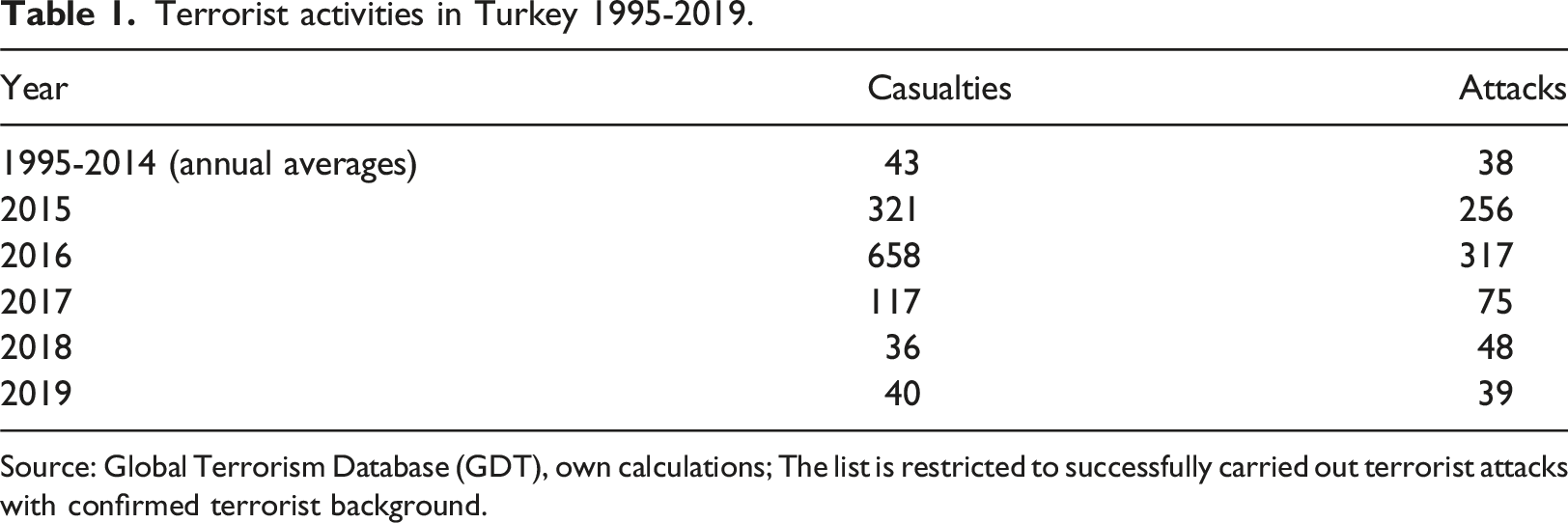
Source: Global Terrorism Database (GDT), own calculations; The list is restricted to successfully carried out terrorist attacks with confirmed terrorist background.
Results
The SCM analysis reveals a significant decline in international tourist arrivals to Turkey after 2015 compared to the synthetic cohort (Figure 1). The difference indicates that millions of potential tourists avoided traveling to Turkey as a result of security concerns. This decline was most pronounced immediately following the major terrorist attacks and the failed coup attempt in 2016. According to the average treatment effect (ATE) estimated, the incidents caused a decrease in log international tourist arrivals of −0.456. This translates into 23.4 million international arrivals less per year on average in the 2015-2019 period and corresponds to an average reduction of arrivals by about 36.4% compared to the synthetic Turkey. SCM results on international arrivals. Source: UNWTO, own calculations.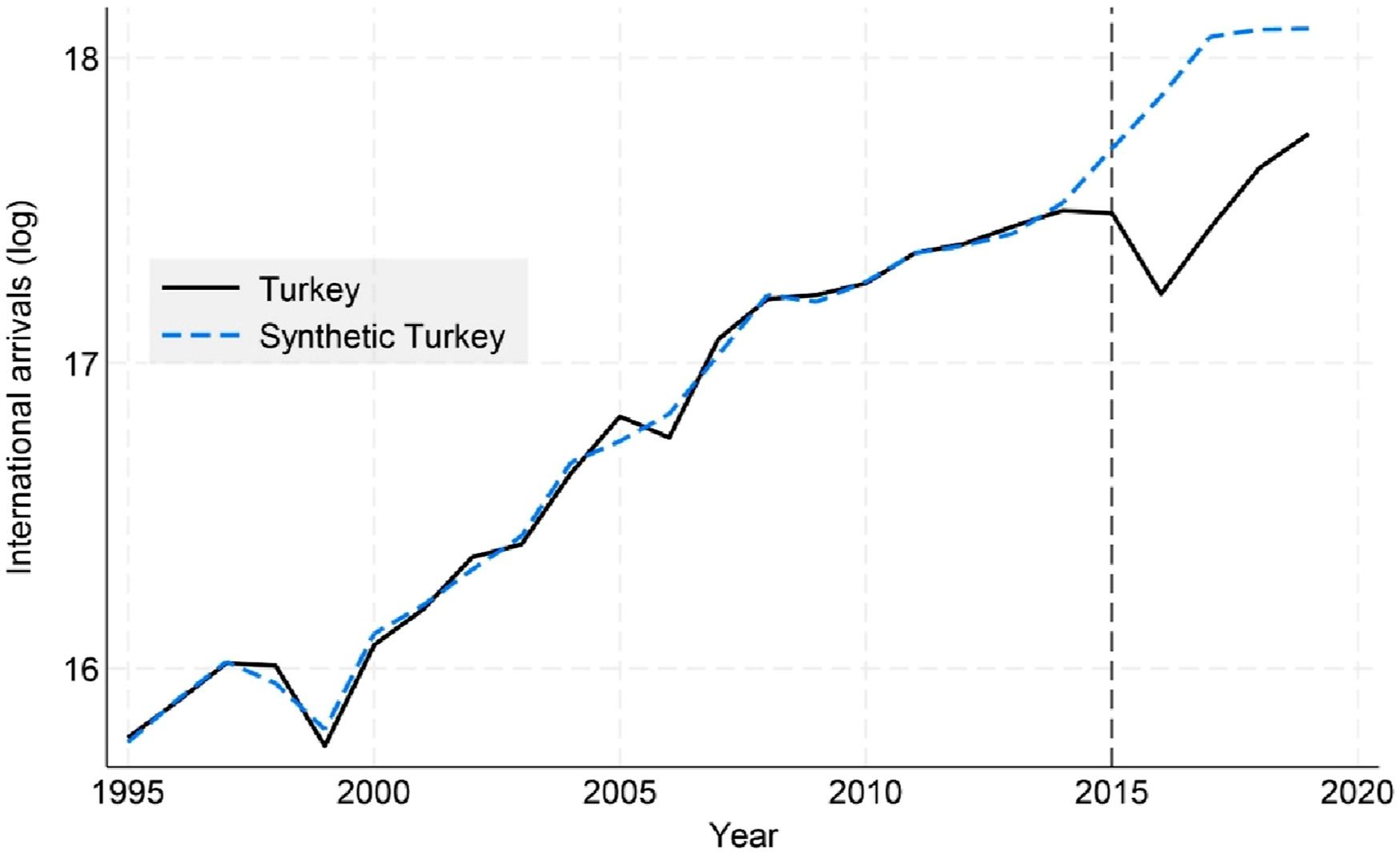
Similarly, the number of overnight stays by international tourists in Turkey also shows a substantial decrease compared to the synthetic counterfactual (Figure 2). The ATE is −0.512 for logs, which corresponds to an average reduction of 70.4 million overnight stays per year compared to the counterfactual during the post-intervention period 2015-2019. In relative terms, this results in a causal decrease in international overnight stays by 41.4%. SCM results on international overnight stays. Source: UNWTO, own calculations.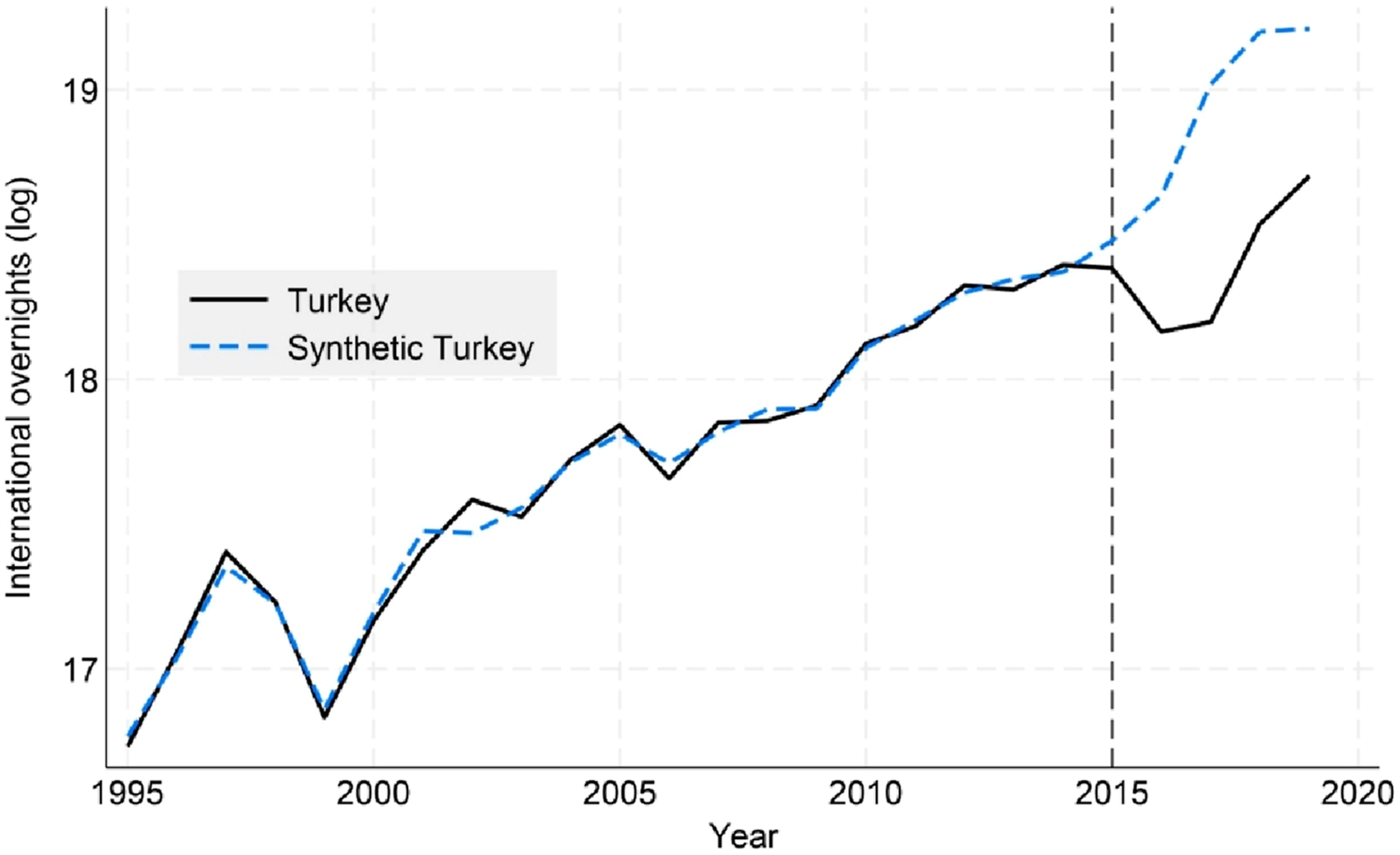
Finally, expenditures of international tourists, a critical metric for assessing the economic impact of the incidents, showed a significant decline as well (Figure 3). As data on expenditures is only available from 2005 onwards for Turkey, the analysis for this variable begins in 2005 instead of 1995. The reduction in spending by international visitors aligns with the negative impact on international arrivals and overnight stays. The ATE for logs is −0.206, which is equivalent to a loss in annual expenditure by international visitors of 7.7 billion USD during the 2015-2019 period. This corresponds to an average gap of 17.8% per year compared to the synthetic counterfactual for Turkey. SCM results on expenditures by international tourists. Source: UNWTO, own calculations; Expenditures in USD (current prices).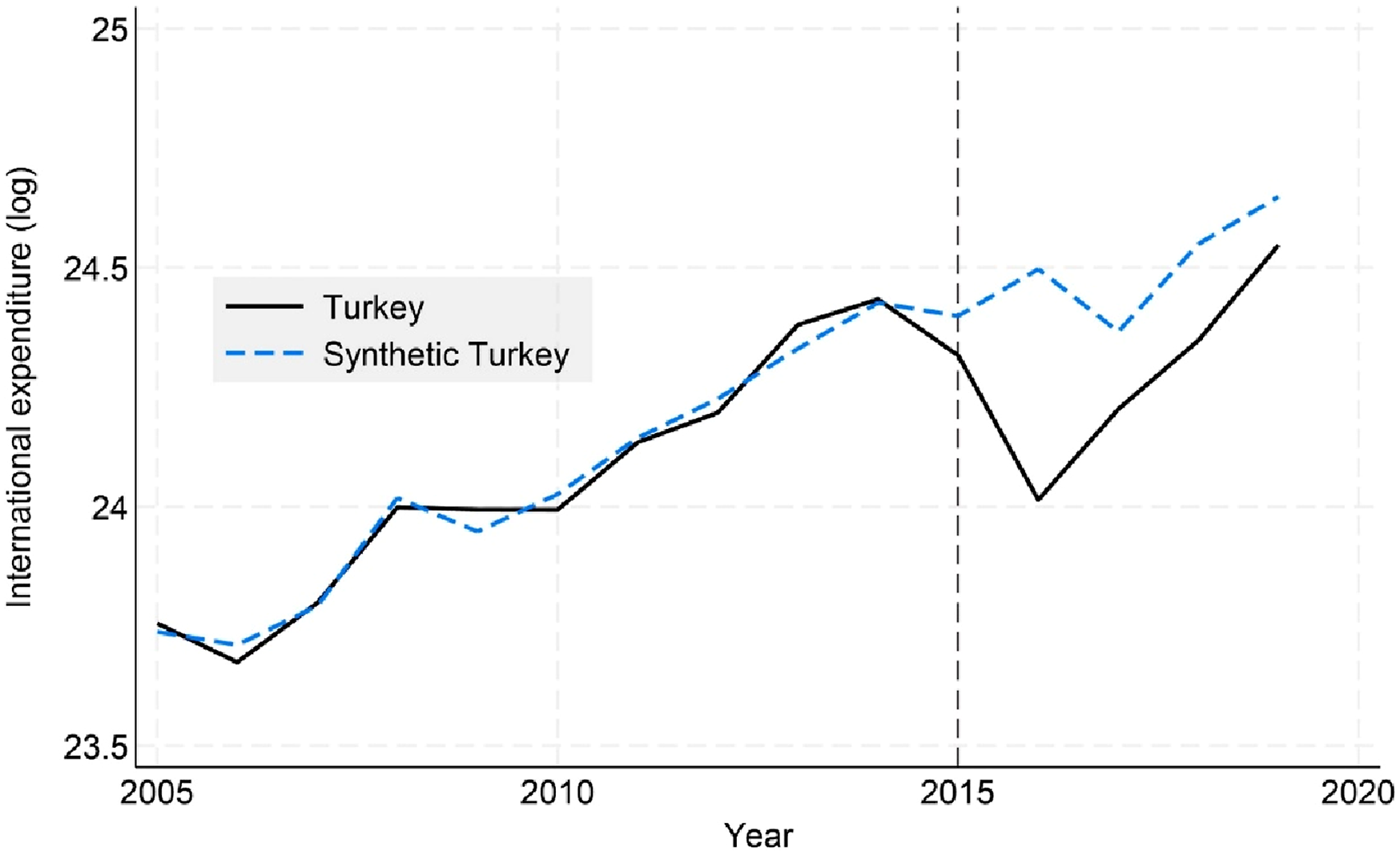
For all three outcome variables the results illustrate an immediate impact stemming from the intensity of terrorist attacks already in 2015. However, the gap between the actual and synthetic outcomes was largest across all three variables in 2016, followed by 2017. In line with the increasing stabilization from 2018 and a decline in the number of attacks to approximately the pre-2015 long-term levels, international tourism in Turkey also recovered substantially. Nevertheless, arrivals, overnight stays and spending by international tourists remained well below the levels of the synthetic counterfactual even in 2019. Figures illustrating the gaps between actual and synthetic outcomes along with Placebo tests highlighting the statistical significance of the identified effects, can be found in the Online Appendix.
Conclusions
The findings of this study underscore the severe and long-lasting impact of security issues in 2015 and 2016 on Turkey’s tourism industry. SCM results provide evidence that the substantial decline in inbound tourism metrics can be causally linked to the period of these incidents. These results are consistent with previous research on the impact of terrorism and political conflict on tourism.
Effective crisis management and communication strategies are essential to mitigate the damage both during and after security incidents. Given the significant economic impact of security threats on tourism, policymakers need to prioritize enhancing security measures to rebuild tourist confidence. Future research could investigate the impact of specific types of security threats. Additionally, qualitative studies could offer a deeper understanding of tourists’ perceptions and decision-making processes following the national security incidents in 2015–2016.
Supplemental Material
Supplemental Material - The long-lasting shadow of terror and political conflict: Effects of the 2015-2016 national security events on Turkey’s inbound tourism
Supplemental Material for The long-lasting shadow of terror and political conflict: Effects of the 2015-2016 national security events on Turkey’s inbound tourism by Firuze Alpaslan and Matthias Firgo in Tourism Economics.
Footnotes
Declaration of conflicting interests
The author(s) declared no potential conflicts of interest with respect to the research, authorship, and/or publication of this article.
Funding
The author(s) received no financial support for the research, authorship, and/or publication of this article.

Supplemental Material
Supplemental material for this article is available online.
Notes
Author biographies
References
Supplementary Material
Please find the following supplemental material available below.
For Open Access articles published under a Creative Commons License, all supplemental material carries the same license as the article it is associated with.
For non-Open Access articles published, all supplemental material carries a non-exclusive license, and permission requests for re-use of supplemental material or any part of supplemental material shall be sent directly to the copyright owner as specified in the copyright notice associated with the article.
