




Abstract
There is an ongoing debate within the literature about whether inbound tourism in developing countries contributes positively to national welfare. Most of the existing literature primarily relies on case studies and lacks theoretical frameworks essential for a comprehensive understanding of the role of imported intermediate inputs in tourism development. We aim to fill this gap by presenting a theoretical specific-factor general-equilibrium model of a tourism-exporting economy that incorporates both imported and non-traded intermediate goods. Our findings indicate that the extensive utilization of imported intermediate goods by the tourism industry, as well as other sectors, could potentially increase residents’ real income during a tourism boom. Additionally, our analysis reveals deviations from some standard results of the “beach disease” model. Lastly, we shed light on the complexity of the consequences of tourism expansion on income distribution, which prove to be more intricate than commonly believed. This underscores the need for a deeper understanding of the multifaceted dynamics involved in analyzing the connections between imports and tourism expansion.
Introduction
For some time now, inbound tourism has become one of the main export sectors in a large number of developing countries across the world. It is considered as having the potential to stimulate their economic growth and to contribute to job creation and foreign exchange generation (Fang et al., 2021; Samira et al., 2019).
However, there is also a recognition among scholars that developing countries have not been benefitting fully from inbound tourism. One of the main reasons put forward in the literature is the high import content of the tourism industry. Developing countries rely heavily on imported goods and services to satisfy the needs of the tourism industry, meaning that a significant amount of international tourism receipts leaves their economies in the form of internal leakages (Pratt, 2015; Pratt et al., 2018; Ramjee Singh, 2006). In a framework where there are no constraints limiting the capacity of the economy to expand production, these economic leakages out of the host-economy determine, together with the strength of intersectoral linkages between tourism and other domestic sectors, the extent to which inbound tourism can generate increased production. The larger the leakages, the lower the multiplier effects, and the lower the linkages with other sectors, the less likely economic benefits are dispersed throughout the destination economy (Pratt, 2015; Pratt et al., 2018; Scheyvens and Russell, 2012). Consequently, minimizing leakages is often seen by policy makers and scholars as one of the key strategies that developing countries should adopt for higher economic benefits (Garrigós-Simón et al., 2015), especially through the implementation of protectionist trade measures and an import-substitution policy.
This common “traditional view” among tourism scholars stems from the absence of factor constraints and price mechanisms in the economic models used, and so their inability to capture the effects of changing factor costs on incomes, sectoral outputs and residents’ welfare (Dwyer et al., 2003, 2004). Another main limit of these models is that they are often partial equilibrium models of the economy, which only examine the relationships between selected few economic variables, keeping other ones unchanged. Due to its simplicity, this “traditional view” of estimating tourism leakages neglects important interactions between various economic variables, markets and inter-sectoral linkages that are the basis of general equilibrium analyses.
Our aim in this paper is to reconsider the influence of intermediate goods, both imported and domestically produced, on the consequences of a tourism expansion on the pattern of sectoral production, on factor returns, and on the country’s real income, by using a general-equilibrium trade-theoretic framework incorporating a set of economy-wide constraints. One of the most important findings of this paper is that the presence of intermediate inputs, and more precisely their degree of tradability, can dramatically change some standard results of existing general-equilibrium models on tourism, especially the results of the “beach disease” model (Copeland, 1991; Holzner, 2011) obtained in a specific factors framework. Last, contrary to widespread opinion, the intensive use of imported intermediate goods by the tourism industry could strengthen the residents’ real income during a tourism boom. A host country can gain more from an inbound tourism expansion when sectors are intensive in imported intermediate inputs rather than intensive in domestic intermediate inputs. This result sheds some new light on a long-standing policy debate as to whether priority in developing countries should be given to domestic or imported intermediate goods and services.
The remainder of this paper is organized as follows. The first section provides a brief review of three streams of literature: tourism leakages, the economic impacts of tourism within a general equilibrium framework, and intermediate goods in models of trade and production. The second section describes the model of a small open tourism-exporting economy using both imported and non-traded intermediate goods. The third section presents the model in terms of relative variations. The penultimate sections analyse the consequences of a tourism expansion on relative prices, the pattern of outputs, the distribution of factor incomes, and the national welfare. Finally, the conclusion of the paper is provided in the last section.
Related literature
Our paper builds on three streams of literature: tourism leakages, economic impacts of tourism under a general equilibrium setting, and intermediate goods in models of production and trade.
Tourism leakages
One of the main economic costs discussed in the tourism literature is related to tourism leakages. Although there are three types of leakages (internal, external and invisible leakages), most of the studies in the tourism literature have focused on internal leakages which can be caused by different factors (imports of goods and services to satisfy the needs of the tourism industry, repatriation of profits and salaries…). (For a recent review of the literature on tourism leakages see Chaitanya and Swain, 2023.) The basic principles of these studies on internal leakages are the same. Tourism leakages prevent host communities from benefitting of all the advantages from tourism activities (Meyer, 2007). As a result, it has been widely argued in the tourism literature that high levels of leakages in developing countries make tourism an inappropriate instrument for economic development. For instance, Pratt et al. (2018) found that 65.5% of all food and beverages used by a sample of hotels in Thimphu and Paro in Bhutan are imported. This means that a significant amount of international tourism receipts is leaving Bhutan in the form of internal leakages. In another study of seven small island destinations, Pratt (2015) found that for every tourist dollar spent in these islands, on average only $0.69 remains in the local economy. Other studies show that the average leakage rate for many developing countries is between 40% and 50% of gross tourism earnings for small economies, and from 10% to 20% for most advanced and diversified economies (Benavides, 2001; Ramjee Singh, 2006). These studies have left a legacy of viewing imports as harmful for host economies, which suggests the implementation of protectionist trade measures and an import-substitution policy.
As stated in the introduction, traditional models on leakages in tourism suppose the absence of factor constraints and price mechanisms, and are often partial equilibrium models of the economy. However, over the last two decades, the study of the economic impacts of tourism has experienced a “paradigm change” thanks to the use of rigorous general equilibrium models that take full account of the interactions between different sectors of the economy, and of changes in the prices of inputs and outputs. As discussed below, these studies reach different theoretical and empirical findings from those based on partial equilibrium models (Copeland, 1991; Dwyer et al., 2004; Nowak and Sahli, 2007).
The general equilibrium approach of the economic impacts of tourism
There is nowadays a rich theoretical literature on the economic impacts of tourism in such a general equilibrium setting (Chang et al., 2011; Chen et al., 2016; Copeland, 1991; Inchausti-Sintes, 2020; Nowak et al., 2003; Nowak and Sahli, 2007). Considering tourism as one sector among many in an economy that compete against each other for scarce resources leads to the general conclusion that a tourism expansion will modify relative prices, factor returns and output composition of the economy. In an earlier theoretical paper, Copeland (1991) identified, in a specific-factor version of his general model, the effects of a tourist boom as similar to the effects of any other sectoral boom, connecting his analysis to the Dutch disease literature and defining what Holzner (2011) named a “beach disease”.
On the empirical side, Adams and Parmenter (1995) found evidence of such a “beach disease” for Australia by using a computable general equilibrium (CGE) model, Capó et al. (2007) for the Balearics and the Canary Islands, and Sheng and Tsui (2009) for Macao. Inchausti-Sintez (2015) detected it for Spain by using a recursive-dynamic CGE model, while Zhang and Yang (2019) used a DGSE model calibrated on Thailand.
Note that the specific-factor model (Jones, 1971a) is commonly used for analysing tourism (Chang et al., 2011; Chen et al., 2016), because tourism activity is to a large degree determined by the presence of a specific set of local natural and cultural attributes (Copeland, 1991; Ritchie and Crouch, 2003). In such a model, the effects of a “beach disease” can be summarized as follows. The real exchange rate appreciates, bringing about a contraction of all traded sectors (traditional export sectors and import-competing sectors) and an expansion of non-traded sectors. Factor income evolution obeys to Jones’ “magnification effect” (Jones, 1971a): the return to the specific factor in the non-traded sector (i.e. a part of the factor specific to tourism) captures the most part of the gain provided by the tourism boom, while the return to specific factors in traded sectors unambiguously falls (Copeland, 1991). The situation of workers is ambiguous: the wage rate increases in terms of traded goods prices but decreases in terms of non-traded goods prices. Hence, workers end up better off after the tourism boom only if the share of non-traded goods and services in their consumption basket is low enough. At the aggregate level, residents’ welfare rises thanks to a terms-of-trade improvement (increase in the price of non-traded goods sold to foreign tourists), provided there is no distortion in the economy and no additional rents to foreign-owned capital leaving the country.
However, despite the high import content of the tourism industry and the debate on the impact of economic leakages out of the host-economy, the role of intermediate goods has, to the best of our knowledge, never been explicitly analyzed in theoretical general-equilibrium models of tourism-based economies. Computable general equilibrium models consider intermediate goods in the form of a composite Armington good (1969), resulting from the aggregation of imports with domestic goods by using a Leontief function (Blake et al., 2006; Inchausti-Sintez, 2015, 2020; Pratt et al., 2013).
Intermediate goods in models of production and trade
In this paper, we study the consequences of a tourism boom in a general equilibrium specific-factor model incorporating both local (non-traded) and imported intermediate goods, with no a priori restriction on the technology. Note that since the sixties, intermediate goods have been incorporated in general equilibrium models of production and trade (Amano, 1966; Kemp, 1969; Vanek, 1963), giving rise since then to a large body of literature. The primary focus of authors during this period was to examine how the inclusion of such goods affects the traditional trade models’ theorems (pertaining to specialization, incomes, gains from trade, etc., as exemplified by Batra and Casas, 1973), or the efficacy of trade policies (such as the theory of effective rate of protection introduced by Corden (1966) and expanded upon by Jones, 1971b). More recently, research in this area has aimed to elucidate the development and dynamics of global value chains (Caliendo and Parro, 2015). A diverse array of theoretical frameworks has been used, ranging from traditional theories grounded in comparative advantages to more contemporary theories based on increasing returns to scale and imperfect competition. Nonetheless, the majority of studies rooted in traditional theories were conducted within the standard Heckscher-Ohlin framework, which assumes freely mobile factors between sectors (Chang and Mayer, 1973). Only a small number of studies used sector-specific factors when incorporating intermediate goods. Moreover, when sector specificity of primary factors was assumed, it was often limited to certain sectors or subsets of the model, with other subsets retaining the Heckscher-Ohlin framework. This pattern has been particularly notable in multi-stage production models (Barua and Pant, 2014; Sanyal and Jones, 1982).
In alternative models, a sector-specific primary input has been substituted with a sector-specific intermediate good (Ishikawa, 2000; Takechi and Kiyono, 2003). However, none of these models align precisely with the study of the consequences of intermediate goods on the “beach disease” symptoms as delineated earlier. This is because these symptoms have been defined, akin to Copeland (1991), within a pure specific factor model, where each sector possesses its own specific primary factor. Although both the Heckscher-Ohlin model and the specific factor model are fundamentally grounded in differences in factor endowments between countries as determinants of trade, their characteristics diverge significantly (Jones, 1971a; Amano, 1977). Furthermore, none of the above-mentioned studies based on sector-specific factor assumptions have addressed the influence of the tradability of intermediate goods on their findings, especially with endogenous prices depending on demand conditions.
Consequently, unlike previous models in the literature, this paper proposes a model of production and trade that integrates both traded and non-traded intermediate goods within a pure specific factor model, where each sector is endow ed with its own primary specific factor.
Within our small open economy, three sectors are present: one non-traded sector, which includes tourism activities, and two traded sectors. The economy relies on two types of intermediate goods: imported and domestically produced. While all sectors utilize imported intermediate goods, only one of the traded sectors and the non-traded sector make use of locally produced intermediate goods.
In this framework, the paper elucidates how the inclusion of intermediate inputs, particularly with different degrees of tradability, can modify certain findings of the standard specific-factor model, thereby impacting the “beach disease” model as well. The first main result is that all traded sectors are no more condemned to decline, some of them can now benefit from the tourism boom. The second main result is that, contrary to the standard model, workers can end up better off after the tourism boom whatever the composition of their consumption basket, while owners of specific capital in some traded sectors can earn even more than in non-traded (tourism) sector. The third main result is that the intensive use of imported intermediate goods by the tourism industry could increase residents’ real income during a tourism boom. The economy could experience a welfare improvement and at the same time an increase in import leakages: the greater the import leakages, the greater the welfare gain from inbound tourism. These results shed some new light on trade policies that should be implemented in developing countries relying on tourism.
Description of the model
We consider a small open economy that is made up of two tradable sectors SA and SM - agriculture and manufacturing goods – and a non-tradable goods and services sector SN (that includes tourism activities). The productions of these sectors are respectively XA, XM and XN. Both goods XA and XM are traded internationally at the externally determined world prices. For concreteness and simplicity, we assume that SA is an exporting sector while SM is an importing sector. This assumption does not affect the ensuing analysis and results of this paper.
In this economy, there are two essential types of intermediate goods: imported and non-traded. The imported inputs, referred to as “I”, are exclusively sourced from overseas since they are not locally available. (This simplifying assumption does not alter the conclusions of the model. We could have obtained similar results with the assumption of SM producing traded intermediate goods).
Non-traded intermediate goods are internally supplied by sector SN itself. In essence, Sector N can be conceptualized as having two sub-sectors. The first sub-sector encompasses goods and services, such as tourism activities, which are inherently non-traded due to the significant transport costs involved. The second sub-sector consists of intermediate goods and services that were originally traded but have been rendered non-traded due to the imposition of prohibitive tariffs and quantitative restrictions. By utilizing Hicks’ composite commodity theorem, both sub-sectors can be aggregated into one sector, whose endogenously determined price is PN. 1
Sectors SN and SM require the use of imported and non-traded intermediate goods. For the sake of simplification, we suppose that the agriculture sector SA requires only imported intermediate goods.
The neoclassical production functions are assumed to be linearly homogeneous (constant returns to scale). They are expressed as



Lj denotes the labour employment in sector j (j = A,M,N). Ti represents the specific factor of sector j (j = A,M,N). Labour and specific factors are internationally immobile. XNj (j = M,N) and XIj (j = A,M,N) refer to, respectively, the quantity of non-traded intermediate goods N and the quantity of imported intermediate goods I used by sector
Under the assumption of profit maximisation and competitive markets, the unit cost functions reflect market prices and are defined as follows


We consider a small open country where the prices of agriculture goods A, manufacturing products M, and imported intermediate inputs I (
The full employment conditions of factors are given below


The two primary factors are supplied inelastically.
Recall that the output of sector j is produced with a neoclassical production function, which has constant return to scale and diminishing returns to factors. Hence, from Shephard’s lemma, the term
Demands for intermediate inputs XNj and XIj (j = M,N) are defined as follows


Residents’ spending function is equal to


We have:


Any variation of the national welfare is thus expressed by

Note that from (11), the current account deficit is assumed to be zero in both the initial and final general equilibria (the model uses a comparative static approach).
Finally, we define the inbound tourism demand functions as

•
•
•
An inbound tourism boom is represented in this model by an increase in the shift parameter α and leads to an increase of non-residents’ consumption of non-traded goods and services. This parameter α captures some exogenous factors (GDP per capita in origin countries of travellers, fashion….). We follow the literature (Chen et al., 2016; Copeland, 1991; Faber and Gaubert, 2019; Nowak and Sahli, 2007) by assuming that variations in tourism activity are determined to a large extent by the presence and the quality of a specific set of local natural and cultural attributes. By offering to their visitors differentiated non-traded goods and services related to experiences in the destination (climate, scenery, natural and cultural sites, gastronomy, etc.), a small open country benefits from a kind of monopoly power in trade of tourism services.
The market-clearing equation of non-traded goods and services requires that the net production (

The model in variations
To determine the consequences of an inbound tourism expansion on income distribution, resident welfare and sectoral outputs, we need the expressions for a change in the supplies, demands, good prices and factor prices. The “^” notation denotes proportional change [with
Supply functions are obtained by totally differentiating the full-employment conditions for specific factors (7) and by using the expressions for unit factor demands



Differentiating (15) yields the market-equilibrium condition in variations for the non-traded good N

The residents’ consumption demand and the foreign tourist demand for N take the usual form in variations


To obtain the expression of real income variations, first differentiate the residents’ budget constraint (11) and the national income (12). Then use definition (13) and recall that the maximization of national income requires that the price plane lie tangent to the

As usual in a specific-factor model, factor incomes depend on both good prices and factor endowments. Assuming that traded good prices, total labour and specific factor endowments remain constant, the combination of variations of unit cost functions, (4) and (5), and of factor-market equilibrium conditions, (6) and (7), yields to the following wage changes (see Supplemental Appendix 1):

The expression in brackets is the elasticity of wages relative to the price of non-traded goods (
Equation (23) is crucial and deserves some comments. In the absence of intermediate goods (
Effects of a tourism expansion
As seen above, an inbound tourism expansion is represented by an increase in the shift parameter α (

Factor income distribution
In usual models of tourism based on international trade theory, an inbound tourism boom gives rise to well-known results on income distribution (Copeland, 1991; Nowak et al., 2003; Thompson, 2016). The return to the specific factor in the tourism (non-traded) sector (
Workers are better off only if the share of non-traded goods and services in their consumption basket is low enough. This is the “neoclassical ambiguity” analysed by Ruffin and Jones (1977). Of course, these results can be obtained in this model by assuming the absence of intermediate goods:

However, with intermediate goods in the economy, the results of a tourism expansion can be very different, at least for workers and owners of the specific factor in the traded sectors. We have seen [equation (23)] that the elasticity (A) In the first case ( (B) In the second case ( Consequences of tourism expansion on factor income distribution.
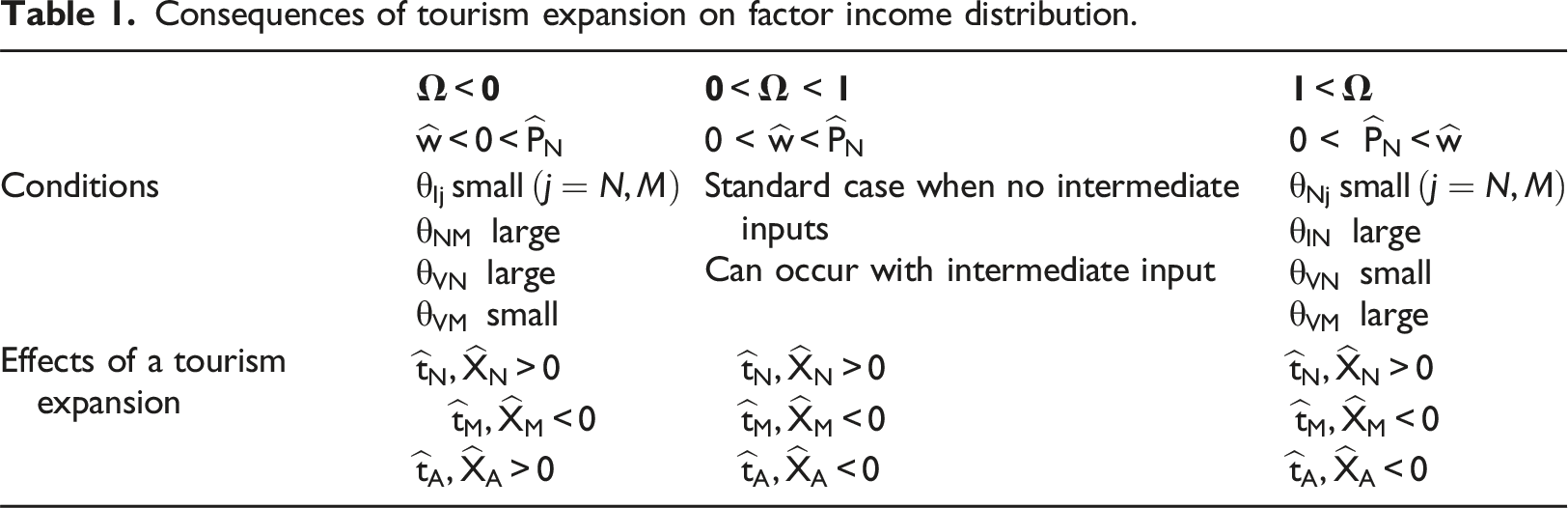
The effect of the tourism boom on the returns to specific factors is obtained by combining the cost-price equations, (4) and (5), in variations with the wage equation (23). Equation (26) shows that the owners of the specific factor in sector N (owners of tourism sites, beaches, hotels, etc. among them) always gain from a tourism expansion. Moreover, they gain whatever the composition of their consumption basket, as their income always increases more than the price of non-traded goods and services. The reason is that the upper bound for the elasticity 


The owners of the specific factor in traded sector M, i.e. the traded sector using non-traded intermediate inputs, always lose from a tourism expansion [see (27)]. However, in the other traded sector, A, that uses only imported intermediate input I, owners of the specific factor can now benefit from tourism [see (28)]. This is the case when the tourism boom causes a wage decrease (
When the return 
Equation (29), resulting from (24) and (28), gives the exact condition:
Numerical illustrations of the consequences of a tourism expansion are provided in Supplemental Appendix 2.
Change in outputs
The evolution of outputs is obtained by plugging (23) and (24) into the supply functions (16)–(18)


As in any specific factor model, output evolution is closely related to the specific factor income evolution. A tourism expansion brings about an increase in the non-traded sector output [see (30)]. Tourism sectors (e.g. accommodation, catering, transport, travel agencies) being both booming and usually non-traded, they are, without surprise, among the sectors benefiting the most from an inbound tourism expansion (Inchausti-Sintez, 2015). However, while in usual models, a tourism boom impacts adversely on all traded sectors of the economy (Copeland, 1991), here it can foster the output of some of them. All traded sectors are no more condemned to decline. This is the case of sector A, as shown by equation (32), provided that the elasticity
We can conclude that the tradability of the intermediate goods used by a traded sector can dramatically influence the consequences of a tourism boom on this sector. An intensive use of traded rather than non-traded intermediate goods can enable a traded sector to benefit from a tourism expansion, or at least can alleviate its harmful effect. This conclusion would be the same in a more general setting where sector A also uses non-traded intermediate goods N. The final result on traded outputs evolution would depend on the ranking of the ratios
Change in welfare
The welfare effect of the tourism expansion is obtained simply by substituting the expression for 
As there is no distortion in this economy, a tourism expansion always brings a welfare gain, which depends on two factors: the share
First, it influences the extent of the real exchange rate appreciation. Intermediate inputs are involved in the value of the own-price elasticity of the non-traded sector output [
Once again, the wage elasticity
Let us now assume that the economy uses high proportions of non-traded intermediate goods (
In summary, all else being equal, intensive use of imported intermediate goods amplifies the real exchange rate appreciation, and so the welfare gain, while an intensive use of non-traded intermediate goods mitigates it, and so reduces the welfare gain. As illustrated by numerical simulations (see Supplemental Appendix), substituting imported intermediate goods for non-traded intermediate ones (reflected in an increase in
Second, the presence of intermediate goods also influences the extent of the welfare gain through the share 
All other things being equal, the welfare gain provided by a rise in PN is all the more important when the share of non-traded intermediate goods in sector N’s unit costs (
Both effects, through the real exchange rate appreciation and through the tourism demand share
This casts a doubt on the relevance of import-substitution policies aiming at promoting the production and the use of local intermediate inputs through high tariffs or quantitative restrictions on imported inputs, especially for the tourism sector.
Conclusion and policy implications
This paper has contributed to scarce theoretical literature on the role of imports in relation to tourism development in developing countries. While our contribution is theoretical, the issues addressed in this paper have practical relevance for developing countries where domestic producers use domestic and imported intermediate inputs. The current research studies on tourism leakages that have come to dominate tourism literature during the past three decades argue that developing countries relying heavily on imports to satisfy the needs of tourists are unable to take full advantage of tourism development. These studies often view imported tourism-related inputs as economic costs that are associated with the further claim that the net benefits to a destination from inbound tourism are correspondingly reduced. Through this theoretical contribution, our analysis presents several findings that question the above simplistic view of the consequences of imports of intermediate goods.
First, our model highlights the fact that the intensive use of imported intermediate inputs in the tourism industry does not necessarily diminish the beneficial effects of an inbound tourism boom on residents’ welfare. Our analysis reveals that the national welfare gain from a tourism expansion is greater when a small open economy uses intensively imported intermediate inputs rather than pure local ones in all sectors, including in the non-traded sector. Contrary to common belief, import leakages cannot be viewed, at least in this general-equilibrium model, as an economic cost that prevents developing countries from fully benefitting from an inbound tourism development. A high import content in all productive sectors, especially in the tourism industry, appears to be a necessary condition for a host country to increase the welfare gain brought about by a tourism expansion.
Second, this paper relates to the literature that examines the “beach disease” (Copeland, 1991; Holzner, 2011) associated with inbound tourism boom. While it has been argued in these trade theoretic studies that tourism could act as a special case of the “Dutch disease”, shifting activity into non-traded sector and away from traded export sectors, our finding shows that inbound tourism could lead to positive effects on some traded sectors. In the presence of intermediate inputs, our analysis shows that an inbound tourism boom could have a positive effect in favour of traded sectors that use intensively imported inputs. Moreover, the consequences of a tourism expansion on income distribution proves to be more complex than commonly believed.
Third, when domestic intermediate inputs consist of goods and services produced through the use of protectionist trade measures, especially prohibitive tariffs or import quotas, a host-country seeking to make the most of international tourism would have an interest in reducing the protection on imported inputs. Moreover, the model suggests that this reduction should concern both imported intermediate inputs used in the tourism sector and those that are not directly related to the tourism industry. This result has important policy implications regarding the beneficial effects of free-trade policies in the context of tourism development in small open economies. Our findings suggest that making intermediate inputs tradable by liberalizing trade in those goods could lead to an improvement of national welfare. This casts doubt on the general relevance of an import-substitution policy for intermediate inputs based on protectionist trade measures for a small tourism-exporting economy seeking to increase local participation artificially. This observation aligns with real-world practices, particularly in East Asian countries, where governments have implemented policies granting duty-free access to imported inputs, particularly those crucial for exporters (Weiss, 2005).
Certainly, it is important to acknowledge that this model may not be universally applicable or comprehensive in describing all real-world scenarios. Like any theoretical framework, its outcomes and policy suggestions are contingent upon certain underlying assumptions. In this case, we rely on assumptions regarding the presence of factor constraints, price mechanisms, and the absence of distortions, particularly concerning intermediate inputs. One of the limitations of this model is its inability to fully capture situations where the production of intermediate inputs generates positive externalities that spill over into other sectors, whether downstream or backward. In such scenarios, there may be a compelling argument for promoting local production through import-substitution policies. For example, let us consider an intermediate inputs sector that heavily emphasizes research and development (R&D). By developing this sector and fostering its production capabilities, alongside concerted efforts in education and training, a country could build a technological capability that would benefit other sectors, generating sectoral diversification, technological progress, industrial upgrading process, innovations and long-term economic growth. Another compelling scenario arises when dynamic economies of scale exist within the intermediate goods sector, attributed to a learning-by-doing externality. In such cases, implementing an import-substitution policy, coupled with temporary protection measures and under specific conditions, could be justified on the ground that the domestic development of this sector would bring gains in the following periods, leading to positive effects on long-run economic growth and an increased discounted value of income. These mechanisms are related to the well-known infant industry argument, which, despite facing numerous criticisms (Sauré, 2007), has demonstrated effectiveness in certain contexts (Juhász, 2018). However, a significant challenge arises in confidently identifying such intermediate goods sectors, especially within the realm of tourism. More broadly, the effects of intersectoral relationships can be dynamic and unfold over time across subsequent periods. Incorporating such mechanisms requires extending the current model into an explicitly dynamic framework, which could serve as a valuable avenue for future research.
Supplemental Material
Supplemental Material - Imports and tourism expansion: A general equilibrium analysis
Supplemental Material for Imports and tourism expansion: A general equilibrium analysis by Jean-Jacques Nowak and Mondher Sahli in Tourism Economics
Supplemental Material
Supplemental Material - Imports and tourism expansion: A general equilibrium analysis
Supplemental Material for Imports and tourism expansion: A general equilibrium analysis by Jean-Jacques Nowak and Mondher Sahli in Tourism Economics
Footnotes
Acknowledgments
The authors would like to extend their sincere thanks to the participants of the 2023 QATEM Workshop for their valuable insights and feedback, which greatly enriched this paper. Special thanks are also due to Larry Dwyer and Peter Forsyth for their constructive comments on an earlier version of this manuscript, which helped improve its clarity and depth.
Declaration of conflicting interests
The author(s) declared no potential conflicts of interest with respect to the research, authorship, and/or publication of this article.
Funding
The author(s) received no financial support for the research, authorship, and/or publication of this article.

Supplemental Material
Supplemental material for this article is available online.
Notes
Author biographies
References
Supplementary Material
Please find the following supplemental material available below.
For Open Access articles published under a Creative Commons License, all supplemental material carries the same license as the article it is associated with.
For non-Open Access articles published, all supplemental material carries a non-exclusive license, and permission requests for re-use of supplemental material or any part of supplemental material shall be sent directly to the copyright owner as specified in the copyright notice associated with the article.
