




Abstract
This article analyzes the influence of heritage labeling on tourist flows in Andalusia (Spain). Some of the labels considered correspond to public registries whose purpose is the protection of heritage, while others correspond to specific recognitions aimed at promoting tourism and local development. A data panel of 31 tourist destinations covering the entire territory of Andalusia has been constructed for the period 2009-2022, incorporating the tourist flows of travelers as response variables and the density of the different typologies of cultural heritage elements as explanatory variables and different control variables. Different models with temporal and transversal effects have been estimated, aimed at evaluating the contribution of different typologies of cultural heritage on traveler flows. The results show that cultural heritage has a significant effect on tourist flows in Andalusia, but with a different distribution depending on the type of flow and the typology of the tourist destination.
Introduction
Labels are an important means of safeguarding cultural heritage and communicating its quality, value, social responsibility and authenticity (Qiu and Zuo, 2023). They constitute an efficient marketing tool that can influence the behavior of potential tourists. The higher the requirements or difficulty obtaining the label, the more it can influence the choice of a tourist destination due to the greater confidence in the quality of the destination (Hassan and Rahman, 2015). This article considers the effect of labeling of cultural heritage on tourist flows in Andalusia, analyzing different types of labels for both tangible and intangible cultural heritage elements in a total of 31 tourist destinations covering the whole of the Autonomous Community of Andalusia.
Andalusia is located in the south of the Iberian Peninsula and is the second largest and most populated autonomous region in Spain. Tourism is one of the most important economic sectors in Andalusia. The main attraction has traditionally been “sun and beach” tourism due to the warm temperatures and the length of the Andalusian coastline. However, cultural and heritage tourism has grown in recent years due to the exceptional historical heritage existing in Andalusia and the promotion of this heritage by public and private institutions as a tourist attraction. For all these reasons, Andalusia is a particularly significant area for studies of the relationship between cultural heritage and tourism. The hotels of this territory with a population of 8,603,392 hosted more than 18 million travelers in 2022, 40% of whom were not Spanish residents.
This paper uses panel datasets to estimate models that allow us to quantify the effect of the different cultural heritage labels on the flows of tourists resident in Spain, tourists resident abroad and the total, as well as analyzing any possible differences according to the type of tourist destination. It carries out a complete analysis of all legally registered cultural assets with the aim of providing a complete overview and relating them to tourist flows in municipal destinations or groupings of municipalities.
The article is structured as follows: Section heritage tourism: Literature review reviews the literature on heritage tourism and highlights the main empirical analyses; Section cultural heritage and tourism in Andalusia-Spain offers a description of the territory analyzed in our study - Andalusia - and its tourism and heritage relevance; Section methodology explains the econometric methodology used; Section data and sources describes the data used and their source; Section results presents the main results; Section discussion discusses the results in relation to previous studies; and finally in the last Section presents the conclusions.
Heritage tourism: literature review
Various studies in the scientific literature have highlighted the importance cultural heritage has been assuming in tourism, to the extent that the UNWTO has recognized the existence of the concept of “cultural tourism”, defining it as “a type of tourism activity in which the visitor’s essential motivation is to learn, discover, experience and consume the tangible and intangible cultural attractions/products in a tourism destination” (UNWTO, 2019).
Cultural tourism and heritage tourism
The concept of cultural tourism began to be studied in the mid-1980s, in parallel with the processes of globalization and diversification of tourists’ motivations when choosing their destinations. Various authors such as Richards (1994) and Stebbins (1996) have addressed the emergence of cultural tourism as a social phenomenon and as an object of academic study. According to Richards, “by the 1980s the flow of international tourists to major sites and attractions began to attract enough attention for the label ‘cultural tourism’ to be attached to an emerging niche market” (Richards, 2018).
Cultural tourism consolidated its status as a type of tourism product and was increasingly the subject of academic research. Cultural tourism fragmented into more specific modalities according to the main motivations of tourists, while tourism companies began to offer more specialized products. It was in this context that a definition of ‘heritage tourism’ began to emerge. Heritage tourism embraces visits, observation and enjoyment of elements of historical, cultural and natural heritage, not only in relation to works of art, sites and monuments but also ways of life, cultural manifestations and traditional expressions, i.e. intangible heritage. Tourists living in the “global village” seek historical, artistic and cultural attractions (Boniface and Fowler, 1993) and “authenticity”, which ends up becoming a measure of the quality of the product determining the degree of their satisfaction (Chhabra et al., 2003) and even their intention to revisit the destination (Park et al., 2019). However, the media have propagated stereotypical images of the cultural heritage of these destinations, and it is this ‘built’ image that tourists expect to encounter.
Tourism and cultural heritage studies: statistical and econometric analysis
Timothy & Boyd, (2003) distinguish two approaches adopted in studies of heritage tourism: the descriptive approach and the experience-based approach. One emphasizing supply and the other emphasizing demand.
Yang et al. (2010) studied the case of the WHSs in China in relation to the increase in international tourist arrivals using two estimation methods: pooling OLS regression and the fixed-effects model. The study by Yang and Lin (2014) adopts, based on China’s provincial-level panel data over the 2000-2005 period, estimates using the fixed-effect panel data model show an insignificant impact of WHSs on tourist arrivals.
Bak et al. (2019) questioned previous studies which establish a linear relationship between the total number of WHSs and tourist demand and introduced two new features: the extension of their study to include Intangible Heritage recognized by UNESCO (ICH) and the use of a non-linear (logit) model for the change variables. It has been shown that “the inscription of intangible cultural heritages contributes to the tourism more than that of the tangible heritages”.
The entry into force of UNESCO’s Convention for the Safeguarding of the Intangible Cultural Heritage opened up a new line of research into this particular type of heritage (ICH) and its relationship with tourism (Rodzi et al., 2013).
Other studies analyze heritage tourism from the perspective of its impact on local economic development and the management of heritage elements (García del Hoyo & Jiménez De Madariaga, 2022). Fostering heritage assets through local and regional policies can lead to an increase in tourism, which in turn leads to increased expectations of economic benefits.
Issues associated with cultural heritage policy and management in relation to tourism and local economic development have also been addressed by researchers. Hribar et al. (2015) reflected on the local development provided by heritage tourism from the viewpoint of sustainability and adequate management, which they related to the participation of local community members. Given the importance that UNESCO attaches to participation by communities in decisions about their heritage, especially in the case of intangible heritage (UNESCO, 2003), some authors (Cellini, 2011; Nilsson, 2018; Patuelli et al., 2013; Su and Lin, 2014) have studied the impact of tourism on local residents and its relationship with heritagization processes through the lens of community participation, although their conclusions differ. In our case, there are two comparable studies carried out for European NUTS 2 regions (Panzera et al., 2021) and Spanish NUTS 3 regions (Castillo-Manzano et al., 2021). The first study, which incorporates explanatory variables relating to other types of tangible cultural heritage and excludes intangible heritage on the understanding that it is derived from the former, detected significant relationships for the UNESCO declarations in relation to international tourism, with domestic tourism considering other elements of cultural heritage to a greater extent. The second study analyzing 50 Spanish NUTS 3 provinces also highlights the role of international tourism, but it only incorporates museums as other elements without incorporating other typologies. Other empirical works that seek to measure the impact of cultural heritage on tourist flows include Cellini (2011), Huang et al. (2012), Patuelli et al. (2013).
Taking as our starting point the ample and diverse literature in this area, this article presents important innovations in terms of the area under study (focusing on the local and regional level) and the units of analysis used based on institutionalized cultural heritage labels (recognized by public authorities) in Andalusia, and incorporating both tangible and intangible cultural heritage elements as well as cultural institutions.
Cultural heritage and tourism in Andalusia-Spain
Labels for heritage and tourism attractions in Andalusia
In Spain, heritage tourism has expanded in parallel to the measures adopted to govern cultural heritage and cultural institutions and their relationship with tourism at the central government level (legislation, institutionalization, registers, recognition, etc.), together with those adopted by each autonomous community following the transfer of powers in the field of culture and tourism after the advent of democracy.
With regard to cultural heritage, in 1985 the Spanish Historical Heritage Act established the regulatory framework for heritage throughout Spain. In Andalusia, the first Historical Heritage Act was passed in 1991. It was replaced in 2007 by the Andalusian Historical Heritage Act currently in force. This Act establishes as a protection measure the inscription of elements considered “assets of cultural interest” in the General Catalogue of Andalusian Historical Heritage (GCAHH), together with others of a general nature identified as heritage. The Act establishes different types of heritage: activities of ethnological interest, movable property and immovable property (Monuments, Historic Ensembles, Historic Gardens, Historic Sites, Archaeological Zones, Sites of Ethnological Interest, Sites of Industrial Interest and Heritage Zones).
The Andalusian Ministry of Tourism, Culture and Sport disseminates the elements included in the GCAHH through a website that distinguishes the elements according to heritage typology, legal typology, administrative status and location. The GCAHH has become an important tool for knowledge regarding the historical and cultural heritage of Andalusia. It is also of interest for tourism promotion due to the fact that it establishes a heritage label.
Apart from discovering the cultural heritage of Andalusia, museums and museographic centers constitute a further attraction for tourists. The Andalusian Museums Act passed very early on in 1984 provided for the creation of an Andalusian Museum System and was repealed in 2007 by the Andalusian Museums and Museographic Collections Act currently in force. The Regional Ministry of Tourism, Culture and Sport has a Directory of Museums of Andalusia (DMA), a public database which lists officially recognized museums and museographic collections.
The Andalusian Heritage Act establishes a Network of Cultural Spaces of Andalusia (RECA) which includes cultural enclaves and cultural ensembles. Unlike museums and museographic collections, cultural spaces are defined not by the assets they house but by the buildings and architectural ensembles of which they are composed. A cultural enclave is a group of public or privately-owned immovable cultural assets inscribed in the General Catalogue of Andalusian Historical Heritage which is open for public visits. They have their own management body due to their heritage relevance and are included in a specific Directory. Visits to these spaces constitute an important tourist attraction.
Also considered are the labels deriving from Declarations of Tourist Interest of Andalusia (DTIA), which recognize elements of Andalusian cultural heritage that stand out as tourism resources. In 1964, the honorary designation of “Fiesta of Tourist Interest” was decreed by the Directorate-General of Tourism Promotion to distinguish fiestas and other events held in Spain that are of significant tourism importance. After Andalusia acquired competence in this area, the granting of these declarations in Andalusian territory was regulated via official decrees, not only for fiestas but also other types of events, although the majority continued to be fiestas. It is essentially a ‘brand’ clearly aimed at tourism promotion, which is why they focus mainly on intangible cultural heritage and, more specifically, on festive occasions.
Finally, the series of cultural elements recognized by UNESCO as “World Heritage” or on the “ICH Lists” includes 15 different elements (the generic multinational declarations in which Spain participates have been excluded). These elements are also included in some of the previous registers, but the fact that they have been recognized by UNESCO gives them an additional value that can influence tourism flows, and they have therefore also been incorporated.
Many of these labels overlap, especially those of UNESCO, given the requirement that they be included in a national registry so that their candidacy for global lists can be processed.
These declarations and registers have provided the raw material for this study (Figure 1). In the case of cultural assets included in the GCAHH, their tourist interest is not explicit as the focus is on heritage protection, although this register formally identifies what is considered to be heritage in Andalusia. Thus, the GCAHH provides essential information regarding the tourist attractions of each destination. The rest of the declarations and registers (museums, cultural enclaves and ensembles, fiestas and routes) are explicitly considered of interest for tourism, embracing visits, advertising and different tourism promotion actions. Labels of cultural heritage and administrative registers.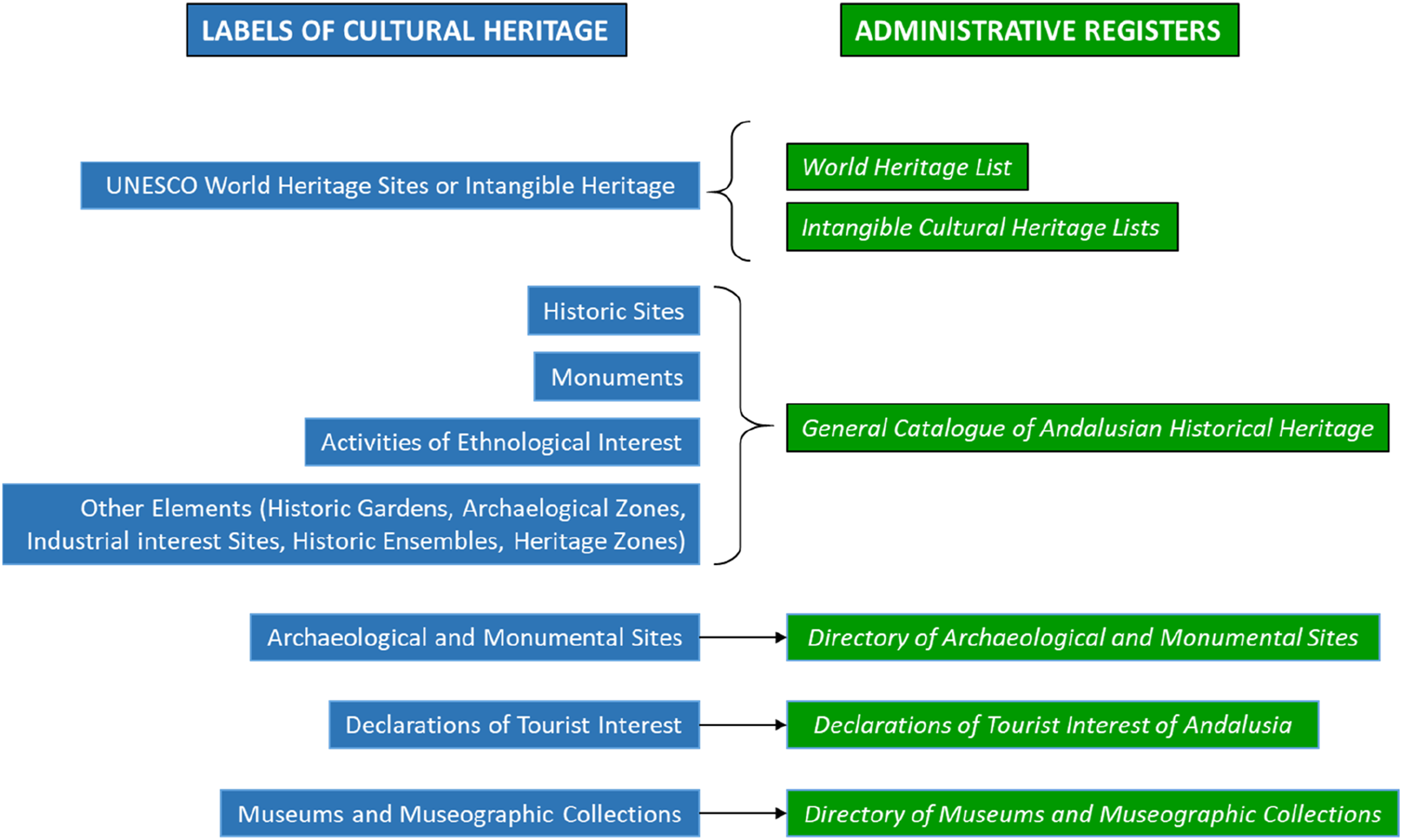
Importance of tourism in Andalusia
Andalusia is a highly consolidated tourism region. Ever since the 1960s, tourism has been of decisive importance for the region’s economy, generating considerable wealth and employment. Tourism policy was fundamentally concerned with the offer of services and focused on three objectives: control of prices and the quality of services; promotion of accommodation capacity; and administrative organization of tourism offers (Pellejero Martínez, 2002).
During these years, the acceleration of tourist activity in Andalusia was mainly fuelled by international ‘sun and beach’ tourism due to the attraction of its beaches, the sunshine hours, the excellent climate, the infrastructure, the hotels, services specially designed for tourism and very affordable prices.
However, towards the end of the 20th century the profile of tourists in Andalusia began to change. The gradual increase in the purchasing power of Spaniards boosted domestic tourism, which also demanded coastal destinations for rest and relaxation. At the same time, tourists’ interests diversified as their motivations and preferences regarding destinations broadened. In Andalusia, large cities and towns with significant historical and cultural heritage were reinforced as tourist destinations, complementing the seasonal nature of beach tourism. In the 21st century, cultural-heritage tourism began to consolidate its presence in line with the transformation of tourism in general. Access to information on cultural resources and heritage via the internet influenced tourists’ decisions when choosing their destination. Tourism companies were conscious of this proliferation of media and information channels (mainly digital media and internet) and made use of the officially recognized cultural heritage of Andalusia and its museums, cultural spaces, archaeological sites and fiestas of tourist interest when promoting their destinations. In fact, according to the Tourist Expenditure Survey of the Spanish Official Statistics office (INE), nearly one out of every five tourists travels to Spain for cultural tourism. They also have a higher average expenditure than tourists as a whole.
According to data from 2022, international tourist arrivals in Spain represented 71.7 million foreign tourists (UNWTO). Of these, 14% went mainly to Andalusia (INE), which hosted just over 1% of the world total of international tourists. It also accounted for just over 20% of domestic tourist flows (INE). This highlights the strategic importance of tourism in Andalusia, representing 5.2% of GDP and 11.5% of employment.
In 2019, an official report on the tourism industry by the Andalusian administration reflected a high percentage of culture-related activities carried out by tourists (42.1%). In the evaluation reports of Andalusia as a tourist destination (Gallego Galán, 2022), the average rating of the “Andalusian cultural heritage” was 8.75 points (on a scale of 1 to 10).Thus, cultural heritage tourism is a key factor for both the development of tourism activity and the activation and enhancement of cultural heritage.
Methodology
Among the variety of econometric techniques used in empirical analyses of tourist demand and the attractiveness of destinations, those that can be applied to data panels stand out, in which the cross-section units correspond to countries and/or regions which are observed at different moments in time. In most of these models, the tourist flow (travelers or overnight stays) with destination in a specific region is considered as a response variable, while the explanatory variables include different variables relating to economic, social and connectivity aspects of the destination region – or the origin when estimating gravity models – as well as characteristics of the tourist offer and, only in very few applications, variables relating to the cultural heritage of the destination region, on the basis that it can attract international and domestic tourist flows. In many of these studies, a panel data model is commonly used (Arezki et al., 2009; Huang et al., 2012; Yang et al. 2010, Yang and Lin, 2014, Su and Lin, 2014; Castillo-Manzano et al., 2021), and we have also used a panel data model for the empirical analysis in this study. The model is a particular case of a more general two-way panel data model, which may be specified as

In the general model (1) above it has been assumed that the coefficients or parameters contained in the vectors
Both the Pool model and the Fixed Effects Model may be estimated by Ordinary Least Squares (OLS), either using differences or by introducing time dummy variables to represent the fixed effects, while in the latter in order to identify the random effects it is necessary to estimate the model by Feasible Generalized Least Squares (FGLS). It is also assumed that the model complies with the usual hypotheses which exclude consideration of heteroskedasticity, cross-sectional autocorrelation and contemporaneous correlations between shocks of different individuals.
Data and sources
As mentioned above, we consider as endogenous or response variables the natural logarithm of the total number of travelers (LNTTOT), the number of travelers with residence in Spain (LNTSPAIN) and the number of travelers with residence abroad (LNTABROAD), also expressed in terms per capita. These variables do not represent total inbound tourist flow as they do not include other types of accommodation due to the difficulty of obtaining information through the respective occupancy surveys carried out by the INE; however, travelers staying in hotels represent 80% of the total flow of tourists staying in Andalusia, 18.24 million travelers out of a total of 22.8 million in 2022. In most of the empirical works analyzed only international tourist flows are taken into account, although others focus on domestic tourism (Patuelli et al., 2013) or on both flows (Castillo-Manzano et al., 2021). The information on the response o variables has been extracted from the Hotel Occupancy Survey carried out by the INE on a monthly basis. This survey provides estimates for the national total, for each Spanish Autonomous Community, for each of the Spanish “provinces”, for certain “tourist zones” and for some of the most important “tourist spots”. Where necessary, missing data have been interpolated using the TRAMO-SEATS (Gómez and Maravall, 1997) package with the monthly series. Altogether, 31 different tourist destinations are considered covering the entire territory of Andalusia, including tourist spots, tourist zones and the rest of the municipalities of each province (Table A in the Supplemental Appendix).
The information on the elements of cultural heritage registered and/or protected in each tourist destination has been taken from the catalogues and registers considered. The first of these is the General Catalogue of Andalusian Historical Heritage (GCAHH). As mentioned above, this is a living register and new elements are constantly being added, and so December 31, 2022 was considered as the cut-off date. This catalogue includes a total of 3,083 records classified into 13 different typologies. The database has been completed with the registration date, taken from the corresponding decision published in the official gazettes. The most important category in quantitative terms consists of monuments protected due to their declaration as an Asset of Cultural Interest, with a total of 2,223 entries. This is followed by those relating to intangible cultural heritage, including the typologies “Activity of Ethnological Interest”, “Site of Ethnological Interest”, “Relating to religious beliefs” and “Social and recreational”, which together total 152 records. In addition, “Historic Sites” have been considered separately with 130 records. The remaining typologies have been grouped in a category which includes very diverse elements that enjoy some degree of protection for their preservation, with a total of 578 records.
Most of the 172 “Declarations of Tourist Interest of Andalusia” (DTIA) issued in the period under analysis are events and celebrations and therefore manifestations of intangible heritage. Similarly, the “Directory of Museums and Museographic Collections of Andalusia” (DMMCA) has also been considered, which includes a total of 177 institutions. Series have been constructed with the existing stock in each year for each tourist destination considered. The “Archaeological and Monumental Sites” (DAMSA) consist of a total of 39 zones of archaeological or monumental interest that are open for visits distributed across Andalusia. Some of these have been withdrawn over time due to budgetary restrictions. As in the case of museums, time series have been constructed with the evolution of the stock of visitable sites in each year.
As mentioned, the explanatory variables include indicators of the density of cultural heritage elements per 1,000 inhabitants listed or inventoried in Andalusia (ARCHAEOSITE, HISTOSITE, ICH, MUSEUMS, DECLARATION, MONUMENTS, OTHERS), also incorporating the UNESCO world heritage sites and the ICH included in the UNESCO lists, which make up the components of vector
As components of the
Type of variables, descriptions and sources.
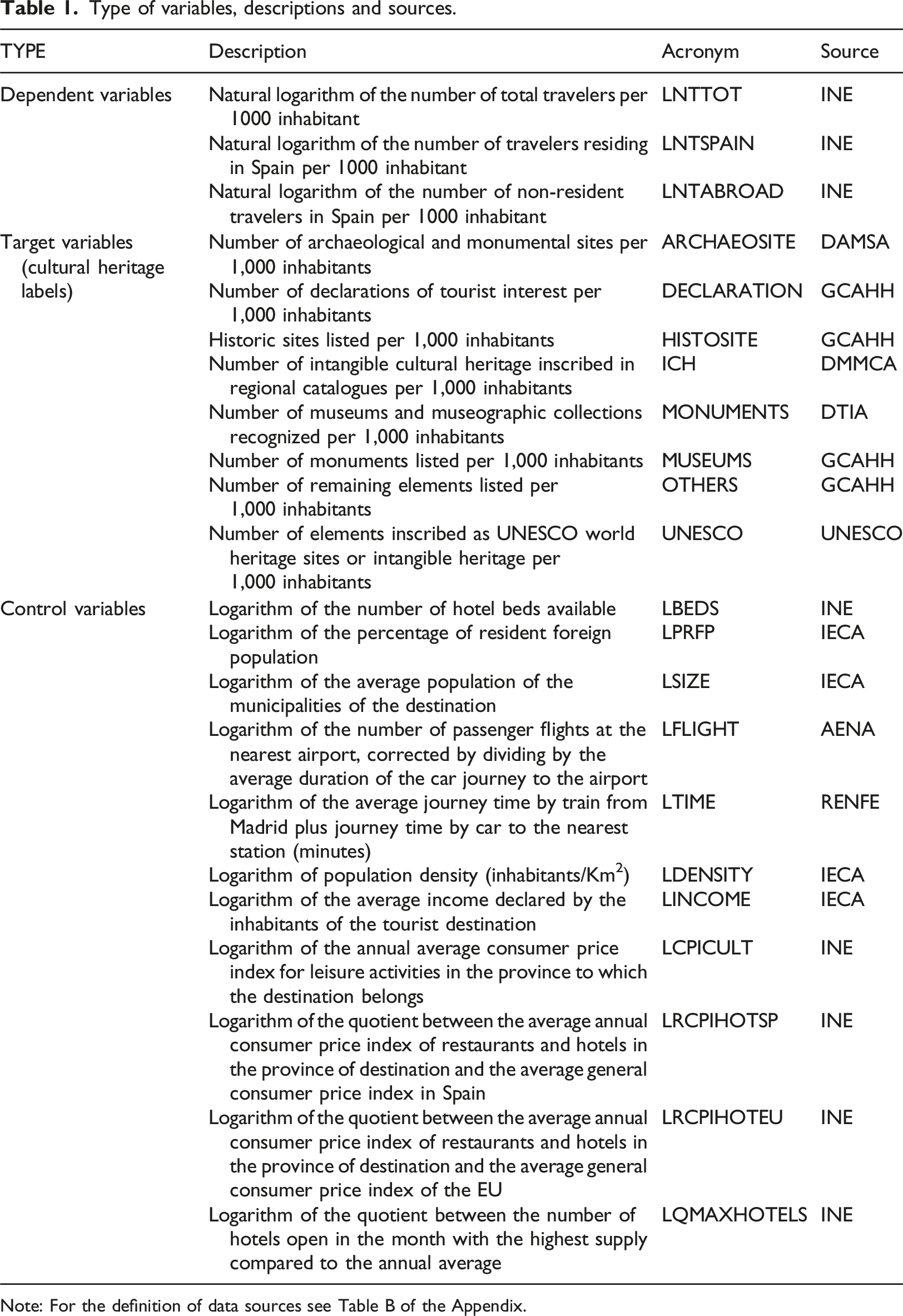
Note: For the definition of data sources see Table B of the Appendix.
Statistical summary of the data used (2009-2022).
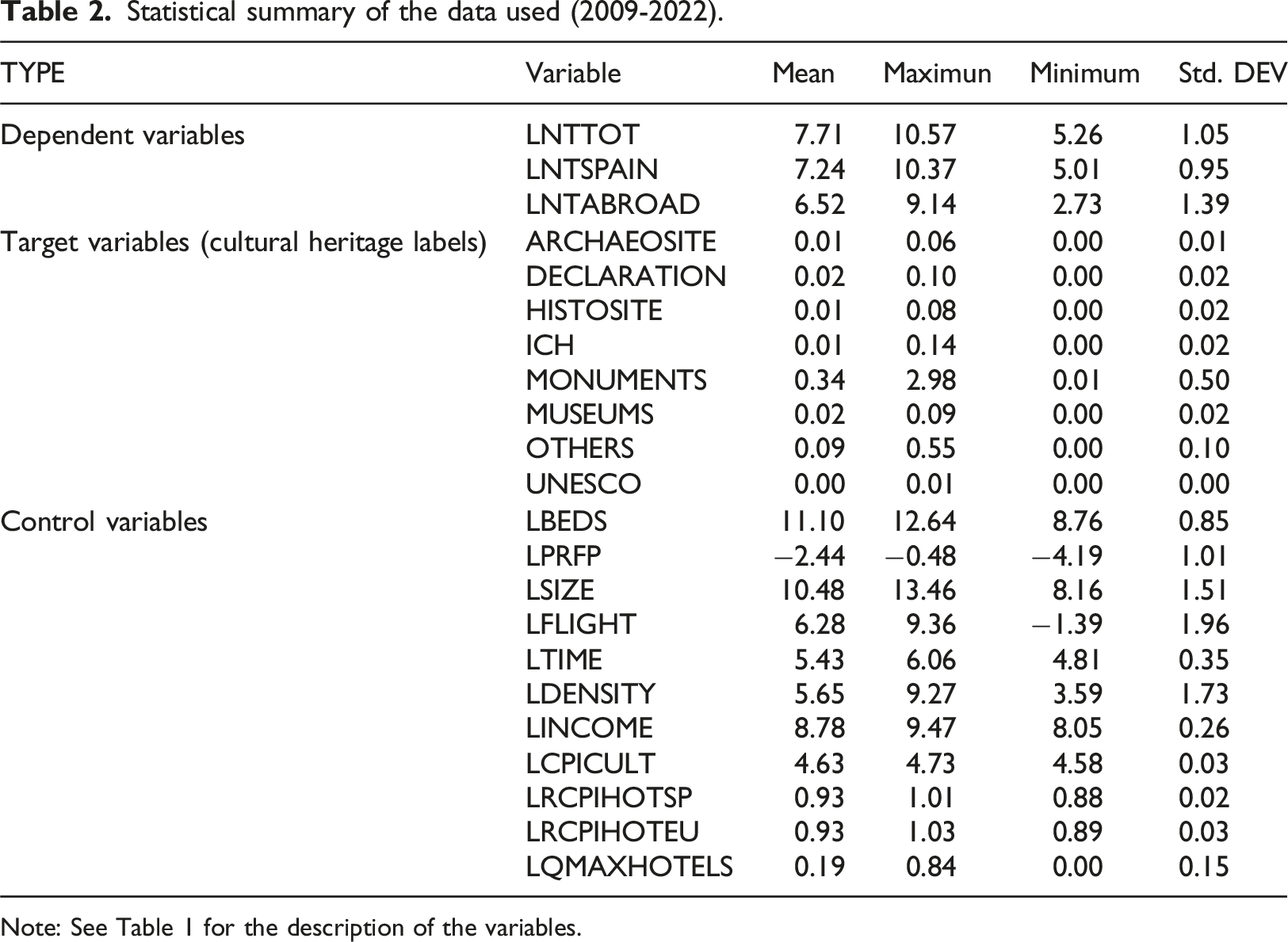
Note: See Table 1 for the description of the variables.
Results
This section presents the main results of different specifications of equation (1) for the set of travelers staying in hotels in the tourist destinations considered in the analysis (Table A of the Supplemental Appendix). These results are exhaustive, covering the entire Andalusian territory. We have analyzed the time interval 2009-2022, resulting in a balanced panel for 14 periods (years) and 31 cross-section units or tourist destinations, with a total of 434 observations for each variable considered.
Estimated coefficients for target variables in individual pooled models.
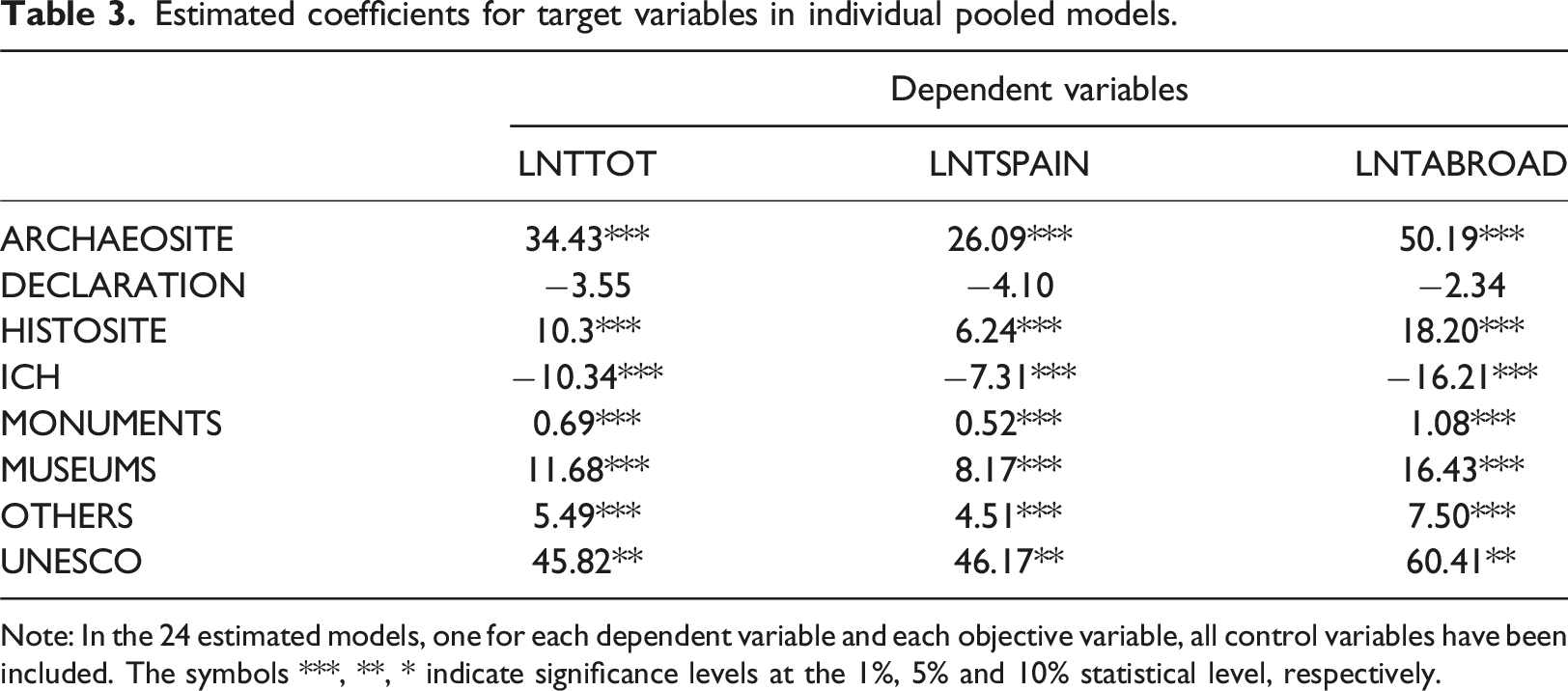
Note: In the 24 estimated models, one for each dependent variable and each objective variable, all control variables have been included. The symbols ***, **, * indicate significance levels at the 1%, 5% and 10% statistical level, respectively.
All the cases show cross-section and period heteroskedasticity, so the Huber-White robust variance-covariance matrix (Wooldridge, 2002) was used.
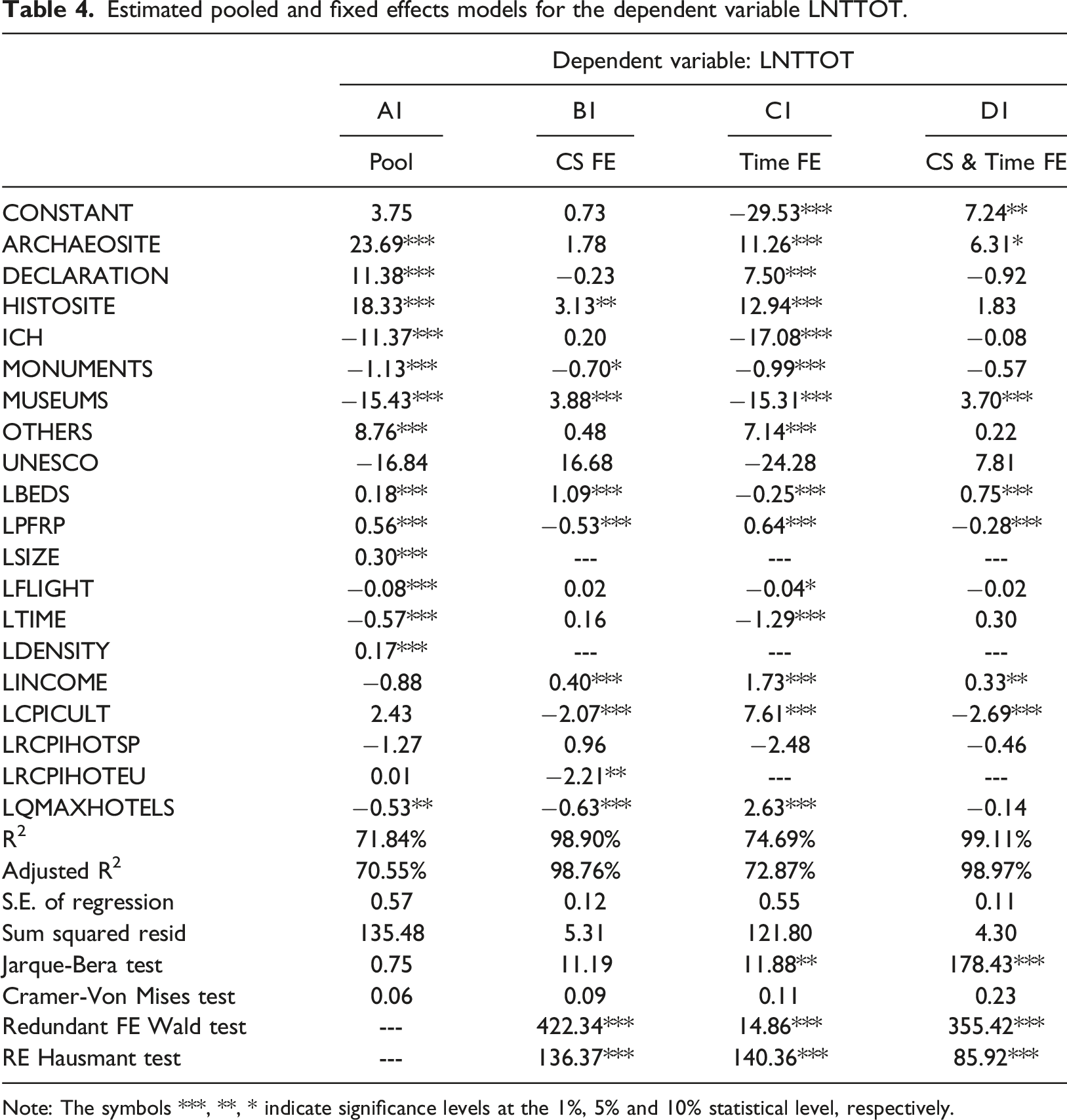
Estimated pooled and fixed effects models for the dependent variable LNTTOT.
Note: The symbols ***, **, * indicate significance levels at the 1%, 5% and 10% statistical level, respectively.
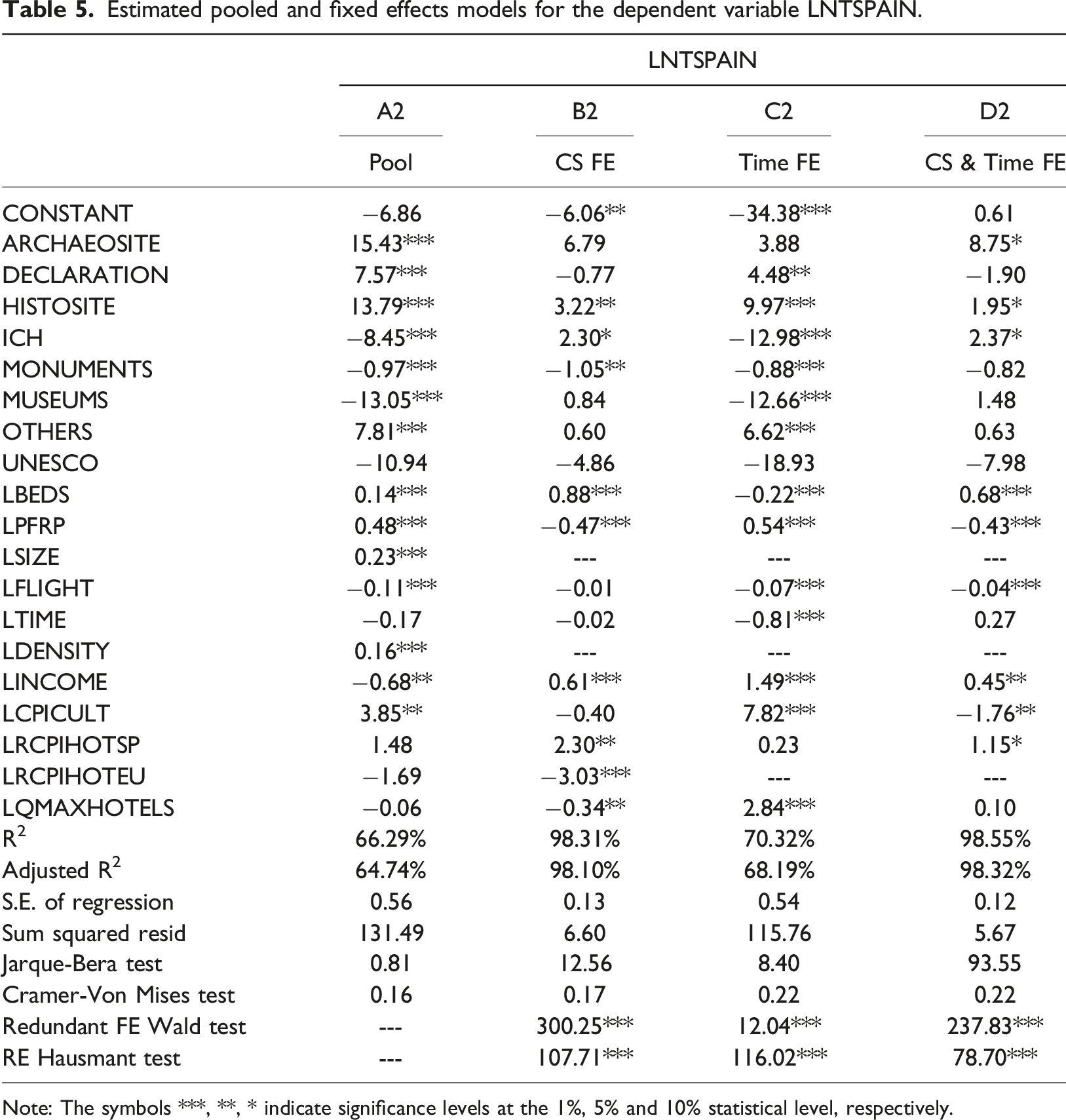
Estimated pooled and fixed effects models for the dependent variable LNTSPAIN.
Note: The symbols ***, **, * indicate significance levels at the 1%, 5% and 10% statistical level, respectively.
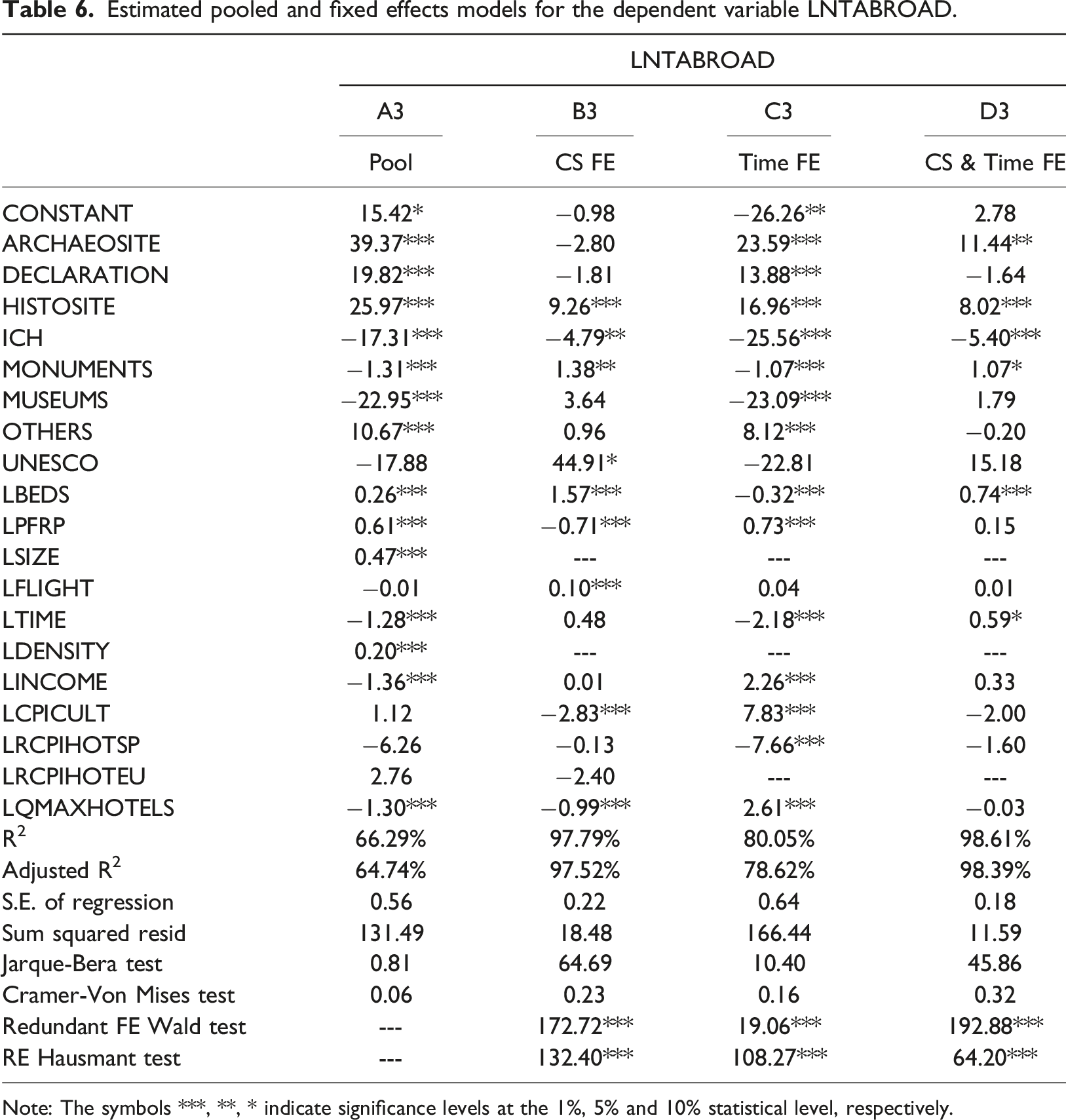
Estimated pooled and fixed effects models for the dependent variable LNTABROAD.
Note: The symbols ***, **, * indicate significance levels at the 1%, 5% and 10% statistical level, respectively.
In our case, the fixed effects explore the relationship between the tourist flows and the control variables (labels). Each destination has its own individual characteristics which may or may not influence the control variables, based on the assumption that the unobserved component may bias the relationship between the response variables and the regressors considered. This must therefore be controlled, so we introduced FEs to remove the effect of these invariant characteristics (in time or in the cross-section) to allow consistent assessment of the net effect of the regressors on tourist flows. These FEs are unique to each tourist destination (to each moment in time) and should not be correlated with other individual characteristics of each destination otherwise the FE model would not be adequate, instead opting for random effects. Accordingly, when fixed effects are admitted in the model the estimates of the individual and pooled models will be biased, meaning that the optimal models are models D1, D2 and D3 obtained by considering fixed effects.,
Set out below are the effects of the labels relating to cultural heritage elements that proved to be significant. Firstly, the labels of sites listed as archaeological and monumental sites open to visits (ARCHAEOSITE) had a major influence on both domestic and foreign tourism, with a one-unit increase in the density indicator leading to an increase of 8.75% and 11.44% respectively in the number of travelers staying in the tourist destinations considered per inhabitant. There is some overlap of labels with OTHERS as this includes all inventoried archaeological sites, including those counted under ARCHAEOSITE.
The labels corresponding to declarations of tourist interest (DECLARATION) were not in themselves significant in any of the models finally estimated and their sign was negative in all the models estimated. This result is consistent, given that this type of label is assigned to events for the promotion of tourism in inland towns located in rural areas with very low tourist flows.
The density of labels relating to listed historic sites (HISTOSITE) is relevant to explain all tourism flows. In the case of domestic tourism in Spain, a one-unit increase in the density indicator of this type of heritage labels can increase the flow of travelers per capita by 1.95%, while in the case of foreign tourism in Spain the estimated effect is much higher, increasing tourist flows by 8.02%. For the total tourist flow, while initially it was significant in the pooled models and also in the model with cross-section fixed effects, it was not significant in the model with Time Fixed Effects. It should be noted that these elements include historic city centers and monuments which are protected, most of which include UNESCO World Heritage Sites.
The labels relating to ICH elements only have a significant positive effect on the flow of domestic tourists in Spain and not in the case of foreign tourism. In fact, a one-unit increase in ICH label density can increase the flow of domestic travelers by 2.37%. These are labels relating to celebrations and social events held in small inland towns in the provinces of Huelva and Seville. They include pilgrimages and festivals attended by large numbers of visitors (e.g. the Pilgrimage of El Rocío, Easter processions, etc.), mainly residents in Spain who have family or emotional ties in the destinations considered.
The labels relating to monuments (MONUMENTS) show a certain degree of collinearity when introducing the cross-section fixed effects, although it does not exceed the usual tolerance limits, and the results do not differ if we had chosen to delete it, so we have maintained its inclusion in the models. Its inclusion is only significant in relation to the tourist flows of foreign travelers in Spain, with a one-unit increase in the density of labels in tourist destinations increasing the flow of foreign tourists by 1.07%. This is a problematic indicator as it is present throughout the territory. Its wide territorial dispersion implies the absence of significant transverse heterogeneity and it is the label that shows the least variability during the period analyzed. It is worth noting that these include some of Andalusia’s most emblematic sites which are also inscribed on the UNESCO World Heritage List, so there is some overlapping of labels. In fact, in the case of ICH prior inscription on national lists is a prerequisite for effective recognition by UNESCO.
The labels relating to museums and museum collections (MUSEUMS) existing in each tourist destination are of limited significance, although with a positive sign. Their non-zero value can therefore only be admitted in the case of total tourist flow with a confidence level of 99%, indicating that an increase of one unit of the density indicator for this type of element results in a 3.75% increase in tourist flows for each destination considered.
The labels relating to other cultural heritage elements (OTHERS) are not significant in any case. These are elements of little relevance to tourism, but as it includes archaeological sites there is some overlap with ARCHEOSITE. It should be noted that its non-significance is due to the fact that part of its effect is incorporated in the unobservable heterogeneity contained in the fixed effects, given that in the pooled models its inclusion is clearly significant with a positive sign.
The UNESCO label, which incorporates elements inscribed on UNESCO’s World Heritage or Intangible Cultural Heritage lists, does not seem to have a significant effect on domestic or foreign tourism. It should be noted that all the heritage items considered here are also included in other catalogues or directories under consideration, so there is a certain degree of overlapping of labels.
As is to be expected, the most significant variable in all three models is the supply of hotel beds (LBEDS). In the case of the total tourist flow, the estimated elasticity implies that a 1% increase in the supply of hotel beds can give rise to a 0.75% increase in tourist flows, which is reduced to 0.68% in the case of domestic tourist flows and is somewhat higher for foreign tourist flows (0.74%).
The estimated elasticities for the remaining control variables vary considerably. The proportion of foreign residents in tourist destinations (LPRFP) has a significant negative effect on the tourist flow of domestic tourists but is insignificant for foreign tourists. This is due to the nature of foreign residents in Andalusia which, with the exception of the Costa del Sol, are located in agricultural areas and consist of emigrants attracted for work purposes. Finally, the effect of the length of rail journeys from Madrid (LTIME) has a positive effect on all tourist flows, although it is only significant in the case of the tourist flow of non-residents in Spain. The LFLIGHT variable only has a significant negative effect on the flow of resident tourists in Spain, but not on non-resident tourists. The income of the destination’s households (LINCOME) has a positive effect on the flow of tourists residing in Spain (and therefore also on the total). The price index for consumption of leisure activities (LCPICULT) has the expected sign, its inclusion being significant both in the total flows of tourists and in tourists residing in Spain. Finally, the ratio of the hotel and restaurant price index over the general price index in Spain as a whole (LRCPIHOTSP) is only slightly significant in the case of the tourist flow of tourists residing in Spain, but with a positive sign. This is because the variable, in most destinations, does not have a clear trend, but rather decreases from 2009 to 2014, then grows until 2019, decreasing subsequently.
We were also able to analyze the effects of possible overlapping of labels. To do so, we estimated the auxiliary regressions between label density indicators with and without incorporating cross-section fixed effects. In the first case, the largest variance inflation factors (VIF) were those corresponding to the ARCHAEOSITE, MONUMENTS and OTHERS labels (VIF < 4). These labels also had significant positive bivariate correlations. On the other hand, despite the fact that prior inscription in national registers is a prerequisite for UNESCO listing, the UNESCO VIF is very low (VIF = 1.08) and its correlations with the other elements are not significant. This does not mean that there are no overlapping labels but rather that the overlap is not statistically significant as the inscriptions occur at different times, firstly in the national register and then in the UNESCO lists. However, when incorporating cross-section fixed effects into the auxiliary regressions, the label that increases its VIF the most is UNESCO, followed by ICH, so part of the decrease in significance is caused by the partial redundancy of these labels with the fixed effects. The fact that the same heritage element is included in several labels is not a condition for its low statistical significance in the models estimated. In view of the results this seems to be due more to a certain redundancy that occurs when introducing cross-section fixed effects in labels with limited variability over time or that are only present in a limited number of tourist destinations (the UNESCO label only It is present in 8 tourist destinations, in which other labels accumulate, such as the cities of Granada, Córdoba or Seville).
Discussion
Our main objective was to assess the effect of labeling of cultural heritage elements on tourist flows. As mentioned, there are few empirical works that analyze these effects with comparable methodologies. They mostly focus on assessing the effect of UNESCO World Heritage Sites without incorporating other types of elements, analyzing panels of countries (Arezki et al., 2009; Su and Lin, 2014) or regions (Cellini, 2011; Patuelli et al., 2013; Su and Lin, 2014), and their conclusions differ. In our case, we have gone down an additional step in the spatial disaggregation, considering municipalities or groupings of municipalities (the eight Andalusian NUTS 3 provinces have been disaggregated into 31 tourist destinations), And UNESCO heritage sites not have a significant effect on domestic and international tourism flows. However, this is highly influenced by other types of labels of tangible or intangible cultural heritage elements. Nonetheless, in relation to domestic tourism the number of archaeological and monumental sites (ARCHAEOSITE), which includes many of the UNESCO world heritage sites, does play a determining role in tourist flows. Therefore, by spatially disaggregating tourist destinations and incorporating different types of cultural heritage, the results obtained differ from other comparable previous studies, in which the effect of UNESCO declarations exceeds that of other forms of cultural heritage (Yang et al., 2010; Yang and Lin, 2014; Castillo-Manzano et al., 2021; Panzera et al., 2021), although they also have a significant positive effect. In our case, the UNESCO label does not have a significant effect on tourist flows in view of the results of the estimation with the time and cross-section fixed effects models. In the individual pooled models, the effect was significant, but when all the labels are considered together its significance is diluted by the aforementioned effect of the label overlap and by the small number of destinations in which this category of label exists.
Some authors have argued that overlapping labels can camouflage causal relationships when comparing national heritage labels and UNESCO labels in China (Cellini, 2011; Yang et al., 2019). We offer some additional conclusions in this regard through an analysis of the possible multicollinearity and/or partial redundancy between the different labels considered, as well as these with the estimated effects. The results show that both tangible and intangible cultural heritage and its listing, cataloguing and dissemination have a significant effect on tourist flows in Andalusia, but with a different distribution depending on the type of flow and the typology of the cultural heritage label. The time fixed effects reflect a general trend in tourist flows in Andalusia, including the drastic drop due to COVID-19.
Conclusions
The results of the analysis carried out may be easily extrapolated to other Spanish autonomous communities, where there are similar records and categories of cultural heritage, especially those where the “sun and beach” tourism model coexists with other types of tourism. It is evident that not only is the existence of registered and inventoried heritage elements important, their protection and adaptation to tourist demand is necessary (Panzera et al., 2021). This implies a need for adequate investment and efficient management. In general, the labels relating to archaeological and monumental sites (ARCHAEOSITE) and historical sites (HISTOSITE) have a clear positive effect on tourist flows, with a higher magnitude in the case of foreign tourism than for domestic tourism. However, in the latter case the Intangible Cultural Heritage (ICH) labels have a clear positive influence, contrasting with the negative effect on foreign tourism. Meanwhile, the monument labels (MONUMENTS) have a positive effect on foreign tourist flows but not on domestic tourism. On the contrary, the labels related to the elements included in the UNESCO lists did not turn out to be a significant attractor of tourist flows, which is due, as we have mentioned, to the possible overlap of labels. The multiplicity of different labels on different dissemination platforms can hinder and distort their perception by potential tourists. As mentioned above, the same heritage element may be included in different labels.
Finally, we would like to raise certain matters regarding the data used. The disparity of the manners in which items are catalogued and listed in databases, directories and catalogues has already been mentioned. This paper does not seek to modify the database of information listed or registered, since it constitutes the means for its dissemination. However, it is likely that a more exhaustive analysis of the files corresponding to each listing could provide higher quality series and obtain perhaps somewhat different results.
Supplemental Material
Supplemental Material - Tourist flows and protection of cultural heritage in Andalusia (Spain): An econometric analysis with panel data
Supplemental Material for Tourist flows and protection of cultural heritage in Andalusia (Spain): An econometric analysis with panel data by Juan J García del Hoyo and Celeste Jiménez de Madariaga in Tourism Economics.
Footnotes
Declaration of conflicting interests
The author(s) declared no potential conflicts of interest with respect to the research, authorship, and/or publication of this article.
Funding
The author(s) disclosed receipt of the following financial support for the research, authorship, and/or publication of this article: ERDF A way of making Europe (PID2022-138651NB-I00), MCIN/AEI/ 10.13039/501100011033 (PID2022-138651NB-I00).

Supplemental Material
Supplemental material for this article is available online.
Author biographies
References
Supplementary Material
Please find the following supplemental material available below.
For Open Access articles published under a Creative Commons License, all supplemental material carries the same license as the article it is associated with.
For non-Open Access articles published, all supplemental material carries a non-exclusive license, and permission requests for re-use of supplemental material or any part of supplemental material shall be sent directly to the copyright owner as specified in the copyright notice associated with the article.
