




Abstract
This study investigates the impact of FDI regulatory restrictions on tourism growth. Using system generalized method of moments (GMM) estimation of the dynamic panel data model, this study finds that FDI restrictions have significant negative effects on tourism growth, implying that liberalizing FDI policies could promote tourism growth.
Introduction
With the growing importance of foreign direct investment (FDI) in tourism (Endo, 2006; Nunkoo and Seetanah, 2018), a number of empirical studies examine the relationship between FDI and tourism development, and show that the causality runs from the former to the latter (Haley and Haley, 1997; Sanford and Dong, 2000; Tang et al., 2007; Selvanathan et al., 2012; Fauzel, 2020). However, little attention has been paid to the implications of FDI regulatory restrictions on tourism growth. To fill this gap in the literature, this study investigates the impact of FDI restrictions in the tourism industry on its growth.
The extent of tourism FDI restrictions in developed and developing countries has decreased significantly over time. However, many developing countries still maintain some FDI restrictions in the tourism industry. The obvious effects of FDI restrictions are impeding inward FDI, ceteris paribus. Mistura and Roulet (2019) finds that restrictive FDI policy incurs an opportunity costs in terms of forgone FDI inflows. However, the effects of FDI restrictions go beyond discouraging inward FDI; restrictive FDI policy may also result in less competition, diversity, and innovation in the tourism industry. Thus, FDI restrictions in tourism may harm its growth. Using system generalized method of moments (GMM) estimation of the dynamic panel data model, this paper finds that FDI restrictions have significant negative effects on tourism growth, implying that reforms liberalizing FDI restrictions could promote tourism growth.
Empirical methodology
The tourism literature shows that FDI has a positive spillover effect on the productivity of domestic firms by facilitating transfer of technology, skills and knowledge to local tourism enterprises, and upgrading the tourism related facilities and services (Nunkoo and Seetanah, 2018), thereby enhancing total factor productivity of host economies. Based on these spillover effects of FDI, we assume that FDI and FDI policy have an important impact on total factor productivity in tourism. Thus, we include the variable of FDI regulatory restrictions in the empirical model to examine the effect of FDI policy on tourism growth.
The basic empirical model is specified as follows:

Equation (1) can also be written as follows:

It is well known that in the presence of the country-specific effects ξ
i
, the estimate of the coefficient on the lagged dependent variable by the ordinary least squares (OLS) is biased upward because the lagged dependent variable is positively correlated with ξ
i
(Blundell and Bond, 1998). Arellano and Bond (1991) propose the first difference GMM estimator to eliminate the country-specific effects:

The first difference GMM estimators control for unobserved country-specific effects ξ i by taking the first differences. However, as demonstrated by Blundell and Bond (1998) and Arellano and Bover (1995), large finite-sample biases can be generated, mainly because lagged levels are only weakly correlated with subsequent first differences. To address this issue, Arellano and Bover (1995) and Blundell and Bond (1998) propose system GMM estimator in dynamic panel data models, which combines two sets of moment conditions, namely, lagged first differences as instruments for the level equations and lagged levels as instruments for the first differences equations. Thus, system GMM estimation corrects for the endogeneity of the lagged dependent variable and other potentially endogenous explanatory variables; it also controls for time-invariant country-specific effects (Blundell and Bond, 1998).
Data on output, value added and labor in the tourism industry are from OECD Inter-Country Input Output Table (ICIO). 1 Meanwhile, FDI restrictiveness is measured by the FDI Regulatory Restrictiveness Index (OECD). This index gauges the level of restrictiveness of an economy’s statutory measures on FDI (Kalinova et al., 2010). The FDI restrictiveness index measures four types of regulatory restrictions on foreign direct investment: (i) equity restrictions, (ii) screening and prior approval requirements, (iii) restrictions on the employment of foreigners, and (iv) other restrictions on the operation of foreign enterprises. This index takes values between 0 and 1, with 1 being the most restrictive. We use the overall index for the tourism industry obtained by adding the scores for all four types of measures.
The aggregate capital stocks provided by Penn World Table 9.2 are divided into the sectoral initial capital stocks in 2005 using the output shares split method. Moreover, the capital stocks in the tourism industry from 2006 to 2015 are calculated by using the Perpetual Inventory Method, with investment measured by gross capital formation from OECD ICIO. FDI restrictiveness index is provided for 1997, 2003, 2006, and 2010–2018, and the OECD ICIO for 2005–2015. Therefore, the analysis in this paper is limited to 2006, and 2010–2015. 2
Estimation results
Impact of FDI restrictions on output and value-added.
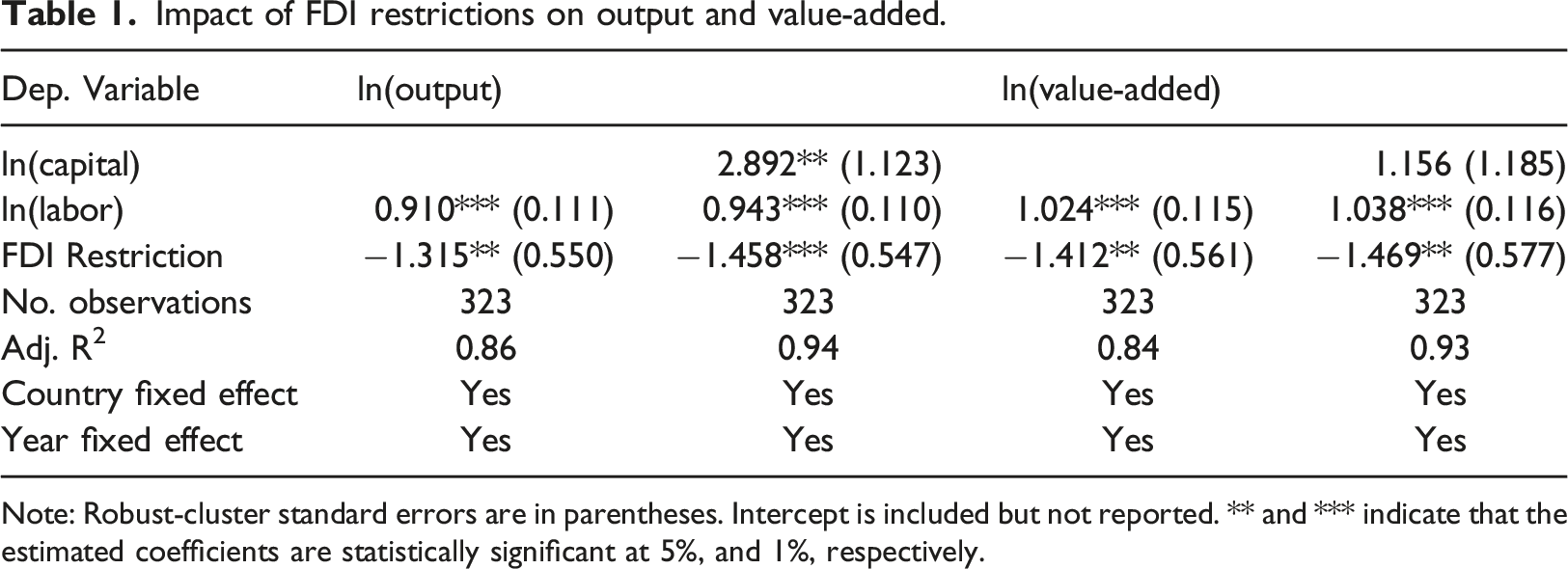
Note: Robust-cluster standard errors are in parentheses. Intercept is included but not reported. ** and *** indicate that the estimated coefficients are statistically significant at 5%, and 1%, respectively.
FDI restrictions and tourism growth.
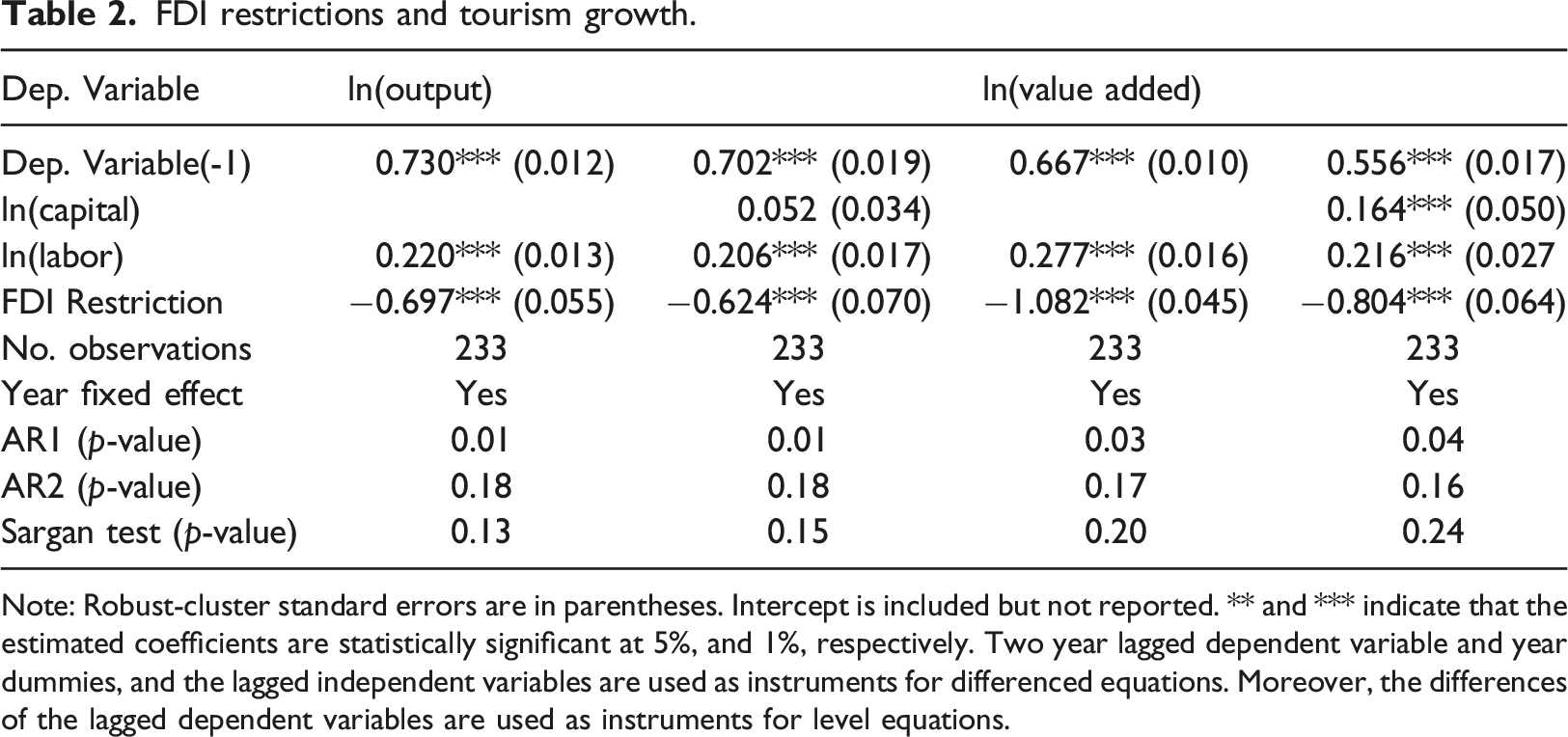
Note: Robust-cluster standard errors are in parentheses. Intercept is included but not reported. ** and *** indicate that the estimated coefficients are statistically significant at 5%, and 1%, respectively. Two year lagged dependent variable and year dummies, and the lagged independent variables are used as instruments for differenced equations. Moreover, the differences of the lagged dependent variables are used as instruments for level equations.
Conclusions
This paper investigates the impact of FDI restrictions on output and value-added level, and growth in the tourism industry. We find that these restrictions have a negative effect on output and value-added level, and growth of the tourism industry. These results suggest that liberalizing the FDI restrictions regime could spur tourism growth.
Footnotes
Acknowledgments
I am very grateful to Professor Soo-Jung Nam and Myung-Soo Yie for valuable comments and Youngsuk Song for helpful research assistance.
Declaration of conflicting interest
The author(s) declared no potential conflicts of interest with respect to the research, authorship, and/or publication of this article.
Funding
The author(s) disclosed receipt of the following financial support for the research, authorship, and/or publication of this article: This study was supported by the Korea Sanhak Foundation (KSF) and the research grant of Kongju National University.
Data availability statement
The datasets generated during and/or analyzed during the current study are available in the Figshare (DOI: 10.6084/m9.figshare.21599100).
