




Abstract
This study examines the impact of regulations on the supply and performance of Airbnb rentals in Geneva by focusing on the role of substitution effects between fully rented accommodations and individual rooms. A difference-in-differences approach is used in combination with logit and count data models with fixed effects for properties. The data consists of monthly Airbnb listings in the 10 largest Swiss cities for the period 2017–2018, with around 220,000 observations on 16,600 properties (60 per cent of which were being let as entire properties). The estimates show that the performance of Airbnb accommodations decreases significantly after the introduction of regulations in terms of bookings, days reserved, occupancy, and revenues. The performance of single rooms let within private properties, meanwhile, benefited from the new regulation in some cases, suggesting that there may be a substitution effect between the two groups. The magnitude of the impact of regulation is considerable, with monthly revenues of fully let Airbnb accommodations decreasing by an average of 15 per cent.
Keywords
Introduction
Several cities have enacted laws to ban or limit short-term rentals (Nieuwland and Van Melik, 2020; Von Briel and Dolnicar, 2021). These regulations vary widely, ranging from outright bans on entire properties to special permits in certain neighbourhoods (of Barcelona, Berlin, Manhattan, and Los Angeles, for example; see Jia and Wagman, 2020; Duso et al., 2021; and Koster et al., 2021) to restrictions on the number of rentals that can take place in a given period (Nieuwland and Van Melik, 2020; Von Briel and Dolnicar, 2021). While renting out a single room is often still allowed, other cities have instituted strict laws that extend to whole flats and houses (as in the case of Berlin in 2016; Duso et al., 2021). One argument for stricter regulations on whole apartments and houses is that short-term renting of these Airbnb accommodations serves as a substitute for long-term leases and drives up housing rents in urban areas (Duso et al., 2021). If such regulations come into force as intended, it is likely that there will be fewer Airbnb listings overall, unless owners or users can adjust their listings and focus on renting out specific rooms instead of entire properties.
The Swiss city of Geneva has introduced regulations that limit short-term rentals of entire properties (i.e. houses and flats, but not individual rooms) from 1 April 2018. The regulations include limiting the duration of short-term rentals to 60 days, establishing a supervisory body, and imposing penalties for violations. 1 The aim is to limit the year-round availability of entire houses and flats (which are often operated by commercial entities) on Airbnb and to combat the housing shortage in the canton (district) of Geneva.
The aim of this study is to investigate whether the introduction of regulations on short-term rentals in Geneva has led to a reduction in supply and demand with regard to Airbnb accommodations. It also seeks to determine whether regulation leads to substitution effects between entire Airbnb accommodations (which are affected by the regulation) and single rooms (which are not). A difference-in-differences approach is used in combination with conditional logit and panel count data models to estimate the treatment effect of regulating short-term rentals. The data is based on the universe of Airbnb listings in the ten largest Swiss cities at the monthly level for the period 2017–2018 (April to December of each year), which amounts to around 222,000 observations. The control group consists of cities where there are no regulations on short-term rentals, or only agreements on arrangements such as the payment of a city tax (as in Zurich and Basel, for example, where Airbnb automatically collects such a tax).
The new rules are likely to have reduced the number of entire Airbnb rentals, which would in turn reduce hosts’ revenues. In particular, high-availability listings are the main target of the regulations. According to AirDNA data for 2016 and 2017, about 30 per cent of Airbnb accommodations in Geneva had an average booking duration of more than 60 days per year. However, the regulations are likely to have prompted Airbnb hosts to start offering private rooms instead of entire accommodations. The extent of these direct and indirect effects is an empirical question.
While Mody et al. (2021) acknowledge that short-term rental regulation is an important topic, extensive empirical research has not yet been done on the subject. Recent research has looked into how rules on short-term rentals have impacted supply and demand with regard to Airbnb listings. These studies cover US cities (Yang and Mao, 2019), New York (Yeon et al., 2022), New Orleans (Van Holm, 2020), Barcelona (Benítez-Aurioles, 2021), Berlin (Duso et al., 2021), and Bordeaux (Robertson et al., 2023). The majority find that these regulations are effective, but the impact varies widely across the studies. In particular, supply-side substitution between fully rented Airbnb accommodations and those not affected by regulation is poorly understood. Two exceptions are presented by the research conducted by Jia and Wagman (2020) and Koster et al. (2021), who find that the supply of single rooms increases or remains unchanged when room rentals are unrestricted, but whole dwellings are regulated.
This study contributes to the growing body of research on how restrictions on short-term rentals can impact the availability and performance of Airbnb accommodations. First, it investigates the supply-side substitution between whole properties and individual rooms when the latter are not affected by regulation. In addition, the study distinguishes between supply-side effects (measured by the share of active listings) and market equilibrium effects of supply and demand (measured by the number of reservations, days reserved, occupancy rate, revenue, and the number of blocked days). The use of fixed-effects count data and logit models takes into account the fact that many Airbnb hosts rent out their homes only sporadically, which often results in many observations with zero revenues or days reserved. Time-invariant observed and unobservable variables, such as those related to listings, hosts, and locations, are also controlled for via fixed-effects models.
The causal impact of regulations on short-term rentals is analysed for Swiss cities. An important assumption in isolating the impact of regulation on the demand for Airbnb accommodations is that there were no external events that could have impacted the performance of Airbnb rentals (such as major sporting events, terrorist attacks, or natural disasters) in the period under consideration. According to the Global Terror Database, terrorist incidents occurred in a number of European locations between 2016 and 2019, including in places where Airbnb laws were introduced. As Benítez-Aurioles (2019) demonstrates for Barcelona, terrorist events can have an immediate detrimental impact on Airbnb accommodations. As far as we know, there were no significant external events in Swiss cities during the period studied that could have affected the number of visitors.
The structure of this paper is as follows: The next Section explains the conceptual background, including the literature and the research hypotheses. We then describe the empirical approach, before presenting the data set and descriptive statistics. After that, the results are presented and then discussed. In closing we provide our conclusions.
Conceptual background and research hypotheses
Previous literature
Short-term rental laws and restrictions come in many forms and often apply only to certain types of short-term rentals (whole houses and flats, or individual rooms). They range from outright bans on the use of homes or apartments for short-term rentals to restrictions on the length of rentals (Von Briel and Dolnicar, 2021). The impact of short-term rental regulations on supply depends on a number of variables, including the nature of the regulations and the presence of short-term rentals with high availability (Duso et al., 2021), as well as the question of whether they are a substitute for standard hotel rooms or operate in separate markets (Sainaghi and Baggio, 2021). If hosts have to comply with numerous rules and procedures, report to or are monitored by the authorities, and spend more time and money on meeting procedural requirements, they may be discouraged from offering their homes on short-term rental websites.
Research on the impact of market entry regulations has found that they negatively affect both the average size of new firms and the creation of new firms (Klapper et al., 2006). Costly rules discourage new firms, especially in sectors where entry rates should be naturally high (Klapper et al., 2006). The entrepreneurship literature also demonstrates that business restrictions have a detrimental effect on start-ups (Gnyawali and Fogel, 1994). According to Gerwe et al. (2022), there will be fewer participants on a given platform if market access is more carefully controlled. In contrast, a streamlined administrative process can result in more listings of short-term rentals (Boto-García et al., 2022).
Regulations on short-term rentals not only directly affect the supply and performance of short-term rentals, they also have wider implications due to potential supply substitution vis-à-vis the long-term rental market and the traditional accommodation sector (Zervas et al., 2017; Dogru et al., 2019; Barron et al., 2021; Koster et al., 2021; Falk and Yang, 2021; Sainaghi and Baggio, 2021; Duso et al., 2021; Yang et al., 2022). In this context, the structure and characteristics of short-term rentals could be relevant. If accessible for longer periods, certain short-term rentals could compete with both the traditional accommodation industry and long-term rentals (Zou, 2020).
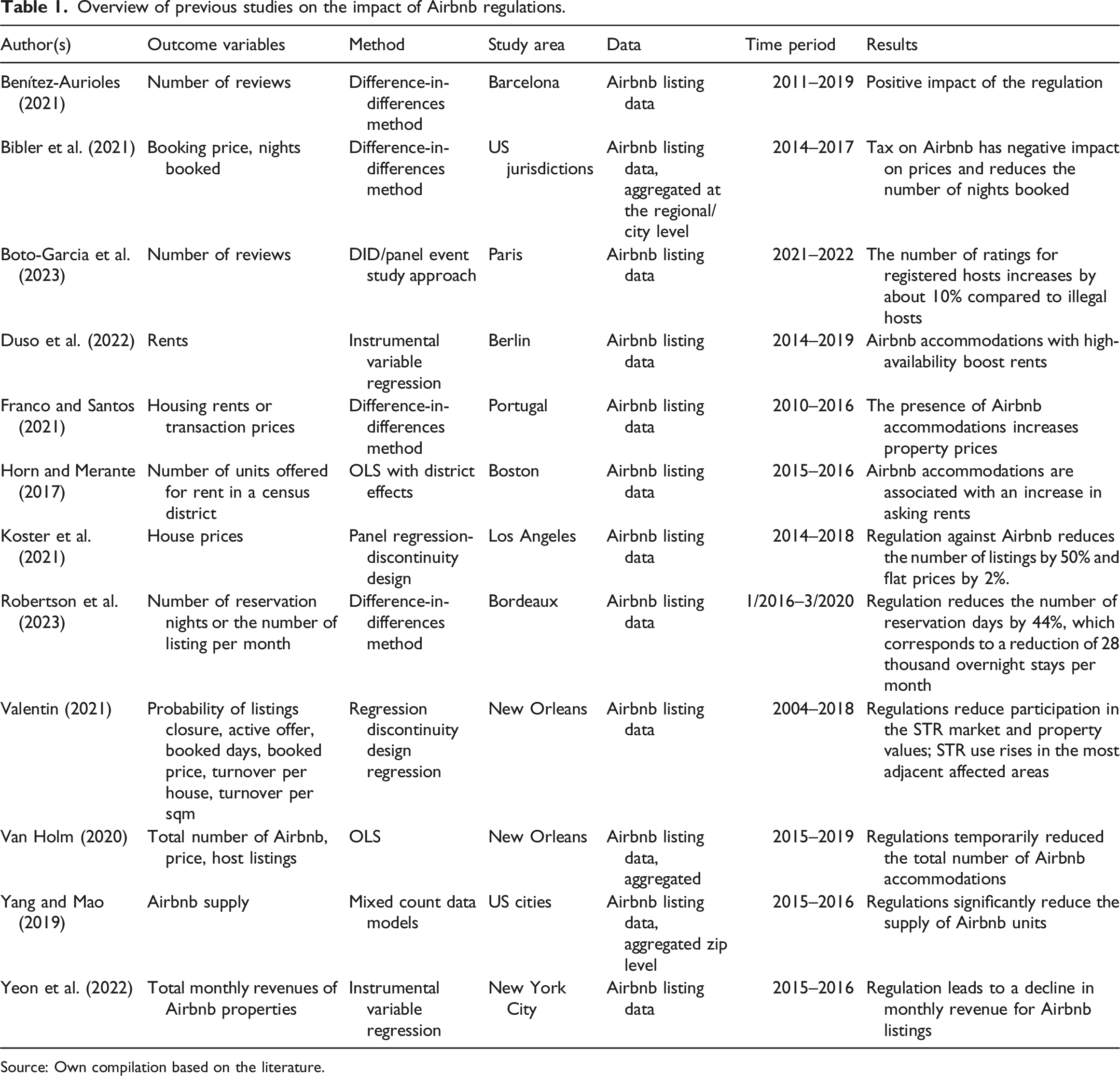
Overview of previous studies on the impact of Airbnb regulations.
Source: Own compilation based on the literature.
The difference-in-differences method, based on microdata at the level of individual Airbnb properties, is used in most related studies. Van Holm (2020) applies this method in exploring the impact of Airbnb regulation in New Orleans – one of the first US cities to introduce new laws of this kind. The results show that regulation initially had a significant negative effect, leading to a decline of 2070 in Airbnb listings. In the medium term, however, the new laws have had no impact, as the number of Airbnb offerings has increased again (Van Holm, 2020).
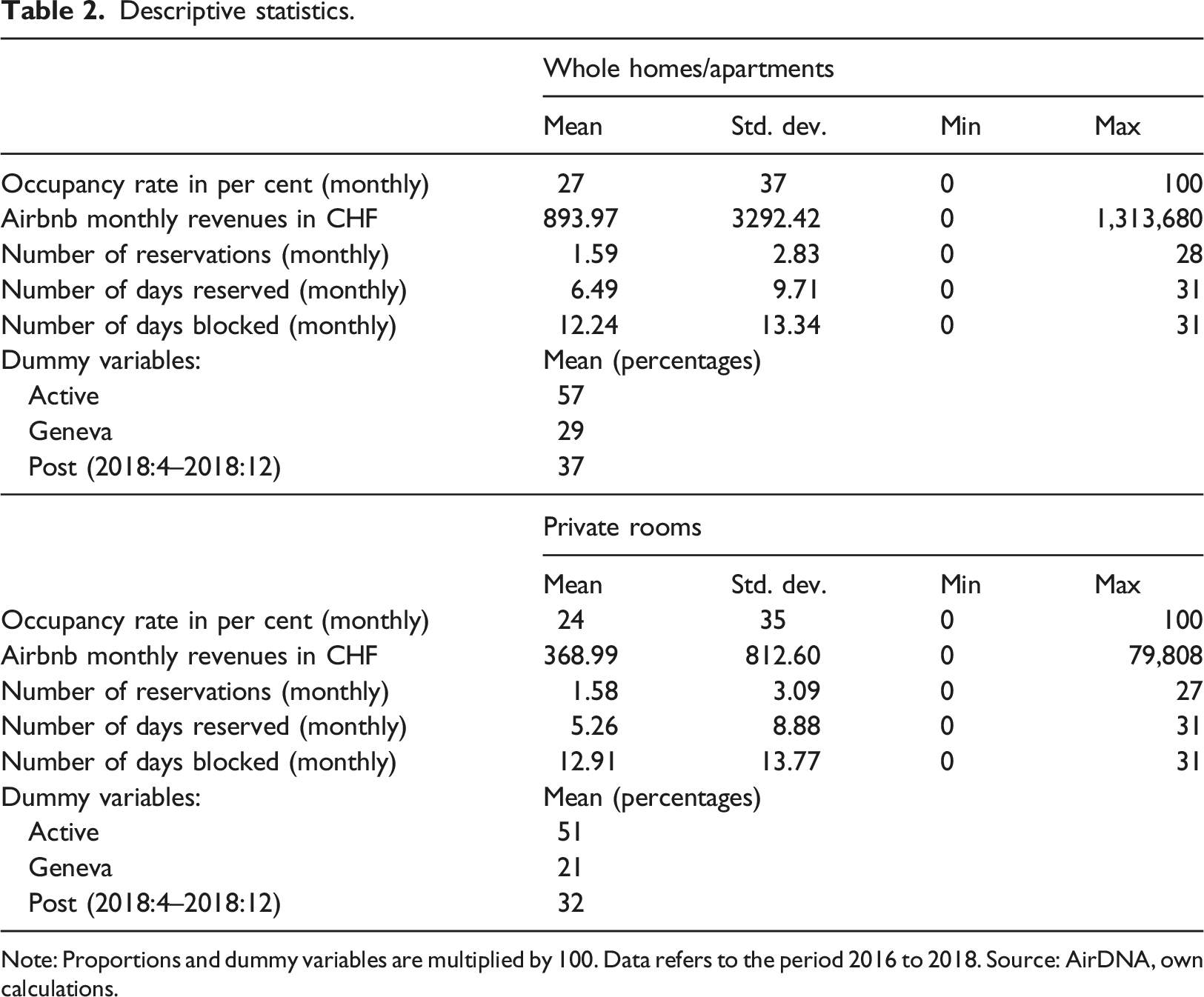
Descriptive statistics.
Note: Proportions and dummy variables are multiplied by 100. Data refers to the period 2016 to 2018. Source: AirDNA, own calculations.
Other studies find more significant negative effects resulting from Airbnb regulations. Using a difference-in-differences technique, Valentin (2021) demonstrates that by imposing regulations on Airbnb, New Orleans increased the likelihood that a corresponding provider would stop operating from 47 to 62 per cent. Similarly, Robertson et al. (2023) find that regulations have had a strong impact on short-term rentals in Bordeaux, where the number of days booked has declined by 44 per cent (equivalent to 28,000 fewer nights per month).
Bibler et al. (2021) investigate how voluntary tax collection agreements between Airbnb and US jurisdictions that enforce such collection affect booking prices. Using a difference-in-differences method, the authors find that enforcing a 10 per cent tax reduces the price paid to Airbnb hosts by 2.4 per cent, increases the total price paid by renters by 7.6 per cent, and reduces the number of nights booked by 3.6 per cent. The authors conclude that while tax legislation can significantly improve compliance by establishing voluntary collection agreements, taxing Airbnb is not an effective way to reduce market activity in a given area.
Instead of directly examining regulations on Airbnb itself, Boto-Garcia et al. (2023) focus on Airbnb’s disclosure of whether listings are required to have a registration number in order to operate legally. Using an event study method and the difference-in-differences method, the results show that the ratings for registered hosts have increased by about 10 per cent compared to illegal hosts.
Although the difference-in-differences method is used in all of the studies mentioned, it is challenging to compare their findings because different types of legislation apply in different cities. In addition, the studies mentioned generally focus on the total supply of Airbnb listings and rarely differentiate between fully rented Airbnb accommodations and individual rooms. Only a few studies also take into account property-specific fixed effects (Bibler et al., 2021 and Robertson et al., 2023 are exceptions to this rule).
Most studies only consider fixed effects at the municipality or census district level (Horn and Merante, 2017; Franco and Santos, 2021; Valentin, 2021; Gerwe et al., 2022; Yeon et al., 2022). Related literature also examines the extent to which regulations lead to a decline in Airbnb listings with high availability (Koster et al., 2021; Duso et al., 2021), which tend to be substitutes for long-term rentals and are thus the main target of regulations. Overall, the impact of laws that only apply to short-term rentals of entire properties and not to individual rooms is not sufficiently addressed in the literature. As they are all part of the same market, the substitutability between different types of Airbnb offerings can be enormous. On the other hand, the substitutability between short-term rentals and hotels or among short-term rentals themselves may be limited because they compete in different markets.
Research hypotheses
Geneva is an example of a city whose law only applies to whole Airbnb houses or flats. On 1 April 2018, it became the first city in Switzerland to limit short-term rentals through platforms like Airbnb to 60 days per year. Aside from the standard subletting restrictions, only entire properties are impacted; there is no restriction on renting out private or separate rooms. Five inspectors were to be hired to keep an eye on how the new guideline is being followed. 2 The maximum number of 60 days for short-term rentals in Geneva is lower than in London and Paris (90 days), but equivalent to Amsterdam as of 2018 (Nieuwland and Van Melik, 2020).
As discussed above, the market entry regulations should have resulted in a reduction in supply. This leads to the first hypothesis:
Regulations on fully rented Airbnb accommodations lead to a decrease in rental activity (measured as the probability of such accommodations being on the market). The second hypothesis focuses on how much the new laws have reduced the supply of fully rented Airbnb properties. The extent of the decline depends on the presence of Airbnb rentals with high availability. Empirical results for Berlin, Germany, show that the regulation of fully rented Airbnb properties leads to a significant decrease in high-availability listings (Duso et al., 2021). Drawing on statistics for Washington, DC, Zou (2020) presents the argument that part-time short-term rentals are unlikely to displace long-term rentals, as very few listings for complete flats were rented for longer than half a year in 2016. In Geneva, the share of total Airbnb listings in 2016 and 2017 that were booked for 180 days or longer ranged between 7 and 8 per cent (source: AirDNA based on 29,000 observations in 2017 and 20,000 observations in 2016). The corresponding figure for 60 days or more is 30 per cent (source: AirDNA). This suggests that the share of high-availability Airbnb rentals is in the moderate range and the rules may not have a significant impact on supply. The second hypothesis can thus be formulated as follows:
Regulations on fully rented Airbnb accommodations lead to a negligible reduction in the number of active Airbnb offerings (measured as the probability of such offerings being on the market). A decline in the supply of entire Airbnb homes or flats will consequently lead to a reduction in the performance of Airbnb rentals overall. This leads to the third hypothesis:
Regulations on fully rented Airbnb accommodations lead to a decrease in their rental activity (measured in terms of performance indicators described later in this paper). However, the extent of this decrease is not clear due to the possible compensation effect of Airbnb hosts potentially increasing prices in response to the decline in supply. The potential substitution effect of regulation on different kinds of Airbnb properties that are unaffected by the reforms themselves is a related research question. The availability of the two types of Airbnb rentals may be impacted differently when fully rented Airbnb properties are regulated, but private rooms are not. According to Koster et al. (2021), property owners or users could move from offering entire properties to renting out only private rooms, which can ultimately lead to additional Airbnb offerings. As our study uses an unbalanced panel data method, new listings in the post-reform period are taken into account. Evidence shows that in Manhattan, where the regulations affect whole houses and flats, the supply of whole houses and flats has decreased, while the supply of individual rooms and shared properties has grown (Jia and Wagman, 2020). This leads to the fourth hypothesis:
Regulations on fully rented Airbnb accommodations lead to a substitution from entire flats and houses to private rooms (measured by performance and the probability of such offerings being on the market). To account for the different effects of the Airbnb regulations in Geneva, separate estimation results for two groups (entire flats and homes, and private rooms) are provided. Entire properties account for about 60 per cent of the estimation sample (source: AirDNA).
Empirical approach
This study uses the difference-in-differences approach to investigate the impact of Airbnb regulation in Geneva on the supply and performance of Airbnb rentals. The identification strategy is to compare the impact of short-term rental regulation on the supply and performance of individual Airbnb listings in cities with and without such regulation. In order to conduct a difference-in-differences analysis, a suitable control group needs to be identified. Cities that are similar to each other but do not have Airbnb restrictions are appropriate for the purposes of this study, and nine such cities have been selected. While two cities (Basel and Zürich) have agreements with Airbnb to levy a local tax, the other seven cities in the control group have no laws at all governing Airbnb. However, the city taxes of Basel and Zürich, which fall in the range of CHF 3–4 (about USD 3–4 USD in 2019), are minimal in comparison to the daily rate of an Airbnb rental and therefore unlikely to impact rental performance. 3
The dependent variables consist of a set of performance indicators and a variable that indicates whether a given Airbnb accommodation is active (the supply indicator). There are different ways to measure the performance of Airbnb listings. Common indicators include the number of reservations per listing in a given month (Xie and Mao, 2017), average revenue per available night in a given month (Xie et al., 2020), and average daily rates or occupancy (Gibbs et al., 2018). Nieto García et al. (2020) consider Airbnb revenue to be the most important outcome variable because it combines prices and overnight stays into a single indicator.
Following the literature, the standard determinants of revenues, such as property-specific characteristics, are included (Sainaghi, 2021). The determinants of the likelihood of an Airbnb accommodation being active are specified for the two groups (entire homes and apartments, and private rooms):
The model is estimated by the fixed-effects logit model (Wooldridge, 2010). This model ignores all observations where the dependent variable does not change (i.e. a listing does not change from active to inactive or vice versa).
In the next step, a set of performance indicators for Airbnb accommodations are modelled:
The identification of the difference-in-differences analysis is based on the common trend assumption (Bertrand et al., 2004). This means that the trend in the performance of Airbnb listings in Geneva and in the control group should be similar in the pre-treatment period. The parallel trends assumption can be tested based on an assumed treatment period starting before the regulation was enacted (‘placebo DID’). However, it is difficult to test the parallel trends assumption using the data set in question, as the performance indicators are monthly, highly seasonal, and associated with time intervals (2017:4 to 2017:12 and 2018:4 to 2018:12) over a period of only 2 years. T-tests show that the coefficient of the interaction term between the 2107 year dummy and the dummy variable for the city of Geneva is significantly negative for the 2016–2017 estimation. This is true for occupancy, total revenues, number of reservations, and number of days reserved, but not for active listings or number of blocked days. We conducted additional robustness checks using a treatment period from January to March 2018 and the same period in 2017 (March to January) as a baseline. This is the period immediately before the Airbnb regulation was introduced in Geneva. There is no significant impact when the dependent variable is occupancy (coeff. of −0.057 and t-stat of −1.22), which supports the parallel assumption. However, there is still a significant negative impact on revenues. Since there are differences in the evolution of performance between Geneva and the control cities between 2016 and 2017, only estimates for the period 2017–2018 are presented. DID estimates are also biased if there are neighbourhood effects, but the geographical distances between the cities are large enough to exclude such effects.
Data and descriptive statistics
This study analyses information provided by AirDNA on Airbnb rentals, which is available in a ready-to-use format and widely used in the related literature (Nieto García et al., 2020). Monthly data on the overall population of Airbnb listings in Switzerland for the period 2016–2018 is examined, corresponding to 1.5 million observations in total. Each Airbnb rental is identified by an individual number, which allows the use of panel data models. The estimation sample is restricted to the ten largest cities in Switzerland and the time periods 2017:4 to 2017:12 and 2018:4 to 2018:12. Fixed-effects panel data models lead to the exclusion of listings where the status of the dependent variable does not change over time. This results in a sample size of around 220,000, of which 131,200 observations refer to whole properties (houses or flats) and 81,320 refer to private rooms. The proportion of shared rooms (1 per cent) is negligible and thus treated as private rooms.
The data contains several performance indicators, including occupancy rate, revenues, average daily rate (ADR), number of reservations, number of days reserved, and number of days blocked.
The other dependent variable is whether a given rental accommodation is active. There is also information on the characteristics of Airbnb rentals, like number of bedrooms, room type (entire or shared), property type (flat, house, chalet, etc.), number of bathrooms, number of maximum guests, response rate, and number of reviews. Tables 5 to 10 in the online appendix show the evolution of Airbnb supply and performance for the two subsamples (see Table 2 for descriptive statistics of estimation sample).
Empirical results
Impact of the regulation on the probability of accommodations being on the market
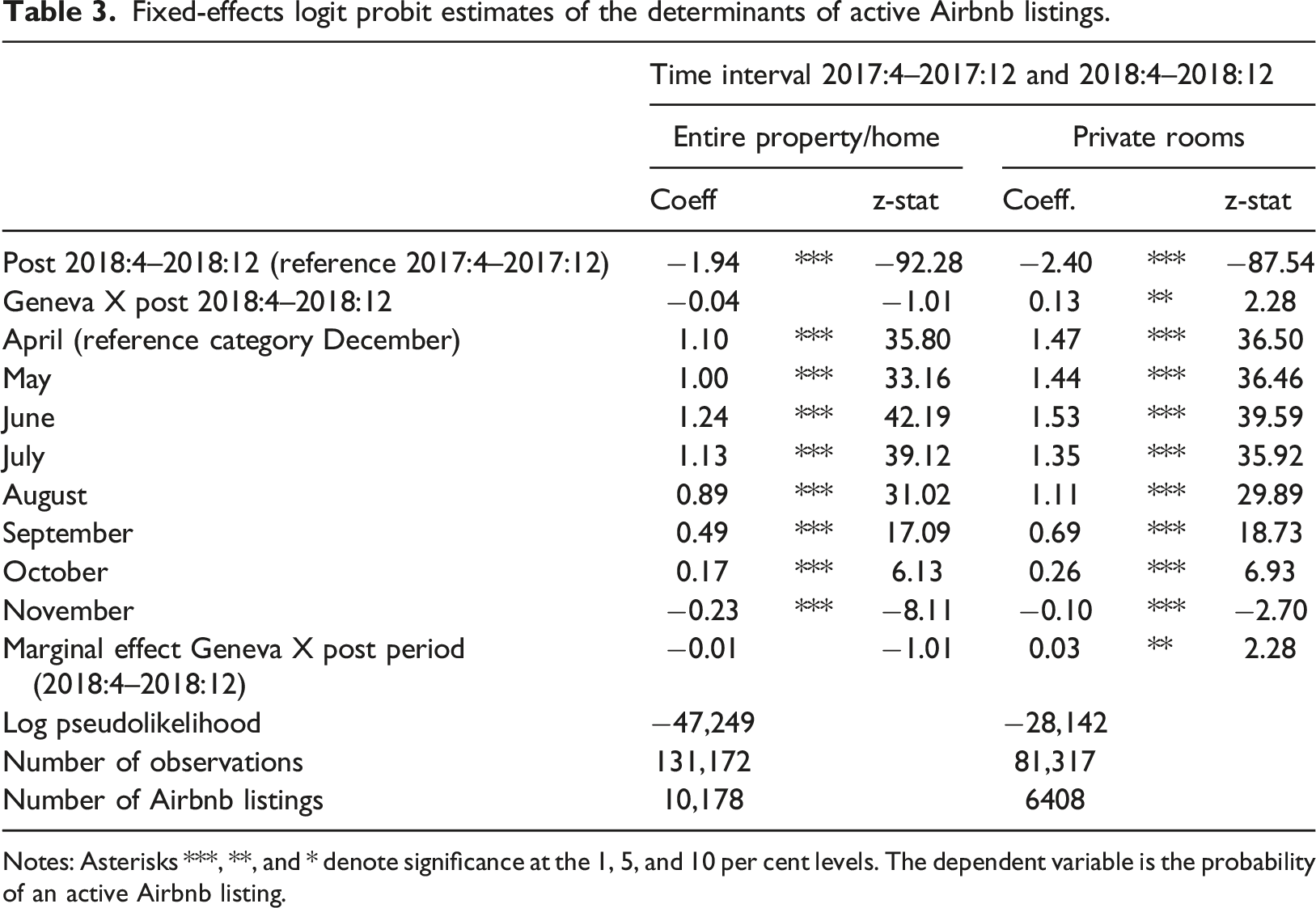
Fixed-effects logit probit estimates of the determinants of active Airbnb listings.
Notes: Asterisks ***, **, and * denote significance at the 1, 5, and 10 per cent levels. The dependent variable is the probability of an active Airbnb listing.
Impact of the regulation on the performance of Airbnb rentals
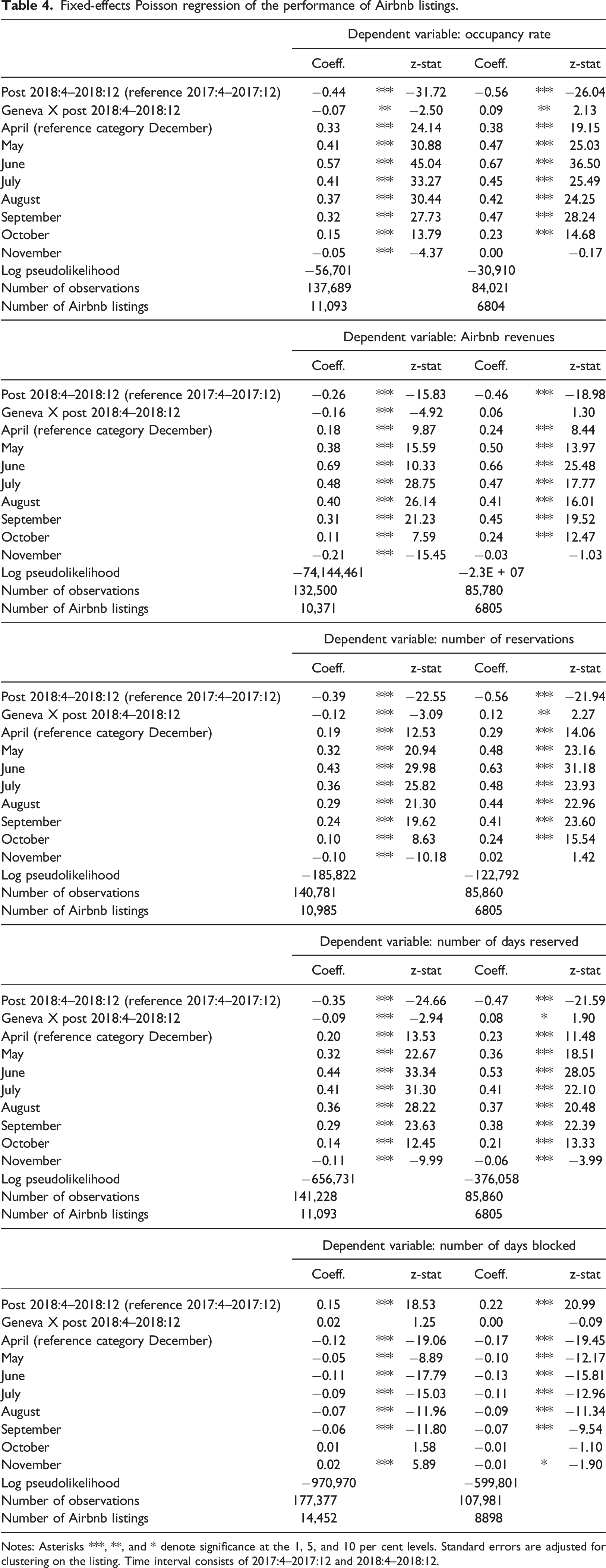
Fixed-effects Poisson regression of the performance of Airbnb listings.
Notes: Asterisks ***, **, and * denote significance at the 1, 5, and 10 per cent levels. Standard errors are adjusted for clustering on the listing. Time interval consists of 2017:4–2017:12 and 2018:4–2018:12.
Therefore, hypothesis 3 cannot be rejected. Similarly, the Airbnb regulation in Geneva has led to an increase in the number of days on which Airbnb offerings are not available, suggesting that Airbnb hosts are less willing to rent out their accommodations.
Concerning the substitution effect between private rooms and entire houses or flats, the results show that the regulation has had a positive impact on occupancy (p-value <0.05) and on the number of Airbnb reservations (p-value <0.05). For the two remaining indicators, revenues and number of days reserved, there are no significant effects at the 5 per cent level. This indicates that the substitution effects between the two types of accommodations cannot be ruled out. Thus, hypothesis 4 cannot be rejected for the two performance indicators in question.
A comparison of the magnitude of the effects provides additional insights. The coefficient of −0.12 on the number of Airbnb reservations of entire homes and apartments means that the number of Airbnb reservations has decreased by 12 per cent since the regulation came into effect compared to the control group and the base period. This indicates that the average number of Airbnb reservations has decreased from 1.4 to 1.2 per month. Similarly, monthly revenues from entire homes and apartments have declined by 15 per cent. The number of days reserved has decreased half a day per month or (cumulated for April–December 2018) four and a half days. The main conclusion is that the magnitude of the decline is remarkable given Airbnb’s strong growth in the past.
Several robustness checks are carried out. The first involves using the average daily rate as an alternative dependent variable. However, there are a large number of missing values for ADR, which means the results are not comparable to the estimates for the five other performance indicators. The number of ADR observations for the smaller sample thus decreases to 56,606. Unreported results show that ADR has not been affected by the regulation, based on a corresponding z-stat of −1.19.
In a second robustness analysis, we limit the sample to full rentals with high availability (read: more than 180 days booked in 2016 and 2017). This leaves us with a small sample size of 12,176 observations and 753 Airbnb hosts. The results of the conditional logit model show that the probability of entire properties being actively listed has decreased by 16 percentage points (with a marginal effect of −0.16 and p <.01; unreported results are available upon request). This clearly indicates that rentals with high availability have been affected most by the regulation. In addition, two cities that have an Airbnb agreement involving a city tax are excluded from the control group. According to our findings, the results (which are also available upon request) do not vary with the composition of the control group.
Discussion
Several cities have introduced strict regulations on all Airbnb rentals, while others are including exemptions for individual rooms. Some examples include Berlin, Los Angeles, New York (Manhattan), and, since 2018, Geneva. These regulations have been prompted by the fact that rentals of entire houses and flats are seen as a threat to the rest of the rental market. It is important for policymakers to know how these reforms are working, as some Airbnb hosts may not comply. The results of this study show that Geneva’s regulations have not had a clear effect on the supply of entire Airbnb rentals. That said, they have impacted the performance of such rentals in the form of a 15-per cent decline in revenues. Private rooms, on the other hand, have benefited in part from the regulations, having seen increases in occupancy and number of reservations. Overall, however, the regulations have had no impact on the share of Airbnb accommodations that are actively available. This is consistent with Jai and Wagman’s study on Manhattan (2020), but contradicts those by Koster et al. (2021) on Los Angeles and Duso et al. (2021) on Berlin, who find sizable reductions in Airbnb supply. Furthermore, the results suggest that Airbnb regulations that only affect a specific type of rental can lead to substitution effects for rentals that are not affected by the reforms. It appears that fully rented Airbnb accommodations and individual rooms operate in the same market segment.
The differences between the results of this study and those in the related literature can be partly explained by the extent of Airbnb regulation, which is much stronger in Los Angeles and Berlin than in Geneva. Another explanation could be that only a small proportion of all the Airbnb rentals in Geneva were being offered for more than 60 days before the implementation of the city’s reform and are thus not a substitute for long-term rentals.
Overall, our results are more consistent with the short-term effects estimated by Van Holm (2020) and Valentin (2021), who report moderate reductions in the performance of Airbnb rentals. These results contrast with those found for Barcelona (Benítez-Aurioles, 2021). However, the author of that study uses the number of reviews as an outcome variable, while this study uses conventional performance indicators, making their findings difficult to compare.
Conclusions
This study examines the impact of short-term rental regulation on the supply and performance of Airbnb listings in Geneva. One novelty of the study is that we distinguish between the supply-side response, measured as the presence of active Airbnb listings, and performance indicators such as monthly revenues, occupancy, number of reservations, number of days reserved, and number of days that properties are not available for short-term rental. The theoretical contribution is that we highlight the possible substitution effect between different types of Airbnb rentals when reforms target only certain Airbnb accommodations, such as entire rental properties as in the case of Geneva. The difference-in-differences approach is used in combination with logit and fixed-effects count data models to estimate the impact of regulations on Airbnb.
Our results show that the performance of entire Airbnb properties in Geneva decreased significantly after the regulations were introduced. The magnitude of the effect was considerable, with revenues from rentals of entire apartments or houses falling by 15 per cent. It was also quite large in consideration of the fact that the proportion of fully rented Airbnb accommodations with high availability was low prior to regulation (between 7 and 8 per cent). Another key finding of the study is that the performance of private rooms that are not covered by the regulation has benefited in part from the regulation. This does not rule out the explanation that private rooms are possible substitutes for entire flats and houses.
Several policy conclusions can be drawn from these results. The main conclusion is that regulations on short-term Airbnb rentals lead to a decline in their performance. This suggests that the regulation of entire Airbnb accommodations has the desired effect. However, there is some substitution in the form of the increased performance of private rooms, which is an undesirable side effect.
Measuring the impact of regulations on Airbnb supply is important because policymakers and hoteliers want to know what the economic and financial ramifications are and several other cities are planning to introduce their own regulations on short-term rentals. If the goal of a city government is to significantly reduce the number of Airbnb accommodations, stricter regulations are needed than those in Geneva. In fact, several cities have now tightened their regulations on Airbnb, as they do not want to return to the explosive urban tourism that emerged before the pandemic. 4 Geneva, however, does not want to go down the path of stricter Airbnb regulation; in fact, the city increased the maximum limit for rentals from 60 to 90 days in 2019. It seems that a certain level of Airbnb activity is to be tolerated.
This study is subject to several limitations. First, it focuses only on the short-term impacts of Geneva’s regulations in the first 9 months after they were imposed. Due to regulatory changes in 2019 and the COVID-19 pandemic in 2020, the medium- or long-term impacts are difficult to assess. Another limitation is that Airbnb rentals in some suburbs of Geneva that are located in France could not be included due to a lack of data. Furthermore, the results on the impact of Airbnb regulation in Geneva may not be transferable to other cities, as the design of such regulations and the specific context of each city (in terms of cost of living and rent prices, for example) are different.
There are many possible avenues that future work could explore. One idea would be to compare the impact of Airbnb regulations in Geneva with suitable data from other cities that have introduced similar reforms. Another would involve investigating whether landlords who have withdrawn their offerings from Airbnb have been using other distribution channels or offering their accommodations for longer periods since the reforms took effect.
Supplemental Material
Supplemental Material - Effects of regulations on the Airbnb market in Geneva
Supplemental Material for Effects of regulations on the Airbnb market in Geneva by Martin Falk and Miriam Scaglione in Tourism Economics
Footnotes
Acknowledgements
We would like to thank the participants of the IATE 2019 conference in La Plata and the 13th (online) Workshop ‘Tourists as Consumers, Visitors and Travelers’ in November 2021 for helpful comments. We are especially grateful to Eva Hagsten for helpful comments that greatly improved the manuscript, and to Tyler Schaffner for excellent proofreading.
Declaration of conflicting interests
The author(s) declared no potential conflicts of interest with respect to the research, authorship, and/or publication of this article.
Funding
The author(s) received no financial support for the research, authorship, and/or publication of this article.

Supplemental Material
Supplemental material for this article is available online.
Notes
Author biographies
References
Supplementary Material
Please find the following supplemental material available below.
For Open Access articles published under a Creative Commons License, all supplemental material carries the same license as the article it is associated with.
For non-Open Access articles published, all supplemental material carries a non-exclusive license, and permission requests for re-use of supplemental material or any part of supplemental material shall be sent directly to the copyright owner as specified in the copyright notice associated with the article.
