



Abstract
This study aims to model the effect of hospitality employment on property crime in economic crime equations, in which unemployment either indicates the opportunity cost of crime or suggests the decrease of targets. We developed a model of property crime that incorporates both unemployment rate and hospitality employment, in which the effect of unemployment rate on property crime is controlled to isolate the net effect of hospitality employment. We tested the model with the data of hospitality employment and property crime rates in the United States from 1972 to 2012, for which the date are available. On the one hand, we verified a negative causation from unemployment rate to property crime, suggesting that high unemployment rates reduce the targets of criminal activities, which in turn reduces property crime. On the other hand, by controlling for the effect of unemployment rate, we found a significantly negative causation from hospitality employment to property crime, suggesting that the decrease in property crime is due to hospitality employment that increases the opportunity cost of property crime.
Introduction
While crime is seen as a complex economic and social phenomenon, an economic approach to studying crime is predominant over others in the literature (Becker, 1968; Howsen and Jarrell, 1987; Mustard, 2010). This approach assumes offenders as rational persons confronted with economic trade-offs between committing a crime and engaging in legal employment (Becker, 1968, 1993; Ehrlich, 1973; Howsen and Jarrell, 1987; Viscusi, 1986). The relationship between unemployment and crime, above all else, lies at the heart of economic theories of crime, which aim to explain whether and how unemployment would affect crime rates (Cook and Zarkin, 1985; Freeman, 1994; Howsen and Jarrell, 1987). It follows that crime occurs when economic gains from criminal activities outweigh those from legal employment, ending up with a lower opportunity cost of crime, thereby providing incentives for people to commit a crime (Becker, 1993; Freeman, 1994; Howsen and Jarrell, 1987). On the other hand, unemployment can reduce crime, because it is associated with contracted economies and personal wealth, which in turn end up with few targets for prospective criminal offenses (Cantor and Land, 1985; Melick, 2003).
Tourism research on crime has drawn little reference to the economic theories of crime that underscore the effect of unemployment on crime. Instead, the tourism literature focused on the victimization of tourists or degradation of destinations due to crime (Boakye, 2010; Brunt et al., 2000; de Albuquerque and McElroy, 1999; Ferreira, 1999; Pizam, 1999; Tynon and Chavez, 2006). Such tourist- or destination-specific focuses, accompanied by numerous qualitative studies, led researchers to conclude an ostensibly positive effect of tourism development on crime in some destinations (Boakye, 2010; Brunt et al. 2000; Mawby et al., 1999; Ochrym, 1990). Since these studies telescoped the complexity of crime into a snapshot of tourist- or destination-specific criminal offenses, the positive tourism-crime relationship might be dubious if the general economic or social context is taken into account. Because tourist- or destination-specific crime accounts for a small fraction of total crime in a society, tourist numbers, a measure of tourism development in many studies (Biagi and Detotto, 2014; Brunt and Hambly, 1999; Fujii and Mak, 1980; Michalko, 2004), are insufficient to explain the total crime rate.
Crime studies in tourism and economics are divided on both their focuses and methodologies. Bridging this gap requires researchers to elicit the labor-intensive nature of the tourism and hospitality industry, on which the unemployment effect on crime can be based. Building up on economic theories that unemployment increases crime due to a lower opportunity cost of crime (Becker, 1993; Freeman, 1994; Howsen and Jarrell, 1987), we argue that hospitality employment would increase the opportunity cost of crime and thus reduces crime, especially for destinations whose economy depends heavily on tourism. If, on the other hand, unemployment reduces crime due to decreased targets (Cantor and Land, 1985; Melick, 2003), we argue that hospitality employment can actually increase crime because a booming tourism economy could bring more targets, including tourists from outside and local residents who benefit from tourism. We aim to decouple the two contradictive effects of unemployment on the occurrence of crime, both of which are theoretically plausible while are perhaps empirically distinguishable as far as hospitality employment is concerned.
Literature review
Unemployment and crime
A central tenet in economic models of crime is that criminals are rational persons who make trade-offs between crime and legal employment based on their respective economic rewards (Becker, 1968; Ehrlich, 1973; Howsen and Jarrell, 1987). Because employment benefits are the opportunity cost of crime, economic studies have focused on the impact of unemployment rate on crime by controlling for the effects of other social factors, such as apprehension rate, conviction, the severity of punishment, and so forth (Becker, 1993; Buonanno, 2006; Edlund and Korn, 2002; Marselli and Vannini, 1997; Mustard, 2010). Cantor and Land (1985) argued that a necessary and sufficient condition for the occurrence of crime is both a motive behind criminal offenses and the presence of a target. When unemployment is concerned, some argued that the unemployed are more likely to commit a crime, because the opportunity cost of crime decreases in the absence of job opportunities (e.g. Freeman, 1994). On the other hand, some argued that unemployment can reduce targets, especially for property crime (Melick, 2003), because unemployment rates means less consumption and property accumulation, and therefore fewer targets exposed to criminal offenders (e.g. Cantor and Land, 1985).
Sine economic rewards from employment are the opportunity cost of crime, unemployment affects property crimes rather than all crimes because property crimes are associated with economic benefits. This conjecture was supported by Howsen and Jarrell (1987), who found that unemployment rate affected property crime rather than violent crime in Kentucky (US). Raphael and Winter-Ebmer (2001) also found significantly positive effects of unemployment rates on property crime rates in the United States, concluding that a substantial decline in property crime rates in the 1990s was due to the decline in unemployment rates. Thus, if unemployment is assumed to affect aggregate crime that includes both property crime and violent crime, the unemployment effect would be either underestimated or biased. For instance, Raphael and Winter-Ebmer (2001) found that the unemployment effect is either negligible or statistically weak in explaining aggregate crime rates. Cook and Zarkin’s (1985) study reported significant negative effects of unemployment on violent crime.
The nature of the unemployment–crime relationship is manifested in the directions of the causality between the two. Raphael and Winter-Ebmer (2001) argued that criminal activities can reduce potential employment due either to the negative effects of incarceration on the labor force participation or to people’s reluctance to engage in legitimate employment. Crime may thus not only directly lead to an increase in observed unemployment rates but can also indirectly exacerbate unemployment through impeding the growth of labor force (Raphael and Winter-Ebmer, 2001). Raphael and Winter-Ebmer (2001) conclude that the unidirectional causality of unemployment–crime inference might be flawed not only because of the omitted variables in crime equations but also due to a simultaneity bias. To discern the direction of the causation between unemployment and crime, instrument variables have been used in various crime equations (Buonanno, 2006; Raphael and Winter-Ebmer, 2001). For instance, Raphael and Winter-Ebmer (2001) used oil price shocks as the instrument variable in their study, because this variable affected unemployment rates but not crime, thereby singling out the effect of unemployment on crime.
Factors affecting property crime
Despite the pivotal role of unemployment in building crime equations, Howsen and Jarrell (1987) argued that these crime equations are still insufficient to explain the total variation in crime rates. This is largely due to the complexity of criminal activities that are rooted deep in complex economic and social environments (Becker, 1993), and thus reducing the unexplained variation in crime needs to draw inference from other disciplines (Howsen and Jarrell, 1987; Marselli and Vannini, 1997). Besides unemployment rate, a wide range of control variables, particularly sociodemographic variables, such as age, gender, income, education, race, and residential district, are factored into crime equations (Bound and Freeman, 1992; Buonanno, 2006; Howsen and Jarrell, 1987; Marselli and Vannini, 1997; Raphael and Winter-Ebmer, 2001). Not only are criminals commonly portrayed as young, male, and Black with economic hardship and less education (Freeman, 1987, 1996; Nagin and Waldfogel, 1995; Shihadeh and Flynn, 1996; Viscusi, 1986), but certain characteristics, such as profession, can also be associated with certain crimes (Croall, 2001). Among all these sociodemographics, race is widely associated with crime occurrence in the United States in particular (Like-Haislip, 2014; Nunn, 2002; Shihadeh and Flynn, 1996; Viscusi, 1986).
A second type of control variables are related to criminogenic consumption, such as drug abuse and alcohol consumption, which affect both property crimes and violent crimes (Carpenter, 2007; Markowitz, 2005; Marselli and Vannini, 1997; Zimmerman and Benson, 2007). Markowitz (2005) found that an increase in beer taxes reduces assaults, while cocaine prices are negatively associated with the occurrence of robberies. Zimmerman and Benson (2007) found that alcohol consumption increases the vulnerability of rape victims, resulting in more rape occurrences. The consumption of these vice goods is seen either as an indicator of potential crimes or simply as a stimulus for crime to occur under certain circumstances. According to Levitt (2004), of the four factors contributing to the drastic decline in crime rates in the United States in the 1990s was the drop of crack consumption during this period. Marselli and Vannini (1997) found that drug consumption has substantial spillover effects on property crime, which further amplifies the effect of unemployment on crime.
A third type of control variables include crime prevention and punishment mechanisms, such as the likelihood of apprehension, surveillance of crime behavior, and incarceration rates (Howsen and Jarrell, 1987; Levitt, 2004; Marselli and Vannini, 1997). Becker (1993) argued that crime rate is determined not only by the rationality of potential criminals but also by the economic and social environment of the society in which people behave (e.g. expenditure on police, punishments, schooling, and training programs). Despite employment providing strong economic incentives, individuals would be less likely to morph into criminals if the likelihood of apprehension and conviction as well as the severity of punishment were also high (Marselli and Vannini, 1997). Howsen and Jarrell’s (1987) study in the United States found that the apprehension rate affects property crime while the length of sentence and the level of public assistance payments have no effect. Also in the United States, Levitt (2004) found that the reduced crime rates can be attributed to the legalization of abortion, police presence, and the increase in the incarcerated population.
Tourism and crime
Much of the tourism research on crime has concluded a positive relationship between tourism development and crime (Biagi and Detotto, 2014; Brunt and Hambly, 1999; Fujii and Mak, 1980; Jud, 1975; McPheters and Stronge, 1974). As a pioneer in studying the relationship between tourism and crime, Jud (1975) attributed the increase in property-related offenses in Mexico to the influx of tourists. Fujii and Mak (1980) found that a significant increase of burglaries and rapes in Hawaii was due to the increase of tourist numbers. A series of studies in Italy showed that tourist areas were reported to have more crime, particularly pickpocketing, than nontourist areas (Biagi et al., 2012; Biagi and Detotto, 2014). In this line of research, Campaniello (2013) found that cities hosting sport events, such as the Football World Cup, increased property crimes in the Italian cities in 1990 while the impact on violent crime was not substantial. McPheters and Stronge (1974) found that the change in property crime, such as robbery, larceny, and burglary, is associated with the seasonality of hospitality employment in eating and drinking establishments.
Not only does tourism development provide certain conditions for criminals, but tourists can also become targets, leading to high gains and low risks for crimes (Brunt and Hambly, 1999; Chesney-Lind and Lind, 1986; Fujii and Mak, 1979; McPheters and Stronge, 1974). Some studies showed that potential gains from tourism-related crimes outweighed those from other economic activities, thereby obscuring the effects of not only economic development but also general criminal conditions on crime (Howsen and Jarrell, 1987; Michalko, 2004). Since tourists normally carry valuable objects and are not so vigilant at the destination, they tend to become suitable targets for criminals (Boakye, 2010; Brunt et al., 2000; Chesney-Lind and Lind, 1986; Fujii and Mak, 1979; Grinols et al., 2011; Ryan, 1993). An increase in crime at destinations can also be attributed to the fact that tourists themselves are offenders (Jones and Groenenboom, 2002; Ryan, 1993; Ryan and Kinder, 1996). Harrison (1994) argued that tourists temporarily leaving behind restrictions of their own society might induce them to engage in chicanery or unlawful activities at the destination.
Some argued that tourism development cannot adequately account for either property crime or violent crime (Grinols et al., 2011; Pelfrey, 1998; Pizam, 1982). It is also plausible that crime deters tourism demand as it causes safety and security issues at the destination (Levantis and Gani, 2000; Pizam 1999; Tynon and Chavez, 2006). Evidence yet of the tourism–crime causality in many studies is relegated to the existence of correlation between the two. For instance, more crimes were reported in tourist destinations than in nontourist areas (Fujii and Mak, 1979; Ochrym, 1990; Walmsley et al., 1983). Ochrym’s (1990) study in New Jersey showed that crime rates were significantly higher in tourist destinations than in urban areas where tourism was not pervasive. Park and Stokowski (2011) found that ski resorts have a higher property crime rate compared to other areas, and crime rates are positively associated with tourism growth (Howsen and Jarrell, 1987). Biagi and Detotto (2014) pointed out that if tourism and crime rates were not exogenously determined, a shock in crime rates would also affect tourist arrivals at the destination.
Research gaps
Tourism studies have shown that the tourism–crime relationship is either evident for certain types of tourists or for particular destinations in certain time periods (Campaniello, 2013; Grinols et al., 2011; Ochrym, 1990; Park and Stokowski, 2011; Pelfrey, 1998; Van Tran and Bridges, 2009). Grinols et al. (2011) argued that it is tourist types that lead to crime occurrence at the destination, which casts doubt on the positive effect of tourism development that is measured by tourist numbers on crime. Thus, the positive tourism–crime relationship is not only dubious on its own right but also has limitations when it comes to the dichotomous analysis of crime in touristic versus nontouristic areas. One limitation is that tourism studies on crime are flooded with case studies, survey data, and cross-sectional analysis (Ajagunna 2006; Biagi and Detotto, 2014; Brunt et al., 2000; Dimanche and Lepetic, 1999; Mawby et al., 1999). Thus, the tourism–crime inference is neither conclusive nor can it be generalized to the broad economy. The positive tourism–crime relationship, if anything, is in the short run, dictated by the seasonality of tourism demand (McPheters and Stronge, 1974; Michalko, 2004) rather than by the unemployment rate in general.
Since criminal offenses in the tourism literature were those against tourists, the tourist- or destination-specific approach either implies or lends support to a positive tourism–crime association (Campaniello, 2013; Chesney-Lind et al., 1983; Montolio and Plannels, 2016). No wonder the influx of tourists would lead to an increase in crime at the destination (Montolio and Plannels, 2016), yet little is known about whether crime actually deters tourism demand, a reverse causality that has yet to be substantiated by empirical evidence. The nature of the tourism–crime relationship would be different, if we traced the roots of crime into the complex economic, social, and legal environment, on which the economic theories of crime are based (Becker, 1993; Viscusi, 1986). Instead of focusing on the association between tourist numbers and crime occurrence, we look at hospitality employment on the supply side and argue that crime is endogenously determined in a society, rather than being brought into by tourists from elsewhere.
Research methods
A crime equation in hospitality
Economic theories of crime assume that individuals make rational decisions about whether or not to engage in criminal activities based on the net benefits of such actions (Becker 1968, 1993; Ehrlich, 1973; Howsen and Jarrell, 1987). Empirical research goes on to examine the effect of unemployment on crime, because economic rewards from employment is the opportunity cost of crime, namely that unemployment lowers the opportunity cost. In line with the economic theories, we argue for a substitution effect between hospitality employment and property crime. We focus on property crime as it is largely driven by economic incentives (Marselli and Vannini, 1997; Raphael and Winter-Ebmer, 2001), and thus employment better reflects the opportunity cost of property crime compared to violent crime (Howsen and Jarrell, 1987; McPheters and Stronge, 1974). We further argue that job opportunities in the tourism and hospitality industry would dilute the economic incentives of property crime and eventually drive down property crime to some extent. By factoring hospitality employment into the crime equation, we develop a crime equation in hospitality as follows:

where t indexes years,
The vector, Xt, represents a set of control variables. First, we control for the effects of unemployment rate, namely that we focus on the net effect of hospitality employment on property crime. Second, we control for sociodemographic variables, including the proportion of population living in poverty, the proportion of youths (15- to 29-year olds), the proportion of population living in metropolitan areas, and the proportion of Afro-Americans (Howsen and Jarrell, 1987; Shihadeh and Ousey, 1996). Third, we control for the effects of the consumption of criminogenic goods, such as alcohol consumption (Levitt, 2004; Zimmerman and Benson, 2007). Fourth, we control for the effects of incarceration. On the one hand, an increase in incarcerated criminals means that fewer criminals are on the “outside” roving the streets (Howsen and Jarrell, 1987; Raphael and Winter-Ebmer, 2001). On the other, incarceration could be a deterrence that can prevent crime from occurring.
We add linear (
Reverse causality between property crime and hospitality employment
To address the reverse causality between property crime and the two endogenous variables, namely hospitality employment and unemployment rate, in the crime equation, we use the generalized method of movements (GMM) in model estimation. The GMM is grounded on the idea that the variables in the model must be uncorrelated (orthogonal) with their errors. The GMM can produce consistent and efficient estimators for time series analysis (Baum, 2006), which best suits the nature of our data and research objectives of this study. The GMM relies on the resolution of a series of moment equations and allows researchers to account for endogeneity in explanatory variables as well as for heteroscedasticity and autocorrelation in error distributions. For the GMM, we consider the following equation:


where Q is an

where

In the case of l = k, the model is identified, and the solution can be straightly derived from the sample moment equation above. If the model is overidentified where

where W is an
Instrument variables for hospitality employment and unemployment rate
As a special case of the GMM estimation, we used instrument variables to account for the endogeneity of hospitality employment (
As for the endogeneity of unemployment rate, we also decipher instrument variables that affect unemployment rate but are independent of property crime. This allows us to resolve the reverse causality from property crime to unemployment rate in crime equations (Raphael and Winter-Ebmer, 2001). Following Blanchard et al. (2010), we include the growth rate of the economy and inflation. These two variables are highly correlated to unemployment rate but have little to do with property crime. Economic justifications for the correlations include the Okun’s (1962) law, suggesting a negative association between unemployment rate and economic growth, and the Phillips (1958) curve, suggesting a negative correlation between unemployment rate and inflation. Also, as being seen, exchange rate and oil price are related to unemployment rate.
To summarize, the theoretical model along with the instrument variables aims to isolate the effect of hospitality employment in the crime equation developed by Becker (1968). As suggested in the literature, a reverse causality problem could arise in the crime equation and its variants because of incorporation of the two explanatory variables, unemployment and hospitality employment. On the one hand, the literature points out that unemployment positively affects crime as high unemployment rate reduces the opportunity cost of committing a crime (e.g. Freeman, 1994). On the other hand, the literature suggests that unemployment may reduce property crimes as it reduces the potential targets of criminal activities (e.g. Cantor and Land, 1985; Melick, 2003). Likewise, hospitality employment would affect crime negatively as it acts as a positive externality through providing jobs to both skilled and unskilled workers. Of course, crimes might also make a tourist destination less attractive, thereby reducing all sorts of tourism demand, including hotel demand. To address the problem of endogeneity, we used 16 instrument variables. Specifically, we instrumentalized unemployment with the growth rate of the US economy and inflation while instrumentalizing hospitality employment with hospital beds, tuberculosis cases, exchange rate, oil price, and the lagged hospitality employment. Finally, the other control variables (poverty, young population, Afro-Americans, metropolis, alcohol consumption, incarceration) are the instrument variables of themselves.
Data description
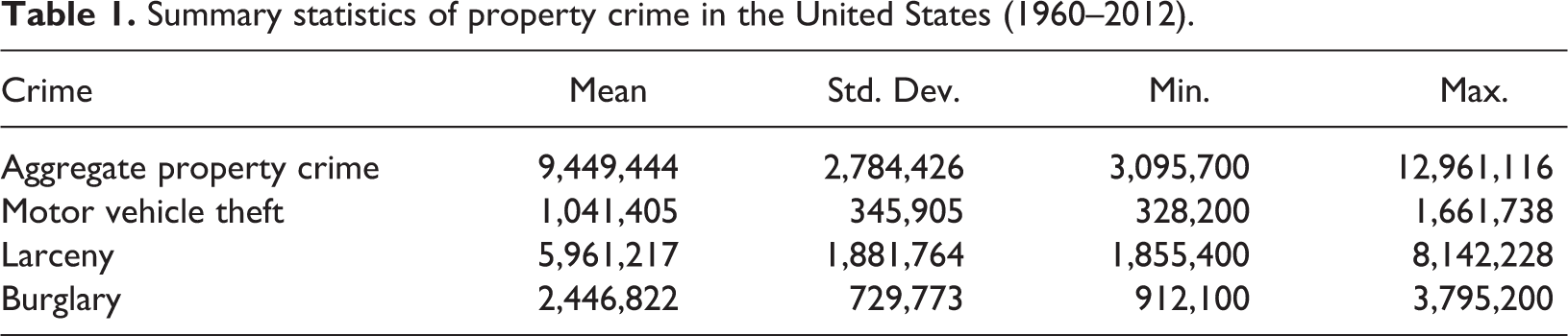
Data for property crime in the United States were obtained from the Federal Bureau of Investigation’s Uniform Crime Reporting. We selected motor vehicle theft, larceny, and burglary recorded from 1960 to 2012 (due to the time lag in the US crime statistics, 2012 was the latest year when our data were compiled). Table 1 shows the aggregate statistics of property crime and the three types of property crime from 1960 to 2012, and Figure 1 plots their growths in the same period.
Summary statistics of property crime in the United States (1960–2012).
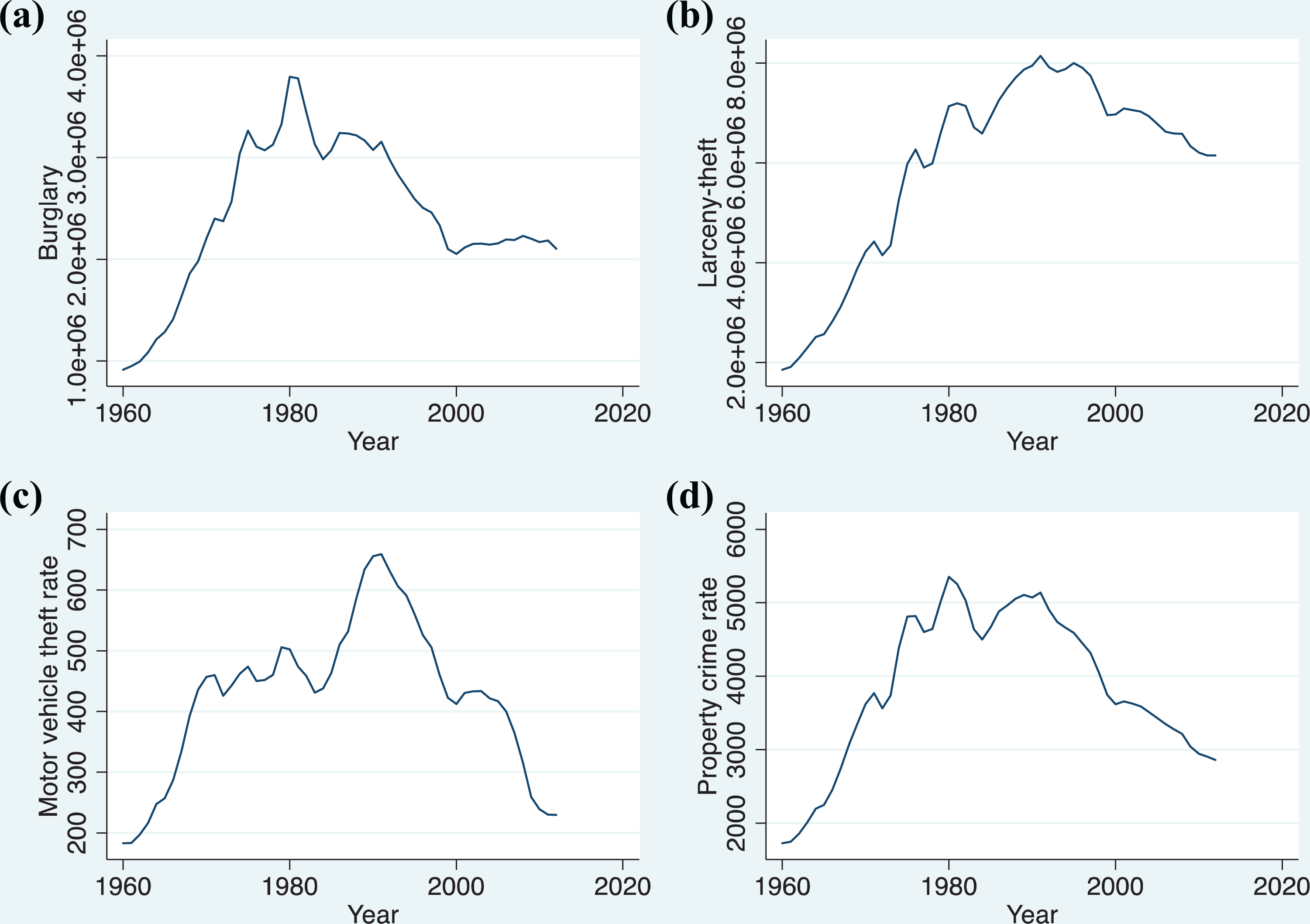
(a)–(d) Growth rates of property crime in the United States.
We retrieved data from the Bureau of Labor Statistics (BLS) for the number of workers employed in the US accommodation sector as a proxy for hospitality employment. Since the data for the number of employees were monthly, we computed the arithmetic average to obtain the yearly data. Figure 2 shows the change in the number of employees in the accommodation sector from 1972 to 2015, for which the data were available. We also collected data for the US unemployment rate from the BLS for the period 1947–2015.
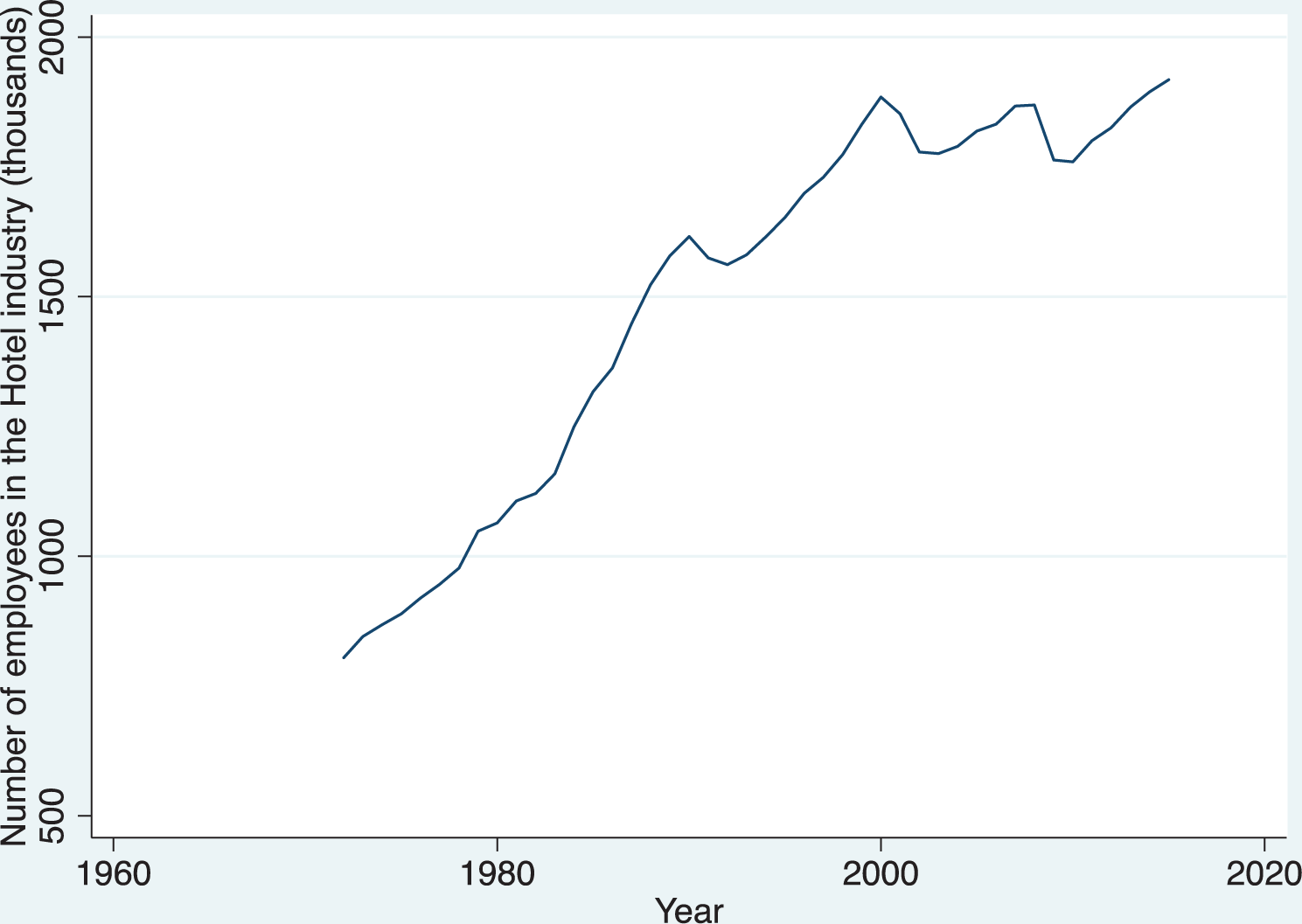
Number of employees in the US accommodation sector.
For sociodemographic variables, we retrieved population data from the United States Census Bureau from 1960 to 2014 and linearly interpolated the original data at a decennial frequency to obtain annual data. Specifically, we retrieved the proportion of the US population living in poverty, the proportion of 15- to 29-year-olds, the proportion living in metropolitan areas, and the proportion of Afro-Americans. For criminogenic consumption, we collected data on alcohol consumption in the United States for the period 1960 to 2014 from the Organization for Economic Co-operation and Development (OECD) Health Statistics. We collected data for the number of prisoners incarcerated in the United States from the Bureau of Justice Statistics for the period 1925–2014.
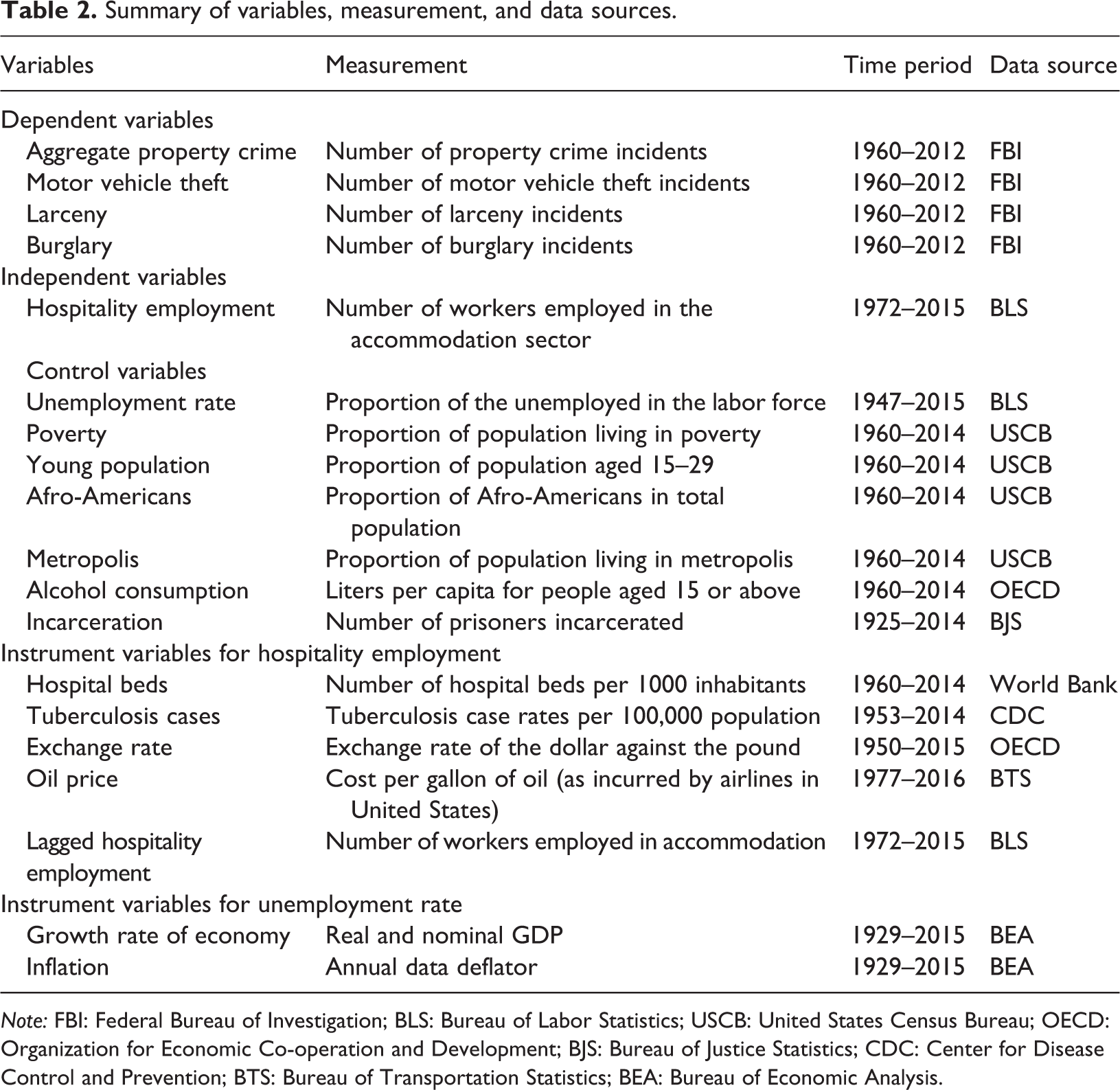
For the instrument variables of hospitality employment, hospital bed numbers per 1000 inhabitants in the United States were retrieved from the World Bank. Tuberculosis case numbers per 100,000 population in the United States since 1953 were obtained from the Center for Disease Control and Prevention. Data of oil price per gallon reported by airlines in the United States were obtained from the Bureau of Transportation Statistics, and we deflated the price using 2009 as a reference year. We collected data on the exchange rate between the US dollar and the British pound from the OECD. For the instruments variables of unemployment rate, we collected data of annual deflator and the real and nominal gross domestic product (GDP) 1 of the United States from the Bureau of Economic Analysis. Table 2 summarizes all the variables, measures, and data sources.
Summary of variables, measurement, and data sources.
Note: FBI: Federal Bureau of Investigation; BLS: Bureau of Labor Statistics; USCB: United States Census Bureau; OECD: Organization for Economic Co-operation and Development; BJS: Bureau of Justice Statistics; CDC: Center for Disease Control and Prevention; BTS: Bureau of Transportation Statistics; BEA: Bureau of Economic Analysis.
Results and discussion
We first present the preliminary results of the hospitality employment–property crime relationship without instrumenting hospitality employment and unemployment rate. This preliminary analysis aims to examine whether and to what extent this relationship can be explained in the crime equation we developed. Then, we check the validity of the instrument variables for both hospitality employment and unemployment rate. After verifying the instrument variables, we present the results of the final model in the presence of the instrument variables, which allow us to test the causality running from hospitality employment to property crime as well as the variance in property crime that is solely explained by hospitality employment. We regress the aggregate property crime and the three types of property crime on the independent variables in model estimation.
Preliminary analysis of the hospitality employment-property crime relationship
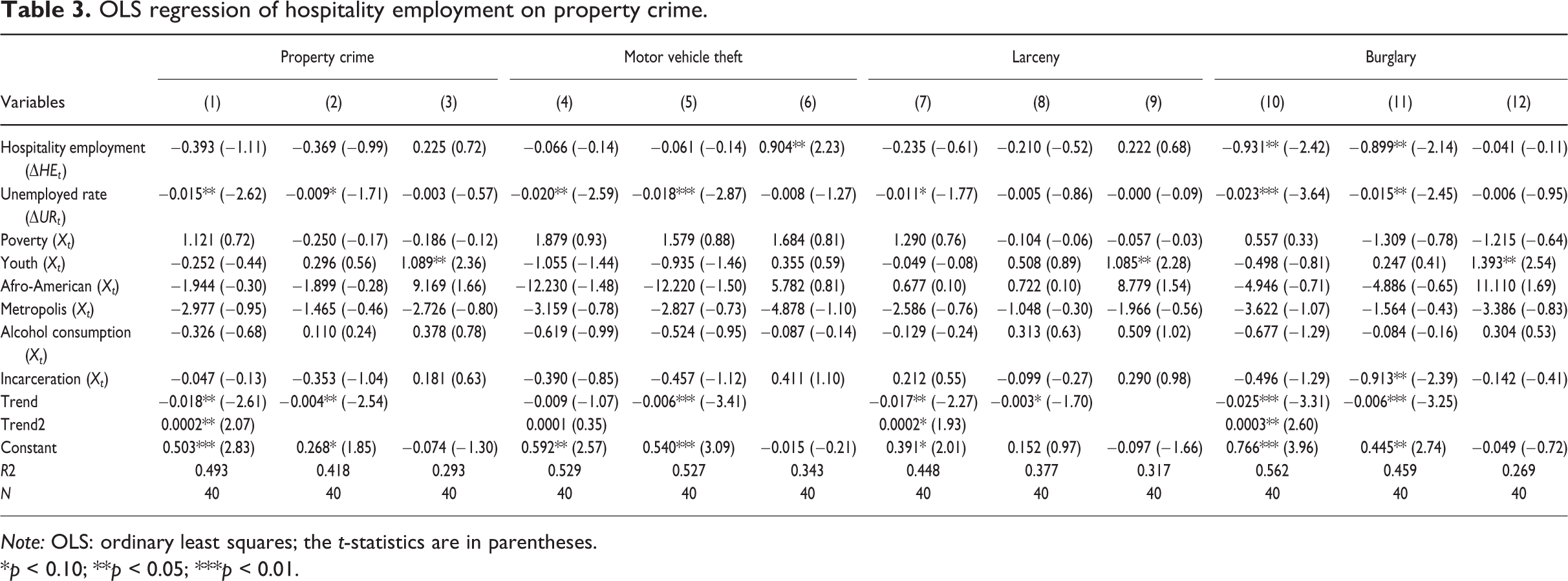
Table 3 shows the ordinary least squares of the change in property crime with respect to the changes in hospitality employment and unemployment rate. Only in 3 (models 6, 10, and 11) of the 12 model specifications did we find statistically significant relationships between hospitality employment and property crime. Despite that, the signs of the three relationships are mixed, rendering the hospitality employment–property crime relationship dubious. Not only was the hospitality employment–property crime relationship indeterminate, the well-established unemployment–crime relationship in economic studies was also called into questions in the model estimation.
OLS regression of hospitality employment on property crime.
Note: OLS: ordinary least squares; the t-statistics are in parentheses.
*p < 0.10; **p < 0.05; ***p < 0.01.
These results lend little support to the effect of hospitality employment on property crime, as the effect is statistically insignificant in most model specifications. Consistent with our proposition, both hospitality employment and unemployment rate might be either correlated to the omitted variables in the crime equation or affected by property crime, suggesting the existence of reverse causalities. The true relationship between hospitality employment and property crime might be muddled by the unexplained variance and errors. In other words, we would have failed to unravel the true relationship if there were reverse causalities between property crime and both hospitality employment and unemployment rate.
Validity of instrument variables
To address the potential reverse causalities between property crime and hospitality employment and unemployment rate, we used instrument variables for both hospitality employment and unemployment rate. 2 The use of instrument variables allowed us to deal with the potential conflictual cause–effect relationship between economics variables, crime incidences, and hospitality activity. We performed Hansen’s J statistic to test the validity of the overidentified restrictions to suggest whether the instrument variables for hospitality employment and unemployment rate are orthogonal or not. Being orthogonal means that the instrument variables are independent of the errors in the crime equation and thus valid, that is, they are highly correlated to hospitality employment and unemployment rate but independent of property crime. According to Baum (2006), the null hypothesis below imposes that the model is correctly specified:

where l = 16, denoting 16 instrument variables in our analysis, namely the five instrument variables for hospitality employment, two instrument variables for unemployment rate, and nine exogenous variables (variables in Table 3 excluding hospitality employment and unemployment rate) that are their own instruments in our model; where k = 11, denoting the 11 parameters to be estimated, consisting of two parameters of the two endogenous variables and nine parameters of the nine exogenous variables.
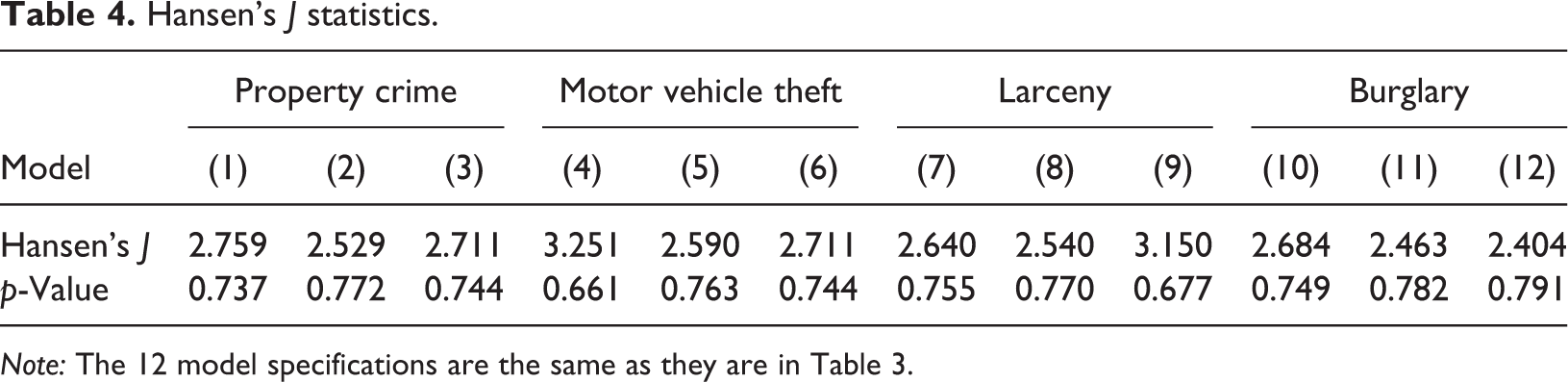
The instrument variables are supposed to be independent of the errors in the null hypothesis while highly correct to the endogenous variables. The rejection of the null hypothesis may occur either because the instrument variables are endogenous or because they are erroneously excluded from model estimation (Baum, 2006). Table 4 shows that Hansen’s J statistics are nonsignificant for all 12 model specifications, and thus we cannot reject the null hypothesis. Therefore, the instrument variables for hospitality employment and for unemployment rate are valid for all these 12 model specifications.
Hansen’s J statistics.
Note: The 12 model specifications are the same as they are in Table 3.
Hospitality employment–property crime causality
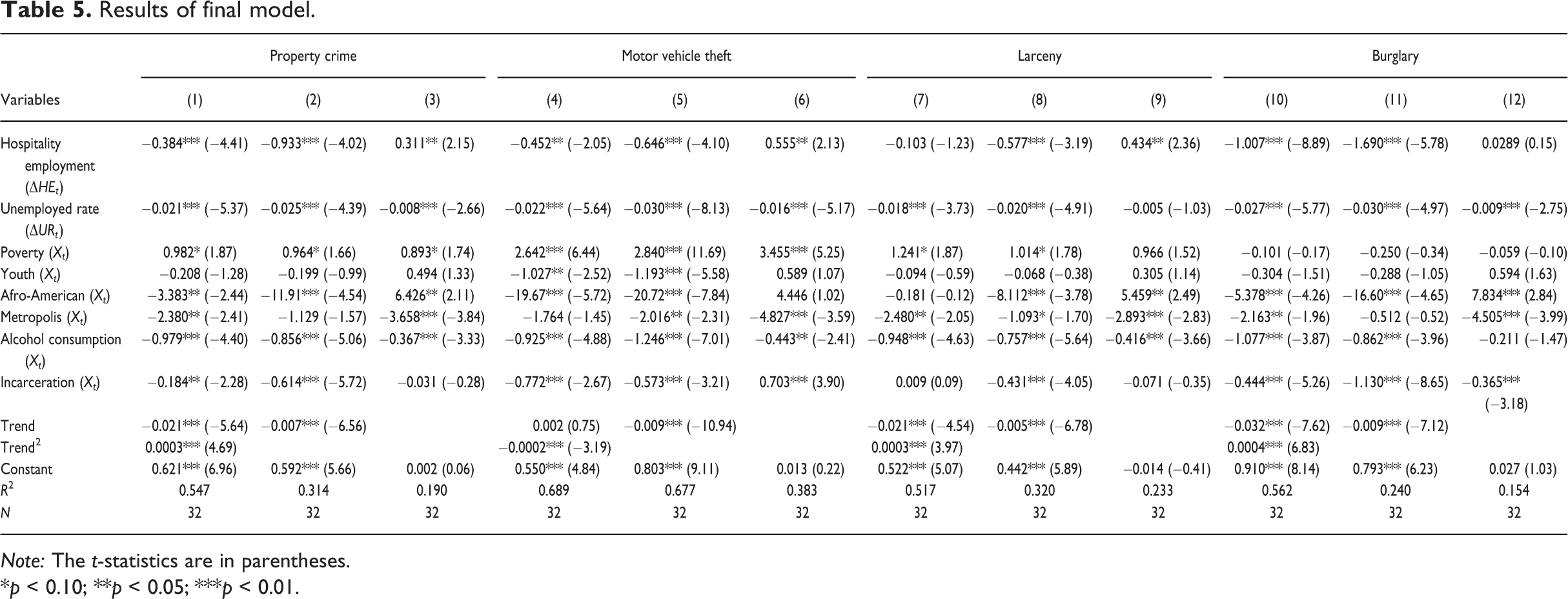
After verifying the validity of the instrument variables, we report the results of the crime equation that factored in the effects of the instrument variables on hospitality employment and unemployment rate (Table 5). Except for Model 7, adding the trend variables led to either the increased significance of hospitality employment in the model or the increased magnitude of it in explaining property crime, suggesting that the occurrence of property crime follows specific trend patterns. According to Wooldridge (2012), excluding a statistically significant time trend may lead to a spurious regression that renders nonsignificant independent variables ostensibly significant. It is thus necessary to include the time trends in the model and retain them when they are tested statistically significant (Wooldridge, 2012).
Results of final model.
Note: The t-statistics are in parentheses.
*p < 0.10; **p < 0.05; ***p < 0.01.
Previous research ascribed similar trend patterns to the seasonality of tourism demand, whereby the targets and potential gains for criminals at the destination also change (McPheters and Stronge, 1974; Mehmood et al., 2016; Michalko, 2004). Yet the time trends in our model suggest the business cycle of hospitality supply in the long run. This is because we modeled hospitality employment into the crime function to measure tourism development rather than short-run demand fluctuations. Since the seasonality of tourism demand is manifested in the short run, it comes with no surprise that a vast majority of studies in tourism verified only the positive tourism–crime association (McPheters and Stronge, 1974; Mehmood et al., 2016; Michalko, 2004), in which the amount of crimes against tourists is obviously associated with tourist numbers at destinations. Focusing on the supply side not only allows us to establish the long-run tourism–crime relationship but helps justify a negative tourism–crime causality when tourism development is due to the number of people employed in the hospitality industry in the long run.
With the instrument variables included in model estimation, model 7 was the only one with a time trend that shows a nonsignificant relationship between hospitality employment and property crime (Table 5). All other seven model specifications demonstrate a series of statistically negative relationships between hospitality employment and property crime, which support our proposition that hospitality employment reduces property crime. Among the largest decline in property crime was burglary, which recorded a 1% (quadratic trend) and a 1.7% (linear trend) decrease due to a 1% increase in hospitality employment. This was followed by motor vehicle theft, with a 0.45% (quadratic trend) and a 0.65% (linear trend) decrease resulting from a 1% increase in hospitality employment, then followed by larceny with a 0.58% decrease (linear trend). Aggregate property crime also recorded a 0.38% (quadratic trend) and a 0.93% (linear trend) decrease due to a 1% increase in hospitality employment. We therefore conclude that job opportunities in the hospitality industry reduce the economic incentives of property crime by increasing the opportunity cost of crime.
Unemployment–property crime causality
Table 5 also shows that unemployment rate in all eight model specifications with trends is statistically negative, suggesting that higher unemployment rate leads to less property crime. On the one hand, the unemployment–crime relationship can be explained by the opportunity cost of crime, which suggests a positive association between unemployment and crime (Becker, 1968; Cornwell and Trumbull, 1994, Ehrlich, 1996; Field, 1990). On the other hand, it can be explained by the target theory, which suggests a negative association between unemployment and crime (Britt, 1994; Cantor and Land, 1985; Field, 1990). Our study provided evidence for the target theory when it comes to the effect of unemployment in general on property crime in particular, suggesting that unemployment rate reduces the targets in the society, thereby reducing the occurrence of property crime. Worth noting is that hospitality employment and employment in general have supported the opportunity cost theory of crime and the target theory, respectively. This means that not only does the mechanism by which hospitality employment affects crime differ from that of general employment, but hospitality employment also affects different types of crimes.
Effects of control variables
As for the effects of sociodemographic variables, we found that motor vehicle theft and larceny rise as poverty increases, leading to an increase in aggregate property crime. Motor vehicle theft was mostly affected by the poverty population, with a 1% increase in the poverty population leading to an increase of 2.64% (quadratic) and 2.84% (linear) in motor vehicle theft. We found that the Afro-American population is negatively associated with both aggregate property crime and the three crime types. This might be due to the outmigration of nonpoor Blacks from their traditional neighborhoods, ghettoizing more poor blacks, as indicated by previous research (Wilson, 1987). This process reduced opportunities for property crime for the Black population whereas opened the door to other crimes. This result is consistent with previous research, showing a negative trend on property crime in the United States (Levitt, 2004). The proportion of young people (15- to 29-year-olds) is negatively associated with motor vehicle theft only, perhaps because youths make up the largest proportion of hospitality employment. We also found that the proportion of the population living in metropolitan areas has a negative effect on property crime, which may indicate that metropolises generate considerable job opportunities in tourism and hospitality.
In line with previous studies (e.g. Markowitz, 2005), we found that two crime-related variables, namely incarceration rate and alcohol consumption, have statistically significant effects on property crime. Table 5 shows that alcohol consumption is negatively associated with property crime as well as the three crime types. The incarceration rate reduces criminal offenses for both aggregate property crime and the three crime types. This is due largely to the increase in the probability of apprehension and the reduction of its payoffs, as revealed by previous research (e.g. Cornwell and Trumbull, 1994).
Conclusion
We have shown that hospitality employment reduces property crime, suggesting a negative relationship between tourism development and property crime. This conclusion is threefold: First, we verified a negative hospitality employment–property crime causation through the use of instrument variables that controlled for the endogeneity of hospitality employment and unemployment rate as well as for the reverse causality. The hospitality employment–crime causation suggests that hospitality employment reduces property crime, because the opportunity cost of crime increases with hospitality employment. Second, having controlled the effect of unemployment rate on property crime—the central tenet that builds up crime equations—we are able to verify the incremental effect of hospitality employment on property crime, which further substantiates that hospitality employment is instrumental in reducing property crime. Third, the negative hospitality employment–crime causation is buttressed by the long-term trend pattern of property crime that is associated with hospitality employment and unemployment rate instead of the seasonality of tourism demand.
The difference between our study and previous tourism studies lies in both theories and methodologies. The tourist- or destination-specific approach, which we think is a limitation of tourism studies on crime, failed to account for the complex economic and social environment in which crime is rooted (Becker, 1993). As pointed out by Harrison (1994), tourist numbers do not generate additional crime but relocate some crime such as prostitution to tourist destinations where tourists become clients. The tourist- or destination-specific approach would inevitably lead one to argue that crime at a tourist destination increases with tourism demand. Yet for a society as a whole, the total amount of crime may remain unchanged unless the macroeconomic environment, such as hospitality employment and unemployment rate, has been changed. Crime is thus endogenously determined instead of being “imported” by tourists from elsewhere. Our study suggests that property crime can be reduced due both to high unemployment in general (fewer targets available) and to high hospitality employment in particular (increased opportunity cost of property crime). Our model is further corroborated as we detected the substantial effect of hospitality employment on property crime after controlling for the effects of unemployment rate.
Previous tourism research argued that tourism development provides more opportunities for criminals, which change with the seasonality of tourism demand (McPheters and Stronge, 1974; Mehmood et al., 2016). Not only did researchers verify a positive tourism–crime relationship, in which tourism development is measured by tourist numbers, but they also suggested that the tourism–crime relationship only occurs in the short run (Mehmood et al., 2016). The long-run negative hospitality employment–property crime causation in our study suggests a different cause of property crime. Instead of looking at the targets available to criminals, we look at the opportunity cost of crime that increases with hospitality employment. Note that the negative hospitality employment–property crime relationship is not specific to particular destinations but to the whole economy in the long run, particularly in which the tourism industry makes up a considerable proportion of the economy.
The policy implications are quite remarkable. Our results show that the hospitality sector is particularly effective in preventing crime. In other terms, the hospitality sector constitutes a positive externality to the whole society and act as a good alternative to crime. Following the literature, in the presence of positive externality, the marginal revenues are underestimated and therefore the society tend to under invest. The article contributes to the existing literature advocating for more sustain for such industry as not only provides revenue and jobs but it is also very effective in preventing crime. However, the effect of tourism/hospitality on crime also depends on the size of the tourism economy in the national economy. Thus, the implications of this study would be more meaningful for countries whose economies rely on tourism, such as the so-called small island developing states, in which tourism could account for as much as 50% of their GDP. The predicament is that we would not be able to test the hospitality employment–property crime causation because of a lack of data of hospitality employment and crime. What we tested was the long-run trend of property crime that changes with macroeconomic factors, such as employment the hospitality sector and unemployment rate in the national economy in general. In this regard, this study provides compelling evidence that tourism-related crime is more than a consequence of the short-run seasonality of tourist numbers that provides destinations with more targets in peak seasons.
Limitation
This study has a couple of limitations. Since hospitality employment is only part of the whole employment in tourism, which includes a wide range of sectors in the destination economy. As far as this study is concerned, the data from the US Bureau of Labor Statistics that are most relevant to hospitality were analyzed. However, the data in the hospitality sector are far from being comprehensive to include all employment in tourism and hospitality as a whole. Future studies should also include indirect employment in tourism and hospitality because indirect employment in tourism and hospitality is even higher than direct employment. It is reasonable to conclude that indirect employment is higher in developed economies than it is in developing economies. Thus, omitting indirect employment in tourism and hospitality could cause model misspecification and the results could also be biased. On the other hand, since this study examined the effect of hospitality employment on property crime at the national level, all the analyses were carried out at the aggregate level. We thus neglected the geographical heterogeneity across the United States, especially when it comes to the difference in hospitality employment between regions that are specialized in tourism and regions that are not. The data are limited and for most of the macroeconomic variables, especially for the instrument variables, are only available at the aggregate level. Future studies should consider expanding the existing literature by exploring data at the regional level and including a longer time period to increase the robustness of the study.
Footnotes
Declaration of conflicting interests
The author(s) declared no potential conflicts of interest with respect to the research, authorship, and/or publication of this article.
Funding
The author(s) received no financial support for the research, authorship, and/or publication of this article.
