




Abstract
Whether farm management in conducting tourism activity becomes more efficient or not is an important theoretical and empirical question for the promotion of tourism in agriculture. Thus, this study theoretically and empirically evaluated the efficiency of educational dairy farms that provide educational tourism by data envelopment analysis. The financial data were collected by the author’s survey of these farms located around the Tokyo Metropolitan area. Based on the theoretical framework that stipulates that the efficiency of farm activity is determined by a farmer’s identity, a bilateral slacks-based measure (SBM) model and Super SBM model were applied to empirically evaluate efficiency. The results revealed that those farmers who engage in processing milk products and direct selling have higher efficiency than those who do not. This is because having an enlarged identity that provides a wider perspective on farm activity enables these farmers to create demand and reduce marginal cost. This wider perspective was nurtured through the network of educational tourism activity. Thus, educational tourism activity by dairy farmers can nurture a new business opportunity and lead to efficient farm resource allocation. Identity can be a crucial factor in building rural entrepreneurship in tourism.
Keywords
Introduction
Tourism activity undertaken by farmers has been attracting growing attention not only in developed countries but also in developing countries as an effective measure for rural development and a new income source (Kastenholz et al., 2016; Sznajder et al., 2009). Nevertheless, even if policy makers eagerly urge promotion of tourist activity, farmers are not always eager to engage in such activities. When farmers launch such a new business, many are not successful. It is frequently questioned why farmers hesitate to engage in rural tourism activities, and, if they do engage in such diversified activities, what are the reasons for a lack of success. These are basic questions that should be addressed for the sustainable development of tourism in agriculture. As far as the author knows, there has been little exploration of these questions nor clear research outcomes that are both theoretically and empirically consistent. In attempting to answer these questions, this article sheds light on what factors cause differences in attitudes among farmers toward tourism and business outcomes in terms of efficiency by incorporating the concept of identity. Whether a farmer takes up tourism or not has been treated as an issue of farmer’s orientation and/or managerial strategy (Barbieri and Mahoney, 2009). The author, however, considers that this issue has been rooted in the subconsciousness of farmers as well, which has not been investigated, yet. In economics, the rapidly developing field of behavioral economics that incorporates psychological concepts enables us to investigate the relationship between subconsciousness and behavior (Kahneman, 2011; Thaler and Sunstein, 2009). Nevertheless, such an investigation has not been fully performed in tourism research, particularly in the rural/agritourism arena. Thus, the author focusses on farmer’s identity that is assumed to generate different attitudes and efficiencies in farm resource management as a symbolic concept at the subconscious level.
This article conceptually investigates farmers’ tourism-oriented diversification from the perspective of identity by incorporating the concepts of behavioral economics. Then empirically, the efficiency of those with different identities by data envelopment analysis (DEA) is evaluated. If we can clarify the relationship between identity and efficiency of farm management, more effective support measures can be designed for the better management of tourism activity by farmers and promotion of farmers’ participation in tourism-oriented diversification.
“Identity” is defined as a person’s sense of self in the social category to which the person belongs according to Akerlof and Kranton (2010). It can be considered that identity is a norm of behavior that subconsciously stipulates decision-making (Akerlof, 2007). People can act more efficiently and satisfactorily when their identity matches their social category than when identity is not well matched. In this respect, identity is a kind of fixed concept that determines a way of thinking and subsequent behavior. Studies of identity in economics were inaugurated by Akerlof and Kranton (2010) and focused on identity regarding familiar examples such as race and gender, which are difficult to change. Identity, however, is not limited to that provided by nature. Occupational identity is supposed to be formed under the environment of the occupation posteriori. This article focusses on occupational identity, that is, traditional, sub-enlarged, and enlarged identity, since we study tourism-oriented diversified farm businesses. Those with the traditional type are dairy farmers involved only in milk production, and those with the sub-enlarged type are dairy farmers who also provide educational services to visitors voluntarily rather than as an economic activity and do not engage in other diversified activities. In this respect, these two types are not oriented toward tourism-oriented farm diversification. In contrast, those with the enlarged type are performing both educational services and diversified activity. I will explain these activities in detail latter.
Ohe (2018) pointed out that identity matters when a farmer conducts a new activity because he/she needs a new mindset that enables him/her to envisage a new activity domain. If he/she has a suitable identity for that domain, a new activity like tourism can be practiced more efficiently (Ohe, 2017). In this respect, formation of identity should be paid more attention for the promotion of tourism-oriented farm diversification.
Nevertheless, economic evaluations so far have been rather concentrated on technical aspects such as learning skills and obtaining necessary knowledge. To fill this gap, this study investigates the matter of identity in connection with the efficiency of farm resource management. The author considers that clarifying this connection can provide empirical evidence of its value in increasing farmers’ motivation toward tourism-oriented diversification. This empirical evidence will also be useful for policy design toward building tourism-oriented rural entrepreneurship.
Thus, this article approaches conceptually and empirically how occupational identity is formed and generates differences in efficiency of farm activity by focusing on educational dairy farms (EDFs), which is a farmers’ network that provides educational services to visitors. Based on a literature review, the author presents a microeconomic conceptual model that can explain why the occupational identity of farmers differs between those who conduct tourism-oriented diversification and those who do not by incorporating behavioral economic concepts. Then, empirically the efficiency of EDFs with DEA models based on the financial data obtained by the author was estimated and it was tested whether different identities result in differences in efficiency of farm operations as a whole. DEA has been a quite frequently applied method and still makes theoretical progress that enables more realistic assumptions than the traditional DEA model. In this study, the slacks-based measure (SBM) model is employed since it is highly probable to assume the existence of underutilized farm resources in input and output based on the reality of farm management. The author also employs a Super SBM model to compare the first SBM models. Employment of SBM models has been scarcely applied in agriculture and tourism research despite their suitability for these fields wherein underutilized resources are not uncommon. Finally, policy recommendations toward tourism-oriented farm diversification and entrepreneurship will be presented.
Literature review
First, let me outline identity research in neighboring social sciences, that is, sociology and psychology, which originated and intensively conducted research on identity issues. Their preceding research also stimulated economic studies of identity in tourism. Comprehensive identity research was performed by Côté and Levine (2002) from a social psychological perspective, which tried to integrate sociological and psychological perspectives based on the development of identity research in the two disciplines during the 1990s. They presented an interesting concept called “identity capital,” which is analogous to economic capital and reminds the author of the process of capital formation. They stated that the process of identity formation is done by exchange of individual resources and builds one’s identity capital. From an economist’s point of view, this concept might enable us to extend the conventional familiar concept of human capital, although it needs more rigid consideration from an economic point of view. In short, their integrated perspective provided a basis for dealing with identity issues from a wider social perspective. Thus, issues of social identity have drawn increasing attention. Along with this research trend, in the 2010s, Kirk and Wall (2011), Jansen and Roodt (2015), Olmedo (2015), and Leitch and Harrison (2017) consecutively explored identity that is related to work.
Kirk and Wall (2011) conducted work–life history analyses on the connection between work and social identity from over 100 case studies in Britain and North America taking into account sociocultural and historical aspects. They call it work identity or occupational identity and used oral testimonies from three occupations: teaching, banking, and railway work. Although their research is qualitative, not quantitative, their studies have widely raised interest in work/occupational identity.
In the late 2010s, the issues of work identity were extended from developed countries to emerging economies (Jansen and Roodt, 2015; Olmedo, 2015). These investigations were in the context of social integration in a multiethnic society experiencing rapid economic growth to integrate people with diverse ethnic backgrounds. This is because the formation of work identity is not only an individual issue, but it is also considered a necessary condition for keeping economic growth. In this respect, work identity is included in the scope of each country’s socioeconomic development policy. Olmedo (2015) investigated the formation of work identity in the Malaysian hospitality industry from a perspective of historical anthropology. Jansen and Roodt (2015) presented a conceptual framework mainly from industrial psychological perspectives based on empirical studies in South African society. They postulated that work performance is influenced by work identity and work identity is determined by individual characteristics and job characteristics. In their book, one chapter was devoted to quantitative analysis by using a structural equation model (SEM) to investigate an objective work identity scale. Although that quantitative study is interesting, the author believes that it needs operationally simpler criteria for measuring identity to conduct an economic evaluation.
The study areas on identity have been expanding to the area of business management in the late 2010s. In line with this expansion of research interest in identity issues, Leitch and Harrison (2017) investigated entrepreneurial activities, which means that identity becomes an important concept to raise entrepreneurship and business management. They took this stance and investigated entrepreneurial identity by focusing on three countries: New Zealand, Israel, and Norway. They also investigated the organizational identity of cooperatives. The methodology was life-history analyses by in-depth interviews and they extended identity theories to entrepreneurial activities from qualitative approaches. To summarize, identity studies have evolved from those of an individual identity to a social one. Entrepreneurial identity is studied as a type of social identity from sociological and psychological perspectives.
From the economics point of view, it should be noted that the above research demonstrated the importance of identity issues in business management. Nevertheless, as far as the author knows, these studies did not conduct evaluations on how different identities can generate differences in efficiency with regard to business outcomes. Therefore, this article fills this gap through an investigation of the relationship between occupational identity and efficiency of a farm business.
Now turning to tourism research, the issues of identity have been discussed in the field of cultural and heritage tourism (Ohe, 2017). Economic approaches, however, have not been fully undertaken on the identity issue. Ohe (2017) also extensively reviewed how identity was treated by economists and previous evaluations of farm efficiency with DEA models in connection with entrepreneurship. Thus, the literature review in this article focused on the relationship between tourism-oriented farm diversification, particularly EDFs, and occupational identity from a perspective of quantitative economic assessment. Previous literature on these aspects did not fully focus on these factors as far as the author knows.
Farm diversification through tourism activity has been increasingly recognized as an effective measure for rural development (Fleischer and Tchetchik, 2005; Ohe and Kurihara, 2013). Nevertheless, a general economic framework for this tourism-oriented farm diversification has not yet been fully established. Also, empirical evidence on issues related to farm diversification should be accumulated further for the promotion of tourism in the farmyard. Thus, this study tries to address this scarcity both conceptually and empirically. The infusion of tourism activity in the farm sector inevitably evolves into various types of tourism activity. Educational tourism in dairy farms is considered to be an example of such an evolution in agriculture. Particularly, EDFs in Japan have been playing a leading role in this kind of educational tourism in agriculture. This activity contributes to an understanding of dairy farming from a perspective of food education directed toward school children and consumers in general (Kobayashi, 2009; Ohe, 2011). The effects generated by EDFs are not limited to the consumer side. Positive effects on the farmer’s side have been pointed out mainly from noneconomic aspects such as self-confidence and extending human networks (Ohe, 2020), which eventually leads to further progress in diversification. Thus, the reason why this study focusses on EFDs is that this activity enables us to gain novel insights into tourism-oriented farm diversification issues. Specifically, the relationship between farmer’s identity and diversification among EDFs has been studied intensively by Ohe (2016, 2017, 2018), the results of which have made progress in this field conceptually and empirically.
Identity was introduced into economics by the pioneering works of Akerlof and Clanton (2000, 2002, 2010), which stimulated studies incorporating identity into diversification issues through tourism in agriculture as mentioned above. Ohe (2018) clarified that the EDFs were more diversified in farm activity and that more females played active roles than on conventional dairy farms. Ohe (2011, 2012, 2020) focused upon how to internalize the educational externality as multifunctionality generated by EDF activity into income sources by taking charging behavior of the educational services as an internationalization criterion. Ohe (2011, 2012) presented a microeconomic framework that explained a stepwise process of educational internalization conceptually and empirically. Ohe (2016) extended these studies by firstly introducing identity into the issue of diversification of farm activity through tourism. Although identity in general is maintained after once established, occupational identity can be transformed depending on the person’s experiences in business (Ohe, 2018). Specifically, Ohe (2018) investigated what factors affect the identity of the successor generation on dairy farms. It was revealed that those who have the enlarged identity that is more oriented toward diversification had job training experience abroad about farm management and extended the human network and female initiative in EDF activity to a greater degree than those who did not (Ohe, 2018). Ohe (2016) evaluated the technical efficiency of milk production by EDFs using the Stochastic Frontier Production Function and pointed out that non-EDFs were more efficient.
However, since EDFs had diversified their activities, evaluation of efficiency should consider managerial efficiency in total including the diversified activity. To cope with this deficiency of study, Ohe (2017) compared the managerial efficiency of two groups of EDFs by a DEA model using simulated revenue earned from the educational service. This is one of the earliest studies focused on tourism-oriented dairy farms despite the fact that DEA applications to dairy farms are not uncommon, for example, Kim (1996) and Girma (2019). The two groups were assumed to have different identities determined by service-charging behavior for the EDF activity. The results indicated that those who have the enlarged identity can realize higher managerial efficiency (Ohe, 2017). Nevertheless, the data used for Ohe (2017) were not financial data that enable more solid verification. Therefore, the current study addresses this issue by using financial data obtained from the author’s survey on EDFs. If these diversified EDFs realize higher managerial efficiency than those that are not diversified, we can present empirical evidence to promote dairy farms’ diversification toward tourism. That is the basic hypothesis to be investigated conceptually and empirically in this study.
Although various terms were found to describe work-related identity such as “work,” “occupational,” and “entrepreneurial” from the literature review, the author uses the term “occupational identity” in this article. This is because work identity has the connotation of simple manual labor and entrepreneurial identity only focusses on entrepreneurship while this article studies both nonentrepreneurial and entrepreneurial farms.
Analytical framework
Why does identity matter for tourism-oriented diversification?
Occupational identity is considered to be formed though job implementation and it is crucial for everyone who has an occupation to behave consistently with that identity for efficient job implementation (Ohe, 2017, 2018). If not, job implementation will not be efficient (Ohe, 2017, 2018).
What essentially creates this difference is considered to be subconscious factors rather than observable managerial strategies and intentional behavior, which have been studied extensively (Ohe, 2018). On the other hand, in economics and management fields, subconscious issues of those in the workforce have not been studied. The recent development of behavioral economics enables us to explore subconscious economic behavior, which has been excluded in these fields.
Occupational identity is difficult to change once it is formed, which is one of the reasons why new tourism-oriented diversification is not easy for farmers to start. With incorporating the concepts of behavioral economics (Kahneman, 2011), the author considers that the difficulty of identity reformation can be well explained by concepts of behavioral economics; the priming effect, framing effect, and the psychological bias that keeps one at the status quo (status quo bias). The priming effect is that a person is influenced by the initial information obtained, which means, for example, that the information obtained when young influences thoughts over time. The framing effect means that a subconscious idea becomes the norm and determines decision-making and behavior. Thus, even if one can see something, if there is no interest in it, there is nothing left for consciousness and memory to absorb, which often happens to everyone in life. People subconsciously recognize things and behave only in the range of what they are interested in and can imagine.
Further, even if a person understands the possibility of a new thing, the status quo bias that makes one avoid changes keeps a person at the status quo. For these reasons, once the occupational identity is formed, it stipulates the way of thinking and becomes difficult to change. In applying this framework to the case of EDFs, the initially formed way of thinking becomes the primary effect when a farmer assumes the job of a dairy farmer. Then, this way of thinking is fixed by the framing effect, and the status quo bias makes change in the way of thinking difficult, which results in a rigid traditional identity, which is explained below in detail.
Thus, those dairy farmers who have the traditional identity are interested in making decisions solely about maximizing milk production because this mental attitude had been framed when they became dairy farmers. In this case, farmers do not see the economy of scope for diversification nor managerial strategies for that direction.
In contrast, it is considered that those who have the enlarged identity do not have the framing effect and status quo bias. What makes the difference between the two types of identity? Ohe (2018) revealed the factors that influence the formation of the enlarged identity. These positive factors are experiences such as on-the-job training of farm management abroad just before and after taking the job of dairy farmer and being a social learning member of an open network of EDFs. This open network creates experience-sharing opportunities for farmers to learn from each other. Further, being female and the size of EDF activity are also positively correlated with the enlarged identity (Ohe, 2018).
Among these factors, the case of on-the-job training abroad for farm management is an important factor that forms farmers’ managerial perspective thereafter, so that it can be said to be a primary effect. Social learning through the open network of EDFs leads to changes in perspectives and sharing of ideas about farm management, which results in the framing effect on the enlargement of the activity domain toward diversification. This social learning function is considered to be the concept of a nudge in behavioral economics in that voluntary behavior leads to a certain direction unconsciously (Thaler and Sunstein, 2009). Ohe (2020) considered that a multitiered open network beyond the traditional village boundary enables operators to overcome the constraints of rural tourism that has been traditionally based on the territorial binding of agrarian communities. The author understands that the multitiered open network can nurture the enlarged identity.
The enlargement of identity formed through the above process improves the resource management capability of farmers from the two aspects of cost and demand, which is explained in detail later.
Conceptual framework on the relationship between identity and efficiency
The works of Akerlof and Kranton (2000, 2002, 2010) were qualitative and stimulating as pioneers. They did not, however, touch upon how identity can cause different behavioral outcomes from the viewpoint of a quantitative empirical evaluation, which can be an effective step for policy design. For an empirical study, it is difficult to recognize the criteria for identity since it is only in the mind. The previous studies of Akerof and Kranton (2010) implicitly assumed that identity was easily observable such as with gender and race. Occupational identity, however, is invisible. Ohe (2017) stated that there are two ways how to know what type a person’s identity is, that is, subjective and objective ways, with each having advantages and disadvantages. This is because identity per se is not observable. This study takes the objective means since it is more operational for policy makers to identify those who have the targeted identity than the subjective way, which requires directly asking the target person what his/her identity is. The objective way was undertaken by Ohe (2016, 2017, 2018). Although the criterion that these studies used was charging behavior for the educational service, the survey results showed that there were farms that charged for a service but were not always oriented toward tourism-oriented diversification. So, more representative criteria should be established. For this reason, the author used the criteria of whether a farmer performed processing and direct selling. This is because processing and direct selling of dairy products are easily objectively observable behaviors that represent tourism-oriented diversification, that is, EDF activity, since selling processed produce to visitors indicates the aim to diversify in a tourism-oriented manner.
Here, points discussed in the previous studies were summarized in relation to identity and dairy farmers’ behavior (Figure 1). Definitions of types of identity slightly differed from one study to another depending on the range of analysis, so that it is necessary to refine these definitions for a wider application. The first criterion that this study took was the existence of diversification, that is, processing and direct selling of dairy produce. The second was whether a dairy farm was or was not an EDF. In keeping with these two points, which are more easily observable criteria than those of previous studies, we established three types of identity, including the case of conventional dairy farmers: traditional, sub-enlarged, and enlarged identity, which is modified from Ohe (2018). First, the traditional identity is held by conventional dairy farmers who solely produce milk and ship it to the cooperatives or the dairy industry without a tourism-oriented diversified activity, that is, direct selling of their dairy processed products. This is the average behavior of dairy farmers in this country. Normally, they try to maximize their milk production physically or in value as indicated by revenue, which is the traditional dairy farmers’ behavioral principle. The second is the case of the sub-enlarged identity, and those EDFs that do not engage in any direct selling activity for their products also fall into this category. It is supposed that those farmers know of the processing and direct selling activities through the EDF network but do not engage in such activities. This is because their main concern is the same as that on the conventional dairy farms, that is, maximization of their sole product, milk. In this case, those EDFs tend to provide educational tourism services not as a viable business but rather as a volunteer activity benefiting the local community without any tourism-oriented diversification.
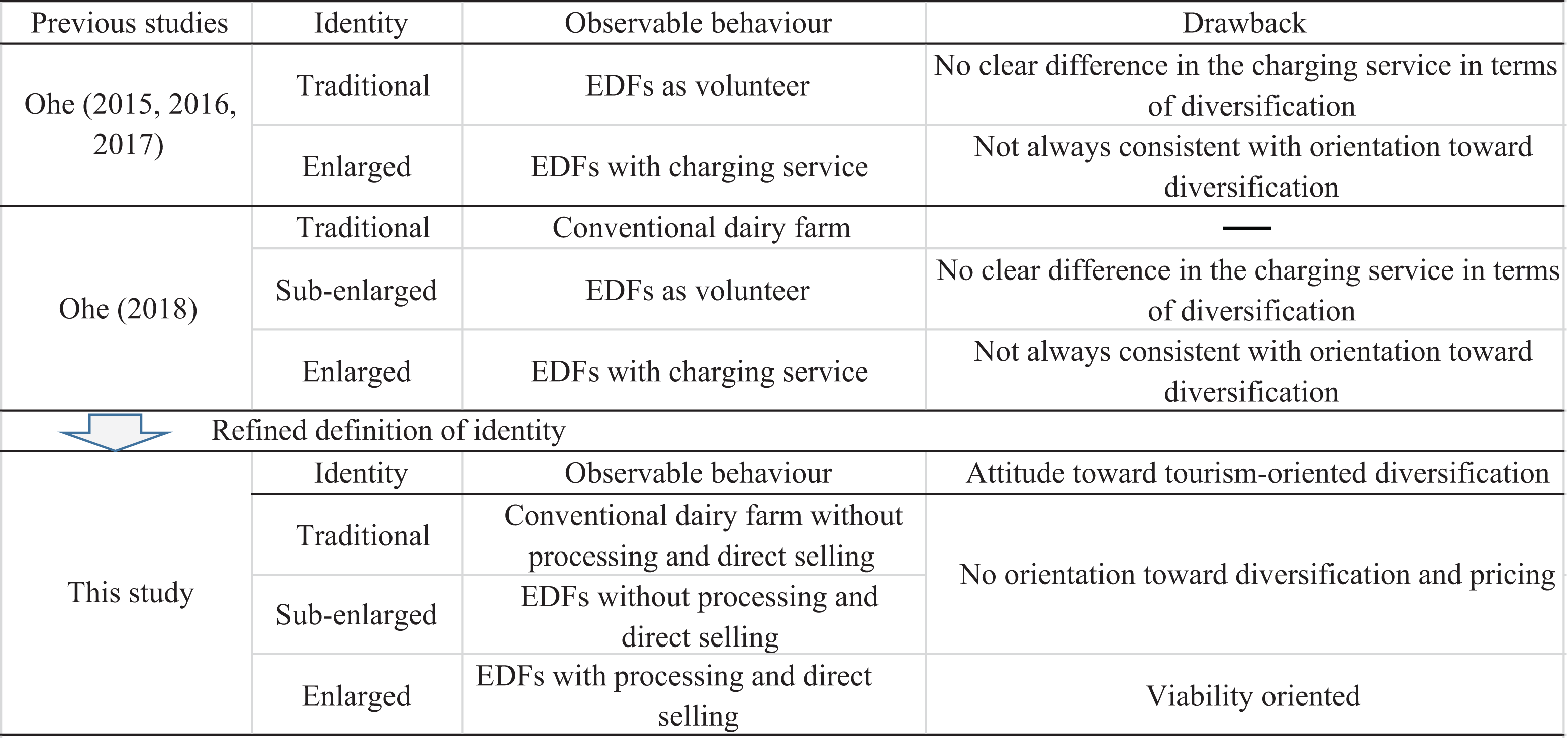
Refined identity definition of dairy farmers from previous studies.
Third, the enlarged identity is held by those who operate EDFs with the intention of processing and direct selling as a business in addition to milk production. A new mindset is needed to acquire skills for processing and direct selling, which is different from traditional milk production skills. Thus, those who have this identity have two sectors to maximize: milk production and diversified goods/services and have the largest domain of farm activity among the three types. It is safe to say that it is necessary to form an appropriate identity for the development of farm diversification (Ohe, 2018). In this case, educational tourism services and direct selling of processed dairy products are considered as a set of tourism-oriented diversified activities. Consequently, it should be noted that those with this type of identity keep in mind markets and viability of tourism-oriented diversification, which supposedly reflects entrepreneurship most among the three types of identity.
There could be another case wherein a conventional dairy farmer conducts processing and direct selling but is not officially an EDF. Since this study only focusses on EDFs, those conventional farmers are not considered in this analysis to simplify the discussion.
The above consideration of identity of dairy farmers leads to an empirical hypothesis that those farmers with the enlarged identity attain higher managerial efficiency in total than those with the sub-enlarged one. A conceptual framework that explained this hypothesis is depicted in Figure 2. This framework is based on Ohe (2018) and revised with the two-identity case. This is because the author focusses on EDFs. Under the assumption of other conditions being constant, it is assumed that there are two types of curves that have different directions of slopes: right downward marginal benefit curves SB and right upward marginal cost curves MC. The optimal level of activity is determined where the two curves meet at point e. In the case of those farmers who have the sub-enlarged identity, the activity level is determined at es where SBs and MCs meet and the optimal activity level is oj at this point.
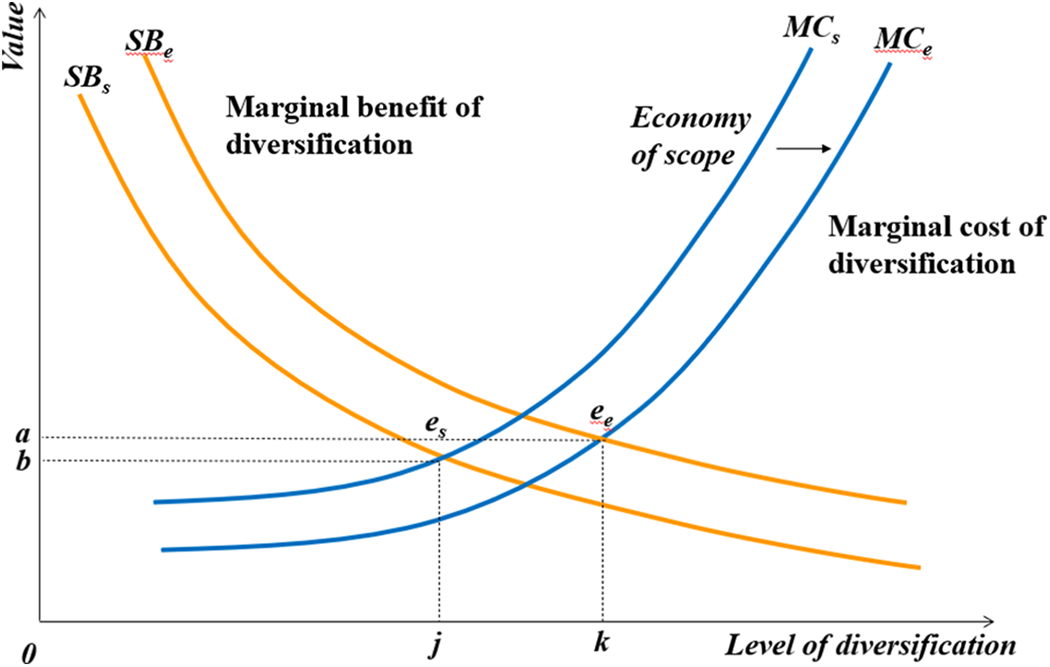
Identity and farm diversification among EDFs. EDF: educational dairy farm.
On the other hand, in the case of the enlarged identity, what makes it different from the sub-enlarged case is that both supply and demand shifts occur, which are illustrated as from SBs to SBe for demand and from MCs to MCe for supply. The supply side shift is recognized as marginal cost reduction due to the enhancement of managerial capability generated by the formation of an appropriate identity for diversification, which makes it possible to realize the economy of scope and better farm resource management by reducing slacks of farm resources. In the case of the sub-enlarged identity, the framing effect hampers those farmers from wanting to use these slacks for diversification. This is not an issue of managerial strategy but that of a subconscious fixed idea before the conscious strategy. The demand upward shift is created by the marketing effort for processed products and farm experience services. This is probably because those having the wider perspective on farm-resource management learned from the open network, which leads to sharing experiences and goals, and eventually understanding new social needs and the creation of tourism services in the farmyard. Thus, the demand creation and the economy of scope between activities result in more efficient resource management of the entire farm. Consequently, the meeting point goes rightward to point ee and the activity level increases to ok. Further, the activity level increases jk (=ok-oj) from the sub-enlarged case, which demonstrates that those with the enlarged identity practice more efficient farm management than the others. Especially, it should be noted that social learning based on the open network of EDFs works as a nudge on unlocking the framing effect and enabling the formation of the enlarged identity. That identity promotes diversification based on efficient farm resource management. Another point from this consideration is that the occupational identity is likely to be formed through the farm activity as well.
That is the conceptual framework and empirical hypothesis. The empirical question is to investigate how managerial efficiency differs between those with different identities using DEA models.
Data
The author obtained information on the milk production of each EDF from the Kanto Dairy Cooperative and Chiba Dairy Cooperatives from 2006 to 2016 and asked their cooperation in conducting a farm survey. From the Japan Dairy Council, the number of visitors to each EDF in the same period was obtained. The author conducted a survey of EDFs from January to March in 2017 because dairy farmers are not very tied up in winter. All EDFs in Chiba and one EDF in Saitama were listed to receive this on-farm survey. Nevertheless, three farms refused to disclose their financial report and one farm provided only a partial report; one highly diversified farm and two nondiversified farms. The reasons for refusal would be too good or too bad farm financial conditions or simply a highly privacy-conscious attitude surmised from the interview results. As a result, 11 farms agreed to provide financial reports, and some provided reports for multiple years. In total, 27 samples as unbalanced panel data were obtained as shown in Table 1 from the booking years of 2008 to 2016. Table 1 also shows the list of decision-making units (DMUs). There was not any technological change in these farms during this period. Due to the panel data, revenues and costs were deflated to obtain real values. For the deflators, we used the Index Numbers of Commodity Prices in Agriculture (2015=100) for revenues and Index Numbers of Materials for Agricultural Production (2015=100) for costs. One thing we had to consider was that every farm had a different book-closing month, for example, March, September, or December. When March is the closing month, for example, the fiscal year of that farm goes from April to March of the next year, which means that their fiscal year contains two periods corresponding to the indices for deflation because the indices are all historical-year-based. Thus, we calculated weighted indices by the number of months in respective years. For DEA model estimations, we compared the case using the weighted indices with the results of two other cases: the case using nominal values and the case using corresponding normal indices of the fiscal year of each farm.
Years of obtained financial data among surveyed EDFs.
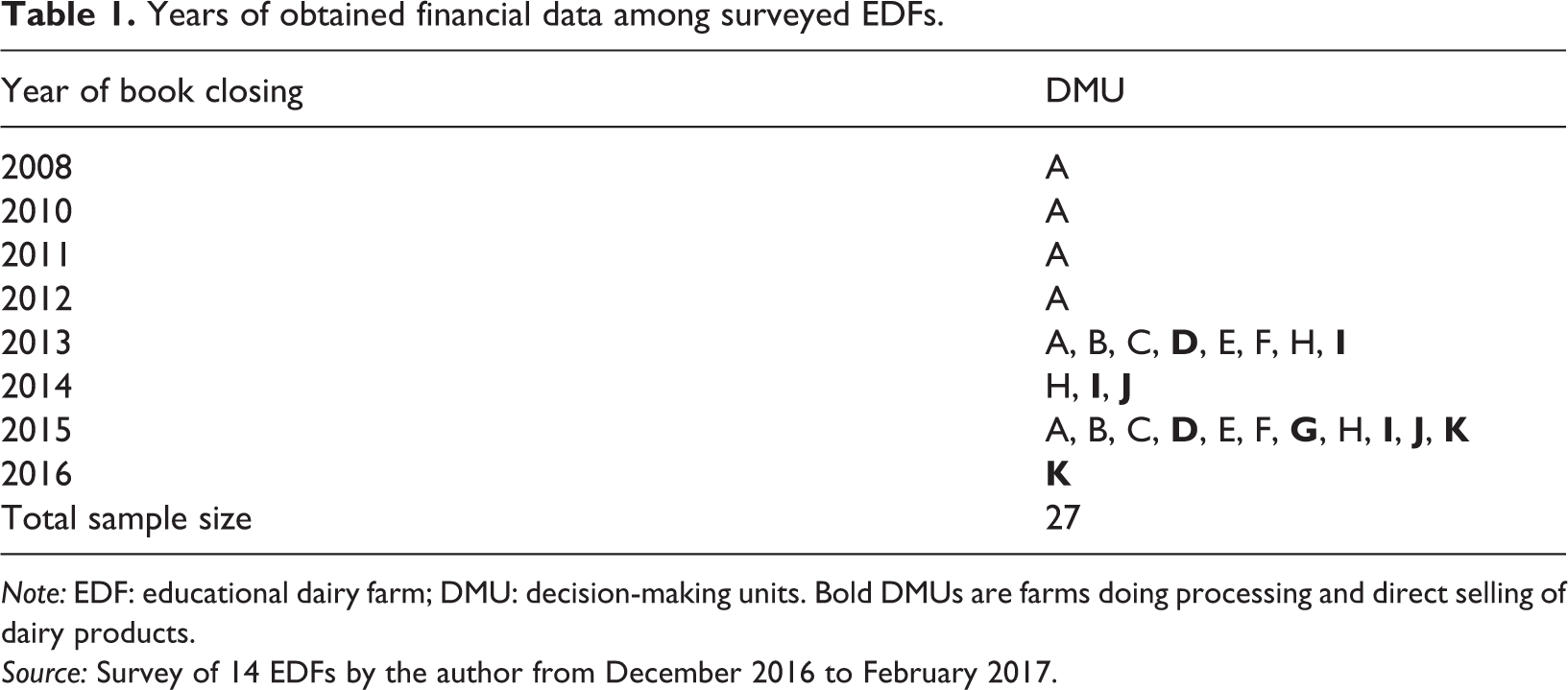
Note: EDF: educational dairy farm; DMU: decision-making units. Bold DMUs are farms doing processing and direct selling of dairy products.
Source: Survey of 14 EDFs by the author from December 2016 to February 2017.
Outline of dairy production in Japan and profiles of surveyed EDFs
Dairy production in Japan has been diminishing in terms of amounts shipped due to ageing of farmers and the decreasing number of dairy farms (Table 2). Region-wise, the decrease in production in regions other than Hokkaido was covered by the increase in production in Hokkaido, the northern island where agriculture is the main industry. Production in Hokkaido exceeded that of all other regions together. Nevertheless, since production in Hokkaido became flat, the national total production continues to diminish due to the rapid decrease in the number of dairy farms in this country. Then, looking at the Kanto region, which includes Yamanashi and Shizuoka prefectures, although Table 2 shows trends of decreasing production the same as that with national production, production by EDFs in this region increased. Production by surveyed EDFs also increased. Thus, we can say that EDFs are dairy farms that have higher productivity in milk production than the average.
Trends in milk production in Japan and by surveyed EDFs (2006–2016) (Unit: t).
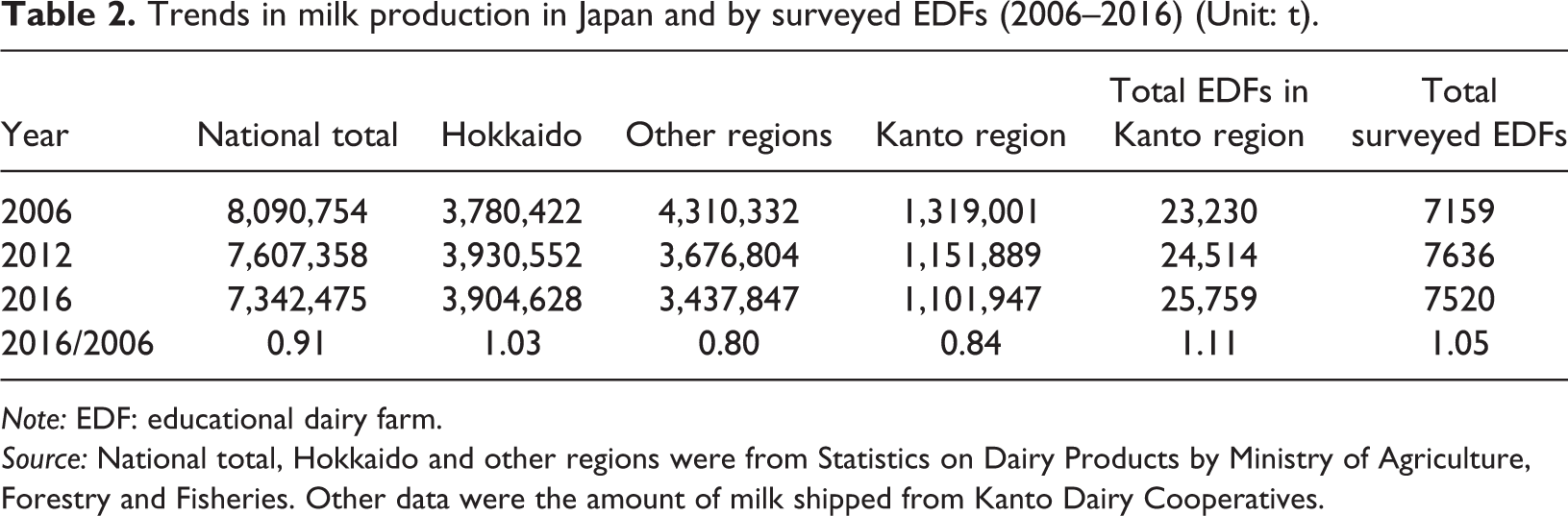
Note: EDF: educational dairy farm.
Source: National total, Hokkaido and other regions were from Statistics on Dairy Products by Ministry of Agriculture, Forestry and Fisheries. Other data were the amount of milk shipped from Kanto Dairy Cooperatives.
Turning to the surveyed EDFs, Table 3 shows the profiles of these farms. The average age of operators was 49 years, which is relatively young. The farms have 54 milk cows and 8.8 ha of land in feed production on average. The number of milk cows ranged widely from a minimum of 30 to a maximum of 100. As stated above, milk production has increased. To investigate this trend further, Figure 3 contrasts production trends between two groups: one that processes and direct sells milk and the other that does not. As shown in Figure 3, those not processing and direct selling increased production while among those processing and direct selling there was a decreasing trend in recent years.
Outline of surveyed EDFs.
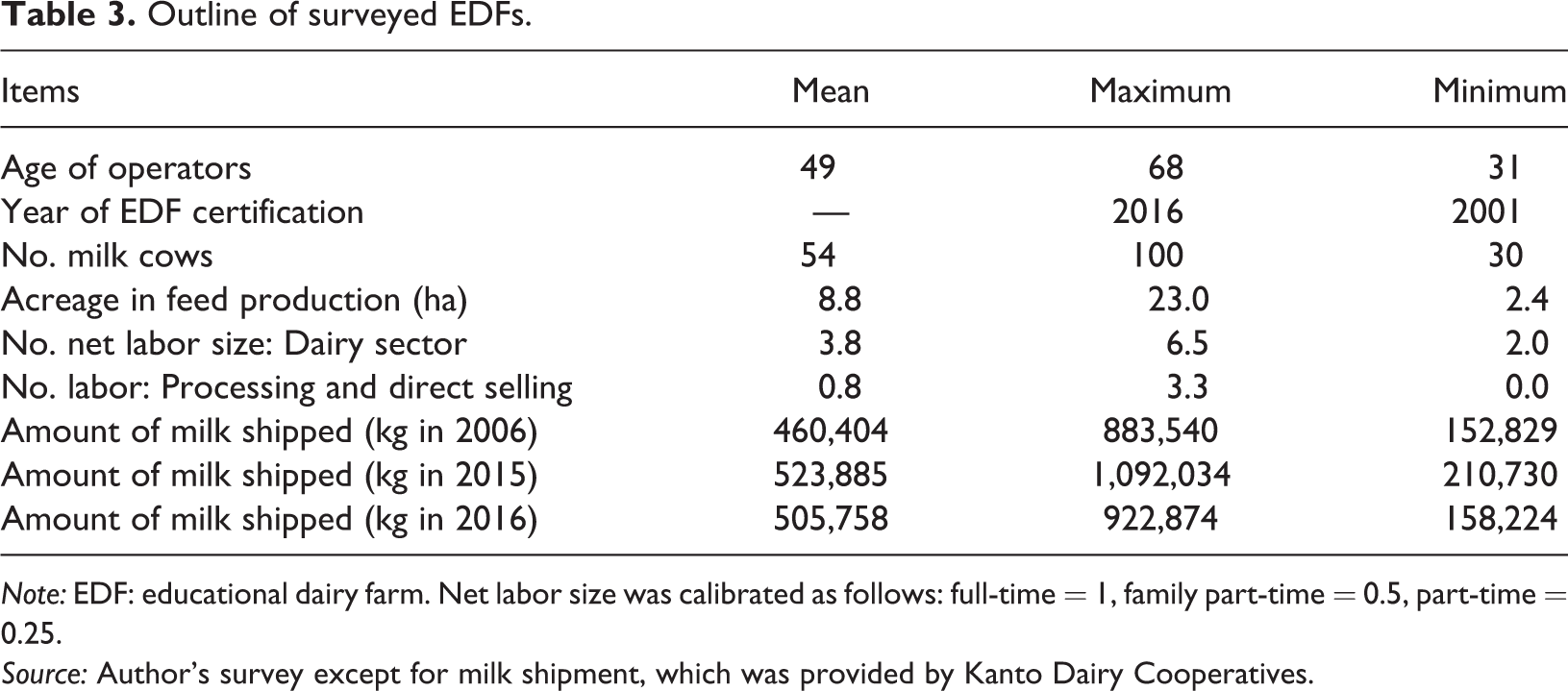
Note: EDF: educational dairy farm. Net labor size was calibrated as follows: full-time = 1, family part-time = 0.5, part-time = 0.25.
Source: Author’s survey except for milk shipment, which was provided by Kanto Dairy Cooperatives.
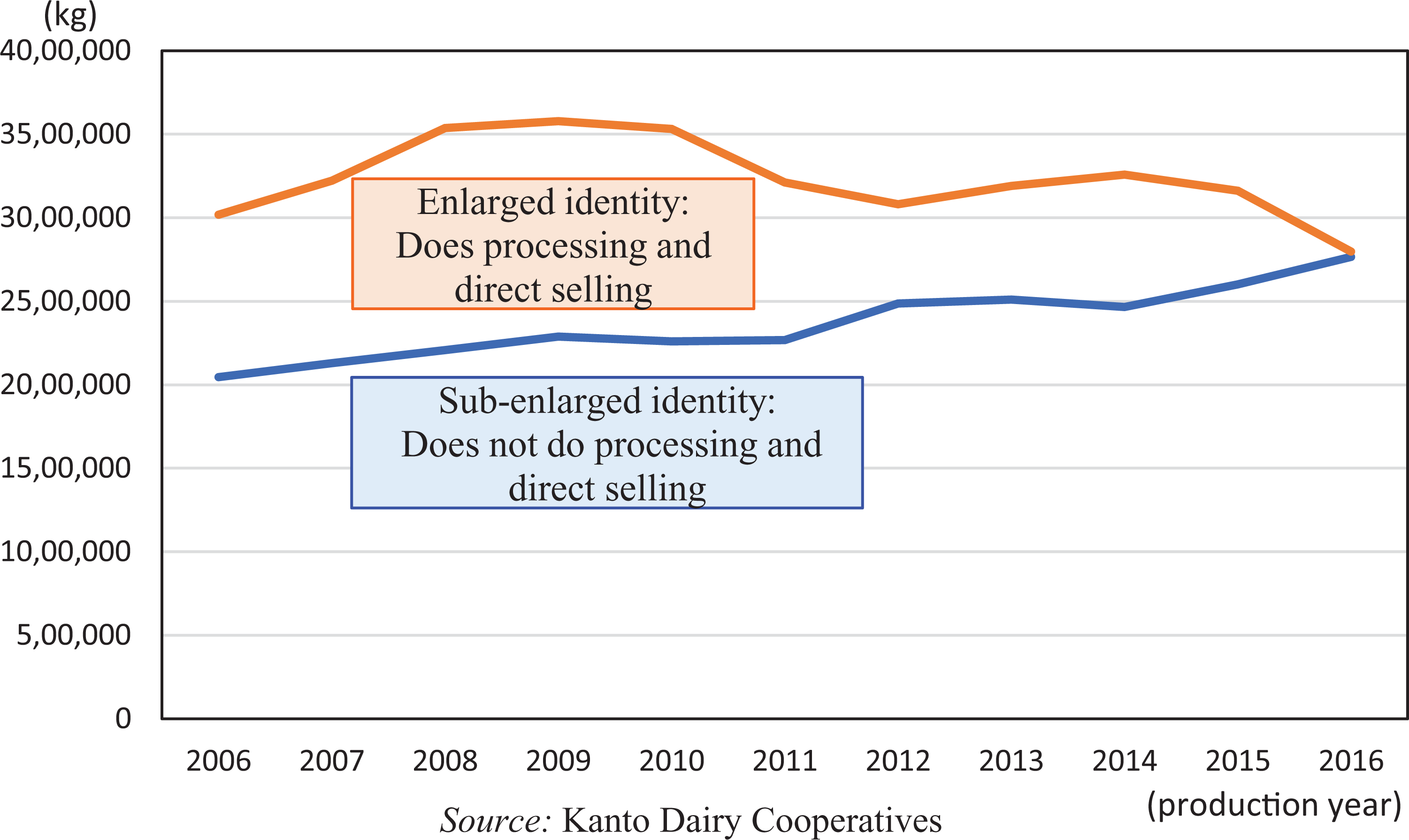
Changes in amount of milk shipped by study.
Consequently, the gap between the two groups narrowed. This is farm behavior that contrasts with what has been conventionally understood as farm-size enlargement behavior. In the author’s interview, a surveyed farmer replied that he shifted from the milk production sector to put more focus on the higher value-added sector, that is, processing and direct selling of milk and milk products. This behavior is considered to be reflected by the trend in the processing and direct selling group in that they reduced fresh milk shipments to raise profitability by diversifying. In short, those who perform processing and direct selling are intensive-oriented rather than oriented to extensively enlarging farm size.
Further, the activity of farms processing and direct selling was statistically compared with those not engaged in these activities (Table 4). Differences that were found to be statistically significant were the format of stall barns, net labor, size, and farm incorporation. Net labor size was calibrated by giving full-time family labor = 1.0, family part-time family labor = 0.5, and hired part-time labor = 0.25. Specifically, a lower percentage of farms that had a stanchion stall barn were among the processing and direct selling group than in those in the other group. More free stall barns and even milking robots were introduced into the farms belonging to the processing and direct selling group. This is because such farms need intensive labor input to perform these activities. To cope with this tight labor demand, they adopted labor saving technology in fresh milk production such as adoption of free stalls or milking robots. Attaining efficient labor input was needed more in this group.
From these differences described above, we can say that those farms engaging in processing and direct selling activities could be supposed to conduct better farm-resource management. Thus, those farms can attract more visitors to their farmyard. Actually, although the average number of visitors differed between the two groups, the significance level was not high due to large variations in visitor numbers among farms.
Comparison of attributes of EDFs whether or not processing and direct selling.
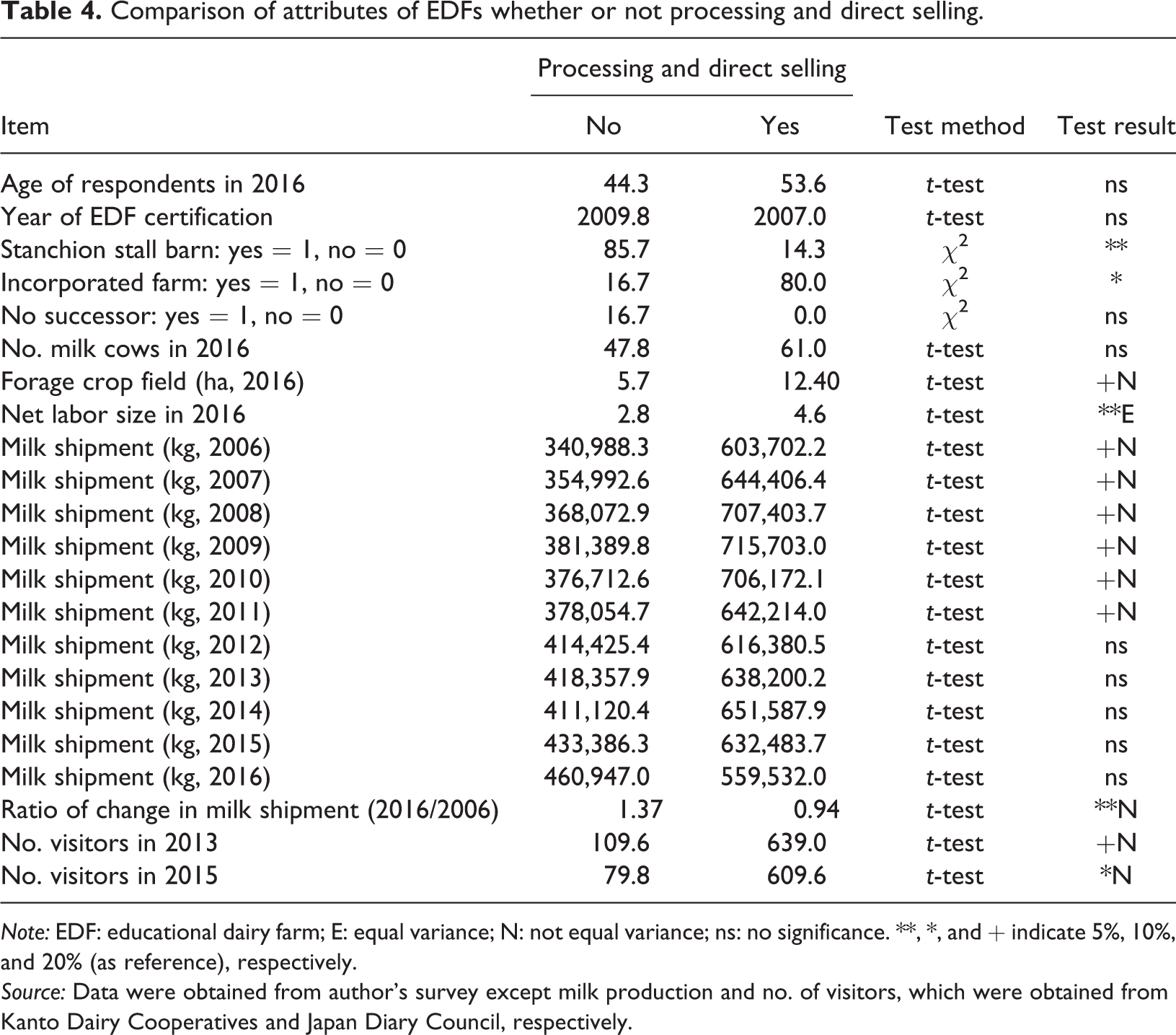
Note: EDF: educational dairy farm; E: equal variance; N: not equal variance; ns: no significance. **, *, and + indicate 5%, 10%, and 20% (as reference), respectively.
Source: Data were obtained from author’s survey except milk production and no. of visitors, which were obtained from Kanto Dairy Cooperatives and Japan Diary Council, respectively.
Table 5 shows differences between farms engaged and not engaged in processing and direct selling in revenue and costs. First, statistical differences were found in total revenue from diversification and total revenue. With respect to total revenue, the difference between the two groups was almost double. In comparison, the difference in revenue from fresh milk production between the two groups was 1.5 times, and the difference in the total revenue widened due to revenue from diversified activity. In fact, the share of revenue from fresh milk production in total revenue was significantly lower, about two-thirds, among those processing and direct selling than among those who did not while revenue from diversification reached 20% (5% and 10% significance levels, respectively).
Comparison of EDF attributes (t-test).
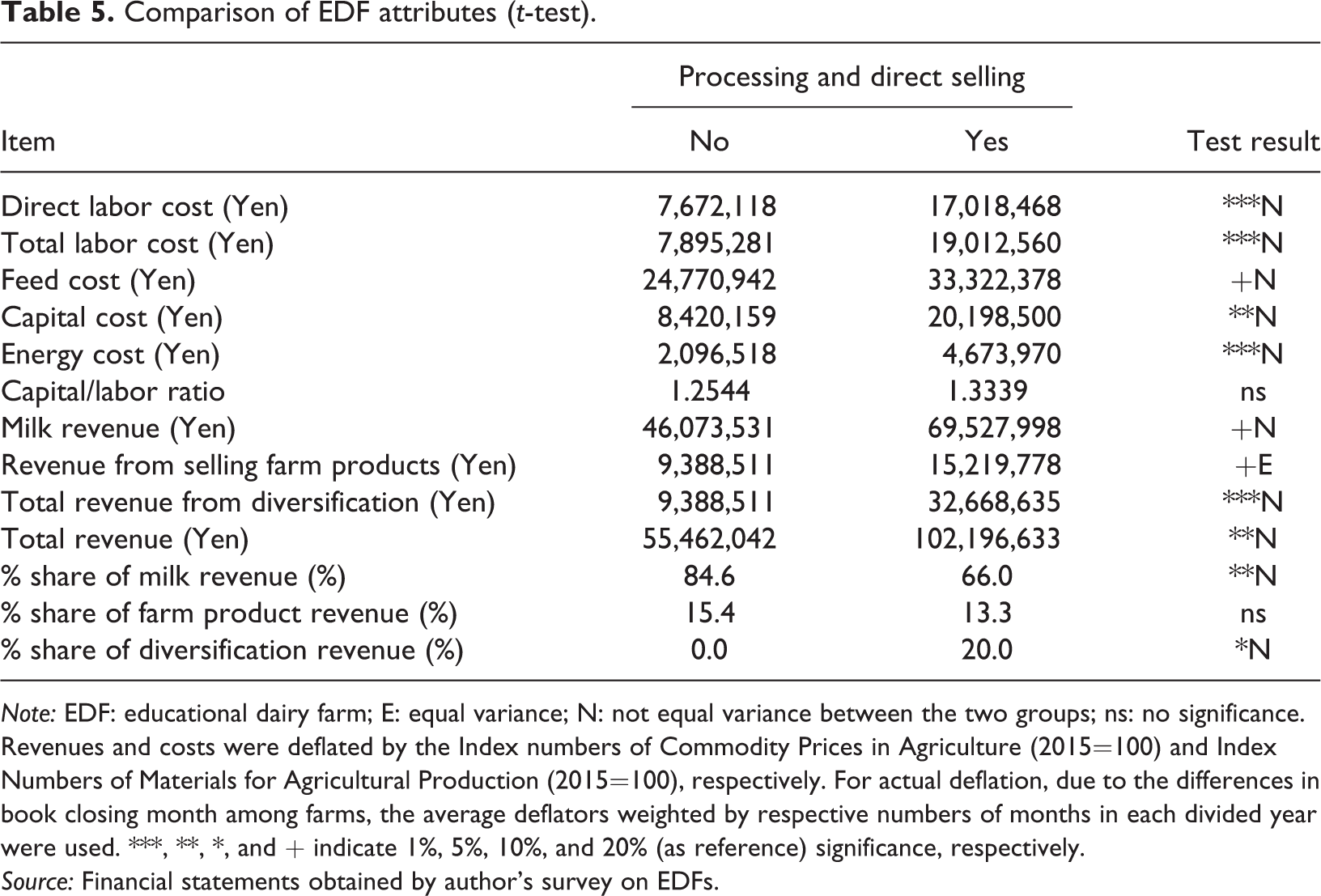
Note: EDF: educational dairy farm; E: equal variance; N: not equal variance between the two groups; ns: no significance. Revenues and costs were deflated by the Index numbers of Commodity Prices in Agriculture (2015=100) and Index Numbers of Materials for Agricultural Production (2015=100), respectively. For actual deflation, due to the differences in book closing month among farms, the average deflators weighted by respective numbers of months in each divided year were used. ***, **, *, and + indicate 1%, 5%, 10%, and 20% (as reference) significance, respectively.
Source: Financial statements obtained by author’s survey on EDFs.
On the cost side, there was not a statistically significant difference in feed cost. Nevertheless, as expected, labor costs for the processing and direct selling group were significantly different from the group that did not process and directly sell. Specifically, both direct labor cost and total labor cost were more than double for the group that engaged in processing and direct selling (1% and 5% significance). Further, capital costs and fuel/energy costs were almost double in that group (1% and 5%). These differences clearly indicate that processing and direct selling activity requires capital investments and intensive labor input, which is consistent with that revealed in the interviews. The ratio between labor and capital costs did not differ, which means that the capital intensity of labor did not differ between the two groups. In this sense, processing and direct selling activity are not capital intensive compared with conventional fresh milk production.
To summarize, the processing and direct selling group had twice the cost and revenue of the group without these activities. Therefore, since we cannot judge which group of farms is more efficient at this stage, it is necessary to employ a DEA framework to evaluate this issue in detail empirically.
DEA model: Theoretical background
The DEA model is a nonparametric method that does not need any assumption of sample distribution. Therefore, it has the advantage that allows estimation with small samples, not like regression analysis. For a case with tight data constraints such as this study, its application is a good example of taking advantage of that strength. There are two types of basic DEA models: the CCR (Charnes–Cooper–Rhodes) model with constant returns to scale and the BCC (Banker–Charnes–Cooper) model with variable returns to scale (Cooper et al., 2007). Although these models have been widely applied to empirical analyses, they have the drawback that the calculation of relative efficiency in based on both proportional input contraction and output expansion, which are termed as radial models. To overcome this drawback, nonradial models were developed and one is the SBM model, which was introduced by Tone (2001). The feature of this model is to consider the slacks, that is, unutilized resources, and evaluate the efficiency of managerial behavior. Unutilized resources can be generated in either inputs or outputs; excess inputs or shortage of outputs. In this respect, the SBM model is well adaptable to the reality of farm diversification activity, which is an advantage over the radial models (Ohe, 2017). In contrast, if no slack is expected, there is no rationale to employ SBM models.
The SBM model introduced by Tone (2001) is as follows. The production technology T assumes that outputs
Then production technology T can be defined by:

The program that calculates the efficiency scores is
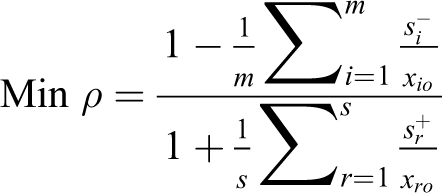
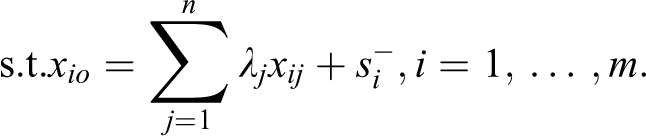
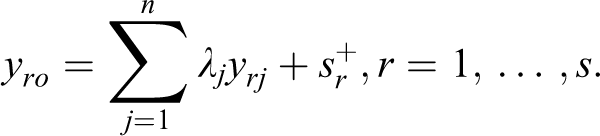



where the slacks in input and output are respectively denoted by
In the DEA framework, CCR and BCC models have been widely applied in the empirical literature on tourism and, during the last two decades, comprehensive literature reviews have been available from different contributors (Assaf et al., 2012, Assaf and Tsionas, 2015; Barros, 2005) and are devoted to these models. SBM is clearly used less and no literature review of SBM is available for applied tourism research, at least to the author’s knowledge. Furthermore, whereas the DEA advantages of the CCR and BCC are clearly established, the advantages of the use of SBM are mixed because researchers that use it may discuss its advantages from different viewpoints. Another benefit of the present contribution is to provide and discuss a literature review devoted to the use of SBM in empirical research on tourism.
Table 6 presents an overview of the contributions using SBM in the tourism sector and its examination prompts several comments. First, three studies used only 1 unit, that is, year, to indicate the time period. Second, only one case conducted both SBM and super efficiency DEA estimations (Ashrafi et al., 2013). Third, six of the seven contributions were published during the last 5 years, which coincides with the diffusion of empirical tourism research. Indeed, the seminal contribution of SBM by Tone (2001) is relatively recent in contrast to those of Charnes et al. (1978) and Banker et al. (1984).
Overview of the contributions using SBM in tourism sector.
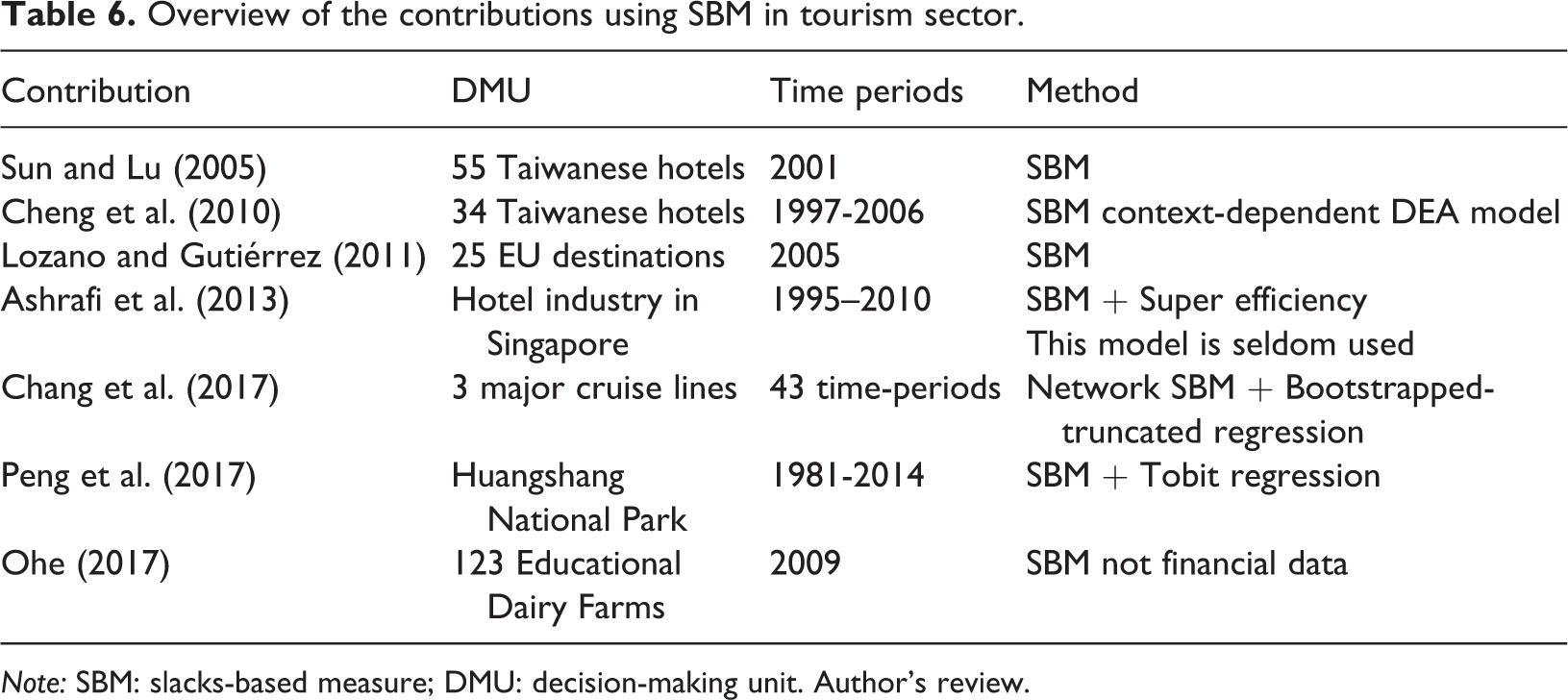
Note: SBM: slacks-based measure; DMU: decision-making unit. Author’s review.
Actually, the SBM model has an objective function that minimizes slacks. The aim of this article is to evaluate diversification, which needs to effectively utilize farm resources, and we assume that rural tourism is a behavior that internalizes multifunctionality, which exerts positive externalities to society as a joint product of agriculture. From this characteristic, rural tourism at the private optimal level tends to be undersupplied from a socially optimal level because of the existence of positive externality (Ohe, 2020). For this reason, both from theoretical and empirical perspectives, the SBM model is an appropriate methodology to evaluate diversification.
In conventional DEA models, the efficiency score does not exceed unity taking it from zero to unity. The most efficient units are all on the frontier and have a unity score, so that it is not possible to compare efficiency further among these most efficient units. To counter this constraint, the Super DEA model was developed, which enables the comparison of units that have an efficiency score of over unity. This is also a nonradial model.
Thus, in this study, the Bilateral SBM model and Super SBM model are employed to obtain robust results. In the super SBM model, the efficiency scores are measured from whole samples rather than from a two-group comparison.
Empirical analysis with the DEA model
Bilateral SBM model
Specifically, firstly, two kinds of models were considered to compare the efficiency between those that do and do not engage in processing and direct selling; the Bilateral SBM model assumed constant returns to scale (CRS), Bilateral SBM_C, and the other model assumed variable returns to scale (VRS), Bilateral SBM_V. The measured efficiency score and rank of the two groups were evaluated by nonparametric tests, respectively. There is another way to perform nonparametric tests on the differences between CRS and VRS models (Bogetoft and Otto, 2011). Firstly, this study used the SBM model to compare the results with Ohe (2017), which used the same test for the SBM model with a different data set. Secondly, the Super SBM model with CRS, Super SBM_C, and the other model with VRS, Super SBM_V, were used to evaluate efficiency that could not be clarified by the first bilateral SBM models. The Bilateral SBM models are all output-oriented because farmers normally try to maximize their outputs. For cross-validation, the researcher employs non-oriented Super SBM models and compares with the results of the SBM models. A non-oriented model enables to consider both input and output slacks, so that it is possible to verify the first SBM-model results from a wider perspective.
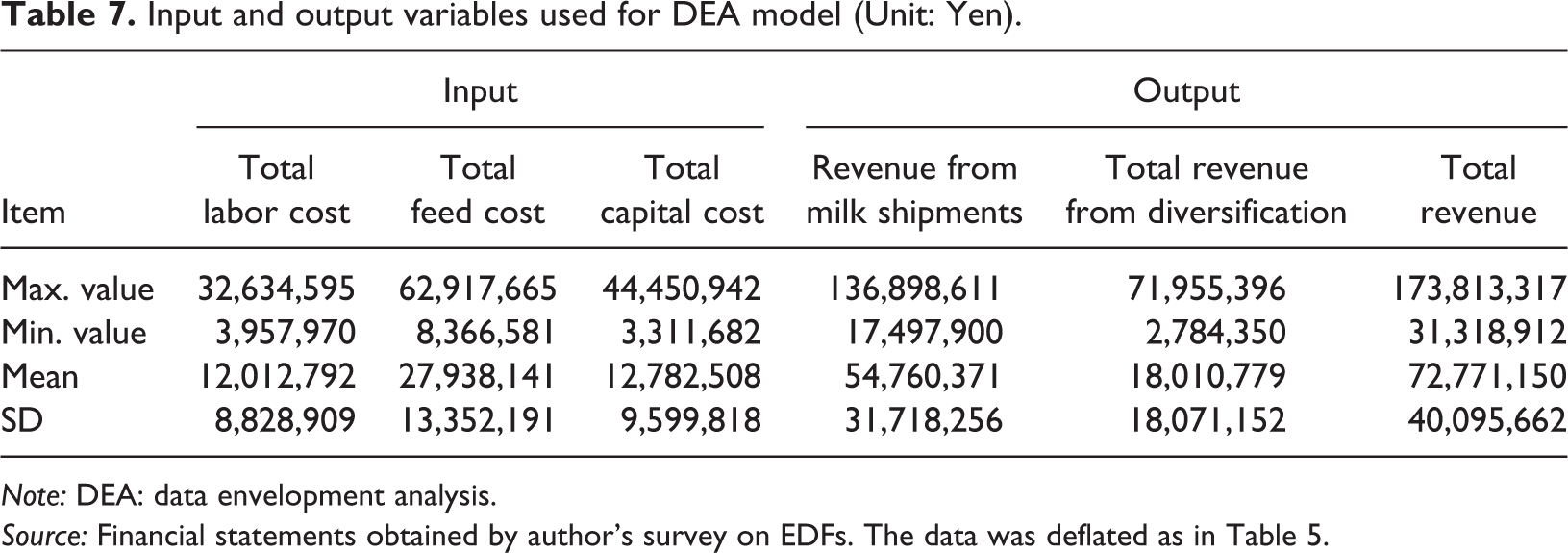
The variables commonly used for the model estimation are summarized in Table 7. The input variables were labor cost, feed cost as the highest variable cost, and capital cost as the fixed cost, and were the three major basic costs and constituted the essential cost structure for dairy farm activity as indicated in Table 5. These three costs are orthodox cost variables for the quantitative evaluation of the input–output relationship (Ohe, 1990). With regard to output variables, three cases were considered to identify differences in efficiency and, if identified, where the differences come from. To be consistent with value terms in inputs, revenues are used as output variables, which followed Ohe (1990). The first case is to use the revenue from milk production, which is the largest revenue for dairy farmers. Dairy farmers normally ship their milk to local dairy cooperatives to which they belong. This case is a one output model with no consideration of diversification. The second case is total revenue from milk and diversified activities, which is used to determine whether there are any differences in efficiency when diversification is considered. Total revenue sums up milk revenue and revenue from diversified activities.
Input and output variables used for DEA model (Unit: Yen).
Note: DEA: data envelopment analysis.
Source: Financial statements obtained by author’s survey on EDFs. The data was deflated as in Table 5.
The third case has two output variables, that is, revenue from milk production and total revenue from diversification. This is the most realistic case by taking into account two kinds of revenues. Looking back to Figure 2, the researcher tried to determine whether those farms with operators having the enlarged identity are located at point ee under the different outputs in the farm. If the two outputs case indicates differences in efficiency between the two groups, the efficiency issue should be dealt with as farm management as a whole rather than as one sector of farm production.
Results of DEA model estimation
Bilateral SBM model
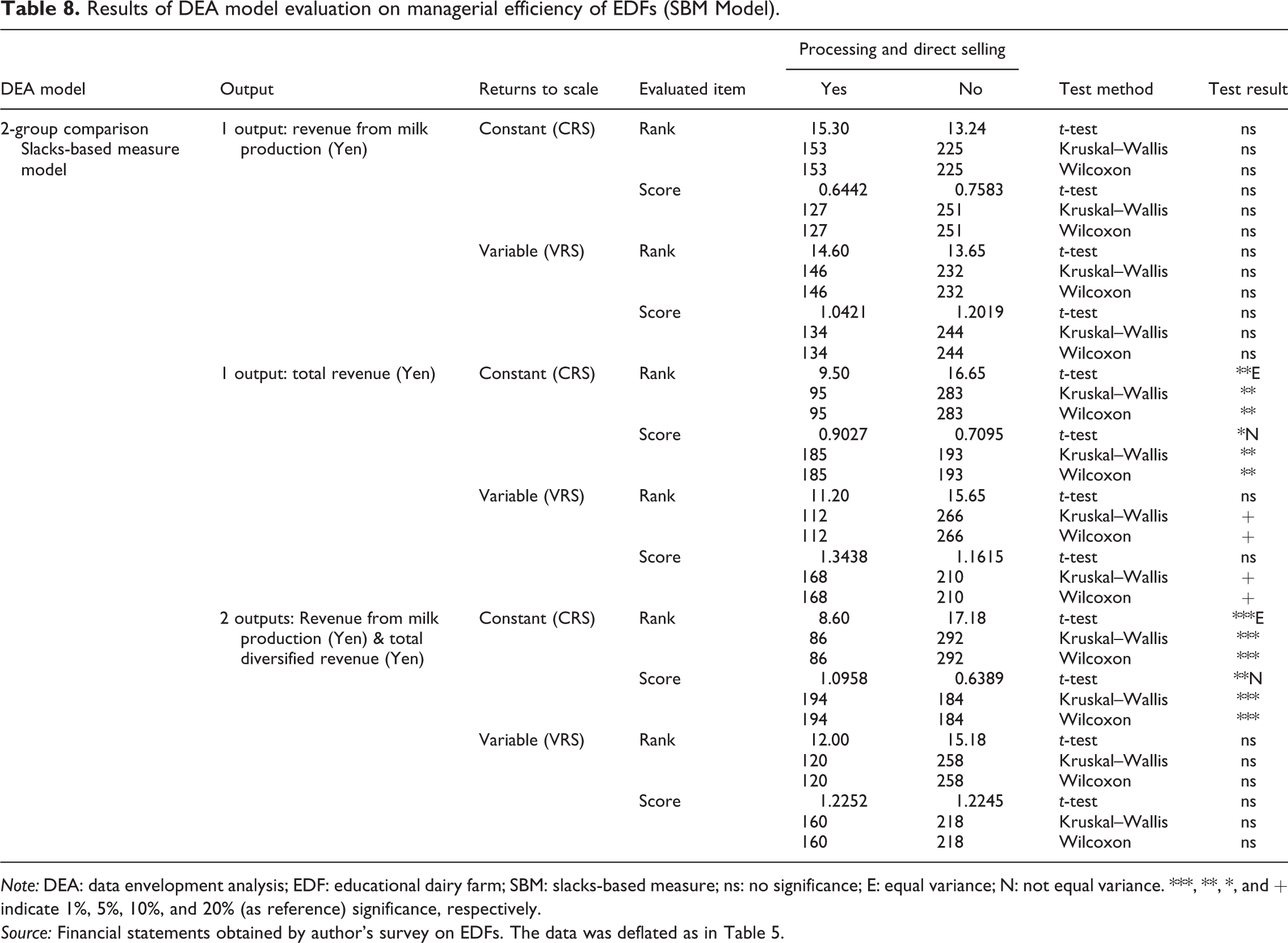
Table 8 shows the results of the Bilateral SBM model estimation and the efficiency scores and ranks. There was no significant difference in results from the other two cases: one using nominal financial data and the other using normal indices for deflators. So, only the results of the weighted deflator case are summarized in Table 8. Now let us look at the results. Firstly, there was no statistically significant difference in efficiency between those processing and direct selling and those not engaged in those activities in the case of one output, that is, the milk revenue case, which means that efficiency in milk production was not related to identity. This result was different from Ohe (2016) by the estimation result of a stochastic frontier production function. That result indicated that those who charge for educational experience services had lower efficiency in milk production than those who do not among EDFs. Nevertheless, milk production in physical terms and real labor units, feed production acreage, and the number of milk cows were used as input variables that are different from variables in strict monetary terms used in this article. In this sense, we should be careful when comparing the results with those of Ohe (2016).
Results of DEA model evaluation on managerial efficiency of EDFs (SBM Model).
Note: DEA: data envelopment analysis; EDF: educational dairy farm; SBM: slacks-based measure; ns: no significance; E: equal variance; N: not equal variance. ***, **, *, and + indicate 1%, 5%, 10%, and 20% (as reference) significance, respectively.
Source: Financial statements obtained by author’s survey on EDFs. The data was deflated as in Table 5.
Secondly, in looking at the case of total revenue as the output, the results are clearly different between the CRS and VRS models. The efficiency scores and ranks showed no statistical significance with less than the 10% level in the model of VRS. In contrast, in the CRS model, significant differences were observed in both efficiency scores and ranks (5% significance). Thus, those who have the enlarged identity conducting processing and direct selling realized higher efficiency in their farm-resource management. Nevertheless, this model is based on the assumption of a single output although actually two outputs on farms exist, which is the third model that we are going to look at below.
Thirdly, what was obtained from the results are common with the second one output model with higher significance levels. No statistical significance was observed in the VRS model, which is consistent throughout the three models with different output variables. Hence, we can say that it is a robust result. On the other hand, the CRS model shows statistically significant differences in both the efficiency score and rank (1% level). To look at details, there was a larger difference in rank sum of the two outputs model between the two groups than that of the second one output model. This means that the gap in efficiency between the two groups widens in the two outputs model. With respect to the efficiency score, the t-test result shows that the differences in average efficiency scores between the two groups are larger than with the second one output model. These facts indicate that two output models most effectively reflect reality. This result is consistent with Ohe (2017), who evaluated managerial efficiency of EDFs by the two output DEA SBM models with a different data set, that is, milk production in physical terms and simulated revenue from the educational service, but not financial data as mentioned earlier.
When a DEA model is employed, normally benchmarking is done based on the DMU with the highest efficiency score. Nevertheless, the study did not aim to find the single efficiency target, so that the author does not undertake ordinary benchmarking in this case. The reason is that the primary concern of this study is to compare the difference in efficiency between the two groups having different identities or mindsets. Thus, identity groups matter. In this respect, the comparison of statistical efficiency can be considered as a proxy for benchmarking. In this bilateral model, the score of the sub-enlarged identity group was measured against the enlarged identity group. From the result of the most realistic and statistically significant two outputs model with CRS in Table 8, the average efficiency of the sub-enlarged identity group is less than two-thirds that of the enlarged identity group (0.6389). This difference demonstrates that there is still much room for the improvement of farm resource management in conventional dairy farms. In this respect, it should also be noted that we can learn from the experience of those with higher efficiency to improve overall dairy farm resource management.
Super SBM model
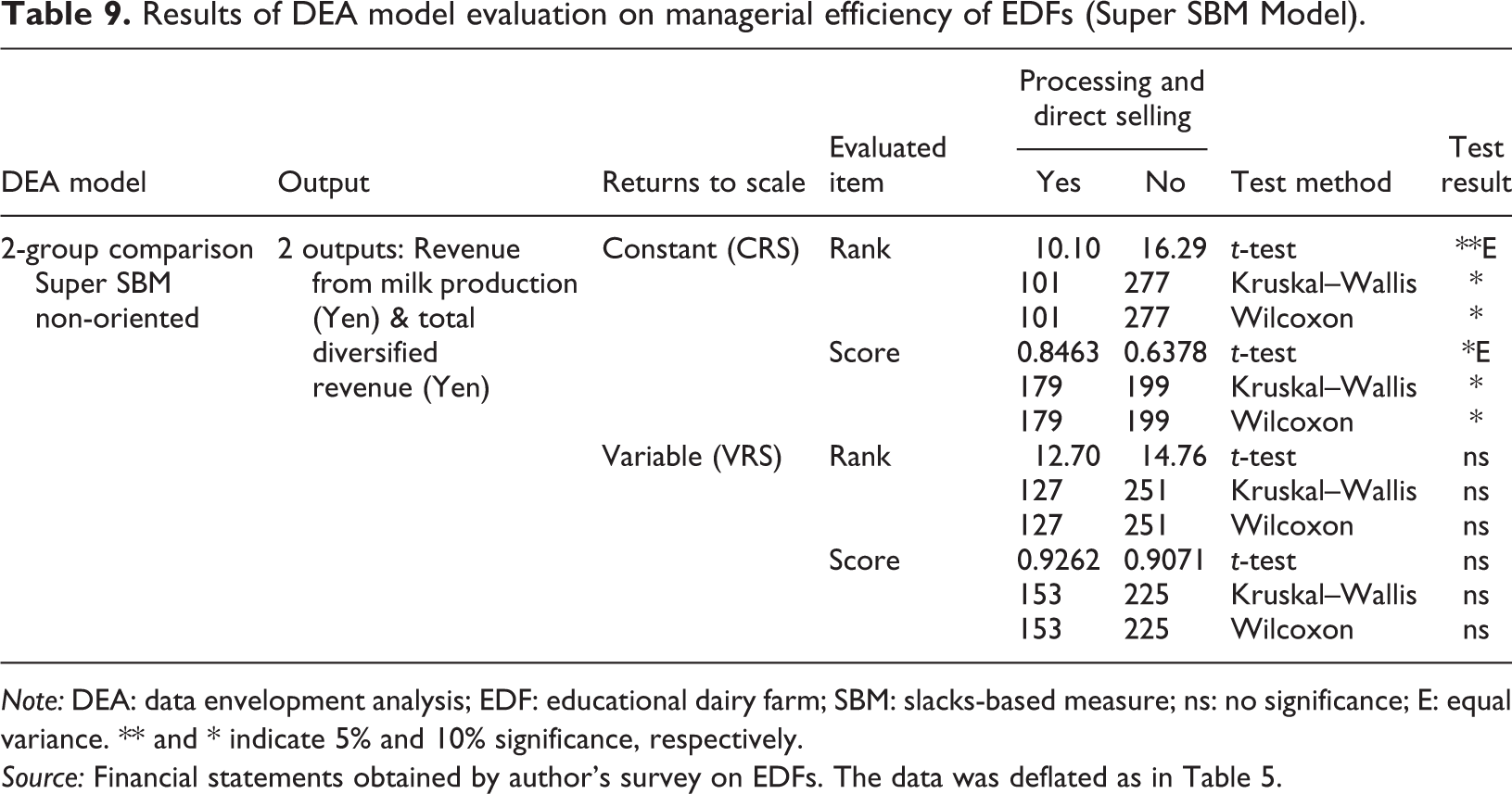
The estimation results of the Super SBM model are shown in Table 9. Again, there were no obvious differences among the cases with different deflation treatments. The results are almost consistent with the bilateral SBM models, although statistical significance was lower than with the bilateral SBM models (5% or 10% significance).
Results of DEA model evaluation on managerial efficiency of EDFs (Super SBM Model).
Note: DEA: data envelopment analysis; EDF: educational dairy farm; SBM: slacks-based measure; ns: no significance; E: equal variance. ** and * indicate 5% and 10% significance, respectively.
Source: Financial statements obtained by author’s survey on EDFs. The data was deflated as in Table 5.
Finally, to summarize the results, first, returns to scale were constant. Second, those who had the enlarged identity conducting processing and direct selling realized higher efficiency in their farm management than those who did not. Thus, the two outputs model is effective for evaluation of the efficiency of dairy farms that conduct educational tourism. Third, on the other hand, it is also true that there is a wide variance in efficiency among those who conduct processing and direct selling.
Discussion
Let me discuss policy implications for the diversification of dairy farms that conduct educational tourism from the results of the DEA model estimation.
The significance of this study has two aspects in that diversified activity conducted by EDFs was investigated with the concept of occupational identity theoretically and with the SBM model empirically.
As to the theoretical contribution, this article characterized farmers’ identity into three types: the traditional identity, sub-enlarged identity, and enlarged identity based on the critical review of previous studies. From the framework that explains the relationship between efficiency and diversification, the author can point out that those who have the enlarged identity experienced both an upward shift of demand and marginal cost reduction by realizing efficient farm resource management. These two aspects both in the demand and supply sides are considered as sources of higher efficiency of farms operated by those who have the enlarged identity. It was also demonstrated that the concepts of behavioral economics are effective to explain at the subconscious level why those with different identities behave quite differently toward tourism-oriented diversification.
The author empirically evaluated the efficiency of farm management based on this conceptual framework with the employment of SBM models that enable users to be realistic in taking into account underutilized farm resources. The results revealed that those who have the enlarged identity who conduct processing and direct selling realized higher efficiency with the CRS than those who do not. Especially, the realistic two outputs model showed a statistically significant difference in efficiency between the two groups. From these empirical results, two derivative findings are obtained as described below.
First, the connection between farm size and efficiency was not confirmed. This fact indicates that the efficiency of a dairy farm and farm size are not related as far as diversification is considered. This result is consistent with the previous study on EDFs (Ohe, 2017).
Second, the theoretical framework and empirical results are consistent, which means that the issue of identity is an integral part of managerial behavior that raises the efficiency of diversified farm activity. Specifically, those operators who have the enlarged identity use managerial behavior to carry out efficient farm resource allocation for the main purpose of milk production and diversified activity, including the educational service. As mentioned in the literature review, this study conceptually and empirically verified the trilateral connection between occupational identity, tourism-oriented diversification and efficiency, which has never been clarified previously. Thus, this empirical result can be supporting evidence for the promotional policy design of tourism-oriented farm diversification.
So far, analyses of dairy farm management have been mainly focused on the farm structure for milk production and its efficiency. The study result here also indicates that, when a farmer tries to launch farm diversification especially toward tourism-related activity, if the existence of a different identity is supposed, the significance and potential for demand creation and diversification can be clarified. However, this tourism-oriented perspective has not been paid enough attention.
Consequently, capability building for demand creation and farm resource management become important issues for the promotion of dairy-farm diversification. For this purpose, identity formation should be included in the area of that capability building. To put it differently, to realize efficient farm resource allocation, the enlargement of the perspective of their domain of farm activity is a prerequisite condition for nurturing entrepreneurship. In this respect, the EDF activity that takes advantage of the EDF network across the country nurtures the enlargement of a farmer’s perspective that leads to the formation of the enlarged identity that suits and promotes diversified activity. Ohe (2018) pointed out the function of the social learning effect through this open network among EDFs. In this context of demand creation and efficient farm-resource management, it is safe to say that those with enlarged identity have an entrepreneurial identity.
Since this study focused on the EDFs located around the Tokyo Metropolitan area, that is, closer to consumers than those of other areas, all of these farmers are supposed to have better managerial skills than ordinary dairy farmers. Therefore, when compared with ordinary dairy farms, the efficiency gap found in this study will be wider. As far as the author’s findings are concerned, it should be noted that the existence of efficient diversified dairy farms conducting educational tourism presents basic evidence for the design of support measures toward tourism-oriented diversification of dairy farms and rural entrepreneurship in the future.
Conclusion
This study evaluated the efficiency of diversified dairy farm activity by focusing on EDFs around a Metropolitan area in Japan from financial data obtained by the author’s survey. To this purpose, two types of SBM models that consider slacks of farm resources were employed. The significance of occupational identity formation suitable for a diversified activity to realize efficient farm-resource management was revealed theoretically and empirically by incorporating the concept of behavioral economics, which takes into account the subconscious attitudes of farmers. Specific findings are as follows:
First, with output-oriented bilateral SBM and non-oriented Super SBM models, those who conducted processing and direct selling of milk products, that is, supposed to have the enlarged identity, realized higher efficiency in their farm-resource management with statistical significance than those who did not. These were robust observations by both models.
Second, it is necessary to enlarge a farmer’s identity for efficient farm diversification, especially tourism-related activity. Thus, it will be effective to support the smooth formation of the enlarged identity, which we can say is an entrepreneurial identity.
Third, a connection between farm size and efficiency was not observed when diversified activity was considered. In other words, diversification can be undertaken at any farm size, either small or large, because such diversity is natural for farms of any size.
Fourth, one way to mitigate an efficiency gap is social learning opportunities through EDF activity that enables farmers to share experiences and perspectives toward the evolution of farm management, as Ohe (2018) mentioned. This wide social capital formed among EDF farmers is considered to eventually lead to demand creation and improved farm resource management, which will nudge policy measures to change the current occupational identity into a more adaptable one.
To summarize, it is quite natural for EDFs to evolve toward farm diversification and efficient farm resource management. This point should be broadly recognized as an important effect of EDFs and building rural entrepreneurship in the long run. In this respect, tourism-related diversification should be explicitly placed in dairy farm policy.
Finally, this study had limitations. The study area was EDFs around a Metropolitan area; therefore, this framework should be tested on EDFs in other areas such as Hokkaido, a northern island where large-scale dairy farms exist, to determine whether a similar result can be confirmed. Thus, empirical evidence should be further accumulated since the framework is also applicable to other parts of the world. For this purpose, it is better to take into account the technical progress of SMB models for empirical application.
Footnotes
Acknowledgements
The author is grateful for the cooperation from the Japan Dairy Council, Kanto Dairy Cooperatives and Chiba Dairy Cooperatives, and EDFs that cooperated for the implementation of this study. The author is also grateful to constructive comments on the methodology from Professor Nicolas Peypoch, the University of Perpignan.
Declaration of conflicting interests
The author(s) declared no potential conflicts of interest with respect to the research, authorship, and/or publication of this article.
Funding
The author(s) disclosed receipt of the following financial support for the research, authorship, and/or publication of this article: This study was funded by the Japan Dairy Association (J-milk) and supported by the JSPS KAKENHI Grant Numbers JP18H03965 and JP20H04444.
