



Abstract
A growing body of research points to heterogeneity in the predictors of turnout and highlights the importance of longitudinal designs in exploring within-country variation as a remedy. Building on this perspective, the present study examines the determinants of district-level voter turnout in Turkey using a panel dataset covering all provinces across 18 general elections between 1950 and 2023. Leveraging the country’s unique variation in institutional and socioeconomic structure across time and space, results based on the Mundlak regression show that compulsory voting, socioeconomic development, and democratizing elections are associated with higher turnout, while political fragmentation and larger party systems are linked to lower turnout. Surprisingly, elections held under majoritarian systems experienced higher turnout than those under PR. Findings from additional analyses further suggest that higher levels of wasted votes, driven by the 10% national electoral threshold, may have dampened voter turnout in PR elections in the more recent decades, particularly in some districts. Overall, these findings suggest that voter turnout is a function of both local-level contextual factors and aggregate-level institutional features.
Introduction
Since the influential work by Powell (1982, 1986) and Jackman (1987), scholarly attention to the question of what shapes voter turnout at the aggregate-level has grown tremendously and led to a massive field of research with numerous studies published on various political contexts. The field has become sufficiently large that several comprehensive reviews and meta-analyses have been published in the past two decades to periodically update the state of the literature (e.g., Blais, 2006; Cancela and Geys, 2016; Frank and Martínez i Coma, 2023; Geys, 2006; Stockemer, 2017), which indicates the sustained interest in the subject and the importance attached to voter turnout. These meta-analyses synthesize published results and document the distribution of estimated effects across existing model specifications. Other contributions adopt data-driven approaches, such as Extreme Bounds Analysis (EBA), which systematically assess the robustness of turnout correlates across a wide range of alternative specifications (e.g., Frank and Martínez i Coma, 2023). Despite important methodological differences, both strands of research point to substantial heterogeneity in the correlates of voter turnout across political contexts, suggesting that context-specific analyses may be particularly informative. In his comprehensive review of the literature, Stockemer (2017) noted, for instance, that the determinants of turnout, which he argues is heavily context dependent, are more complex than previously thought. Similar inconsistencies in regard to the predictors of voter turnout across political contexts have also been documented in other reviews and meta-analyses (e.g., Blais, 2006; Cancela and Geys, 2016; Frank and Martínez i Coma, 2023).
Extant research has examined various factors as predictors of voter turnout at the aggregate-level, with the bulk of scholarly attention focusing on institutional (e.g., Endersby and Krieckhaus, 2008; Geys, 2006; Norris, 2004; Pierzgalski et al., 2025; Radcliff and Davis, 2000), socioeconomic (e.g., Geys, 2006; Steiner, 2010; Stockemer and Scruggs, 2012), and various contextual partisan factors (e.g., Fornos et al., 2004; Frank and Martínez i Coma, 2023; Çakır, 2022). Due to significant country-level heterogeneity in turnout determinants, especially in relation to institutional factors, Blais and Aarts (2006, p.186) point to the importance of longitudinal research that examines within-country variation. Citing similar reasons, Stockemer (2017, p.712) suggests that future research should be more context-specific, ideally exploring the conditions under which some of the oft-cited correlates of turnout are at play. Similarly, Birch (2016) points out that major institutional changes such as the introduction of compulsory voting often coincide with other structural changes that may influence voter turnout, and that these overlapping effects need to be accounted for through longitudinal research. In line with these views, the present study adopts a longitudinal approach to contribute to this debate by analyzing the relationship between some of the commonly used predictors formulated in the literature and district-level voter turnout in Turkey.
The case of Turkey provides unique opportunities to study voter turnout for a number of reasons. Most importantly, it offers exceptional within-country variation in institutional and contextual factors that are often only observable in large cross-national studies. Since the introduction of multiparty elections in the second half of the 1940s, Turkey has experienced several electoral system reforms, transitions between unicameralism and bicameralism, voluntary and compulsory voting, and dramatic changes in the party system. Two military coups significantly reshaped the political landscape by banning political parties and shaping the pool of political elites competing in elections. In addition to this unique variation over time, the country also displays substantial sociospatial variation in district-level party fragmentation, economic development, population distribution, and district magnitude across regions (Bulut and Yildirim, 2020), which offers a rich context for analyzing how contextual and institutional factors shape electoral participation.
Inspired by past research, I argue that voter turnout at the district-level is a function of both institutional and socioeconomic factors, as well as local and national-level partisan factors that help mobilize voters. My analysis is based on an original dataset of voter turnout from all electoral provinces observed across 18 electoral cycles between 1950 and 2023. The dataset includes detailed information on political institutions, government structures, socioeconomic development indices, and data on the characteristics of political elites representing individual districts. While results from a series of correlated random-effects models provide strong support for previously established relationships, new insights are provided regarding the role of electoral systems, political elites, and party system size. Specifically, results show that compulsory voting, socioeconomic development, and democratizing elections are associated with higher turnout, while political fragmentation, larger party systems, and low clarity of responsibility in the system are linked to lower turnout. Surprisingly, elections held under majoritarian systems (party bloc vote) experienced higher turnout than those under proportional representation system. Supporting the call for more longitudinal research within countries, these findings underscore that voter turnout is highly contingent on both local and national political contexts.
The article is structured as follows. I first review the literature on voter turnout at the aggregate-level, and derive my hypotheses based on past studies. I then introduce my dataset of voter turnout, and present my analysis based on panel models. I conclude with implications for future research.
Correlates of voter turnout
Background
Utilizing a comprehensive list of predictors of voter turnout across different political contexts, the literature on voter turnout at the aggregate level focuses on various systemic factors (Blais, 2006; Cancela and Geys, 2016). Much of the literature on aggregate level turnout examines the role of political institutions, from electoral systems, number of parties to compulsory voting (Stockemer, 2017). Almost all commonly used predictors of voter turnout, except for compulsory voting, have been shown to vary in their effects across countries and levels of government (e.g., national vs. local) (Blais and Aarts, 2006; Frank and Martínez i Coma, 2023), which presents a challenge for political scientists.
The lack of consensus over the set of factors that explains voter turnout has not diminished scholarly interest in the subject. On the contrary, it has sustained attention on the topic and strengthened the need to continuously re-examine commonly cited predictors across different political and institutional contexts (Frank and Martínez i Coma, 2023: p.630). Welcoming the diverse findings from the vast literature on voter turnout as a much needed development for scholarly debate, Stockemer (2017) suggests that future research should adopt a more context specific approach and engage in systematic comparisons to streamline the diverse findings. In a similar vein, expressing skepticism about the role of electoral systems in shaping voter turnout, Blais and Aarts (2006) point out that more longitudinal research is needed to strengthen our confidence in the role of institutions.
Building on past research, I formulate several formal hypotheses in the section that follows. While much of my theoretical discussion relies on previous scholarship based on established democracies, I also introduce context-specific perspectives from past research that might help explain turnout in other political contexts. Specifically, I focus on three clusters of factors that help explain voter turnout at the district-level: institutional, socioeconomic, and contextual partisan factors.
Theoretical expectations
One of the well-established findings in the literature is that compulsory voting increases voter turnout in all political settings (Frank and Martínez i Coma, 2023), though the size of its impact is not uniform across countries (Blais, 2006). The effect of compulsory voting likely varies across modes of enforcement; turnout may not increase substantially upon adopting compulsory voting in countries where electoral participation is not strictly enforced (Birch, 2016). In a comprehensive study utilizing data on 1421 democratic national elections from around the world, Kostelka et al. (2024) present evidence that the effect of compulsory voting is conditional on state capacity and its enforcement. Still, although compulsory voting does not uniformly impact individuals’ attitudes toward political participation (Singh, 2021), the literature shows that countries that adopted compulsory voting, on average, experienced higher turnout rates (Cancela and Geys, 2016; Stockemer, 2017). In the context of Turkey, voting is formally compulsory under Article 63 of the Electoral Law, and non-voters are liable for an administrative fine. However, there has been no strict enforcement mechanism in the country. 1 In light of this, I expect elections held under compulsory voting to have higher turnout rates, but the magnitude of this effect is likely to be weaker than in country contexts where compulsory voting is strictly enforced.
Turnout in elections held under compulsory voting is higher than those under voluntary voting.
Empirical research reminds us that political fragmentation and party system size may shape voter turnout in important ways (Blais, 2006; Geys, 2006; Wilford, 2017). Research on psychology of decision making convincingly shows that the explosion of options in life increases cognitive complexity of choice, which often leads to anxiety and dissatisfaction (Schwartz, 2015). In electoral contexts where a larger number of parties compete, voters may face greater informational demands, as the task of distinguishing among many competing options requires more cognitive effort and political knowledge (Blais and Dobrzynska, 1998; Brockington, 2004). The increased cost of information seeking may discourage less motivated or less politically sophisticated individuals from participating altogether. Furthermore, the literature also indicates that larger party systems, which often produce coalition governments, can lower political efficacy by reducing citizens’ sense that their participation meaningfully influences political decisions (Geys, 2006). However, Taagepera et al. (2014) and Grofman and Selb (2011) note that the relationship between voter turnout and the number of effective parties is more complex than previously thought. Together, the dynamics discussed in previous research suggest that more fragmented party systems may lead to lower levels of voter turnout, as individuals may choose not to invest time in politics when they perceive the system as complex, confusing, or less consequential (Augenblick and Nicholson, 2016; Goidel and Armstrong, 2025).
Importantly, the implications of party system size for voter turnout may operate through partially distinct mechanisms at the national and district levels. At the national level, the number of parties competing in an election reflects the overall complexity of the party system and the informational environment faced by voters. A larger national party system can make party cues less effective by increasing cognitive demands for voters, and weaken programmatic clarity, which, in turn, can lower political efficacy. At the district level, effective party system size captures the degree of fragmentation in the immediate electoral context in which voters cast their ballots. At the district level, higher party fragmentation (i.e., seats are allocated to several parties) reflects a more crowded partisan environment in which parties tend to face greater challenges in organizing locally, reaching voters, and communicating clear and distinctive messages. In such contexts, voters may also find it harder to attribute local policy outcomes to specific parties, which may reduce the perceived relevance of participation. Taken together, these dynamics suggest that party system size at the national level and fragmentation at the district level represent related but analytically distinct sources of electoral complexity, each of which may independently depress voter turnout by raising the perceived costs and reducing the perceived benefits of political participation.
Based on this discussion, I propose two hypotheses related to the party system. First, I argue that the number of parties competing in an election will be negatively associated with voter turnout, as larger party systems increase decision-making complexity and costs associated with information-seeking. Second, for similar reasons, I expect that political fragmentation, measured by the district-level effective number of parties (in the previous election), will be negatively associated with turnout.
Voter turnout decreases as national party system size increases.
Voter turnout decreases as party fragmentation increases at the district-level.
Although Hypotheses 2 and 3 focus on party system size and fragmentation, it is useful to clarify how these expectations relate to Turkey’s history of electoral reforms before proceeding to the hypothesis about electoral systems. Electoral reforms may shape party system structure in various ways, and past research shows that changes in district magnitude are closely related to the number of parties competing in elections (e.g., Carey and Hix, 2011; Lago and Martinez i Coma, 2024a; Lago and Martinez i Coma, 2024b). 2 In the Turkish case, repeated electoral reforms have altered the effective permissiveness of the system over time, which arguably conditioned party entry and survival. Importantly, however, the present study does not seek to estimate the causal effect of electoral reforms on party systems or turnout. Instead, it treats party system size and district-level fragmentation as important contextual features of electoral competition, regardless of their institutional origins, and examines how variation in these features is associated with voter turnout over time and across districts.
A commonly examined question in the literature on aggregate-level voter turnout is whether PR systems, on average, tend to generate higher turnout than plurality/majoritarian systems (Blais and Carty, 1990; Stockemer, 2017). Extant research pointed to electoral proportionality as a key factor in the proposed relationship (Blais, 2006; Cancela and Geys, 2016; Jackman, 1987; Powell, 1986): more proportional outcomes are associated with higher participation. Blais and Carty (1990) showed that PR can raise turnout by several points compared to first-past-the-post elections. Although the mechanism often articulated in the literature relates to “wasted” votes and voter efficacy (Blais, 2006; Geys, 2006; Grofman and Selb, 2011; Jackman, 1987), the exact mechanism is still open to debate (Karp et al., 2008; Pierzgalski et al., 2025). Moreover, a considerable number of empirical studies, and most of the relatively recent ones, fail to support the conclusion that PR systems foster voter turnout (Cancela and Geys, 2016; Stockemer, 2017). Notably, Pierzgalski et al. (2025) argue and show that it is not the electoral formula itself that affects turnout, but rather other characteristics associated with the system such as district magnitude. Following this debate, I test the proposition that PR systems foster voter turnout.
Voter turnout increases in elections under the PR system.
Political participation is also shaped by moments of regime transitions that temporarily alter citizens’ perceptions of political efficacy and the stakes of participation. Building on early work (e.g., O’Donnell et al., 1986; Turner, 1993), a growing literature shows that the first competitive elections following authoritarian rule or military intervention often generate unusually high turnout, as voters perceive these contests as regime-defining and politically consequential (Kostelka, 2017; Nugent and Brooke, 2023; Olar, 2024). Bratton (1998) reports that founding elections in Africa in the 1990s experienced relatively high turnout rates. These “democratizing elections” differ fundamentally from routine contests, as they combine heightened elite mobilization, elevated media attention, and a renewed sense of political inclusion. Examining 108 parliamentary elections in post-authoritarian Latin America and post-Communist Europe from 1978 through 2003, Kostadinova and Power (2007) show that turnout in founding elections are indeed higher than consecutive elections after democratization; however, turnout gradually declines over time. Overall, post-intervention elections represent episodic political shocks that operate alongside, rather than outside, institutional and party-system dynamics. Following this logic, I expect the first free and fair elections after military interventions to display higher voter turnout.
The periods immediately following the military interventions (the first free and fair elections) will display higher voter turnout.
Research also shows that socioeconomic resources play a key role in shaping one’s decision to participate in democratic processes, most importantly, the decision to vote (Frey, 1971; Smets and Van Ham, 2013; Verba et al., 1995). Resources such as time and money, which are often correlated with civic skills and interest in politics, tend to influence individuals’ participation in politics (Ojeda, 2018). Especially for low-income groups, devoting time to political information-seeking and participation in formal politics often carries an opportunity cost, the time that could otherwise be spent for more essential needs. Based on this, I expect districts with lower levels of socioeconomic development to be more detached from formal political processes, and therefore have lower turnout rates, compared to other districts. Specifically, I argue that districts with higher GDP per capita exhibit higher turnout.
Voter turnout increases as GDP per capita increases at the district-level.
Together, the hypotheses proposed above reflect an integrated framework in which electoral institutions and socioeconomic development shape the long-term structural conditions and baseline propensity for political participation, party systems condition the clarity and competitiveness of electoral choice in routine electoral contexts, and episodes of political transition (i.e., military coups) temporarily reshape citizens’ motivation to engage through short-term mobilization dynamics.
Research design
The case of Turkey
As briefly discussed in the previous sections, the case of Turkey presents excellent opportunities to explore the correlates of aggregate-level voter turnout. During the period under investigation in this study (1950-2023), Turkey has undergone various major changes in its electoral rules, representative institutions, and demographic and socioeconomic structure – factors that have likely influenced the dynamics of political participation. There is also significant spatial heterogeneity across provinces in terms of socioeconomic development, urbanization, population density, district magnitude, and ethnic composition, all of which have historically shaped political competition and participation patterns. The cleavage between the center and the periphery, as Mardin (1973) described in his influential work, has been a defining feature of Turkish politics, with major political, economic, and cultural divisions becoming enduring societal fault lines across regions. I leverage this rich variation over time and across space to examine the correlates of voter turnout at the district-level. While allowing us to hold various important contextual factors constant, this long panel of subnational units makes it possible to examine how district with different characteristics responded to the same national policy change (e.g., compulsory voting), thereby revealing heterogeneous effects that are not visible in national averages.
Since the introduction of multiparty elections in the second half of 1940s, Turkey has undergone various important institutional changes. Established as a unicameral parliamentary system in 1923, the country experienced a period of bicameralism between 1961 and 1980, a phase that both began and ended with military intervention, and has operated under a presidential system since 2018. The military interventions of 1960 and 1980 have, though short-lived, drastically reshaped the political landscape by introducing two new constitutions, electoral systems and political parties. Compulsory voting was introduced in the early 1980s, although it has not been strictly enforced (Taşkın, 2015).
In the past 70 years, Turkey has used various majoritarian and proportional electoral systems (Özbudun, 1995). Block Vote System (party block vote) was used between 1946 and 1960, which is a majoritarian system where voters vote for a party list in multi-member districts. In this system, the party with the plurality of votes won all seats in the district, leading to highly disproportional outcomes. Since 1961, different versions of proportional representation electoral system have been used, though the differences across these systems were quite drastic. In elections between 1961 and 1980, a slightly different versions of the D’Hondt method without national electoral threshold was adopted, with the exception of the 1965 elections that used the national remainder system (i.e., largest remainder system with national pool). Under these highly proportional systems, almost all electoral parties managed to win a parliamentary seat. Starting with the 1983 election, Turkey has also adopted a 10% national threshold, 3 and this resulted in a large number of electoral parties failing to win a parliamentary seat. To illustrate, only 5 out of 20, and 2 out of 18 electoral parties managed to secure representation in parliament in the 1999 and 2002 elections, respectively (TÜİK, 2012). The current electoral system has been particularly consequential for districts where ideologically similar electoral parties compete with one another, which often resulted in large numbers of wasted votes.
Since the transition to multiparty elections, Turkey has consistently exhibited high voter turnout, typically ranging from 75% to 90% in general elections. This places the country ahead of many newer democracies after the World War II and comparable to many established ones. The very high turnout rates in the early 1950s (nearly 90%) declined sharply in the 1960s and 1970s, and stabilized around 65% to 72% in most general elections during this period. Turnout was significantly higher in the post-1980 period, with all general elections (except for the 2002 election) exceeding 80%. In many instances, such as in 1983, 1987, and 1999, turnout was particularly high, ranging from 87% to 93%. This suggests that although the enforcement of compulsory voting has been extremely lax, elections held under compulsory voting experienced fairly high turnout rates, especially compared to those held in the 1960s and 1970s.
In addition to the vast variation over time, there are also notable differences across provinces in the country. Istanbul and the surrounding area forms the industrial and economic core of the country, while eastern and southeastern provinces remain much less developed. Western provinces tend to have higher population densities, which is reflected in their larger district magnitudes. These regional disparities also extend to voter turnout, with significant variation across provinces, especially during the early years of multiparty elections, when turnout patterns were less uniform. For example, in the general election of 1957, many provinces such as Konya and Istanbul had a considerably low turnout, around 51% and 62%, respectively, where the national turnout was nearly 77%. 4 In the past few decades, provinces in the Kurdish populated areas in the southeast had particularly low turnout rates, compared to economically more developed regions of the country. This considerable variation across time and space makes Turkey as a valuable case to explore correlates of voter turnout.
Empirical strategy
I leverage a recently introduced dataset of district-level voter turnout across all provinces over 18 electoral cycles spanning from 1950 to 2023 (Yildirim, 2024). 5 Relying on official statistics provided by the Turkish Statistical Institute (TUIK), the Grand National Assembly of Turkey (TBMM), and The Supreme Election Council (YSK), I collected data on three sets of factors: institutional, socioeconomic and contextual partisan factors. My independent variables include party system size, political fragmentation in the district, provincial GDP per capita, democratizing elections (i.e., the first election after a military coup), compulsory voting and electoral system. The party system size measures the number of electoral parties in each general election (i.e., parties appearing on the ballot), whereas the political fragmentation variable measures effective number of electoral parties (ENEP, see Laakso and Taagepera, 1979). The ENEP variable is based on the vote shares of each electoral party in the district in the previous election and varies across time and space. The provincial GDP per capita variable is taken from Aşık et al. (2023), and it indicates the relative economic development of a province in the year preceding the current election. The variables democratizing elections, compulsory voting, and majoritarian electoral system are coded as binary indicators, taking the value 1 in elections held under the respective conditions and 0 otherwise.
While aggregate-level research often overlooks how individual politicians may mobilize voters, micro-level studies show that political elites do play a role in fostering voter turnout (Holbrook and McClurg, 2005; Holbrook and Weinschenk, 2014; Smets and Van Ham, 2013). Politicians can accomplish this directly through mobilization efforts or indirectly via credit-claiming and blame-avoidance linked to their party. Based on interviews with politicians and constituents, Campbell and Lovenduski (2015) show that a substantial portion of both groups consider the following to be among the most important roles of MPs: “taking up and responding to issues and problems raised by constituents,” “contributing to the development of legislation,” “taking part in parliamentary debates,” and “being active in the constituency. Studies also provide empirical evidence that individual politicians and their personal characteristics increasingly occupy a greater space in voters’ evaluations of political parties and their decision to turn out (Ferreira da Silva and Costa, 2019; Ferreira da Silva et al., 2021; Garzia, 2013; Garzia et al., 2022). Ferreira da Silva (2018) examine data from 25 countries to show that voters’ evaluations of politicians are positively associated with turnout decisions. In the Turkish context, although personal vote-earning attributes are generally assumed to carry little influence in shaping voting behavior, MPs’ motivation to engage in legislative and constituency matters may contribute to voters’ willingness to participate in politics. Although I lack the data to directly explore this possibility, I take inspiration from previous research showing that MPs’ willingness to establish strong relations with the regional constituency is correlated with seniority and party status (Ciftci and Yildirim, 2017; Yildirim, 2020). Following this, the seniority and party status of MPs representing the district may be associated with turnout. Moreover, studies show that the scope of competition in the district shapes both voters’ and parties’ strategic behavior (Lago and Martinez i Coma, 2024a), which may influence vote intention and participation. In short, the characteristics of politicians representing the district and the local environment within which they compete may be directly or indirectly associated with voter turnout in the district. For this reason, I control for politicians’ past parliamentary experience (number of parliamentary terms served), whether they are affiliated with the government party (percentage of MPs from the governing party or parties), as well as competitiveness in the district (the vote-share gap between the first and second parties). 6
Studies also find an association between various structural factors at the district level and voter turnout. District magnitude has been widely used either as an explanatory or a control variable in previous research, though the findings are often mixed (see Muraoka and Barceló, 2019; Stockemer, 2015). 7 Past research also theorized about the role of rurality in turnout. Although urbanized areas tend to be economically more developed and therefore may be expected to display higher turnout than rural areas, the literature shows that, in many democracies, turnout is higher in rural areas due to social pressure, lower information costs, and increased personalization of electoral processes (Blais, 2006; Geys, 2006; Stockemer, 2017). I also utilize national-level control variables that capture the clarity of political responsibility. Specifically, these variables are the number of governments formed during each electoral cycle, and the number of parties that form the government prior to the subsequent general election. Descriptive statistics are reported in Table A.3 in the appendix. 8 Moreover, Table A.1, Table A.2, and Figure A.1 in the online appendix present an overview of the institutional changes in the country, trends in voter turnout over time, and variation in turnout across selected provinces, respectively.
To understand whether a panel model is preferable to pooled OLS, I conducted a Breusch-Pagan Lagrangian multiplier test. The test yielded a statistically significant result (p < 0.001), which suggests that a panel model is required due to meaningful unit-specific component. I then conducted a Hausman test to determine whether differences in coefficients across random and fixed-effects models (fully specified models) are systematic. The test shows that coefficients obtained from both model specifications are not systematically different, indicated by the lack of statistical significance at any conventional levels. Due to their advantage relative to random effects, however, I estimate Correlated Random Effects models (i.e., the Mundlak approach; see Allison, 2009; Bell and Jones, 2015; Mundlak, 1978) with clustered standard errors, which extends random effects by adding the unit means of time-varying covariates into the regression. I report additional model specifications in the online appendix (i.e., random- and fixed-effects models, see Table B.1 in the appendix). Additionally, I replicated the fully specified model using a lagged dependent variable, and present the model in Table B.2 in the appendix.
For the main analysis, I estimate the following equation:
9

Results
Main findings
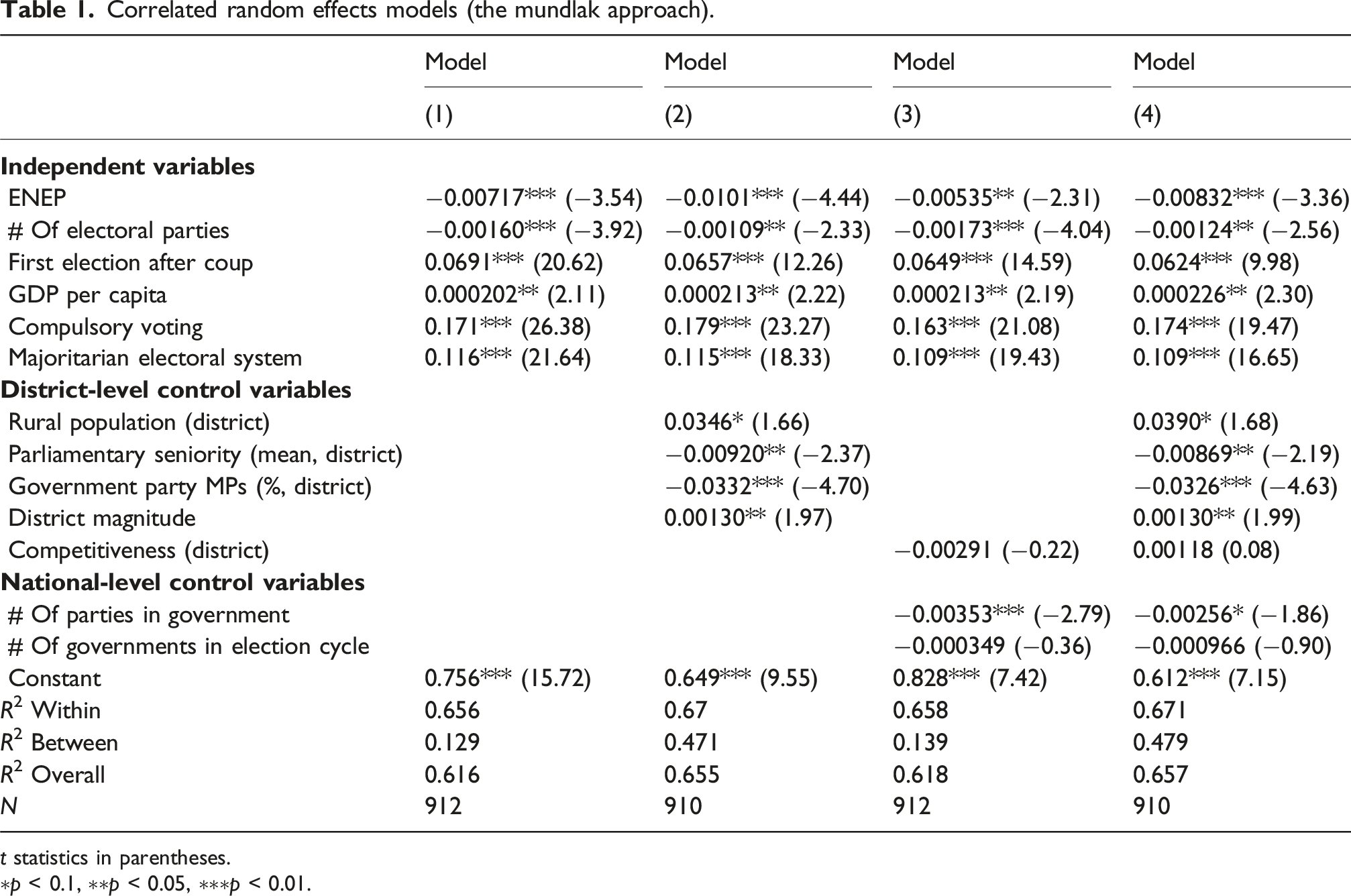
Correlated random effects models (the mundlak approach).
t statistics in parentheses.
∗p < 0.1, ∗∗p < 0.05, ∗∗∗p < 0.01.
Results from the baseline model lend initial support to my hypotheses. Political fragmentation in the district (ENEP) and the size of the party system are negatively associated with voter turnout (p < 0.01), while first elections after a coup, provincial GDP per capita, majoritarian electoral systems, and compulsory voting are positively associated with turnout (p < 0.01). 10 These findings are largely in line with my expectations, except for the finding related to the role of electoral system, which I will further discuss in the concluding section. Importantly, the results remain mostly insensitive to the inclusion of control variables. These results are also insensitive to alternative model specifications using fixed- and random-effect models, as well as a lagged DV model, with one exception. While the GDP variable remains statistically significant in both random- and fixed-effects models (p < 0.01 and p < 0.05, respectively), it loses statistical significance when the model includes turnout at time t-1. For its sensitivity to the inclusion of the lagged dependent variable, I proceed with caution in interpreting the GDP variable.
As seen in Model 4, a one-unit increase in ENEP and the size of the party system is associated with a decrease of 0.008 and 0.0012 in voter turnout, respectively (p < 0.01 and p < 0.05). This means that a change from minimum to maximum in the values of ENEP and party system size decreases voter turnout by nearly 5 and 2 percentage points, respectively, which are of modest size. Turnout was 17 points higher under compulsory voting (p < 0.01), 11 and 6 points higher in the first free and fair elections after a military regime (p < 0.01). The variable GDP per capita is statistically significant at p < 0.05, and carries a positive sign, indicating a positive relationship with turnout. All else equal, increasing GDP per capita from its minimum to its maximum is associated with roughly a 7-percentage-point increase in voter turnout. 12 Finally, quite unexpectedly, districts under the majoritarian electoral system of Party Bloc Vote experienced roughly 11% more turnout compared to their counterparts in the PR system. 13 Overall, these results support all my hypotheses except the one concerning electoral institutions. I discuss this counter-intuitive finding in greater detail in the concluding section.
I now turn to the district-level and national control variables included in the models. I begin with district-level factors. Model 4 indicates that the rural population, and district magnitude variables are positively associated with turnout (p < 0.1 and p < 0.05, respectively). Although statistically significant, the association is only modest in both cases. The seniority of MPs representing the district and the share of government party MPs are negatively associated with turnout (p < 0.05 and p < 0.01, respectively). All else equal, moving from the minimum MP seniority in the district (i.e., no prior parliamentary experience) to the maximum (i.e., 4.6 legislative terms) is associated with a decrease of about 4 percentage-point in turnout. On average, districts in which all MPs belong to the governing party experience a 3-percentage-point decrease in turnout relative to districts with no governing-party MPs. The results also show that district level competitiveness is not statistically associated with turnout.
The models also control for national contextual factors that may influence clarity of responsibility. The variables government formation frequency in election cycle and the number of parties in the last government before the general election (p < 0.5) is negatively associated with voter turnout, with the coefficients being substantively small. Overall, the contextual partisan factors at the national level included in my models appear to exert relatively little influence on voter turnout, compared to other variables, as indicated by the negligible increase in the explained variance. However, the findings related to the control variables included in the CRE models (i.e., Mundlak regression) remain remarkably stable across other model specifications presented in the online appendix.
Additional analysis
Why did elections under PR underperform in terms of voter turnout compared to the elections held under the majoritarian system in the 1950s? In particular, the elections held between 1960 and 1980, a period characterized by a highly permissive electoral system, produced unusually low turnout rates. One possible explanation for the low turnout rates in the 1960-1980 period relates to the broader political context of the period. The 1970s were marked by high levels of ideological polarization, political conflict, and, at times, political violence that prevented many from participating in formal politics. Such an environment may have discouraged electoral participation for some segments of the electorate. While I cannot directly test this explanation with the available data, it is important to acknowledge that the political climate of the time may have contributed to relatively low turnout rates under PR.
Although the finding related to the role of electoral systems presented in the previous section is mainly driven by the very low turnout rates in the elections held between 1960 and 1980, one important feature of the PR elections held from 1983 onward deserves more scrutiny. The general elections held in the recent decades used a very high national electoral threshold, and this may have dampened voter turnout by generating substantial ‘wasted votes’. Unlike many PR systems, the Turkish system has frequently produced highly disproportionate outcomes, as parties receiving sizeable district-level support were excluded from parliament if they failed to surpass the 10% national threshold. This raises an important question: did districts with higher levels of wasted votes in one election subsequently experience lower voter turnout in the next election? If voters perceive their prior participation as ineffective, turnout may decline due to frustration, reduced political efficacy, or weakened mobilization incentives. While this analysis does not fully explain why the majoritarian system of the 1950s produced, on average, higher turnout rates than the PR systems of the past 60 years, it helps clarify what voter turnout would have been under PR in the absence of a high national threshold.
I begin by providing a few illustrative cases to demonstrate the scope of ‘wasted votes’ due to the national electoral threshold. In the past decades, several parties were unable to win parliamentary seats because they failed to pass the national electoral threshold of 10%, despite receiving a considerable number of votes in many districts. For example, in the 2002 general election, four major parties, each receiving approximately 10–12% of the vote in the Adana district, failed to win any of the district’s 14 seats. In another example, the second largest party (by vote share) in a 12-seat district won no seat despite winning nearly 20% of the vote, while the third largest party won 5 seats. These incidents may have adversely affected political participation and self-efficacy among voters in the two districts. Specifically, voters whose votes were effectively “wasted” may have become frustrated with the electoral process and may have perceived participation as more costly, given that their preferred parties remained excluded from parliament despite their sizeable local support. I test this argument using a measure of ‘wasted vote’ as an explanatory variable, and replicate my models based on the post-1983 period. This new variable, ranging from 0 to 76% (with a mean of 16.6), measures the district-level vote share of the parties that failed to win a seat due to the national electoral threshold. Because the new model is restricted to the post-1983 period, various important variables were omitted from the model.
Figure B.1 in the online appendix illustrates the marginal effects of ‘wasted votes’ on voter turnout at the district level. As seen in the figure, the variable ‘wasted vote’ and voter turnout is negatively associated (p < 0.01), indicating that districts in which there were more wasted votes in the previous election experience lower turnout in the subsequent election. Specifically, moving from the minimum to the mean value of the wasted votes variable is associated with a decrease in turnout of approximately 1.5 percentage points. In districts that rank in the top 10th percentile for wasted votes, turnout declines by around 5-6 percentage points. However, while these findings suggest that the disproportionality created by the national threshold may have contributed to dampening voter turnout at the district level over the past four decades, they should not be interpreted as providing a complete explanation for the differences observed between majoritarian and PR periods. Instead, the analysis presented here suggests that turnout might have been higher in the absence of a national electoral threshold during this period, when voter turnout would otherwise be expected to be high due to compulsory voting, a proportional electoral system, unicameralism, and relatively higher levels of economic development and urbanization compared to earlier decades in the country.
Conclusion
This study set out to advance our understanding of the determinants of voter turnout by examining how district-level political, socioeconomic, and national contextual factors shape voter turnout across varying political contexts within the same country. While much of the literature on aggregate-level voter turnout focuses on national institutional context, less is known about how local dynamics interact with national partisan factors to shape turnout. By leveraging an original dataset that combines information on institutional characteristics, local and national partisan contexts, and socioeconomic indicators across 81 provinces and 18 electoral cycles in Turkey between 1950 and 2023, this study makes a comprehensive attempt to explore correlates of voter turnout in a single-country setting. The longitudinal design and district-level focus allow for a nuanced understanding of how dramatic shifts in institutional rules interact with socioeconomic development in the district, and party system size to shape voter turnout.
The study also showed that elections held under majoritarian electoral system experienced higher turnout rates compared to those under PR system. However, it is important to note that the majoritarian system examined in this study is block party vote, and for this reason, I proceed with caution in interpreting my findings related to electoral systems and avoid making broad generalizations across electoral system families. 14 Still, a few general observations are warranted regarding this counterintuitive finding. Starting with the first free and fair multiparty elections in the country, the 1950s saw very high turnout rates, ranging from 89% to 76% (with an average of 84.3%). Turnout has declined tremendously in the 1960s and 1970s, where turnout rates around 65-70% became the norm in the general elections. The high (low) levels of voter turnout observed in Turkey during the 1950s (1960s and 1970s) cannot be explained by electoral institutions alone. Although the majoritarian electoral system used in that decade is typically associated with lower turnout in established democracies, the Turkish case was shaped by a unique political context: the 1950 election represented the first genuinely competitive contest following decades of single-party rule and marked a peaceful transfer of power that was widely perceived as regime-defining. This may have positively contributed to voters’ political efficacy. The declining turnout rates in the 1960s and 1970s seem highly counterintuitive in light of the transition to proportional representation system and the 1961 constitution that is regarded as one of the most liberal and rights-expansive constitutions in the country’s constitutional history. However, as briefly discussed in the previous section, the declining turnout rates in the 1970s can be explained partly by chronic government instability, fragmented party systems and widespread political violence. Additional analyses based on elections held under the PR system with a high national electoral threshold (10%) showed that the district with higher number of wasted votes (i.e., votes that did not translate into seats due to the 10% threshold at the national level) were associated with lower turnout levels in subsequent elections. This implies that turnout rates in elections held from 1983 onward might have been higher in the absence of a high national threshold. The Turkish experience thus illustrates that the relationship between electoral systems and voter turnout is contingent on broader political conditions.
Given the heterogeneity within electoral system families, I argue that comparisons between electoral systems should move beyond the simple dichotomy of majoritarian versus PR systems. After all, not all majoritarian systems affect turnout the same way, and the same is likely true for PR systems. Rather than focusing solely on the formal type of electoral system, it is crucial to consider the extent to which a system produces disproportionate outcomes, and, in turn, the extent to which such disproportionality undermines voters’ incentives to participate. To put it differently, it is important to understand how electoral formula interact with other institutional factors to shape turnout. Voter engagement appears to be shaped less by the broad classification of electoral systems than by how effectively those systems translate votes into representation.
Despite its longitudinal approach, this study has important limitations. Most importantly, the purely observational nature of the data prevents me from making causal claims about the relationship between voter turnout and the various factors examined. Moreover, changes in institutional design over the past 70 years may have introduced unobserved influences that shaped turnout in unpredictable ways. The overlapping timing of major reforms such as the introduction of compulsory voting and the national electoral threshold in the early 1980s has further contributed to causal heterogeneity in the findings. Second, although the study’s longitudinal approach strengthens internal validity, it cannot support the kinds of external-validity claims typically made in cross-national research. Future research employing longitudinal designs – ideally from multiple countries that vary in key characteristics – that enable stronger causal inference could help advance our understanding of aggregate-level voter turnout.
Supplemental material
Supplemental material - District-level drivers of voter turnout: Evidence from a longitudinal study in Turkey
Supplemental material for District-level drivers of voter turnout: Evidence from a longitudinal study in Turkey by Tevfik Murat Yildirim in Party Politics
Footnotes
Acknowledgments
I thank Burcu Task for her comments on an earlier version of this manuscript. I am grateful to Ramsha Gilani for her research assistance.

Funding
The authors received no financial support for the research, authorship, and/or publication of this article.
Declaration of conflicting interests
The authors declared no potential conflicts of interest with respect to the research, authorship, and/or publication of this article.
Data Availability Statement
All replication materials will be posted on Harvard Dataverse upon the publication of this manuscript.
Supplemental material
Supplemental material is available online.