




Abstract
We seek to explain within-country determinants of political party structures. However, unlike most scholars in the field, who start with hypotheses connecting specific structural features with specific explanatory variables (e.g., ideology, party age), we instead seek to explain overall structural similarity in terms of such variables. This allows us to determine whether the latter have an effect on party structures, even if we have no a priori hypotheses about what exactly this effect is. In the paper, we first introduce a new measure of structural similarity of political parties, based on their formal institutional arrangements reflected in their statutes. Then, using a dataset of Polish party statutes, and following the similarity-based hypothesis testing approach, we verify hypotheses about party structures being determined by ideology, party age, time of observation, as well as legislative and electoral experience of party candidates.
Introduction
What factors explain party choice of organizational structures? At least since Katz and Mair’s seminal Party Organizations: A Data Handbook (1992), scholars have been trying to answer this question through both qualitative case studies and large-N comparative analysis. This research highlights the primary importance of country-level factors, such as regulatory requirements, and secondary (weaker yet discernible) impact of ideology (Scarrow et al., 2017). Nevertheless, substantial unexplained variance in organizational profiles remains (Masi and Pizzimenti, 2023), which this article seeks to explore and explain.
We are hardly the first researchers to tackle explaining party structural choices. Others typically identify specific organizational features (e.g., collective leadership, direct election of leaders, intra-party democracy) and test a priori hypotheses linking these to attributes such as ideology, institutionalization, and size. For instance, it has been hypothesized that left-wing and right-wing parties differ in levels of centralization or complexity (Janda and King, 1985). Yet the fact that, say, party ideology explains only a small proportion of structural features tested does not necessarily mean that ideology is not a significant determinant of organizational choices: it might simply indicate that our understanding of the relation between party ideology and party organization is imperfect enough that we fail to identify the right features and formulate the right hypotheses. It may well be that the impact of ideology exists but is seen at the level of emergent patterns (the proverbial forest missed for the trees) rather than individual features.
To address this possibility, in the present article we take a more exploratory course by treating party structure as a “black box” of features. The standard approach to detecting statistical dependence without specifying its form would be to use the statistical learning toolbox, but it comes with all the problems of overfitting, bias-variance tradeoff, etc. (Domingos, 2012; Hastie et al., 2009). To avoid those problems, we take a distance-based (or, actually, similarity-based) approach. Rather than explaining individual components of the “black box”, we seek to explain the similarities between entire organizational “boxes” (feature vectors).
We introduce a new index quantifying general organizational similarity, rather than similarity along predefined dimensions (e.g., leadership selection). We then explain this similarity through the similarity of other party attributes (e.g., ideology, party age). We rely on the fact that we can reason about the existence of a statistical dependence of variables from dependence of distances between their realizations. Accordingly, if structural similarity of observation pairs is associated with similarity of explanatory features, that implies those features in turn explain party structures.
Our large-N analysis requires simplifying party structures into a manageable set of discrete features. Despite general similarities across party structures (Scarrow et al., 2017), we can still capture the differences by selecting appropriate features. Overall similarity makes it easier to discretize points of potential differences. Since we are using a large-N approach, we rely exclusively on party statutes (the official story). We thus inevitably lose some information about actual party governance practice, but this is a necessary trade-off, as obtaining detailed and reliable information about actual practice (the real story) for a large number of parties past and present is infeasible. Furthermore, taking such an approach is in accord with a long tradition of party research (Katz and Mair, 1992; Smith and Gauja, 2010).
Due to the diversity of national regulatory contexts and the documented importance of country-level determinants (Scarrow et al., 2017: 308), the coding framework must be tailored to each country. Thus, the costs of a large-N cross-country analyses scale linearly with the number of parties and countries. Consequently, we limit our initial study to a single country. We have chosen Poland because of good data availability (centralized party registration), stable institutional environment (no major changes in legal framework governing party organization since 2001), relatively large sample, good balance between party system stability and volatility (steady but gradual influx of new parties), rapid structural evolution of existing parties amidst ongoing political transformation, and national uniformity of party structures (no intra-party regional differences, which simplifies analysis).
Our sample includes Polish parties that obtained at least 3% of the national vote (or belonged to a coalition that did) in parliamentary elections from 2001 to 2019. However, party structures are not static – parties can change, revise, or amend their statutes. Accordingly, no single observation can capture that evolution for any party existing for a longer time. Nor should there be a one-to-one mapping between observations and statutes: it ought not to matter whether a party is replacing a statute or just revising it. Instead, we compare party structures at regular intervals, aligning observations with general election cycles. Accordingly, each observation (“party instance”) represents the statute version in force at the time of a general election. We only include observations from 2001 onwards, since during earlier elections party structures were governed by a different legal framework.
The article proceeds in five sections. In the first section, we review literature on party structures and their determinants. In the second one, we present our hypotheses. In the next one, we introduce the methodological framework, including the similarity index and the distance-based hypothesis testing approach. We also operationalize the explanatory variables here. In the subsequent section, we fit the statistical models, and report results. Finally, in the last section we discuss the implications for broader understanding of party organization and its determinants.
Party structures and their determinants in the subject literature
Research on party organizations has been dominated by the party model approach, classifying party organizations into discrete models, such as mass parties (Duverger, 1954), catch-all parties (Kirchheimer, 1966), electoral professional parties (Panebianco, 1988), cartel parties (Katz and Mair, 1995), business-firm parties (Hopkin and Paolucci, 1999), and entrepreneurial parties (Krouwel, 2006, 2012). Studies on party models explore how parties evolve and adapt in response to political and social stimuli, but also suggest that, within a given period and under specific political conditions, party organizations tend to exhibit similarities (Heidar and Saglie, 2003; Pizzimenti et al., 2024).
The first comprehensive database on political party organizations was developed by Janda (1980), followed by Katz and Mair’s (1992, 1994) extensive research on party organizational change in the 1960–1990s. More recently, the Political Parties Database (PPDB) project led by Scarrow et al. (2017, 2022) provided empirical evidence confirming structural heterogeneity within party models (Pizzimenti et al., 2024), while noting the primary role of country-level factors, followed by ideology (Scarrow and Webb, 2017: 20).
Research typically focuses on specific aspects of party structure, with comprehensive comparative projects being exceptions rather than the rule. Common topics include intra-party democracy (IPD) (Bille, 2001; Brause and Poguntke, 2025; Close et al., 2019; Ignazi, 2020; Kabasakal, 2014; Kosowska-Gąstoł and Sobolewska-Myślik, 2024; Rahat and Shapira, 2017; Salgado, 2020; Von dem Berge et al., 2013; Von Dem Berge and Obert, 2018), leadership (Cross and Pilet, 2015; Hartliński, 2014; Radecki and Gherghina, 2015), candidate selection (Hazan and Rahat, 2010; Kosowska-Gąstoł, 2025; Meserve et al., 2018; Rahat, 2009; Rahat and Hazan, 2001; Rehmert, 2020), and membership (Scarrow, 1995, 2015; Scarrow and Gezgor, 2010; Scarrow and Webb, 2017; Van Biezen et al., 2012; Wincławska and Pacześniak, 2024).
Empirical research focused on country-level determinants, such as the legal framework (Casal Bértoa and Van Biezen, 2014; Van Biezen and Piccio, 2013; Van Biezen and Rashkova, 2014), found to be primary influences on party structures. Nevertheless, there remains substantial intra-country variance. Masi and Pizzimenti (2023) have shown that its level is explained by, inter alia, fragmentation of the party system and political culture, but not by socioeconomic and supranational variables. Pizzimenti et al. (2024) investigated the effect of levels of socialization with the government on party organizational convergence. Pizzimenti et al. (2024) found that, contrary to expectations, more intense regulation slightly increases organizational differences. On the other hand, increased judicial scrutiny reduces organizational independence (Gauja, 2008).
Ideology remains the most examined within-country factor. Scholars typically hypothesize a relationship between ideology and particular structural features, such as centralization or organizational complexity (Beyme, 1985; Janda and King, 1985). Center-right parties are usually assumed to have light organizations (Enyedi and Linek, 2008; Wilson, 1998), while center-left ones are assumed to develop large bureaucratic structures with auxiliary organizations (Duverger, 1954). Scholars assume ideological families share organizational features reflecting their missions, for example, democracy and gender equality (Hartshorn-Sanders, 2006). Although the impact of ideology on party structure seems obvious, this assumption is rarely proven empirically. Enyedi and Linek (2008: 471) found commonalities among Central and Eastern European (CEE) center-right parties but concluded ideology is not the sole predictor of organization.
Tavits (2013) explored factors determining organizational strength, including electorate composition, environmental hostility, and leadership style. For instance, she argued rural and economically disadvantaged electorates drive parties toward extensive structures more than urban, middle-class orientations. Pragmatic leaders also foster stronger organizations than ideological amateurs. Additional factors considered by other scholars include party size (Mir, 2025), the length of party statutes (Scarrow et al., 2023), the organization of parties within multi-level systems (Deschouwer, 2003; Fabre, 2011; Thorlakson, 2013), and electoral volatility (Gherghina, 2015).
Considerable attention has been devoted to Polish party structures, viewed via the party model lens (Bichta, 2010; Sobolewska-Myślik et al., 2010, 2016), or their individual elements, mainly leadership (Hartliński, 2012, 2015; Radecki, 2015; Radecki and Gherghina, 2015) and membership (Pacześniak and Wincławska, 2017; Sobolewska-Myślik et al., 2007). Sobolewska-Myślik et al. (2010) also surveyed party members, enabling statute–practice comparisons. Leadership studies emphasize selection procedures (Hartliński, 2014; Radecki and Gherghina, 2015) and intra-party position (Hartliński and Kubát, 2020; Kosowska-Gąstoł, 2023). Membership studies ask what do party members actually do and whether parties still need them (Wincławska, 2020). Scholarship has increasingly shifted focus towards internal and external communication (Jacuński et al., 2021; Wincławska and Brodzińska-Mirowska, 2016). However, factors determining party structure are addressed only sparingly, with a focus on legal regulations (Casal Bértoa and Walecki, 2014; Kulig, 2013), social cleavages (Obacz, 2018), and barriers to entry for new parties (Marmola, 2020).
Following Katz and Mair (1992, 1994), we operationalize structures on the basis of party statutes. This is in accord with approaches taken by researchers such as Smith and Gauja (2010: 757) and von dem Berge et al. (2013), who developed a method to measure IPD by studying party statutes, as well as by Scarrow et al. (2017), who compiled a comprehensive database of party statutes as part of their PPDB project.
Researchers studying structural determinants, convergence, or variance consistently highlight the need for further analysis and new methods. Our article aims to partially fill this gap.
Hypotheses
We test six hypotheses about within-country determinants of party structures, generally arising out of prior literature, though only in some cases empirically tested before:
Party structures are explained by party ideology (understood either in terms of party family or of a policy space position). Researchers often assume party structures are determined by party family (e.g., Social Democrats, Christian Democrats, Liberals, Conservatives, Greens, etc.) or position on the political spectrum (e.g., left-right). Green parties, for instance, typically adopt gender-balanced co-leadership (Hartshorn-Sanders, 2006), while right-wing parties tend to have simpler structures, fewer members, and rely more on charismatic leadership (Enyedi and Linek, 2008; Wilson, 1998). Conversely, center-left parties traditionally have complex bureaucratic structures, active memberships, and collective leadership (Duverger, 1954), while recently gravitating towards direct intra-party democracy (Faucher-King and Treille, 2003). Classification of parties into families is generally based on expert assessment of party ideologies, origins, electoral support, name, and transnational affiliations (Langsæher, 2023). Standard classifications include Chapel Hill Expert Survey (CHES) and Comparative Manifesto Project datasets. There are multiple approaches to party positioning, differing in how the policy space is defined. The traditional approach is to use one-dimensional left-right axis, though the meaning of those terms can differ across periods and countries (Ignazi, 2003; Tavits and Letki, 2009). Yet as party competition is becoming less one-dimensional, a two-dimensional policy space with economic and cultural (GAL-TAN) dimensions is becoming a popular alternative model (Jolly et al., 2022).
Party structures evolve over time, so they are explained by the observation date. Party structures tend to evolve in parallel due to similar challenges from the external environment, evident in consecutive innovations in party structures associated with new party models: from mass parties of the mid-20th century, through catch-all, cartel, and business firm parties (Masi and Pizzimenti, 2023), up to recent ones like digital parties (Gerbaudo, 2019). Other examples of evolutionary trends in party organization include empowering rank-and-file membership through direct leader elections and intra-party primaries (Bucur and Field, 2018; Kenig et al., 2015; Kenig and Pruysers, 2018). Such arrangements have gradually increased since the 1960s, reflecting internal democratization in response to societal demands (Bille, 2001). Democratic transition in Poland after 1989 created an environment that might have provided stimuli for accelerated evolution of party structures.
Party structures are explained by party age (used as a proxy for institutionalization). Party institutionalization (Huntington, 1965; Panebianco, 1988) involves routinization and development of internal rules (Randall and Svåsand, 2002). While institutionalization is latent, measurable indicia of institutionalization exist, such as party age, experience with leadership alternation in the context of generational change, and experience with alternation in power. Since age is the simplest and mathematically best-behaved of those, and existing research (e.g., Scarrow et al., 2023) points towards it being a good proxy for institutionalization, we test it as a potential structural determinant.
Party structures are explained by the entrepreneurial character of the party. Entrepreneurial parties, established and organized by and around a prominent leader, rather than a grassroots organization or social movement (Krouwel, 2006, 2012), may differ structurally from others because of their top-down origins and the special role of the leader. For instance, we would expect them to lack extensive internal structures, particularly when leaders rely on media recognition. The entrepreneurial party model does not have a single canonical definition, though various related concepts have emerged (e.g., Harmel and Svåsand, 1993; Hopkin and Paolucci, 1999). We employ a definition proposed by Hloušek and Kopeček (2017), developed specifically for CEE context, which characterizes entrepreneurial parties by the following features: centrality of the party leader, for whom the party serves as a vehicle to carry out their personal business and political interests; charismatic mass-media-driven messaging; absence of a sponsor organization or movement; and not being formed through splits.
Party structures are explained by the level of legislative experience of party candidates. Political experience of members (particularly elites) shapes party structures, especially through distinguishing “rooted newcomers” from parties created from scratch. Rooted newcomers benefit from prior organizational skills and experience, as well as familiarity with organizational templates, fostering institutionalization (Bolleyer and Bytzek, 2017). Conversely, parties founded by political outsiders may be more likely to experiment with new institutional arrangements. Finally, sharp personal discontinuity and large influx of politically inexperienced members can weaken existing institutionalization patterns. Since reliable data on member political experience is unavailable, we use Polish Political Data Infrastructure project data on legislative candidates as proxies, noting that candidates tend to be more active than average members and to have a disproportionate impact on party structures. We consider legislative experience to be especially good proxy for organizational experience, as it is usually associated with full-time professional involvement in politics.
Party structures are explained by the level of electoral experience of its candidates. While likely less valuable than legislative experience, electoral experience still distinguishes political insiders from amateurs. For this reason, it warrants investigation as a separate factor.
Data and methods
At the outset, we differentiate party structures from party organizations. Party organization is a broader concept encompassing multiple elements, including financial resources, bureaucracy, ideology, and relations with the state (Krouwel, 2012), while party structure consists primarily of formal intra-party governing arrangements and procedures.
To compare party structures, we need to represent them in terms of a relatively small number of discrete variables. Our definition of those variables is inspired by the organizational dimensions framework by Scarrow et al. (2017). They identified three key dimensions: structures, resources, and strategies of representation. Inspired by their approach, and particularly the first category, our conceptualization of party structure includes components such as party bodies, both individual (party leader) and collective, their composition, and selected functions, including candidate selection for national elections. Our conceptualization also encompasses the territorial structures of the party, examining the number of sub-national levels as well as their strength compared to central bodies.
Data
We analyze the organizational structures of 21 Polish political parties that received at least 3% of the aggregate vote in any general election during the period from 2001 to 2019 (or were a part of a coalition that did). See Appendix E for a list of those parties. The 3% threshold is below the statutory electoral threshold (thus including the serious though unsuccessful electoral contenders, while still eliminating marginal ones), but corresponds to the threshold used to determine eligibility for public funding. The choice of 2001 as the temporal cutoff was motivated both by regulatory environment (first election held after the adoption of the present Party Law in 1997) and party system realignment: 2001 saw the beginnings of Law and Justice and the Civic Platform of the Republic of Poland, two political parties that came to dominate Polish politics since 2005, and was the last election shaped primarily by the post-Communist/post-Solidarity cleavage. We used party statutes effective at each general election, resulting in multiple observations (“instances”) per party. In total, we examined 49 party instances.
Our primary source was the collection of records of the Party Registry maintained by the Warsaw District Court, as under the Party Law of 1997 parties are obligated to file their statutes (including any amendments and revisions) with the Court. Missing or incomplete documents were supplemented with other collections, such as the Political Parties Archive of the Institute of Political Studies of the Polish Academy of Sciences (2025), as well as online resources.
Coding process
The statutes were coded manually by two researchers, with discrepancies reconciled by their mutual agreement. Our coding scheme, inspired by von dem Berge et al. (2013), was organized into three categories: members’ rights, constitution of party bodies, and decision-making process, each consisting of multiple binary questions.
In the ‘members’ rights’ category, we coded the existence of a statutory enumeration of such rights, explicit guarantees of rights to express divergent opinions, form factions, and participate in manifesto creation, as well as specific membership requirements, limitations, special member categories, and minority representation in party bodies or candidate lists.
The ‘party bodies’ category consisted of questions addressing composition, size, and powers of party bodies, the role of ex-officio members, position and powers of the party leader, number of party territorial organizational levels, and relationships between national and sub-national bodies. The final category, ‘decision-making process’, focused mostly on candidate selection for both national and intra-party elections, as well as on the process of adopting a party manifesto.
Overall, we identified 53 features coded as Boolean variables. Each variable was associated with ‘yes/no’ question, with values ‘1’ attributed to ‘yes’ and ‘0’ attributed to ‘no’. The coding sheet is included in the supplementary material as Appendix A.
Similarity index
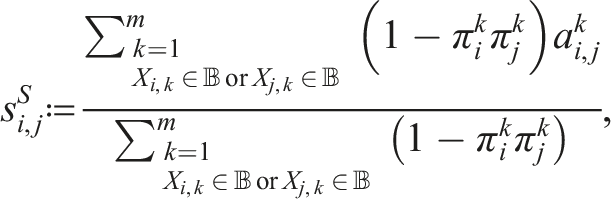
Our index of party similarity is a modified version of Hamming distance between two sequences of answers (Hamming, 1950). One modification addresses missing values, occurring when a statute does not address a specific issue, but neither does it foreclose any answer. On average, each pair of instances has 41.25 fully observed variables and 2.43 jointly missing variables. Some pairs have as few as 18 complete variables. Discarding all incomplete variables would yield misleading results: for example, parties agreeing on 18 out of 18 pairwise complete variables would appear more similar than parties agreeing on 49 out of 50 pairwise complete variables. To avoid this, we only remove variables missing in both parties and impute a neutral value of ½ in the case of missing data, following Słomczyński and Stolicki (2016).
The second modification involves variable weighting, as not all structural features occur equally frequently. Some features, such as enumeration of members’ rights (found in over 99% of statutes), are very common, while others, like presidential primaries, are quite rare. We believe that agreement between party statutes on uncommon features should count for more than agreement on very common features (cf. Cohen, 1960). Accordingly, we weight each variable
Distance-based statistical methods
Distance-based statistical methods are a class of methods where hypotheses about the relationships among observations are formulated and tested in terms of pairwise distances or similarities rather than direct linear or nonlinear functional forms. They are commonly used in settings where the variables are high-dimensional or endowed with a particularly complex structure, making it impractical to employ direct hypothesis testing, including in fields such as ecology (Lichstein, 2007; Reiss et al., 2010), genetics (Garrido-Martín et al., 2023), neuroscience (Popal et al., 2019), psychology (Toschi et al., 2018), linguistics (Huisman et al., 2021; Nerbonne and Heeringa, 2008), and machine learning (Székely et al., 2007). The basic underlying idea is as follows: Let
Explanatory variables
We have six explanatory variables,: (1) (a) Using discrete party family classification from Chapel Hill Expert Survey (CHES) (Jolly et al., 2022). (b) As a one-dimensional continuous measure, viz., position on ‘generic’ left-right axis, determined according to the CHES variable LRGEN. (c) As party position in a two-dimensional policy space defined by two CHES variables: position on the economic left-right axis (LRECON) and position on the GAL-TAN axis. (2) (3) (4) (5) Party structures are explained by the level of (6) Party structures are explained by the level of
We also include one party-level control:
Results
To test our hypotheses using the distance-based approach, we need to translate them into hypotheses regarding similarities. In this context, our observation is a pair of party instances, similarity of party structures is the regressor variable, and predictors are either distances between original explanatory variables or their conjunctions (the latter in the case where the explanatory variable is Boolean and applicable only to a small set of party instances): S1a. Similarity of party structures negatively correlates with the discrete distance between party family labels. S1b. Similarity of party structures negatively correlates with the absolute differences of party positions on the generic left-right axis (LRGEN). S1c. Similarity of party structures negatively correlates with the S1d. Similarity of party structures negatively correlates with: (i) the absolute difference of party positions on the LRECON axis, (ii) the absolute difference of party positions on the GAL-TAN axis. S2. Similarity of party structures negatively correlates with the absolute differences of observation years. S3. Similarity of party structures negatively correlates with the absolute differences of party ages. S4. Similarity of party structures positively correlates with both parties being labeled as entrepreneurial. S5. Similarity of party structures negatively correlates with the absolute differences in candidate legislative experience. S6. Similarity of party structures negatively correlates with the absolute differences in candidate electoral experience. S7. Similarity of party structures positively correlates with both parties being labeled as post-communist.
We also control for whether the compared instances represent the same party (i.e., same legal entity, regardless of the name).
Since the similarity index only admits values between

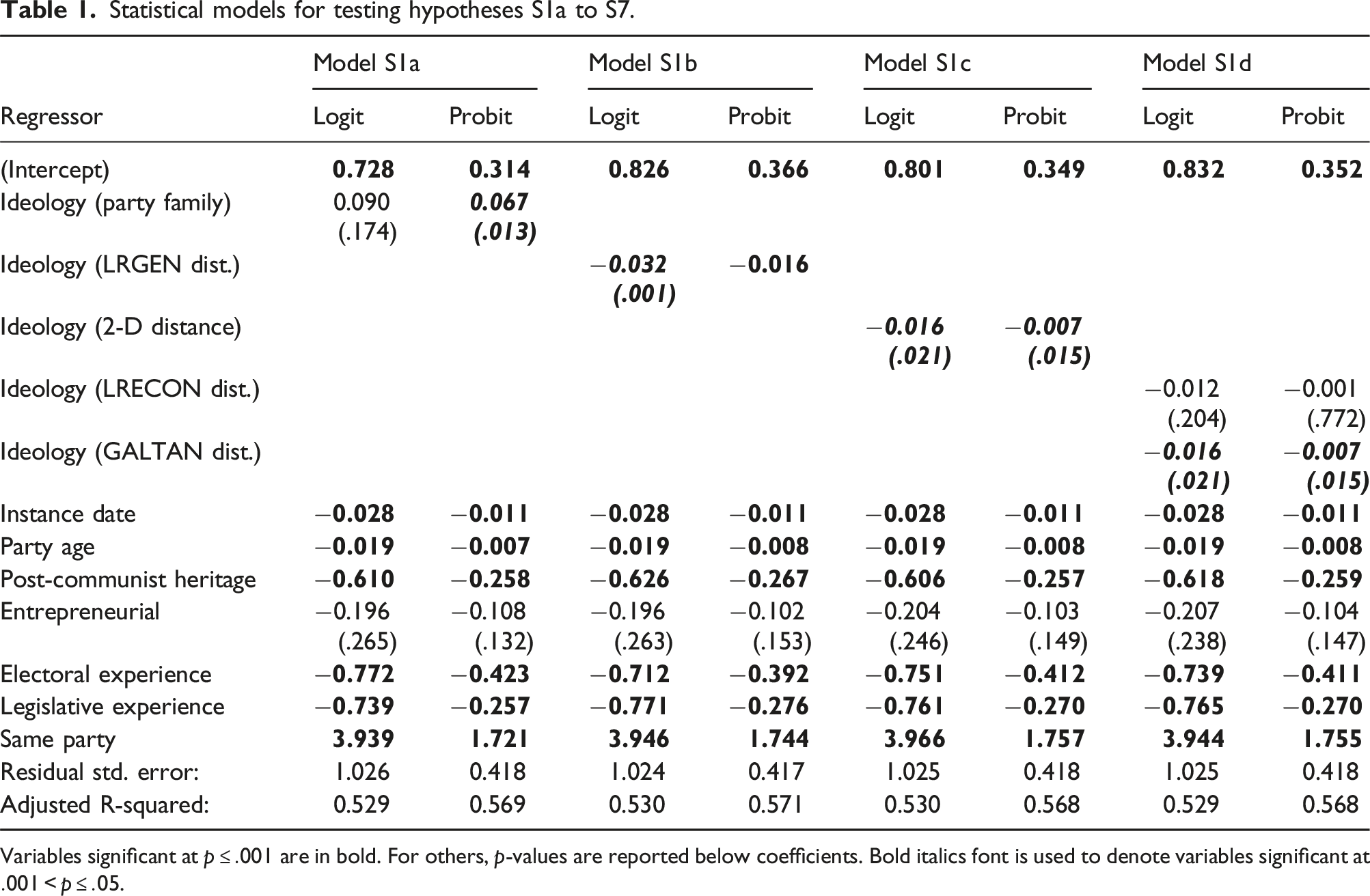
Statistical models for testing hypotheses S1a to S7.
Variables significant at
All variables except ideology and entrepreneurial character are significant under every variant of the model. As for ideology, its significance depends on the specific operationalization. Party family is relevant under the probit model but not under the logit model, thus lacking robustness to reject the corresponding null hypothesis. Conversely, distance on the general left-right axis is consistently significant, while distance in the 2-dimensional policy space shows only borderline significance after controlling for false discovery rate. Decomposition of this two-dimensional distance revealed significance only along the GAL-TAN axis.
Our analysis confirms hypotheses S2, S3, S5, S6, and S7: structural similarities between parties negatively correlate with differences in observation dates, party ages, electoral and legislative experience, and positively correlate with shared post-communist heritage. Ideological distance along the LRGEN and GAL-TAN axes also negatively correlates with structural similarity. On the other hand, there is insufficient evidence to confirm the hypothesis regarding significant structural differences between party families – a finding we discuss in greater depth below. Nor have we been able to confirm the hypothesis that entrepreneurial parties share greater structural similarity than the others.
One potential formal limitation of our models is the non-independence of observations due to the metric properties of our similarity measure, violating standard assumptions of generalized linear models. To test whether this violation affects our results, we have fitted corresponding distance matrix regression models (Anderson, 2001; McArdle and Anderson, 2001) as a robustness check. Since the distance matrix regression method yielded identical conclusions, we do not discuss them in detail (see Appendix C for details).
For many of our explanatory variables, their impact can be easily translated into qualitative terms by pointing out examples of statutory provisions associated with them. Thus, for instance, leftward position on the LRGEN axis is strongly associated with explicit minority quotas, 1 found in many leftist parties in our sample (SLD, SDPL, TR, Together). This feature is also associated with the progressive side of the GAL-TAN axis, on which all of those parties fall. Conversely, the statutory feature correlated with rightward LRGEN position is singling out the party leader in the statute (e.g., PiS, PO, LPR, and arosław Gowin Poland Together). This finding aligns with their ideological profiles—liberal or conservative—emphasizing individualistic values.
Economic liberalism (right side of the LRECON axis) is associated with the rule granting the executive committee the right to nominate a presidential candidate (Ryszard Petru Modern, KNP, Confederation, and PPChD), while the conservative side of the GAL-TAN axis is associated with the rare exceptions to the common rule of executive committee accountability. Parties granting their executives unusual autonomy include LPR, Self-Defense, Confederation, KNP, and Kukiz’15. In the cases of Self-Defense and Kukiz’15, such omissions likely reflect their limited political and organizational experience, and the rudimentary character of their statutes. LPR and KNP, as right-wing parties, tend to empower the executive. The case of Confederation can be attributed to it being an umbrella organization for a federation of parties.
Parliamentary experience positively correlates with statutory provisions such as the ex officio inclusion of mayors and local representatives in party congresses and the presence of four or more organizational levels. These rules are typical of long-established, highly institutionalized parties with significant parliamentary representation (PiS, PO, to a lesser extent SLD and PSL). Four-level territorial organization is also associated with party age, reflecting how age correlates with organizational development characteristic of party institutionalization.
We also find significant associations with our control variable – post-communist legacy – suggesting persistence of post-communist patterns even decades after the transition to democracy. For instance, neither of the post-communist parties in our dataset (SLD, PSL) recognizes special categories of membership, while most other parties do.
Discussion and conclusion
Our study aimed to identify and explain determinants of party structures, contributing in three key ways. First, we introduced new quantitative methods into the field – a similarity index and distance-based hypothesis testing. Second, we proposed and empirically tested hypotheses regarding within-country determinants of party structures. Third, we presented a new, detailed dataset of Polish party statutes tailored specifically for similarity analysis.
Unlike previous studies, we examined overall structural similarity rather than individual structural features. We introduced a novel measure quantifying structural similarity among parties, explaining this similarity through six hypothesized determinants: ideology, timing, party age, entrepreneurial origin, and candidates’ legislative and electoral experience. The results confirmed that all of these factors, except the entrepreneurial origin, determine parties’ structural profiles. However, ideological influence was nuanced: significant when operationalized as a general left-right or GAL-TAN position, but not when using party family classifications.
These results contrast with previous assumptions about party families, based mostly on qualitative research, as well as with the findings of Kitschelt (1988) and Hartshorn-Sanders (2006), who observed similarities in the structures of Green parties. However, Green parties may be unique, and they were sparsely represented in our sample. Furthermore, it might be the case that our result is an artifact of the choice of a CEE country: classification of party families was developed primarily with Western European countries in mind, and post-1989 CEE parties, arising out of very different cleavages and circumstances, might fit poorly into it.
In contrast, ideology understood as a position in a policy space can be a significant predictor of party structures, but this depends on the definition of the space and the dimension under consideration. The impact of ideology is most pronounced when it is operationalized in terms of the general left-right axis (LRGEN), and less pronounced but still statistically significant for the GAL-TAN axis of the two-dimensional policy space. On the other hand, position on the economic left-right axis is not statistically significant.
The general left-right axis (LRGEN) showed significant explanatory power, aligning with the literature (Beyme, 1985; Duverger, 1954; Enyedi and Linek, 2008; Janda and King, 1985; Scarrow and Webb, 2017; Wilson, 1998). The lack of significance for economic left-right positions (LRECON) may seem surprising in light of this result. However, while LRGEN and LRECON axes largely coincide in Western Europe, the situation can be different in CEE countries. In Poland, in particular, the left-right divide is determined primarily by historical and cultural issues rather than economic ones. Thus, the positions occupied by the parties on the left-right axis in the general sense (LRGEN) are explained to a greater degree by GAL-TAN than by LRECON (0.90 to 0.37 in terms of standardized regression coefficients). In particular, CHES experts tend to classify parties with post-communist roots as left-wing and those with post-Solidarity heritage as right-wing (Borowiec, 2023; Grabowska, 2004) regardless of their economic policy.
We observed greater structural similarity among parties of comparable ages. Generally, parties that have existed longer have more elaborate organizational structures. This is consistent with theories linking party age to institutionalization (Huntington, 1965; Scarrow et al., 2023). Political experience – both legislative and electoral – emerged as another determinant, also associated with more elaborate structure. This implies in particular that structures of “rooted newcomer” are distinct from parties created from scratch.
We also find that temporal proximity correlates with the similarity of party structures. This expectation agrees with literature indicating that one of the factors shaping party structures is the demand coming from the external environment (Katz and Mair, 1995). However, the relation between party structures and time is not directly reflected at the level of any specific structural feature, but only through emergent patterns discernible at the general level. This suggests that the impact of age is too diffuse to register under variable-specific regressions, but affects sufficiently many features to register under the similarity-based approach. For instance, direct election of a leader is an innovation that diffuses with time, but is still not common enough to yield significant correlation. Moreover, temporal trends can depend on other factors, e.g., the frequency of minority quotas increases for left-wing but not for right-wing parties. The temporal proximity finding illustrates why the similarity-based approach outperforms feature-wise regression, enabling us to detect emergent patterns.
Regarding organizational longevity, we observed greater structural similarity among parties of comparable ages, consistent with theories linking age to institutionalization (Huntington, 1965; Scarrow et al., 2023). Generally, parties that have existed longer have more elaborate organizational structures. For instance, one of the structural features most characteristic of long-existing parties in our dataset is the four-level territorial structure (as opposed to simpler ones).
Contrary to expectations, entrepreneurial origin did not significantly influence party structures. Whether this absence of effect results from limited data (only four entrepreneurial parties were studied) or reflects no systematic difference requires further investigation. On the other hand, despite many years that have elapsed since the collapse of communism, post-communist legacy (which we treated only as a control) still remains a significant predictor of party structures.
Generalizability remains limited due to the single-country scope. However, broader comparative analyses face challenges, including the excessively high level of generality of available cross-national datasets such as PPDB 2 and the need for codebooks to vary across countries in order to incorporate country-specific institutional issues (e.g., how party structures adjust to federal or consociational institutions in countries where those exist). Reliance solely on party statutes constitutes another limitation, albeit one justified by tradition and practical constraints on data collection for large-scale quantitative analyses beyond official sources.
We have demonstrated how a distance–based hypothesis testing approach, coupled with appropriately tailored similarity index, can be successfully applied to analyze determinants of party structures, we have managed to explain approximately 57% of the variance in structural similarity and confirm several hypotheses. This not only advances our understanding of within-country determinants of party structures, but also holds substantial promise for further comparative research.
Supplemental Material
Supplemental Material - Within-country determinants of political party structures: Similarity-based analysis of Polish party statutes
Supplemental Material for Within-country determinants of political party structures: Similarity-based analysis of Polish party statutes by Dariusz Stolicki, Beata Kosowska-Gąstoł and Katarzyna Sobolewska-Myślik in Party Politics
Footnotes
Acknowledgements
The authors are grateful to the reviewers of this journal for their thorough feedback and very constructive suggestions on earlier versions of this study.
Declaration of conflicting interests
The author(s) declared no potential conflicts of interest with respect to the research, authorship, and/or publication of this article.
Funding
The author(s) disclosed receipt of the following financial support for the research, authorship, and/or publication of this article: This research has been supported by the National Science Center, Poland, under grant no. 2019/33/B/HS5/01757. Open access to this publication has been supported under a grant from the Faculty of International and Political Studies under the Strategic Programme Excellence Initiative at Jagiellonian University.

Supplemental Material
Supplemental material for this article is available online.
Notes
Author biographies
References
Supplementary Material
Please find the following supplemental material available below.
For Open Access articles published under a Creative Commons License, all supplemental material carries the same license as the article it is associated with.
For non-Open Access articles published, all supplemental material carries a non-exclusive license, and permission requests for re-use of supplemental material or any part of supplemental material shall be sent directly to the copyright owner as specified in the copyright notice associated with the article.
