



Abstract
The meaning of left-right ideology has been changing in European democracies. The left-right conflict has been traditionally understood in economic terms, pitting those who favour a more equal income distribution against those who believe that economic inequalities incentivize performance. Scholars have recently suggested that the terms “left” and “right” have taken a more cultural meaning relating to issues including immigration, the civic integration of migrants and national identity. Under what circumstances the left-right is understood by citizens in economic or cultural terms is less well known. In this article, we test top-down context (the framing of issues by politicians) and bottom-up context (economic and social circumstances) as correlates of this change. We conduct a cross-country regression analysis using eight waves of the European Social Survey for 26 European countries. We show that both the framing of issues by politicians social and economic circumstances predict citizens’ left-right self-placement.
Introduction
The terms ‘left’ and ‘right’ belong to the core of how citizens, politicians, pundits, and political scientists think about politics (Mair, 2007). The left-right dimension remains important for understanding political conflict in Western democracies, particularly with the current success of parties at the far right and far left end of the spectrum (e.g., March and Rommerskirchen, 2015; Mudde, 2014). Despite their indubitable utility for comparative politics, the terms ‘left’ and ‘right’ carry different meanings in different political contexts (Corbetta et al., 2009). Some scholars have gone as far as saying that the left-right dimension at its very core is “an amorphous vessel whose meaning varies in systematic ways with the underlying political and economic circumstances” (Huber and Inglehart, 1995: 90). The meaning of left and right changes depending on the political context. Therefore, the terms are interpreted differently not only between countries but also over time (Caprara and Vecchione, 2018). In recent decades, some observers have seen a shift in the meaning of the left-right dimension from economic to cultural (De Vries et al., 2013). The left and the right used to reflect a conflict between those who favor government intervention to ensure equitable economic outcomes and those who believe that economic inequality and free markets drive economic development, respectively. More recently, the left-right dimension divides those who favor a multicultural society open to immigration and those who seek to limit immigration and protect their native culture. While many authors have observed this change (e.g., Caprara and Vecchione, 2018; De Vries et al., 2013; Jankowski et al., 2022), it is unclear thus far under what conditions this change has occurred. More generally, despite the commonplace notion in political science that left and right reflect political circumstances, we lack a direct test of under what circumstances left and right differ in their meaning. Therefore, the central question in this paper is: under what conditions is the left-right dimension at the voter level economic in nature, and under what conditions is it cultural in nature?
Roughly speaking, there are two approaches to understand how the left-right dimension changes meaning: the sociological and strategic approach (De Vries and Marks, 2012). The first, sociological, approach focuses on how societal developments spur changes to the meaning of left and right. This school proposes that the “culturalization” of the left-right dimension is the result of macro-level societal transformations, particularly immigration. Yet, solid empirical evidence for this approach is lacking. In this paper, we examine whether this is the case by seeing whether the strength of the relationship between cultural attitudes and the left-right dimension reflects a country’s changing population. If migration leads to the culturalization of the left-right dimension, then economic circumstances should by the same logic lead to the economization of the left-right dimension. We examine this by looking at the relationship between unemployment on the one hand and the relationship between economic attitudes and the left-right dimension on the other.
The second, strategic, approach instead sees an important role for political actors, particularly political parties. From this perspective, change in meaning is the result of deliberate action by politicians who actively choose to make the cultural dimension the dominant line of conflict instead of the economic dimension. We examine whether the nature of elite conflict (either structured along the economic or the cultural dimension) affects whether voters see the left-right conflict primarily in economic or in cultural terms.
This study represents, to the best of our knowledge, the first direct test of whether left-right self-identification reflects specific societal and political contexts. De Vries et al. (2013) only show a change in the correlation over time in one country without relating this empirically to societal or political factors; Lindqvist (2022) uses some indicators of party competition but does not test the sociological alternative. In this research, we investigate the link between macro-level and party-related factors as predictors, with left-right self-identification as the outcome. We prioritized comparability over causality, examining data spanning over a decade.
After discussing the nature of the left-right dimension, we consider the sociological and strategic theories of left-right transformation. Then, we describe how we use the leverage given by nearly twenty-year time span of the European Social Survey and its multinational nature to uncover these patterns. Subsequently, we present our findings which show that both the framing of issues by politicians social and economic circumstances predict citizens’ left-right self-placement. We conclude with a discussion of the results.
Left and right
The central idea of this article is that the meaning of left and right are not fixed. These terms are “convenient tags that can be associated with different social objects” that can be “applied by extension to new subjects and situations” (Sani, 1974: 207). They are “empty vessels ready to be filled or decanted with any and all contents” (Corbetta et al., 2009); in the words of Sartori (1976 [2005]: 335), “these labels are easily ‘unloaded’ and ‘reloaded’ – for they lack any semantic substratum.” The meaning of left and right is determined by “the underlying political and economic circumstances” (Huber and Inglehart, 1995: 90). The notion that the meaning of left and right is dependent on context is recognized by many authors (Benoit and Laver, 2006; De Vries et al., 2013; Fuchs and Klingemann, 1990; Gabel and Huber, 2000; Mair, 2007; Van der Brug and Van Spanje, 2009; Zechmeister, 2006; Zuell and Scholz, 2019). The meaning of left and right differs between countries, as different conflicts divide the political arena (Benoit and Laver, 2006: 201-202). Moreover, it is broadly accepted that the development of the divide reflects changes in the social or political conditions within a country (Fuchs and Klingemann, 1990: 228-229; Kitschelt and Hellemans, 1990); yet there is little empirical evidence of the system behind these differences.
Since the start of the 20th century, left and right have often been interpreted in an economic fashion. From this perspective, “[T]he right has been more favorable to… the hierarchy of birth or of wealth; the left has fought for the equalization of advantage or of opportunity, for the claims of the less advantaged” (MacIver, 1947: 216). The empirical relationship between economic egalitarianism and left-right self-identification has been repeatedly found to be quite strong (Aspelund et al., 2013; Evans et al., 1996; Inglehart and Klingemann, 1976; Wiesehomeier and Doyle, 2012).
Recently, however, left and right have also been gaining cultural meaning in Western European democracies (De Vries et al., 2013: 223; Petersen et al., 2010; Steiner, 2024). In this view, the left favors openness to immigrants and hospitality for refugees as well as a pluralist, multicultural society, while the right is opposed to immigration and favors maintaining the dominant national culture. This political conflict focuses on immigration, the civic integration of immigrants and the role of Islam in Western societies. The association between nationalism and right-wing views runs much deeper and is much older (e.g., Fuchs and Klingemann, 1990: 214), but it appears to have become even stronger in recent decades (De Vries et al., 2013).
While our theoretical starting point is that the meaning of left and right are not fixed, some authors work from the notion that the meaning of left and right has a stable core. Authors like Bobbio, 1996; Lindqvist, 2022, 2024b; Lipset et al., 1954; see also Lindqvist and Dornschneinder-Elkink, 2023) argue that the left-right dimension at its core divides those who favor societal change towards greater equality on the left from those who oppose such change and accept existing inequalities on the right. 1 This can concern inequalities between different groups, for example between men and women, between the poor and the rich, between ethnic minorities and the ethnic majority (Lindqvist, 2024, 2024b; Lipset et al., 1954). Lindqvist (2024b) argues that the meaning of left and right can still change as different inequalities decrease and increase in salience. The expectations about change that we detail below can be interpreted from both perspectives and our paper does not seek to mediate between these perspectives.
Sociological and strategic theories of left-right transformation
We want to know under what conditions these different issues become attached to the left-right dimension. De Vries et al. (2013) introduce the ideas of issue bundling and issue crowding out to understand how the left-right dimension changes meaning. New issues can be integrated into the left-right dimension (issue bundling). In this process, some other issues may become less important to understand the left-right dimension (issue crowding out).
What mechanisms underlie this issue of crowding out and issue bundling? As De Vries and Marks (2012: 187) note, there are two approaches to understanding how the importance of issues for the left-right dimension can change: the sociological approach and the strategic approach. The sociological approach emphasizes the bottom-up nature of change in the meaning of left and right. Economic and societal changes create new social cleavages that can influence how people identify as left or right. The strategic approach looks at the role of political parties, which can link specific issues to the left-right dimension. Such links send voters cues on how to think about left and right. In that way, they can influence how voters think about politics, including what they consider left and right.
The strategic approach
The strategic approach puts political elites in the lead. As Arian and Shamir (1983: 142) propose, “[t]he learning of ‘ideological’ cues does not occur in a vacuum. Their source is political”. Political parties do not simply represent grievances and sides of societal divisions; rather, they have a clear mobilization function that they achieve by structuring societal conflict and adjusting the salience of issues (Carmines and Stimson, 1989). Parties give voters cues on how to conceive of the political conflict and how to think about specific policy issues (Harteveld et al., 2017; Lenz, 2009; Slothuus, 2010; Steenbergen et al., 2007), including what meaning to attach to left and right (De Vries and Marks, 2012; Steiner, 2024). The choice of political parties to mobilize on specific issues changes the meaning of left and right (Kitschelt and Hellemans, 1990: 230-232) and affects citizens’ left-right self-placement (Huber, 1989). We know that if political elites offer a clear left-right difference, then voter attitudes are more clearly anchored in terms of left and right (Neundorf, 2009). By activating a particular conflict in the voters’ minds, political parties may increase their ideological consistency on that issue (Petersen et al., 2010).
This strategic approach builds further on the seminal work of Schattschneider (1960, pp.65-66; see also Mair, 1997), who argues that politics is a struggle between political actors over the definition of political conflict, the “conflict of conflicts”. Parties do not just compete with each other along a central conflict dimension; rather they actively seek to influence which issues structure political conflict. As voters are not distributed evenly on economic and cultural issues (on average, European voters tend to be on the left on economic issues but on the right on cultural ones), politicians are able to stack the electoral deck in their favor by emphasizing one or the other. If the main political conflict is economic in nature, the egalitarian parties have a stronger position. If it is cultural in nature, conservative parties are at an advantage.
From this perspective, change in the meaning of the left-right dimension is a top-down process (De Vries et al., 2013: 226) which consists of two steps. Firstly, a political entrepreneur, a party or a politician attempts to put a new issue on the agenda. This entrepreneur seeks to redefine the dominant political conflict in a way that benefits them. In response, established political parties may change their position on the issue or change the attention that they spend on it (Meguid, 2005). Established parties may then seek to integrate this issue into the existing dominant line of conflict to minimize electoral risk (De Vries et al., 2013: 224). In doing so, established and new parties give voters new cues about how to think about left and right, thereby changing the meaning of left and right at the citizen-level.
Overall, the strategic approach emphasizes the role of conflict at the elite level. The idea here is that if the main elite conflict divides cultural nationalists and cosmopolitans, cultural views structure the way in which citizens conceive of left and right. The same is true for economic issues; if the main elite conflict divides economic egalitarians and economic libertarians, citizens will understand left and right in economic terms. 1. Strategic-Economic Hypothesis: The more the elite conflict is economic in nature, the stronger the relationship between voter-level economic attitudes and left-right self-identification is. 2. Strategic-Cultural Hypothesis: The more the elite conflict is cultural in nature, the stronger the relationship between voter-level cultural attitudes and left-right self-identification is.
The sociological approach
The sociological approach emphasizes that the meaning of left and right reflects macro-level societal conditions. A person’s position in the societal structure determines whether one aligns with the left or the right. In the classical Lipset-Rokkan approach, these societal conflicts reflect very old historical conflicts about class, religion and region (Lipset and Rokkan, 1967). This approach has been recently updated by Kriesi et al. (2008), who argue that similarly to the Industrial Revolution, the onset of globalization in the 1990s reshaped the political landscape in West European democracies. In this view, issues gain prominence on the basis of large-scale societal changes. From this perspective, the change in the meaning of the left-right dimension is a bottom-up process; it follows changes in the daily lives of citizens and how they define their own interests.
The sociological approach emphasizes the importance of macro-societal conditions for how voters understand left and right. The principal example here is the role that globalization, broadly speaking, has for culturalization the left-right dimension. In West European democracies, globalization is particularly visible in the form of immigration (De Vries et al., 2013; Kriesi et al., 2008). The argument is that where immigration has visibly reshaped society, attitudes towards immigration play a larger role in structuring the dominant line of conflict than in countries that have not seen much immigration. The external shock of immigration can cause a redefinition of what is conceived of as left and right (Jankowski et al., 2022).
With regards to economic matters, high levels of unemployment are likely to focus voters on economic issues (Van der Brug et al., 2015). This can help to explain change over time. When unemployment increases in a country, citizens are more likely to think of their economic interests because more citizens are actually unemployed, see their family members lose jobs or fear losing their own job. Being unemployed often comes with a decrease in income and increased reliance on redistributive policies. Unemployment is closely tied to how citizens experience the economy. When unemployment is higher, economic issues are likely to matter more for how citizens think of the political conflict. 3. Sociological-Economic Hypothesis: The higher the level of unemployment is, the stronger the relationship between economic attitudes and the left-right dimension is. 4. Sociological-Cultural Hypothesis: The greater the share of the population that is not native to a country, is, the stronger the relationship between cultural attitudes and the left-right dimension is.
Data & methods
In our analysis, we will examine to what extent left-right self-placement correlates with views on specific issues and to what extent that differs under varying political, economic and societal circumstances. This methodological approach is quite common to assess what opinions correlate with ideological positioning (e.g., Freire and Kivistik, 2013; Lindqvist, 2022; Otjes and Katsanidou, 2017).
To test our hypotheses, we use data from various sources to reflect the individual, elite, and contextual level by combining several datasets. Individual-level data come from the European Social Survey (ESS), and we merge nine rounds of the ESS. Furthermore, party-level data come from the Chapel Hill Expert Survey (CHES) project (Jolly et al., 2022). Country-level data come from World Bank Open Data (for economic variables) and OECD data for the foreign-born population.
We drop countries for which we have missing values on some variables from the analysis because they are not covered in one of the datasets. Because we are interested in contextual effects (on party and country level) and because we assume the effect will not be the same for respondents interviewed in different years within the same ESS study, we split these into two country-year cases. Therefore, for example, for Sweden data from ESS round 9, we create two country-year points, as 1033 respondents were interviewed in 2018 and 506 respondents were interviewed in 2019. After merging all datasets and excluding missing cases, we are left with 211,361 respondents across 248 country-year points from 26 countries. A detailed list of countries and years of the interview is available in the Appendix (Table A1).
Individual-level measures
Our dependent variable is respondents’ left-right self-positioning on an 11-point scale ranging from 0 (left wing) to 10 (right wing). For respondents’ economic position, we use preferences for redistribution. This item measures respondents’ agreement with the statement “The government should take measures to reduce differences in income levels” using a five-point scale. We code this item so that higher values represent higher levels of agreement with the statement. For respondents’ cultural position, we create an index measure from six ESS items 2 (listed in the Appendix, Table A2). We make a composite index from these items, with higher values meaning that respondents are more positive towards immigrants.
In a robustness test, we address the issue that the cultural hypotheses may perform better because at the individual level, we measure immigration as a composite index (made from six survey items), while we measure economic preferences using a single survey item. It is well known that scales have lower measurement error than single survey items (Nunnally 1978). Thus, this approach creates an uneven playing field between these hypotheses. To address this concern, we also run the same models with a single-item measure for immigration (in Table A10 in the Appendix). 3
In the models, we control for the attitudes of voters on moral issues. Historically, there has been a third interpretation of left and right. Here, the right represents maintaining the existing moral and social order, while the left represents striving for greater individual freedom (Caprara and Vecchione, 2018; Jost et al., 2003; Thorisdottir et al., 2007). Currently, we can still see this conflict on moral issues, where the left favours equal treatment and freedom of choice for LGBTQIA + individuals, while the right seeks to uphold traditional family values at the cost of individual freedom and equal treatment. We follow Kriesi et al. (2008) in distinguishing this moral conflict from the cultural conflict. Specifically, we use the item “Gays and lesbians are free to live as they wish”, which is also measured on a five-point scale, with higher values for those who strongly agree with this statement.
We also include a number of demographic controls, as left-right positions are associated with respondents’ location in the social structure (Van der Eijk et al., 2005). We include gender, age, education, the level of urbanization of the city of residence, whether the respondent is unemployed, union membership and church membership. Respondents’ gender is operationalized as binary self-identification, with female respondents coded 1 and 0 for male respondents; age is a continuous variable; education is operationalized as a binary variable coded 1 for those who have a BA or MA (or equivalent) from a university and 0 for others; we code the level of urbanization of the respondents’ residence as a binary variable coded 1 for those who live in big cities and suburbs, and 0 for those who live in small cities and villages; we also include respondents employment situation (1 = unemployed; 0 = employed); finally, we code individuals’ union and church membership, as labour union membership is associated with left-wing self-identification and church membership with right-wing self-identification (Freire, 2006). Whether the respondent is a member of a union is a binary variables and church attendance variable is measured on a seven-point scale with higher values indicating more frequent attendance.
Measures for the sociological approach
To test the two sociological hypotheses, we need information on unemployment and the share of the foreign-born population. We examine relative unemployment. This is the unemployment the year before the year of interviewing (t-1) coming from World Bank Open Data minus the country average unemployment in that country in the research period. In this way our measurement picks up on differences within a single country over time, instead of between country differences. Put differently, it measures changes in the experiences of respondents. However, for robustness, we also run the analysis on a couple of different economic indicators, namely GDP per capita and income inequality (both in the year before the year of interview). The analysis with all these variables and plotted effects can be found in the Appendix (Tables A7, A8 and A9 and Figures A5, A6 and A7).
To test the sociological-cultural hypothesis, we use a relative share of the foreign-born population. This is the share of foreign-born population in the year before the year of interviewing (t-1) coming from OECD data minus the country average share of foreign-born population in that country in the research period. In this way our measure picks up on differences within a single country over time.
On the country level, we add a dummy indicator for Central and Eastern Europe countries (variable “CEE”) as a control, acknowledging previous research findings that left-right ideology positioning might work differently in post-communist Europe (Tavits and Letki, 2009). 4 We interact this with the ideological measures to pick up on regional differences in the relations between these dependent variables.
Measures for the strategic approach
To test the two strategic hypotheses, we need information on whether the political conflict is economic or cultural in nature. To this end, we use the Chapel Hill Expert Survey (CHES). The first variable (“CHES economy”) is the correlation between the general left-right expert placement of parties and economic left-right expert placement. The more the elite conflict reflects the economic dimension, the stronger this correlation is. The second variable (“CHES immigration”) is the correlation between the general left-right expert placement of parties and expert placement of parties on immigration policy. The more the elite conflict reflects the cultural dimension, the stronger this correlation is. We believe that this is a good measure of the cues that voters get. Imagine a situation in which there are three parties, one right-wing pro-business party, one left-wing pro-labour party and one centrist party that is in between these parties on economic issues; all three parties in this situation would have an identical position on migration. In that case, the three parties will send out different messages on economic issues, clearly signaling to voters what it means to be left-wing, centrist or right-wing, but do not give different cues on migration. 5 By using the correlation between CHES left-right positioning and issue specific items, we get at these cues. Since ESS and CHES data come in their own cycles, which do not always match, we merge the CHES data with the closest available ESS country-year cases.
The measures previously described look at the extent to which elite political conflict is structured by economic and cultural issues. Another way to think about what the conflict focuses on is to look at which issues are salient in elite conflict. We know that the individual saliency of issues determines which issues are important for a society’s understanding of left and right. These preferences are likely affected by party cues (Weber and Saris, 2015). Imagine our case above again; the argument now is that when parties spend a lot of attention on an issue, they are signaling to voters which issues matter for their political ideologies. So, if the three parties that do not differ a lot on migration do focus on economic issues a lot, this dominates the political environment and consequently how voters think about politics. We look at these patterns by examining saliency-based measures drawn from MARPOR/CMP data as a robustness check (available in the Appendix, Table A6). The variables are created by averaging the share of all party manifestos devoted to the economy (for the “CMP economy” variable) and the share of manifestos dedicated to immigration (for the “CMP immigration” variable). The list of MARPOR/CMP items used for these variables is available in the Appendix (Table A3).
Modeling strategy
Our goal is to determine under what conditions individual-level positions on economic and cultural issues correlate to left-right self-identification. We run a regression to compare the importance of different societal and party-political factors. To this end, we use cross-level interactions to test our hypotheses. The idea is that, for instance, if unemployment drives the relationship between economic attitudes and left-right self-identification, we can see this by observing that in countries with high unemployment, the relationship between self-identification and economic attitudes is stronger. Because of the nature of the dataset, with individuals nested in country-years nested in countries, we run three-level linear models.
The goal of this paper is to determine which macro-level factors shape the relationship between positions on specific issues and left-right self-identification. We do not have the ambition to determine which contextual factor causes voters to think of left and right in particular ways. That would require a different, experimental, design. Our goal is to look at the preceding step and examine which factors correlate with how voters conceive of left and right. We realize that the bottom-up and top-down factors are likely to be related: the emergence of small societal cleavages may be exploited by strategic politicians. We still believe that in our set-up we can see which contexts correlate with these relationships: if the left-right dimension follows the cultural dimension in a country without a relatively high number of migrants or if it follows the economic dimension in a country with low unemployment, it is unlikely that current societal circumstances are correlated with how voters conceive of left and right.
Secondly, our correlational design cannot determine whether it is only the voters who take cues from the elite or whether the elite also take cues from the voters about how to conceive of left and right. The relationship between the elite and the masses is likely a two-way street. We do two things to assess to what extent our correlational results might be driven by the reverse relationship. Firstly, we not only look at the effect of the party-level correlation between left and right positions but also, as a robustness test in the Appendix (Table A6 and Figure A3 and A4), we look at the salience of economic and cultural issues. It is less likely that these reflect on whether the left-right dimension is economic or cultural in nature at the voter level than the CHES-based measure we use. Secondly, we run an additional robustness test looking at an interaction between elite cues and political interest: if parties follow how the public thinks about left and right, they will follow the entire population and not just politically interested people. Elite cues, however, are more likely to affect citizens who follow elite conflict. A large number of voters hardly pay any attention to party politics (Bartels, 2008). Those who are interested in what politicians say are more likely to be cued by them. In other words, citizens who follow politics with interest are likely to conceive of political issues in the same way as politicians (Otjes and Rekker, 2021). However, voters with less political interest and sophistication are less likely to link their own left-right position to their own issue positions (Lesschaeve, 2017). This means that there is an interaction relationship: when elite conflict pits the economic egalitarians against economic libertarians, citizens who follow politics with interest are likely to think of left and right in economic terms. Citizens who follow politics with a similar level of interest in a system where political conflict is not economic in nature are less likely to conceive of left and right in that way. Among people who lack any political interest, elite cues are likely to matter less; i.e., elite cues are simply less likely to reach these voters. Therefore, we add a third factor to these interactions, namely, political interest. Note however, that this still cannot establish a causal relationship: it may simply be that the political elite is drawn from the subset of politically interested voters and so instead of elite cueing, the patterns found reflect similarities in political socialization between elites and politically interested citizens.
The final issue that we want to flag is that when considering the relationship between policy positions and left-right self-positioning, there are two options: voters can update their left-right self-positioning if their policy positions change, or change their policy positions to conform to their left-right position. Our regression design may appear to be based on the assumption that policy positions determine their left-right positions. This is merely an artefact of the design. We believe that this relationship is reciprocal (Lesschaeve, 2017; Steiner, 2024; Weber and Saris, 2015). Voters who consider themselves left-wing might take positive and negative cues about what it means to be left-wing from their surroundings and the elite, and update their issue positions accordingly. Voters who hold certain issue positions strongly might no longer feel comfortable with identifying as right-wing if what it means to be right-wing contradicts their issue positions.
Regression results
Three-level hierarchical models with interactions and random slopes included.
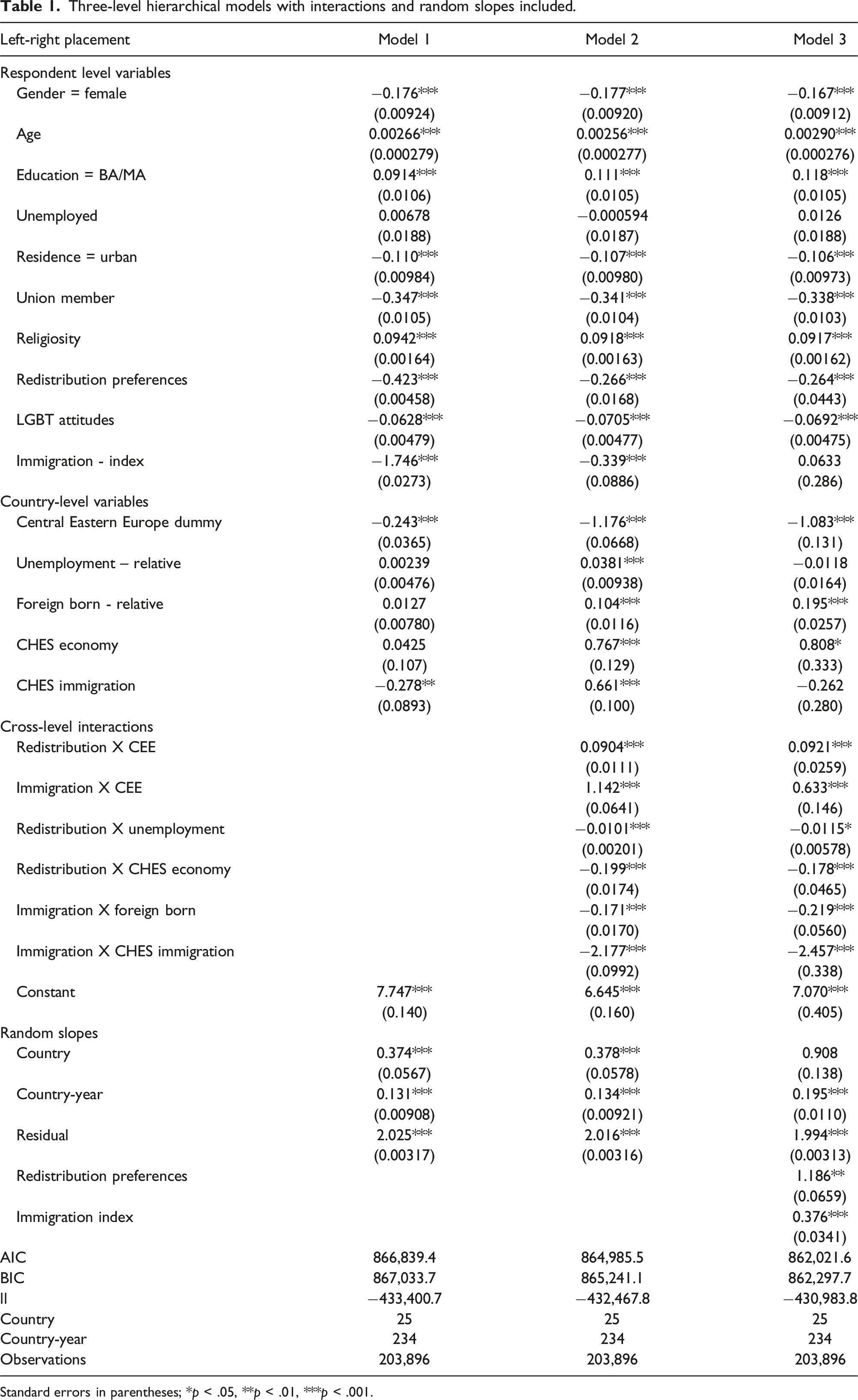
Standard errors in parentheses; *p < .05, **p < .01, ***p < .001.
The first thing one notices is that across different model specifications, the results do not markedly vary. Most importantly, all the interaction effects in Models 2 and 3 have the same direction and same level of statistical significance across different models.
To explore the relationships, we present effects with predicted values for interaction effects separately, i.e., one line for those respondents with highest and one line for those with lowest value on the individual-level variable in the cross-level interactions. First, we test the two strategic approach hypotheses. The strategic-economic hypothesis posits that the more the elite conflict is economic in nature, the stronger the relationship between voter-level economic attitudes and left-right self-identification is. Thus, we interact individual-level economic attitudes (preferences for redistribution) with the CHES economy variable. The effects are presented in Figure 1. Predicted probabilities (CHES economy). Predicted probabilities of redistribution preferences over different values of the CHES economy (light area and squared dots present the effect for respondents who do not want more redistribution; dark area and circles present the effect for those who want more redistribution). Based on Model 2 in Table 1.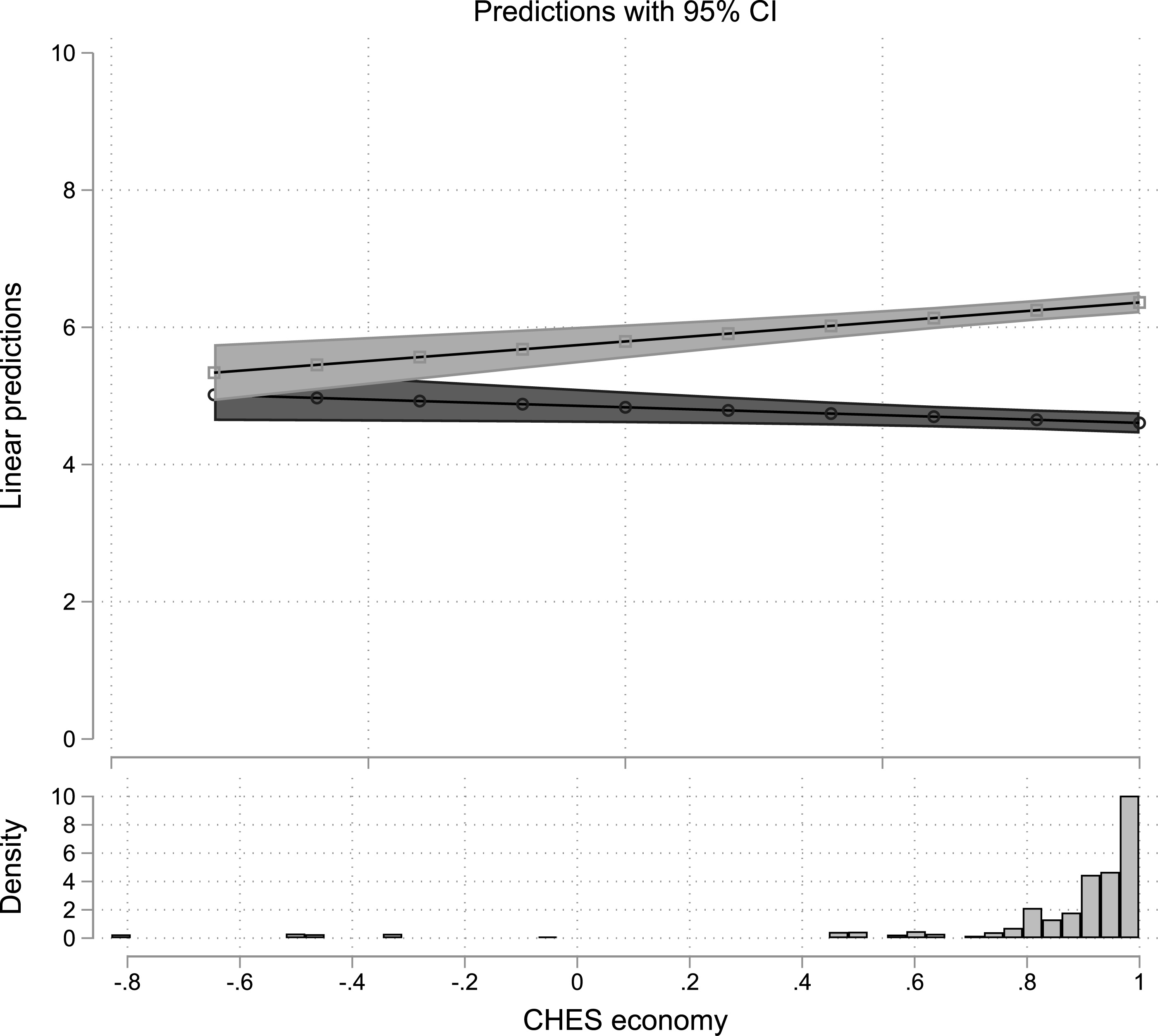
As one can see in Figure 1, we find strong evidence to support the strategic-economic hypothesis. When egalitarian parties position themselves on the left of the left-right dimension and inegalitarian parties position themselves on the right (which, as we can see from the CHES economy distribution, is the case for most countries in our sample), egalitarian respondents tend to also position themselves on the left, while inegalitarian respondents are on the right. There is a two-point difference between them (on an eleven-point scale). However, when at the elite level the relationship is reversed (which happens in a number of cases), there is no difference in left-right self-identification between egalitarian and inegalitarian voters. This provides support for the strategic-economic hypothesis.
The second, strategic-cultural hypothesis posits that if elite conflict is cultural in nature, the relationship between voter-level cultural attitudes and left-right self-identification will be strong as well. Individuals’ cultural attitudes are operationalized through the immigration index, with higher values showing respondents’ openness towards immigrants. Figure 2 presents the effects. Here, we can clearly see that as immigration attitudes cohere more with left-right positioning at the elite level, voters who are most pro-immigration position themselves further to the left. On the other hand, respondents who oppose immigration tend to be more right-wing when the left-right and the immigration dimension cohere more at the elite level. The figure shows a clear difference between the two groups. If the left-right positions of parties align with their positions on migration, there is a two-point difference in left-right self-identification between the most pro- and anti-migration (on an eleven-point scale). If the relationship between parties’ left-right position and their immigration position is reversed, which happens in a few cases, pro-migration voters identify as right-wing and anti-migration voters are left-wing. This provides evidence for the strategic-cultural hypothesis. Predicted probabilities (CHES Immigration). Predicted probabilities of immigration index over different values of CHES immigration (light area and squared dots present effect for respondents who do not see immigrants favorably; dark area and circles present effect for those who do see immigrants favorably). Based on Model 2 in Table 1.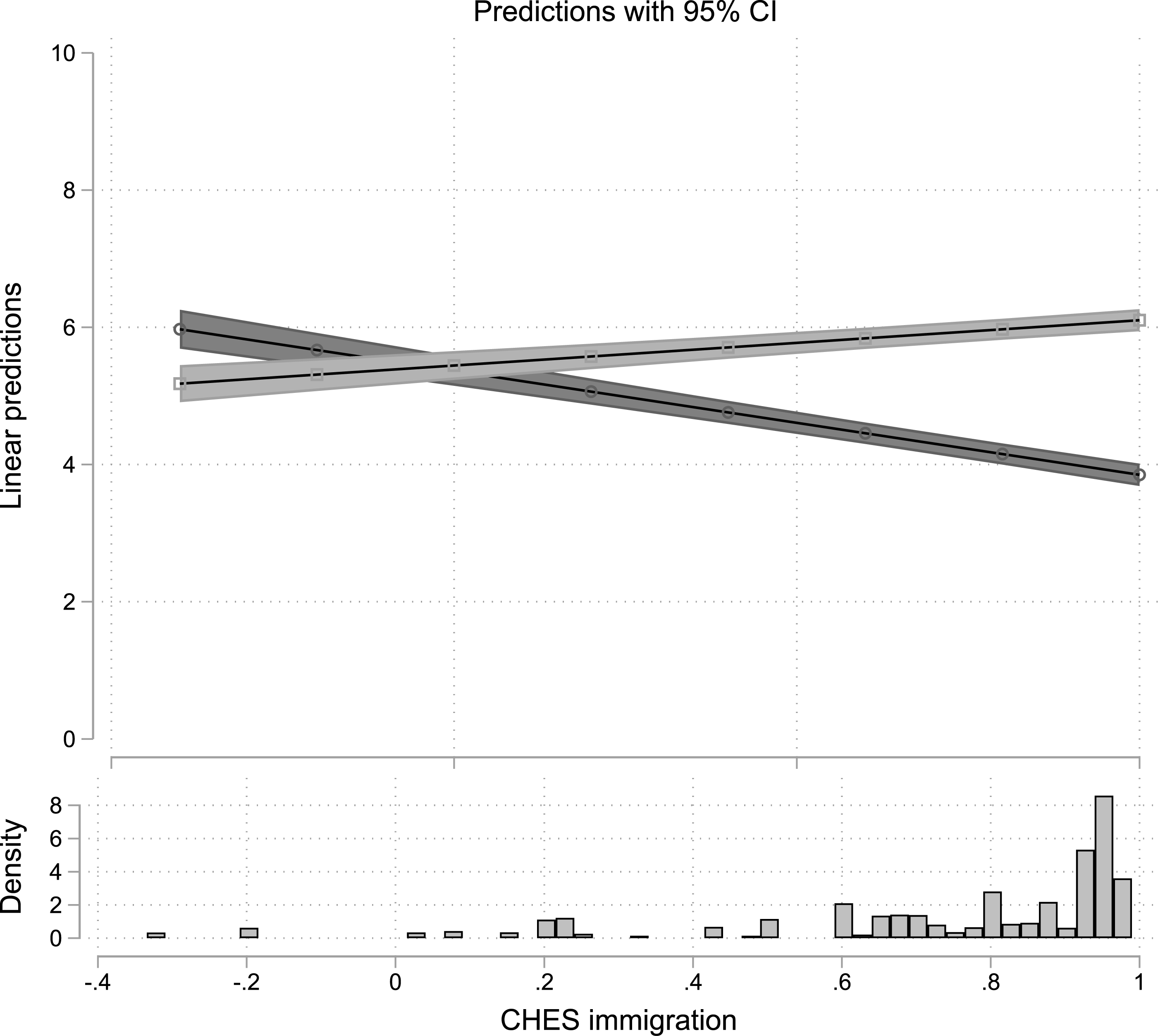
Next, we turn our attention to the sociological approach. The first of these two hypotheses posits that the higher the level of unemployment is, the stronger is the relationship between economic attitudes and the left-right dimension. Note that we look at relative unemployment: that is whether employment in 1 year is greater or larger than the entire research period in that country. This means that our measure picks up on within-country differences. The effects are presented in Figure 3. The figure shows that when unemployment is far below the country’s average, the most inegalitarian respondent places themselves on a six on the left-right dimension. The most egalitarian respondent places themselves just below a five. They are just over one point apart. When a country sees relatively high unemployment, the most inegalitarian person shifts to around 6.5 and the inegalitarian person to around 4.5, widening the gap between them to two points. This is a smaller effect than for the strategic hypotheses, but the change is still significant, providing evidence for the economic-sociological hypothesis. Predicted probabilities (unemployment). Predicted probabilities of redistribution preferences over different levels of unemployment (light area and squared dots present effect for respondents who do not want more redistribution; dark area and circles present effect for those who want more redistribution). Based on Model 2 in Table 1.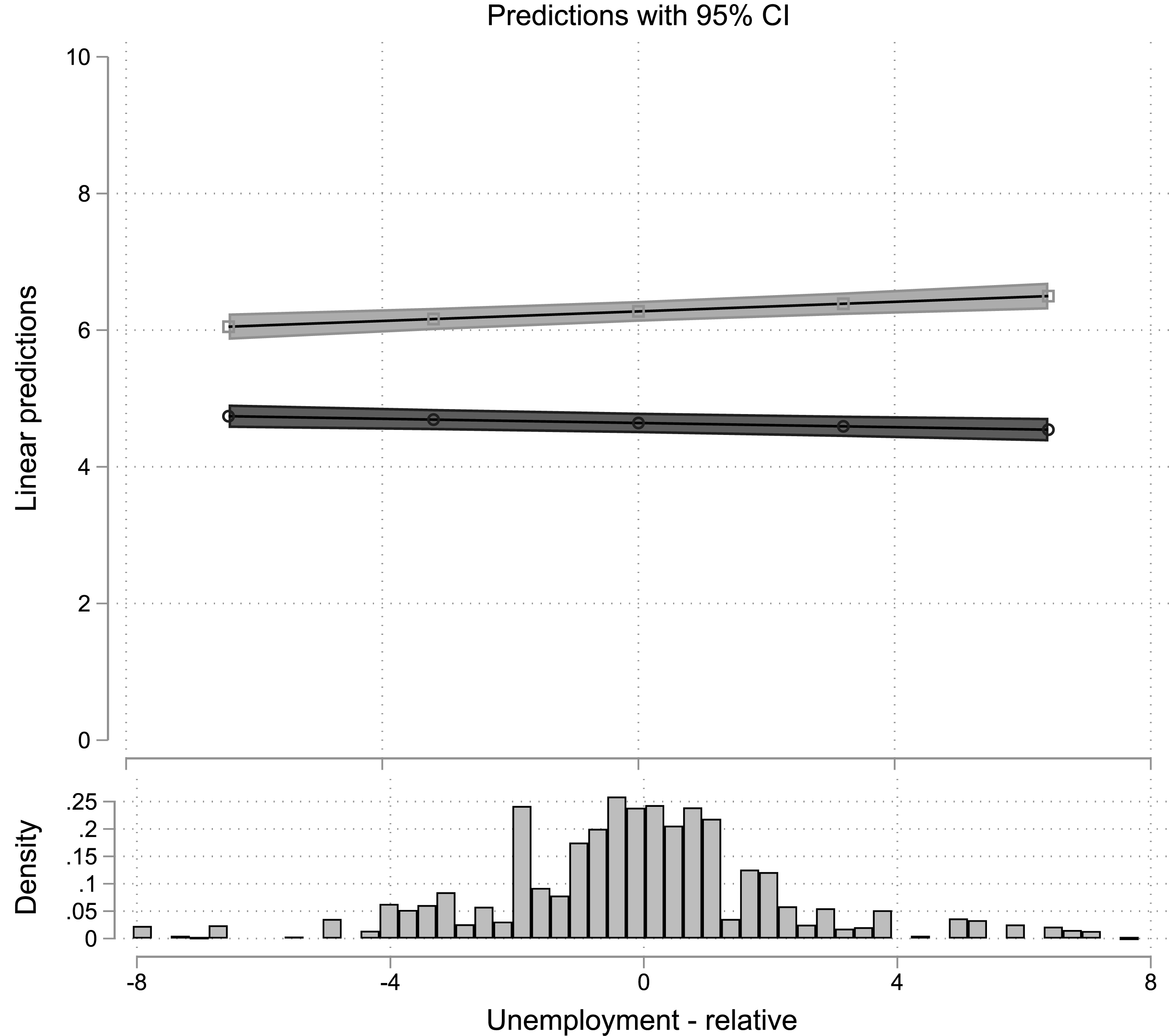
The second hypothesis from the sociological approach states that the greater the share of the population is that is not native to a country, the stronger the relationship between cultural attitudes and the left-right dimension will be. For this hypothesis, we do find compelling results, as we can see from Figure 4. Data clearly show that the more foreign-born individuals there are in a country (compared the average in the research period), the bigger the differences are in left-right self-identification between those who favor and those who oppose more immigration. If there are very few migrants in the country compared to the research period, the difference in left-right self-identification of those who are most pro-immigration and most anti-immigration is less than one point. In the countries with the highest level of migration, this difference is more than two points (on an eleven-point scale). Predicted probabilities (foreign-born population). Predicted probabilities of immigration index over different levels of foreign-born population (light area and squared dots present effect for respondents who do not see immigrants favorably; dark area and circles present effect for those who do see immigrants favorably). Based on Model 2 in Table 1.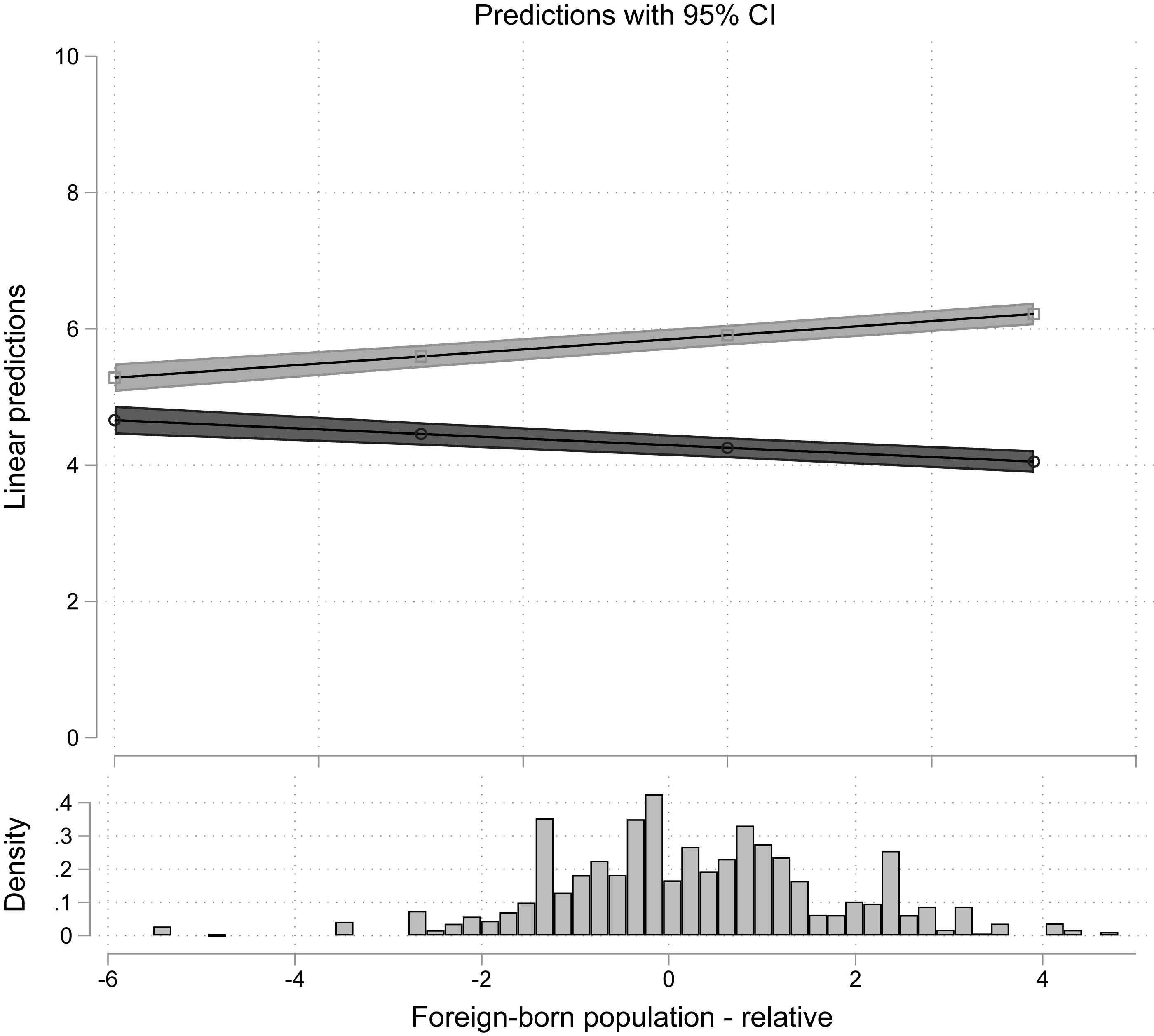
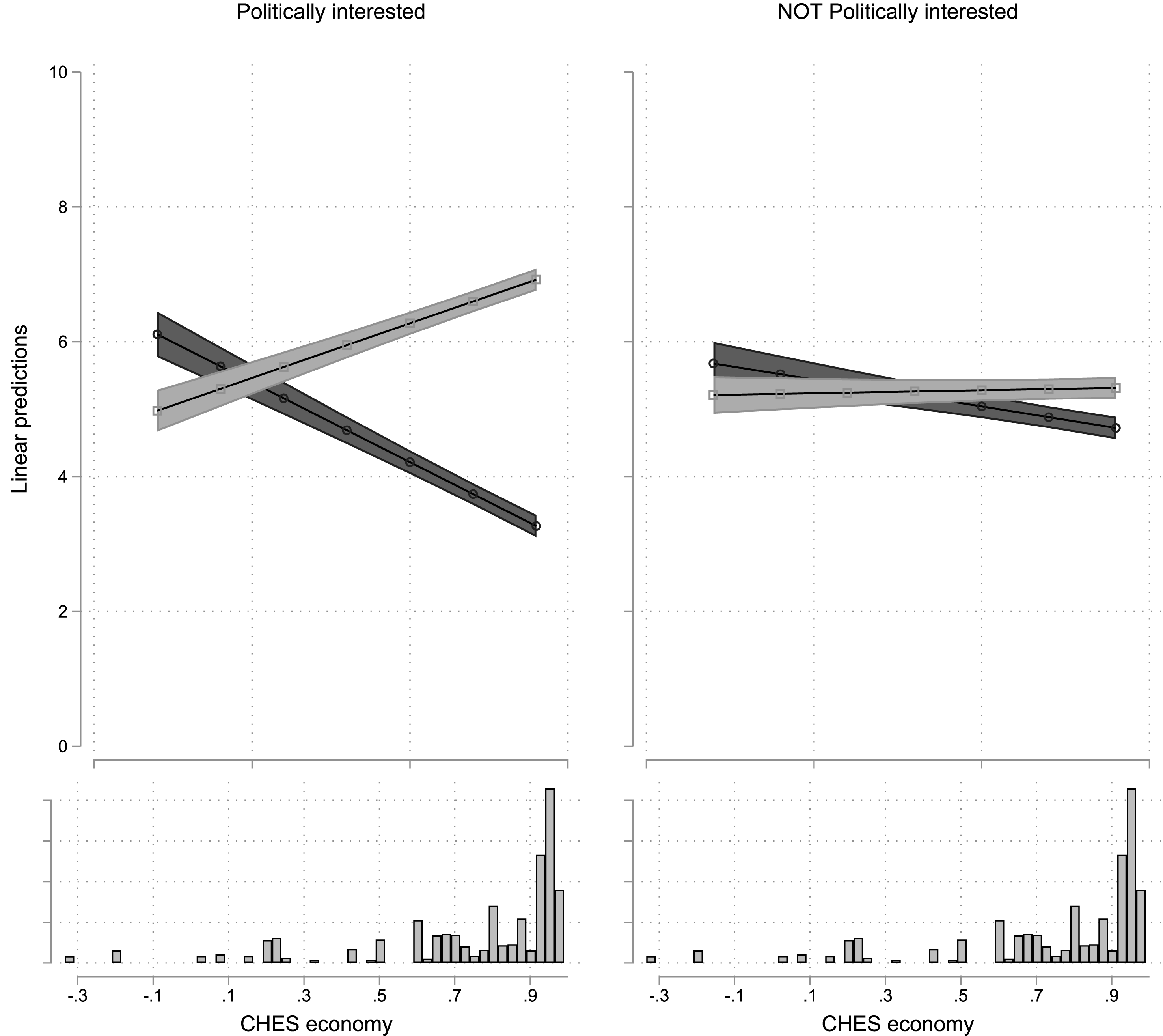
Overall, we find significant evidence for each our hypotheses. In the Appendix, we present a number of robustness tests. First, as flagged above, one issue with the strategic approach may be that instead of voters responding to politicians’ cues, it may be that politicians respond to how voters think about issues. To test the importance of politicians’ cues, we restrict our analysis to respondents who follow politics more closely (proxied by their self-reported higher interest in politics). If the relationship is about cueing, then these voters should be more sensitive to the nature of elite conflict. We test this by including three-level interactions, adding political interest to the above-described two-level interactions between individual-level variables and CHES variables. These models are presented in full in the Appendix (specifically Table A4). Here, we highlight plotted effects for these three-level interactions. Figures 5 and 6 clearly show that this assumption is well established in our data. Namely, effects are clearly significantly more pronounced for respondents who are politically interested compared to those who are not. If at the elite level, the left-right completely aligns with the economic dimension, then politically interested inegalitarian and egalitarian voters tend to be two-and-a-half points apart on the left-right dimension. For politically uninterested voters, this difference is closer to one point. For immigration, we find an even stronger pattern; if at the elite level, the left-right completely aligns with the immigration dimension, then politically interested conservative and progressive voters tend to be three points apart on the left-right dimension. Among politically uninterested voters, this difference is smaller than one point. Predicted probabilities (political interest; CHES economy). Three-level interaction between redistribution preferences, political interest and CHES economy (light area and squared dots present effect for respondents who do not want more redistribution; dark area and circles present effect for those who want more redistribution). Based on Model 4 in Table A4 (appendix). Predicted probabilities (political interest; CHES Immigration). Three-level interaction between immigration, political interest and CHES immigration (light area and squared dots present effect for respondents who do not see immigrants favorably; dark area and circles present effect for those who do see immigrants favorably). Based on Model 4 in Table A4 (appendix).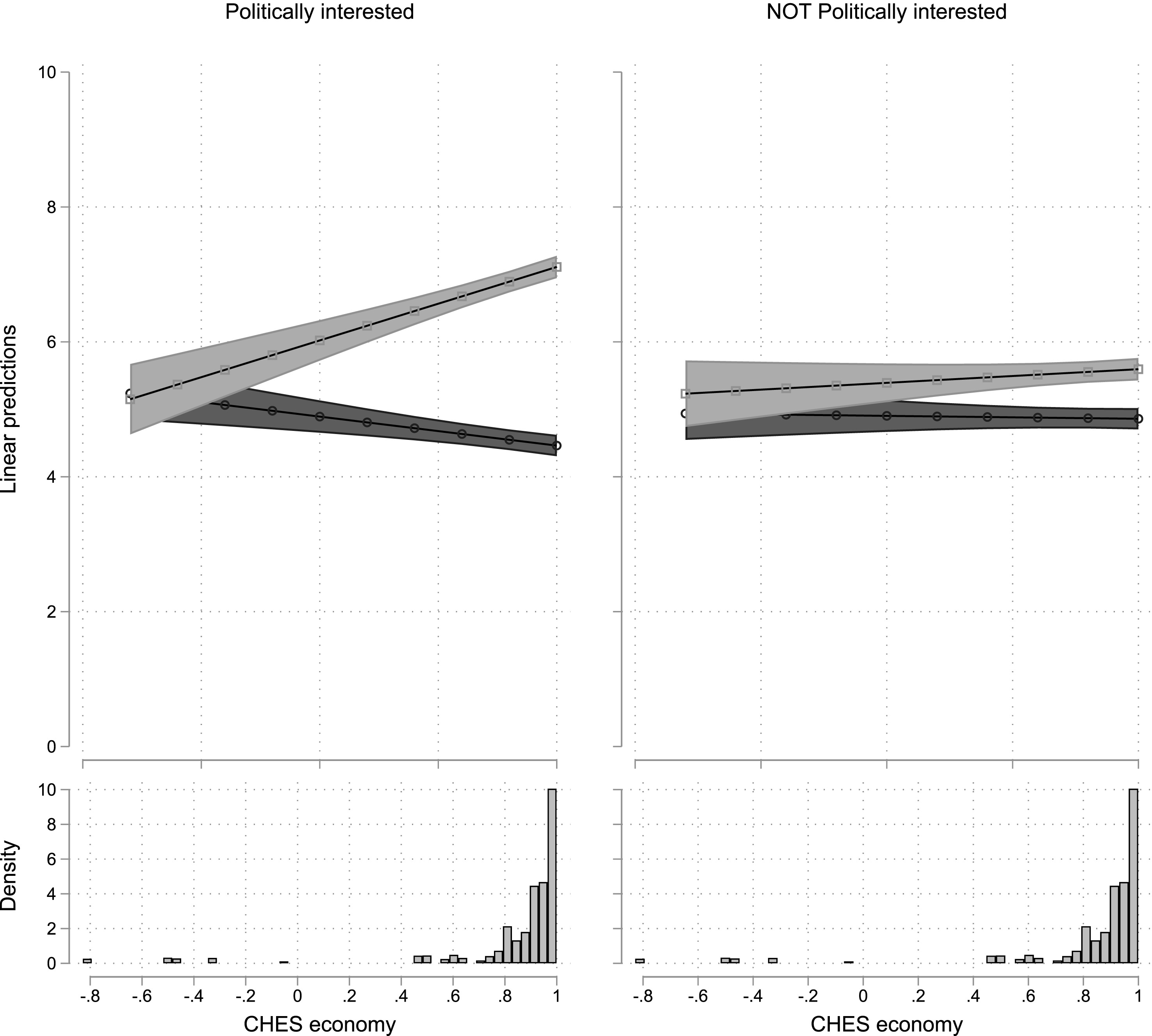
While the elite cues may be more visible for voters who are politically interested, the socio-economic variables may also be more visible for specific voters. In Table A5 in the Appendix, we interact individual characteristics with the contextual variables: we look at employment status for the economic explanation and residence (urban-rural) for the cultural explanation. The underlying argument is that voters who are unemployed themselves are more likely to update their left-right self-positioning based on their economic views as unemployment increases. For the sociological-cultural explanation, we chose the difference between urban and rural because migrants often live in larger cities. Therefore, for voters who live in larger cities, the demographic change of the population may be more salient than for voters who live in rural areas with migrants. The results (in Figure A1 and A2) highlight distinct shifts in political orientation in response to economic and cultural factors. Among employed individuals, those who support redistribution tend to move further to the left as unemployment rises, whereas those who oppose redistribution exhibit a rightward shift under the same conditions, as Figure A1 shows. However, for individuals who are unemployed, left-right identification does not depend on the country’s level of unemployment. We still see a difference in left-right position between egalitarian and inegalitarian respondents, but this does not change with country-level unemployment. This suggests that when people become unemployed, they no longer understand the relationship between left and right and policy positions from a macro-societal perspective. Future research with a stronger causal design may want to investigate this. On the cultural dimension, we observe less pronounced polarization in rural areas (Figure A2): Among individuals living in both urban and rural areas, an increase in the share of the foreign-born population leads those with unfavorable views of immigrants to shift more to the right, while those with favorable attitudes toward immigrants tend to move further to the left. The effect of migration views on left-right self-positioning is a slightly more pronounced among those living in urban areas.
In the Appendix (specifically Table A6 and Figures A3 and A4) we also look at an alternative approach to elite conflict. Instead of looking at whether the elite-level left-right positions correlate with economic and cultural issues, we look at whether the elite focuses attention on economic or cultural issues in their manifestos. That is, we expect that when more manifestos focus on, for instance, economic issues, the relationship between voter-level economic attitudes and left-right self-identification will be stronger. The results we find here are weaker, in particular for the economic dimension. If we see parties merely as cueing the importance of an issue (instead of more positional cues, as our CHES measure reflects), we find that economic cues only matter in one of four models. It does not have a significant effect if we weight the cues by party size and if we include the more statistically demanding model with random slopes for the lower-level variables; in that case, only the interaction for immigration cues remains statistically significant. This affects the significance of unemployment as well, which is also not significant in one of the four models (specifically the one with random slopes for the individual level variables). Figure A3 shows that the more manifestos focus on economic issues, the more voters with inegalitarian views identify themselves as right-wing. Figure A4 shows that for cultural issues there is a clear effect of attention on cultural issues: if parties spend no attention to migration, voters with different positions on migration are one point apart on the left-right dimension. If the attention parties spend on issues at its highest, the results are three points apart. These weaker result show that positional cues are different from salience cues. Salience cues concern both valence and positional economic issues. However, our theoretical thinking departs from the notion that positional issues matter, not valence, since it is the salience of positional issues which should change voters' left-right position. There is no reason for a voter to choose the left or the right side in politics specifically because of economic valence issues, but positional issues should lead voters to choose different sides. 6
In the Appendix (Table A7-A9 and Figures A5-A7), we also examine three alternative measures of economic circumstances: GDP per capita (which, like unemployment, is calculated relative to average GDP per capita in that country in the research period), inequality (also relativized) and absolute unemployment (without taking into account the average unemployment). The findings for the first two variables support the relationship we previously presented for unemployment; when societies are poorer or less equal, the economic positions are associated more with the left-right dimension. If we look at the actual unemployment rate, the relationship disappears. This is likely because in that case the variable picks up on between-country differences instead of within-country differences.
We also look at the possibility that the strong results for the migration measure compared to the economic measure are caused by the migration measure being an index where economic positions are measured by a single item. We examine this in the Appendix (Table A10 and Figure A8-9). Even when we use a single indicator for the cultural positions, the results still support the two migration-related hypotheses.
Our models rely strongly on multiple interactions. Braumoeller (2004) and Gunderson (2022) propose that if one includes the interaction between variable A and B and the interaction between variable A and C, one also needs to include the interaction between variable B and C and the three-way interaction between A, B and C. By not including these interactions, one essentially assumes that the interaction between B and C and the three-way interaction are zero. If all variables are involved in the same interaction, the number of interactions grows exponentially with the number of variables. When both economic and cultural factors are part of the same interactions, a model with seven variables would require 120 interactions. To address this concern, we included a simplified model in Table A11 in the Appendix (visualized in Figures A10-11), that includes only three-way interactions between the cluster of variables related to economics and the cluster of variables related to migration; 7 that is, between redistribution, unemployment, and CHES Economy and between migration, share of foreign-born residents and CHES migration.
Where it comes to the cultural explanations, the two panels in Figure A10 indicate that when the cultural dimension structures the elite-level left-right dimension, voters who think favorably of migration are more likely to place themselves on the left, independent of whether share of foreign-born residents is either relatively low or relatively high. For voters who are opposed to migration, the pattern is different: when the share of foreign-born residents is low, the elite cues do not impact the left-right self-positioning of these voters, but when it is high, elite cues are important for their left-right self-positioning. The net result of this is that when the share of foreign-born residents is high and party positions on the cultural positions follow the left-right dimension, the effect of migration views on left-right self-positioning is greater than when the share of foreign-born residents is low, when elite cues are not consistent, or when neither condition is present. In this three-way interaction, we find evidence for both the strategic-cultural and sociological-cultural hypotheses.
When it comes to redistribution, the two panels in Figure A11 indicate that when at the elite level, the economic views follow the left-right dimension, voters who oppose redistribution are more likely to position themselves as right-wing, independent of whether unemployment is low or high. For voters who support redistribution, we see a different pattern. These voters only place themselves more on the left when unemployment is relatively high. When unemployment is relatively low, there is no relationship between party cues and voter left-right positioning. The net result of this is that when unemployment is high and party positions on the economic dimension follow the left-right dimension, the effect of the economic dimension on voter left-right self-positioning is greater than when elite cues are not consistent, when unemployment is low, or when neither condition is present. In the rare case when parties do not cue that pro-redistribution is left or anti-redistribution is right, there is no substantial difference in the left-right self-positioning between those who have different economic preferences. When economic cues are consistent, greater unemployment does increase this effect. This means that the effect of unemployment is conditional on party positioning. All in all, using these three-way interactions, we find that the two cultural explanations are robust, but the model shows that the effect of unemployment is conditional on party cues.
Conclusion
We examine to what extent the content of the terms ‘left’ and ‘right’ among Europe’s voters have reflected the context that they operate in. From a sociological perspective, we determine how the way in which citizens conceive of left and right correlate with the economic and societal circumstances. From the strategic perspective, we determine how these left-right conceptions reflect elite cues.
We find strong and convincing evidence pointing towards the strategic approach. That is, if the left-right and a specific issue are linked at the elite level, then they are linked at the voter level. This is true for both economic issues and cultural issues. Our results point to the importance of political elites: the way in which citizens think of terms such as left and right reflects how political elites link issues. While we do not seek to make a causal claim, we at least find that the correlation, a necessary condition for causation, is present. In this research, spanning 26 European countries over nearly 20 years, we provide robust evidence for the strategic hypotheses. Subsequent studies could consider adopting a more experimental methodology to ascertain evidence regarding causality.
For the sociological approach (the idea that how voters think about issues reflects societal circumstances), we also find strong and significant results; we find that in countries with a more diverse population in terms of migration background, the left-right dimension is more often related to the cultural dimension. When unemployment is historically high, voters’ left-right positions reflect their economic views. These results are significant when looking at alternative measures of economic circumstances (e.g., inequality and GDP per capita). Further analysis does indicate that the effect of unemployment is conditional on partisan cues: when parties do not cue that left is pro-redistribution and the right is anti-redistribution, there is no difference between the left-right self-positioning of voters who have egalitarian and inegalitarian views, independent of the level of unemployment. Moreover, the nature of the cue matters: we find that how voters conceive of left and right changes as positional cues change, but not necessarily when the salience cue change.
All in all, this indicates that voters take into account both the cues sent by politicians about what is left and right, and the economic and demographic circumstances on the ground as they experience these themselves. Given the emphasis on the importance of elite cues in the literature, our results for societal circumstances are particularly notable: they do point to the importance of voters’ experiences in addition to cues they get from politicians in shaping their political attitudes.
The notion that voters’ views reflect elite competition follows from the classical literature on political socialization (Campbell et al., 1960; Converse, 1969; Key, 1961; Zaller, 1992), which argues that the labels ‘left’ and ‘right’ are part “of one’s political education, of one’s political and social adjustment” (Arian and Shamir, 1983: 140). That theory would propose that interpretations of left and right would be settled in the impressionable years of citizens, and then remain relatively stable over the course of their life (Steiner, 2024). Therefore, a model as presented here, where current societal context and political debates are correlated with current left-right self-placement, is not entirely in line with this theory. Future research may want to delve further into this discrepancy and examine to what extent the societal context and political circumstances of one’s youth shape citizens’ views of the meaning of left and right, and the extent to which the current societal and political context do. A more individual-level approach will also allow political scientists to determine to what extent the meaning of left and right differs between individuals, generations and social groups depending on their experiences (Bauer et al., 2017; Lo et al., 2014; Steiner, 2024; Thorisdottir et al., 2007). As Dalton (2010: 105) writes, “To a German blue-collar worker, left may still mean social welfare policies; to a young German college student it may mean environmental protection and issues of multiculturalism.” Our first results regarding the effect of location of residence and unemployment status indicate promising results. Future research may want to consider how other individual-level variables affect which issues voters link to left and right. These studies could potentially study the role of religiosity, for instance, (with more religious voters linking moral issues more to their left-right position).
A second issue that future research may want to tackle is the causal mechanisms at play. Our study was purely correlational: we show that under particular societal and political circumstances, the left-right positioning of voters has reflected their economic or cultural positions. This does not allow us to determine definitively the flow of causality. It may be that some political elites exploit particular societal circumstances to focus the meaning of left and right in the eyes of the voters in a cultural or economic way. It could also be that politicians ape the societal conflict that they see on the streets in parliament: i.e. politicians follow society’s cues instead of the other way around. Yet, it may also be that independently of political rhetoric, when particular societal circumstances are salient in the mind of voters for example, during a period of economic downturn, voters think of left and right in economic ways. We need more causal work in the field of left-right identification using longitudinal data and quasi-experimental designs to test the underlying causal mechanisms more explicitly.
Supplemental Material
Supplemental Material - Between class conflict and culture war. How left-right self-positioning reflects elite conflict and social-economic context
Supplemental Material for Between class conflict and culture war. How left-right self-positioning reflects elite conflict and social-economic context by Simon Otjes, Slaven Živković and Alexia Katsanidou in Party Politics.
Footnotes
Acknowledgements
This paper has been previously presented at the 2022 ECPR General Conference. The authors would like to thank the reviewers and editors of this journal, the attendees of the session at the General Conference for their careful comments and suggestions. We thank Niki Haringsma for his excellent editorial assistance.
Declaration of conflicting interests
The author(s) declared no potential conflicts of interest with respect to the research, authorship, and/or publication of this article.
Funding
The author(s) received no financial support for the research, authorship, and/or publication of this article.

Supplemental Material
Supplemental material for this article is available online.
Notes
Author biographies
References
Supplementary Material
Please find the following supplemental material available below.
For Open Access articles published under a Creative Commons License, all supplemental material carries the same license as the article it is associated with.
For non-Open Access articles published, all supplemental material carries a non-exclusive license, and permission requests for re-use of supplemental material or any part of supplemental material shall be sent directly to the copyright owner as specified in the copyright notice associated with the article.
