




Abstract
Our paper investigates the drivers of party digitalisation, measuring the influence of environmental factors, inter-party competition and party characteristics on the utilisation of digital tools. The main innovation of this paper is to propose a measurement of digitalisation that classifies digital processes according to their functions and goals: an internal dimension oriented towards participation and members’ engagement, and an external dimension focused on communication and campaigning. Data has been extracted from the DIGIPART database on parties’ digital procedures by Meloni et al. (2024). Our findings highlight the importance of parties’ organisational and ideological features in explaining their internal digitalisation, but not the external. In terms of participation, bigger parties tend to implement more initiatives for online participation, while right-wing parties are less prone to digitalise their internal structures. These effects are reinforced by competition between rivals and contagion processes, which exert positive influence both at the internal and external levels.
Introduction
The diffusion of Information and Communication Technologies (ICTs) has altered the way parties organise and interact with their own members and citizens. Seminal studies on this research strand have analysed how the meaning and characteristics of party digitalisation have changed over time (Gibson and Ward, 1999; Norris, 2001; Vaccari, 2013; Ward and Gibson, 2009). Scholarly research has systematically explored the impact of the digital transformation and party competition on the party system through the normalisation and equalisation hypotheses (Gibson and McAllister 2015). More recently, the effects of party digitalisation on internal participation, decision-making and intra-party democracy have also been explored mostly in new parties (Blum and Zuber, 2016; Boyd, 2008; Gerbaudo, 2019; Meloni and Lupato, 2023; Vittori, 2020).
However, research on the main dimensions and drivers of party digitalisation is still underdeveloped (Barberà et al., 2021; Fitzpatrick, 2021; Sandberg, 2022). While there have been some attempts to understand party digitalisation as a single phenomenon (González-Cacheda and Cancela, 2024; Sandri et al., 2024), most of the literature nevertheless points out the differences between the internal (oriented to participation) and the external (oriented to communication and campaigning) dimensions of party digitalisation (Bennet et al., 2018; Deseriis, 2020; Lioy et al., 2019). By the same token, while the phenomenon has mostly been approached as driven by internal organisational features (González-Cacheda and Cancela, 2024; Sandri et al., 2024), the impact of contagion effects (Gauja, 2016) has not been sufficiently researched. In particular, we lack evidence on the influence of competitors’ innovations over parties’ digitalisation and the imitation synergies that can be generated.
The aim of this paper is two-fold: first, we revisit the literature on the meaning and facets of party digitalisation to theoretically underpin the distinction between its internal and external dimensions. Second, we identify macro (societal and institutional), meso (party system) and micro (organisational) features that might influence both dimensions of the phenomenon. Our main expectation is that party digitalisation is not just related to the particular features of a party (such as ideology or resources), but also to contagion trends between competing parties. To do that, we rely on Sandri et al. (2024), who identified different dimensions and variables of party digitalisation, drawing inspiration from Fitzpatrick’s (2021) pillars and García-Lupato and Meloni (2023) framework. Based on this, we construct two indexes: the Internal Digitalisation Index, encompassing intra party democracy initiatives; and the External Digitalisation Index, based on the use of ICTs for party communication and campaigning purposes. The data is extracted from the second round of the DIGIPART dataset (Meloni et al., 2024) which covers a sample of 79 parties from five European countries (France, Italy, Germany, Spain, and the United Kingdom). The main innovation introduced by this dataset is to map digital procedures that were effectively implemented, classifying them according to dimension they are oriented at: communication or participation and decision- making.
The results confirm that party internal digitalisation is partially explained by ideology (micro level). In particular, right-wing parties are less likely to develop digital participation initiatives. However, ideology does not exert any effect over the external digitalisation, which our model can only explain by party competition. The contagion hypothesis receives empirical support in both dimensions, emerging as the most relevant explanatory factor of party digitalisation and adding new evidence on how digitalised political environments increment party digitalisation. Such findings contribute to a better understanding of the drivers of party digitalisation by offering two main innovations: first, showing the importance of considering both environmental and internal conditions; and second, measuring the internal and the external dimension of the digital transformation. The divergent results between external and internal digitalisation highlight the importance of analysing both dimensions as separate processes, explained by different factors.
The paper is structured as follows: After engaging in the main theoretical debates on the implications of party digitalisation, we analyse previous works on its drivers to explore an alternative framework of analysis. In the second section we explain the composition of the dataset and the methodology. Finally, we present the results of our regression analysis and discuss its main implications.
Explaining internal and external party digitalisation
Meaning and dimensions of party digitalisation
Digital tools have been used by political parties since the mid 1990s, providing new opportunities for internal management, campaigning, and communication (Gibson and Ward, 1999; Lilleker et al., 2011; Norris, 2001; Ward and Gibson, 2009). That said, the meaning of party digitalisation has substantially evolved over time, expanding the focus from the transformation of external communication activities to changes in internal structures and decision-making procedures. On the one hand, social media and online platforms have provided new possibilities to spread their messages and reach larger audiences (Jungherr et al., 2019). On the other hand, digital tools have expanded the potential for internal participation and members’ engagement (Dommett et al., 2020a; Gibson et al., 2017; Scarrow, 2014; Mosca and Quaranta, 2017).
This change of meaning has been extensively pointed out by the emergence, during the mid- 2010s, of several often labelled as new digitally native parties such as the Five Stars Movement, Podemos or the Pirates. These parties have combined radical claims on participation and grassroots democracy with an intensive use of newly developed digital participatory tools (Gerbaudo, 2019; Mikola, 2018; Vittori, 2020). Seminal academic research has since devoted much attention to disentangle to what extent the intensive use of digital tools for intra-party democracy (internal dimension) or party communication and campaigning (external dimension) has led to substantial organisational differences and, eventually, to different party models (Hartleb, 2013; Bennett et al., 2018; Deseriis, 2020; Lioy et al., 2019). In parallel, since the late 2010s, and especially after the COVID-19 pandemic, more mainstream political parties have embraced a wider variety of digital tools for participation (Cross and Pilet, 2015; Hazan and Rahat, 2010; Pilet and Cross, 2014; Sandri et al., 2015). Due to this normalisation trend, many cutting-edge digital participatory tools have been experimented and adopted by a growing number of parties. In that sense, Thuermer (2021) proposed a conceptual division between digitalisation by default and selective digitalisation: while some parties (mostly digital natives) base all their internal processes, decision-making and membership online, constituting fully digital organisations, other parties choose a more selective approach, keeping some activities offline while digitalising only some specific processes. Further, new research has pointed out how the institutionalisation process undergone by some of the digital native parties has resulted in partial de-digitalisation trends, based on the suppression or re-definition of certain digital structures and online procedures in favour of more hybrid models (Meloni and Lupato, 2023).
The blurring distinction between the digital affordances used by new and mainstream parties has highlighted the need to discuss party digitalisation as the key overarching phenomenon, and to identify its main dimensions (González-Cacheda and Cancela, 2024; Raniolo et al., 2021; Sandri et al., 2024). The implication is that party digitalisation is a quickly evolving phenomenon developing at different intensities not only between parties, but also among different organisational dimensions within each political party. So far, Fitzpatrick’s (2021) five-pillar model has provided a useful analytical framework to classify digitalisation initiatives according to their functions and develop different indicators for specific organisational needs: communication, participation, voting, deliberation, and organisation. These pillars, further divided into subcategories, allow to map and quantify internal and external dimensions of party digitalisation with specific indicators (Sandri et al., 2024).
Macro, meso and micro drivers of internal and external party digitalisation
Extant research has not satisfactorily filled important gaps regarding the driving conditions of party digitalisation, and there is still scarce evidence of which incentives parties may have when it comes to introduce digital tools. A seminal approach on party digitalisation studies has focused on building overall party digitalisation indexes to identify the main variables that potentially explain variation between parties. This emerging research strand has mostly focused on the impact of party features such as ideology, party family, age or size (González-Cacheda and Cancela, 2024; Sandri et al., 2024; Villaplana et al., 2023).
In this regard, Sandri and colleagues (2024) have found a positive relationship between the size and the digitalisation level of the party, being bigger parties more prone to use ICTs. More surprisingly, older parties seem to be more advanced too, whereas ideology does not seem to be conclusive, confronting the assumption that digitalisation is primarily a new-left parties’ initiative. These insights are coherent with the economic requirement of any organisational reform, since online platforms, voting systems and other technologies represent an investment which not all parties can afford. Resources and expertise give a competitive advantage to mainstream and well-established parties in relation to smaller, newer ones. Nevertheless, more recent research did not find a statistically significant relationship between the age and the digitalisation of the party. Also party families, instead of ideological categories, have been found to be more powerful explanatory factors. In particular, Greens make a more extensive use of digital tools, while Conservatives the least (González-Cacheda and Cancela, 2024).
These findings bring into discussion the possibility of further variables and alternative measurements of digitalisation. Firstly, while focusing on internal party features, previous research has often overlooked potential drivers of digitalisation, such as inter-party competition or systemic conditions at the country level. Indeed, the integration process of new technologies in political parties is arguably influenced both by their organisational design and their environment (Kurban, 2023). Secondly, measures of digitalisation focus on the overall use of digital technologies. A different approach is to explore how different factors can incentivise separate dimensions of party digitalisation: the external and the internal. These factors can be classified at the macro, meso and micro levels (Barnea and Rahat, 2007). Macro conditions refer to the characteristics of the political system and the electorate, shaping the normative and social environment of political parties. The meso level encompasses the party system interactions and how competition between rival parties hikes innovation. Lastly, the micro level consists of the organisational features of each party.
Extant research has already suggested that contagion processes can drive the generalisation of digital technologies in a party system (Raniolo and Tarditi, 2020; González-Cacheda and Cancela, 2024). Interacting and competing with each other, parties receive information from their environment which can incentivise their own innovation (Dalton et al., 2002). Ultimately, this would lead to imitation processes and the generalisation of digital structures through a contagion effect (Dommett et al., 2020b). Indeed, higher levels of electoral competition and the emergence of strong new parties have been pointed out to have a positive effect on party digitalisation (González-Cacheda et al., 2022). In the internal dimension, the innovations introduced by strongly digitalised competitors may incentivise other parties to develop online participatory platforms, especially when new competitors exert electoral pressure. In the external dimension, the normalisation of online communication and electioneering by leading digital parties may as well raise digitalisation of its rivals. Based on these observations, we propose the following hypotheses:
Micro factors are more plausibly connected to the internal dimension of digitalisation, given the normative implications and organisational conditionings of intra-party decision-making. In terms of age, previous research did not obtain conclusive results. Although Sandri and colleagues (2024) found older parties to be more digitalised, González-Cacheda and Cancela (2024) could not confirm this association. Building on our contagion hypothesis, we do not expect age to condition party digitalisation, given that older parties may replicate younger parties’ initiatives and vice versa. As for size, parties with less resources have been considered more prone to utilise digital tools for bases mobilisation (Mosca and Quaranta, 2017). Actually, empirical investigations have found bigger parties to be more digitalised (Sandri et al., 2024). This would be due to the fact that big parties have more resources and expertise to develop online platforms for their internal functioning. On the contrary, usage of social media is precisely characterised by its accessibility and relatively low cost. ICTs have arguably enabled small parties to overcome their lack of absence to mainstream media (Galais and Cardenal, 2017). Hence, we should expect party size to increase internal digitalisation, while the external dimension will not be affected by it.
Regarding ideology, the literature has often stressed that left-wing parties are more prone to develop online participatory processes, partially answering their electorate’s concerns over inclusiveness and transparency (Bennet et al., 2018; Hartleb, 2013; Mosca and Quaranta, 2021). Although this has not been empirically supported (González-Cacheda and Cancela, 2024; Sandri et al., 2024), the lack of evidence may be due to the measurement of digitalisation as an overall index. Whereas the external dimension can be hardly explained in normative terms (based instead on competitiveness), the internal dimension is probably more connected to ideology, as it refers to decision-making and participative culture. They should thus be analysed separately.
As for macro level factors, they are not as likely as meso and micro drivers to have a bearing on parties’ external digitalisation. This is due to the weaker connection between general trends of digitalisation in a country and the specific strategies of political parties. On the contrary, Schaub and Morisi (2020) showed broadband Internet benefited new populist parties in Germany and Italy (even if in a modest way) as it provided a communication platform suited to its communication needs, allowing them to circumvent traditional information gatekeepers. However, as they point out, mainstream parties can (and have) caught up in their digital use, even if the communication style allowed by the Internet benefits more populistic and anti-elitist rhetoric. Accordingly, we control for the potential effect that societal digitalisation may exert over parties’ utilisation of ICTs.
Resources have been also stressed as an important determinant of parties’ capacity to introduce structural reforms. Having a high level of financial resources might enhance digitalisation initiatives, allowing parties to invest in online infrastructure (Margolis and Resnick, 2000). At the macro level, we argue that resources must be measured in terms of parties’ average income. While parties’ private income is ultimately related to their size and electoral performance (e.g. members’ fees and private donations), public finance establishes a general base for every party in a country. Hence, this may create common conditions that explain the average digitalisation of a party system. For instance, we could consider how higher rates of public party funding could predict higher levels of overall digitalisation. While we do not develop specific hypotheses on determinants of digitalisation at macro level, we include resources and public funding as control variables in our analysis.
Research design
Case selection and data
The analysis is mainly based on the DIGIPART dataset (Meloni et al., 2024), initially elaborated for exploring the use of online platforms and procedures for 62 parties across five countries (France, Italy, Germany, UK and Spain) for the period 2021-2022 (Sandri et al., 2024). It includes information on digital procedures that were effectively implemented by parties, providing us with more direct observations in comparison to other datasets previously used (González-Cacheda and Cancela, 2024). The PPDB (Scarrow et al., 2022), concretely, does not specifically cover data on digitalisation and is not based on actual use, but on manifestos and party norms.
Following our research questions, DIGIPART has been expanded in two ways. Firstly, we have added new data on non-statewide parties covering the same period 2021-22, based on Mompó and Barberà (2023). Introducing a multi-level perspective in our analysis ensures a more fine- grained analysis of the determinants of party digitalisation. Secondly, we have included two macro variables: on the one hand, we rely on the Digital Economy Society Index 1 (DESI), built by the European Commission, which measures national digitalisation levels. This allows us to explore the connection between general levels of digitalisation (at the economic, social and government level) and the digitalisation of parties, showing somewhat similar levels of digitalisation in our five countries. On the other hand, we have included data from Ignazi and Fiorelli (2022) on public funding as a percentage of the average income of the main political parties of each country. Although the latest data is from 2016, it indicates the average investment capacity of parties in the long-term. Hence, the variable serves as an equalisation control to moderate the effect of internal revenues (e.g. quotas and donations).
Overall, the expanded dataset provides information on 79 parties from 5 European countries: 10 parties from the UK, 20 from Spain, 14 from France, 26 from Italy and nine from Germany. Countries were selected from among the larger European states with similar but still varying scores on the DESI, to ensure a comparable systemic context in terms of progress in digital transformation. The sample includes both established and new parties, state-wide and non- statewide, from different party families. All parties with parliamentary representation at the national or regional level were considered relevant in Sartori’s terms (1976). This case selection allows for a comparison of different types of parties, moving away from more narrowly targeted case studies, small-scale comparisons, or exclusive focus on a single party family.
The variables
Dimensions of party digitalisation.
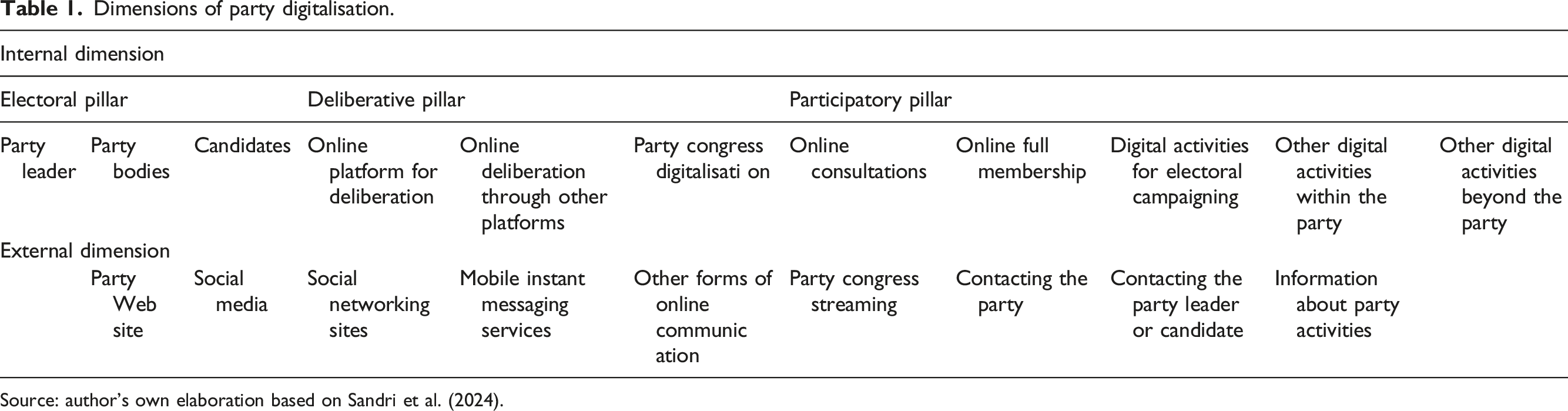
Source: author’s own elaboration based on Sandri et al. (2024).
As for the independent variables, predictors at the micro level include Size (H2), Age (H3) and Ideology (H4). Size and Age are two numerical variables based on the percentage of MPs in the parliament, and the year of foundation. Regarding Ideology, parties are classified in four categories, based on the Chapel Hill Survey, each of them coded with a number: left (1), centre (2), right (3) and not aligned (0). The left category includes social democratic, socialist, communist and left-wing ethno-nationalist parties. Right refers to Conservatives, Christian Democrat, far-right and right-wing ethno-nationalist parties, while centre parties are mostly liberals. Finally, the non-aligned group mainly includes populist or regionalist parties not matching any of the previous labels.
To measure the meso-level dimension (H1a and H1b), we have constructed two alternative indexes that capture different types of interactions within the party system. First, the Front Runner is identified as the party with the highest total digital score in each party system (sum of external and internal dimensions, with a maximum of 20 points). Its expected influence is based on electoral competition dynamics: in party systems where the Front Runner is highly digitalised, we anticipate stronger effects on digitalisation. To ensure that this effect stems from electoral competition, the Front Runner is selected exclusively from parties represented in the national parliament. Second, the Digital Dispersion Index reflects the overall digitalisation landscape by measuring the gap between the most digitalised party and the average scores of the rest of the system. It is calculated as follows: Digital Dispersion = Front Runner score - Average digitalisation (excluding front runner). By excluding the Front Runner’s score from the average, we prevent artificial inflation of the mean. The resulting value represents the distance between the most digitalised party and the remaining parties, which in turn defines the level of competitiveness. A high dispersion indicates a low level of competition, where a strongly digitalised leader faces weaker rivals, potentially discouraging further innovation. Conversely, a low dispersion suggests a more balanced digital race, where competing parties are closer in their digital capabilities, increasing the likelihood of further digital innovations.
We hypothesise that both the Front Runner’s digitalisation and the Digital Dispersion will positively influence parties’ likelihood of adopting digital tools. Since the meso variables are based on the same scales as the dependent variables, we ran robustness checks to confirm that they remain within a moderate correlation with the dependent variables (Front Runner - Internal Digitalisation: 0.54/External Digitalisation: 0.32; Digital Dispersion - Internal Digitalisation: −0.37/External Digitalisation: −0.42) 2 . Finally, at the macro level we use the DESI data as an indicator of social digitalisation, and data on parties’ access to public funding from Ignazi and Fiorelli (2022).
We test our hypotheses with a linear regression, consisting of estimating the effects of different predictors over the observed values. In this case, we measure the predicted increase on party digitalisation (Y) generated by several variables (X). This model of analysis is usual when conducting statistical analysis over small samples, and the model parameters are easily interpretable (Su et al., 2012).
Results
Meso and macro indicators.
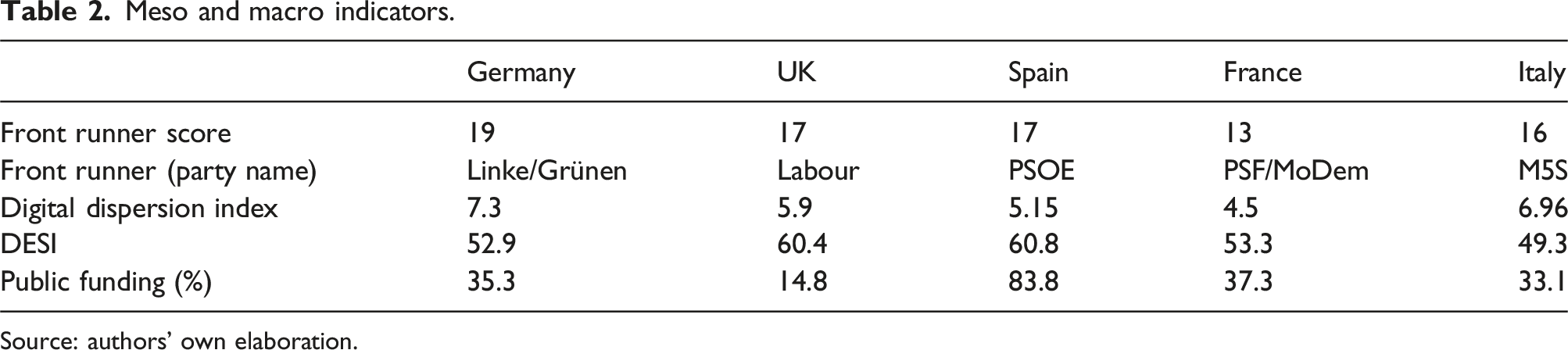
Source: authors’ own elaboration.
Graph 1 outlines the internal and external digitalisation means according to micro, meso and macro factors. On average, the external dimension of digitalisation is more developed than the internal: 7.25 over a 0–9 index, against a 4,06 over a 0–11 index. Use of ICTs such as social media and websites is in general highly developed and generalised, while online participatory platforms and electronic voting are underused in comparison. Per country, German parties have the highest internal digitalisation, followed by British and Spanish parties. French and Italians have the lowest rates. This trend is repeated with regard to external digitalisation, although this time French parties have similar scores to Spain and only Italy is behind. The standard errors are considerable in both cases, discouraging any clear national trends: only French and Italian parties can be grouped apart when it comes to internal digitalisation, given their considerably low averages. Nonetheless, it provides first evidence on the impact of the meso level indicators: higher party digitalisation matches with strongly digitalised front runners and competitive party systems. The leading position of Germany also suggests that having a strong front runner has a bigger effect than the digital dispersion. A close race does not seem to incentivise innovation as much as facing a pioneer party. On the contrary, macro factors do not seem to be conclusive: British parties are poorly subsidised but are on average highly digitalised, and even if every country has similar levels of social digitalisation, their parties differ considerably. Digitalisation means by variables.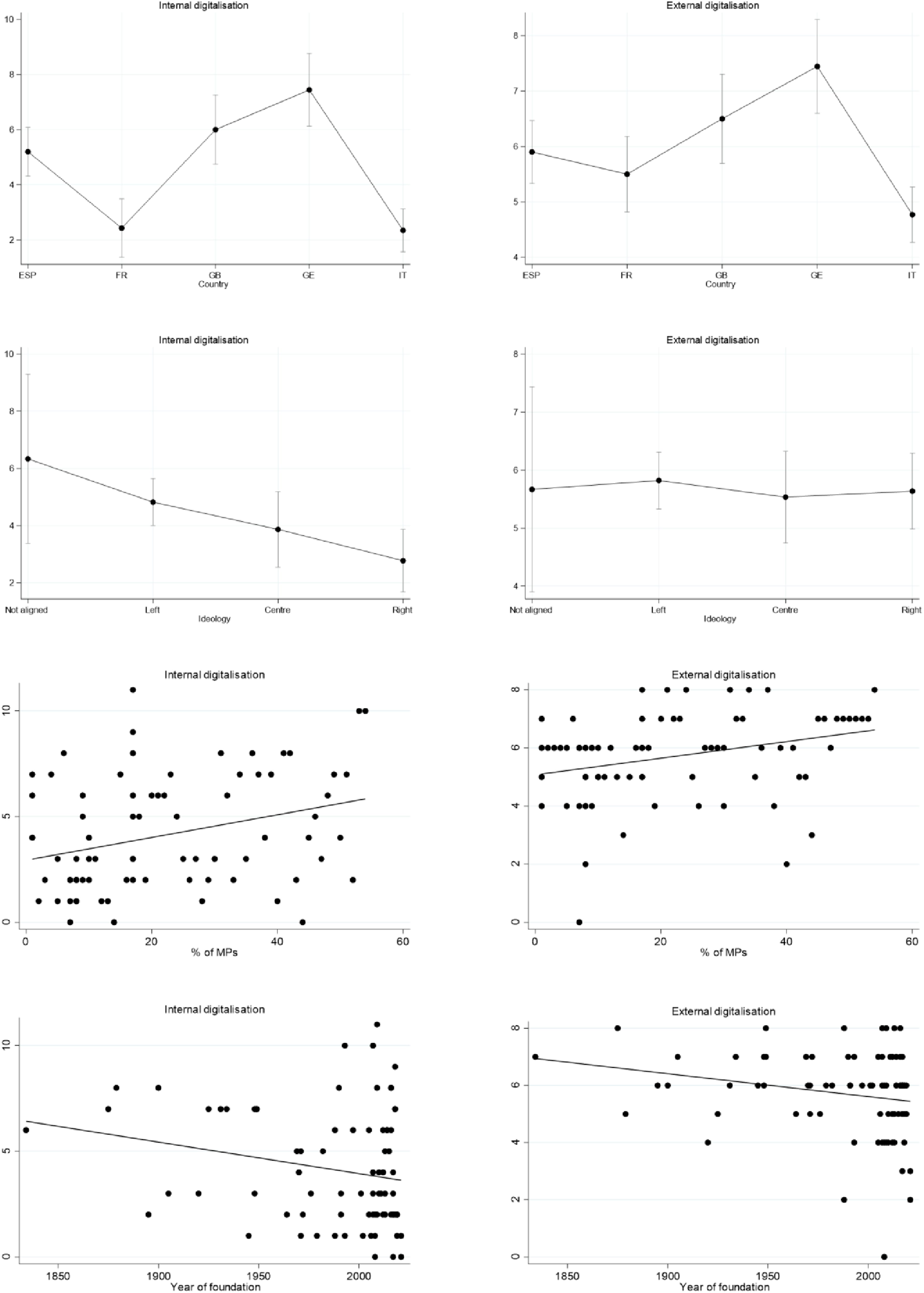
With regard to ideology, variance within each category is considerable, and we cannot demonstrate significant differences between centre, left and not aligned parties. In the last case, the margins of error are especially important due to the lack of observations. Still, the graph clearly shows that right parties have a lower internal digitalisation, a difference which does not appear in the external dimension. According to these figures, it is not possible to discern any clear influence of size and age. Older and bigger parties are on average more digitalised in both dimensions. However, there are great disparities between groups of parties with similar ages or parliamentary strength.
Linear regression on digitalisation estimates.
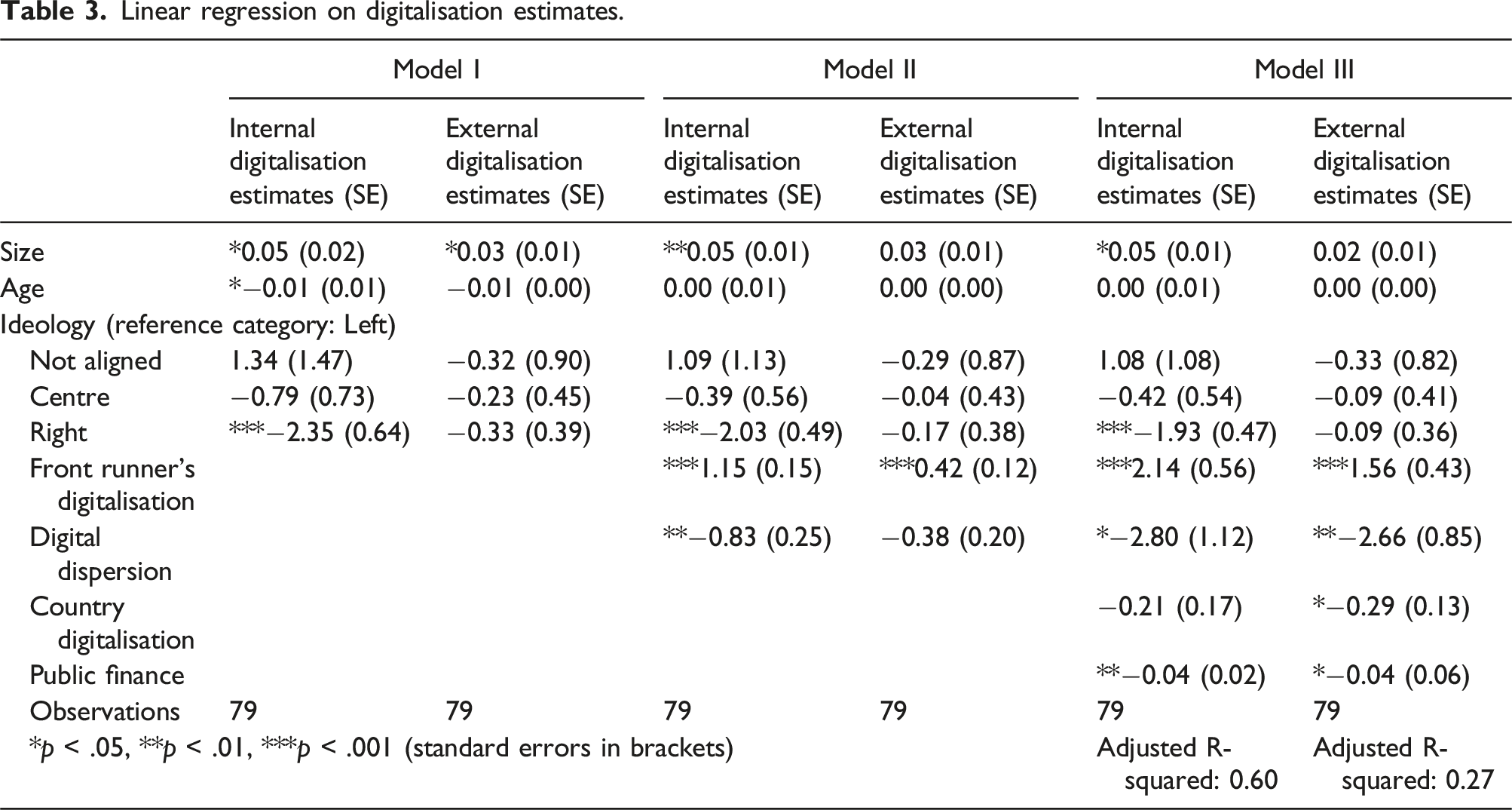
Regarding the internal dimension, meso factors are the main predictors, especially the front runner. Each additional point in the front runner’s digital index will expectably increase by 2.14 the internal digitalisation of its competitors. Dispersion also affects digitalisation, although it is statistically weaker. The negative value means that the greater the distance between the leader and the average group (high score), the lower the incentives to digitalise (-2.80). Such effects are remarkably important over a 0-11 index. Ideology is also relevant. While we did not find significant differences between left, centre and not aligned parties, right parties are considerably less likely to utilise digital tools for participation (−1.93). As for size, bigger parties are slightly more likely to use ICTs for decision-making. However, its effects (0.05) are very small and its statistical significance low, so it can hardly be considered. Contrary to our expectations, receiving a higher percentage of public finance holds a negative effect (−0.04), perhaps because it disincentives innovation. Even so, it has little influence.
For the external dimension, none of the micro variables receive empirical support. As expected, ideology and size do not exert any testable influence over parties’ use of online communication. Both macro measurements are statistically significant: the national indicators on ICTs use and public finance surprisingly exert a negative influence on party external digitalisation, but their effects are very small and statistically weak (−0.14 and −0.04 respectively). This somehow contradicts Schaub and Morisi (2020) initial analysis, but it highlights the relevance of competition and how mainstream parties have equalised their use to new and populistic ones. Only meso variables predict a higher external digitalisation. Front runner’s digitalisation will expectably increase by 1.56 its rivals’ external digitalisation. Regarding the digital dispersion, the wider the distance between the underdog and the group is, the lesser the incentives to digitalise (over −2.66).
Summarising the effects over the two dimensions of digitalisation, our models point to inter- party competition as the main predictor. The less competitive a digital environment is, the less likely are its member parties to digitalise, particularly if the front runner is comparatively less digitalised, but also if it is too far ahead from the group. We also need to consider the influence of ideology over digital participation, being right-wing parties less prone to develop the internal dimension but not the external. As expected, age is not significant in any of the models, implying similar digitalisation scores between differently aged parties. Contrary to our expectations, bigger parties are only slightly more digitalised than smaller ones.
Discussion
Our results are partially in line with previous studies on the effect of party internal features on digitalisation. Bigger parties have been found before to be more likely to develop online platforms and other participatory tools (Sandri et al., 2024). Nevertheless, our model does not show a strong effect, so this variable seems to be secondary. Hence, the second hypothesis (higher internal digitalisation among bigger parties) cannot be consistently confirmed. When it comes to the external dimension (online communication), party size does not have any demonstrable influence, supporting the idea that digital tools enhance small parties’ capacities to communicate in more equal conditions with stronger competitors that might have access to mainstream media (Galais and Cardenal, 2017). Our findings on age are also consistent with other authors’ (González-Cacheda and Cancela, 2024): as expected, being a younger or an older party does not hold a significant relationship with digitalisation levels, nor in the internal or the external dimension.
Only normative considerations exert a decisive influence over digitalisation of decision- making and members’ participation. As already stated in González-Cacheda and Cancela (2024), being a conservative party is more strongly associated with having low levels of internal digitalisation. On the contrary, the relationship between left and populist positions and internal digitalisation, extensively assumed in the literature (Deseriis, 2020; Gerbaudo, 2021; Mosca and Vittori, 2022), is not supported in our model. This conveys a different understanding of the influence of ideology: rather than a positive association between digital participation and leftist positions, what we find is a negative correlation between the former and right parties. This provides empirical support for our third hypothesis (right parties are less likely to digitalise participation and decision-making). Note that this association affects right-wing parties in general, and not just the conservative family. This is a significant finding since it points to an interaction between ideology and competition: rather than an exclusively normative stance, parties on the right seem to be less exposed to the competitive pressure of mostly leftist digital leaders. This might relate as well to the fact that none of the digital leading parties in the sample are conservative. For instance, the electoral pressure that right parties may feel is not as direct as for those in more leftist or centrist positions. Another possibility is that members of right parties simply prefer more vertical and hierarchic decision-making, so they do not have to answer participatory demands coming from their bases.
However, internal party features appear to interact only with the internal dimension of digitalisation, while we did not find any relationship between external digitalisation and micro- level drivers. Meso level factors are precisely aimed at explaining this gap, focused on how inter-party competition incentivises the introduction of ICTs both at the internal and external level. Indeed, the digital strength of the front runner increases the average digitalisation, pointing to the incidence of leading digital parties over the party ecosystem. Digital dispersion, which we have measured in terms of competitiveness and distance between the leader and the group, also proved to be significant. Rather than alternative incentives, they seem to be complementary elements of pressure within a party system. Therefore, our first hypothesis receives empirical support: inter-party competition enhances digitalisation both at the internal and external dimension.
These findings reinforce our main theoretical strand: first, different types of digital processes need to be analysed separately, aiming to find common explanatory factors; second, inter-party competition and institutional contagion can be stated as the main conditions behind both processes. We interpret this influence as an imitation and reaction mechanism: the digital innovations introduced by a pioneer party exert pressure on its competitors, incentivising further digitalisation processes in the party system. The fact that none of the front runners in our study are digitally native, supports in itself the contagion hypothesis: although we cannot establish a historical chain, parties such as PSOE and the PS have probably pushed their digital transformation by the emergence of Podemos and the France Insoumise, eventually surpassing them and dragging other parties to remain competitive. Such a process is more straightforward with regard to the external dimension. There is no need for direct competition to feel appealed by innovative communicative strategies, but their introduction can be boosted by imitation and the reception of environmental inputs. In comparison, there are more variables intervening in the internal dimension, which entails deeper organisational consequences. The introduction of online participatory tools is encouraged by imitation and competition, though it is also mediated by the ideology of the party.
Finally, differences between our two indicators demonstrate that digitalisation is more widely introduced for communication purposes, which relates to the electoral side of a party, while digital intra-party democracy is underdeveloped. When it comes to innovating in decision- making, parties seem to be more cautionary and constrained, not just to the strategies of their rivals, but to their own organisational culture and normative considerations.
Conclusion
The drivers of party digitalisation have been approached from the perspective of organisational features (González-Cacheda and Cancela, 2024; Sandri et al., 2024), while the effects of party competition have not been yet properly researched. Further, several authors have pointed to the different implications of digital initiatives oriented to communication or participation (Bennet et al., 2018; Deseriis, 2020; Lioy et al., 2019). Our article contributes to this debate by proposing two measurements of digitalisation: internal and external. Its goal is to explore the influence of party competition and party characteristics on both dimensions, using data from DIGIPART (Meloni et al., 2024).
Our findings add new evidence to the drivers of party digitalisation by studying the influence of contagion processes. Competition and imitation synergies between rivals seem to incentivise digital innovation, while the impact of internal features is more limited and conditional. Ideology mediates with meso-level conditions, predicting a lower participatory-oriented digitalisation among right-wing parties.
Nonetheless, the contribution of this study is limited by the size of the sample and its territorial bias, as it only includes parties from Western Europe. It is thus necessary to continue exploring digital processes in parties from other regions, such as Eastern Europe or Latin America. Further research should continue tracing the introduction of digital processes through time, develop additional indicators to measure meso level factors, and explore the causal connection between contagion processes and digitalisation.
Footnotes
Declaration of conflicting interests
The author(s) declared no potential conflicts of interest with respect to the research, authorship, and/or publication of this article.
Funding
The author(s) disclosed receipt of the following financial support for the research, authorship, and/or publication of this article: Adrià Mompó has contributed thanks to an “Investigo” research position granted by the Spanish Public Employment Service. Marco Meloni acknowledges the Horizon 2020 project “The rise of citizens voices for a Greener Europe – PHOENIX” for supporting his research activity.
