



Abstract
Based on new data, we assess rival claims about right parties and equality. We show that the Far Right and the Center Right have become alike regarding their positions on economic equality and equal rights. Based on crowdcoding of party manifestos, we map the equality trajectories of 69 right-wing parties in 12 OECD countries from 1970 to 2020. Following a discussion of the diverging ideological and electoral incentives of center- and far-right parties, we map the egalitarian profiles of center- and far-right parties over 50 years. Then, we conduct a multivariate analysis of trends at the party level. We find that center-right parties have been reluctant to address high inequality and demands for equal rights, while many far-right parties have surpassed them in promoting economic equality and even support for equal rights. As an important qualification, we show that far-right parties support equal rights often in abstracto without specifying groups.
Ever the anti-egalitarian right, an egalitarian turn, or a weaponization of equal rights?
Ever since the French Revolution, political scientists and political philosophers agree on one thing regarding the Left-Right dichotomy: reflecting different views of human nature that can be traced back to Burke and Rousseau, right parties defend inequalities while the Left fights for greater equality (Bobbio, 1996; Jahn, 2010) with regards to economic resources and rights.
This old consensus of a holistically anti-egalitarian Right has long given way to a multitude of perspectives on the egalitarian trajectories of right-wing parties. What is contested now is the extent to which center- and far-right parties endorse(d) economic equality and (weaponized) equal rights in their positions. By weaponization, we mean the advocacy of equal rights for minorities in a context where parties frame these rights in opposition to a supposedly “parochial” non-western migrant culture. This paper does not aim to develop or test an explanatory theory but instead provides the first large-N assessment that directly addresses these contested questions, moving beyond the reliance—necessitated by data limitations—on either overly narrow conceptual categories (e.g., welfare chauvinism) or overly broad ideological measures (e.g., Right-Left indices). 1
To date, an assessment of the rival claims has not been possible due to a lack of large-N time series data on right-wing parties’ equality positions across countries. Therefore, despite the importance of the Right’s supply side (i.e., positions in campaigns) for the viability of democracy (Hacker and Pierson, 2020; Levitsky and Ziblatt, 2018; Ziblatt, 2017), political scientists could not study the Right and equality with the rigorous analyses of large-N data that allow generalizations. In analyses that touch upon the Right and equality, the focus is on first- and second-dimension positions, including social investment versus consumption, welfare, and/or group appeals (Abou-Chadi and Krause, 2020; Bale and Kaltwasser, 2021; Horn and Van Kersbergen, 2022; Jensen, 2014; Kitschelt, 1997; Weeks and Allen, 2023).
In addition to this “welfare bias”, there is little connection between the studies that focus on center-right parties (Jensen, 2014) and the numerous works on the Far Right (Rathgeb, 2024).
By contrast, this paper draws on a new and extensive crowdcoded dataset to track how (and to what extent) right-wing parties emphasize economic equality and equal rights. To foreshadow what we mean before we discuss details in the data section: equal rights statements (example 1) advocate equal treatment for all, including groups and minorities; while economic equality statements are positive references to economic equality or pre- and redistribution (example 2). (1) Rights: “Labour stands with people from ethnic minority backgrounds.” (Labour Party 2019) (2) Economic: “Labour will introduce a tax on wealth above £100,000.” (Labour Party 1974)
Comparing the programmatic evolution of 69 center- and far-right parties across 12 OECD countries from 1970 to 2020, we qualify and address four contested claims in the debate about the Right in the politics of (in)equality (nb: we do not speak about legislative output):
First, there is the claim that center-right parties, owing to a lack of incentives, do not engage substantively with the (re)distribution of resources (Tavits and Potter, 2015; Ziblatt, 2017). The perceived silence of the Center Right on inequality is particularly alarming for those who see parallels to the defensive reaction of the Right to demands to extend suffrage (ibid). While the perception of an ideological hollowing out of segments of the center-right is clearly relevant beyond the US case (Wolkenstein, 2022), it is unclear to what extent the idea of issue evasion of a “Merchant Right” (to use the wording of Piketty, 2020) travels beyond specific contexts.
Second, there is a heated debate on whether far right parties such as the former Scandinavian Progress Parties or the Rassemblement National increasingly emphasize economic equality. To the extent that this is true, they defy their economically libertarian and anti-egalitarian roots and with it what was long believed to be a winning formula (an electorally successful combination of economically libertarian and culturally authoritarian positions, then replaced by greater centrism) for radical right parties. That some of these parties have become more centrist is now agreed upon (De Lange, 2007; Rathgeb, 2024). Yet, how generalizable, how egalitarian, and how durable such changes are remains unclear – particularly when using the mainstream Right as a yardstick. Studies on welfare chauvinism (Rathgeb and Busemeyer, 2022) provide useful pointers regarding the heterogeneity of right parties and caution us not to exaggerate changes. Yet, support for social policies (and be it only for natives) and economic equality must not be aligned – neither at the voter nor at the party level (Horn and Kevins, 2023). Welfare policy addresses status threats and selective status protection, but its levelling capacity beyond life-cycle redistribution is limited (Haselmayer and Horn 2024; Jensen 2014).
Third, turning to equal rights, the extent to which the Far Right is increasingly acceptant of equal rights is a controversial issue. While this can be part of a detoxification strategy – to disassociate the brand from negativity towards minority groups and move towards gaining acceptance among centrist voters and centrist coalition partners – there is a more extrinsic reading. Inspired by political developments in the Netherlands (think of Fortuyn or Wilders), the “weaponization” of tolerance against supposedly “non-western” values of migrants (read: Muslims) could be at play. Again, it is not at issue if such cases can be found. The Danish People’s Party, as one of Europe’s (until recently) most successful far-right parties, provides a prominent example (“Where Islam enters, tolerance leaves”, the People’s Party’s former leader Pia Kjærsgaard wrote in newsletters) of a party that contrasts equal rights with traditional values of migrants – despite its lack of emancipatory credentials (Mygind and Rasmussen, 2012). What matters foremost is if far-right equal rights references have increased significantly and how generalizable juxtapositions of equal rights and “parochial” migrants are. This means that we aim for generalizability rather than adding to the many excellent case studies.
Fourth, the Center Right is regarded as complicit in mainstreaming positions previously limited to the Far Right (Mudde 2019). Yet, with regard to equal rights, different patterns could lead to the (same) result that parties have become alike. Option A is: The Center Right may deemphasize equal rights – unlikely given modest start levels (we show). Option B, more likely, if the Center Right remains skeptical vis-a-vis new and expanding demands for equal rights and emancipation of minority groups and does not address them, this stasis in combination with an increased emphasis by the Far Right renders the initially distinct camps increasingly indistinguishable – notwithstanding the heterogeneity of right parties (Halikiopoulou and Vasilopoulou, 2014; Jensen, 2014; Mudde, 2007), which is largely confirmed by our results.
To sum up, while there is no shortage of competing narratives and illustrative cases, we lack an analysis that yields robust conclusions regarding the Right and equality. We differentiate between center-right (Liberals, Christian-Democrats, and Conservatives) and far-right parties. 2 Since debates such as the one we try to contribute to can be derailed by discussions about the “right” categorization of mainstream and far-right parties, we use the widely used and expert-validated PopuList (Rooduijn et al., 2019). 3
The remainder of the paper will proceed as follows: First, we discuss the above claims in light of the ideological and electoral constraints under which center- and far-right parties operate. Although our core ambition is to assess rival views with the new data we introduce, some ideas about the economic equality and equal rights trajectories are more convincing than others. Our expectation is that far-right parties are susceptible to moderation of traditional anti-equality positions (libertarian on the first dimension and authoritarian on the second dimension), while center parties face ideological and electoral headwinds when it comes to more equality. A joint result of centrist stasis and far-right catch up is that average positions are now similar.
After discussing the crowdcoding procedure with which we map parties’ equality concepts over time, we introduce the data and methods before we present the key results. Our analysis proceeds in three steps. Firstly, we examine the egalitarian trajectories of center and far-right parties – looking at trajectories from 1970 to 2020. Secondly, we run regressions with country fixed effects and a complete list of commonly-used confounders to conduct a more rigorous assessment. Both the descriptive and the multivariate analysis confirm that far-right parties have become virtually indistinguishable from center-right parties. It is important to stress that this does not mean that they are as egalitarian as left parties. Rather, it reflects a mix of far-right catch up and a center-right non-adaptation to rising inequality and emancipatory demands.
The third part examines potential reasons why these results may be misleading. While the results for economic equality hold irrespective of the economic context, left parties, and emphasis on meritocratic notions of equality and social mobility, the equal rights results raise two follow up questions that go beyond adding control variables. A common reaction to our equal rights catch-up result is to ponder which groups – if any – are referred to in equal rights statements and how that has changed. A related question is if weaponization of equal rights against migrant groups could underlie the result. We explore the extent to which right parties pitch (new-found) tolerance against migrants and we map the group appeals put forth by parties that mention equal rights. We find that weaponization is too rare to “explain away” the catch-up result. A limitation is that far-right parties embrace equal rights only in an abstract sense and still show very limited commitment to advocating the rights of specific minority groups.
Adaption and stagnation of equality positions
There have been several developments that have blurred the traditional ideological divisions between center-right parties and what Kitschelt (1997) referred to as Radical Right parties. Hereafter, we focus on the electoral and ideological underpinnings that lead to the expectation that the far-right catches up with the ‘stagnant’ center-right, even if this increasing concern with equality may sometimes be better qualified as selective egalitarianism. We first discuss parties’ views on economic levelling and then equal rights before we sum up our discussion.
Economic equality
When we speak of catch-up, this implies a less egalitarian starting point for far-right parties – even regarding economic equality. Notwithstanding the diversity of parties and contexts in the 1970s, far-right parties that were in parliaments in the 1970s were less egalitarian than center-right parties, many of which – even liberals – were consenters of the post-war welfare state. By contrast, reflecting the ties to economically liberal, small-business, and libertarian circles, a skepticism toward redistribution and taxation dominated far-right ideologies in the 1970s. Either leveling and the tax state were rejected per se (as in the case of the new Nordic Progress parties, or revisionist and nationalist stances dominated (as for the FN in France).
The proletarization of the Far Right, while not a new trend (Betz, 1994), in tandem with the small state reorientation of the Center Right in power the 1980s – consider the cabinets of Schlüter, Reagan, Thatcher and the first Kohl cabinet (Horn, 2017) – then undermined the economic pillar of the aforementioned old winning formula (a combination of economically libertarian and culturally authoritarian positions). First and most notable in the universalist Nordic welfare states, the political response included welfare chauvinism and selective status protection (Rathgeb, 2024). 4 A more recent development that blurred the ideological divisions on the supply side is the emergence of what has been dubbed plutocratic populism, (Fraser, 2017; Hacker and Pierson, 2020). Political entrepreneurs on the Right increasingly rail against the “exploitation” of workers in combination with a critique of the privileges of select groups and the elite(s) (Fraser, 2017; Hochschild, 2018). While it is tempting to ridicule the image of plutocrats with pitchforks that this may evoke, this is an important aspect, in addition to the perspective that pitches the (lower) middle class against the have-nots – because this rhetoric is tailored to the structure of the far-right electorate, which is underrepresented at both the top and bottom of the income distribution (Bale and Kaltwasser, 2021). Far-right parties (or individual political entrepreneurs such as the new US Vice President J.D. Vance) can thus – rhetorically – pitch the downtrodden and struggling middle class against the rich elites and the scroungers and takers that benefit from the state (Rathgeb, 2021, who cautions that such rhetoric may be at odds with policies). This dovetails with the idea that globalization and the open society more broadly is a project by and for the elite, so politicizing gains at the top vis-à-vis the (old) middle classes is a promising strategy to mobilize grievances and status threats.
The center-right parties, by contrast, not only lack the electoral incentives to stress the limits of growing economic concentration, but face the challenge of how to integrate economic equality into their broader worldviews – to the extent that such an ideological core still persists. There are no obvious points of connection for parties that are theoretically and empirically pro-capital and which usually prefer subsidiarity over state interventionism.
Center-right parties have long held the meritocratic views of equality that social democrats adopted in the 1990s (Sandel, 2020) and are wedded to their historic pro-business, pro-capital stances. In sum, in the absence of an actual policy solution, their programmatic strategy is to evade rather than to politicize the issue of economic (in)equality (Tavits and Potter, 2015).
Equal rights
When it comes to equal rights, old distinctions between an authoritarian radical right and a moderate mainstream right are no longer sufficient to understand the politics of recognition. 5
As for the Far Right, until the 1990s, its parties were widely regarded as “not housebroken”. 6
Many far-right parties have since toned down hostile stances (including open anti-semitism) towards certain minority groups. This detoxification can be traced back to leadership changes, electoral ambitions to appease moderates, or a strategy to weaponize tolerance against non-western migrants (e.g., via femo-nationalist frames). While these factors can be intertwined or exert parallel effects (as the cases of the Danish People’s Party, Rassemblement National or the Sweden Democrats illustrate) – making it difficult to disentangle their importance – talk of equal rights helped parties delegitimize their pariah status and break the cordon sanitaire.
By contrast, in light of the higher starting values of center-right parties and despite the partial exception of liberal parties, there are no clear ideological or electoral reasons to expect an increased focus on equal rights and anti-discrimination by center-right parties. In progressive countries, continued acquiescence or consent may be a viable strategy. Yet (as argued by Hacker and Pierson, 2020), in the absence of a viable political response to economic concentration, the Right may also revert to obstruction or revisionism regarding equal rights. In its milder form, this means reluctance to expand/update rights in line with the shifting social attitudes and evolving norms regarding equal rights and diversity (e.g., women’s and LGBTQI rights). In its more extreme form, deflection may manifest itself in attempts to repeal institutionalized rights. Debates about abortion rights and transgender legislation in the US are a case in point.
To conclude, ideological susceptibility and electoral incentives yield similar expectations. We see no cogent reason to expect that the Center Right should increase its positive references to material equality and equal rights. 7 For the Far Right, incentives point to a revision of its old economically libertarian and anti-emancipatory stances in favor of stronger emphases on equality. Unlike centrists, these parties can complement their nativist anti-elite rhetoric with selective economic egalitarianism and a selective embrace of group rights without paying an electoral price. 8 The vilification of wealthy elites and “globalism”, the scapegoating of people read as foreigners, and the weaponization of equal rights against the perceived “parochialism” of some migrants are fully compatible with the ‘us against them’ frame so prevalent on the Far Right.
We will now introduce the data that then allows us to assess these expectations in three steps. The aggregated descriptive and the party specific multivariate analysis show increases for far-right and stagnation for center-right parties. Thus, we see catch-up on the economic and rights dimensions. We then show that this result cannot be “explained away” by a strategy of far-right parties weaponizing equal rights against migrants. However, we also caution that the increasing equal rights emphasis of far-right parties rarely features specific (minority) groups.
Data and methods
Our new dataset on equality concepts consists of 12 OECD countries that represent significant variation in terms of the state’s role, institutions, and type of market economy. 9 The analysis covers 502 manifestos from 69 right-wing parties running in 173 elections from 1970 to 2020.
To qualify claims about right parties and (in)equality, we need data that allows us to reliably distinguish whether parties favor economic equality and redistribution or talk about social rights and antidiscrimination. To do so, we use crowdcoding (Benoit et al., 2016; Haselmayer and Jenny, 2017; Horn, 2019) of party manifestos to gather new data on parties’ emphases on different concepts of equality: economic equality, equal chances, equal rights, general mention, and a residual category that mostly includes regional, generational, or healthcare-related aspects of inequality. However, we integrate it with computational text analysis in order to reduce the workload for and costs of coders, while simultaneously retaining their capability for deep processing of semantic nuances. In short, we apply binary classifiers to segment and classify manifesto statements, which reduces the original text corpus from 800,000 to roughly 55,000 statements (Appendix B includes all details on the data collection pipeline). We then forward all statements to crowdcoders on Amazon Mechanical Turk, a platform that has been successfully used for collecting data in previous studies (Berinsky et al., 2012; Skytte, 2022; Sumner et al., 2020). After having read a short instruction and passing a qualification test, coders were presented individual statements and some context and asked to judge whether they include a positive reference to equality and equal treatment and if so, which of the specific categories applies. Based on previous research (Benoit et al., 2016) and our pre-tests, we collected five coding decisions per statement. This number ensures that aggregated results match expert ratings and, at the same time, ensures fast data collection at a reasonable cost. To warrant fair remuneration, we made sure our workers were able to attain local minimum wages. 10 Fourth, we aggregate individual codings based on a simple majority vote. This approach reflects the general idea of the ‘wisdom of crowds’ and is well anchored in social choice theory (e.g., De Condorcet, 1785). We obtain a high agreement between the crowd’s judgment and the three postdoc experts based on 2904 coded units at the unit level: Krippendorff’s alpha of 0.72 exhibits good agreement even by conventional standards of quantitative content analysis. Appendix B provides additional information on quality checks, the expert codings, validation strategies, and coder agreement and shows that we obtained good levels of validity across countries (Table B2). As a result of this crowdcoding pipeline, for each party at each election since 1970, we know the share of the manifesto allocated to positive references to economic equality and the share of positive references to equal rights.
Parties’ emphasis on equality
We focus on a party’s (percentage) share of manifesto statements positively related to (a) economic equality, and (b) equal rights. The former includes statements in favor of more financial and economic parity and statements critical of the concentration of income and wealth. By contrast, equal rights statements advocate equal rights and criticize unequal rights as well as discrimination – based on factors such as disability, gender, race, ethnicity, religion, or sexual orientation. These statements can, but must not, include concrete policy proposals.
Categorization of parties
The paper sets out to examine variation in right-wing parties’ emphasis on equality. There are two approaches that have both upsides and downsides but essentially yield the same result. Party categorization typologies are rightly deemed crucial. They are not crucial for our results.
We rely on a classification of far-right parties based on expert judgments called Populist (by Rooduijn et al., 2019). For more specific analyses of party families and to define what is a (center) right party, we use the party families from the widely used coding of party families by the MARPOR or Manifesto Project (Lehmann et al., 2022). Right parties include Liberals, Christian Democrats, Conservatives, which form the group of centrist Right parties – in contrast to the category of nationalist parties, which are also labelled far-right (Mudde, 2007). We adopt Mudde’s label even though the parties this refers to are sometimes called “radical”.
This gives us 21 Liberal, 10 Christian Democratic, 21 Conservative and 14 Far-Right parties. 11 Table A1 lists all parties and their Populist and MARPOR coding. It is important to note that the measures are strongly correlated (e.g., r = 0.9 for the far-right coding based on MARPOR’s (Lehmann et al., 2022) “nationalist” and Rooduijn et al.’s (2019) “populist right”). Parties from the Left and fringe parties (agrarian, regional, special issue) are excluded.
Analysis step I: Descriptive analysis of equality emphasis
We begin the analysis by looking at the emphasis of equality concepts over time. In Figure 1, we plot the average yearly share of far-right parties’ positive references to economic equality (relative to the party manifesto) and compare it to trends for center-right parties. Regarding economic equality, the left panel shows that center-right parties have kept stable or decreased their positive references to economic equality between 1970 and 2020, while far-right parties are now the party group with the stronger rhetorical emphasis on material equality. Within 20 years, far-right parties almost doubled positive references to economic equality (1.5–3%). Emphasis of economic equality and equal rights: averages. Notes: Lines represent the average share of manifesto statements allocated to economic equality/equal rights.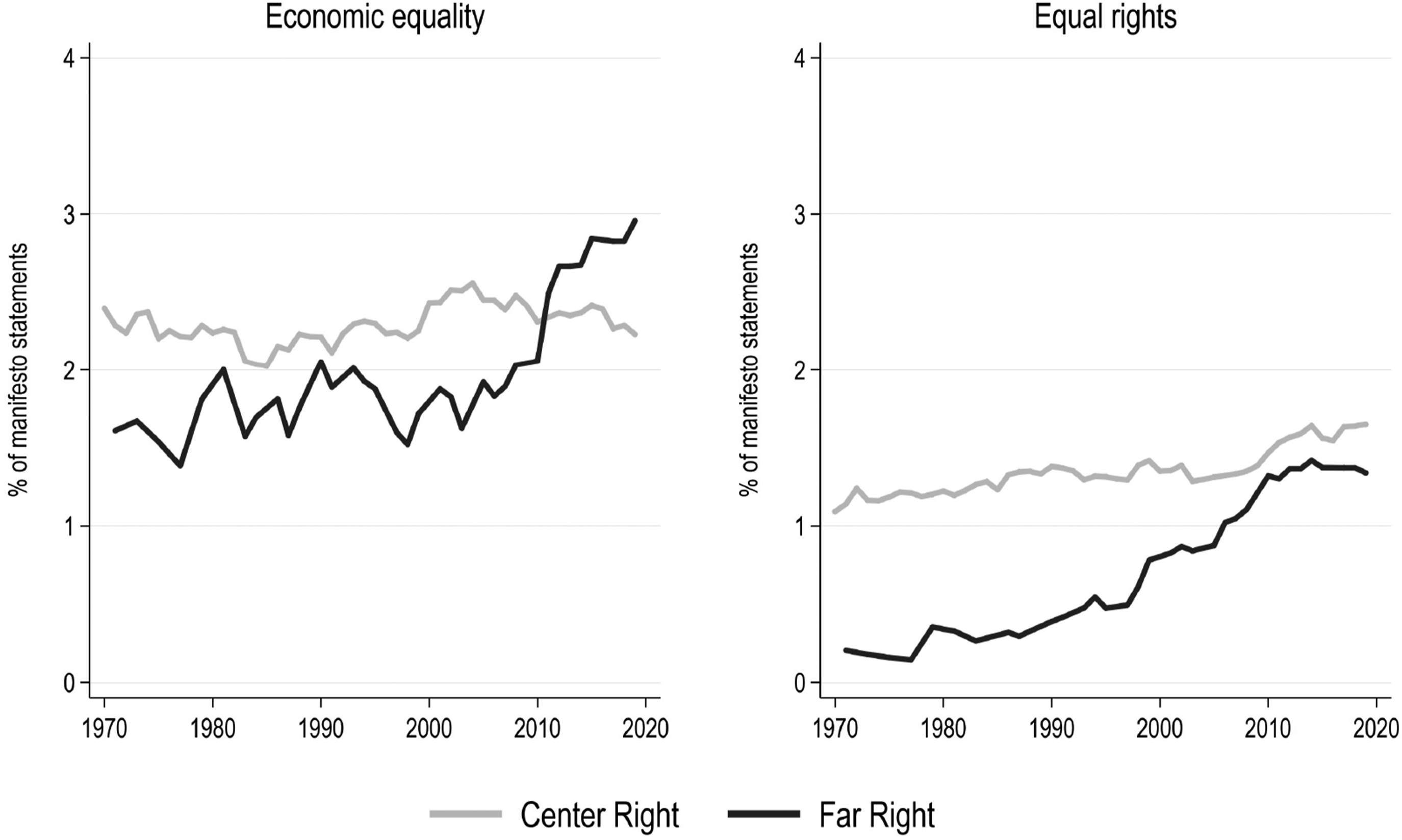
Especially from the early 2000s onwards, this upward trend among the Far Right contrasts sharply with the center-right parties. As Appendix C shows, this applies vis-à-vis all center-right party families. When we break down the Center Right into three party families, the Far Right has a lower starting value and a higher end value vis-à-vis each of the center party families on economic equality. Despite their reputation as “social” capitalists due to their role in expanding the welfare state (Van Kersbergen, 1995), Christian Democratic parties are no exception to this. Instead, the temporary spike is driven by Nordic conservative parties and a reminder why – given the low number of parties per party family – the differentiation between Far and the Center Right has to take precedence over nuanced categories. This also alleviates us from discussing further fine-grained party family ascriptions which (while useful in some regards and whose value we do not question per se) can be hard to defend and pseudo-exact. 12
Turning to the equal rights trajectory in the right panel of Figure 1, again split into an overview and an assessment per party family in Appendix C, we see a catch-up process over five decades. Starting from a very low (0) level that reflects the old hostility towards minority groups and the fact fewer far-right parties existed in 1970, far-right parties are now on par with center-right parties, though we shall again stress the heterogeneity of far-right parties (Mudde, 2007).
The breakdown per party family suggests that Christian Democrats have not increased their equal rights emphasis, in contrast to conservative parties and, in particular, liberal parties. This means that our stasis expectation regarding the Center Right is less justified when it comes to equal rights. Yet, the key result is that center- and far-right parties have come to show similar equal rights emphasis (however, as shown in step III of our analysis, the Far Right more often invokes equal rights in abstract terms – without specifying the group). As a version of Figure 1 that tracks the median instead of the average shows (Figure 2), these convergence results are not driven by outliers that skew the averages, but observable in the middle of the distributions, too. To contextualize the results, we add the trends for left parties. Emphasis of economic equality and equal rights: median, and including the Left. Notes: Lines represent the median share of manifesto statements allocated to economic equality/equal rights.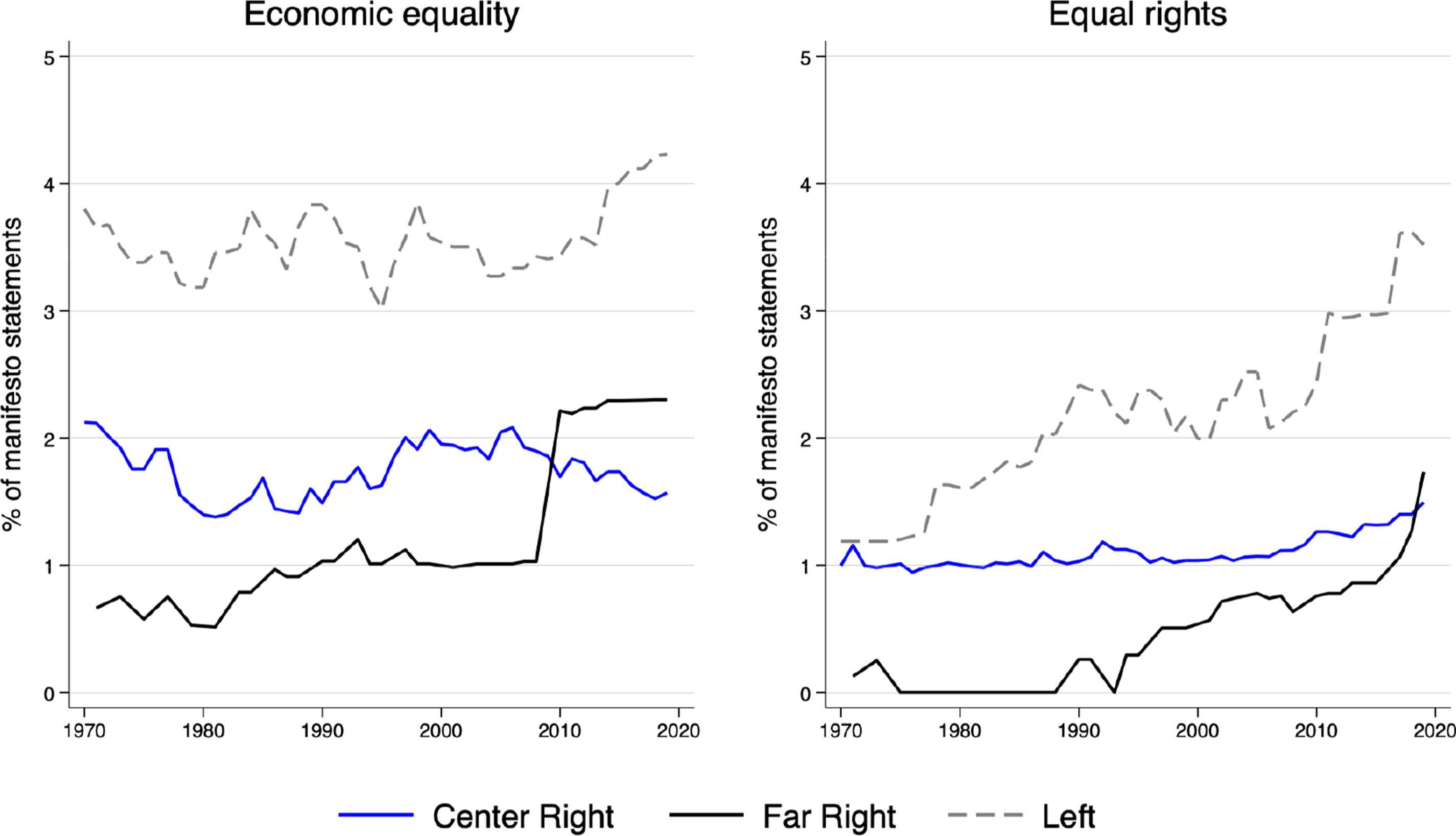
The question of which groups are appealed to and whether weaponization plays a role is addressed in part III. But first, we assess if the catch-up pattern we found holds in multivariate regressions.
Analysis step II: Multivariate analyses of equality emphasis
Emphasis of equality concepts of right parties over time. Far Right from Popu-List.
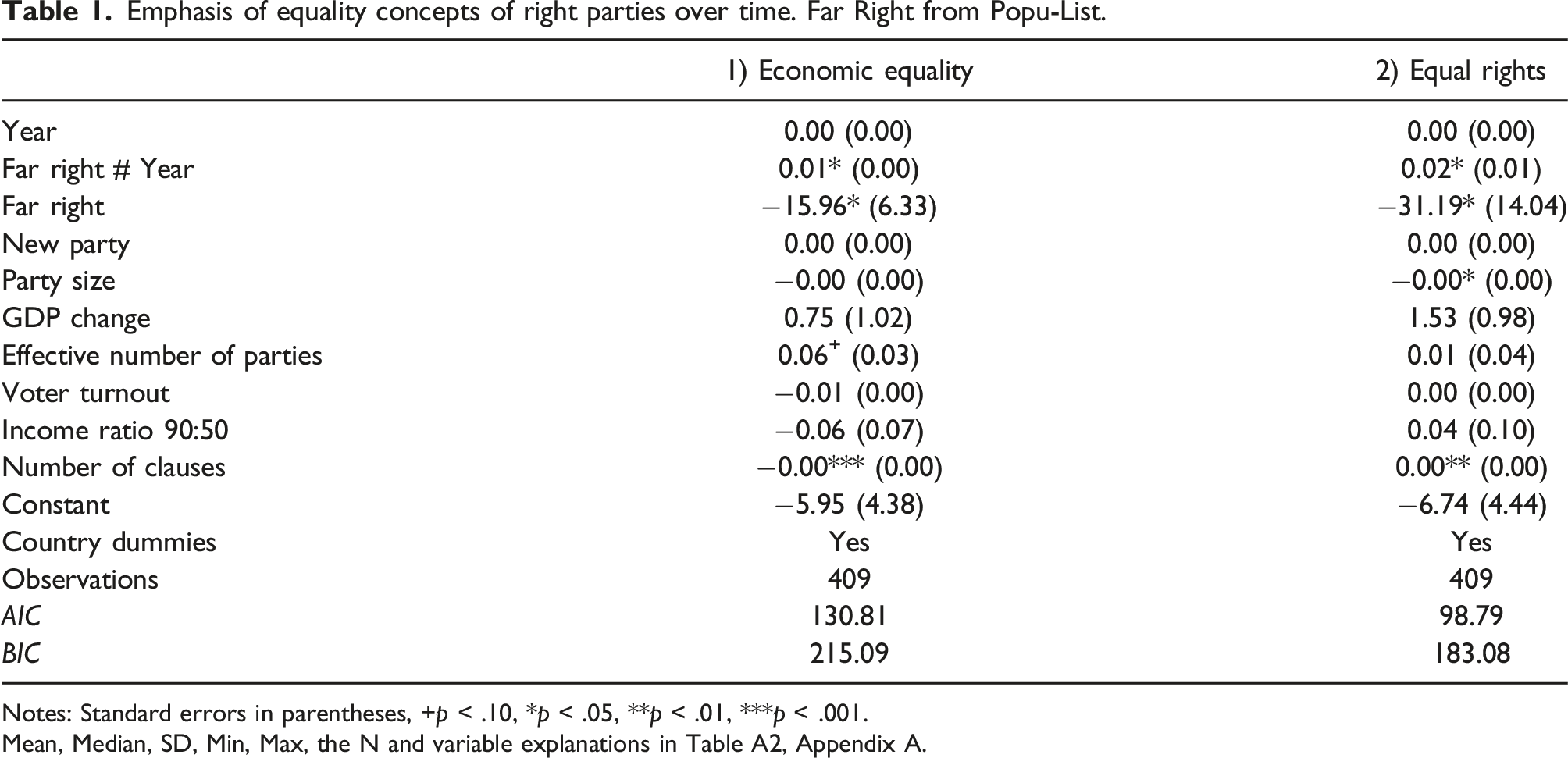
Notes: Standard errors in parentheses, +p < .10, *p < .05, **p < .01, ***p < .001.
Mean, Median, SD, Min, Max, the N and variable explanations in Table A2, Appendix A.
Table 1 presents the results of the two fractional probit regression models. For a much more intuitive interpretation of effects and their magnitude, Figure 3 plots the predicted probabilities based on the regression models. Our key independent variable is the election year, which we interact with the right party family indicator. In line with our expectation, a positive effect for the interaction would indicate that far-right parties increased attention to equality over time. Equality and right parties over time. Far Right via Populist right (from PopuList). Notes: All estimates are based on Table 1. Lines indicate predicted shares of manifesto statements on economic equality/equal rights. Shaded areas show 95%-confidence intervals. Bars show the distribution of observations.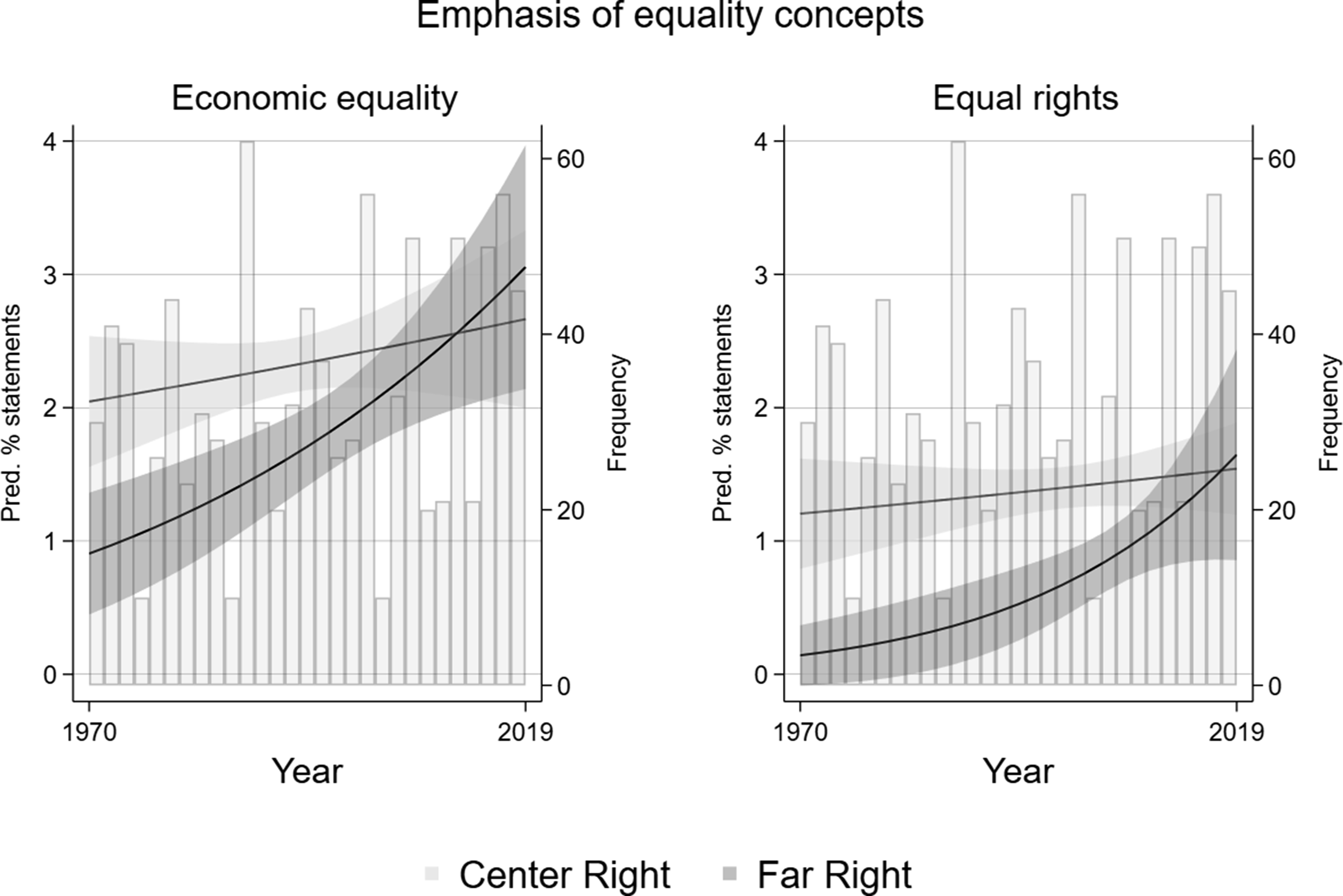
Based on Model 1 in Table 1 and Figure 3 (left panel), we find support for our expectation regarding economic equality, but must also qualify that our results point to a fragmentation of the Far Right: Far-right parties substantively increased positive emphasis on economic equality over time. The time effect is significant at conventional levels (p > .05), but broad CIs reflect the persistent heterogeneity of far-right parties (Mudde, 2007). At the beginning of our period of observation, far-right parties devoted one out of every hundred statements (1%) to economic equality and redistribution. For the most recent elections, this very low share almost tripled to about 3% of all manifesto statements. During the same period, center-right parties also raised attention to economic equality slightly, but the effect is small in substantive terms (2.0–2.7%). In any case, bearing in mind the widening confidence intervals at the end of the time series and the finite number of right parties and countries considered here, it is fair to say that center- and far-right parties have become alike regarding economic equality, even when we control for the country context and common confounders.
Turning to the equal rights dimension, we find a strong, positive, and significant time trend (at p < .05). The visual evidence in Figure 3 (right panel) is clear: over the period of observation, far-right parties increased positive references related to equal rights and antidiscrimination from virtually zero (0.02%) to 1.7% of the manifesto – a value that is more than 80 times higher in 2020 when compared to the 1970s. Again, no such increase is observed for center-right parties, which fluctuate around 1.5% of their manifestos being allocated to equal rights (1.3% in the 1970s, 1.5% in the 2010s). Despite the ideological fragmentation within the far-right bloc being evident, these findings support our expectation that the Far Right, or significant segments thereof, now express more favorable views towards equal rights (compared to a few decades ago). Meanwhile, the Center Right appears stagnant. 13
A final consideration is to test to what extent substantive aspects such as a party’s age and degree of establishment or electoral performance affect changes. In light of previous studies and the available data (as detailed in C2, we draw on Krause and Wagner 2021), one could argue that electoral support or government participation leads to moderation or that parties tend to undergo a sequence in which they become more moderate over time; even though cases like the SVP seem to suggest that this is not necessarily the case. We see two technically feasible strategies (given the case number, double interactions will be underdetermined) to modify our analysis: (1) including these aspects as additional variables to our analysis and (2) replacing time as interaction term with the substantive variables. As the results in appendix C2.2 show, neither of the aspects we add seems to undermine our core results. Regarding the interactive approach to replace time with substantive variables, it turns out that these factors do not drive results (C2.3). However, only future research with more cases and longer time series can adequately assess the factors associated with time.
Analysis III: Group appeals and weaponization of equal rights
The result that the Far Right has caught up with a stagnating center-right camp is robust, also in light of left equality trends, different economic factors, or general emphasis on equal chances.
However, there are two core concerns or follow-up questions that require further analysis. First, to better understand if weaponization of equal rights is at play, we quantify statements that pitch equal rights against allegedly “parochial” immigrant values. Second, we track over time what (minority) groups – if any – parties appeal to when they emphasize equal rights.
Four student coders coded 4500 equal rights statements. For the first task (weaponization), the coders coded statements that stylize migration or migrant communities (of whatever kind) as a threat to equal rights. Given the expected low number of cases, they were advised to also code latency and even to mark suspected dog whistles. For the coding of groups, they coded the first and second groups whose rights should be extended or whose discrimination should end. The groups are: no(ne), gender, race/ethnicity/migrants, LGBTQI, disabled, old/elderly, other. Statements in favor of diversity or antidiscrimination and blanket statements on equal rights that enumerate four or more groups are coded as no(ne) – but were rare anyway. 14 Beyond the groups listed, few groups were mentioned. Even disability faded relative to gender, race/ethnicity, and LGBTQI. Each statement was coded by two coders, and in 91% of cases, they agreed. The remaining 9% were reviewed and then finalized by the senior authors. Appendix C4 tracks the relative importance of the most discussed and empirically most prevalent group categories: gender (including equal treatment of women), LGBTQI, and race.
Regarding the groups that right parties referenced positively in equal rights appeals, we find that the modal category is typically “no group/none”. On average, half of the appeals do not include a group. This stands in contrast to the center-right parties and shows that the embrace of equal rights is often diffuse, not group specific. Also, LGBTQI-related equal rights appeals remain close to non-existent for the Far Right (a minor increase is due to two party programs).
Gender-related appeals to equal rights by far-right parties are much more frequent, but are – despite their potential for weaponization – not increasing anymore after a peak around 2010.
Race- and ethnicity-related equal rights statements are only salient since the late 1990s. Still, the uptick reflects that the detoxification led to a moderation of stances toward minorities. 15
When it comes to statements that weaponize equal rights against migrants, we found that few parties engage in such statements and even for these parties the caseload is exceedingly low. A few explicit instances can be found for the RN in France (concerning women’s rights and women as victim group) and UKIP in the UK (LGBTQI rights as part of integration). Yet, the scattered statements are equally infrequent for the Center Right. Conservatives in France, the UK, the US, and, to some extent, in Sweden have used formulations that point to a tension between equal rights and migration. We read this as evidence against large-scale weaponization tactics.
In sum, neither mentions in changing minority group appeals nor the explicit use of (non-western) migrants as a threat to tolerance suggest that weaponization is behind our results. Yet, it is a key qualification that the Far Right rarely specifies which group’s rights it advocates. 16
Conclusion: Porous boundaries as a result of centrist stasis and far-right moderation
We started from the conviction that we need to clearly differentiate between a rights-based and an economic conception of equality to better understand right-wing parties. The results suggest a certain ideological hollowing out of center-right parties. They are outflanked by the Far Right in the politics of redistribution and ever harder to distinguish regarding the politics of recognition. While center-right parties respond slowly or not at all to rising inequality and new demands for equal rights (Lamont, 2023), the Far Right has often increased its previously very low emphasis. This Center Right stasis seems particularly worrisome in light of current debates about the conservative dilemma, as historical parallels have been drawn to the demise of democracy – when the Center Right failed to respond to demands for franchise extension.
Though the Far Right remains heterogeneous, some extreme and nativist parts of the Right were able to integrate egalitarian stances into their anti-elite rhetoric while trying to detoxify their brands from old anti-emancipatory positions (in an effort to avoid red flags for centrists). However, we can show that this newfound tolerance is rooted in a rather generic embrace of equal rights. Appeals to gender and LGBTQI groups remain rare – even when compared to center-right parties. Likewise, statements that mirror Pia Kjærsgaard’s (Danish People’s Party) “Where Islam enters, tolerance leaves” (Mygind and Rasmussen, 2012) are too rare to be regarded as indicative of a broad trend; and are equally non-salient among center-right parties. Yet, in light of the early stage and the limitations of the research on group appeals (Horn et al., 2021) and our focus of manifestos (not social media), more evidence is needed.
For the Far Right’s increased emphasis on economic equality, the trend is slightly less robust (variation is larger) and future research should study the scope conditions and determinants in more detail. Among potential explanations for the economic moderation of far-right parties, those that take into consideration government participation seem most promising. The long-term trajectories of the Far Right in Denmark and Austria point towards the possibility that the previous economic anti-egalitarianism proved particularly problematic when far-right parties were – de jure or de facto – in office. Maybe the confrontation with political dilemmas – about who gets what – led both parties to strengthen appeals to material equality and the less affluent but deserving groups (e.g., pensioners, old workers with a long employment history, people currently working in physically demanding routine jobs, but also teachers and nurses). Such changes contribute to and underscore our overarching conclusion: the differentiation between center-right and more far-right parties has, on average, become increasingly blurred.
Supplemental Material
Supplemental Material - Blurring lines. Economic equality and equal rights concepts of center- and far-right parties, 1970–2020
Supplemental Material for Blurring lines. Economic equality and equal rights concepts of center- and far-right parties, 1970–2020 by Alexander Horn, Martin Haselmayer, and Jonathan Klüser in Party Politics
Footnotes
Declaration of conflicting interests
The author(s) declared no potential conflicts of interest with respect to the research, authorship, and/or publication of this article.
Funding
The author(s) disclosed receipt of the following financial support for the research, authorship, and/or publication of this article: This work was supported by the German Research Foundation, DFG (428250727).
Supplemental Material
Supplemental material for this article is available online. The data of the Varieties of Egalitarianism project will be available at https://voe-project.org/ by July 2025.
Notes
Author biographies
 ) at the University of Konstanz. He is Interim professor for “Comparative Analysis of Political Systems” at Humboldt University Berlin.
References
Supplementary Material
Please find the following supplemental material available below.
For Open Access articles published under a Creative Commons License, all supplemental material carries the same license as the article it is associated with.
For non-Open Access articles published, all supplemental material carries a non-exclusive license, and permission requests for re-use of supplemental material or any part of supplemental material shall be sent directly to the copyright owner as specified in the copyright notice associated with the article.
