



Abstract
The rise of radical right parties in Europe has led to a number of strategic responses from mainstream parties (MSPs). However, not all MSPs are equally affected by the rise of challenger parties. This idea has been neglected in much of the quantitative work in the field. This paper extends this argument and investigates electoral overlap in a cross-country study of multiparty systems. Using Propensity to Vote (PTV) data to measure the electoral overlap between MSPs and radical right parties in eight Western European countries, I estimate the effect of right-wing threat on the positions of MSPs on immigration. A higher threat of losing voters to the radical right is associated with a move towards more restrictive immigration policies; on the other hand, a party’s chance to win voters back from the radical right has no significant impact on its position.
Introduction
New parties have introduced issues to European party systems that were previously ignored by mainstream parties (De Vries and Hobolt, 2020; Kriesi et al., 2006). Radical right parties (RRPs) have risen across Europe, incentivising mainstream parties (MSPs) to adapt and take a stance on immigration. Centre-right parties have moved rightwards on immigration with disputed effectiveness (Krause et al., 2022; Spoon and Klüver, 2020); meanwhile, Social Democrats lose cross-pressured voters who are economically left, but culturally align with the radical right. This has sparked debate over whether social democratic parties should take up restrictive positions on immigration (Abou-Chadi and Wagner, 2019; Hjorth and Larsen, 2020; Kurella and Rosset, 2017).
Even though not all MSPs are equally at risk of losing voters (Meguid, 2005, 2008), most quantitative studies still ignore the idea of varying threat (see for example Abou-Chadi, 2016; Abou-Chadi and Krause, 2020; Krause et al., 2022). This is particularly striking as case studies indicate that MSPs react differently to new issues being introduced by niche parties, depending on their threat (Bale et al., 2009; Green-Pedersen and Krogstrup, 2008; Meguid, 2008). Furthermore, existing theory focuses primarily on the threat of losing voters to a new party. However, with many “new” parties having been established forces for multiple election cycles by now, MSPs should also be expected to strategize to win back voters they lost previously. Therefore, this paper broadens the research question to explore when mainstream parties move towards the radical right on immigration.
Electoral overlap is a relatively new concept that assumes voters are considering more than one party to vote for (Häusermann, 2022; Otjes and Louwerse, 2017). Overlap denotes the extent to which voters are “shared” between two parties, i.e., they consider to vote for either party. I disaggregate overlap into the threat to lose voters and the prospect of gaining new voters, using a dataset combining European and national voter surveys. Comparing this measure of availability to the vote shares of radical right parties shows that voter availability to RRPs differs across MSPs within the same election. This has important implications for mainstream party strategy.
I find that the availability of MSP voters to RRPs incentivises mainstream parties to adopt more anti-immigration policy positions. This effect persists even when controlling for challenger vote share, indicating that parties do indeed react to party-specific risks of voter loss. However, I also find that the availability of recent RRP voters to a mainstream party does not have a significant effect on MSP policy positions. This implies that while MSPs do not actively compete for radical right voters, they do attempt to prevent their existing voters from moving to RRPs.
By showing that vote share alone is an inadequate measure of electoral threat, this paper has important implications for our understanding of mainstream party strategy. When analysing the effectiveness of accommodation, future research could therefore be strengthened by not just considering RRP vote shares, but also including voter availability. If a party accommodates a challenger to prevent the loss of current voters, reducing the risk of its voters defecting to the challenger may be considered a success, even if accommodation does not reduce RRP vote shares.
New issues in party competition
Traditional spatial models analyse party competition on a single left-right axis, on which voters have a preferred position and will choose the party closest to their preference (Downs, 1957). However, parties are faced with multiple issues that they take positions on. Even when parties selectively emphasise policy issues, they still share a set of policies they compete on (Budge and Farlie, 1983). Introducing new issues outside that set is associated with risks, since these issues may uncover tensions within a party or be received poorly by voters. As a result, new issues are primarily introduced by smaller niche parties from outside the established party system (De Vries and Hobolt, 2020; Meguid, 2005, 2008).
Niche parties are generally associated with emphasising a small number of non-economic issues relative to their competitors (Wagner, 2011). These niche parties get associated with their position and can win votes across the party system from voters who care about the niche party issue (Meguid, 2005). This creates a unique situation in which mainstream parties face little constraints from prior positions (Meguid, 2008), and have to decide whether to engage with the new issue or not. One common instance of niche parties in Europe are radical right parties, which emphasise immigration issues and a nationalist position. This is an issue on which few mainstream parties have a clear stance, and voters are spread out across all possible combinations of issue preferences (see for instance Kurella and Rosset, 2017). Under which conditions, then, can we expect mainstream parties to take up positions on the issues introduced by a radical right niche party?
Existing research finds that parties generally avoid new issues, but can change their positions in response to the success of their competitors. Immigration is a “wedge issue” that does not align with existing divides, and therefore creates conflict within mainstream parties (De Vries and Hobolt, 2020). As a result, MSPs try to avoid the issue even in the face of initial niche party success. However, when other parties gain votes, their competitors move closer to their position to imitate their success strategy (Adams and Somer-Topcu, 2009). In the case of immigration, this can be observed for social democratic parties in multiple countries (Bale et al., 2009), as well as Northern European centre-right parties (Green-Pedersen and Krogstrup, 2008; Odmalm, 2011).
Once immigration does become salient, and therefore can no longer be avoided, MSPs quickly increase their emphasis on the issue (Gessler and Hunger, 2021); in doing so, they also tend to become more restrictive in their position (Abou-Chadi et al., 2019). Since immigration is a contested issue where voters do not broadly agree on a position, movement of parties is strongly dependent on how much of an electoral threat RRPs can pose to their competitors (Abou-Chadi, 2016).
Existing research suggests that centre-left parties in particular appear to benefit from moving to the right (Hjorth and Larsen, 2020; Spoon and Klüver, 2020). On the centre-right, however, accommodation may have a negative effect and make RRP positions appear more legitimate (Williams and Hunger, 2022). These findings would suggest that if parties were rational vote-seekers, centre-left parties would take restrictive positions on immigration and centre-right parties would remain silent or become more open. However, Abou-Chadi (2016) shows that mainstream parties placed further to the right react more strongly to electoral gains made by RRPs.
A possible explanation for this seemingly counter-intuitive result is that some parties are more at risk of losing voters to rising RRPs than others (Meguid, 2008). Case studies support this argument, showing that MSPs react when losing voters to niche competitors (Bale et al., 2009; Meguid, 2008; Odmalm, 2011). However, to date, there is no cross-national quantitative study of MSP reactions using electoral threat as an explanatory variable. This paper uses a measure of electoral threat derived from voter surveys to measure electoral overlap in party dyads. By using this measure to explain MSP movement on immigration, it tests those case study findings in a cross-national context. It finds that MSPs in the same electoral context may face different amounts of threat from challengers, and this has an impact upon MSP strategy independent of past challenger vote shares.
Holding onto established voter bases
Voters are not equally available to all parties, and patterns of availability vary between countries. Different strategies are therefore beneficial for different parties (Häusermann, 2022). By measuring the availability of voters to competitors using voter surveys, we get a more nuanced image of the strategic incentives of political parties. Here, I argue that parties choose their strategy based on how much their voter base is affected by a rising RRP, and why threatened parties are likely to accommodate on immigration. Then, I will extend that argument to attempts to the potential to gain voters from the radical right.
The argument assumes that parties are primarily vote-seeking and know which competitors they share potential voters with. Politicians estimate public opinion to be more conservative than in reality (Broockman and Skovron, 2018). However, applying these results to European parties shows that “the conservative bias is found in politicians across the political spectrum” (Pilet et al., 2023: p. 3). If this misperception is consistent across parties, it should not lead to bias in the results. Parties also have access to extensive opinion polling and directly interact with their supporters, and observe public opinion through media coverage. Many parties also participate in local, regional, or European elections that signal updated voter preferences to them. Therefore, while misperceptions occur, the overall assessment of parties can be expected to be broadly plausible. This is also supported by a case study among German parties, finding that candidates have a good estimate of which voters are available to them (Lichteblau et al., 2020).
The rise of a challenger party leads to a loss of votes among its more established competitors, as some voters defect to the challenger. When challenger parties focus on previously underrepresented issues, they are viewed as the best actor to address this issue. As a result, voters who care about those issues are particularly likely to flock to the challenger (De Vries and Hobolt, 2020). When a party’s voter base is threatened by a niche party, it has an incentive to shift its position towards that challenger in order to offer an alternative to those considering changing their vote to the challenger (Meguid, 2008). If a mainstream party does provide an attractive alternative policy on the challenger issue, the incentive for voters to defect to the challenger party declines (Meguid, 2005). Successful challenger parties therefore pull mainstream parties towards their position (Abou-Chadi, 2016; Abou-Chadi and Krause, 2020).
What does it mean for a party’s voter base to be threatened by a challenger? Meguid (2008) states: “A niche party is a danger to a mainstream party if it takes (a significant number of) votes from it” (p. 96). This is different from the total vote share of the niche party, since it accounts for voter flows between parties. There is evidence that parties change their position to accommodate competitors they lost votes to in a past election (Abou-Chadi and Stoetzer, 2020). However, voter flows are unknown until after the election. This would imply that parties only react to the rise of a challenger with a significant delay, and are blind to the challenger’s threat before it actually wins over voters. Given the presence of opinion polls between elections, this is a strong and unlikely assumption; therefore, past voter flows are unlikely to fully explain party strategy. The idea of threat as voter flows also has limitations on a conceptual level. If voters consider changing their votes away from a party, they pose a risk to that party’s vote share regardless of their eventual decision (Wagner, 2017). If parties adjust their position pre-emptively, a voter flow measure underestimates the threat posed by the challenger.
Immigration is a positional issue. Voters do not agree on an ideal position on immigration, and multiple parties can attempt to claim issue ownership (Abou-Chadi, 2016). This makes positional movements from mainstream parties more attractive, since challenger parties enjoy a smaller first-mover advantage than on other issues. 1 At the same time, the positional nature of the issue creates costs associated with moving towards anti-immigration positions: Voters who oppose stricter immigration laws may move away from MSPs that accommodate a challenger, and vote for a party promising a more permissive policy instead. Mainstream parties that are not threatened by a challenger party therefore have no incentive to move towards restrictive positions on immigration.
Parties do not only compete for their own past voters. They also have the potential to win voters from other parties. In mainstream-niche-competition, this is particularly important, since there is a potentially large set of voters that has previously voted for an MSP. Therefore, MSPs can reasonably expect to win back some of those voters. The combination of challenger threat (MSP voters available to a niche party) and potential gains from a challenger (niche party voters available to an MSP) can be referred to as the electoral overlap between the two parties. RRP voters being available to an MSP competitor implies they are located close to the mid-point between the two party’s positions, but slightly prefer the RRP position. Moving towards more restrictive immigration positions moves that midpoint, and should therefore tip some of those voters back over to the MSP side (Bräuninger et al., 2021). This argument assumes that RRP voters are still open to voting for other parties, something that has been questioned (Lewandowsky and Wagner, 2022). However, the empirical measures used below are based on self-reporting, so this should not be a problem.
Under these conditions, we can expect a positive relationship between electoral overlap of MSPs and radical right parties, and the anti-immigration positions that MSPs take. This party-specific effect should persist even when controlling for the vote share of the niche party. The mechanisms outlined in this section should generally apply equally to both aspects of electoral overlap, i.e., there is no particular reason to expect MSPs react differently to losing voters to an RRP competitor than they would to the chance of winning back voters from an RRP. However, as these are two distinct measures, and to account for the possibility of the two aspects affecting party decisions differently, I separate them into two hypotheses: H1: Mainstream parties whose voters are more available to RRPs take more restrictive positions on immigrations, even when controlling for RRP vote share. H2: If MSPs have a higher potential to win back voters from an RRP, they are more likely to move towards more restrictive immigration positions.
Data and measurement
This paper covers eight European democracies with proportional election systems, and a radical right party competing in at least two elections. Mainstream parties in these countries have been chosen on the basis of regularly reaching 10% of vote share or being included in government, or a combination of the two. 2 In most countries, this includes a social democratic, Christian democrat, and liberal party. A full list of cases can be found in Appendix A. Unfortunately, in Eastern Europe, parties merge and split regularly (see e.g. Ibenskas and Sikk, 2017) and the EES does not include PTV scores for smaller parties, which includes most Eastern European RRPs. Therefore, countries from this region are not included in the analysis. As only Slovenia and Slovakia fulfilled the initial criteria, the loss of data through this decision is small.
In line with previous work sharing a comparable focus (e.g. Abou-Chadi, 2016; Abou-Chadi and Krause, 2020; Meguid, 2005, 2008), party positions on immigration are identified using the Manifesto Project (MARPOR) dataset (Volkens et al., 2021). Support for immigration is measured by items per602 (National Way of Life: Negative) and per607 (Multiculturalism: Positive); opposition is measured by items per601 (National Way of Life: Positive) and per608 (Multiculturalism: Negative). 3
Following Lowe et al. (2011), these items have been scaled by taking the differences between the logs of the two data points:

The higher this value is, the stronger a party opposes immigration. The measure takes into account both the ratio of positive to negative statements, as well as the number of those statements. Since many MSPs do not have a clear stance on immigration, this is important: Measuring only the direct proportion of positive to negative statements, as suggested by Kim and Fording (2002), results in less clearly distinguished positions. Many MSP positions consist of only a few statements either in favour or against immigration, which are coded as extreme positions when not accounting for the total number of statements. The downside of the logit scaling is that the variable becomes somewhat sensitive to the added value. I have chosen 0.5, as suggested by Lowe et al. (2011).
4
Figure 1 shows the distribution of positions across RRP challengers and mainstream parties respectively. Challengers cluster around highly anti-immigrant positions, with the vast majority of their positions being in the upper quartile of MSP positions.
5
Distribution of positions across radical right and mainstream parties.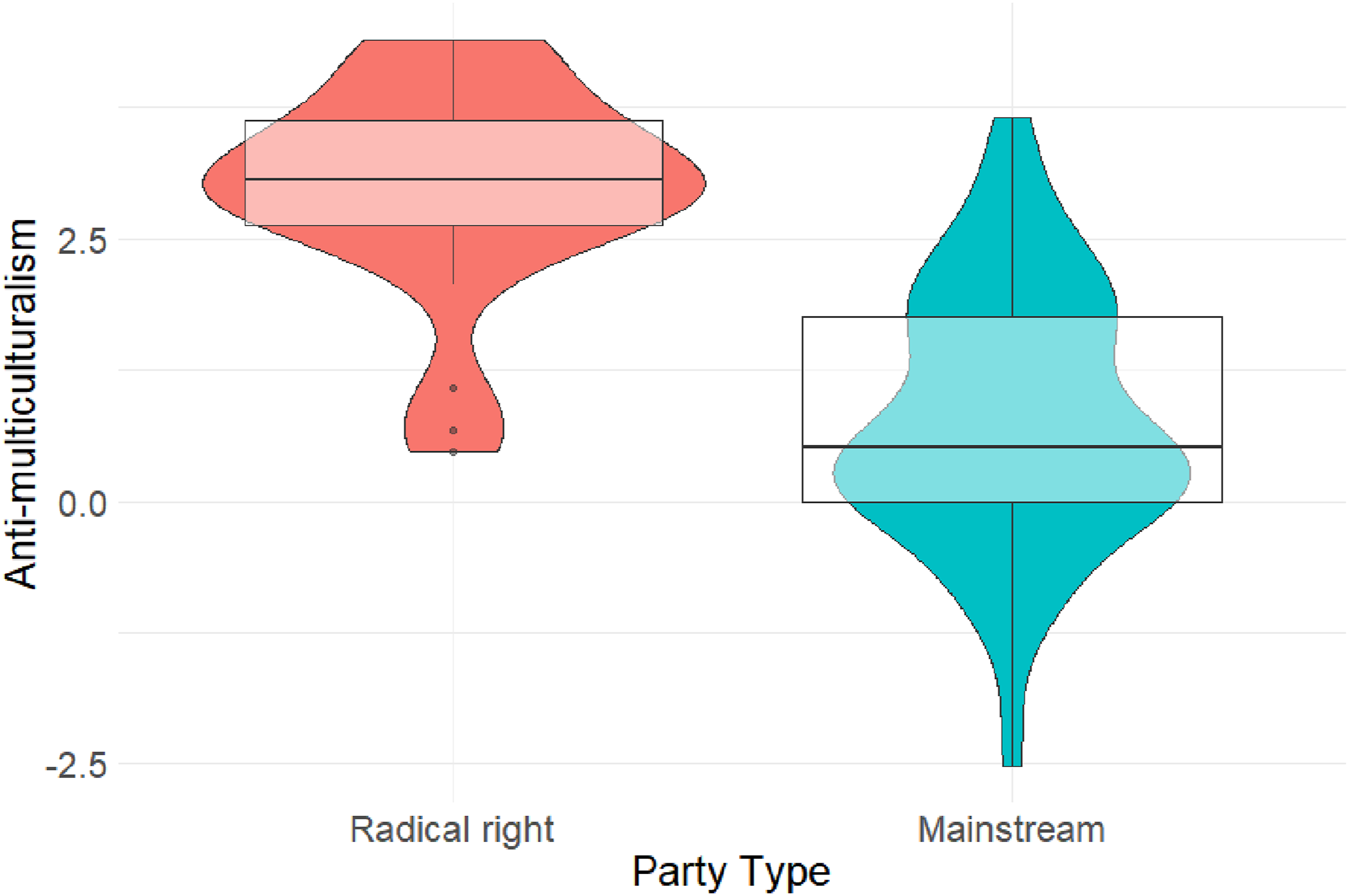
On the mainstream party side, the distribution reflects the party structure of most countries. In most countries, mainstream parties select into two major blocks: One centre-left block around a social democratic party that avoids the issue altogether or takes moderate stances around the zero point, and one centre-right block around a Christian Democratic and/or Liberal party taking a moderately restrictive position. The higher, smaller bulge representing centre-right mainstream parties shows that their positions can get fairly restrictive, but still remain notably more moderate than even the lower quartile of radical right parties.
Measuring challenger threat
I measure the threat posed by a challenger with a Propensity to Vote (PTV) based metric, using a set of voter surveys. PTV questions ask respondents for each party of a given set: “On a scale from 0-1o, how likely are you to ever vote for this party?” 6 . This question aims to capture the utility of a vote for any given party without making assumptions about what drives voter decisions (Van der Eijk et al., 2006). Unlike measures based on party choice, this approach allows to differentiate voter preferences among parties they did not vote for (Ramonaitė, 2018; Van der Eijk et al., 2006).
Voter data has been taken from the European Election Study (EES) dataset, which provides survey data collected in the context of European Parliament elections. This set provides the most readily available data across multiple years and countries; the fact that the survey is taken between national elections also isolates PTVs from the election campaign of interest and makes sure PTVs are measured prior to parties taking a policy position. Wherever EES data are not available or multiple elections took place between two rounds of the EES, I used national election surveys to complete the dataset. Switzerland’s data are entirely taken from the national Swiss SELECTS dataset (SELECTS, 2022). Availability scores are taken from the closest preceding source to a given national election. Appendix B contains a full timeline of elections and data sources.
Wagner (2017) proposes an availability measure related to a voter’s biggest PTV, where PTV values are rescaled to a range of 0 to 1; Lewandowsky and Wagner (2022) adapt it based on past voting decisions. On an individual level, the availability of each voter i for a given party dyad (a,b) is defined as

For example, a voter j who rates the MSP at PTV = 1 and the RRP at PTV = 0.9 is very likely to vote for either party, resulting in an availability score of 1 – (
The electoral threat that a niche party a poses to mainstream party b is then defined as the average availability towards party a among voters who voted for party b at the last national election. If a voter who voted for an MSP in the past election, but reports a higher PTV for the challenger, their availability is still coded as 1, in accordance with Lewandowsky and Wagner (2022).
Figure 2 shows the availabilities of MSP voters to RRPs and vice versa. It shows a spread of availability in both directions. The two measures are moderately correlated (r = 0.427).
7
Overall, RRP voters tend to be more available to MSPs than MSP voters are to the radical right.
8
This supports the idea that voters generally prefer MSPs when they offer similar policies to niche parties. This advantage is a core assumption of the argument for accommodation (Meguid, 2005). MSP threat of losing voters to RRP, compared to the potential to gain voters from RRP.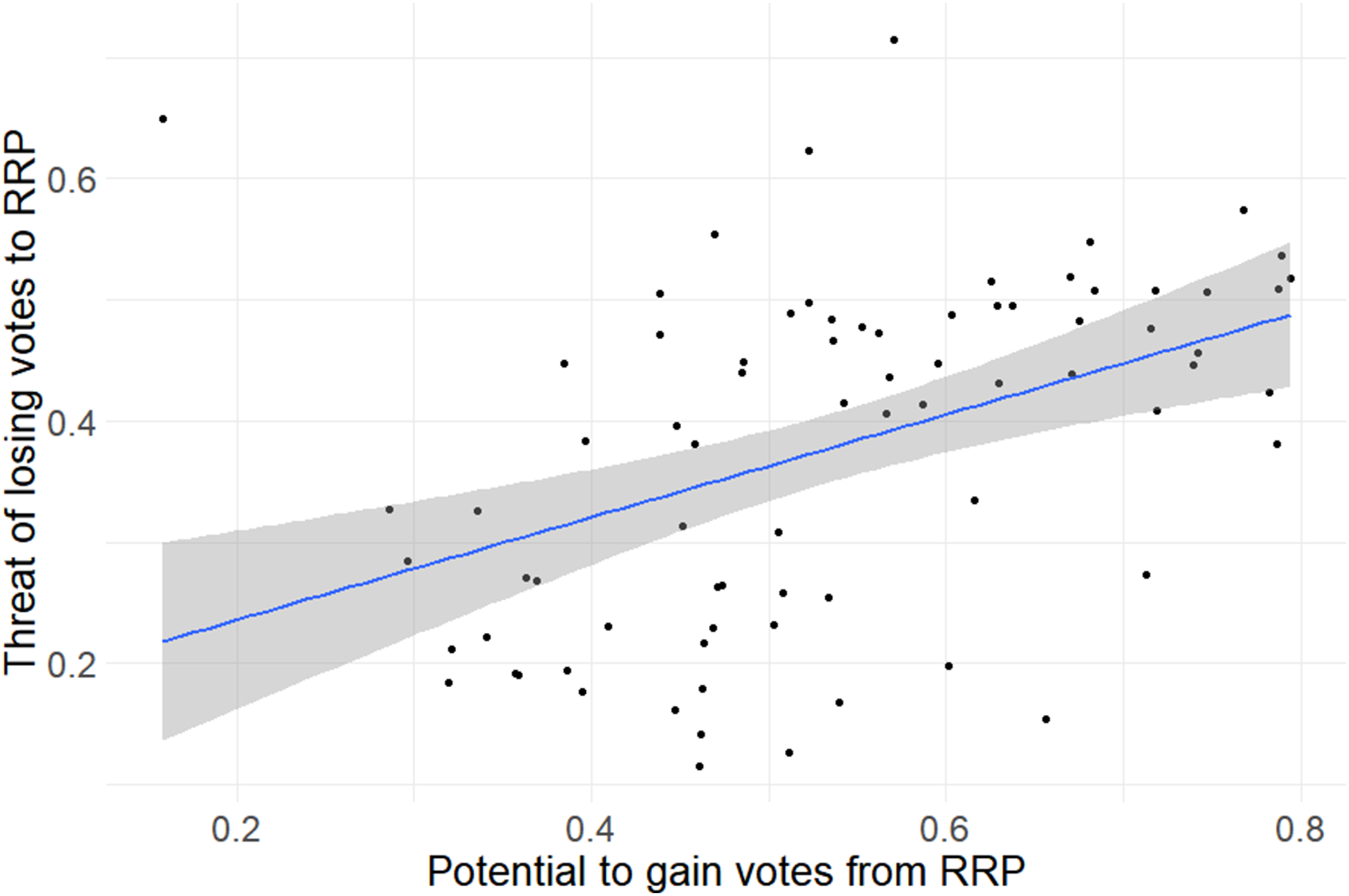
Figure 3 offers a more in-depth look at electoral overlap by country. In most countries, RRP voters are more available to MSP voters than vice versa. Furthermore, availabilities are often distributed with multiple peaks. A good example for this is Switzerland, where the distribution shows two clear peaks: Voters of the centre-right parties (CVP and FDP) usually reach an availability to the radical right SVP of around 0.4 to 0.5, whereas voters of the Social Democrats reach availabilities between 0.18 and 0.26. An increase in the SVP’s power is therefore more threatening to the Swiss centre-right, and results in different reactions from them than from the Social Democrats. Availability distribution across countries, sorted by mean MSP voter availability.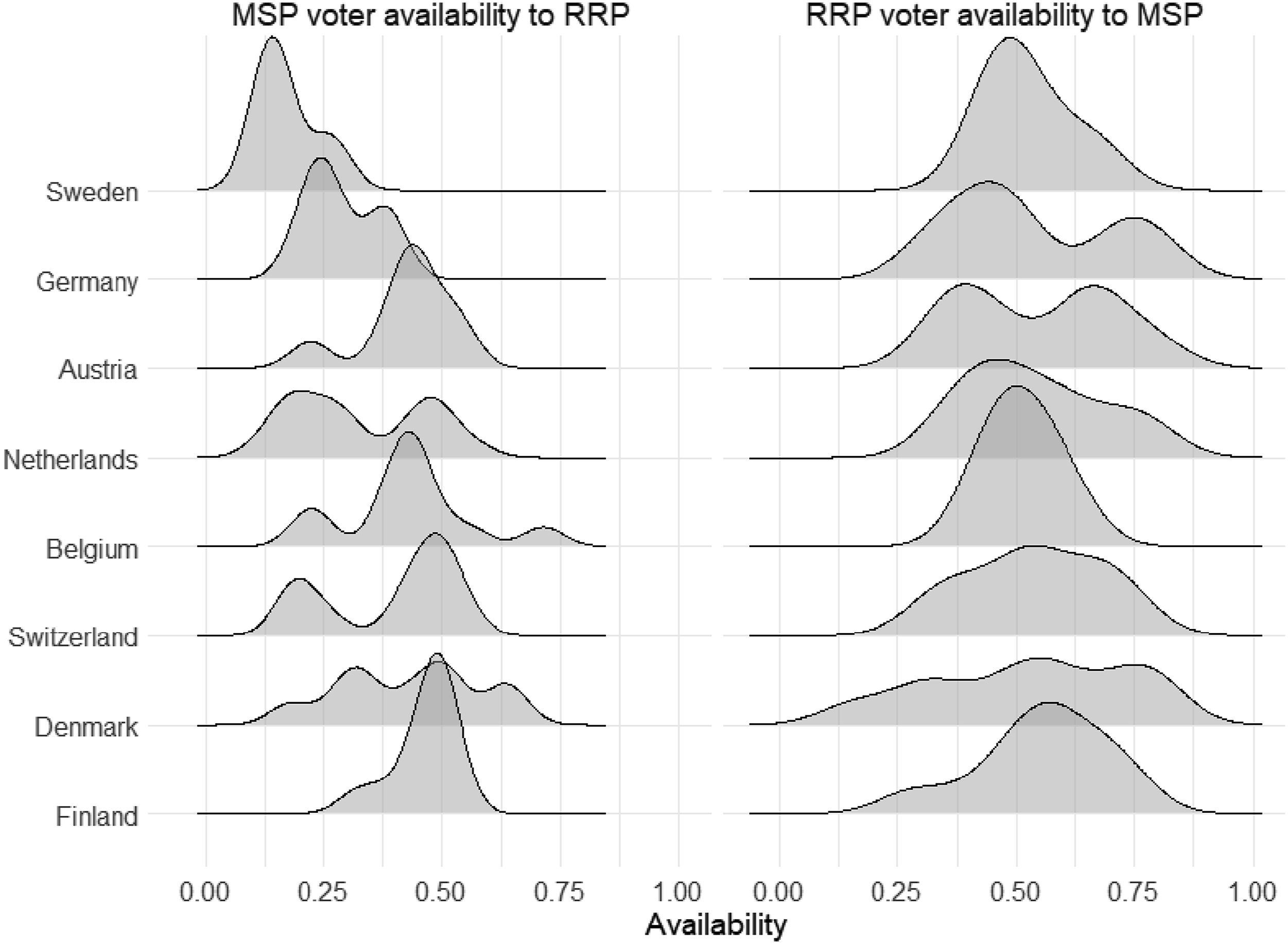
The existence of structural differences in availability between party families raises important questions. First of all, the idea that challenger parties, including the radical right, draw from across the political spectrum (De Vries and Hobolt, 2020; Meguid, 2005, 2008) is in many cases wrong. Instead, they slot into the existing party spectrum and draw from specific parties. This also means that an increase in RRP power does not affect all parties equally.
Models and results
OLS regression results of Models (1) to (5), explaining mainstream party position on immigration.
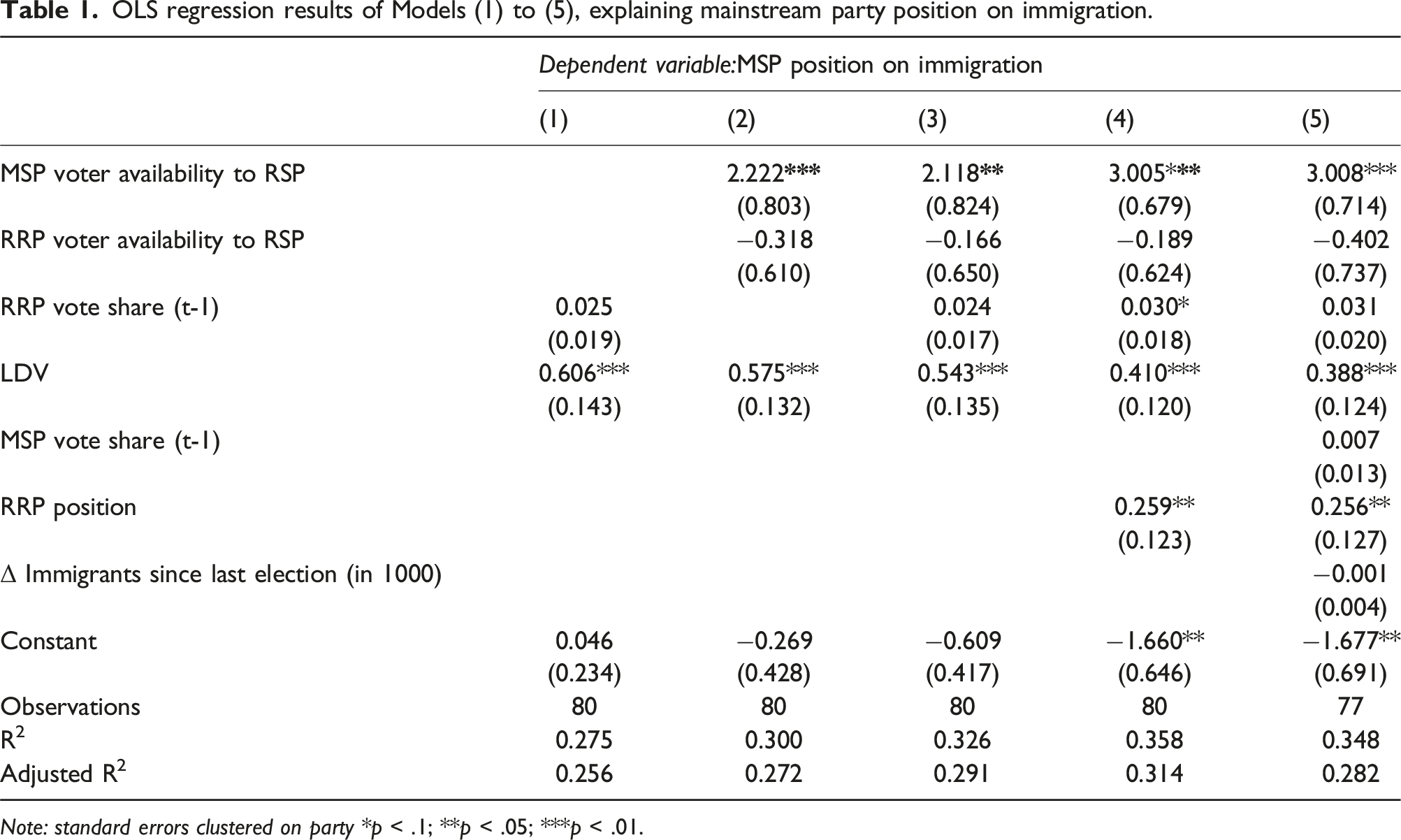
Note: standard errors clustered on party *p < .1; **p < .05; ***p < .01.
This holds true even when RRP vote shares remain even or move counter to availability. For instance, in the Danish elections in 2011 and 2015, the Danish People’s Party (DF) has kept a relatively consistent vote share, but the threat that DF posed to the Social Democratic Party (SD) increased from 0.178 to 0.325. As the overlap model suggests, the SD’s position turned significantly more anti-immigration in this election. However, despite DF’s vote share spiking in 2015 (from 13.8% to 21.1%), its threat on the SD remained stable in the coming electoral cycle (from 0.325 to 0.334). Accordingly, the SD did not adjust its position to be more restrictive as the vote share argument would suggest, but stayed close to its previous position.
Another very good example is Germany, where the Alternative for Germany (AfD) entered parliament in 2017 and increased its vote share from 4.7% to 12.6%. This shock should have seen massive movements to the right from German parties, but only the FDP – whose threat of losing voters to the AfD rose from 0.26 to 0.38 – moved to a more restrictive position. Germany’s two largest parties saw a small decrease in threat from the AfD, and accordingly moved towards more permissive immigration positions. These examples point to an effect of electoral overlap that is independent from changes to RRP vote share. This can also be observed when comparing model (1), which is purely reliant on RRP vote share, to model (3) adding availability measures. The effect of RRP vote share at the past election remains stable, but there is an additional positive effect of electoral threat to the MSP. Electoral overlap therefore likely has an effect on MSP positioning independent of RRP vote size, and should be taken into account when explaining party strategies.
OLS regression results of Models (6) to (10), explaining salience of immigration among MSPs.
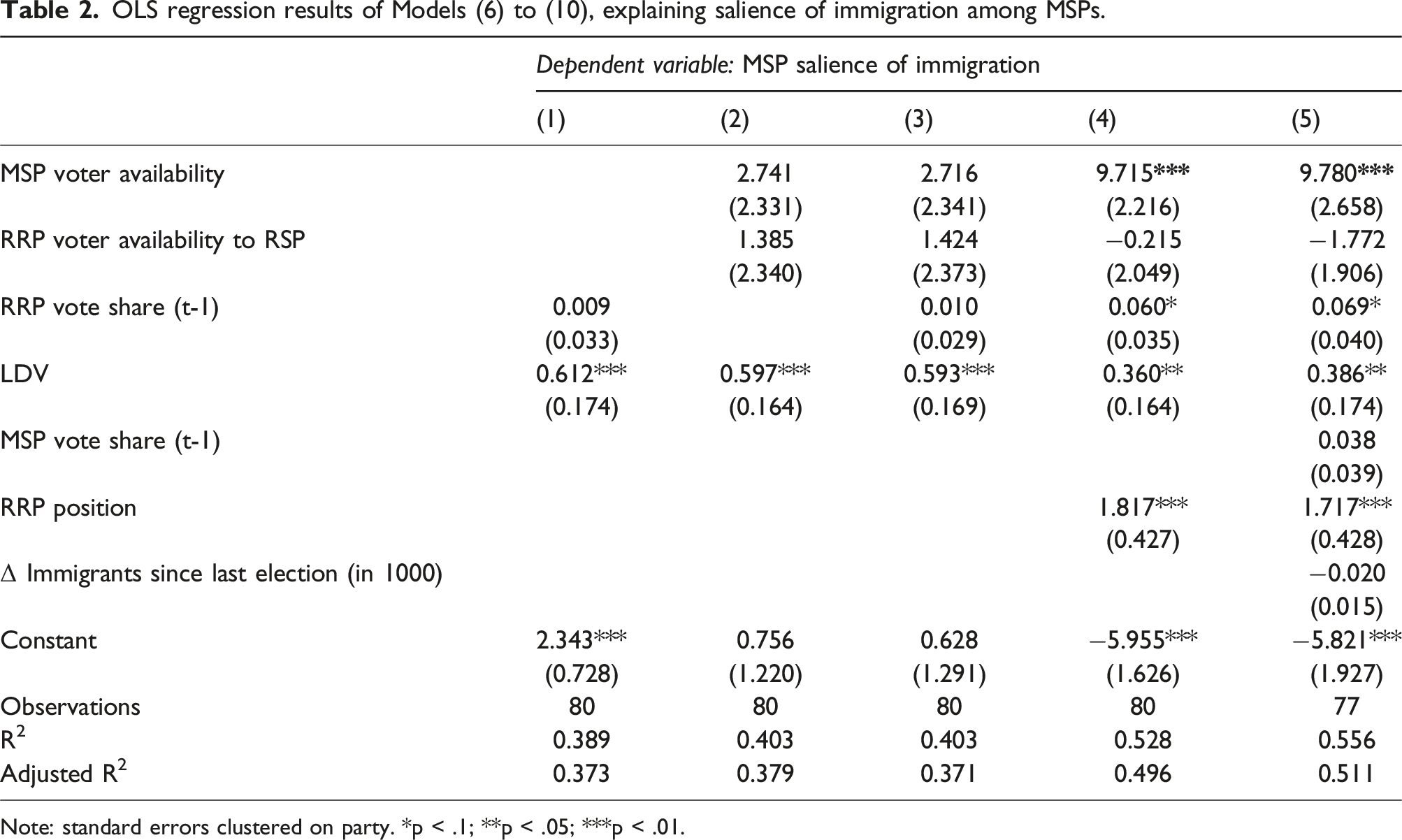
Note: standard errors clustered on party. *p < .1; **p < .05; ***p < .01.
Figure 4 visualises the results of my models by showing predicted values in four hypothetical scenarios. Scenario (1) keeps the vote share of the RRP stable at a high level, and changes the availability of MSP voters by one standard deviation. This is relatively common for centre-right MSPs facing established niche parties. Examples include the Swiss Liberals (FDP) and the Dutch D′66. Scenario (2) keeps threat constant while varying the vote shares of the RRP by one standard deviation. Examples of this scenario include the Danish Liberal Party between 2011 and 2015, or the Austrian Social Democrats (SPÖ). Scenario (3) increases and decreases both RRP vote share and availability of MSP voters by one standard deviation respectively. Finally, Scenario (4) shows a scenario of stable availability, but a sharp rise in RRP votes starting from zero. This simulates the emergence of a new party, and mirrors the trajectory of the Sweden Democrats or the True Finns. Projected development of MSP positions in the following four scenarios: (1) Vote share constant at 14.36. Threat varies: 0.24 – 0.38 – 0.52. (2) Threat constant at 0.38. Vote share varies: 6.62 – 14.36 – 22.10. (3) Vote share varies: 6.62 – 14.36 – 22.10. Threat varies: 0.24 – 0.38 – 0.52. (4) Threat constant at 0.26. Vote share varies: 0 – 8.73 – 14.35.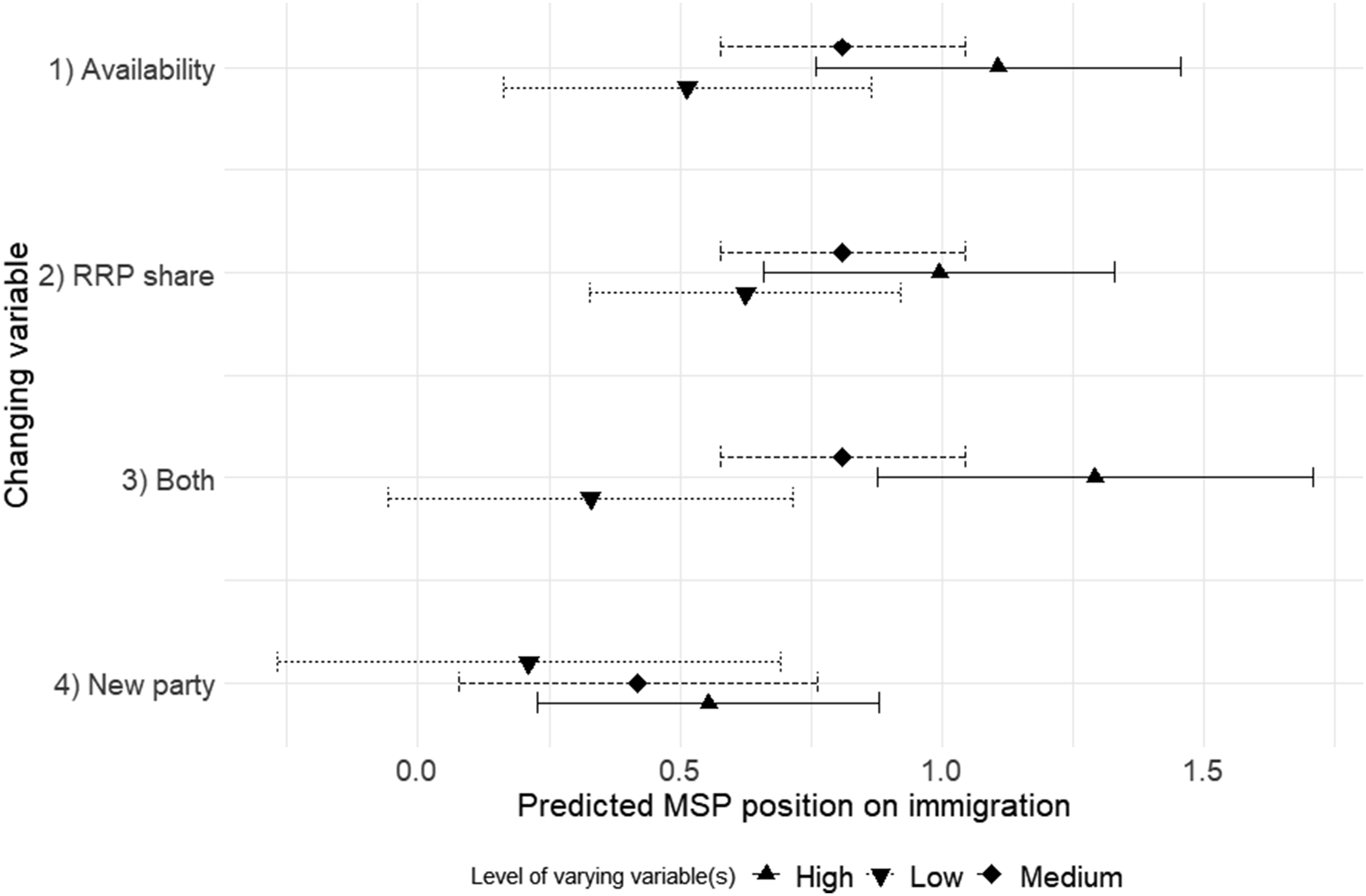
In all cases, the square represents the medium scenario, with the arrows up or down reflecting a decline or increase to the RRP niche party by one standard deviation for scenarios 1) to 3). For scenario 4), each estimate represents an RRP vote share growth by one quartile. Figure 4 shows that the effect of changing the threat posed by voter overlap is larger than that of changing the vote share of the radical right party, indicating that parties are somewhat more responsive to the risk of losing voters than simply a niche party growing in size. This indicates that political parties primarily care about their current voter base, rather than targeting all voters equally.
Are radical right voters lost to the mainstream?
Together, these results strongly support H1. However, the second hypothesis – that MSPs accommodate in order to win voters back from RRPs – is not supported by the data. While the test for H2 does not yield a significant result in any model, the estimated coefficient is negative, indicating that higher availability of RRP voters to a mainstream party correlates with more permissive immigration positions. This coefficient is not statistically significant and should therefore not be over-interpreted. Nonetheless, this is a surprising finding that could act as a starting point for future research. Here, I present two potential explanations for this result.
Voters of RRPs, particularly populist RRPs, could be disillusioned with MSPs and no longer vote based on policy positions (Lewandowsky and Wagner, 2022). Even though this is clearly not the case for the voters displaying high availabilities towards MSPs, they might underestimate their ability to win voters from RRPs. Relatedely, MSPs might also be hesitant to appear as “courting” radical parties, especially when RRPs are considered to violate political norms. Therefore, party strategists might perceive those voting for RRPs as “lost” voters and prefer to compete for other voter groups. This explanation has the biggest implication for parties, but is also hard to test.
Mainstream parties might also use other techniques to target these voters. They could emphasise other issues that they are perceived as more competent on, such as economic issues (Kurella and Rosset, 2017), or campaign on the basis of their general competence (De Vries and Hobolt, 2020). MSPs might consider RRPs to be issue owners on immigration, and believe voters prefer the original. In many countries, RRP voters also become less available to MSPs over time; this implies that these voters may be more likely to identify with their new party and buy into populist anti-MSP narratives. Therefore, MSP campaigning may shift to other issues as they perceive the market on immigration to be cornered by RRPs.
While the data shows a clear connection between the risk of losing voters and accommodation, the causality is less clear. PTV data is measured before the manifesto is written, ruling out direct reverse causality. However, a mainstream party may have taken anti-immigration views in the past, which could have led to an electorate that is more open to the far right and provides renewed accommodation incentives now. Even if this is the case, the results still show that not all parties always accommodate when the radical right gains votes, and not all parties react equally to a stronger far right. Therefore, the main finding of the paper that parties are more likely to accommodate when their voters are available to the radical right remains valid, even if the reason for this relationship may differ between cases.
Besides questions of causality, there are some other limitations as well. First of all, the time between voter surveys and elections is inconsistent, and sometimes large. In theory, the PTV question asks if a respondent considers ever voting for a party, and should therefore be stable over time, but it is likely that voter’s opinions of parties change over time. While this makes the study noisier, there is little reason to believe it introduces structural bias, and omitting elections with large gaps between the two points does not change the results. Secondly, relying on party manifestos omits other ways in which parties communicate their positions. This, again, is a necessary simplification to ensure comparability, as parties do not campaign the same way in every country. Including other channels, such as TV spots or televised debates, might distort results due to these channels being used differently across countries. Finally, the study uses an N of 80 for most models, which is smaller compared to some other cross-national studies of party manifestos. This is necessary due to the lower availability of PTV data going back in time. As time progresses and more voter surveys are conducted asking PTV questions, future research into voter availability and party strategy will hopefully be able to operate with larger datasets and expand this research. (Irwin et al., 2003; Kolk et al., 2012).
Conclusion
By incorporating a party-specific measure of electoral threat, this paper provides important new insights on mainstream party strategy in the face of challengers. In line with existing research, it shows that mainstream parties move towards radical right parties when faced with a risk of electoral losses. However, it shows that this effect is not only a reaction to growing RRP vote shares. Parties also react specifically to the risk of losing their current voter base to the challenger. It further shows that there is no effect related to the potential of winning back voters that already voted for RRPs in past elections. Mainstream parties do therefore strategize to protect their existing voter base, but shy away from actively competing for radical right voters even when those voters would be available to them.
Future research examining mainstream party strategy in the face of niche parties should therefore include an availability-based measure where possible. Leaving out such a measure misses an important source of variation on the impact that rising RRPs have on mainstream party positions. Including such a measure also brings studies closer in line with the theory on party strategy, and with the body of qualitative research suggesting that parties do react unequally to rising challengers depending on the specific threat those challengers exhibit on their voter base (Bale et al., 2009; Green-Pedersen and Krogstrup, 2008; Meguid, 2008).
These findings could also offer an explanation as to why parties continue to accommodate RRP challengers even though this strategy is not necessarily yielding electoral gains (Krause et al., 2022; Williams and Hunger, 2022). If more threatened parties are more likely to accommodate challengers, this implies that parties more likely to lose votes are more likely to accommodate. Therefore, findings that accommodation is associated with vote loss (or growing RRP vote shares) might be reflecting endogeneity, as parties not about to lose votes are not accommodating in the first place. Therefore, future studies that evaluate the success of accommodation based on its effect on availability rather than vote share could shed light on the effectiveness of accommodation as a preventative measure.
Supplemental Material
Supplemental Material - Not everyone suffers equally: The effect of electoral overlap on mainstream party responses to radical right parties
Supplemental Material for Not everyone suffers equally: The effect of electoral overlap on mainstream party responses to radical right parties by Dino Noah Wildi in Party Politics.
Footnotes
Acknowledgments
I would like to thank Thomas Däubler (University College Dublin) for his extensive assistance and supervision, and multiple colleagues and Joint Session participants for their excellent feedback. I also thank the reviewers and editorial team for their helpful comments and assistance throughout the publication process.
Declaration of conflicting interests
The author(s) declared no potential conflicts of interest with respect to the research, authorship, and/or publication of this article.
Funding
The author(s) received no financial support for the research, authorship, and/or publication of this article.

Data availability statement
All datasets in the article are published openly and accessible through their respective website and/or distributor, and have been cited in the reference list. The cleaned and edited datasets used in the statistical analysis reported in the paper have been submitted to Party Politics alongside the manuscript, and will be made available as part of a replication package via Harvard Dataverse. This includes challenger overlap measures for all parties included.
Supplemental Material
Supplemental material for this article is available online.
Notes
Author biography
References
Supplementary Material
Please find the following supplemental material available below.
For Open Access articles published under a Creative Commons License, all supplemental material carries the same license as the article it is associated with.
For non-Open Access articles published, all supplemental material carries a non-exclusive license, and permission requests for re-use of supplemental material or any part of supplemental material shall be sent directly to the copyright owner as specified in the copyright notice associated with the article.
