



Abstract
Much has been written about the state of parties and democracy. For electoral democracy scholars, parties are in trouble and, thus, so is democracy. Meanwhile, democratic innovations scholars operate with a different premise about parties, which they see as ‘the problem’, and the state of democracies, which they see as being re-imagined as citizen-centred. In short, we have a dystopian view about the state of parties and democracy versus a utopian view of a democracy that excludes parties. The paper start by reviewing these conflicting views to make the case that one is under-estimating the potential of democratic innovations and the other is under-estimating the role of parties in driving the innovations. We then set out a framework of democratic innovations centred on party agency. Finally, we reverse things to examine the role of democratic innovations within parties, again revealing divergent views about the nature of the reforms and the potential of parties.
The title of this paper is a play on Schattschneider’s (1942) famous words, which referred to the symbiotic relationship between political parties and democracy. Much has been and is being written about the state of parties and democracy, one of the most noted pieces being Mair’s posthumous Ruling the Void (2013), which very directly framed the account of the state of democracy in terms of the state of parties. According to Mair, and many other scholars in the field of electoral democracy, parties are in trouble and, thus, so is democracy.
Meanwhile, in a parallel political science universe, one of the most vibrant new sub-disciplines, democratic innovations, operates with a very different premise about the role of parties, and about what is occurring to democracies. For many scholars in this tradition, political parties, if anything, are ‘the problem’. The aim is to imagine a new form of democracy, one that is citizen-centred (Elstub and Escobar, 2019a; Smith, 2009), at the heart of which are new participatory and deliberative institutions that enable direct, unmediated engagement in democratic processes by citizens. In this vision, there is ‘hope’ for a new form of democracy (Gastil and Knobloch, 2020), but, for many of these scholars, one without parties (e.g. Geissel, 2022; Landemore, 2020).
In short, we have one pretty depressing view about the state of parties and democracy versus a more hopeful view for democracy, but one that may not include parties. Where the views differ is on the prospect for democracy; where there is some overlap is in how parties are being written out of the picture either because they’re in their death throes or because they simply should not have been there in the first place. There are issues with both views that this paper seeks to address. We start, in the first section, by reviewing these conflicting positions to make the case that one perspective is under-estimating the potential of democratic innovations and the other is under-estimating the important role of parties in driving the innovations. Section 2 then sets out a framework of democratic innovations that credits parties with a leading role. But this relationship between democratic innovations and parties can work both ways; thus, in section 3, we examine recent internal organizational developments within political parties, which again reveal divergent views about the nature of the reforms and the potential of political parties.
Competing visions of parties and democracy
In political science, broadly conceived, views tend to differ about the state of democracy and the role of parties. The electoral democracy field starts from the perspective of the overlap between parties and democracy that dates back to the creation of both. For Weber (1990: 3) parties are ‘the children of democracy’, for LaPalombara and Weiner (1966: 3) they are ‘the creature[s] of modern and modernizing political systems’. Schattschneider’s statement that ‘modern democracy is unthinkable save in terms of parties’ (1942: 1) tends to be the most quoted. His perspective was unapologetically normative, calling for the development of a model of ‘party government’, a term that became quite prominent in political science debates in the 1970s-1980s, culminating in a multi-volume project on ‘the future of party government’ directed by Wildenmann (e.g. Castles and Wildenmann, 1986).
Central to the party government perspective is the premise that parties are the key transmission belts in democracy (Sartori, 1976). This perspective has a long pedigree, dating back at least to the classic work of Almond (1960). More recent descriptions of the party government model (notably by Lawson, 1980; also Römmele et al., 2005), use the term ‘linkage’ to distinguish political parties from other organizations, marking them out as the primary representative agents between citizens and the state. Dalton et al. (2011) set out a ‘chain of democratic linkage’ in five stages, each of which partes are at the centre of: a campaign stage involving the selection of candidates and setting the parameters of the electoral process, a participatory stage involving the mobilizing of cores, an ideological stage offering policy choices to voters, a representative stage in the formation of government, and a policy stage in delivering on the policies advocated in the election. It is this sense of parties as the key link in our representative system of politics that leads to the perspective of the two being synonymous (i.e. that representative democracy equals party democracy) and that democracy cannot operate without parties. No wonder that key authors like Mair (then) referred to the twentieth century as the ‘century of party democracy’ (Mair, 1995: 41, italics in the original).
As we moved into the twenty-first century, a host of studies suggested that Schattschneider’s ‘unthinkable’ may now be happening, the most prominent being Mair, who in in his posthumous Ruling the Void is unequivocal in stating that ‘[t]he age of party democracy has passed’ (2013: 1). In his eyes political parties are failing and with them democracy itself, the latter being ‘redefined’ to downplay popular sovereignty, resulting in a ‘stripped down’ democracy (Mair, 2006: 8), characterised by citizens and politicians withdrawing from electoral politics. He writes of a growing divide between citizens and their leaders, political parties in their death throes, and democracies shorn of their popular roots. Of course, he is by no means alone in painting such a doom-laden picture. Consider, for example, Crouch’s (2004) vision of a ‘post-democracy’ in which citizens are by-passed and apathetic (the latter at the heart of Hibbing and Theiss-Morse’s [2002] ‘stealth democrats’), or Achen and Bartels’ (2017) call for technocratic government that dispenses with citizens altogether, or studies that envision democracy dying due to the lack of toleration for the other side (Levitsky and Ziblatt, 2019) to the extent that winning is seen to trump democratic norms (Goodman, 2022), or the extensive research on ‘democratic backsliding’ (e.g. Bartels et al., 2023; Waldner and Lust, 2018). Undoubtedly, there is something of a growth industry in studies of party and democratic decline. While the analysis does seem persuasive, there is a possibility of over-exaggerating the extent of the threats, or at least not giving sufficient credence to ongoing processes of reform and innovation in democracy, or, indeed, for that matter, in parties too. We return to this below.
In contrast to this dystopian vision of party and democratic decline, there is a second vision that adopts a rather utopian perspective of democracies that operate without parties – in this instance, potentially under-estimating the role that parties play in democracy. The aim is to imagine a new form of democracy, one that is citizen-centred (Elstub and Escobar, 2019a; Smith, 2009), at the heart of which are new participatory and deliberative institutions that enable direct, unmediated engagement in democratic processes by citizens. In this vision, there is ‘hope’ for a new form of democracy (Gastil and Knobloch, 2020), but, for some at least, one without parties (e.g. Geissel, 2022; Landemore, 2020). Inevitably, there are a number of different strands to this, but for the purposes of this paper they can be grouped into two main approaches, one from a deliberative theory perspective, and another based on empirical analysis of democratic innovations.
The first approach originates in a classic political theory tradition whose ‘criticism of parties is in some sense older than parties themselves’ (Scarrow, 2002: 5), a tradition that prompted Schattschneider at the time to refer to parties as ‘the orphans of political philosophy’ (1942: 10). While there are modern-day exceptions (e.g. Bonotti, 2017; Muirhead, 2014; Rosenblum, 2008; White and Ypi, 2016; Wolkenstein, 2019) – some of whose arguments we refer to below – the prominent position remains that parties are viewed ‘as corrupt and corrupting; as factions ambitious to exercise power; as unreasonable, unrepresentative, and undemocratic’, and for this reason they remain ‘at the margins of normative political theory’ (Muirhead and Rosenblum, 2020: 96). This can be seen in theoretical perspectives on new ideal forms of non-party, deliberative democracy. As an illustration, let’s briefly consider two prominent examples of recent work in this space. Landemore (2020) and Guerro (2014) (among others who could be mentioned) share a common agenda, namely to promote a new form of democracy that is centred on citizens – a form of democracy that, they argue, revisits the original design of ancient democracies. In Landemore’s ‘open democracy’ ordinary citizens are in the driving seat with random groups of them taking decisions in large ‘open mini-publics’ that are connected to the wider public via crowd-sourcing platforms and other smaller deliberative fora. In Guerro’s version the citizens deliberate in a series of single-issue lottery-selected legislatures (or ‘SILLs’). Both authors share the ambition of removing elections from the equation, though, tellingly, each does accept that there might still need to be some element of election. The absence of elections, by these accounts, ends corruption (notably money in politics, and policy capture by vested interests), and it also removes the need for parties. As Landemore notes (2020: 26), ‘elections entail a type of party politics that is itself not conducive to deliberation or its prerequisites, such as open-mindedness rather than partisanship’. For her, an ‘open democracy’ should be one without elections or parties – a ‘no-party democracy’. 1
Here we confine ourselves to commenting on Landemore’s call for a ‘no-party democracy’. 2 As outlined above, parties have a vital role in the everyday running of democracies, a role that won’t simply disappear in the event that democracies were to transition to being notably more deliberative in how they operate (such as envisaged in Guerro’s and Landemore’s visions). In Bernard Manin’s normative perspective on a deliberative political system, political parties are ‘essential’ (Manin, 1987: 357). Joshua Cohen is even more insistent that ‘political parties supported by public funds play an important role in making deliberative democracy possible’ (Cohen, 1989: 30). For him, ‘it is difficult to see … how we can best approximate the deliberative conception … in the absence of strong parties’ (p. 32). Similarly, Teorell stresses how parties ‘are particularly well suited to providing linkage from the deliberations of civil society … into the political sphere’ (1999: 373). What makes this so is that, unlike other social and political organisations, parties are continually ‘striving for public office’. We can see this in terms of parties’ linkage roles that were summarised above, not least in setting out policy options for citizens (White and Ypi, 2011: 392), in mobilizing voters at elections, and in being held to account for the implementation of policy (Gherghina et al., 2023a). It is also evident in the role of parties working together, where necessary cooperating across party lines as they manage the democratic process together – referred to by Bonotti and Nwokora (2024: 694) as the parties’ ‘collegiality’ role.
A second perspective on democracy beyond parties originates in the sub-discipline of democratic innovations. In terms of its treatment of parties, this perspective tends, if anything, to be more neglectful rather than necessarily condemning of them. As van Biezen and Saward put it, in this approach ‘political parties are conspicuous by their marginality or absence’ (2008: 24). The focus here is on citizen-led democracy. The seminal study is by Smith, who defines democratic innovations as ‘institutions that have been specifically designed to increase and deepen citizen participation in the political decision-making process’ (2009: 1). The key phrase here is ‘to increase and deepen citizen participation’. More recently, in their introduction to a Handbook on democratic innovations, the editors adopt similar language about institutional reforms that ‘deepen’ the role of citizens, but they take it up a notch by proposing that the innovations should also ‘reimagine’ the role of citizens (Elstub and Escobar, 2019a: 11). There is general agreement about the main forms of innovations: top of the list are deliberative mini-publics; the others include participatory budgeting, and referendums (particularly citizen initiatives); some authors also add collaborative government forums and digital participation.
Common to all of these is that citizens are at the heart of things. There tends to be little discussion about where and how political parties might still fit: in Smith’s book, parties hardly get mentioned at all (they’re not even included in the index); the only reference to parties by Elstub and Escobar is when they express the view that parties ‘do not reimagine the role of citizens, but rather are standard forms of participation in representative democracies’ (2019a: 15). 3 More than a decade earlier, and a year before Smith popularised the term ‘democratic innovations’, Van Biezen and Saward (2008) published an important paper on the theme of how party scholars and democratic theorists (particularly deliberative theorists) tend to talk past each other. The following comment offers a good response to the Elstub and Escobar view on parties: ‘[d]emocratic theorists often propose new mediating structures – deliberative bodies, participative budgeting, and so on – but leap too blithely over the existing, if troubled, core mediating devices, namely parties’ (Van Biezen and Saward, 2008: 28). (As we shall see below, van Bizen and Saward’s point can be taken further to note the role that parties play in establishing and driving these new mediating structures.)
For a long time, much of the focus in the democratic innovations field was on discrete, rather siloed reforms – the establishment of a citizens’ assembly or a participatory process, the introduction of citizens’ petitioning for referendums, and so on; but more recently, reflecting debates over ‘scaling up’ or ‘mainstreaming’ democratic innovations, attention has turned to developments that are more systemic in nature, with a scope to include traditional representative institutions. This is perhaps most notable in the ‘deliberative systems’ approach, which is based on the principle that political systems comprise a mix of traditional/representative and innovative institutions that operate as ‘differentiated, but to some degree interdependent parts … connected in such a way as to form a complex whole’ (Mansbridge et al., 2012: 4). The blending of existing and new institutions is also central to the ‘mending democracy’ approach, which ‘involves strengthening connections across the democratic fabric’ (Hendricks et al., 2020: 3). Following this metaphor, democratic innovations, such as citizens’ assemblies, are seen as ‘patch[es]’ that can be ‘stitch[ed] in’ to the existing fabric of democratic institutions (Boswell et al., 2023: 91). 4 The deliberative systems and mending democracy approaches at least have the merit of not ignoring parties or denying a role for them; but, parties are still rather marginalised in such accounts (for an exception, see Biale and Ottonelli, 2019). The focus remains on the innovations; little if any attention is played to the role of political parties in all of this.
To summarise, we have two very different perspectives on the state of democracy and the role of parties. The electoral democracy field tends to over-exaggerate the extent of party and democratic decline, or at least not give enough credence to the potential of democratic reform and innovation. By contrast, the democratic innovations field is more hopeful about the state of democracy but largely dismissive of parties. Both perspectives need revisiting to note the fact that, first, democracies are constantly adapting and evolving (and as we shall see in section 3, so are parties) suggesting at least that the fate of democracy may not be quite as dismal as some suggest, and, second, that parties are playing a key role in this.
The role of parties in democratic innovation
Scholars working in the field of electoral systems have known for some time that democratic institutions are prone to change: the rules governing the electoral process are constantly under review (see for instance, Bowler and Donovan, 2013; Carter et al., 2024; Renwick and Pilet, 2016). The same applies to institutional reforms in democracy more generally. There are no shortage of examples. Reforms to the functioning of electoral democracies include the following: the introduction of gender quotas, reforms to electoral systems, party funding reforms, the abolition of second chambers, reductions in voting age, regional devolution, the establishment of election management bodies. A comprehensive analysis of trends over a 20 year period between 1990-2010 by Bedock (2017) shows just how extensive this has been across Europe’s established democracies. Her findings are conclusive: ‘reforms have been relatively frequent (on average, one reform every two-and-a-half years)’; indeed, to such an extent, she suggests, ‘that change is permanent’ (Bedock, 2017: 242-43).
Over this same period there have also been extensive reforms that go beyond electoral democracy, which include the introduction of citizens’ petitions, freedom of information legislation and the open government agenda, participatory budgeting, and the growing use of deliberative mini-publics (DMPs) in the policy process as well as in debates over constitutional reform (e.g. Dalton et al., 2003; Elstub and Escobar, 2019; Reuchamps et al., 2023). In the case of DMPs, their use has become so widespread that an influential OECD report refers to this as ‘a deliberative wave’ (OECD, 2020).
A point that is often elided over is that these reforms to electoral democracy and beyond are being driven by political parties (for exceptions, see Gherghina and Jacquet, 2022; Ramis-Moyano, 2025; Sintomer et al., 2016). To put this in the baldest sense, democratic innovations need parties if they are to happen. Clearly, there are any number of causal factors that lie behind a process of reform, as summarised in Figure 1. An incomplete list would include the following contextual points: societal change (e.g. growing demands from more educated electorates), economic crisis (resulting in demands to reform processes so as to avoid a repetition: see e.g. Iceland and Ireland in the wake of the 2008-09 Great Recession), the growing perceptions of threats to democracy that demand a response of some sort (at the heart of reforms to protect the integrity of the electoral process, for instance; e.g. Norris, 2014), or, indeed, concerns about political parties (notably the tracking of declining party membership in established democracies; e.g. Van Biezen et al., 2012).
5
There is also an important role for motivators whose role is to educate on and/or promote areas of reform. These might include NGOs, lobby groups, and experts calling for particular reforms, or, perhaps more indirectly, pressures from international actors to resolve some problem or other, usually based on examples of best practice in other countries. Political parties and democratic innovations.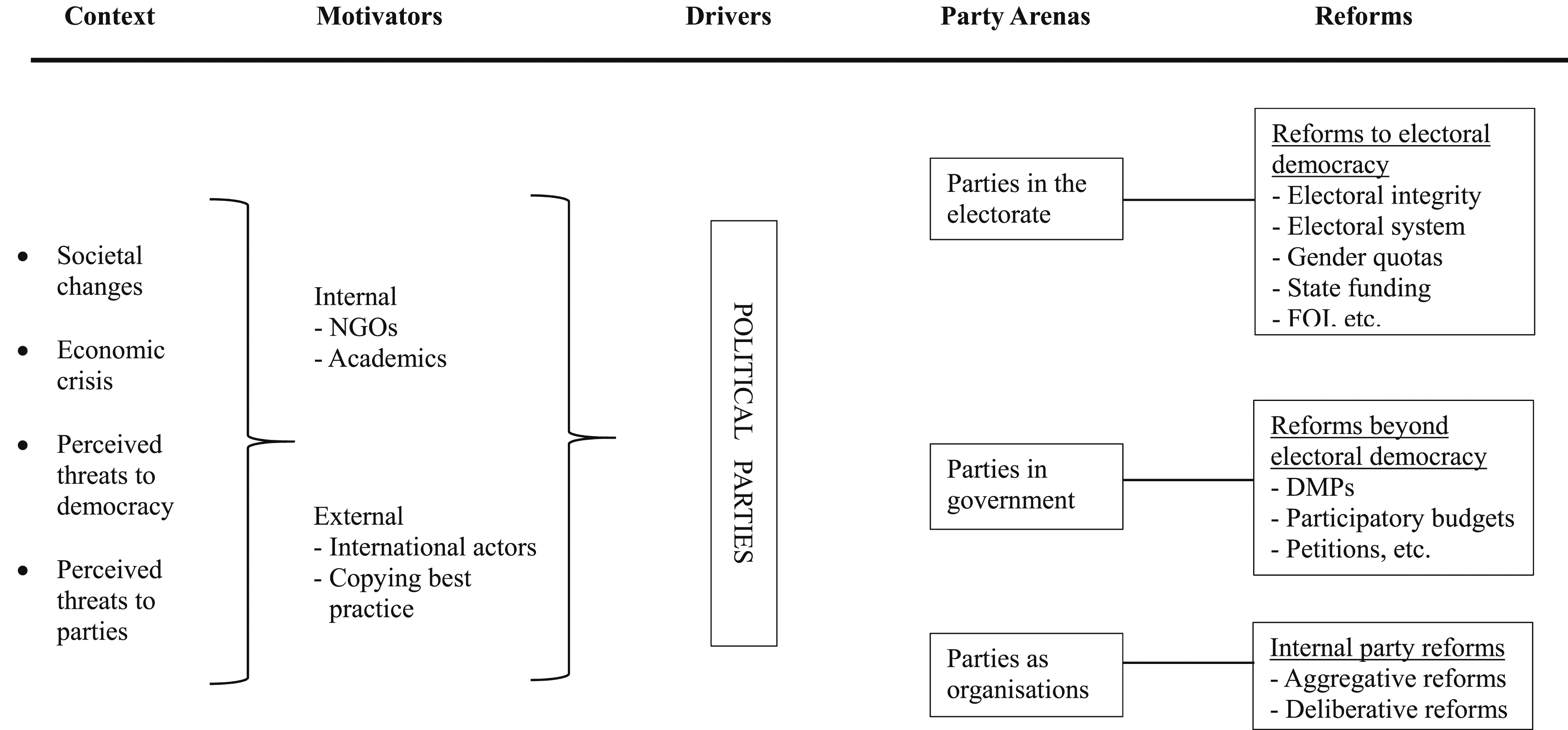
The context might favour reform and motivators may be clamouring for it, but in order for the reform to happen it needs action by political parties. The reforms can be grouped into three main forms, each affecting an arena that parties operate in. In this and the previous section we’ve been dealing with the first two arenas: parties in the electorate, which is where the reforms to electoral democracy are focused; and parties in government, where we see reforms that go beyond electoral democracy. (The third arena, parties as organisations, is dealt with in the next section.) 6
The first take away from this discussion is that political parties have a vital role to play in driving the process of democratic reform and innovation. That role needs greater recognition and more foregrounding in the field of democratic innovations (cf. Gherghina, 2025). Our second take away is that democracies are not standing still: there have been and continue to be regular processes of democratic reform that impact on elections (vote-centred) and in the periods between elections (talk-centred). Of course, this then begs the question whether such reforms will make much difference to the fate of democracies. There clearly are doubters, notably Mair who was of the view that many of the reforms favour ‘options that actually discourage mass engagement (2006: 28), and specifically regarding DMPs his view was that they are ‘exclusive’, not offering ‘much scope [for] … conventional modalities of mass democracy’ (Mair, 2006a: 8; also Mair, 2013). Similarly, Pateman has noted that many of the reforms ‘are not integrated into the overall system of representative government or democratic institutions, nor do they become part of the regular political cycle in the life of a community’ (Pateman, 2012: 10). And we know from studies on electoral reform that there is limited evidence of the reforms actually having much impact (Bowler and Donovan, 2013; Renwick and Pilet, 2016), though, as Bowler and Donovan note, such a null finding may simply reflect that electoral reforms ‘tend not to address the issues that voters care about’ (2013: 139). But despite these doubts, there are other scholars who have, in Gastil and Knobloch’s (2020) words, a more ‘hopeful’ view of how democratic innovations may provide a fillip to democracy (for a sample, see Cain et al., 2003; Farrell and Field, 2022; Farrell and Suiter, 2019; Fishkin, 2018; Geissel, 2023; Hendriks et al., 2020; Landemore, 2020; Smith, 2021). Ultimately, the jury may be out on whether democracies will prevail, but the fact that they are constantly evolving at least gives reason for hope.
The role of democratic innovations within parties
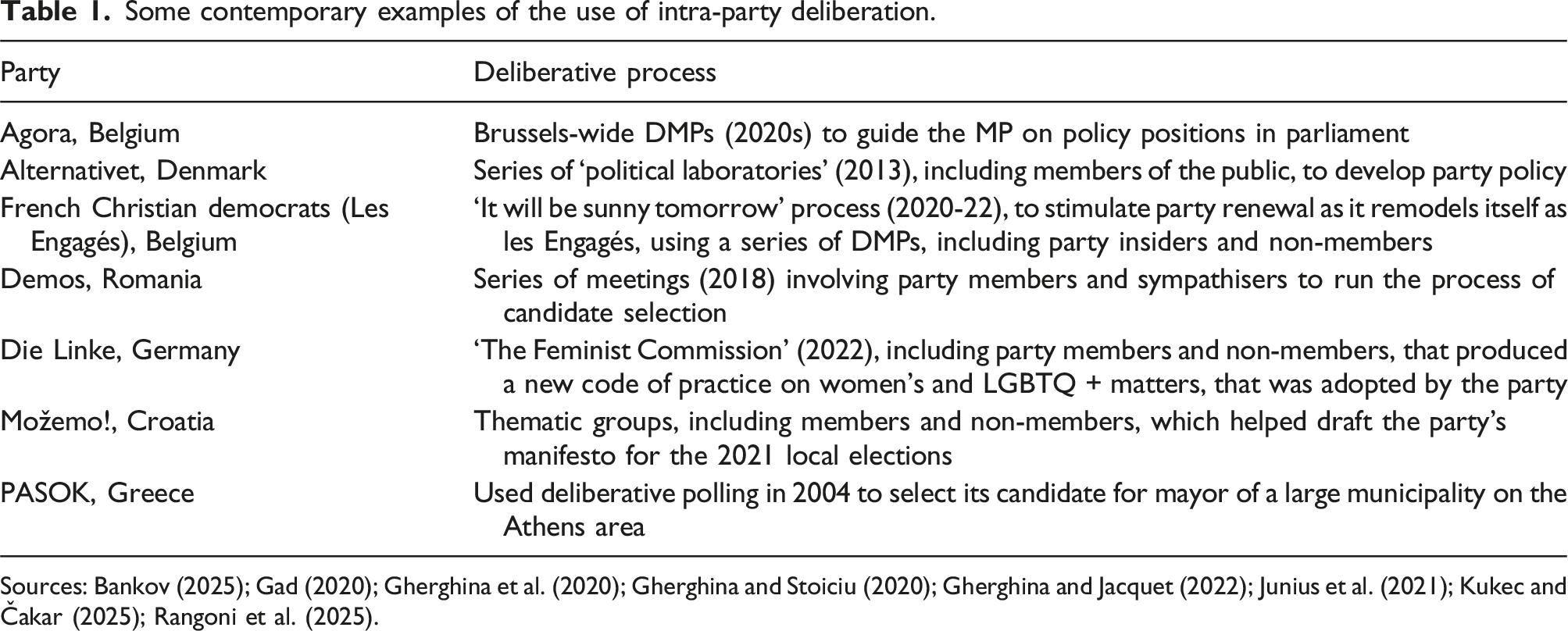
Some contemporary examples of the use of intra-party deliberation.
The general consensus, however, is that these aggregative reforms may not be sufficient to help the parties hold onto party members. In a context of declining membership numbers it makes sense that party leaders might seek to give a greater role to party members in internal decision-making; but the evidence suggests that the reforms are not working: membership numbers continue to decline across the board (e.g. Van Biezen et al., 2012). 7 Separate from the lack of impact of aggregative reforms on overall membership numbers, there is a question over whether these reforms may have an opposite impact to the purported reason for introducing them by side-lining the activists and not really addressing the underlying issue of how to re-engage party members, a point first noted by Mair (1994; see also Barnea and Rahat, 2007; Ignazi, 2020; Invernizzi-Accetti and Wolkenstein, 2017; Katz and Mair, 2009; though see Gauja, 2017: 183; van dem Berge and Poguntke, 2017: 151).
The potential of deliberative reforms features to some extent in the IPD perspective, 8 but not prominently so. An example of this is the examination of parties’ internal consultations on developing policy or debating party reforms (e.g. Gauja, 2017: 94-97, 123-30; Scarrow, 2015: 179-81). Poguntke et al. also incorporate this into their ‘Assembly-based variant’ of IPD, where ‘participants debate propositions and take a decision’ (Poguntke et al., 2016: 671). The general conclusion, however, is that these processes have little impact on the internal operations of parties. As Gauja puts it, there is a ‘disjuncture between the way in which consultation is portrayed … and the reality of the process’ (2017: 125), and Scarrow notes the limited appeal of many of these processes for party members (2015: 181). Telling in each of these studies is that developments of this type are not analysed through the lens of deliberation, even though they would seem to fit the definition of what Bachtiger and his colleagues (2010) refer to as ‘Type II deliberation’. 9
Contrast the IPD perspective with the work of scholars making a normative case for parties to embrace deliberative reforms in their internal operations (Bankov, 2025; Biale, 2025; Ignazi, 2020; Invernizzi-Accetti and Wolkenstein, 2017; Teorell, 1999; Warren, 2023; Wolkenstein, 2016). Like IPD scholars, they are of the view that aggregative reforms are not sufficient. For instance, Wolkenstein argues that aggregative reforms ‘run the risk of simply reinforcing the preferences of the party elite, thus weakening … the members on the ground’ (2016: 297). As a consequence, party members ‘become disenchanted’ (p. 298). For these authors, ‘parties need to become more democratically deliberative in their internal structure’ if they are ‘to perform the democratically important function of mediation between society and the state’ (Invernizzi-Accetti and Wolkenstein, 2017: 106, emphasis in the original). The kernel of the argument is that the adoption of internal deliberation would reap some benefits for parties. In particular, it could help to at least stem the decline in membership numbers; by giving members greater ‘voice’ within the party makes it more likely that they will remain as members (see also Heidar and Jupskas, 2022). As Ignazi notes, it would re-engage members in the process of policy formation and thus ‘reinstate and reenforce the collective dimension of participation’ (2020: 15). Teorell suggests that since a key ‘hallmark’ of parties is to engage in trade-offs and compromise when developing positions, including the members in this would help in dissipating tensions between party leaderships and the activist base (1999: 373-74). Wolkenstein adds some other benefits, including that by operating a more inclusive, deliberative process of discussion about party policy this ‘could over time sharpen a party’s distinctive partisan profile’ (2016: 315).
Wolkenstein (2016) sets out specific designs on how a deliberative process might operate in practice. He distinguishes between three possible models: a problem-oriented forum, which would draw from a number of party branches to design party policy; a partisan deliberative network, where branch-level deliberations would feed into national party deliberations; and a partisan deliberative conference, mixing grassroots members with party elites to deliberate on key policy or strategic decisions.
Empirical work on parties’ use of deliberative processes is relatively new and still quite scarce, much of it focused on newer parties that feature internal deliberation as part of their raison d’être. The ‘digital parties’ (Barbera et al., 2021; Gerbaudo, 2019) are probably the best known: they include Podemos in Spain, the Italian Five Star Movement, and the Pirate parties that sprang up across a range of different North-European countries. The common trait is an emphasis on ‘going beyond’ traditional party members, and emphasising online deliberation. The core ambition that these parties share in common is what Gerbaudo refers to as ‘participationism’, in which those accessing the online platforms can supposedly engage in deliberative dialogues about issues prior to voting on them. But as he reports in his authoritative book-length study of the phenomenon, ‘[d]espite the presence of deliberative, discussion-oriented and qualitative forms of online decision-making, the form of digital democracy that prevails … is clearly top-down: more concerned with balloting than discussing’ (Gerbaudo, 2019: 133). He concludes that ‘there is a clear discrepancy between the lofty promise and the prosaic reality of digital democracy’ (Gerbaudo, 2021: 739), a view shared by Wolkenstein, who sees their design as ‘ill-suited’ to the development of intra-party democracy (2016: 306).
Beyond the digital parties, there are other examples recently emerging that provide more promising evidence of the use of deliberative processes by parties (Gherghina, 2025; Gherghina et al., 2020, 2023). Table 1 provides a sample of seven prominent cases that would appear to come close to the normative ideals set out above. 10 Common to all these cases is that the deliberative processes were consequential – they influenced party-decision making processes; and in two cases their recommendations were mandatory (Agora and PASOK). The ‘it will be sunny tomorrow’ process run by Belgium’s French Christian Democratic Party in 2020-22 offers a real-world example of Wolkenstein’s ‘partisan deliberative conference’, because the final stage of the two-year deliberative process culminated in DMPs that mixed party members together with elected politicians (Rangoni et al., 2025). These cases are consistent with Gherghina et al.’s (2020a) observation that intra-party deliberation is common to all party families and across new and old parties – though, perhaps more a case for the new than the old, supporting Kukec and Čakar’s (2025: 156) contention that intra-party deliberation is ‘particularly attractive to new parties in their efforts to bring politics closer to citizens, develop innovative policies, and attract new members and sympathisers’.
It should be noted, however, that these cases have had quite mixed results. The Agora party continues to feature deliberation as its modus operandi, having organised a series of DMPs to date. 11 For Junius et al. (2021) the party has been ‘relatively successful in promoting meaningful intra-party deliberation while effectively operating in a representative system’. But the picture is less positive for the other cases summarised in Table 1: PASOK’s was a one-off (Gherghina and Jacquet, 2022); the Demos experiment was judged to have been internally divisive (Gherghina and Stoiciu, 2020). In other cases, the deliberative process eroded over time due to electoral successes and the need to adapt to being in power (Možemo!), or as a result of the emergence of a strong leader (Les Engagés), or simply due to the party’s membership base reaching a critical mass making it difficult to continue with deliberative processes (Alternativet) (Gad 2020; Kukec and Čakar, 2025; Rangoni et al., 2025). In Die Linke’s case the use of deliberation has been episodic (Bankov, 2025), which raises questions over how embedded this may become over time. In short, it is too early to draw firm conclusions on the degree to which these reforms are making a sustained difference. However, there is little doubting that ‘deliberative democracy has entered the repertoire of political parties, both in rhetoric and in practice’ (Gherghina, 2025a: 5). The fact that a growing number of parties are at least experimenting with deliberative processes internally suggests that we may be on the cusp of a ‘deliberative turn within parties’ (Rangoni et al., 2025: 139). It also suggests that IPD scholars should pay more attention to this feature than heretofore (on this, see also Heidar and Jupskas, 2022).
Conclusion
Parties get a bad rap. For some, they are the source of many of the problems in contemporary democracies, and even for those of a more sympathetic disposition, parties are seen as a shadow of their former selves as they, and democracies, decline. This paper has sought to offer a corrective to both perspectives by noting two key points. First, to counter the pessimistic perspective on the state of democracy, we have argued that more attention needs to be given to the fact of democratic innovation: democracies have experienced and are experiencing substantial reforms. Whether these will be sufficient to save them remains an open question, but the fact of democratic innovation needs more acknowledgement.
The second point has been our main focus, which has been to develop an argument that (similar to the symbiotic relationship between parties and democracy that was referred to at the start of this paper) there is a symbiotic relationship between democratic innovations and political parties. In the first instance, democratic innovations need parties: democratic reforms simply would not happen were it not for the agency of parties in driving the reforms; in Caramani’s words, parties still have a ‘crucial role’ to play (Caramani, 2017: 65). But this symbiotic relationship has a strong element of mutual dependency. It also works in reverse: parties need democratic innovations, and there are early signs that some parties now recognise this. This emerging trend need to be tracked more closely by scholars working in this space.
There is one final point to end with, and that is to return to the fundamental issue that underlies Schattschneider’s famous statement. Contrary to the pessimistic picture (or neglect) of parties that characterise the electoral democracy and democratic innovations literatures, parties may face all sorts of challenges in the contemporary world, but they continue to make fundamental contributions to democracy, especially by providing linkage between citizens and the state, contributing to the process of public justification, and promoting regulated rivalry and legitimate opposition (e.g. Bonotti and Nwokora, 2024; Dalton et al., 2011; Muirhead and Rosenblum, 2020). The party isn’t over (yet).
Footnotes
Acknowledgements
Earlier versions of this paper were presented at seminars at Seoul National University (May 2024), and Science Po Toulouse (April 2024), and at the ECPR Joint Sessions, Leuphana University, Lüneburg (March 2024). I am grateful to the following for advice and suggestions that have greatly helped in the drafting of this paper: Petar Bankov, Luciano Bardi, Loïc Blondiaux, Daniele Caramani, Fernando Casal Bertoa, Russ Dalton, Jean-Michel Eymeri-Douzans, Anika Gauja, Sergiu Gherghina, Piero Ignazi, Dick Katz, Euiyoung Kim, Bettina Mitru, Gideon Rahat, Min Reuchamps, Paul Webb, and my anonymous reviewers. The usual disclaimer applies.
Declaration of conflicting interests
The author(s) declared no potential conflicts of interest with respect to the research, authorship, and/or publication of this article.
Funding
The author(s) received no financial support for the research, authorship, and/or publication of this article.
