



Abstract
Can partisanship itself – independent of any party mobilizing activity – help voters overcome participatory obstacles? Challenges for evaluating this question in normal circumstances abound as parties mobilize voters specifically based on their partisanship and in order to counter participatory hurdles they may face. Here, taking advantage of a quasi-experimental circumstance in which a targeted mobilizing effort was not feasible, I show that party membership itself reduced vulnerability to an unforeseeable electoral hurdle and did so even among a class of supervoters who participated in every recent election. Employing logistic regression and propensity matching to isolate the influence of party, the results show the inoculating effect of party applies not only to major U.S. parties (Democrats and Republicans), but also to adherents of minor parties, rendering partisans about 40% less likely to have their ballot thwarted. The results offer unique evidence that party loyalties have an effect independent of party mobilization and a stark warning that while party-less voters may not be the intended target of procedural voting hurdles, they are likely to bear the sternest burden of them.
One of the defining characteristics of partisanship is its positive effect on political participation (Campbell et al. 1960). While partisanship is strongly associated with political interest and participatory habits, does it inoculate potential voters against unprecedented participation hurdles? Several U.S. states have raced to erect an array of voting hurdles in the aftermath of the 2020 election (see, e.g., Pomante 2024; Schraufnagel 2022), thus the question is not only timely but it is of growing pertinence.
Answering whether partisanship protects voters from the effects of procedural burdens is not as straightforward as it may seem. Parties may organize and mobilize specifically to combat new hurdles and take advantage of new procedural opportunities, making it difficult or impossible to distinguish between the effect of the procedure, the effect of a party’s efforts, and the effect of party loyalty (see, e.g., Patterson and Caldeira 1985). Even a procedural hurdle itself may, ironically, serve as motivation to participate as the belief that one is being targeted for exclusion has the potential to stimulate commitment to voting (Biggers and Smith 2020; Valentino and Neuner 2017).
Using a quasi-experimental analysis enabled by the failure of Franklin County (Ohio) Board of Elections to send correct absentee ballots to tens of thousands of voters in 2020, this paper offers unique evidence on the power of party to foster participatory resilience in a circumstance in which there was neither targeted party mobilization effort nor any potential stimulation from targeted exclusion. As such, the data here indicate that partisan loyalties can independently empower voters to overcome participatory hurdles. The implications of these findings include not just a more refined understanding of the power of partisanship in the modern participation equation, but also a cautionary warning about the potential for electoral hurdles to pose a potent threat to independent-minded and party-less voters.
Parties and participation
Partisanship has long been found to stimulate political participation in the United States (Campbell et al. 1960; Dalton 2021; McAllister 2020; Southwell 1988) and around the globe (Cakir 2022). Partisans participate more actively in politics, care more about it, like the candidates more, and follow it more closely than political independents (Brady et al. 1995; Campbell et al. 1960). Partisanship is associated with imbuing voting with expressive benefits (Rau 2022) and inculcating an orientation toward political action (Huddy et al. 2015). Building on Tajfel and Turner’s (1979) work on social identity theory, several contemporary studies of partisanship suggest the power of partisanship as an identity to spur attention, action, and intense feelings (Abramowitz and Sanders 2006; Chopra and Wydick 2023; West and Iyengar 2022).
While party ties affect the likelihood of voting, so too do the efforts of parties to contact their supporters and encourage their participation (Oliver 1996; Rosenstone and Hansen 1993; Wielhouwer and Lockerbie 1994). Assessing several decades of data, Wielhower and Lockerbie (1994) found parties were regularly reaching out to about one-fourth of the electorate. Examples abound from the state level (Nickerson et al. 2006) to cross national comparative studies (Karp and Banducci 2007) of the positive effect of party mobilization efforts. Panagopoulos and Francia (2009), for example, estimate that mobilization efforts brought out an additional 14.5 million voters in the 2008 U.S. presidential election. The effects of mobilization have also been found to linger beyond the immediate election. Experimental studies that exposed voters to a mobilization treatment in a particular election found that the increased likelihood of voting in the targeted election reverberated to increase the likelihood of voting in subsequent elections (Coppock and Green 2016; Bedolla and Michelson 2012; Gerber et al. 2003; Ternovski 2024; Cutts et al. 2009; but see Niven 2002).
Procedural hurdles and opportunities
While parties may advance political participation, the power of electoral hurdles can serve as a restraint. As a general rule, the harder you make voting, the fewer people will do it (Blais et al. 2019). When polling places are farther from voters’ homes, fewer people vote (Dyck and Gimpel 2005; Morris and Miller 2022). When polling places are harder to find and access, or even simply when polling locations change, fewer people vote (Barreto et al. 2009; Brady and McNulty 2011). When voter ID rules are stringent, fewer people vote (Hajnal et al. 2017; Hood and Bullock 2012). Previous research also finds that even the smallest new hurdle to voting can have a substantial impact on the turnout of otherwise lower propensity voters (Leighley and Nagler 2013; Verba et al. 1995). Powell (1986) found that more than attitudes or the United States party structure, procedural impediments to voting were responsible for voter turnout in the U.S. trailing levels in peer nations.
The effects of making voting easier are also apparent. Kaplan and Yuan (2020) find that every additional day of early voting increased turnout 0.2%. Richey (2008) concluded that the state of Oregon’s conversion to universal voting by mail increased turnout by 10%. 1
To be sure, several studies indicate that the relative difficulty of voting is modestly related or unrelated to turnout rates (e.g., Yoder et al., 2021; Gronke and Miller 2012). The counterintuitive finding that making voting harder does not make voting less likely may owe to the fact that as a whole such studies have not been designed to account for the influence of partisanship and mobilization. In other words, there is a considerable difference between showing a procedural hurdle has no effect versus showing that a procedural hurdle’s effect can be overcome by partisan efforts.
Yoder and colleagues (2021) offer no measure of partisanship and no measure of mobilization in their assessment of how absentee access influences turnout. Gronke and Miller (2012) offer no measure of partisanship and only an indirect proxy for mobilization (campaign spending) in their assessment of turnout in Oregon’s vote by mail process. Giammo and Brox (2010) as well as Barreto et al. (2006) offer no measure of partisanship and no measure of mobilization in their consideration of the effects of early voting.
Several other studies in this area include some consideration of partisanship or mobilization, but not both (e.g., Neeley and Richardson 2001; Walker et al. 2019; Kousser and Mullin 2007). Even the rare studies in this space that consider both the effect of partisanship and mobilization (Dyck and Gimpel 2005; Karp and Banducci 2001) do not account for any reciprocal aspect to the relationship between mobilization contact and partisanship.
The importance of this limitation is that we have reason to believe that parties orient themselves to maximize the advantageous effect of electoral opportunities and mitigate the damage of electoral hurdles (Neiheisel and Horner 2019). As in the example shown in Figure 1, when polling places are moved or other electoral hurdles are created, parties respond to directly counter their effects. Indeed, a good argument can be made that campaign activity is fundamentally oriented to produce advantageous turnout outcomes (e.g., Holbrook and McClurg 2005). Without properly accounting for the power of partisan identity and partisan organizational efforts, our understanding of what drives participation and the effects of electoral procedures is clouded. That is, we may be overlooking a fierce effect on select subgroups because available data conflate the effect of procedures, parties, and mobilization. Example of party outreach to counter electoral hurdle.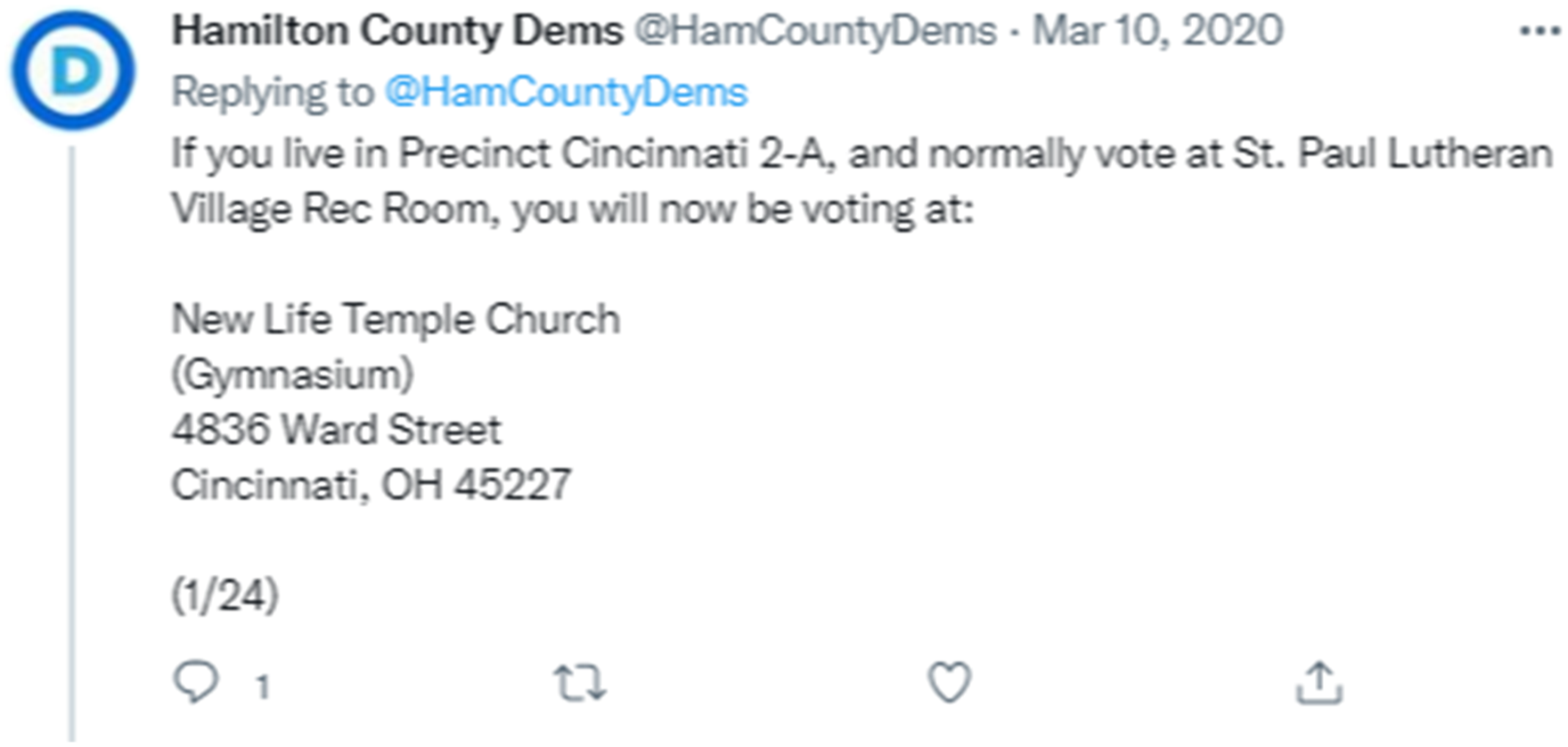
A quasi-experiment
Based on a quasi-experiment inadvertently facilitated by the Franklin County (Ohio) Board of Elections, the data here offer a unique opportunity to consider how partisanship affects participation in the face of an electoral hurdle while isolating out of the equation the effect of near-term mobilization.
Based on both human error and the failure to install adequate quality-control measures, the Franklin County Board of Elections mailed out approximately 50,000 faulty absentee ballots for the 2020 general election. The ballots corresponded to the wrong precinct, denying voters the opportunity to cast votes for the correct state legislative candidates and some other local matters. Incorrect ballots had reached voters’ mailboxes – and in some cases been filled out and returned by voters – by the time the Board of Elections identified the error and defined its scope.
Affected voters were informed by mail that they could vote in person or they could vote the new (second) ballot that was mailed to them. Voters were further told that the failure to submit the correct second ballot -- or alternatively to vote in person -- would leave them unable to vote in some races and would reduce the likelihood that their entire ballot would be counted in a timely fashion.
For the purposes of study, this circumstance presents a unique opportunity because the identity of the affected voters was not revealed by the Board of Elections until after the election. Thus, there was no way for parties or any groups to mobilize voters to stimulate the timely return of the second absentee ballot. (Indeed, most absentee ballots in the county were correctly sent, so a blanket mobilization message to all absentee recipients to return their second ballot would have produced mass confusion and possibly imperiled the return of correct original ballots.)
Further, unlike many procedural hurdles linked to the attempted suppression of participation, this procedural hurdle was inadvertent. Those affected were not targeted by party, race or income and the situation was not the subject of any publicly orchestrated outrage. It was, therefore, a poor vehicle for any kind of boomerang effect in which attempts to deter voting can stimulate it (Valentino and Neuner 2017).
The reach of the faulty ballots across the county was quite wide. At least 500 voters received a faulty ballot in 12 of the county’s 16 municipalities. Columbus, the largest city in the county (and the state), was home to 47.2% of those affected by a faulty ballot.
The analysis here focuses on 49,095 voters who received the incorrect ballot and for whom complete data was available from the Board of Elections. Among those who received an incorrect ballot, 77.2% voted a correct ballot (either by returning the second ballot or by voting in person). 17.2% voted only their incorrect ballot or submitted the correct ballot only after it was too late to count. 5.6% did not return either ballot.
Data in the Board of Elections voter file offers a complete record of each affected voter’s turnout history, their age, their date of registration, and their party membership status (defined in Ohio by virtue of voting in a party’s primary). Race and gender are imputed from full names in the voter file using U.S. Census records. 2
While primary voting habits are not the ideal measure of partisan identity, previous research has found they are closely related (Finkel and Scarrow 1985; Gerber et al. 2010). Finkel and Scarrow (1985: 639) conclude that the formal association with a party that accompanies primary voting reinforces partisan identity for voters, serving as an “anchor to their perception of the partisan tie.” Gerber et al. (2010) demonstrate this concept in a field experiment, revealing that the act of voting in a primary raised individual’s commitment to the party’s ideas. 3
The circumstance described here is not a true experiment as individuals were not randomly chosen to receive faulty absentee ballots. But the value of a quasi-experiment is the ability to study conditions that literally cannot be imposed (Cochran, 1965; Goldfarb et al. 2022). 4 It would, for one, be illegal to intentionally send out faulty ballots – as it was, the Franklin County Board of Elections faced potential sanction from the Ohio Secretary of State for failing to monitor the absentee distribution process more closely and permitting the erroneous ballot problem to occur. Quasi-experiments also afford the opportunity to study a massive number of participants – in this case 49,095 voters – a sample vastly beyond the scope of the typical social science experimental design.
For analysis purposes, the foundational fact here is that these circumstances represent an “exogenous shock” that “can approximate random assignment” because “the covariates can be considered exogenous to the treatment” (Goldfarb et al. 2022: 2). That requirement is met here as faulty ballots were distributed widely and without any relationship to the voter’s partisanship.
With respect to differences between partisans and independents, three levels of analysis are conducted to minimize the effect of any non-equivalencies between the groups. First, a series of comparisons imposing increasingly strict criteria demonstrate the bivariate relationship between partisanship and overcoming the double ballot hurdle. Second, a logistic regression assesses the influence of partisanship while controlling for other factors related to participation (such as age and race). Third, a propensity matching procedure is utilized to isolate the effect of partisanship while matching cases on other variables.
Based on the sum of previous research, I hypothesize that party loyalty alone – independent of near-term party mobilization efforts – will help voters overcome this participatory hurdle because partisans have higher political interest (thus making voters more likely to pay attention to a second mailing and its associated instructions), care more about candidates (thus making voters less likely to accept the risk that the faulty ballot would cost them their ability to vote for a full slate of candidates or the risk that their ballot would not be counted at all), and have an orientation toward action (thus increasing the likelihood that when presented with the task of voting the second ballot they would do so in a timely fashion). These attributes should apply to members of any party (regardless of the party’s electoral odds or the party’s organizational capacity) because these traits are derivative of identity and feelings rather than tangible goods or transactional exchanges related to party strength and success.
Results
Failure to cast correct ballot by partisanship.
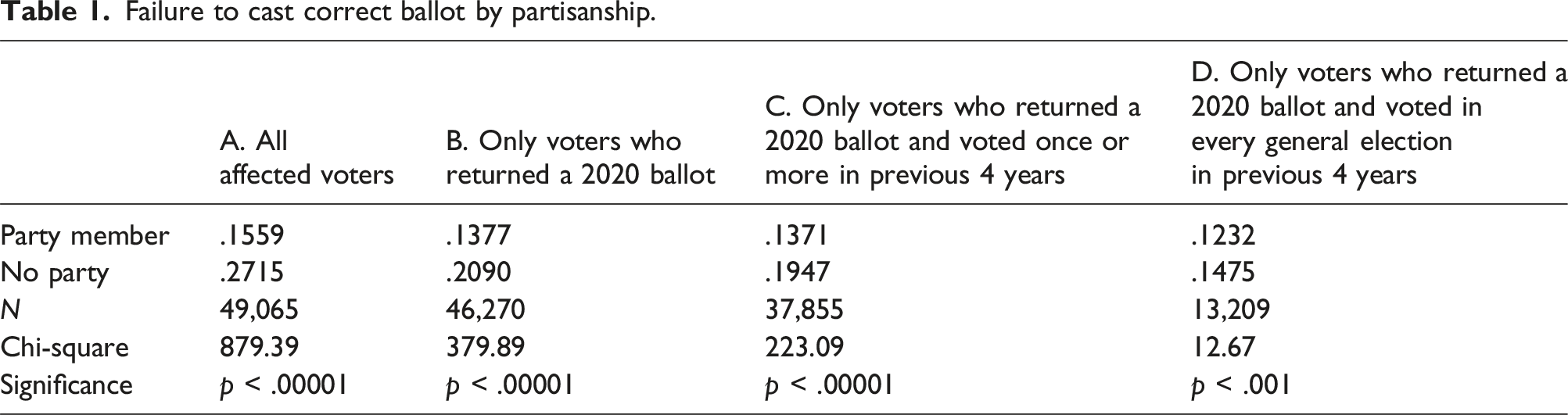
The first data point offers a simple comparison that includes every voter who received a faulty ballot. Among this population, 15.59% of party members failed to return a correct ballot. That rate reflects those who voted only with the faulty ballot, who voted a second ballot but did not return it in time for it to count, or who chose not to return any ballot. The failure rate among non-party members, however, was considerably higher at 27.15%. In short, more than one in four non-party members failed to return a correct ballot despite caring enough about the election to fill out the required paper form to obtain an absentee ballot in the first place. (While voters in Ohio can request an absentee ballot application online, requesting the actual ballot requires a signed paper request). The disparity between party members and non-members is statistically significant (p < .00001) and hints at the truly powerful effects that new electoral procedural hurdles can have on those who are not partisan adherents.
Restricting the comparison only to those who returned a 2020 ballot (eliminating from the comparison those who failed to return either ballot) again demonstrates the power of party as 13.77% of party members failed to vote a correct ballot compared to 20.9% of non-party members. Consider for a moment the nature of this comparison. All these voters cared enough about the election to request an absentee ballot in writing. All these voters cared enough to submit a ballot. And yet, when asked to vote all over again, to attend to the details of which of the two ballots they were sent was the correct one and which was the faulty one, and to do so in a timely fashion, non-party members were half-again as likely as partisans to fall short.
Skeptics could rightly point out that since party membership here required voting in a primary, perhaps the difference in the two groups is less party itself and more the habit of voting. Restricting the comparison to only those who returned a 2020 ballot and had voted in another election in the last 4 years again shows that party membership matters.
Finally, the most stringent test of party effect compares only those supervoters who returned a 2020 ballot and voted in each election in the previous 4 years. While the gap between party members and non-members shrinks, it is still quite meaningful. Among supervoter party members, 12.32% failed to vote a correct ballot. Among supervoters who are not party members, that number increases to 14.75%. Even within this subset of a subset of a subset of voters, among only those people who vote habitually, the difference between partisans and non-party members represents a difference between hundreds more people having their vote fully count and hundreds more people being stymied.
While the bivariate analysis makes a strong case that party loyalty is associated with participatory resilience, even when accounting for previous voting history, perhaps other differences between partisans and independents could be responsible for the apparent relationship. Given the dichotomous dependent variable (0 = correct ballot; 1 = failed to vote correct ballot), a logistic regression is utilized to assess the effect of party loyalty while controlling for other variables frequently associated with participation.
To best assess the influence of partisanship, two models are created that vary how partisanship is expressed. In the first model, partisanship is expressed as a dichotomous measure (0 = independent; 1 = partisan). To assess whether the effect of party is specific to a party or applicable across parties, in the second model four separate partisanship dummy variables reflect association with the four parties recognized under Ohio election law (Democratic, Republican, Libertarian, and Green). In this case, Independent is set as default.
Following a long line of research on the power of voting history on participation, the voting history variable captures how many times the individual voted in general elections in the last 4 years. Additional variables include age and length of time registered, both associated with higher turnout in previous research (Smets and Ham 2013). I also include a measure of gender (1 = women, 0 = men) and race (dichotomous variables for African American, Asian, Latino/a, with white set as default).
While the independent variables would ideally include a full set of measures related to socio-economic status, publicly available data relevant to SES offer only details on the voter’s residence. Here I employ a dichotomous measure of whether the voter’s residence is above or below the median county home value of $164,500. 5 Though obviously an imperfect measure of the full range of socio-economic variables and their associated effects (see, e.g., Brady et al. 1995), the home value variable offers at least a defensible control for any concern that economic resources, not partisanship, are responsible for the variation in submitting a correct ballot.
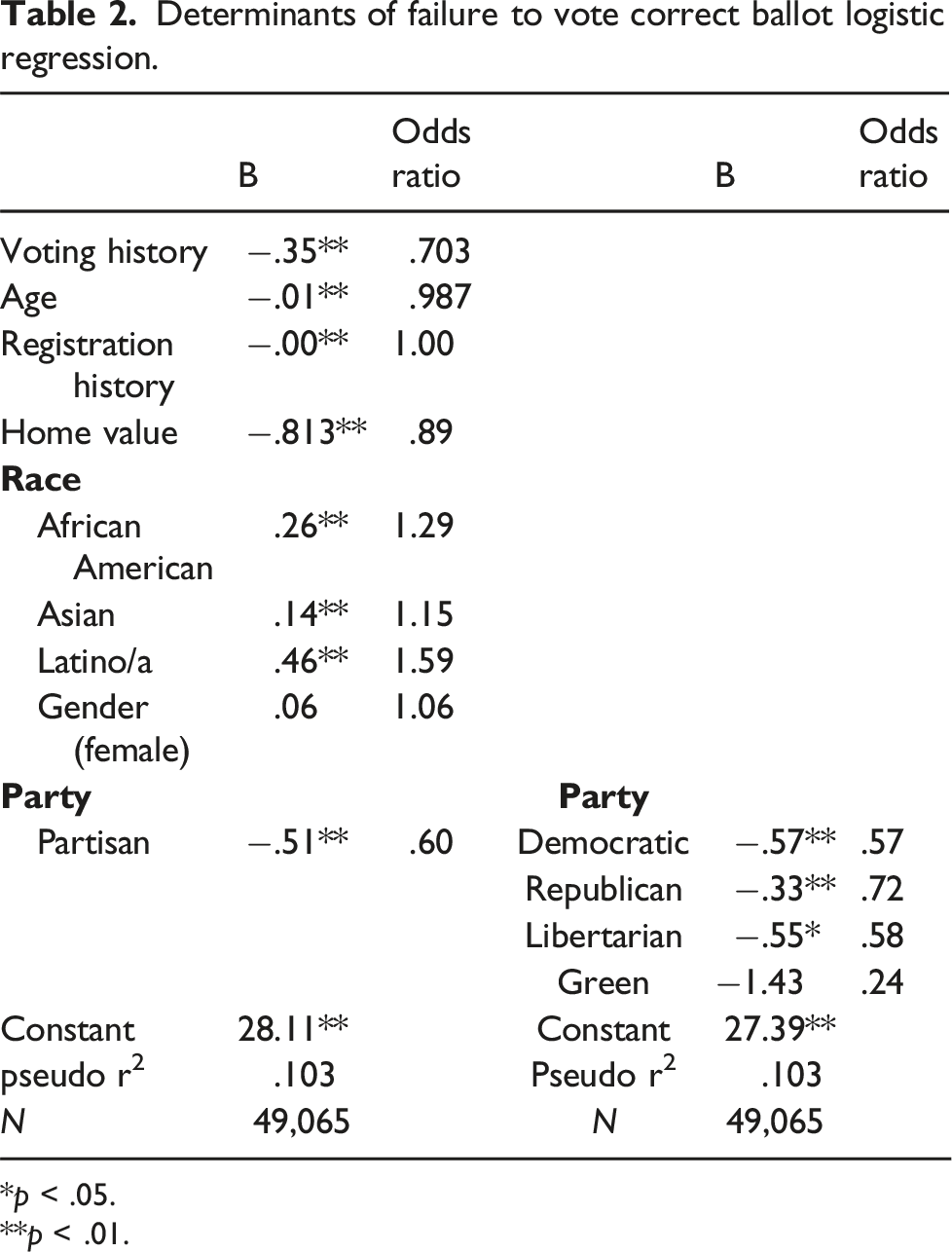
Because the model assesses the likelihood of failing to vote correctly, negative coefficients here indicate an association with voting a correct ballot. Positive signed coefficients, conversely, are associated with faulty ballots.
Determinants of failure to vote correct ballot logistic regression.
*p < .05.
**p < .01.
Race was also a statistically significant factor in faulty ballot vulnerability. Relative to white voters, African American, Asian, and Latino/a voters were 29, 15, and 59% more vulnerable to faulty ballots. Gender did not have a statistically significant effect.
With respect to party, the results are clear. In the dichotomous version, partisans were 40% less likely to fail to submit a correct ballot. With partisanship delineated, Democrats, Republicans, Libertarians and Greens were all less likely to fail to vote a correct ballot than were the unaffiliated/party-less. In the case of Democrats, party was associated with a 43% reduced vulnerability to faulty ballot status. For Republicans, the associated figure was a 28% reduction. For Libertarians and Greens, the effect was a 42 and 76% reduction, respectively.
That a reduction in vulnerability to the double absentee ballot challenge was seen both collectively and individually across all parties underscores the vital nature of partisan identity itself. These parties vary considerably with regard to the structure of their organizations, the number and potency of their candidates, and their prospects for electoral success. Yet, association with any of these parties reduced vulnerability to this electoral hurdle. Given the circumstances of this particular electoral hurdle, the results clearly demonstrate that party membership is an asset even when the party itself takes no action.
Figure 2 applies the estimates from the logistic regression to illustrate the effect of party in two disparate types of cases. Applying the odds ratio estimates from the logistic regression to a case with an expected low failure rate (white, older, more wealthy, supervoter), reveals that even for such individuals party is associated with lowering the failure rate from about 13% to about 9%. For an individual with an expected higher failure rate, (Latina/o, younger, less wealthy, never voted), party is associated with lowering the failure rate from almost 40% to about 21%. Failure to vote correct ballot. (Applied logistic regression estimates).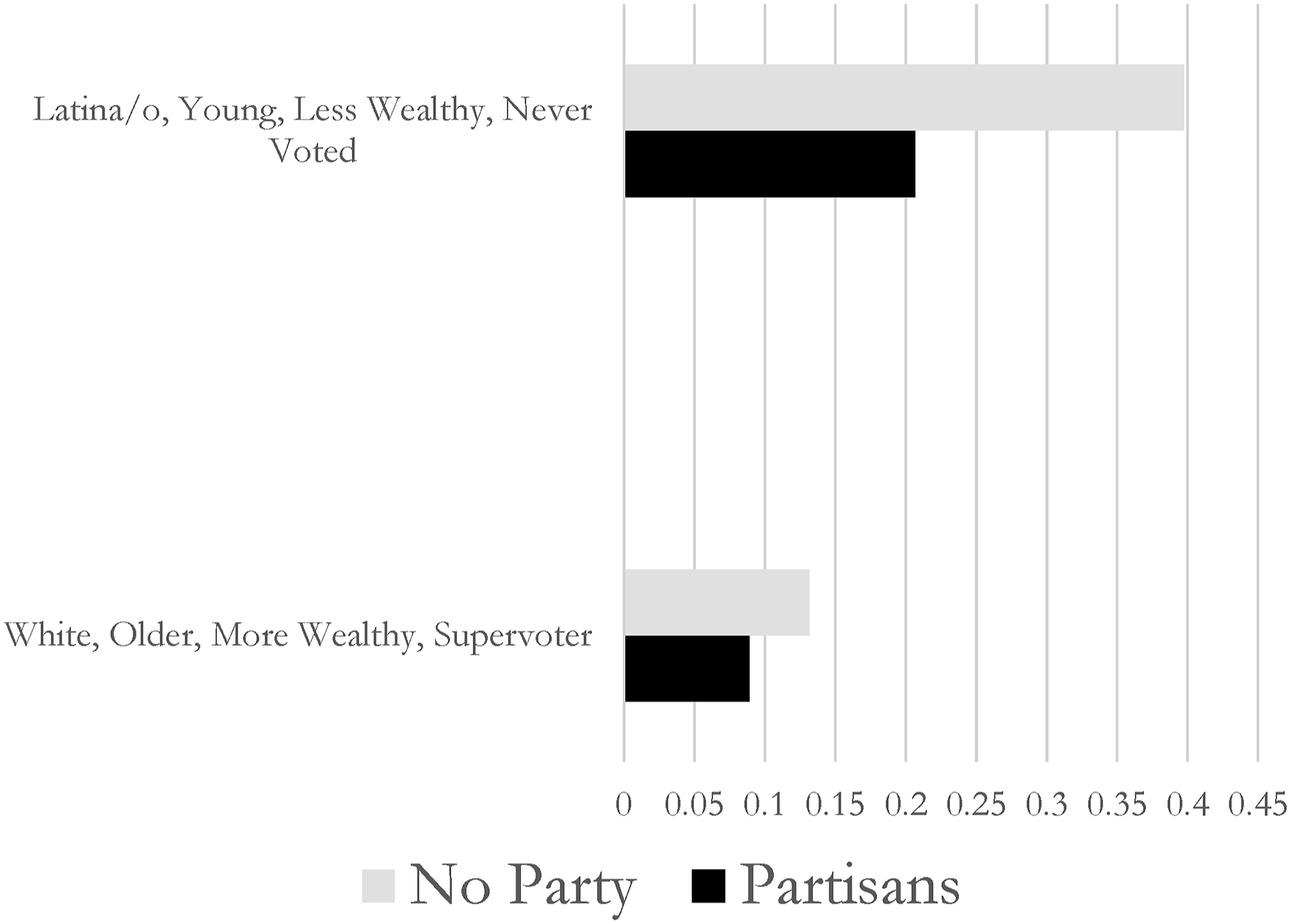
Thinking about the effect from the other direction also underscores the influence of party. That is, had the party-less voted correct ballots at a rate equal to even the worst performing party loyalists (Republicans), several thousand additional correct ballots would have been cast among these absentee voters.
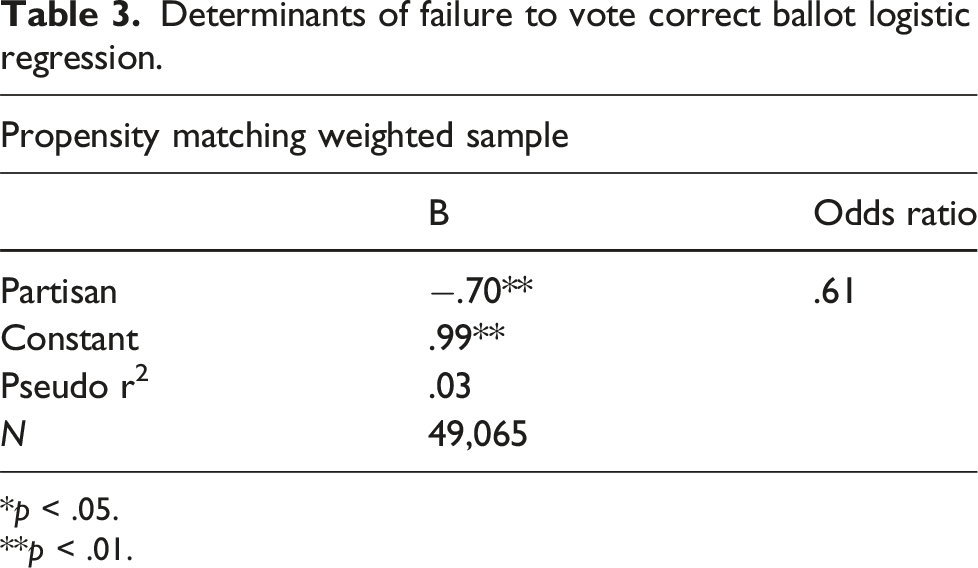
As a further test of the effect of partisanship, propensity matching (using R) was employed to create a matched and weighted sample. Partisan voters were matched to nonpartisan voters not only on the influential variables included in the previous model, but also on non-substantive differentiators like precinct, town, and legislative district. By creating a “weighted sample” that was “constructed without any reference to the outcome” of the analysis, propensity matching helps isolate the effect of the variable of interest while filtering out effects of other between-group differences (Austin 2011).
Balance between the groups is confirmed visually through comparing density plots for each covariate before and after the matching process. It is also confirmed with a Love plot, where the absolute standardized mean difference was <0.1 for each covariate after the matching process. From this we can conclude that the propensity matching created statistically balanced groups appropriate for the next stage of analysis.
Determinants of failure to vote correct ballot logistic regression.
*p < .05.
**p < .01.
Notably then, the matched sample procedure produces a result remarkably similar to the unweighted data. In one case, the estimated effect of partisanship is a 40% reduction in faulty ballots, and in the other a 39% reduction. As such, any lack of equivalency between the partisan and independent groups does not appear to be the source of their differences with regard to participatory resilience.
Mechanisms of partisan participation
The data point to party members enjoying greater capacity to overcome the double absentee ballot hurdle than non-party members, but from what does this advantage derive? As previously noted, research suggests three mechanisms of advantage: partisans have a higher level of political interest, care more about candidates, and have an orientation toward action. While the circumstances here and the available data do not lend themselves to measuring the distinct effect of the three mechanisms, I would argue that data do suggest that all three have some influence.
To this point, the comparisons have dealt with meeting the requirements of voting in the face of this unprecedented obstacle. Partisans’ capacity to successfully vote a correct ballot – by attending to the details of this situation and following through on what was required – suggests they indeed enjoy a higher level of political interest relative to non-party members. Diving deeper into the data reveals that party members were not just more likely than non-party members to meet, but also to exceed the requirements of the situation, pointing to the influence of caring about the candidates and having an orientation toward action.
Consider the rate at which these absentee ballot seeking voters abandoned their expressed preference to vote by mail and greeted the news that their first mail ballot was faulty by showing up in person to vote. These voters, likely shaken by the news that unknown infirmities in the process threatened the validity of their mail-in ballot, took on the additional effort of showing up to vote in person (either early or on Election Day) presumably because they cared so deeply that their candidate preferences be successfully recorded.
Examining only those who successfully cast a 2020 ballot, 8.49% of partisans responded to the faulty first ballot by voting in person. The comparable rate among non-party members was 5.19% (p < .001).
An orientation toward action is suggested in the rapidity with which party and non-party members returned their second ballots. Comparing only those who voted the correct 2020 ballot by mail, party members returned their ballot on average 2-days faster than non-party members (within what amounted to a 12-day window to successfully return the second ballot). This difference was statistically significant (p < .001). Additionally, more than 40% of party members (40.5%) returned their second mail ballot to the Board of Elections on the first possible day, compared to 27.2% of non-party members.
In both the voting in person and the speed of returning the second ballot comparisons, we are seeing not merely compliance with these unprecedented requirements of voting successfully, but a willingness to exceed applicable standards. Voting in person required setting aside the second (corrected) ballot, setting aside the demonstrated preference for voting by mail established by submitting the absentee application in the first place, and physically going to the polling place. Voting the second (corrected) ballot as fast as possible, meanwhile, required opening the second ballot, casting one’s votes, and then immediately returning the ballot, well before the applicable deadline. These actions are entirely consistent with an orientation toward action and caring about the candidates.
Again, precisely testing the effects of the three hypothesized contributors to partisan participation is beyond the ken of the date. But I would argue the consistent finding that partisans were more likely to meet the unprecedented requirements of voting in this situation, and the examples of partisans exceeding those requirements, are consistent with contributions from interest in the election, caring about the candidates, and having an orientation toward action. That is, higher political interest made voters more likely to pay attention to the second mailing and its associated instructions, caring more about the candidates made voters more likely to vote in person to eliminate any risk associated with the faulty mail-in ballot, and an orientation toward action made party voters more likely to act quickly in returning their correct ballot.
Conclusion
When the Franklin County Board of Elections in Ohio sent out tens of thousands of incorrect ballots to absentee voters during the 2020 election, it was, in effect, giving voters a test that they could not possibly have prepared for in advance. To have their vote count for each office on the ballot, and to ensure their vote would be counted at all, voters needed to disregard the original ballot they were sent even if they had already completed and returned it. Such a voter would have begun the process with every reason to believe that voting with the original ballot was proper – indeed it is what they were told to do in the instructions that accompanied that original ballot. To make up for the election board’s error, however, voters needed to take the otherwise strange step of ignoring their first ballot (whether they had submitted it or not) and voting with the second ballot they were sent (or, disregard their apparent preference for voting absentee by mail and cast their vote in person) in a timely fashion.
Party loyalty -- with its attendant higher interest in elections and concern for candidate outcomes and its orientation toward action (Huddy et al. 2015) -- helped voters overcome this threat to their vote. This threat that they had never heard of before, not prepared for, not been warned of, not trained for, nor been mobilized to overcome. As such, the results here suggest that party loyalty stands as a potential defense against electoral hurdles both existing and yet to be deployed. While policies effectively making voting harder continue to spread across much of the United States (Pomante 2024), we cannot know the precise nature of future policies that may be deployed to deter voting. The fact that party loyalty in this case stood as a defense against an unprecedented obstacle is a telling marker of what partisanship is capable of here and in the uncertain participation landscape ahead. That the effect of party holds even across supporters of minor parties is also notable given that so much research on party effects in the United States considers only the two major parties, even though, collectively, most Americans report at least an attraction to third party options and millions actually cast votes for third party candidates in the typical contemporary U.S. presidential election (Kerbel and White 2023).
Much of the recent efforts across the United States to make voting harder have been at the behest of Republican officeholders who presumably believe that their efforts will dampen participation among Democrats (Wang 2012; Hicks et al., 2016). Yet, Hajnal et al. (2017: 365) point out that “despite all of the discussion about how these laws benefit Republicans and hurt Democrats, there has been little empirical analysis.” That analysis is admittedly quite complicated, especially given the reciprocal relationship between party and mobilization. Here though, in a circumstance in which mobilization to overcome this obstacle was not practicable, we see that partisanship in itself, regardless of which party one followed, served as a defense against a participation hurdle. The implication here is that try as they might to dampen the participation of their rival party, the first victims of any effort to raise barriers to participation are likely to be those inclined toward political independence. This is particularly notable given the generally weak turnout of independents, especially pure independents (Keith et al., 1986). In other words, policies and practices that make voting harder represent something of a triple threat to independent voters. They begin less likely to vote than partisans as a general practice, this effect is exacerbated by the imbalance in mobilization attention in which partisans are more likely to be contacted by their party and independents more likely to be left alone (Caldeira et al. 1985), only then to be compounded by the finding here, that partisanship imbues its adherents with a certain political resilience against voting impediments that is less likely to be found among non-party members.
There are, to be sure, significant limitations to this analysis that should be acknowledged and that therefore suggest efforts to replicate. The results are based on one election in one place featuring one unique electoral hurdle. The voters studied here are only in Franklin County, Ohio, a Democratic stronghold. 6 Relative to the U.S. overall, Franklin County’s population is more likely to hold a college degree (45.1% in Franklin County/38.5% in U.S.) and is slightly less diverse (65.1% white in Franklin County/62.0% white in U.S.). The 2020 election was a relatively high turnout presidential election with the Franklin County ballot also including various non-competitive congressional races, state house and senate races, and an array of generally non-competitive county offices.
While the results here rely upon voting in party primaries to categorize party alignment, a more precise measure of personal partisan strength might help delineate the effect of party on overcoming electoral hurdles and help distinguish which mechanisms of participation are at work. If any fundamentally partisan people are miscategorized here as non-party members, it is possible a more precise partisanship measure would reveal an even stronger relationship between party and participatory resilience.
Nonetheless, the results here are consistent with the foundational findings on partisanship and participation (Campbell et al. 1960). Moreover, the core finding that party loyalty helps voters overcome an electoral hurdle was found among all those affected, among all who returned a ballot, among all with a history of recently voting, and among all with a spotless voting history. It was found among Democrats, Republicans, Libertarians, and Greens. It was found when controlling for variables of interest and when using propensity matching to weight the sample to minimize differences between partisans and independents. Thus, a quasi-experiment with tens of thousands of participants offers compelling evidence that consistently points in one direction: even without any direct mobilization effort, party ties help voters overcome participation hurdles.
Footnotes
Declaration of conflicting interests
The author(s) declared no potential conflicts of interest with respect to the research, authorship, and/or publication of this article.
Funding
The author(s) received no financial support for the research, authorship, and/or publication of this article.
