



Abstract
The decision-theoretic Downsian model and other related accounts predict that increasing perceptions of election closeness will increase turnout. Does this prediction hold? Past observational and experimental tests raise generalizability and credible inference issues. Prior field experiments either (1) compare messages emphasizing election closeness to non-closeness messages, potentially conflating changes in closeness perceptions with framing effects of the voter encouragement message, or (2) deliver information about a particular race’s closeness, potentially altering beliefs about the features of that election apart from its closeness. We address the limitations of prior work in a large-scale field experiment conducted in seven states and find that a telephone message describing a class of contests as decided by fewer, as opposed to more, votes increases voter turnout. Furthermore, this effect exceeds that of a standard election reminder. The results imply expected electoral closeness affects turnout and that perceptions of closeness can be altered to increase participation.
A variety of accounts in the voter turnout literature have incorporated perceived election closeness as a key factor in encouraging voting. The motivation behind a focus on closeness is often rooted in the failure of extensions of the Downsian decision-theoretic framework to explain important variation in turnout. Specifically, Downs (1957) presented a theoretical framework explaining turnout by focusing on the utility accrued by the individual voter, which, if taken literally, leaves us with the puzzle of why anyone would vote at all. Subsequent extensions attempted to explain this puzzle by incorporating intrinsic benefits of the voting experience (e.g., Aldrich, 1993; Meehl, 1977; Riker & Ordeshook, 1968), but such frameworks were unable to account for why, for instance, higher turnout was associated with closer elections. Subsequent works have explicitly accommodated expected election closeness as important in encouraging turnout, for example in accounts in which elites put in more effort when elections are predicted to be close (Schachar & Nalebuff, 1999), or in which citizens view elections as group competitions (Coate & Colin, 2004), or in which voters weigh the social benefits of voting (Edlin et al., 2007).
However, whether these predictions reflect actual behavior is unclear, as prior investigations of the direct effect of variation in perceived electoral closeness on participation generally suffer from a number of threats to credible causal inference. For example, studies that exploit variation in observed election closeness or survey assessments of perceived closeness fail to rule out the possibility that omitted factors correlated with an election being close or someone believing it will be close (such as increased campaign or media activity) also affect the decision to vote (see Blais, 2000; Enos & Fowler, 2014 for reviews of prior work). In contrast, survey (e.g., Ansolabehere & Iyengar, 1994) and lab (e.g., Duffy & Tavits, 2008) experimental approaches address endogeneity concerns but may not accurately reflect behavior outside those settings. Field experimental tests alleviate both sets of concerns, but almost all prior field studies compare closeness messages to other types of messages (e.g., Dale & Strauss, 2009; Enos & Fowler, 2014), which makes it difficult to ascertain whether any observed turnout effects arise due to (1) the framing of the vote choice in terms of closeness or (2) changes in perceptions of how close the election will be. Moreover, even experimental treatments about election closeness may not solely manipulate perceptions of pivotality. This is potentially true of the single field experimental paper that implements multiple closeness treatments (Gerber et al., 2020), because those treatments convey information about the closeness of that particular race (via polling margins). Whether a specific race is close may also alter perceptions of other factors that affect the decision to vote (e.g., the importance of the contest or the quality of the candidates).
In this paper, we present results from a novel field experiment that addresses the limitations of prior observational and experimental tests. We contacted more than 16,000 registrants in 7 states by phone during the 2014 Congressional primaries and delivered two messages that differed only in how close they (accurately) describe past primary races across the country as being (7% of past contested races were decided by either less than 350 or less than 2500 votes). Importantly, these interventions depart from prior field experiments on election closeness in that they do not communicate information about the specific race (or district) in question (e.g., whether one candidate is leading in the polls) but instead convey general information about the likelihood a race will be close given past races of that type nationwide. In this way, we hold constant both campaign contact and the framing of the turnout decision in terms of closeness, and isolate variation in expected closeness from all other information that might be conveyed by describing that race and that could affect the decision to vote through other mechanisms.
We find that registrants assigned to receive a message stating that past elections have been closer—the 350-votes condition—are 1.6 percentage points (6.4%) more likely to vote than those assigned to receive a message that past elections have been less close—the 2500-votes condition (p = .02, two-tailed). That difference is consistent across states, electoral contexts (whether the respondent lived in a competitive primary district), and past patterns of voter participation (though the modestly sized treatment effects combined with smaller samples mean estimated differences in effects within subgroups are generally not statistically significant in isolation). Furthermore, this message is more effective than a standard message that reminds the recipient of an upcoming election.
In summary, our findings demonstrate that outreach emphasizing that a class of elections is more likely to be closer increases participation. The results also show that the perception that “one’s vote doesn’t matter,” a frequently cited justification for abstention, is malleable and not simply correlated with other factors that also explain low rates of participation. As such, those views can be manipulated so as to increase participation, potentially highlighting a mechanism for further raising political engagement. In the conclusion, we expand upon these implications and discuss some limitations of the design.
Election Closeness and Participation
Despite the simplicity and appeal of various theoretical approaches that predict a relationship between perceived closeness and turnout—including those that incorporate the intrinsic rewards of voting (Riker & Ordeshook, 1968), the strategic behavior of elites in the face of looming closeness (Schachar & Nalebuff, 1999), or the social (Edlin et al., 2007) or group (Coate & Colin, 2004) returns to voting—empirical tests of the effect of expected closeness on turnout are limited in their credibility as causal evidence. There are four main approaches in this work. The first is to examine the aggregate relationship between observed election closeness and levels of turnout. Blais (2000) characterizes this literature as providing strong reasons to believe that individuals are more likely to vote when the contest is close, while a subsequent meta-analysis by Cancela and Geys (2016) is similarly supportive of this expectation but less conclusive. However, the mechanism explaining this result is potentially ambiguous. For instance, because elites can predict which contests will be close, those contests are likely to draw more media attention and those candidates likely engage in more campaign activities aimed at persuasion (Aldrich, 1993; Cox & Munger, 1989; Matsusaka & Palda, 1993). Furthermore, voters may behave according to strategies such as minimax regret (Ferejohn & Fiorina, 1975; Kenny & Rice, 1989) in which their decision calculus does not assign ex ante probabilities to perceived closeness at all, but which, post hoc, may seem empirically consistent with having turned out as a function of perceived closeness. We note, however, that the evidence for voters engaging in minimax regret is lacking (e.g., Blais et al., 1995). More generally, close elections may be close because many people vote or because of some other omitted factor that affects turnout. In any case, ambiguity about these mechanisms could be made clearer via experimental manipulation of perceived election closeness in the minds of potential voters.
The second approach eschews aggregate election-level analysis in favor of individual-level data. One advantage of this approach is that it is possible to measure individual-level assessments of perceived election closeness along with other factors that might predict voting. Some studies find evidence that individuals who think elections will be closer are more likely to vote (e.g., Blais et al., 2000). Nonetheless, many of the same threats to inference arise in this context because the sources of individual-level variation in perceived closeness may also affect other factors that increase turnout, or may reflect existing individual-level differences in the willingness to vote. In the absence of a full accounting of all (potential) factors that explain variation in participation (or correlated measurement error), the threat of omitted variable bias remains large.
Scholars have turned to a third approach—namely lab- or survey-experimental tests of the effects of variation in electoral closeness on participation—to address these concerns about credible causal inference. Ansolabehere and Iyengar (1994), for example, find in a survey that manipulating the poll results embedded in a newscast (i.e., making the race appear more or less competitive) has no effect on intention to vote. By contrast, Kam and Utych (2011) find that races described as close spur cognitive engagement, with subjects undertaking efforts (e.g., seeking out more information) consistent with the actions of someone more likely to participate.
Work in the lab, in which the returns and costs to voting are experimentally manipulated, also provides some support for the effect of expected closeness on voting. Some of this work focuses on analyses in which pivotality is endogenous to others’ anticipated actions (i.e., as an equilibrium outcome of a game; see, e.g., Feddersen & Pesendorfer, 1996, 1999; Palfrey & Rosenthal, 1983, 1985). 1 Duffy and Tavits (2008) show that in a lab experiment where the costs and benefits of voting are fixed, a higher perceived probability that one is pivotal increases the propensity to vote, although the relationship is not as sharp as predicted by theory in light of the parameters manipulated in the game (see also Levine & Palfrey, 2007).
For both types of experiments, one important concern is external validity: Subjects participating in a survey or playing a laboratory game may behave differently than they would if exposed to similar stimuli outside of the laboratory. This may occur either because the decision to vote (or express an intention to vote) is not an accurate reflection of real behavior, or because the way people make decisions in the lab setting is different from how they would behave outside of it. Additionally, in the case of prior survey experimental work, manipulations of closeness may generate variation not just in expectations about closeness, but also in beliefs about factors like aggregate turnout, which may affect beliefs about election importance and other relevant factors.
Prior Field Experiments Examining the “Closeness” Hypothesis.
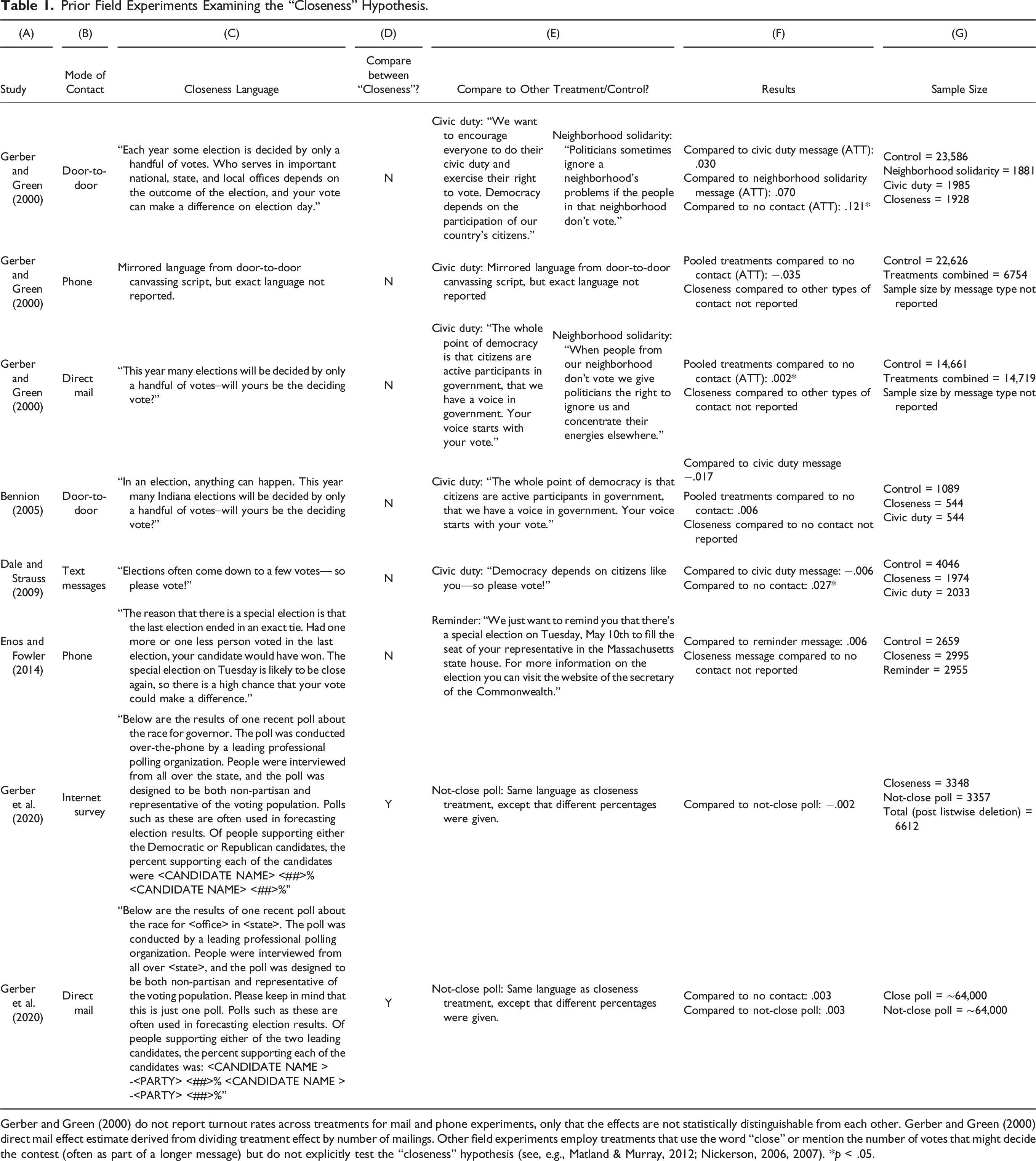
Gerber and Green (2000) do not report turnout rates across treatments for mail and phone experiments, only that the effects are not statistically distinguishable from each other. Gerber and Green (2000) direct mail effect estimate derived from dividing treatment effect by number of mailings. Other field experiments employ treatments that use the word “close” or mention the number of votes that might decide the contest (often as part of a longer message) but do not explicitly test the “closeness” hypothesis (see, e.g., Matland & Murray, 2012; Nickerson, 2006, 2007). *p < .05.
Gerber and Green (2000), for example, conclude that asserting via door-to-door canvassing or direct mail (but not phone) that each year some elections are decided by only a handful of votes increases turnout compared to no contact, but the effects are not distinguishable from those of other messages. Similarly, Bennion (2005) finds no evidence that stressing in canvassing that many elections in the state “will be decided by only a handful of votes” has a larger effect on turnout than a standard civic duty message, while Dale and Strauss (2009) determine that text messages stating that “elections often come down to a few votes” increase turnout in comparison to an uncontacted control group, but actually have a smaller effect on turnout than a standard civic duty message. Enos and Fowler (2014) show that raising awareness of one’s potential pivotality following a special election in which the original contest ended in a tie between the two major party candidates increases turnout in the follow-up election vis-à-vis an election reminder, but the difference is not statistically significant. 2
The single exception to the comparison of a closeness message to a non-closeness message is the two experiments reported in Gerber et al. (2020). They report results from a pair of studies explicitly designed to test the effects of manipulating perceived election closeness by providing polling margins in a particular race. In a 2010 panel study with treatments delivered online, they find that providing subjects with a close poll (one in which the race is depicted as very close) increased perceptions measured in the same pre-election survey that the final race will be close relative to a poll that was less close. However, using the close-poll treatment as an instrument for perceived election closeness, they find no evidence that inducing differences in perceived closeness increased turnout as measured using administrative records among those who also completed a post-election survey.
A second experiment in Gerber et al. (2020) was a large-scale (N = approximately 126,000) field experiment with treatments administered using mailed postcards. The treatments were manipulated along two dimensions: close versus not-close polls and large versus small electorate (turnout). The experiment yields a statistically insignificant .3 point increase in turnout associated with the close-polls treatment. One concern with these experiments is that the polling margin in a particular race may convey information not just about its expected closeness, but also about its candidates (i.e., the race may be close precisely because of something about the relative qualities of the incumbent and challenger). Thus, it is not clear that the treatment perturbs only expected election closeness. 3
2014 Seven-State Field Experiment
We conducted our field experiment during the 2014 primary elections in seven states [Massachusetts (MA), Michigan (MI), Minnesota (MN), Missouri (MO), New Hampshire (NH), Tennessee (TN), and Wisconsin (WI)] in which all registered voters can vote in at least one party’s primary election. 4 We first obtained a complete list of registered voters in each state. Prior to treatment assignment we excluded records likely to be invalid or persons who could not be contacted by phone. In households with multiple registrants, one registrant was selected at random for inclusion in the sample. From this pool, subjects were then randomly assigned to one of four treatment groups described below—in brief, a placebo, a traditional election reminder, a close elections message, and a less-close elections message. Treatment assignment was stratified by state, whether the registrant lived in a district with a competitive House race, and an individual’s past record of voter participation. 5
Differences in Election and Turnout Context Across States.
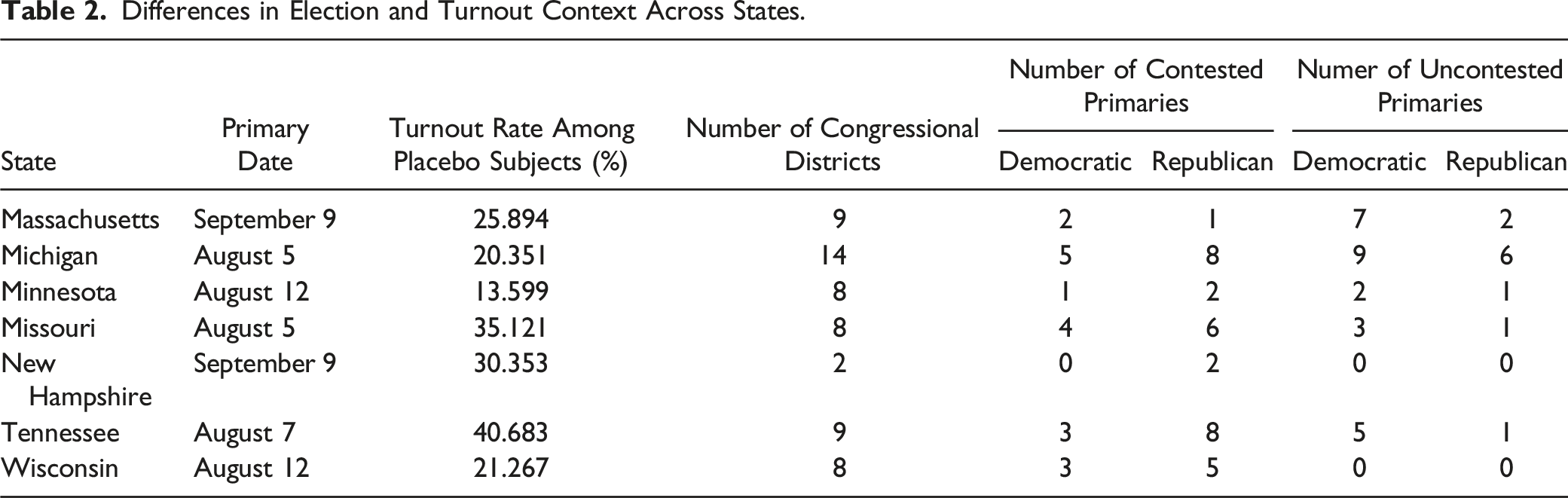
Each message was delivered by telephone in the four days leading up to each state’s primary election by a professional survey vendor we hired. All interventions began with the same question asking whether the subject was a resident of his or her state. 6 Subjects who answered in the affirmative were coded as contacted and treatments were then delivered. 7 As this question was asked prior to the portion of each script that branches into the assigned treatment group, we use this common (treatment-independent) definition of contact so that inclusion in the analysis is not potentially affected by variation in the subsequent treatment content. Voting in the 2014 primary was measured using turnout as recorded in updated state voter files obtained from our vendor in spring 2015. Individuals are coded as having voted if they are listed as having done so in the official record, and as not having voted otherwise.
Our core treatments were messages that emphasized the potential closeness of the election but that varied in the (accurate) information they conveyed about how close the race would be. Both messages began with an informational prompt and asked the registrant if they were aware of the upcoming primary. Following this, both scripts included the following message, after which the call concluded: Because fewer people vote in most primary elections than in general elections, each vote matters more for deciding who wins. In fact, of the approximately 160 seriously contested primaries for the US House in 2012, more than 7% were decided by fewer than [# OF VOTES] votes. Think about how you will feel if you don't vote and it turns out the election was decided by only a few votes.
In the Closeness 350 treatment, the number of votes was 350. In the Closeness 2500 treatment, the number of votes was 2500. To arrive at these figures, we examined returns for the 2012 House primary elections and found that 162 had a margin of less than 25 points, and we coded these as being “seriously contested.” In these races, 12 (7.4%) were decided by fewer than 350 votes, and therefore were decided by fewer than 2500 votes as well. Importantly, therefore, by using this specific language we are able to avoid deception. 8 Following the statement about election closeness, subjects in the two closeness conditions were asked whether they expected they would vote in the upcoming primary (and if they initially expressed that they did not know, they were asked for their best guess). 9 Subjects in the election reminder and placebo conditions (described below) were not asked the vote intentions question. Note that these two treatments do not mention anything about the particular primary contest in the respondent’s district and hold constant all features apart from how close 7% of elections are. As such, we believe this makes it less likely that subjects infer features of their particular race from the variation in the closeness treatment (although they may infer something about the race in general from the fact that someone sent them a message at all, or react to framing voting in terms of closeness, reasons we compare outcomes across the two closeness messages). Additionally, the treatments communicate that turnout is generally low in primary elections, fixing expectations about average turnout across treatments.
Our third treatment was a standard script message asking the respondent whether they were aware of the upcoming primary election. It was similar to the opening script for the Closeness messages, but also mentioned that turnout was expected to be high. Finally, our fourth treatment was a Placebo message with no political content; after confirming a subject was a resident of their state, they were asked how often they went to the grocery store. To avoid simply terminating the placebo call after confirming state of residence because it might be awkward, we asked respondents about grocery store visits because it was an innocuous non-political question compatible with consumer marketing surveys.
We note that all comparisons are among a sample defined in a homogenous way: Those we can contact on the phone and confirm their state of residence. The identification of our control group in this manner allows us to compare turnout across conditions among registrants we are able to contact via phone—a subset of the entire population but one that is most important for assessing the effectiveness of mobilization efforts that take place using live phone calls. At the same time, this means that, as with all observational and experimental designs in which a subset of the population is not contacted, we must exercise caution in assuming treatment effects would be the same among those we cannot contact.
Our vendor contacted 8453 registrants in the Closeness 350 condition, 8402 in the Closeness 2500 condition, 11,591 in the election reminder condition, and 10,487 in the Placebo condition. Balance tests show that treatment groups did not vary materially on all covariates available in the voter file (age, year of registration 10 , gender, race/ethnicity, and the number of times having voted in previous general, primary, and special elections). 11
Results
Turnout by Closeness Experimental Condition in Phone Field Experiment.
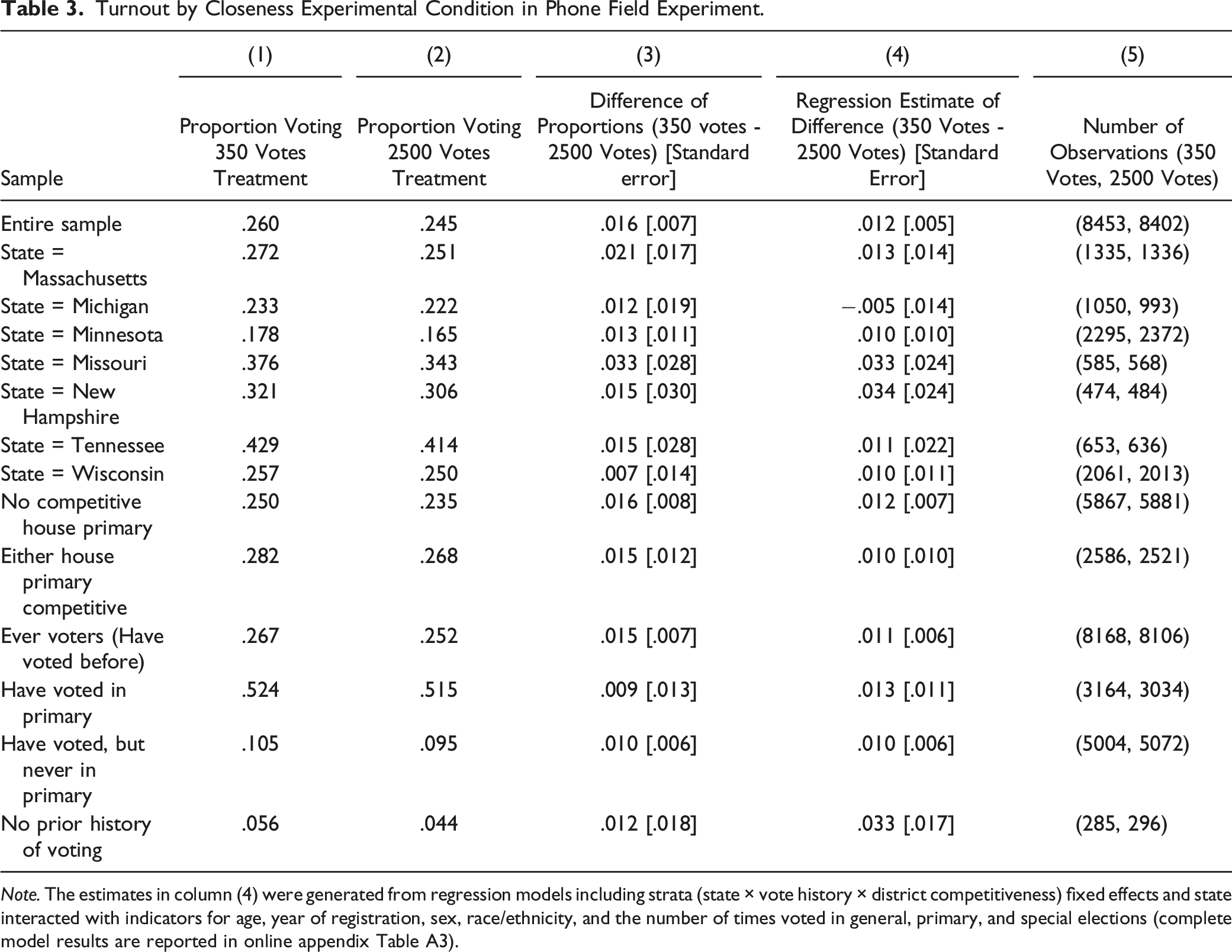
Note. The estimates in column (4) were generated from regression models including strata (state × vote history × district competitiveness) fixed effects and state interacted with indicators for age, year of registration, sex, race/ethnicity, and the number of times voted in general, primary, and special elections (complete model results are reported in online appendix Table A3).
The remainder of the table shows the consistency of this result for different states, electoral contexts, and past voter history. Generally, the regression estimates are indistinguishable from the 1.2 point estimate for the entire sample. (The estimates for the subsamples are not usually individually statistically significant, reflecting the fact that we are attempting to detect a small effect, as well as variability in effect sizes across competitive and non-competitive elections, using smaller samples.) Focusing on the regression estimates (which are less sensitive to potential imbalance created by sampling variability), we estimate that the Closeness 350 message is more effective than the Closeness 2500 message in 6 of 7 states. Additionally, it appears equally effective in districts with or without a competitive House primary (estimated effect of 1.0 and 1.2 percentage points, respectively). Finally, the message appears effective for all partitions of past voter history (while the point estimate for never voters is noticeably larger than for primary election and general election voters, that effect is derived from significantly fewer cases and is not statistically distinguishable from the effects for those other types of voters).
These results show that otherwise identical messages that differ only in how close they describe a past similar election as being can increase turnout when those previous elections are closer. This is direct evidence that a message designed to create an expectation that an election will be closer will bring more people to the polls. 16
Additionally, our experimental design also allows us to assess the comparative effectiveness of the closeness messages. For this analysis, we compare turnout in four conditions: Those who received each Closeness message, those who received the standard election reminder, and those who received the Placebo message. Figure 1 displays the comparative effectiveness of each treatment in increasing participation relative to the placebo message (the 95% confidence interval for each estimate is indicated with the black capped lines). These estimates are derived from a regression model similar to that used in the Table 3 analysis (see Table A4 of the online appendix). Compared to the placebo condition, those who received the Closeness 350 message are 3.0 points more likely to vote, which represents a proportional increase in turnout of 13.1% compared to the 22.7% turnout rate in the placebo condition. The Closeness 2500 and election reminder messages are both more effective than the Placebo message (by 1.8 and 2.0 points, respectively), but neither is as effective as the Closeness 350 message. Thus, the evidence indicates that providing information designed to heighten perceptions that the election is close increases turnout compared to an otherwise identical message that makes the election seem less likely to be close, and the Closeness 350 message is more effective than a standard election reminder script (p = .05, two-tailed test).
17
Comparative effectiveness of different treatments.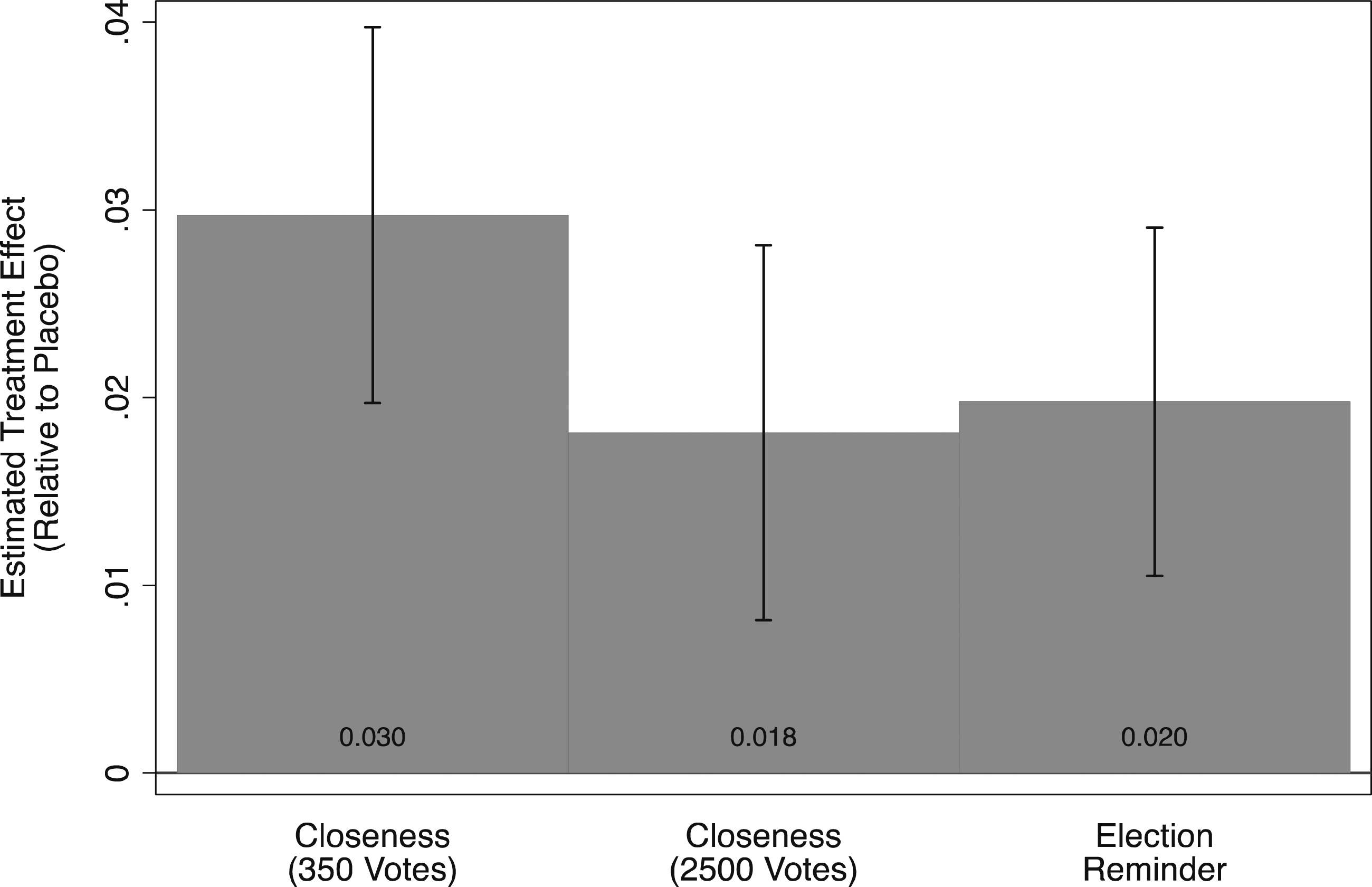
Conclusion
Does variation in expected election closeness, a core factor in the canonical decision-theoretic turnout calculus and other related accounts, explain voting? We provide experimental evidence in the field setting that communication manipulating the expected closeness of a class of elections increases participation. Some individuals are more likely to participate in an election when they are informed that their individual votes are more likely, as opposed to less likely, to be decisive. Importantly, we compare across closeness treatments, fixing the framing of the decision to vote, and deploy treatments that provide information about expected election closeness that is independent of the expected margin in a specific race. These treatments are particularly novel compared to prior work, because polling margins in a specific race may convey information beyond expected closeness (e.g., about expected turnout and incumbent and challenger characteristics) that might on its own influence the decision to vote.
We note that while these effects appear robust and our treatments are designed to hold constant other factors that may also affect voting, our design does have some important limitations. One potential concern is the generalizability of the treatment effects. On the one hand, the fact that our experimental sample consisted of voters who could be reached by phone means that they are an unusual type of voter compared to the general electorate. It is not clear what the implications of this fact are for the ability to generalize the effects of mobilization efforts emphasizing election closeness. On the other hand, such voters are likely to be older (as, indeed, our sample is), and hence have a higher baseline propensity to turn out and a more muted reaction to any mobilization effort. This latter fact might lead us to speculate that the treatment effects found here are actually conservative estimates of how similar treatments would impact the wider electorate. This constitutes an interesting avenue for future research.
Furthermore, we do not directly show that our treatments increase turnout by increasing the perceived instrumental returns to voting or how exactly those benefits are understood (e.g., in individual or group terms). These results show that election closeness does appear to matter, and that all else equal, closer elections do drive greater participation. It is possible though that the treatments also perturb other relevant and likely consequential causal pathways—beliefs about civic duty (an intrinsic motivation to vote), expectations about peer behavior and evaluations (social norms), or the returns to a political group (group utilitarian perspectives), for example. Pairing our tests with survey data (to ascertain whether the treatment affects the theoretical construct we designed it to alter and whether it affects arguably unrelated concepts) is another valuable area for future work.
In addition, the context of our study is a set of relatively low-salience congressional primary elections during a midterm year. This raises the question of whether a treatment inducing message recipients to think about election closeness would have a similar effect in higher-salience environments, such as a general election in a midterm or presidential contest. Though it has been widely theorized across turnout field experiments that high-salience contests are subject to ceiling effects that make turnout messages generally less effective (e.g., Gerber et al., 2008; Smith et al., 2003; Townsley, 2018), evidence for the effect of election salience on treatment effects heterogeneity is mixed. Some have found evidence that treatments are more effective in low-salience than high-salience contests (e.g., Rogers et al., 2017), while others have found limited evidence that treatments are more effective in high-salience contests (e.g., Fieldhouse et al., 2014). Still others, however, have shown empirical support for a curvilinear relationship in which treatments appear to be more effective among medium-propensity voters in medium-salience elections (e.g., Arceneaux & Nickerson, 2009), and a final group finds no relationship between election salience and treatment effectiveness (Gerber et al., 2010). Our stratification by district competitiveness indirectly accounts for variation in election salience, while our analyses of treatment effects in districts without any competitive primaries or districts with at least one competitive primary (see Table 3) show little difference in effects between these cases. Overall, given the mixed evidence in prior research and in the present study, we do not have strong prior beliefs about whether the treatment would be less effective in higher salience contests, in part because we lack systematic evidence about whether individuals perceive those contests as more or less likely to be close than the primary elections studied here and because we have not fully theorized about factors that create different sets of marginal (potentially mobilizable) voters in each context. In light of this, we believe this is an interesting open question for future research.
Those limitations aside, our design is, we believe, the first to successfully isolate a treatment inducing message recipients to think about election closeness in a field setting, and our findings open new avenues for identifying messages that successfully mobilize citizens. Contrary to frequent claims in prior survey work that many individuals believe that their decisions about whether to vote will not affect an election outcome, perceptions of election closeness (and anticipated pivotality) appear malleable, and we now have initial evidence that altering them increases the propensity to vote. Future work should examine how (and for whom) messages stressing electoral closeness can best be leveraged to bring potential voters to the polls.
Supplemental Material
Supplemental Material - Messages Designed to Increase Perceived Electoral Closeness Increase Turnout
Supplemental Material for Messages Designed to Increase Perceived Electoral Closeness Increase Turnout by Daniel R. Biggers, David J. Hendry, Alan Gerber, and Gregory Huber in American Politics Research
Footnotes
Declaration of Conflicting Interests
The author(s) declared no potential conflicts of interest with respect to the research, authorship, and/or publication of this article.
Funding
The author(s) disclosed receipt of the following financial support for the research, authorship, and/or publication of this article: William and Flora Hewlett Foundation.
Data Availability Statement
The data and code required to replicate all analyses in this article are available at the Harvard Dataverse Network, at:  .
.
Supplemental Material
Supplemental material for this article is available online.
Notes
References
Supplementary Material
Please find the following supplemental material available below.
For Open Access articles published under a Creative Commons License, all supplemental material carries the same license as the article it is associated with.
For non-Open Access articles published, all supplemental material carries a non-exclusive license, and permission requests for re-use of supplemental material or any part of supplemental material shall be sent directly to the copyright owner as specified in the copyright notice associated with the article.
