




Abstract
The level of attention parties devote to specific issues is one of the key factors in parties’ electoral campaign strategies. Research so far only scarcely focused on parties’ attention towards specific issues at the subnational level—even though some issues are primarily dealt with at this level. Building on a novel data set covering 679 regional election manifestos in Austria and Germany between 1990 and 2019, we assess the influence of party-specific and contextual factors on subnational parties’ issue attention. More specifically, we hypothesize that a party’s national issue ownership has a positive influence on its issue attention in regional election manifestos. This effect should, however, be moderated by whether a regional party is in government at the regional and/or national level. Our results support our hypotheses: While issue ownership has a positive influence, government participation decreases this effect.
Keywords
Introduction
The combination of position-taking and issue emphasis in electoral campaigns has received a lot of scholarly attention in the last decades, particularly at the supranational and national level (see, e.g., Abou-Chadi, 2016; Braun and Schmitt, 2020; Lehmann and Zobel, 2018; Praprotnik and Ennser-Jedenastik, 2023). Yet, political competition does not come to an end at the national level—all democratic regimes also have a subnational political sphere, where political competition takes place as well. 1 Whereas a couple of studies deal with subnational parties’ position-taking (see, e.g., Alonso et al., 2013; Gross and Debus, 2018; Müller, 2013; Nyhuis and König, 2018; Stecker, 2015), subnational parties’ emphasis of specific issues and the explanation of such salience strategies has not received a large amount of scholarly attention (but see Kortmann et al., 2019; Kortmann and Stecker, 2019; Libbrecht et al., 2009; Pogorelis et al., 2005; Siewert and König, 2019). This is particularly the case regarding subnational parties’ issue ownership and them being in government or opposition. Only few studies (indirectly) address to what extent subnational parties’ issue ownership explains political actors’ behavior, for example when drafting manifestos, asking parliamentary questions or setting the agenda at the regional and local levels, and how this behavior is impacted by the government-opposition status of subnational parties (Gross et al., 2023b, 2024; Mortensen et al., 2022). Therefore, we will answer the following research question: Which effect do national issue ownership and government participation have on issue attention at the subnational level?
Building on a novel data set covering 679 regional election manifestos in Austria and Germany between 1990 and 2019, we assess the influence of party-specific and contextual factors on parties’ issue attention at the subnational level by analysing 8148 party-issue attention-observations. More specifically, we hypothesize that a party’s national issue ownership has a positive influence on its issue attention at the subnational level. We additionally argue that this effect is moderated by government participation at the regional and/or the national level. To test these hypotheses, we apply a newly developed dictionary that allows us to measure parties’ issue attention in their regional election manifestos as the share of words dedicated to specific issues. The results of Tobit regression analyses support our hypotheses: While national issue ownership has a positive influence on a regional party organization’s issue attention, a government participation at both the regional and the national level decreases this effect.
These results have important implications for our understanding of party competition at the subnational level. We add new empirical evidence to the increasing literature on subnational party organizations’ electoral strategies (see, e.g., Cabeza, 2018; Cabeza et al., 2017; Hopkin and Bradbury, 2006; Müller, 2013; Stecker, 2015) by specifically focusing on parties’ issue attention strategies at the subnational level. Thus, we complement the dominant position-taking perspective in the subnational party competition literature with a newly compiled dataset on subnational party organizations’ issue attention (cf. Alonso et al., 2013). Furthermore, we corroborate findings from the national level that a party’s participation in government is decisive in explaining a party’s issue attention, particularly regarding the issues a party ‘owns’ (Eriksen, 2024; Greene, 2016; Ivanusch, 2024; Kristensen et al., 2023a, 2023b; Seeberg, 2017b, 2023; Stubager and Slothuus, 2013).
Parties’ issue attention at the subnational level: theoretical considerations and hypotheses
In multi-level democracies, political parties are non-unitary actors that consist of different party organizations. At each level of government, these parties aim to increase their benefits with regard to votes, offices, and policies (Strøm, 1990). Depending on the party, the relevance of these benefits may vary. In the run-up to an election, however, the benefit of votes usually becomes the most desirable goal (Strøm and Müller, 1999). An increase in votes is seen as instrumental to fulfil the latter two goals since it is often connected with more offices and policy implementation capacities.
Fighting and winning an election is not an easy task. A party needs to find the right top-candidate, has to agree on an electoral program, and should not make any major or devastating mistakes during the weeks of campaigning on (social) media channels and in the streets. At the subnational level, all these tasks need to be accomplished as well. Additionally, however, subnational party organizations face the challenge of the interdependence between the subnational and the national level. Despite being independent actors with – depending on the political system at hand – considerable legislative powers (see, e.g., Stecker, 2015), they are part of a national party organization and they know that voters often take national considerations into account when casting their subnational vote. Subnational party organizations must therefore also consider the national level when planning their campaigns.
There is an emerging literature on party competition at the subnational level backing this claim. For example, by looking at the case of Spain, Cabeza et al. (2017) find that regional parties emphasized national issues to increase their vote share in regional elections. Most recently, an analysis of Austrian and German regional manifestos by Gross et al. (2023a) showed that regional parties emphasize regional topics less if regional elections happen close to national ones.
In the following, we argue that subnational party organizations also take the ‘issue ownership’ of their national party organization into account when designing their electoral campaigns, in general, and drafting their election manifestos, in particular.
The association between issue ownership and issue attention
Subnational party organizations orient themselves on the electoral programs written by their national party. This has already been demonstrated for subnational party organizations’ position-taking strategies (see, e.g., Bräuninger et al., 2020; Müller, 2013; Stecker, 2015) but not with regard to their issue emphasis patterns. Regarding issue emphasis patterns, we expect to find similar issue emphasis patterns in both subnational and national manifestos regarding the issues a party ‘owns’.
Parties’ issue attention lies at the heart of the well-known salience theory (Budge and Farlie, 1983). Salience theory states that parties do not compete by presenting different policy positions, but by emphasizing favourable and de-emphasizing less favourable issues. This means that, for example, a Social Democratic Party talks a lot about social welfare policies – preferably an extension of social welfare policies – and the Greens advocate new pathways in the fields of environmental protection. 2 To what extent parties devote their attention to specific issues in their national manifestos largely follows the logic of issue ownership (see, e.g., Lefevere et al., 2015; Petrocik, 1996; Seeberg, 2017a). Voters have long-term associations of specific issues with different parties (or party families) by ascribing certain competencies to parties which then ‘own’ specific issues by being considered as the most competent actor to handle the issue. Parties’ issue ownership can be considered as ‘a basic structure for party competition which reflects historical political conflicts, although cleavages and class politics may have waned,’ and ‘issue ownership is something that voters use to navigate the political landscape and distinguish parties from each other’ (Seeberg, 2017a: 478–479; see also Stubager and Slothuus, 2013). As rational actors, parties pick up these attributions and formulate their manifestos accordingly. Parties ‘owning’ specific issues emphasize these issues to a larger extent than other issues not just for one specific election but for a couple of elections because ‘issue ownership is a long-term and distinct phenomenon’ (Seeberg, 2017a: 476). This is closely connected to a party’s position and its actions on the specific issue. Parties gain issue ownership ‘not only because they ‘do something,’ but because they ‘do the right thing’ and adopt the policy which a majority of voters want’ (Seeberg, 2020: 1239).
Furthermore, the finding on issue ownership as a predictor for parties’ issue attention is also corroborated by findings on German parties’ issue-based campaigning on Facebook during the 2021 federal election campaign (Haßler et al., 2024), as well as for Norwegian parties’ issue attention strategies on Facebook, Instagram and Twitter during the 2021 national election campaign (Magin et al., 2024): parties focus their attention more on issues that they own as compared to other issues. This pattern also translates to parliamentary actors’ behaviour: in their parliamentary speeches, parliamentarians focus more on issues their party owns than on other issues (Ivanusch, 2024).
Following the logic within these concepts is perfectly explicable with an understanding of subnational party organizations as rational actors as well. They are aware of their situation within the multi-level context, they know their national party’s preferences as well as their potential voters’ preferences and they try to come up with a manifesto that subsumes these different requirements best (see, e.g., Deschouwer, 2003). Furthermore, parties do not want to send mixed signals to voters, that is, they do not want to de-emphasize issues they ‘own’ at the national level because this would hurt their party image. For example, a green party’s subnational party organization should emphasize the environmental issue because the Greens ‘own’ this issue, just as a Eurosceptic party should emphasize EU issues in their manifestos because it is this issue that defines the party brand. We thus argue in our first hypothesis:
(issue ownership hypothesis): If a party ‘owns’ an issue at the national level, then the subnational party organization has a higher issue attention regarding this issue than other parties at the subnational level.
The moderating effect of government participation on the association between parties’ issue ownership and issue attention
While we see a party possessing ownership over a specific issue as a necessary condition to the (expected) positive relationship between issue ownership and issue attention (see H1), we argue in the following that this relationship is moderated by a party’s government-opposition status (see H2 below). We start our theoretical reasoning by engaging with the recent literature on political actors’ behaviour on social media platforms regarding the relationship between issue attention, issue ownership and government-opposition status. Then, we will focus on the interplay between national and subnational party organizations and what this relationship means for subnational political actors’ strategies regarding issue attention.
Recent findings on political actors’ behaviour on social media platforms demonstrate that even individual politicians focus more on the issues their party ‘owns’ than on other issues. However, this association is moderated by being in government or opposition. For example, Danish politicians’ issue attention on Twitter is primarily directed towards issues where their respective parties are the issue owner but this effect is conditioned by whether the party is in government or not – politicians from opposition parties focus their attention more on issues that are owned by their party as compared to politicians from government parties (Eriksen, 2024). Contrary to this finding, Ivanusch (2024) shows for the case of Austrian parliamentarians that they particularly focus on issues which are owned by their party in their parliamentary speeches if they are part of the government.
Turning to the subnational level, however, we still do not know if this association between issue attention, issue ownership and government-opposition status also holds empirically. Looking at subnational elections and taking the multi-level setting into account, both the literature on party positions (see, e.g., Cabeza et al., 2017; Müller, 2013; Stecker, 2015) and government formations (see, e.g., Bäck et al., 2013; Däubler and Debus, 2009; Gross et al., 2023b) demonstrate the intertwined relationship between subnational and national party organizations: subnational party organizations can take different policy positions than their national counterparts, but only in a confined and limited range on the specific ideological dimension. Additionally, at the subnational level the patterns of government formation are very similar to the ones at the national level because of the ideological stability of subnational and national party organizations. Therefore, the subnational and national government composition should matter not only for parties’ position-taking at the subnational level but also for their issue attention in their subnational election manifestos.
Regarding government parties’ manifestos at the subnational level, we expect that they do not exclusively highlight those issues that they ‘own’ but rather also address other issues because they have been in charge for subnational or national politics over the past years, dealing with a broader range of issues that must be addressed. Based on the literature on party competition at the national level, we know that government status affects voters’ evaluations of a party’s competence and therefore a parties’ issue ownership (see, e.g., Seeberg, 2017b; Stubager and Slothuus, 2013). Opposition parties, on the other hand, have a greater leeway when drafting their manifesto and can pick and choose their main issues to contrast their alternative plan for the country. Particularly niche or single-issue, challenger parties (De Vries and Hobolt, 2020; Meguid, 2005) might use their ‘niche’ or ‘challenger’ status to their advantage by just emphasizing one or only a few issues they are closely associated with by the voters.
Most of the time, subnational elections can be considered as ‘second-order elections’ (see, e.g., Golder et al., 2017; Schakel, 2015; Schakel and Jeffery, 2013). The literature on party competition in these second-order elections (see, e.g., Cabeza, 2018) demonstrates that parties at the subnational level are often rather judged by voters based on issues that are primarily dealt with at the national, not the subnational level (Jeffery and Hough, 2001; León, 2014). We argue that this creates incentives for subnational parties that are in government at the national level to broaden the range of issues they are talking about in their subnational election manifestos because they want to attract these national politics-oriented voters. The downside of this strategy is, however, that subnational parties that are part of the national government cannot play their preferred card, that is, solely talking about the issues they ‘own.’
Consequently, we expect a moderating effect of a party’s government participation at the subnational and national level on a party’s issue ownership expressed in its subnational election manifesto. Our second hypothesis thus reads as follows:
(government hypothesis): The effect of issue ownership is moderated by government participation. If a party is in government – either at only one level or at both levels –, then the parties’ issue attention to the issue it is ‘owning’ will decrease. Of course, a party can be in government at one political level but in opposition at another political level. Parties in multi-level systems try to avoid such situations to not send ‘mixed signals’ to voters regarding their position-taking and issue saliency strategies (Däubler and Debus, 2009). However, increasingly fragmented and polarised party systems at both the national and subnational levels sometimes do not leave a choice for parties to join so-called ‘cross-cutting’ coalitions (see, e.g., Bäck et al., 2013). Additionally, recent research has demonstrated that the incumbency bonus can also turn into an incumbency burden due to diverging media attention (Thesen et al., 2024). More specifically, it is shown that media attention, especially attention towards problems and conflicts, can lead to lower support for incumbents. Based on this, government parties at the regional level might want to avoid talking about those problems that are contested at the national level if they are also part of the national government. Regarding the moderating effect of a party’s government participation in multi-level systems on the association between issue ownership and a party’s issue attention, we do not have a priori theoretical expectations if it makes a difference between the following two cases: (1) a party is in government at the federal but not at the state level, and (2) a party is in government at the state but not at the federal level. Therefore, we do not state an explicit hypothesis here, but we do account for this possibility in one of the robustness checks following the main empirical analysis by using a categorical variable.
Research design
We speak to the literature on parties’ issue attention at the subnational level by focusing on regional election campaigns in Austria and Germany. Austria and Germany are appropriate test cases for our analyses as they represent examples of Western European multi-level systems, where state politics at the subnational level influences federal politics at the national level as well as the other way around (Bussjäger and Johler, 2021; Däubler and Debus, 2009; Karlhofer and Pallaver, 2013; Stecker, 2016). They are both federalist countries which means that both levels possess exclusive but also shared competencies (see Gross et al., 2023a). Most importantly, even though subnational and national party organizations are closely tied (Hepburn and Detterbeck, 2013: 88), there are no obvious constraints for Austrian and German regional party organizations about drafting manifestos (cf. Däubler, 2012b; Dolezal et al., 2012). This differs from other countries such as Belgium or Spain, where subnational party organizations oftentimes must use some parts of ‘framework programmes’ written by upper-level party organizations (Cabeza et al., 2017; van de Wardt, 2014). This means that if we find an impact of the national level on the content of manifestos at the regional level then this impact did not originate from official, institutionalized avenues, but rather is the product of a specific election campaign strategy by political actors at the subnational level.
Whereas these factors highlight the comparability of Austria and Germany, party competition and government formation patterns differ between and within both countries in the period under study. Subnational party competition and government formation in Germany became much more regionalized between 1990 and 2019 – largely due to the electoral success of the Left Party and the Alternative for Germany (AfD) – and state government formations varied considerably both between the German states and compared to the federal government than it was the case in Austria (Detterbeck and Hepburn, 2010: 110–111; Gross et al., 2023a).
We use parties’ regional election manifestos to measure their issue attention at the subnational level. Manifestos can be considered as ‘authoritative’ and ‘representative statements for the whole party’ (Klingemann et al., 2006: 164), which lay the base for parties’ electoral campaigns (see, e.g., Däubler, 2012a; Eder et al., 2017; Harmel, 2018; Harmel et al., 2018; Kavanagh, 1981). Parties provide citizens, party supporters, party members, as well as the media with detailed information on their policy positions, and which issues they find especially important by focusing more attention on these issues in their manifestos. Furthermore, manifestos also serve the purpose of signalling to rival parties which issues are of utmost importance for a party in case the party is a candidate for post-electoral negotiations about forming a government.
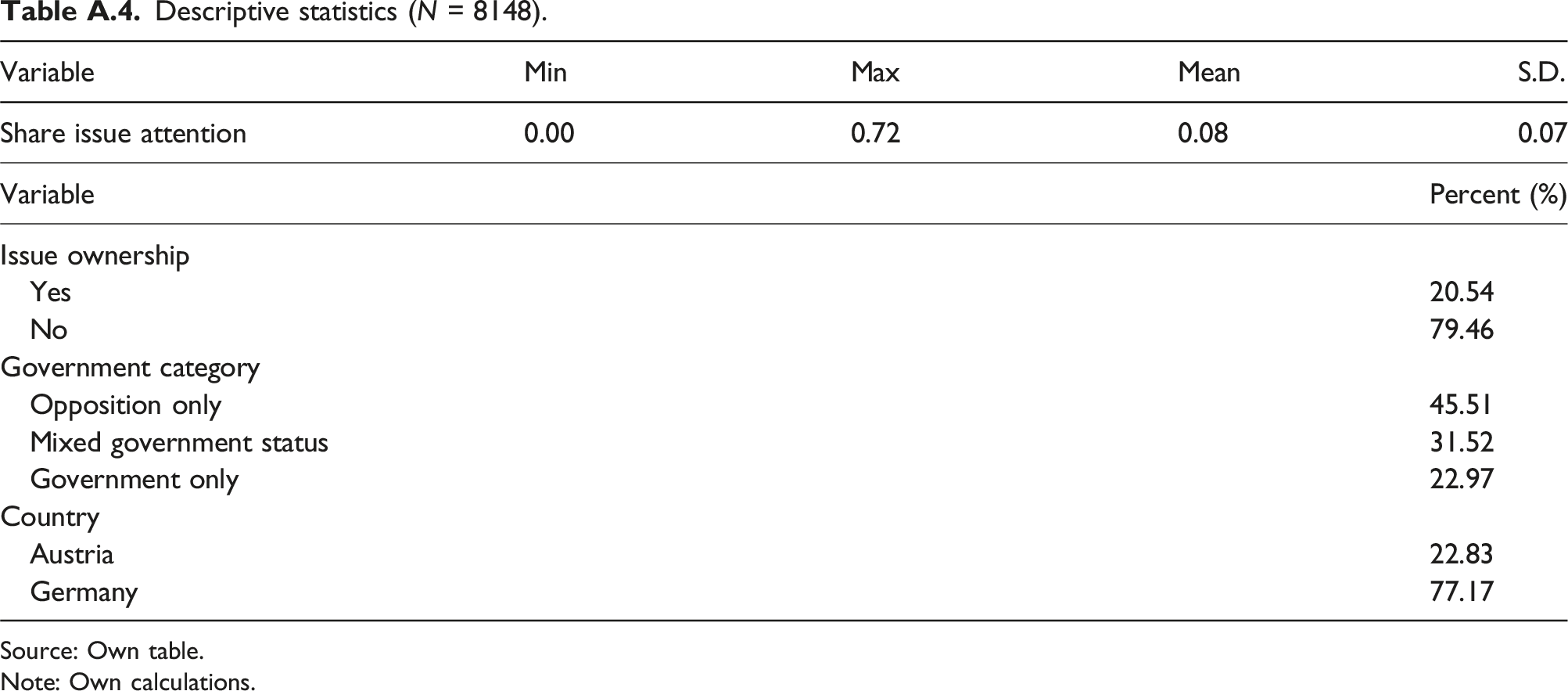
Our unit of observation is one issue in one manifesto per party per regional election. We include all parties that entered the regional parliament at least once in the period under investigation and excluded parties that only competed at the regional level. 3 Regional election manifestos were retrieved both from the Political Documents Archive (Benoit et al., 2009; Gross and Debus, 2018) and complemented by the most recent Austrian regional manifestos using the information in Gross et al. (2023a). Overall, our dataset includes 8148 (679 manifestos times 12 issues) issue-manifesto-party-election observations from 14 different parties between 1990 and 2019. The Christian Democratic Union of Germany (CDU) and the Christian Social Union in Bavaria (CSU) are treated as one party since the parties form a joint parliamentary group in the federal parliament (Bundestag) and are described as ‘sister parties’ (Schwesterparteien). Even though the CSU runs as a separate party organization, CSU and CDU do not compete against each other in either federal or state elections. Furthermore, the CSU ‘is part of the state-wide political camp of Christian Democracy’ (Detterbeck and Hepburn, 2010: 110).
Dependent variable: a party’s share of issue attention
We are interested in how relevant specific issues are in parties’ manifestos at the regional level. Consequently, our interest is in issue attention rather than issue saliency. In contrast to studies on issue saliency that typically allocate the full text of a manifesto to issues, issue attention rests on a selection of relevant words that are defined beforehand to the analysis in a dictionary. There is no ‘gold standard’ in defining a priori which issue areas can be important in subnational electoral campaigns. We relied on the still scarce empirical literature on coding subnational political actors’ issue attention, that is the very specific issues and broader domains provided by the Regional Manifestos Project (Alonso et al., 2013), and the regional, mixed, and national issue categories employed in a recent analysis of Austrian and German manifestos (Gross et al., 2023a). We focus on 12 prominent issue areas: (1) Agriculture, Environment, Energy, Climate (AEEC), (2) Development, Defence, Foreign, Security (DDFS), (3) Domestic, Asylum, Immigration (DAI), (4) Economy, (5) Education, (6) Europe, (7) Fiscal, (8) Infrastructure, Transportation, Digitization (ITD), (9) Justice, (10) Media, (11) Religion, Identity, and (12) Welfare, Family, Health (WFH).
To receive a party’s share of issue attention in the regional manifestos, we used a dictionary approach (see, e.g., Grimmer and Stewart, 2013: 274–275). In contrast to hand coding techniques using quasi-sentences for estimating the issue attention of parties in manifestos (see, e.g., Alonso et al., 2013; Budge et al., 2001; Klingemann et al., 2006), dictionary coding is a purely quantitative approach where single words belonging to a specific topic are allocated to the respective issue categories. Coding is therefore less time-consuming and less demanding regarding the training and the monitoring of human coders. Once a dictionary has been generated, the dictionary is then applied to the documents of interests (in our case: manifestos) and the frequency of occurrence of key terms is recorded (Laver and Garry, 2000).
These key terms, which must be exclusively associated with a specific issue and adequately describing the content of an issue, have been identified by first using the dictionary provided by Gross et al. (2023a) who focus on the share of regional and national topics mentioned in regional party manifestos in Austria and Germany. In a second step, we added key terms from other empirical studies analysing election manifestos (Jakobs and Jun, 2018; Pappi and Seher, 2009) and legislative speeches (Bergmann et al., 2018) in Germany. In a third step, we analysed data provided by the Austrian National Election Study (AUTNES, Dolezal et al., 2012) as well as Austrian manifestos to look for words that only pertain to the Austrian context.
To ensure as much intercoder reliability as possible, all three authors assigned key terms to issue areas separately and each case of different coding has been discussed amongst the authors until a unanimous solution had been reached. This approach circumvents some of the inherent problems of dictionaries regarding intercoder reliability (Grimmer and Stewart, 2013: 275): since we are not interested in the tone or the emotion of a statement or a key term used within an election manifesto, we simplify the classification problem by relying on a binary coding – a key term can only exclusively belong to one of the 12 issues, or it will not find its way in the dictionary.
Applying the dictionary to regional election manifestos provides us with the frequency with which the key terms belonging to a specific issue in the dictionary are mentioned in the respective manifestos.
4
For each of the 12 issues, we summed up all mentions regarding an issue and then divided the frequencies of each issue category by the total number of mentions belonging to the 12 issue categories. The share of these frequencies is the dependent variable Share issue attention, theoretically ranging from 0 (a party does not devote any attention to this issue in its manifesto) to 1 (a party exclusively devotes its attention to this issue in its manifesto). The calculation of Share issue attention can be written as follows:

It is important to note that Share issue attention is a relational measure. For example, a score of 0.25 in Share issue attention indicates that a party devotes 25 per cent of its attention in its regional election manifestos to this specific issue, compared to all other issue categories. Of course, there are a lot of words that either do not belong to any of the 12 issue categories we defined a priori, or which are non-exclusive for a specific issue – and therefore are disregarded by our dictionary. This is also the reason why we are not using the total amount of words to determine a party’s issue attention in its manifesto because such a measurement would be dependent on the manifesto length which varies considerably between parties in European multi-level systems (see, e.g., Klemmensen et al., 2007).
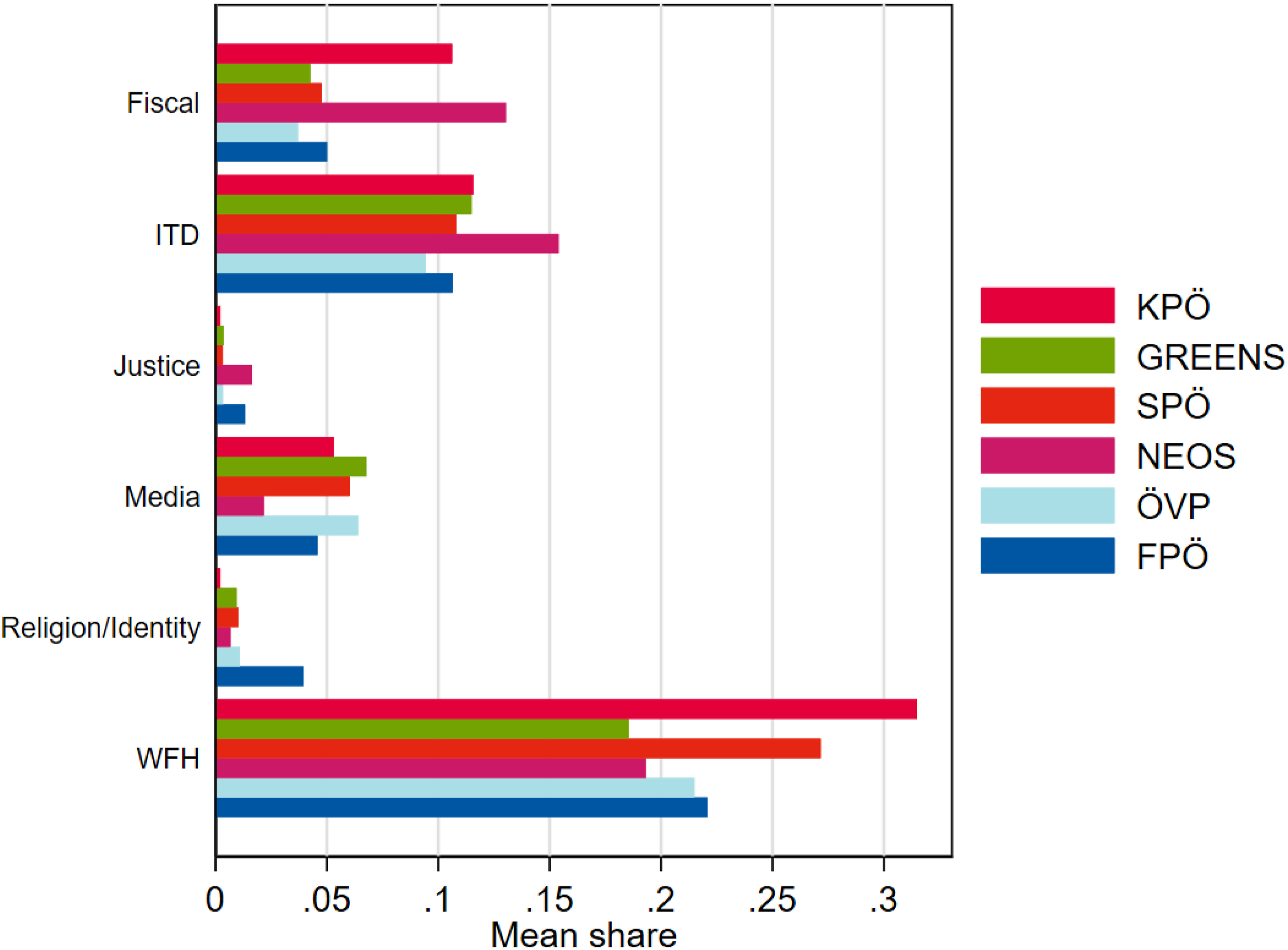
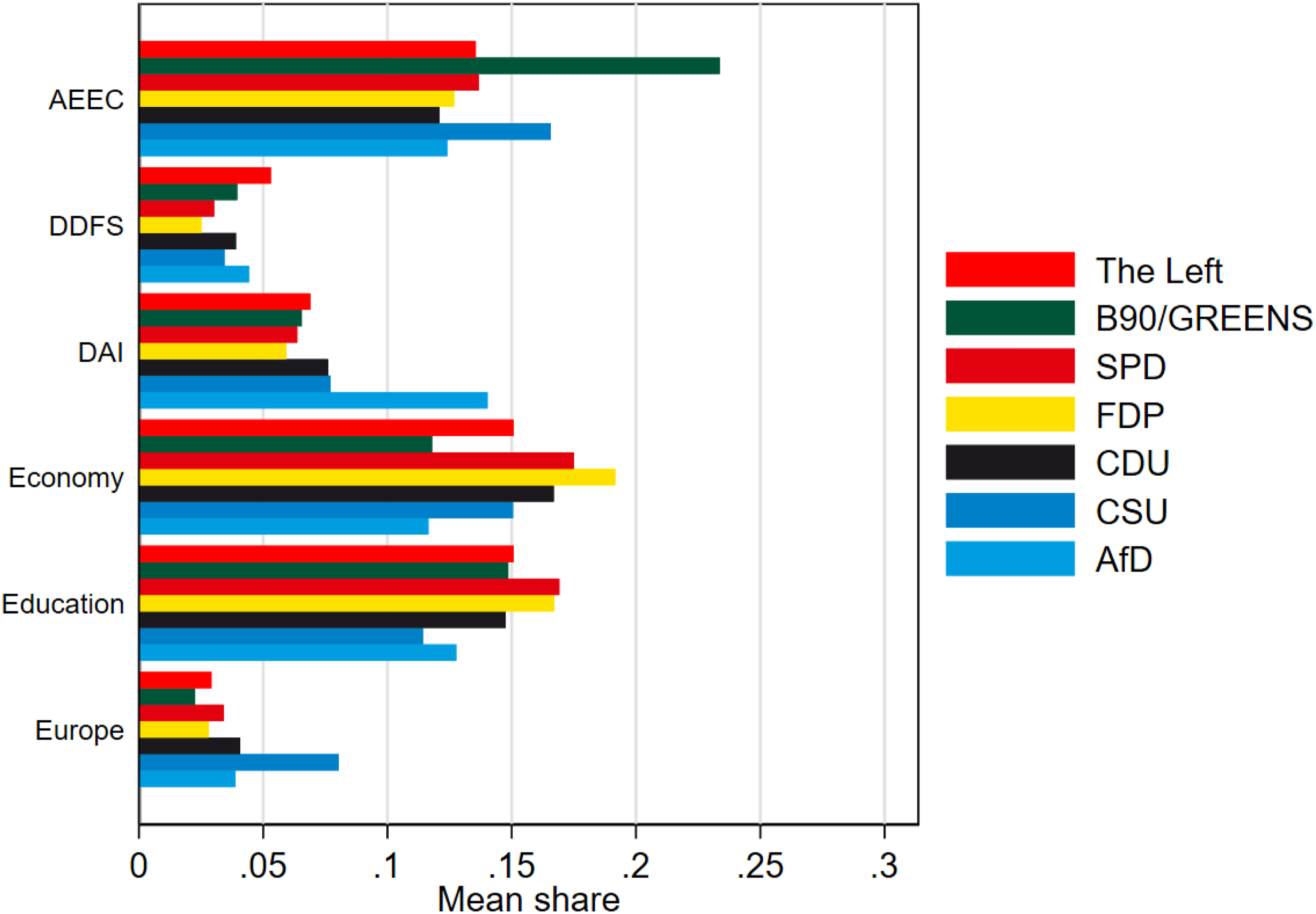
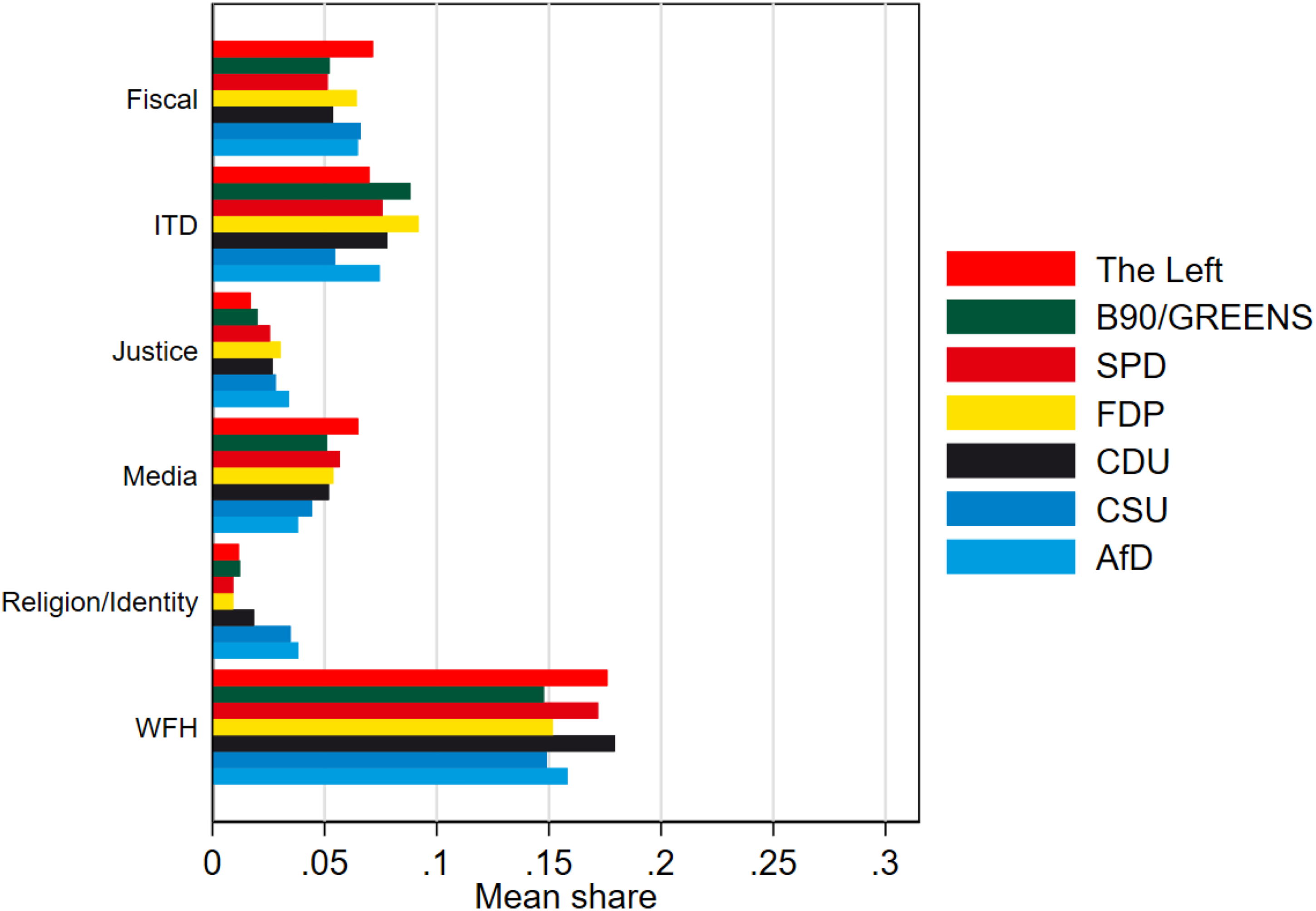
To give a first impression of the distribution of Share issue attention across the 12 issues we include Figures A.1–A.4 in the Appendix. 5 These results show the face validity of our dictionary coding by showing that parties owning an issue devote more attention to these issues.
Independent variables: issue ownership and government participation
For our empirical analysis we need two main explanatory variables: issue ownership and a party’s government participation at the regional and/or national level.
In our analyses, the independent variable Issue ownership takes on the value ‘1’ if a party is assigned as being the issue owner in a specific issue category. There are numerous attempts in the literature on operationalizing issue ownership: we started with the dataset on parties’ issue ownership at the national level provided by Seeberg (2017a) and generated the variable Issue ownership in three steps. Since Seeberg’s issue areas are slightly different from our 12 issue categories for the dictionary (sometimes more fine-grained, sometimes broader), in a first step all three authors independently allocated Seeberg’s issues to the 12 issue categories of our dictionary (see Table A.1 in the appendix). Inter-coder agreement was high: out of the 33 issues, 31 were coded to the identical category (94% agreement). The disagreements – natural disasters and housing – were discussed among the authors and a final decision was made. 6
In a second step, we coded the issue owner for each issue based on the 2013 data in the dataset by Seeberg (2017a). Note that time-varying issue ownership data was only available for some (but not all) issues in Germany, and not for Austria. However, given that issue ownership is a stable, long-term phenomenon (Egan, 2013; Seeberg, 2017a), basing our allocation of issue ownership on the 2013 data, which falls within the midpoint of our research period, provides us with pertinent information (see also Ivanusch, 2024 for a similar operationalization). Issue ownership in the Seeberg data set relies on election surveys. It represents the proportion of respondents favouring each party within each party system on a specific issue during elections. Thus, we gave issue ownership in each issue to the party that had the highest proportion of respondents assigning it the highest competence of handling the respective issue. Since we had assigned more than one issue to certain dictionary categories, in some cases different parties owned the same issue category in our dictionary. We gave the issue ownership to the party that owned more issues in each category. This procedure allowed us to determine the issue owner in seven out of our 12 issue categories for the Austrian case and in six out of our 12 issue categories for the German case (see Table A.2 in the appendix).
In the final and third step, we then assigned issue ownership to the still missing categories based on in-depth knowledge of the Austrian and German party systems (see Table A.3 in the appendix). In general, there is a major overlap between the allocation of issue ownership in Austria and Germany but there are also important differences. For example, the issue of ‘Justice’ was allocated to the conservative Austrian People’s Party (ÖVP) in Austria, but to the liberal Free Democratic Party (FDP) in Germany.
While we have decided to only allocate one issue to one party, we made an exception for the AfD in Germany. Since its party foundation in 2013 and its initial focus on the issue of European integration and the EU economic policy, the AfD has changed its focus of attention to migration, immigration and asylum issues (Debus and Florczak, 2022) and additionally gained issue ownership of the issue ‘Domestic, Asylum, Immigration.’
In contrast to the operationalization of a party’s issue ownership, the operationalization of a party’s government participation at the regional and/or the national level is straightforward. Government participation takes on the value of ‘1’ if a party has been in opposition both at state and federal levels, the value of ‘2’ if a party has only been in government at one of the two levels, and the value of ‘3’ if a party has been in government both at state and federal levels. We retrieved this information via the Wikipedia pages referring to the various state and federal elections in Austria and Germany. 7
Empirical analysis
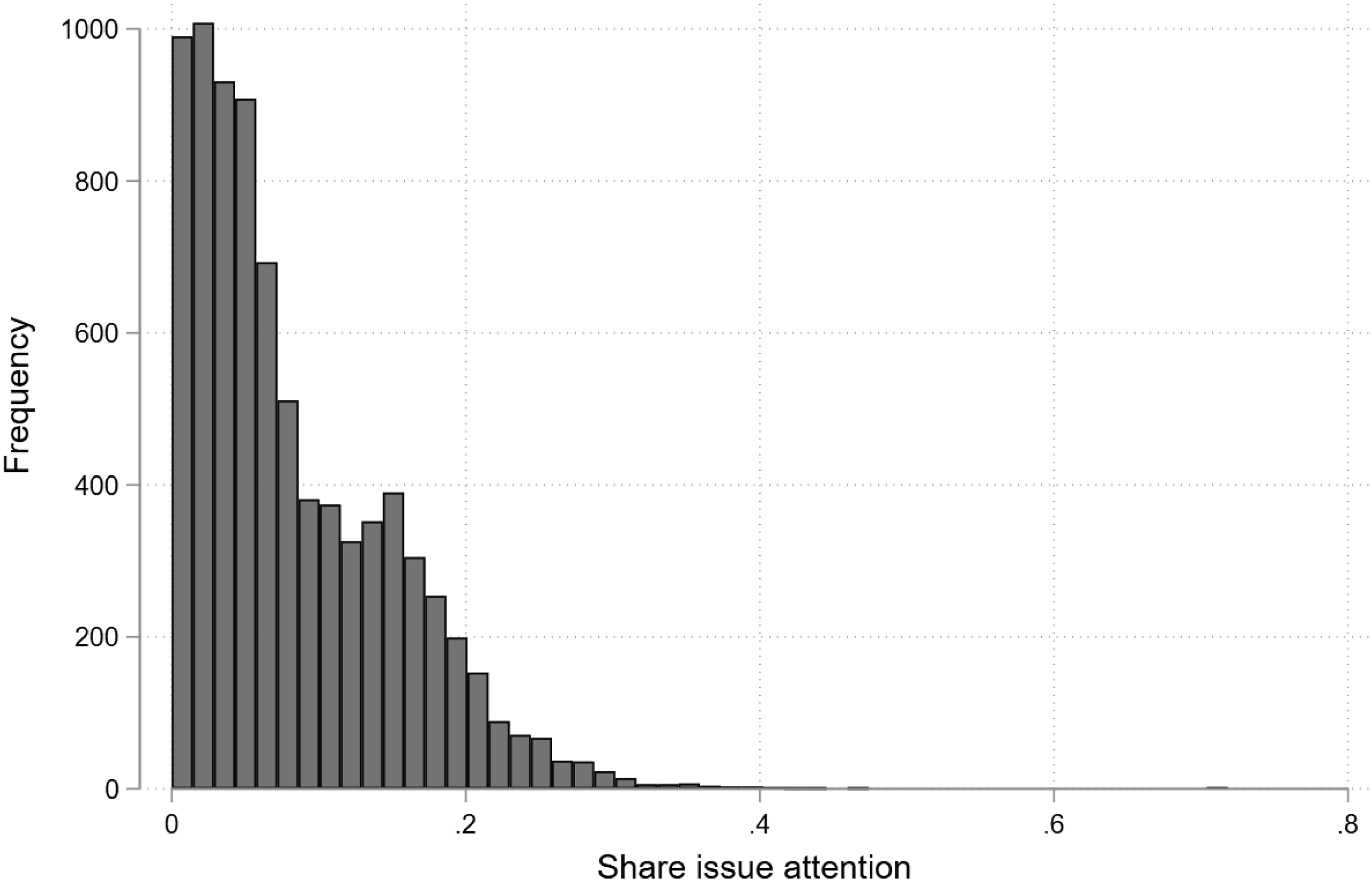
To test our hypotheses, we run Tobit regressions with the natural logarithm of the share of issue attention as the dependent and issue ownership as well as government participation as independent variables. Using a Tobit regression is appropriate because the observations in the data can only take on positive values or zero for the dependent variable Share issue attention (see Tobin, 1956). The right-skewed distribution of Share issue attention (see Figure A.5 in the appendix) requires a log-transformation of the dependent variable to meet the assumption of homoscedastic residuals underlying Tobit models.
Our unit of analysis is the share of issue attention of a regional party organization regarding one issue in one manifesto written in one region for one election. In our dataset, we have 8148 party-issue attention-observation from 679 manifestos. Since the observations are not independent from each other, we cluster by manifestos to account for election- and party-specific factors that may not be captured by our independent and control variables. We additionally include a categorical variable for the issue categories and for Austria to make sure that the results are not biased due to differences between issues and countries.
Analysing parties’ issue attention.
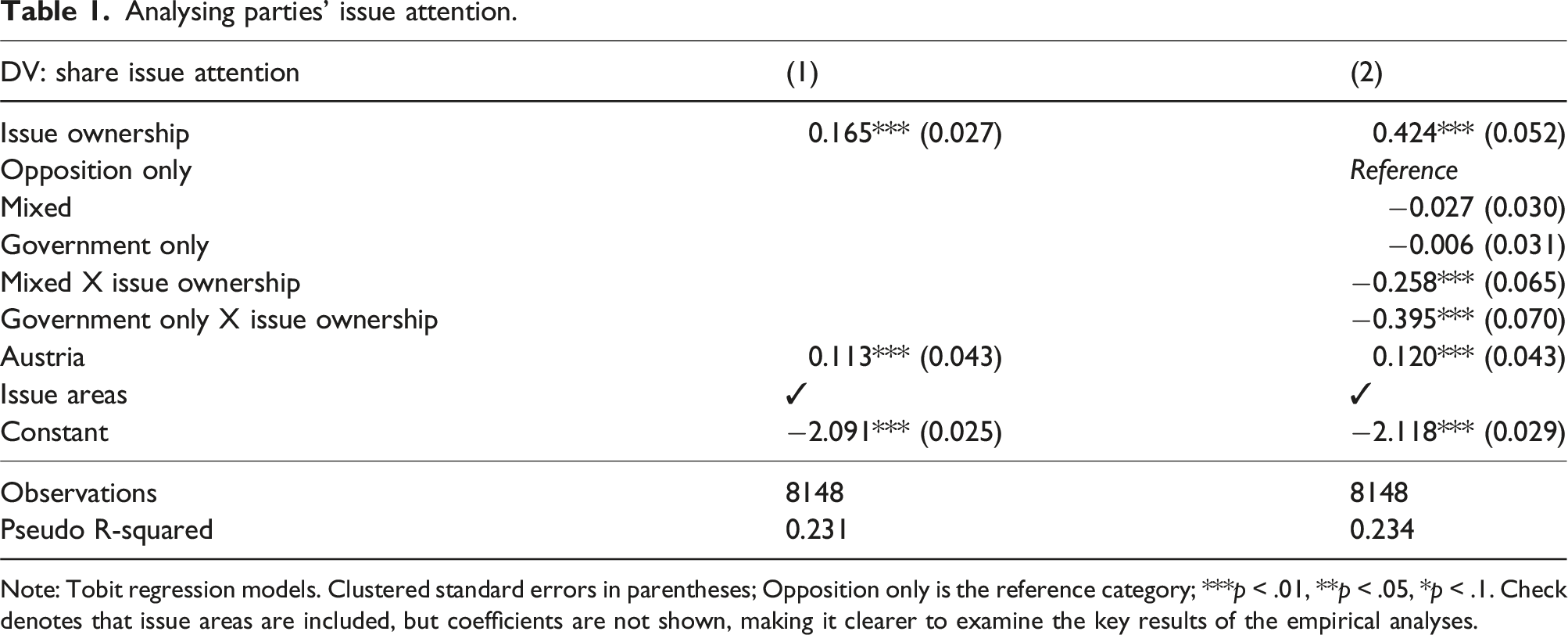
Note: Tobit regression models. Clustered standard errors in parentheses; Opposition only is the reference category; ***p < .01, **p < .05, *p < .1. Check denotes that issue areas are included, but coefficients are not shown, making it clearer to examine the key results of the empirical analyses.
Model 1 supports our first hypothesis: the coefficient of Issue ownership is positive and statistically significant. This means that parties allocate a higher share of attention in their regional election manifestos towards issues that they own. Because Share issue attention is log-transformed, the fixed-effect coefficients of Issue ownership displayed in Table 1 can be interpreted in terms of percentage change. On average, a party devotes 17 per cent more of its regional election manifesto content to an issue if it owns this issue, compared to issues where another party is the issue owner. This finding for parties’ issue attention strategies at the subnational level in Austria and Germany thus echoes the empirical findings for parties’ issue attention strategies at the national level: even though parties also talk about non-owned issues, issues that they own get substantially more attention than other issues (see, e.g., Budge, 2015; Seeberg, 2017a).
Model 2 tests the interaction hypothesis. The interaction effects between issue ownership and government participation are negative and statistically significant. These results lend support to our second hypothesis where we expected that government participation has a moderating effect on the impact of issue ownership on a party’s share of issue attention.
Figure 1 displays the average marginal effects for issue ownership depending on whether the party is solely in opposition, in government at one level, or in government at both levels. We see a substantial decrease of the average marginal effect across categories. The average marginal effect of issue ownership drops from 0.43 (being in opposition at both levels) to 0.17 (mixed government status) to 0.03 (government only). Note that, in the government only situation, the AMEs are no longer significantly different from zero: if parties are in government at the regional and at the national level, issue ownership does not have an influence on the attention that parties pay towards issues in their manifestos. It is especially opposition parties that significantly and substantially devote more attention to the issues they own, whereas government parties cannot focus on the issues they own to such a large extent in comparison to all other issues they must cover in their election manifestos. Average marginal effect (AME) of issue ownership and a party’s government participation. Note: The figure is based on Model 2 in Table 1.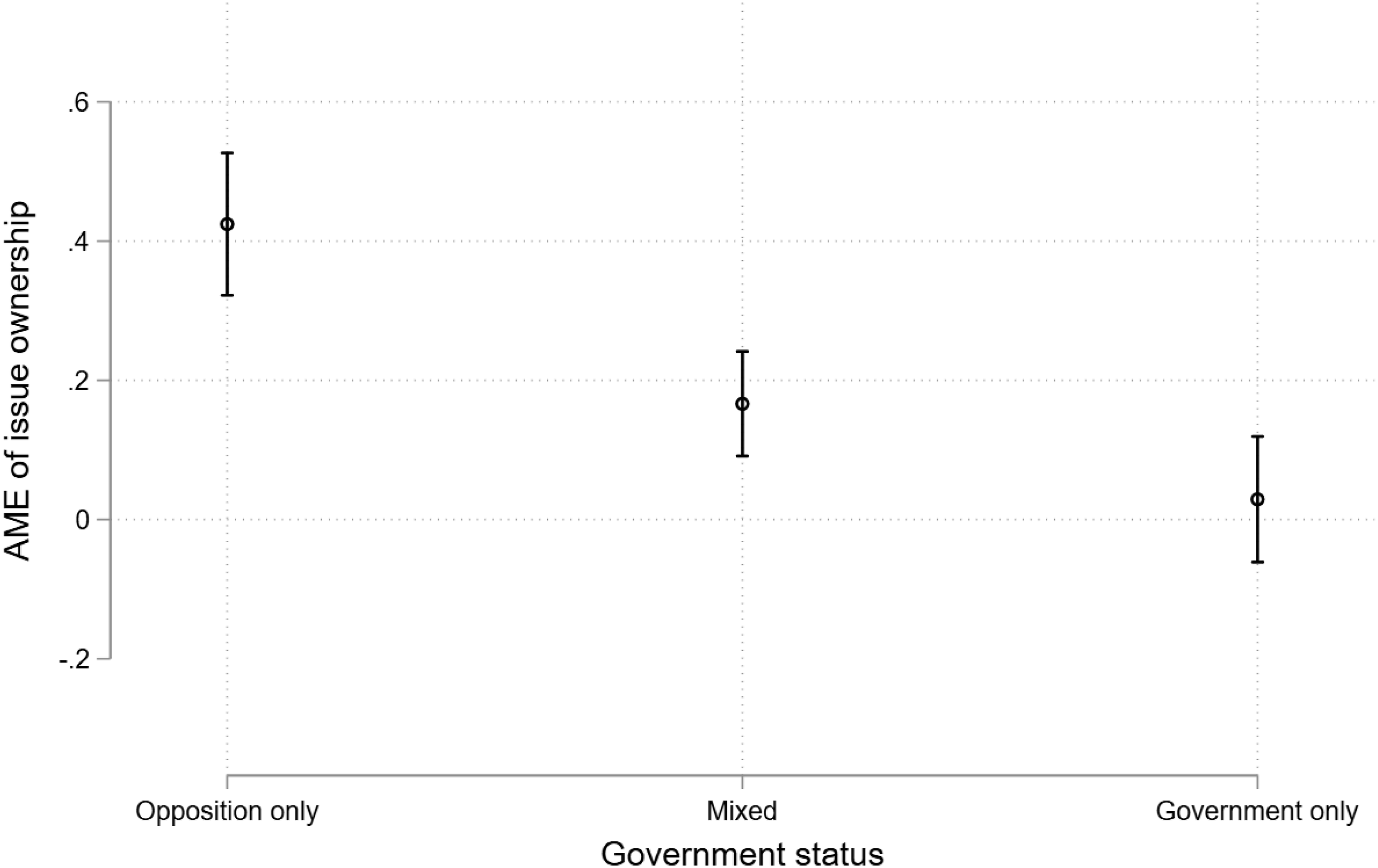
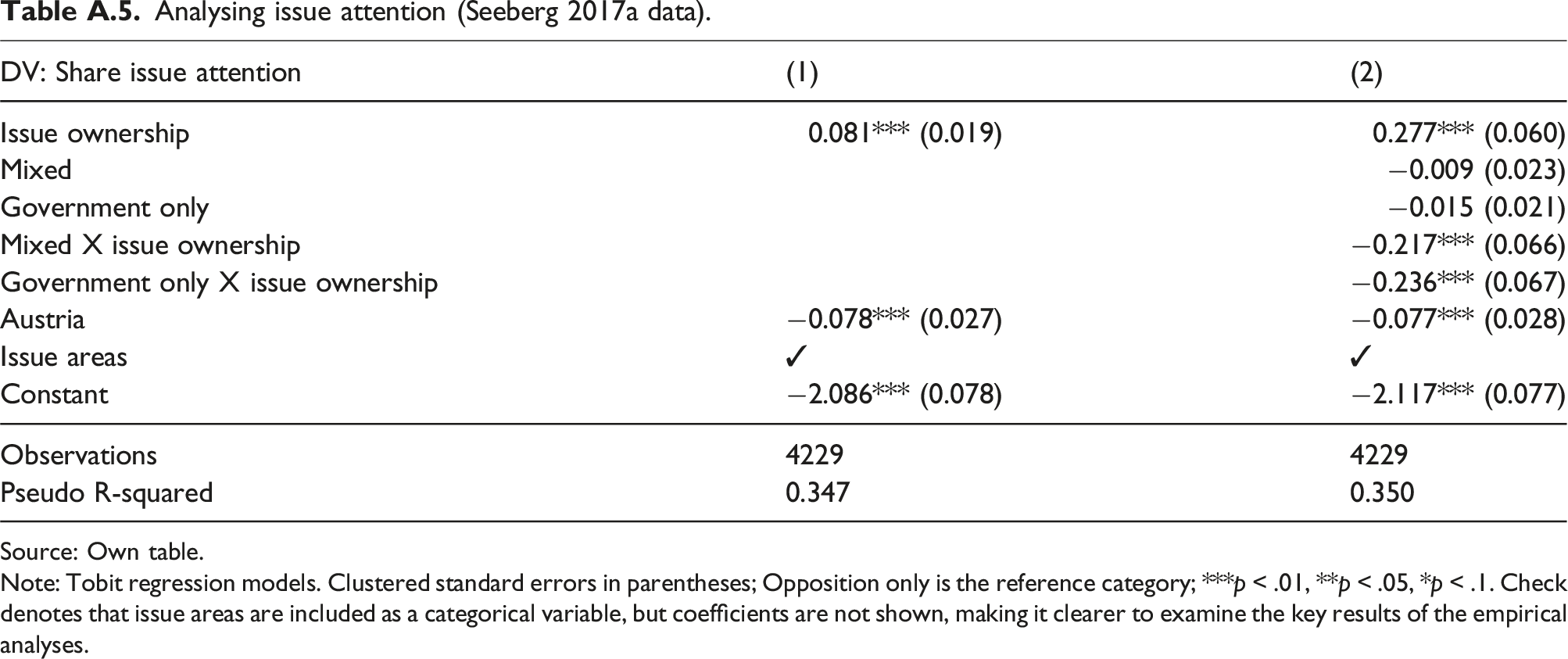
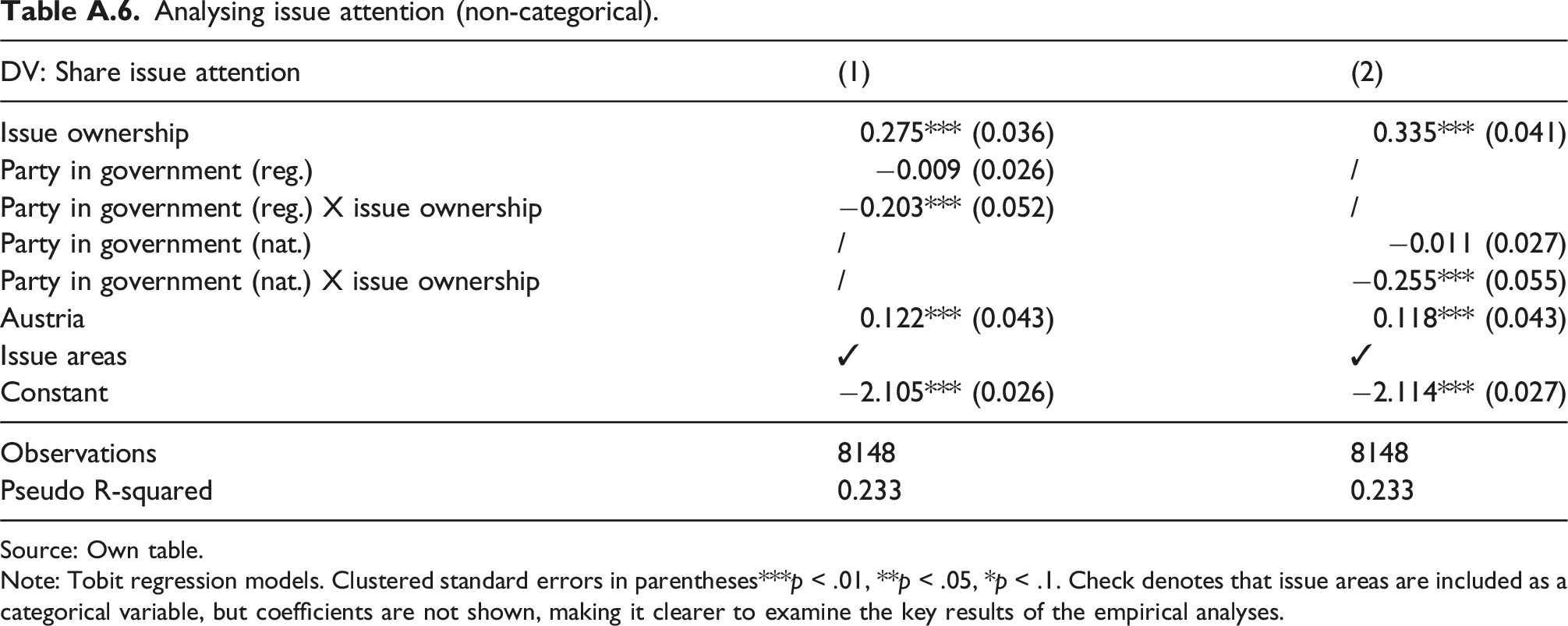
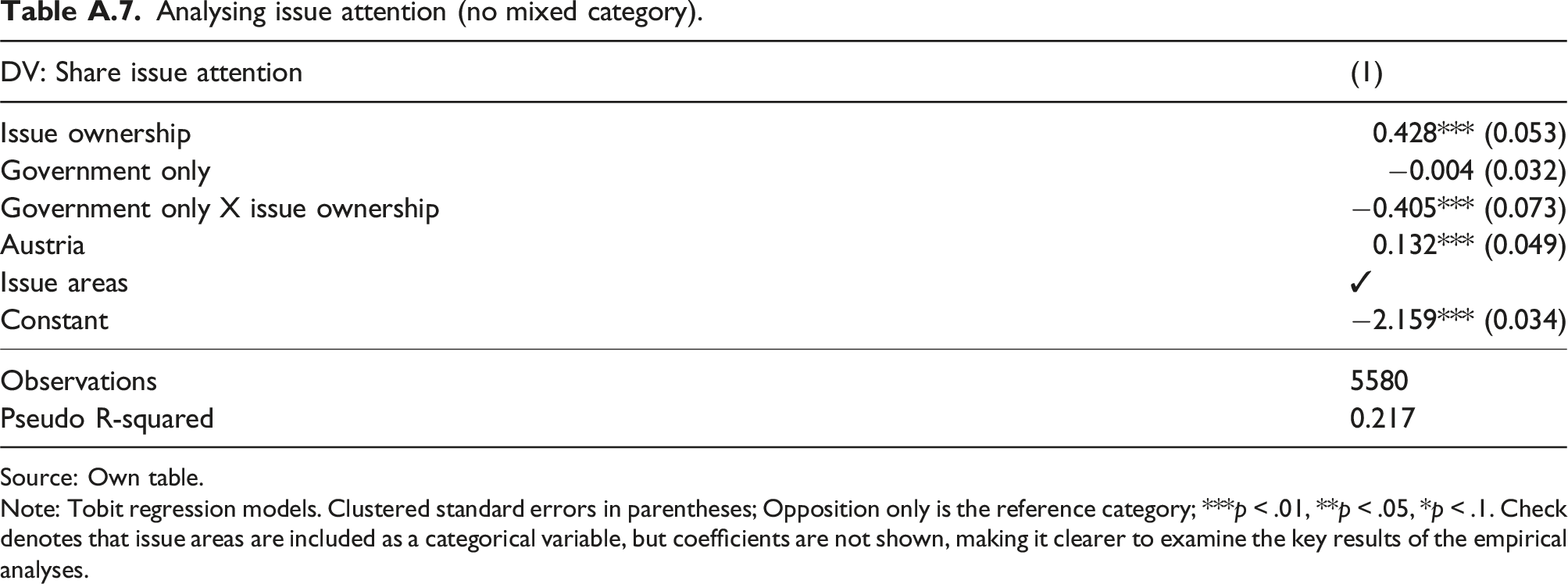
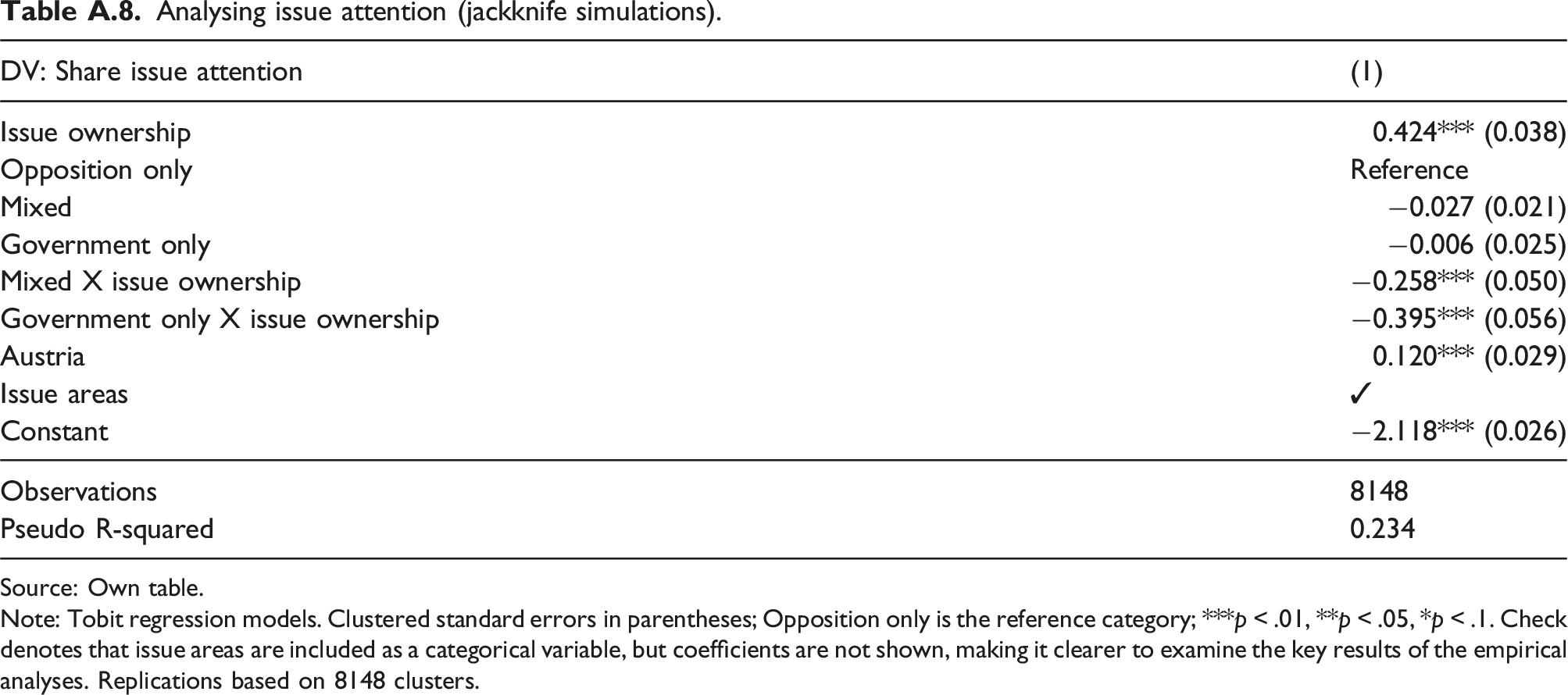
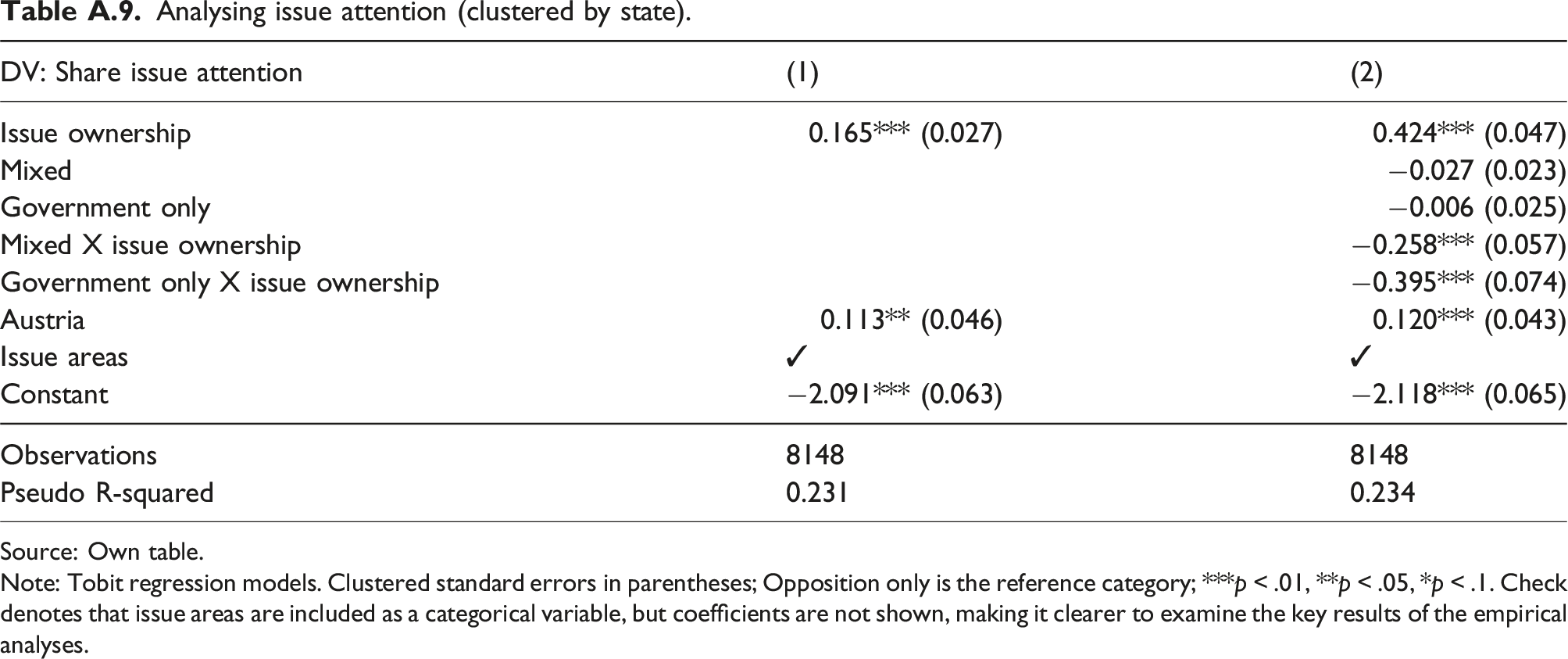
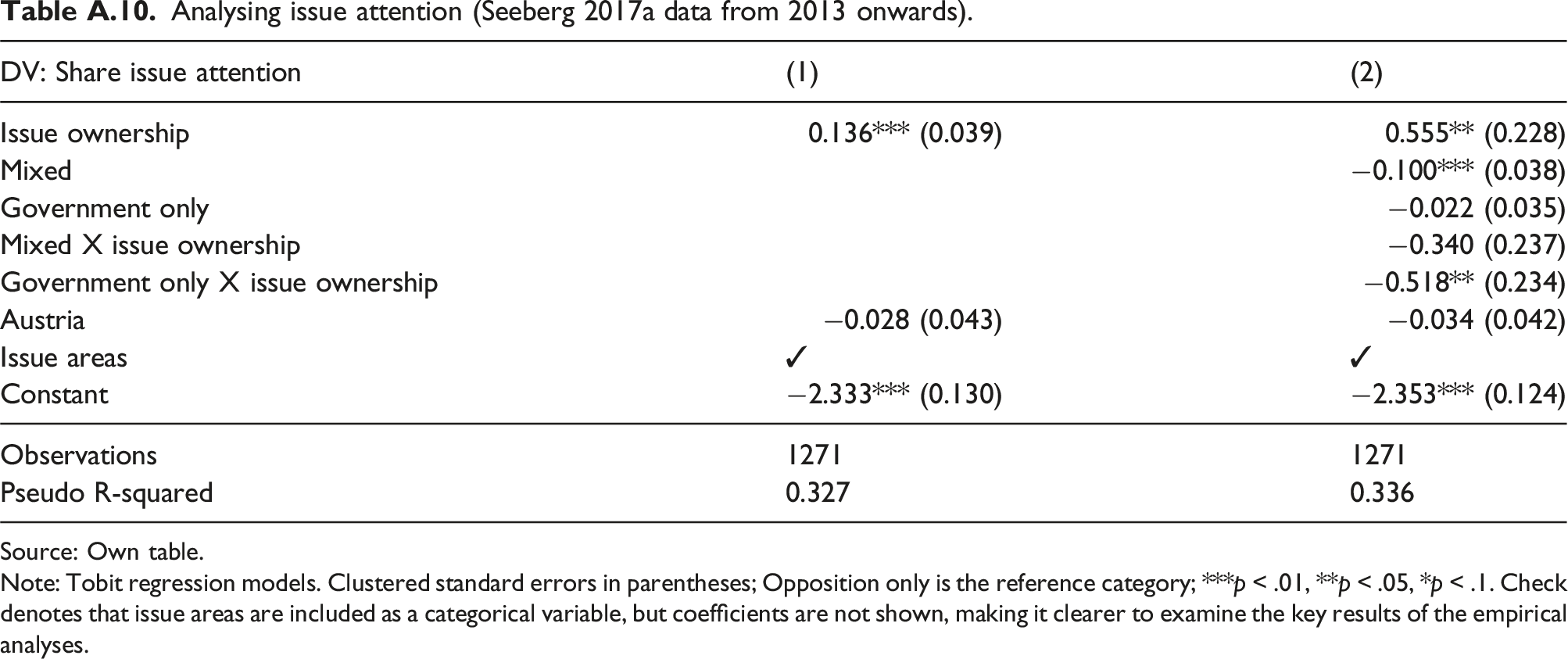
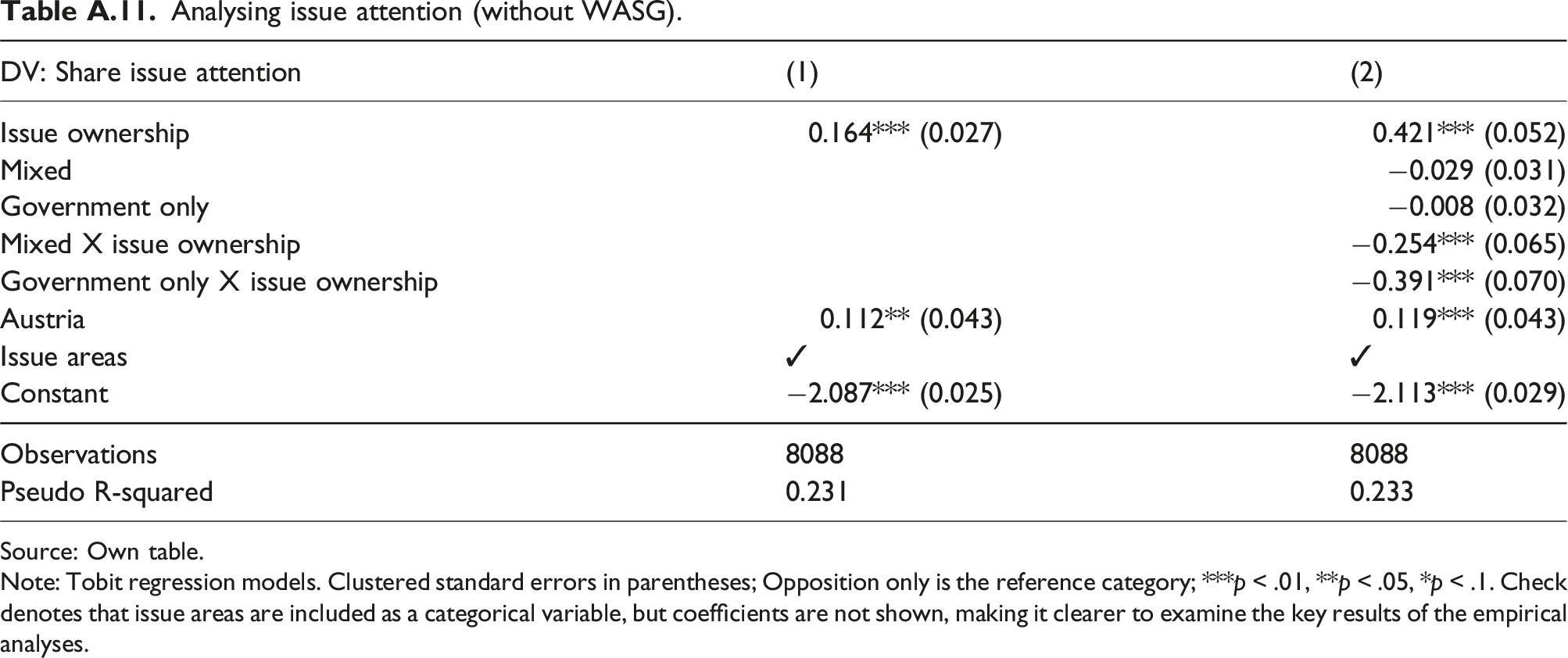
We tested the robustness of our empirical results using different model specifications in Tables A.5–A.11 in the Appendix. As described in the research design section, we started with the data provided by Seeberg (2017a) to operationalize issue ownership in some categories and added issue ownership in the remaining categories based on in-depth knowledge of the two cases under study. As a robustness test, we re-ran our models based on a restricted data set that includes only the issue ownership data provided by Seeberg (2017a). We further restrict the Seeberg data sample to observations starting from 2013 to avoid major time differences between observations and issue ownership data. Additionally, we include the following robustness checks: government status variable as non-categorical, dropping the mixed category, jackknifing individual observations, including state clusters instead of manifesto clusters as well as dropping the WASG manifestos. Overall, our results remain mostly stable with very few exceptions.
Conclusion
Which effect do national issue ownership and government participation have on issue attention at the subnational level? In this study, we answered this question by arguing that subnational parties should devote more attention to issues that they ‘own’ at the national level, compared to other issues. Additionally, we argued that this association should be moderated by a party’s government participation both at the national and the regional level.
Using a newly compiled data set on parties’ issue attention in Austria and Germany between 1990 and 2019, we first demonstrated that parties at the subnational level devote substantially more attention to those issues that they ‘own’ than to other issues (an increase by 17 per cent). Secondly, we show that this association between a party’s issue ownership and its issue attention to these issues at the subnational level is moderated by its participation in both regional and national governments: It is particularly opposition parties which focus more on the issues they ‘own,’ compared to other issues, whereas the association between issue ownership and issue attention is not statistically significant anymore for parties that are in government at both levels.
Whereas our theoretical arguments are not country-specific and should apply to other multi-level contexts in European democracies and beyond, our empirical test of the theoretical arguments only focusses on Austria and Germany. Therefore, additional research is needed to corroborate these findings for Austria and Germany at the regional level in other multi-level political systems.
Furthermore, whereas we were able to corroborate national-level findings that government parties – even if they own specific issues – distribute their issue attention across a greater number of issues, compared to opposition parties, we cannot assess in the current empirical setting to which extent economic or societal conditions might affect the relationship between issue ownership, government participation, and issue attention. It would, however, be worthwhile to explore these conditions further, especially regarding potentially varying effects between and within countries. In this sense, expanding the cases under study to see if our results hold in other than federalised institutional settings and in countries where self-rule and shared-rule patterns also differ between regions within one country (e.g. Spain) would be an additional step forward.
Lastly, future studies could theoretically engage and empirically test national-level findings of issue competition between parties at the subnational level by focusing on how parties respond to issue attention strategies of other parties (see, e.g., van de Wardt, 2015), particularly if such parties are seen as an electoral threat (see, e.g., Spoon et al., 2014), on the effects of the party system agenda in general (see, e.g., Green-Pedersen and Mortensen, 2010), and how the ideological closeness between parties (see, e.g., Green-Pedersen and Mortensen, 2015; Meyer and Wagner, 2016; Williams et al., 2016) affects the association between issue ownership and issue attention. Finally, it would be interesting to see if incumbency can also turn into a burden at the regional level and how this depends on government status and different media outlets (Thesen et al., 2024). Our study on parties’ issue attention strategies at the subnational level in Austria and Germany is hopefully a first step towards a more comprehensive analysis of issue competition between parties at the subnational level.
Footnotes
Author contributions
The list of author names follows a rotation principle. All authors contributed equally to all work.
Declaration of conflicting interests
The author(s) declared no potential conflicts of interest with respect to the research, authorship, and/or publication of this article.
Funding
The author(s) disclosed receipt of the following financial support for the research, authorship, and/or publication of this article: All authors acknowledge funding from the International Association for the Study of German Politics (IASGP). Martin Gross acknowledges funding from the LMUexcellent Postdoc Support Fund. Katrin Praprotnik conducted this research under the auspices of the Austrian Democracy Lab, a cooperation with Forum Morgen.

Notes
Appendix
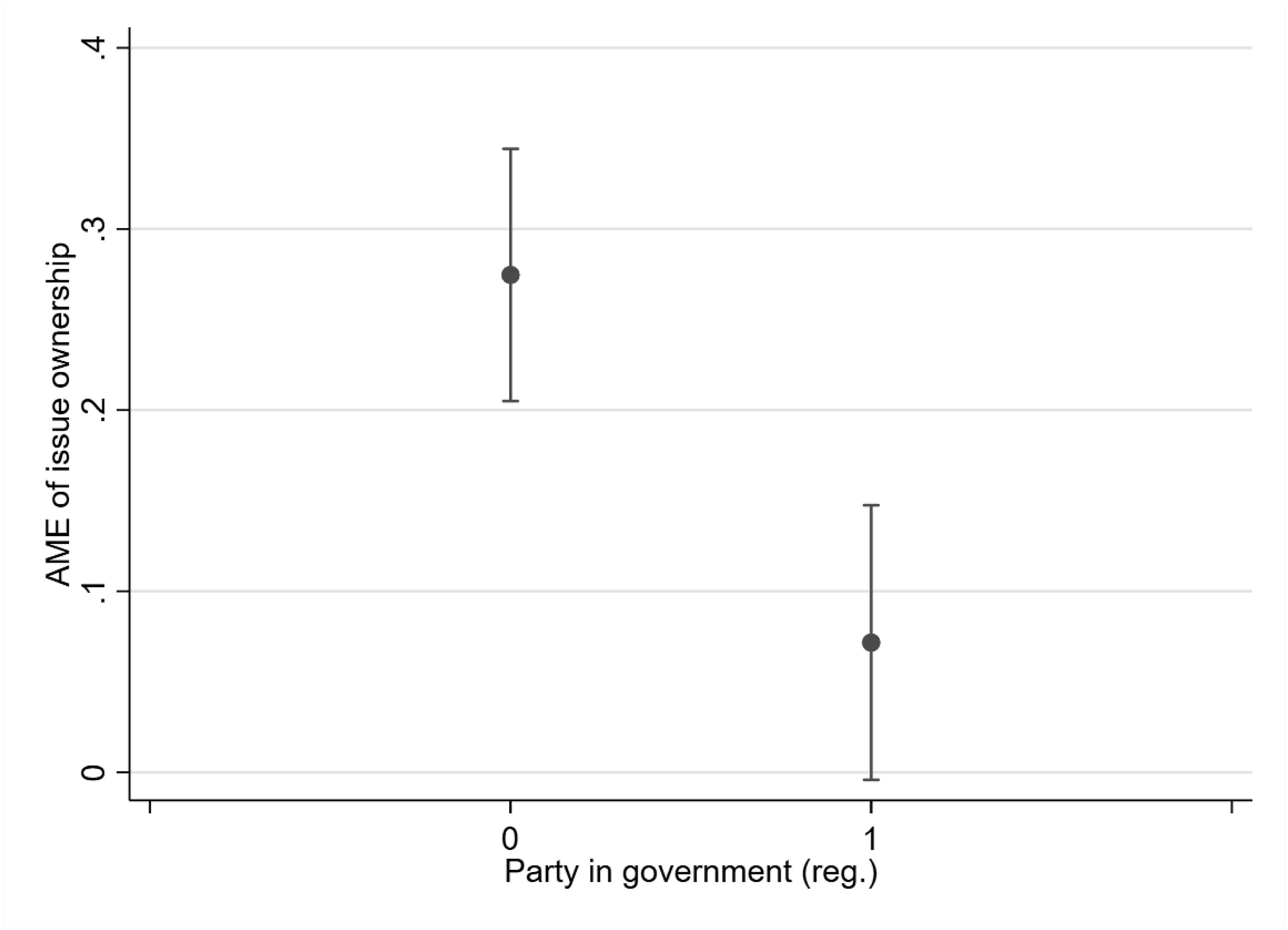
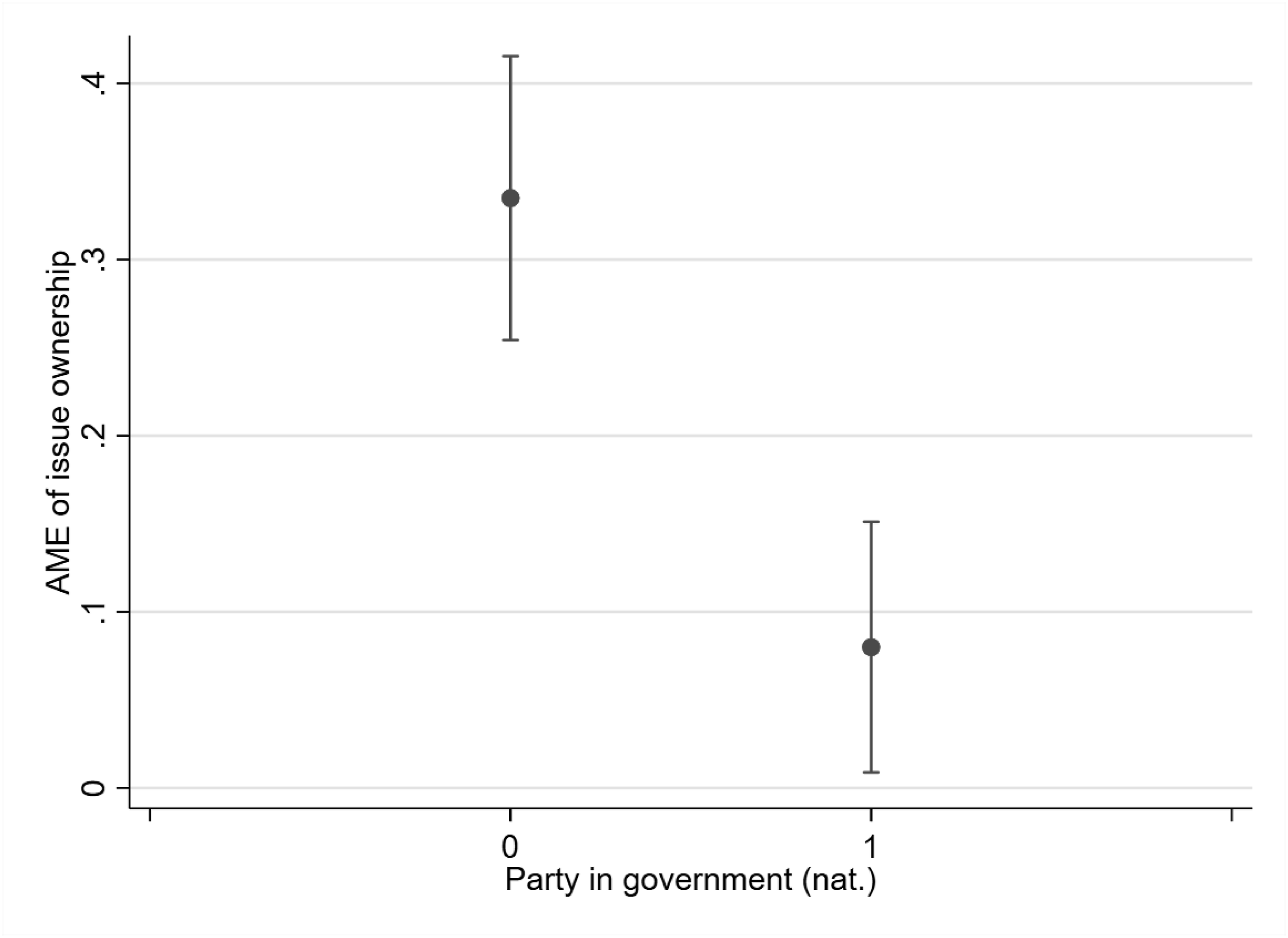
Mean shares of Austrian parties (issues 1–6). Source: Own graph. Note: AEEC: agriculture, environment, energy, climate; DDFS: development, defence, foreign, security; DAI: domestic, asylum, immigration. Mean shares of Austrian parties (issues 7–12). Source: Own graph. Note: ITD: infrastructure, transportation, digitization; WFH: welfare, family, health. Mean shares of German parties (issues 1–6). Source: Own graph. Note: AEEC: agriculture, environment, energy, climate; DDFS: development, defence, foreign, security; DAI: domestic, asylum, immigration. Mean shares of German parties (issues 7–12). Source: Own graph. Note: ITD: infrastructure, transportation, digitization; WFH: welfare, family, health. Distribution of dependent variable. Source: Own graph. Average marginal effect (AME) of issue ownership and a party’s government participation at the regional level. Source: Own graph. Note: The figure is based on Model 1 in Table A.6. Focusing at the regional level, we see that the average marginal effect drops from 0.28 (regional party organization in opposition) to 0.07 (regional party organization in government). Average marginal effect (AME) of issue ownership and a party’s government participation at the national level. Source: Own graph. Note: The figure is based on Model 2 in Table A.6. Similarly, focusing at the national level, we see that the average marginal effect drops from 0.34 (party is in opposition) to 0.08 (party is in government).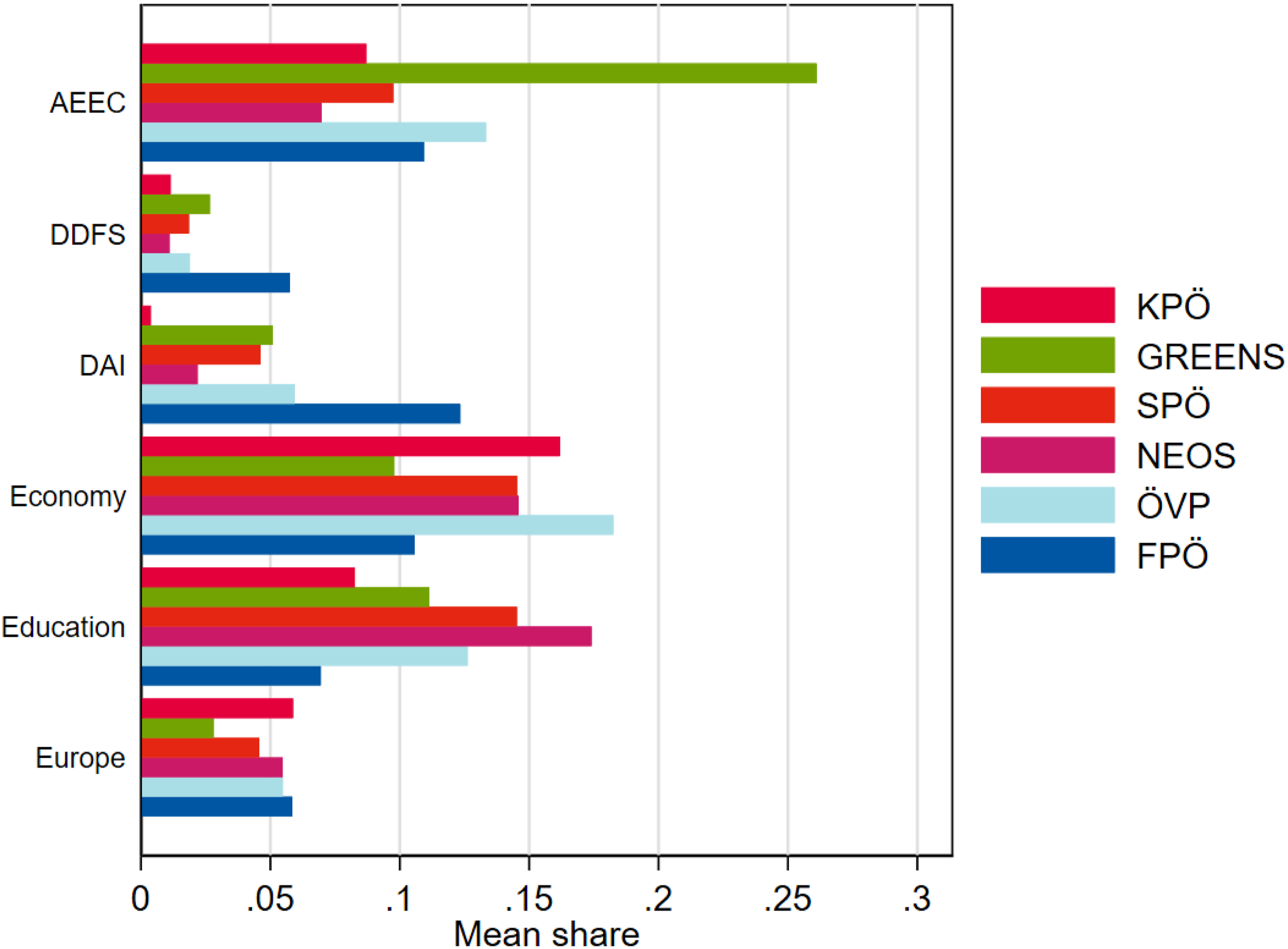
Allocation of Seeberg’s (2017a) issues to our dictionary categories. Source: Own table. Allocation of issue ownership to parties based on Seeberg (2017a). Source: Own table. Final allocation of issue ownership to parties. Source: Own table. Descriptive statistics (N = 8148). Source: Own table. Note: Own calculations. Analysing issue attention (Seeberg 2017a data). Source: Own table. Note: Tobit regression models. Clustered standard errors in parentheses; Opposition only is the reference category; ***p < .01, **p < .05, *p < .1. Check denotes that issue areas are included as a categorical variable, but coefficients are not shown, making it clearer to examine the key results of the empirical analyses. Analysing issue attention (non-categorical). Source: Own table. Note: Tobit regression models. Clustered standard errors in parentheses***p < .01, **p < .05, *p < .1. Check denotes that issue areas are included as a categorical variable, but coefficients are not shown, making it clearer to examine the key results of the empirical analyses. Analysing issue attention (no mixed category). Source: Own table. Note: Tobit regression models. Clustered standard errors in parentheses; Opposition only is the reference category; ***p < .01, **p < .05, *p < .1. Check denotes that issue areas are included as a categorical variable, but coefficients are not shown, making it clearer to examine the key results of the empirical analyses. Analysing issue attention (jackknife simulations). Source: Own table. Note: Tobit regression models. Clustered standard errors in parentheses; Opposition only is the reference category; ***p < .01, **p < .05, *p < .1. Check denotes that issue areas are included as a categorical variable, but coefficients are not shown, making it clearer to examine the key results of the empirical analyses. Replications based on 8148 clusters. Analysing issue attention (clustered by state). Source: Own table. Note: Tobit regression models. Clustered standard errors in parentheses; Opposition only is the reference category; ***p < .01, **p < .05, *p < .1. Check denotes that issue areas are included as a categorical variable, but coefficients are not shown, making it clearer to examine the key results of the empirical analyses. Analysing issue attention (Seeberg 2017a data from 2013 onwards). Source: Own table. Note: Tobit regression models. Clustered standard errors in parentheses; Opposition only is the reference category; ***p < .01, **p < .05, *p < .1. Check denotes that issue areas are included as a categorical variable, but coefficients are not shown, making it clearer to examine the key results of the empirical analyses. Analysing issue attention (without WASG). Source: Own table. Note: Tobit regression models. Clustered standard errors in parentheses; Opposition only is the reference category; ***p < .01, **p < .05, *p < .1. Check denotes that issue areas are included as a categorical variable, but coefficients are not shown, making it clearer to examine the key results of the empirical analyses.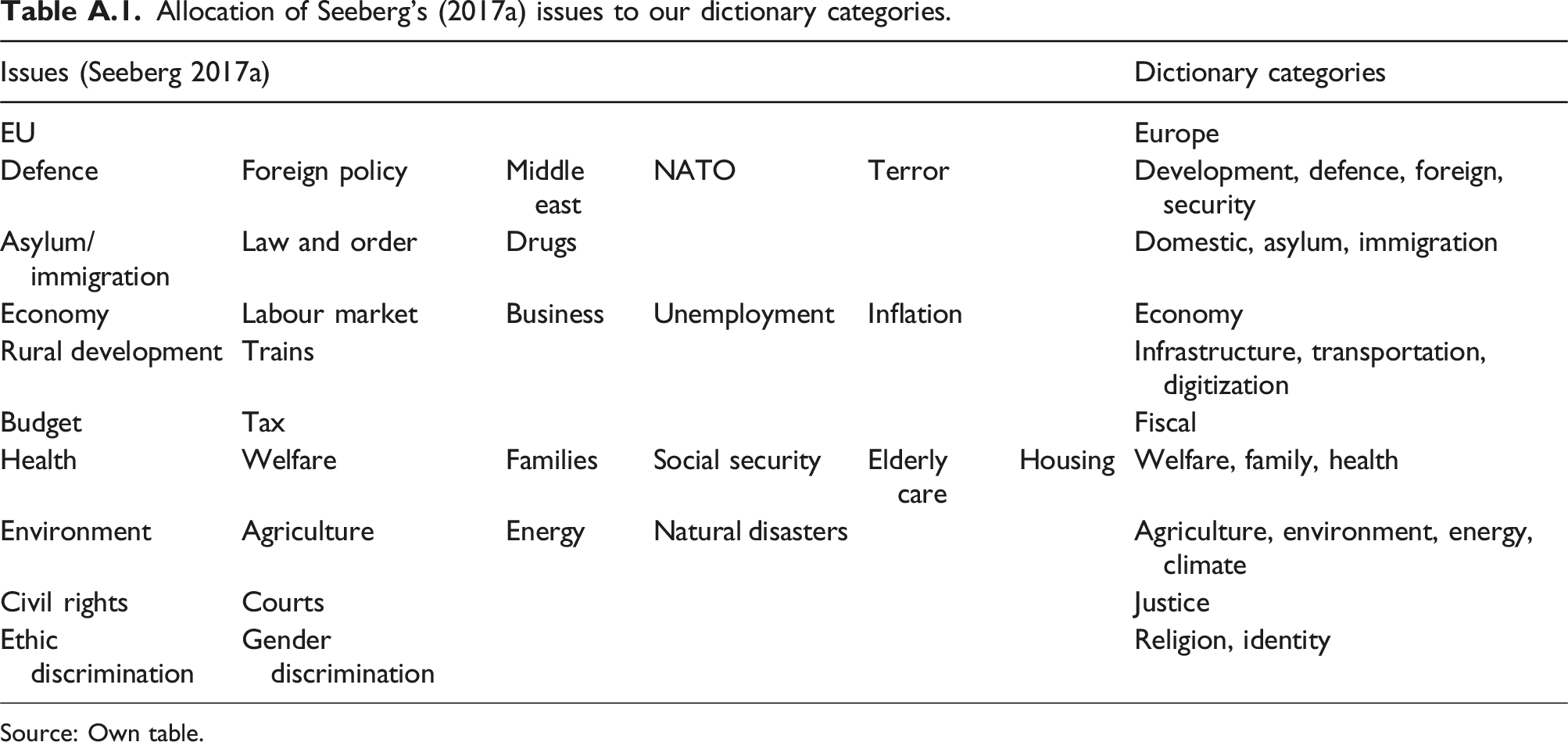
Issues (Seeberg 2017a)
Dictionary categories
EU
Europe
Defence
Foreign policy
Middle east
NATO
Terror
Development, defence, foreign, security
Asylum/immigration
Law and order
Drugs
Domestic, asylum, immigration
Economy
Labour market
Business
Unemployment
Inflation
Economy
Rural development
Trains
Infrastructure, transportation, digitization
Budget
Tax
Fiscal
Health
Welfare
Families
Social security
Elderly care
Housing
Welfare, family, health
Environment
Agriculture
Energy
Natural disasters
Agriculture, environment, energy, climate
Civil rights
Courts
Justice
Ethic discrimination
Gender discrimination
Religion, identity
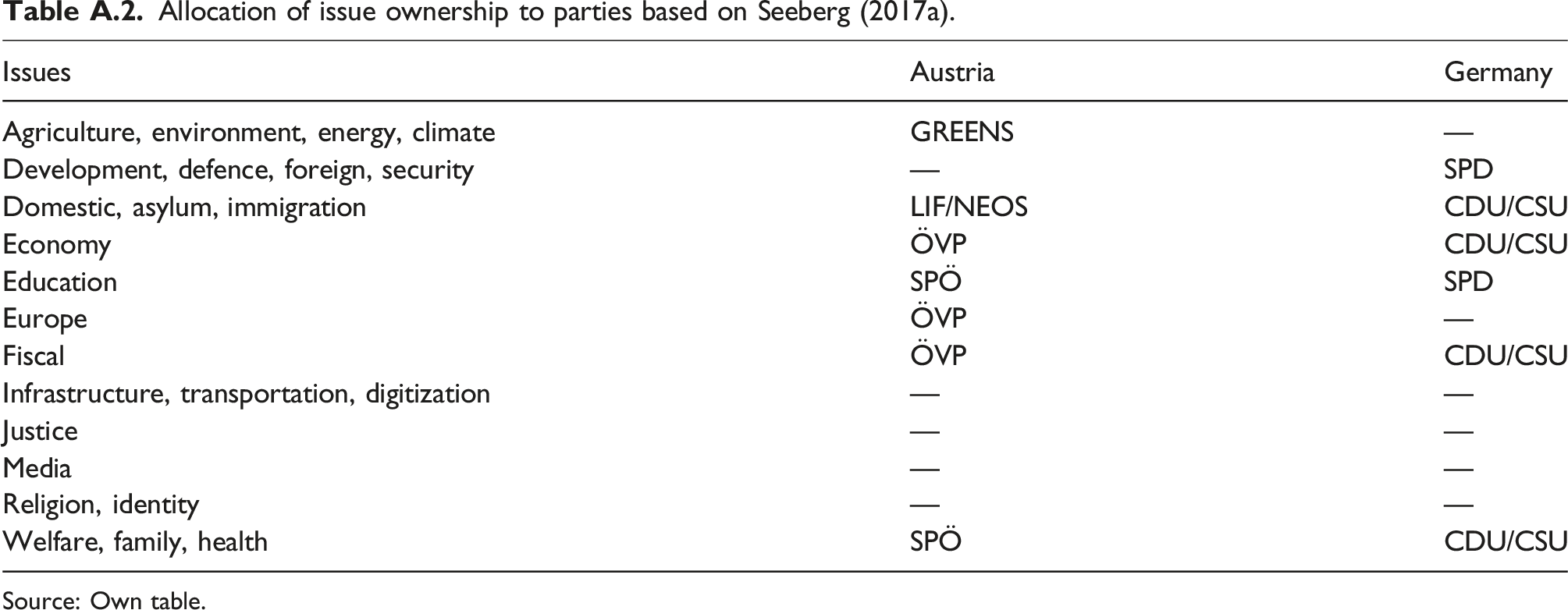
Issues
Austria
Germany
Agriculture, environment, energy, climate
GREENS
—
Development, defence, foreign, security
—
SPD
Domestic, asylum, immigration
LIF/NEOS
CDU/CSU
Economy
ÖVP
CDU/CSU
Education
SPÖ
SPD
Europe
ÖVP
—
Fiscal
ÖVP
CDU/CSU
Infrastructure, transportation, digitization
—
—
Justice
—
—
Media
—
—
Religion, identity
—
—
Welfare, family, health
SPÖ
CDU/CSU
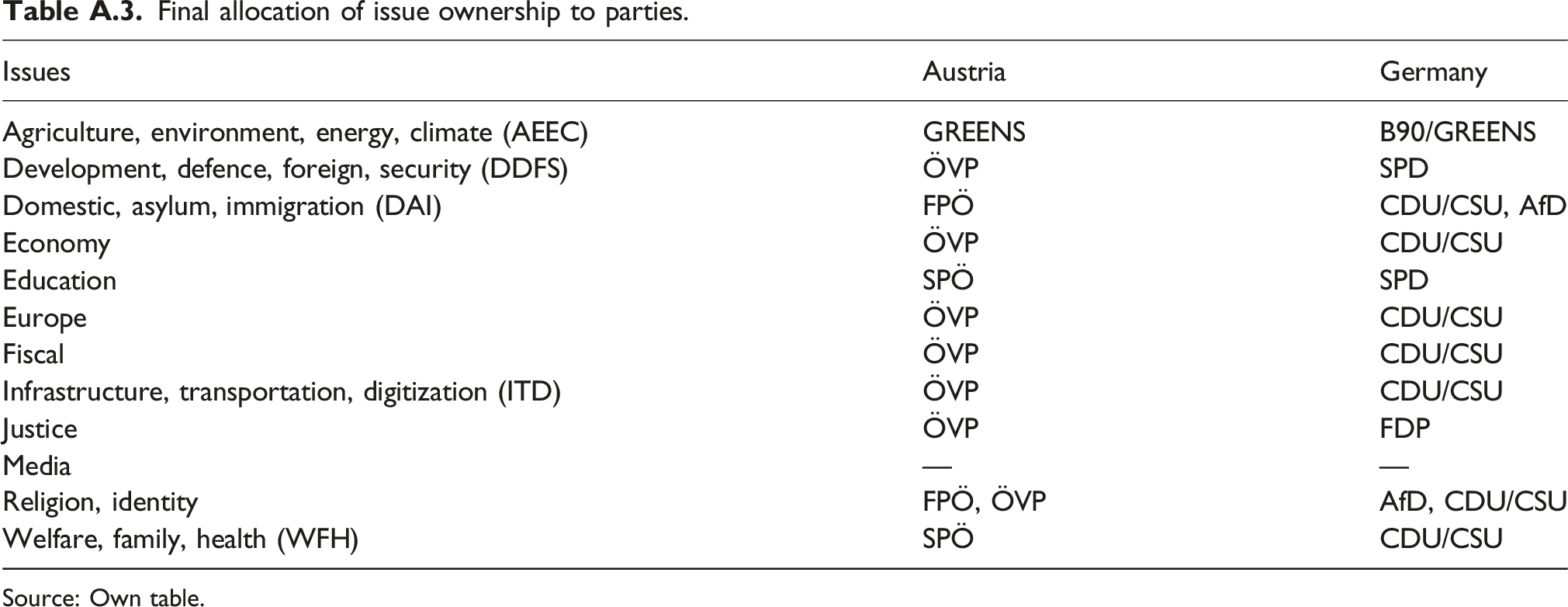
Issues
Austria
Germany
Agriculture, environment, energy, climate (AEEC)
GREENS
B90/GREENS
Development, defence, foreign, security (DDFS)
ÖVP
SPD
Domestic, asylum, immigration (DAI)
FPÖ
CDU/CSU, AfD
Economy
ÖVP
CDU/CSU
Education
SPÖ
SPD
Europe
ÖVP
CDU/CSU
Fiscal
ÖVP
CDU/CSU
Infrastructure, transportation, digitization (ITD)
ÖVP
CDU/CSU
Justice
ÖVP
FDP
Media
—
—
Religion, identity
FPÖ, ÖVP
AfD, CDU/CSU
Welfare, family, health (WFH)
SPÖ
CDU/CSU
Variable
Min
Max
Mean
S.D.
Share issue attention
0.00
0.72
0.08
0.07
Variable
Percent (%)
Issue ownership
Yes
20.54
No
79.46
Government category
Opposition only
45.51
Mixed government status
31.52
Government only
22.97
Country
Austria
22.83
Germany
77.17
DV: Share issue attention
(1)
(2)
Issue ownership
0.081*** (0.019)
0.277*** (0.060)
Mixed
−0.009 (0.023)
Government only
−0.015 (0.021)
Mixed X issue ownership
−0.217*** (0.066)
Government only X issue ownership
−0.236*** (0.067)
Austria
−0.078*** (0.027)
−0.077*** (0.028)
Issue areas
✓
✓
Constant
−2.086*** (0.078)
−2.117*** (0.077)
Observations
4229
4229
Pseudo R-squared
0.347
0.350
DV: Share issue attention
(1)
(2)
Issue ownership
0.275*** (0.036)
0.335*** (0.041)
Party in government (reg.)
−0.009 (0.026)
/
Party in government (reg.) X issue ownership
−0.203*** (0.052)
/
Party in government (nat.)
/
−0.011 (0.027)
Party in government (nat.) X issue ownership
/
−0.255*** (0.055)
Austria
0.122*** (0.043)
0.118*** (0.043)
Issue areas
✓
✓
Constant
−2.105*** (0.026)
−2.114*** (0.027)
Observations
8148
8148
Pseudo R-squared
0.233
0.233
DV: Share issue attention
(1)
Issue ownership
0.428*** (0.053)
Government only
−0.004 (0.032)
Government only X issue ownership
−0.405*** (0.073)
Austria
0.132*** (0.049)
Issue areas
✓
Constant
−2.159*** (0.034)
Observations
5580
Pseudo R-squared
0.217
DV: Share issue attention
(1)
Issue ownership
0.424*** (0.038)
Opposition only
Reference
Mixed
−0.027 (0.021)
Government only
−0.006 (0.025)
Mixed X issue ownership
−0.258*** (0.050)
Government only X issue ownership
−0.395*** (0.056)
Austria
0.120*** (0.029)
Issue areas
✓
Constant
−2.118*** (0.026)
Observations
8148
Pseudo R-squared
0.234
DV: Share issue attention
(1)
(2)
Issue ownership
0.165*** (0.027)
0.424*** (0.047)
Mixed
−0.027 (0.023)
Government only
−0.006 (0.025)
Mixed X issue ownership
−0.258*** (0.057)
Government only X issue ownership
−0.395*** (0.074)
Austria
0.113** (0.046)
0.120*** (0.043)
Issue areas
✓
✓
Constant
−2.091*** (0.063)
−2.118*** (0.065)
Observations
8148
8148
Pseudo R-squared
0.231
0.234
DV: Share issue attention
(1)
(2)
Issue ownership
0.136*** (0.039)
0.555** (0.228)
Mixed
−0.100*** (0.038)
Government only
−0.022 (0.035)
Mixed X issue ownership
−0.340 (0.237)
Government only X issue ownership
−0.518** (0.234)
Austria
−0.028 (0.043)
−0.034 (0.042)
Issue areas
✓
✓
Constant
−2.333*** (0.130)
−2.353*** (0.124)
Observations
1271
1271
Pseudo R-squared
0.327
0.336
DV: Share issue attention
(1)
(2)
Issue ownership
0.164*** (0.027)
0.421*** (0.052)
Mixed
−0.029 (0.031)
Government only
−0.008 (0.032)
Mixed X issue ownership
−0.254*** (0.065)
Government only X issue ownership
−0.391*** (0.070)
Austria
0.112** (0.043)
0.119*** (0.043)
Issue areas
✓
✓
Constant
−2.087*** (0.025)
−2.113*** (0.029)
Observations
8088
8088
Pseudo R-squared
0.231
0.233