




Abstract
Responsiveness to voters is key for democratic rule, yet often fails to occur. We argue that coalition government adds an additional hurdle to responsiveness. Multi-issue policy log-rolls between coalition parties in coalition agreement negotiations, none of which are individually supported by a parliamentary majority, can lead to policy change opposed by a majority, that is: minority rule. Similarly, coalition agreements can block policy change supported by a parliamentary majority through a veto by one of the government parties, frustrating majority rule. Drawing on data from the Netherlands Bureau of Economic Analysis, we assess how often coalition agreements include policies supported by less than a parliamentary majority, and how often they exclude policies supported by parliamentary majorities. We show that two-thirds of policies included in coalition agreements are not supported by a floor majority, and that 30% of policies supported by a floor majority fail to be included in a coalition agreement.
Keywords
Introduction
The 2007 Dutch coalition agreement included the introduction of a sizable healthcare insurance deductible. This became government policy despite only a single party, which got just three percent of the votes, including it in its manifesto. During the same term, parties holding a majority of seats in parliament favoured abolishing the mortgage interest tax deduction, yet plans for its abolition were conspicuously missing from the coalition agreement and the deduction remained part of the tax code.
Why would the governing parties choose to prevent majority-supported policies from becoming law, while at the same time passing policies most of them do not favour? In both cases, such behaviour was driven by the dynamics of coalition government: Parties negotiate coalition agreements which set out the policies that the government will pursue, and which it won’t. In the case above, the Christian Democrats were able to veto a majority-supported tax increase they opposed, while the ChristianUnion was able to ensure that its deductible proposal became policy.
A key standard of democratic rule is that policy changes supported only by a minority should not prevail (Dahl 1989). Majoritarian electoral systems can lead to violations of this rule, as a party supported only by a minority of voters often controls a parliamentary majority (Gallagher and Mitchell 2005). Coalition government, a common feature of polities with proportional representation, can violate this rule even when the legislature accurately represents the overall distribution of voters’ preferences. Coalition government can frustrate majority rule when policy changes supported by a minority become law and through decisions not to pursue majority-supported policies. It thus poses a substantial challenge to democratic responsiveness.
How often such a lack of a responsiveness of the government to the legislative majority occurs is, however, unknown. While Stecker (2020) observes examples of this, a systematic exploration of its frequency is missing. We quantify how often coalition government frustrates majority rule, drawing on a dataset covering all policy proposals with budgetary implications made by Dutch governing parties in their election manifestos over five terms, and link these to the policies included in subsequent coalition agreements. We show that minority policymaking is commonplace under coalition government. The number of policies included in a coalition agreement which fail to command majority support is substantially larger than the number of policies included that are supported by a parliamentary majority. At the same time, over 30% of proposals with majority support are not included in a coalition agreement.
Democracy and majority rule
Majority rule is an nigh universally accepted decision-making rule in democracies (Cohen 1971): When deciding between two alternatives, the alternative that is preferred by more than half of the participants should be selected. The assumption that the majority should rule is often implicit in democratic theories. Dahl (1956) traces this notion back to Aristotle, Locke and Jefferson. The latter wrote that “the lex majoris partis is the fundamental law of every society of individuals of equal rights; to consider the will of the society enounced by the majority of a single vote as sacred as if unanimous” (Jefferson 1817).
Egalitarian theory is a prominent justification of majoritarianism. The voice of each citizen is of equal value (Christiano 2008; Dahl 1956; Waldron 1999). In the language of social choice theory, the majority rule is anonymous, that is, it does not privilege some citizens above others (Dahl 1989; May 1952). Jones (1983) argues that “To allow the will of the minority to prevail would be to give greater weight to the vote of each member of the minority than to the vote of each member of the majority, thus violating political equality.” Moreover, it does not require that anyone’s opinion is played down in order to reach consensus (Waldron 1999). A more inclusive decision-making rule may afford more protection to minorities, but at the cost of the ability of the group to reach positive decisions (Cohen 1971), a key advantage of majoritarianism, since this maximises responsiveness (Saffon and Urbinati 2013). 1
In the daily practice of politics, popular majority rule has been replaced by rule by a majority of the people’s elected representatives. The role of legislatures in democracies, however, is not strongly theorized. Waldron (1999) derives the justification for majoritarianism in elected legislatures from the egalitarian perspective, with the logic that the equal respect afforded to citizens can be transferred to equal respect for their representatives.
This theory of party-based representative democracy is perhaps stated most clearly in the report of the APSA Committee on Political Parties (1950). Its goal is to ensure that government policy reflects the preferences of the electoral majority (Schmitt and Thomassen 1999). For this the political system and its actors must meet several criteria: firstly, parties have to offer different policy alternatives in elections. Secondly, voters must vote for the party that is closest to them on every issue (or in a single dimensional issue space). Thirdly, parties must implement their policy programs in office.
In the legislature, if the distribution of seats reflects the distribution of preferences among the voters, the floor median will reflect the majority preference of the population. A spatial model of legislative policy-making with a single-dimensional policy space, open rule, and single-shot decision-making predicts that the position of the median legislator will be the policy outcome, as that position cannot be beaten by another policy in a majority vote (Black 1948), meaning that under these circumstances a popular majority prevails in the legislative process. Taking decisions using the issue-by-issue median allows for both popular control and political equality, making it a uniquely fair collective choice rule in a democracy (Ward and Weale 2010).
A weakness of the ‘APSA’ model is the fact that majoritarian electoral systems can give parties supported by a minority of voters a majority of seats (Gallagher and Mitchell 2005). This is particularly concerning if parties fail to converge on the position of the median voter (Powell 2000). But even if the ruling majority is supported by a majority of voters, Rae and Daudt (1976) identify another weakness: the positions endorsed by a parliamentary majority may reflect the preferences of a minority of voters if parties offer package deals of policies to voters and the political space is multidimensional (the so-called “Ostrogorski paradox”). The multidimensionality of voter preferences is seen as the key weakness of democratic majoritarianism (Dahl 1956; Kirkpatrick 1971; Thomassen 1994).
In the following, we propose an additional empirical concern regarding the practice of majority rule in party-dominated parliaments, even when these accurately mirror the voters’ preferences: coalition agreements.
Coalition agreements and majority decision-making
Even in the unlikely case that the policy space is unidimensional, that all voters turn out and vote for the party closest to them, and their votes are proportionally represented in parliament, the implementation of the preferences of the majority of the people in a representative system is not assured. Policymaking in parliamentary regimes with coalition governments is not predominantly driven by the floor, but rather by the government coalition. The actual decisions are made during coalition bargaining, where coalition parties agree on a package deal, including agreements not to pursue specific policies (Timmermans and Andeweg 2000).
Since every party in a minimum-winning coalition government can veto policy changes (Tsebelis 2002), in particular at the coalition agreement negotiation stage, a policy change favoured by a majority of the legislature may fail to end up in the coalition agreement. In this case, we would observe a frustrated majority, that is, a parliamentary majority which is unable to prevail even under majority rule.
However, if all the coalition parties vetoed all policy changes that they disagreed with, the legislative agenda of a government grinds to a halt. Alternatively, coalition parties may engage in policy log-rolls, where policies favoured by some of the coalition parties are accepted by the others, in return for similar support for policies which in turn only these other parties favour. As Nagel (2012) notes “the façade of majority government too often conceals a logrolled reality of minority rule over specific policies”. Partly, this is driven by the threat of a different coalition forming, excluding a party which is unwilling to accept “the implementation of a distasteful measure” (McGann 2006, 450). Thus, policies without majority support in the legislature can nonetheless become law, leading to minority rule.
Klüver and Bäck (2019) find that the more a party prioritizes an issue the more likely that they will get what they want out of the coalition negotiation. While reasonable from the perspective of negotiation theory, this is normatively problematic: As nearly all policies have budgetary implications, if parties with intensive beliefs on a topic, but representing a minority of voters, obtain their desired policy, this means that everyone else pays for them getting their way. Moreover, if parties and voters feel differently about which issues matter to them, these negotiation solutions may exacerbate the Ostrogorski Paradox.
Majorities can be formed at different stages: In elections (by both single parties and electoral alliances), when coalition cabinets form, or for individual laws. Different institutional setups make these outcomes more or less likely, and come with different trade-offs from the perspective of democratic responsiveness (Ganghof 2015): In particular, failures of majority rule are more likely to occur at the electoral stage under majoritarian electoral systems, whereas proportional electoral systems may fail at the law-making stage.
Data and case
Systematically observing all policy change in a country is difficult. Given the key role in coalition governance of coalition agreements (which are essentially long-term multi-issue log-rolls), they allow for a good approximation of the policies subsequently pursued. Coalition agreements constrain the policies pursued by governments (Goodhart 2013), their contents tend to be adopted into law subsequently (Thomson et al., 2017), and reneging on an agreed policy undermines cabinet stability (Saalfeld 2008).
While applying scaling techniques to coalition agreements and manifestos allows for the comparison of a large number of cases (Klüver and Bäck 2019), such an approach obscures the detail and complexity of the policy positions that parties negotiate about (Schermann and Ennser-Jedenastik 2014). Furthermore, parties have incentives to blur their positions in their manifestos (Rovny 2012).
An unusual feature of the Dutch political system allows us to overcome this: Parties in the Netherlands submit their election manifestos to the Netherlands Bureau of Economic Analysis (Centraal Planbureau, CPB). This estimates the budgetary impact of every policy measure proposed therein. In order to include them in this calculation, parties have to make their policy proposals concrete. Following the government formation, the CPB applies the same process to the coalition agreement (Bolhuis 2018). Given the politically neutral and respected role of the CPB, the budgetary impact estimates it produces play a key role in coalition negotiations.
As the scoring of the policy proposals made in manifestos and coalition agreements are done in the same manner, we can observe what each party wanted in terms of policy change and the extent to which this was included in the coalition agreement. Hence, we can assess the extent to which floor majorities are frustrated and minority rule occurs. We examine five coalition agreements: 2007, 2010, 2012, 2017, and 2022. 2 The Online Appendix further details the data used and how we operationalised the data for the analysis below.
A key question here is how to interpret silence in manifestos. Given that there is a more-or-less fixed total budget due to previous commitments, limits on how much debt a country can take on and in the case of a Eurozone state like the Netherlands, the Stability and Growth Pact, which limits both overall debt and yearly deficits, any proposal that costs money must be balanced by a spending cut or a tax increase. When it comes tax proposals that would generate revenue or budget cuts to existing programs, silence also cannot be understood as implicit support, as such policies often are controversial electorally. Given that silence is thus unlikely to indicate indifference, including a policy with minority support in a coalition agreement implies that at least one party supports a policy which they did not include in their manifesto, meaning that voters who chose the party based on the published manifesto end up providing the plenary votes for polices which they did not support – which, as we argue, is problematic from a majority rule, and so democratic, perspective.
Results
Policy proposals by coalition parties, 2007-2022.
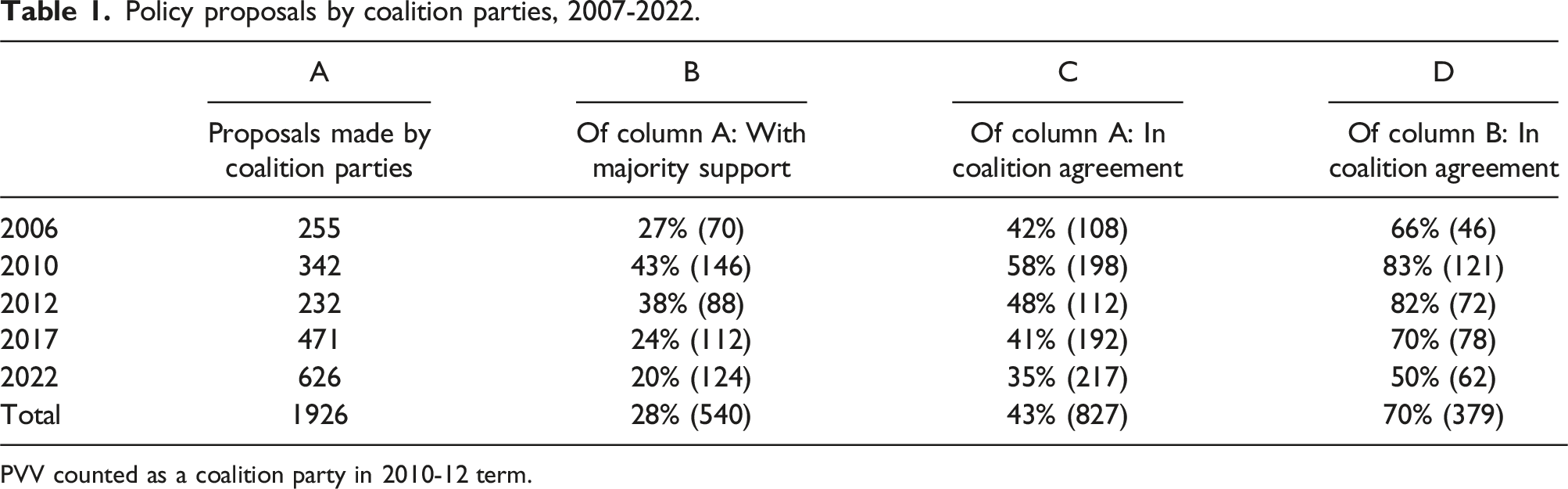
PVV counted as a coalition party in 2010-12 term.
Column A and column B show that fewer than one in three policies proposed in the election manifestos by parties which subsequently entered government commanded the support of a floor majority. Columns C and D show that majority floor support is neither a sufficient nor a necessary condition for being included in a coalition agreement. Clearly, both minority rule and frustrated floor majorities occur frequently under coalition government.
Policies in coalition agreements.
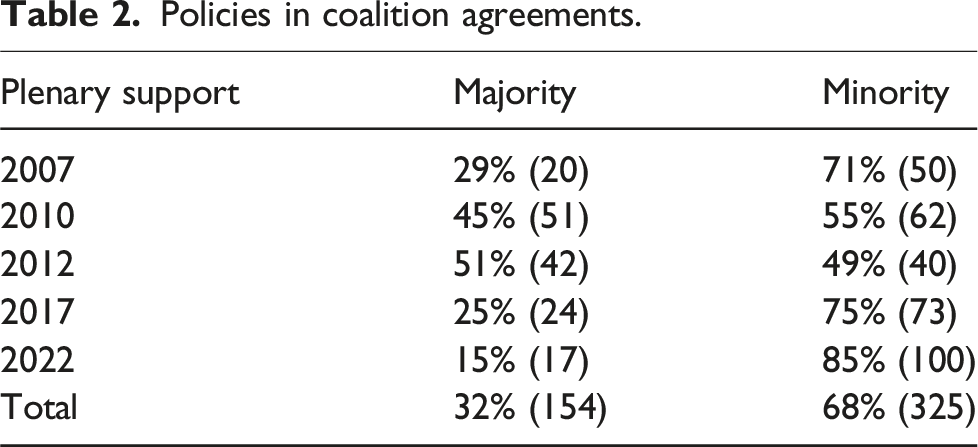
Frustrated majorities.

Figure 1 shows the number of parliamentary seats held by parties which supported a policy in their manifesto for each of the policies included in a coalition agreement. Parliamentary support for policies included in coalition agreements shows a large range. Seven policies were supported by a single party with only five MPs, covering both small proposals, such as investing in vocational education oriented at engineering (CU 2017 and 2022), but also increasing the level of wealth that is untaxed (CU 2022). Twelve policies were supported by parties holding 148 of 150 seats, such as the proposals to maintain the deduction on the Dutch EU contribution (in 2010). The median number of votes in support of polices included in coalition agreements is only 63, well short of a plenary majority (76). 68% of policies included in coalition agreements were supported by a floor minority. Over 26% of policies included in a coalition agreement have the support of less than a quarter of the plenary. This includes the proposal to increase the tuition fees for students who take too long to complete their studies (CDA 2010) and to cut spending on legal assistance for people with small incomes (PVV 2010). At the other extreme, one in eight policies in coalition agreements have the support of two-thirds or more of the plenary. Plenary support of policies included in coalition agreement.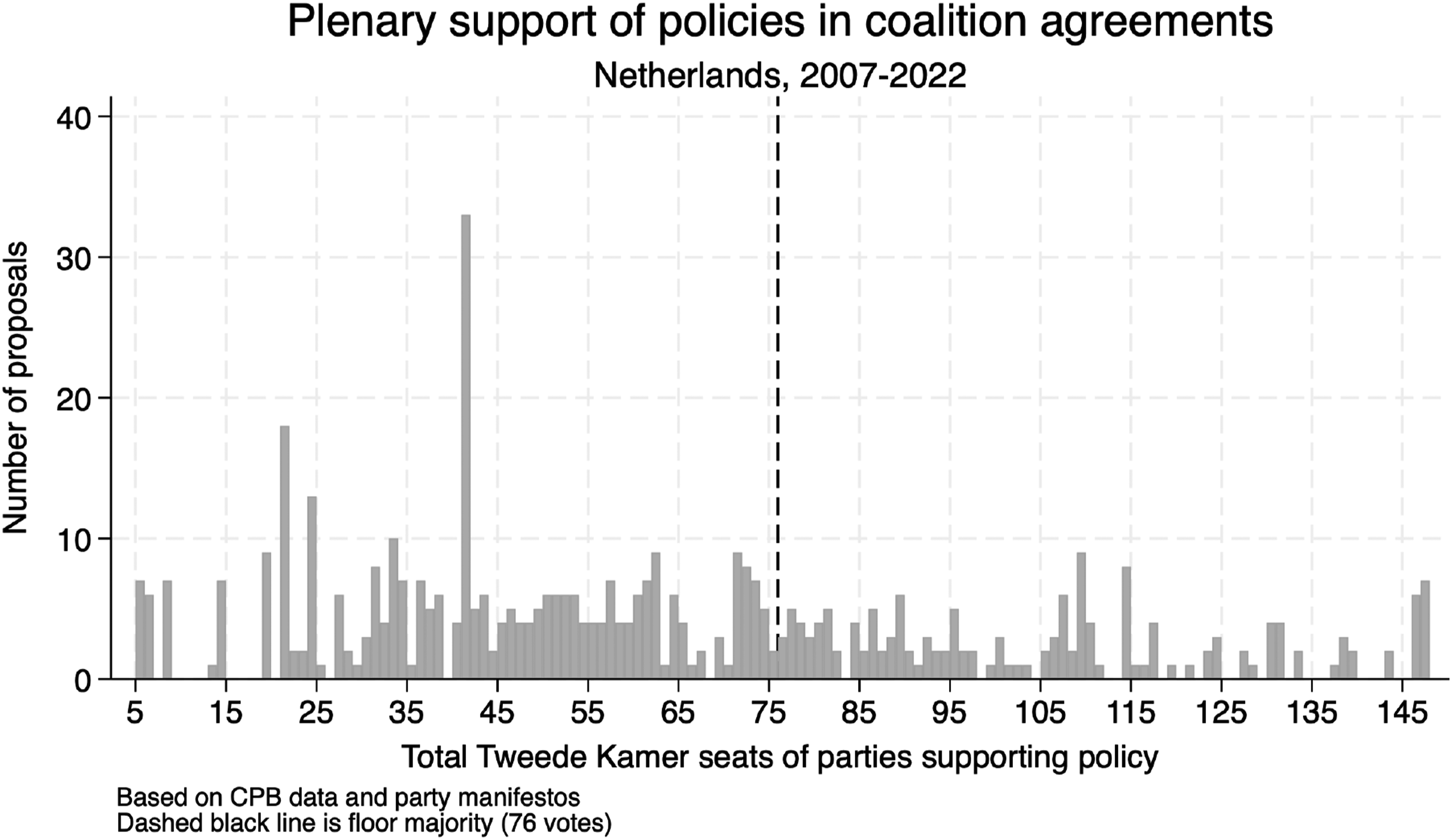
Figure 2 shows the number of parliamentary seats held by parties which supported a policy in their manifesto for each of the policies which, despite majority support, was not included in a coalition agreement. As can be seen, a number of these polices had support that extended beyond a bare majority. While 28% were supported by a majority of 10 seats or fewer, a third were supported by parties controlling two-thirds or more of seats. In other words, even policies with very substantial support in the Tweede Kamer often fail to be included in coalition agreements. Policies with majority support not included in coalition agreements.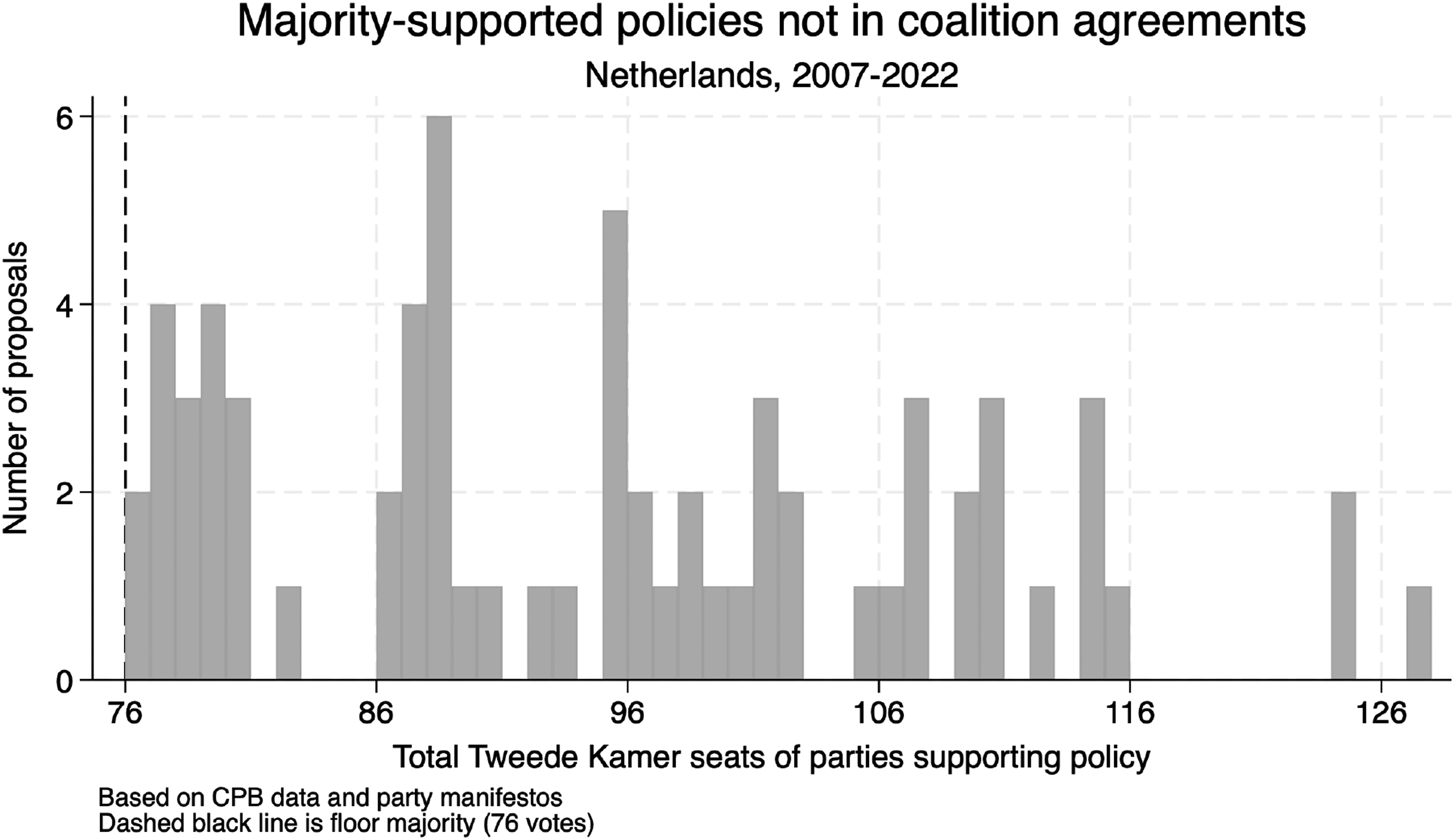
Conclusion
Analysing a unique dataset of policy pledges and negotiation outcomes, we have shown that coalition government often violates majority rule: Over two decades, nearly one in three policies supported by a majority was excluded from coalition agreements. Frustrated floor majorities, while problematic, can occur for reasons other than a minority veto, such as budgetary constraints. Policy changes supported only by a minority, having successfully overcome the inertia of the policy-making process, are normatively more problematic. Yet a majority of policy proposals included in Dutch coalition agreements did not have the sincere support of a parliamentary majority.
While different understandings of democracy assign different importance to the direct translation of the people’s policy preferences into policy (Andeweg and Louwerse 2020), no vision of democracy would favour minority rule. A trade-off appears to exist: While proportional representation usually avoids the failure of majority rule caused by an electoral minority being translated into a parliamentary majority, this comes at the cost of failures of majority rule at the law-making stage. In addition to allowing for broader input into the policy-making process, proportional representation (as shown here) leads to widespread minority rule.
The relevance of this case extends beyond the Dutch borders. Parliamentary regimes experience coalition government over 70% of the time (Gallagher et al. 2011). Here, parties bargain about policy. Whether a parliamentary majority supports a proposal is not necessarily the most convincing argument when negotiators decide to include a proposal in a coalition agreement. In some ways, the Netherlands is an unlikely case to observe minority rule. The fact that all proposals in all party manifestos and coalition agreements are quantified by the CPB makes it less likely that parties agree to policies without majority support, since the CPB process makes explicitly going against the wishes of the majority far more visible than in systems where such logrolls can be obscured with vague wording. On the other hand, due to the fragmented party system and large number of parties represented in government, the Netherlands is a likely case for coalition government leading to frustrated majorities. To the extent that these two factors cancel each other out, our findings have substantial potential to travel to other coalition systems. While less fragmented party systems may make frustrated floor majorities and minority rule less common, the extent to which this occurs is an empirical question, yet one that goes to the heart of democratic governance. While the CPB data are unique to the Netherlands, similar data could be collected for other countries; our findings indicate the importance of directly measuring policy proposals and policy change in order to assess the effects of coalition government on policy outcomes, and future work may seek to do so explicitly.
Future work should go beyond these aggregate findings and explore the drivers of the inclusion or exclusion of individual policy proposals: When and why are policies with majority support excluded from coalition agreements? When and why do policies supported by only a minority make it into the coalition agreement? What is the role of the salience of different proposals for the different parties? To what extent do different (types of) parties differ in how they can get their policies included in coalition agreements? What role does the cost of a proposal play? 4 To what extent is there variation across policy fields, 5 and what drives this? These are key questions to further explore in future work.
Supplemental Material
Supplemental Material - Coalition government, frustrated majorities, and minority rule
Supplemental Material for Coalition government, frustrated majorities, and minority rule by David M Willumsen and Simon Otjes in Party Politics
Footnotes
Declaration of conflicting interests
The author(s) declared no potential conflicts of interest with respect to the research, authorship, and/or publication of this article.
Funding
The author(s) received no financial support for the research, authorship, and/or publication of this article.

Supplemental Material
Supplemental material for this article is available online.
Notes
Author biographies
References
Supplementary Material
Please find the following supplemental material available below.
For Open Access articles published under a Creative Commons License, all supplemental material carries the same license as the article it is associated with.
For non-Open Access articles published, all supplemental material carries a non-exclusive license, and permission requests for re-use of supplemental material or any part of supplemental material shall be sent directly to the copyright owner as specified in the copyright notice associated with the article.
