



Abstract
Multiparty governments often draft extensive coalition agreements to enforce policy compromises made at the government formation stage. Given that such agreements have important policy consequences, parties have strong incentives to ensure that their key objectives are included. This study addresses the inclusion of parties’ specific electoral pledges in the coalition agreements of three Finnish governments, based on over 1000 pledges. The results show that pledges falling into issue areas that were salient to parties’ campaigns were relatively likely to be included, especially if the level of salience was approximately the same to the other government parties as well. In contrast, the probability of inclusion was lower where a party had made more pledges in an issue area. The analysis suggests that a notable share of government parties’ pledges never became part of coalition agreements, but the pledges that were included reflected the most salient campaign themes.
Keywords
Introduction
Electoral pledges are at the centre of established theoretical approaches to representative democracy, often summarised using the concept of promissory representation (Mansbridge, 2003). According to these views, those seeking public office make pledges to the electorate during campaigns, and pledges help citizens elect representatives whose intended policies match their preferences. The election winners have incentives to fulfil their pledges as the following election offers voters the possibility to punish incumbents who have failed to meet their promises, by voting them out of office, or reward promise keeping with re-election.
To deliver what they have promised, representatives typically need the support of a legislative majority. However, in many political systems it is unrealistic to expect any party to obtain a majority and carry out its commitments without support from other parties. Instead, compromises are necessary, and drafting a coalition agreement is one way for parties to manage them (Falcó-Gimeno, 2014). Such agreements have been studied from several perspectives, including their comprehensiveness and the ways in which they affect and constrain the work of governments (Bergman et al., 2024; Höhmann and Krauss, 2022; Indridason and Kristinsson, 2013; Moury, 2011; Moury and Timmermans, 2013).
This study addresses the inclusion of parties’ specific electoral pledges in coalition agreements, taking into account whether governments commit themselves to fulfilling individual parties’ pledges or merely express support for them. We build on recent advances in research on multiparty government that highlight the relevance of preference tangentiality, or the degree to which parties emphasise different issue areas that are broader than the campaign statements to which we refer as pledges. These studies have addressed the selection of coalition partners (Dumont et al., 2024), bargaining duration (Ecker and Meyer, 2020), the adoption of control mechanisms that include not only coalition agreements but also the appointment of cross-partisan junior ministers (Falcó-Gimeno, 2014), as well as the visibility of issue areas in coalition agreements (Klüver and Bäck, 2019).
By pledges, we mean commitments to clearly delimited actions and outcomes that parties make in parliamentary elections (Royed et al., 2019). They outline parties’ policy objectives in concrete terms, and their study is an increasingly prominent approach to representative democracy and party politics (e.g. Thomson et al., 2017). Systematic analyses have established that when parties are in government, they usually carry out a notable share of their pledges (Thomson et al., 2019). Parties in coalition cabinets, nonetheless, fulfil their pledges to a smaller extent than parties governing alone (Thomson et al., 2017), which reflects the necessity of compromises. We expand the limited set of studies that address the inclusion of specific pledges in coalition agreements (Schermann and Ennser-Jedenastik, 2014b; Thomson, 1999; Vodová, 2020). The importance of these studies is underlined by the fact that research has repeatedly concluded that if a pledge is included in the agreement, its fulfilment becomes much more likely (Costello and Thomson, 2008; Mansergh and Thomson, 2007; Schermann and Ennser-Jedenastik, 2014a). Therefore, understanding the inclusion of pledges in coalition agreements is essential for understanding the ‘pledges-to-policy’ linkage and, consequently, democratic representation.
Our data cover three government coalitions that were formed after the Finnish parliamentary elections of 2011, 2015 and 2019. Reflecting trends that are visible in many countries (Indridason and Kristinsson, 2013), Finnish coalition agreements have become increasingly comprehensive in recent decades. Given parties’ avoidance of stating their preferred coalition alternatives before elections, post-election negotiations have been decisive in shaping these agreements. The Finnish case therefore offers an excellent opportunity to study the inclusion of electoral pledges in coalition agreements. By the turn of the millennium, constitutional changes turned the formerly semi-presidential system into a typical parliamentary system. Moreover, the fulfilment rate of electoral pledges has been similar to many countries with multiparty majority governments (Ylisalo and Makkonen, 2022).
Our findings therefore have broader implications. The results indicate that a large share of government parties’ pledges are not mentioned in coalition agreements. Nonetheless, parties seem to be especially concerned with having pledges pertinent to their most salient campaign themes included in coalition agreements, and their chances of success are improved if their coalition partners share those issue priorities. Moreover, ‘less is more’ as making a large number of pledges in an issue area decreases the probability that a given pledge becomes part of the agreement.
Theory and hypotheses
Coalition agreements offer parties a way to constrain the actions of the other coalition members and enable parties to influence ministries that they do not hold (Krauss and Kluever, 2023). Moreover, agreements limit ministerial drift, that is, a situation where policies are made according to the preferences of a minister (Klüver and Bäck, 2019).
Coalition agreements indeed have considerable policy consequences (Indridason and Kristinsson, 2013; Krauss and Kluever, 2023). For example, Moury’s (2011) comparison of three countries suggests that most decisions made by different ministries were in line with coalition agreements. Moreover, the existence of an agreement arguably increases the legislative productivity of the coalition (Bergman et al., 2024). Accordingly, parties have strong policy motives to influence the contents of such agreements. In addition, Eichorst (2014) identifies a political advertising motive alongside the motive to create credible commitments to policy positions. When the former motive is at stake, parties seek to attract attention to promises that are easy to fulfil and eventually benefit the government parties electorally.
Some studies focus on issue attention in coalition agreements, that is, what policy topics are covered and how extensively. For example, Klüver and Bäck (2019) find that issue attention in coalition agreements tends to relate to the salience of various issues to different parties. If an issue is important but divisive among coalition parties, they have incentives to constrain the autonomy of each other in the respective policy area. In contrast, if no disagreement exists on an issue, there is no need to invest time in detailed policy plans regarding it, except the advertisement motive, when drafting the coalition agreement. The same is true if parties disagree on an issue but consider it unimportant.
The notion of preference tangentiality is central to Klüver and Bäck’s (2019) analysis, which also applies to many other recent studies. In his theory of government formation, Luebbert (1984) identified three bargaining relationships. In Luebbert’s terminology, preferences are tangential if parties emphasise different issues, convergent if they emphasise the same issues and hold similar positional preferences, and divergent if parties emphasise the same issues but their positional preferences are incompatible.
When parties prioritise different issues, they are expectedly willing to cede control over policy areas to parties prioritising those areas, which reduces the need for further reconciliation and makes multiparty government easier. When it comes to the choice of coalition partners, Dumont et al. (2024) hypothesise that parties holding tangential preferences are more likely to form coalitions. The hypothesis draws on the assumption that parties emphasising different issues find it easier to make policy logrolls while retaining their distinct profiles. Similarly, parties with tangential preferences arguably find it necessary to introduce fewer control mechanisms to curb ministerial drift (Falcó-Gimeno, 2014) and need less time to agree on government formation (Ecker and Meyer, 2020). Nevertheless, the evidence has not always been in line with theoretical expectations. For example, while Klüver and Bäck (2019) find that the amount of agreement text devoted to an issue area tends to be negatively related with preference tangentiality, Dumont et al.’s (2024) empirical results suggest that parties with highly tangential preferences are less likely to form governments together. One of the possible reasons that Dumont et al. identify is the finiteness of resources, that is, the fact that the policy output of the government is likely to focus on the jointly salient issues.
Pledges in coalition agreements
Studies on the policy impact of parties’ programmatic objectives increasingly often use individual pledges, operationalised as testable policy commitments as they appear in electoral manifestos (Royed et al., 2019), as the unit of analysis. As noted above, one of the factors that are positively associated with the probability of pledge fulfilment, in the context of multiparty governments, is the inclusion of a pledge in a coalition agreement (Costello and Thomson, 2008; Schermann and Ennser-Jedenastik, 2014a; Thomson et al., 2019).
Thomson (1999), Schermann and Ennser-Jedenastik (2014b) and Vodová (2020) have specifically addressed the link between pledges and coalition agreements. Thomson analyses three Dutch coalition agreements and finds, among other things, that pledges on issues where the coalition parties disagreed as well as pledges supported by more than one coalition party were more likely to be referred to in the agreements than pledges made by only one coalition party.
Schermann and Ennser-Jedenastik (2014b) analyse the inclusion of government parties’ pledges in the coalition agreements of three Austrian cabinets, and differentiate between full adoption, partial adoption, and no adoption. To be fully adopted, ‘the action outlined in the pledge needs to be manifestly written down in the coalition agreement’ (ibid.: 796), whereas ‘not adopted’ means that the respective policy is not mentioned in the agreement. Other cases, including limited versions of the actions to which pledges pertain, fall into the ‘partly adopted’ category. Schermann and Ennser-Jedenastik find that salient pledges, indicated by the number of times the pledge is repeated in the manifesto, are more likely to be included, as are pledges made by the party that controls the relevant ministerial portfolio. Other variables associated with an increased likelihood of inclusion are consensus between government parties, the fact that the pledge refers to upholding the status quo, and the support of a parliamentary majority for a pledge. According to the definition that has become established in the literature, pledge A is consensually related to pledge B if the fulfilment of B would imply that A is at least partially fulfilled (see Costello and Thomson, 2008). The policy distance between the government parties on the respective policy dimension, in contrast, tends to decrease the likelihood of (partial) inclusion.
Vodová (2020) applies the same classification but focusses especially on differences between partial and full adoption. She analyses the coalition agreements of three Czech governments to see whether interparty consensus or the salience of the issues to parties (as indicated by the share of pledges dedicated to an issue) and voters (based on survey evidence) affect inclusion. Vodová finds that the likelihood of including a pledge partially, compared with full adoption, increases with interparty consensus about the pledge. Even when parties agree on an issue, that agreement is not necessarily complete as two parties could, for example, pledge to cut a tax but in different amounts. Consequently, a compromise in the form of partial adoption is the likely result. Vodová also finds that in highly salient topics, the probabilities of full and partial adoption are virtually equal and that some party-level factors, such as party size and age, affect the likelihood of compromise.
The classification in the last two studies is analogous to pledge fulfilment studies, where it is common to distinguish between fulfilment, partial fulfilment and non-fulfilment (Royed et al., 2019). Partial fulfilment means that some steps have been taken towards fulfilling the pledge, but the result is not exactly in line with the pledge; for example, a one per cent tax reduction when a party pledged a two per cent cut. However, even without a direct commitment to a policy, it is possible to show symbolic or imprecise support for it. For example, the agreement may state that the issue is important or deserves examination.
Assuming that parties take their pledges seriously, they prefer clear commitments. However, even vague indications of support can be preferable to a lack of reference, because such statements put the issue on the agenda (Indridason and Kristinsson, 2013). By accepting a formulation that does not commit the coalition to decisions, a party can hope to raise the issue for discussion later and any support for the pledge could give the party leverage in future negotiations. At least the party can show that the issue has not been neglected. Therefore, it is important to distinguish between commitments to the enactment of pledges and less precise support.
Furthermore, merely considering ‘non-inclusion’ may conceal conflicts where a pledge and a statement in the coalition agreement are mutually exclusive (Thomson, 1999). From the perspective of the party making a pledge, a conflicting statement in the coalition agreement is expectedly an inferior outcome compared with the lack of inclusion that does not explicitly rule out the fulfilment of the pledge.
Consequently, we identify five types of connections between electoral pledges and coalition agreements and assume that parties place them in the following preference order: (1) full inclusion, (2) partial inclusion, (3) imprecise support, (4) no connection, and (5) conflict.
Hypotheses
We consider the lack of connection between a pledge and a coalition agreement the default outcome that occurs if there is no specific reason for a different relationship. A general expectation is that instances of conflict are uncommon (see Thomson, 1999) because a coalition agreement must be acceptable to all coalition partners. This would hardly be the case if the agreement explicitly ruled out a large share of the objectives of any party.
Beyond that, we first hypothesise that the salience of the issue area of a pledge is associated with the importance that the respective party attaches to having the pledge included. According to the salience theory of party competition (e.g. Klingemann et al., 1994), parties differentiate themselves from each other by emphasising issues selectively. It is reasonable to assume that parties are especially concerned with having their imprint on policies in the issue areas that are central to their campaigns. Insofar as policy motives are concerned, these should be the issue areas that parties prioritise for intrinsic reasons. Moreover, from a vote-seeking perspective, parties’ credibility would be weakened if their central campaign themes had no policy consequences. In line with this reasoning, Bäck et al. (2011) argue that parties aim at controlling ministries whose jurisdictions cover their most salient issues. Hence, we expect that the probability of a pledge being included in the agreement increases with the salience of the issue area:
The probability that a pledge is included in the coalition agreement increases with the salience of the issue area to the party making the pledge. Klüver and Bäck (2019) argue that if an issue is unimportant to some parties, there is little incentive to engage in lengthy negotiations, leading to reduced focus on that issue. While preference tangentiality is expectedly also relevant when it comes to the inclusion of specific pledges, its likely consequences are different. We expect that parties seek to include as many pledges as possible in the agreement even when there is no immediate risk that coalition partners try to hamper the enactment of those pledges. All else being equal, the transaction costs associated with copying a statement from a manifesto are low. It may be beneficial for a party to have its pledges included for advertising purposes (Eichorst, 2014) and the inclusion of a pledge helps the party manage the risk that its partners become critical of the policy later. Therefore, pledges about issues where preferences are tangential should be relatively easy to include due to their unimportance to the other parties. If the other parties instead prioritise the issue area, conflicts plausibly emerge about which pledges should be included, decreasing the probability of an individual pledge becoming part of the agreement. Therefore, we hypothesise:
The positive association between salience and the probability of inclusion becomes stronger as preference tangentiality in the respective issue area increases. Previous studies suggest that consensus between pledges is associated with their inclusion in coalition agreements. Importantly, however, consensual pledges are not necessarily identical. This leads Vodová (2020) to argue that when pledges are consensual, the likelihood of partial vis-à-vis full inclusion increases. Our adjustment to this argument draws on the notion that consensual pledges indicate interparty support for concrete measures, albeit consensus is likely to increase the necessity of compromises regarding the exact content of those measures:
Consensual pledges are more likely to be included partially relative to imprecise support.
Consensual pledges are less likely to be included fully than partially. The salience of an issue area is distinct from the number of pledges that a party makes regarding it. A party may devote a large share of its manifesto to justify policies whose substance it expresses in only a few pledges. Conversely, an equally lengthy section may amount to a list of weakly interrelated pledges. In this case, it is unlikely that all pledges are equally important to the party, while in the former case that assumption may be justified. Therefore, we expect that if the number of pledges in an issue area is small, the utility from having one of them included is greater than when the number of pledges is large (cf. Thomson et al., 2017: 531). Additionally, fulfilling numerous pledges even in the absence of disagreements may be unrealistic due to the finiteness of resources (see Mansergh and Thomson, 2007). For example, if numerous pledges fall within the jurisdiction of one ministry, it may not be possible to increase the budget of the ministry sufficiently to enact all of them. This plausibly discourages the parties from including pledges without upper limit. Accordingly, we hypothesise:
The probability that a pledge is included in the coalition agreement decreases as the number of pledges made by the respective party in the same issue area increases.
Data and methods
Our data consist of 1202 pledges that prospective government parties made in three parliamentary elections (2011, 2015 and 2019). The Finnish parliament is unicameral, and as long as government proposals do not infringe the constitution, European Union legislation or international commitments, there are no formal veto players for a majority coalition acting in unison. Few binding rules regulate government formation (Heasman and Backman, 2021).
We used parties’ electoral manifestos as primary source materials when identifying pledges (see Royed et al., 2019). In some cases, we used other published party documents instead of or in addition to documents specifically labelled as manifestos, provided that they outlined policy goals for the upcoming term (see Appendix 1 in the Supplementary Material). While the topical literature defines an electoral pledge as a testable commitment to an action or an outcome, some variation exists regarding its operationalisation. Whereas a ‘broad’ operationalisation allows for pledges that can be fulfilled in several alternative ways, a ‘narrow’ operationalisation requires that a statement must commit the party to ‘one specific action or outcome that can be clearly determined to have occurred or not’ (Royed et al., 2019: 24; original emphasis). We applied the narrow operationalisation. As the crucial criterion was testability, the statements contain both soft (e.g. ‘we want to’) and hard (e.g. ‘we will’) diction, as well as policy objectives formulated as demands (‘x must be done’). Multiple research team members reviewed the data and borderline cases were discussed. As such, the identification of pledges did not depend on the choices of a single coder.
Another crucial data source consisted of the coalition agreements of three governments that varied in the number of parties and ideological orientation. 1 The governments included a wide, left-to-right six-party surplus majority coalition (2011), a centre-right three-party minimal winning majority coalition (2015), and a centre-left five-party surplus majority coalition (2019). During the study period, all parliamentary parties were in government at some point, except for Movement Now that won one seat in 2019. Conversely, none of the parties was in government throughout the period.
Outcome variable
The unit of analysis is a pledge. Each pledge was assigned to one of five categories based on its relationship with the coalition agreement (see Appendix 2) and the outcome variable is the probability with which a pledge falls into each of the categories. Full inclusion means that the respective action or outcome was included in the coalition agreement essentially unchanged. Hence, the enactment of the relevant passage in the agreement would have rendered the pledge fully fulfilled. Partial inclusion implies that the coalition agreement included a commitment towards taking steps in the direction of fulfilling the pledge, but the enactment of the passage in the coalition agreement would have only led to the partial fulfilment of the pledge. The third category, imprecise support, consists of instances where the coalition agreement contained a passage signalling support for a pledge but no commitment to fulfilling it even partially. This category also includes cases where the coalition agreement mentioned examining the issue. No connection means that the substance of the pledge was not mentioned in the coalition agreement. Finally, conflict means that the coalition agreement included a passage whose enactment would have implied the non-fulfilment of the pledge. In Appendix 3, we present examples of pledges falling into each category.
Explanatory variables
To measure the salience of the issue areas to which pledges belong, we classified each pledge into one of 14 subject areas (see Appendix 4). The classification is largely analogous to the scheme that Naurin (2014) applies to Swedish data. However, we placed pledges addressing values and moral issues, such as marriage legislation and euthanasia, to a separate category. We then followed a strategy similar to that used by Bäck et al. (2011; see also Dumont et al., 2024; Klüver and Bäck, 2019) and used Manifesto Project (MARPOR) data (Lehmann et al., 2023) by attaching a subset of coding categories to each subject area. Drawing on salience theory, MARPOR scores measure the share of quasi-sentences that a party has devoted to an issue area in a manifesto, the assumption being that the share of manifesto text increases with salience. We defined the salience of the subject area of each pledge to the party that had made the pledge as the sum of scores attached to the subject area. Salience correlates with the share of pledges in each subject area (Pearson’s r = 0.65), suggesting that parties have tended to devote pledges to their salient issues (cf. Thomson, 1999). Following Klüver and Bäck (2019), we measured preference tangentiality within a subject area by computing the standard deviation of salience scores across all government parties, a larger standard deviation indicating a higher degree of tangentiality. As we expect that tangentiality moderates the association between salience and pledge inclusion, we interacted salience and tangentiality.
A pledge was coded as consensually related to a pledge made by another party in the same election if the fulfilment of the latter would have implied the full or partial fulfilment of the former. We then formed two binary variables to account for the fact that a pledge can be consensually related to pledges of more than one party. Consensus with one party (consensus (1)) indicates that one government party had made a pledge to which the pledge was consensually related. Consensus with two or more parties (consensus (2+)) indicates that at least two other government parties had made such pledges. Some pledges were consensually related to those made by three or four parties, but we assigned these pledges to consensus (2+) to mitigate small-N problems. To measure pledge volume, we counted the total number of pledges that a party had made in the subject area of the pledge. Pledge volume correlates with salience (r = 0.52). We therefore ran robustness tests where we excluded one of the variables.
To control for the overall salience of the issue area to the coalition partners of the party that made the pledge, we measured joint salience using the mean of the salience scores of the other government parties. In the main analysis, we accounted for differences in parties’ bargaining strength using the binary variable prime ministerial party whose value was one if the pledge had been made by the party of the formateur. Since 1991, the prime ministerial party has also been the largest parliamentary party, which has plausibly yielded an additional bargaining advantage. In a supplementary analysis, we used another binary variable, necessity for a parliamentary majority. The value of the variable was one if the pledge was made by a party whose departure would have made the coalition lose its majority.
We furthermore differentiated between outcome pledges related to targets beyond direct government control, such as achieving a certain level of economic growth, and pledges that pertain to the passing of legislation, budget allocations or other actions. We also differentiated between status quo pledges, pertinent to the preservation of the prevailing situation, and pledges to change it. For reasons specified below, we only used this binary variable in a supplementary analysis. To control for the possible effect of opposition support on pledge inclusion, we calculated the share of parliamentary seats held by opposition parties that had made pledges with which the pledge was consensually related. Finally, the formateur has considerable room for manoeuvre in organising negotiations, and because such choices may affect pledge inclusion, we included year dummies (2015 and 2019) in the models. 2 Descriptive statistics are reported in Appendix 5.
Methods
As the outcome variable is an ordering, we applied ordinal regression in the main analysis. Diagnostic tests indicated that the ‘conflict’ category of the outcome variable gave rise to estimation problems, notably Hauck–Donner effects (Yee, 2022). As instances of conflict were infrequent, we combined the category with ‘no connection’ in the regression analyses. We labelled the resulting category ‘no inclusion,’ which serves as the base level. Nonetheless, the ‘conflict’ category remains relevant because it includes pledges that parties were willing to abandon. We therefore conducted a descriptive analysis of the kinds of pledges that fell into this category. The status quo variable also led to Hauck–Donner effects, plausibly because status quo pledges can be partially included or receive imprecise support only in special cases. Therefore, we included the status quo variable in a multinomial logit model reported in Appendix 7.
Finally, a Brant test indicated that not all explanatory variables conformed to the proportional odds assumption (Williams, 2006). These variables were consensus (2+), outcome pledge and year 2015 (see Appendix 6). We therefore estimated partial proportional odds models, whereby the coefficients of these variables were allowed to vary at different levels of the outcome variable.
Results
Number of pledges in coalition agreements by party.
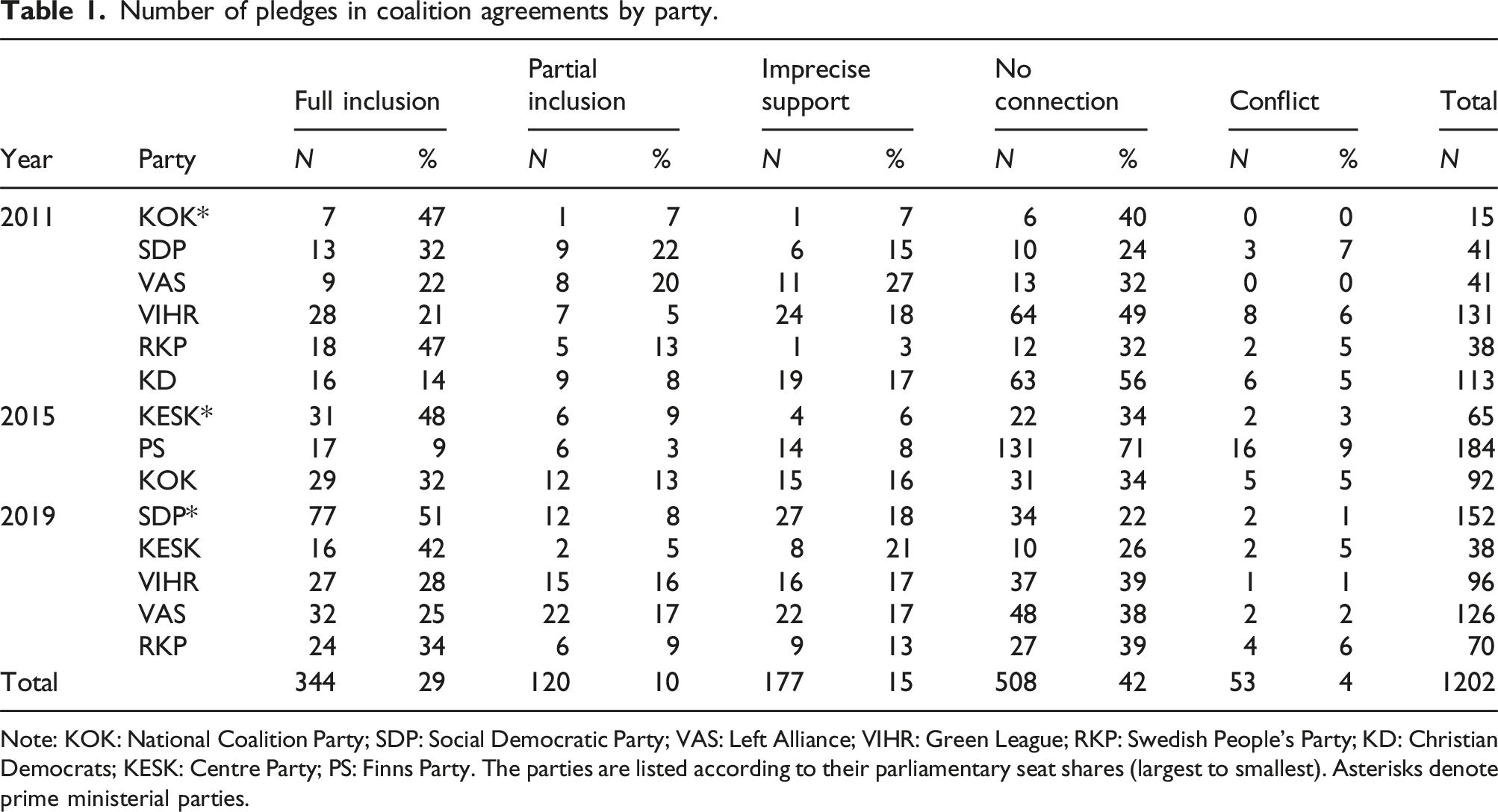
Note: KOK: National Coalition Party; SDP: Social Democratic Party; VAS: Left Alliance; VIHR: Green League; RKP: Swedish People’s Party; KD: Christian Democrats; KESK: Centre Party; PS: Finns Party. The parties are listed according to their parliamentary seat shares (largest to smallest). Asterisks denote prime ministerial parties.
Partial proportional odds models. Outcome variable: inclusion of a pledge in a coalition agreement (base level: ‘no inclusion’).
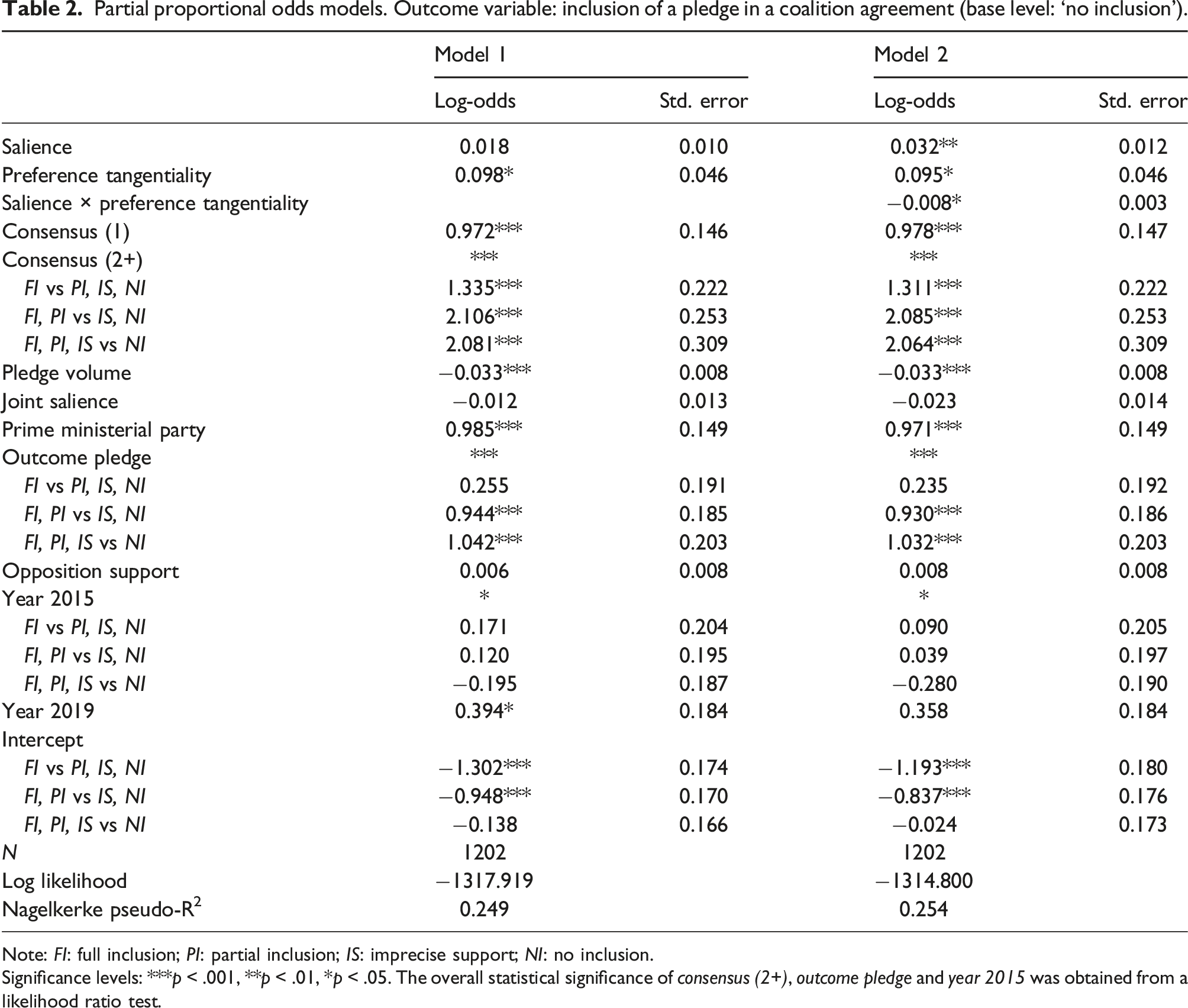
Note: FI: full inclusion; PI: partial inclusion; IS: imprecise support; NI: no inclusion.
Significance levels: ***p < .001, **p < .01, *p < .05. The overall statistical significance of consensus (2+), outcome pledge and year 2015 was obtained from a likelihood ratio test.
The models do not provide unambiguous support for Hypothesis 1. While the coefficient on salience has the expected positive sign in Model 1, it lacks statistical significance at the .05 level. We therefore cannot conclude that salience has an unconditional, positive association with the inclusion of pledges. Nonetheless, the interaction in Model 2 points to the existence of a conditional association. As the coefficient on a constituent term indicates its effect when the value of the other constituent term is zero, the positive coefficient on salience in Model 2 means that the probability of inclusion increases with salience at least at the average level of preference tangentiality. However, contrary to Hypothesis 2, the sign on the interaction term is negative, suggesting that the association between salience and the probability of inclusion becomes weaker as preference tangentiality increases.
Furthermore, the coefficients on the consensus variables are not entirely in line with expectations. First, consensus (1) appears to have a consistently positive association with the probability of superior bargaining outcomes. Second, consensus (2+) does increase the probability of at least partial inclusion vis-à-vis ‘imprecise support’ or ‘no inclusion’. However, it also increases the probability of ‘full inclusion’ vis-à-vis lower levels of bargaining success, albeit to a lesser extent. Therefore, while Hypothesis 3a receives support from the data, Hypothesis 3b does not; instead, interparty consensus on specific pledges appears to have promoted both partial and full inclusion.
Hypothesis 4 concerning pledge volume, in turn, is clearly in line with the data. One additional pledge within an issue area has decreased the probability of an individual pledge progressing to higher levels of bargaining success by more than three percentage points, as indicated by the respective odds ratios (exp (−0.033) ≈ 0.968).
As for the control variables, joint salience has a negative sign in both models but lacks statistical significance. The multivariate test confirms that prime ministerial parties have been successful in having their pledges included. Outcome pledges, in turn, have been relatively likely to be included partially or receive imprecise support. Plausibly, this is because such pledges have often pertained to macroeconomic aggregates or budget deficits, and goals have become more modest in interparty negotiations, while the direction of change has not been controversial. Opposition support, in turn, has no discernible association with pledge inclusion.
To illustrate the interaction in Model 2, we calculated the predicted probabilities with which a pledge falls into different categories of the outcome variable, conditional on salience. When calculating the probabilities, the values of the other continuous variables were fixed to their means, and those of the binary variables to their proportions. The predicted probabilities are shown in Figure 1. The solid lines depict the probability at different levels of salience when the value of preference tangentiality is at its mean. The dotted and dashed lines show the predicted probability when tangentiality is one standard deviation below or above the mean, respectively. Salience and preference tangentiality matter especially when it comes to the probabilities of ‘full inclusion’ and ‘no inclusion.’ Specifically, the probability of ‘full inclusion’ increases and the probability of ‘no inclusion’ decreases as salience increases, provided that the level of tangentiality is relatively low. Conversely, at relatively high levels of tangentiality, the predicted probabilities are almost independent of the level of salience. In turn, in the ‘imprecise support’ and ‘partial inclusion’ categories, salience and tangentiality have no discernible connection with the predicted probability.
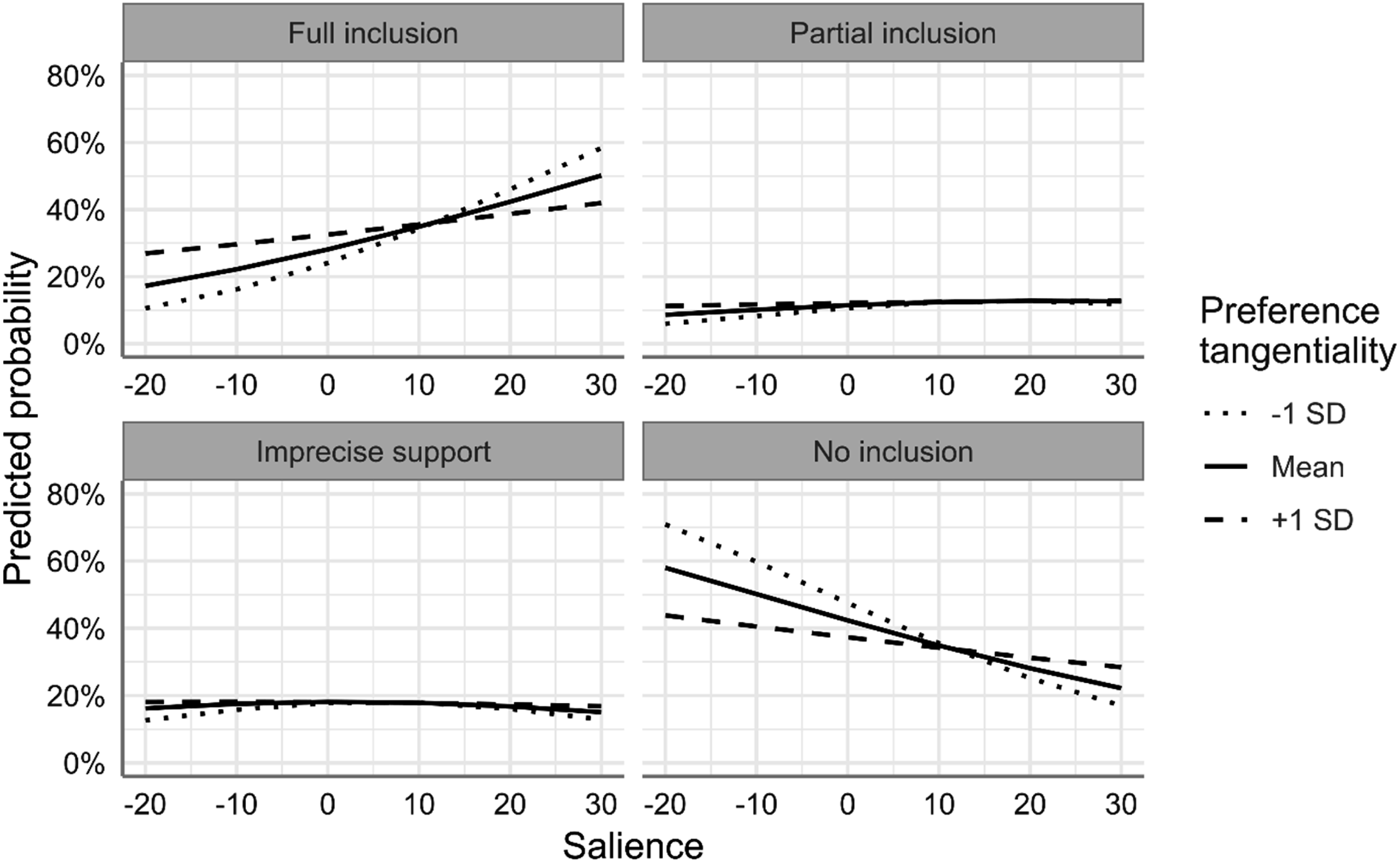
Predicted probabilities.
Supplementary analyses
We made a series of modifications to the models reported above to assess the robustness of the findings. We summarise the main results here and report the detailed results in Appendix 7. First, while multicollinearity was not a major issue based on variance inflation factors (see Appendix 6), the correlation between salience and pledge volume may have skewed the results, notably by making the association between salience and the probability of inclusion appear excessively weak in Model 1, Table 2. However, models where the variables were included one at a time led to substantively similar conclusions regarding their association with the outcome variable. Second, substituting an alternative indicator of bargaining strength, necessity for a parliamentary majority, for prime ministerial party led to no substantive changes in the other results. Nonetheless, necessity for a majority is associated with a larger probability of superior bargaining outcomes. Third, the inclusion of the status quo variable caused no substantial changes in the results. For reasons specified in the Methods subsection, we estimated a multinomial logit model instead of an ordinal model, whose results were highly consistent with those reported above. The model suggests that status quo pledges were unlikely to be partially included or receive imprecise support, while their probability of being fully included did not differ from that of no inclusion (cf. Schermann and Ennser-Jedenastik, 2014b). Fourth, Schermann and Ennser-Jedenastik (2014b) find that positional differences are associated with a lower probability of pledge inclusion. Our data provide limited possibilities to examine the possible consequences of issue area specific positional differences. However, following Klüver and Bäck (2019), we were able to estimate the range of government parties’ positions in six issue areas to measure the degree of issue-specific conflict. As restricting the number of issue areas included in the analysis caused a notable reduction of observations, we combined the ‘partial inclusion’ and ‘imprecise support’ categories to mitigate small-N problems. Re-estimating models analogous to those in Table 2 with the range of issue specific positions included did not lead to changes in the signs of most variables, but it did render some of them statistically insignificant. This applies to salience, tangentiality and their interaction. Position range in itself had no discernible association with the outcome variable, and no interaction with salience was detected. It deserves to be noted, however, that the number of observations and consequently the precision of the estimates were drastically reduced. Finally, no factor that would clearly characterise the pledges in the original ‘conflict’ category stood out. The pledges of prime ministerial parties were seldom in this category, which also applies to status quo and outcome pledges. Moreover, the fact that a pledge is consensual does not seem to prevent the coalition agreement from being in conflict with it.
Conclusion
In this study, our aim was to explain the inclusion of parties’ specific pledges in coalition agreements. Our analysis drew on the handful of previous works that have addressed this issue (Schermann and Ennser-Jedenastik, 2014b; Thomson, 1999; Vodová, 2020) as well as on recent studies highlighting the importance of preference tangentiality for the building and functioning of coalition cabinets (Dumont et al., 2024; Ecker and Meyer, 2020; Falcó-Gimeno, 2014; Klüver and Bäck, 2019). These studies have addressed, for example, the choice of coalition partners and the adoption of control mechanisms. By showing that preference tangentiality, or the extent to which parties emphasise different issues, is consequential also when it comes to the inclusion of specific pledges in coalition agreements, this study helps understand some of the key mechanisms underlying coalition governance. Moreover, our results corroborated some previous findings pertinent to the inclusion of pledges in coalition agreements while failing to corroborate others, contributing to an improved understanding of the ‘pledges-to-policy’ linkage.
Empirically, the analysis covered three government formation situations in Finland. Analysing the Finnish case is especially illuminating given the increasing fragmentation of party systems in several countries. The Finnish party system has historically been highly fragmented on Western European standards and the building of majority governments has required negotiations between several parties. Such complex bargaining structures are likely to become increasingly common.
We created a novel classification of pledge inclusion to distinguish partial inclusion from imprecise support. We hypothesised that parties are particularly concerned with having pledges included in the coalition agreement when those pledges pertain to policy areas that have been salient to their campaigns. Furthermore, we hypothesised that this should be particularly easy when preferences are highly tangential, that is, the issue area is not salient to the other government parties.
The evidence was largely in line with the former hypothesis but contrasted the latter. Specifically, it turned out that the probability of inclusion is particularly high when the issue area is salient to the party making the pledge and the level of preference tangentiality is low. It is possible that a mechanism analogous to that identified by Falcó-Gimeno (2014) as well as Klüver and Bäck (2019) produces this empirical regularity. That is, when the level of preference tangentiality is low, parties are encouraged to decrease the risk of policy drift by ensuring that the compromises considering the issue area are outlined in detail in the coalition agreement. Moreover, parties may find it attractive to form coalitions where the level of preference tangentiality is low (Dumont et al., 2024).
Nevertheless, our results were in line with earlier findings (Schermann and Ennser-Jedenastik, 2014b; Thomson, 1999), according to which interparty consensus on specific pledges increases their probability of inclusion in a coalition agreement. Unlike Vodová’s (2020) analysis of Czech coalition agreements, our results did not support the notion that when parties make almost identical pledges, partial inclusion rather than full inclusion is the most likely outcome. Instead, we did not find any decisive difference between these levels of inclusion. Nonetheless, we found that the number of pledges in an issue area is inversely related to the probability of their inclusion: as the pledge volume in an issue area grows, the probability for an individual pledge considering that issue area to be included in the agreement decreases. Our results moreover suggested that prime ministerial parties are especially successful in having their pledges included in coalition agreements, an observation that also Vodová (2020) makes. This plausibly contributes to the fact that parties holding the position of the chief executive are able to carry out their pledges more often than other parties (Thomson et al., 2017).
We differentiated between commitments to fulfilling a pledge and signals of imprecise support. Future studies could address the question on whether commitments to carry out a pledge indeed increase the probability of fulfilment compared to imprecise support. Another potential avenue for further research is the effect of bargaining strength. A supplementary analysis suggested that parties with an ability to turn a majority coalition into a minority one have been relatively successful in having their pledges included in coalition agreements. However, our data are not suitable for differentiating between necessity for a parliamentary majority and party size. Future research could therefore address various aspects of bargaining strength, preferably using comparative research designs. Moreover, as stated above, our data provide limited possibilities to analyse the potential consequences of positional differences, that is, distances between parties’ ideological positions on various policy dimensions. Nonetheless, as previous research suggests that coalition parties seek to control each other in salient and divisive issue areas (Höhmann and Sieberer, 2020), future research on the pledges-to-agreement should address such effects.
Supplemental Material
Supplemental Material - Clear commitments and signals of support: The inclusion of Finnish parties’ electoral pledges in coalition agreements
Supplemental Material for Clear commitments and signals of support: The inclusion of Finnish parties’ electoral pledges in coalition agreements by Juha Ylisalo, Sakari Nieminen and Kimmo Makkonen in Journal of Party Politics.
Footnotes
Acknowledgements
The authors wish to thank the anonymous reviewers for their insightful comments. The authors also wish to thank Katrin Praprotnik, the participants of the ‘Parties’ Electoral Pledges and Democratic Representation’ panel at the 2023 ECPR General Conference, and the participants of the Political Science Research Seminar at the University of Turku for their valuable comments on earlier versions of this article. The authors also thank Juuso Laine for excellent research assistance.
Declaration of conflicting interests
The author(s) declared no potential conflicts of interest with respect to the research, authorship, and/or publication of this article.
Funding
The author(s) disclosed receipt of the following financial support for the research, authorship, and/or publication of this article: This work was supported by the Research Council of Finland (grant number 340660) and the Emil Aaltonen Foundation (‘The life cycle of an electoral pledge in a multiparty democracy’ project).
Ethical statement

Supplemental Material
Supplemental material for this article is available online.
Notes
Author biographies
References
Supplementary Material
Please find the following supplemental material available below.
For Open Access articles published under a Creative Commons License, all supplemental material carries the same license as the article it is associated with.
For non-Open Access articles published, all supplemental material carries a non-exclusive license, and permission requests for re-use of supplemental material or any part of supplemental material shall be sent directly to the copyright owner as specified in the copyright notice associated with the article.
