




Abstract
Why are many traditional governing parties of advanced democracies in decline? One explanation relates to public perceptions about mainstream party convergence. Voters think that the centre-left and -right are increasingly similar and this both reduces mainstream partisan loyalties and makes room for more radical challengers. Replicating and extending earlier studies, we provide evidence supporting this view. First, observational analysis of large cross-national surveys shows that people who place major parties closer together ideologically are less likely to be mainstream partisans, even when holding constant their own ideological proximity to their party. Second, a survey experiment in Germany suggests that this relationship is causal: exposure to information about policy convergence makes mainstream partisan attachments weaker. Importantly, we advance previous discussions of the convergence theory by showing that, in both our studies, ideological depolarisation is most detrimental to mainstream centre-left partisan attachments. We suggest that this is due to differing party histories.
For much of the post-war period, Western party systems were fairly stable. Relatively few people switched their votes between elections, and those who did oscillated between the same core group of parties whose names would have been familiar to their grandparents (Bartolini and Mair, 1990; Lipset and Rokkan, 1967; Rose and Unwin, 1970; De Vries and Hobolt, 2020: 97). At the end of the 20th century, the parties competing to form governments were, therefore, largely the same as those 50 years earlier (Mair, 1998). Two decades into the 21st century, this is no longer the case. Citizens are increasingly promiscuous with their vote choices (Bischoff, 2013; ; De Vries and Hobolt, 2020: 97; Fieldhouse et al., 2020: 9–14; Mair, 2013) and more likely to shun the old parties at the ballot box in favour of younger challengers (De Vries and Hobolt, 2020: 24; Hobolt and Tilley, 2016; Hooghe and Marks, 2018). In particular, recent elections have seen the collapse of many mainstream left parties (Benedetto et al., 2020). Underlying these trends is a growing emotional distance between voters and mainstream parties in many countries, as shown by declining rates of partisan identification (De Vries and Hobolt, 2020: 75–76; Fieldhouse et al., 2020: 51–55; Mair, 2013: 35).
There are many potential explanations for why established parties are under pressure. This long list includes post-industrialisation (Benedetto et al., 2020); the decline of social organisations linked to major parties (Gidron and Ziblatt 2019); the repercussions of the late-2000s Great Recession (Hernández and Kriesi, 2016; Hobolt and Tilley, 2016); a backlash against increasing ethnic diversity and international integration (Hooghe and Marks, 2018); the rise of the internet and new patterns of political communications (Schaub and Morisi, 2020) and the introduction by minor parties of new ‘niche’ or ‘wedge’ issues that internally divide the older parties (De Vries and Hobolt 2020; Van de Wardt et al., 2014)
Less considered is the ideological convergence of party systems and its effect on partisanship. Yet, there are good reasons to expect that this relationship might hold the key to understanding the problems of contemporary mainstream parties. Whether one takes a spatial-voting perspective about the amount of political ‘space’ for challengers (Downs, 1957; Hainsworth, 1992: 11) or a social identity perspective about the declining emotional affection for party brands (Lupu 2016), convergence should have consequences. 1 There is an important distinction between these two perspectives, however. The spatial model predicts that centripetal movements by mainstream parties will cause only ‘abandoned’ voters on the far-left and -right of the spectrum to jump ship, but the emotional-psychological model implies that convergence could lead to a more widespread exodus. This is because people unhappy with convergence are not merely those who demand representation of their own non-centrist positions, but all those who want meaningful political contestation.
In this article, we provide evidence that ‘convergence matters’, and that the social identity perspective gives the most convincing reason why. First, we use the Comparative Study of Electoral Systems (CSES) dataset of 71 national elections from 1996 to 2016 to demonstrate that people who place mainstream parties closer together on a left-right spectrum were considerably less likely to feel attached to a mainstream party. Crucially, the effect remains even when the ‘representation gap’ between a voter’s own position and that of the nearest establishment party is held constant. Second, we attempt to untangle the potentially reciprocal causal direction between partisanship and personal perceptions of a party’s distinctiveness via an original survey experiment fielded in Germany in 2019. We show that exposing partisans to real world information about party convergence makes them more likely to renounce their ties to that party than those exposed to more polarising policy information.
Our contribution also advances previous discussions of the ‘convergence thesis’ by demonstrating an asymmetry: convergence leads to much more disaffiliation from the centre-left than from the centre-right. We argue the historically unique social and ideological profile of social democratic parties (Bartolini, 2000; Boix, 2011) has led to centre-right coalitions being more flexible and less tied to a single conception of what positive political change should look like (Gidron and Ziblatt, 2019). We therefore also help to explain the specific contemporary problems which appear to face the established centre-left (Benedetto et al., 2020; Berman and Snegovaya, 2019; Gingrich and Häusermann, 2015; Keating and McCrone, 2013).
In what follows, we first discuss why mainstream ideological convergence weakens partisan attachments and why this might especially apply to the centre-left. Second, we describe Study 1 and the results of models, using cross-national observational data, which predict mainstream partisan affiliation using perceptions of party convergence. Third, we describe Study 2 and the results of survey experiments in which we manipulate perceptions of convergence. Finally, we conclude by discussing our results and their implications for the future of Western party systems.
Why might convergence affect partisanship?
Spatial models of political competition predict that, in certain situations, the convergence of major parties is a rational strategy for vote-seeking political parties (Downs, 1957). Of course, many assumptions must hold for centripetal movements to reap electoral dividends (Grofman, 2004). Nonetheless, evidence exists that parties can gain votes through ideological moderation, in both two-party (Cox, 1990) and multi-party systems (Adams and Somer-Topcu, 2009; Ezrow, 2005). This is not the same as all mainstream parties converging on the centre, however. And in fact, there is evidence that it is non-mainstream parties who benefit from a general depolarisation of mainstream parties (Abedi, 2002; Hino, 2012; Kitschelt and McGann, 1995; Spies and Franzmann, 2011; Spoon and Klüver, 2019). Why voters abandon the mainstream is less clear. One explanation is a simple extension of the spatial model. If previously centre-left and centre-right parties converge on the political centre, a vacuum is created that can be exploited by parties of the radical left and right (Hainsworth, 1992: 11). This sounds logical but, given that most voters are at the centre (Adams and Somer-Topcu, 2009: 682), mainstream convergence should also mean that most voters will be closer to a mainstream party than they were previously. While mainstream parties who converge may lose partisans from the fringes, they should also gain partisans from the centre. More generally, if we hold constant the positioning of a given voter from the mainstream party, then convergence should have no effect on partisan affiliations. 2
This spatial account assumes that voters are policy-orientated. Yet we know that party attachments are much more than this. We commonly think of links between voters and parties as a bond based on the associations of parties with tangible ‘objects’ in voters’ lives that they may view positively or negatively (Achen and Bartels, 2017; Campbell et al., 1960). In this respect, party identifiers are less like rational supermarket consumers and more akin to psychologically invested sports fans who come to develop a sense of ‘their’ club as a partial extension of themselves (Green et al., 2002: 219–221).
Related to this is the ‘branding model’ of partisanship in which voters learn about party brands (whether they are ‘pro-poor’, for example) by observing party behaviour over time (Lupu, 2013, 2015, 2016). These brands are perceived in relative rather than absolute terms and people self-categorise into identity groups not only when they think that they resemble that group’s archetypal member, but also when they think that their group differs from the out-group in meaningful ways (Hogg et al., 2004; Tajfel, 1981). In general, the clearer the understanding of a voter about where ‘their’ party stands relative to all other parties, the stronger the partisan identification. Thus, party convergence will attenuate emotional bonds between citizens and mainstream parties. This account also links to the theory of cartel parties: when politicians downplay policy distinctions they risk a backlash against a perceived ‘excessive violation of the norms of democratic fairness’ (Mair and Katz, 2009: 759) and voters moving to newer, possibly more populist or radical alternatives (Grzymala-Busse, 2019: 39–40; Katz and Mair, 1995; Mair, 2013). 3 These expressive-emotional accounts of partisanship potentially help us understand why people who abandon convergent establishment parties are not just those on the ideological fringes. Rather any voter, regardless of their ideological position, could lose their partisan affiliation if they believe that their party has diluted its historical brand.
The spatial and branding models thus give us different expectations. If the spatial account is correct, then mainstream convergence will not affect partisan attachments to mainstream parties once we account for voters’ distance to parties. If the branding account is correct, then mainstream convergence will weaken partisanship even controlling for voter-party positions. This gives us two competing hypotheses.
Mainstream partisan affiliation will be no weaker if mainstream parties converge once party-voter positions are considered.
Mainstream partisan affiliation will be weaker if mainstream parties converge, even once party-voter positions are considered. H1a and H1b concern all mainstream parties. However, there is good reason to think that there may be an ideological asymmetry. Specifically, that the established centre-left are more likely to be punished by their supporters for appearing close to the centre-right than vice versa. Why are social democratic parties more vulnerable to the charge of ‘selling out’? Perhaps most important is their distinctive party history. Mainstream left parties were, and are, more ideological and hence more prone to accusations of ‘betrayal’. Socialist and social democratic parties were founded with the explicit goal of representing the working class and alleviating the negative effects of capitalism (Bartolini, 2000; Boix, 2011; Sassoon, 1996): that is, they based their appeal in positive terms. This usually meant a core focus on economic redistribution (Budge and Farlie, 1983: 304–305). By contrast, centre-right parties tended to be catch-all parties, focused on different issues that could deflect attention away from the redistributive appeals of their rivals (Budge and Farlie, 1983). In that sense, the centre-right was often a negative alliance against the changes proposed by the left (Gidron and Ziblatt, 2019: 29). This difference is also seen in traditional articulations of conservative philosophy, which has tended to be more pragmatic and dispositional, with fewer images of a perfect society that specific government interventions are meant to initiate (Alexander, 2015: 10; Oakeshott, 1991 [1956]). Party history is important because it shapes the emotional attachments that voters have to a party. If parties are associated with a particular ideology and that ideology changes then partisanship will disproportionately weaken. This leads us to hypothesis 2.
Mainstream leftist partisan affiliation will weaken more than mainstream rightist partisan affiliation if mainstream parties converge, even once party-voter positions are considered. We subject these hypotheses to empirical testing in two separate studies. First, we use national election studies from 1996 to 2016 to test how perceptions of mainstream convergence affect mainstream partisan affiliations. Second, we use an original survey experiment in Germany to test how an information treatment about convergence affects partisan affiliations. These two studies are complimentary. The first allows us to demonstrate that the association between partisanship and party polarisation can be generalised to a wide variety of political contexts. The latter enables us to make the case that this association is causal and not a consequence of those with strong attachments systematically misperceiving their party’s positions as closer to themselves (Busch, 2016; Granberg and Brown, 1992).
Study 1
We begin by asking whether those who perceive mainstream polarisation are less likely to have an attachment to a mainstream party. To answer this question, we take 71 national surveys, covered by the CSES, from the last 20 years in the parliamentary democracies of western Europe, Canada, Australia and New Zealand. We restrict the country selection to hold several basic development and institutional factors constant, but also identify a relatively stable ‘core’ of mainstream parties. The latter is important, as in more recent democracies the parties of government rise and fall much more rapidly (Dassonneville and Hooghe, 2011: 15–24). Our dependent variable is a straightforward measure of partisan affiliation with a mainstream party. 4
There are two crucial measurement decisions. First, the identification of mainstream parties. To ensure the robustness of our results, we use three different definitions of ‘mainstream’: a party family approach, a government experience approach and a largest rivals approach. In the first instance, following Spoon and Klüver (2019), we group competitors into ‘party families’ based on shared ideology or foundational heritage (Mair and Mudde 1998; Von Beyme 1985). Using the Chapel Hill Expert Survey to assist classification, we identify parties as ‘mainstream’ if they belong to the ‘Big Five’ party families that historically dominated Western party systems: liberal, conservative, social democratic, Christian democratic and agrarian (Lipset and Rokkan, 1967). Our second approach follows Hobolt and Tilley (2016) and includes any party which has participated in a national government, thereby extending ‘mainstream’ to include some newer radical right and Green parties. Finally, our third measure follows Meguid’s (2005) method of classification which considers only the largest ideological rivals in a particular country. That is, the most electorally popular centre-left (social democratic) and centre-right (liberal, Christian democrat or conservative) party at a given election. 5
The second important measurement decision concerns party polarisation. Unlike much previous work (Abedi, 2002; Berman and Snegovaya, 2019; Hino, 2012; Kitschelt and McGann, 1995; Spies and Franzmann, 2011; Spoon and Klüver, 2019, although see Lupu 2015 for a notable exception), we focus on perceived rather than ‘objective’ polarisation. By using perceptions of parties, we can include perceptions of voter-party distance and thus distinguish between H1a and H1b. The ideological placements we use are self-placement and party placement (of up to eight of the largest parties per country) on an 11-point left-right ideological continuum. 6 To transform individual left-right placements of parties into an index of perceived polarisation, we use two different strategies. First, when measuring attachments to mainstream parties as defined by party family or government tenure, we use a modified version of Dalton’s (2008: 906) formula that collects parties’ deviations from the mean perceived left-right mainstream party position in their country and weights those deviations by the party’s vote share at the relevant election before summing them (Grant 2021). This variable theoretically runs from 0 (maximum convergence: all mainstream parties have the same position) to 11 (maximum polarisation: two parties, gaining roughly the same vote share, sit at opposite ends of the political spectrum). Second, when measuring attachments to either the largest centre-left or centre-right parties, we also use a simpler range based measurement of convergence equivalent to the absolute difference between where the respondent places both on the same 11-point left-right scale (Abedi, 2002; Carter, 2005; Spies and Franzmann, 2011).
Our models are relatively straightforward. We use multilevel logistic regressions (using maximum likelihood estimation with adaptive Gauss-Hermite quadratures) in which random intercepts are specified to account for the clustering of voters into both elections (level 2 units) and countries (level 3 units). Importantly, in modelling the association between mainstream partisanship and perceived polarisation, we control for perceived proximity to the nearest mainstream party. The latter is the absolute distance between where on the spectrum the respondent places themselves and where they place the nearest mainstream party. If the inclusion of this variable eliminates any effect of polarisation/convergence, we know that H1b is unlikely to hold.
We also include several further control variables similar to those specified by Lupu (2015) in his own study of the effect of perceived polarisation on party attachment. At the individual level, we control for respondents’ absolute distance from the central value on the 11-point left-right scale (i.e. 5), as we would expect more radical respondents to be less attached to mainstream parties. We also control for basic demographic characteristics commonly linked to strength of partisanship: age, gender, household income (in terms of national quintiles) and university education. At the election-level, we include the (logged) average age of the mainstream parties and the effective number of electoral parties (ENEP); at the country-level, we include the extent of ethnolinguistic fractionalisation in society and a dummy variable for proportional representation. 7 These variables are important as we might think that attachment to mainstream parties will be weaker in systems that are younger, multi-party, have weaker social cleavages and use proportional representation. Our results are robust to using a simple fixed-effects regression to remove potential unobserved confounding contextual factors entirely (see Online Appendix 4).
Multilevel logistic regression models predicting the likelihood of a partisan attachment to a mainstream party (0–1).
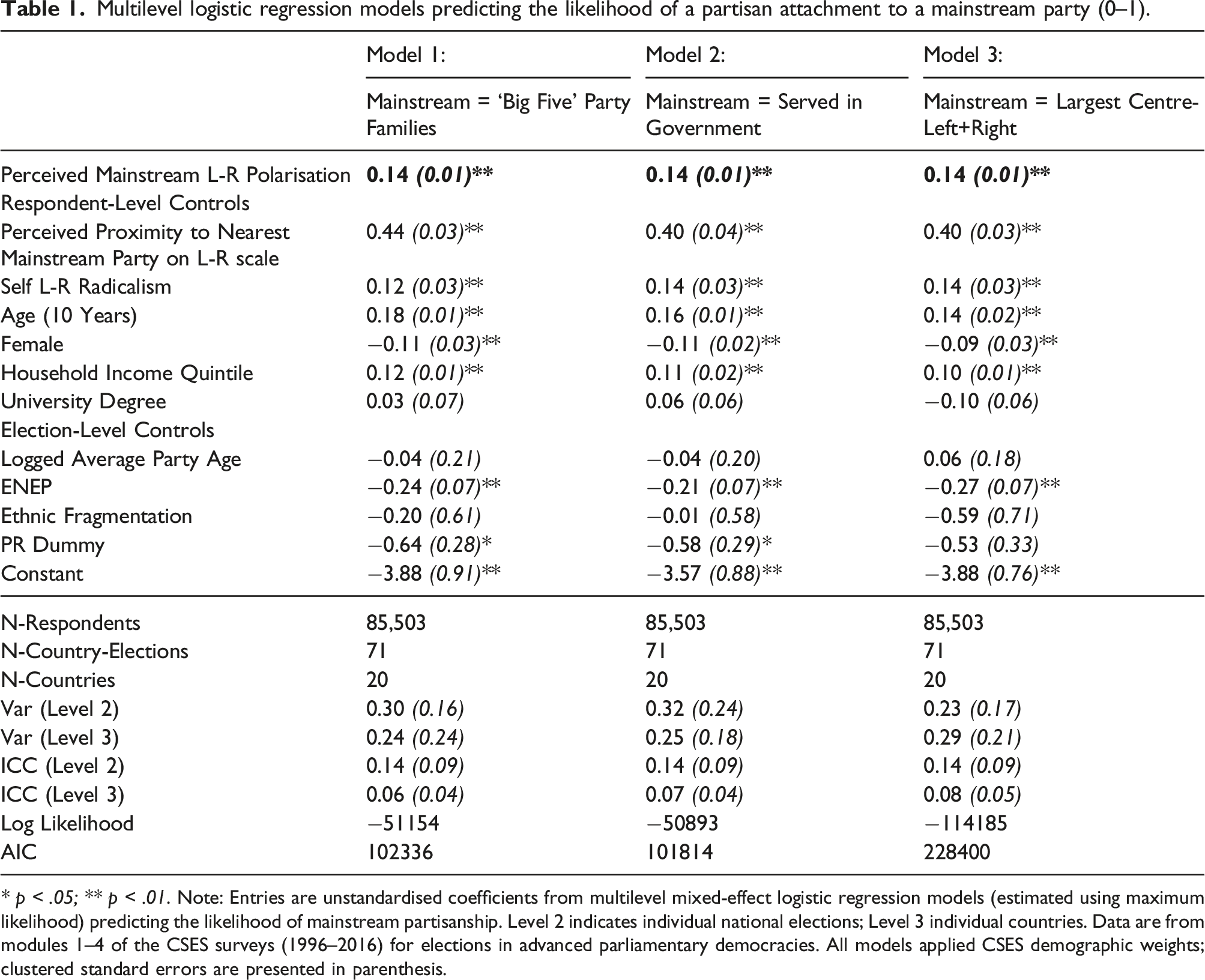
* p < .05; ** p < .01. Note: Entries are unstandardised coefficients from multilevel mixed-effect logistic regression models (estimated using maximum likelihood) predicting the likelihood of mainstream partisanship. Level 2 indicates individual national elections; Level 3 individual countries. Data are from modules 1–4 of the CSES surveys (1996–2016) for elections in advanced parliamentary democracies. All models applied CSES demographic weights; clustered standard errors are presented in parenthesis.
As Table 1 shows, regardless of the measure of mainstream party, people are more likely to have a partisan attachment when they view those parties as more ideologically diverse. This holds even when controlling for proximity to a party and it seems, therefore, that there is good support for hypothesis 1b rather than 1a. Ideological convergence by itself weakens partisanship. How large are these effects? Figure 1 is an odds ratio coefficient plot that depicts the impact of a one standard deviation change (or a one-unit change, in the case of the PR dummy) for a selection of the variables listed in Table 1 on the likelihood that a respondent has a mainstream party attachment. A one standard deviation change in ideological polarisation is consistently associated with around a 35% increase in the odds of a partisan affiliation. These effects are comparable to the largest election-level effects. Changes in the odds of having a partisan attachment to a mainstream party (based on Table 1). Note: This figure is a coefficient plot demonstrating changes in the odds that a respondent identifies with a particular type of mainstream party, alongside 95% confidence intervals. Selected coefficients are taken from Models 1–3 of Table 1. The symbols indicate marginal changes in the odds of partisanship for a one standard deviation increase in that variable.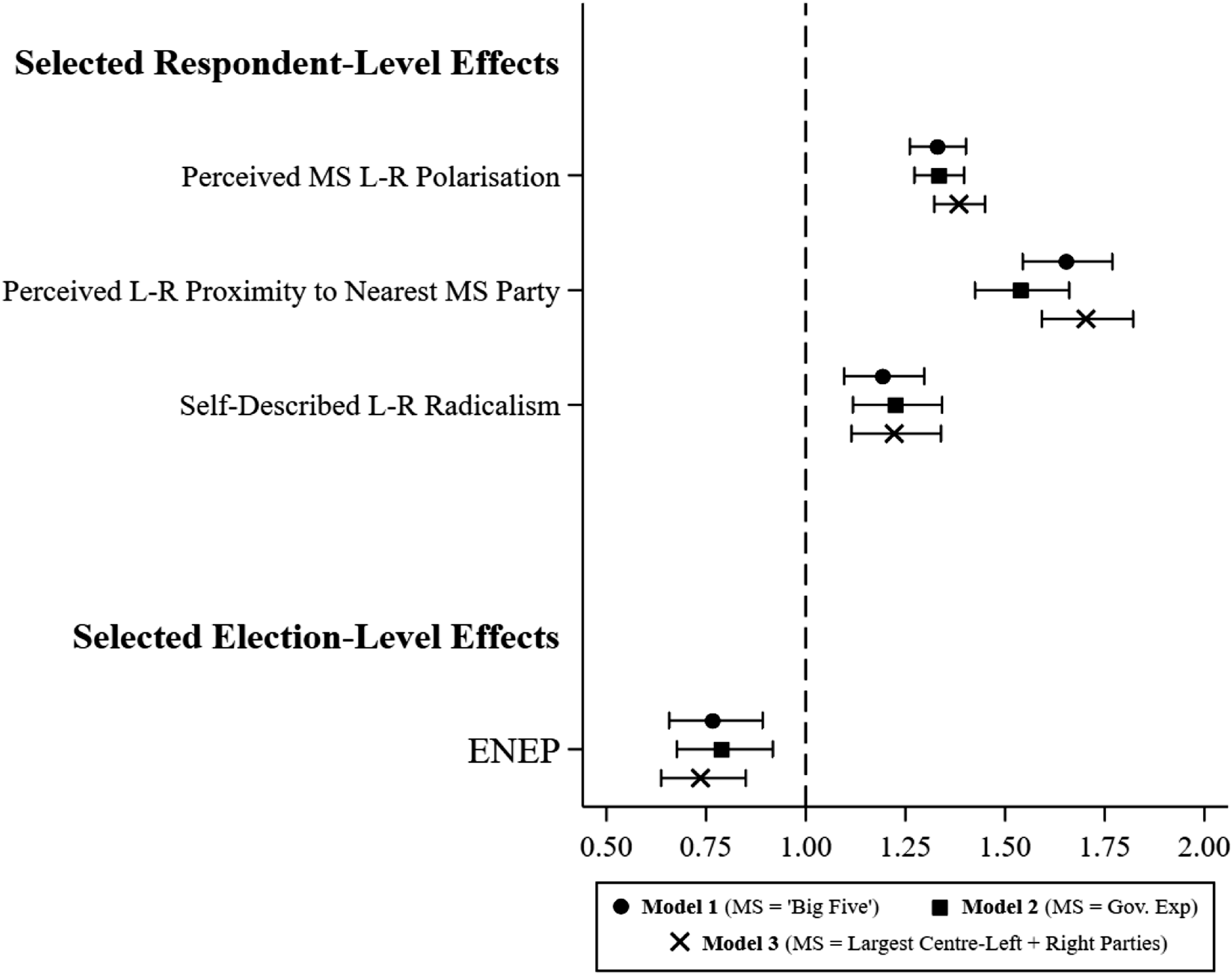
Multinomial logistic regression models with country-election fixed-effects predicting the likelihood of major centre-left (1) or centre-right (2) partisanship versus neither (0).
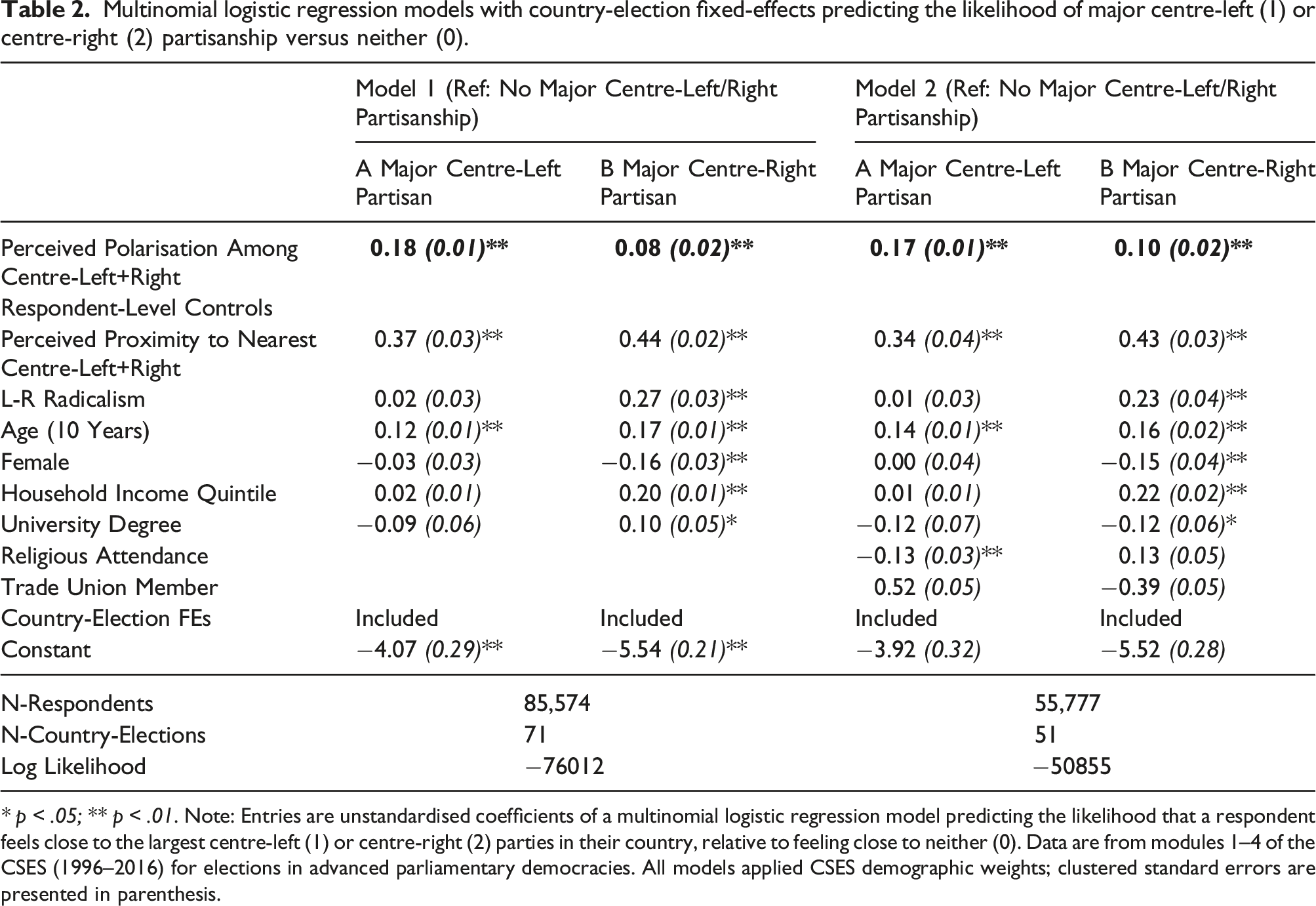
* p < .05; ** p < .01. Note: Entries are unstandardised coefficients of a multinomial logistic regression model predicting the likelihood that a respondent feels close to the largest centre-left (1) or centre-right (2) parties in their country, relative to feeling close to neither (0). Data are from modules 1–4 of the CSES (1996–2016) for elections in advanced parliamentary democracies. All models applied CSES demographic weights; clustered standard errors are presented in parenthesis.
The results in Table 2 support hypothesis 2. While respondents are more likely to support both the centre-left and the centre-right when they make clearer ideological distinctions between the two, the coefficient indicating the effect of polarisation on centre-left partisanship is about twice as large as that for centre-right partisanship, depending on the model.
9
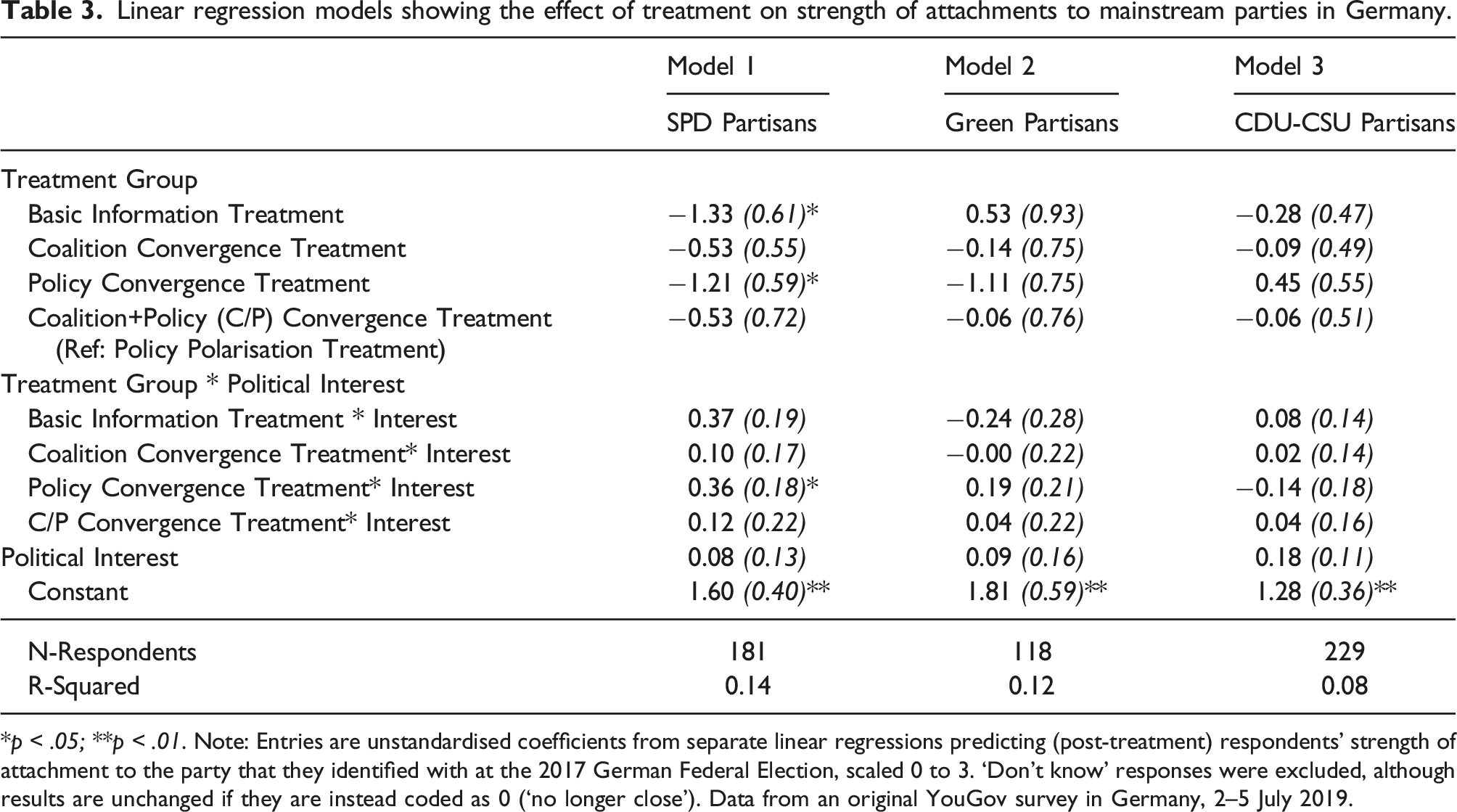
Figure 2 shows these different effects. We plot the likelihood of a respondent identifying with a social democratic party (SPD), a centre-right party, or neither according to the absolute difference the respondent places between the two parties on the 11-point left-right scale. The values of all other variables are held constant at their predicted level for an average voter in Germany at the 2013 election. The likelihood of feeling close to either of the two major parties more than doubles (from about a 1/3 to 2/3 chance) as one moves from believing that the two are maximally convergent to maximally polarised. However, this effect is largely driven by variability in party attachment to the centre-left. It appears that partisan affiliation for rightist parties is less affected by the distinctiveness of their ideological brand. Predicted probability of centre-left and centre-right partisanship by perceived polarisation (based on Table 2, Model 2). Note: Figure 2 is a margins plot demonstrating changes in the odds that a respondent identifies with a particular type of party with 95% confidence intervals. Coefficients are taken from Model 2 of Table 2. The plot is for the statistically average respondent: a 49-year-old, university-educated, non-trade union affiliated, non-Church attending, median income woman in Germany (2013) who places themselves 2 points off the centre of the 11-point left-right spectrum and is within 2 points of the nearest of either the major centre-left (SPD) or centre-right (CDU-CSU) parties. The histogram is shows the distribution of polarisation perceptions in our sample. Linear regression models showing the effect of treatment on strength of attachments to mainstream parties in Germany. *p < .05; **p < .01. Note: Entries are unstandardised coefficients from separate linear regressions predicting (post-treatment) respondents’ strength of attachment to the party that they identified with at the 2017 German Federal Election, scaled 0 to 3. ‘Don’t know’ responses were excluded, although results are unchanged if they are instead coded as 0 (‘no longer close’). Data from an original YouGov survey in Germany, 2–5 July 2019.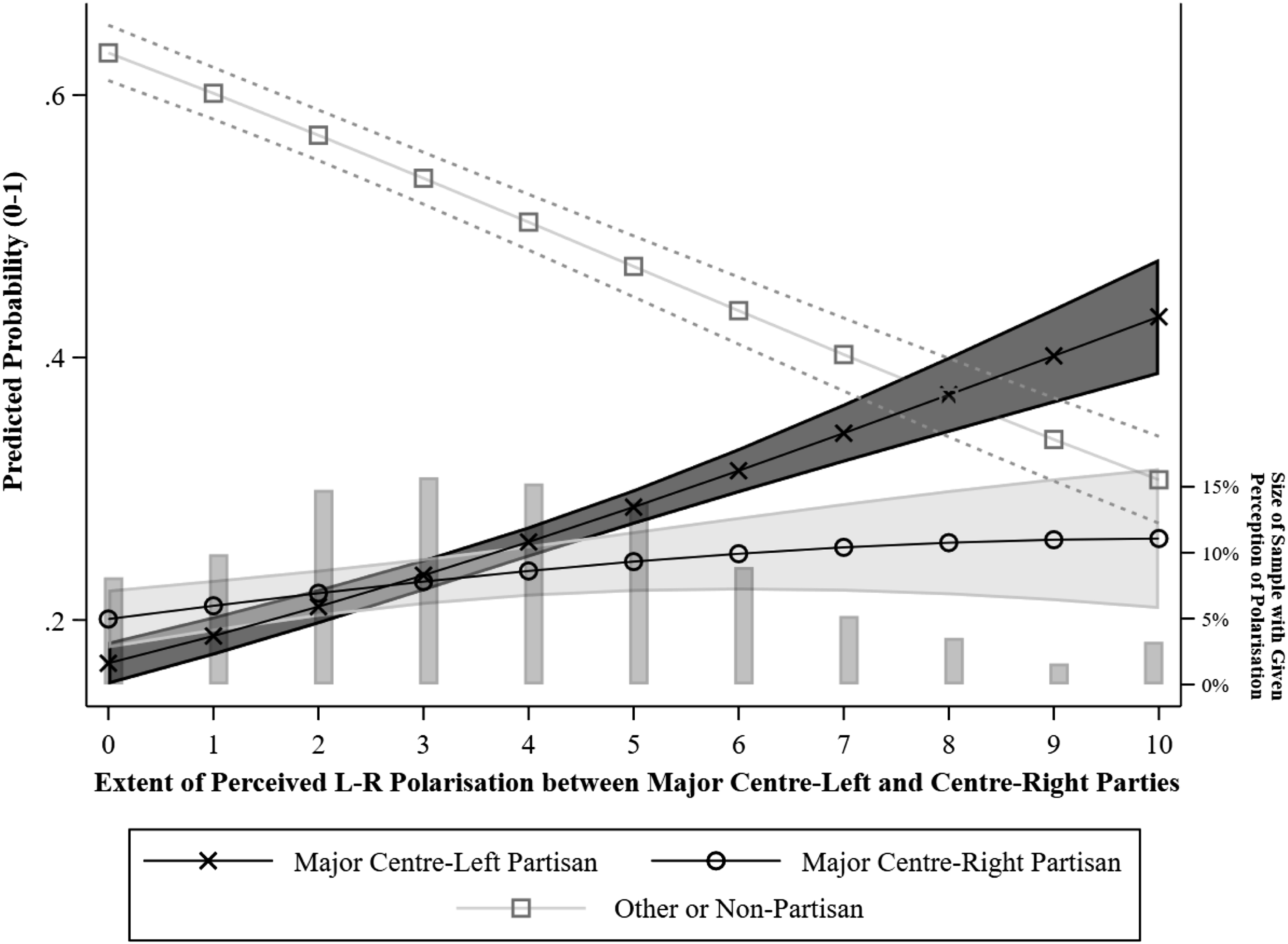
Study 2
Despite controlling for many potentially confounding demographic, attitudinal and contextual variables, our discussion of the findings in Study 1 assumes that perceived party positions are not merely the endogenous product of the ‘perceptual screen’ embedded in the eyes of voters already affiliated to a party (Campbell et al., 1960). There are reasons to doubt that assumption. After all, voters are rarely credited with being able to approach political facts in an objective manner (Achen and Bartels, 2017) and considerable evidence exists that survey respondents are likely to mentally ‘pull’ their preferred party closer towards their own position and ‘project’ disliked parties further away (Busch, 2016; Granberg and Brown, 1992). In Study 2, we thus aim to identify the causal effect of convergence more clearly by using a survey experiment. Here, we present different groups of respondents with (real) information concerning political parties in their country. Some treatment groups get information that suggests established parties had become more similar in recent years; other treatment groups receive information that they had become more distinct. In line with H1b and H2, we expect that exposure to information about convergence will reduce partisan attachments to mainstream political parties and, in particular, centre-left ones.
Our experiment has five treatment groups and was fielded to a representative sample of the German population, drawn from YouGov’s online omnibus panel in July 2019. Germany in 2019 is a good case to test our theory. While the two largest political parties were the centre-left SPD and the centre-right Christian Democratic Union–Christian Social Union (CDU-CSU), both parties had converged over the last few elections. For example, during the early-2000s, the SPD attempted to tackle high levels of unemployment and the rising costs of social services by liberalising the German labour market and reducing welfare benefits and state pensions (the so-called ‘Hartz IV’ and ‘Agenda, 2010’ reforms). More recently, the ostensibly socially and economically conservative CDU-CSU has presided over the introduction of gay marriage, a minimum wage and a cap on landlords’ ability to raise rents.
Our set-up is similar to Lupu (2013) who found that exposure to information suggesting parties had converged in their policy and patterns of coalition-making reduced the strength of partisan affiliations. However, we also make use of more recent attempts by the parties to draw clearer distinctions between themselves. For example, while in the early-2000s, Gerhard Schröder moved the SPD much closer to the traditionally more economically right-wing CDU-CSU, the leader of the SPD in July 2019, Andrea Nahles, strongly distanced herself from these policies. She claimed that the Hartz-era welfare sanctions and reduced unemployment benefits would be at least partially reversed (Isenson 2019), putting the SPD once more into conflict with the CDU-CSU (Kettenbach et al., 2019). Juxtaposing this information, we were able to keep the subjects of contention (or agreement) consistent, even while giving the appearance of policy polarisation or convergence. In Figure 3, we present examples of our information vignettes, giving the treatments for policy convergence and policy polarisation as they relate to the SPD and the CDU-CSU. Example treatment vignettes: Policy convergence treatment v policy polarisation treatment for SPD and CDU-CSU. Note: Respondents also received information (on subsequent screens) about the Greens and the FDP and a consistent brief statement about the AfD and Die Linke which did not vary by treatment status. Please note that the original survey was in German. See Online Appendix 8 for the full range of vignette scripts.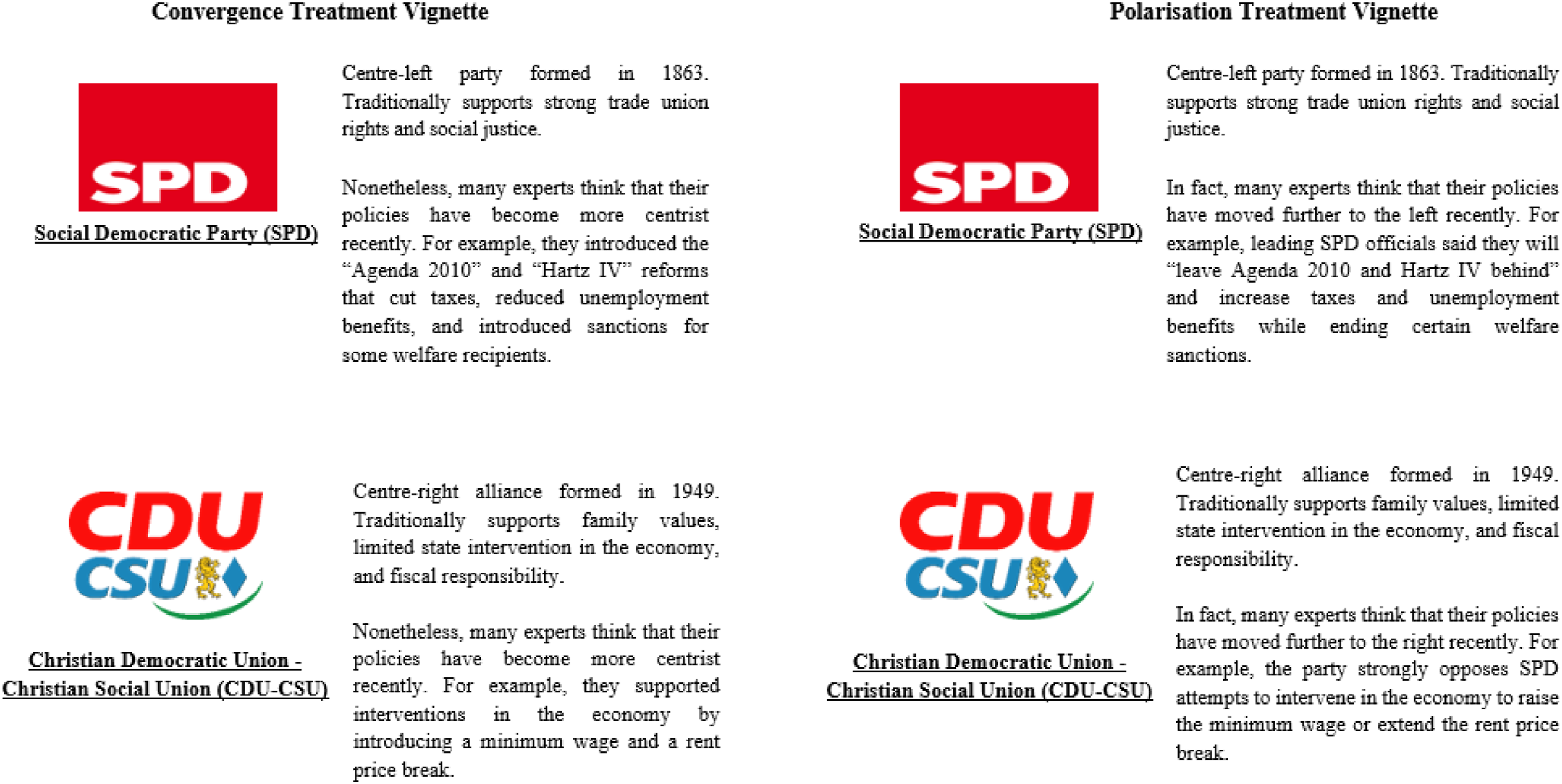
Convergence amongst mainstream German parties has not just been in the realm of policy, however. The SPD and the CDU-CSU have cooperated extensively with each other in government: they ruled in coalition together for 10 of the 14 years between 2005 and 2019. This ‘relational’ convergence may have affected attitudes towards the parties more than the ‘positional’ convergence in policy. The coalition partners that a party chooses has been shown to influences where voters place them in ideological terms (Fortunato and Stevenson 2013), and this can lead to the dilution of a party’s longstanding ‘brand’ (Lupu 2013).
We thus present information to respondents about party differences in terms of policy and coalition-making and vary that information by treatment group. The information concerns all four established mainstream parties (the SPD, CDU-CSU, Greens and the Free Democratic Party (FDP)).
10
The five treatment groups are shown in Figure 4. All respondents received the parties’ logos, names and basic biography, in addition to the same short summary of the positions of two non-mainstream parties, the Left Party and AfD, for comparison. This is all the information that respondents in the ‘basic information group’ received. Respondents in the ‘coalition convergence group’ also got a short summary reminding them that parties on the left (the Greens and the SPD) have increasingly made allies out of right-leaning parties (the FDP and the CDU-CSU) in federal and state-level government. Those in the ‘policy convergence’ group instead got examples of these parties’ policies which conflict with their supposed position on the classic left-right spectrum. Group 4 got both the coalition and policy convergence information. Finally, those in the ‘policy polarisation group’ received examples of the parties returning to their traditional ideological niches. The full treatment vignettes are in Online Appendix 7. Experimental treatment groups.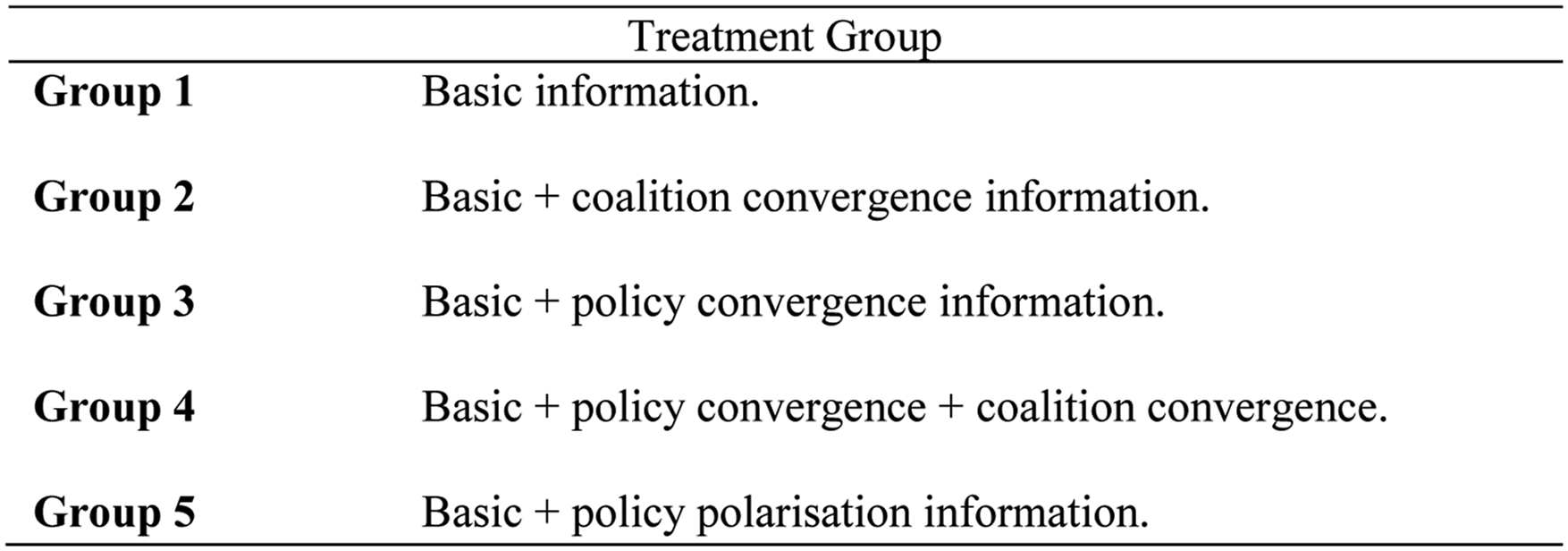
In all cases, we should expect treatment effects to be greater for those who are less politically interested. Those with high levels of political awareness are more likely to already be aware of the information that we present and less likely to update their views given a single piece of information (Zaller, 1992). Furthermore, Lupu (2013), using a similar set-up, found information about political parties had a stronger effect on partisanship for the less informed. All models therefore include an interaction between self-reported political interest (scaled 1–5) and treatment status.
Before turning to the impact on partisanship, it is worth noting that our treatments had the intended effect on voters’ perceptions of mainstream parties. Using two different measures of perceived polarisation, neither requiring an abstract understanding of ‘left’ and ‘right’, we find that politically uninterested people were more likely to perceive polarisation when given the polarisation treatment compared to the convergence treatments. These effects were only statistically significant for the groups who received information about policy positions, rather than coalitions. Any effects of treatment on partisanship should therefore be via changing policy perceptions (see Online Appendix 8 for the full details 11 ).
Study 2 results
We separate our sample according to the partisan identity that each respondent expressed in an earlier survey fielded by YouGov following the 2017 general election. 12 We examine people who previously had an attachment to the three largest mainstream parties: the CDU-CSU, the SPD and the Greens. Those who did not have a partisan identity, or felt close to a minor party, are excluded. 13 We asked respondents, post-treatment, the following question: ‘In an earlier YouGov survey, you said that you tend to feel close to the [X] party. How close would you say that you feel to this party?’, with respondents able to select from a 4-point scale ranging from ‘I no longer feel close to this party’ (0) to ‘very close’ (3). Table 3 presents a series of linear regression models predicting supporters of each party's remaining strength of partisanship following exposure to treatment. In each model, the effect of a particular vignette is interacted with political interest.
In accordance with hypothesis 2, our results suggest heterogeneity in treatment effects by party. Centre-left partisans – those who identified with the SPD or the Greens – appear more likely to renounce their previous partisan ties when exposed to the policy convergence treatment, and this effect is greatest for the least politically sophisticated. Given the relatively small treatment, these effects are quite large. For instance, our model predicts that a previous SPD partisan with a low level of political interest (1 out of 5) exposed to the polarisation treatment would have an attachment to the party that is about 1.2 points stronger (on a 4-point scale) than if exposed to the ‘brand-diluting’ policy convergence treatment. The effect for Green supporters is of comparable magnitude and direction, albeit not statistically significant at conventional levels. By contrast, all treatments are clearly non-significant for CDU-CSU supporters.
Discussion
The purpose of this article was two-fold: first, to see whether perceptions of establishment party convergence are associated with the decline of mainstream partisanship and second, to see whether centre-left parties are more vulnerable to this process. We find both effects in Study 1 and Study 2. Our results thus show that it is not just unrepresented radical voters who are affected by depolarisation as spatial models of partisanship might suggest. Both studies also highlight an important asymmetry to this general phenomenon: convergence affects support for centre-left parties more than it does for centre-right parties. Convergence, therefore, may result in both an absolute, and relative, loss of support for mainstream social democrats.
Our findings add empirical support to the notion that the recent struggles of many established parties in western Europe, and elsewhere, are due to the ‘brand-diluting’ activities of those parties in their attempts to converge on a (potentially illusive) median voter (Lupu, 2016). Our results also corroborate much of the work on the decline of class politics that suggests that more centrist appeals by social democratic parties since the 1990s may have cost them some of their existing partisans (Berman and Snegovaya, 2019; Elff, 2009; Evans and Tilley, 2017; Grzymala-Busse, 2019; Rennwald and Evans, 2014). While structural changes like the decline of manufacturing, and the proliferation of university-educated professional voters, pose big questions for the electoral viability of the traditional centre-left (Benedetto et al., 2020; Gingrich and Häusermann, 2015), our results imply that these parties may not have suffered quite so severe a recent malaise had they more vigorously contested the policies promoted by their conservative rivals.
There are, as always, caveats to these findings. One is the identification of the mechanism behind the distinctive partisan response to left-wing party convergence. We have suggested that this might lie in the historically more ‘ideological’ tradition of leftist parties. That is, relative to traditional conservative scepticism about transformative political projects, left-wing politics is more often accompanied by an idea of a utopian society that can be enacted through legislation (Alexander, 2015: 10; Gidron and Ziblatt, 2019: 29; Oakeshott 1991 [1956]). It is certainly plausible that political projects built around ‘positive’ alliances for change might be more prone to feelings of betrayal, but we do not currently directly test this. To do so, would require a research design, perhaps via laboratory experiments or qualitative interviewing, that could uncover more fully partisans’ decision-making processes. 14
Our work is also restricted in its measures of convergence. In Study 1, we measure convergence using a simple left-right dimension, but a two-dimensional issue space would perhaps better fit the mass public’s ideology (Ford and Jennings, 2020). Equally, convergence on policy is only one way that parties can demonstrate similarity. Voters might conceptualise party differences in terms of social group representation that is more dependent on heuristics such as the background of elites. These sort of ‘group appeals’ may be important in shaping attitudes towards parties (Converse, 1964, 38–44; Evans and Tilley, 2017; Thau, 2019) and identity congruence can potentially rival issue congruence for determining the strength of alignment between voters and parties (Achen and Bartels, 2017, 313; Heath, 2013).
Those caveats aside, our findings have some interesting implications for party politics more generally. Most importantly, it may be worth questioning the generalisability of the US example of ‘pernicious polarisation’ (McCoy and Somer, 2019) and the associated dangers to civility, legislative productivity and trust in government (Lee 2015). Perhaps some party systems are instead suffering from too little ideological diversity which can have its own negative consequences for representation, government responsiveness, the stability of political competition and turnout (Roth 2018; Wessels and Schmitt 2008). After all, as the proponents of the ‘responsible party model’ (APSA 1950: 14) argued 70 years ago, if the two major parties do not have alternative programs that can be executed, ‘the voters’ frustration and the mounting ambiguities of national policy might set in motion more extreme tendencies to the political left and the political right’.
The question thus remains of where, and when, polarisation goes ‘too far’. And, in particular, what circumstances might affect the answer to this question. Is polarisation so harmful for the functioning of American politics – with its frequent gridlock and shutdowns – because of the large number of institutional veto players in that system? Perhaps the danger is less severe in parliamentary democracies, where more polarisation may actually prove helpful in encouraging scrutiny of the incumbents, without risking the worst forms of institutional paralysis. But this is for a very different research project to answer.
Supplemental Material
sj-pdf-1-ppq-10.1177_13540688221097809 – Supplemental Material for Why the left has more to lose from ideological convergence than the right
Supplemental Material, sj-pdf-1-ppq-10.1177_13540688221097809 for Why the left has more to lose from ideological convergence than the right by Zack P Grant and James Tilley in Party Politics
Footnotes
Acknowledgements
The data used in Study 2 come from an online survey conducted by YouGov Deutschland GmbH between 3 July and 5 July 2019. We would like to thank Lisa Bischoff, Friederike Haberstroh, Filip Bubenheimer, Leo Maedje, Celine Le, Theresa Feicht and Ilona Lahdelma for their excellent research assistance in drafting this survey. For their constructive feedback on earlier versions of this article, the authors would also like to thank Abigail Axe-Browne, Lea Kaftan and all of those who attended the presentation of our findings at the 2019 Elections, Public Opinion, and Parties annual conference at the University of Strathclyde. All remaining errors are our own.
Declaration of conflicting interests
The author(s) declared no potential conflicts of interest with respect to the research, authorship, and/or publication of this article.
Funding
This publication arises from research funded by the John Fell Oxford University Press Research Fund [grant number 0006613]. It is based on Zack Grant’s doctoral project, which was funded by an Economic and Social Research Council (ESRC) studentship [grant number ES/J500112/1] and the St John’s College (University of Oxford) Lamb and Flag scholarship.

Notes
Author Biographies
References
Supplementary Material
Please find the following supplemental material available below.
For Open Access articles published under a Creative Commons License, all supplemental material carries the same license as the article it is associated with.
For non-Open Access articles published, all supplemental material carries a non-exclusive license, and permission requests for re-use of supplemental material or any part of supplemental material shall be sent directly to the copyright owner as specified in the copyright notice associated with the article.
