




Abstract
Although positive campaigning is a widely used communication strategy in election campaigns, determinants aside from political characteristics and gender are largely unknown. However, the personality traits of candidates could affect campaigning strategies beyond these factors. Recent research shows that people with an aversive (“dark”) personality tend to self-promote and are attracted to leadership positions. Transferring these findings to self-promotion in election campaigns, I ask if candidates with a more aversive personality use positive campaigning more often. 2,133 candidates who ran for 10 state parliaments in Germany in 2021, 2022, and 2023 self-reported how often they used positive campaigning. Analyses via structural equation modeling show that the candidates’ aversive personality is positively and significantly related to their use of positive campaigning and that this relationship holds when controlling for political and sociodemographic characteristics. The implications of the findings and potential pathways for further research are discussed.
Introduction
When explaining the campaign communication of candidates, research mostly focuses on negative campaigning – a strategy that is potentially detrimental to democracy (Ansolabehere et al., 1994), intentionally harmful for other candidates or parties (Benoit, 2017), and yet, risky for its users as it can lead to backlash effects (Roese and Sande, 1993) and alienate voters (Walter and Van der Eijk, 2019). The other side of campaign communication, positive campaigning or acclaiming, is much less researched although it is the most widely used communication strategy in election campaigns (e.g., Benoit, 2017; Brazeal and Benoit, 2001; Hansen and Pedersen, 2008; Paatelainen et al., 2016; Stein and Benoit, 2021). While negative campaigning refers to “any criticism leveled by one candidate against another during a campaign” (Geer, 2006: 23), acclaims “seek to promote a candidate’s own strengths and advantages” (Benoit, 2017: 7) and aim to build a good reputation (Bernhardt and Ghosh, 2020). At the same time, acclaims are relatively safe to use: Positive campaigning is usually supported by voters (Reinemann and Maurer, 2005) and is low-risk because of its positive content (Wicks et al., 2011). Even though acclaims have the potential to increase votes and inform voters about the candidates’ qualities, determinants beyond the candidates’ political position are largely unknown. This article aims to broaden the understanding of which types of candidates use positive campaigning more often.
Specifically, I extend research to the role of the candidates’ personality in their use of positive campaigning. Findings that the candidates’ use of attacks differs regarding their personality traits (Maier et al., 2023) underline that personality matters for campaign communication. Particularly, the aversive or “dark” personality, referring to non-pathological traits that can lead to socially problematic or malevolent actions (Moshagen et al., 2018; Paulhus and Williams, 2002), was identified as a driver of negative campaigning (Nai et al., 2019; Nai and Maier, 2020) – but its possible relationship with positive campaign communication was not researched yet although both strategies are not mutually exclusive. Candidates with a more aversive personality could use both, positive and negative campaigning more often than others: The so far employed focus on negative campaigning follows research on the association of aversive personality with various kinds of behaviors that are harmful toward others (e.g., bullying: Goodboy and Martin, 2015; deception and lying: Jonason et al., 2014). However, there are reasons to believe that candidates who score higher on aversive personality traits may also like to present themselves as overly positive and that their personality could foster positive campaigning as well. People with an aversive personality tend to overestimate themselves (Jain and Bearden, 2011; O’Reilly and Hall, 2021; Smith et al., 2018). At the same time, they seek admiration and attention (Jones and Paulhus, 2014; Nevicka et al., 2011) which can be satisfied by publicly presenting their inflated self-views. While grandiosity and self-promotion may be less in demand in some situations, they can appear appropriate for leadership positions. An aversive personality can have a “bright” side and serve as a door-opener when striving for or holding such positions (see Smith et al., 2018 for a review). Indeed, people with high narcissism and psychopathy are often found in higher levels of management (Boddy et al., 2010; Grijalva and Harms, 2014). If these findings are transferred to the context of election campaigns, having an aversive personality could be beneficial for candidates to present themselves to the public in a good light. The question is, therefore, whether candidates with a more aversive personality use positive campaigning more often.
To understand why this may be the case, the function of positive campaigning in election campaigns and the state of knowledge about its determinants are introduced. Findings on positive self-views, self-promotional tendencies, and attraction to policy positions in people with aversive personality traits lead to the expectation that the candidates’ aversive personality is positively associated with the use of positive campaigning. The empirical analysis is based on data from 2,133 political candidates who ran for 10 state parliaments in Germany. The dataset is unique as most measures come from self-reports which are first-hand information and allow the inclusion of less popular candidates for whom external assessments are often not available. Results show that candidates with a more aversive personality use positive campaigning more often than those with a less aversive personality. This is the case even when political and sociodemographic characteristics are controlled.
Purpose and known determinants of positive campaigning
There are many reasons why candidates may consider the use of positive campaigning. Before and during an election, people need to know why they should vote for a candidate. Acclaims inform voters about what they can expect – they advertise the candidates’ personal features (character acclaims) or their political plans and achievements (issue acclaims, Benoit, 2017). In other words, positive campaigning is supposed to improve the reputation of candidates (Bernhardt and Ghosh, 2020). An advantage of positive campaigning is that it usually does not backfire, provided that the candidates do not exaggerate too much (Schütz, 1998). Positive messages are likely to be supported by the audience (Reinemann and Maurer, 2005) and are less risky than other types of messages because their content is positive (Wicks et al., 2011). In an experimental setting, it shows empirically that candidates who used positive campaigning are rated more favorably than opposing candidates (Carraro et al., 2010).
Although negative campaign ads are more memorable than positive ones (e.g., Bradley et al., 2007; Chang, 2001), this does not always have the desired effects. Positive messages, on the other hand, enhance candidate evaluation (Matthews and Dietz-Uhler, 1998; Nai and Seeberg, 2018) and could act as a defense against damaging messages of the opponent (Kahn and Geer, 1994). Positive campaigning is linked to more of one’s own voters going to the polls under some circumstances, and increased vote shares when opponents are out-advertised (Malloy and Pearson-Merkowitz, 2016). Positive messages also boost the likelihood of voting for their sponsor (Matthews and Dietz-Uhler, 1998). Moreover, a higher volume of positive campaign messages improves candidate ratings more than a lower volume (Kahn and Geer, 1994; Nai and Seeberg, 2018).
Knowledge on the candidate level about the use of positive campaigning mainly concerns the status of political incumbency. Incumbents were found to use more acclaims than challengers (Benoit, 2014; Vafeiadis et al., 2018). In theory, incumbents have more to advertise. They can highlight their experience in a political position and talk about how they have achieved past successes (Benoit, 2017). In German state elections, one might think of incumbency in two different ways: incumbency of the candidate and, in a broader sense, incumbency of the party for which the candidate is running. The reason is that the election systems in most of the German states are based on the principle of personalized proportional representation. Consequently, people have one vote for a constituency candidate (“first vote”) and another vote for a party (“second vote”). While approximately half of the seats in a parliament are assigned to winners of the constituencies, the other half is filled by the party members on the parties’ lists. Incumbency could thus affect positive campaigning via the candidates’ personal incumbency or via their membership in a governing party whose successes and experience they can use for their acclaims.
The candidates’ gender is another known determinant of positive campaigning. However, research on the effects of gender is inconclusive and rare. Some studies find a slight tendency for men to promote themselves more than women (e.g., Panagopoulos, 2004), but others conclude that women are more likely than men to use positive campaigning and mostly rely on this strategy (e.g., Coffé et al., 2023).
Connecting positive campaigning and aversive personality
While we do not know much about which candidates use positive campaigning more than others aside from political characteristics like incumbency and sociodemographic characteristics like gender, recent research on negative campaigning goes beyond that and shows that especially an aversive personality plays a role in negative campaign communication. When findings about personality effects on self-view, leadership, and political ambition are linked, there are reasons to assume that aversive personality traits are associated with positive campaigning as well.
Concepts of aversive personality
People have different degrees of aversive personality traits, ranging from low to high levels. Aversive personality is often conceptualized as a set of separate but interrelated traits. Prominent examples are the Dark Triad which consists of narcissism, Machiavellianism, and psychopathy (Paulhus and Williams, 2002), and the Dark Tetrad which additionally includes the fourth trait sadism (Buckels et al., 2013; Chabrol et al., 2015). Due to the strong correlation between the separate aversive traits, the idea behind newer concepts is that aversive personality is a collection of various traits with one common source (Douglas et al., 2012; Furnham et al., 2013). This conceptualization is also valuable because of failed attempts to separate aversive traits empirically (Bader et al., 2023). The so-called “dark core” (Moshagen et al., 2018: 661) reflects “the general tendency to maximize one’s individual utility—disregarding, accepting, or malevolently provoking disutility for others—, accompanied by beliefs that serve as justifications” (Moshagen et al., 2018: 657). In other words, people with aversive personality traits seek what they subjectively perceive as benefits even when the means to this end are sometimes harmful to others. The common core can be described as a combination of aversive features of personality traits, while the specific traits on their own can additionally entail non-aversive features (Bader et al., 2023). Regarding the Dark Triad, the core comprises psychopathy’s meanness, narcissism’s self-centered antagonism and, partly, agentic extraversion and neuroticism, and Machiavellianism’s amoral manipulation, cynicism, distrust, and desire for control and status (Bader et al., 2023).
Self-perception and self-presentation of individuals with an aversive personality
Despite their socially problematic actions, people with an aversive personality manage to think positively about themselves (e.g., Jain and Bearden, 2011; O’Reilly and Hall, 2021; Smith et al., 2018). To keep doing so, they find reasons or hold beliefs why their malevolent behavior is justified (Hilbig et al., 2022). Examples of those beliefs are the competitive jungle social worldview (Duckitt et al., 2002) and normlessness (Seeman, 1959). Apart from this, a belief that is often held by people with an aversive personality and connected to putting oneself in the foreground is that they are better than others.
A variety of studies point out that individuals with highly aversive personality traits have more positive self-evaluations than others although they do not perform better by more objective measures (Gabriel et al., 1994; Guedes, 2017; Jain and Bearden, 2011; Robins and John, 1997). A potential reason is that people with an aversive personality have exceedingly positive, and sometimes inflated, self-views: They tend to be self-entitled, convinced of themselves (Jain and Bearden, 2011; O’Reilly and Hall, 2021; Smith et al., 2018), and attention-seeking (Jones and Paulhus, 2014; Nevicka et al., 2011). For example, highly narcissistic people think that they are superior (Brummelman et al., 2016), special and unique (Emmons, 1987), and psychopathy is linked to grandiosity and arrogance (Hare et al., 2000; Mathieu et al., 2020).
People with an aversive personality also tend to promote themselves, which serves two main purposes. The first purpose is maintaining a grandiose self-view and was mainly discussed in research about narcissism (e.g., Back et al., 2013). The narcissistic self “is a self that cannot stand on its own” (Morf and Rhodewalt, 2001: 179), and for external validation, narcissists seek attention or admiration (Brummelman et al., 2016; Emmons, 1987). The need for admiration may be unique to narcissism but superiority, entitlement, and dominant behavior are part of the dark core (Moshagen et al., 2018). The second purpose of self-promotion is connected to the strategic side of individuals with an aversive personality. Machiavellians manipulate others in order to gain money, power, and status (Furtner and Baldegger, 2016). Assertively promoting their strengths helps them to demonstrate their perceived dominance and skills and thereby make a good impression (Furtner et al., 2017; Sherry et al., 2006). They tend to show a perfectionistic version of themselves and hide personal weaknesses (Sherry et al., 2006). In an experiment, high Machiavellians presented themselves as highly capable, even when they were not, to intimidate others (Shepperd and Socherman, 1997). Research about personality effects on leadership suggests that high-functioning psychopathic individuals can present themselves as perfect leaders (Palmen et al., 2018). People with higher psychopathy appear charming (Mathieu et al., 2020) and seem charismatic and skilled in presentations (Babiak et al., 2010).
The self-promotional tendency of people with an aversive personality was also shown empirically. Studies show that individuals with higher aversive traits use self-presentational tactics and show off on social media (Abell and Brewer, 2014; Carpenter, 2012; Fox and Rooney, 2015; McCain et al., 2016), as also shown by the fact that psychopaths post more selfies (Fox and Rooney, 2015), and narcissists share positive life events to project a positive self-image (Bergman et al., 2011; Palmer et al., 2016).
Most of the presented research on self-perception and self-presentation focuses on separate aversive traits, but large parts of these traits are common to an aversive core (Bader et al., 2023). Regardless of the specific trait, people with high scores tend to present themselves positively. The nuanced reasons may be various, but a driver of behaviors common to all aversive traits should be utility maximization at the expense of others. Such kind of utility maximization is a major consequence of the dark core (Hilbig et al., 2023). During an elections’ campaign phase, which is a competitive situation, self-promotion does not only inform about candidates’ strengths but also intends to create a relative competitive advantage or at least enhance reputation and status. Thus, self-promotion during an election is intended to maximize utility at the expense of others, which suits the needs of people with an aversive personality.
Motivation and perceived talent for politics of individuals with an aversive personality
Also in the political domain, individuals with high scores on aversive personality traits tend to have a grandiose and positive self-image.
Machiavellians and narcissists think that they are especially qualified for a political career and that they would be successful in this field (Blais and Pruysers, 2017; Peterson and Palmer, 2019). In addition to feeling more confident when imagining themselves in a political role, Machiavellians as the strategists among people with an aversive personality are more likely to enjoy campaign activities (Peterson and Palmer, 2019). Narcissists are also more likely to have thought about running for office (Peterson and Palmer, 2019). All Dark Triad traits are related to feeling qualified and having thought about applying for a political position (Peterson and Palmer, 2021). Not only do people with an aversive personality themselves think that they are a good fit for such positions, but also their external image as political leaders seems to be convincing: Narcissists were better rated at charismatic leadership and, together with fearlessly dominant psychopaths, at presidential performance (Deluga, 1997; Lilienfeld et al., 2012). Additionally, experts attributed higher overall greatness and public persuasiveness to narcissistic politicians (Watts et al., 2013).
Being attracted to a political career can be a reason for people with an aversive personality to promote their perceived greatness and ability toward others. Self-advertising can lead to external validation of their self-perception as competent and successful politicians. It can also help to gain a competitive advantage by increasing the chance of obtaining an influential political position or improving reputation and status. In the context of campaign communication, I expect that candidates with an aversive personality present themselves in a good light by using positive campaigning. Therefore, the hypothesis is: The higher the self-reported aversive personality of candidates, the more often they use positive campaigning (H1).
Data and methods
The analyses are based on data from candidates who ran for 10 state parliaments in Germany in 2021, 2022, and 2023 (N = 5,896 were running; 2021: Rhineland-Palatinate, Baden-Wuerttemberg, Saxony-Anhalt, Berlin, Mecklenburg-Western Pomerania, 2022: Saarland, Schleswig-Holstein, North Rhine-Westphalia, Lower Saxony, 2023: Bremen). A full sample was drawn by inviting all candidates to the survey, including members of smaller parties for the elections in 2021.
Sample and procedure
Data collection started on the day after the election and ended 2 months later. To reach the candidates, publicly available contact information was researched. Candidates with a personal email address were invited by email to participate in an online questionnaire. If such an email address was not found, candidates received a printed questionnaire together with a return envelope. In addition, the postal invitation included a personalized link to the online questionnaire for candidates who preferred to participate online. 5,755 candidates were successfully contacted, of which 42.7% (N = 2,456) at least answered the questionnaire partially (Rhineland-Palatinate: n = 362, Baden-Wuerttemberg: n = 490, Saxony-Anhalt: n = 153, Berlin: n = 391, Mecklenburg-Western Pomerania: n = 161, Saarland: n = 116, Schleswig-Holstein: n = 139, North Rhine-Westphalia: n = 336, Lower Saxony: n = 224, Bremen: n = 84). 2,142 candidates reported their use of positive campaigning. Nine Participants who rushed through the online questionnaire were excluded (index of relative completion speed >2; see Leiner, 2019). The final sample consists of 2,133 candidates. 13.4% belonged to the Christian Democrats (CDU), 13.5% to the Social Democrats (SPD), 6.7% to the Alternative for Germany (AfD), 11.8% to the Liberal Party (FDP), 11.1% to the Left Party (DIE LINKE), 15.5% to the Green Party (GRÜNE), and 28.1% to other parties. 34.6% of the participants were female, and the sample was between 18 and 87 years old (M = 45.92; SD = 13.70).
Measures
The measures come from self-report questionnaires (see Table A1 in the Appendix for the wording of the questionnaire items) and candidate lists published by the state returning officers.
Positive campaigning
To measure the use of positive campaigning, candidates were asked: “If you think back to your own election campaign. How often have you promoted your own policy, i.e. presented your political achievements, political plans, political positions, or your own person in a positive way?” They reported their level of positive campaigning with answer categories from 1 “never” to 5 “very often” (M = 4.03, SD = 0.94). To validate this self-reported measure, it was correlated on the aggregate level with the observed acclaims on the social media accounts of the candidates (see Figure A1 in the Appendix). As a matter of course, social media covers only one part of the entire use of positive campaigning but this gives a hint if the self-reports go in the right direction. The positive relationship between the two measures suggests that this is the case.
Aversive personality
Aversive personality was assessed using the PEAPS short scale (Maier et al., 2023) which combines aversive traits into one scale, following the idea of a common core and findings about the large overlap of aversive traits (e.g., Moshagen et al., 2018; Schreiber and Marcus, 2020). The combined measurement intends to increase participation, as election candidates are unlikely to answer the extensive batteries that allow measuring the traits separately. Moreover, the original item wording can be considered harsh or inadequate (Maier et al., 2023). Thus, the PEAPS scale mitigates the item wording and minimizes the number of questions to a short scale of six items (Cronbach’s α = 0.67): i. “There have been times when I was willing to suffer some small harm so that I could punish someone else who deserved it”, ii. “I insist on getting the respect I deserve”, iii. “I want my rivals to fail”, iv. “It’s wise to keep track of information that you can use against people later”, v. “There are things you should hide from other people to preserve your reputation”, and vi. “People who mess with me always regret it”. The answer categories range from 1 “do not agree at all” to 5 “fully agree”. Collecting personality self-reports from political elite samples is challenging. Social desirability and rationalization processes can affect the responses (Schumacher and Zettler, 2019). In this sample, the average scores of the six PEAPS scale items cover low and high levels of aversive personality and follow a bell-shaped distribution which is only slightly left-leaning (M = 2.52, SD = 0.70).
Control variables
The analyses include political and sociodemographic control variables. Political characteristics are adjusted by four different measures. First, incumbent denotes if the candidate was already a member of the state parliament during the election (0 “no incumbent”, one “incumbent”). Second, governing party is 1 if the candidate’s party was in government in the respective state parliament during the election and 0 if it was not. Third, an 11-point scale from 1 “left” to 11 “right” indicates the candidate’s political ideology (M = 4.73, SD = 2.24). Fourth, to capture extremism, political ideology was folded in half, resulting in a six-point scale in which 0 represents a neutral and 5 an extreme ideology (M = 2.04, SD = 1.56). Sociodemographic characteristics were provided in the candidate lists. Age was calculated by subtracting the birth year provided in the candidate lists from the election year. Male was coded 1 for male candidates and 0 for female candidates.
Analytical strategy
After a description of the candidates’ reported use of positive campaigning, structural equation models (SEM) were calculated to account for the latent measurement of aversive personality (using the R package lavaan; Rosseel, 2012). The indicators of aversive personality as well as the measure of positive campaigning are ordered categorical and endogenous, and positive campaigning is skewed to the right. As ordered categorical outcome variables are neither continuous nor normally distributed, the reported SEM use WLSMV, a weighted least square estimator that can handle such variables (see Muthén, 1984): WLMSV estimates model parameters via diagonally weighted least squares (DWLS). The full weight matrix is used to compute robust standard errors as well as a scaled and shifted test statistic (simple second-order correction) (Rosseel, 2023). A probit link is applied to all paths directed towards positive campaigning, which means that an unobservable and continuous variable y* is assumed to underlie the ordered outcome variable (Muthén, 1984). Unstandardized probit coefficients then indicate how a change of one unit in the predicting variable changes y*, ceteris paribus. Pairwise deletion of missing values was specified. This procedure nonetheless deletes cases with missing values on the exogenous covariates listwise because the model is estimated conditional on them.
Model fit was assessed following the suggestions by Kline (2005) who defines an acceptable fit as TLI and CFI of higher than 0.90, and SRMR and RMSEA of less than 0.10. The chi-square test is often significant in large samples even when differences from perfect fit are trivial (Bentler and Bonett, 1980; Kline, 2005). For the models in Figures 1–3, power analyses show that the probability for rejecting the hypothesis of exact fit (RMSEA for H0 = 0.00) when true fit is the respective models’ RMSEA (RMSEA for H1) is higher than 0.99, given the models’ N, degrees of freedom, and an alpha value of 0.05 (MacCallum et al., 1996; Zhang and Yuan, 2018). Confirmatory factor analysis of the latent variable aversive personality. Note: N = 2,118. CFA using DWLS with a scaled and shifted test statistic and robust standard errors (WLSMV). The variance of the latent factor is fixed to 1. Chi
2
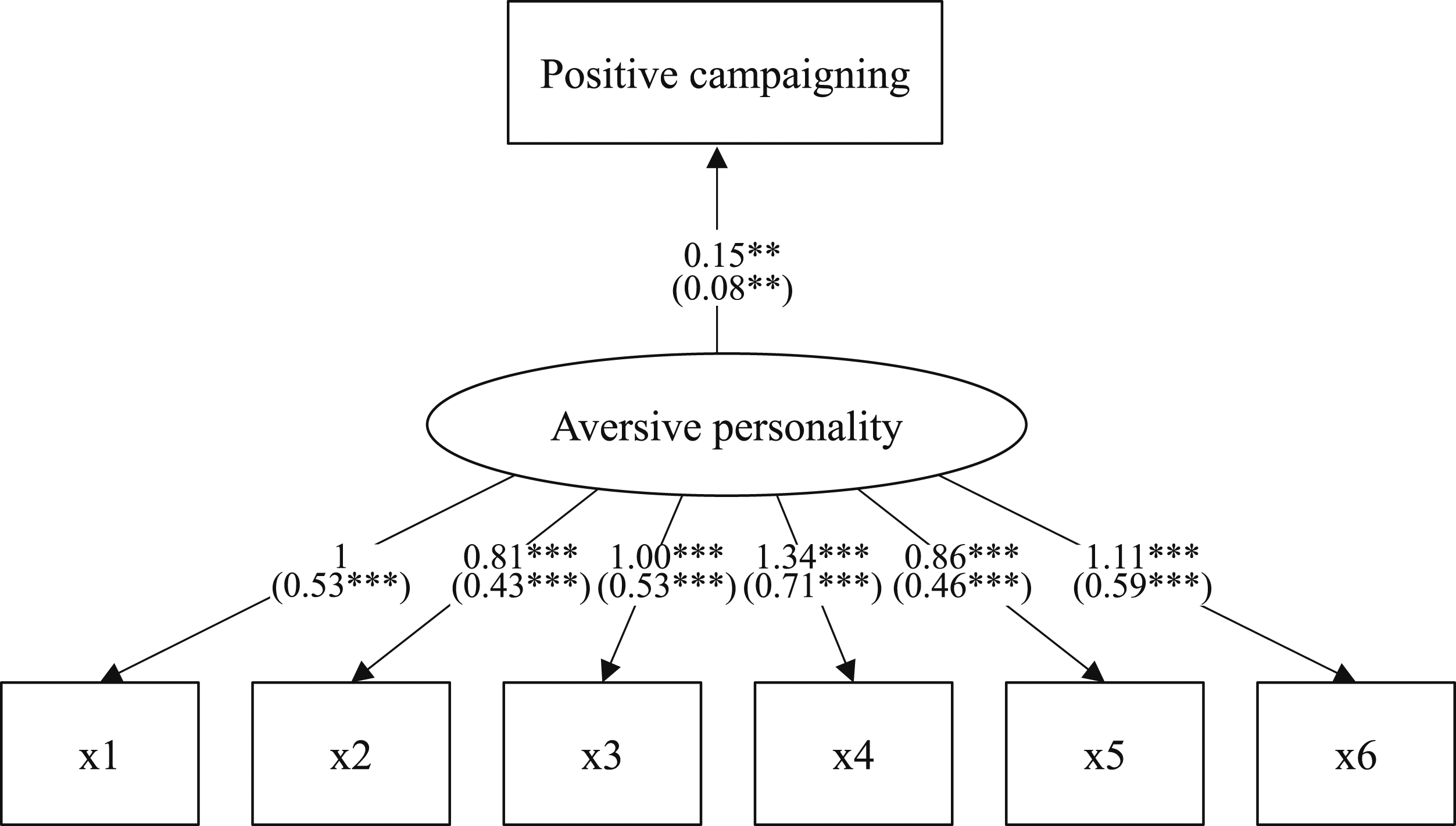
(9) = 74.74, p < .001, CFI = 0.97, TLI = 0.96, RMSEA = 0.06 [0.05, 0.07], SRMR = 0.03. Significance levels: ***p < .001, **p < .01, *p < .05. Structural equation model without control variables. Note: N = 2,133. SEM using DWLS with a scaled and shifted test statistic and robust standard errors (WLSMV). Standardized coefficients in parentheses. See Table A3 in the Appendix for full results. Chi
2
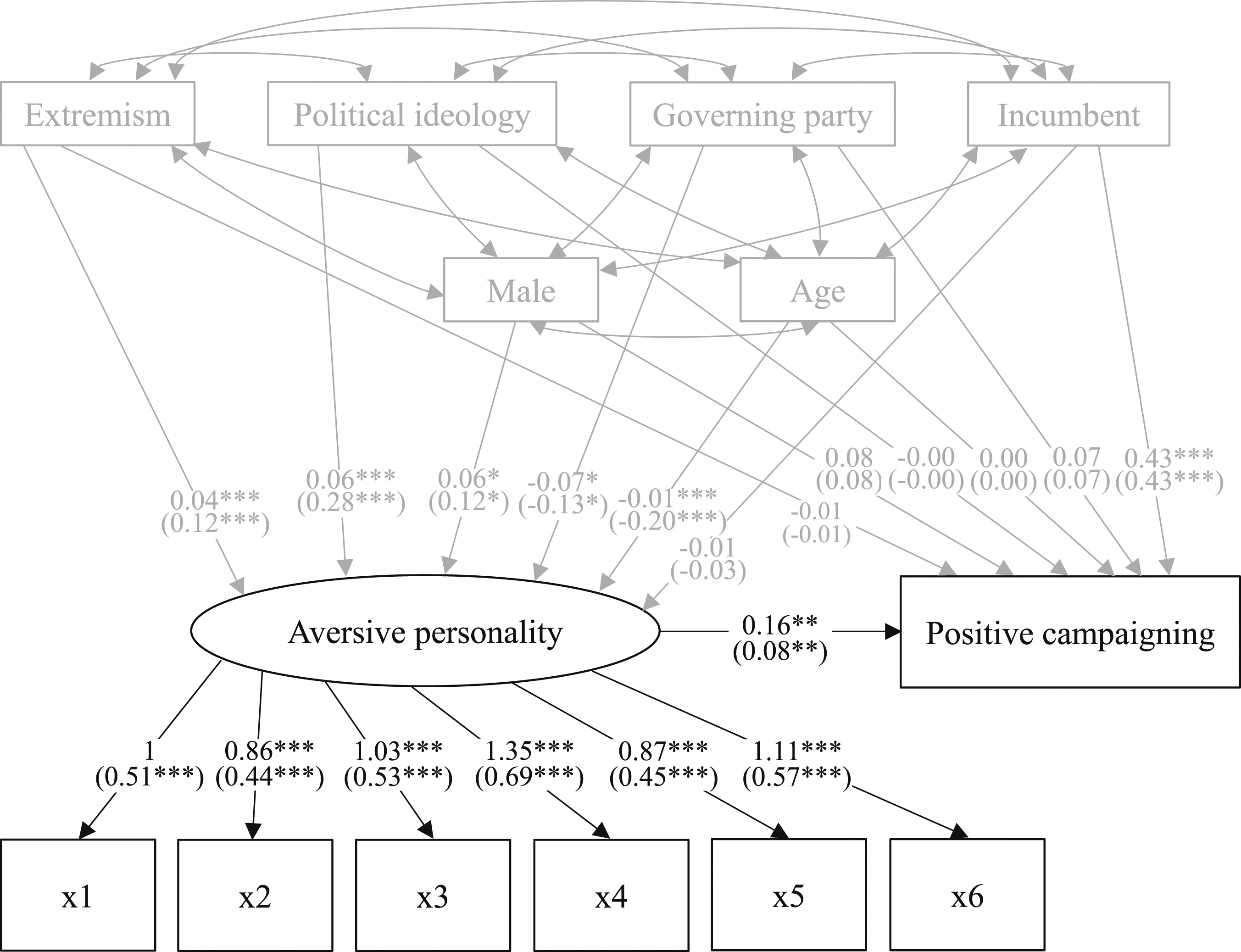
(14) = 85.07, p < .001, CFI = 0.97, TLI = 0.96, RMSEA = 0.05 [0.04, 0.06], SRMR = 0.03. Significance levels: ***p < .001, **p < .01, *p < .05. Structural equation model with control variables. Note: N = 1,961. SEM using DWLS with a scaled and shifted test statistic and robust standard errors (WLSMV). Standardized coefficients in parentheses. Exogenous covariates are correlated but the correlations are not estimated (model estimation is conditional on exogenous covariates). See Table A4 in the Appendix for full results. Gray arrows and boxes belong to control variables. Chi
2
(44) = 200.23, p < .001, CFI = 0.93, TLI = 0.97, RMSEA = 0.04 [0.04, 0.05], SRMR = 0.03. Significance levels: ***p < .001, **p < .01, *p < .05.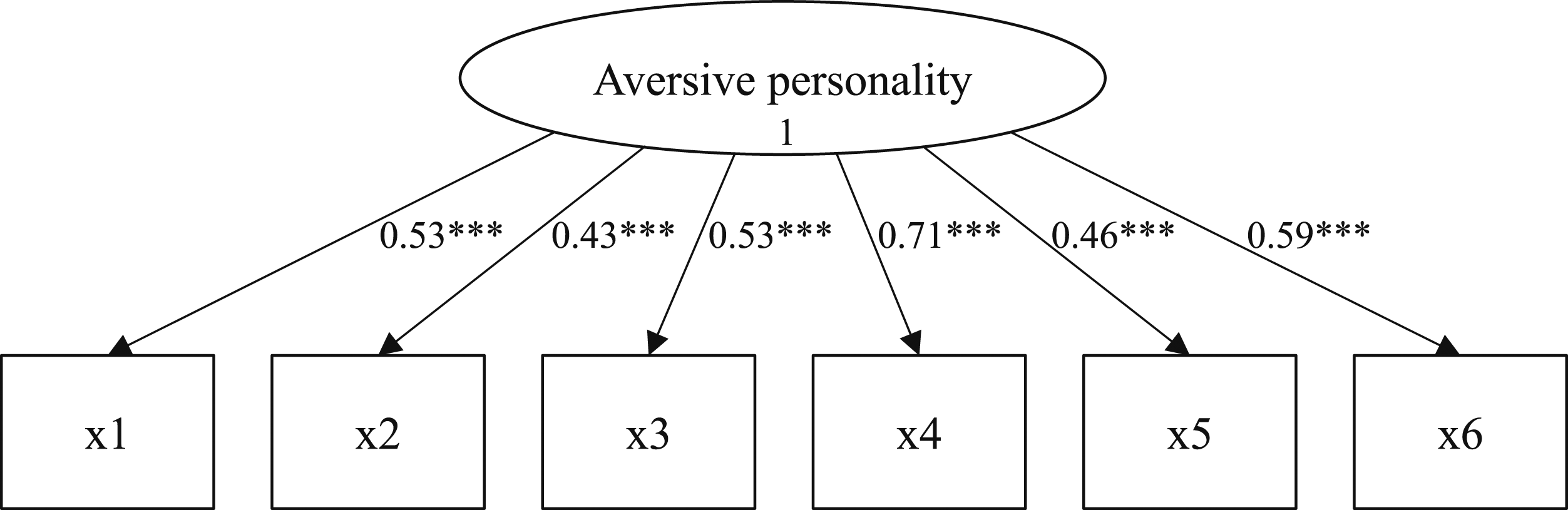
To begin with, a Confirmatory Factor Analysis (CFA) was performed to ensure that the latent variable aversive personality is well represented by its indicators. Then, structural equation models were run to assess the relationship between aversive personality and positive campaigning. The first model includes only the latent variable aversive personality without control variables. The second model tests if the coefficient of aversive personality remains stable when political and sociodemographic characteristics are held constant (see Table A2 in the Appendix for a correlation matrix). To capture possible associations of the control variables with aversive personality and at the same time campaigning, the latent variable aversive personality was additionally regressed on the control variables (see also Muthén, 2012). The specific relationships between control variables and aversive personality are not central to the research question and thus they solely serve as adjustments. Finally, robustness checks and an exploratory test of how aversive personality is associated with a high or low use of both, positive and negative campaigning, are calculated.
Results
Acclaims are used frequently among the candidates in the sample. 2.0% (n = 43) never used positive campaigning, 5.4% (n = 115) used it seldomly, and 14.2% (n = 302) sometimes. The majority of candidates often used positive campaigning (44.7%, n = 954). 33.7% (n = 719) reported that they used positive campaigning very often.
Figure 1 shows a confirmatory factor analysis of aversive personality. All of the six indicators load adequately on aversive personality and the model fit is good.
But how is aversive personality related to positive campaigning? Two structural equation models with positive campaigning as the dependent variable were calculated. In Figure 2, positive campaigning is regressed on aversive personality without control variables (see Table A3 in the Appendix for full results). The scaled goodness of fit indices indicate a good model fit. The use of positive campaigning increases with the aversiveness of the candidates’ personality (β = 0.151; p = .003).
The SEM illustrated in Figure 3 includes political and sociodemographic control variables (see Table A4 in the Appendix). The model has an acceptable fit. Incumbents on average use positive campaigning more often than others (β = 0.425; p < .001). The use of positive campaigning did not differ significantly by membership in a governing party, gender, age, political ideology, or extremism. Despite controlling for these variables, aversive personality and positive campaigning are positively and significantly related (β = 0.165; p = .003).
In both models, the R 2 belonging to the dependent variable positive campaigning is nevertheless low (without control variables: R 2 = 0.007, with control variables: R 2 = 0.025). This indicates a low magnitude of the association between aversive personality and positive campaigning despite statistical significance.
Four robustness checks test if the association holds when the model is altered. The first check adds election dummy variables to adjust for possible differences between the elections (Table A5 in the Appendix). The second check accounts for the candidates’ perceived chance to win (Table A6 in the Appendix). The reason for running the latter robustness check is that it may not be incumbency itself that causes incumbents to acclaim more. They, and also some other candidates, may use more positive campaigning to push votes as they have a high chance to win – or to play safe because they have a low chance to win (see, e.g., research on frontrunners and trailing candidates; Skaperdas and Grofman, 1995; Wicks and Souley, 2003). The third robustness check includes dummy variables for the candidates’ parties (Table A7 in the Appendix). Candidates might self-select into parties based on their personality traits, and party membership comes with different resources and types of electorates which could in turn be connected with different campaign strategies. Fourth, the latent measurement of aversive personality was replaced by a mean score of the six items (Table A8 in the Appendix). The coefficient for aversive personality is positive and significant in each robustness check. All models therefore imply that candidates with a more aversive personality use positive campaigning more often.
As previous studies report a positive relationship between aversive personality and negative campaigning, the question remains if candidates use both, positive and negative campaigning, more often. The dependent variable was switched to a binary variable in two exploratory models. Results show that the more aversive the personality, the more likely are candidates to use both kinds of campaigning often or very often (Table A9 in the Appendix), and the less likely they are to use both kinds of campaigning never or seldomly (Table A10 in the Appendix).
Discussion and conclusion
Research on campaign communication focused mainly on the explanation of negative campaigning as a potentially harmful strategy. Aside from a few studies on how political characteristics and gender affect the candidates’ use of acclaims, positive campaigning did not receive as much attention. In order to broaden the understanding of what characteristics are associated with the use of positive campaigning, I asked if a more aversive personality is related to a more frequent use of acclaims.
Analyzing a large-scale sample of German candidates who were running for 10 state elections, I find that in addition to and beyond political characteristics, the candidates’ use of positive campaigning differs by their personality. The more aversive the personality of the candidates, the more often they use positive campaigning. The reported share of explained variance in positive campaigning points towards a low association which is nevertheless significant and stable throughout different model variations. The results align well with previous findings that people with an aversive personality think highly of themselves and their abilities, and communicate these beliefs to the public. The formerly discovered “bright” side of “dark” personality in leadership (e.g., Judge et al., 2009; Smith et al., 2018) can thus also be observed in the context of election campaigning – people with an aversive personality tend to behave in a way that can be beneficial for attaining a political position. The more aversive the personality of candidates is the more they seem to pull all the strings of campaign communication – not only the negative but also, to a limited extent, the positive ones. Candidates with a more aversive personality are also more likely to have a high use and less likely to have a low use of both, positive and negative campaigning. Theoretically, this makes sense: Candidates with a more aversive personality may use negative and positive campaigning more often out of different motives (i.e. going against others vs self-promotion) that are all means to a perceived utility maximization.
However, it is still unclear whether the utility is maximized as intended by the candidates. While some studies show that aversive personality traits such as psychopathy and narcissism can be positively associated with political success measures like election success and winning the popular vote (Nai, 2019a, 2019b; Watts et al., 2013), it is subject to future research if these associations are moderated by the used forms of campaigning or their combination. Furthermore, from these analyses alone it cannot be stated that an aversive personality lines up with more campaign communication in general; research about other kinds of campaigning and their connection to aversive personality (e.g., defenses) is necessary to test this assumption.
Some limitations of this study should be considered. First of all, state elections in Germany take place in complex election systems. The candidates who participated may be influenced by the circumstances within the country, the multi-party system, or by the elections being on the federal-state level. More research is needed to clarify if the results are generalizable to other contexts than German state elections. Also, the measure of aversive personality in the analyses is a self-report scale. Self-reports can be biased when candidates give socially desirable or rationalized answers. However, it is not clear at this time if aversive personality traits are perceived as undesirable in the political arena (Schumacher and Zettler, 2019). Being a tactical and, to some extent, ruthless person with high self-esteem could be considered an advantage in political competition. Indeed, while politicians on average were found to report higher scores on socially desirable basic personality traits than a community sample, the bias does not appear to be overly strong (Schumacher and Zettler, 2019). In a German study, politicians scored lower on personality traits that would be intuitively labeled socially desirable (Best, 2011). Nevertheless, biases in the aversive personality self-reports of the present study cannot be excluded, and candidates might report a personality that they perceive as desirable, especially during an election. The chance of bias may be reduced because candidates were informed about data anonymization before the study, data were collected after the election, and PEAPS-scale items are more moderate. Positive campaigning is also measured by self-reports and, likewise, the responses can be biased by social desirability and rationalization processes. Nevertheless, on the aggregate level, the self-reports correlate positively with the use of acclaims on the candidates’ social media and thus, go in the expected direction. In comparison to content analyses of written or published information, self-reports have the advantage that they capture positive campaigning of all kinds. Furthermore, the analyses rely on cross-sectional data which implies that associations are not the same as causal relationships. Although personality was often assumed to be stable, a variety of studies suggest that personality traits can change over time (see Caspi et al., 2005 for a review). People are drawn to certain environments because they fit their personality, which in turn reinforce continuity in personality traits (Roberts and Robins, 2004). I assume that, predominantly, candidates with an aversive personality use positive campaigning because it fits their needs. However, without longitudinal research, it cannot be ruled out that using positive campaigning also amplifies aversive traits even though the timespan of a campaign is quite limited. Additionally, the positive relationship between aversive personality and positive campaigning could also reflect that candidates with a low level of aversive personality avoid positive campaigning. Lastly, the low share of explained variance also implies generally low associations with positive campaigning. While this study offers a preliminary step, more research should be employed to test if the results regarding aversive personality hold with different kinds of measurements, samples, and in different political arenas (e.g., social media, traditional media).
By providing rare insights into the field of positive campaigning, the findings of this study once more underline the importance of the relationship between personality and campaign communication, in addition to other studies about personality effects on negative campaigning (e.g., Maier and Nai, 2023; Maier et al., 2023; Nai and Maier, 2020). The fact that candidates with different personal characteristics act and communicate differently opens up new research paths. Future research could explore possible mechanisms and dependencies of the connection between aversive personality and positive campaigning. For instance, the strength of this association might depend on the exact content of the positive message. Candidates with an aversive personality may focus more on promoting themselves as a person than their political plans. Furthermore, there may be a higher difference between more and less aversive candidates depending on other factors, for example, issue ownership: While highly aversive candidates may overestimate themselves and promote their abilities regardless of owning an issue or not, less aversive candidates may be similarly confident, but only when being issue-owners. To appropriately test such hypotheses, more comprehensive data is needed. Other research paths could also consider the effects of more basic concepts of personality on positive campaigning, for example, Big Five personality traits like extraversion and openness.
While this study provides first answers to one out of many open questions about positive campaigning, more research on its determinants and consequences is necessary. When this less detrimental side of campaigning is better understood, along with the previous findings from negative campaigning research, a more complete picture of campaign communication can be obtained.
Supplemental Material
Supplemental Material - “Dark” positivity: Do candidates with a more aversive personality use positive campaigning more often?
Supplemental Material for “Dark” positivity: Do candidates with a more aversive personality use positive campaigning more often? by Mona Dian in Party Politics
Footnotes
Acknowledgements
The author would like to thank all the candidates who took the time to participate in the surveys despite their busy schedules.
Declaration of conflicting interests
The author(s) declared no potential conflicts of interest with respect to the research, authorship, and/or publication of this article.
Funding
The author(s) disclosed receipt of the following financial support for the research, authorship, and/or publication of this article: This work was supported by the German Research Foundation (DFG) (project number 441574527).
Research ethics
The study was IRB approved before data collection (GESIS ethics committee, 27 November 2020, reference number 2020–6)

Data availability statement
Since the data contain sensitive information from candidates, the data can be only made available to other researchers on request.
Supplemental Material
Supplemental material for this article is available online.
Author biography
References
Supplementary Material
Please find the following supplemental material available below.
For Open Access articles published under a Creative Commons License, all supplemental material carries the same license as the article it is associated with.
For non-Open Access articles published, all supplemental material carries a non-exclusive license, and permission requests for re-use of supplemental material or any part of supplemental material shall be sent directly to the copyright owner as specified in the copyright notice associated with the article.
