




Abstract
Previous research finds limited evidence for a positive link between intra-party democracy and citizens’ inclination to vote for democratizing parties or to become more involved in partisan activities. This article investigates the association between democratic candidate selection processes and citizens’ political engagement levels, which can be considered a crucial predisposition for actual political participation. First, we test the selection processes’ effect on the two forms of political participation that are likely to be affected by democratizing intra-party reforms: electoral and partisan participation. Second, we examine how inclusive candidate selection processes are linked to three forms of engagement: watching campaign ads, reading newspapers, and discussing politics with friends and family. The analysis is based on public opinion survey data during seven election cycles from the Israel National Election Survey and candidate selection data on Israeli parties. The results of the hierarchical models show that democratic candidate selection processes are associated with higher engagement levels, while simultaneously bearing no effect on electoral and partisan participation. This implies the existence of a structural disconnection between citizens’ political engagement and participation levels in response to intra-party democracy.
Keywords
Introduction
How does the introduction of democratic intra-party decision-making procedures affect citizens’ political attitudes and behavior? Earlier scholarly work provides mixed evidence when it comes to citizens’ responses to such democratization efforts. Several studies show that intra-party democratization does not necessarily lead to increased political participation (Carty and Blake 1999; Webb 2002), fails to attract large numbers of activists and leads to short opportunistic membership increases (Rahat and Hazan 2007), potentially causes public displays of internal conflicts (Greene and Haber, 2015), or has no impact on citizens’ perceptions of the party or willingness to vote for or become member of the party (Wauters and Kern 2021). Other studies only point to short-term effects on public excitement and higher scores in opinion polls, and a lack of long-term electoral effects (Cozza and Somer-Topcu 2021; Pedersen and Schumacher 2015). Finally, Shomer et al. (2016; 2018) do find evidence for a positive association between democratic candidate selections and citizens’ satisfaction with democracy and trust in political parties.
The current study seeks to shed more light on whether and how intra-party democracy affects citizens’ political behavior by investigating its impact on political engagement and two specific types of political participation, that is, electoral and partisan participation. We first focus on electoral and partisan participation, which are two types of participation that are most strongly affected by such intra-party reforms. We reconsider the classic, but previously often rejected hypothesis that intra-party inclusive selection processes would lead to higher levels of participation among citizens. In a second step, we concentrate on political engagement—in this contribution measured as talking about politics with friends and family, following the political news by reading newspapers, and watching election campaign ads—which is considered by many as a necessary precondition for political effectiveness and participation (Galston 2001) and a strong predictor for citizens’ future participation levels (Bee 2017). Indeed with regards to electoral participation, forms of cognitive political engagement such as being motivated to spend attention on political and campaign events are often mentioned as a predisposition to turn out and vote (e.g., Blais and Daoust 2020). To the best of our knowledge, we offer the first investigation into the effects of intra-party democracy on this crucial precursor to political participation. As political engagement precedes participation in the causal chain, this novel analysis improves our understanding of whether and how democratized intra-party selection processes do or do not affect citizens’ political attitudes and behavior.
Our study is focused on the nature of intra-party candidate selection processes and their consequences for citizens’ participation and engagement levels. In recent decades, intra-party selection reforms have become widespread and often utilized as a cure to citizens’ disengagement and dissatisfaction (Coller et al. 2018) and to decreasing membership rates and party activism (Close and Kelbel 2019). These selection processes typically take place only a few months prior to the elections, and the stakes of these contests are substantial as they determine the menu of candidates from which voters can choose (Rahat 2007). How parties select their candidates for political office is of vital importance to the entire political system (Gallagher 1988; Rahat and Hazan 2001), as it determines the composition of representative institutions and quality of political personnel (Schindler 2021). For candidate selection, there is thus a clear conceptual and temporal link with electoral participation and partisan participation. As other intra-party procedures such as leadership selections usually take place more than a year before the elections (So 2021), we argue that candidate selection provides a stricter test of the link between intra-party democratization and both participation and engagement.
In order to analyze the relationship between candidate selection and participation as well as engagement, we combine data from the Israel National Election Survey (INES) on citizens’ public opinion with data on candidate selection processes of Israeli political parties covering seven election cycles (1996–2015). We rely on the typology of Hazan and Rahat (2010) and distinguish between primaries, delegate selections, and exclusive organs as selection modes. The candidate selection data shows considerable cross-party and cross-temporal variation regarding inclusiveness of the selectorate, as Israeli parties adopted highly inclusive party primaries as well as exclusive single party leader selection methods during this period. Israel is also a case where politicians and political observers have argued in favor of inclusive selection processes based on their alleged positive effects on citizens’ attitudes vis-à-vis the political system (anonymized).
As concerns participation, we run hierarchical models analyzing the link between candidate selection on the one hand and electoral and partisan participation on the other hand. Similar to previous empirical studies, we find no evidence supporting the argument that citizens’ participation in general elections or partisan membership are higher in the event of inclusive candidate selection processes. With regard to political engagement, we estimate hierarchical models to analyze the three response variables: watching election campaign ads, reading daily newspapers, and talking about politics with friends and family. For all three forms of political engagement, we find support for a positive association with intra-party primaries.
In sum, our results thus demonstrate that the often pessimistic views regarding the link between intra-party democracy and citizens’ attitudes and behavior should be nuanced. Indeed, citizens seem to be more cognitively involved in politics when there are more inclusive candidate selection processes in place. However, our study also reveals a structural disconnection between political engagement and participation: even though citizens seem to become more engaged, this does not translate into higher levels of electoral or partisan participation.
This article is structured as follows. In the first section, we redevelop the classic hypothesis on how intra-party democracy would affect various forms of political participation. We also present our theoretical arguments as to the link between the nature of intra-party candidate selection processes and citizens’ political participation and engagement, the latter being a crucial and overlooked precursor to participation which we expect to be positively associated with inclusive processes. The second section discusses the research design by elaborating on the data on Israeli parties’ selection processes and survey data from the Israeli National Election Survey, the operationalization of independent and dependent variables and the modeling strategy for our study. The empirical analysis in the third section first presents the models explaining electoral and partisan participation, and subsequently reports models for the three indicators of political engagement. In the concluding section, we reflect on the structural disconnection between political engagement and participation when it comes to democratic candidate selection processes, and we discuss avenues for further research as a follow-up to our empirical findings.
How Intra-Party Democracy Mobilizes Citizens, Voters and Party Members
In an attempt to address the existential crisis they have been facing in the last few decades (Coller et al., 2018), political parties have implemented democratic reforms as to their internal decision-making procedures (Sandri and Seddone 2021). 1 These movements towards intra-party democracy have been documented both for leadership contests (Cross and Pilet 2015) as for the selection of electoral candidates (Hazan and Rahat 2010). In response to the alleged public demand for more participatory democracy (Gauja 2016; Fernández-Martinez and Font Fábregas 2018), party elites have undertaken such reforms under the assumption that more inclusive and transparent decision-making procedures increase their organizations’ attractiveness among citizens (Cross and Blais 2012; Wauters 2014). Opening up these forms of intra-party personnel selection could subsequently attract voters and stimulate party activism (Wauters 2014; Close and Kelbel 2019). Parties thus specifically aim for increased electoral and partisan participation when opening up their selection procedures.
Recently, scholars have shown renewed interest as to whether such democratizing reforms indeed lead to higher levels of participation among citizens. Three studies stand out in this respect. First, Wauters and Kern (2021) conduct an experimental study into the effects of inclusive leadership contests on citizens’ perceptions of the party’s trustworthiness, and their inclination to vote or to join the party as a member. The authors find no effect of selecting the party leader in an inclusive manner on the attractiveness of parties for citizens. Second, the cross-national observational study by Cozza and Somer-Topcu (2021) finds no effect of party leader selection by members on electoral performance of parties. However, their results indicate that parties with inclusive procedures can expect a short-term boost in their polling scores, and an additional experiment points out that expanded selectorates may also increase excitement and enthusiasm among voters. Third and finally, Pedersen and Schumacher (2015) also find support for a short-term effect on opinion polls, but no electoral effect in the long-term.
These three studies thus have in common that they provide limited support for the claim that intra-party democratization mobilizes citizens, voters, or members to vote for or to become more involved in the party’s life. In an older study, Rahat and Hazan (2007) paint a similar pessimistic picture when it comes to the link between intra-party selection processes and participation. The authors find that the introduction of primaries brought about only a provisional recovery of membership decline. At least in the early 2000s, the reported membership figures on Israeli parties showed signs of “opportunistic membership”: citizens registered with the sole purpose to select a particular candidate but did not intend to vote for the party in the general election or to renew their membership the following year. This led to a temporary steep increase in the run-up to the primaries, followed by a decrease after the selection processes had passed (Hazan and Rahat 2010).
In addition to studies focusing directly on the effects of inclusive procedures on electoral and partisan participation, scholars point to several undesired effects of intra-party democracy for party elites. For instance, inclusive selectorates may incentivize legislator to dissent (Shomer, 2017), complicate demographic or descriptive representation among selected party personnel (Spies and Kaiser 2014; Reiser 2018), care less about the selected candidates’ public profile than delegates (Schindler 2021), and lead to lower levels of competition ( Kenig 2009). Finally, internal democracy can also bring internal divisions to the forefront with detrimental effects for party homogeneity and citizens’ perceptions of the party (Greene and Haber 2015).
Despite mounting empirical evidence of its negative consequences and the lack of support for potentially positive effects on electoral performance, there are still substantial arguments as to why citizens might be mobilized in response to forms of intra-party democracy after all. To begin with, in contrast with the above-mentioned studies documenting the undesired effects of intra-party democracy, the cross-national study by Shomer et al. (2016) indicates that citizens display higher levels of satisfaction with democracy when their preferred party utilizes inclusive selection procedures to select candidates. A follow-up study focusing on levels of trust in parties points in a similar direction (Shomer et al. 2018).
Furthermore, the three notable studies which investigated the electoral effects of intra-party democracy consistently focus on leadership contests. Even if the two forms of intra-party personnel selection are often discussed together (e.g., Sandri et al. 2015), there are crucial differences between leadership selection and candidate selection which may lead to different empirical outcomes as to the electoral effects of inclusive selection procedures. Typically, there is a substantial time lag 2 between leadership selection processes and subsequent elections as party elites fear to foster a perception of disunity shortly prior to the election (So 2021). This time lag might also explain why Pedersen and Schumacher (2015) and Cozza and Somer-Topcu (2021) only find a short-term boost in the parties’ polling results and no long-term electoral effect: by the time the election takes place, voters’ initial enthusiasm about the democratic nature of leadership selections has already waned off. Furthermore, in times of thriving centralized personalization (Balmas et al. 2014), where election campaigns are increasingly focused on the electoral or party leader, it may also be the case that the short-term polling boost is caused by the new face of the party leader instead of the inclusive selection procedure itself (Wauters and Kern 2021).
For these reasons, we argue that candidate selections are in fact more suitable processes to investigate the impact of intra-party democracy on citizens’ behavior. In contrast with leadership contests, candidate selections typically take place only a few months prior to legislative elections, right at the start of the election campaign. Apart from this temporal link, there is also a stronger conceptual link between intra-party candidate selection processes as a stage of pre-electoral political recruitment, and the institution of legislative elections (Norris 1997). In sum, both this stronger temporal and conceptual link might affect citizens’ voting behavior more convincingly than leadership contests. Also with regard to partisan participation or party activism, we expect candidate selection to yield an important effect as the stakes of these contests are substantial: during inclusive selection processes, wide selectorates determine the menu of candidates from which voters can choose on election day (Rahat 2007). Therefore, this intra-party procedure does not only affect the own party’s attractiveness at the voting booth but also the composition of legislatures and the quality of political personnel (Schindler 2021). In sum, we argue that candidate selection procedures provide a more suitable test of the link between intra-party democracy and participation than leadership contests.
H1: Inclusive candidate selection processes are associated with higher levels of citizens' electoral and partisan participation.
By retesting the “classic” hypothesis on the link between intra-party democracy and participation with a focus on candidate selection processes, we aim to challenge the null findings of recent empirical studies. While acknowledging the existence of many types of political participation and the fact that the repertoire is still expanding (Theocharis 2015; Theocharis and van Deth 2018), we focus in this contribution on electoral and partisan participation, which have a direct conceptual and temporal link with intra-party candidate selection processes. In more general terms, scholars define political participation as an activity initiated by ordinary citizens who attempt to influence political choices at any government level (Pontes et al. 2019; van Deth 2014; Verba, Schlozman, and Brady 1995). While voting or “electoral participation” is a form of participation which is very distinct from other types (Theocharis and van Deth 2018; Parry et al. 1992), partisan participation is a clearcut example of “institutionalized political participation” as it entails citizens’ involvement with political parties, politicians, and political meetings. Nevertheless, these forms have in common with other forms such as digital, protest, or consumerist political participation that citizens need to be engaged, involved, and interested in politics prior to actually displaying such participatory behavior (e.g., Blais and Daoust 2020).
Therefore, another potential reason why above-mentioned studies on the link between intra-party democracy and participation report null effects is that citizens are not sufficiently motivated or engaged by these democratizing reforms to participate in elections or party activities. Indeed, engagement is at the heart of the reported theoretical mechanisms via which inclusiveness would lead to higher levels of participation. For instance, several scholars have discussed the attention effect of intra-party democracy (e.g., Cozza and Somer-Topcu 2021; Pedersen and Schumacher 2015; Wauters and Kern 2021), as inclusive contests lead to higher public and media attention to (intra-party) politics vis-à-vis decision-making in smoke-filled back rooms by exclusive party elites. Central to this argument is the greater involvement of the media during democratic intra-party processes. On the one hand, the level of media coverage on candidate and leadership selections is substantially higher if these intra-party processes are organized more democratically (Pedersen and Schumacher 2015). Inclusive selection processes take longer, are more public and give the media an opportunity to observe internal party affairs, and report on intra-party battles between different party factions. Even citizens that are by nature not as interested in elections may develop more attention to the campaign through incidental exposure to information (Mahéo 2017), which is more widespread in the case of inclusive processes. On the other hand, party members and voters rely on information disseminated by their preferred party or the media to inform themselves about aspirant-candidates (Sheafer and Tzionit 2006).
Another mechanism is the legitimacy effect of inclusive intra-party processes, which increase the perception and sense of procedural fairness among voters, and which will also improve the party’s general perception and its attractiveness as an organization in the eyes of the public (Wauters and Kern 2021; Shomer et al. 2016). Some parties indeed adopted more democratic selection processes to increase the appearance of fairness, to strengthen citizens’ and members’ sense of involvement in party affairs, and to attract new members (Ashiagbor 2008). 3 The legitimacy effect seems particularly crucial in times of exceptional distrust towards political parties, and may explain how parties can overcome their perception crisis by offering new ways to participate (Ignazi 2014). Additionally, Cozza and Somer-Topcu (2021) also elaborate on the incentive effect of inclusive intra-party processes: candidates in such contests need to develop strong campaign organizations and effective electoral pitches to persuade a wider audience than in the case of exclusive processes. These campaign organizations in turn could activate more party supporters, generate public enthusiasm prior to the general election, and expand the party’s electorate (Indridason and Kristinsson 2015).
For each of the mentioned theoretical mechanisms, political engagement is a necessary intermediate step in between intra-party democracy and increased levels of participation. Even if media attention for party affairs increases, citizens still need to be sufficiently motivated and engaged to follow politics before they participate electorally or become a party member. By the same token, citizens need to be aware of intra-party procedures before perceiving them as more fair and legitimate, and potential voters need to expose themselves to the campaign activities of candidates before being triggered to participate politically.
In our study, we conceptualize political engagement as a cognitive or behavioral involvement with politically relevant events, similar to Gibson and Cantijoch (2013) and Adegbola and Gearhart (2019) but also in line with other studies who understand engagement more in psychological terms rather than the more purely “behavioral” terms of participation (Barrett and Brunton-Smith 2014). Political engagement thus generally refers to being attentive to politics, rather than the more narrow forms of behavior that aim to affect politics and which we labeled political participation earlier on in this article. Referring to the discussed mechanisms via which intra-party democracy might trigger increased electoral and partisan participation, and the expected increased attentiveness to politics that comes with it, we formulate the following hypothesis regarding political engagement:
H2: Inclusive candidate selection processes are associated with higher levels of citizens' political engagement.
Research Design
To test the way intra-party selection processes affect participation and engagement, we use public opinion data and variation in selection processes from Israel, between the years 1996 and 2015. Specifically, the data covers seven election cycles and uses the Israel National Election Survey (INES) to examine whether the way parties select candidates affected their supporters’ degrees of engagement and participation. 4
Israeli parties’ candidate selection processes from 1996 until 2015 are diverse and subject to frequent changes. Our analysis takes advantage of this cross-party variation to test the hypotheses. Prior to the 1996 elections, the four largest parties in Israel (Labour, Likud, Tsomet, and Meretz) selected their candidates via a form of party primaries. Both Labour and Likud selected their lists for the 14th Knesset via primaries in which candidates could run either at the constituency or at the national level, whereas Meretz and Tsomet used a two rounds process. Other parties used more exclusive processes, for example, the National Religious Party selected via its central committee, whereas Degel Hatorah used a single rabbi to select the list (Hazan and Rahat 2010; Rahat and Sher-Hadar 1999). 5
The diversity of selection processes continued to characterize Israeli parties as they selected their list for the 15th Knesset (1999). For example, Labour stuck with the primary processes, whereas Likud, the National Religion Party, and Shinui, used their respective central committees (Rahat 2002). Still other parties used even more exclusive processes, for instance a negotiation between the Center Party leaders determined its list. Prior to the 2003 elections, Likud selected its list via the party’s convention, and so did Meretz. The National Religion Party used its central committee whereas Agudat Yisrael used an exclusive process and so did Shas in which the Council of Sages formed the list (Hazan and Rahat, 2010). Labour, on the other hand, used an inclusive party primary procedure.
Labour continued to select via primaries its list to the 2006 elections, yet Likud, Hadash, and the National Religious party used party delegates to determine their respective lists. The newly formed party—Kadima—used a very exclusive procedure in which Ariel Sharon arranged the list by himself. Prior to the 2009 elections, for the 18th Knesset Kadima, Likud and Labour chose their lists via party primaries, whereas Israel Betenu and Yahadut-Hatorah used exclusive selectorates (Rahat 2010). Other parties, like Hadash and Balad used an intermediate level of inclusiveness, and selected their lists via the parties’ conventions.
Shas, Kadima, Ta’al, and Israel Betenu are among the parties that used non-elected exclusive selectorates to arrange their lists prior to the 2013 elections. Meretz used elected delegates to select, whereas Labour, Likud, and Habait Hayehudi used primaries (Shapira and Rahat 2015). Likud and Habait Hayehudi continued to select their candidates for the 2015 elections by party primaries, and so did Labour (which joined Hatnuaa to form the Hamahane Hazioni). On the other hand, Israel Betenu, Yesh Atid, and Yahadut Hatorah, among others, selected via restrictive and exclusive selection processes.
Respondents to the INES were classified as supporters of a party X (at a given election), based on their answer to the question “If elections were held today, which of the parties mentioned below would you vote for?” 6 The number of individual-level observations and parties in a given session depended also on the operationalization of the outcome variable (see below). The largest dataset includes 5855 respondents and 76 party-sessions. 7
Our key independent variable—selection processes—is defined as the way parties select their lists prior to a given election. We specifically use the selectorate dimension, devised by Hazan and Rahat (2010), which examines who can take part in selecting the candidates and arranging the party’s list. We use a three category operationalization which differentiates between exclusive selection via a single/small group of leaders, selection via a delegate party organ, and selection via primaries.
Concerning the dependent variables, we study the link between selection processes and political participation as well as political engagement. Regarding the former, we focus on electoral and partisan participation, participation using two formal modes. First, we use a question from the post-election module of the INES about whether respondents voted in the elections to operationalize electoral participation. 8 Second, to operationalize partisan participation, we look at whether a respondent has a membership and/or active role in a political party. 9 Furthermore, to measure political engagement and attentiveness to political/societal issues, we use three different items. More specifically, with a view to establish more confidence in the robustness of our empirical findings, we follow the strategy of “casting a wide net” (see also: Vaccari et al. 2015) and analyze three different forms of engagement that align with our conceptualization, which are clearly differentiated from participation and which appear in the seven INES surveys utilized in the empirical analysis. First, we study how selection processes affect respondents’ tendency to discuss politics with their friends and family, which show individuals’ engagement with politics and current events (Klofstad 2007). 10 Second, we study respondents’ inclination to watch political party ads on TV during the electoral campaign. 11 Third, we study whether and how selection processes impact people’s tendency to read daily newspapers. 12 Section 2 in the online Supplemental Appendix includes the wording of all the above-mentioned items.
The analyses include control variables to account for confounding effects. At the party level, we include a party’s size, its ideology, and coalitional status as additional independent variables that might affect its supporters’ tendency to participate/engage in politics. 13 At the individual level, we include various demographic variables such as age, gender, education, religion, and income. Literature on the micro-level determinants of political participation and engagement indeed show that participation is not distributed equally across citizens, but rather relates to their socio-economic status (Brady, Verba, and Schlozman 1995; Kern and Hooghe 2018). Additionally, demographic factors also affect citizens’ political participation patterns (Neundorf et al. 2013). Age increases the odds of engaging in more institutionalized forms of political participation (Dalton and Wattenberg 2002; Neundorf et al. 2016). Whereas men are more likely to become involved in conventional forms of participation (Burns, Schlozman, and Verba 2001), younger age cohorts and women are more inclined to engage in unconventional forms (Stolle, Hooghe, and Micheletti 2005).
As concerns engagement, the set of individual-level predictors is highly similar: education, income, age, and gender significantly affect the frequency of discussing politics, political interest and citizens’ estimation of the importance of politics (e.g., Bennett, Flickinger, and Rhine 2000). High education gives access to politically engaged social networks (Nie, Junn, and Stehlik-Barry 1996), and provides citizens with political knowledge and therefore decreases the cognitive costs of engagement (Wolfinger and Rosenstone 1980).
Given the multilevel structure of our data and to adequately depict the data generating process that underlies our hypotheses, we need to estimate a series of hierarchical models. Multilevel models enable us to examine the effect of party-level predictors (e.g., selection processes) on micro-level outcomes (political participation and engagement). We nest respondents in party-sessions based on their voting intentions, and run varying intercept models, whereby the intercept is modeled as random effects of party-sessions.
For the outcome variable of voting (i.e., electoral participation), we ran a hierarchical logit model, as it is defined as a dichotomous outcome. While all other outcome variables are either a four or a five ordered categories variable, we opted, for ease of interpretation, to report hierarchical linear models. We present in the supplemental material (section 6) the results for the hierarchical ordered models, while noting that the ordered logit coefficient in HLM are opposite in signs to the coefficient of the linear models, as they depict how the odds of being in a lower category change.
Results
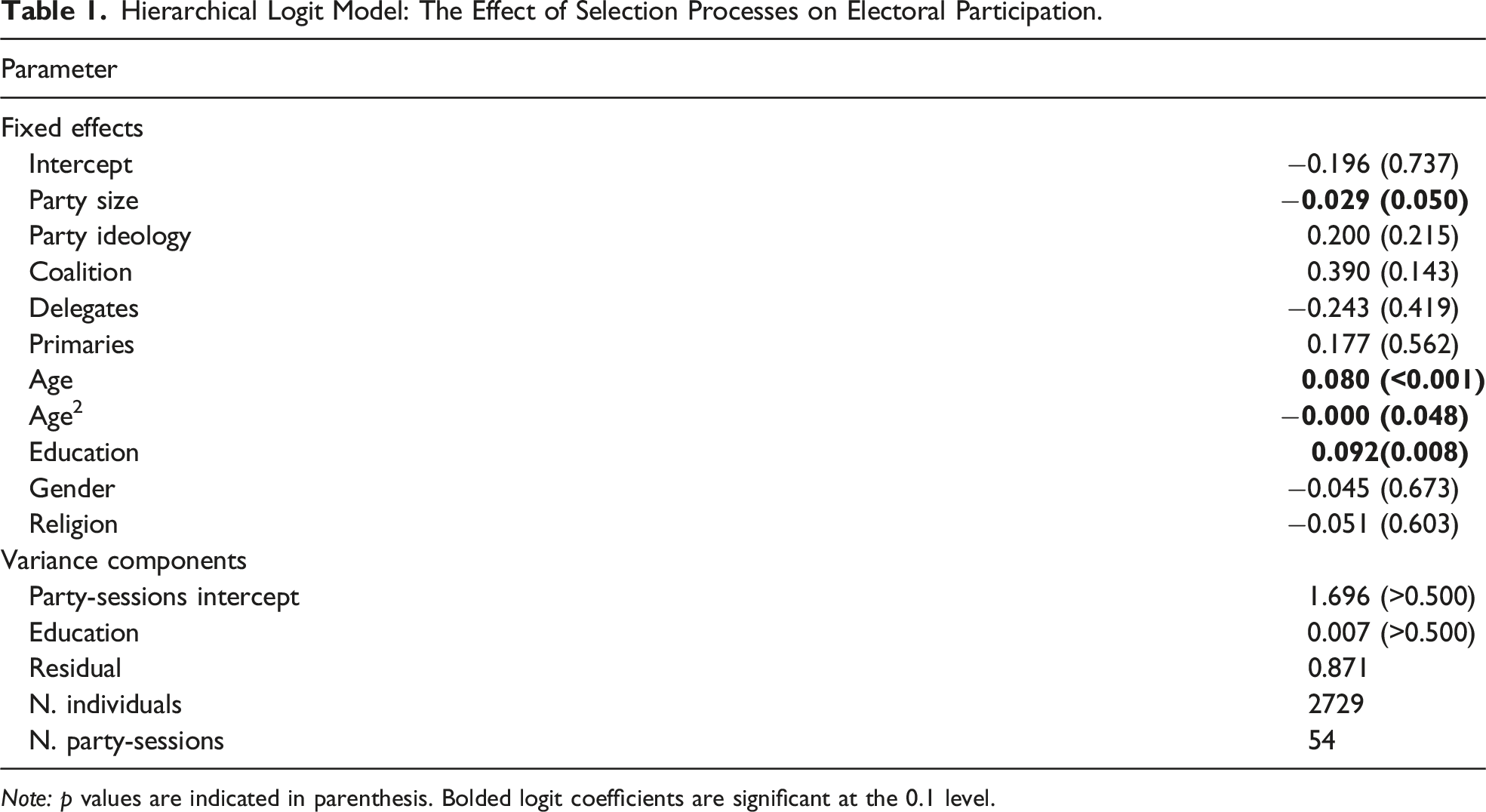
Hierarchical Logit Model: The Effect of Selection Processes on Electoral Participation.
Note: p values are indicated in parenthesis. Bolded logit coefficients are significant at the 0.1 level.
The unit-specific analysis models the expected outcome (vote) on a given set of random effects(u0j). To begin with, it is evident that selection processes are not related to people’s tendency to participate in elections. Neither the Primaries nor the Delegates variables are significant indicating that supporters of parties that use primaries are not more likely to vote on election day, compared to identifiers with parties that use delegates or party leader(s) to select their lists. By the same token, supporters of parties that use party delegates to select their list do not differ in their inclination to vote from supporters of parties that use primaries or an exclusive leadership selection. These null results mimic previous findings in the literature on the link between intra-party democracy and electoral participation. In fact, at the party level, it seems the only variable which might affect odds for voting is the party’s size. Thus, as party size increases by one seat, the odds of voting for the party decrease by 3%. Likewise, the predicted probability that a respondent will vote for a party that won 2 seats in the Knesset (its minimum value) 16 is 0.63, while the predicted probability to vote for a party that won 38 seats (its maximum value) is 0.37, holding all other covariates constant.
At the individual level, age and education seems to bear an effect on electoral participation. It seems age exhibits a curve-linear relationship with the probability of voting, whereas education increases the odds of voting. For a 1 year increase in education, the odds of voting are expected to change by a factor of 1.082, holding all other variables constant. While this effect seems small, for a standard deviation increase in education (=3.12 years), the odds are expected to change by a factor of 1.28, holding all other covariates constant. In other words, the odds of voting increase by 28%, holding all other variables constant.
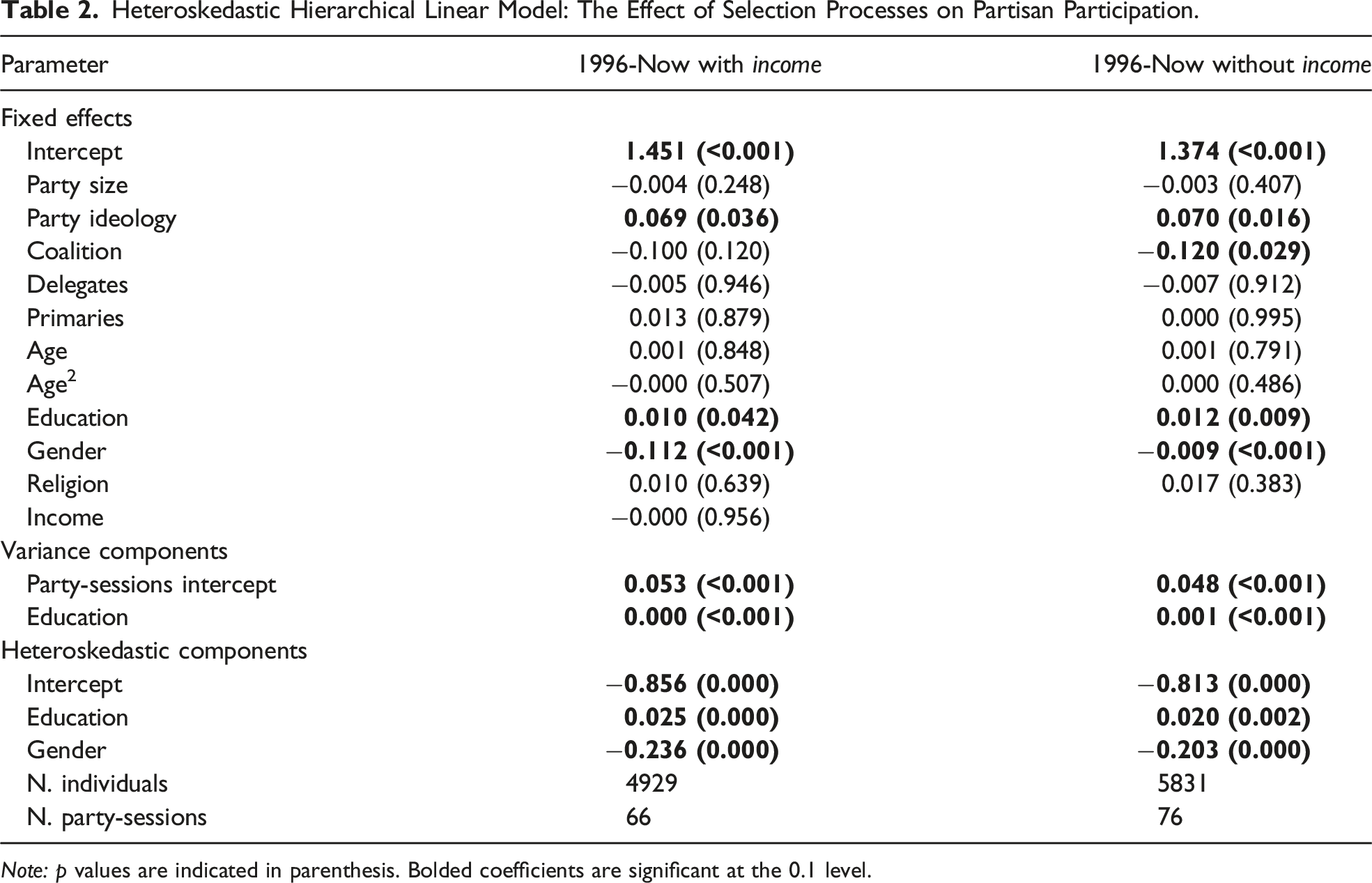
Heteroskedastic Hierarchical Linear Model: The Effect of Selection Processes on Partisan Participation.
Note: p values are indicated in parenthesis. Bolded coefficients are significant at the 0.1 level.
Table 2 further corroborates previous findings concerning the inability of inclusive selection processes to enhance and increase citizens’ meaningful participation in parties. Specifically, the scope of the selectorate a party uses has no effect on its ability to attract active supporters and members. Compared to parties that utilize a restrictive small group of party leaders, parties that use delegates and those that use primaries do not encourage their supporters to actively participate in the party’s affairs, as is indicated by the non-significant coefficients of delegates and primaries in both models. Therefore, we again need to reject H1 which expects a positive association between inclusive candidate selection processes and citizens’ participation levels.
While selection procedures do not seem to relate to partisan participation, other individual-level as well as party-level covariates do. Thus, a party’s ideology seems to be related to its supporters’ tendency to get formally involved: supporters of left wing parties tend to be more formally active than supporters of right wing parties. Note though, that while the effect is statistically significant, its substantive size is small. At the individual level, respondents’ education level and gender seem to affect partisan participation, as females are less inclined to actively support or enroll in an active duty in parties compared to men (expected activity levels of 1.47 and 1.58, respectively), and more educated people tend to be more actively involved.
The results thus far support the assertion that was demonstrated previously in the literature that democratized—more inclusive—selection processes do not necessarily increase citizens’ political participation, and specifically, their levels of electoral and partisan participation. 17 We now move on to the second part of the empirical analysis, which is a test of the association between selection processes and political engagement, that is, citizens’ tendencies to discuss politics with friends and family, or their inclination to pay attention to politics via the media.
To begin with, we measure people’s tendency to watch political party ads on TV during the electoral campaign. 18 Next, we investigate whether and how selection processes affect people’s inclination to read daily newspapers. 19 If our theoretical argument is correct, we should see that respondents, who identify with parties that use more inclusive selectorates to determine their list will tend to exhibit higher levels of attentiveness to political issues, in line with hypothesis H2.
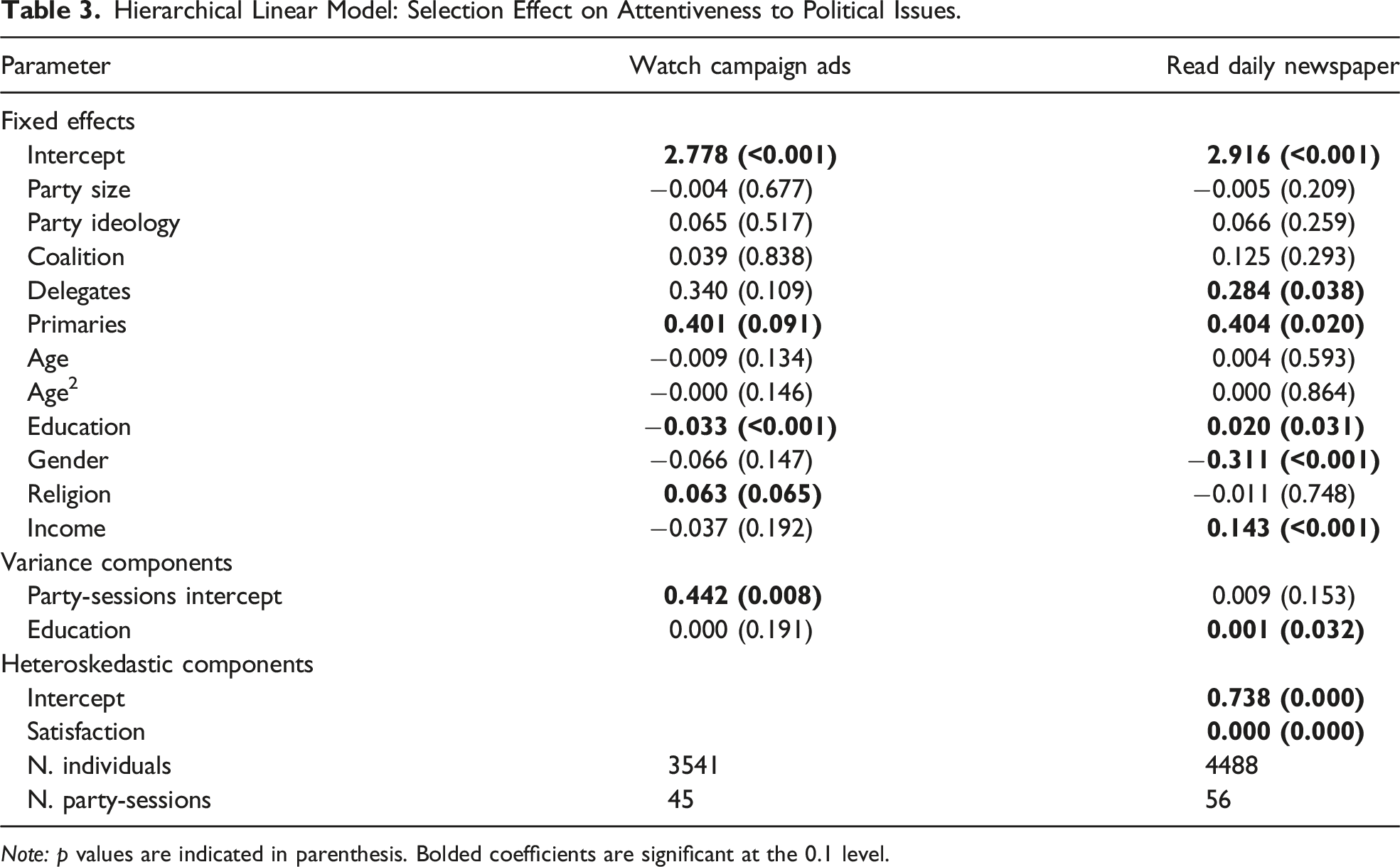
Hierarchical Linear Model: Selection Effect on Attentiveness to Political Issues.
Note: p values are indicated in parenthesis. Bolded coefficients are significant at the 0.1 level.
Table 3 provides quite strong support for hypothesis H2: respondents who support parties that use primaries are more likely to be attentive to political issues measured as their tendency to watch campaign ads and read daily newspapers, compared to supporters of parties that use a restrictive process to select their lists. Supporters of parties that use an elected party organ to select their lists (such as a delegated committee) are more likely to read daily newspapers, yet they do not differ in terms of campaign ads consumption from supporters of parties that use exclusive selectorates. Specifically, the expected value of watching ads for supporters of parties that use primaries is 2.64, for supporters of parties that use delegated organs if 2.52 and for supporters of parties that use exclusive selections is 2.18. 20
While not the prime focus of the current manuscript to further support the hypothesis about the link between democratized selection processes and media attention, we anecdotally provide evidence that primaries receive more media attention than selection via exclusive procedures. To this end, we compare the coverage of 2 major Israeli daily newspapers: Haaretz and Yediot Ahronot, and look at the number of articles that dealt with candidate selection prior to the 2013 elections. We check between the following dates: 11/4/2012–22/1/2013, whereby the later date was the date of the general elections. We compare the Likud, which held primaries to Shas and Yesh Atid, which, selected via very exclusive procedures. In Yediot, we found 12 articles that dealt with Likud’s primaries, 3 that dealt with Yesh Atid’s list selection, and no article for Shas’. In Haaretz, we found 5 articles that dealt with Likud’s primaries, 1 that covers Shas’ selection, and no article that covers Yesh Atid’s.
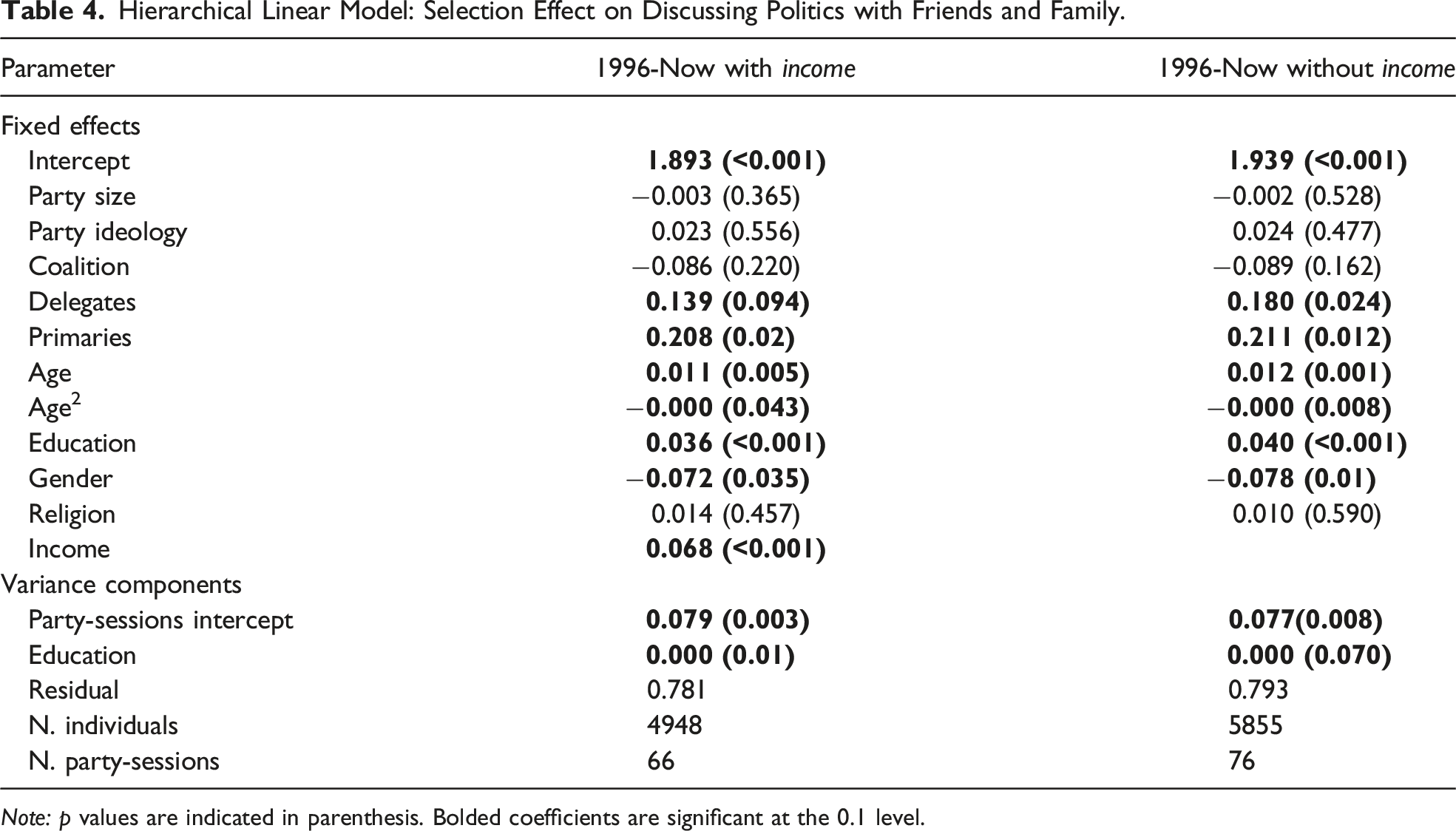
Hierarchical Linear Model: Selection Effect on Discussing Politics with Friends and Family.
Note: p values are indicated in parenthesis. Bolded coefficients are significant at the 0.1 level.
The results reveal that respondents who support parties that use inclusive procedures tend to discuss political issues more often compared to those who support parties in which an exclusive group of non-elected officials select candidates (expected values of 3.05 and 2.83, respectively). Interestingly this is the only party-level covariate that significantly relates to citizens’ political engagement, as neither a party’s ideology nor its coalitional status seem to bear an effect. Again in line with H2, Inclusive selections seems to foster a more widespread political discussion amongst citizens than exclusive selection procedures. 21
Various individual-level predictors also affect citizens’ tendency to discuss political issues with their inner circles. The analysis demonstrates that females are less likely to verbally engage their family and friends with political concerns. The more educated and the richer a person is, the more they discuss political issues. Age seems to bear a curvilinear relationship whereby, the older a person is, the more likely they are to talk about politics, but at a certain threshold this trend reverses itself.
Conclusion
This article analyzes the link between democratic candidate selection processes and citizens’ participation and engagement levels. In line with earlier studies, we find no effect on two types of participation that are conceptually close to intra-party democracy: electoral and partisan participation, which reinstates the scholarly pessimism about the ability of parties to influence citizen behavior through intra-party democratization efforts. However, the models explaining levels of political engagement measured using three different indicators provide a more optimistic image and report a significant positive association. Thus, in line with other recent studies (Pedersen and Schumacher 2015; Cozza and Somer-Topcu 2021), we bring evidence for increased public involvement and attentiveness to politics in a context of inclusive intra-party processes. However, we cannot estimate based on our study if this is indeed a short-term effect, similar to mentioned studies.
Increased engagement, rising attentiveness to political issues, and more frequently discussing politics with friends and family are considered as necessary preconditions for political participation. If our empirical analysis was solely focused on the link between intra-party democracy and engagement, we could have concluded that political parties can serve as mobilization agents after all. This is an argument from the classic literature (e.g., Dalton and Wattenberg 2002) which had gotten less convincing as it lacked empirical support from earlier studies on the consequences of intra-party democratization. However, we also tested the link with participation, and this part of our analysis showed no effect of democratic intra-party selection methods on citizens’ participation levels. In other words, there seems to be a structural disconnection between engagement and participation: even though citizens seem to become more engaged when parties select their candidates in an inclusive manner, this does not translate into higher levels of electoral or partisan participation.
What might explain this peculiar disconnection between political engagement and participation when it comes to intra-party democracy? As this study focused on candidate selection processes, which typically take place shortly before legislative elections, it is unlikely that the positive effect of those inclusive selections already waned off entirely over time. Moreover, engagement and participation levels were gauged in the same cross-sectional survey, which was run very close to election day for each of the seven Israeli election cycles. The fact that we focused on candidate selection processes for the Israeli legislative elections, which are organized under closed list PR with long lists of candidates for a nationwide Israeli constituency, strongly reduces the chance that increased engagement among citizens is actually caused by a single leader, as would be more likely found in leadership selections’ effect.
A first potential explanation for the disconnection are contextual effects that are not taken into account in this study. While motivation and political involvement might be generally acknowledged as crucial precursors to participation, voting in an election or getting involved in party life prior to an election can be affected by other contextual determinants, such as the closeness of the election, whether the election deals with powerful political office, or whether the previous election was recent or not (Blais and Daoust 2020). These are elements we are not able to account for in our single country study, but which could be included in a broad cross-national design on the relationship between intra-party democracy and citizens’ participatory behavior. Moreover, we also see other relevant factors at the individual voter level that should be examined more closely in future research and which might drive the disconnection between engagement and participation among voters. Party supporters and members might approach intra-party participatory devices and voting in elections rationally, and will only participate if they estimate their party membership and vote in the election have an impact on the outcome (Wauters 2010). Unfortunately, we lack data on respondents’ perceptions of their impact on elections and intra-party selection outcomes.
Another potential explanation for the disconnection is that citizens are not necessarily convinced that parties should adopt inclusive decision-making processes. Close, Kelbel, and van Haute (2017) ask whether citizens are in favor of democratized selection procedures and show that preferences are relatively heterogeneous and depend on educational and efficacy levels, political interest, and trust. This also has important consequences for possible connections between democratic procedures and participation levels. As the authors themselves state: “Yet formally enlarging the right to participate in the selection of candidates does not entail that voters would actually participate if they were given the opportunity” (Close, Kelbel, and van Haute, 2017, 660). It could be the case that some sympathizers and members do not support democratic procedures because intra-party competition has previously brought internal disagreements to the forefront. These experiences leave them dissatisfied with their parties’ internal working and, at least a significant share of them, unwilling to participate in democratic selections. In sum, besides rationally calculating whether their (new) membership and participation in democratic selection processes is worth the hassle, some citizens and party supporters might also refrain from participating because inclusive intra-party procedures do not match their preferred party model. The INES surveys unfortunately do not include any items on preferred party organizational models for political parties. Section 8 in the online Supplemental Appendix provides analyses and discussion of using education as a proxy for candidate selection preferences, allowing it to interact with selection processes to model the preference heterogeneity. All in all, the analysis does not find support for the existence of such a conditional effect.
A third and straightforward reason why only citizen engagement is affected is the much higher threshold to actually take part in participatory behavior, which requires more knowledge, time, and civic skills than following the news or talking about politics. The boost in engagement has to be substantial before any effects could spill-over into actual political participation.
Finally, we want to point to a number of issues regarding our study. First, as we use cross-sectional data on Israeli voters in seven election cycles, we cannot ascertain whether the positive and significant coefficient of the selectorate variable points to a causal effect of candidate selection on political engagement. It might be the case that politically engaged citizens are more inclined to vote for the type of party that experiments with democratic intra-party processes. Instead, our analysis brings evidence that inclusive candidate selection processes are positively associated with higher levels of political engagement among citizens. A natural survey experiment tapping political behavior of real-world party supporters and members in the context of intra-party democratization would allow us to tease out the causal mechanisms at work. Moreover, our study is based on Israel, a highly interesting country case to examine the relationship between political engagement and candidate selection processes, as Israel is a country with considerable variation in the independent variable of interest. Ideally, future research efforts undertake a cross-national analysis of political engagement levels to increase the external validity of the reported findings and to test for the effect of macro-level variables on participation and engagement levels.
Furthermore, we cannot entirely rule out that the positive association between democratic candidate selections and political engagement stems from negative attention by citizens and media. This makes an important difference to the normative discussion of our findings. If increased engagement levels are only fueled by displays of internal conflicts, democratic candidate selections are normatively undesirable as these processes can delegitimize party institutions. If, on the contrary, intra-party democracy draws positive attention from the public, both parties and democratic systems in general benefit from its inclusive nature. In the future, we intend to devise an experiment to test whether the increased engagement levels resulting from democratized selections are the outcome of positive or negative attention. Yet one should bear in mind that the detected association might be explained by both positive and negative public attention: regardless of whether the selection process runs smoothly or outs the party as hopelessly divided, citizens become more politically engaged. The normative desirability of introducing intra-party primaries then largely depends on the organizational maturity and internal cohesion of the parties under study.
Supplemental Material
sj-pdf-1-prq-10.1177_10659129221119203 – Supplemental Material for Are Citizens More Politically Engaged when Candidate Selection is Democratic? Analysis of Seven Parliamentary Election Cycles in Israel (1996–2015)
Supplemental Material sj-pdf-1-prq-10.1177_10659129221119203 for Are Citizens More Politically Engaged when Candidate Selection is Democratic? Analysis of Seven Parliamentary Election Cycles in Israel (1996–2015) by Gert-Jan Put and Yael Shomer in Political Research Quarterly
Footnotes
Declaration of Conflicting Interests
The author(s) declared no potential conflicts of interest with respect to the research, authorship, and/or publication of this article.
Funding
The author(s) disclosed receipt of the following financial support for the research, authorship, and/or publication of this article: The research for this paper was funded by the Israel Science Foundation (184/15).

Supplemental Material
Supplemental materials for this article are available with the manuscript on the Political Research Quarterly (PRQ) website.
Notes
References
Supplementary Material
Please find the following supplemental material available below.
For Open Access articles published under a Creative Commons License, all supplemental material carries the same license as the article it is associated with.
For non-Open Access articles published, all supplemental material carries a non-exclusive license, and permission requests for re-use of supplemental material or any part of supplemental material shall be sent directly to the copyright owner as specified in the copyright notice associated with the article.
