



Abstract
Saxony remains a hot spot for far-right mobilization making it a prominent case for studying Neonazi-networks as well as broader issues of challenges for democracy. Local and regional mobilization has intensified during the political contestation of migration 2013ff. with Dresden’s PEGIDA becoming a benchmark for regional regressive movements. During the pandemic, we observed yet another uptick in far-right mobilization, again deeply rooted in local networks that existed before the crisis and leading to a specific dynamic distinct from other regions in Germany. To explain this phenomenon, it is important to consider regional and local characteristics of identity formation, perceptions of ‘winner-and-loser’ dichotomies, and the broader challenges of global and European inequalities. As this contribution argues, here lie yet idle potentials for the comparative study of Euroscepticism and place.
The Free State of Saxony, East Germany, remains a hot spot for far-right mobilization making it a prominent case for studying Neonazi-networks as well as broader issues of challenges for democracy (e.g. Brichzin et al., 2022; Decker et al. 2023). Local and regional mobilization has first intensified during the political contestation of migration 2013ff. with Dresden’s PEGIDA becoming a benchmark for regional regressive movements. During the pandemic, we observed yet another uptick in far-right mobilization, again deeply rooted in local networks that existed before the crisis and leading to a specific dynamic distinct from other regions in Germany. Euroscepticism has constantly been a talking point in these movements, interwoven with other topics like migration, anti-elitism, climate crisis and so on. To explain this phenomenon, it is important to consider regional and local characteristics of identity formation, perceptions of ‘winner-and-loser’ dichotomies, and the broader challenges of global and European inequalities. As this contribution argues, here lie yet idle potentials for the comparative study of Euroscepticism and place.
The Transformation of the Public Sphere as the New Context for the Study of the Far-Right
The academic debate on the significance of digital media for democracy can be summed up with the diagnosis of a transformation of and threefold challenge for the democratic public sphere in the form of a ‘globalization, commodification and digitalization of the social’ (Seeliger and Sevignani, 2021). Concerning participation in public discourse, optimistic contributions initially predominated, hoping for a more democratic public sphere through the rapid reduction of access barriers (e.g. Gimmler, 2001; Xenos et al., 2014). However, even early optimistic voices were aware that social interactions on the Internet are shaped by formal and non-formal rules, too. Hence, the utopia of a more egalitarian public debate is by no means an automatism. Moreover, according to Habermas (2006: 423), the fragmentation of the public sphere into millions of chat rooms spread across the globe, rather than a common public sphere, leads to a large number of thematically limited public spheres instead of the formation of one egalitarian, global sphere of debate.
At the same time, we observe new mobilization of conspiracists and right-wing extremists organized through social media chats and fuelled by alternative media consumption (Benkler et al., 2018; Boulianne and Lee, 2022; Cosentino, 2020; Fielitz and Marcks, 2020; Rohgalf, 2017). In the Free State of Saxony in East Germany, to provide a regional example, a bottom-up mobilization of citizens against Covid-19 measures and vaccination, driven by long-existing anti-democratic resentment and authoritarian orientations (Decker et al. 2023) was met by effective networking strategies of extremist groups like the Free Saxons (Freie Sachsen) who not only challenge specific policies, but European integration and the democratic state or, frankly, democracy itself. In our monitoring project, we find that citizens do follow large national or regional channels, but, at the same time, they are usually organized in only one or two local chat groups. Local and very tangible topics are frequent. People discuss, to give an example, where in the region they can send their children for recreational activities without wearing a face mask. I want to show in this short article, thus, that to understand possibly newly arising societal cleavages, we must consider the online sphere and its local context at the same time. This is related to the hybridization and decentralization of far-right organizations (Blee and Latif, 2020) but also the ‘localization’ or regional embeddedness of people’s everyday life experiences and the aforementioned fragmentation of the public sphere. Mobilization against Europe, vaccination and/or refugees, it seems, is particularly effective when it brings together globally spread narratives (like ‘the great replacement’, cf. Cosentino, 2020) with local (perceived) pressures and identity formation.
More generally, we have to question the role of modern communication technology in new authoritarian protest movements as well as radicalization in local contexts. This is particularly challenging as we should not only produce numerous case studies but aim at comparing and linking the examination of political dynamics and socioeconomic trajectories of specific places. While we know much about populists’ use of the media and social media in particular, i.e. the supply side, studying the demand side of populism within (digitalized) local/regional settings requires new tools and approaches while at the same time keeping a comparative perspective. Such endeavours have to react to short-term crises but also rapid technological change and are thus vulnerable to the resource-demanding proposal writing culture for academic funding as well as rigid project specifications. We can gain, however, with such studies an understanding of fragmented, localized public spheres and dynamic, populist discourses that result from and at the same time reinforce the ongoing transformation of the public sphere.
The focus on regional movements or cases of far-right mobilization particularly provides insights into the study of Euroscepticism for at least two reasons. First, regional movements often portray themselves as antagonists to the centralization tendency and the egalitarianism of European integration. Hence, understanding the demand side of these mobilizations helps uncover regional narratives of ‘being left behind’ and identities – take the name of the extremist Free (sic!) Saxons – and also the material preconditions such as winner and loser dichotomies (Kiess et al., 2017), the evident geographic imbalance of benefits of European integration (Rodríguez-Pose, 2018; Rodrik, 2017) or the social grievances caused by globalization, digitalization and neo-liberalization (Colantone and Stanig, 2018) shaping Eurosceptic politics while at the same time avoiding the national container fallacy. Second, the sovereigntist call of far-right populists across Europe at some point inevitably resorts to Eurosceptic agitation. Comparatively, studying regional differences and commonalities of far-right mobilizations even if they are not at its core or in the beginning Eurosceptic thus promises to advance the literature on Euroscepticism.
Studying Digital Fascism: A Regional Perspective
The starting point of a new research agenda of contemporary far-right mobilization in the context of the digital transformation of the public sphere is a thorough understanding of key strategies and actors. Maik Fielitz and Holger Marcks (2020) use the term ‘digital fascism’ to describe how the extreme right went online in recent years. The decisive factor in terms of content and underlying ideology is the ‘guiding image of the awakening of a threatened nation’ as a fascist logic (Fielitz and Marcks, 2020: 39). Whether it is a ‘refugee crisis’ or a pandemic is irrelevant. As we have seen in the anti-vax mobilizations, protesters often build identity upon the rejection of the ’mainstream’ and the pure act of being against ‘it’, no matter what or who ‘it’ is (Amlinger and Nachtwey, 2022: 273). This is also one shared characteristic that connects a wide range from less radical to extreme right actors and movements (for the argument of using far-right as an umbrella concept, cf. Pirro, 2022). Here, the conceptualization of populism as a ‘thin ideology’ (Mudde, 2004) that at its core focuses on the distinction between the pure people and the corrupt elites, is more than instructive.
Building on the Manichean worldview of the good people versus the bad elites, radicalization is a logical consequence – this is precisely the danger of misunderstanding populism as a soft version of extremism thus underestimating the radical logic at its core. Doomsday scenarios and conspiracy narratives demand
heroes who continue the story toward a national happy ending. Where the state can no longer be relied upon, it is a matter of taking matters into one’s own hands to protect the community from invaders and to clean up with traitors (Fielitz and Marcks 2020: 42).
Leading the way are extreme right-wing influencers, which cadres of the Identitarian movement, for example, like to stylise themselves as. Unsurprisingly in the German context, the keyword givers are well-known figures from the neo-Nazi and Alt-right milieu, such as Götz Kubitschek. He wants ‘the rift to become even deeper’ (quoted in the work of Stegemann and Musyal, 2020: 222), while at the same time pleading for ‘self-extenuation’ (p. 225). For the new generation of Identitarians, this then becomes the strategy of a ‘mixture of shock and normalisation’ (according to Martin Sellner in Sezession, quoted in the work of Stegemann and Musyal, 2020).
In our project, we look particularly at the case of Saxony and regional dynamics within the far-right and conspiracist Telegram scene (Kiess and Wetzel, 2022; Kiess et al., 2022; Kiess and Wetzel, 2023). For this purpose, we collected all geographically (i.e. operating in/from Saxony) and thematically (i.e. right-wing extremist, conspiracist and anti-vax movement) relevant channels and groups (our N varies around 300) and started monitoring them. For ethical as well as practical reasons, we focus on openly published messages. While we, therefore, ‘only’ monitor the visible part of this radicalized milieu, the dynamics in the dataset still allow for accessing thematic and structural shifts. For ethical reasons, we do not use any personalized information except for public figures (e.g. party members or spokes persons of the movement organizations). All messages, linking actions and metadata are stored live to avoid deletion and thus loss of data. We use network analysis, natural language processing and qualitative methods to understand networks, changes in topics, adaptations to external irritations and, not least, offline mobilization and radicalization.
Already at an early stage, we were able to confirm that users are organizing predominantly at the local level. As Figure 1 shows, the 16,700 Telegram accounts covered in March 2022 showed a networking degree of 1.3, that is, the majority is a member in only one group, most likely of her or his hometown (we are for legal and ethical reasons not able to identify the persons and their exact location). If we see multiple memberships, then it is mostly among regionally close groups. Hence, city names in the figure arrange in approximate proximity, although not geographically correct: groups from the city of Leipzig (on the right) appear close to each other and close to a group from Northern Saxony (Nordsachsen); groups from the East Saxonian cities of Kamenz, Bautzen and Görlitz cluster on the lower left and so on. This is a first hint that Telegram allows users to orient themselves within their (local) comfort zone further fragmenting the public sphere.
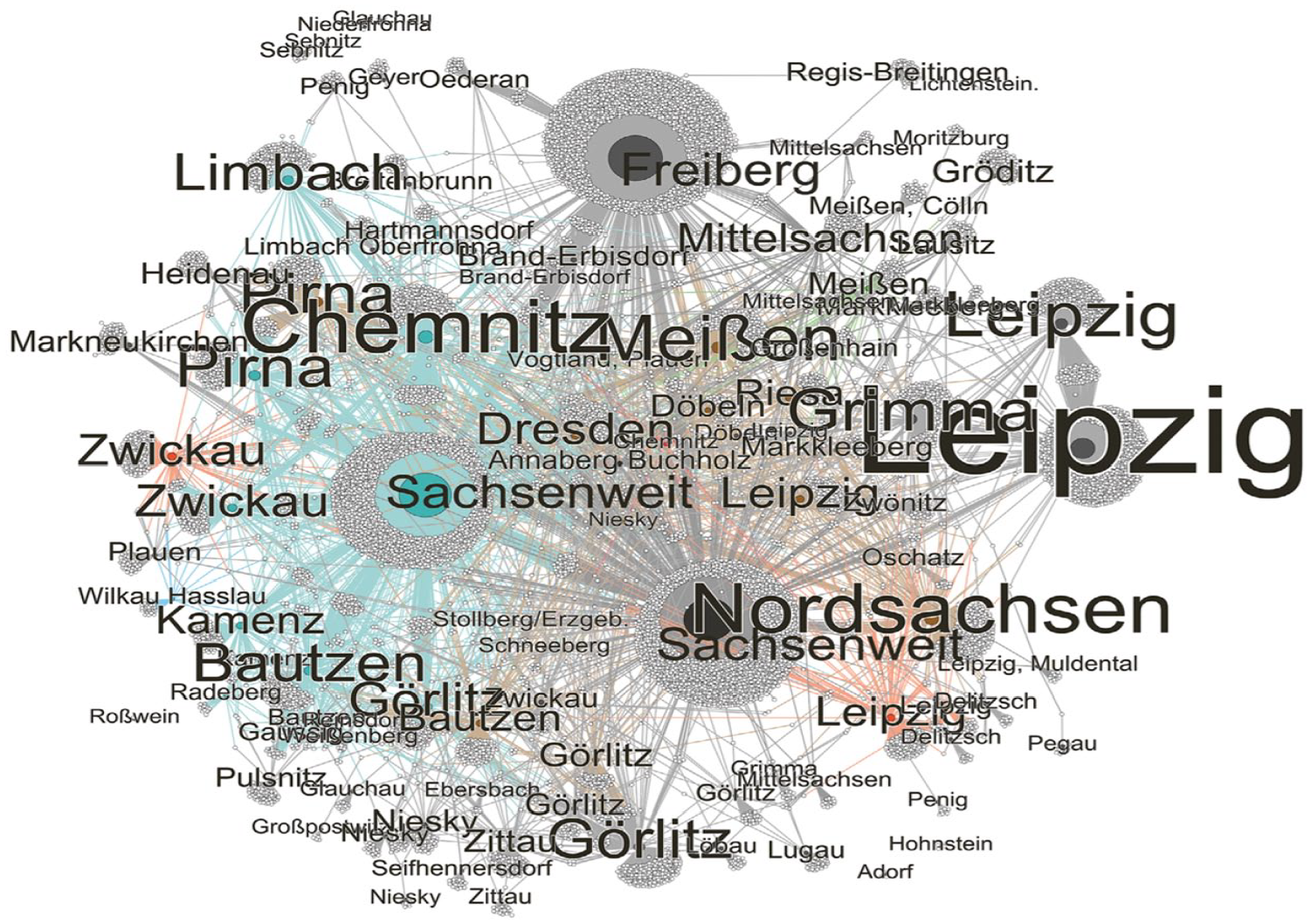
Group Member Network Based on Memberships per Individual Account (March 2022).
A second observation concerns the network of channels in Saxony based on references to each other (Figure 2). In the centre sits, the main channel of the Free Saxons, which receives the most references from other channels, that is, other channels regularly link to messages posted by the Free Saxons. This is the result of a well-orchestrated social media campaign and street mobilization of the right-wing extremist party. While some channels like those of the neo-Nazi party Der III. Weg (The Third Way) on the upper right or PEGIDA-protagonists Lutz Bachmann and Siegfried Daebritz (lower centre) are more distant from the majority of channels, the network forms a relatively homogeneous picture indicating an integrated milieu of channels. Peculiar is the large number and also spreading of QAnon-related channels. Channels devoted to spreading this particular narrative are active across the scene that proves the global importance of the narrative (Cosentino, 2020; Langer, 2022). The network itself forms a relatively closed public sphere, that is, we observe no interaction with democratic parties, legitimate media outlets or activists from other political spectra.
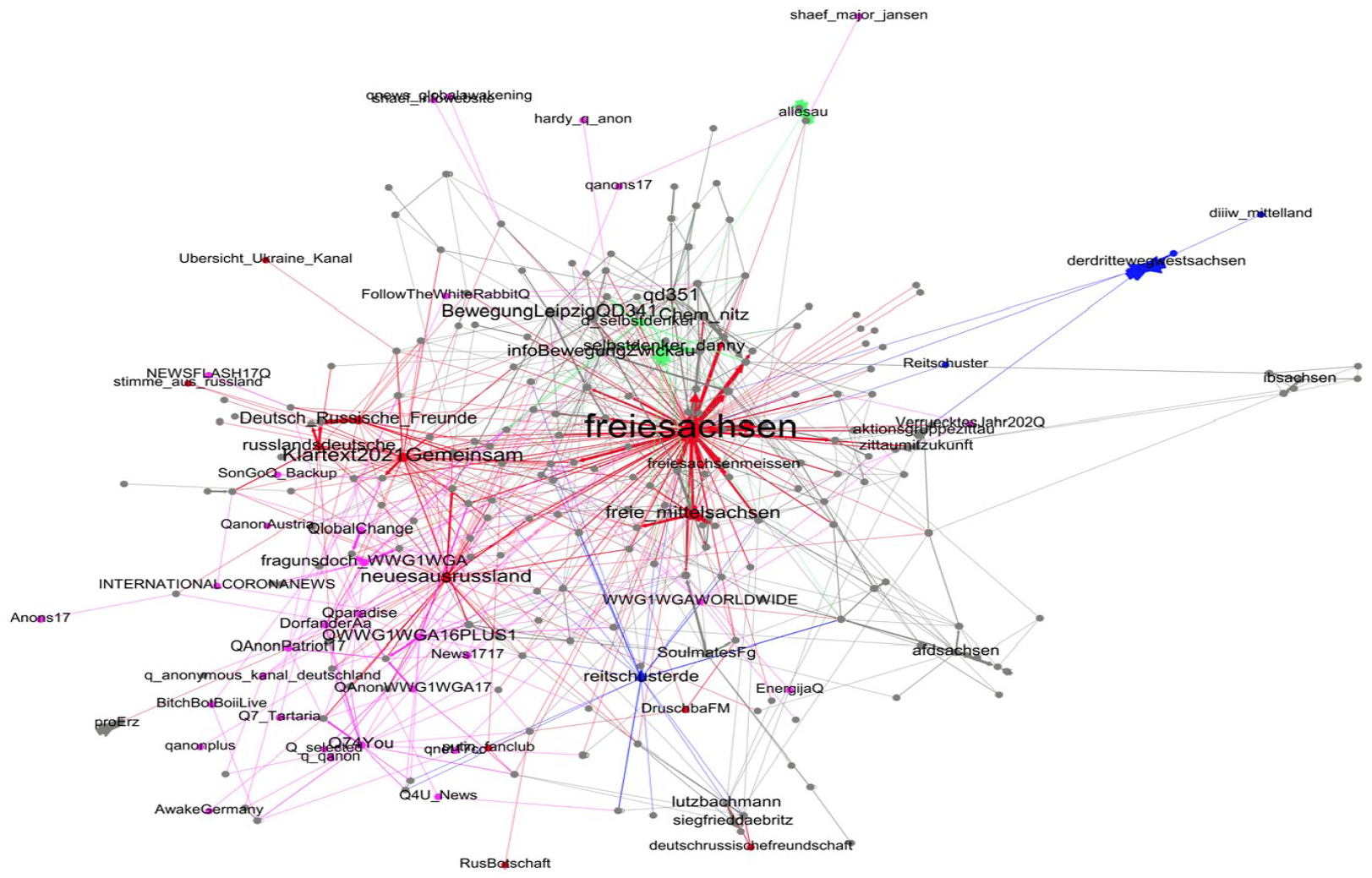
Network of Far-Right and Conspiracist Telegram Channels in Saxony Based on Links to Each Other (May 2022).
Both Figures together provide a first picture of the regional scene of far-right and conspiracist groups in Saxony, East Germany. Although there is one actor with particular influence in the regional scene, namely, the Free Saxons, the movement is far from centralized and homogeneous. Rather, this far-right Telegram scene is itself fragmented and more or less independent local groups play an important role while, ideologically speaking, we observe a wide range from esoteric groups focusing on allegedly harmful face masks and vaccinations (Eltern stehen auf, parents rising), the already established far-right Alternative für Deutschland (AfD) focusing on vote maximization, to militant Neo-Nazi groups like the Third Way more interested in cadre training. What brings them together, anyway, is a rather diffuse anti-democratic sentiment. This hybridization and decentralization as well as the movement character of the Saxonian far-right longs for theory-driven comparisons with other cases to put into perspective what we have found to be an unprecedented dynamic in post-war Germany.
To enable, third, observations of the use of Eurosceptic frames in the Saxonian far-right Telegram scene, I make use of our topic modelling approach (introduced in Kiess and Wetzel, 2023). Applying BERTopic on our sample of tens of thousands of messages in the period from 1 January 2023 to 17 April 2023, we automatically derived 1347 topics. I then selected those topics that frequently contained the words ‘Europa’, ‘EU’ and/or ‘europäisch’. Here, I can only provide a very small insight: The most important Europe-related topic comes in on place 72 of our list of topics and contains 100 messages revolving around (allegedly) European climate policies that would harm homeowners. Fearmongering with labels like ‘expropriation’, the messages resemble classic populist-Eurosceptic framings of ‘evil’ EU-elites aiming to take away from ordinary citizens. In another topic, ranking 254th in our list, messages claim that the EU commission aims at enforcing (predominantly ‘islamic’) immigration to Europe, which justifies claims like ‘DEXIT, IREXIT, ILATEXIT, GREXIT und ROEXIT’. 1 In another topic, messages claim that Hungary would leave the EU because of its LGBTIQ-supporting policies. Hence, anti-immigrant, anti-Muslim and anti-LGBTIQ resentment is connected to EU institutions and this combination is then used to reinforce the sense of revolt against the ‘elites’ that dominates the debate on Telegram. In sum, Euroscepticism is by no means dominant in this particular Saxonian Telegram-bubble. Among the dominant mobilization frames are migration, climate change, parenting/children/schools, Covid-19, Ukraine/Russia and others. However, Eurosceptic frames and blaming EU institutions for policies against the ‘ordinary, hard-working people’ are readily adopted and interwoven with other far-right frames whenever it is opportune for agitators.
The study of online mobilizations on a regional level offers insights into the supply side of far-right agitation and also the demand side because it is possible to track not only member and follower numbers but also views, shares and genuine comments versus copy and paste content. Covering local groups is the key to detecting regional dynamics. At the same time, national, European or even global knowledge networks can be traced following the spread of particular narratives (QAnon, Great Replacement) and also particular memes or other types of content. Here lies also one of the potentials of comparative work across European regions. While we may expect similar instances of hybridization and decentralization, studying how this is adapted in regional contexts with different political, social and economic dynamics would advance our understanding of populist Euroscepticism and the far-right more generally.
Concluding Remarks
This contribution aimed at linking the theoretical perspective of the ongoing digital transformation of the public sphere, the related challenges of far-right mobilization for democracy, and, even more so, its study, with the bottom-up approach taken with our project studying far-right mobilization in Saxony via Telegram. I maintain that regarding our efforts to track and understand the regional logic of far-right politics, its relationship with Euroscepticism, and the role of social media, we are still a long way from piecing together the relevant theoretical perspectives, technical tools and methodological approaches. Given the complexity of such an endeavour, particularly the comparative aspect must not get lost in our interest in case studies and the need for timely informing regional and national stakeholders. What is indeed warranted are platforms for institutionalized scholarly exchange to advance our studies and possibly even integrate them.
Footnotes
Declaration of conflicting interests
The author(s) declared no potential conflicts of interest with respect to the research, authorship and/or publication of this article.
Funding
The author(s) received no financial support for the research, authorship and/or publication of this article.
