



Abstract
This research delves into the abundant landscape of party positioning data, highlighting a scarcity of interconnected voter and party positioning sources. Leveraging Voting Advice Applications (VAAs), this study explores congruence from a comparative standpoint, capturing political preferences on the same scale and timeframe. Analysing data from two pan-European VAAs, EU Profiler and
Introduction
Political parties are channels of expression for citizen preferences and demands. Accordingly, political representation is the ultimate goal in the relationship between parties and citizens (Sartori, 2005). A higher degree of representation would suggest that citizen preferences are better reflected in the political stances of the parties, with spillover effects into increased democratic satisfaction (Dalton et al., 2000). The distance between parties and voters is used as a measure of the quality of the political representation process and ultimately, of the good functioning of a democracy.
The match between voters and their representatives lies at the heart of a good democratic process. The last decades of political representation studies present varied results and different portrayals of the linkage between citizens and political elites. On one hand, there is a line of studies that shows that congruence on the left-right (hereafter RiLe) dimension between voters and parties is high (Dalton, 1985, 2013; Powell, 2000; Thomassen, 1994), suggesting that the representation process is successful. On the other hand, various strands of representation studies show weakening ties between citizens and their representatives on the ideological RiLe, but also on narrower policy dimensions (Bremer, 2018; Clements et al., 2018). Replicating findings from one of the first studies to compare issue congruence across EU countries (Dalton, 1985), Dalton (2017) shows that while there are high levels of congruence on the RiLe scale between citizens and their preferred party, the strength of this linkage varies across issue dimensions. While the linkage is strong on policies that belong to the RiLe dimension, it is weaker on policies related to immigration and gender issues. This research builds on these findings and explores issue congruence in contemporary democracies, extending the analysis to all countries of the European Union using VAA-generated data.
The aim of this study is to investigate the linkage between parties and their supporters, in EU nations, beyond the RiLe continuum. Congruence is assessed as the distance between the position of the party and the position of the party supporters on three issue dimensions: cultural, economy, and gender. The study will also look into the determinants of issue congruence, focusing on the features of the political parties, namely ideological leaning, governmental status, and the niche/mainstream party dichotomy while accounting for the age of the party and features of the electoral system. Congruence is referred to as the match between prospective voters in the elections to the European Parliament (hereafter EP) and their most preferred party, on a set of 11 policy issues. The data were collected with the help of two pan-European VAAs, the 2009 EU Profiler and 2014
EP elections are not used here to inspect the level of support for the EU. Similar to Dalton (2017), they are used as an event when a large number of countries hold elections simultaneously and voters reconsider their policy preferences. Although treated as second-order elections, voters prioritize their true party preferences (Reif, 1984), and make choices based on the national context rather than on the parties’ stances on EU issues Clark and Rohrschneider (2009). Recent findings on European identity show that European attachments exist in combination or as an alternative to national identities (Dalton, 2021). These identities overlap with partisan attachments, creating a solid base for the study of congruence with data from EU elections.
This article proceeds in five steps. First, we discuss the political representation literature that lays the theoretical foundations of this study. Second, we present the empirical aspects of this work, introducing the data, followed by the measures of congruence on three issue dimensions. Third, we consider the effect of institutional factors. Fourth, we inspect the effect of the determinants of issue congruence at party level. The last section presents the findings and implications for congruence studies and VAA research.
Studying issue congruence
In the tradition pioneered by Huber and Powell (1994, 2000) congruence is assessed as the distance between the position of the citizens and the representatives on the RiLe scale . The use of the RiLe scale in a comparative perspective is based on two assumptions. First, the meaning of RiLe is the same across national contexts. Second, asking voters to define their policy preferences is too demanding of an exercise (Lax and Phillips, 2012). While it shaped the study of representation, the use of RiLe to assess congruence presents a few caveats. First, RiLe is an ambiguous concept, with its use based on the assumption that in most modern democracies, the left and right represent a unidimensional discourse that is familiar to voters (Powell, 2000). However, while congruence on the RiLe dimension captures the degree of ideological consistency across policy issues, it says very little about citizens’ views on issues themselves (Broockman, 2016). While the process of political representation might prove successful on the RiLe dimension it does not prove that all relevant policy dimensions are constrained by it (Thomassen, 2020). Second, the meanings of RiLe differ across electoral contexts (Benoit and Laver, 2006). Comparing values across 20 European nations, Piurko et al. (2011) show that for the most part, both left and right have coherence, but less so in the post-communist democracies of Eastern Europe, making its use in comparative research highly problematic. Third, RiLe fails to reflect the wide array of issues that shape modern-day politics. Traditionally, the issues embedded in RiLe were of economic nature. More recently, major societal changes have pushed new issues onto the political agenda, such as immigration, same-sex marriage, or the legalisation of the use of soft drugs, that shape the political discourse. With the shift to issue voting, political parties try to dominate the electoral competition with issues they own, such as economic, environmental, or immigration policies, and the nature of the electoral competition forces parties to take a stance on issues they would have previously ignored Thomassen et al. (2005).
For decades of representation research, self-positioning on the RiLe continuum was the only survey component that allowed cross-national comparisons (Blais and Bodet, 2006; Golder and Stramski, 2007). A unidimensional measure does not accurately describe the modern-day political space Dalton, (1985). Even when issues are separated between RiLe and TAN/GAL, the latter fails to form a coherent dimension when viewed from a demand-side perspective (Wheatley and Mendez, 2021
This work contributes to the political representation literature in two ways. First, it uses issue congruence, expanding on the understanding of a political landscape that is continuously evolving. Second, it introduces a new way of studying issue congruence, using VAA-generated data. The measure of agreement between voters and parties is based on a large set of issues, moving away from congruence on the RiLe dimension. We address Golder and Stramski (2007)’s critique that research fails to consider the way in which congruence is most appropriately conceptualised given the research goals and that the process is driven by data availability and convention. Additionally, the reliability of congruence estimates is positively affected by the number of statements and the diversity of the topics included (Lesschaeve and Padmos, 2023).
The measure of congruence developed here builds on the concept of representative deficit, which illustrates the citizens’ political preferences that are not mirrored by the parties’ electoral promises. Introduced by Alvarez et al. (2014), the concept is used in work using VAA-generated data (Dinas et al., 2014; Lacey et al., 2014; Bright et al., 2020; Costello et al., 2021). We use two measures of congruence: centrism, and responsiveness Dalton (1985, 2017). This work adds to the representation literature by introducing a straightforward, cost-effective way of investigating congruence, using VAA data.
Measuring issue congruence
Voting advice applications data
While there is no gold standard in assessing congruence, decades of representation studies identify several desirable characteristics: the alignment of political preferences between citizens and representatives to be measured on the same issues, scale, and at the same point in time. Data used for analysis was collected through two pan-European VAAs developed for the European Parliament Elections of 2009, respectively 2014 (Reiljan et al., 2020b). EU Profiler included 255 political parties from 27 EU nations and
While self-selection bias is the main drawback of VAA-generated data, the advantages outweigh the limitations. Decades of scholarly research in representation studies show that the main limitations relate to the small number of common statements, different question wording, and different measurement scales, as well as data being collected at different points in time, especially when the party positioning relies on expert surveys (Powell, 2009). VAA data offers a generous battery of questions that capture party and voter preference on the same issues, same scale, at the same point in time, across EU member states (Garzia and Marschall, 2019). These characteristics help alleviate a key problem in empirical work on congruence, known as Differential Item Functioning (DIF), used to assess whether survey scales have different measurement properties for different groups of respondents (Hare et al., 2015). As an alternative to procedures that can estimate and correct for voters’ misperceptions, De Angelis (2020) encourages the use of VAA data for the study of congruence, as it can reduce DIF and produce comparable latent policy scores.
Measures of issue congruence
Issue dimensions.
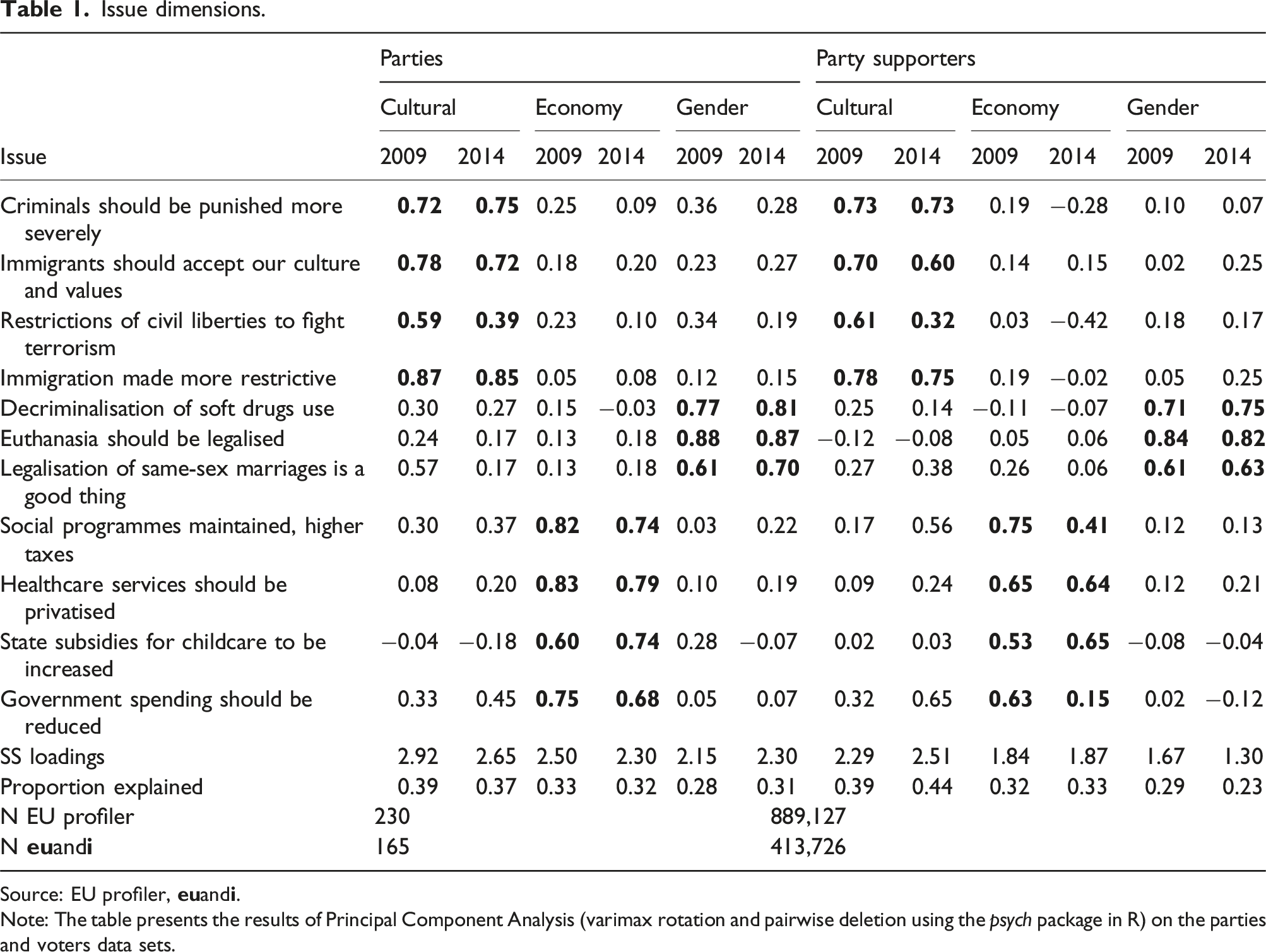
Source: EU profiler,
Note: The table presents the results of Principal Component Analysis (varimax rotation and pairwise deletion using the psych package in R) on the parties and voters data sets.
To assess the link between party stances and their supporters’ political preferences, we employ two metrics. Centrism (Achen 1977; Dalton 1985), quantifies the distance between a party’s position on issue j and the mean position of its supporters on the same issue:
A small value indicates proximity to the center of party supporters’ preferences. The second metric, political responsiveness (Birch 1971; Achen 1977), based on the assumption that the preferences of the party supporters should be relative to the preferences of the parties they support, is gauged through the regression equation:
Figure 1 depicts congruence between parties and their supporters on the economy dimension in 2009. Each dot represents a party dyad, with party positions on the horizontal axis and averaged supporter positions on the vertical axis. The figure reveals a moderate correlation (r = 0.49), and the regression line (b = 1.12) indicates a 1.12-point shift on the x-axis for each unit increase in party supporter opinion. This aligns with findings from Dalton (2017). Although parties and voters use the same 5-point scale, their positions are not directly comparable due to the comparative nature of this study, potentially influenced by systematic respondent-level bias (Lo et al. 2014). Congruence economy dimension 2009. Source: EU Profiler Note: Each dot signifies a party dyad, with the x-axis indicating party positions and the y-axis reflecting the positions of party supporters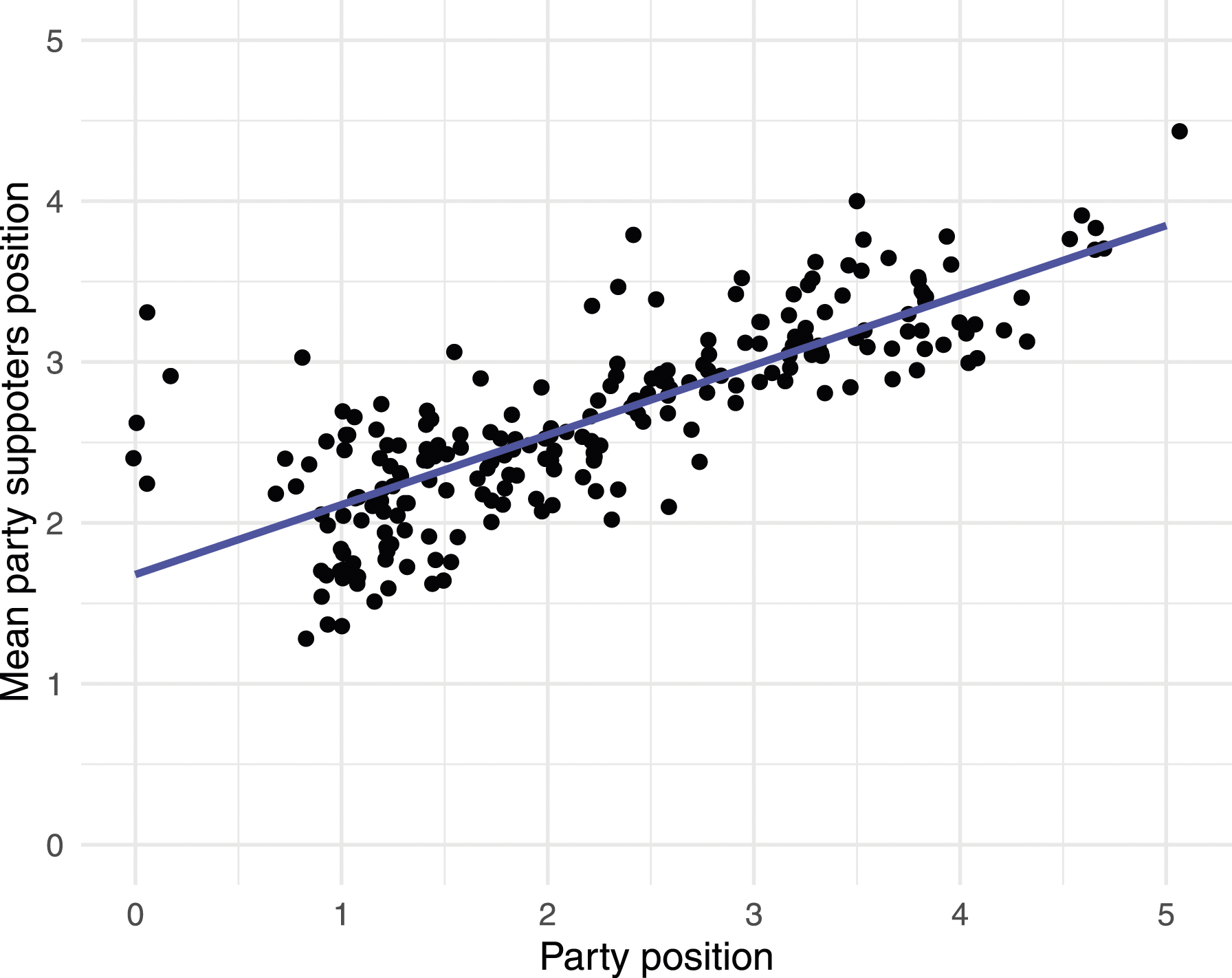
Issue congruence.
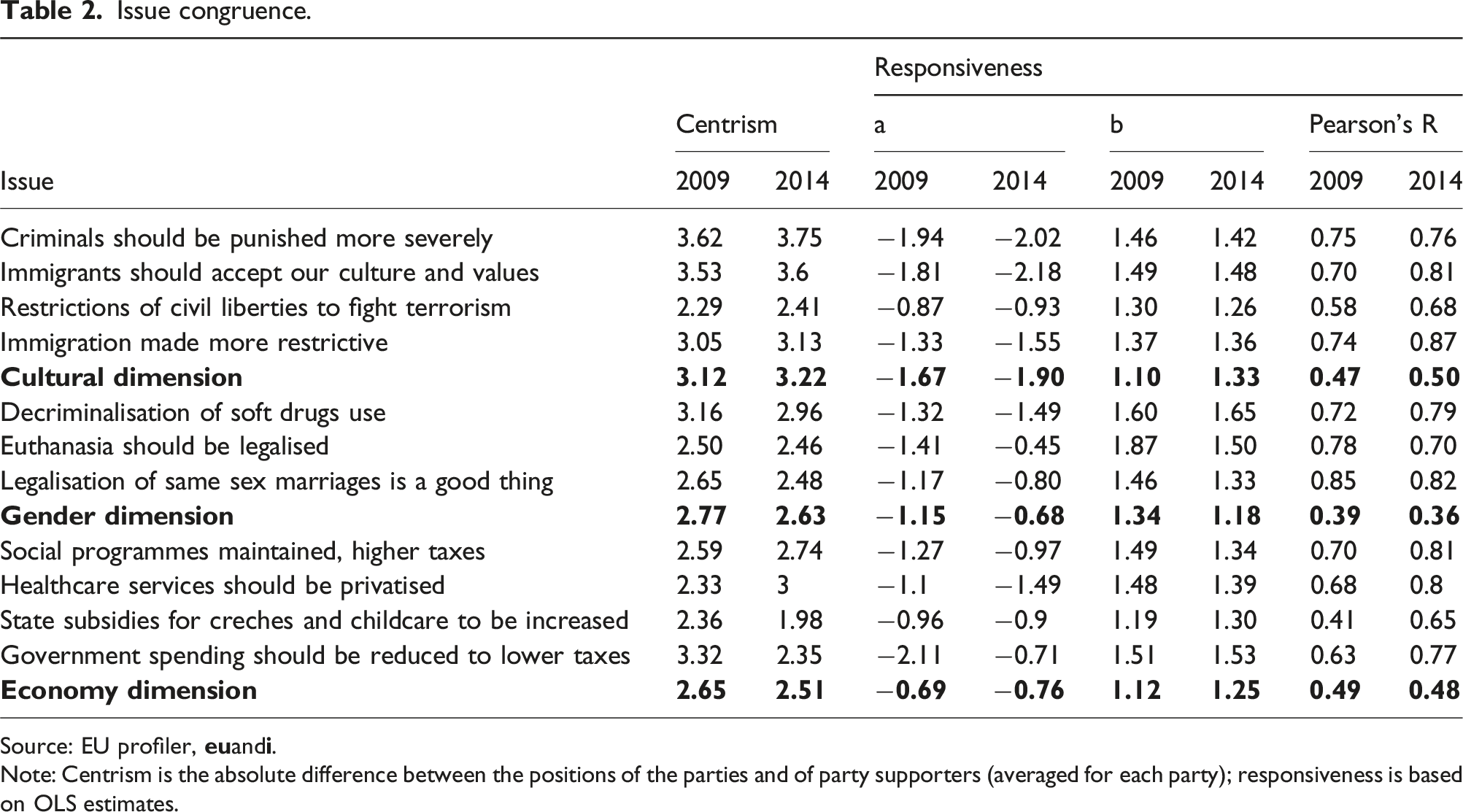
Source: EU profiler,
Note: Centrism is the absolute difference between the positions of the parties and of party supporters (averaged for each party); responsiveness is based on OLS estimates.
Centrism scores indicate modest agreement between parties and supporters. Discrepancies are most pronounced on cultural issues, especially immigration and crime penalties. High disagreement is observed on the gender dimension, particularly soft drug decriminalization. Economy-related issues, like social programs and tax increases, exhibit somewhat better alignment. Patterns remain consistent across elections, except for the economy dimension. While 2014 sees increased agreement on government spending and state subsidies, there’s less consensus on privatizing healthcare compared to 2009.
Table 2 (right side) displays responsiveness scores. Unstandardized b coefficients >1 indicate parties hold more extreme positions than supporters. This is most evident on euthanasia (b = 1.87 in 2009, b = 1.50 in 2014) in the gender dimension, where parties show the highest responsiveness. Strongest correlation occurs on same-sex marriage legalization (r = 0.85 in 2009, r = 0.82 in 2014). Parties are responsive on cultural and economic dimensions, with consistent patterns across issues. Economy is unique, exhibiting a loose structure in party-supporter stances. Responsiveness patterns are similar across elections and opinion correlations. However, issue-level correlations between supporters and elites surpass those on dimensions.
Figures 1 and 2 Appendix reveal parties represent supporters well on the economy, but party opinions are more diverse. Centrism scores show greater supporter consensus on this dimension, aligning with Dalton (2017), likely due to mapping onto traditional issues familiar to supporters. On the cultural dimension (see Figures A1 and A3 in the Appendix), the linkage is weaker. Despite party responsiveness and strong issue correlations, supporters exhibit slightly larger opinion variation in both elections. Gender dimension congruence is weakest (see Figures A2 and A4, Appendix). High centrism scores indicate party and supporter opinions diverge. Despite strong issue correlations, overall correlation is weakest on this dimension, with notable policy differences not just between parties but also among supporters. Congruence economy dimension 2014. Source: 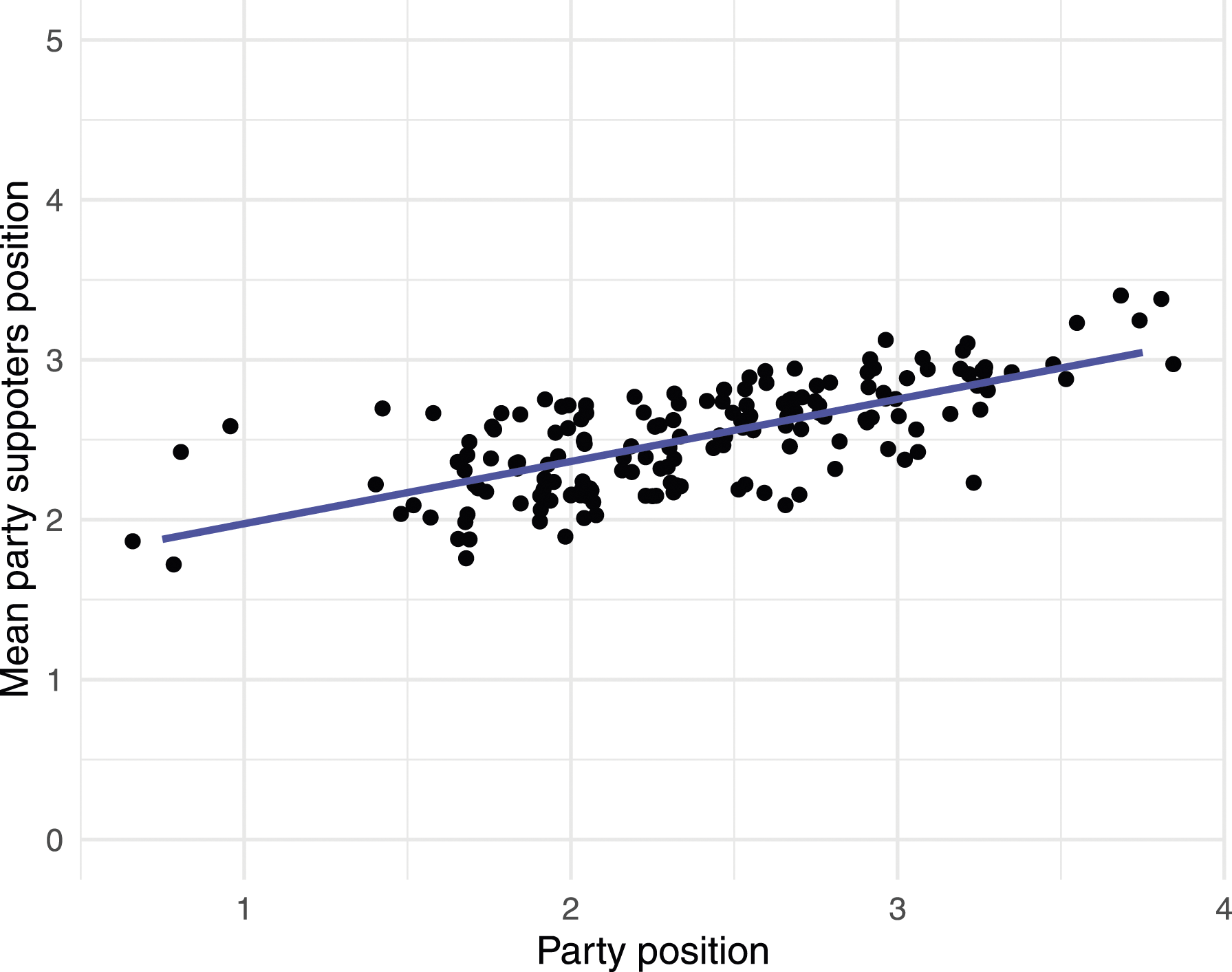
Predicting issue congruence
In what follows, we aim to explain variation in congruence scores. We consider predictors at both the institutional level, in the tradition of representation studies, and at the party level.
Institutional factors
Due to the homogeneity of electoral rules for EP elections, the effect of PR versus majoritarian systems cannot be examined in this context. Following Dalton (2017), we rely on other features of the electoral systems. One of the most examined characteristics of a party system is counting the number of political parties. Having more party choices translates to higher levels of citizen satisfaction, as the number of channels through which citizens can express their political preferences increases (Dalton, 2008). For this purpose, we use the effective number of political parties (ENEP).
Closely related to the number of political parties are district magnitude and disproportionality (LSq) of the electoral system. Higher district magnitudes offer more opportunities for political parties, therefore more choices for voters (Powell, 2000). Small parties are particularly advantaged under systems with large district magnitude. Low disproportionality stimulates more responsiveness among political parties (Ezrow, 2010). The empirical results are mixed and often contradictory (Blais and Bodet, 2006; Golder and Stramski, 2007), which Eggers and Fouirnaies (2014) attribute to the level of analysis used, whether system- or district-level.
Although more relevant for the study of ideological congruence (Dalton, 2008), we also consider polarization, as the degree of differentiation among political parties in a given political system. Often overlooked in the favour of measures that quantify the parties in an electoral system, polarisation reflects the quality of party competition (Dalton, 2008). Higher dispersion along the ideological continuum should provide voters with distinct electoral choices, leading to more congruence.
We explore differences between post-communist and established Western democracies (Dalton, 2017; Rohrschneider and Whitefield, 2012). Expecting greater congruence in stable, long-standing democracies, where parties effectively communicate stances, we contrast this with lower party identification levels in Eastern Europe. Despite differing competition structures, Eastern Europe mirrors Western axes, emphasizing social issues over economic ones with niche parties (Rovny and Edwards, 2012). Aligning with Dalton (2017), we include the World Bank’s Voice and Accountability index for democratic development and the United Nations’ Human Development Index as a control variable.
Institutional level predictors of congruence.
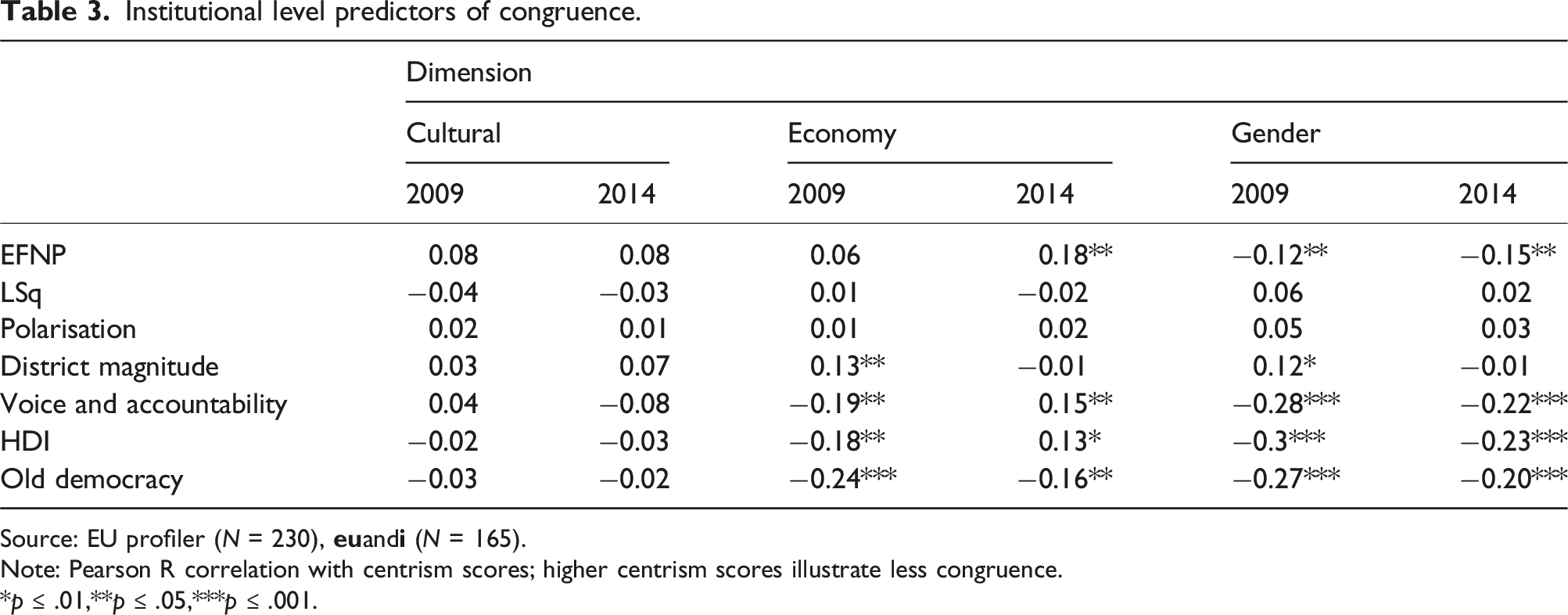
Source: EU profiler (N = 230),
Note: Pearson R correlation with centrism scores; higher centrism scores illustrate less congruence.
*p ≤ .01,**p ≤ .05,***p ≤ .001.
The impact of electoral system features and country contextual factors is limited and varies across issue dimensions and election years. This aligns with Dalton (2017), suggesting a positive interpretation that representation is not solely tied to institutional characteristics. This concurs with Belchior (2013), who found that system-level features like electoral system proportionality and fractionalization fail to explain variation in congruence between voters and MPs, as seen in the 2009 EP elections.
Party characteristics
The electoral systems’ impact on congruence is limited, possibly due to insufficient variation in party congruence at the country level. Research indicates voters reward ideologically distinctive parties (Belchior, 2013), especially those at the extremes, which are expected to be more congruent. Party size’s effect on congruence is mixed (Dalton, 1985; Mattila and Raunio, 2006); larger parties send clearer signals but may be less responsive, while niche parties are more responsive to the issues they own (Klüver and Spoon, 2016; Hooghe and Marks, 2018). Niche-mainstream party dichotomy, as defined by Meguid (2005), suggests niche parties, like Green or nationalist parties, prioritize unique issues, potentially leading to stronger links on cultural and gender issues. Ezrow, (2010) argues citizens with access to both mainstream and niche pathways fare better. Mainstream parties, larger and centrist, exhibit higher congruence (Belchior, 2013; Holmberg, 2000), especially on economic issues.
Government parties tend to adopt a centrist position at the cost of losing their ideological distinctiveness, which leads to confusion among their voters with regard to policy stances (Belchior, 2013). Controlling for governmental status is not enough, as the timing of the elections matters as well. Coining the concept of an election cycle, Reif, (1984) showed that congruence decreases the further a government party is in an election cycle. As the elections to the European Parliament are closer to the national ones, parties with governmental status will present higher levels of congruence with their supporters. Additionally, we consider the age of the party. As a measure of party size, we look at party vote share in the EP elections.
Party-level predictors of congruence.
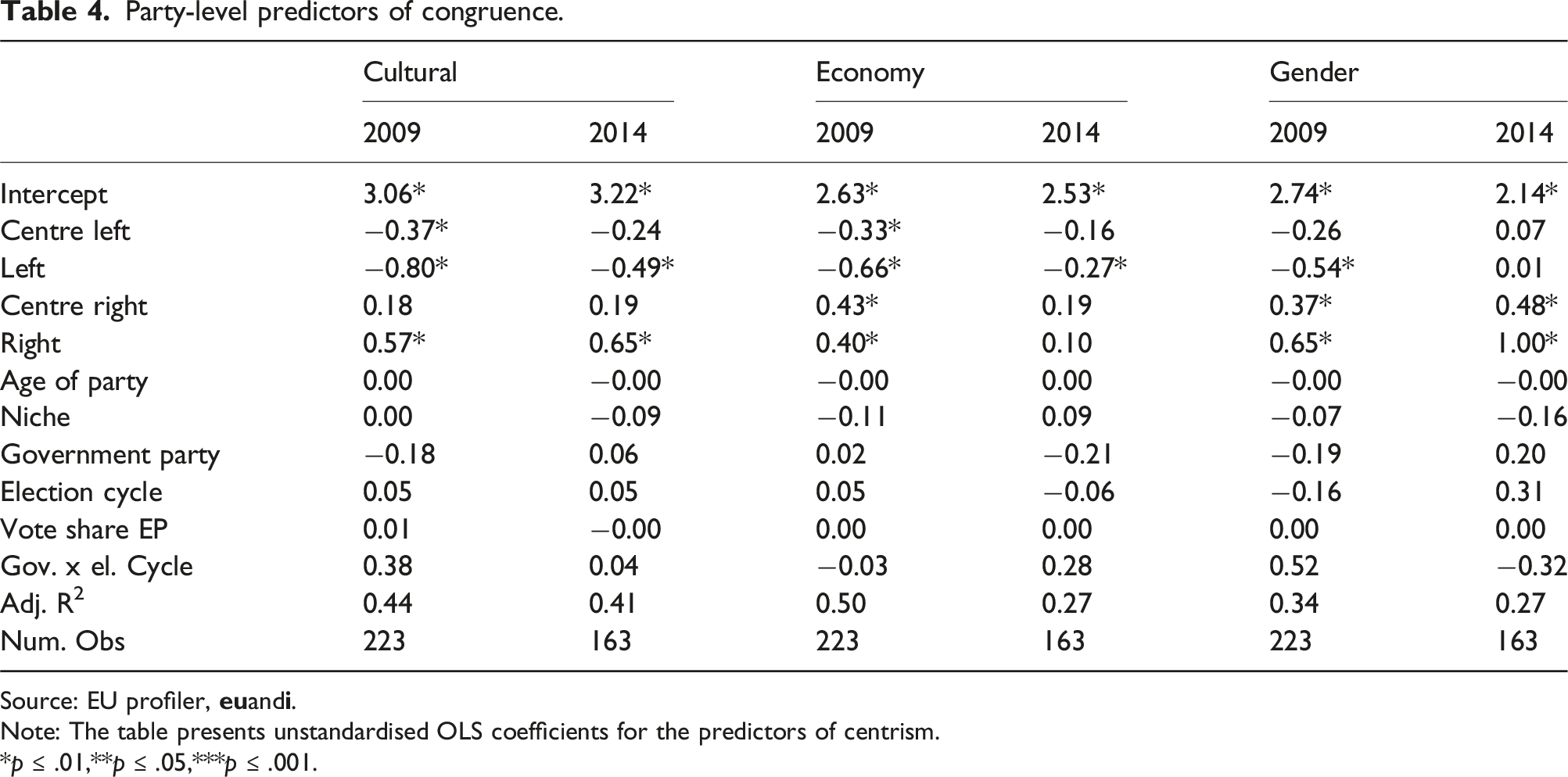
Source: EU profiler,
Note: The table presents unstandardised OLS coefficients for the predictors of centrism.
*p ≤ .01,**p ≤ .05,***p ≤ .001.
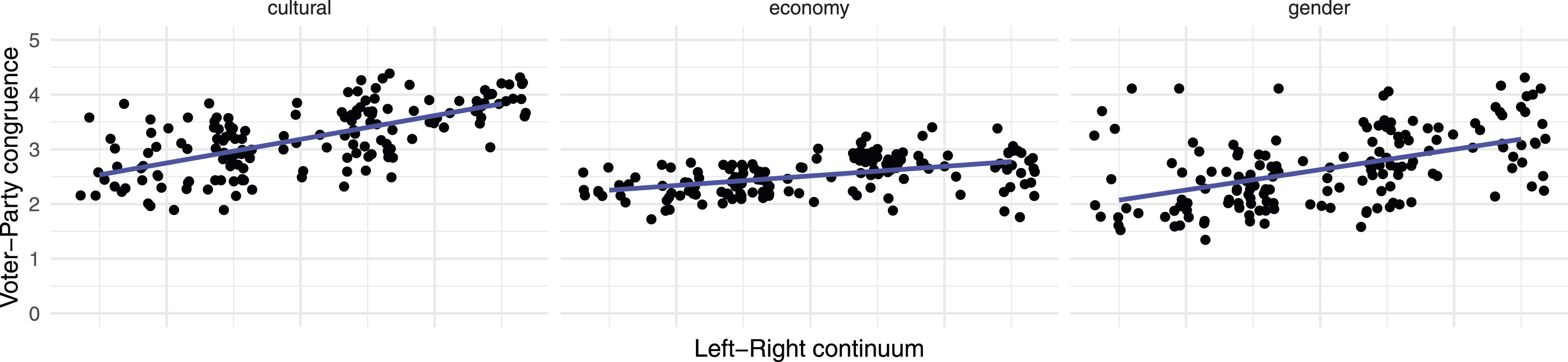
Ideological distinctiveness is not rewarded for parties on the right. Figures 3 and 4 depict parties’ positions on the RiLe continuum against centrism scores. Each dot represents a party dyad. Cultural issues exhibit more consistency among right-leaning parties in both elections, with greater variation on the left. Conversely, economic issues show increased variation on the right but maintain the most consistency in representing supporter views. The gender dimension mirrors the economic pattern, with left-leaning parties demonstrating higher congruence, though some far-left parties present low congruence levels, introducing noise to the data. Centrism and Left-Right 2009. Source: EU Profiler Note: Each dot represents a party dyad. The x-axis represents the RiLe continuum from 1 (left) to 7 (right) Centrism and Left-Right 2014. Source: 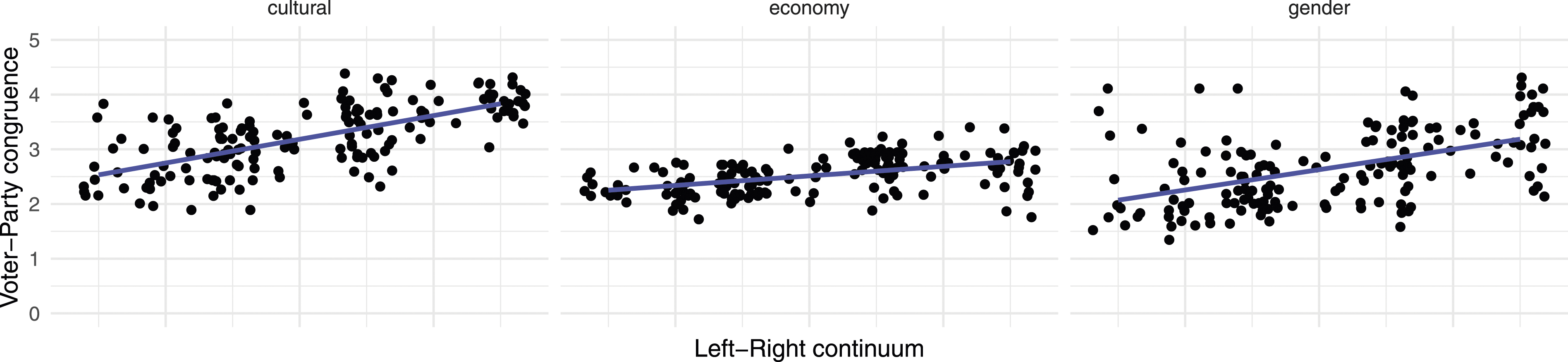
Expecting larger parties to be less responsive, the impact of EP vote share is minimal. Differentiating parties by mainstream or niche status, often aligned with size, reveals mainstream parties aligning more closely with supporters on economic issues, particularly in 2014. This concurs with past research indicating mainstream party congruence on the RiLe dimension, encompassing economic issues (Ibenskas and Polk 2022). While niche parties exhibit a trend of higher congruence on cultural and gender issues, the coefficients lack statistical significance.
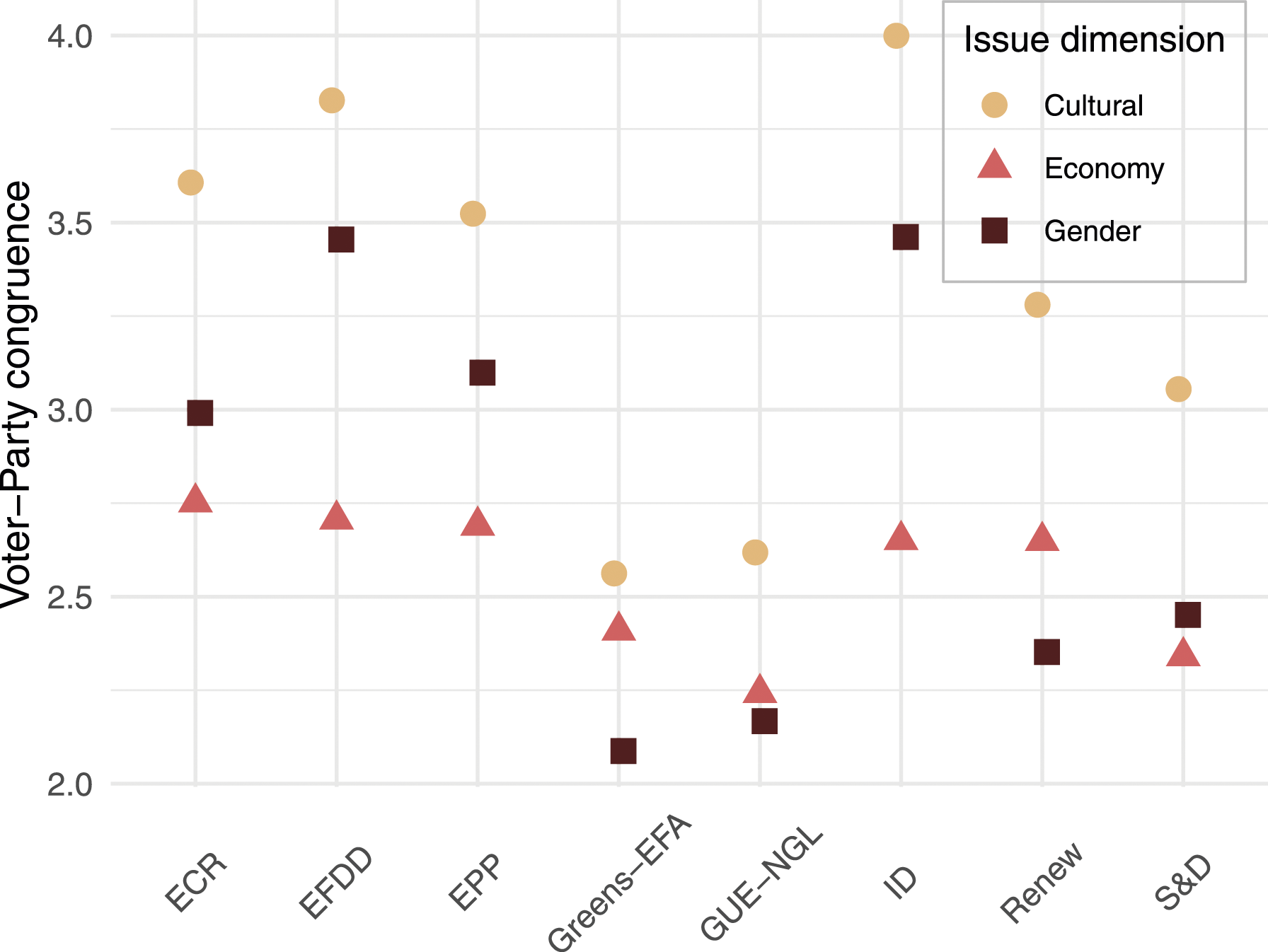
Figures 5 and 6 display congruence based on party family or EP group membership. The vertical axis shows centrism scores, with each point representing the average centrism scores for parties in each EP group. Colors and shapes represent different issue dimensions. In 2009, EP groups housing green and communist parties (Greens-EFA and GUE-NGL) exhibit the highest congruence across all three dimensions. Greens-EFA leads in gender issue congruence, while GUE-NGL’s communist parties excel on economic issues. The 2014 elections reflect a similar pattern. Notably, right-wing nationalist parties in the Identity and Democracy (ID) EP group defy theoretical expectations. However, this aligns with regression results (Table 4), where right-leaning parties are least congruent with supporters. For both elections, the representation link is weaker on cultural issues. This is most pronounced for euroskeptic parties (EFD in 2009 and EFDD in 2014), which sends positive signals about public opinion on issues related to immigration and crime. At the same time, agreement on economic issues is strongest for europskeptic and socialist parties. Congruence by EP Group 2009. Source: EU Profiler Note: Each point represents the average for the parties in EP groups Congruence by EP Group 2014. Source: 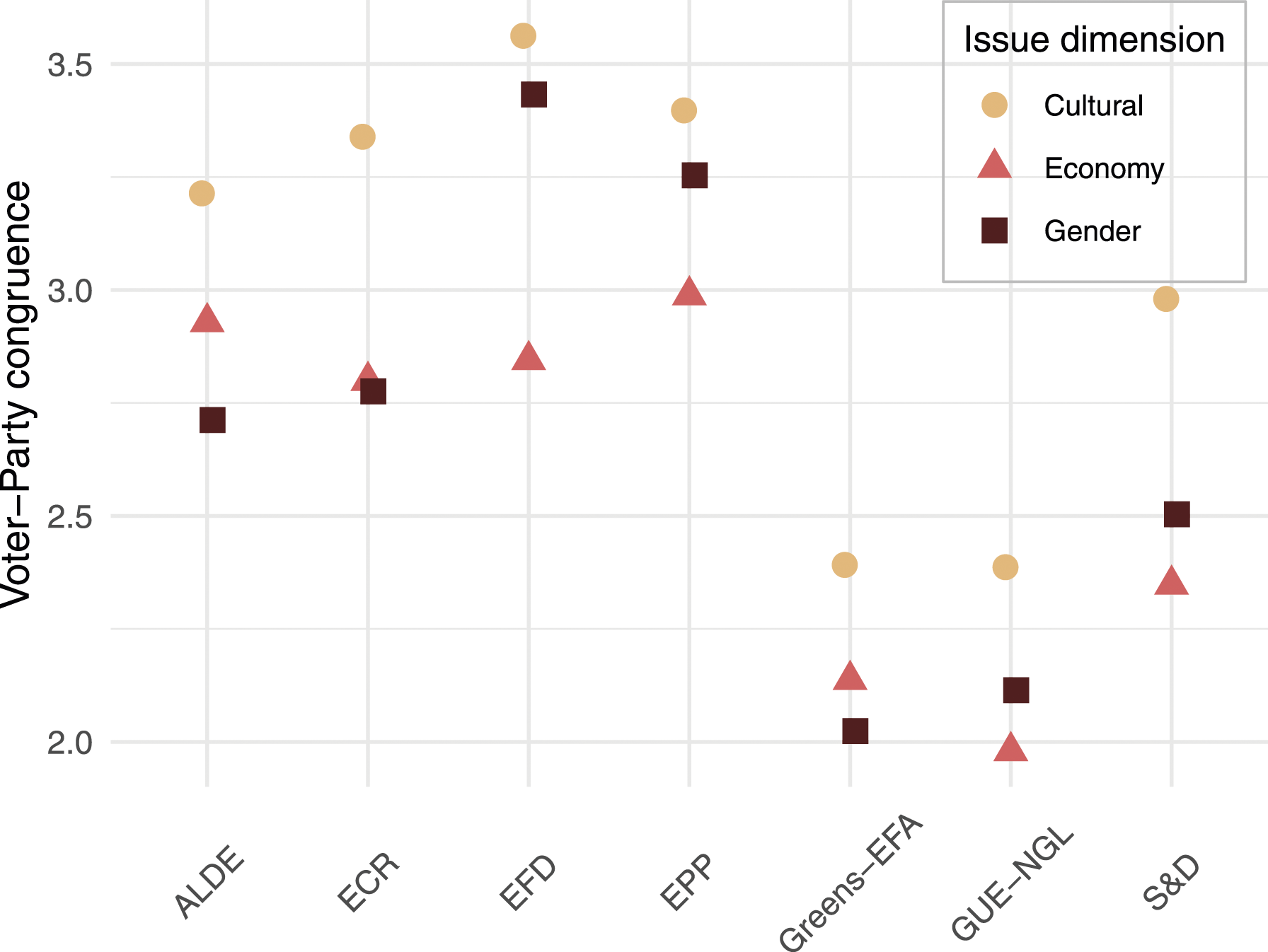
The effect of governmental status varies across dimensions and elections. While some evidence suggests that parties in government and further away in the election cycle may weaken the representational link, these relationships lack statistical significance. Besides ideological leaning, none of the other party characteristics consistently and significantly affect congruence. In essence, what Dalton (2017) calls ‘objective characteristics’ are less relevant compared to the party’s ideological edge.
Conclusion
The vast field of political representation studies benefited from the technological innovations around data collection. Increased data availability led to methodological innovations for gauging political representation in various electoral settings. At the same time, the plethora of means of assessing the link between representatives and those represented led to contradictory findings in the literature, with evidence of strong links using ideological congruence (Powell, 2000; Thomassen, 1994) and cautionary findings with high levels of representative deficit (Bright et al., 2020) and weak ties not just on the RiLe, but also on narrow policy dimensions (Clements et al., 2018; Dalton, 2017).
Much of the disagreement in the literature is attributed to the panoply of ways to measure congruence, due in part to compromises around data. These range from having to rely solely on ideological congruence and limiting the number of issues, to the number of parties, countries, and elections. Estimating the positions of the representatives from voters’ perceptions is highly problematic (Dalton et al., 2011) and looking solely at ideological congruence does not suffice, as salient issues in modern-day politics go well beyond the RiLe (Dalton 2017).
While there is no gold standard in assessing congruence, with measures ranging from simple distance measures to measures of relative congruence (Golder and Stramski, 2010), representation scholars agree on one aspect, shaped by data limitations. Congruence should be measured on the same questions, on the same scale, and at the same point in time. VAA-generated data offer the perfect opportunity to measure congruence in a comparative framework, First, VAAs are an integral part of the electoral process in an increasing number of countries. To date, there are VAA tools for three EP elections, which collected millions of responses. Because the wording of the issue policies is similar across countries, it allows for a comparative study. Second, VAAs include a large number of policy issues. Third, they include small parties, usually left out, because their supporters are more difficult to reach through traditional surveys. Fourth, it provides information on party positioning, on the same issues on which the voters are surveyed. The positioning of the parties is done by political experts, in some cases in consultation with the political parties. Last, the cost of the data is low, especially compared with traditional surveys (Cedroni and Garzia, 2010).
VAAs create a wealth of data that can be used to study various aspects of electoral behaviour, from turnout (Garzia et al., 2017b; Gemenis, 2018), to vote choice (Pianzola et al., 2019) and acquisition of information (Munzert and Ramirez-Ruiz, 2021). A less researched avenue is the study of political representation using VAA data, with the exception of Alvarez et al. (2014); Triga et al. (2018); Bright et al. (2020); Costello (2021); Costello et al. (2021), who focus on representative deficit. The main drawback in using VAA data for academic research stems from its double self-selection bias. First, as an online tool, VAA tends to attract users who are young, well-educated, and from urban areas. Second, it attracts users who are interested in politics. However, with an increase in the number of users, the first self-selection bias becomes less of a problem. The second type of bias could be used as an advantage. Bright et al. (2020) use Almond’s seminal distinction between the elites, the attentive public, and the general public, arguing that VAA users make up the attentive public, who are more informed about politics compared to the general public.
The increasing use of digital technologies in the electoral process and VAA proliferation means that more data will be readily available to study voter preferences. Some VAA developers collect demographic data and vote intention, which can be used to study congruence at the individual level. Additionally, these can be used to address the concerns around data quality, by applying more sophisticated weighting techniques, such as post-stratification.
Using data generated by EU Profiler and
In summary, there is evidence of a strong link between parties and their supporters, but the levels of agreement vary across issue dimensions. These nuances cannot be observed when we study representation from a traditional perspective, relying on ideological congruence. This work is an exercise in illustrating the advantage of using VAA data to investigate issue congruence in a pan-European setting, extending the analysis to two elections and a larger number of political parties. Further research can include more policy issues and an EU issue dimension.
Supplemental Material
Supplemental Material - Harmony and dissonance: Unveiling issue linkages between voters and parties across EU democracies
Supplemental Material for Harmony and dissonance: Unveiling issue linkages between voters and parties across EU democracies by Raluca Popp in Party Politics
Footnotes
Declaration of conflicting interests
The author(s) declared no potential conflicts of interest with respect to the research, authorship, and/or publication of this article.
Funding
The author(s) received no financial support for the research, authorship, and/or publication of this article.

Supplemental Material
Supplemental material for this article is available online
Notes
Author biography
References
Supplementary Material
Please find the following supplemental material available below.
For Open Access articles published under a Creative Commons License, all supplemental material carries the same license as the article it is associated with.
For non-Open Access articles published, all supplemental material carries a non-exclusive license, and permission requests for re-use of supplemental material or any part of supplemental material shall be sent directly to the copyright owner as specified in the copyright notice associated with the article.
