




Abstract
This study shows how interest group–party relations, parties’ cross-cutting policy preferences, and competition with challenger parties shape the structure of issue competition on climate policy. It uses the ‘most similar’ cases of the UK and Ireland to show how differences in party systems influence the structure of issue competition. The study takes up the challenge of integrating salience and position in the conceptualisation of climate policy preferences. Empirically, it provides new evidence on factors influencing climate policy preferences and the party politics of climate change, focusing on interest groups, party ideology, and challenger parties. Further, it identifies similarities between the general literature on interest group influence on party preferences and the literature on interest groups in climate politics, and seeks to make connections between them.
Introduction
Climate change mitigation policy consists of issues within and across several sectors; it is also a relatively recent arrival—since the 1990s—to domestic political agendas. Party preferences on climate policy are shaped by factors ranging from public opinion and interest group demands to party ideology and the nature of the party system. In the aggregate, these policy preferences constitute a structure of issue competition, as parties accord greater or lesser priority to climate policies, and take positions that are more or less polarised. The structure of issue competition on climate policy has implications for efforts to mitigate climate change because it influences public attitudes and public policy: polarisation among parties leads to polarisation among the public (Birch, 2020); convergent climate politics is associated with climate policy ambition (Christoff and Eckersley, 2011: 440; Farstad, 2019); and the priority (salience) of climate policy for parties is an important condition for ambitious policy (Carter and Jacobs, 2014; Jensen and Spoon, 2011).
This study examines the UK and Ireland to assess the roles of interest groups, wider party ideology (i.e. preferences that cut across climate policy preferences), and challenger parties in shaping the structure of issue competition on climate policy. In conceptualising the structure of issue competition, our point of departure is the observation that salience and position matter (Clarke et al., 2009: 44; Stokes, 1963: 373). We develop a framework incorporating both concepts in four ideal-typical structures of issue competition (Guinaudeau and Persico, 2014). In applying it, we show that issue competition on climate policy differs in its structure between countries, and within countries over time and across climate policy issues.
To explain differences in the structure of issue competition on climate policy, we focus on two countries that are similar in important respects and that differ in the structure of their party systems, with implications for interest groups’ relations with parties, parties’ cross-cutting policy preferences, and competition on climate policy from challenger parties. We show that the structure of issue competition on climate policy has been influenced by interest groups’ interaction with the party system; this speaks to recent studies within and beyond comparative climate politics (Mildenberger, 2020; Otjes and Rasmussen, 2017). We also find that parties are constrained by policy preferences that cut across climate policy and by the incentive to accommodate successful challengers on climate policy. Thus, interest groups, ideology and challenger parties each play important and often mutually reinforcing roles in influencing the structure of competition on climate policy.
The study makes several contributions. First, while existing scholarship tends to assume that competition and party preferences on climate policy are either a matter of salience (priority) or position, we show that there are varieties of issue competition both between and within countries. Second, it makes broader contributions to the literature on party preferences, especially by using a comparative case study to focus on lesser-studied influences: interest groups (Klüver, 2020; Otjes and Green-Pedersen, 2019) and party ideology (e.g. Meyer, 2013). It identifies affinities between important arguments in comparative climate politics (e.g. Mildenberger, 2020) and interest group–party relations (Otjes and Rasmussen, 2017), and provides evidence to support the idea that institutional conditions moderate interest group influence on party preferences. Third, it contributes to the emerging body of research on the party politics of climate change (Båtstrand, 2014; Carter et al., 2018; Farstad, 2018, 2019; Ladrech and Little, 2019; Leiren et al., 2020; Marcinkiewicz and Tosun, 2015) with these findings on interest group influence, and by showing how cross-cutting preferences constrain parties and how challengers drive accommodative policy changes.
Structures of issue competition on climate policy
There are divergent assumptions and positions about whether environmental policy—of which climate policy is a subset—is a positional or valence issue. Studies of political competition on the environment in European democracies often identify it as an archetypal valence issue, characterised by consensus about the goal of environmental protection and competition over parties’ performance or perceived competence (Clarke et al., 2009). This is reflected in measures of parties’ environmental policy preferences such as the Manifesto Project’s measure of environmental salience; unlike some classic positional issues such as immigration, there is no complementary ‘negative’ measure identifying policies promoting environmental degradation (Volkens et al., 2019).
However, the status of the environment as a valence issue has been increasingly questioned (Gemenis et al., 2012). Partisan differences over climate policy are notably pronounced in Australia, Brazil, Canada and the USA, where there have long been bitter environmental conflicts over the extraction of primary resources (Carter, 2018). In Australia, fierce debates over carbon pricing schemes have dominated successive elections, peaking in 2013 when the Liberal leader, Tony Abbott, campaigned successfully against the Labor Government’s carbon pricing scheme with a ‘pledge in blood’ to ‘axe’ Labor’s tax (Crowley, 2017: 3). Deep partisan divisions over climate change between the Republican and Democratic parties and their supporters (Dunlap et al., 2016) encouraged Donald Trump to campaign for the presidency on a climate-sceptic platform and to withdraw the USA from the Paris climate agreement.
Even in Europe, parties take different positions on climate policy. Most European radical right populist parties deny climate change exists or reject the need for urgent responses (Schaller and Carius, 2019), while Green parties take distinctive pro-environment policy positions. There are also consistent differences between right and left suggestive of positional climate politics (Båtstrand, 2014; Carter et al., 2018: 736; Farstad, 2018: 705). Some measures of parties’ preferences reflect this positional aspect of environmental politics, usually assuming that it involves a trade-off between environment and economy (see Appendix A).
The apparent diversity in national experiences suggests that fixed assumptions about the nature of climate politics may be hard to sustain; it may even differ between climate policy sectors (Leiren et al., 2020: 2; see also Ennser-Jedenstiak, 2020 on welfare policy). Many issues combine valence and positional aspects (Clarke et al., 2009: 44; Stokes, 1963: 373) and the structure of competition can differ between contexts and issues. Yet few scholars (see De Sio and Weber, 2014; Guinaudeau and Persico, 2014; Meguid, 2008) bring salience and position together to conceptualise issue competition.
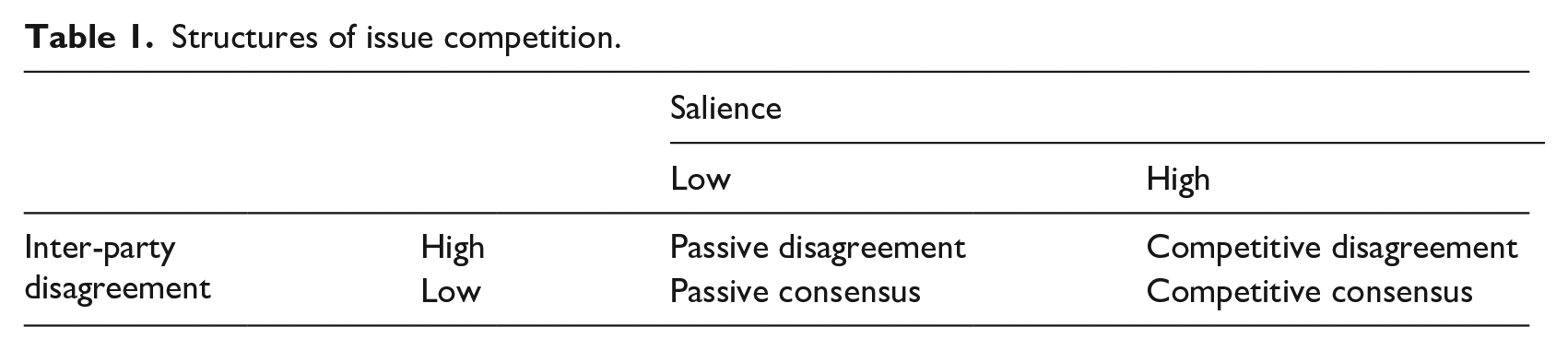
We argue that the structure of issue competition on climate politics should be investigated rather than assumed, and that it can differ between contexts and climate policy issues. Building on Guinaudeau and Persico’s (2014) typology of structures of issue competition, we suggest that party competition can vary in its salience and in the extent of disagreement between parties (Table 1). These characteristics combine to present four ideal-typical structures of issue competition: competitive consensus 1 (low levels of disagreement, high salience); passive consensus (low disagreement, low salience); passive disagreement (high disagreement, low salience); and competitive disagreement (high disagreement, high salience). These ideal types help describe the structure of issue competition at various levels: cross-sectoral policy themes like climate policy, policy sectors within those themes (e.g. agricultural climate policy), and specific policy instruments (e.g. the adoption or rate of a carbon tax) (Guinaudeau and Persico, 2014: 314).
Structures of issue competition.
Explaining differences in structures of issue competition
Explanations of variation in party preferences can help us to understand differences in the structure of issue competition. Such explanations conceive of parties as purposive actors that compete for votes by following public attitudes, responding to voters’ priorities, and focusing on issues on which they are perceived as credible; they also respond to other parties’ electoral success and to their preferences (see Abou-Chadi et al., 2020: 750–751 and Klüver, 2020: 978–981 for reviews; see also Abou-Chadi, 2016; Meguid, 2008; Spoon et al., 2014). Not all influences on party preferences have received equal attention. We know less about ideological constraints and interest group influence, in particular, than about other factors (e.g. public attitudes, party competition). Ideological constraints include parties’ past or cross-cutting preferences (Ladrech and Little, 2019; Meyer, 2013). Systematic research on interest group influence on parties’ policy preferences has only recently begun to emerge (Klüver, 2020; Otjes and Green-Pedersen, 2019).
To help explain differences between structures of issue competition on climate policy, we focus on three factors that a comparison of the UK and Ireland can help illuminate, given differences in their party systems: interest group–party relationships, party ideology, and competition from challenger parties. Given its potentially profound economic consequences, interest groups have strong reasons to seek influence on parties’ climate policies; parties’ climate policy preferences are likely to be constrained by their other policy preferences, especially given that climate policy is rarely a top priority; and there are often identifiable ‘challengers’ of the climate policy status quo, both green parties and climate sceptics.
Interest group influence on party preferences has until recently been a lacuna in the literature (Klüver, 2020: 980–981). Recent studies focusing on Germany and on labour market policy in comparative perspective have shown that interest group mobilisation influences party preferences, that this relationship is moderated by voter preferences (Klüver, 2020), and that interest groups can exert more influence than competing parties (Otjes and Green-Pedersen, 2019). Otjes and Rasmussen (2017) show that interest group–party collaboration is shaped by the structure of the party system. These studies assume that interest group–party relationships are rooted in parties’ responses to the capacity of interest groups to deliver information, electoral support, or finances.
Case study research in comparative climate politics has examined interest group influence on party preferences (Farstad, 2019; Leiren et al., 2020) and the role of economic interests in shaping policy (e.g. Eikeland and Inderberg, 2016; Mildenberger, 2020). Mildenberger (2020) argues that carbon-intensive business and labour interests benefit from ‘double representation’ in climate politics that can overcome divides in the party system by mobilising politicians across the political spectrum to resist climate policy initiatives. This double-representation is moderated by institutional context: where economic interest groups have guaranteed, consistent access to policymakers, the politics of climate change is characterised by low conflict and salience; otherwise, the structure of climate politics is more variable.
The literatures on comparative climate politics and on interest group influence on party preferences remain isolated from one another. Yet, both Mildenberger (2020) and Otjes and Rasmussen (2017) argue that institutional conditions moderate interest group–party relations. Our contribution is to examine this argument, focusing on climate politics and institutional differences between the UK and Ireland.
We also expect party ideology, or parties’ policy preferences on issues that cut across climate policy such as taxation, regulation, spending, or subsidies, to shape their climate policy preferences. A party that opposes new taxes, for example, is unlikely to advocate a carbon tax. At the system level, this manifests itself in broader patterns of conflict and consensus (e.g. on economic policy) being reflected in the structure of competition on climate policy. While there is evidence of correlations between left–right ideology and climate policy preferences in the aggregate (Carter et al., 2018; Farstad, 2018), empirical evidence identifying specific cross-cutting issues shaping climate policy preferences is limited (Båtstrand, 2014; Ladrech and Little, 2019).
Climate policy competition will also be influenced by the strength of challenger parties with outlying preferences, such as green or climate-sceptic parties. These parties influence the structure of climate politics directly by their presence (they are part of the structure of issue competition), and indirectly by influencing other parties’ incentives to compete with them on climate policy. Existing research provides evidence of various responses to green parties on the environment (Abou-Chadi, 2016; Meguid, 2008: ch. 5; Spoon et al., 2014), but less evidence of the underlying mechanism driven by vote-seeking competition (Ladrech and Little, 2019).
Cases and analytical approach
A case study approach can be used to examine structures of issue competition in terms of positions and salience and at multiple issue-levels (theme, sector, and instrument); it can also illuminate the mechanisms by which interest groups, party ideology, and challengers influence the structure of climate politics. We focus on the UK and Ireland from 1997 until 2019, a period that begins with the negotiation of the Kyoto Protocol, which put climate policy on domestic political agendas, and ends after the UK general election of December 2019. We present the case studies in two periods—pre- and post-2010—as there were significant changes in the conditions shaping climate politics around 2010, with austerity policy responses to the global economic crisis, the growing polarisation in British politics, and the post-Copenhagen Summit slump in climate policy’s general salience. The case studies draw on sources including secondary literature, existing data on party preferences (Appendix A), interviews with party and interest group representatives, and election manifestos. 2
We focus on three climate policy sectors that cover 60–75% of emissions in the UK and Ireland: transport, electricity generation, and agriculture. These sectors include the two largest emissions sectors in both countries. In 2018, transport was the largest contributing sector to GHG emissions in the UK (28%) and second-largest in Ireland (20%). Electricity generation was the second-largest in the UK (23%) and third-largest in Ireland (18%). Agriculture was the largest sector in Ireland (34%) and the fifth-largest in the UK (10%). We also focus on two cross-sectoral instruments: domestic carbon pricing and framework climate legislation.
The UK and Ireland are ‘most similar systems’. They are parliamentary systems with strong, centralised executives and weak upper houses; until January 2020, when the UK left the EU, both were EU members; they are wealthy; and they have relatively low vulnerability to climate change impacts. They have both been characterised by modest levels of public concern about climate change, so cross-national differences in party competition are unlikely to be explained by differences in public opinion (Figure 1; European Commission, 2020).
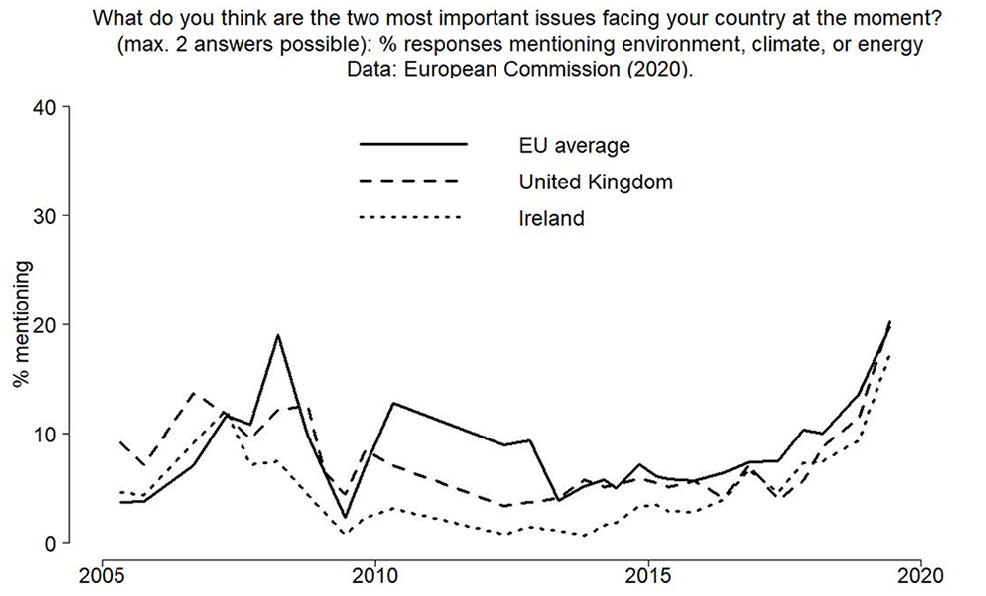
Public concern about climate change in the UK and Ireland, 2005–2019.
We focus on how their very different party systems shape structures of issue competition on climate policy. The UK is characterised by majoritarian politics centred on a left–right cleavage, dominated by Labour, the Conservatives and, until 2015, the Liberal Democrats, with weak Green parties. It became increasingly polarised in the 2010s and saw the rise of the climate-sceptic, right-wing UKIP. Ireland’s party politics has been distinguished by the ideological proximity of the centre-right Fianna Fáil (FF) and Fine Gael (FG) parties and competition between them to lead coalition governments. Among several other parties is a small Green Party that has had greater relevance at national level than its sister parties in the UK, and there is no significant right-wing party.
Ireland and the UK also differ in their constellations of economic interest groups and how they interact with the party system. In the UK the historic links between trade unions and Labour and between business interests and the Conservatives remain strong; in Ireland, neither have institutionalised links with FF or FG, and access to policymakers has been fairly bi-partisan (interest group representative, personal interview, January 2015), facilitated by a tripartite Social Partnership process until 2009. Their economies are also structured differently: the UK has a long-established manufacturing sector and a larger extractive sector, while Ireland’s economic strategy has focused on attracting foreign direct investment from the technology and pharmaceutical sectors, with a proportionally larger agriculture sector specialising in livestock farming.
United Kingdom
1997–2010
Before the 2005 general election, competition on climate change was characterised by a mixture of passive consensus, passive disagreement and, on transport policy, competitive disagreement. Both parties accepted climate science and supported delivery of the UK’s Kyoto GHG reduction target. Although of low salience for both parties, Labour was more willing to develop climate change mitigation policies (Mildenberger, 2020: 222–223). The Labour Government elected in 1997 adopted a 2010 target of a 20% reduction in CO2 emissions that went beyond the UK’s Kyoto target. Yet, despite a Royal Commission on Environmental Pollution report highlighting significant weaknesses in the Labour Government’s climate policy, the Conservative 2001 manifesto proposed weakening key climate measures, notably by abolishing Labour’s new Climate Change Levy on energy use by large businesses.
Whereas the Labour Government’s Renewable Energy Obligation (REO) amounted to a subsidy of around £5 billion by 2010, Conservative support for renewables lacked any spending commitment. The parties adopted contrasting positions on transport policy where their climate measures mirrored longstanding preferences for either public or private transport. Road transport was politicised by nationwide fuel protests in 2000 causing panic in government circles and prompting a brief surge in Conservative support (Blair, 2010: 291–298). Consequently, the Conservatives campaigned in 2001 with a headline-grabbing commitment to cut petrol tax by 6 p per litre and depicted Labour as ‘anti-car’, while four years later they promised to end Labour’s ‘war on the motorist’, review the use of speed cameras, and modernise the road network. Labour countered by promising huge infrastructure investment, particularly on public transport, but avoided increases in fuel duties.
David Cameron’s election as Conservative leader (December 2005) was the catalyst for a new ‘competitive consensus’ in climate politics when all three major parties battled to be the ‘greenest’ on climate policy (Carter and Jacobs, 2014). Tony Blair had helped push climate change on the international stage, notably by placing it on the agenda for the 2005 Gleneagles G8 Summit (Blair, 2010: 563). Yet Labour’s domestic policies—its anaemic Climate Change Programme (March 2006), for example—left it vulnerable to attack. Cameron embraced climate change in his drive to detoxify the Conservative image and increase the party’s appeal to young voters and women. His support for Friends of the Earth’s ‘The Big Ask’ campaign was critical in securing cross-party support for the pioneering Climate Change Act 2008 (CCA), which enshrined ambitious emissions targets in law, backed by five-yearly carbon budgets and an independent Committee on Climate Change to advise the government on policy (Carter and Jacobs, 2014; Lockwood, 2013). Political action on climate policy was made easier because the business community, encouraged by the economic rationale provided by the 2006 Stern Review, was now also onside, as illustrated by a Confederation of British Industry report demanding stronger climate targets and incentives for low-carbon technologies (Carter and Jacobs, 2014: 135).
Later, Cameron’s opposition to E.ON’s proposed coal-fired power station at Kingsnorth pressured Labour into banning new coal-fired power stations unless compatible with carbon capture and storage technology. Meanwhile, confident it would face little political opposition, and with burgeoning support for the Greens threatening several Labour MPs in marginal constituencies, the Cabinet embraced significantly more progressive climate policies to be delivered by a new Department for Energy and Climate Change (DECC) (Special Advisor, personal interview, July 2010). Its ambitious Low Carbon Transition Plan targeted a sevenfold increase in renewable supply and identified a litany of measures, including a feed-in tariff, requiring all new homes would be zero-carbon by 2016, a home insulation programme, and a mass roll-out of smart meters, backed by huge infrastructure expenditure to support offshore wind and electric vehicles (Carter and Jacobs, 2014). Both major parties now supported the construction of new nuclear power stations. Many traditional differences over transport policy dissipated, as the Conservatives matched Labour in supporting significant rail infrastructure investment including London’s Crossrail, widespread electrification, and constructing a North–South high-speed rail line (HS2). Indeed, Cameron trumped Labour by opposing the construction of a third runway at Heathrow airport on environmental grounds; significantly, Labour’s decision to support it reflected strong lobbying from the business community.
2010–2019
This competitive consensus was initially sustained after the 2010 election. The three major parties presented manifestos containing strong climate policies and the newly-elected Conservative–Liberal Democrat coalition agreement promised the ‘greenest government ever’, committing inter alia to establish a Green Investment Bank, a Green Deal supporting household energy efficiency, a minimum floor price for carbon, and rejecting the third Heathrow runway.
However, Cameron had not persuaded all Conservative MPs to prioritise climate policy (Lockwood, 2013: 1344); even his close ally, Chancellor George Osborne, criticised green policies as a costly ‘burden’ on British businesses in the era of austerity, and lobbied hard against several climate measures (Guardian, 29 November 2011). With the Liberal Democrats holding the DECC portfolio, disgruntled Conservative backbenchers freely expressed their discontent about onshore wind farms and the impact of green duties on domestic energy bills. They were encouraged by the right-wing press and by burgeoning support for the climate-sceptic UKIP, which had fought the 2010 election promising to repeal the CCA, ban onshore wind farms, encourage coal extraction, abolish renewables subsidies, and withdraw from the EU emissions trading scheme. UKIP’s growing threat encouraged sceptical Conservative MPs to frame climate change measures negatively because they typically involved regulations, taxes or subsidies, and often resulted from EU policies (Lockwood, 2013: 1344).
In order to depoliticise climate policy before the 2015 general election, the Conservative, Labour, and Liberal Democrat leaders produced a joint climate pledge committing them all to seek a strong, legally-binding global climate deal, to work together to implement the CCA, and accelerate the transition to a low-carbon economy (Guardian, 14 February 2015). This may have prevented a backlash against existing policy, but did little to advance the climate agenda.
There was increased polarisation on climate and the environment after 2010 (see data in Appendix A), and the manifestos provide evidence of disagreement. Labour and the Liberal Democrats outlined a raft of progressive climate measures, including a 2030 decarbonisation target, energy-efficiency programmes, and promoting green jobs, although the Liberal Democrats went further by promising several new legislative measures, such as a Zero Carbon Act. The Conservative manifesto struck a different tone: Cameron’s earlier enthusiasm for climate action was reined in, even promising to end subsidies for onshore wind farms (while investing heavily in the nascent fracking sector). The transport policies of all three parties emphasised significant spending on rail infrastructure, Labour and the Conservatives promised price freezes, but the Conservatives committed to road upgrades while only the Liberal Democrats explicitly opposed the Heathrow runway.
Subsequently, the newly-elected Conservative government dismantled a string of climate measures: removing subsidies for onshore wind farms, reducing them for solar installations and biomass, selling the Green Investment Bank, cutting the tax incentives for greener cars, and dropping the zero-carbon home commitment (Guardian, 24 July 2015). Later, Prime Minister May disbanded DECC, moving responsibility for climate change to the Department for Business, Energy and Industrial Strategy, which sent a negative signal regarding the priority given to combating climate change (Guardian, 15 July 2016). Labour under Jeremy Corbyn initially appeared reluctant to challenge the government on this issue, but this passive disagreement slowly shifted towards competitive disagreement at the snap 2017 general election. The Conservative manifesto marginalised climate change, with just a few references to a low-carbon economy and improving energy efficiency. Yet it enthusiastically embraced shale gas, promising measures to fast-track applications to side-step local objections. Labour presented a raft of policies to promote the low-carbon transition, including increased state intervention to deliver renewable and nuclear energy and an energy-efficiency programme to insulate 4 million homes. Whereas the Conservatives promised major investment in both rail and roads, and now favoured a third Heathrow runway, Labour outlined an extensive investment programme bolstering public transport, with the headline-grabbing promise to renationalise the railways. Both parties supported EVs.
The 2019 general election was dominated by Brexit, but growing public concern about climate change, encouraged by the high-profile school climate strikes and Extinction Rebellion protests, encouraged the major parties to compete fiercely with radical climate policy offers and positioning (Carter and Pearson, 2020). Every party promised an ambitious target for ‘net zero’ emissions: the Conservative 2050 target was trumped by Labour’s promise to deliver most emission reductions by 2030 through a radical Green New Deal involving £250 billion spending to create 1 million ‘climate jobs’. Labour’s far-reaching promises included a massive home energy efficiency programme, planting 2 billion trees by 2040, action on fuel poverty and an emphasis on a ‘just transition’ for workers in fossil fuel industries. By contrast, the newly-upbeat Conservative rhetoric was backed by rather vague and less-ambitious commitments, including modest investments in energy efficiency, extensive tree planting, and working ‘with the market’ to deliver 2 million green jobs. Both parties would invest in EV infrastructure and new railway lines, although Labour would renationalise the railways while Conservative planned to spend £28.8 billion on roads. In short, there was a renewed ‘competitive consensus’, but also some positional differences, as Labour’s programme was significantly more ambitious (Ibid).
Throughout the case study (1997–2019) there were few substantive climate policy differences over agricultural policy, which was of low salience. Both parties repeatedly promised to push for reform of the Common Agricultural Policy to encourage environmental stewardship schemes, framing this primarily as a biodiversity issue.
Party competition on climate policy in the UK moved from a period of ‘passive consensus’ between the parties characterised by low salience and low disagreement (with some exceptions), through an era of ‘competitive consensus’ notable for high salience and low disagreement, to a period of ‘passive disagreement’ when salience had declined but there was considerable disagreement, particularly about energy policy, before fierce party competition in 2019 heralded a return of the ‘competitive consensus’ (Table 2).
UK overview.
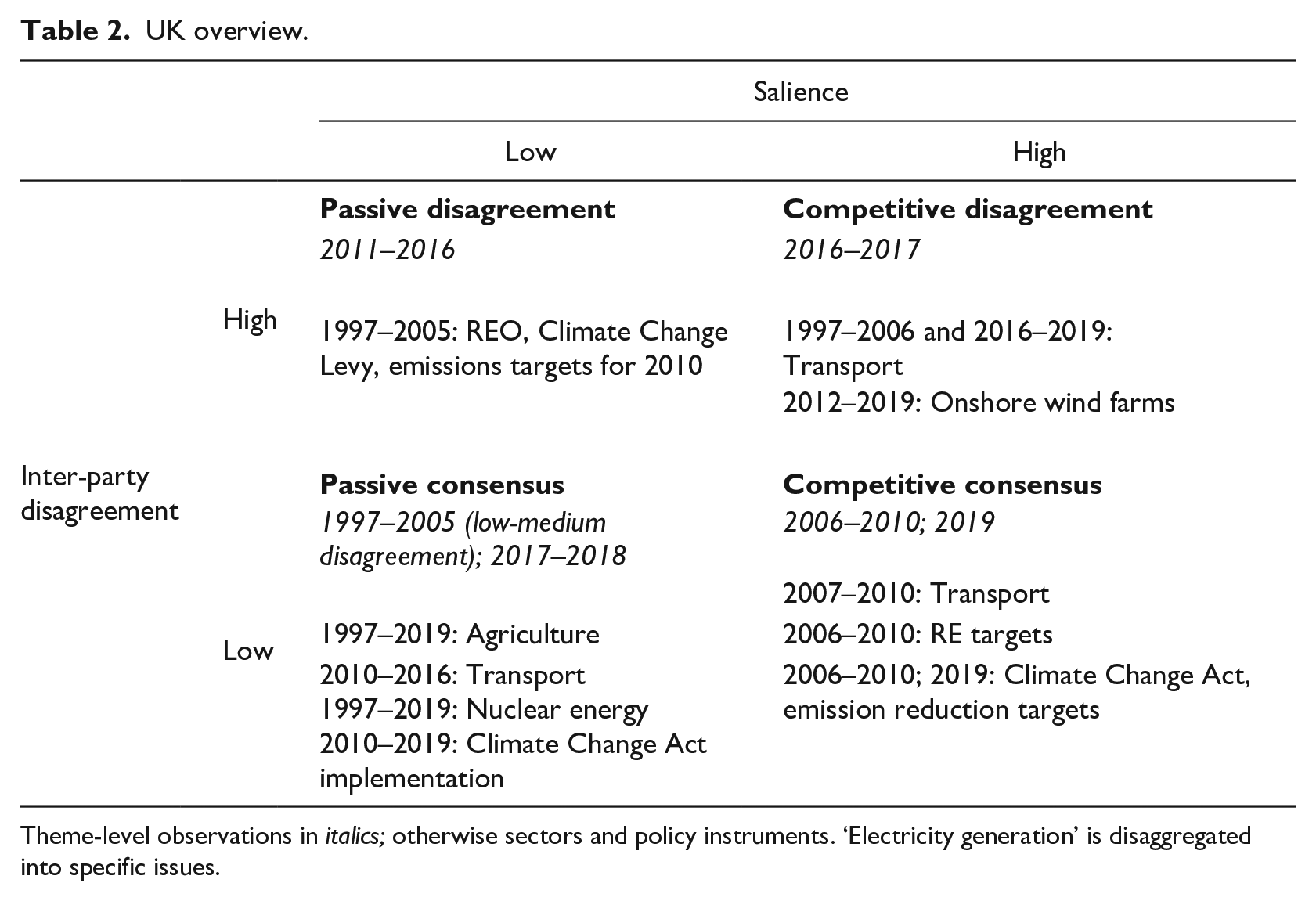
Theme-level observations in italics; otherwise sectors and policy instruments. ‘Electricity generation’ is disaggregated into specific issues.
Ireland
1997–2010
Climate policy was of low salience for the Irish parties until a surge in international attention made it electorally relevant in 2006 and 2007. There was little inter-party disagreement, with the exception of the Greens who consistently took distinctive positions. An early attempt to introduce a carbon tax was driven primarily by the FF Environment Minister but by 2004 this initiative had foundered amidst opposition within his own party, the Progressive Democrats (PDs, their economically liberal coalition partners), and industry (Coghlan, 2007: 146–151). In 2007, the Greens were alone in supporting a carbon tax.
FF, which led governments from 1997 until 2011, attempted to ‘green’ its image ahead of the 2007 general election, responding to increased public concern and the possibility of coalition with the Greens, although it did not substantiate this move with significant positional changes. FG was, for reasons unrelated to environmental policy, the Green Party’s favoured senior coalition partner, so had less reason to court the Greens, and was slower to respond to the climate zeitgeist (Little, 2017: 207–209).
At this stage, the parties were uniformly enthusiastic about wind energy and by 2007 there was a competitive consensus on electricity generation from renewables: FG aimed for 33% by 2025; FF 33% by 2020; and Labour 50% by 2020. Although concerns about energy security were cited in allowing peat- and coal-fired plants to open and remain unconverted to lower-carbon fuels, electoral politics and regional economic interests also played a significant role in energy policy. FF was particularly keen on peat-fired electricity generation in its 1997 manifesto and it opened two heavily-subsidised peat-burning stations in 2005 in its electoral heartland (Cunningham, 2008: 103–104, 107). It was not alone: as late as its 2011 manifesto, FG was still signalling its support for continued peat burning, while ‘accepting’ that it would be phased out by the mid-2020s.
The Greens’ entry into government with FF and the PDs in 2007 provided Labour with an opportunity to wrest issue ownership of climate change from them (Little, 2017: 210–211). As the UK CCA went through Parliament, Labour campaigned for legislation including ambitious new targets and a carbon budget mechanism, and in October 2009 and 2010 the cross-party Joint Committee on Climate Change and Energy Security published proposals for climate legislation. The Greens had signalled their support for legislative targets with a Private Members’ Bill in 2005 and in October 2009 they extracted from FF a commitment to a climate law (Torney, 2017: 252–260).
From 2008, Ireland’s deep economic crisis meant that climate policy was no longer a priority for the parties, although they stressed their support for measures that could provide employment and growth, such as retrofitting homes. Under pressure from a fiscal crisis and the Greens, FF agreed in 2009 to the introduction of a carbon tax (Convery et al., 2013); it also introduced an air travel tax of €3 per flight. The Opposition objected, but once introduced, the carbon tax was quickly accommodated: by the 2011 general election, FG and Labour proposed increasing it from €15/tonne to €25/tonne; industry’s position on the carbon tax also evolved (Interest group representative, personal interview, January 2015).
Although it accounted for around 30% of Ireland’s GHG emissions, agriculture was in decline and was of low salience. In 2000, the government’s first National Climate Change Strategy (NCCS) envisaged a 5% decline in herd numbers contributing to emissions reductions; the revised NCCS (2007) also envisaged a long-term reduction in agricultural emissions. The parties tended to defend the declining agricultural sector and the main driver of agricultural emissions—herd numbers—was not on the political agenda (Little, 2020).
On transport, the parties typically favoured significant investment in both roads and public transport projects. The Greens and sometimes Labour (e.g. in its 2002 manifesto) clearly prioritised public transport. Several parties opposed or sought broad exceptions to road tolls (e.g. FF in 1997, SF and Labour in 2007) and with some exceptions (mainly the Greens) the parties also tended to support, or not to oppose, expanding aviation infrastructure, especially regional airports.
2010–2019
In contrast to the UK, inter-party disagreement declined during the 2010s (Appendix A), albeit the main issue on the agenda until 2015—climate legislation—was somewhat divisive. In the last days of the FF-led government in December 2010, the Greens published a draft law that contained targets for 2050, 2030, and each year until 2020. There was strong resistance from within FF, spurred on by the main industry lobby group and by the mobilisation of the largest farmers’ organisation against it, but the party leader insisted on it as necessary to sustain the coalition (Special Advisors, personal interviews, December 2014 and July 2015). The Bill fell with the Dáil in early 2011, but climate legislation was firmly on the political agenda. Labour entered government with FG in 2011 committed to enacting climate legislation that included emissions reduction targets of 3% per annum. FG favoured putting Ireland’s 2020 EU targets in law, but only on the basis of all-party agreement. The coalition agreement dispensed with this condition but otherwise reflected FG’s preferred targets (the equivalent of a 2.5% reduction per annum); however, it soon became clear that the legislation was not a priority for the party (Torney, 2017: 252–260).
The only target specified in the government bill proposed in 2013 was ‘transition to a low carbon, climate resilient and environmentally sustainable economy in the period up to and including the year 2050’ (DECLG, 2013); ‘low carbon’ was later specified in a ‘National Policy Position’ as an 80% reduction across non-agricultural sectors and ‘an approach to carbon neutrality in the agriculture and land-use sector, including forestry, which does not compromise capacity for sustainable food production’ (Government of Ireland, 2014). FG made some concessions, notably guaranteeing the independence of the new advisory body and including a commitment to ‘climate justice’, but the main provisions remained the same (Torney, 2017: 252–260). FF, meanwhile, remained unwilling to insist on targets (NGO representative, personal interview, June 2016).
With the publication of the Food Harvest 2020 (2010) and Food Wise 2025 (2015) policies, agriculture went from being a sunset industry to being a growing contributor to export-led economic growth, with plans to increase Ireland’s national herd by 300,000 (Irish Times, 12 December 2015). All four major parties had significant electoral ambitions in rural areas and, encouraged by farmers’ organisations’ strong constituency-level networks, supported this vision. The contradictions between Labour’s ambitions for climate policy and its enthusiastic support for agricultural expansion caused some intra-party tensions. Ireland successfully sought significant flexibilities for land use as part of its EU 2030 emissions targets and at the Paris COP in December 2015 Taoiseach (PM) Enda Kenny told journalists that Irish agricultural production would not be compromised by climate policy; this assertion went unchallenged by FF, SF, or Labour (Irish Times, 24 February 2016). In a 2016 televised debate among the leaders of the four main parties, none conceded that reduced ambition in agricultural production was necessary to achieve Ireland’s climate policy objectives. Only the Greens—who held no parliamentary seats from 2011 to 2016—opposed herd expansion (Augustenborg, 2016).
Mobilisation against energy infrastructure increased sharply, causing a change of heart among politicians (NGO representative, personal interview, June 2016). While at the 2011 general election, many parties’ support for onshore wind energy had softened, by 2016, most parties indicated that they wished to restrict, review, or diversify away from onshore wind energy. Likewise, the preservation of raised bogs (carbon sinks) prompted significant local political mobilisation in support of turbary rights, which led the FG–Labour government to reduce protection for them. Using coal and peat for electricity generation, of concern to their owners (state-owned companies), unions, and communities that depended on fossil fuel-fired plants for employment, ranged from the Greens’ commitment to phase them out within five years to other parties’ proposals to replace fossil fuels with lower-carbon fuels over longer periods (Augustenborg, 2016).
Transport policy remained an area of broad consensus, although the Greens continued to differ from the other parties in consistently prioritising public transport and slow modes. At the 2011 election Labour renewed its support for regional airport connectivity, aligning with its geographically broader electoral ambitions, while FG campaigned to abolish the air travel tax and fulfilled that promise in 2014.
In 2019, when the economy was performing strongly, and in the context of mobilisation by environmentalist social movements and increased focus on climate change internationally, climate policy became salient again for the public (Figure 1) and the parties. After a decade in the doldrums, the Green Party recovered in opinion polls in the spring, and in May it quadrupled its representation in local government and secured two seats in the European Parliament.
The cross-party Joint Oireachtas Committee on Climate Action, which reported in March 2019, agreed a wide variety of climate policy measures, presenting a broad consensus among the parties on climate policy, including on a proposal for new, more effective climate legislation and the need to examine land-use change and diversification in agriculture; much of this was reflected in the FG-led government’s Climate Action Plan, published in June. However, the issue that drew most attention was increasing the carbon tax: it generated significant divisions between leftist parties (including Sinn Féin), which opposed it, and the other parties which favoured increasing it to €80/tonne by 2030 (Little, 2020).
Climate politics was thus characterised by a ‘passive consensus’ for most of the period 1997–2019, apart from a brief period around the 2007 general election and in 2019, when there were signs of a ‘competitive consensus’ (Table 3). The Green Party consistently took distinct positions, but was too small to make a significant direct impact on the structure of competition, and specific issues including climate legislation and carbon taxation were the focus of broader inter-party disagreement.
Ireland overview.
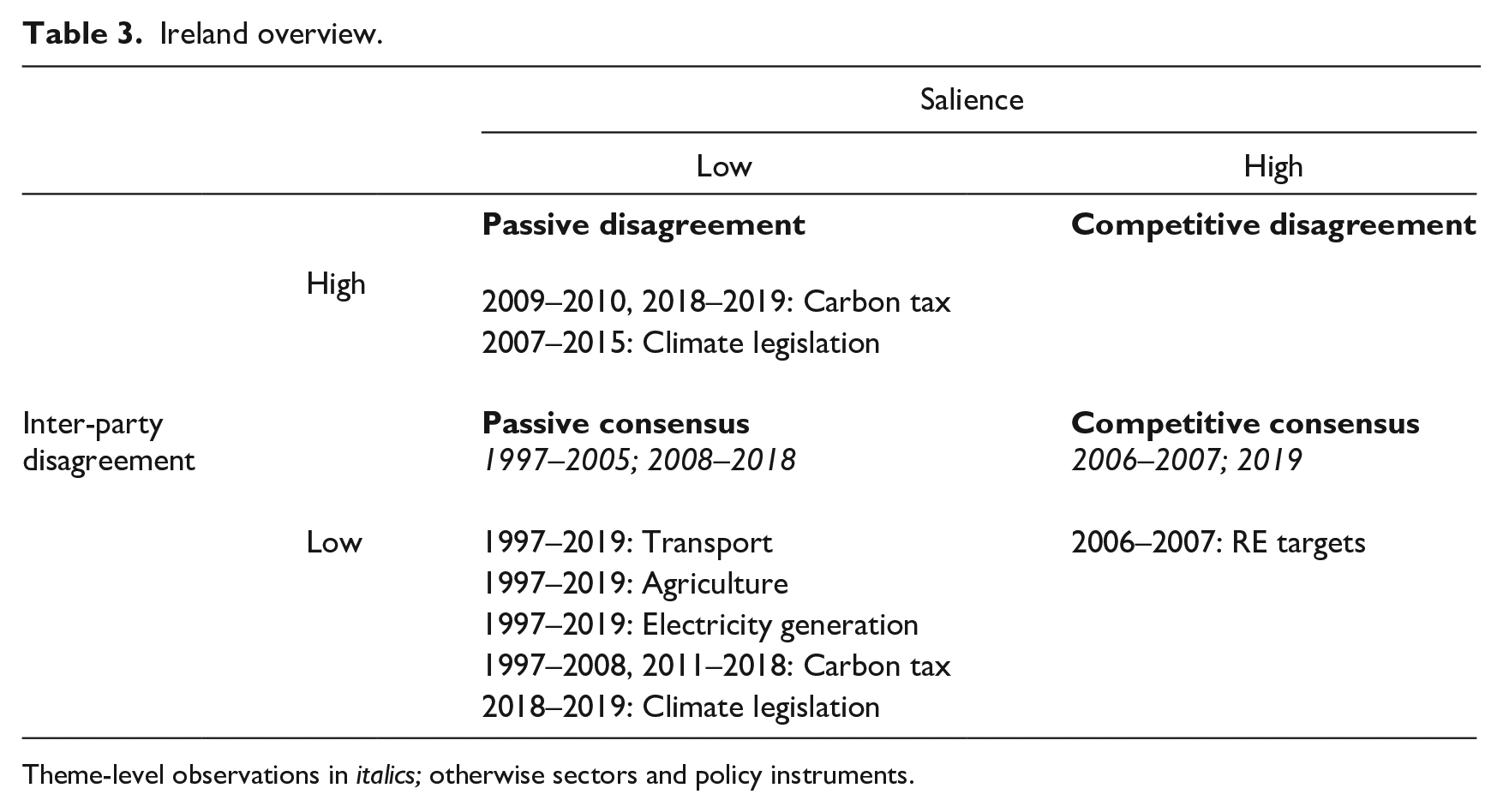
Theme-level observations in italics; otherwise sectors and policy instruments.
Analysis and discussion
The structure of issue competition on climate policy—its salience and the degree of inter-party disagreement—differs between countries, and within countries it differs over time and between climate policy issues. Our case studies show that the typical pattern of climate politics in the UK and especially in Ireland has tended towards consensus, although it became increasingly polarised in the UK in the 2010s, in tandem with broader patterns of political competition. The salience of climate policy has varied, peaking in 2006–2007 and again in 2019 in both countries. However, increased salience has not itself driven inter-party disagreement; if anything, increased public salience has been an incentive not only for increased salience among the parties, but also for increased convergence. At sector and instrument level, low levels of inter-party disagreement were evident in Ireland and the UK around agriculture and major elements of energy and transport policy. However, there was disagreement and even evidence of high-salience ‘competitive disagreement’ in the UK on some issues, especially from 1997 to 2005 and in the mid-2010s, and there was some division on climate legislation and carbon tax in Ireland (Tables 2 and 3).
The ‘most-similar’ cases of Ireland and the UK help us to examine how interest groups influence the structure of party competition on climate policy in countries with different configurations of interest group–party relationships due to differences in their party systems. Prior to 2005, traditional ties with interest groups were reflected in the UK parties’ sectoral climate policies: for example, Labour’s Climate Change Levy provoked fierce industry opposition, while protests against its fuel duties were widespread amongst farmers and road hauliers. In Ireland, FF and FG had more ‘ecumenical’ relationships with the major interest groups and in an electoral system that produces intense local competition, had similar incentives to protect regional economic interests (e.g. fossil fuel plants, regional airports, the rural economy). Together with the low level of ideological diversity, this was highly conducive to preference convergence. These observations are consistent with the argument that institutional conditions moderate interest group collaboration with and influence on parties.
The case studies also show the importance of interest groups’ agency and their evolving preferences. Agricultural policy in Ireland provides a clear example of interest groups using an economic crisis to frame sectoral interests as national economic interests and to sustain an expansionary consensus across governments by working across party lines; this lobby was also organised such that it could engage effectively with parties at local level in a candidate-centred system.
Changes in interest group preferences also mattered: after 2006 in the UK, for example, the burgeoning support for action on climate change within the business community (and among trade unions) made it much easier for all parties to embrace progressive climate policies. While Mildenberger (2020: 3) argues that the representation of economic interests by parties typically allows carbon polluters to obstruct progressive climate policies, conversely, evolving preferences among business interest groups and unions in the UK and Ireland undoubtedly enabled the main parties to develop new policy positions in favour of climate action.
There is strong evidence of preferences on cross-cutting issues constraining parties’ preferences on climate policy. Although both countries have tended towards consensus on climate politics, this tendency is much stronger in Ireland where left–right differences have long been marginal, while left–right differences infuse climate politics in the UK, constraining parties’ climate policy responses. For example, during the period of considerable inter-party disagreement on climate policy in the UK in 2015–2017, the parties’ policies bore a clear ideological imprint. Similarly, positional politics on transport climate policy (1997–2005) was fuelled by longstanding left–right divisions over public and private transport, while convergence on transport came with Cameron’s modernisation project. In Ireland, the Greens were often alone in proposing distinctive positions; where significant positional differences existed between the centre-left more generally and the centre-right, they were most notable on climate legislation until 2015, which was not a highly ideological debate.
With regard to challenger parties, the Irish Green Party’s relevance, in a proportional representation electoral system that fosters intense electoral competition in every constituency, provoked accommodative responses from other parties—especially those close to it in the political space, such as Labour, and especially when climate policy was salient (2007, 2019). In the UK, the Greens’ influence on other parties’ preferences was generally weak due in part to the plurality electoral system. More significant than the Greens was the emergence of the right-wing, climate-sceptic UKIP, which helped drag the Conservative right to adopt more partisan positions, reflected in growing Conservative discontent about onshore wind farms and green energy levies. These findings add to the evidence for accommodative responses to challenger success on the environment (cf. Abou-Chadi, 2016; Spoon et al., 2014), even where they are not issue-owners.
Together, the findings of this study help to illustrate the channels through which observed differences between left and right on climate policy (Båtstrand, 2014; Carter et al., 2018; Farstad, 2018) are generated, and how convergent climate policy preferences are sustained where those left–right differences are weak. The case studies also allow us to observe that the ‘interest group’, ‘ideology’, and ‘challenger’ channels are not separate and are sometimes closely aligned. For example, configurations of interest group–party relations—such as the business–Conservative relationship—had ideological content and was not just a resource exchange relationship, while the more ‘ecumenical’ interest group–party relationships in Ireland mirrored the more convergent party system. The Conservatives were compelled to compete with UKIP on the cross-cutting issues of regulation, taxation, subsidies, and the EU: both party competition and intra-party constraints drew them into that position.
Finally, the case studies also show that consensus may be necessary but not sufficient for valence competition. In Ireland and the UK, the content of climate policy consensuses was not always oriented towards reducing emissions. Agricultural climate policy in Ireland is perhaps the clearest example: from 2010, the consensus centred on policy that would increase emissions. This violates an assumption of valence competition when applied to environmental policy—that parties agree on the need to protect the environment—and therefore further calls into question the assumption that climate and environmental policy is invariably a valence issue. It underlines that the association between political consensus and effective climate policy (e.g. Christoff and Eckersley, 2011: 440) depends on the substance of that consensus.
Conclusion
This article analyses structures of issue competition on climate policy in order to examine the role of interest group–party relations, cross-cutting issues, and challenger parties in shaping those structures. It makes three contributions. First, it breaks with the long practice of conceptualising and operationalising climate change and the environment as matters of either salience or position. It argues that climate politics is characterised by variation in salience and inter-party disagreement, and it has suggested that the substance (overall position) of the system on an issue should also be taken into account when assessing the ‘valence’ status of an issue. By showing that positional competition on climate policy can exist even in classic ‘valence’ contexts, it takes up the challenge of empirically investigating rather than assuming the structure of issue competition (Clarke et al., 2009; Guinaudeau and Persico, 2014; Stokes, 1963). In doing so at theme, sector, and instrument level, it has shown that these structures of competition can coexist within a policy theme. Future research might focus on heterogeneity in the structure of issue competition on climate policy at theme, sector, and instrument levels in other contexts. These might include systems where climate politics is highly positional, such as Australia or the USA, to investigate the extent to which some aspects of their climate politics are characterised by consensus, contrary to the dominant mode of climate politics.
Second, it contributes to the underdeveloped literatures on the influence of interest groups (Klüver, 2020; Otjes and Green-Pedersen, 2019) and intra-party constraints (Meyer, 2013) on parties’ policy preferences. It shows how interest group relations with parties tend to cluster with issue-conflicts (or their absence), and thus the issues that cut across and constrain parties’ climate policy preferences. As existing studies of interest group influence have focused on issue salience, one additional direction that this study points to is further research on their effects on parties’ positions, which are often the primary object of these groups’ efforts. It also highlights the need for research on interest groups in climate politics and research on interest group influence on party preferences to speak to one another.
Third, this article contributes to the burgeoning literature on the party politics of climate change, including on the roles of challenger parties and ideological constraints, respectively, in shaping the structure of issue competition on climate policy. It adds to established findings on the role of challenger parties and cross-cutting issues with case-level evidence of mechanisms that are often assumed but less frequently exposed empirically, describing how party preferences on multiple cross-cutting issues—taxes, spending, subsidies, and regulations—have structured climate politics. In addition to showing how green parties with outlying climate policy preferences have been accommodated, it also describes the accommodation of a climate-sceptic party in the UK. These findings complement those of existing cross-national research (Farstad, 2018; Spoon et al., 2014). Together, they show that much of climate politics hangs on the broadest structures of party politics, although within this broad structure, there is variation between issues and over time.
Supplemental Material
sj-pdf-1-ips-10.1177_0192512120972582 – Supplemental material for Party competition on climate policy: The roles of interest groups, ideology and challenger parties in the UK and Ireland
Supplemental material, sj-pdf-1-ips-10.1177_0192512120972582 for Party competition on climate policy: The roles of interest groups, ideology and challenger parties in the UK and Ireland by Jale Tosun, B Guy Peters, Neil Carter and Conor Little in International Political Science Review
Supplemental Material
sj-pdf-2-ips-10.1177_0192512120972582 – Supplemental material for Party competition on climate policy: The roles of interest groups, ideology and challenger parties in the UK and Ireland
Supplemental material, sj-pdf-2-ips-10.1177_0192512120972582 for Party competition on climate policy: The roles of interest groups, ideology and challenger parties in the UK and Ireland by Jale Tosun, B Guy Peters, Neil Carter and Conor Little in International Political Science Review
Footnotes
Acknowledgements
We thank three anonymous referees, Jale Tosun, Guy Peters, Marian Sawer, and Charlie Burns for their helpful comments on earlier drafts of this paper.
Funding
The author(s) disclosed receipt of the following financial support for the research, authorship, and/or publication of this article: This research was supported by the Economic and Social Research Council (Research Number ES/K00042X/1). Project: Climate Policy and Political Parties.

Supplemental material
Supplemental material for this article is available online.
Notes
Author biographies
References
Supplementary Material
Please find the following supplemental material available below.
For Open Access articles published under a Creative Commons License, all supplemental material carries the same license as the article it is associated with.
For non-Open Access articles published, all supplemental material carries a non-exclusive license, and permission requests for re-use of supplemental material or any part of supplemental material shall be sent directly to the copyright owner as specified in the copyright notice associated with the article.
