




Abstract
How do electoral institutions affect primary competition and legislative behavior? This paper examines the understudied electoral rule known as ballot access laws, advancing the novel theory that denying ballot access to minor candidates forces these outsiders into major parties. I find that in American states that adopt high ballot access thresholds experience higher rates of ideological heterogeneity and primary competition, and those that reduce their thresholds experience a reduction in heterogeneity and competition. Using an original dataset on state-level changes to ballot access thresholds from 1990 to 2018, I find that an increase in the number and types of primary competition leads to an increase in heterogeneity within both party caucuses. This paper adds to the literature on legislative behavior and electoral institutions, demonstrating institutions' role in shaping electoral competition and the ideology of those represented in office.
Introduction
Tired of dissent from the left-wing Working Families Party (WFP) following the 2018 midterm elections, New York’s Democratic Governor, Andrew Cuomo, sought to eliminate competition from the party. The Democrats achieved this not by defeating the WFP or choosing not to fuse votes with the party. Instead, the Democratic Party decided to use a commission appointed by the Governor to make it difficult for the party to run candidates in future elections. The Public Campaign Finance Commission voted to raise ballot access requirements for party status from 50,000 votes to 130,000 votes, eliminating ballot access rights for the WFP, which received 114,000 votes in the previous qualifying election. While seemingly insignificant, eliminating party status increased the number of signatures the WFP would need to run for state assembly tenfold from 150 to 1500 signatures. This helped the Democratic Party prevent organized dissent from another political party and further increased its control over which candidates could run and seek political office in New York.
New York’s Democratic elites’ work to eliminate minor party dissent may seem out of place in the American party system, defined by the persistence of the two-party duopoly. The duopoly in the American party system is assumed to be an innate consequence of the first-past-the-post electoral institution (Cox, 1997; Downs, 1957; Duverger, 1959). While the study of minor parties is rare, and their direct effect on policy is unclear in American Politics (Hirano and Snyder Jr, 2007; Hirano, 2008), the impact of minor parties in shaping major parties is well documented in other established party systems (Adams and Somer-Topcu, 2009; Abou-Chadi and Krause, 2020; Meguid, 2005; Pardos-Prado, 2015). The two-party system in the United States does not merely exist because of the majoritarian election rules; it is also bolstered by electoral rules established by members of two dominant parties to hasten the development or elimination of dissenting political parties (Argersinger, 1980; Burden, 2007; Drometer and Rincke, 2014; Lewis-Beck and Squire, 1995; Winger, 1997). This paper examines the consequences of regulations established to prevent the entry of new political competition in the United States. Parties use ballot access laws to increase the costs for candidates outside the two-party system, allowing the dominant parties to choose who can run for elected office.
In this article, I examine the consequences of ballot access laws. Ballot access laws create rules and requirements determining who gets on the ballot in the general election; they are determined at the state level and generally require candidates seeking political office to collect a certain number of signatures to have their name on the ballot. In most states, major parties face lower or no ballot access thresholds since they are state-recognized. In contrast, minor parties/independent candidates must collect substantially more signatures to be able to compete in an election. These rules vary across the states, with some, like Florida, requiring zero signatures and others, like Arizona, requiring over 3000 signatures to get on the ballot for a state legislative race. While previous work has demonstrated that the more signatures needed to seek office deter competition from outside of the two major parties (Burden, 2007; Lewis-Beck and Squire, 1995; Schraufnagel and Milita, 2010). Research has yet to examine the consequences of eliminating this competition beyond general election competition, including where candidates deterred from the general election choose to run and the downstream ideological implications for the legislature enacting these regulations.
I hypothesize that ballot access laws are a crucial determinant in the ideological composition of state legislatures, specifically by increasing the competitiveness and ideological diversity of primaries. Since ballot access laws increase the costs of running in the general election, they impose a substantial burden on candidates from minor and independent parties because they have limited resources to collect the required signatures. Facing high costs, these candidates instead choose to run in major party primaries, where there are often no or substantially lower signature requirements. Increased competition results in changes to the candidate that emerges from the primary process. This leads to a decrease in party ideological unity in state legislatures.
To test this theory, I examine the impact of two exogenous shocks in Florida and Alaska that dramatically reduced ballot access requirements on primary competition in both states. When the threshold is lowered, I find significantly fewer competitors, with candidates moving to the general election running under minor party and independent labels. Next, I construct a novel data set of ballot access laws in American states from 1990 to 2018. I examine how this increase in primary competition changes the ideological composition of state legislatures. Looking at state-level changes in ballot access laws, I find evidence that heterogeneity increases when states adopt higher thresholds and is reduced when they lower their thresholds.
This paper provides several key contributions. It provides an examination of how an overlooked electoral rule can shape the ideological space of a legislature. It adds to the literature on political parties by demonstrating how higher costs to form new parties force candidates to stay a part of the current party system. It reveals the consequences of this dynamic, showing that party outsiders reduce ideological unity within party caucuses. It provides new explanations for increased levels of primary competition in American elections by demonstrating how ballot access laws increase primary competition. Finally, it examines the often-ignored role of third parties in shaping the ideological makeup of legislative bodies in the United States. While the party literature in the United States has not focused on actors outside the two-party system, their exclusion/inclusion affects the electoral and ideological environment in American party politics.
Ballot reform and state control
Before adopting the Australian ballot in the United States, political parties played a significant role in regulating who could and could not stand as a candidate for political office. Parties printed and directly distributed ballots to voters who voted by turning them in on election day. Any party that could afford to print ballots could run for office. This allowed many upstart political parties to run and have electoral success beyond the Democratic and Republican parties. Third parties developed localized support within cities and regions in states, eventually expanding support throughout the state by spreading their message (Chamberlain, 2012). This allowed minor parties to be successful; for example, after the 1896 election, third parties held 600 seats in the state lower and almost 100 seats in upper state legislative chambers (Dubin, 2007). However, as the adoption of the Australian ballot spread, states began printing ballots with candidates’ names, allowing voters to select their preferred candidate in the voting booth’s privacy. With the Australian ballot, parties no longer created and distributed ballots; instead, they needed to provide the lists of candidates they wanted to run in an election to the government, the the government would put those candidates on the ballot. The state government determined which candidates were placed on the ballot through a candidate qualification process.
The need by the state for a candidate qualification process meant states became more active in regulating who would have their name placed on the ballot. This allowed the parties in power in the state legislature to use their control over determining the process to keep minor party and independent candidates off the ballot. State governments enacted barriers to running for office only after adopting the Australian ballot (Argersinger, 1980). These barriers included signature requirements, filing fees, and previous vote totals to regulate who could access the ballot. These rules often only applied to non-state recognized parties ensuring it was more difficult for third parties to field candidates than the established Democratic and Republican parties. This served the dominant major parties’ goal of eliminating who competed for votes by eliminating new, fringe, or other political parties (Lewis-Beck and Squire, 1995). With this goal in mind, ballot access laws, fusion elimination, and the Australian ballot weakened the electoral success of third parties and increased the dominance of the Democratic and Republican parties in state and local elections (Argersinger, 1980; Reed, 2016; Winger, 1997).
The literature on the impact of state control on the ballot and third-party electoral fortunes is varied. The two major parties in control of the legislature actively sought to diminish third parties using new ballot regulations with the adoption of the Australian ballot (Argersinger, 1980). However, evidence that these regulations result in electoral doom for minor candidates needs to be clarified. Hirano and Snyder Jr (2007) argue that ballot regulation “occurred roughly at the time that electoral support for third parties began to decline; the literature provides little evidence that a connection exists between these two phenomena” [p. 2]. While others have found direct negative affect from the institution of ballot regulations on the number of minor party candidates in a state legislature (Reed, 2016).
Ballot access laws
Ballot access laws are a significant barrier to running for office for candidates not members of established political parties. Whereas state-recognized parties are guaranteed their nominee’s name will appear on the general election ballot, minor candidates often must collect a certain number of signatures to run. This can include collecting over 3% of their constituency’s signatures just to have your name on the ballot. 1 The stringency of this regulation reduces competition in elections by reducing the number of minor candidates that run in a general election (Burden, 2007; Lee, 2012b; Lewis-Beck and Squire, 1995; Schraufnagel and Milita, 2010; Winger, 1997). As the percentage of signatures a minor candidate must collect increases, the number of minor candidates in the general election decreases. Burden (2007) finds that when this requirement is around 1% of eligible voters, there is a dramatic reduction in candidates; at 2%, there is rarely a minor candidate on the ballot. When signature numbers are reduced, both the number of votes minor candidates receive and the number of candidates increase (Schraufnagel and Milita, 2010).
Given state-level control over election regulation, established parties within the state legislature generally have control over setting ballot access regulations. By establishing high-cost regulations through very high signature requirements, the Democratic and Republican parties can work together within the legislature to establish election rules to prevent outside competition. While many believe major parties shouldn’t feel threatened in an American election system with first-past-the-post, single-member districts because they create strong incentives for strategic voting and a two-party system in the United States (Cox, 1997; Duverger, 1959). The two parties continue actively changing the regulation allowing minor party candidates to compete in the legislative elections. This may cause parties to create stricter ballot access laws when they feel threatened (Drometer and Rincke, 2014).
The barriers to entry that ballot access laws create have not been thoroughly examined, with most work focusing on how the regulation reduces the number of minor candidates on the ballot (Burden, 2007; Lee, 2012b; Lewis-Beck and Squire, 1995; Schraufnagel and Milita, 2010; Winger, 1997). Ballot access laws impede candidates seeking to run in the general election, eliminating potential competitors to both the Democratic and Republican parties. This can help both parties by preventing spoiler candidates or losing votes to minor parties ideologically aligned with Democratic or Republican parties, like the Green or Libertarian parties. Little work has examined the downstream consequences of ballot access laws on the ideological makeup of the state legislative body that imposes them or the other electoral avenues candidates deterred by the barrier seek.
High ballot access signature requirements also make it difficult for members of major parties to leave their party and run as independent or third-party candidates. Loss of party support already deters many incumbents from leaving their political party. The loss of party resources and higher running costs ensures that states with higher signature requirements keep in ideological outsiders by making it too costly to defect and run as an independent or minor party candidate. In states that prevent “sore losers” from running, a candidate who loses a party’s primary and runs in the general for another party there exists significantly higher levels of polarization in the state legislature (Burden et al., 2014). Similarly, ballot access laws act as a mechanism preventing candidates from defecting from a major party. Partisan disaffiliation laws, including sore loser and ballot access laws, are an effective mechanism for preventing partisan defectors (Chamberlain and Klarner, 2016).
Previous research establishes that minor candidates find signature requirements too costly to seek the general election ballot. However, they need to establish whether this stops them from running for office. The structure of ballot access laws makes it costly to run in the general election but not necessarily the primary election of a major party. Candidates deterred from the general election may choose to run in a major party’s primary. King and Lee (2022) shows a comparable strategic consideration occurs when candidates opt to run in a general election as a third or independent candidate instead of a major party primary if the primary is saturated with too much competition. Initially, it may seem counter-intuitive that these candidates would run in a primary of a party they do not belong to, where their chances of winning the primary are low. However, minor candidates often seek to run for office not because they are office-seeking but for the alternative reason of agenda-setting (Rosenstone et al., 1996). Running in the primary at a lower cost can help them to achieve their goal without bearing the costs of collecting signatures to run in the general election. Candidates running in the primary may have more impact than in the general election. Hirano (2008) finds that minor candidates bear little influence on changing the ideological skew of major party candidates when they run in a general election. However, Sulkin (2005) shows that policy uptake by primary winners does occur even if the losing candidates receive substantially fewer votes than the winner.
The electoral consequences of ballot access laws can lead to ballot access laws serving as partisan disaffiliation laws preventing partisan defectors. They also could serve as a mechanism for changing the stage a candidate chooses to run, opting to move away from the costly general election and into the less costly major party primary. Both these processes could lead to changes in the ideological behavior of the state legislators in states with restrictive ballot access laws. While the effects of disaffiliation have been studied, work has yet to explore whether minor candidates deterred from the general seek to run in the primary of a political party with ballot access. If this process is occurring, we should see more candidates run as members of the major party when thresholds are high; we should then observe increased levels of competition within primaries. Suppose, instead, these laws successfully eliminate electoral competition. In that case, we should observe candidates giving up their electoral ambitions and not running for office; then, we should observe no difference in the number of candidates in the primary. • Hypothesis 1 Party Primary Consolidation: High ballot access thresholds increase the number of candidates in major party primary elections.
The work on ballot access has examined the regulation’s role in deterring candidates from defecting from their party or minor party candidates from being able to access the general election ballot. No work has examined the downstream effects of this regulation on legislative behavior and the ideological composition of the legislature affected by aggressive ballot access regulations. This is unfortunate, as ballot access laws are part of the numerous electoral rules and institutions that change at the state level every year. Most work has focused on how more prominent institutions affect and shape the behavior of elites within the legislature. While some work has found substantial effects on polarization occurring from institutions, including term limits (Olson and Rogowski, 2020), most work has found null results on institutions affecting the ideological composition of a legislature. Formal models link primaries to polarization (Aranson and Ordeshook, 1972), yet the literature cannot locate polarization occurring because of either the introduction of primaries (Hirano et al., 2010) or the primary system a state adopts (McGhee et al., 2014).
Similarly, increased partisan bias in the redistricting process has also been cited as a primary mover of changes in the behavior of legislators in the United States. However, similar inconclusive work exists within the redistricting/gerrymandering literature; finding a specific causal link between redistricting and polarization has yet to occur (McCarty et al., 2009). Further electoral reforms suggested by Fiorina et al. (2005) to change redistricting guidelines do not appear to change elite behavior, with little difference between reforms (Kogan and McGhee 2012) and different systems (Masket et al., 2012).
Despite some electoral rules finding inconclusive links to legislative behavior change, more minor rules determining when and who can compete in general elections have shown promising results. Burden et al. (2014) shows sore loser laws destabilize candidate entry in primaries leading to increased polarization by 10%. Olson and Rogowski (2020) shows a similar process of destabilization occurring with term limits. Additionally, Daniel J. Lee (2012a) shows when third-party entry is probable, with ballot access signatures contributing to the likelihood of entry, there is a greater chance of divergence amongst major party candidates. Identifying other institutions destabilizing the electoral landscape and elite behavior is important to understanding how institutions shape the ideological composition of legislatures.
While most work on institutions and roll call ideology has focused on polarization, little has focused on how electoral institutions shape the ideological diversity of legislative caucuses. Certain electoral institutions can potentially increase or decrease the number of ideological outsiders that enter the party, compete in its primaries, and influence its legislators indirectly through competition or directly by being elected. Thus, some institutions may play a role in creating a more ideologically diffuse caucus filled with members not traditionally aligned with the party.
Ballot access laws can change the nature of electoral competition, similar to sore loser laws and term limits (Burden et al., 2014; Lee, 2012a; Olson and Rogowski, 2020). Ballot access laws can directly affect the amount of competition, where the competition occurs, and where the new competition is coming from. If hypothesis one is supported, more competition occurs at the primary stage of an election with an increase in the number of candidates running in major party primaries with fewer competitors entering the general election. They can also deter party defectors keeping candidates who would otherwise leave a party in the party. How do these ideological outliers affect the ideological composition of a legislature? With high ballot access thresholds, candidates who prefer to run under a different label, either a minor party or as an independent, instead choose to run in primaries with the party label they most closely identify with. These “Republicans” or “Democrats” presumably do not share the same ideological positions as the Republicans and Democrats who would run regardless of ballot access laws. The result of this increased competition could have many downstream effects on both polarization and party ideological unity within the party.
The type of competition it creates makes ballot access’s effect unique. With high ballot access thresholds, the increased competition does not come from within the party but instead from people who would generally align themselves outside of the party, either party defectors or minor party candidates. This should increase ideological diversity within the party because independent and minor parties are ideologically divergent from major parties. To demonstrate this claim, I use the Bonica (2013) DIME dataset’s CF-Score to show the average party-level ideology of state legislative candidates. The CF-Score is scaled similarly to NOMINATE Scores, with positive scores indicating right-wing ideology and negative scores left-wing ideology. While Bonica (2013)’s data set only includes three-party levels of Democrat, Republican, or other for candidates to be members of, I supplement the data with Klarner (2018)’s State Legislative Election Returns (SLER) data set on the party membership of each candidate. The results of the merge show the stark ideological difference between the average Republican Party state legislative candidate with a score of 0.836, compared to the Constitution and Libertarian Parties scores of 2.100 and 1.764. Similarly, the Democratic and Green Party; diverge with scores of −0.631 and −1.761.
By keeping in potential party defectors and incentivizing many minor candidates to run in primaries, the ideological landscape of a legislature whose members face high ballot access thresholds if they do not join a state-recognized party should be more diffuse. Political competition must occur within the major parties meaning more diverse candidate ideologies exist within those parties.
2
We expect states that adopt high ballot access thresholds to experience an uptick in ideological heterogeneity in their legislatures. Depending on the nature of this competition, we could also expect an increase in polarization if the competition primarily comes from extremist third-party outsiders pulling the parties towards the poles of their political ideology. If this competition also includes moderates and deterred party defectors upset with the extremity of their parties, we may only observe heterogeneity and not polarization. • Hypothesis 2 Increased Polarization: High ballot access thresholds increase polarization between major parties in state legislature. • Hypothesis 3 Increased Heterogeneity: High ballot access thresholds increase inter-party ideological heterogeneity in both the Democratic and Republican party.
Primary election competition
State legislatures provide an ideal environment for examining the consequences of ballot access laws on primary competition and legislature ideology. While minor parties have not successfully run for office at the federal level in the United States, they have been more successful historically at the state and local levels (Chamberlain, 2012; Hirano and Snyder Jr, 2007; Reed, 2016). State party systems vary from the national party system, allowing policy and agenda control variation from national trends (Coffey, 2011). Furthermore, state legislators have been shown to actively adapt to changing electoral conditions (Kousser et al., 2007).
State legislative election data is quite comprehensive regarding the general elections (Klarner, 2018), but this data lacks complete data on primaries. To better grasp how ballot access laws affect primaries, I examine two exogenous changes to ballot access laws that were not initiated by state legislatures in Alaska and Florida. I explore the effects of an Alaska Supreme Court ruling forcing a reduction in signature requirements for minor party and independent candidates from 3% to 1% in the case Miller (1982). While, Vogler struck down Alaska’s ballot access law in 1982 for gubernatorial candidates, various court challenges and legislative delays meant the threshold was not lowered for state legislative candidates until 5 days after the 1986 state legislative filing deadline. 3 Starting in 1988, the costs of running as a minor candidate were reduced dramatically in Alaska, 4 creating an unanticipated change in the ballot access process in the state.
Additionally, I leverage a shock caused by the Florida revision process. In 1998 voters in Florida passed Revision Eleven, amending the Florida Constitution to ensure ballot access procedures for minor parties and independent candidates cannot be more complex than for members of major parties. Before the passage of Revision Eleven, Democrats and Republicans had to pay a filing fee to gain access to the ballot, whereas other candidates had to collect 3% of the registered voters in the district they were running for. Starting with the 2000 election, the number of signatures to run for the Florida House Representatives went from an average of 2048 signatures to merely a filing fee for minor candidates. The passage of Revision Eleven serves as an ideal case study because potential candidates could not anticipate the placement of a revision on the ballot due to the unique nature of the Florida Constitution that allows an appointed Constitutional Revision Commission to place revisions on the ballot every 20 years. This case has been previously used to study the effects of ballot access laws, with Schraufnagel and Milita (2010) finding increases in non-major candidates and their vote shares in general elections.
I collected primary election data for the House of Representatives primaries for Alaska and Florida to examine the consequences of ballot access changes in primary election competition. Data for Alaska was collected from the Alaska Division of Elections from 1982 to 1994, 5 changes in the ballot access laws occurred in 1988. For Florida, I use the Florida House of Representatives primary election data from the Florida Secretary of State’s Web site from 1992 to 2010. This data covers two redistricting cycles, with the intervention of lowered ballot access thresholds occurring in the 2000 election cycle.
To test hypothesis 1, use a Poisson regression where the dependent variable is the number of observed candidates in a primary election for either the Republican or Democratic primary.
6
The independent variable is BallotAccess
dt
, a dichotomous treatment variable coded as 0 before ballot access thresholds were lowered and coded as 1 starting in 1988 in Alaska and 2000 in Florida when the threshold was lowered. I control for other variables important for understanding primary and general election competition at the state legislative level, including party support, and term limits (Hogan 2003; Prier and Wagner 2009). Additionally, I control for district and election cycle fixed effects in the regression. The equation for the model is below; it controls for both observed and unobserved confounding influences.

BallotAccess dt is the dichotomous treatment variable for when states have implemented restrictive ballot access laws; it functions as an iterative time-series indicator. It is coded as 1 when laws are restrictive and 0 when rules are not restrictive. NumberofCandidates dt is the number of observed primary competitors at the district level running in the primary for either major party to test hypothesis 1. IncumbentRunning dt controls for if the incumbent is running for re-election, DemocraticPrimary dt for the partisanship of the primary, in Florida I include IncumbentTermLimited dt if the incumbent was term-limited 7 and PreviousParty′sVote dt the party’s support level in the previous election.
Lowered ballot access thresholds effect on number of primary competitors.
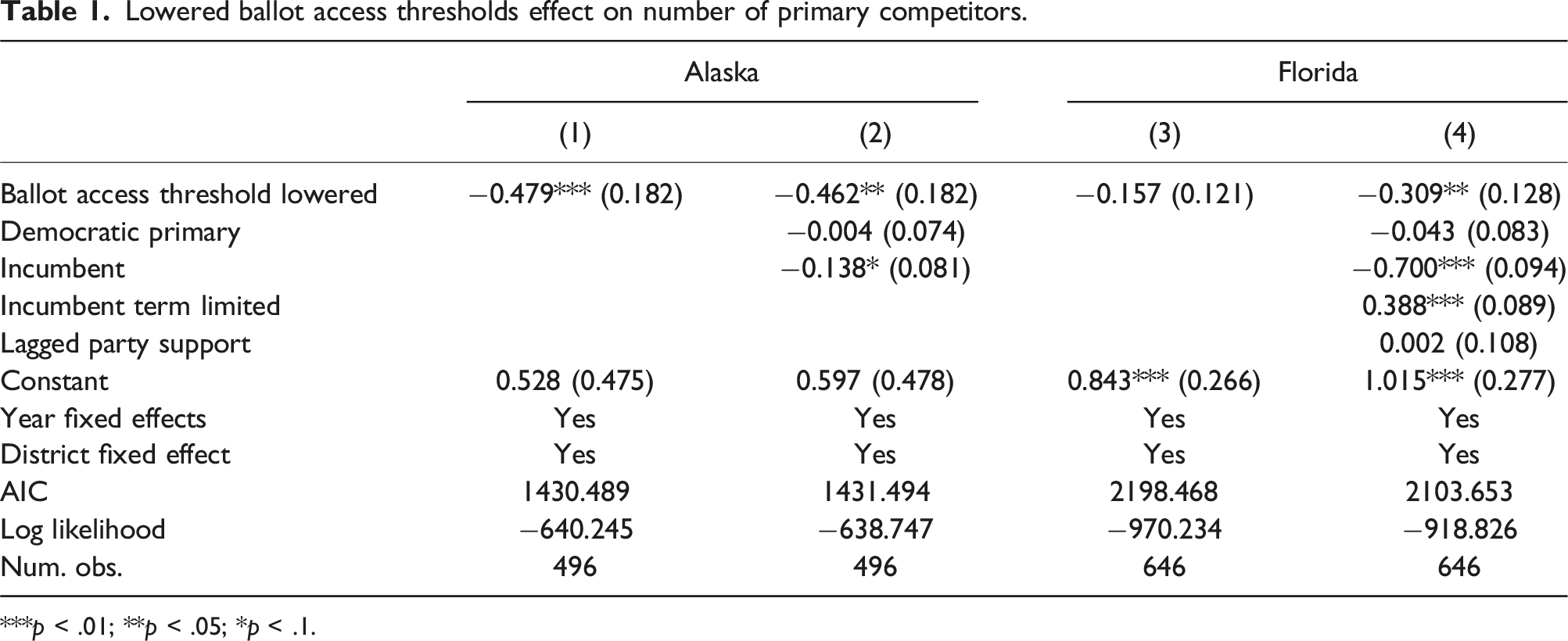
***p < .01; **p < .05; *p < .1.
Ideological consequences of ballot access thresholds
Changes in ballot access laws 1992 to 2018.
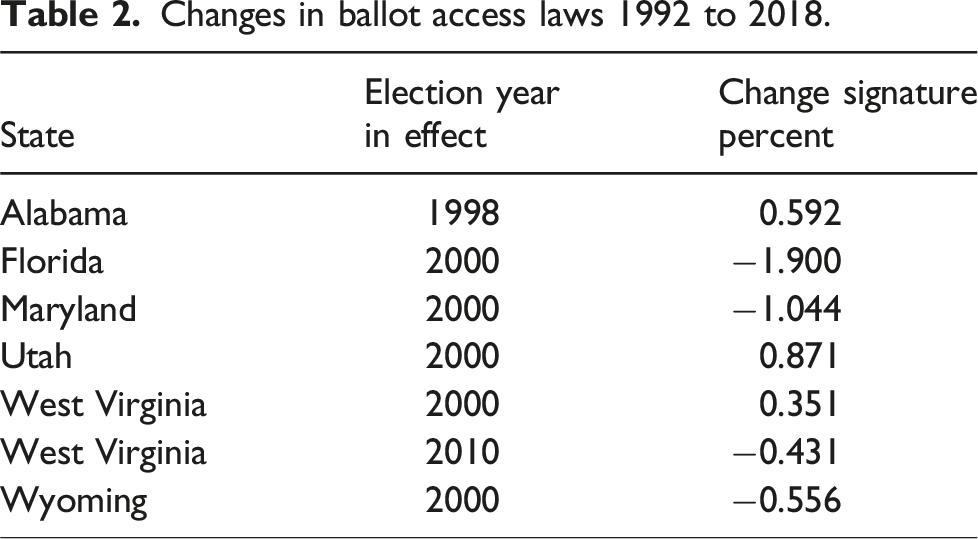
To test both the inter-party heterogeneity and polarization hypotheses, I use a data set collected from the American Legislatures project, which measures ideology scores for state legislatures at the individual and aggregate level from 1993 through 2018 (Shor and McCarty 2011).
10
American Legislatures project scales roll call votes within a state legislature similar to NOMINATE; however, because of missingness, it only assigns a lifetime score. The panel structure of the data is leveraged to use changes in ballot access restrictiveness to function as a difference-in-difference indicator. The equation is below:
BallotAccess st is a dichotomous treatment variable for states implementing restrictive ballot access laws. It is coded as 1 when laws are restrictive and 0 when laws are not restrictive. The variable is coded not based on the date of passage for a state legislature but based on the first year a state legislature was seated after an election with a new threshold. IdeologyOfLegislature st is the dependent variable measured in three ways for the hypotheses. The dependent variable for the polarization hypothesis within a state legislature is the difference between the mean Democratic score and the mean Republican score within a state during a legislative session. For the heterogeneity hypothesis, I use the standard deviation of the ideology score of both Democrats and Republicans in a state’s lower house. 11 State and year-fixed effects are used, and standard errors are clustered at the state level. 12
Effect of high ballot access thresholds on roll call votes.
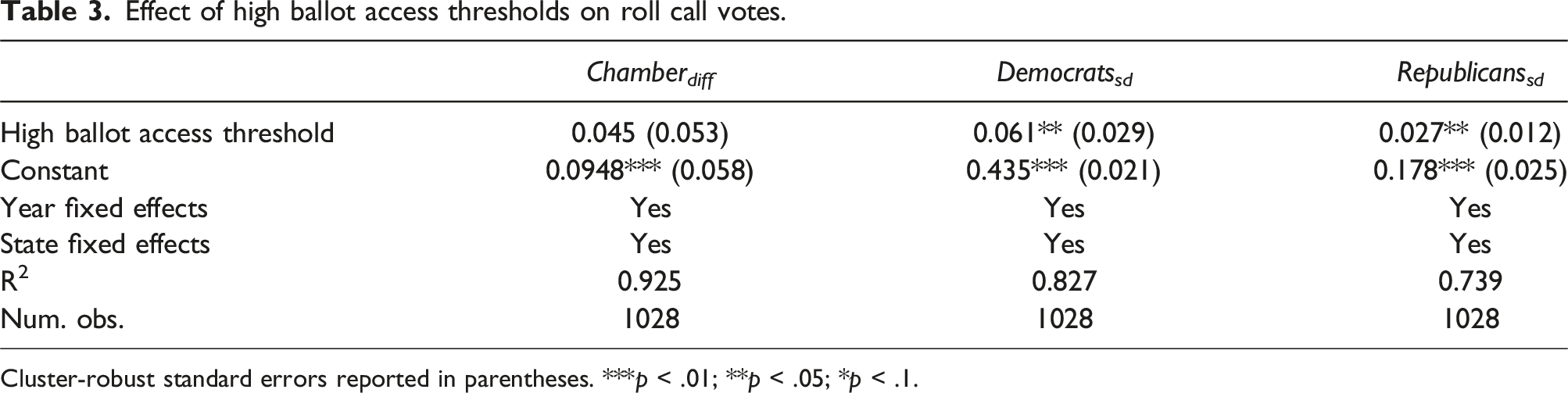
Cluster-robust standard errors reported in parentheses. ***p < .01; **p < .05; *p < .1.
An important consideration when working with the American Legislatures project’s measure of ideology scores for state legislatures is that the scores for legislators are calculated over a lifetime. Therefore, changes in the composition of a legislature’s ideology cannot be observed through the adaptation mechanism but through the replacement of legislators over time. This is especially important when we consider that incumbents are less likely to face the changes in their primary competition that non-incumbents face. 13 This means the long-term cumulative effects of ballot access laws may indicate a clearer story for the impact of these laws; through replacement, more members of the legislature would have been exposed to the consequences of ballot access laws. To test this, I include an additional term for the year since the enactment of the last major ballot access law change and interact it with the difference-in-difference indicator of ballot access changes. 14
Interactive effect of high ballot access thresholds adoption over time.
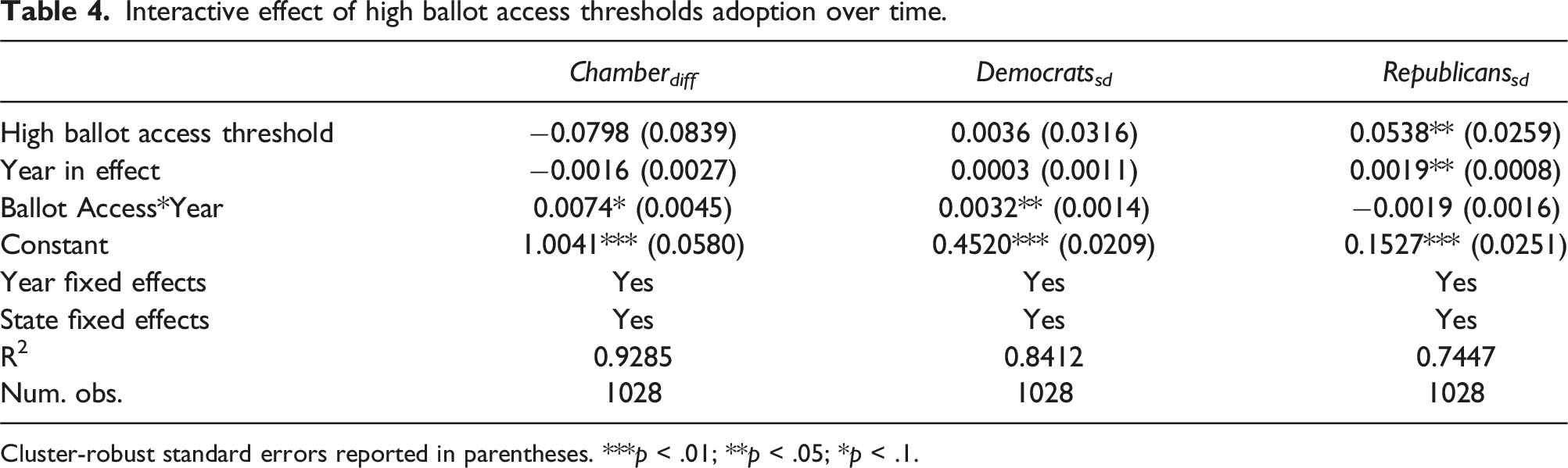
Cluster-robust standard errors reported in parentheses. ***p < .01; **p < .05; *p < .1.
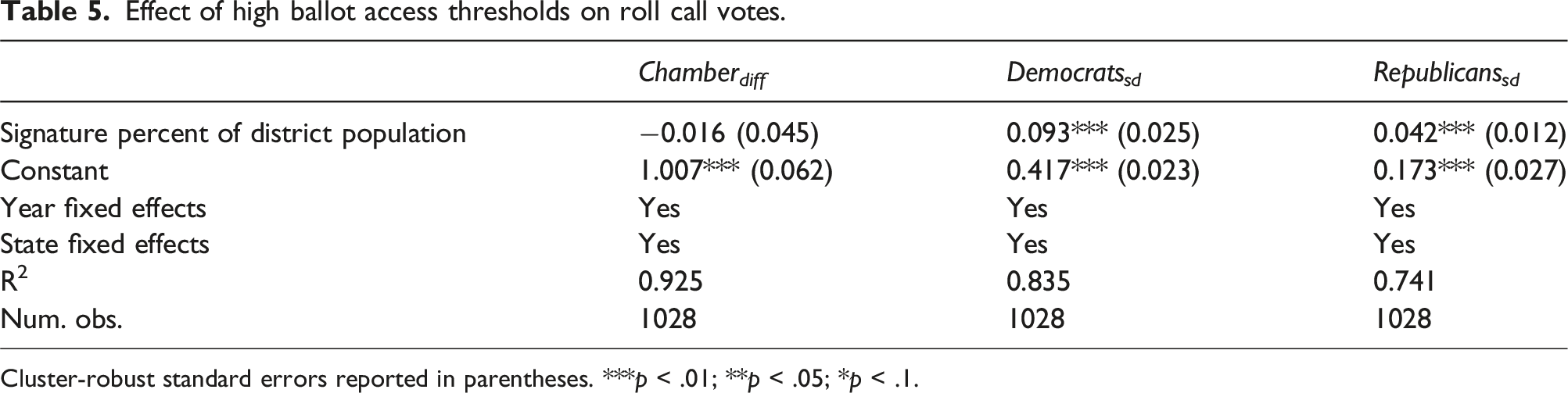
In the previous models, the treatment indicator creates a difference-in-difference design for examining ballot access laws. All models up until this point rely on a treatment variable that does not factor in varying degrees of extremity in the ballot access regime. To examine whether extremity is linear and not dichotomous, I collect the rolling year average for each election needed to gain access to the ballot. Because some states fix their ballot requirements to varying goal posts, including the number of registered voters, votes for governor or secretary of state, the requirements over a ballot access regime are averaged. This prevents variation in an electoral outcome from skewing results for states with varying signature totals when no major institutional change has occurred. 16 The model remains the same, with a new treatment indicator representing the percent of signatures of the district population a candidate would have to collect to run in the general election.
Effect of high ballot access thresholds on roll call votes.
Cluster-robust standard errors reported in parentheses. ***p < .01; **p < .05; *p < .1.
Finally, to visualize how changes in the percent of signatures required to gain ballot access affected caucus ideology, I plotted the mean heterogeneity of states that changed their ballot access laws before and after changes, with the x-axis being the average percent of signatures needed to gain ballot access. In Figure 1, there is an increase in heterogeneity as the percent of signatures required increases. Changes in ideology after threshold change.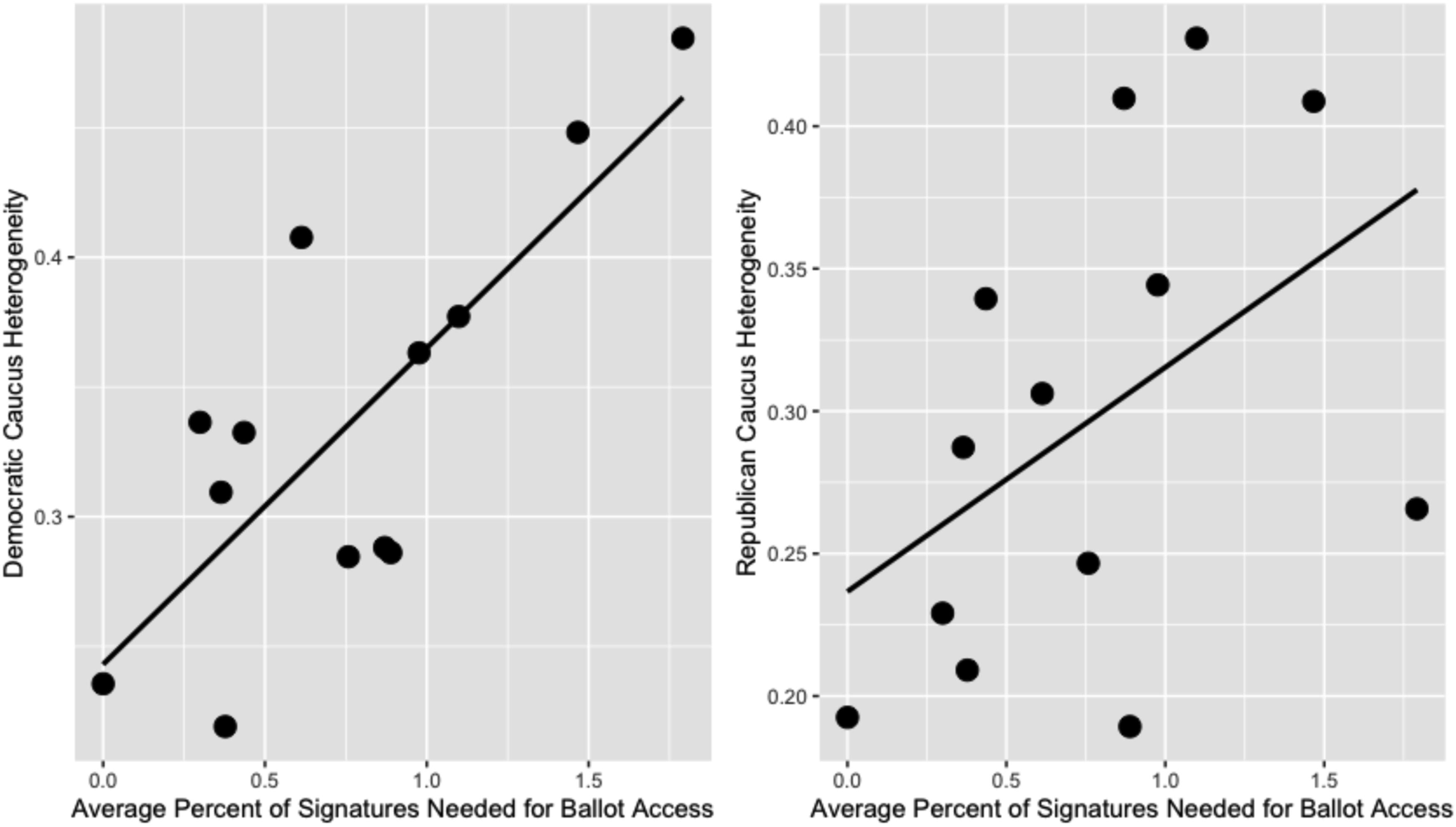
Discussion
The results demonstrate that when ballot access costs are increased, party outsiders increasingly assert adverse effects on party unity, creating more ideologically diverse and diffuse legislatures. Parties in the state legislature enacting more restrictive ballot access laws may intend to snuff out competition (Drometer and Rincke, 2014); instead, this action results in increased electoral competition in their primaries and a more ideologically diverse caucus. By raising signature requirements, parties in the legislature are changing the costs for party outsiders and incentivizing them to challenge them in the primary. Ballot access laws acting as party disassociation rules further exacerbate this problem. The resultant consequence of this process leads to less controllable caucuses filled with members with more diverse ideological and political goals.
For candidate entry, ballot access laws also serve as an essential indicator that explains who enters an election and which election they enter. Examining different institutional mechanisms that make it easy or difficult to run may be fruitful when looking at candidate entry. The results indicate that other processes that constrain access do have downstream effects. Importantly, blocking third parties from the general and reducing their numbers in general, as Burden (2007) finds, does not eliminate those candidates or ideologies from expressing themselves in an election. Minor candidates appear to have an ideology and will seek to express it despite impediments brought by major parties.
The decline of third-party voting in the United States has often been associated with the inability of third parties to act as issue entrepreneurs (Hirano and Snyder Jr, 2007). For example, Hirano and Snyder Jr (2007) found that the decline of third-party voting resulted in third parties losing their ability to bring new issues into the public domain and demonstrate support for them through electoral success. This success often forced major parties to adapt their positioning by co-opting the successful policies which third parties ran on. This paper suggests that party co-optation may still occur in electoral environments where third-party candidates have a certain threshold of votes, allowing them to pose a serious challenge to a candidate. This results in candidates co-opting specific issues positions of third-party candidates.
While the results indicate that party unity is affected by ballot access laws, examining which roll call votes creates this level of heterogeneity is critical. What are the issues that the party is moving on? Exploring this may be able to disentangle in which areas of state policy ballot access laws have had their largest impact and which areas of policy party leaders are unwilling to constrain their members in a process similar to Sulkin (2005).
Drometer and Rincke (2014)’s finding that parties modify ballot access laws when threatened indicates strong parties can actively choose when to modify thresholds. When changes are non-exogenous, stronger parties are important in deterring or creating more third-party competition. Strong parties must weigh the costs and benefits of allowing competition outside the two-party system against the likelihood of a more diverse party caucus. More work should examine how election law changes to less salient election rules plays a role in party calculations and ideological outcomes.
The results also hold implications for how we think about primaries. Much of the literature has sowed doubt on primaries’ impact on polarization (Hirano et al., 2010; Hall, 2015; McGhee et al., 2014); this work may not account for how primaries may be the only resource for candidates from outside the mainstream parties in certain states to have the ability to be politically represented. Further work should examine how specific non-traditional candidates may have an advantage in primaries because a dedicated or passionate extremist may be able to tip the scales for their preferred candidate in low information and low-turnout primary elections.
Supplemental Material
Supplemental Material - How ballot access laws increase primary competition and decrease party unity
Supplemental Material for How ballot access laws increase primary competition and decrease party unity by Cassidy Reller in Party Politics
Footnotes
Declaration of conflicting interests
The author(s) declared no potential conflicts of interest with respect to the research, authorship, and/or publication of this article.
Funding
The author(s) received no financial support for the research, authorship, and/or publication of this article.

Supplemental material
Supplemental material for this article is available online.
Notes
Author biography
References
Supplementary Material
Please find the following supplemental material available below.
For Open Access articles published under a Creative Commons License, all supplemental material carries the same license as the article it is associated with.
For non-Open Access articles published, all supplemental material carries a non-exclusive license, and permission requests for re-use of supplemental material or any part of supplemental material shall be sent directly to the copyright owner as specified in the copyright notice associated with the article.
