



Abstract
A central theme emerging from recent research on party competition is that political actors sometimes remain deliberately opaque in their communication. This phenomenon has been investigated under labels such as position-blurring, ambiguity, issue clarity or ideological clarity. In this paper we propose a distinction between two concepts that are sometimes conflated in this literature: ambiguity and vagueness. While ambiguity means that there is substantial variance in parties' positional signals, vagueness denotes political statements that are non-committal in terms of the policy action to be taken or the outcome to be achieved. We explore the co-variation of these two dimensions and their relationship to issue ownership and government status using manifesto data produced by the Austrian National Election Study. These data are unique in that they provide detailed positional information as well as information on policy commitment (election pledges). We show that the two dimensions are uncorrelated and have opposite relationships with issue ownership (vagueness positive, ambiguity negative). We conclude that analyses of position-blurring in party competition should take different strategies of non-clarity in party communication into account.
Introduction
In politics, words matter. Much of what political actors do day in, day out is to communicate. A large part of that communication effort is directed at voters, often with the aim of generating or maintaining electoral support in a competitive environment. It thus comes with little surprise that political scientists have invested heavily in understanding communication strategies in election campaigns. One part of this literature attempts to explain when and why parties remain nebulous or refrain from presenting clear-cut positions in their campaigns (e.g., Shepsle, 1972; Milita et al., 2014). Especially studies analyzing European party competition have shown that position-blurring can be an electorally successful strategy (Bräuninger and Giger, 2018; Han, 2018; Lo et al., 2016; Rovny, 2012; Somer-Topcu, 2014).
Although the empirical evidence within this literature is rapidly growing, the theoretical under-pinnings of concepts such as position-blurring or ideological clarity remain somewhat weak (Lefevere, 2023). While scholars agree upon the communicative goal, namely to become attractive to a larger group of voters, they use different and often very broad definitions that leave room for various operationalizations. For example, Rovny (2012: 273) defines position-blurring as a strategy in which parties put forward ‘vaguely broad positions […] or present a mixture of positions’. He rests his analyses on the standard deviation of expert’s judgments of party placements (see also Han, 2018: 527). Milita et al. (2014: 429), on the other hand, refer to a ‘vague rhetoric’ and subsume valence statements, conflicting statements as well as attacks against other parties under that label. Most recently, Bräuninger and Giger (2018: 527) write that ambiguity occurs when parties are ‘reluctant to say precisely what they stand for and what policies they promise to implement’. The authors use wordscores of manifesto text to measure the concept.
Our research note aims to contribute to a clearer theoretical conceptualization within this literature. Based on previous work (Praprotnik, 2017a; Dolezal et al., 2018), we argue for a distinction between two communication strategies that produce opaque outcomes: ambiguity and vagueness. Ambiguity is the result of positional variance in the communication signals of political actors. This is the dominant approach in the recent literature, and it is derived from spatial models of political competition that require aggregating an actor’s individual statements onto a higher-level policy dimension. By contrast, vagueness is the result of statements that are non-committal in terms of policy actions or outcomes, as conceptualized in the literature on pledge fulfillment (Thomson et al., 2017). While largely neglected by the existing literature on party competition (but see Milita et al., 2014), we consider it highly useful to distinguish plainly indeterminate language from aggregate positions comprised of ideologically heterogeneous statements. 1
In the subsequent section, we will elaborate on the distinction between strategic ambiguity and strategic vagueness. Next, we show how to operationalize the theoretical approach based on the case of Austria. The descriptive analyses then provide a first glance at why the theoretical distinction matters: issue ownership, a key variable in the study of position-blurring (e.g., Tromborg, 2019; Han, 2018; Rovny, 2012), relates to ambiguity and vagueness in opposite ways. While perceived competence is negatively associated with ambiguous rhetoric, it correlates positively with vague campaign communication.
Theoretical framework
Political parties are rational actors that try to maximize the benefits of policy, office, and votes (Müller and Strøm, 1999). In the run-up to an election, they will strive to increase their vote share as success at the polls will render both the attainment of executive office as well as the implementation of policy priorities more likely. Furthermore, political actors recognize the fact that not all parts of their agenda are equally popular with all sections of the electorate (Budge et al., 2001). They also are acutely aware of the potential gap between what they want to say and what may be possible to implement given legal, institutional, or budgetary constraints (Praprotnik, 2017b). Therefore, rational political parties have strong incentives to optimize the electoral appeal of their political communication efforts, while maintaining some flexibility in anticipation of these constraints. One way of doing this is to engage in ‘blurring’ or ‘beclouding’ their positions, or sending signals of low ideological or issue clarity (Bräuninger and Giger, 2018; Han, 2018; Lo et al., 2016; Praprotnik, 2017a; Rovny, 2012; Somer-Topcu, 2014).
However, looking closely at this literature reveals that the definitions of these concepts often contain two elements: The first one builds on a spatial understanding of political competition and views positional variance, that is, directionally conflicting statements within a policy domain, as a source of unclear or opaque communication. We propose using the term ambiguity for this phenomenon. As ambiguity is a product of positional variance across messages or measurements, it can only be applied at an aggregate level, not at the level of an individual observation.
The second element is not concerned with the positions an actor takes, but with the specificity of their content. The literature on pledge fulfilment has long relied on identifying objectively testable pledges in political text. We use the term vagueness to denote actors’ reluctance to present such objectively testable promises. We elaborate on this distinction below.
Strategic ambiguity
Most research in party competition conceptualizes and operationalizes ambiguity as some form of (perceived) variance in party position-taking. Rovny’s work, for instance, is rooted in a (multi-dimensional) spatial understanding of party competition and argues that parties have incentives to blur their positions on issues that are less central to their appeal (Rovny, 2012). A case in point is the family of populist radical right parties whose socio-economic policies often combine strongly protectionist or redistributive stances in some areas with calls for liberalization and retrenchment in others (Ennser-Jedenastik, 2016; Rathgeb, 2020; Rovny, 2013; Rovny and Polk, 2020). Work by Han (2018) confirms that the tendency to send such mixed positional signals is greater on secondary issues and in the face of voter polarization.
In line with the spatial models on which this work builds, the ambiguity of party communication is typically operationalized as some measure of variance over party placements in expert surveys. A related approach is to use surveys of voters instead of experts. Somer-Topcu (2014), for instance, shows that perceptual disagreement over party positions gives voters the impression that parties may be ideologically closer to them than they really are. Hence, voters are more likely to support parties with more ambiguous positions. This idea has already been examined by Downs (1957) and Shepsle (1972) (who showed that it may have limits). More recent research by Lehrer and Lin (2020) demonstrates that the benefit of ambiguity disappears when voters perceive parties as internally divided.
Another method to arrive at estimates of ambiguity has been proposed by Bräuninger and Giger (2018). They use the variance over individual word loadings generated by the Wordscores algorithm (Laver et al., 2003) as a measure of ambiguity in party manifestos. Similarly, Lo et al. (2016) have proposed to use the dispersion parameter in a negative binomial model that constitutes an extension of the Wordfish algorithm (Proksch and Slapin, 2009) to calculate a measure of manifesto ambiguity. While operationally different from (and somewhat more complex than) the survey-based approaches, these procedures follow the same conceputal logic. Building on a spatial understanding of political competition, the key ingredient of all these methods is to capture variance in the positional signals associated with a party, be they different perceptions of party positions by voters or experts or different ideological loadings of words used in a party document.
Importantly, the notion of ambiguity as positional variance rests on the premise that positional information is observed as an aggregate, either of individual perceptions (experts, voters) or of individual signals conveyed in a single document. For example, a party may make two statements that are neither vague nor unclear in and of themselves. Yet if one statement implies a strongly leftist position whereas the other implies a strongly rightist position, the aggregate picture may be one of ambiguity. After all, ambiguity is sometimes theorized as an outcome of intra-party differences (Lo et al., 2016) or of the desire to appeal to distinct voter groups (Somer-Topcu, 2014).
Strategic vagueness
Our argument in this paper is based on the premise that opaque or unclear political messages are not only produced by aggregating ideologically conflicting signals, but can be a feature of these individual signals themselves. A political message, even if it sounds clear, can thus be indeterminate in terms of its practical consequences.
The literature that has most thoroughly examined the practical consequences of parties’ statements during election campaigns is the literature on pledge fulfillment (Thomson et al., 2017; Praprotnik, 2017b; Naurin et al., 2019). While most studies in this tradition have examined whether and under what circumstances parties act on their election promises when in government, data on pledge-making has also been examined in studies of party competition. For instance, Praprotnik (2017a) shows that the proportion of manifesto statements containing objectively testable pledges is larger for opposition parties and for those with more extreme ideological positions. Similar findings have been reported by Dolezal et al. (2018). Objectively testable pledges are those that allow a clear judgement (without value judgements, though) as to whether the action (or non-action) promised has been taken, or the promised outcome has been achieved.
Ambiguity and vagueness in political messages.

Operationalization
Our empirical analyses are based on the case of Austria, a European parliamentary democracy with a multi-party system and proportional representation. More specifically, we examine data from 34 manifestos issued by seven different parties across nine parliamentary elections held between 1990 and 2008. The main political actors in the Austrian party system during this time period were the Christian-democratic Austrian People’s Party (ÖVP), the Social Democratic Party of Austria (SPÖ), the populist radical right Freedom Party of Austria (FPÖ), the Greens, the Liberal Forum (a predecessor of the present-day NEOS), and the Alliance for the Future of Austria (a break-away from the FPÖ). Coalition governments were in power throughout the research period (ÖVP–SPÖ between 1990 and 2000, ÖVP–FPÖ/BZÖ between 2000 and 2007, SPÖ–ÖVP again from 2007).
The data come from a manually-coded content analysis of election manifestos conducted by the Austrian National Election Study (AUTNES). Within AUTNES, manifestos are coded in two steps: First, trained coders split each grammatical sentence into individual statements according to grammar-based rules (Chomsky, 1957) and translate these statements into a standardized format (typically ‘PARTY for X’, ‘PARTY against Y’, or simply ‘PARTY talks about Z’, if no clear direction is discernible). Second, a different coder then assigns the appropriate policy issue (from a pre-defined issue catalogue), the actor’s position towards this issue (positive, neutral, or negative) as well as the pledge character to each statement. All codings were subjected to inter-coder reliability tests (for further information on the AUTNES coding process, please see Dolezal et al. (2016)).
Variables: strategic ambiguity and strategic vagueness
In order to examine or theoretical distinction between ambiguity and vagueness, we need to operationalize both concepts. As described above, both measures build on a comprehensive content analyses of election manifestos. The operationalization based on manifestos is somewhat similar to Bräuninger and Giger (2018) or Lo et al. (2016), but in contrast to studies using expert (Han, 2018; Rovny, 2012; Rovny and Polk, 2020) or voter surveys (Somer-Topcu, 2014) to evaluate ambiguity. Although all approaches have their merits, a manifesto-based method is clearly the most useful for our purposes. Even if the public rarely reads these campaign documents, they provide a guideline for political candidates as well as a point of reference for political opponents and the media (Eder et al., 2017). In addition, they hold information across a large variety of issues that cannot be evaluated as easily via expert or voter surveys. Finally, we are interested in campaign strategies, not in general party positions beyond the campaign.
The strategic ambiguity variable is calculated as the additive inverse (A × −1) of Van der Eijk’s agreement measure A (Van der Eijk, 2001) across all left-wing, neutral, and right-wing statements in a given policy area (we focus on a number of socio-economic policies in the analysis). Consider three party manifestos, each containing 30 statements on taxes. Party A’s 30 statements are all left-wing, Party B makes 10 left-wing, 10 neutral, and 10 right-wing statements, and Party C makes 15 left-wing and 15 right-wing statements. The agreement scores would be 1 for A, 0 for B, and −1 for C. Our ambiguity measure is simply the agreement measures times minus one. Thus, in our example, Party A would have the least ambiguous position on taxes (−1), Party B a middling degree of ambiguity (0), and Party C would be the most ambiguous (1).
The strategic vagueness variable is calculated as one minus the proportion of statements that contain objectively testable pledges. In line with the literature on pledge fulfilment (Royed, 1996: 80), an objective pledge is understood as a demand to enact a certain measure or reach a certain goal that can be verified without a value judgement. Thus, the manifesto text needs to be clear and specific enough to provide a benchmark that allows researchers to evaluate whether or not a pledge was fulfilled. 2 For instance, the abolition of tuition fees at public universities (a pledge commonly made by Austria’s left-wing parties in the 2000s) is one example of an objectively testable demand to enact a certain measure. A party’s promise to improve study conditions, however, is too broadly specified, because it could be evaluated based on a variety of measures, ranging from subjective well-being of students to better student–teacher ratios. To be sure, after the fact, a government party may be able to point to measures taken that worked in that direction (or even produced that outcome), yet our definition of ‘objective’ covers only pledges that are testable a priori. Other types of pledges are classified as subjective pledges. Similarly, a promise to reduce youth unemployment is an objectively testable pledge to reach a certain outcome that can be verified at the end of the legislative period by consulting the relevant data. A promise to ‘help young people without a job’, on the other hand, is too vague and therefore counts as a subjective pledge. All other statements that contain neither objective nor subjective pledges, such as simple narrations of facts (or what parties consider to be facts) or appeals to the beauty of the country and the greatness of its people, are subsumed as statements without pledge character. In the present study, we rely on the coding of objective pledges and differentiate these from both subjective statements and statements without pledge character. As we are interested in pledge-making (or, rather, vagueness as the opposite of pledge-making) as a strategy, we do not examine whether or not parties were able to fulfill their pledges. Interested readers can find such analyses in previous works on pledge fulfilment in Austria (Praprotnik, 2017b, 2017c; Schermann and Ennser-Jedenastik, 2014).
Issue ownership
Our second aim in this note is to explore how vagueness and ambiguity are related to issue ownership. The literature on position-blurring has assumed (and, indeed, shown) that parties often take vague or ambiguous positions in policy areas that are secondary elements in their ideology (Han, 2018; Rovny, 2012, 2013; Tromborg, 2019). Therefore, position-blurring should be more likely in areas were parties have weak issue ownership. We examine eight socio-economic policy areas in party manifestos to explore this relationship (budget, economy & business, family policy, health care, housing, labor market, pensions, taxation). For each of these policy areas, we have survey data in the election year showing the percentage of respondents who choose one of four parties (SPÖ, ÖVP, FPÖ, Greens – other parties were not covered consistently in the survey) as the most competent (Meyer and Müller, 2013). We focus on socio-economic policies because determining left-wing and right-wing positions – a central task in our empirical strategy – can be done more uniformly across these areas. To avoid having outliers bias our analysis, we only include policy areas that cover at least 30 statements in a manifesto. This leaves us with a total of 86 cases (policy areas) from 28 manifestos.
Empirical evidence: relations with government status and issue ownership
We examine parties’ strategic use of ambiguous and vague elements in their campaign communications in two steps. First, we discuss the empirical evidence along the lines of parties’ main characteristics: ideology, size and government status. Second, we move to our main test, namely the examination of issue ownership and its influence on parties’ decision to present issues with positional variance or without clear promises. Since both measures are only meaningful at the aggregate level, we conduct all analyses at the level of the eight policy areas (see above).
Campaign strategies and party characteristics
Figure 1 shows that ambiguity does not vary much between parties. The SPÖ displays somewhat higher levels of ambiguity on average, yet the party medians do not differ greatly and variation around them is large. Furthermore, there is little evidence in our data that vagueness varies systematically across parties either. The median vagueness (the proportion of statements without objectively testable pledges) across policy areas is lowest for the populist radical right FPÖ and highest for the Greens. The two traditional major parties (ÖVP and SPÖ) are somewhere in between. Vagueness is therefore correlated with parties’ left-right position, yet the relationship is rather weak and the variance around the median is substantial. Vagueness and ambiguity in eight socio-economic policy areas by party.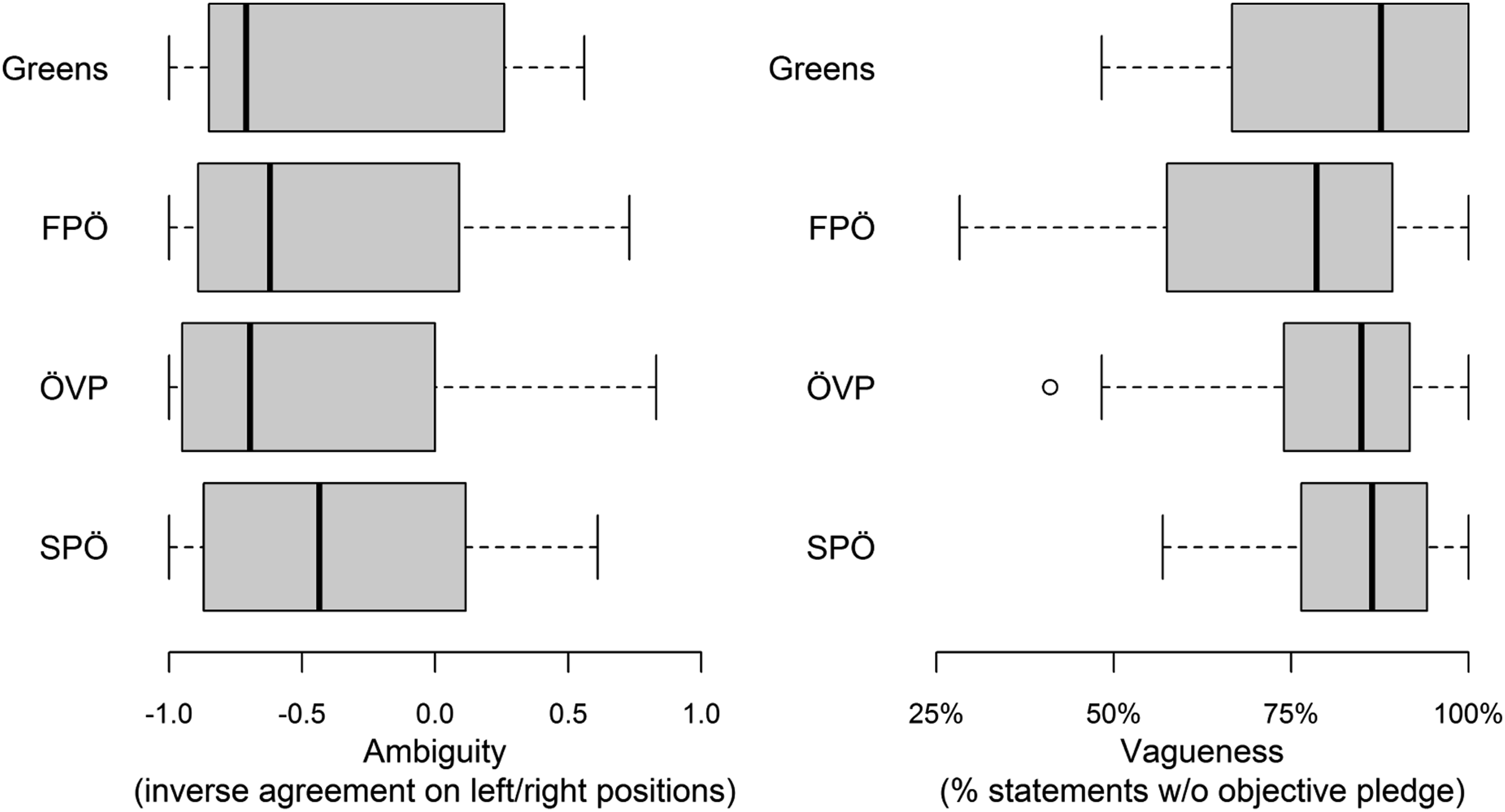
However, as Figure 2 shows, there are substantial differences according to government status. Opposition parties are somewhat more ambiguous in their manifestos (see left-hand panel in Figure 2). One possible explanation for this may be that the parties in government during the period of observation happen to be those that primarily compete on economic matters (SPÖ and ÖVP), whereas the opposition parties between 1990 and 2008 (mostly FPÖ and Greens) are more focused on non-economic issues (e.g., immigration, the environment, gender equality, European integration, or political malfeasance and corruption). Vagueness and ambiguity in eight socio-economic policy areas by government status.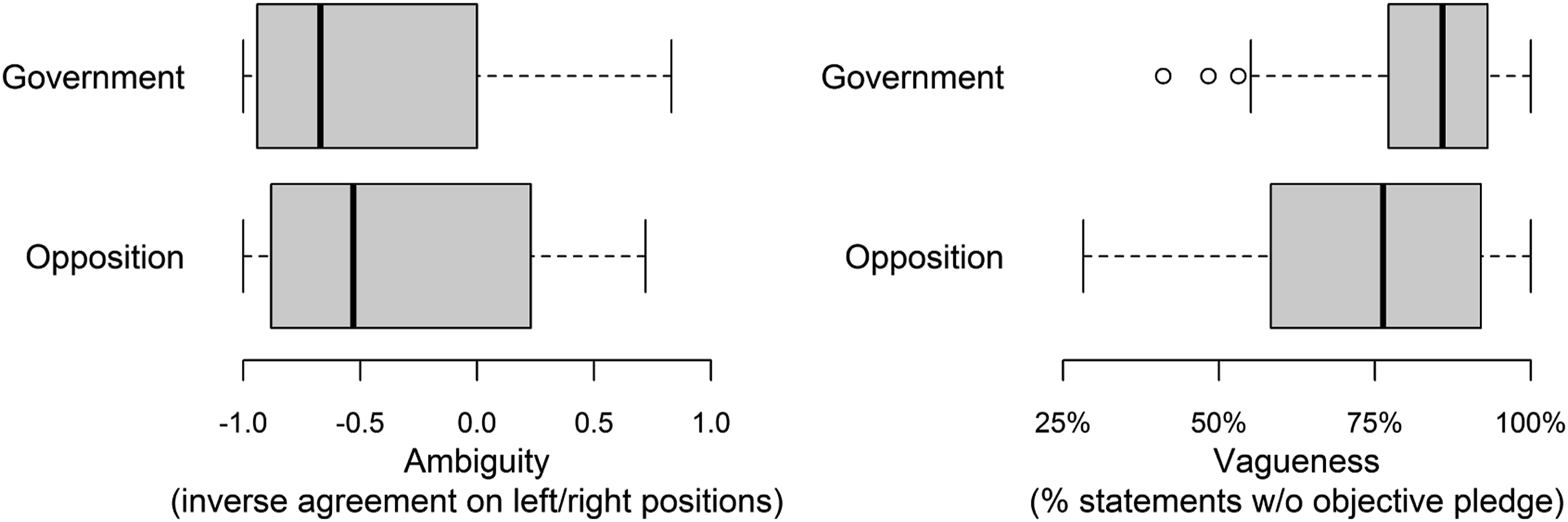
Interestingly, government parties display much higher levels of vagueness than opposition parties. Government parties are thus muss more noncommittal in their manifestos, suggesting that they may factor in a higher probability of actually having to deliver on their promises. Since Austria is a country with comparatively low partisan turnover in government (thanks largely to a longstanding SPÖ–ÖVP duopoly on power that has only weakened in the last 25 years), government parties are typically more likely to remain in cabinet than opposition parties to enter. Therefore, it makes sense for government parties to tread more carefully in making pledges, whereas opposition parties can risk making bold promises, given the lower chances of having to act on them.
Campaign strategies and issue ownership
We now re-examine the relationship between ambiguity and issue ownership and add the concept of vagueness to the test (see Figure 3). As noted above we use perceived party competence as our survey-based measure of issue ownership. The relationship between perceived party competence and ambiguity (i.e. positional disagreement in a policy area) is moderately negative (r = −0.24, p = 0.03). The more competent voters perceive a party in a policy area, the less likely it is to make ambiguous statements. This finding echoes the results of previous studies that identify strategic ambiguity as a feature that is more prevalent on a party’s secondary issues (e.g., Rovny, 2012, 2013). Vagueness and ambiguity and their relationship with perceived party competence. (Dotted lines are linear fits).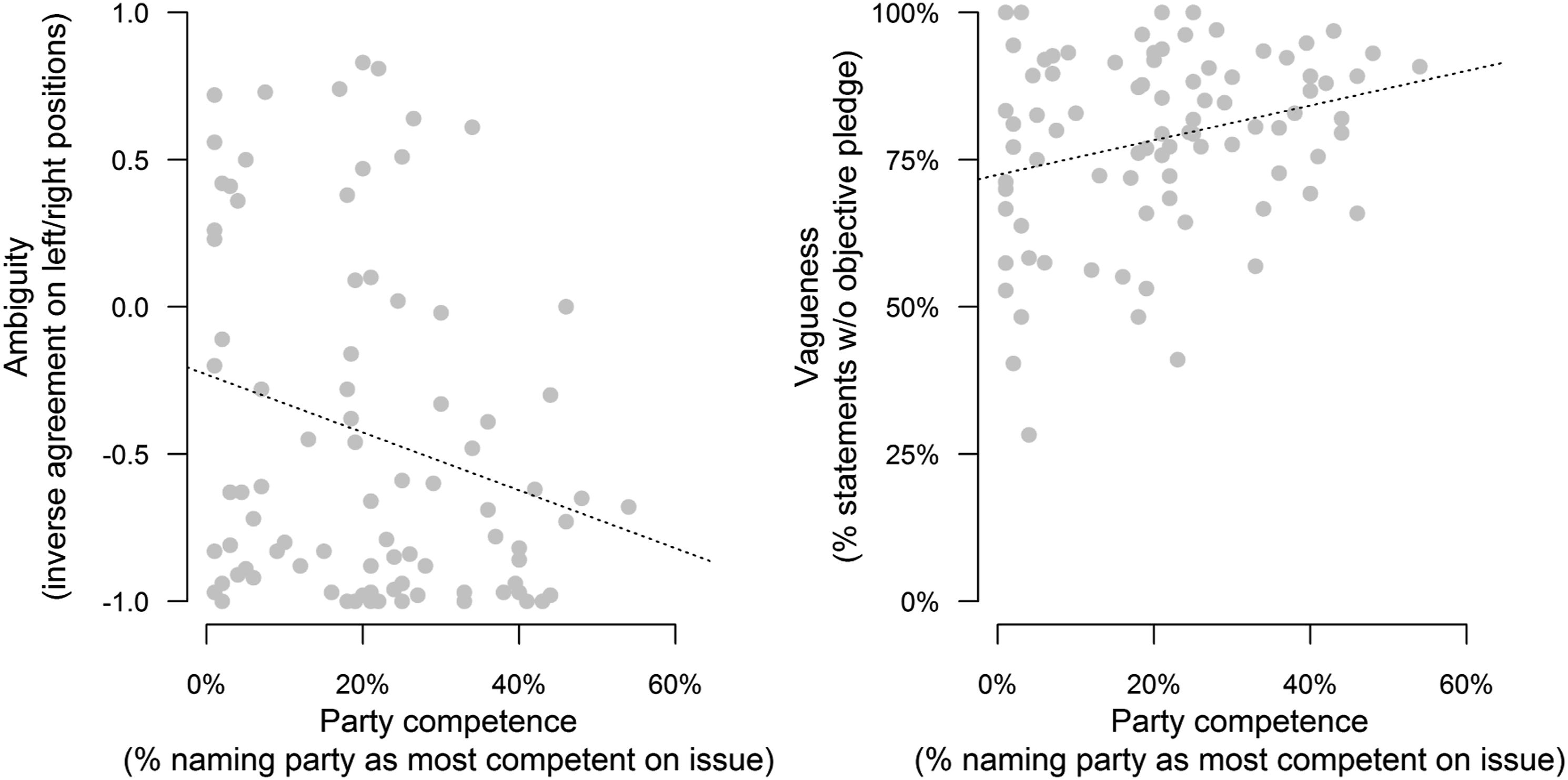
By contrast, the right-hand panel shows a moderately positive relationship between party competence perceptions and vagueness (r = 0.27, p = 0.01). The more competent a party on an issue (in the eyes of voters at least), the more likely it is to remain vague in its manifesto. Or, put differently, the more likely it is that they discuss issues with low shares of objective pledges.
This finding clearly underlines the usefulness of the theoretical distinction between ambiguity and vagueness that motivates this note. The two concepts do not only vary in how strongly related they are to issue ownership, these correlations even have opposite signs. Ambiguity and vagueness are thus not just theoretically distinct, but also empirically. This is underlined by Figure 4, showing a scatterplot of the two variables. The correlation is practically zero (r = −0.01, p = 0.90), suggesting that the two phenomena are party strategies that may superficially sound like they are related, but really are distinct. The relationship between vagueness and ambiguity.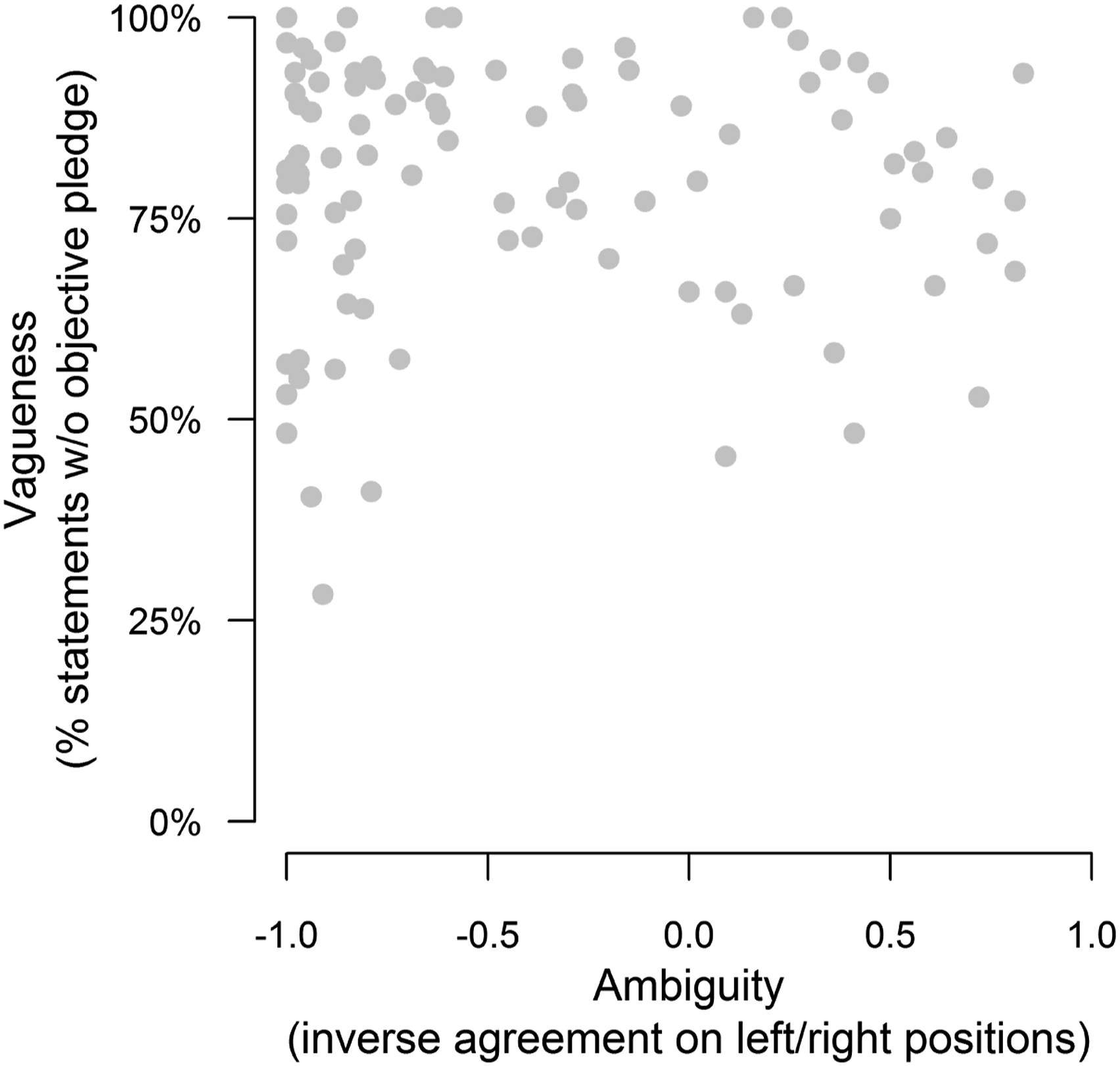
This is the central substantive conclusion from our exploration exercise. Conceptually distinguishing between strategic ambiguity and vagueness not only clarifies the theoretical argument about either phenomenon, it also helps in describing and analyzing empirical relationships. Parties may at times put forward arguments that are very ambiguous but not vague. At other times, they may offer a policy agenda that is vague, but not ambiguous. Keeping these two dimensions theoretically and empirically separate should help researchers in theorizing and empirically analyzing rhetorical strategies in party competition.
Discussion and conclusion
In this research note, we have argued parties’ unclear or opaque rhetoric can be broken down into two distinct facets, namely strategic ambiguity and strategic vagueness. While the first is based on spatial conceptualizations of political competition and refers to positional variance (the known approach in the literature), the second means a lack of clear-cut electoral promises and links to the literature on pledge fulfilment. Consequently, we followed previous studies and operationalized ambiguity as a measure of disagreement and proposed to look at parties’ pledges in election manifestos to measure vagueness (Thomson et al., 2017). A first empirical test based on the case of Austria shows that these strategies have opposite relationships with issue ownership: Being the issue owner leads to less ambiguous, but more vague, policy programs.
The theoretical and empirical distinction between ambiguity and vagueness is thus not a distinction without a difference. Democratic theories such as the mandate model state that elections provide voters a chance to select their future representatives based on policy programs with distinct and clear-cut pledges (McDonald and Budge, 2010; Roberts, 2010). If parties’ proposals lack specificity, then the voter–representative relationship is possibly hampered. By contrast, ambiguous political communication may make voters more likely to feel represented by a party (Somer-Topcu, 2014).
We hope that future studies take up our conceptual distinction and put it to a more comprehensive empirical test – in terms of the number of cases involved, model sophistication and variety of data sources. As the opportunities to study political communication multiply through the development of more and more advanced methods of computer-assisted analysis, it remains all the more important to maintain theoretical clarity about the concepts used for analyzing political speech and text.
Footnotes
Declaration of conflicting interests
The author(s) declared no potential conflicts of interest with respect to the research, authorship, and/or publication of this article.
Funding
The author(s) disclosed receipt of the following financial support for the research, authorship, and/or publication of this article: Katrin Praprotnik conducted this research under the auspices of the Austrian Democracy Lab, In cooperation with Forum Morgen. Laurenz Ennser-Jedenastik gratefully acknowledges funding from the Austrian Cooperative Infrastructure for Electoral Research (ACIER), financed by the Austrian Federal Ministry of Education, Science, and Research (BMBWF).
