




Abstract
Scholars voice increasing interest in strategic ambiguity—a strategy whereby parties intentionally conceal their positions on divisive issues. Scholars contend that strategic ambiguity can help European parties broaden their electoral appeals. Although they identify several tactics and styles of position-blurring, the observational literature has yet failed to capture different variants of ambiguous rhetoric, let alone evaluate their effect on the vote. In this article, I rely on cross-country survey experiments that utilize representative samples of around 22,000 respondents from 14 European countries to evaluate the effect of four varieties of ambiguity: vagueness, ambivalence, flip-flopping, and negative messaging. I investigate the impact of ambiguous rhetoric vis-a-vis the context of competition facing the party. The findings reveal that the consequences of ambiguity vary by the actual form it takes and the context of competition facing the party. First, among the varieties, vague and ambivalent variants were superior to negative messaging or flip-flopping. Second, ambiguity helped the party in the absence of popular policy offers in the party system, while it backfired when competitors explicitly agreed with the voter. The findings imply that ambiguity is generally a useful strategy, but its benefits do not extend to rhetorical tactics that harm the party’s valence image.
Introduction
Theories of democratic representation require political parties to present distinct policy bundles since voters in representative democracies are represented by and through parties (Sartori, 1968). Without such clear policy offerings, congruence could be broken, and as a result, democratic representation could be paralyzed (Powell, 2019). In practice, however, parties frequently make ambiguous pronouncements to blur their ideological positions on divisive issues. Consider, for example, the Labour party’s “Final Say on Brexit.” The party repeatedly promises to reach a “sensible deal” but does not explain how. More strikingly, the party explains its stance on the Brexit debate by taking two contradictory positions at the same time: “Only Labour will offer the choice of remaining in the EU, or leaving with a sensible deal.” 1 Scholars have investigated the causes and consequences of ambiguous positioning for parties’ and candidates’ electoral success (Shepsle, 1972; Campbell, 1983a; Bräuninger & Giger, 2018; Han, 2018; Nasr, 2021; Somer-Topcu, 2015; Rovny, 2012, 2013).
Despite the growing attention to this strategy, the empirical literature has been limited by inadequate measurements and abstract levels of analysis that made inferences problematic. 2 Scholars recognize that ambiguity is not a single strategy, but rather a set of electoral tactics that parties employ to conceal their policy positions on thorny issues. To name a few examples, the party can make vague, even conflicting or contradictory, promises, denounce challengers’ positions without disclosing its stance, or even cast inconsistent messages to different audiences or over time (Cahill & Stone, 2018; Rovny, 2013; Somer-Topcu, 2015). However, previous studies have failed to capture these various types from observational data, let alone evaluate their impact on the vote. This is important because the identified electoral benefits from ambiguity may not extend to the types that fail to attract the voter. Furthermore, the observational investigations do not account for the strategic behavior of competitors and voter preferences, which strongly shape the effectiveness of party strategies (e.g., Meguid, 2005).
To overcome these shortcomings, I rely on large-scale survey experiments that utilize representative samples from 14 European countries, comprising around 22,000 respondents. 3 The experiments seek to evaluate the impact of four “varieties of ambiguity” vis-a-vis the context of political competition facing the party, in terms of rivals’ and voters’ positions. Specifically, I ask respondents to evaluate two parties, precise and ambiguous, in terms of their positions on European integration, which has become increasingly politicized in European competition in recent years (Hooghe & Marks, 2009; Kriesi, 2016). I first randomize the type of ambiguity to investigate the effect of four varieties of ambiguity: vagueness, ambivalence, flip-flopping, and negative messaging.
Second, I randomize the position of the precise party (i.e., the competitor), which I then compare to the voter’s self-placement. As a result, I could analyze the consequences of the four varieties in different situations that might face the ambiguous party. First, competition favors the ambiguous party when the precise opponent disagrees with the voter. In contrast, it becomes unfavorable when the opponent party and the voter agree. Lastly, competition can become level or neutral when the voters are indifferent or undecided.
The experimental data reveal several novel findings. First, the different types of ambiguous rhetoric yield different consequences on the vote, depending on how they influence the party’s public image. While respondents rated the vague and ambivalent types positively, they strongly shunned the switching and negative variants. These strategies also led to different consequences on parties’ valence ratings, which I proxy through competence. Voters perceived the vague and ambivalent parties as more competent than the precise competitors, while the switching and negative variants were harmful. Second, regarding the competition context, the data demonstrate that ambiguity cannot help the party when opponents agree with the voter, but it can indeed broaden parties’ appeals when rivals disagree with the voter. The findings suggest that, even when rivals disagree with voters, it may be advantageous for the party to take ambiguous positions, as these may be more effective in attracting the undecided. Overall, the findings show that, when used correctly, ambiguity can help parties broaden their appeals when compared to stating a specific position.
The Consequences of Ambiguity
A growing body of literature contends that parties can broaden their appeal by employing strategic ambiguity—a strategy whereby political parties intentionally blur their positions on problematic issues (Rovny, 2012, p. 271). This argument dates back to Downs (1957), who expected that parties could gain electorally when they “becloud their policies in a fog of ambiguity.” (p. 136)
Recent empirical research has indeed confirmed Downs’ expectations (Bräuninger & Giger, 2018; Lehrer & Lin, 2018; Lo et al., 2016; Rovny, 2012; 2013; Somer-Topcu, 2015). In an influential study, Somer-Topcu (2015) demonstrates that parties gain more votes in elections when they appeal broadly by blurring their policy positions. This positive effect is expected in particular when the party’s vague messages are adopted strategically rather than as a result of internal divisions within the party (Lehrer & Lin, 2018). By and large, ambiguity succeeds because it allows voters to project their positions onto the party, increasing its vote share in elections (Nasr, 2021). Rovny (2012, 2013) also argues that radical right parties gain votes by blurring their positions on economic issues because radical right voters have heterogeneous economic preferences. Experimentally, Tomz and Van Houweling (2009) find that ambiguity does not harm and can benefit candidates in elections, especially in partisan settings. Piston et al. (2018) also find that ambiguity in the US can benefit white candidates when they face white voters. However, the benefits do not extend to black candidates facing white voters. Taken together, this body of literature expects that with a few exceptions, ambiguity is more rewarding than harmful, especially to European political parties.
Despite the growing interest in this strategy, the empirical literature has been limited by a mismatch between the conceptualization of strategic ambiguity and the real-world actions by parties and politicians. Specifically, Shepsle’s (1972) formal conceptualization of ambiguity has been highly influential in the empirical literature. If competition happens on a latent ideological dimension [A,B], he conceived of ambiguity as not being “represented by points in [A,B] but rather by probability distribution over points in [A,B].” In other words, ambiguous parties do not occupy one precise point on a latent ideological dimension, but a range of possible points, which then differs from one party to the next.
Relying on positional distributions has been the most common method by far to capture the presence of ambiguity in the observational literature. Survey-based studies employ the perceptual disagreement between voters or experts regarding party positions on the left-right scale (Cahill & Stone, 2018; Campbell, 1983a; Ezrow et al., 2014; Han, 2018; Lehrer & Lin, 2018; Nasr, 2020; 2021; Somer-Topcu, 2015; Rovny, 2012; 2013; Rovny & Polk, 2020). Similarly, text-as-data approaches utilize the variance surrounding party positions, which they estimate from party-produced text (Bräuninger & Giger, 2018; Lo et al., 2016). Even some experimental studies prime respondents with a range of positions rather than one clear-cut point to leverage ambiguity (Tomz & Van Houweling, 2009; see also Brader et al., 2013). 4
One major flaw of this conceptualization is that it cannot capture the variety of tactics by which parties in real-world campaigns conceal their policy positions (but see Koedam 2021). 5 Scholars share the consensus that parties employ various rhetorical strategies to influence the clarity, or the variance so to speak, of their positions. According to Rovny (2013), for instance, “position blurring can appear as either a lack of a position, as concurrent multiplicity of positions, or as positional instability over time” (p. 6). Cahill and Stone (2018) similarly argue that ambiguity can be achieved by different means, such as group-targeted messaging, avoiding the issue altogether, or emphasizing the valence side of policies. 6 Because of this misalignment between the strategy’s conceptualization and its real-world implications, we have a limited understanding of how different rhetorical tactics may influence voters’ behavior and attitudes. In other words, it is unclear whether the electoral benefits of ambiguous positioning apply equally to all types and levels of ambiguous rhetoric. Tomz and Van Houweling (2009) highlight this important limitation while concluding their seminal article: “although our experiments examined a ubiquitous type of ambiguity in doses that candidates commonly use, one must be careful about extrapolating our conclusions to other types and levels of ambiguity” (p. 96).
While the variety of tactics embedded in this strategy is critical while evaluating its consequences, other limitations also challenge our ability to draw inferences from observational data. The first of these limitations relates to the strategic behavior by parties and politicians. While the variance surrounding party positions can indeed result from party strategic behavior, it can also result from non-strategic characteristics, such as internal divisions within the party or the parties’ lack of reputation, as in the case of new parties. Additionally, voters could disagree because they view party positions differently, or because of the lack of interest or information (Zaller, 1992). 7 While this concern challenges empirical investigation of strategic ambiguity, it remains difficult to disentangle these different sources of ambiguity in observational studies. Second, this literature is mainly concerned with ambiguity on the generic left-right dimension. However, parties are rarely ambiguous on all issues. While they could indeed adopt a catch-all strategy (Kirchheimer, 1966; Somer-Topcu, 2015), parties in multidimensional contexts are more likely to employ strategies of shifting attention (Riker, 1986): They keep clear promises on their primary issues, while they blur issues or dimensions that are secondary to them (Han, 2018; Rovny, 2012; Rovny & Polk, 2020). Because we lack comparative data on voter perceptions beyond left-right, it remains unknown how voters evaluate different styles of ambiguous rhetoric on specific issues or sub-dimensions.
The current study seeks to conduct a fine-grained investigation of the rewards from different blurring tactics and identify their causal effects via survey experiments that feature the specific issue of European integration. I consider two main factors: (a) the actual approach the party employs to blur its position (the type of ambiguity) and (b) the context of political competition facing the party in terms of voter preferences and the policy supply in the party system. I discuss these two aspects consecutively.
Varieties of Ambiguous Rhetoric
I first consider different variants of ambiguous rhetoric. This refers to the rhetorical tactics that party cadres could employ in election campaigns when they are explicitly asked to discuss unfavorable issues, where avoidance or complete silence is not a choice.
I argue that it is necessary to distinguish different rhetorical tactics and evaluate their consequences on the vote separately. Indeed, party strategies under ambiguity do not convey information about their policy positions; nevertheless, they might have different implications for other non-policy characteristics of the party, commonly known as valence. While certain types of broad talking might show the party as moderate or flexible, other rhetorical styles might expose it in the public, portraying it as opportunistic or incompetent (Campbell, 1983a). Character-based valence features, such as competence, integrity, and honesty, affect voter decisions to support parties and candidates (Abney et al., 2013; Clarke et al., 2004; 2009; Mondak, 1995; Stokes, 1963; Stone & Simas, 2010). Recent research demonstrates that party strategies not only influence voter perceptions of party positions, but also extend to their non-policy characteristics. For example, Johns and Kölln (2020) demonstrate that party decisions to signal moderate or extreme positions can reveal non-policy characteristics such as competence. Gooch et al. (2021) similarly find that candidates who signal unusual policy positions are seen as less competent and less effective leaders.
I further expect that the effect of non-policy characteristics will be particularly important under ambiguity when party policy positions are intentionally blurred. In that case, voters will need to rely on alternative sources to evaluate the party. Previous research contends that voters can, for example, rely on partisanship (Tomz & Van Houweling, 2009), party affect (Nasr, 2021), or candidate race (Piston et al., 2018). I argue that party valence ratings could also be effective for different reasons. For example, Green and Hobolt (2008) substantiate that the importance of competence for voter decisions has heightened when British parties converged ideologically because voters cannot see policy differences between parties. Clark and Leiter (2014) similarly show that when party systems are less electorally dispersed, the electoral effects of parties’ character-based valence attributes will become more important. In line with these studies, I expect that valence evaluations of the party will be crucial when voters cannot discern parties’ policy stands. Therefore, I hypothesize that the electoral benefits of ambiguity will not extend to types that harm the public image of the party.
Hypothesis 1: The positive effects of ambiguity will not extend to types of rhetoric that harm the party’s valence image.
To evaluate this expectation, the experiments distinguish four different types of ambiguity: vagueness, ambivalence, flip-flopping, and negative messaging.
First, the party may send vaguely contradicting signals about its policy intentions. I call this variant ambivalence. According to this strategy, party leaders could respond by highlighting the positive and negative aspects of a given policy without taking a clear side. The Labour Party’s statement on Brexit exemplifies policy ambivalence: The party promised to stay in the EU while still promising to leave with a sensible deal. Another example of policy ambivalence is the immigration stance of the German CDU under the chancellorship of Merkel. The party’s messages have been contradictory, oscillating between open and closed borders, welcoming diversity while demanding cultural assimilation (Hertner, 2021). This strategy was found efficient in shaping voter perceptions of parties’ positions. Nasr (2020) implies that parties adopt an ambivalence strategy to “mute” the party’s position on specific issues. As a result, it becomes less conspicuous in the party system.
A second ambiguity tactic is to make indisputable “vague” pledges or valence statements that lack any policy substance. Such vague statements could emphasize the end-states of certain policies without providing specific policy proposals (e.g., Parvaresh, 2018). Consider, for example, the following statement from the German Alternative for Germany (AfD): “We commit ourselves with all our energy to reform our country in the spirit of freedom and democracy.” 8 This rhetorical style is common in real-world politics, and represents a viable option when the party cannot remain silent, but needs to address the controversy.
A third type of ambiguous positioning is positional inconsistency over time. Candidates, for example, may seek extremist positions to appeal to their constituencies, but then seek moderate positions as elections approach to attract swing voters or other coalition partners. 9 In the words of Page (1976, p. 744), “a candidate might, for example, make statements at different times and places that contradicted each other. He might say 63% of the time that he intended to do X, and 37% of the time that he favored Y, allowing voters to infer the probabilities from relative frequencies.” For example, Boris Johnson has heavily criticized Theresa May’s withdrawal agreement on Brexit, voted against it twice, to later vote for it. 10 While overt flip-flops can damage a party’s credibility, researchers note that the tactic is not unusual at all in real-world campaigns (e.g., Bentley & Voges 2019; Slothuus 2010). Jimmy Carter, for example, changed his mind about military spending not once, but three times before the 1980 presidential election (Slothuus & Bisgaard, 2020, p. 3). Indeed, previous empirical evidence established this strategy’s perplexing effect. When political parties change positions, voters become confused as to where the party can actually be placed (Tomz & Houweling, 2012; Jung & Somer-Topcu, 2020). Even experts show more pronounced disagreement regarding parties that change positions more frequently (Koedam, 2021).
Finally, the party may divert public attention away from its position by criticizing its opponents and disapproving of their current policy proposals. Rather than taking a stance, the party could respond to the situation by emphasizing their opponents’ incompetence or highlighting the likely negative consequences of their policy without discussing which direction the party would take instead. Donald Trump repeatedly attacked Hillary Clinton during the 2016 US Presidential debates on issues that Republicans do not own, such as healthcare. Trump has launched numerous attacks on “Obamacare,” for example, without elaborating on what he intends to do as president.
It is worth mentioning that it could seem controversial to subsume position changing and negative messaging under the general concept of strategic ambiguity. There are large bodies of work on both these strategies. Scholars have investigated the causes and consequences of position changing (see Adams, 2012 for a review) and negative campaigning (Banda & Windett, 2016; Jung & Tavits, 2021; Nai & Walter, 2015; Nai, 2020). These studies highlight several incentives for parties to change positions or go negative. They suggest that parties might adjust their positions in response to challengers’ positions (Adams & Somer-Topcu, 2009), shifts in public opinion and past election results (Adams et al., 2004; Budge, 1994; Spoon & Klüver, 2014), or because the party suffers internal divisions which lead to casting inconsistent messages over time (Jung & Somer-Topcu, 2020). They might also decide to “go negative” to harm the attractiveness of opponents, especially when they prove more popular in pre-election polls (Pereira, 2020). However, these strategic incentives differ from the purpose of the current study. Here, I consider these tactics as alternative position-blurring strategies that the party could use in election campaigns when confronted with unfavorable issues. As a result, rather than evaluating each strategy in isolation, I seek to assess the consequences of the four tactics in relation to one another.
The Context of Competition
I further expect that the rewards from ambiguous rhetoric will vary depending on the context of competition. After all, party leaders never act in vacuum, as they formulate campaign tactics to correspond to the political environment facing the party. In other words, party tactics are context-dependent, and what might benefit the party in one situation can be detrimental in another. Among other aspects, the party most importantly accounts for (1) the policy positions of rival parties (e.g., Adams & Somer-Topcu, 2009; Meguid, 2005; Schumacher & Van Kersbergen, 2016; Wagner, 2012) and (2) the policy preferences of the electorate (e.g., Adams et al., 2004; Downs, 1957; Ezrow et al., 2011; Hakhverdian, 2012; Klüver & Spoon, 2016). The conjunction of these two factors will determine whether the political environment is favorable or unfavorable to the focal party. If the voter has a strong preference for the policy and the rival party agrees with them, the political environment is disadvantageous to the ambiguous party. If, by comparison, the rival disagrees with the voter, competition becomes advantageous to the ambiguous party.
According to proximity voting, voters will support the closest ideological position to their own stance (Downs, 1957). Empirically, Tomz and Van Houweling (2008) find that proximity voting is the most commonly prevalent among voters when they assess policy positions of different parties (see also Lacy & Paolino, 2010; Simas, 2013). Therefore, if the voter has a clear preference regarding the policy issue, I expect that the rewards from ambiguous rhetoric will generally depend on the match between the voter’s position and the policy offers available in the party system. In disadvantageous competitions, where the rival party agrees with the voters, they will simply support the precise party, which comes close to their ideology. Therefore, vague positioning will not benefit the party when competitors provide clear electoral promises that resonate with the voter.
By contrast, ambiguity can be rewarding in advantageous competitions where the rivals vocalize their rather unpopular views explicitly. Making ambiguous pronouncements, in this case, will carry several advantages over challengers. On the one hand, the voter can still vote for the ambiguous party, hoping that it might end up adopting a favorable position. Furthermore, ambiguity could allow the voters to project their views onto the party, assuming that it agrees with them (Krosnick, 2002; Nasr, 2021; Somer-Topcu, 2015). On the other hand, vague positioning will allow the party to attract voters with diverse preferences, enlarging its supporting base. Thus, ambiguous positioning can benefit the party in elections if the voter has a clear preference but does not find a congruent policy offer.
Hypothesis 2a: When the voter is decided and the rival party agrees with them, ambiguity will not help the party in elections.
Hypothesis 2b: When the voter is decided and the rival party disagrees with them, ambiguity will be rewarding in elections.
Voters do not always have clear or one-sided preferences; they are sometimes indifferent, too (e.g., Ryan, 2017; Stoeckel, 2013). They can have only weak or no attitudes about the issue because they believe it is unimportant to them, or perhaps because they are unaware of the implications of the debate. Research from social psychology suggests that, compared to individuals with one-sided preferences, individuals with weak attitudes are more susceptible to persuasion effects and contextual factors (Bassili, 1996; Lavine et al., 1998). Accordingly, when the voter is undecided or indifferent, I expect that the rewards from ambiguous positioning will depend on the attractiveness of the party’s rhetoric. In other words, the party will need to convince the voter that it represents a viable option. To do so, it has to “skillfully” conceal its position while avoiding rhetorical tactics that might show the party as dishonest or opportunistic (Frenkel, 2014; Rogowski & Tucker, 2018). Thus, when the voter is undecided about the issue, the rewards from ambiguity will depend on the actual form it takes. The expectation concerning neutral voters is therefore similar to H1.
Hypothesis 2c: When the voter is undecided, the rewards from ambiguity will depend on the type.
Data and Methods
To evaluate the effectiveness of ambiguous rhetoric, I conducted a series of survey experiments in the following 14 European countries: Denmark, Finland, France, Germany, Greece, Hungary, Italy, Lithuania, the Netherlands, Poland, Romania, Spain, Sweden, in addition to the United Kingdom. These experiments were embedded in the annual “Solidarity in Europe” survey conducted by YouGov (Genschel et al., 2020). The data for this experiment were collected in April 2020 from representative samples of the population. 11 Furthermore, the country pool represents the key European regions, since it contains representatives from the North-West, South, Central, and East European nations. Thus, the empirical design attempts to achieve internal validity by employing randomized treatments and external validity from representative samples of the population to draw causal inferences about the consequences of ambiguous positioning (Mutz, 2011). The overall sample size is 21,779 respondents. 12
The experiment features party positions on European integration, which has become increasingly politicized in European party systems in recent decades (e.g., Hooghe & Marks, 2009). The issue of European integration does not align easily with the traditional left-right dimension of political competition. For example, Marks et al. (2006) argue that opposition to European integration is as likely to come from the left as it is likely to come from the right. Therefore, European integration has been a divisive issue for European parties, especially for dominant parties with divided members or constituents (De Vries & Hobolt, 2020, p. 55). This feature makes evaluating the consequences of position-blurring using European integration a realistic empirical investigation since voters are likely to see recurrent ambiguous pronouncements from dominant parties that occupy the political landscape. In addition, the issue of European integration is highly positional when compared, for example, to economic growth, corruption, or education, which have a high valence component. The latter issues leave little room for parties to be distinguishable from one another in terms of their policy goals. To study the effect of ambiguous positioning, one needs a highly positional issue so that parties can be in principle distinguished if they were to position clearly. The issue of European integration meets this standard.
Experimental Design
The experiment begins by asking respondents to read a paragraph about deepening European integration. It simplifies the issue of further integration by turning Europe into one federal state, giving the United States of America as an example to ensure clarity. Specifically, respondents read the following statement: “People nowadays have different political views on European integration. Now, we would like to show you the policy position of two parties regarding the EU, more specifically on the issue of turning Europe into one federal state like the United States of America, which can be named the United States of Europe. The names of these parties will remain confidential.”
The experiment first asked them about their preferences regarding further European integration. To do so, they placed themselves on a 0–10 scale, where zero means strongly oppose and 10 means strongly support. The symmetrical 11-point scale carries the advantage of allowing a middle-point which could be chosen by respondents who feel neutral about the question at hand (Abascal & Rada, 2014; Saris & Gallhofer, 2014). Figure 1 shows the distribution of respondents’ preferences. It shows two peaks, specifically at zero representing strongly oppose and at the mid-point. Additionally, the figure shows that despite allowing the option “don’t know,” only 13% of respondents picked this option, while 87% could place themselves on the scale. This ensures that respondents sufficiently comprehended the topic of the experiment.
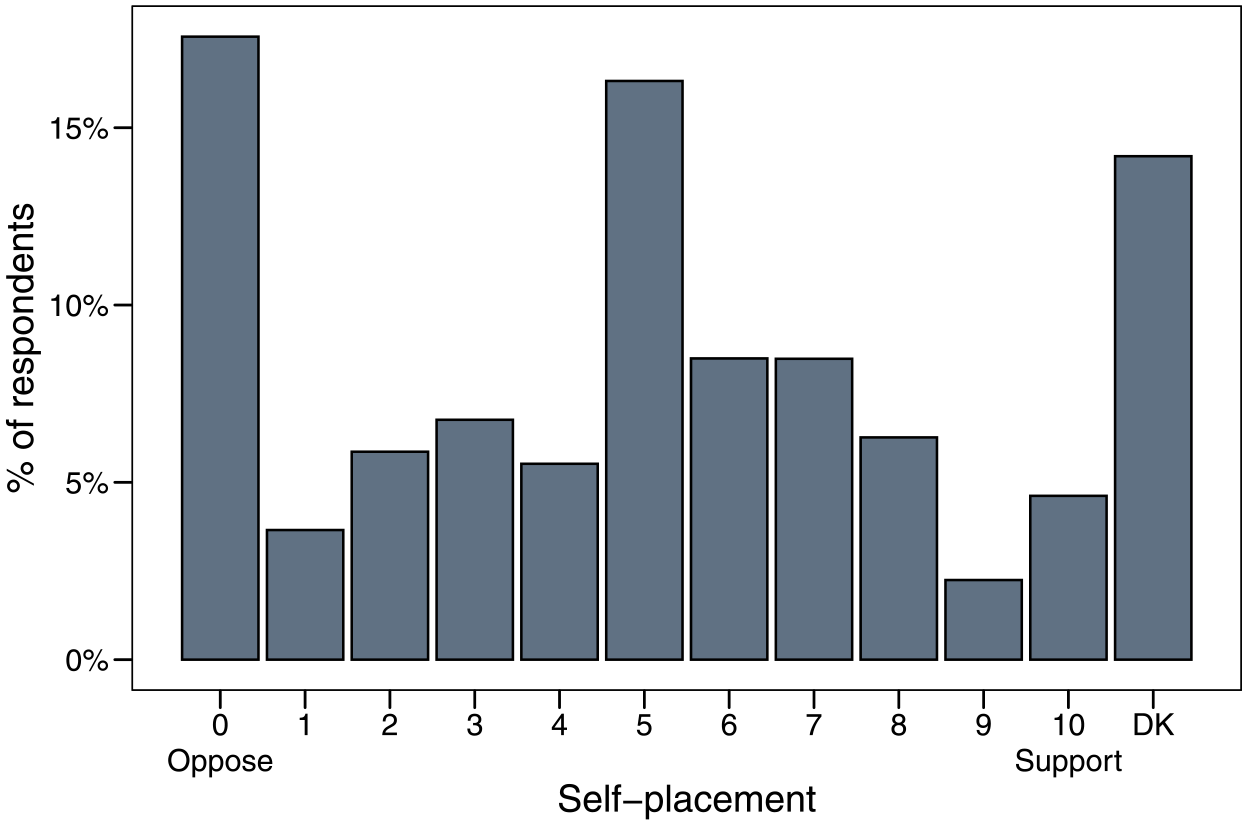
Respondents’ self-placement on further EU integration.
Next, the experiments asked them to evaluate two parties, labeled A and B, where the first is precise and the second is ambiguous. These parties were therefore unbranded, and I return to this issue later. Respondents were assigned randomly to one of four experimental conditions, as visualized in Figure 2. In each condition, they were primed with the policy statements from the two parties. While the precise party (Party A) was constant in all groups (control condition), the type of ambiguity of the second party (Party B) was manipulated to correspond to the four varieties of ambiguity discussed above. Therefore, respondents in each group were asked to evaluate a precise party against a vague, ambivalent, switching, or negative opponent.
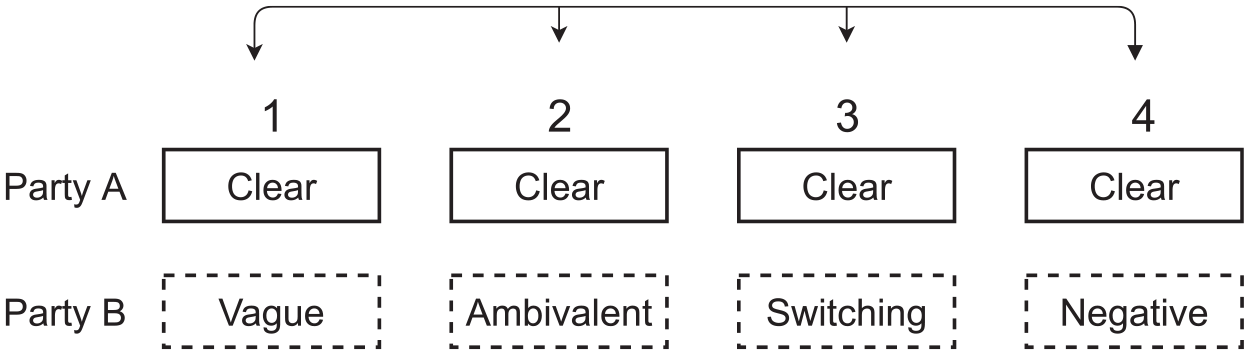
Experimental design.
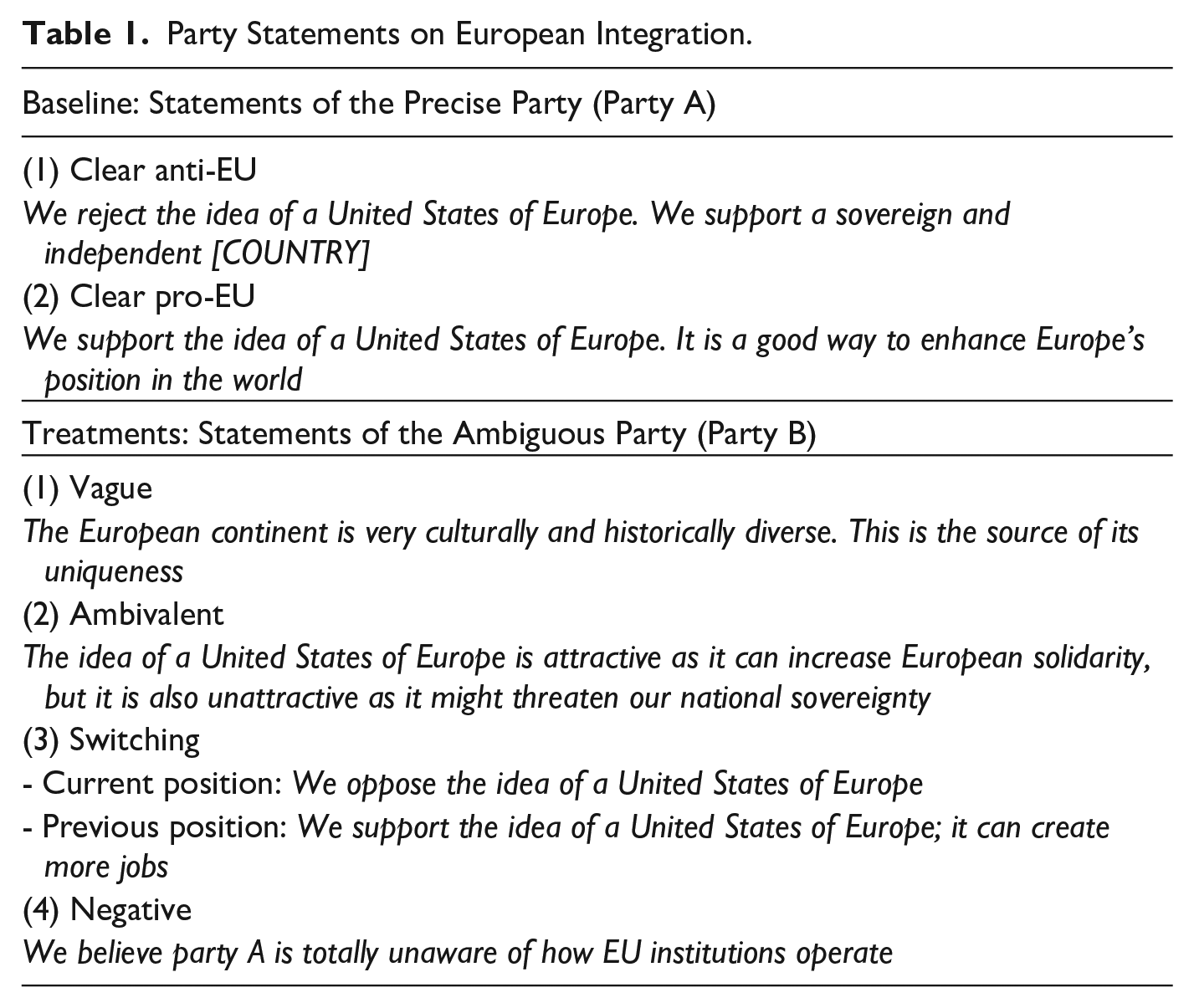
It is important to note that the experiment also randomized the policy position of the precise party. In half of the sample, it was in favor of further European integration, while it was against in the other half. The statements of the precise party are presented in Table1. By comparing the position of the precise party to respondents’ self-placement, I could examine the impact of ambiguous rhetoric in different contexts of competition. I discuss this aspect in detail below.
Party Statements on European Integration.
Treatments
The four experimental groups varied in terms of the type of ambiguity. The four varieties of ambiguity were administered in a way that resembles what parties and politicians communicate in real-world elections. The statements of the ambiguous party are presented in Table 1. In the first experimental group, the ambiguous party made a general statement about Europe that is hard to argue against without mentioning whether it stands in favor or against more integration: its statement represents the vague type of ambiguity. In the second group, the ambiguous party made statements about both positive and negative aspects of deepening integration, without promoting one side over the other. This strategy represents the ambivalent type of ambiguity.
In the third group, respondents were primed with two statements from the ambiguous party, which represents the switching variant. One represents its current position, whereas the other represents the previous position (see also Tomz & Houweling, 2012 for a similar strategy). Finally, the ambiguous party in the fourth group did not mention any statement about European integration. Instead, it waged an attack against the opponent, by naming it incompetent or unaware. Therefore, this strategy corresponds to the negative type of ambiguous rhetoric.
It is important to lay out the similarities and differences between the four strategies, especially between the ambivalent and switching types, on the one hand, and between the vague and negative types, on the other. While the ambivalent and switching variants share the common denominator that they both feature two potential contradictory positions, the ambivalent party discusses the issue generally, highlighting its expected pros and cons, without mentioning whether it stands with either side. The switching party, in contrast, changes its position over time. Thus, the latter has an additional temporal dimension. Likewise, the vague and negative types also share the common feature that the party never speaks about itself. In the negative type, the party speaks about the opponent, highlighting its incompetence, while the vague party makes a general statement about the topic of the controversy that is difficult to disentangle or argue against. Therefore, the negativity component differentiates these two.
Measuring the Outcome
After they read the statements of the precise and ambiguous parties, respondents were asked which party they would vote for if there was an election tomorrow. They were allowed to choose between Party A and B or neither of the two parties. The third option is important since voters would decide to abstain in the absence of a viable option.
Finally, respondents were asked to rate the two parties in terms of their perceived competence. They rated the two parties on a 0–10 scale, where zero represents “not competent at all” and 10 represents “very competent.”
Because voters never evaluate one party in isolation, I evaluate the strategies by comparing the vote share or competence scores of the ambiguity versus the precise party in each experimental condition. The vote choice variable, vote differential, is therefore calculated as the difference between the votes received by the ambiguous and precise party. Positive values indicate that the ambiguous party received more votes than the precise party and vice versa. 13 Likewise, the estimates for competence follow the same logic: competence differential is calculated as the difference between the rating of the ambiguous and precise party. Similarly, positive values indicate that the ambiguous party was rated more positively in terms of competence, and vice versa.
Findings
The Average Effect of Ambiguity
How did respondents rate the different varieties of ambiguity? I start the analysis with Figure 3 which visualizes the net vote advantage of the ambiguous party. In line with the theoretical expectations, it shows notable differences between the four types of ambiguity. In particular, the results demonstrate that only vagueness and ambivalence could help the ambiguous party outperform its precise competitor, while negative messaging and flip-flopping were clearly harmful. The vague strategy was the most beneficial among the four varieties, with a 12.5% net vote advantage over the clear party. The ambivalent strategy came second, with a positive vote advantage of 6%. Comparing these two, the difference between the vague and ambivalent vote differentials is also large in magnitude, around 6.5%, and statistically significant (t = 4.4, p-value < 0.001).
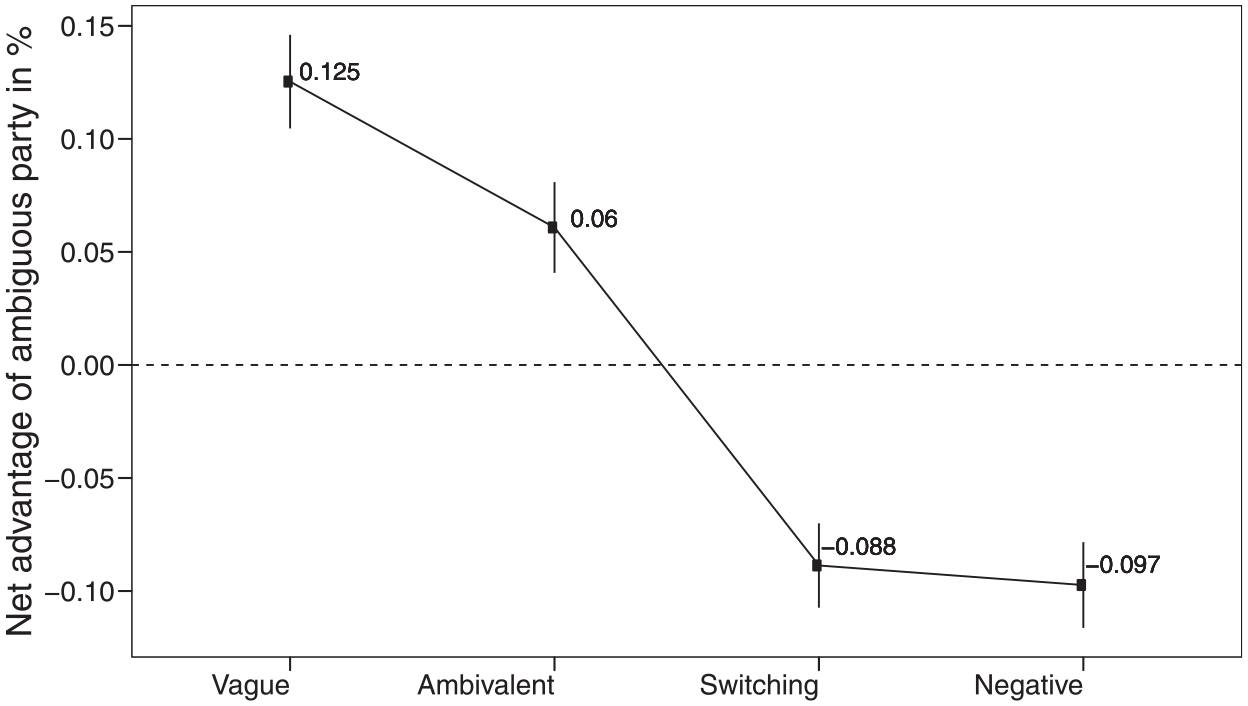
The net vote advantage of the ambiguous party in the four experimental groupsNote. The figure shows the differences in vote share between the ambiguous and precise party in each experimental group. Bigger values indicate that the ambiguous party outperformed the precise party, and vice versa. The vertical lines represent the 95% confidence intervals. Comparisons should be made between groups in order to see how the vote differential varies across different experimental conditions.
In contrast, position switching was clearly harmful to the party. The switching party incurred a negative vote differential of 9% compared to its precise opponent. Negative messaging has also led to a 10% vote disadvantage compared to the clear party. The differences between these two variants is rather small, amounting around only 1% of the vote, and likewise not statistically significant (t = 0.6, p-value = 0.524). These findings align nicely with previous research highlighting the backlash effect of attacking opponents (Banda & Windett, 2016; Roese & Sande, 1993; Lau et al., 2007; Nai, 2020) and negative consequences of flip-flopping (Tomz & Houweling, 2012).
Another observation that could be seen in the Supplemental Figure A1 in the appendix is that the different varieties not only affected the vote choice but also could predict whether the voter decides to vote at all. The two negatively rated varieties have significantly increased the share of respondents who decided to not vote for either party. To be specific, the first two groups (corresponding to the vague and ambivalent treatments) show abstention percentages of 20% and 28%, respectively. By comparison, the switching and negative treatments lead to abstention rate of 36% and 34%, respectively.
H1 expected that the rewards from ambiguous messaging will not extend to types of ambiguity that harm the party’s public image, which I proxy by using competence ratings. To investigate this hypothesis, Figure 4 presents the competence differential of the four treatment conditions. The figure shows a clear and similar pattern to that of the vote choice analysis. While the vague and ambivalent treatments were rated positively in comparison to the precise party, the switching and negative variants were rated negatively. The vague strategy was similarly the most positively rated in terms of perceived competence among the four groups, with a difference of around 0.5 scale points compared to the precise party. The ambivalent treatment comes second with a 0.12 point difference, a small difference in comparison. The difference between these two groups is statistically distinguishable from zero (t = 5.2, p-value < 0.001). The switching and negative treatments received negative differentials of −0.86 and −0.57, respectively (t = −4, p-value < 0.001). These findings lend support to H1: The effect of ambiguity shows to be associated with how the party’s rhetoric affect its public image. When party tactics hurt their public image, they fail to broaden their electoral appeals when facing a precise opponent.
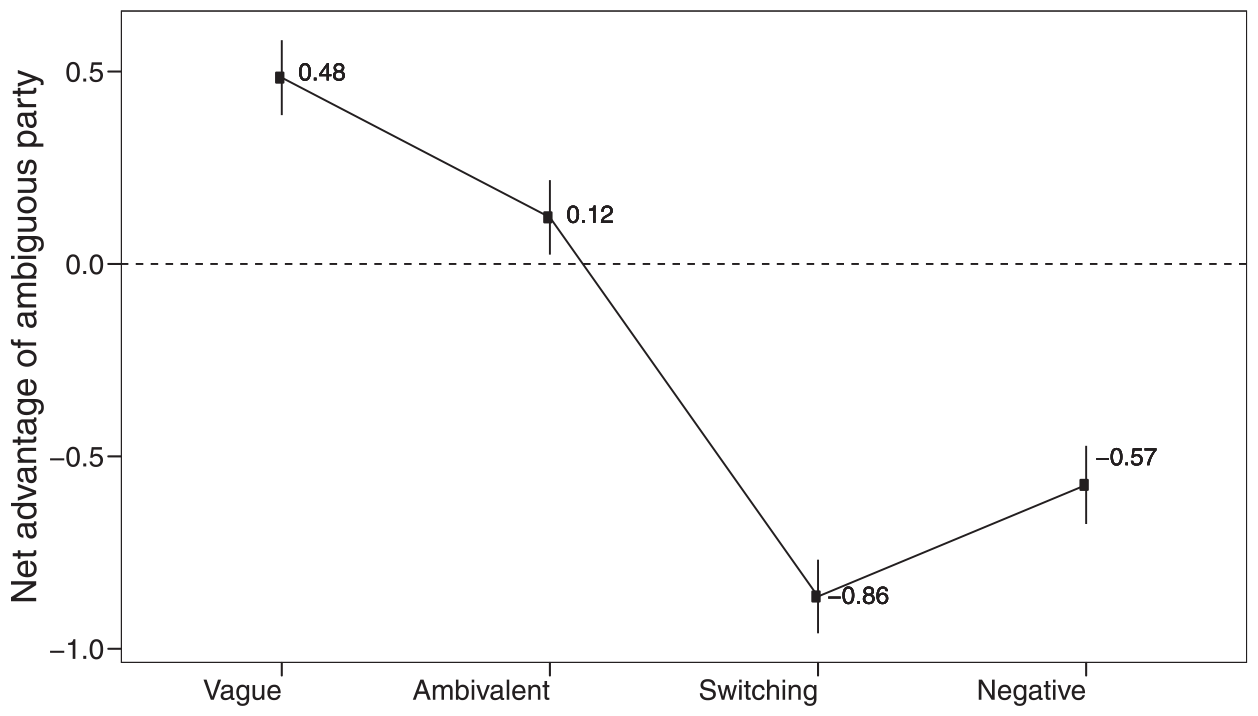
Respondent evaluations of the parties’ perceived competence. Note. The figure shows the differences in competence rating between the ambiguous and precise parties in the four experimental conditions. Bigger values indicate that the ambiguous party was perceived to be more competent, and vice versa. The vertical lines represent the 95% confidence intervals. Comparisons should be made between groups in order to see how different ambiguity tactics affect the competence rating of the party.
The Contextual Effect of Ambiguity
The aforementioned findings are stated most generally while (by design) controlling for voter preferences and the position of the rival party. I now pay close attention to different contexts of competition. I expected that the effect of ambiguity will also vary with the context of competition (H2a-c). I specifically introduced three different competition contexts where the precise party (1) agrees with respondents, in which case competition is unfavorable to the ambiguous party, (2) disagrees with respondents, where competition becomes favorable, or (3) when the voter is undecided, in which case competition is level or neutral.
To construct these contexts, I split voters into three groups based on their self-reported preferences about European integration: Europhiles, Euroskeptics, or undecided. 14 Next, I compare the respondent’s preference to the declared stance of the precise party. The three scenarios outlined in Table 2 are the result of matching respondents’ positions with that of the precise rival. The rows represent the position of the clear party, while the columns represent the positions of respondents.
The Context of Political Competition Facing the Ambiguous Party.
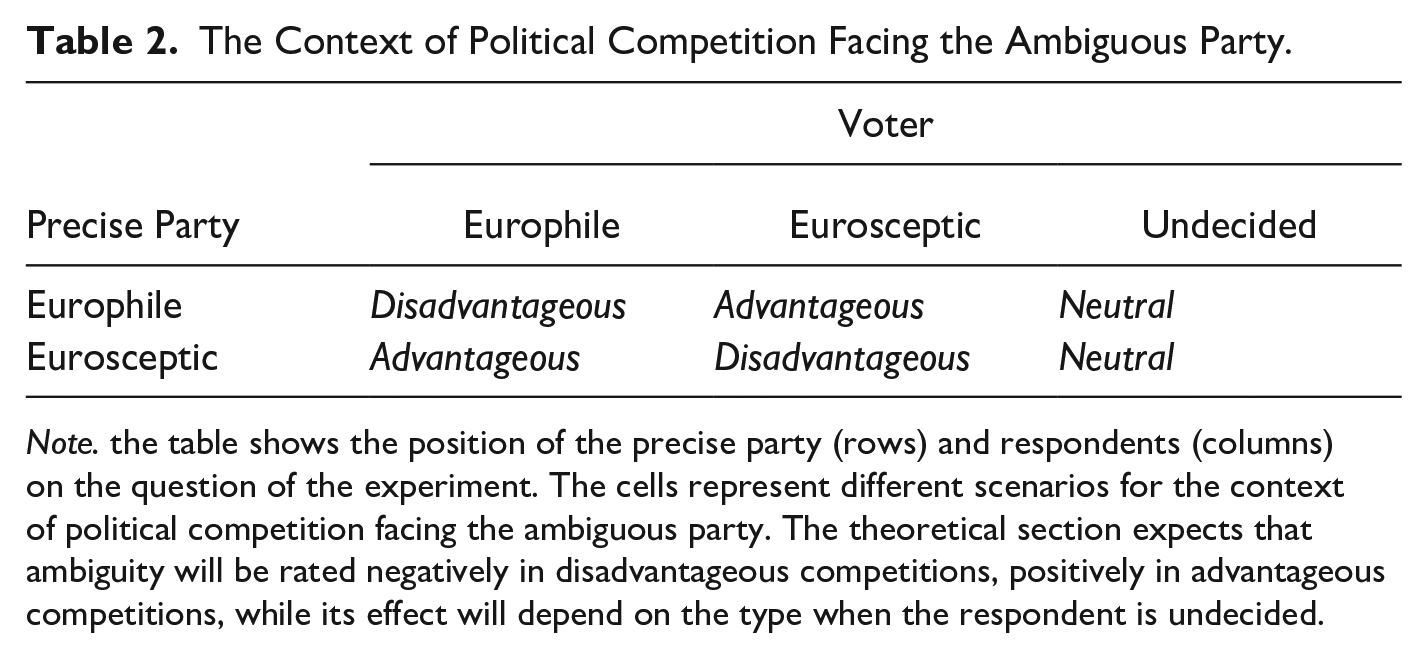
Note. the table shows the position of the precise party (rows) and respondents (columns) on the question of the experiment. The cells represent different scenarios for the context of political competition facing the ambiguous party. The theoretical section expects that ambiguity will be rated negatively in disadvantageous competitions, positively in advantageous competitions, while its effect will depend on the type when the respondent is undecided.
Figures 5 visualizes the effect of ambiguity types in the three situations outlined in Table 2. The outcome variable remains the vote differential between the ambiguous and the precise party as shown previously in Figure 3.
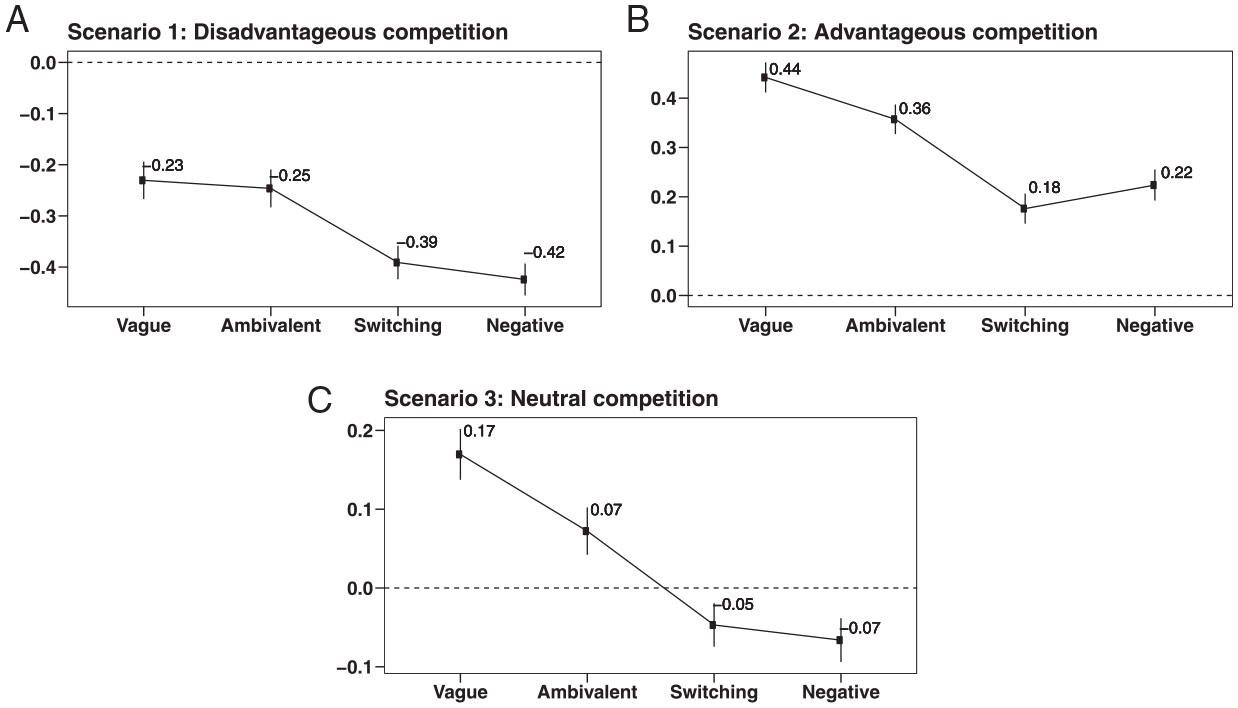
The contextual consequences of ambiguous rhetoric. Note. The figure shows the differences in vote share between the ambiguous and precise party in different contexts of competition for the four experimental conditions. Bigger values indicate that the ambiguous party outperformed the precise party, and vice versa. The vertical lines represent the 95% confidence intervals. Comparisons should be made between groups in order to see how the vote differential varies across different experimental conditions.
Panel A shows that the four varieties were rated negatively when the precise party explicitly agreed with the voter. Ambiguity shows to be not too helpful when respondents find popular policy proposals that meet their preferences (H2a). The “vague” and “ambivalent” variants received about 23% and 25% fewer votes compared to the clear party, respectively. This striking disadvantage inflates even further for respondents who received the switching and negative treatments. These two received around 39% and 42% fewer votes than the clear party, respectively. Therefore, the results show that ambiguity is a destructive strategy in disadvantageous competitions. “Going vague” could not help the party when the competitor approached voters with a popular policy position. It is worth to note that the effect size is likely exaggerated in the context of the experiment because there are two parties only. In real-world competitions where voters are exposed to more than two parties, the differences are expected to be less striking. I come to this concern later.
The differences between the four varieties in this context deserve a highlight. Although they were all vulnerable to the clear party, the differences between them are still striking in substantive terms. The vague and ambivalent variants could avoid around half the vote loss suffered by the negative or switching variants. In addition to the large magnitude, the differences are also statistically significant (t > 7; p-value < 0.001). However, the differences between vagueness and ambivalence on the one hand, and attacking and switching on the other, are not statistically distinguishable from zero (t = 0.6 and t = −1.4, respectively).
In contrast to these destructive effects, Panel B shows that ambiguity is clearly a winning strategy when the precise party disagreed with respondents, which lends support to H2b. The ambiguous party outperformed the clear opponent in the four treatment conditions. The vague variant of ambiguity received 44% more votes than the clear party. The ambivalent party, similarly, received around 36% more votes compared to the precise party. The difference between vague and ambivalent variants is statistically significant (t = 3.8; p-value < 0.001). The switching and attacking variants of the ambiguous party were also preferred to the precise party. They received 18% and 22% more votes than the clear party, respectively. The difference between these two is also statistically significant (t = −2.14; p-value = 0.03).
Although the four variants were clearly beneficial to stating an otherwise clear but unpopular position, the results again show clear differences between varieties of ambiguity. The vague variant seems to be the most rewarded among all, followed by ambivalence, while negative messaging and switching come next.
Turning to the third situation, in which the voter is indifferent, Panel C indicates an interesting finding—similar to what is shown above in Figure 3. It specifically shows that when the voter is indifferent or undecided, the effect of ambiguity clearly depends on the actual form it takes. The vague and ambivalent variants were rated positively, while attacking and switching were rated negatively. The vague variant received a positive difference of around 17%, while the ambivalent party’s advantage is estimated around 7%. The difference between vagueness and ambivalence is statistically significant (t = 4.3; p-value < 0.001). In contrast, the switching and negative variants received a 5 and 7% negative vote differentials, respectively. The difference between these two is nonetheless statistically insignificant (t = 0.9; p-value = 0.3).
Replication Study
I conducted a second iteration 1 year after the main study to ensure that the findings go beyond a single survey. YouGov again collected the data from representative samples of the 14 countries included in the main analysis, totaling around 22,000 respondents. Except for the question of voter self-placement, the replication study is identical to the original. The self-placement scale in the replication employs a labeled 5-point Likert scale instead of the continuous 0–10 scale, giving respondents the option of strongly support, support, indifferent, oppose, or strongly oppose further integration. This modification aims to validate the voter categorization based on a 0–10 scale. The replication study’s findings are presented in Appendix. Despite the 1-year period and the change in measurement scale, the findings are virtually identical to the main study.
External Validity
Experiments gain their power from achieving high internal validity, pertaining to the researcher’s ability to control treatment assignment. However, dealing with issues related to the generalizability of the findings beyond the experimental setting remains an ongoing challenge. In this section, I discuss several concerns about the current findings’ external validity. These remarks can also make viable avenues for future research on strategic ambiguity.
The first concern relates to the fictional parties featured in the experiment. The choice of employing unbranded parties carries positive and negative aspects. First, experiments examining the consequences of party strategies are challenging because respondents are very likely to receive experimental treatments after being exposed to information about the party in the real world. Challenges emanating from pre-treatment biases have been discussed in the literature (e.g., Slothuus, 2016). Because respondents cannot distinguish the real parties with complete certainty, relying on unbranded parties could help overcome this problem, at least in part. On the negative side, however, one cannot be entirely sure what parties respondents have in mind while answering the experimental questions. Likewise, we do not know how they will evaluate different blurring tactics if the parties were real. Previous research has investigated the role of individual-level factors in assessing parties’ ambiguity, such as partisanship (Tomz & Van Houweling, 2009), party likeability (Nasr, 2021), or candidate race (Piston et al., 2018). We learn from these studies that voters evaluate party strategies based on their prior identification or feelings toward these parties. Therefore, a remaining question is whether respondents would assess the different varieties differently if they come from the party they like or identify with.
The second point of concern is that the experiment only features two parties in countries with multiparty systems. One possible consequence is that the findings may be exaggerated, whereas they are likely to be smaller when voters choose between multiple parties. Furthermore, it remains unclear how voters will react if multiple parties position ambiguously on the issue. While these aspects challenge the present study, I note it is a likely scenario that voters might not consider all available parties equally while deciding their vote. Instead, they choose among a limited set of parties, most probably the ones that belong to their ideological camp. To investigate how many parties voters might consider in real-world elections, I analyze the European Election Study’s question on vote intentions. The EES surveys ask respondents how likely it is that they would ever vote for each of the biggest eight national parties. Supplemental Table C4 in the Appendix shows that in 27 European countries, respondents on average consider only two parties while deciding their vote even when they are faced with multiple parties.
Finally, it is also likely that the effect of ambiguous statements is issue-specific. European integration is a special issue in the sense that it relates to a supra-national dimension of competition. It is also highly positional in comparison to national issues with a high valence component, such as economic growth, health, or education, as previously discussed. Therefore, it remains an open question whether voters would react differently to other issues, especially those with a high valence component.
Conclusion
The strategy of position-blurring has attracted considerable attention from scholars of European party competition in recent decades. They consider ambiguity as a viable strategy to broaden parties’ electoral appeals beyond their core supporters. Because the party may attract voters with heterogeneous preferences, it proved effective in broadening parties’ electoral appeals. Although ambiguity could be achieved by different strategies, one question that has been neglected is how different types of ambiguous rhetoric could affect voter attitudes and behavior. The current study sought to fill this gap by distinguishing four types of ambiguous rhetoric and evaluating their causal effects via cross-country survey experiments. The article has suggested that parties could blur their positions by making vague, even contradictory, or mixed statements, casting inconsistent messages over time, or denouncing challengers’ positions, without committing to a precise position itself.
This novel approach yielded intriguing results, which could significantly contribute to this growing body of literature. Ambiguity in the form of vague or mixed statements could outperform the precise opponent, whereas position changing and negative messaging were detrimental. The latter two strategies were found to harm the party’s perceived competence.
The analysis has also considered the context of competition facing the party. Ambiguity could help the party when the precise opponent disagreed with the preferences of the voters. In addition, vague and ambivalent statements could convince the undecided to vote for the ambiguous party, which gave it a clear advantage over the precise opponent. In contrast, ambiguity could not help the party when the voter and rival parties agreed in terms of policy preferences. By and large, the findings demonstrate that ambiguity is, indeed, an overall effective strategy. Ambiguity could also be a viable option in constituencies or competitions where voters do not find clear congruent policy offers from parties. This is because vague or mixed positions give room for those voters to wish that the party will end up adopting their positions, while it could at the same time attract voters who do not have strong preferences.
Of course, different position-blurring strategies could also lead to different consequences due to other reasons that the current experiment does not account for. For example, these strategies might be different not only categorically but also in terms of degree. In other words, some rhetorical tactics may be weaker than others and, as a result, would enable the voter to see through the party’s intentions. For example, it might be the case that when parties attack a precise opponent, the voters can find a leeway to guess where the party stands, especially the politically interested who know where other parties stand on different issues. Flip-flopping, by comparison, might be a stronger type, especially when opponents highlight the party’s ambivalence in public, which increases the probability of the voter observing both positions. A second, yet related, mechanism is that these different tactics could affect voters’ psychological mechanisms differently. For example, voters might project their positions onto the party under some tactics but not others. These questions represent possible directions for future research.
Finally, and more generally, the findings also show that party positions matter a great deal, and that voters decide their vote consistently with their policy preferences. Although this argument might seem intuitive, several political scientists cast doubt in the ability of voters to uphold consistent positions and to vote based on these preferences. For example, Achen and Bartels (2017) argue that voters do not for a party because of its policy positions, but they do vote based on who they are, on their identity, social stratum, and on voting habit formulated by a history of family voting. The findings show that while casting their vote, respondents indeed weighted the policy offerings of parties with their own preferences and voted consistently with these preferences.
Supplemental Material
sj-pdf-1-cps-10.1177_00104140221089652 – Supplemental material for Varieties of Ambiguity: How do Voters Evaluate Ambiguous Policy Statements?
Supplemental material, sj-pdf-1-cps-10.1177_00104140221089652 for Varieties of Ambiguity: How do Voters Evaluate Ambiguous Policy Statements? by Mohamed Nasr in Comparative Political Studies
Footnotes
Acknowledgements
I thank YouGov for generously funding and expertly administering the surveys and Philipp Genschel, Anton Hemerijck, and Lorenzo Cicchi for their collaboration in the “Solidarity in Europe” project. An earlier version of this paper was presented in the ECPR summer school on political parties in Aarhus, Denmark, in August 2021. I thank all the participants and discussants as well as Mats-Philipp Ahrenshop, Ruth Dassonneville, Jonne Kamphorst, Hanspeter Kriesi, Levente Littvay, Zeynep Somer-Topcu, and Haoyu Zhai for constructive comments on earlier versions. I also acknowledge excellent comments from the editors and three anonymous reviewers.
Declaration of Conflicting Interests
The author(s) declared no potential conflicts of interest with respect to the research, authorship, and/or publication of this article.
Funding
The author(s) received no financial support for the research, authorship, and/or publication of this article.

Supplemental Material
Supplemental material for this article is available online.
Notes
References
Supplementary Material
Please find the following supplemental material available below.
For Open Access articles published under a Creative Commons License, all supplemental material carries the same license as the article it is associated with.
For non-Open Access articles published, all supplemental material carries a non-exclusive license, and permission requests for re-use of supplemental material or any part of supplemental material shall be sent directly to the copyright owner as specified in the copyright notice associated with the article.
