



Abstract
We add new insights to the party theory of parliamentary debate proposed in Proksch and Slapin’s The Politics of Parliamentary Debate by combining a quantitative replication analysis of floor speeches with a qualitative explanation of the endogenous transformation of two institutions mediating elections and parliamentary speech in the Japanese Diet. Although the House of Representatives in Japan used a single non-transferable vote system with particularly strong personal vote-seeking incentives, our analysis based on a new dataset shows that, contrary to the theory’s predictions, the pattern of speech activities among party leaders and backbenchers is close to that of Germany, which has a party-centered proportional representation system. Such seemingly contradictory results, however, can be consistently understood within the scope of the theory if we consider the patterns of endogenous change in the parliamentary system and party organization. These results highlight the potential for further development of the theory.
Keywords
Introduction
Parliaments are the fundamental organ of democratic government in both parliamentary and presidential systems. Essentially, they are speech institutions (Benoît and Rozenberg, 2020). However, the role of parliamentary speeches in the entire political process varies across countries (Bäck et al., 2021). Given this importance and diversity, scholars have conducted studies on how, why, and by whom parliamentary speeches are delivered; the party theory of parliamentary debate (PTPD) proposed by Proksch and Slapin (2015) (hereafter P&S) has had the most significant impact. They theoretically linked speech patterns to the characteristics of electoral systems, focusing on the role of party leadership in controlling floor access. Specifically, they argued that whether elections are party or personal vote-centered affects party leaders’ incentives to delegate speech activities to backbenchers and, consequently, the likelihood that backbenchers access the floor. Various empirical studies have been conducted based on their framework, and comparative studies have further advanced the theory (Bäck et al., 2021; Slapin and Proksch, 2021).
Parliamentary rules and electoral incentives.
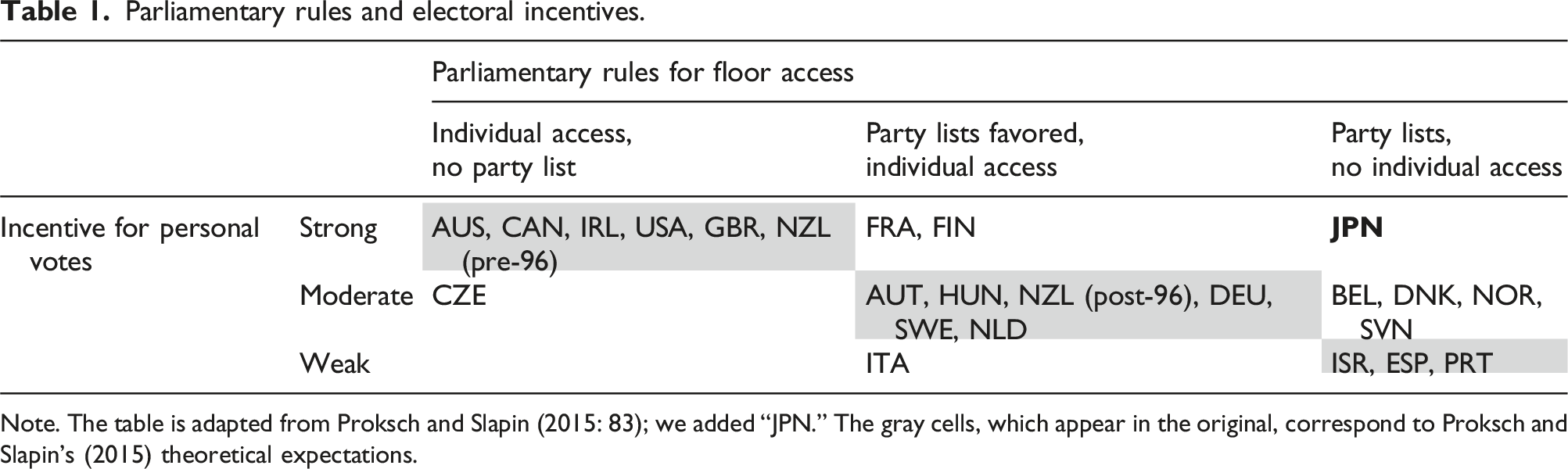
Note. The table is adapted from Proksch and Slapin (2015: 83); we added “JPN.” The gray cells, which appear in the original, correspond to Proksch and Slapin’s (2015) theoretical expectations.
First, we analyze speech patterns in plenary sessions of the Diet (hereafter, HOR and Diet are used interchangeably) over the postwar period, closely replicating P&S’s analyses. Quantitative replication analysis confirms that the PTPD is not straightforwardly applicable in Japan, where, despite the SNTV system’s strong personal vote-seeking incentives, backbenchers gave limited personal speeches at plenary sessions, and the overall speech pattern was similar to that in the German Bundestag, whose members have been elected basically through a proportional representation (PR) system. This pattern persisted even after the electoral system was changed to a mixed-member majoritarian (MMM) system, which remains more personal-vote centered than electoral systems in Germany and other countries at the bottom right of Table 1.
Subsequently, we solve this puzzle by qualitatively explaining the endogenous formation of the two institutions that mediate between the electoral system and parliamentary speech: parliamentary and party institutions. For the former, we describe how the characteristics of the postwar Diet’s plenary sessions result from postwar rationalization of prewar parliamentary practices and subsequent institutional transformation. We then analyze organizational changes in the Liberal Democratic Party (LDP), which became the dominant party; their response to electoral incentives was strongly affected by the parliamentary system formed in the earlier postwar period. Because the parliamentary rules—which, from the theoretical perspective of P&S, are supposed to serve as a first line of defense for party leaders—did not counterbalance personal vote-seeking incentives in the LDP, additional party organization measures were required. Thus, while each mediating institution independently played a significant role, they were deeply interrelated in the LDP’s responses to personal vote-seeking incentives.
Thanks to its extremely personal vote-centered electoral system, postwar Japan’s Diet is a suitable and interesting case to verify the PTPD’s theoretical scope and analyze the detailed mechanisms by which personal vote-seeking incentives affect parliamentary speech patterns. Although our quantitative results represent a superficial deviation from the theory, detailed qualitative examination shows that Japan can indeed be situated within the PTPD framework.
Theory of parliamentary debate and its application to the Japanese diet
Parliamentary speech is a critical activity for legislators; relevant research has adopted various perspectives, including credit claiming (Mayhew, 1974) and disagreement signaling in coalition governments (Martin and Vanberg, 2008). Bäck et al. (2021: 3–6) outlined approaches to parliamentary debate research and noted the particular importance of strategic and partisan-rhetoric approaches. The PTPD lies centrally between these approaches; it theorizes that parliamentary speech is strongly influenced by electoral systems, building on previous discussions related to party branding and legislators’ desire for personal votes (e.g., Carey and Shugart, 1995; Cox and McCubbins, 1993).
P&S argued that the organization of parliamentary speeches depends on whether the electoral system is party- or personal vote-centered. In the former case, party leaders use their influence to emphasize the party’s brand, and the leaders themselves tend to give floor speeches. In the latter case, leaders tend to delegate speech to backbenchers and allow them to make deviant and rebellious speeches in pursuit of personal votes. Many empirical studies have been conducted under this theoretical framework in recent years; scholars have greatly expanded the scope of the PTPD and further elaborated the relationship between electoral incentives, party governance, and parliamentary institutional rules. 1
Another important idea in the PTPD is that two institutions—parliamentary institutions and party organizations—mediate the influence of electoral systems on parliamentary speech and are endogenously transformed. This argument means that party leaders design rules in the party and the parliament to control access to plenary sessions. According to P&S, of the two mediating institutions, parliamentary rules are a more direct “first line of defense” (77) for party leadership in controlling floor access. P&S (77–83) found that parliamentary rules can be divided into three patterns that roughly correspond to strong, medium, and weak personal vote-seeking incentives in electoral systems (Table 1). The basic parliamentary rules are set through negotiations between party groups, followed by internal party rule-making regarding speaker selection, time allocation, and controlling speech contents.
However, when we analyze Japan through the lens of the PTPD, we notice it is quite exceptional. Japan adopted SNTV for HOR elections from 1947 to 1993, which provides extremely strong personal vote incentives (Carey and Shugart, 1995), given that: first, nominations by political parties are not required for candidates to run, and second, major parties may nominate two or more candidates in a district, so their candidates must compete for votes from their party’s supporters. The 1994 reform changed the HOR’s electoral system to an MMM system; the first post-reform election was held in 1996. Although this change was intended to reduce personal vote-seeking incentives and increase the importance of party votes, these incentives are still stronger than in continental European countries with closed-list PR or mixed-member proportional systems (Carey and Shugart, 1995). 2
However, individual access to the floor in Japan is very rare. Speech time on the floor is strictly regulated and assigned to each parliamentary group. All questions and debates represent the group, and each group has only one opportunity to speak in each question and debate. Party leaders play a decisive role in selecting speakers; in most cases, they are selected from members of the committee to which the concerned bill was referred. These conventions, though not legally binding, apply to most parties. Moreover, in some parties, including the LDP and the defunct Democratic Party of Japan, the content of speech is (was) sometimes internally preapproved by leaders. 3 Therefore, Japan is located in the top right cell in Table 1, which represents a deviation from the PTPD. We will return to this issue in a later section and discuss how these party-centered speech rules were formed; first, we investigate Japan’s deviation through quantitative analysis of speeches.
Quantitative analysis
P&S empirically validated their theory regarding the relationship between electoral systems and floor access rules with detailed studies of the British House of Commons and the German Bundestag, which employ personal and party vote-centered electoral systems, respectively. P&S found that party leaders are more likely to make speeches than backbenchers in Germany. Regarding the U.K., backbenchers are more likely to take the floor than leaders in opposition parties, and the opposite is true for ruling parties; though, as P&S admitted, the content of leaders’ speeches may be dictated by their specific roles as government officials in the latter case. Moreover, legislators whose ideological position is distant from (close to) that of their party are more likely to obtain floor access in the UK (Germany).
In this section, we test whether the patterns P&S found apply to the Japanese case. We conducted two analyses. First, in Study 1, we compared the frequency of speeches in the Diet between party leaders and backbenchers. If the PTPD holds, party leaders should have encouraged backbenchers to speak in the Diet under Japan’s personal vote-centered electoral systems; thus, backbenchers should be more likely to make speeches than leaders. Second, in Study 2, we examined the relationship between the aggregate amount of speech delivered by members of parliament (MPs) and their ideological proximity to their party leaders. Given strong personal vote-seeking incentives in Japan, the PTPD expects that the more opposed MPs are to their party leadership, the more they would speak in the Diet, as in the British House of Commons.
While this study is not the first to analyze parliamentarians’ speeches in the Japanese Diet, few studies have reexamined P&S’s theory using their approach. Goplerud and Smith (2021) examined changes in the volume of speeches by ministers and bureaucrats before and after the 1994 reform, and Curini et al. (2020) measured the strength of conflict between the ruling and opposition parties based on data from the prime minister’s general policy speeches and subsequent debates. However, neither study focused on individual legislators. Matsumoto and Matsuo (2010) examined the relationship between the attributes of individual legislators and the volume of their speech; however, their focus was mainly on the motivations of individual legislators, not on party leaders’ delegation of speechmaking.
The closest analysis to our study was conducted by Smith (2021). Through examinations of both plenary and committee meetings based on data from 1996 to 2017, Smith (2021) pointed out that party leaders have a large weight in plenary meetings, with some speech opportunities being reserved for backbench members in committee meetings. This suggested that Japan’s overall pattern may be placed between the party- and individual-centered systems in the comparative theoretical spectrum. Our empirical analysis basically corroborates these findings, especially with regard to plenary sessions. Additionally, Smith (2021), as well as Goplerud and Smith (2021), also paid particular attention to the importance of institutional conditions in explaining the realities of parliamentary politics in Japan, which approach our study also shares.
However, there are important differences between our study and that by Smith (2021), mainly because we aim to conduct a full replication of P&S. First, in Smith (2021), there was no analysis of the relationship between backbenchers’ ideological distance from their party and amount of speech, one of the core components of P&S’s analysis. Second, Smith’s (2021) definition of party leaders, which generally referred to only two people in each party (the party president and secretary general), was much narrower than that adopted by P&S, which included whips and others. Third, we distinguish between members who have joined the government or cabinet and other members of the ruling party. Fourth, our empirical model differs from Smith’s (2021) in the way that individual legislator fixed effects are handled. Additionally, whereas Smith’s (2021) analysis is limited to the period after 1996, our data covers the periods before and after the 1994 electoral system change. In short, the present study can be considered to extend that by Smith (2021) by providing additional analysis, more comparable definitions of party leaders, better data handling, and analysis of the pre-reform period.
Our two analyses were based on text data from HOR Minutes; we obtained these from the online search engine of the Minutes using the official application programming interface (for details on data collection and variable definitions, see Online Appendix B). We focused on LDP members of the HOR. 4 We created unbalanced panel data, in which the unit of time was the standard period of LDP personnel (hereinafter, “period”—for a detailed definition, see Online Appendix B); thus, the unit of observations was MP-period. As this study investigated party leaders’ delegation of speaking time to backbenchers as party members, we omitted speeches made by people in nominally non-partisan roles. Specifically, we excluded the Speaker, a facilitator (giji shinko gakari), and government members (e.g., ministers) from our analyses, even when they were LDP legislators. We can clearly distinguish their speeches because the online Minutes record each speaker’s title.
Although recent studies of the Japanese Diet have often substituted committee speeches for plenary speeches (Cox and McCubbins, 2011; Curini et al., 2020; Goplerud and Smith, 2021; Smith, 2021), we focus purely on plenary speeches to closely match P&S’s analysis of plenary sessions. Moreover, committees are essentially closed, practical working places and are therefore unsuitable for testing the PTPD. Nonetheless, similar conclusions were obtained when we analyzed committees (see Online Appendix C).
Among Japan’s parties, precise data about changes in party posts were only available for the LDP, so we report only this analysis in the main text. As the LDP is well-known for its extensive adaptation to a personal vote-centered electoral system (Krauss and Pekkanen, 2011; Rosenbluth and Thies, 2010), our analyses work as a “most-likely” case study when the empirical evidence does not support the theory. 5
Study 1
We analyzed speeches in the HOR from October 1979 (the beginning of the second Ohira cabinet) to September 2006 (the end of the reshuffled third Koizumi cabinet). We set the starting point to the late 1970s because the prevailing view is that the LDP’s organization and its internal customary rules reached their final forms around that period (e.g., Krauss and Pekkanen, 2011). We could not analyze data after 2006 because of a lack of detailed LDP personnel information (Liberal Democratic Party [LDP], 2006). As the strength of the personal-vote incentive could have been changed by the electoral reform, we separately analyzed data from the SNTV period (until November 1996; the end of the first Hashimoto cabinet) and that under MMM (after that time).
Following Matsumoto and Matsuo (2010), the dependent variable was the logged number of characters in speeches delivered by an MP in a period. 6 To address cases of zero, we added one to the number of characters before taking the logarithm.
We employed a linear model with MP-level fixed effects, which controlled for time-invariant factors specific to each MP. 7 The main independent variable was an indicator variable, party leader, equal to one if an MP was one of the LDP leaders for at least 1 day in that period and zero otherwise. 8 We defined the following positions as LDP leaders: Vice-President, the “big five” (“goyaku”; i.e., Secretary-General, Chairperson of the General Council, Chairperson of Policy Research Council, Chairperson of Diet Affairs Committee, and Chairperson of Election Strategy Committee), acting members for the “big five,” and assistants of the “big five.” Note that LDP members do not hold government positions concurrently with these positions. For periods when the LDP had lost power, we added the President to the LDP leaders. We did not consider the President as a party leader for periods when the LDP was in power, because the President essentially plays the role of the Prime Minister in the Diet, and thus does not make speeches as a party leader in such periods.
Additionally, we controlled for the following time-varying covariates: speaker and committee chairs, ministers, age, total number of terms served (logged), and vote share in the last election. For the analyses of MMM periods, we considered the following additional variables: junior ministers (i.e., state minister and parliamentary vice-minister), running for a single-member district (SMD) tier in the last election, “zombie” status (losing in SMD but elected in PR thanks to the duplicate candidacy system) in the last election, and the interaction term between SMD and vote share. All control variables other than age, total number of terms served, and vote share were dummy variables. We also included dummy variables for election terms. We used standard errors robust to heteroskedasticity across MPs and serial correlations.
Estimation results of Study 1.
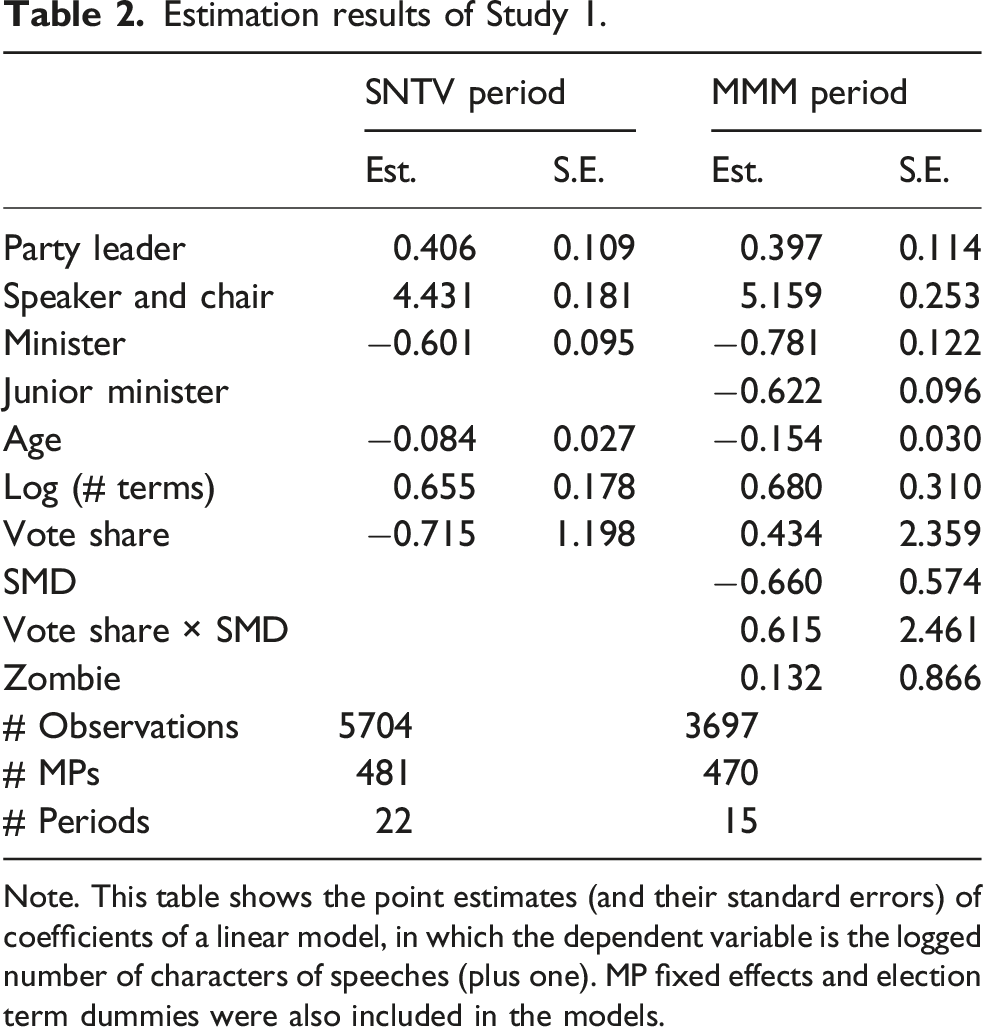
Note. This table shows the point estimates (and their standard errors) of coefficients of a linear model, in which the dependent variable is the logged number of characters of speeches (plus one). MP fixed effects and election term dummies were also included in the models.
Study 2
The period of analysis for Study 2 was from November 2003 (the beginning of the second Koizumi cabinet) to October 2017 (the end of the reshuffled third Abe cabinet). We limited analysis to the period after the 2003 HOR election because of the availability of data necessary to measure the variables of interest; thus, Study 2 covers only the MMM period. The dependent variable is the same as Study 1.
The independent variables of interest were policy distance between each MP and party leaders. We measured MP policy positions using the UTokyo-Asahi surveys of HOR legislators, conducted before every HOR election after 2003 by Ikuo Kabashima (before the 2005 survey) and Masaki Taniguchi (after the 2009 survey), in collaboration with Asahi Shimbun (Japan’s second-largest newspaper company). 9 Fortunately, these surveys have a very high response rate (more than 90% for all five surveys we used). These surveys included items asking HOR candidates for their opinions on various issues using a five-point scale; several items were shared across some or all of the surveys.
Following previous studies showing that the policy space of recent Japanese politics is largely bidimensional (Kabashima and Takenaka, 2012; Miwa and Taniguchi, 2017) as well as those utilizing the UTokyo-Asahi surveys to test hypotheses based on spatial theory (Fujimura, 2012; Smith and Tsutsumi, 2016), we estimated each MP’s ideal point in a two-dimensional space. Specifically, we employed a two-dimensional ordinal item response theory model to 68 issue attitude items pooled across five elections from 2003 to 2014, with a view to making a policy space comparable across years (for detailed procedure and results of the ideal point estimation, see Online Appendices F.1–F.3). Based on the estimated item-specific parameters and the average positions of each party’s MPs, we interpreted the first and second dimensions as left–right and economic ideologies, respectively, consistent with the abovementioned studies. 10 We specified the LDP leaders’ policy positions by averaging the top leaders’ ideal points for each period, defining top leaders as Vice-President and the “big five.” 11 Then, we computed the main independent variables, left–right distance and economic distance, by taking the absolute value of the difference in policy positions between each MP and top leaders’ average for each dimension. Finally, we standardized these two variables to ease interpretation of the estimation results.
We estimated a linear model but did not include MP fixed effects because the policy distance variables have small within-individual variations. Therefore, we had to be more cautious about causal interpretations in Study 2 than in Study 1. 12 Additionally to the same control variables as Study 1, we considered an indicator variable for top leaders. Moreover, because MP fixed effects were not included, we added MPs’ time-invariant attributes—dummy variables indicating female and dynastic politicians—to the set of control variables. The standard errors explained in Study 1 also apply to Study 2.
Estimation results of Study 2.
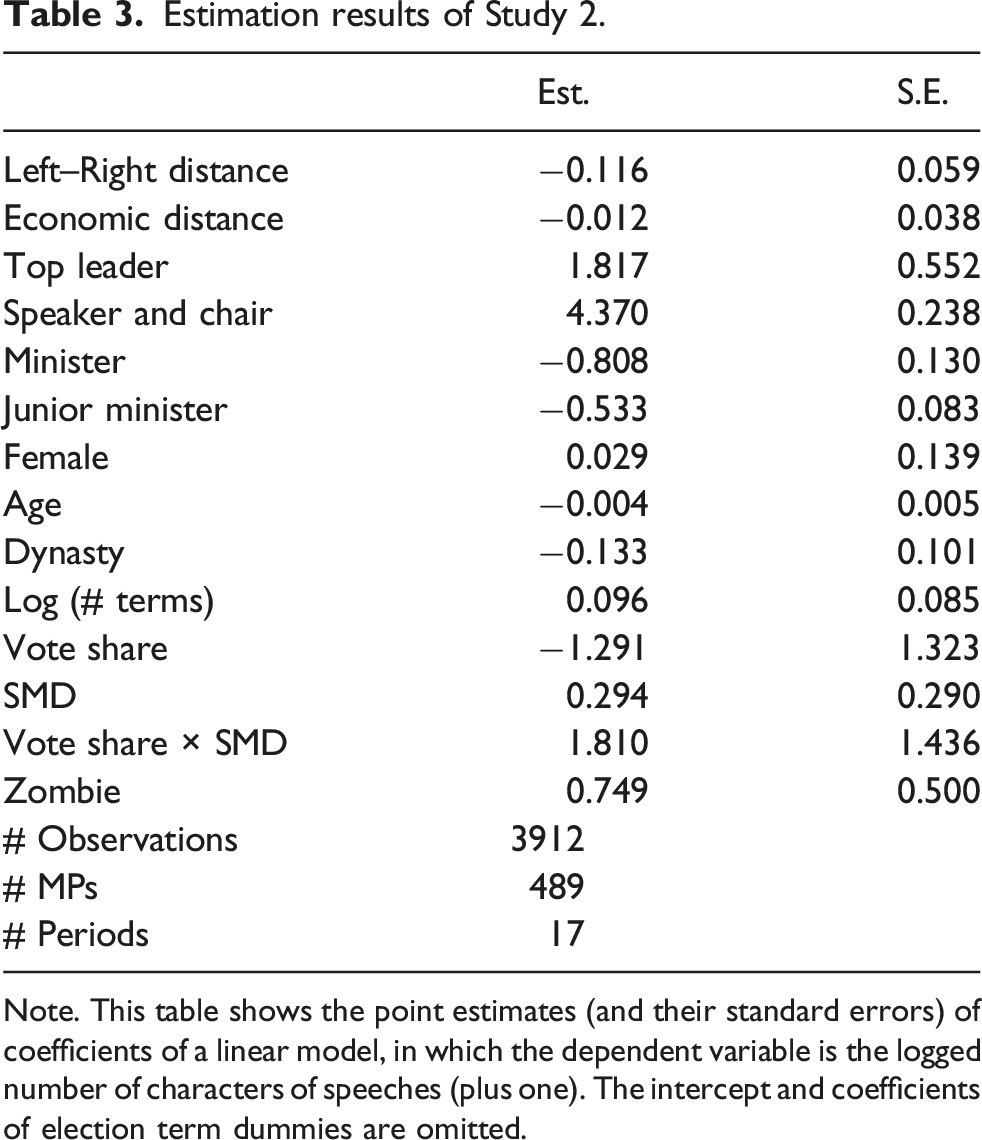
Note. This table shows the point estimates (and their standard errors) of coefficients of a linear model, in which the dependent variable is the logged number of characters of speeches (plus one). The intercept and coefficients of election term dummies are omitted.
In summary, we found that LDP leaders were more likely to speak than backbenchers in plenary sittings under SNTV and MMM, both of which are candidate-centered systems, as explained above. These results clearly contradict the PTPD. Moreover, while our results about the economic dimension neither support nor contradict the PTPD, the LDP has a similar pattern to parties in Germany—at least in terms of the left–right dimension—directly contrary to the expectations of P&S’s argument.
Institutionalization patterns of two intermediary systems
We now qualitatively analyze why Japan deviates from the PTPD, focusing on the endogenous patterns of changes in the two mediating institutions: the parliamentary system and the party organization.
Superficially, Japan—as described in Table 1 and the previous section—presents a seemingly incomprehensible puzzle. However, if we more deeply examine the ideas in P&S and Slapin and Proksch (2021), this puzzle can be explained consistently within the PTPD framework. First, parliamentary rules are interparty rules and are essentially established prior to the formation of internal party rules. As P&S (77) pointed out, parliamentary rules are a first line of defense for party leaders in controlling floor access. Thus, parliamentary rules formed beforehand may subsequently influence the formation of party institutions. In fact, in postwar Japan, the formation of the parliamentary system preceded and its characteristics greatly influenced the institutionalization of political parties, especially the LDP as a majority party. Second, Slapin and Proksch (2021: 35–37) argued that, while legislative agenda power, debate structure (rules), and rules for allocating speaking time to individual legislators count in parliamentary systems, they are all affected by governmental authority concerning government bills. In this regard, governmental authority in the postwar Japanese Diet was extremely constrained, significantly impacting parliamentary speechmaking rules. These two issues regarding intermediary institutions explain why the Japanese Diet has been somewhat anomalously institutionalized. Our following argument suggests that even if the empirical patterns seem to deviate from the standard P&S theory, they can be understood consistently within an expanded PTPD framework.
Establishment of the plenary session as an arena for limited interpartisan debate in the postwar diet
The postwar HOR inherited various institutions and informal practices from the prewar Imperial Diet. The norm of operating the entire chamber based on interparty negotiation and consensus was one of the most important legacies (HOR and House of Councillors, 1990: 85–86; Kawato, 2005: 34–35). Moreover, in the Imperial Diet, reading was almost completely omitted, and clause-by-clause reviews were abolished because sessions were very short. Succeeding these conventions had a major impact on the rationalization of the postwar Diet (Narita, 2019; Shirai, 2017).
Furthermore, the government’s powers in the Diet were drastically reduced by the new constitution and the Diet law enacted in 1947. In the Imperial Diet, the government had the power to open, close, and suspend sessions and to extend and dissolve the Diet. The prewar government also held full discretion regarding bill amendment and withdrawal. However, all of these powers were abolished in the postwar Diet, where individual legislators’ rights regarding speechmaking and submitting proposals and amendments were ensured. Additionally, a free debate system in plenary sessions and powerful standing committees was introduced to promote debates among legislators (Baerwald, 1974).
From these initial conditions, postwar rationalization began. According to Cox (2006), parliaments are inherently collegial and need to endogenously generate rules for their own operation. In particular, they involve controlling officers who are given special agenda control power and rules constraining individual parliamentarians’ power to delay. In essence, parliamentary rationalization refers to the early endogenous formation of these fundamental parliamentary institutions.
First, the Diet Law was partially amended as early as 1948, followed by major amendments in 1955 and 1958 (Okazaki, 2003). The 1948 amendment introduced a rule limiting legislators’ speech time (Mukoono, 1994). Since the 1955 amendment, the law has required 20 co-signatories (50 for budget-related bills) for legislators to submit a bill or an amendment to the floor. At the same time, the rules agreed to by the major parliamentary groups made it nearly impossible for individual legislators to discretionarily submit bills or amendments in committees, especially in a way that crossed group lines. Additionally, free discussion in plenary sessions was abolished. Individual legislators’ power was severely restricted, and the Diet came to be managed by parliamentary groups, especially the larger ones. Moreover, in 1958, a limitation was imposed whereby regular sessions could be extended only once, adding a serious restriction to the majority’s power, and the law reaffirmed the core role of the House Steering Committee in the overall management of parliamentary procedure (Kawato, 2005). These reforms indicated a return to the prewar system in which intergroup negotiation and consensus was respected as much as possible (so-called “kakuha kyogikai”), strongly restricting the majority. 14
Through this process, the foundation of plenary speech rules was established around 1960. 15 Their core characteristics are as follows. First, plenary session time was minimized. The annual length of plenary sessions almost halved during the 10 years following the commencement of the postwar Diet, from more than 130 to 76 hours on average (Oyama, 2003: 228). Second, all plenary speeches are made on behalf of parliamentary groups. The 1955 amendment of the Diet law and other reforms established a rigid group-based system in which speech time is allocated to groups through intergroup negotiation; groups determine who can make a speech. This system corresponds to the short session time, which obstructed groups from permitting individual legislators to freely make plenary speeches. In this way, plenary sessions became an arena for limited interpartisan debate.
As for managing intergroup negotiations, a so-called “tsurushi” (literally “suspension”) system gradually formed from the later 1950s. By temporarily suspending the reference of bills to committees, this system controls the agenda of plenary sessions (especially its timetable) through negotiations between ruling and opposition parties. The initial rule of the postwar Diet was that bills submitted to the floor were immediately referred to a committee (Article 56 of the Diet Law). However, in the 1948 amendment, it was stipulated that the purpose of a bill may be heard at a plenary session “when the House Steering Committee deems it particularly necessary” (Shirai, 2013: 142–145). Although this provision was initially rarely used, the House Steering Committee, especially its board of directors (composed of major groups), began using this rule to coordinate the overall agenda from around 1955. This direction was firmly established in January 1956, just two months after the LDP’s foundation. At that time, the LDP, as a majority party, accepted the principle of hearings for the purpose of important bills in plenary sessions and agreed that this process would be determined by negotiations between the ruling and opposition parties. 16 The tsurushi system was further established from the 1960s onward; the LDP’s occasional demands for change were rejected. 17
In sum, the plenary session was institutionalized as an arena for limited interpartisan debate through the above process. This system has since been characterized by a minimal amount of activity, speeches always on behalf of a group, and negotiations between the ruling and opposition groups based on tsurushi.
Institutionalization of the ruling LDP
Next, we examine how the LDP responded to the strong personal vote-seeking incentives created by the SNTV in a way that avoided delegating parliamentary speech.
The LDP, established in 1955 through a grand merger of conservative parties, was a coalition of factions. From its inception, it had strongly decentralized organizations, and its members lacked ideological cohesion. As for election campaigns, though the party had some role, personal campaigns were key. However, the LDP needed to address how personal vote incentives could be used to sustain its dominant party position under the SNTV. Thus, first, each faction was allowed to support its own candidate, resulting in overt intraparty competition. Second, LDP members actively brought pork to their constituencies to strengthen their supporting organizations.
However, it was also essential for every candidate to send messages to the constituency to differentiate themselves from other candidates in the same party and win more personal votes. In many countries, such opportunities are provided, to some extent, in the form of speechmaking in parliamentary plenary sessions. As pointed out above, the Japanese Diet’s institutionalization of the plenary session as an arena for limited interpartisan debate had occurred around 1960, leaving almost no possibility of free speech by individual members.
This posed a major new problem for the LDP, who experienced internal rebellions that prevented important government bills from being passed (Satake, 1998). These rebellions were driven by backbenchers’ dissatisfaction with their inability to act freely in the Diet, despite their need to appeal to their supporters to cultivate personal votes. Thus, the LDP’s leadership came to face two critical forces: the opposition and rebels within the party. On the one hand, the Diet structure had already been established wherein the authority of the majority party was restricted, and negotiations with opposition parties were respected; on the other hand, the LDP itself had institutionalized a decentralized factional system and candidate-centered electoral campaign strategies. The party’s executive understood that it would be extremely difficult to get a controversial bill passed using party discipline to stifle backbench rebellions; clearly, drastic measures were needed.
However, changing the Diet rules by majority voting was already extremely difficult in the early years of the one-party-dominant system; post-war Diet rationalization had already established an operational norm based on negotiations and consensus-building between the ruling and opposition parties. Consensus among the main parliamentary groups in particular was an almost indispensable requirement for any changes to the Diet’s rules (e.g., Sato and Matsuzaki, 1986). Furthermore, this norm had been disseminated among the public since the early postwar period; violating it imposed a serious cost by estranging the public from the government. The 1960 turmoil relating to the US-Japan Security Treaty revision—in which the highhanded majoritarian process to obtain parliamentary approval triggered massive protests and finally forced the Prime Minister to resign—explicitly demonstrated the power of this norm to the LDP. The incident became a crisis because a significant part of the public perceived it as a unilateral attempt by the LDP to fundamentally change the Diet’s operational norms. 18
Therefore, while maintaining Diet rules, the LDP made a significant shift by introducing internal preliminary reviews (“jizen shinsa”) of bills at the party headquarters (Oku and Kohno, 2015). This preliminary review system provided individual legislators with a variety of opportunities for checking and negotiating the contents of bills; once the internal review process was completed, strict party discipline was enforced. Essentially, the LDP established a process within the intraparty structure to deal with individual legislators’ need for personal votes outside the Diet. Accordingly, LDP MPs were able to make claims and demands very freely during the pre-submission preliminary review process. Because of the imposition of strict party discipline before parliamentary deliberation of bills, the speaking activities of LDP members in the Diet were significantly reduced. Thus, the mechanism for dealing with personal vote incentives, at least from the LDP’s perspective, was transferred from the Diet to party headquarters to ensure the stable passage of government bills (Nonaka, 2019). 19
In summary, the LDP’s institutional adaptation to the SNTV partially took advantage of its original decentralized nature. Meanwhile, however, an unusual large-scale system of internal preliminary reviews was also established, primarily because individual members’ opportunities to speak at plenary sessions were strongly restricted, and an extremely group-centered management practice had taken hold in the Diet. Accordingly, it was almost impossible for the LDP to simultaneously secure the passage of government bills and fulfill its members’ strong need for personal votes. The preliminary review system was formed to substitute the party’s internal process for plenary sessions.
Conclusion
This study analyzed parliamentary debates in the Japanese Diet from a new angle using a mixed-method approach. By closely replicating P&S’s analyses using data from the Japanese Diet, we demonstrated the characteristics of plenary session debate patterns, while a further qualitative analysis revealed their historical foundations.
The following three points were clarified. First, the patterns of plenary session parliamentary debates in the Japanese Diet significantly deviate from the PTPD’s predictions. Specifically, despite working in a candidate-centered electoral system, LDP leaders are more likely to make floor speeches than backbenchers. Moreover, members whose left–right stance (but not economic position) was close to that of the leaders obtained more speaking opportunities. Second, these theoretical deviations originate in the endogenous transformations of the two institutions that mediate electoral systems and parliamentary speech: parliamentary institutions and party organizations. Third, the Japanese Diet’s initial theoretical deviance from the PTPD dissolves if we consider the endogenous transformations of these institutions; thus, Japan’s case contributes to the theoretical development of the PTPD.
Japan’s deviation from the PTPD is largely due to the impact of the electoral system on parliamentary institutions (which is indirect); in some cases, the endogenous nature of parliamentary institutions is constrained, obstructing their transformation. Our findings suggest that the substantive endogenous nature of parliamentary institutions should be reexamined from various perspectives.
An important limitation is that the Japanese case alone does not necessarily clarify which factors influence and determine (the non-existence of) the endogenous nature of parliamentary institutions. Postwar Japan is rather exceptional in many respects, such as its anomalous parliamentary rationalization, which was strongly framed by prewar institutional legacies, and the remarkably long dominance of the LDP compared to other democracies. We believe that—precisely because of these unique features—incorporating the Japanese case greatly enhances the PTPD’s scope. Nonetheless, more in-depth examinations of the endogenous nature of parliamentary institutions are essential to further elaborate, expand, and strengthen the explanatory power of the PTPD. Thus, conducting empirical studies in various countries while theorizing the endogenous nature of institutions is an important future research agenda.
Supplemental Material
Supplemental Material - Party theory of parliamentary debate and the endogenous nature of parliamentary institutions: Theoretical implications from Japan’s diet
Supplemental Material for Party theory of parliamentary debate and the endogenous nature of parliamentary institutions: Theoretical implications from Japan’s diet by Naoto Nonaka and Hirofumi Miwa in Party Politics
Footnotes
Acknowledgements
The authors thank Naoki Nonaka for his invaluable data collection and Takaya Kanno and Ayano Shimbo for their research assistance. Earlier versions of this paper were presented at the Annual Meeting of the Japanese Association of Electoral Studies on May 9, 2021. The authors are grateful to the meeting participants and an anonymous reviewer for their helpful comments and suggestions.
Declaration of Conflicting Interests
The author(s) declared no potential conflicts of interest with respect to the research, authorship, and/or publication of this article.
Funding
The author(s) disclosed receipt of the following financial support for the research, authorship, and/or publication of this article: This work was supported by JSPS KAKENHI Grant Number 20K20509 and Nomura Foundation Grant Number N22-3-L30-008.

Notes
Author biographies
References
Supplementary Material
Please find the following supplemental material available below.
For Open Access articles published under a Creative Commons License, all supplemental material carries the same license as the article it is associated with.
For non-Open Access articles published, all supplemental material carries a non-exclusive license, and permission requests for re-use of supplemental material or any part of supplemental material shall be sent directly to the copyright owner as specified in the copyright notice associated with the article.
