



Abstract
Parliaments are settings where conspiracy theories can easily cause significant and lasting impacts. Despite this, there is a scarcity of academic literature on how conspiracy theories are utilised in parliaments. This study addresses this gap by examining how political parties in Turkey use and respond to conspiracy theories through an analysis of parliamentary debates. It employs the qualitative content analysis method, appropriate for the open-ended and exploratory nature of this inquiry. The investigation is guided by Weberian theory, which categorises types of thinking, to delineate the rationalities political parties use to interpret conspiracy theories. The findings indicate that Turkish political parties deploy conspiracy theories instrumentally to advance their agendas and discredit opponents. The research concludes that conspiracy theories are a regular and essential aspect of mainstream politics in Turkey, used pragmatically by political actors, rather than as marginal phenomena employed by extremists.
Introduction
Conspiracy theories can have profound social and political repercussions across the globe especially in the current age of post-truth (McIntyre, 2018). For example, belief in conspiracy theories regarding the spread of the COVID-19 virus has been linked to resistance against preventive measures and vaccination uptake. Moreover, populist leaders, such as Viktor Orbán, the current Prime Minister of Hungary, frequently employ conspiracy theories to undermine their opponents and garner support for their own agendas (Pirro and Taggart, 2023). In the halls of parliaments, conspiracy theories can spread like wildfire, swiftly influencing politics and policymaking. Therefore, it is imperative to analyse how these theories are perceived and used by political parties in parliaments. Besides, parliamentary records constitute a formal and often publicly accessible record of mainstream politics, reflecting the positions and strategies of political actors in a transparent and comprehensive manner. Although these records are crucial for analysing the significance of conspiracy theories, there is a surprising scarcity of studies on the topic (McKenzie-McHarg and Fredheim, 2017; Zvada, 2022). This research aims to bridge this scholarly gap by examining the uses of conspiracy theories in Turkish parliamentary speeches. It seeks to elucidate how political parties perceive and use these theories in contemporary Turkish politics.
By scrutinising the articulation of conspiracy theories in the Turkish parliament, the research contributes to the debate on how to approach these narratives. One strand of studies argues that conspiracy theories are irrational value systems that fail to accurately explain events and divert people from reality. This viewpoint characterises conspiracy theories as disinformation campaigns, potentially symptomatic of political pathology among marginal groups, often associated with extremist values (Hofstadter, 1965; Pipes, 1997; Robins and Post, 1997). Byford (2011) cautions against engaging with conspiracy theories, warning that they lead to a ‘dead-end’ and divert attention from genuine solutions to social issues. Goertzel (1994) suggests that belief in one conspiracy theory predisposes individuals to believe in others (also see Wood et al., 2012). In contrast, a more prevalent perspective considers conspiracy theories as rational attempts by people to make sense of reality by alternative explanations (Bratich, 2008; Brotherton, 2015; Gray, 2010). For example, Knight (2000) describes conspiracy theories as a form of do-it-yourself sociology.
This study explores the mentions of popular conspiracy theories in Turkish parliamentary speeches between 1982 and 2022. It analyses all discourses (N = 334) that cited the following keywords: conspiracy, conspiracy theory, deep state, dış mihrak (foreign interference), Ergenekon conspiracy, parallel state, takiye (dissimulation) and üst akıl (mastermind). Using qualitative content analysis, the paper investigates how political parties perceive and use conspiracy theories in parliamentary debates. It addresses three interrelated research questions: (1) What are the rationales behind political parties’ acceptance and rejection of conspiracy theories? (2) How do conspiracy theories align with the political agendas of those who promote them? (3) Under what circumstances, if any, do political parties change their positions concerning conspiracy theories? While doing so, the study dwells on Weber’s (1978) theory on types of rationality, which helps to categorise different rationalities of endorsing or rejecting conspiracy theories.
Below, the paper first introduces the research context with an overview of the conspiracy theories in modern Turkish politics. The subsequent section illuminates the application of Weberian theory, elucidating its capacity to unveil the underlying factors that foster belief in such conspiracies. Then, the article delineates the methodological approach employed and presents the empirical evidence. It concludes with a concise discussion on the implications and significance of the findings.
Research context: Conspiracy theories in modern Turkey
Turkish politics is rife with conspiracy theories on a variety of topics, ranging from minority groups to the machinations of secret state institutions. To provide an informed perspective on the prevalence of this rhetoric, one must look back to the collapse of the Ottoman Empire. The empire, which spanned from the Balkans to North Africa and included diverse ethnic and religious groups, gradually disintegrated primarily due to wars with colonial powers and the independence movements of its minorities in the 19th and early 20th centuries. In response, most Ottoman political movements and modernisation attempts sought to prevent complete dismemberment. The 19th-century Ottoman reformation, known as the Tanzimat era, aimed to create an inclusive Ottoman political community based on civic principles and basic rights (Gurpinar, 2019). In parallel, three ideological currents emerged: Ottomanism, which aimed for the unity of all minorities under the Ottoman identity; Islamism, which proposed that the Ottoman identity was Muslim and that unity among Muslims could save the empire; and Turkism, which sought to create ethnic unity among Turks (Nefes, 2013).
Despite all the Ottoman efforts, the empire was left debilitated by the end of the First World War. The Treaty of Sèvres in 1920 between the empire and the Allied powers allocated only a small portion of its past territory to the Ottomans. The remaining Ottoman forces, led by Mustafa Kemal Atatürk, waged a successful War of Independence from 1919 to 1923. This culminated in the Treaty of Lausanne in 1923, which secured the current borders of Turkey and led to the establishment of the Turkish Republic that same year. The collapse of the Ottoman Empire by foreign powers and minorities fostered a conspiratorial mindset, suggesting that foreign powers could manipulate local minorities to undermine the Republic of Turkey (Gurpinar, 2019; Saglam, 2022). This perspective, known as the Sèvres syndrome, derives its name from the Treaty of Sèvres, which represented a moment when foreign conspiracies seemed successful (Guida, 2008). An example of this wary outlook regarding the dismemberment is manifest in the opening line of the Turkish national anthem: ‘No Fear! For the crimson flag that proudly ripples in this glorious twilight, shall not fade’.
Actors across the political spectrum used versions of the conspiracy theories about dismemberment to interpret social and political developments in modern Turkey. For instance, since the early 20th century, anti-Semitic conspiracy theories among Turkish Islamists hold Jewish plots as responsible from the collapse of the Ottoman Empire and the establishment of the secular system in the republican period, which they criticised. Necmettin Erbakan, one of the founding fathers of political Islam, stated in a parliamentary speech, ‘It is a part of the Zionist ideology… They train Jews and Armenians who can speak Kurdish to encourage our people in the southeast [Kurds] to rebel against the Turkish state’. 1 Indeed, many other conspiracy theories in modern Turkish politics can also be traced back to the Sèvres syndrome. These theories involve the Kurdish separatist movement, with claims that foreign powers, including Western and Israeli interests, support the PKK (Kurdistan Workers’ Party) to dismember Turkey. Similarly, the faiz lobisi (Interest rate lobby) conspiracy theory posits that international financial groups—often linked to Zionist or globalist agendas—manipulate Turkey’s economy to destabilise the country and prevent its growth (Nefes, 2017). The significance of the syndrome is also evident in the conspiracy theory concepts explored in this study. The deep state, Ergenekon, parallel state, and takiye conspiracy theories describe internal secret groups manipulating Turkish politics to either defend or undermine the republican regime. Similarly, dış mihrak (foreign interference) and üst akıl (mastermind) refer to foreign actors who, sometimes in collaboration with domestic groups, conspire to achieve these objectives.
The deep state in Turkey refers to a purported clandestine network in the Turkish government and military that operates independently of elected officials, exerting considerable influence over national affairs. It is believed to be involved in numerous assassinations, disappearances, provocations, death threats, disinformation efforts, psychological operations and corrupt dealings (Ertur, 2016). Ergenekon conspiracy is a version of the deep state that involved allegations of a clandestine, secularist ultra-nationalist organisation plotting to overthrow the Turkish government. It is based on a trial that started in June 2007. The investigation subsequently widened to uncover coup plots, bomb attacks, assassination plans and additional hidden arms caches (Ertur, 2016; Söyler, 2013). The trial concluded in 2019 when Turkey’s Supreme Court of Appeals overturned the convictions, citing insufficient evidence and procedural errors (BBC News, 2016). The parallel state refers to accusations against the Gülen movement. Abdullah Öcalan, the imprisoned PKK leader, introduced the term, accusing Gülenist civil servants of following orders based on their religious hierarchy, with Fethullah Gülen at the top, rather than the official hierarchy (Gurpinar, 2019). The parallel state theory holds the Gülenists responsible for various plots, including the Ergenekon trial. The theories are widely accepted by nearly all political actors after the Gülen movement’s attempted coup in 2016, which is seen as proof of their validity. Last, the takiye conspiracy theory posits that certain political actors, particularly those with an Islamist background, are engaging in a deliberate deception by hiding their true intentions behind a façade of secularism or moderation. This theory has been primarily directed at Islamist political parties and were cited as the main reason for the closure of some of the parties by the Turkish state (Celep, 2014).
Dış mihrak translates to foreign interference and represents the belief that foreign nations or international entities are secretly working to undermine Turkey’s sovereignty, stability and progress. The concept is deeply rooted in historical events and the geopolitical anxieties associated with the Sèvres syndrome, reflecting a long-standing suspicion of foreign influence on Turkish politics. Üst akıl is a variation of the dış mihrak. While it can be literally translated as mastermind, üst akıl conveys the notion of a metamind or supramind, implying an all-powerful, secretive agency, whether a group or institution and often functions as a grand conspiracy framework in Turkey (Karaosmanoğlu, 2021). This concept suggests a level of coordination and intentionality that transcends national borders, with a hidden agenda to control or destabilise countries like Turkey. Between 2016 and 2019, various political factions in Turkey—including Islamist, nationalist, Kemalist, leftist, and social-democratic groups—eagerly adopted this term, and it gained widespread acceptance among those active in the Turkish media (Karaosmanoğlu, 2021). The study will explore the ways in which politicians referred to these prevalent conspiracy theories in the Turkish parliament.
Rationalities of conspiracy theories
Max Weber identifies four types of rationalities that people use directly or indirectly to guide their actions: instrumental, substantive (value rationality), theoretical and formal. The shared goal of these rationalities is to make sense of reality by turning scattered perceptions into clear and meaningful patterns (Kalberg, 1980). Thus, paying attention to the types of rationality by which people interpret conspiracy theories could help comprehensively delineate how and why they accept or reject these theories. In the context of this paper, the Weberian rationality types are used to categorise the types of thinking that Turkish political parties employ in their perceptions of prevalent conspiracy theories.
Practical rationality involves using instrumental and pragmatic reasoning to address everyday problems. This form of rationality enables individuals to perceive and assess their environment in ways that meet their personal objectives (Weber, 2001: 38). Weber (2009) notes that merchants are frequent daily users of practical rationality because their occupation requires them to focus on their immediate material needs. Second, value rationality is driven by value-based principles, such as norms and ethics, to address daily issues. It highlights that people’s attitudes, choices, and perceptions are shaped by the social norms and values of the contexts to which they are connected. According to Weber (1978), any monetary system’s functionality depends on people’s acceptance of the legitimacy of the governing authority and the currency. In other words, the validity of monetary sytems depend on value-rational acceptance of people.
The other two forms of rationality, formal and theoretical, do not directly link to everyday social action. Formal rationality refers to calculating means to achieve ends using universally applicable rules, such as those found in legal systems and modern bureaucracies. Weber (1978) characterises legal systems as formally rational when they exhibit uniformity and systematic law-making. Weber’s concept of formal legal rationality entails a logic that organises and synthesises all pertinent information, offering an objective, quantifiable judgment applicable on a universal scale (Eisen, 1979). Theoretical rationality, also known as intellectual rationality, encompasses people’s efforts to interpret reality through abstract cognitive processes, such as constructing ethical frameworks. It involves a deliberate understanding of reality by developing accurate abstract concepts, attributing causality, and creating symbolic meanings, rather than through direct action (Kalberg, 1980). Given that theoretical and formal rationality are not directly linked everyday attitudes and actions, such as the reflections on conspiracy theories, this study will focus on value and practical rationality.
Weber views value rationality as the only way of thinking that can promote consistent attitudes in social life, because it can methodically organise actions to align with explicit value frameworks. While practical rationality can respond to the diverse realities of everyday situations, it lacks this methodical component introduced when actions are governed by internalised ethical values (Kalberg 1980). Being rooted in interests, they are overridden whenever stronger conflicting interests emerge. In short, according to Weber, people generate consistent and long-lasting patterns of social action through value rational justifications. In The Protestant Ethic and the Spirit of Capitalism, Weber (2001) illustrates how the Calvinist emphasis on hard work and frugality acted as a value rational framework that promoted the development of capitalist economic practices. The organisation of social actions in line with these religious values led to consistent and systematic economic behaviour that transcended mere material interests.
The significance of value rationality in Weberian theory for shaping consistent attitudes is crucial for this paper’s analysis. If Turkish parliamentarians endorse conspiracy theories based on value-rational thinking, it implies that these theories are unaffected by changing contextual interests. Conversely, if parliamentarians reject conspiracy theories for value-rational reasons, such as a commitment to political integrity, these theories will have a reduced impact. Similarly, if Turkish political parties accept or reject conspiracy theories through practical rational thinking, e.g., by being influenced by partisan interests, their attitudes may change over time. Applying the theoretical distinction between Weberian value and instrumental rationality to analyse how Turkish political parties communicate conspiracy theories can enrich the scholarly debate on how to perceive these theories: either as irrational value systems that fail to explain social phenomena (e.g., Hofstadter, 1965; Pipes, 1997; Robins and Post, 1997) or as instrumentally rational attempts to offer alternative explanations (e.g., Knight, 2000). For instance, if Turkish political parties employ value-rational thinking when endorsing conspiracy theories, it would support the former view. Contrarily, if they utilise practical rationality in their endorsements, it would provide evidence to the latter perspective.
Furthermore, the instrumental use of conspiracy theories by political actors is not necessarily rooted in a belief in their veracity. Studies highlight that conspiracy theories can be strategically transmitted without commitment to their truthfulness (Delouvée, 2015; Saglam, 2021, 2024). This insight is particularly relevant in understanding parliamentary discourse, where conspiracy theories often function as performative tools used to advance agendas. In other words, Turkish parliamentarians might invoke conspiracy theories not always because they believe them to be true. Such instrumental use aligns closely with Weber’s conception of instrumental rationality, where the utility of a narrative could supersede concerns about its factual accuracy. All in all, the Weberian theory enables the research to provide a more systematic perspective on the rationalities of rejecting or accepting conspiracy theories in Turkish parliamentary politics. By applying Weber’s perspective in a novel context and topic, this paper not only extends the application of the sociological theory and but also contributes to the ongoing debate about the socio-political nature of conspiracy theories.
Method and data
The study employs qualitative content analysis, a method well-suited to exploratory research and the interpretation of latent meanings in texts (White and Marsh, 2006). Unlike its quantitative counterpart, which focuses on measurable elements such as frequency counts, this approach enables a nuanced exploration of symbolic and contextual dimensions (Hsieh and Shannon, 2005). As Krippendorff (2019) explains, it involves rearticulating texts into analytical or critical narratives, making it particularly valuable for interpreting how conspiracy theories are utilised in parliamentary debates. By examining both explicit and implicit content, this method provides insight into how conspiratorial concepts are used in parliamentary speeches. Qualitative content analysis, with its capacity to interpret the strategic use of language, is particularly well-suited for examining these speeches, where language is meticulously crafted to address complex issues and resonate with a wide range of audiences.
Types of conspiracy theories analysed.

It is not feasible to cover all conspiracy theory themes in the parliamentary records of the period due to their sheer volume. Consequently, some significant themes were excluded. For instance, the Sèvres syndrome has endured since the Republic’s foundation in 1923 and extends beyond the timeframe studied here. However, its influence is partially captured in themes like foreign interference and the deep state. Similarly, anticommunist conspiracy theories, particularly prevalent between the 1950s and 1980s, were excluded to maintain the study’s temporal focus. Furthermore, the interest rate lobby (faiz lobisi) conspiracy theory, which emerged after 2013, was typically mentioned only briefly in many parliamentary debates, making it less suitable for qualitative, in-depth analysis.
Another researcher compiled a dataset of all speeches (N = 330) in which Turkish politicians either accepted or rejected one of the conspiracy keywords between 1982 and 2022. Total population sampling was helpful to develop a comprehensive analysis of how political parties articulated these conspiracy theories. To ensure inter-rater reliability, both the author and the other researcher independently coded whether political parties accepted or rejected these conspiracy theory concepts. Subsequently, they calculated the coding agreement, resulting in a simple agreement rate of 89.7% (0.897) and a Cohen’s kappa of .791, which suggest a strong level of agreement (McHugh, 2012). The high interrater reliability underscores the robustness of the coding process and enhances the credibility, assuring that the interpretations are not significantly biased by individual perspectives. This adds to the overall validity of the research, enabling a more accurate representation of how conspiracy theories are discussed in the Turkish parliament.
Ideological orientations of political parties.
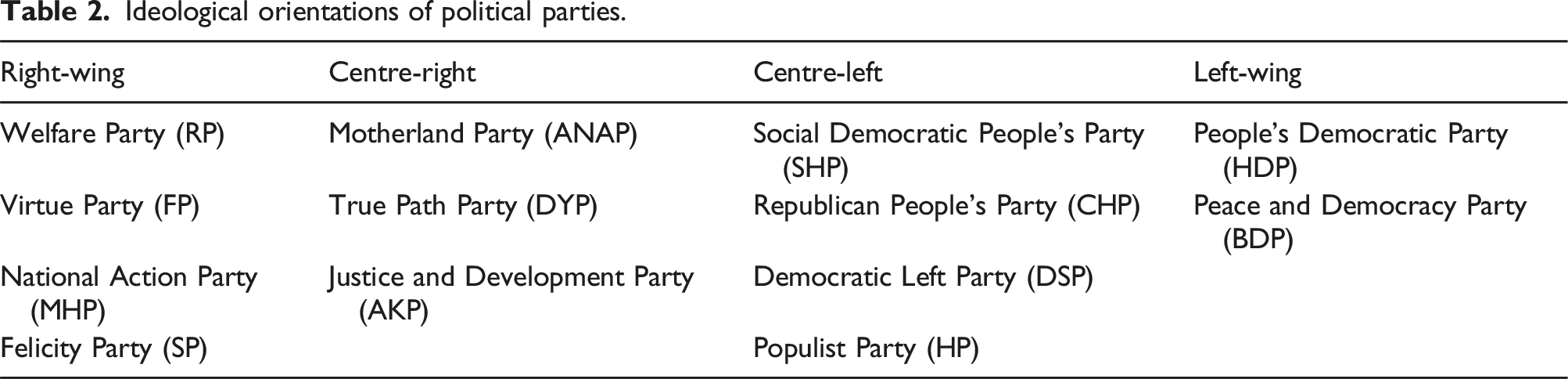
Findings
Summary of findings by research question.
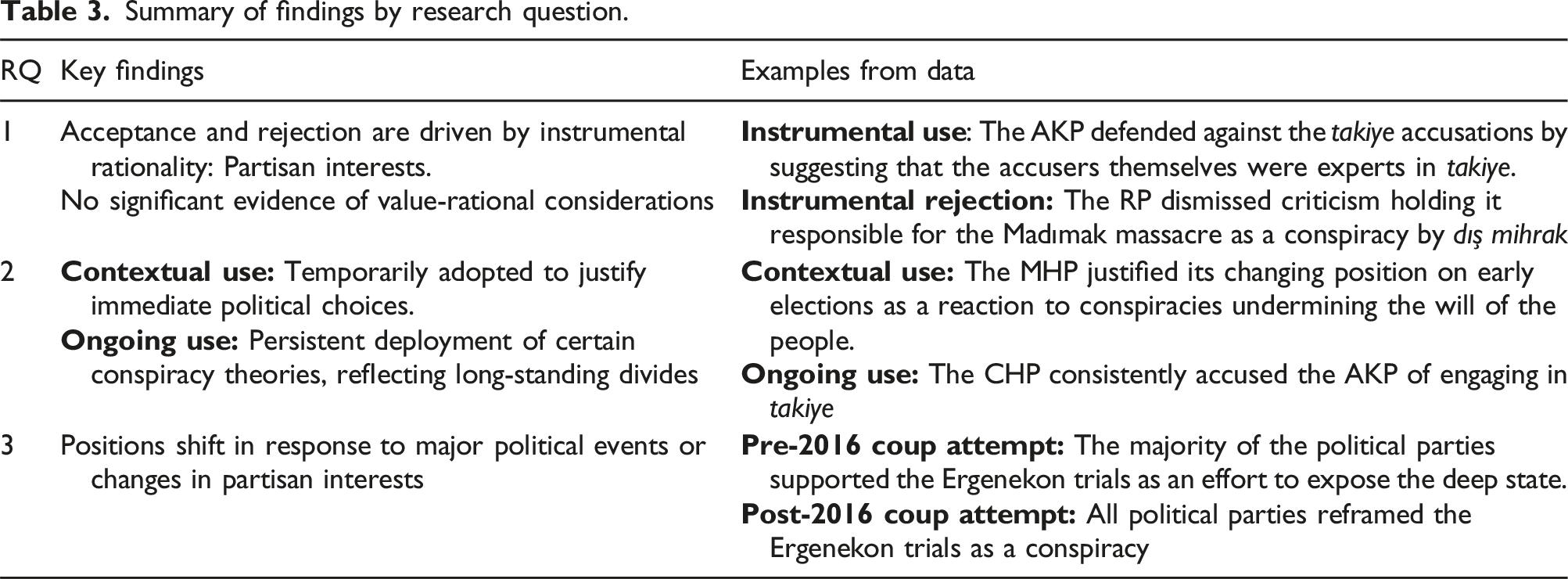
Detailed findings
Rationales behind acceptance and rejection of conspiracy theories.
The acceptance or rejection of conspiracy theories by political parties is predominantly driven by political interests. They adopt or dismiss conspiracy theories strategically in line with their partisan objectives. For example, the term conspiracy is often employed to discredit opposing parties or to unify the party base and others around a common perceived threat. As an example of the latter, Mesut Yilmaz (ANAP) described the Sivas Masaccare in 1993 2 as a part of a grand conspiracy: ‘Honourable members of parliament, it is an undeniable fact that Turkey is facing a multifaceted conspiracy. Now, this conspiracy, supported from abroad, is about to gain a very sad but also very thought-provoking new dimension with the events that occurred in Sivas yesterday’. 3 Yilmaz underlines the significance of the threat and attributes it to foreign conspiracies to unify Turkish political parties on a potentially very polarising issue on the day following the massacre. Regarding the instrumental use of conspiracy theories to discredit opposing political parties, a speech by Berdan Ozturk from the Peoples’ Democratic Party (HDP) described the Turkish government’s replacement of elected HDP mayors in numerous municipalities across Turkey since 2016, citing alleged ties to the Kurdistan Workers’ Party (PKK), as a conspiracy. 4 In parallel, the rejection of conspiracy theories are aligned with partisan interests and discrediting opponents. Tunc Bilget (DYP) condemned a leader of an opposing political party for spreading conspiracy theories: ‘I do not think that spreading conspiracy theories befits a great leader like you, Mr Erbakan. Ask the psychologists; conspiracy theories are produced by those who cannot grasp the realities of life’… 5
The influence of partisanship is also evident in political parties’ uses of conspiracy theories about internal plots. Kemal Anadol (CHP) refers to deep state conspiracy theories both to defend his party and to attack others, stating: ‘Instead of dealing with your imaginary deep state for 6 months… or a year without being able to prepare an indictment, if you had focused on May 1, 1977, you would have found the deep state there. But it does not suit your purposes, what a pity!’ 6 In parallel, the rejection of conspiracy theories about internal enemies employs instrumental reasoning based on partisan interests. Nurettin Canikli (AKP) defended his political party against takiye accusations by counterattacking: ‘We do not know dissimulation techniques (takiye), we have no such past or tradition. But, if some of you are experts in dissimulation, I cannot do anything about that’. 7
The endorsement of external conspiracy theories typically emerges in contexts of heightened nationalist sentiment and perceived security threats. Political parties use these theories to bolster their political stances. For instance, Abdullatif Şener from the right-wing political Islamist Welfare Party (RP) associated foreign threats with attacks on his party by stating, ‘I condemn the efforts of foreign interference (dış mihrak) that seek to hold the Welfare Party responsible for the events (the Madımak Massacre)’. 8 Şener’s invocation of foreign interference to defend his party against criticism for its alleged role in the Madımak Massacre exemplifies the instrumental use. In parallel, the rejection of conspiracy theories about external threats is influenced by partisan interests. Emin Haluk Ayhan of the Nationalist Movement Party (MHP) criticised the AKP government’s economic policies as inadequate, cautioning against using conspiracy theories as a scapegoat: ‘It is impossible to achieve the targets set in the medium-term economic program. The government should not attribute this to a conspiracy by the üst akıl and should fulfill its responsibilities immediately’. 9 Although Ayhan belongs to a nationalist party often inclined to conspiracy theories about foreign actors, he preemptively rejects such ideas when criticising the government’s economic program. This confirms how partisan interests could influence the use of conspiracy theories in the parliament.
Alignment of conspiracy theories with political agendas.
Political parties invoke conspiracy theories in alignment with their agendas in two ways: (a) contextual and (b) ongoing. First, in the contextual approach, conspiracy theories often reflect immediate political interests and are spread in a temporary manner. Nazif Okumuş, an MP from the Nationalist Action Party (MHP), justified its call for an early election by framing it as a defence against conspiracies: ‘Yes, the Nationalist Movement Party had emphasised that the general elections should be held on time. Until when?… Until efforts were made to alter the will of the people as expressed at the ballot box through conspiracies’. 10 After the early elections, neither Okumuş nor his party mentioned these conspiracy accusations again, indicating that they were used contextually to legitimise the MHP’s political choices. This pattern is also manifest in the rejection of conspiracy accusations. Following the murder of journalist Uğur Mumcu 11 , who was renowned for his opposition to political Islam, Şevket Kazan, an MP from the political Islamist Welfare Party (RP), dismissed conspiracy theories implicating his movement with the assasination: ‘… the duty of the state is not to praise democracy and produce conspiracy theories based on dubious assumptions, but to promptly find concrete evidence’. 12 Kazan and his movement did not revisit these theories, even though Mumcu’s murder remains unsolved today, further illustrating the situational use of conspiracy theories to serve immediate political purposes.
Second, Turkish political parties perpetuate certain conspiracy theories, tied to longstanding political debates and divisions. A prime example is the theories surrounding the concept of takiye. Since the 1990s, in Turkish politics, takiye has served as a conspiratorial lens to scrutinise the authenticity and motives of political Islamist actors. It is predominantly wielded by secular and republican MPs to accuse parties aligned with political Islam. Cetin Soysal from the Republican People’s Party (CHP) leverages this conspiracy theory to accuse the AKP government: ‘If you are going to defend the republican regime, defend it to the end; if you are going to support Islamic sects, support them to the end, but do not practice takiye (dissimulation)’. 13 Ismail Aydinli from the Democratic Left Party (DSP) makes analogous accusations: ‘Today, unfortunately, under the roof of the Grand National Assembly of Turkey… some parliamentarians, who exploit religion and engage in takiye, continue to exploit even this bill, which is a symbol of civilisation, democratisation and gender equality’. 14 In response, parliamentarians from parties with political Islamist roots condemned the accusations as defamatory. Huseyin Celik (AKP) protested, ‘…not just today, but for a long time… the distinguished spokespersons of the Republican People’s Party, referring to our party and our government… accuse us of takiye… Now, look, this is a serious indictment’. 15
This dynamic is also observable in discussions about external enemies’ plots. After the failed coup attempt in 2016, the concept of üst akıl became a pivotal tool for the pro-AKP media to justify government policies, discredit opposing viewpoints and assert political legitimacy (Karaosmanoğlu, 2021). In the parliament, AKP members employed this theory more often, while other parliamentarians generally opposed the narrative. For example, Mehmet Erdogan (AKP) attributes numerous grave problems to the üst akıl, stating, ‘The cause of all these martyrs is the same: The üst akıl desires this. The üst akıl also introduced economic terrorism… Therefore, my dear brothers and sisters, we must unite’. 16 In contrast, Adem Geveri from the HDP ridicules the üst akıl theory, suggesting it is merely an excuse for the AKP’s failures: ‘God forbid, if we face a new coup tomorrow, how will the President and the government, who are primarily responsible for these mistakes, answer to the nation? This time, who will you blame? Who will you designate as the üst akıl?’ 17
In summary, political parties in the Turkish parliament pragmatically align conspiracy theories with their immediate and ongoing agendas. They utilise these theories pragmatically to defend their interests, delegitimise their opponents and garner political legitimacy, rather than leveraging them as substantive information to formulate policies or solutions.
Circumstances of changing positions on conspiracy theories.
Turkish political parties altered their positions on the Ergenekon conspiracy theories, particularly after the coup attempt on 15 July 2016. This shift could be attributed to the reevaluation of the Gülen Movement as a terrorist organisation (FETÖ: Fethullah Gülen Terrorist Organisation) because of its leading role in the attempted coup. This is generally accepted by the Turkish political parties. Accordingly, while prior to the coup attempt, the Ergenekon trials were believed in varying degrees by many as a legitimate effort to uncover deep-seated conspiracies by the Turkish state, after the failed coup, the focus shifted to FETÖ’s role in orchestrating these trials, leading to a widespread criticism of the judicial process. Consequently, the political parties in the Turkish parliament re-evaluated their stances on the Ergenekon trials and accompanying conspiracy theories.
Before the attempted coup, members of the left-wing Kurdish movement, along with the AKP, were supportive of the Ergenekon trials in their early years. For instance, Selahattin Demirtaş (DTP) linked the Ergenekon conspiracy to counter-guerilla activities, stating: …when gangs emerged in Şemdinli, the Prime Minister declared, ‘We will pursue this to the end’. Afterwards, the investigation was halted. Consequently, because those responsible could not be held accountable, the Ergenekon gang has now been discovered. We do not know how much accountability will be enforced or how deeply the investigation will go, but until now, the debates in Turkey about counter-guerilla activities, the deep state, non-state organisations, and crime syndicates have unfortunately never transformed into a level of effectiveness, political will, or pressure that would genuinely satisfy public opinion.
18
Before the 2016 coup attempt, only center-left republican parties questioned the Ergenekon conspiracy narrative. For example, Kamer Genç (CHP) claimed that the AKP government used the Ergenekon trial to silence its political opponents. 19 After the coup attempt, references to the Ergenekon conspiracy theories among political parties from the left to the right uniformly rejected these accounts. For example, Ramazan Can (AKP) characterised the Ergenekon trials as one of FETÖ’s crimes: ‘We witnessed the actions of the vile FETÖ terrorist organisation in the events of December 17–25, the Ergenekon trial, the MIT incident, the MIT trucks incident, and the match-fixing case’. 20 In other words, the failed coup attempt caused a significant change in political parties’ treatment of the Ergenekon conspiracy theories in the parliament. Such a drastic change in the approach to conspiracy theories was not observed in the other accounts analysed in this study.
Discussion and conclusions
The findings shed light on the uses of conspiracy theories in Turkish parliamentary debates from 1982 to 2022. It is evident that Turkish political parties, irrespective of their ideological affiliations, strategically embrace or dismiss conspiracy theories to further their partisan goals. These theories are employed primarily as tools to undermine opponents and bolster one’s own political stance, rather than as reliable frameworks for interpreting political events. Political parties’ uses or rejections of these theories align closely with their political agendas and may shift in response to significant changes in the context. In essence, political parties’ tendencies to endorse or dismiss conspiracy theories fluctuate with substantial changes in the context of interests. Thus, the research demonstrates the importance of Weberian instrumental rationality in the use of conspiracy theories by political parties in the Turkish parliament.
While coming to this conclusion, the study searched for political parties’ value-based considerations of conspiracy theories, and there was no significant evidence. First, political party representatives did not engage in value judgements, such as honesty or trustworthiness. There were no discussions on the moral problems of using conspiracy theories either. The harshest critiques of these accounts merely attributed these theories to psychological problems. Second, the differences in the ideological values of political parties did not significantly impact the content of their conspiracy theories. For example, when endorsing a theory, such as the deep state, all parties referred to a similar clandestine organisation manipulating politics through conspiracies. A noteworthy exception was the political Islamists’ references to conspiracy theories about Zionism. In four speeches in our data set, they warned about Zionist plots. Third, Weber (2001) posits that people develop enduring patterns of social behavior based on value-rational justifications. The absence of value-based considerations of conspiracy theories in the Turkish parliament is also confirmed by the shifts in political party positions when circumstances alter. In other words, political parties’ interpretations of conspiracy theories were driven by their interests, which were abandoned whenever stronger conflicting interests arose. Besides, although all political parties dismissed conspiracy theories as weak explanations, they still employed them when it served their interests. If they had held strong values against conspiracy mentality, this would not have been the case.
All in all, this research highlights the strategic uses of conspiracy theories in Turkish parliamentary debates, where political actors mention them, much like moves in a chess game, to outmaneuver opponents and achieve partisan objectives. Far from being fringe beliefs, as some suggest (e.g., Byford, 2011; Pipes, 1997; Robins and Post, 1997), conspiracy theories are integral to mainstream politics in Turkey. The findings align with studies that argue people do not need to believe in the conspiracy theories they propagate (Delouvée, 2015; Saglam, 2021, 2024). Such narratives can be employed as strategic tools, independent of their factual basis. In that regard, the study contributes to the literature on how political partisanship drives beliefs in conspiracy theories (e.g., Albertson and Guiler, 2020; Enders et al., 2020; Miller et al., 2016; Nefes, 2013, 2014; Nefes and Aksoy, 2024; Pasek et al., 2015; Smallpage et al., 2017; Uscinski et al., 2016; Uscinski and Parent, 2014). This resonates with the post-truth era’s dynamics, in which emotional appeals and personal beliefs, often bolstered by conspiracy theories, overshadow objective facts (McIntyre, 2018). It underscores a critical risk: when false beliefs gain traction among policymakers, even the most implausible claims can be rationalised.
This article provides insights into the potential significance of conspiracy theories in the politics of authoritarian and populist regimes by demonstrating how they can be used to promote political agendas, discredit opponents and rally support. In authoritarian and populist contexts, these narratives serve to consolidate power and legitimise contentious policies. Populist leaders frequently leverage conspiracy theories to present themselves as protectors of the people against perceived threats. These strategies capitalise on the emotional and symbolic appeal of conspiracy theories. Additionally, the pragmatic use of such theories risks normalising them, entrenching division and distrust in political systems. Indeed, this study highlights the strategic uses of conspiracy theories in parliamentary speeches and examines their broader consequences, contributing to discussions on authoritarian and populist politics.
The paper also advances the theoretical discussion on conspiracy theories by offering a sociological explanation grounded in Weber’s theory. The perspective provides a systematic framework for analysing the rationales behind the use and dismissal of conspiracy theories. It is particularly valuable in identifying how political actors specifically legitimise their views on conspiracy theories to assess the potential impacts of these accounts. For example, in line with the Weberian theoretical prediction, one could expect that if political parties rely on instrumental rationality, the impact of specific conspiracy theories might not be as substantial as when value rationality is employed. Further, the Weberian theory of rationalisation enables a detailed analysis of the interplay between values and instrumental reasons in beliefs in conspiracy theories. In so doing, the paper’s theoretical approach not only enhances the literature by being applicable beyond the Turkish context but also expands the scope of Weberian sociological theory.
While the study’s focus on parliamentary debates represents a novel and highly significant contextual choice for analysing the causes and impacts of conspiracy theories in a systematic manner, it does not encapsulate the broader public engagement with conspiracy theories, as the general population might perceive them differently. Future research could broaden the scope to include media analysis and public opinion surveys, thereby providing a more comprehensive view. Additionally, subsequent studies could build on these findings by examining parliamentary records from different countries, offering a comparative insight into the interplay between mainstream politics, policy making and conspiracy theories.
Footnotes
Acknowledgements
This research was made possible by a Gulbenkian Foundation research grant. In addition, Ramon y Cajal research grant (RYC2018-023919-I) played an important role in facilitating the realization of this study. I would also like to acknowledge my gratitude to Dr Metin Yüksel for his invaluable help in creating the dataset. Finally, I extend my heartfelt thanks to the anonymous reviewers for their insightful and constructive feedback.
Declaration of conflicting interests
The author(s) declared no potential conflicts of interest with respect to the research, authorship, and/or publication of this article.
Funding
The author(s) disclosed receipt of the following financial support for the research, authorship, and/or publication of this article: Dr Türkay Salim Nefes wishes to express his profound gratitude to the Ramon y Cajal research grant (RYC2018-023919-I) for its instrumental role in facilitating the realisation of this study.
