




Abstract
This article investigates the influence of electoral manifestos on the online communication of electoral candidates. Our study addresses electoral candidates’ conflict between party discipline and individual issue prioritisation. Building on the salience framework, we examine the thematic congruence between manifestos and online communication. Moreover, we test which issues are emphasised during the 2017 German federal election campaign. To this end, we created an original topic dictionary based on party manifestos. Applying the dictionary, we classify 143,969 tweets by 797 candidates. Our analyses demonstrate that manifestos shape the online communication of electoral candidates substantially. The findings show that electoral candidates of left–wing parties focus on core issues over time. Our results not only highlight the authority of party leadership, but also suggest that politicians do not tap the whole potential of online communication.
Introduction
‘(I) recommend our manifesto for a fact check,’ replied Michael Kellner (2017), the secretary general of The Greens, to the statement by Andreas Scheuer, secretary general of the Christian Social Union, that The Greens advocate open national borders without taking measures to control the entry of immigrants. The dispute took place via Twitter during the run–up to the 2017 German federal election. It is exemplary of the linking of traditional and modern political communication.
Our study addresses the link between traditional political communication through manifestos and modern online communication by asking to what extent online communication reflects a party’s issue agenda as outlined in its election manifesto. This question is supplemented by two subquestions: How does online communication evolve during an election campaign? What individual factors influence online communication? By combining manifestos and online communication, we address ‘the dynamics of political conflict’ (Schwarzbözl et al., 2020: 797). In other words, we examine whether the online communication of electoral candidates reflects policy issues of their party’s manifesto or whether politicians use online communication to set a divergent thematic emphasis.
Our research question is motivated by the conflicting relationship between party discipline and individual issue prioritisation. Party headquarters aim to present a unified image to the public. Coherent appearance plays a significant role, especially in election campaigns. It is well established that the public is aware of whether parties are cohesive and do present themselves with a consistent profile. Consequently, high party discipline increases reputation and votes (Greene and Haber, 2015). Loyal politicians are prioritised by the party organisation, which allocates political offices and grants access to essential resources. Deviations from the party line contradict the party leadership’s objective to present a coherent party. As a result, deviations can have negative career implications. Scholarship has focussed on deviations from policy stances expressed in roll call votes (Sieberer and Ohmura, 2021). Parliamentary activities such as votes and speeches are predetermined by the parliamentary context and are only accessible to parliamentarians. By analysing issue prioritisation in political communication, our paper broadens the prevailing perspective. We follow recent work that investigates issue emphasis online (Ceron et al., 2022; Franzmann et al., 2020). This has two advantages: First, a larger number of politicians engage in online communication, namely all candidates for political office. Second, online communication offers greater personal leeway to step out of the party line than positioning. Deviating individual priorities are more likely to be tolerated by the party leadership.
Building on the salience framework, we refer to the press–release assumption (De Sio et al., 2018) and test whether electoral candidates’ online communication reflects their party’s issue agenda. In addition, we examine the temporal development of coverage of core issues in a campaign. We also investigate the individual factors of thematic expertise and electoral security, which are assumed to influence the communication behaviour of electoral candidates.
Online communication via Twitter provides a valuable case to examine congruence of electoral candidates’ individual agenda and their parties’ manifesto. First, the online setting limits control by the party leadership (Bauer et al., 2023; Ceron, 2017). Online communication therefore offers politicians more autonomy than parliamentary activities. Second, Twitter enables direct communication with the electorate by sidestepping established media channels that traditionally act as gatekeepers of information (Engesser et al., 2017). At the same time, online communication presents an opportunity to increase coverage by traditional media outlets because media actors use social media, such as Twitter, as an important source of information. Hence, Twitter’s rewarding opportunity structure allows politicians to circumvent constraints such as party control and accessibility and engage in more individualised communication.
Our analysis covers the last 12 weeks of the 2017 Bundestag election campaign. Overall, we analyse 143,969 tweets by 797 politicians. To assess the correspondence between manifestos and online communication, we created an original topic dictionary. The keywords for each policy category were extracted from the most frequently mentioned words in the manifestos. We then used our innovative manifesto–based dictionary to classify the tweets into 17 policy areas. Using fractional logistic regression models, we demonstrate that manifestos influence online communication substantially. In line with theory, towards the end of the campaign, candidates of left-wing parties put more emphasis on the core issues of their party's manifesto. Our analyses show that electoral security does not affect which topics an electoral candidate addresses. Thematic expertise is less influential on candidates’ communication than the manifesto. Overall, our results show that manifestos influence online communication substantially. The findings illustrate that parties ensure that the public perceives their issue agenda as consistent. Our results suggest that by merely reproducing the issue priorities of their party’s electoral manifesto, electoral candidates do not fully exploit the potential of online communication.
Our paper contributes to the understanding of politicians’ online communication. Knowledge about the content of online communication is scarce (Posegga and Jungherr, 2019; Stier et al., 2018b), and the individual issue agendas often remain unexplored (Peeters et al., 2021). Moreover, the impact of manifestos on online communication has received little scholarly attention. Studies tend to focus on congruence between online communication and the media agenda (Gilardi et al., 2022). However, online communication has gained social relevance due to its greater public attention and increasing use as political battleground. Our findings improve the understanding of the conflict between party discipline and individual issue prioritisation.
Theoretical framework
Traditionally, electoral manifestos are the central campaign documents. They are an attempt by the parties to inform the public about their programmatic intentions. In addition to this external function, party programmes fulfil an internal function (Kercher and Brettschneider, 2013) because they serve as essential point of reference for party members. Providing an overview of a wide range of policy areas, the official party line helps to run a campaign (Eder et al., 2017). It can therefore be assumed that manifestos also have an impact on the policy issues politicians address online.
Our investigation builds on the salience framework, according to which parties tend to emphasise specific policy areas. Scholars have found a large thematic overlap between politicians’ online communication and the individual parliamentary agendas (Castanho Silva and Proksch, 2022; Peeters et al., 2021). Online prioritisation is related positively to the importance politicians attach to issues in the overall political discourse.
According to the press–release assumption, parties use social media, similarly to press releases, to publish a comprehensive range of issues and take a generalist approach. De Sio et al. (2018: 1218) assume that parties use online communication ‘to communicate their desired messages to the media, just like in a press release.’ This assumption has been validated across Western Europe (Gilardi et al., 2022). For smaller parties in particular, it might be important to address the full range of policy issues, as the media covers these actors and their viewpoints less often (Kratzke, 2017).
The ‘riding–the–wave’ approach (Ansolabehere and Iyengar, 1994), on the other hand, argues that parties focus on selected issues and those that currently concern the electorate. Addressing issues high on the public agenda creates the impression that parties are responsive to societal concerns. As opposed to manifestos drafted in advance of a campaign, online communication allows parties to react promptly to current affairs and comment on topical issues.
Two arguments support the assumption that both issue agendas differ from each other. First, the selective online audience. The online audience and the general population are inherently different, varying considerably in age, education and political interest (Jungherr et al., 2016). A deviation from topics of the manifesto in online communication could do justice to the online audience. Second, the comprehensibility of policy issues. Complex issues are more difficult to convey; for example, Twitter limits the number of characters. Scholars assume that online communication is more strategic and selective than manifestos, which cover issues extensively (Van Ditmars et al., 2020). An Austrian study points out that smaller parties have a more selective focus online (Plescia et al., 2020).
The salience theory provides the underlying context for our investigation of the online communication of electoral candidates. In accordance with the press–release assumption, we presume that manifestos have a substantial influence on the individual online communication. Our central question is to what extent the issue agenda of electoral manifestos affects the prioritisation of issues addressed online. The basic hypothesis in line with the press–release assumption is that manifestos provide a guideline for online communication.
The concept of issue yield describes the salience political actors attach to issues. The basic premise of issue yield is the importance of internal unity for party communication (De Sio and Weber, 2014). The concept of issue yield assumes that parties emphasise issues on which the position is widely shared within the party and is consistent with the electorate. Testing issue yield for the 2017 German federal election, Franzmann and colleagues (2020) show that higher party congruence leads to more importance being attached to a topic on Twitter. When the preferences of members are heterogeneous within parties, downplaying the issue is a rational strategy (Steiner and Mader, 2019). With regard to the manifesto, it is safe to assume that the publicly communicated prioritisation of issues is widely shared within the party. Therefore, the manifesto’s prioritisation should be reflected in the online communication of electoral candidates.
The higher the salience of an issue in the manifesto, the higher its salience in the online communication of electoral candidates.
Hypothesis 1 implies that political actors address policy areas in accordance with the manifesto. Candidates do pursue central issues that are of particular importance to party members and supporters. Members share essential values and preferences. Candidacy often has to do with personal interest in the central issues. Engagement in a party resembles a socialisation process, as it involves becoming acquainted with the party’s focus. Moreover, parties tend to nominate candidates in accordance with their main priorities. We refer to these policy areas as core issues. The term core issue differs from the concept of issue ownership, as issue ownership refers to attributions by citizens. 1 By emphasising core issues, parties demonstrate that these issues are important to them and accentuate their sincerity.
Lesschaeve et al. (2018) illustrate that thematic congruence between candidates and party leadership is highest on central issues. German parties prioritise their core issues in online communication (Dusch et al., 2015). At the individual level, ownership positively affects the content of online messages by Belgian parliamentarians (Peeters et al., 2021). Despite providing an opportunity to create an individual profile, research has shown that most politicians employ Twitter to reinforce their party’s stance (Castanho Silva and Proksch, 2022; Gilardi et al., 2022).
In the context of an election campaign, temporal issue dynamics are particularly relevant. We address the question whether parties’ prioritisation is consistent or whether parties shift their thematic focus in the final weeks before the election. At the beginning, parties aim to set the essential campaign agenda (Kriesi et al., 2009) and signal various areas of expertise. In the final weeks, the main objective is to stress their core issues. By highlighting these, parties aim to motivate supporters and persuade undecided voters. For example, the German Social Democrats focussed more on social issues the closer Election Day (Baumann et al., 2021), and on Twitter, parties have changed the focus of their online communication during the 2017 Bundestag election via official party accounts (Ceron et al., 2022). We expect that similar temporal dynamics of addressed issues are present across all Twitter accounts of candidates.
The nearer Election Day, the more the online communication of electoral candidates focusses on the party’s core issues.
Turning to the individual level, a central factor is the candidate’s role perception as representative. Delegates and trustees embody opposing ideal types of representational roles (Converse and Pierce, 1986). Delegates act on instructions of their principal, the principal being the constituency or the party. Party delegates or partisans adhere to the party line and enforce the decisions taken. Trustees, their counterparts, make autonomous considerations and may arrive at dissenting judgements. As factors related to the representational role, we discuss the candidates’ electoral security and thematic expertise.
Electoral security is a ‘key variable’ (Giannetti and Pinto, 2020: 160) to account for ideological heterogeneity between candidates and parties. Electoral security denotes how certain a candidate can be of winning a parliamentary seat. Security transcends the distinction between district and list candidates, which is crucial in the German context. It is essential to be more precise and consider potential effects of electoral security. We refer to two contrasting arguments about its influence on communication behaviour.
Politicians with better chances of entering parliament might be less dependent on their party. Hence, they are less willing to follow the party line on thematic priorities. Candidates with high chances of entering parliament are more likely to conduct an individualised campaign (Makropoulos et al., 2020). Higher electoral security therefore might lead to a more personalised campaign that deviates from the party agenda.
By contrast, priorities of politicians with high prospects of success might be congruent with the party programme. These candidates are potentially involved in the drafting of the manifesto. Increasing electoral security of individual politicians leads to more agreement with the average left–right positioning of their fellow candidates (Giannetti and Pinto, 2020) or more agreement with the party leadership (Lesschaeve et al., 2018). Considering the mixed evidence regarding electoral security, we conduct an explorative analysis to investigate the influence of electoral security on the individual agreement of candidates with the thematic priorities of the manifestos.
Politicians pursue a division of labour and specialise in certain issue areas. Commenting frequently on the same issues demonstrates thematic expertise and increases their credibility and visibility. By focussing on a few issue areas, candidates differentiate themselves from competing candidates. For example, Belgian legislators specialise on individual issues in their online communication (Peeters et al., 2021). We assume that candidates use online communication to address issues related to their thematic expertise particularly frequently. Consequently, manifestos should have less influence on online communication in the policy areas of individual expertise.
Data and methods
Case
We use Germany as a case to investigate the congruence between the issue agenda outlined in the manifesto and online communication during the election campaign 2017. Based on a powerful legislature, the German political system assigns an important role to parties. Consequently, politicians regard the manifesto issued by their party headquarter as essential campaign material. For the 2017 election studied here, 90% of candidates stated that they placed a strong emphasis on the manifesto in the campaign (own calculation based on the candidate study by Weßels et al., 2017). 44% of the candidates had a Twitter account. More than two thirds of the politicians with an account perceived Twitter as an important communication medium. By contrast, only 3% of the German population used Twitter in 2017 on a weekly basis (Frees and Koch, 2019). Overall, the 2017 election is characterised by a considerable ratio of politicians that owned an account and the use of Twitter as viable campaign tool.
Creating our dictionary
Our topic dictionary is based on election manifestos. Existing dictionaries mostly rely on survey responses or expert evaluations. Using manifestos as the source for the dictionary ideally fits our research endeavour. Our dictionary consists of separate subdictionaries for each of the six German parties that gained parliamentary representation. Within each of the subdictionaries, the keywords are mutually exclusive.
The manifestos of these six parties form the core of our dictionary. Based on the renowned coding scheme of the Manifesto Research on Political Representation (MARPOR) project by Volkens et al. (2019), we restructured all 77 MARPOR subcategories into 17 policy areas (see Table A.1 in the supplemental material). The number of categories coincides with other dictionaries that describe the political debate with about 20 issues (Stier et al., 2018a). Our 17 policy areas correspond to the remits of the German federal ministries. We carefully selected the keywords from the 100 most frequent words of each party in every policy area. 2 The policy categories include all identified words from each parties’ manifesto. Recognising keywords as mutually exclusive within the party dictionaries ensures that the keywords are coherent and meaningful. Our approach allows to draw a clear distinction between the policy categories and increases the informative value of the issue areas. Overall, our party dictionaries comprise around 900 keywords for each party.
Tweets
We examine the Twitter messages of the candidate accounts of the six major parties. We combined datasets by Stier et al. (2018a) and Kratzke (2017). As the former data is not publicly accessible, we conducted a recollection, resulting in a dataset with 783 Twitter accounts of candidates. 3 Adding accounts that were not part of our created dataset but covered by Kratzke (2017), we base our analysis on 797 candidate accounts. From these accounts, 143,969 messages were published between 12 weeks prior and 5 days after Election Day.
Goodness of the dictionary
Overview of our Twitter dataset including accounts, tweets and classification rates.
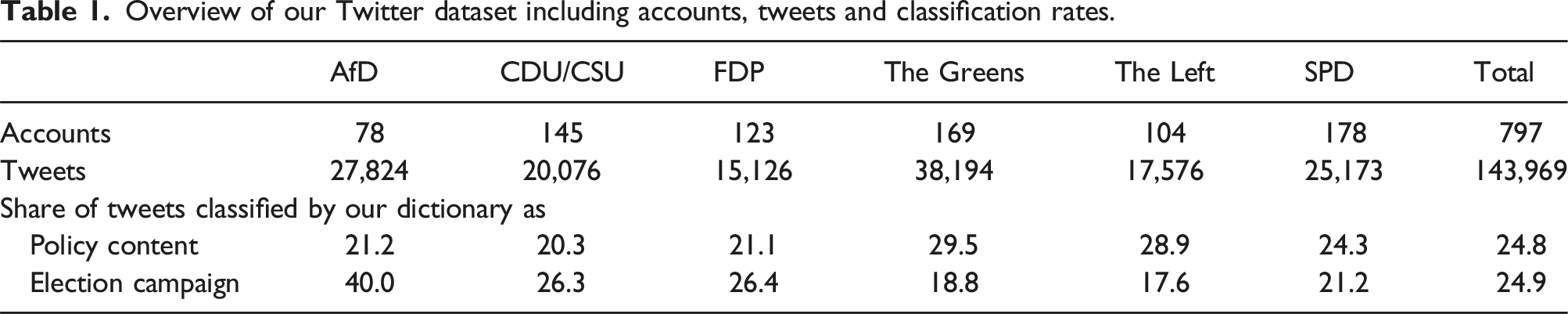
Overall, our dictionary classifies every second tweet. 24.8% of all tweets contain policy content. This is in line with findings about the Twitter usage by German politicians. Giger et al. (2021) report 23.9% policy–related tweets. Our classification rate is approximately evenly distributed between references to policies and references to the election campaign. The category election campaign captures messages that exclusively relate to the political competition between parties and leading candidates. Non–classifiable tweets contain, for example, information about the constituency or private content. The consistency of the descriptive results with other studies proves that our topic dictionary is well suited for our research endeavour. Moreover, the low variation in classification rates of policy content between the parties corroborates the successful construction of the dictionary: our manifesto–based dictionary is applicable to all parties instead of reflecting only the issue priorities of a particular party.
As an additional evaluation, we reviewed the 200 most mentioned words in the tweets that are not included as keywords in the topic dictionary. These not included words do not correspond to the 17 policy categories of the dictionary. Moreover, they do not indicate additional policy categories that are specific to the online discourse. We consider this a confirmation for the appropriateness of our topic dictionary.
Variables
Given our multiple research questions, we use different dependent variables. We focus on the share of tweets addressing each policy area to test Hypothesis 1. The share is calculated for individual politicians. This results in 13,549 cases (797 candidates × 17 policy areas). The central explanatory variable is the party’s share of an addressed policy area in the manifesto.
To test Hypothesis 2, we calculate the probability that a tweet addresses a core issue. Core issues are the three issues that are mentioned most often in the manifesto. 5 The central explanatory variables are time (measured in 2–week intervals) and party affiliation. Focussing on core issues is reasonable because we are interested in a general trend of attention rather than in all 17 policy areas. Most policy areas are rarely addressed in a 2–week interval.
For the explorative investigation of electoral candidates’ individual deviation from the party line, we use the share of tweets addressing each policy area that has also been used to test Hypothesis 1 and a variant of the variable that captures tweets addressing the core issues. The variation of the dependent variable is necessary because the predictors vary either by issue and candidate (thematic expertise) or by candidate only (electoral security). Thematic expertise is measured by committee affiliation in the legislative period 2017–2021. Committee affiliations reflect the topical background of parliamentarians. We collected the information from the Bundestag (2022) webpage. Our measurement ensures data on expertise of candidates of all parties; however, it only includes elected members of parliament. 6 Electoral security calculates the individual probability of candidates to win a mandate. The formula was developed by Stoffel and Sieberer (2018) for the German context. 7 A characteristic feature of the German electoral system is the combination of district candidates (majoritarian tier) and list candidates (proportional tier). Taking a conservative approach, we use the higher of the two probabilities of winning a mandate when a candidate runs in both tiers (see Martínez-Cantó et al., 2023).
Regression models
We use fractional logistic regression models (Papke and Wooldridge, 1996) to estimate the effect of the share of topics addressed in the manifestos on the share of topics addressed in online communication. This type of regression is considered ‘best practice’ (Villadsen and Wulff, 2021: 313) for dependent variables that are expressed as share bounded between zero and one. Fractional logistic regressions are more precise than models without an integrated boundary. As a robustness check, we rerun the models as linear regressions. This yields the same substantial results. 8 Fractional logistic regression models are employed to test Hypothesis 1 and for the explorative analysis of electoral security and expertise.
We use logistic regression to analyse the probability that a tweet addresses a core issue over time. Our analyses use a dichotomous categorisation of whether content–related messages address a core issue (1) or another policy area (0). To test Hypothesis 2, the models examining temporal dynamics focus on tweets up to Election Day.
Regression models that analyse the probability that a tweet addresses a core issue over time or models in which electoral security is included employ control variables at the individual level. We include candidates’ age, gender and partisanship as control variables. Other models analyse the share of tweets as dependent variable, which sums up to one for each candidate. Therefore, variables at the candidate level do not have any predictive power.
Results
Our investigation starts with a descriptive comparison of issue concentration.
9
Due to its internal and external function, a manifesto addresses a broad range of issues and therefore has a low issue concentration. Our theoretical reasoning is that online communication also covers many different topics. Figure 1 illustrates that this is the case. The online communication of candidates aggregated by their respective parties likewise addresses a broad issue agenda. Issue concentration in manifestos and in online communication, aggregated per party. Issue concentration is measured by the Herfindahl–Hirschman index (Rhoades, 1993). The index ranges between close to 0 and 1. Lower values indicate that the policy categories are addressed equally; higher values indicate a strong issue concentration.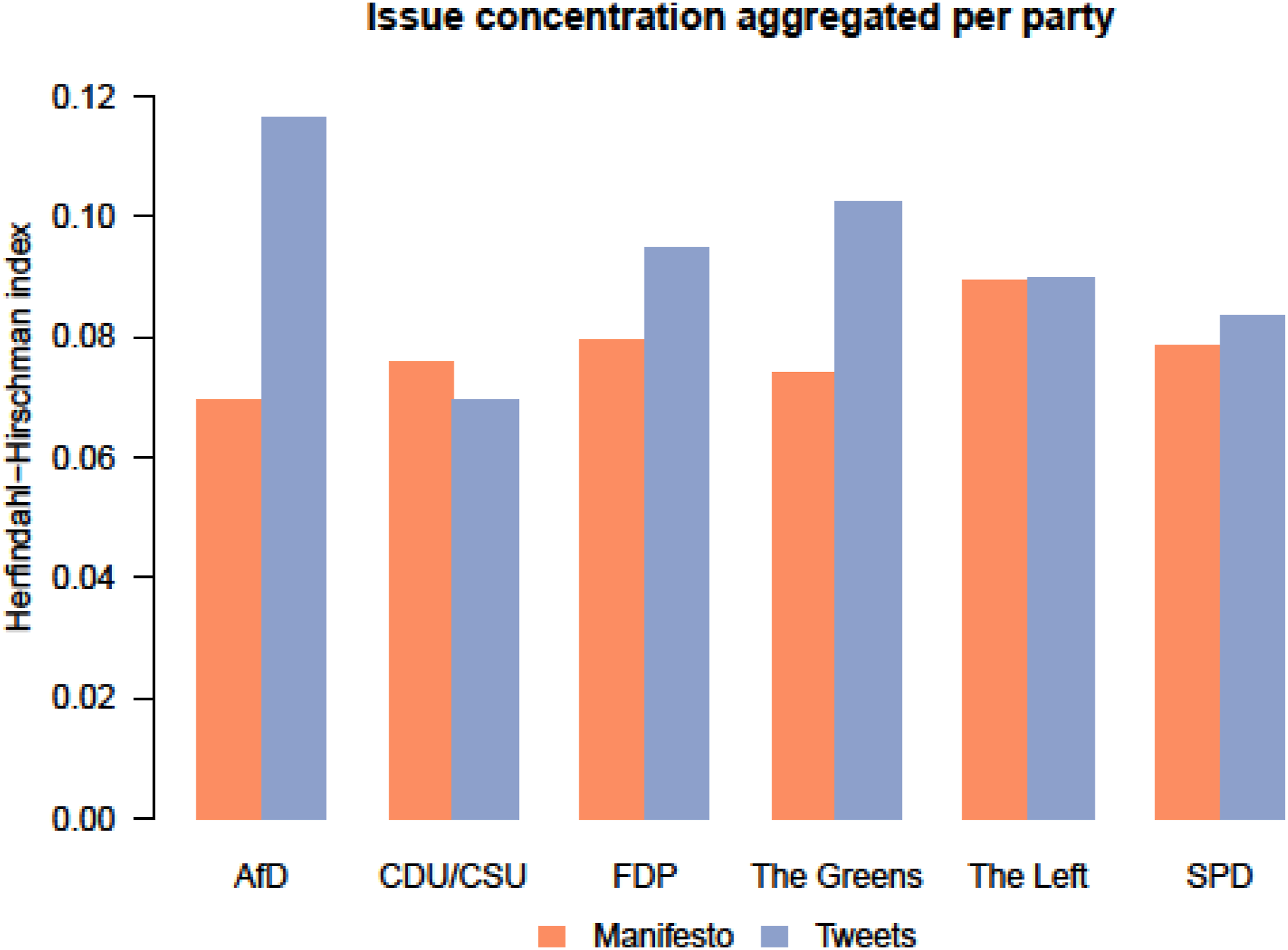
To test Hypothesis 1 that manifestos influence online communication, we estimate fractional logistic regressions. Figure 2(a) shows that policy areas emphasised in the manifestos are more often addressed in tweets by candidates. An issue with a coverage of 2% in the manifesto is addressed in 2.3% of the thematic online communication on average. A coverage of 7% in the manifesto leads to an average online frequency of 3.9%. Hence, the result corroborates Hypothesis 1. Marginal effects of emphasis in the manifestos on individual online communication. Both figures show marginal effects based on the fractional regression model presented in Table A.7. (a) The left figure, which is based on Model 2, shows the effect of emphasis in the manifestos on individual online communication across all policy areas. (b) The right figure, which is based on Model 3 and 4, includes a categorisation by core issues. This results in a cut–off point between other issues and core issues at 10% manifesto coverage.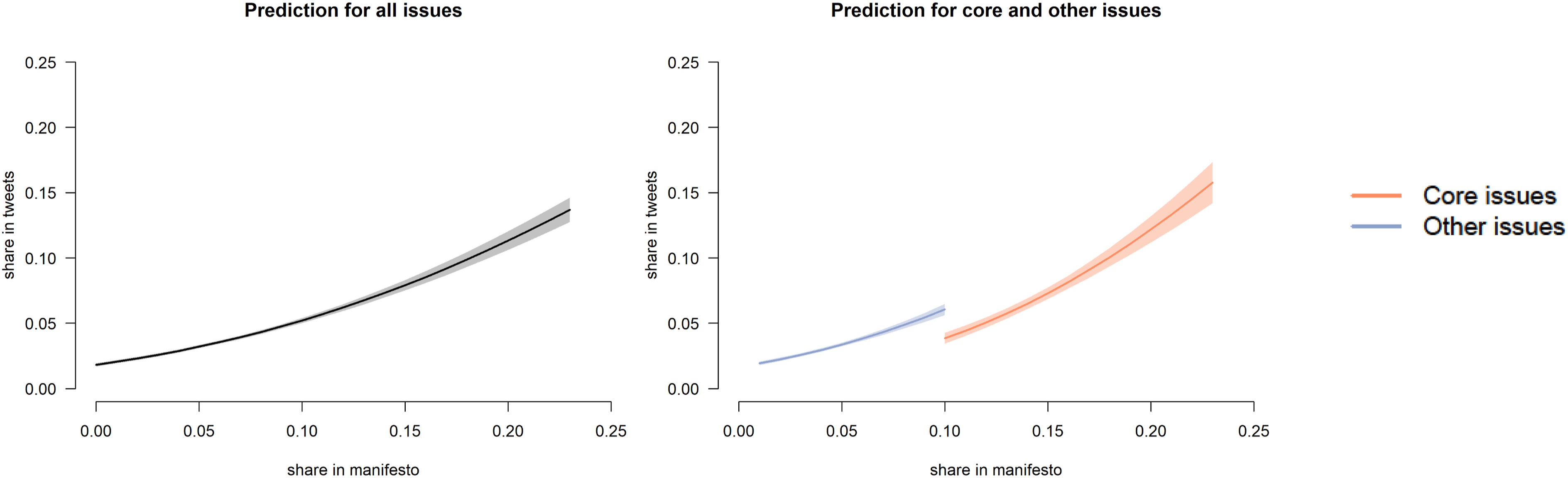
Hypothesis 2 addresses the question of how the prominence of core issues develops during the campaign. We divide the campaign into 2–week intervals and compare the temporal dynamics based on tweets by candidates aggregated by parties. Figure 3 illustrates the predicted probability that a tweet addresses a core issue over time. For candidates of The Greens, The Left and the SPD, we observe a substantial and significant increase in the probability that they address a core issue. The Greens devote considerable attention to their core issues throughout the campaign with about every second tweet being devoted to the core issues. The Left and the SPD focus more strongly on their core issues at the end of the campaign. The share of core issues also increases for candidates of the CDU/CSU, but the overall level of attention remains comparatively low. The thematic choice of the FDP is consistent, with the proportion of core issues remaining at 33%. It is notable that the AfD deemphasises its core issues in the final phase of the campaign. The share of the AfD’s core issues decreases significantly from 42% to 30% of their thematic tweets. Hypothesis 2 is confirmed for candidates of the three left–wing parties (SPD, The Greens, The Left) and the centre–right party CDU/CSU. The communication pattern of the extreme right AfD, however, is not in line with Hypothesis 2. Temporal development of tweets on core issues over time. The figure displays the predicted probability that a tweet addresses a core issue. The campaign is divided into six periods of 2 weeks. The logistic regression is based on candidates aggregated by parties. Regression table is presented in Table A.8 (Model 2).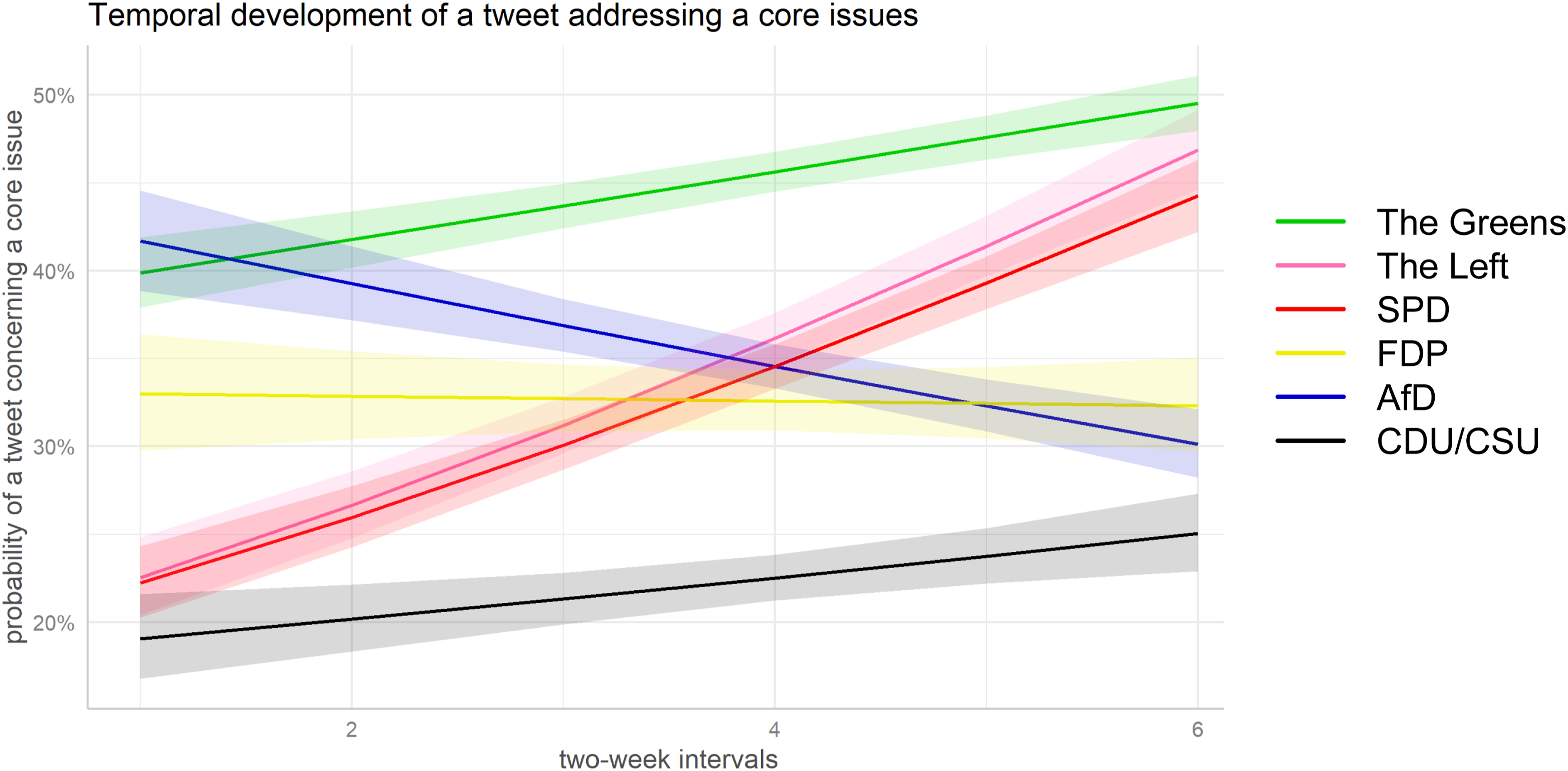
Figure 4(a) and (b) illustrate the influence of the candidates’ thematic expertise and electoral security on their online communication. Figure 4(a) shows the effect of manifestos on online coverage of an issue dependent on individual expertise. As expected, politicians tend to emphasise an issue in their online communication more when they have expertise on the respective issue. The effect of expertise is, however, insignificant for issues that are addressed in the manifestos with a frequency of 12%. This corresponds approximately to core issues. Hence, candidates address core issues irrespective of their expert status. Figure 4(b) shows the influence of electoral security on the prevalence of core issues. The almost horizontal line indicates that electoral security has no significant influence on the individual thematic focus of candidates. They dedicate on average every third tweet to core issues, irrespective of the extent of electoral security. With an average electoral security of 42.4%, a candidate devotes a predicted share of 36.4% of thematic tweets to core issues. (a) Marginal effects of issue concentration in the manifesto on individual online communication by expertise. Regression table is presented in Table A.9. (b) Marginal effects of electoral security on the share of tweets that address a core issue. Regression table is presented in Table A.10.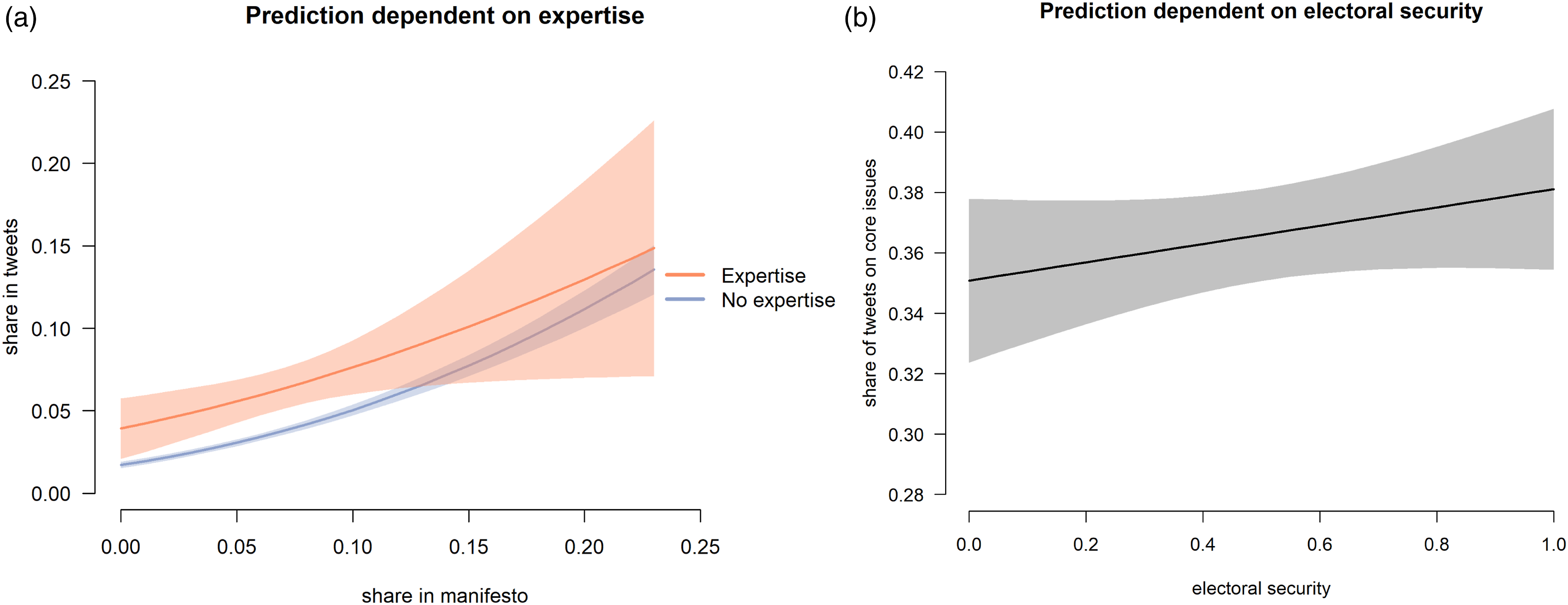
Discussion
Our analysis demonstrates that manifestos shape the online communication of German electoral candidates substantially. The press–release assumption that online communication reflects campaign issues contrasts with the ‘riding–the–wave’ approach, which assumes that thematic priorities vary.
With Hypothesis 1 we examine the influence of issue prioritisation in manifestos on issue prioritisation in online communication. We find a positive effect, as expected: the more an issue is emphasised in a manifesto, the more often it is addressed in candidate’s tweets. The evidence corroborates the press–release assumption. We replicate the analysis additionally with a division into core issues and other issues (Figure 2(b)). Parties dedicate between 0 and 10% of the manifesto to other issues and 10–25% to core issues. The distribution allows us to compare marginal effects around the cut–off point of 10% coverage in the manifesto. Other issues at the cut–off point are covered significantly more often than core issues (6.2% vs 4.0%). Therefore, we cannot conclude that politicians place a particular focus on their parties’ core issues. Our result is consistent with the findings from other studies on online communication (Ceron et al., 2022).
With Hypothesis 2 we investigate how the focus on core issues changes over the course of the campaign. In line with the hypothesis, candidates of the three left–wing parties (SPD, The Greens, The Left) and candidates of the centre–right CDU/CSU put more emphasis on core issues at the close of the campaign. The result is likewise consistent with the press–release assumption. The finding is remarkable, as the total number of messages increases as Election Day approaches. Therefore, a larger share implies a disproportionate increase in messages dedicated to core issues. FDP candidates display a horizontal trend as they do not change the focus on core issues over time. Candidates of the extreme right AfD show a temporal tendency that runs counter to Hypothesis 2.
The AfD’s deviation might be related to our operationalisation of core issues. Because we consider three core issues per party, there are instances where there is no clear distinction between coverage of core issues and other less frequently covered issues. The manifesto of the AfD shows an unexpected pattern of prioritisation. While the party received considerable attention for its vigorous criticism of migration issues, ‘immigration’ and ‘multiculturalism’ are not among the parties’ three core issues. However, the identified core issues ‘interior’, ‘justice’ and ‘economics’ are also consistent with the party’s thematic profile (see comparison in Table A.6). Combined into a single category, ‘immigration’ and ‘multiculturalism’ would be classified as core issue. A closer look at the AfD’s priorities in online communication over time reveals that both migration–related topics dominate candidates’ online communication starting from the third campaign week onwards.
An alternative explanation is that the finding for Hypothesis 2 is based on general trends within the campaign aside from the parties’ core issues. The existence of a general trend is plausible, as the core issues ‘labour and social affairs’, ‘equality’, and ‘finance’ overlap between the parties. However, considering the thematic dynamics of the 2017 election, this assumption is not robust. We use two approaches to monitor general trends of the public opinion. Firstly, we are using survey data capturing the most important problem (Forschungsgruppe Wahlen, 2023). Migration is the dominating campaign issue, with about half of the respondents identifying it as the most important problem. Policy issues such as pensions (core issue ‘labour & social affairs’) and the social divide (core issue ‘equality’ or ‘finance’) are clearly less relevant. Both categories only slightly increase in importance during the campaign. Secondly, we check whether core issues are generally discussed more frequently on Twitter. We use a randomised sample of 500,000 tweets posted by public accounts during the 2017 Bundestag campaign. The descriptive overview does not indicate a thematic concentration of public accounts over time as shown for the political communication. While Hypothesis 2 is difficult to test in a single election, the discussion of alternative explanations gives us confidence that the increased emphasis on core issues is due to the general focus of parties.
We exploratively examine candidate characteristics related to role perception, which are assumed to influence individual online communication. As the results highlight, electoral security and thematic expertise have little to no effect on the selection of issues in online communication. It should be kept in mind that the analysis of thematic expertise is based on parliamentarians only. Post–election committee affiliation depicts thematic expertise in order to include politicians from AfD and FDP, which were not represented in parliament at the time of the campaign. The recourse to prior committee affiliation is therefore inaccurate. Including two parties outside the Bundestag might cause a bias in the calculation of electoral security. However, Martínez-Cantó et al. (2023) examine the agenda of interpellations in Germany over a longer period and also find no influence of electoral security.
We conclude this section by addressing the internal and external validity of the results discussed. Internal validity is constrained by technical aspects, i.e., deleted tweets become inaccessible. As we retrieved the tweets for our analysis 3 years after they were published, we do not know how many original tweets we are unable to collect. To assess the extent of inaccessible messages, we take advantage of the fact that Stier et al. (2018a) and Kratzke (2017) collected data on candidate accounts and posted messages. This allows us to calculate how many tweets contained in Kratzke (2017) we are able to retrieve for our data basis. For the subset of candidate accounts included in both datasets, 89.70% of the original tweets are recollected. With a missing rate of 10.30%, this indicator displays a satisfactory result that increases the confidence in our data. Furthermore, Bauer et al. (2023) point out that social media accounts are used by both candidates and staff members. It is therefore not possible to clearly attribute the posted content to the candidates. While measurement errors cannot be ruled out, we have reason to believe that potential errors apply equally to all policy categories.
Contextual aspects play a central role in external validity. Our findings are based on a single campaign in one country, which makes generalisation difficult. A premise of our contribution is the higher importance of the party compared to the candidate and the high relevance of the manifesto in the German context. Both aspects vary by country. In addition, platform–specific effects of social media communication have to be considered when our findings are to be transferred across platforms. However, Haßler et al.’s (2023) analysis of political Instagram accounts during the 2017 Bundestag election is consistent with our results.
Conclusion
Our paper explores the influence of issue prioritisation in manifestos on the online communication of electoral candidates. We started by discussing the importance of manifestos and online communication for politicians. Online communication, e.g., via Twitter, allows for bypassing media outlets as traditional gatekeepers of information. The opportunity for individual candidates to use online communication to address diverse issues is a mixed blessing for the party itself. Different constituencies can be reached and mobilised, but the impression of lacking party unity might also arise. It is therefore worthwhile to explore the online communication of electoral candidates by examining the relevance of the manifesto.
Our analyses highlight that modern political communication in the form of social media such as Twitter significantly reflects the policy issues outlined in the manifesto as the traditional form of political communication. This corroborates the press–release assumption. Salience in the manifesto translates into higher salience of issues in the online communication of electoral candidates. Electoral candidates of left–wing parties focus on core issues during the campaign. The analyses of the influence of electoral security and thematic expertise illustrate that the individual role perception of candidates plays only a minor role in online communication.
Our results are both good and bad news for the party headquarters. On the positive side, our study proves that manifestos have a cohesion effect. Despite the many opportunities to set individual priorities in their online communication, German candidates address the issue priorities outlined in the manifesto. This is also negative news, however. If parties and candidates use Twitter merely as another channel of political outreach, they ignore its potential. Twitter provides the potential for candidates to address topics outside the political discourse that attract attention from the media and the public. The analysis of the 200 words that are most mentioned online and that are not included in our dictionary indicates that this potential is not systematically utilised. Haßler et al. (2023) arrive at a similar conclusion. By emphasising the traditional policy areas, politicians miss the chance to reach a younger audience, among others. However, it is precisely this target group that is hard to reach through traditional communication channels.
Our investigation of the 2017 Bundestag campaign follows the call for systematic studies of political online communication. Our comprehensive dataset of electoral candidates enables us to draw conclusions about the importance of manifestos for politicians’ issue prioritisation in online communication in the German context. In a next step, further countries and periods should be investigated, preferably exploring changes in individual online communication over time. Additionally, analyses should go beyond campaigns, in which candidates are particularly active and find an attentive audience. A central question that further research should address is which audience is reached through political online communication and how the electorate perceives online messages. As politicians are making greater use of online communication, there is sufficient data available to answer related and further questions about the policy content. We conclude our analysis with an adapted proverb: the opportunity to send online messages every day, does not keep the manifesto away.
Supplemental Material
Supplemental Material - Do electoral candidates reflect or select campaign issues? The influence of electoral manifestos on online communication
Supplemental Material for Do electoral candidates reflect or select campaign issues? The influence of electoral manifestos on online communication by Valentin TZ Berger and Felix Jäger in Party Politics
Footnotes
Acknowledgements
Both authors contributed equally to this paper. We are thankful to the two anonymous referees who have helped to improve the article with their valuable remarks. An earlier version of this paper won the poster award at the Anniversary BAGSS Conference 2021, Bamberg, Germany.
Declaration of conflicting interests
The author(s) declared no potential conflicts of interest with respect to the research, authorship, and/or publication of this article.
Funding
The author(s) disclosed receipt of the following financial support for the research, authorship, and/or publication of this article: The publication of this article was funded by the University of Bamberg.
Data Availability Statement
The data that support the findings of this study are available in the Harvard Dataverse at the preserved https://doi.org/10.7910/DVN/RCU7LS. Further data were derived from the following resources available in the public domain: Manifesto Project Database (Volkens et al., 2019; https://manifesto-project.wzb.eu/datasets/MPDS2019b), Social media monitoring for the German federal election 2017 (Stier et al., 2018a; https://doi.org/10.4232/1.12992), and The #BTW17 Twitter Dataset (Kratzke, 2017;  ).
).
Supplemental Material
Supplemental material for this article is available online.
Notes
Author biographies
References
Supplementary Material
Please find the following supplemental material available below.
For Open Access articles published under a Creative Commons License, all supplemental material carries the same license as the article it is associated with.
For non-Open Access articles published, all supplemental material carries a non-exclusive license, and permission requests for re-use of supplemental material or any part of supplemental material shall be sent directly to the copyright owner as specified in the copyright notice associated with the article.
