




Abstract
Personalized campaign styles are of increasing importance in contemporary election campaigns at all levels of politics. Surprisingly, we know little about their implications for the behavior of successful candidates once they take public office. This paper aims to fill this gap in empirical and theoretical ways. It shows that campaign personalization results in legislative personalization. Legislators that ran personalized campaigns are found to be more likely to deviate in roll call votes and to take independent positions on the floor. These findings result from a novel dataset that matches survey evidence on candidates’ campaign styles in the 2009 German Federal Elections with the legislative behavior of successful candidates in the 17th German Bundestag (2009–2013). Combining data from the campaign and legislative arenas allows us to explore the wider consequences of campaign personalization.
Introduction: The Scope of the Personalization of Politics
The personalization of politics is considered a major trend in established democracies (Karvonen, 2010; McAllister, 2007). Electoral politics is thought to be increasingly centered on individual candidates, both at the national as well as at the constituency level (Balmas et al., 2014; Zittel, 2015). In this paper, we make an original contribution to this debate by asking whether campaign personalization results in legislative personalization, where successful constituency candidates who ran personalized campaigns are more likely to take independent positions in legislative contexts in an effort to seek personal votes.
With this research question, we contribute to a wider debate about the scope of the personalization in politics. While early research focused on voter perceptions and choices (e.g., Kaase, 1994), subsequent work adopted a broader perspective on the issue (Pedersen & Rahat, 2019; Rahat & Sheafer, 2007). This involved personalization in the media (Holtz-Bacha et al., 2014; Kriesi, 2012), in party politics (Cross et al., 2018), in electoral system design (Renwick & Pilet, 2015), and in campaign behavior (Zittel & Gschwend, 2008). We further advance this research agenda by asking about the legislative ramifications of constituency level campaign personalization and whether candidates who ran personalized campaigns are more likely to adopt an independent stance in legislative contexts. Doing so, we focus on an important implication of electoral personalization since legislative choices affect our daily lives in direct and far reaching ways. Our research question also points to a potential backlash of electoral personalization with important implications for effective party government in European politics.
The campaign behavior of constituency candidates that we advance from in this paper has been a visible subject in previous research (Carty et al., 2003; Chiru, 2015; De Winter & Baudewyns, 2015; Eder et al., 2015; Giebler & Wüst, 2011; Karlsen & Skogerbø, 2015; Papp & Zorigt, 2016; Selb & Lutz, 2015; van Erkel et al., 2017; Vandeleene et al., 2019; Zittel, 2015; Zittel & Gschwend, 2008). The findings that result from it enhanced our understanding of the variation in candidates’ campaign efforts and styles, as well as the sources of individual differences. The important question about the legislative implications of campaign personalization however remains unexplored. This is a major gap, not only with regard to our understanding of the scope of personalization, but also with regard to questions about the sustained relevance of established models of legislative behavior amidst electoral change.
In view of established models of legislative behavior, our paper bridges two literatures that share common issues but rarely pay attention to one another – research on campaign personalization and research on individual legislative behavior. While the legislative studies literature did take note of elite level personalization, that is, personal vote seeking, it remained focused on the conditioning role of institutional incentives (André et al., 2015; Bräuninger et al., 2012; Carey & Shugart, 1995; Cox, 1987; Mayhew, 1974; Olivella & Tavits, 2014; Rudolph & Däubler, 2016; Stegmaier et al., 2016). With our analysis, we aim to supplement this literature by highlighting the need to revisit the personal vote seeking concept in view of electoral personalization and testing established theories amidst a new phenomenon.
Our paper takes a first step in theoretically and empirically exploring the legislative implications of campaign personalization. At the theoretical level, we argue that constituency level campaign personalization matters if it takes the form of individualized campaigning, where entrepreneurial candidates campaign on the basis of candidate-centered organizations and candidate-centered agendas. We expect this to trigger two distinct mechanisms that mediate between campaign and legislative politics. First, individualized campaigns affect candidates’ subjective perceptions about their own agency and about the lack of help they received from their party. Second, individualized campaigns affect subjective perceptions about individual accountability as a result of candidate-centered campaign promises. Both mechanisms provide incentives for personal vote-seeking in legislative contexts including a greater proclivity to deviate in roll call votes and to take independent policy stances on the floor.
Our conception of individualized campaigning does not aim to contradict collective agency in campaigns. Rather, it envisions candidates as running their campaigns in relatively autonomous ways which may well be tolerated or even facilitated by parties. In light of weakening partisanship in modern electorates, parties might be inclined to strengthen candidates as vote-getting instruments. However, in doing so, parties may adopt a cure to the disease that comes with its own challenges. This would be the case if personal-vote seeking in legislative settings would further weaken partisanship in electorates and undermine the effectiveness of legislative decision-making. With this paper, we address this important implication of campaign personalization and explore its quantity and quality for the case of the German Bundestag.
Empirically, the paper relies on a new dataset that matches survey evidence on campaign styles resulting from the 2009 German Candidate Study (GCS, 2009) with observational data on the legislative activities of successful candidates in the 17th German Bundestag that was in session between 2009 and 2013. While analyzing these data, we explore the extent to which deviations in roll call votes and critical vote explanations are affected by candidate-centered campaign organizations and agendas. We probe the causal direction of this relationship theoretically and assess the robustness of the observed patterns empirically. To this end, we focus on first-term legislators and we draw on semi-structured interviews with members of the 17th Bundestag about their campaign experiences. Our results show that legislators who personalized their previous campaign in terms of its structure or content are more likely to deviate in roll call votes and to take independent positions on the floor. These effects are more consistent than the effects of institutional and individual level factors, and they hold even when we control for these factors.
The Legislative Implications of Campaign Personalization
Why are some legislators ready to join teams and cooperate with fellow party members while others are prone to take independent positions on the floor? In this section, we first sketch established approaches in answering this important question, which stress the role of electoral institutions and regime types. In a second step, we elaborate our own argument about the independent role of candidates’ campaign experiences for their proclivity to take independent positions on the floor.
The Institutional Sources of Legislative Behavior
Students of legislative behavior traditionally stress the importance of electoral institutions for incentivizing vote-seeking legislators to pursue distinct courses of action. They distinguish between two ideal types of systems, namely party-centered and candidate-centered systems (Carey, 2007; Norris, 2000a). Party-centered electoral systems restrict voters to choices about party lists and thus provide incentives to legislators to remain loyal to their party. Disloyalty could result in sanctions either by party elites (de-selection) or voters (de-election). By contrast, candidate-centered electoral systems allow geographically defined subsets of voters to take choices on individual candidates. This provides incentives for vote-seeking legislators to cater to their constituency and to seek personal votes to avoid de-selection by local parties or electoral defeat at the hands of local voters. Thus, candidate-centered electoral systems introduce a second principal whom legislators are subject to and whose demands might conflict with those of party leaders. This theoretical consideration results in the following hypotheses that we test in the analysis presented below:
H 1a : Nominally elected legislators are more likely to deviate in roll call votes
H 1b : Nominally elected legislators are more likely to voice positions in floor debates that are critical of the stances of their parties
Analyses on the behavioral implications of candidate-centered electoral institutions highlight the important role of inter-party competition (André et al., 2015; Griffin, 2006; Kuklinski, 1977; MacRae, 1952). Narrow margins indicate high levels of electoral vulnerability, which incentivize legislators to make extra efforts to win re-election. Narrow margins are also said to increase the marginal utility of candidates vis-à-vis party labels since only few votes are needed to make a difference. Both mechanisms result in the following hypotheses that we test against our own argument:
H 2a : Legislators contesting marginal seats in nominal elections are more likely to deviate in roll call votes compared to legislators contesting safe seats
H 2b : Legislators contesting marginal seats in nominal elections are more likely to voice positions in floor debates that are critical of the stances of their parties compared to legislators contesting safe seats
In addition to electoral institutions, students of legislative behavior also highlight regime type as incentivizing vote-seeking legislators to pursue distinct courses of action. The option to cast a vote of no confidence in parliamentary regimes is assumed to provide incentives to members of governing parties to close ranks to secure government stability and thus to hold on to their special access to office and policy. Under parliamentary government, the leadership of governing parties also commands distinct resources such as ministerial appointments that can be instrumental in “bribing” legislators to secure their cooperation (Cox, 1987; Diermeier & Feddersen, 1998; Huber, 1996; Martin, 2014). Advancing from these theoretical considerations, we test the following hypotheses against our own argument:
H 3a : Members of opposition parties are more likely to deviate in roll call votes compared to members of governing parties
H 3b : Members of opposition parties are more likely to voice positions in floor debates that are critical of the stances of their parties compared to members of governing parties
Our study does not aim to contradict institutional theories of personal vote-seeking. Instead, we intend to revisit them in view of campaign personalization, thus adding to our understanding of legislative behavior amidst recent trends in electoral politics. This goal requires a next theoretical step in which we elaborate our argument about the legislative implications of campaign personalization.
Campaign Personalization and Legislative Behavior
The personalization concept is fairly broad and has been subject to various specifications (Andeweg & Holsteyn, 2011; Balmas et al., 2014; Rahat & Sheafer, 2007; Zittel & Gschwend, 2008). In this paper, we portray campaign personalization in terms of individualization, where personalized campaigns are run by candidates on the basis of a candidate-centered campaign organization and agenda (Plasser & Plasser, 2002; Zittel & Gschwend, 2008). With this, we stress the role of individual agency as an important component of campaign personalization that is consequential for the proclivity of candidates to seek personal votes once elected to public office.
Our conception of individualized campaigns requires two clarifications. First, our emphasis on individual agency does not mean to negate the role of parties in election campaigns. Instead, it stresses that constituency campaigns are broad-based enterprises that include multiple agents with different roles and different levels of influence (Nielsen, 2012). While parties can be more or less in control of local campaign efforts, candidates can supplement party activities. In European democracies, where parties control political careers, campaign individualization is unlikely to go against the expressed interests of parties. It rather results from weak district parties that tolerate or facilitate individualized campaigns to further their collective vote-seeking goals. Second, we do not assume a perfect fit between the organizational and thematic dimension of individualized campaigns. Individualized campaigns may be characterized by one or the other, or both. In the remainder of this section, we elaborate these two dimensions.
The candidate centeredness of the campaign organization is consequential beyond Election Day because it defines legislators’ perceptions about the utility of their party for their vote-seeking and career concerns. What matters in elections is not only that candidates won, but how they won, and who was considered instrumental in this regard. This ties in with general considerations about the relationship between principals and agents in the legislative studies literature, where an agent is assumed to follow the interests of a principal to the extent that the latter is able to provide resources conducive toward reaching the goals of the former (Carey, 2009: 14). Advancing from this logic in principal-agent relationships, we hypothesize that candidates who run organizationally individualized campaigns will subjectively feel that they owe little to their parties once elected to public office.
A useful way to bolster the argument about the legislative implications of individualized campaign organizations is to reflect on the kind of support candidates need in their campaigns and why it matters to them. Answers to this question point to practical forms of support that parties grant in vertical and horizontal ways. Vertically, central campaign headquarters distribute campaign funds, campaign materials, and logistical help to local candidates and organizations. With this, central party organizations aim to mobilize party activists to participate in the campaign while simultaneously controlling the campaign message and style (Norris, 2000b; Radunski, 1980). Additional forms of vertical support involve visits of party leaders to support local candidates and vitalize their campaigns (Belanger et al., 2003). Horizontally, local parties provide manpower in the form of party members to support candidates in their canvassing efforts (Radunski, 1980: 131ff.). These forms of vertical and horizontal support influence the level of campaign effort that is crucial for a successful campaign.
Candidates who do not receive the necessary party support to sustain their campaign efforts might develop individualized solutions in organizing their campaigns. For example, personal networks can help candidates staff their campaigns (Fisher et al., 2014; Talpin, 2016). In addition, candidates might outsource some campaign functions and finance their efforts with private or third-party funding. While this allows candidates to launch vital campaign operations despite weak party support, this is likely to come with a price tag for parties in the form of a lower proclivity among successful candidates to toe the party line once elected.
Similar to the type of campaign organization, candidate centered campaign agendas are consequential beyond Election Day because they also shape the perceptions of legislators about the utility of their party for their vote-seeking objectives. This flows from the fact that candidates not only depend upon practical help in their campaigns but also upon political help. Political help traditionally results from partisan cues that provide low-cost information about candidates and helps boast their votes independent of personal qualifications and records (Campbell et al., 1960; Conroy-Krutz et al., 2015; Snyder & Ting, 2002).
To compensate for weakening partisan cues, candidates might decide to personalize their campaign appeals and talk about themselves rather than about their party. Empirically, this can result in campaign posters that simply show a face and a name rather than a party label or a policy statement. This can also result in campaign content that highlights personal traits which demonstrate candidate valence, that is, characteristics that are unequivocally perceived as desirable independent of party-political convictions (Buttice & Stone, 2012; Clarke et al., 2011; Green, 2007; Nyhuis, 2016). This, too, should come with a price tag for parties. Successful candidates who campaigned on the basis of candidate-centered agendas might grow distant from their parties since they might interpret their election as a result of their own appeals and efforts rather than as a result of the political help they received from their party (Butler & Neff Powell, 2014; Neiheisel & Niebler, 2013).
Our considerations about the legislative implications of individualized constituency campaigns result in the following hypotheses that we test against institutionalist theories of legislative behavior:
H 4a : Legislators that ran on the basis of a candidate-centered campaign agenda are more likely to deviate in roll call votes
H 4b : Legislators that ran on the basis of a candidate-centered campaign agenda are more likely to voice positions in floor debates that are critical of the stances of their parties
H 5a : Legislators that ran on the basis of a candidate-centered campaign organization are more likely to deviate in roll call votes
H 5b : Legislators that ran on the basis of a candidate-centered campaign organization are more likely to voice positions in floor debates that are critical of the stances of their parties
The argument that we make in this section raises questions about the direction of causality and potential third factors that might influence the relationship between individualized campaigns and legislative efforts. Figure 1 addresses these issues to further clarify our considerations and to inform the subsequent empirical analysis. Figure 1 depicts campaign behavior as part of a feedback loop. In this sense, our argument does not imply a simple one-shot causal relationship, where t0campaign determines t1legislature. Instead, it stresses a continuous interplay between candidates’ campaign experiences and their activities in legislative contexts, where campaign styles affect future legislative activities but also reflect past experiences in legislative politics.
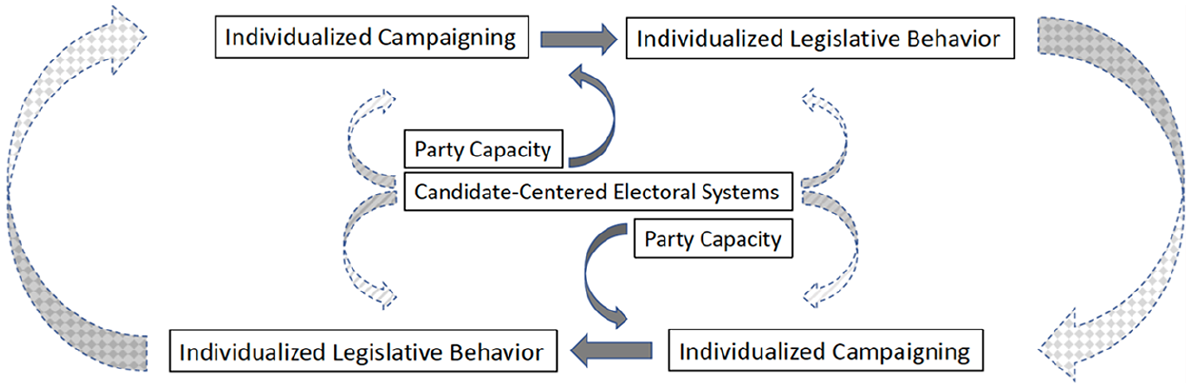
Personalized campaigns and legislative politics.
Amidst this interplay, campaigns exert an independent effect on legislative behavior in twofold ways. First, we second Richard Fenno’s (1996, p. 9) conception of campaigns as formative events, where representation, that is, perceptions about whom legislators represent, originates. This suggests paying particular attention to first-term legislators in the subsequent empirical analysis. First-term legislators lack a legislative record in national politics, which enables us to gauge the effects of their campaign experiences in an unfiltered way. Second, we envision campaigns to function as running tallies that update past experiences and remind incumbents to whom they owe their mandate (e.g., Mansbridge, 2003; Sulkin, 2011) To further validate this assumption, our empirical analysis draws on 19 semi-structured interviews with members of the 17th German Bundestag that were asked about their campaign experiences. These interviews highlight that legislators are acutely aware of the level of party involvement in their campaigns.
Figure 1 acknowledges the role of electoral incentives for the behaviors of candidates and legislators. However, it also stresses that this parallels the independent effects of parties’ campaign capacities. Previous research has already touched upon this issue by showing that higher levels of party support attenuated candidates’ proclivity to run personalized campaigns (Bøggild & Pedersen, 2018). Our analysis provides further evidence in this regard by testing the legislative implications of campaign personalization against electoral system effects. We also validate the subjective role of party capacity based on the perceptions of legislators using semi-structured interviews with members of the 17th German Bundestag.
Figure 1 remains silent about party organizational factors and individual level ambition as potential sources of omitted variable bias, where these factors might explain both individualized campaigning and individualized legislative behavior. With regard to party level factors, we report a robustness test with party dummies in our empirical section to explore this issue. With regard to individual level ambition (for a helpful overview see Öhberg, 2017: Chapter 2; for a classic see Schlesinger, 1966), we expect that individualized behavior in European party democracies can be facilitated by party, for example, in case of weak parties, but hardly emerges in opposition to the party. We nevertheless tap into this issue by controlling for seniority and ideological distance from the party.
Data, Variables, and Empirical Models
In the following analysis, we explore our theoretical argument on the basis of the German case. We select this case as it exhibits common features of European democracies, such as strong parties, parliamentary government, and candidate-centered electoral institutions which allows drawing some general conclusions from the analysis. In addition, the case offers access to matched data on campaign and legislative behavior that result from the 2009 German Candidate Study (CCS, 2009) and a follow up analysis on the legislative behavior of successful candidates in the 17. Bundestag (2009–2013). Such data are required to test our argument about the legislative effects of campaign personalization.
Table 1 provides an overview of the key independent variables for our analysis that result from our theoretical considerations. One distinct feature of the German case concerns its mixed-member electoral system that allows testing the effect of candidate- versus party-centered modes of election within one country case. Germany’s mixed-member system provides voters with a candidate vote to elect 299 legislators in single member districts on the basis of a plurality rule. In addition, German voters cast a party vote to elect approximately the second half of the Bundestag in multi-member districts on the basis of a proportional formula. This led students of German electoral politics to hypothesize a mandate-divide, where nominally elected legislators are expected to engage in personal vote seeking (Klingemann & Wessels, 2001; Lancaster & Patterson, 1990; Stratmann & Baur, 2002).
Overview of Independent Variables.
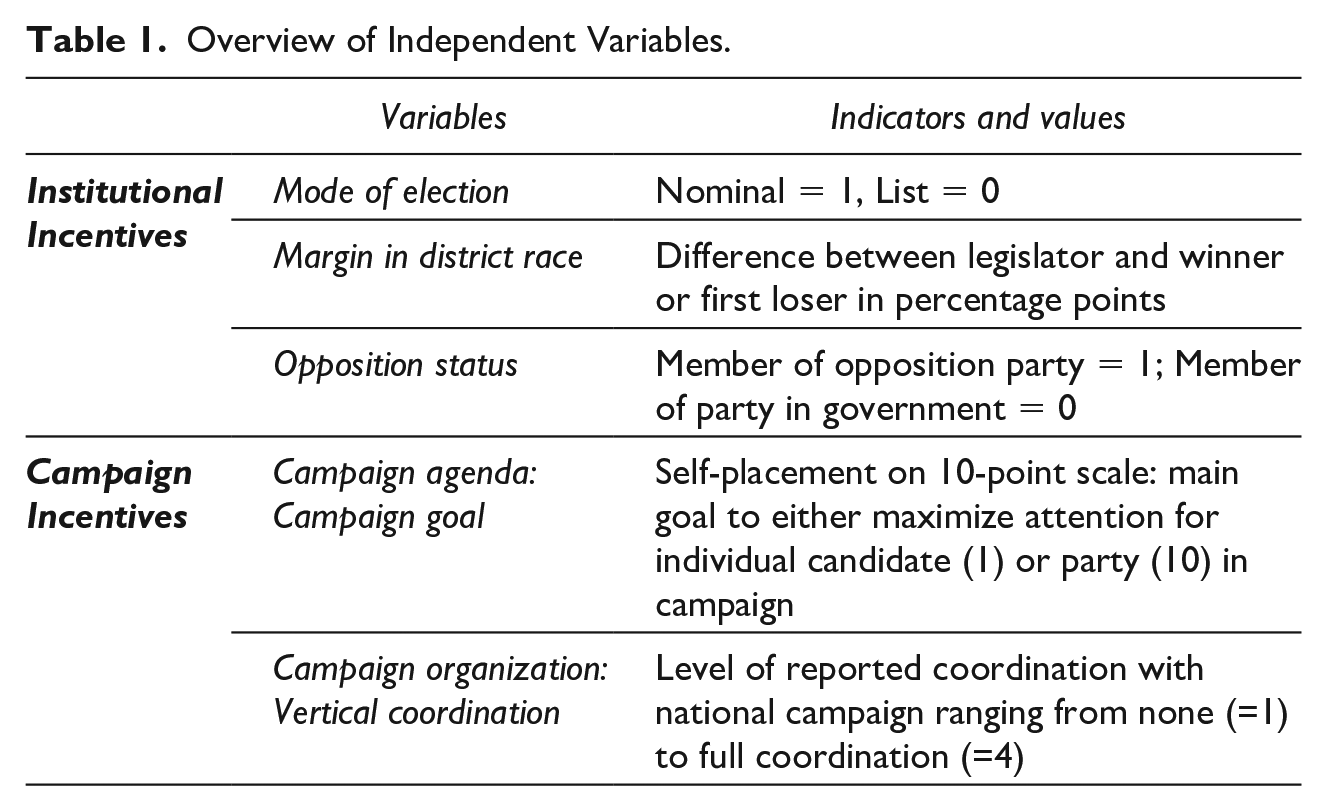
Another distinct feature of German electoral politics is the frequency of dual candidacies. Traditionally, a large majority of German legislators runs at both electoral tiers (85.3% in our data set), which allows district losers to win mandates on the basis of the party vote. Some scholars have therefore questioned the existence of a mandate-divide and expect equal incentives for dual candidates to pay attention to district needs (e.g., Manow, 2015; Nohlen, 2000; Saalfeld, 2005). The high number of dual candidacies does not preclude the widely acknowledged role of inter-party competition under plurality rule, where marginality in district races incentivizes legislators to be particularly mindful of district needs (Zittel & Gschwend, 2008).
We include opposition status in our models as an important institutional condition of legislative behavior. In the 17th Bundestag, the government coalition was formed by the conservative CDU/CSU and the market-liberal FDP. The opposition parties consisted of the social democratic SPD, the radical left LINKE, and the leftist green party. If theories on the behavioral effects of parliamentary government hold true, we should see lower levels of personal vote seeking among legislators that represent parties in government.
In addition to variables that tap into the institutional sources of legislative behavior, Table 1 also summarizes the variables that we use to measure candidates’ campaign styles. We draw on the German Candidate Study 2009 (GCS, 2009) that includes useful questions in this regard. We focus on two questions that measure candidates’ campaign goals and the degree to which their campaign was integrated into the upper level campaign organization as indicators for candidates’ campaign agenda and campaign organization. We selected two summary variables to assess candidates’ campaign styles since we aim to build a scarce model in light of the relatively low N and since we wish to focus on variables that are designed to characterize the overall nature of campaigns (Zittel & Gschwend, 2008). Campaigns involve a large number of activities that are hard to make theoretical sense of in isolated ways. We believe that the two selected variables are useful since they summarize a broader set of activities that relate to candidates’ campaign agenda and their campaign organization.
The measure for the subjective campaign goal of candidates is based on a question that asked for their self-placement on a 10-point scale. The scale ranged between the extremes “to focus attention for one’s party” and “to focus attention for one’s own candidacy”. We believe that this variable captures the overall tone and content of the campaigns and the extent to which candidates talked about themselves rather than their parties. The measure for the organizational dimension results from candidates’ answers to a question that asked whether they coordinated their campaign with the national campaign “not at all”, “hardly”, “somewhat”, or “fully”. We believe that this is a valid indicator for the help that candidates received from their party and whether their campaign organization was party- or candidate-centered.
Our models include two controls for possible individual level sources of personal vote seeking. First, we first control for the ideological position of legislators. This allows testing whether behavior in campaign and legislative contexts might be driven by individual factors that are exogeneous to institutional and campaign incentives. Specifically, the ideological distance to the party controls for the possibility that ideological mavericks seek personal votes both in campaign and legislative contexts. For the ideological distance, we measure differences between candidates’ self-placement on a left-right scale and the party means that result from a related question in the GCS 2009. Second, we control for seniority in the Bundestag measured as the number of previous legislative terms. With increasing seniority, legislators become familiar with the rules of the parliamentary game, enjoy greater electoral security, and larger political networks. This might make them feel less beholden to the preferences of their parliamentary party group, also affecting their campaign style.
The key feature of our empirical model involves matching our survey based independent and control variables with observational data to measure the extent to which successful candidates took independent positions in the Bundestag and thus sought personal votes. We focus on two factors as dependent variables, namely roll call behavior and vote explanations. We rely on data from the 17th German Bundestag (2009–2013) and for all legislators that participated in the GCS 2009. In the following, we explain our dependent variables in greater detail.
Our first dependent variable measures the absolute number of deviations in roll calls per legislator in the 17th Bundestag. We define deviations as any vote that contradicts the majority vote of one’s party. It is important to note that roll call votes are not the default in the German parliament but need to be requested by 5% of all members. In the 17th Bundestag, legislators participated in 275 roll calls of which 274 are included in our analysis. 1 The 274 roll call votes result in a dataset of 154,212 individual votes. Among these, 2,468 votes (1.58%) expressed a deviation from the party majority. On average, 9.01 legislators deviated on a roll call vote (standard deviation: 20.82). All members voted with their party majority on 76 roll call votes. The maximum number of deviations on a roll call vote was 177, that is, 42.45% of all votes cast on that roll call deviated from the respective party majority.
Our second dependent variable measures the absolute number of vote explanations that either explain a deviant vote or that voice concern despite a consenting vote. According to § 31, Abs. 1 of the rules of procedure of the German Bundestag, explanations can be tabled individually after each floor vote in oral or written form. Oral explanations may not exceed 5 minutes and both forms of explanations are included in the official minutes (Becher & Sieberer, 2008; Sieberer, 2010, 2015; Zittel & Nyhuis, 2018). Vote explanations are distinct from floor votes in two ways. First, they can be issued on non-recorded votes and thus provide additional opportunities for legislators to take positions that cannot be traced otherwise. Second, vote explanations can contain two types of statements that provide a more nuanced sense of legislators’ deviations from their parties. In the first type of statement, legislators express concern with the party position without deviating from it. This reveals individual position taking that cannot be observed otherwise. Only in the second type of statement, legislators table vote explanations to explain a deviant vote and thus mirror their roll call behavior. However, the fact that legislators actively communicate a deviant vote underlines a special motivation to go public. A correlation of .67 indicates a strong but far from perfect relationship between the two measures.
Vote explanations can be tabled by groups of legislators. Yet, collective explanations do not not contradict the motivations outlined above and thus their significance for personal vote seeking. In our analysis, we treat individual and collective explanations as equivalents. The vote explanations were read and manually classified by four trained student assistants according to a coding scheme specifically designed for this purpose. We opted for a manual coding of the vote explanations as critique can be expressed in various and subtle ways. The two core variables that were manually coded are the author of the vote explanation and the content of the vote explanation (explanation of a deviation from the majority position, expression of concern with the majority position despite a non-deviation, agreement with the majority position, technical vote explanations). The first two content categories are combined for our second dependent variable, to measure whether legislators took a critical stance towards their party. 2 To validate the coding scheme, a sample of the explanations was jointly coded and reviewed by the coders and the investigators.
To illustrate our conception of a critical vote explanation, we provide a verbatim example. This explanation was tabled by Klaus-Peter Willsch (CDU/CSU) on the occasion of a 2010 vote concerning a law that aimed to provide a credit of 22.4 billion Euro to the then ailing state of Greece. It reads as follows: “I have explained my position to my party group already in the last week of February, namely that I consider the European structures utterly unsuited for dealing with the debt overload and the possible bankruptcy of Greece. The proposed aid for Greece violates the letter of the law and most certainly the spirit of the European treaties. Rather than securing the long-term stability of the Euro, these measures threaten them. I therefore cannot and I will not go along with this policy.” (Translation by the authors)
All in all, the legislators in our sample tabled 429 unique texts, 120 of which took critical stances. Since a unique text can be signed by more than one legislator, this results in 863 activities with a total of 206 critical stances.
Both dependent variables have count properties and are subject to pronounced over-dispersion. To take this into account, we estimate negative binomial regression models instead of the more conventional Poisson model as negative binomial models fit an additional dispersion parameter (Hilbe, 2011).
To sum up, the data for the following analysis stem from three sources. First, from the German Candidate Survey 2009 (GCS, 2009) which includes a set of questions that characterize the level of individualized campaigning. Second, from an analysis of vote explanations by members of the 17th German Bundestag (2009–2013). Third, we rely on data collected by Bergmann et al. (2016) on the roll call votes of German legislators. For the analysis, we match these data sources and include only those members of the 17th Bundestag that participated in the GCS 2009, served a full term, and ran in a single member district. We dropped members of government (ministers and junior ministers) to control for the effect of position roles (Searing, 1994). 3 Overall, this restricts the sample to a subset of about one third of the 17th Bundestag. The subsample is broadly representative of the legislators with regard to party affiliation, mode of election, district marginality, opposition status, seniority, age, gender.
To further validate our casual assumptions, we draw on 19 semi-structured interviews that were conducted with members of the 17th German Bundestag between May and July 2015. The legislators were recruited on the basis of a quota-sampling procedure to ensure the equal inclusion of all parties represented in the Bundestag and of both modes of election. The participants were asked, among other things, about their experiences in the previous campaign. Their answers illustrate perceptions of party capacity and individualized forms of campaigning.
The Behavioral Effects of Campaign Personalization in the German Bundestag
In a first step of the analysis, we provide descriptive evidence about the inter- and intra-party differences in legislators’ roll call behavior and their use of vote explanations. In further steps, we estimate multivariate negative binominal regression models to explore the behavioral effects of campaign personalization, provide robustness checks, analyze the effect sizes, and further validate our causal argument based on the semi-structured interviews.
Inter- and Intra-Party Differences in Personal Vote Seeking in the 17th German Bundestag
In our sample, only 48 legislators (26.1%) never deviated from the party line, while 136 (73.9%) did so at least once. The mean legislator deviated in 4.2 roll calls with a standard deviation of 6.8. The inter-party differences displayed in Figure 2 (left box) corroborate the expected government-opposition divide. The mean opposition member (SPD, Greens, Left) deviates considerably more than the mean member of government parties. However, we also find variance among opposition parties. The mean member of the Green party cast 14.6 deviant votes trailed by the mean SPD member with 6.1 deviant votes. With regard to intra-party variance, Figure 2 (left box) shows particularly high levels of heterogeneity for opposition parties.
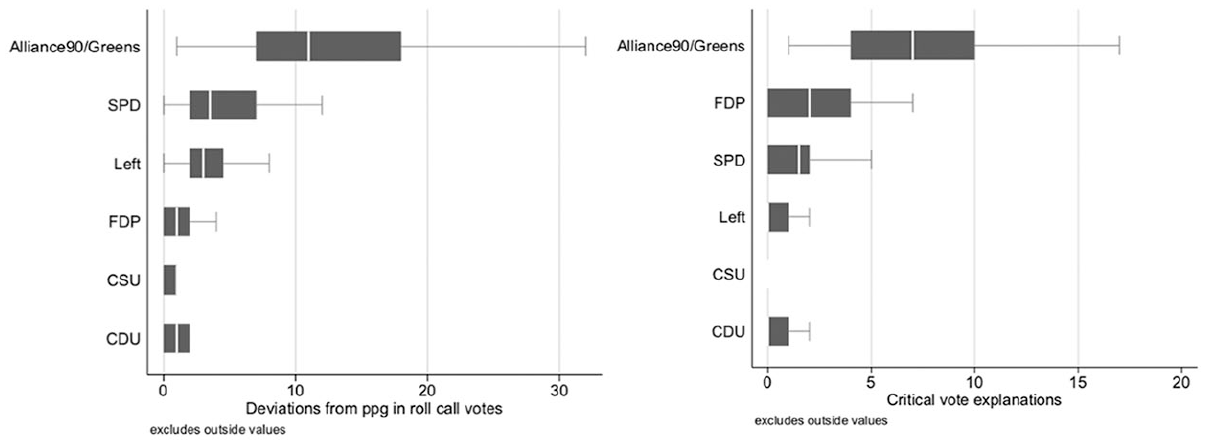
Inter- and intra-party differences in deviations in roll call votes and critical vote explanations.
The pattern for critical vote explanations (Figure 2, right box) is similar to the deviations in roll call votes. The only difference concerns the liberal party (FDP). In contrast to the low number of deviating votes, the FDP exhibits the second-highest average in the use of critical vote explanations compared to all other parties. This finding might well be driven by the status of the party as the junior partner in a liberal-conservative governing coalition dominated by the CDU/CSU. Party whips of governing parties should show little tolerance for vote deviations. Vote explanations can provide an easy venue for MPs of junior coalition parties to express their frustrations with the compromises the party majority was willing to accept in coalition agreements.
The Conditions of Personal Vote Seeking in the Bundestag
We now turn to explaining the observed variance by reporting the findings from several negative binominal regression models, one set of models for the roll call deviations and one for the vote explanations. We develop each of these two analyses in two steps. We first estimate a small model that only includes the institutional variables and controls (Models 1a and 2a). We then estimate full models that include the campaign variables (Models 1b and 2b). This allows exploring whether focusing on campaign behavior adds to our ability to explain personal vote seeking in legislative contexts and to what extent individualized campaign styles increase the likelihood of successful candidates to deviate in roll call votes and take independent positions on the floor in vote explanations.
Both full models reported in Table 2 support our theoretical argument on the legislative effects of individualized campaign styles. All four coefficients point in the theoretically expected direction and are statistically significant at least at the .1 level. 4 Legislators that campaigned on the basis of a candidate-centered agenda are more likely to deviate from their party in roll calls and to table vote explanations that are critical of their party’s position. Even more so, legislators that coordinated their campaigns to lesser degrees with the national campaign are more likely to deviate in roll calls and to table critical explanations.
Negative Binomial Model Results.
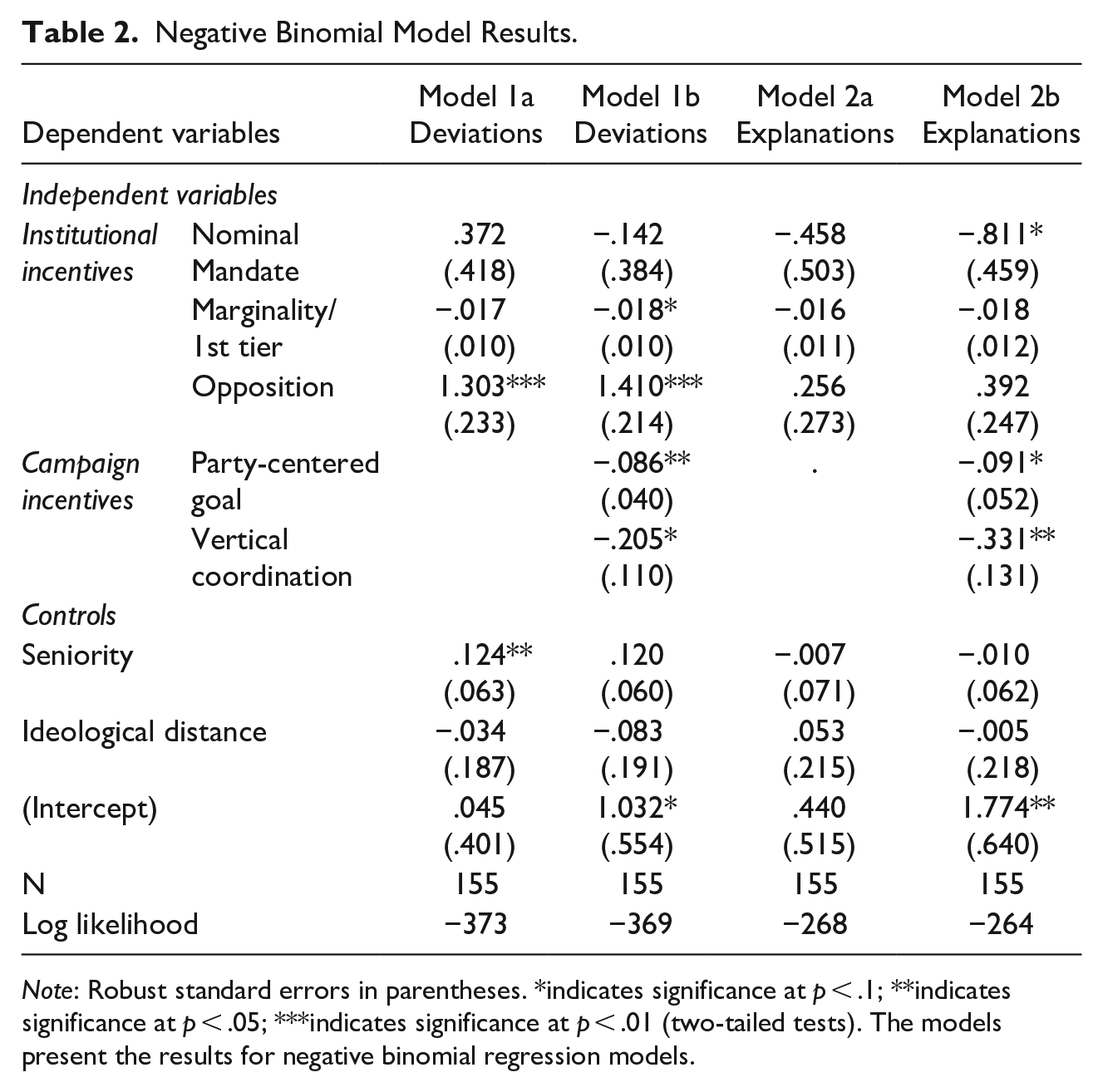
Note: Robust standard errors in parentheses. *indicates significance at p < .1; **indicates significance at p < .05; ***indicates significance at p < .01 (two-tailed tests). The models present the results for negative binomial regression models.
Table 2 provides some support for institutional theories of legislative behavior, but less consistently so compared with the effects of campaign personalization. Overall, Table 2 corroborates the expected effect of opposition status for roll call behavior but fails to show a statistically significant effect for vote explanations. Members of the opposition are significantly more likely to deviate in roll call votes compared to members of parties in government (H3a). However, they do not show similar tendencies when it comes to critical vote explanations.
With regard to electoral context, the results reported in Table 2 reject the mandate divide hypotheses (H1a and 1b), which confirms recent research on this issue (Ferrara et al., 2005; Gschwend & Zittel, 2018; Manow, 2015). Our findings on the effects of marginality are also inconsistent (H2a and 2b). Legislators that were elected on the basis of close margins or failed to win their districts by close margins tend to be more likely to deviate in roll calls (H2a), while this effect is not evident for vote explanations.
The results for the controls presented in Table 2 provide further evidence for our theoretical argument on the independent legislative effects of individualized campaign styles. We do find an effect for seniority, where more senior legislators are more likely to deviate from their party in roll calls. But this effect neither extends to the second independent variable in our analysis, nor is it able to override the campaign effects. To test for the robustness of our findings and to address concerns about reverse causality and omitted variable bias, we conduct three further steps in our analysis that we report in the remainder of this section.
Robustness
In a first step, we draw on qualitative interviews with 19 Members of the 17th Bundestag to validate our assumptions about the subjective role of party capacity in campaign contexts. We selected members that also participated in the 2009 German Candidate Study on the basis of a stratified sampling procedure to ensure representativeness in terms of party and legislators’ mode of election. We conducted semi-structured interview that contained two prompts inviting interviewees to reflect on the support they received in their last campaign (first question) and the main themes of their campaign (second question).
The two questions resulted in narratives that broadly fall into two categories. The first category involves narratives that acknowledge little party support in campaign efforts and that stress the role of candidate-centered organizational and thematic choices. The following verbatim quote provides illustrative evidence in this regard.
“I never received much support from my local party, they just did not care. I was the only candidate, and I ran seven times for the Bundestag, who never went into debt. . . . Of course, you need donors, and I had a few, since I know many people. And I always composed a team, a few young people, who I paid. . . . (In my campaign, I always stressed) that I represent the interests of (my district). I never emphasized issues such as social policy . . . I always put my own person first.” (Interview IR12, translation by the authors)
The narratives that fall into the second category explicitly stress extensive party support in campaign matters and involve little to no considerations about individual level choices and efforts.
As front runner for my party I had to cover the whole state. For public debates, I received coaching about the issues . . . my campaign schedule was centrally coordinated . . . in my district, the local party organized everything. The (party) and the members of the (party) were the main supporters of my campaign. . . . the most important themes in my campaign were issues such as child care and family policies . . . these were the big issues in my campaign.” (Interview IR09, translation by the authors)
Many of our interviewees fall in between these extremes, but lean towards one or the other side of the continuum. Most importantly, all narratives resulting from the prompts stress that legislators are well aware of the role of their parties in their campaigns, that they are ready to develop candidate-centered solutions in case of weak party capacity, and that this appears to be partly independent from prior legislative activities and styles.
For a second test, we incorporate party dummies into the full models while excluding the opposition variable to assess whether the results might be affected by party level factors such as party specific candidate nomination procedures, other party organizational factors, or leadership strategies. While the direction of the effects for the campaign factors remain consistent and similarly sized, the coefficients for the campaign organization (roll call deviations) and campaign content (critical vote explanation) are not statistically significant at conventional levels. Therefore, this robustness test comes with a grain of salt but does not fundamentally contradict the argument that campaign styles impact legislative behavior. We document the results of this analysis in the online appendix.
Table 3 shows a third robustness test that replicates our full models only for first-term legislators that were newly elected in 2009. This test aims to explore possible reverse causality, such that personal vote seeking in legislatures may influence individualized campaign strategies. By restricting our analysis to first-term legislators, we can rule out a possible impact of previous national level legislative experience and focus on one of the two possible causal directions to show that legislators’ first campaigns do have an impact on their legislative behavior, independent of subsequent interactions between legislative behavior and campaign activities.
Negative Binomial Model Results Only for First-Term Legislators in the 2009 Elections.
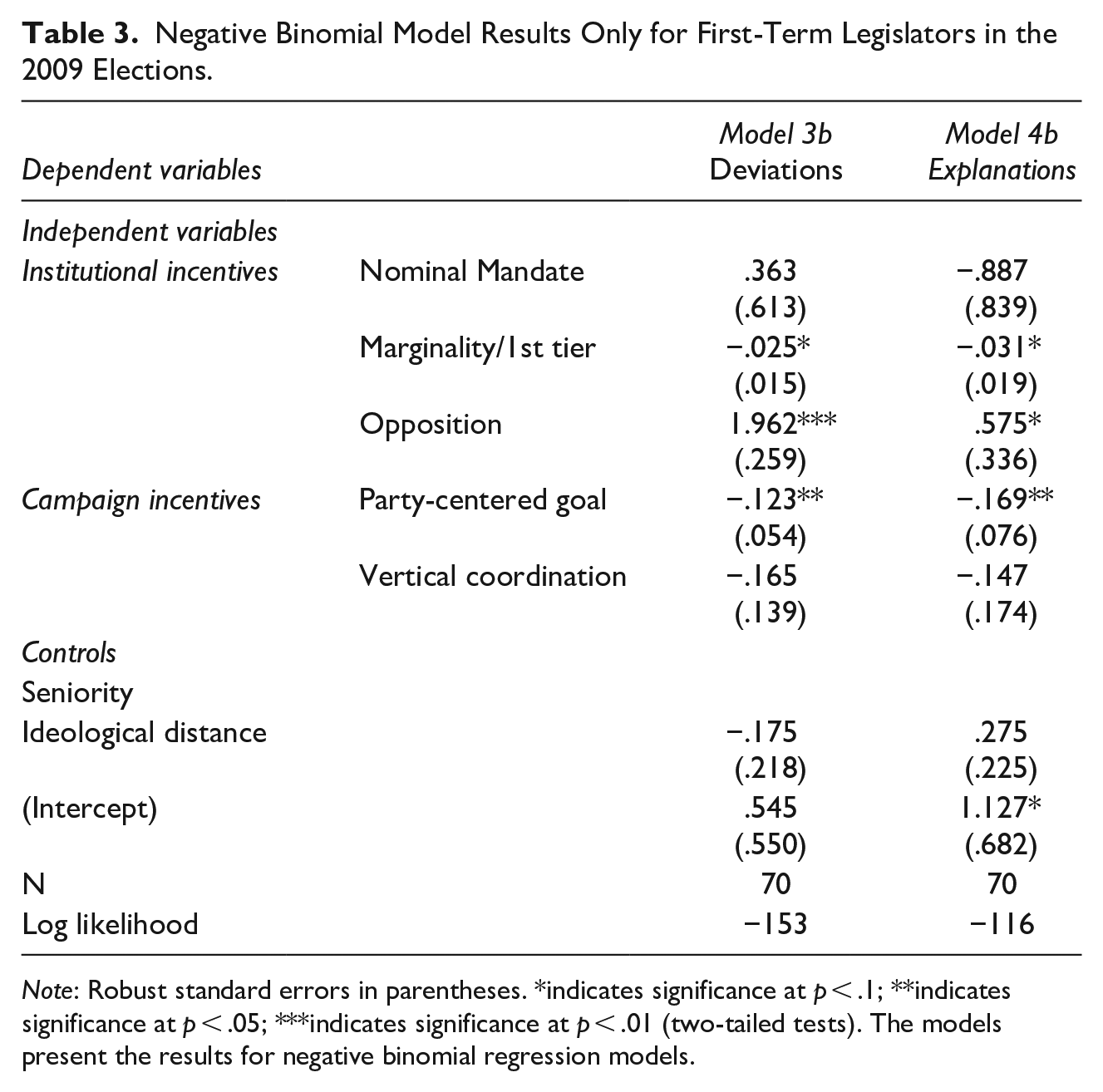
Note: Robust standard errors in parentheses. *indicates significance at p < .1; **indicates significance at p < .05; ***indicates significance at p < .01 (two-tailed tests). The models present the results for negative binomial regression models.
While the campaign effects in Table 3 all point in the expected direction, only the agenda parameters reach conventional levels of statistical significance. Hence, while there is an effect of the first individualized campaign on subsequent legislative behavior, these findings do suggest that one single campaign experience does not determine legislative behavior once and for all. Compared with the more consistent effects of the full models in Table 2, the results from the models in Table 3 might be indicative of the hypothesized feedback loop where individualized campaign experiences trigger and further reinforce personal vote seeking over the course of a legislative career.
Effect Sizes
In a last step of our analysis, we explore effect sizes. We concentrate on Model 1b (deviations in roll call votes) that we report in Table 2. The plots reported in Figure 3 demonstrate noteworthy effect sizes for candidates’ campaign agenda and their campaign organization.
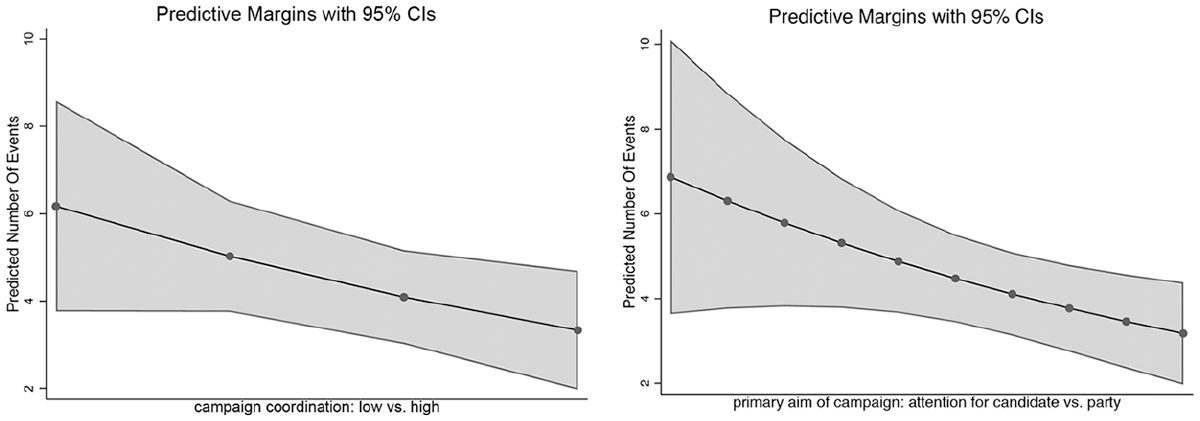
Marginal effects with 95% CIs for campaign agenda (right box) and for vertical campaign coordination (left box) on deviations in roll-calls.
The right panel of Figure 3 shows the effect of legislators’ campaign agenda in the previous election on their likelihood to deviate in roll calls. It shows that a move from one extreme of focusing all attention on the party to the other extreme of maximizing attention for the candidate results in an increase of 3.7 vote deviations. We can evaluate the size of this effect by comparing it to the most pronounced substantial effect in Model 1b, the opposition status (see Online Appendix for the effect sizes of all variables in Model 1b). This variable predicts 4.7 additional deviating votes for an otherwise average member of the opposition compared to an otherwise average member of the government majority. At the backdrop of this theoretically expected and quite substantial effect, the effect that we find for legislators’ previous campaign style remains noteworthy and non-negligible.
The left panel of Figure 3 illustrates the effect size for legislators’ campaign organization. It shows that a move from one extreme stressing full coordination with upper level campaign headquarters to the other extreme stressing no coordination results in an increase of 2.8 vote deviations. Again, compared to the predicted effect size of legislators’ opposition status (See Online Appendix), this remains a noteworthy effect.
Conclusion
The analysis that we report in this paper shows that campaign personalization matters for legislative behavior. Legislators that ran individualized campaigns in the previous elections are more likely to deviate in roll call votes and to table vote explanations that are critical of the party stances. Our findings stress that these effects supplement institutional factors, especially the higher levels of legislative individualization among members of the opposition.
Do our findings generalize to other European democracies? By and large, we are positive about the exemplary nature of the selected case. Germany combines candidate-centered electoral institutions with parliamentary government and strong parties, which mirrors institutional configurations in many other European democracies. At the same time, other scholars have found that high levels of campaign personalization resulted in little legislative individualization (e.g., Farrell et al., 2015), which highlights the role of case specific factors and raises the need for further research on this matter. In addition, the various forms of candidate-centered electoral institutions across European democracies, that is, electoral system personalization (e.g., Renwick & Pilet, 2015), and party level differences across Europe require more cross-national national research on the legislative effects of campaign personalization in different national contexts.
Our findings have important implications for the analysis of legislative behavior but also for practical debates about the campaign strategies of political parties in the context of changing electoral markets. Regarding legislative behavior, our results suggest going beyond institutional level explanations and paying closer attention to campaign politics and thus how legislators win their bids for public office. This brings us full circle to Richard Fenno’s conviction that election campaigns are places where representation originates and where it is sustained. Again, this perspective is not meant to substitute well-established theories of legislative behavior. Instead, it adds a piece to the puzzle of explaining when and why legislators might subscribe to collective forms of representation.
With regard to debates about parties’ campaign strategies, our findings stress that the personalization of campaign politics might be a double-edged sword. In view of weakening parties in European democracies, candidates and their characteristics are of increasing importance as vote-getting strategies. However, this may come at a cost to parties. Recruiting ambitious candidates, letting them off the leash during election campaigns, or even actively encouraging them to cultivate individual agency in campaigns might prove a risky strategy from a party organizational perspective. Personalization at the grassroots might win votes for parties in the short run. But in the long run, it comes with the risk to make parties less disciplined in legislative contexts. Consequently, political parties in established democracies face the challenge of striking a balance between their collective vote seeking goals and maintaining their effectiveness as key mechanisms to secure accountable government.
Supplemental Material
Online_Appendix_Legislative_Effects_CPS – Supplemental material for The Legislative Effects of Campaign Personalization An Analysis on the Legislative Behavior of Successful German Constituency Candidates
Supplemental material, Online_Appendix_Legislative_Effects_CPS for The Legislative Effects of Campaign Personalization An Analysis on the Legislative Behavior of Successful German Constituency Candidates by Thomas Zittel and Dominic Nyhuis in Comparative Political Studies
Research Data
mp_data_17deu_v11_short – Research Data for The Legislative Effects of Campaign Personalization An Analysis on the Legislative Behavior of Successful German Constituency Candidates
Research Data, mp_data_17deu_v11_short for The Legislative Effects of Campaign Personalization An Analysis on the Legislative Behavior of Successful German Constituency Candidates by Thomas Zittel and Dominic Nyhuis in Comparative Political Studies
Research Data
replication_zittel_nyhuis – Research Data for The Legislative Effects of Campaign Personalization An Analysis on the Legislative Behavior of Successful German Constituency Candidates
Research Data, replication_zittel_nyhuis for The Legislative Effects of Campaign Personalization An Analysis on the Legislative Behavior of Successful German Constituency Candidates by Thomas Zittel and Dominic Nyhuis in Comparative Political Studies
Footnotes
Acknowledgements
We thank Henning Bergmann, Stefanie Bailer, Tamaki Ohmura, Thomas Saalfeld, and Ulrich Sieberer for providing data on roll call behavior in the German Bundestag. We also thank Monika Nalepa, Jochen Müller, Katjana Gattermann and the participants of two workshops on the personalization of politics at the Universities of Aarhus and Amsterdam, organized by Prof. Helene Helboe Pedersen (Aarhus) and Dr. Katjana Gattermann (Amsterdam), for helpful comments on a previous version of the paper.
Declaration of Conflicting Interests
The authors declared no potential conflicts of interest with respect to the research, authorship, and/or publication of this article.
Funding
The authors disclosed receipt of the following financial support for the research, authorship, and/or publication of this article: The research for this paper is supported by the Deutsche Forschungsgemeinschaft (DFG) through ZI 608/7-1 and HE 5813/2-1. We are indebted to Janina Barth, Lena Ehret, Matthias Henneke, Andreas Herzog, Fabienne Rauschenplatt, Lennart Schürmann, and Marie Wittenius for invaluable help in preparing the data for the project.

Notes
Author Biographies
References
Supplementary Material
Please find the following supplemental material available below.
For Open Access articles published under a Creative Commons License, all supplemental material carries the same license as the article it is associated with.
For non-Open Access articles published, all supplemental material carries a non-exclusive license, and permission requests for re-use of supplemental material or any part of supplemental material shall be sent directly to the copyright owner as specified in the copyright notice associated with the article.
