




Abstract
Campaign costs have risen in Africa. I ask: what has driven this cost inflation? Studies of Western parties attribute it to campaign modernization as mediatization. Studies of African parties do not recognize this campaign advancement. They attribute these it to another cause: spiraling clientelism. I argue that there is a third, hitherto overlooked driver of such inflation and adaptation: the hybridization of rallies with capital-intensive practices. This capitalization of rally production amounts to an alternative form of campaign modernization which diverges from those found in the global north. I trace this process in Tanzania, but this theory has wider reach. Many African campaigns are rally-intensive and have fewer authoritarian retardants of party competition than Tanzania. This makes it likely that other countries’ experiences resembled or surpassed Tanzania’s in Africa and beyond. Altogether, I demonstrate that there is ongoing innovation at rallies which is driving significant rises in campaign costs.
Keywords
The trend is clear: election campaign costs in Africa have risen, and risen dramatically (Cost of Politics, 2023). I ask: what has driven this inflation of campaign costs in Africa? Research on Western campaigns offers one chief answer: campaign modernization (Norris, 2000). This modernization in turn has been propelled by mediatization, which has provided parties with new sorts of capital-intensive methods to employ and professionals to hire. This capitalization and professionalization has created steady upward pressure on campaign costs (Ansolabehere et al., 1993; Stromer-Galley, 2019).
Research on African campaigns offers a different answer: that campaign costs in Africa have been raised by an upward spiral of clientelism, both in general elections (Koter, 2017) and primary elections (Ichino and Nathan, 2012; 2013). In short, they suggest, there have been rising costs, but that they have largely occurred without advancement through campaign time; they not been (principally) driven by campaign modernization.
In this article, I argue that there is and has been a third and hitherto overlooked driver of campaign costs in Africa: rally capitalization. Recognizing this driver requires conceptual work. The literature conceives of the rally as ‘premodern’ and therefore innately capital-light and technologically simple (Norris, 2000; Plasser and Plasser, 2002). However, I unpack how rallies are produced. I argue that while old practices of rally production are labor-intensive, new ones have been developed which are capital-intensive. These innovations in rally production have initiated a process of competitive rally capitalization. Through these practices, parties have incorporated vehicle-mounted public address systems (PAs), motor cycle squadrons, motorcades, mobile stages, and helicopters, among other things, into rally production at scale. In these hybridized rallies, parties have found new ways of notifying and mobilizing potential attendees, preparing rally sites, fostering festivity and conferring status on candidates.
I encountered and theorized this process in Tanzania, which has the most rally-intensive campaigns in the world (Paget, 2019). I employ process tracing methods of analysis and exposition. I conclude that rally capitalization also substantially increased campaign costs. While these conclusions could be idiosyncratic to Tanzania, there are two reasons to infer that they are not. First, many African election campaigns are rally-intensive (Paget, 2019), and so rally capitalization in aggregate is costly across them. Second, Tanzania has an electoral-authoritarian regime which has retarded party competition. This ought to have dampened this process in Tanzania. The fact that rally capitalization proceeded there regardless increases the probability that it will take place, perhaps with even greater intensity elsewhere.
Therefore, my research contradicts the notion that campaign cost-inflation and party adaptation have taken place in Africa without movement through campaign time. Indeed, I argue that, while it does not involve mediatization, rally capitalization nevertheless constitutes an alternative form of campaign modernization. While this variant of campaign modernization may have been inconsequential in Western countries, it is certainly consequential in Tanzania, and beyond.
Campaign modernization as rally capitalization
What has driven rising campaign costs in Africa? Studies of Western parties attribute these phenomena to one principal cause: campaign modernization (Norris, 2000). They define modernization in terms of mediatization (Norris, 2000; Plasser and Plasser, 2002). Campaigns passed in turn through the ‘television age’ (Ansolabehere et al., 1993) and the ‘Internet age’ (Stromer-Galley, 2019), or as Norris calls it, the ‘last stage of the modernization process’ (Norris, 2000: 147). This ever-evolving mediatization capitalized campaigning; it created new fields of communication in which new, capital-intensive methods of communication were developed and adopted, most expensively, television and Internet advertisements (Ansolabehere et al., 1993; Stromer-Galley, 2019). It also professionalized campaigning; it created new fields of party activity and expanded old ones. To undertake these activities, parties and campaigns recruited professional staff with commensurate skills into new roles and structures (Ansolabehere et al., 1993; Gibson and Rommele, 2001; Stromer-Galley, 2019). This rolling capitalization and professionalization increased campaign costs.
In contrast, studies of African parties attribute little or none of the rising costs of campaigning to campaign modernization. These non-attributions turn on their analyses of mediatization. Older studies determine mediatization to be partial; communication was dominated by ‘pavement radio’ (Ellis, 1989). In this context, they judged that campaigns were hybrids of old and new (with an emphasis on the old): parties followed a ‘shopping model’ by selectively incorporated modern methods of communication from an ever-lengthening ‘shopping list’ into campaigns otherwise dominated by ‘culture-specific traditional campaign styles’ (Plasser and Plasser, 2002: 348). Giovanni Carbone claims that there was little such communication modernization in Africa at all (Carbone, 2007). Of course, subsequent research documents significant mediatization that has occurred. However, it stresses that it has taken the form of social media-tization which widens the domain of people that can communicate (Nyabola, 2018). Studies find that parties’ principal responses have indeed professionalized their media production. Nevertheless, the accompanying rises in campaign costs have been deflated in two ways. First, with exceptions, they have not dedicated large sums to television or digital advertisements. Second, they have relied less on professional consultants and staff, and more on both politicians and large cohorts of activists who communicate as amateurs via Internet platforms (Gadjanova et al., 2019; Kwayu, 2021). In fact, some studies argue that despite this mediatization, parties remain focused on ground campaigning over mediated campaigning (Kwayu, 2021; Tatchou, 2022).
Instead, studies of parties in Africa chiefly attribute rising campaign costs to spiraling clientelism. They argue that competition between candidates to outdo one another by offering ever-greater gifts to constituents has created continuous upward pressures on campaign expenditure (Koter, 2017). Multiple studies explicitly attribute rising costs to such clientelist inflation (Arriola et al., 2021; Koter, 2017; Wahman and Bech Seeberg, 2022). The implication of their arguments is that campaign cost-rises in Africa have occurred with at most limited progress through campaign time. Insofar as it has been driven by clientelism alone, it has involved no movement through the practices associated which the successive stages of campaign modernization (Gibson and Rommele, 2001; Norris, 2000; Plasser and Plasser, 2002).
I argue that in Africa, these changes have involved campaign modernization. However, this modernization has taken a different form: it has taken place through the rally. The literature already recognizes one role which the rally can take on in (post-) modern campaigns: a mediated one. They can cease to be, principally, a mode of face-to-face contact and become, instead, a pseudo- or media event (Ansolabehere et al., 1993; Chadwick, 2017; Middleton, 2021) designed to ‘win and stylize media coverage’ (Paget, 2019: 450). I conceptualize a distinctive form of campaign modernization through the rally which can proceed or not independent of whether the rally or indeed the campaign as a whole mediatizes. This notion contradicts ideas embedded in the literature. Not only is campaign modernization conceptualized as mediatization. The rally is enduringly conceptualized as ‘premodern’ (Plasser and Plasser, 2002: 277), ‘labour-intensive’ (Plasser and Plasser, 2002: 84) or simply ‘old’ (Dinkin, 1989: 134), not as modern.
However, these studies are unimaginative about how rallies are produced. The rally should be conceptualized as a medium of communication. As such a communication technology, it consists of an arrangement of devices, person-roles and practices (Latour, 1990) which is reified in routinized ‘protocols’ (Gitelman, 2008). The stage; the dais; the floor; the roles of ‘speaker’ and ‘audience;’ the rituals of speaker arrival and departure; the practices of calling and answering; and the like, are all a part of this routinized production of the rally. Studies of communication technology are clear that ‘rather than static, blunt, and unchanging technology, every medium involves a “sequence of displacements and obsolescences, part of the delirious operations of modernization”’ (Gitelman, 2008: p. 8). As such, while the rally format itself may be ancient, the devices, person-roles and practices through which it is produced need not be.
In the sections which follow, I analyze the practices of rally production found in Tanzania, and the devices and person-roles fixed in them. I show that over time, those practices have changed. In these new practices, expensive devices have been incorporated alongside new person-roles. Past research (Chadwick, 2017), especially historic research, does recognize some such new practices, ones by which devices and person-roles were incorporated into rallies which made them the sort of media events described above. It documents how stenographers, journalists, camerapersons, technicians, microphones, video cameras and assorted accompanying equipment and staff were incorporated into rallies through time even as they remained important means of face-to-face contact (for example, see Burden, 1972; Matthew, 1987; Ritchie, 2007). However, many other of the new and capital-intensive practices which I identify have been integrated into rallies in Tanzania are not directly related to the mediatization of the rally. Instead, they have fulfilled functions previously fulfilled by other, labour-intensive practices, sometimes to supplement and sometimes to replace them. Through the adoption of these practices, rally production has been capitalized. Therefore, the rally is not simply a ‘premodern’ mode of communication. Like so many other communication technologies, the evolving incorporation of different devices and person-roles into its production makes it forever new.
This capital-intensive rally production amounts to a form of campaign modernization as rally capitalization. This form of campaign modernization takes place through hybridization, but not hybridization in which parties choose ‘new’ methods of communication from a shopping list to employ alongside ‘old’ ones (Plasser and Plasser, 2002). Instead, it takes place through the hybridization of the methods on that list, in this case, the rally. Rally capitalization can occur independent of mediatization. Nevertheless, it displays the other hallmarks of modernization: technological innovation and capitalization. In other words, I argue that mediatization should be de-centered from campaign modernization. Campaign modernization in the global south need not take the form which it has taken in the global north.
The campaign modernization as rally capitalization is particularly pertinent in Africa, because in much of Africa, election campaigns are unlike others; they are rally-intensive (Paget, 2019). In these campaigns, the rally is not only, as is so common in the contemporary global north (Ansolabehere et al., 1993; Chadwick, 2017), a means to draw and style media coverage, but also the principal form of face-to-face contact. Both the coverage of the rally on other media and the in-person attendance of rallies is intensive. Every day of the campaign, rallies are convened not only by politicians seeking media coverage, but by hundreds and thousands of candidates running in parliamentary and municipal elections respectively. The average national rate of rally attendance across the thirty-three sub-Saharan countries surveyed in the Eighth Round of the Afrobarometer was 36% (Afrobarometer, 2023). In contrast, just 7.2% of people attended rallies in the 2016 American election (ANES, 2017). This makes rally capitalization an important potential driver of campaign expenditure. As rallies are convened at scale, rises in their costs increases overall costs at scale.
Moreover, in defiance of old modernist ideas, rally attendance in sub-Saharan Africa has not decreased with time, at least not uniformly. Figure 1 displays reported aggregate rally attendance across the 25 sub-Saharan African which were surveyed across Rounds Five to Eight of the Afrobarometer over a decade. Between those rounds, rally attendance fell more than 2% (the approximate sampling error margin) in 11 countries, rose more than 2% in six and it held steady in eight. The mean fell from 41% to 36%. However, Round 8 asks about many campaigns conducted at the peak of the COVID-19 crisis, when rallies were banned by governments and shunned by individuals. Between Rounds Five and Seven (pre-COVID), mean rally attendance held steady: it moved from 41.3% to 40.1%. Rally attendance fell by more than 2% in 13 countries, but rose by more than 2% in eight, and held steady in four. These statistics tell a story of divergent trajectories of aggregate rally attendance. Among them are many stories of persistence in and development of rally cultures in Africa. In those places, and others besides, rallies are here to stay. National rates of rally attendance by country across Afrobarometer survey rounds 5 to 8 (Afrobarometer, 2023) (only sub-Saharan African countries included across all four survey rounds included).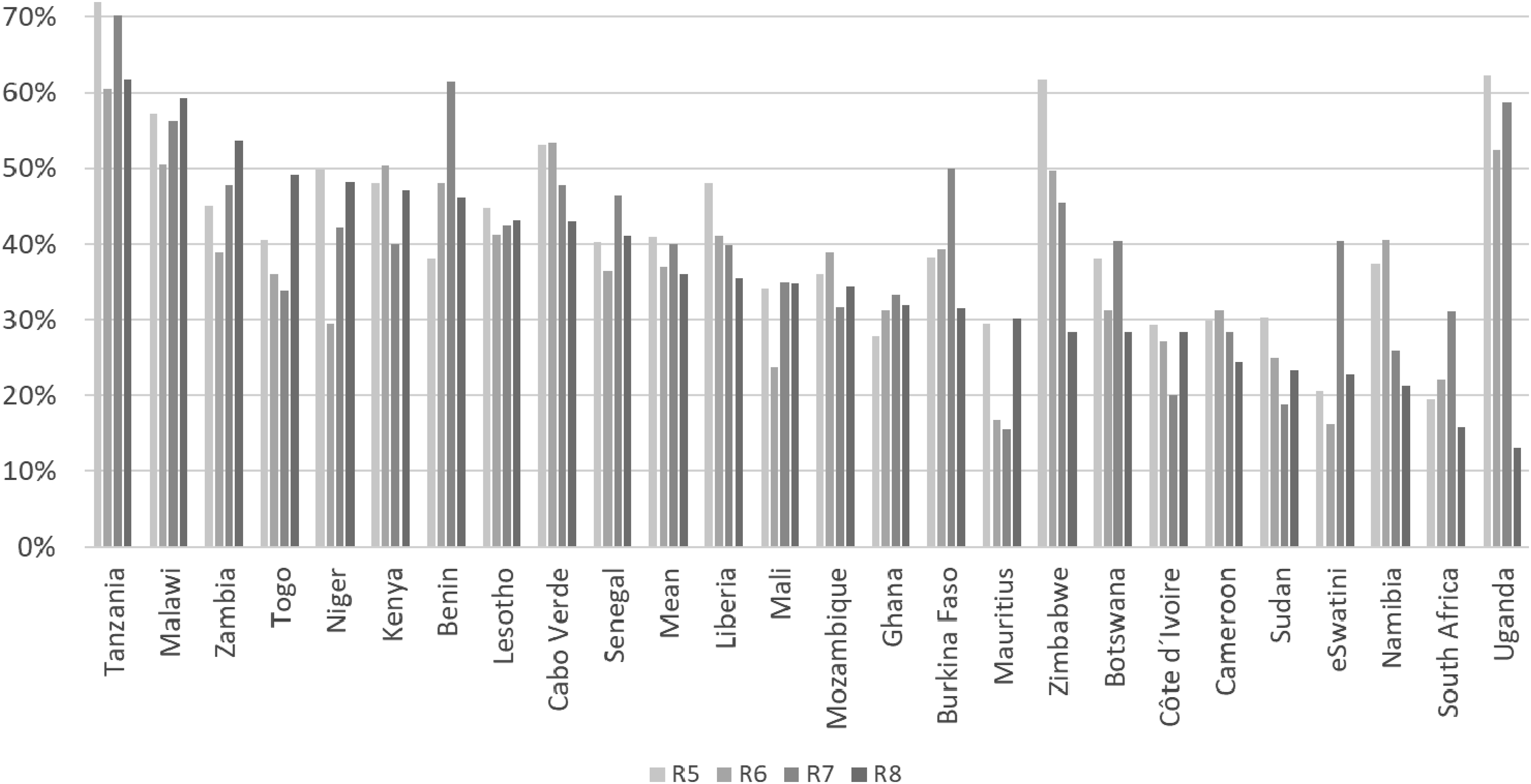
I advance a theory that causally links innovations in these capital-intensive practices to campaign cost-inflation. This causal process draws its theoretical integrity from the literatures about campaign technological diffusion, and party competition (Epstein, 2018; Gibson and Rommele, 2001). It follows this sequence: A. Innovate/infer. Some parties or candidates develop a capital-intensive practice of rally production, which is more effective than other practices. They make inferences about its effectiveness. B. Raise campaign funding. They raise funds for expenditure on election campaigning. C. Capitalize rallies. They spend those funds on capital-intensive practices of rally production more. D. Gain electoral advantage. These methods yield electoral advantages to them.
This electoral advantage puts other parties and candidates under pressure to respond by raising funds and adopting these practices. These parties or candidates become the new subjects of the process from B through D. Equally, after observing the electoral advantage which the method brings, other parties or candidates revise their inferences about its effectiveness, initiating a new process from A through to D. Through these connections, the causal sequence becomes a cycle, which continues until the marginal benefit of capitalizing rallies falls enough to converge upon its cost. Through this process, candidates individually, and parties in aggregate, capitalize their rallies and increase their campaign expenditure. This process is laid out in Figure 2. This process treads a fine line between structure and agency. Candidates and parties adopt or eschew these capital-intensive methods of their own volition. However, in competitive systems, parties that do not adapt their practices do worse until they learn better or are weaned out. Process of rally capitalization.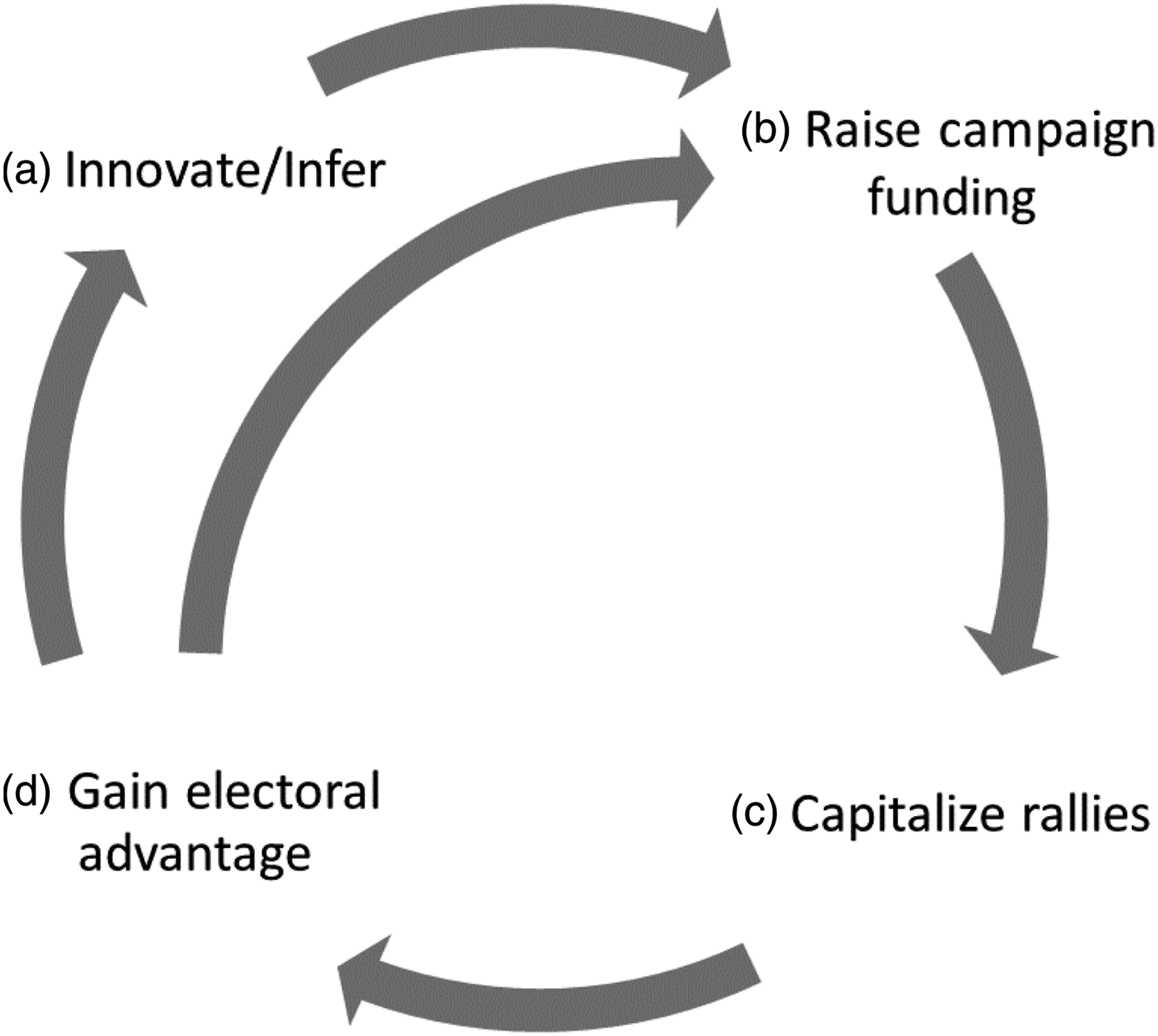
This rally-capitalizing process is missing in prior accounts of campaign. I recognize that both mediatization and clientelism may have both driven cost inflation in Africa. However, I argue that the above process of party capitalization has also driven it. Therefore, campaign change in Africa has not taken place outside of campaign time, but within it.
Alternative explanations
To substantiate my argument, I argue that this process – hereafter, the rally capitalization theory – non-negligibly contributed to the rising campaign expenditure in Tanzania between 1995 and 2015. I observed rally capitalization by different degrees at rallies convened at every level in Tanzania from presidential campaigns through to ward councillor campaigns. It may be that this argument is applicable to campaign expenditure across these levels. However in the name of feasibility, I focus on parliamentary campaigns by Tanzania’s dominant party and leading opposition party - Chama cha Mapinduzi (CCM) and Chama cha Demokrasia na Maendeleo (Chadema). To substantiate these claims, I employ process tracing: the diagnosis of a process in a case. This diagnosis involves the consideration of alternative processes that may instead have been at work in a case (Bennett and Checkel, 2015).
There are two such plausible alternative theories in this case. First, mediatization propelled campaign modernization which increased costs and drove party adaptation. Second, spiraling clientelism inflated campaign costs. Some studies argue that precisely this process took place in Tanzania (Babeiya, 2011; Cooksey and Kelsall, 2011).
I refer to these two alternative processes as the mediatization and clientelism theories. I do not contend that the processes expressed in these theories were absent in Tanzania. Indeed, I believe that they were both present. Mediatization and rising clientelism each contributed to the rising campaign costs and the growing closeness of parties and financiers. I merely argue that they were not present to the exclusion of rally capitalization. I seek to discount the strong versions of these theories, that they explain all, or all but a negligible proportion of, the rising campaign costs and the growing closeness between political parties and their financiers. I refer exclusively to the strong versions of these theories – thus defined - below. There are two subvariants of the clientelism theory which are also challenge the rally capitalization theory. In one, the rally is principally a conduit for clientelist exchanges, as others have argued (Kramon, 2018). In another, rally attendees are drawn by and the rally is produced principally through clientelist exchanges, as others have argued (Muñoz, 2019). The first is contradicted a fortiori by other studies which show that non-clientelist messages are conveyed at rallies both and alter attendees programmatic opinions of those parties in Tanzania (author reference). I disconfirm the second in the process of disconfirming the strong version of the clientelism theory.
Process tracing
Process tracing involves inferring from the evidence the likelihood that each contending theorized process was at work in the case (Bennett and Checkel, 2015). I develop five hypotheses as process tracing tests. These tests take the forms of hypothesized intermediary empirical claims which, if supported by the evidence, would bear on the probability that one or more of the contending theorized processes was at work in the Tanzanian case. I use them as expositional tools which make clear the reasoning by which I move from evidence to theory. Some of these hypotheses are repetitive of the causal steps in the theory outlined above. However, as these hypotheses are formulated to make explicit how the evidence which I marshal bear on theory, some of them disaggregate or otherwise translate steps from that theory into multiple empirical claims which correspond to the evidence which I shall present and review in the sections which follow. The first three are:
Rally production by CCM and Chadema parliamentary candidates became more capital-intensive between 1995 and 2015, in accordance with step C above.
Campaign expenditure by CCM and Chadema parliamentary candidates rose between 1995 and 2015, in accordance with step B.
CCM and Chadema parliamentary candidates’ campaign expenditure in 2015 was constituted in significant part by expenditure on capital-intensive practices of rally production, in accordance the link between steps B and C. Together, this trio of hypotheses is disconfirmatory. If parliamentary campaign expenditure in 2015 was composed in significant part by rally capitalization costs, and the amount of rally capitalization had increased since 1995, logically any rises in campaign expenditure must have been composed at least in part by the rising costs of capitalizing rallies. In that case, it could not be that the rising costs of campaign mediatization or clientelism accounted for all, or almost all rises in campaign expenditure in Tanzania, whether that mediatization and clientelism took place at rallies, or elsewhere. Therefore, the strong versions of the mediatization and clientelism theories should be rejected. Hypotheses One to Three would not confirm the rally capitalization theory in its entirety. It would not confirm that the adoption of rally-intensive methods began with innovation and involved inferences about their effectiveness, in accordance with step A. Nor would it confirm that rally capitalization by some induced rally capitalization by others, in accordance with the link between Points D and B, which makes the sequence a cycle. Innovation in and competition through rally capitalization are elusive subjects because they are diffuse; they occur across the production of countless rallies over 20 years of campaigns. To render the process tangible, I follow the introduction of one particular capital-intensive method of election campaigning: the helicopter. The helicopter is so expensive that to date, few politicians of any stripe in Tanzania have employed it. This makes its proliferation traceable. I examine it as a lens onto wider dynamics of innovation, competition and rally capitalization. To do so, in this regard alone, I broaden the scope of my study to include both presidential and parliamentary use of the rally.
After the first time the helicopter was employed as a campaign tool, similarly well-resourced candidates adopted it too. If the evidence supported this hypothesis, it would be indicative of acts of inference and mimicry which follow innovation, in accordance with step A and the link between it and step B in Figure 2. This would further support the rally capitalization theory.
After the helicopter was adopted as a practice of rally production, incrementally, more candidates adopted it. If the evidence supported this hypothesis, it would suggest that helicopter-use by some induced further helicopter-use by others, in accordance with the link between steps D and B. In sum, evidence which supported Hypotheses One, Two and Three would be sufficient to reject the strong versions of the mediatization and clientelism theories. Each Hypothesis One to Five supported by the evidence would further indicate that a competitive process of rally capitalization played out in Tanzania. In the absence of an alternative theory which explains each of these phenomena, those indications would be independent and cumulative. Together, they would constitute considerable support for the rally capitalization theory. I generated the theory of rally capitalization through ethnographic research during Tanzania’s 2015 election campaign, during which I conducted 148 interviews and observed 42 rallies. See the appendix for more information. I designed subsequent theory-testing data collection to generate evidence which would support or disconfirm my hypotheses (Bennett and Checkel, 2015). I undertook further six unstructured interviews with select political actors and commentators. In 2017, I commissioned two research assistants to administer fourteen structured interviews with parliamentary and councilor candidates and their campaign managers from the 2015 campaign, selected for convenience, following a detailed script. Tanzania is an increasingly authoritarian state. To protect my research assistants and vulnerable interviewees, I anonymize them.
Labor- and capital-intensive practices of rally production
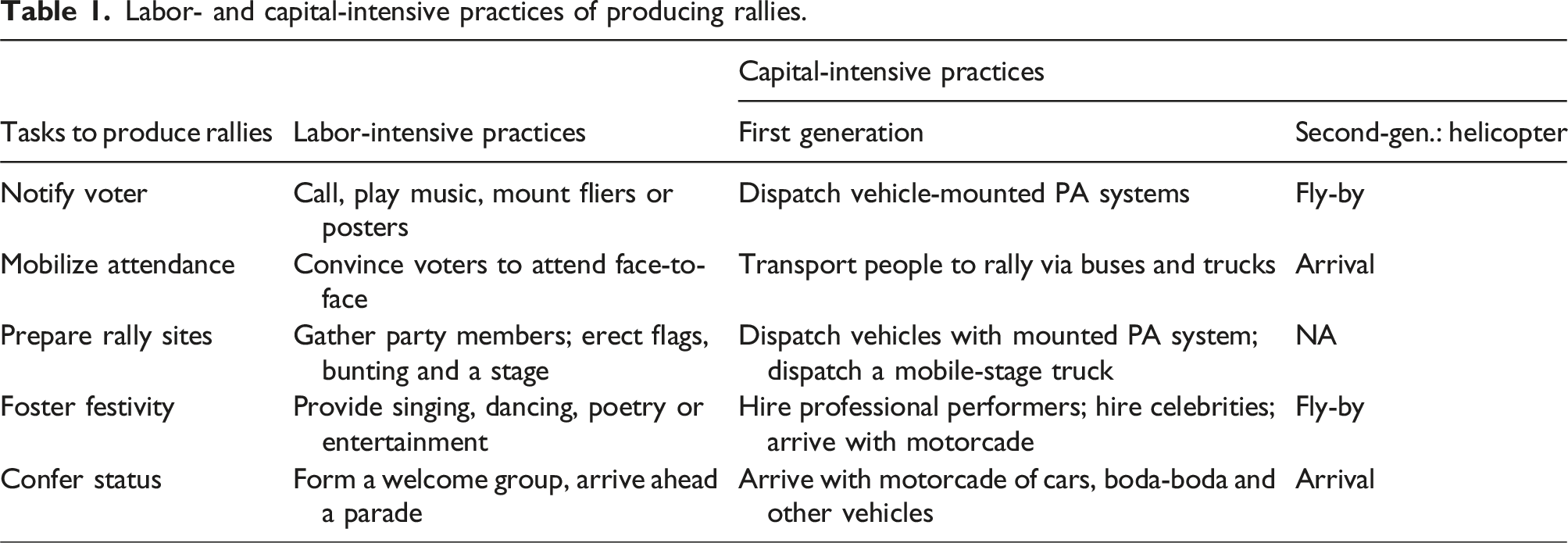
In Tanzania, Chadema and CCM have far-reaching networks of branches (Morse, 2014). Through them, assortments of activists undertook labour-intensive tasks at rallies which fulfil at least five functions.
First, activists notified people about the rally. Wherever I went, party activists described the same practices. Branch chairpersons instructed activists to spread news of a rally by word of mouth. Simultaneously, they would arrange for general announcements to be made by musicians and callers (Anonymous L, 2015).
Second, activists prepared the rally site. At numerous rallies which I attended, organizers had raised flags, erected stages, laid-out chairs, unlocked gates, threaded cordons, and hung bunting in party colours. They also prepared rally sites by populating them. They formed a starter-crowd which would ease others’ anxieties about being the first, conspicuous attendees.
Third, and relatedly, these rally producers fostered festivity at rallies. They did so in part by laying on entertainment. Often, this entertainment consisted of ngoma: a women’s singing and dancing group (Fieldnotes, 2015i; 2015j). Other times, it incorporated other dancing and singing (Fieldnotes, 2015d; 2015h). Those populating the starter-crowds further cultivated a jubilant atmosphere at rallies by fulfilling the role of shills or claqueurs. They acted and led others in acting festively: cheering, dancing, smiling and otherwise exhibiting joy.
Fourth, activists mobilized attendance. Activists not only notified their neighbours about rallies but went door-by-door to persuade people to attend them. I followed Chadema campaigners on one such pre-rally canvass (Fieldnotes, 2015l) and I was told by others that this practice took place (Anonymous O, P, and Q, 2015).
Lastly, activists conferred status on the candidate by forming welcome committees that received them and then accompanying them the final paces to the rally site in elaborate and attention-attracting processions. I witnessed such meetings and processions at multiple rallies (Fieldnotes, 2015d; 2015j; 2015n). In them, the candidate was performatively constructed as someone who was both revered and united with those that greeted them.
Once, rallies were produced in Tanzania principally through these practices. However, new practices of rally production have been gradually adopted since then. Parties increasingly notify residents about forthcoming rallies using vehicle-mounted public address (PA) systems. If a parliamentary candidate used PAs in 1995, she probably used only one, to amplify her speeches (Mtei, 2009). By 2015, at most rallies I attended, there were several. While one was reserved for speakers, others were deployed ‘to go around the community announcing that there will be a rally’ (Anonymous K, 2015). Supplementing callers and musicians with vehicle-mounted PAs is an unambiguous case of rally capitalization.
Parties also used PAs to prepare rally sites. Typically, a vehicle-mounted PA was dispatched to play music and become a visible – and indeed, an audible – congregation point (Fieldnotes, 2015c; 2015g; 2015k; 2015l; 2015m). They also transported mobile stages (Anonymous B, 2017; Anonymous C, 2017). The most modest were platforms, erected on-site (Fieldnotes, 2015g). The most elaborate were trucks converted to bear mechanized stages, PAs and generators (Fieldnotes, 2015f). Such customized trucks were most frequently used by presidential candidates, but I also saw them used by better-resourced parliamentary ones (Fieldnotes, 2015h; 2015m).
While mobile stages stayed at each rally until it’s close, once a rally had begun, PA trucks were dispatched to the next in the series of rallies scheduled for that day. There, they would announce the rally and contribute to its preparation, acting as a mobile advanced team. This enabled parties to prepare several rallies in tandem which candidates could move between them rapidly. Several campaigners explained these this rally preparation in relay to me (Anonymous A, 2017; Anonymous M, 2015). I witnessed both CCM and Chadema parliamentary candidates adopt these methods as I followed their successive rallies throughout the day (Fieldnotes, 2015c; 2015g; 2015j; 2015l).
The PA was also used to foster festivity. The volume and bass of the stereo is a draw in (rural) Tanzania. I often watched people rushed to dance to music between each speaker’s address (Fieldnotes, 2015e). The PA also enabled new forms of entertainment to be laid-on. At one rally (Fieldnotes, 2015k), the music played through the PA formed the backdrop to acts which danced to bongo flava [a fusion of hip-hop and Afropop]. At another, a cohort of young, urbane and ostentatiously wealthy campaigners were bussed in to dance to the same (Fieldnotes, 2015g). Altogether, the vehicle-mounted PA system is an archetypal case of how rally production changed in Tanzania. New person-roles and practices of rally production were developed in which incorporated it. These practices gradually supplemented and, in some cases, replaced previous, labor-intensive practices of notifying residents, preparing sites, and fostering festivity.
PAs aside, vehicle-use increased between 1995 and 2015. I witnessed trucks carrying people to parliamentary candidates’ rallies in four constituencies (Fieldnotes, 2015d; 2015g; 2015h; 2015m). A CCM district campaign manager said that they employed 20 vehicles in addition to buses to transport people (Anonymous C, 2017). Equally, parties motorized their face-to-face mobilizers of rally attendance by mounting them on motorbikes (Anonymous R and S, 2015).
Equally, candidates travelled to rallies at the head of long motorcades. I watched CCM’s presidential candidate arrive in Mwanza accompanied by perhaps a hundred cars and several hundred boda boda (Fieldnotes, 2015p). I rode in two similar such convoys for Chadema’s presidential candidate (Fieldnotes, 2015q; 2015r). However, parliamentary candidates arranged motorcades too. One led a convoy through tiny hamlets accompanied by four cars and 20 boda boda (Fieldnotes, 2015n). 1 One led a parade to collect nomination forms accompanied by 12 mini buses, 45 boda boda in addition to various vehicles (Fieldnotes, 2015a). 2 Often, even routine journeys which were not even a part of rallies were turned into rolling motorized parades (Fieldnotes, 2015o).
These motorcades were spectacles. Their speed, size, and noise; the party colours in which they were painted and the flags that streamed behind every vehicles were captivating to behold. Each additional vehicle in a motorcade not only augmented the spectacle; in their pageantry and ostentation, they fostered festivity. At moments, in their noise, exuberance and flamboyance, they even created carnival-like atmospheres in which the normal limitations of social behaviour, it seemed, were exhilaratingly suspended. These processions also gave further status to the candidate or party. It exhibits the wealth required to assemble this train of vehicles. Equally, it exhibits a form of wealth in people. It displays the number of people literally following the candidate. In these respects too, among other things, these capital-intensive methods replicated effects previously achieved using labor-intensive ones, at greater scale.
The most capital-intensive method used to produce rallies is the helicopter. Helicopters gave candidates both speed and mobility. The helicopter also gave them status. The helicopter is an emblem of modernity, a symbol of humankind’s triumph over their natural limitations through flight. Chadema Central Committee member Mwesiga Baregu remarked that the helicopter ‘suggests power and importance’ (Baregu, 2015). Equally, it invokes metaphors about social status and elevation; politicians in helicopters literally descend to the village. Another Chadema Central Committee member, Tundu Lissu, explained that ‘For a lot of people, airplanes are things you see up in the sky’ (Lissu, 2015b).
Helicopter landings are also spectacles. This extraordinary dimension of the helicopter fosters festivity and mobilizes voters to attend rallies. One Chadema parliamentary candidate remarked that ‘The chopper attracts masses, people come to rallies to see it’ (Anonymous M, 2015). A newspaper report of a Chadema rally in 2005 read ‘The helicopter hovering within the Usa-River caused major stir in the township as thousands of people left their regular tasks and rushed towards the open air venue’ (Arusha Times, 2005). I witnessed a similar event first-hand in Iramba (Fieldnotes, 2015g).
Pilots seemed to understand and play to the spectacular aspect of the helicopter. I observed this when Chadema’s presidential candidate arrived at a rally by helicopter. The pilot flew the helicopter in a long ellipse around the rally site, making several passes. The pilot may have been deciding where to land the helicopter, but her orbital path was unnecessarily wide. It took the helicopter far past the grounds and over the body of the nearby town. This impromptu air show lasted 8 min (Fieldnotes, 2015b). The pilot was notifying the town that Chadema’s presidential candidate had arrived. These tactics are commonplace in Tanzania. One campaign veteran said that typically ‘the chopper would hover around the city, town and village, and that way draw people to go [to] the rally’ (Baregu, 2015).
In this regard, the helicopter can fulfil many tasks in rally production. Therefore, it can be used as a supplement to or a substitute for other labor- or capital-intensive methods. The helicopter’s potential as a wholesale substitute, in combination with mobile truck stages, was illustrated in the 2005 elections, when Chadema’s presidential candidate, Freeman Mbowe, flew to rallies by helicopter. Lissu said of the helicopter that: … We didn’t have party structures on the ground. Without a chopper, we wouldn’t have been able to organize rallies. … [because they flew by helicopter] we were able to get a huge number, to compensate for the lack of ground troops (Lissu, 2015b).
Labor- and capital-intensive practices of producing rallies.
Rising election campaign expenditure
In this section, I discuss the evidence that between 1995 and 2015, parliamentary campaign expenditure rose across parties, which supports Hypothesis Two. Then I discuss the evidence that these rises in expenditure were made-up of higher spending on rally capitalization, which supports Hypothesis Three.
There are few publicly available sources that aggregate campaign spending in Tanzania. However, numerous qualitative accounts form a picture of low parliamentary campaign expenditure in 1995 (Lissu, 2015a; Jussa, 2017; Mtei, 2009: 207–8). These conditions were especially commonplace across the opposition from 1995 to 2005 (Shayo, 2005). However, both CCM’s and Chadema’s campaign expenditure rose, especially between 2005 and 2015. Domestic election observers judged that in 2010: …the campaign materials for the bigger parties, especially the ruling CCM, are clearly more elaborate and expensive in this than in previous elections… some parties and candidates have spent fortunes. (TEMCO, 2011: 8)
Describing the 2015 election, domestic observers wrote that parties made ‘the huge investments during campaigns’ (LHRC and TACCEO, 2016: 38). Tanzanian politicians give similar first-hand accounts of recent changes in campaign expenditure. For example, one CCM ward account attested that at ‘the last election [2010] the spending increased’ (Anonymous J, 2017). However, it is also corroborated by a series of secondary studies (Babeiya, 2011; Cooksey and Kelsall, 2011). Two representative surveys of parliamentary candidates, between them, offer a picture of parliamentary campaign expenditure more than doubling between 2005 and 2015, on which, more below (Khisa et al., 2022; Mattes and Mozaffar, 2019). Therefore, even if the data presented above were insufficient to confirm Hypothesis Two beyond reasonable doubt, this hypothesis stands a fortiori on the strength of prior research. Altogether, there is significant evidence in support of Hypothesis Two.
Five anonymous parliamentary candidates and campaign managers gave estimates of the total costs of their 2015 campaigns. They cluster at $46,000 (Anonymous A, B, C, D 2017; Anonymous M, 2015). 3 As a point of reference, GDP per capita in Tanzania stood at $836 in 2015. 4 These estimates are vulnerable to unrepresentativeness. However, they are corroborated by an independent, representative survey of 2015 parliamentary candidates in Tanzania, referred to above, which puts their campaign costs at almost an identical figure: $42,100 (Khisa et al., 2022). They also sit in the middle of the pack of estimates of parliamentary general election campaign costs which have been recently generated from representative candidate surveys in other eastern African countries more recently, including Malawi ($14,700, 2019), Zambia ($39,900, 2021), Uganda ($68,700, 2017), and Kenya ($95,700, 2017) (Cost of Politics, 2023). 5 Therefore, the $46,000 estimate provided here is a conservative benchmark against which to estimate the proportion of campaign expenditure dedicated to capital-intensive methods of rally production in 2015. Interviewees gave the daily price of car-hire at between $23 and $69 (Anonymous E, F, and G, 2017), consistent with quotes which I received (Anonymous N, 2015). For all 63 days of the official campaign, one car at these prices would consume between 3.2% and 9.5% of a $46,000 budget. The equivalent prices they gave for PA van-hire put full campaign-use at between 6.3% and 15.8% of a $46,000 budget. These estimates exclude fuel. Almost all CCM and Chadema parliamentary candidates hired entire squadrons of vehicles. Therefore, the cost of hiring and fueling these vehicles alone would near-fill campaign budgets.
Finally, helicopters dwarf other campaign expenditures. A quote from a Tanzanian aviation company put the hourly-price of helicopter-hire at $3250, exclusive of landing and pilot fees (Anonymous H, 2017). A Tanzanian politician estimated $2000 per hour (Anonymous M). Even at this lower price, one four-hour day would consume 17% of the typical $46,000 budget. Six such days would exceed it. In the 2015 campaign, CCM and Chadema employed at least ten helicopters between them. Assuming conservatively that they were employed for four-hour days for half the campaign, total expenditure on helicopter-hire alone would have been over $2.5 million. Therefore, it can be deduced that exorbitant amounts were spent capitalizing rallies in 2015, and moreover, that extremely high proportions of parliamentary candidates’ campaign expenditures in 2015 were dedicated to capital-intensive rally production.
Interviewees attest to this directly. A Chadema parliamentary candidate’s campaign manager told me that ‘in campaigns you must use cars, and PA systems, all of those are hired, and they are expensive’ (Anonymous I, 2017). Similarly, when a CCM parliamentary candidate’s campaign manager was asked what the most expensive campaign parts of the campaign were, he replied ‘The public announcement and music truck’ (Anonymous J, 2017). Another opposition party leader Ismail Jussa (2017) told me that ‘most of the funds that we have used go into the rallies in the campaign.’
Altogether, I have presented evidence (primary and secondary) that parliamentary campaign expenditure by CCM and Chadema candidates rose between 1995 and 2015. I have presented evidence that extremely high proportions of that 2015 expenditure was dedicated to the capital-intensive production of rallies. Finally, I have presented evidence this capital-intensive rally production followed a 20-years process in which rally production gradually capitalized. Given the nature of data collection in authoritarian regimes, this evidence has limitations, and so Hypotheses One to Three cannot be confirmed beyond reasonable doubt. Nevertheless, there is a clear preponderance of evidence which supports each of them. If one accepts these three claims, it a logical necessity is that the rise in campaign expenditure from 1995 to 2015 was composed in significant part by the increase in the capital-intensive production of rallies.
Therefore, by the reasoning laid out above, the strong versions of the mediatization and clientelism theories should be rejected. The evidence presented above shows that rally capitalization did not constitute a negligible portion of rising campaign expenditure; it constituted a significant portion of it.
Patterns in helicopter proliferation
In this section, I present evidence which addresses the role of innovation and competition in rally capitalization across parliamentary and presidential campaigns through helicopter use, in accordance with Hypotheses 4 and 5.
In congress with the literature on campaign technology (Epstein, 2018; Gibson and Rommele, 2001), in Tanzania, innovation began where it was most urgent: in the opposition. Chadema MP Philemon Ndesamburo became the first parliamentary candidate to campaign by helicopter, in 2000. In 2005, Chadema Chairman Mbowe became the first presidential candidate to do so. In 2010, President Jakaya Kikwete (CCM) did too. This behavior was congruent with imitation; it appears as though politicians mimicked one another as they made new inferences about the electoral advantage the helicopter supplied. Indeed, that is how Chadema leader Baregu interpreted events. He told me that Mbowe’s helicopter-use ‘put CCM completely on the wrong foot. Afterwards, they realized they could maybe draw on our example’ (Baregu, 2015). This supports Hypothesis Four.
However, CCM went further than matching Chadema’s helicopter use; it exceeded it. In 2010, CCM arranged for not one but three helicopters to transport its presidential candidate and other national leaders across the country (TEMCO, 2011: 54). Chadema used two helicopters in 2005 and 2010. However, in 2015 it hired four. Its leaders also frequently travelled between airfields by private plane. Perhaps anticipating Chadema’s upscaling, CCM parliamentary candidates hired at least six helicopters between them (Ubwani, 2015). This pattern of helicopter adoption is consistent with a process of competitive outbidding specified in Hypothesis Five. This is also suggested by interviewees. One Chadema official said that ‘In 2015, the candidates were motivated to spend more and reach a big number of people’ (Anonymous A, 2017). Altogether, this supports Hypotheses 4 and 5. This support does not decisively confirm that patterns of innovation and competition drove adoption; it remains possible that some other process drove both of these pheneomena. However, it is indicative of it.
Conclusion
In Tanzania, from 1995 to 2015, campaign costs rose. In all likelihood, this process was driven in part by clientelism and mediatization, as previously studies suggest. However, I have made the case that it was also driven by a competitive process of rally capitalization. Therefore, accounts of campaign cost inflation in Africa should be revised. It could be that Tanzania’s rally capitalization is an outlier. However, as many campaigns in Africa are rally-intensive, they provide enabling environments for this process. Moreover, this competition-driven process gathered pace in Tanzania in spite of the competition-blunting authoritarianism of a dominant party. The implication is that in more competitive campaigns, rally capitalization will have proceeded further. For instance, in Kenya, politicians registered 86 helicopters for its 2017 campaign (Duggan, 2017) – rally capitalization par excellence.
In this article, I have lifted the hood on how rallies are produced. I have begun to illustrate just how complex rally production is, and the variety of actors, intentions, practices and devices it involves. Future research should explore how rallies are produced elsewhere, and indeed how rally production is changing. More widely, I have illustrated one way in which the forms that campaign modernization in the global south takes in the global differ from those charted in the global north. Future research should explore what forms of campaign modernization takes elsewhere. It should resist the temptation to graft the historic experience of the global north onto that of the contemporary global south in the process.
Finally, rallies were banned (for opposition parties, in practice) in Tanzania in June 2016. Apart from a 2-month pause for the 2020 election campaign, the ban stayed in place until January 2023. This article throws into relief yet another way in which this ban was consequential. Not only may the ban have sapped opposition support and undermined opposition party-building for which the rally was used (Paget, 2022). It is possible, perhaps likely, that it interrupted the continuous, creative and costly process of innovation in rally production.
Supplemental Material
Supplemental Material - Capitalized rallies: Why campaigns costs are rising and rallies are hybridizing in Tanzania
Supplemental Material for Capitalized rallies: Why campaigns costs are rising and rallies are hybridizing in Tanzania by Daniel Paget in Party Politics
Footnotes
Acknowledgements
This paper emerged out of my doctoral dissertation. Thanks to my doctoral supervisor Nic Cheeseman, and my examiners Robin Harding and Cristian Vaccari. Thanks to Jonny Steinberg, Andrea Purdekova, Ole Therkildsen, Barnaby Dye, Michaela Collord, Macha Rauschenbach, and Rebecca Engrebetsen for comments on previous versions of this paper. Thanks to Michael Wahman for his encouragement and interest in this paper. Thanks to LSE WGAPE 2020 organizing committee for their interest in this paper. Thanks to those that gave comments on this paper at ASA 2017, the Oxford African Studies Seminar Series in 2017, and PSA MPG 2019. Everlasting thanks to my research assistants and all those in Tanzania that cooperated with me in my research.
Declaration of conflicting interests
The author(s) declared no potential conflicts of interest with respect to the research, authorship, and/or publication of this article.
Funding
The author(s) received no financial support for the research, authorship, and/or publication of this article.

Supplemental Material
Supplemental material for this article is available online.
Notes
Author biography
References
Supplementary Material
Please find the following supplemental material available below.
For Open Access articles published under a Creative Commons License, all supplemental material carries the same license as the article it is associated with.
For non-Open Access articles published, all supplemental material carries a non-exclusive license, and permission requests for re-use of supplemental material or any part of supplemental material shall be sent directly to the copyright owner as specified in the copyright notice associated with the article.
