



Abstract
Scholars have identified the important roles personal characteristics — such as religion, gender, and race — play in influencing policymakers' position-taking behavior. One important yet overlooked personal characteristic is generation. This personal characteristic is not only influencing individual policymakers’ position-taking behavior; it is also changing some important political realities across Europe. An illustrative example of these changes is Finland's decision to join NATO. Based on documentary analyses of parliamentary speeches and personal interviews with Finnish officials, this article demonstrates that Russia’s 2022 invasion of Ukraine revealed already established, generation-based cleavages among MPs whose parties had long opposed the prospect of joining NATO. The speeches also reveal a dynamic and evolving orientation to the Baltic states among an emerging political cohort of Finnish MPs, who have been socialized in a fully EU-integrated Finland.
Introduction
When scholars discuss officials’ position-taking behavior, they typically focus on voters and parties. These are very important determinants in explaining the behavior of political candidates and elected officials. However, as Baumann et al. (2015) have argued, this approach tends to equate parties’ official positions with those held by individual political actors. As such, some researchers have sought to incorporate personal characteristics into their analyses of political actors’ position-taking behavior. Given the amount of fragmentation and diversity within U.S. political parties, analyses of American policymakers’ personal characteristics are more common than in Europe (or elsewhere). Existing studies focus on gender, religion, and ethnicity (Burden 2007; Washington 2008; Baumann et al. 2015). But this scholarship has overlooked a significant personal characteristic in determining elected officials’ position taking behavior – namely, generation.
Generation (or political cohort) is more difficult to unpack than other personal characteristics. However, some rare occasions do allow analysts to identify differences based on the political cohorts of elected officials. And these differences are important; they explain several phenomena taking place across Europe. A new generation of European MPs, whose adult lives have been spent after the Cold War and within a fully integrated EU, are increasingly assuming leadership roles. While many become members of already established parties, this post-EU accession cohort often understands itself and party ideology differently than their more senior colleagues.
Focusing on distinct political cohorts, this analysis unpacks Finland’s decision to join NATO. While Finnish public opinion underwent a radical change in the aftermath of Russia’s 2022 invasion of Ukraine, several younger MPs – from political parties whose official positions on NATO changed – had already begun articulating openness to membership before the invasion. 1 Even among MPs from Finland’s Social Democratic Party (SDP), a party for which opposition to NATO, at least in theory, was especially entrenched, Russia’s invasion revealed cohort or generation-based ideological cleavages among Finnish political elites. While voter pressure explains, in many ways, why even some of Finland’s largest and most resistant political parties ultimately decided to support NATO membership, it does not clarify policymakers’ positions and the implications thereof. Documentary analyses and interview data with Finnish MPs reveal that the decision to join NATO signified a larger, generation-based ideological shift among a new Finnish political cohort, one whose political socialization took place in a fully EU-integrated Finland. Contrasting pre- and post-EU accession cohorts of Finnish MPs, this article adds the role of generation in terms of explaining MPs’ position-taking behavior.
In analyzing cohort-based cleavages, this article also complicates existing scholarly assumptions about the collective Finnish political identity or brand. While analysts have long assumed that opposition to NATO, identification with the Nordic states, and self-differentiation from the Baltic states have formed integral parts of Finnish geopolitical reality and identity (Aunesluoma and Rainio-Niemi 2016; Forsberg 2018), recent scholarship has noted a tendency in some of Finland’s policies to deviate from these orientations (Elgström and Delputte 2017; Ojanen and Raunio 2018). This analysis adds to that scholarship by demonstrating some important shifts taking place in the behavior of many Finnish MPs, particularly regarding NATO, Europe, and the Baltic states. While several policymakers still strive to mirror the policies of and identify with Nordic neighbors, a new generation of Finnish MPs is looking to Europe (including Baltic and Eastern European states) for guidance and inspiration in places their more senior colleagues and predecessors have consciously avoided.
Personal characteristics and MPs’ position-taking behavior
Based on principal agent theory, scholars typically assume incumbents behave instrumentally – that is, in ways that conduce to career advancement (Müller 2000; Strøm 2012). As such, incumbents’ behaviors are understood to relate to a strict set of circumstances, such as level of competition for them to win in whatever political contests they participate – nominations, elections, reelections, etc. (Strøm 1997, 2012). The literature nuances ‘voters’ by differentiating between specific party supporters and the general electorate; these nuanced distinctions result in different behaviors among parties (Ezrow et al. 2011; Klüver and Spoon 2016). In addition, the scholarship accounts for the deviations, which occur when the electoral setting varies – that is, proportional systems, competitive single-party districts, and intraparty competitions with preference voting lead to distinct behaviors (Baumann et al. 2015). In some of these systems, individuals win political competitions based on their standing within a constituency. Nonetheless, these approaches relate to the important external pressures, which determine incumbents’ individual position-taking behavior.
While more traditional accounts have identified a tendency for parties to project clear and consistent party positions (Ranney 1954; Dahlberg 2009), several scholars have noted scenarios in which political actors’ behaviors diverge from party lines. In some scenarios, it is advantageous for parties to represent voters with a range of decisions from which to select, particularly in district-level elections (Rovny 2012; Somer-Topcu 2015; Bräuninger and Giger 2018). By doing so, parties appeal to both public and partisan concerns simultaneously (Ezrow et al. 2011). In such circumstances, legislators have more freedom in taking positions, which do not always conform to the party line. In addition, when looking at the behavior of individuals, scholars have noted the ways in which certain initiatives – such as the drafting or the cosponsoring of bills – yield positive electoral results (Bowler 2010). These important analyses reinforce the central connection between behavior and electoral success.
But elected officials offer prospective voters not only a range of decisions but also a range of principals – or, as Carey argues, ‘competing principals’ (2009). Building on instrumental approaches in assessments of political actors’ position-taking behavior, some researchers have identified important ways in which personal characteristics or values influence behavior, too (Burden 2007; Jones 2009; Baumann et al. 2015). For example, Burden’s Personal Roots of Representation correlates policymakers’ support of diverse legislation, such as tobacco regulation, women’s reproductive rights, religion, and several others, with attributes they specifically possess (2007). Subsequent research has expanded Burden’s findings (Washington 2008; Baumann et al. 2015). Factoring personal characteristics into incumbents’ position-taking behaviors does not contradict instrumental approaches; rather, it extends the research to include other important considerations, which explain how political actors behave. This is especially true when there exist few external constraints. As Baumann et al. argue, ‘How closely MPs’ behavior will mirror internal factors depends on the strength and direction of external pressures. Personal characteristics will be evident in legislative behavior only if few or rectified external pressures exist’ (186, 2015).
Where there is less external pressure (i.e., party commitments, voter preferences, etc.), the influence of political actors’ personal characteristics play a larger role in explaining their behaviors (Searing 1994). In the existing research, this has meant unpacking individual actors’ religious backgrounds, personal or professional expertise, family compositions, and self-interests – such as those factors that enhance the wealth of individual actors (Burden 2007). Scholars have thus unpacked the role several personal characteristics, such as religion, gender, race, and/or ethnicity, play in determining or anticipating policymakers’ behaviors (Baumann et al. 2015; Wängnerud 2009) -- and these personal characteristics take shape within social groups (Jenkins, 2014; Young 2000).
In these discussions, however, scholars have not yet unpacked political actors’ respective generations (or political cohorts). While the concept and influence of distinct generations are difficult to guage, there exists relative consensus that this phenomenon (or personal characteristic) plays a central role in shaping the views of a people, who are socialized at roughly the same time and in response to a similar set of key events (Mannheim 1970; Searing et al. 1976; Inglehart, 1977; Putnam, 2000). As such, generation factors centrally in several analyses of identity and behavior among voters (Jennings et al. 2009; Cohen 2011; Winograd and Hais 2011; Dalton 2015; Medenica, 2018). And these considerations apply to elected officials, as well. Or, as Jones indicates, ‘politicians are people, too’ (2009). Incumbents form social and political identities in the same way as the voters on whom they rely (Mead 1934). Where there exist few external pressures, officials’ personal characteristics (which include the political cohorts within which they were socialized) manifest themselves more clearly. I would argue, however, in rare cases, when public opinion aligns across the political spectrum, personal characteristics are also identifiable. These cases are rare, but, when they emerge, they offer scholars unique analytical opportunities.
Russia’s 2022 invasion of Ukraine was one of these opportunities. In Finland, Russia’s war against Ukraine caused a sea change in public opinion about NATO membership. In 2021, 24% of Finns supported Finland joining NATO; in 2022, this number had increased to 68% – and only 15% opposed it. 2 With the exception of voters from the Left Alliance (47%), which held 16 out of 200 seats in Parliament (8%), Finnish MPs from the other major political parties formed significant majorities – 83% (Coalition Party), 79% (Center), 74% (Social Democrats), 72% (Finns), and 67% (Green). The shift in popular opinion put intense pressure on parties across the aisle to lodge an application for NATO membership. Reflective of this external pressure (and other factors), MPs supported membership at a staggering rate – 188 to 8 (that is, nearly 96% of those who ultimately voted supported the bill). Six out of the eight who voted against membership were from the Left Alliance; three MPs were counted absent.
But focusing exclusively on the attitudes of the larger voting population to explain the behavior of the MPs is somewhat misleading. While most Finns disapproved of NATO membership prior to Russia’s invasion (53% in 2020), 3 by April 22, 2022, a significant majority of Finns supported it (68%). Nonetheless, the largest share of Finns, who retained negative views about membership were, according to survey data from The Advisory Board for Defence Information (ABDI), the youngest – between 25 to 34 years of age (23%) and those under 25 years of age and younger (18%). In contrast, 14% of Finns between 35 and 49 years of age and 12% of those older than 50 had a negative attitude. 4 As such, while a significant majority of Finns supported membership in NATO across demographic age groupings, the survey data did, to a certain extent, distinguish the overall young population from the young MPs. At the outset of Russia’s invasion of Ukraine, the strongest and most vocal support among MPs often occurred among younger members – namely, MPs in their 20s, 30s and early 40s – while the strongest reservations typically came from more veteran MPs, particularly (but not exclusively) the large Finnish Social Democratic Party (SDP).
This disparity may, in part, speak to Lenz’ critique of issue voting – namely, that the behavior of voters often conforms to that of elected officials based on the perception of performances rather than policies of the political elites for whom citizens voted (2013). Indeed, based on ABDI data from December 2022, the percentage of those 25–34 years old with negative views about Finland’s membership in NATO had decreased to 19% (from 23%), and those 25 and younger to 16% (from 18%). 5 While the empirical data do not necessarily prove a causal link, the gradual decrease may, as Lenz argues, reflect a tendency among some Finns to ‘follow the leader’.
To some extent, this shift on NATO among a post-EU accession political cohort of Finnish elected officials ‘updates’ scholarly accounts. For example, Aunesluoma and Rainio-Niemi have argued: ‘Finland’s Cold War policy of neutrality cannot be reduced to mere pragmatism and strategic thinking. Neutrality became an integral part of how common people and policymakers alike thought about Finland. That is, neutrality became a part of Finland’s national identity and a key element in its distinctively national state ideology’ (78, 2016). Apart from the political leadership that had long supported the prospect of NATO membership, parliamentary speeches taking place in the aftermath of Russia’s 2022 invasion of Ukraine frequently bear this argument out among Finnish MPs, who grew up in the 1950s, 1960s, and early 1970s. For those born, largely, in or after the 1970s, however, Finnish MPs consistently manifested distinct behavior in discussions not only about NATO but also about themselves.
Background
Following the Finnish Civil War (1915–1918), Finland broached forming a security alliance with several countries – Germany and, after, Poland and the Baltic states (Alapuro 1988; Pivoras 2020). These efforts fell through, however, in the early 1920s when parliament opted not to ratify the 1922 Warsaw Accord (Kaukiainen 1984, 205). Ultimately, Finland sought collective security through membership in the League of Nations. By the mid-1930s, Finland’s foreign security policies resembled those of the Scandinavian countries – that is, neutrality (Kaukiainen 1984; Götz 2005). In 1939, Soviet Russia attacked Finland in the Winter War. During the war, Finland faced a much larger foe on its own. While Finns countered Russian attacks for several months, this conflict resulted in Finland ceding large swathes of its territory to the Soviet Union (Hill 2017). In the 1941–1944 Continuation War, Finland joined Nazi Germany in its efforts to repel Soviet Russia. Aggressions involving Finland, the Soviet Union, and Nazi Germany continued until 1947 with the Paris Peace Treaty. This treaty kept Finland out of the Soviet Union – a fate that befell the Baltic states – but meant more territorial losses to the Soviets. In the early and mid-1940s, discussions with Denmark, Norway, and Sweden about forming a defense union (that is, the Scandinavian defence union) fell through. As several western powers sought to counter the Soviet Union in the aftermath of the Second World War (including, ultimately, the foundation of NATO), Finland signed the Treaty of Friendship, Cooperation and Mutual Assistance with Russia in 1948 (Gebhard 2017).
Finland’s treaty with Russia also established a precedent in terms of its future orientation to NATO. As the Cold War developed, Finland became alienated from potential Western Allies, particularly those that the Soviet Union considered antagonistic – such as West Germany and United States. Finnish leadership therefore established a series of norms and policies, which specifically catered to their geopolitical circumstances. This approach meant maintaining positive relations with the Soviet Union and staying out of military alliances to safeguard their own sovereignty – a stance that has become identified as the ‘Finlandization’ model (Allison 1984, 124). At the same time, Finland developed its own military capabilities, maintained its autonomy in terms of policy-making decisions, and avoided economic dependence on the Soviet Union (Forsberg 2018, 101).
Its position, however, did not stand in the way of Finland forming ‘strategic’ partnerships, especially with other Nordic countries – particularly, with Sweden – from the early 1990s onward (Forsbeg 2018). The tie with Sweden led Finland to follow suit in swapping its ‘neutrality’ position for one of military ‘non-alignment’; in addition, Finland followed Sweden when the latter lodged an application to join the European Union (EU) in 1990. By 1995, with support from the public, Finland had also become a member state (Arter 1996). Among Nordic states, Finland showed the greatest support for the 1994 EU referendum; and, importantly, this support registered most conspicuously among younger Finnish voters (Arter 1995). As Finland transitioned into a more integrated Europe, this integration also enabled it to form partnerships with several defense organizations, including Partnership for Peace (PfP), the Euro-Atlantic Partnership Council (EAPC), the North Atlantic Cooperation Council (NACC), Nordic Defence Cooperation (Nordefco), and NATO operations in Bosnia, Kosovo, and Afghanistan (Ojanen 2006; Forsberg 2018). As perceptions of NATO improved, Finland introduced its ‘option policy’ to join the organization should circumstances change. 6 Given the ambiguity of the circumstances that would, in fact, warrant reconsideration, Finnish parties have divided along distinct lines.
Among those that long resisted the prospect of NATO membership were some of Finland’s largest political parties, such as the Center Party and the Social Democrats. While some prominent Finnish Social Democrats have openly supported NATO accension – such as, former President Martti Ahtisaari and former MP and MEP Liisa Jaakonsaari – the Social Democrats played an open role in ensuring that Finland did not join. President Tarja Halonen (2000–2012) made maintaining Finland’s non-alignment status a priority of her presidency. While still strengthening military cooperation with NATO and other Nordic countries, Finland’s Social Democrats remained opposed to the prospect of joining the alliance (Forsberg and Vaahtoranta 2001; Dahl 2011; Forsberg 2018). Forsberg has noted this long-standing opposition among many prominent Finnish Social Democrats: ‘The majority of Social Democrats are also against Finland’s membership of NATO, with former President Halonen and long-time foreign minister Erkki Tuomioja (2000–07 and 2011–15) famously associated with a reserved attitude towards the issue, but again, there are also a few prominent supporters of NATO within the party ranks as well’ (111, 2018).
Russia’s annexation of Crimea in 2014 and other forms of aggression before 2022 intensified debate among Finnish MPs. By late 2021, several MPs from different political parties had already ‘broken rank’ and articulated support for NATO. For example, some MPs from the Green Party and the Finns Party had received backlash for publicly taking a pro-NATO position. Nonetheless, apart from MP Suna Kymalainen, an outlier who had advocated for NATO membership since at least 2013, Social Democratic MPs did not manifest willingness publicly to deviate from the party line. Rather, they preferred to maintain a special relationship and continue with their policy of a ‘NATO membership option’ (Kanniainen 2022).
Nonetheless, in the months following Russia’s 2022 invasion of Ukraine, Finnish MPs decided to exercise this option. While the war provided those who had long advocated NATO membership far more incentive, parliamentary debates also reveal that many of Finland’s elected officials had formed their positions before Russia’s 2022 mobilization or invasion. They also indicate that, for many MPs, the war did not immediately convince them to join NATO. Rather, the Finnish parties, which had most staunchly opposed it beforehand, manifested cohort-based position-taking behaviors. For example, in the immediate aftermath of the 2022 invasion, more senior Social Democratic MPs continued to advocate the same justifications they had employed from the end of the Cold War. However, younger Social Democrats – most conspicuously, then Prime Minister, Sanna Marin – articulated a ready willingness to join the alliance. Emboldened by Russia’s aggression, young MPs – both SDP and otherwise – began openly advocating distinct beliefs and values in parliamentary speeches and debates. By mid-May, the SDP and all the other parties had largely coalesced in support of membership.
Methods
Data for this article consist of documentary analyses of relevant parliamentary speeches as well as 16 expert interviews. Interviews were, largely, with Finnish MPs who had voted on the NATO bill. But I also interviewed a Social Democratic analyst from a Finnish think tank. And, for comparative perspective, I interviewed a Swedish Social Democratic analyst as well as a Swedish MP. While undertaking fieldwork in Finland, I also spoke informally to several Finnish non-elected city and state officials as well as political analysts.
For documentary analysis, I drew from Finland’s parliamentary speeches, particularly from the last several years, on the topic of security and NATO. By analyzing MPs’ speeches in parliament, I was able to identify the rhetorical and ideological shifts, which have taken place among Finnish MPs. To contextualize and nuance the parliamentary speeches, I also interviewed several of the MPs, who voted on the NATO bill. Not as many Finnish MPs as I had hoped were willing to sit for interviews. Nonetheless, I did manage to speak to several Social Democratic officials, who had been the most vocally outspoken on the topic of NATO, such as MP (and former prime minister) Antti Rinne, MP (and former foreign minister) Erkki Tuomioja, MP Kimmo Kiljunen, and MEP Miapetra Kumpula-Natri. In addition, I spoke to several younger MPs from other parties – including former Prime Minister (2003–2010) and Speaker of the Parliament Matti Vanhanen (Center Party), Green Party Chairperson, MP Atte Harjanne, and several other MPs from various political parties.
Based on parliamentary speeches, I sought to interview those who had voiced opinions on the topic of NATO (before and after Russia’s invasion). During the interviews, I asked MPs for their parties’ as well as their personal histories regarding the prospect of NATO membership. With participants’ consent, I audio-recorded interviews. I asked each for permission to use their names in any quoted material. I have omitted those who preferred the information provided remain confidential. By combining documentary analysis and expert interviews, I was also able to recreate how Finnish political elites’ perspectives shifted (or did not) just before and in the immediate aftermath of Russia’s 2022 invasion of Ukraine.
Finnish MPs’ generation-based position taking
Finland’s Social Democrats and NATO
In parliamentary debates, not all parties manifested the same degree of cohort-conditioned behavior. For example, the National Coalition and Swedish People’s Party of Finland had supported NATO membership long before 2022; in addition, many from the Left Alliance remained reluctant even after Russia’s invasion of Ukraine. Also, the Finns and Green MPs had demonstrated more unevenness on the topic of NATO before the invasion. However, among the MPs whose parties changed most fundamentally on the prospect of NATO membership – namely, the Social Democratic Party (SDP) and Center Party – a cleavage consistently manifested itself.
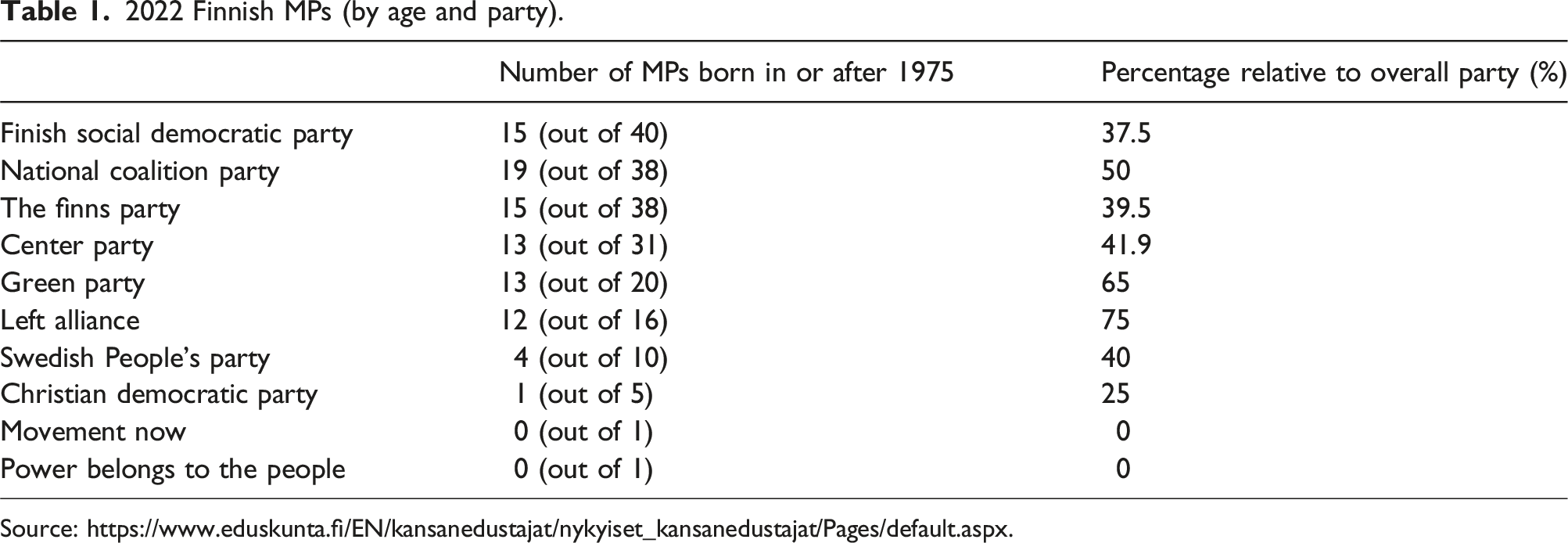
2022 Finnish MPs (by age and party).
While the age disparity among SDP MPs may explain, in part, why so few articulated a position against NATO before Russia’s 2022 invasion, parliamentary speeches between February and April 2022 manifest clear generation-based distinctions among them. For more senior members, the arguments posited were thematic: (1) non-alignment had worked effectively for over eight decades; (2) Finland would run the risk of becoming a war “frontline”; and (3) Finland had always had to deal with geopolitical matters on its own and in its own way. For the younger members, however, there existed no reluctance with the prospect of NATO membership. Rather, for Finnish MPs, whose entire adult lives were spent in a fully EU-integrated Finland, support for NATO seemed both logical and intuitive.
There were exceptions. Among SDP MPs, Suna Kymalainen has delivered speeches in support of NATO since 2013. 7 As several MPs told me in interviews, she received a great deal of criticism in her party for going against the party line. In addition, former Prime Minister Antti Rinne and, at the time of this writing, SDP MP, tweeted in support of NATO on March 12, 2022. 8 He also received a great deal of backlash for articulating a position, which would become the party position two months later. In addition, several younger MPs – especially from the Left Alliance – harbored reservations even after Russia’s 2022 invasion. Still, while these important exceptions existed, parliamentary speeches evince predictable patterns, particularly among SDP MPs: Those born roughly before the late 1970s continued to articulate reticence until mid-May, whereas those born during or after manifested a thorough readiness to join NATO. While SDP consists predominantly of more senior members, a new political cohort is gradually taking the helm (see Table 1). The growing presence of this new cohort of MPs is reshaping parliaments not only in Finland but also across Europe.
By looking at the existing speeches, it becomes clear that, even during events leading up to Russia’s invasion, the SDP MPs whose opinions most fundamentally ‘changed’ were those more senior members – that is, younger SDP MPs largely required no convincing. On the day before Russia invaded Ukraine, February 23, 2022, Finland’s MPs had convened in a plenary session to discuss the growing security situation. Among SDP MPs, senior members did most of the talking. However, there existed clear distinctions in perspective. For example, veteran SDP MP, Kimmo Kiljunen (born in 1951) argued the following: [T]here are many reasons to consider NATO membership, but one reason prevails over all others — and that is Finland’s own security. This is the determining factor that, at least in my opinion, clearly determines whether we should be a NATO member or not. There have also been assessments that, in this particular situation, it is in a certain way lucky that we are not members of a military alliance, because at worst a great power confrontation already exists here, and if it escalates at worst, then we would be on the frontline, which cannot be in our security interests [i].
As Russia’s army mobilized along Ukraine’s border, Kiljunen maintained a position central to his party since the end of the Cold War – namely, keeping Finland out of NATO. In rationalizing this party position, Kiljunen referred to the potentiality of putting Finland at risk on the ‘frontline’. This position resonates historically among more senior members of Finland’s Parliament, whose political position were shaped during the Cold War.
In contrast, relatively young SDP members, who grew up in a post-Cold War, EU-integrated Finland, did not demonstrate the same reluctance. For example, during the same plenary session, then Prime Minister, Sanna Marin (born in 1985), had the following to say: Finland’s policy includes preserving the national space for movement. If our security required it, we would be ready to apply for NATO membership. Others also have the right to choose their security arrangements. It belongs to the basic principles of European security. Our support for Ukraine is unwavering. The development of the European Union, defense cooperation and partnership with NATO are real stabilizing factors in this environment. Cooperation with our partners, just in case, creates stability [ii].
Kilunjen and Marin’s speeches reflect a generational cleavage among SDP members on the topic of NATO. For Kilunjen, NATO remains something to avoid (‘it is in a certain way lucky we are not members’), whereas, for Marin, NATO is consistent with Finland’s values and positioning. For younger SDP members, NATO and cooperation with other states in Europe and the US are not mutually exclusive; rather, they are complementary (‘defense cooperation and partnership with NATO’).
After the invasion, public opinion mounted favorably toward the prospect of Finland joining NATO. While more senior SDP MPs continued to articulate reticence or uncertainty through March and April, younger Social Democrats became more vocal in their support of NATO. In a speech from late April, SDP MP Johan Kvarnström (born in 1986) said the following: One of the most underlined sentences in the report is certainly the one where it is said that with the NATO membership of Finland and Sweden, the threshold for the use of military force in the Baltic Sea region would rise, which would increase the region’s stability in the longer term. The report encourages an active security policy and gives a positive image of NATO membership. In addition to the already mentioned, possible membership is estimated to improve Finland’s military security of supply and the crisis preparedness of society as a whole [iii].
While Kilunjen and other more veteran SDP MPs believed that NATO put Finland at greater risk, Kvarnström, Marin, and others identified the opposite – namely, that it strengthened the country and region’s security and ‘crisis preparedness’. These inverse positions within the same party reflect, I would contend, a generational shift. And SDP MPs understood these differences, too. For example, senior SDP MP Erkki Tuomioja (and long-standing NATO critic) identified to me the Prime Minister’s position: ‘Although the party leader did not make any public statements, I knew what her decision was from the very beginning. And, as I have mentioned, I have done many talks with the President, with the Minister of Defense, with the Foreign Minister, and others both inside and outside the party, and I never had any meaningful dialogue with the Prime Minister’. 9 While many younger SDP MPs may not have publicly supported the prospect of Finland joining NATO, Tuomioja highlights awareness of clear party differences on the topic.
Even after Finland’s political parties had reached a consensus by mid-May 2022 – in response to the strong external pressure – to support NATO membership, SDP MPs articulated distinct narratives. For example, in a mid-May plenary session, SDP MP Johanna Ojala-Niemelä (born in 1974), provided the following explanation: My grandfather, born in 1917, spent seven years at the front. After his military service, he only had time to spend two weeks in civilian life when he was called to the front, and according to his grandfather, the best years of his youth were spent in the wars. My grandmother, who was born in 1914, had to leave her home twice and go to an evacuation center…My father, who was born in July 1944, had to leave for evacuation to Sweden when he was only two weeks old. These stories I heard in my childhood have left a strong imprint on my DNA. Although I don’t see joining NATO as a blissful solution, I think it is an alliance of reason [iv].
In her speech, Ojala-Niemelä begrudgingly accepts NATO (‘I don’t see joining NATO as a blissful solution’) but roots her previous conviction in her family’s history in conflict situations (‘strong imprint on my DNA’). This reiterates the position of the party while simultaneously responding to the external pressure to support NATO. In contrast, young SDP MPs continued to identify the continuity in policy and a more EU-integrated ethos. In a speech delivered by SDP MP Matias Mäkynen (born in 1990) in mid-May, he identified a different perspective: It is still unlikely that a large-scale war would be fought in Europe. This is also thanks to the restraint created by NATO. Still, even this option must always be prepared. Membership in NATO would strengthen Finland’s security of supply in addition to security guarantees. When a crisis comes, NATO countries primarily support each other and only then others. Military and other security of supply has proven to be crucially important in the Ukraine crisis, especially as the war drags on. In order to strengthen Finland’s security of supply in times of crisis, NATO membership is justified [v].
While several SDP MPs continued to refer to the party narrative as regards the historical position of Finland during 20th century conflicts, young SDP MPs, such as Mäkynen, understand NATO through the lens of Finnish political elite, whose political socialization took place in an EU-integrated Finland (‘NATO countries primarily support each other and only then others’). And these generation-based distinctions consistently manifested themselves in speeches among SDP MPs as well as others.
By focusing on SDP MPs, I do not intend to argue that the personal characteristic of generation explains only their different positions on NATO. SDP MPs manifested among the most vocal opposition toward NATO prior to 2022. Indeed, this opposition played an important role in the party’s political identity for many decades. As such, their behavior represents the role of cohorts in MPs’ position taking on the topic of NATO. Nonetheless, political cohorts behave differently among other MPs from parties, which had not previously supported NATO. For example, in December 2021, the chairperson of the Green Party, Atte Harjanne (born in 1984), posted a blog entry in which he called upon Finland to join NATO. 10 Several other political elites from different parties also broke rank and articulated the desire to join NATO. Among those most outspoken (from parties that did not support NATO membership) the theme that links them relates to the political cohort – practically all of them have become adults in a fully EU-integrated Finland.
Shift toward the Baltic States
The implications of generation-based cleavages also push back on certain assumptions, which have prevailed in the existing scholarship as regards a Finnish political identity or brand. In particular, debates and interviews show that many younger Finnish MPs have developed a different attitude about the Baltic states than the scholarship has yet identified. This developing attitude does not necessarily contradict the prevailing scholarly consensus, which holds that Finland’s leadership has long cultivated a distinctly Nordic identity -- and resisted affiliation with the Baltic countries. But it does somewhat complicate this position. For example, Forsberg argues, ‘the central identity aspiration during the Cold War was to become a Nordic country rather than the fourth Baltic state (as designated in the Molotov-Ribbentrop Treaty of 1939)’ (117, 2017). Similarly, Browning makes this point by unpacking Social Democrats’ discourse in the late 1990s: ‘To some extent a discourse of “Nordic teachers” and “Baltic students” emerged such that in 1998 Finnish Foreign Minister, Tarja Halonen, even depicted Finland as Estonia’s “godmother” in the development of Estonian–Russian relations (Kansan Uutiset, 16 December 1998)’ (41, 2007). As such, scholars tend to stress Finland’s regionalized identity or brand within the context of the Nordic countries.
Parliamentary debate corroborate these insights, particularly among senior MPs. Some prominent Social Democratic MPs even used Baltic countries’ NATO accession to justify their continued opposition. For example, in a plenary session from 2013, veteran Social Democratic leader, Erkki Tuomioja (born in 1946), made a representative statement about the Baltic countries: ‘When asked about the Baltic countries, this so-called reassurance policy is NATO’s policy, it is not Finland’s policy. In other ways, we participate and want to support the opportunities and abilities of these countries to strengthen their own security. But perhaps it is also worth noting that the countries that are most worried about their security are precisely these new NATO countries today’ [vi]. In reinforcing what the scholarship has long assumed about Finnish MPs, Tuomioja articulates the prevailing consensus: The Baltic countries’ then recent accession to NATO should, if anything, provide Finns a reason not to do so.
In personal interviews, too, more senior officials continued to articulate this reluctance. Former Prime Minister Matti Vanhanen, for example, told me the following: ‘I think we should not take an example from the past, when in the 1920s and 1930s, they were willing to...I don't know the English word, but maybe [form a] coalition with Finland, the Baltic states, and Poland, especially Poland was active…’ Referring to the historical events that shaped Finland’s inter-war history, Vanhanen articulates a common sentiment, which divides MPs based on generation: For more senior members, the Baltic countries are something to study, if anything, as a way to determine how Finnish political actors should not conduct themselves.
In contrast, for many younger Finnish MPs – Social Democrat and otherwise – Russia’s 2022 invasion revealed a very different orientation to the Baltic states. In the aftermath of Russia’s invasion of Ukraine, many Finnish MPs began looking to the Baltic states for new ways of understanding their own geopolitical realities. For example, then Prime Minister, Sanna Marin (born in 1985), stated the following in September 2022: ‘We must acknowledge how naive we have been about Russia and how mistaken we have been in our ideas about Russia’s actions. We should have listened more closely to our friends from the Baltic states and Poland, who have lived under Soviet rule. Together we are now paying a high price for our dependence on Russian energy’. And this new orientation crosses party lines. In an interview with the Green Party’s Chairperson, Atte Harjanne (born in 1984), he described this shift in thinking: ‘We’re part of the Nordics. The full Nordic, rich countries. We're like the Swedes. We're not like the Balts. And they were annoying the Russians, but we're the calmer...Now the leadership is the Estonians, the Poles, the Latvians, the Lithuanians, they are the most active. And it's a very new dynamic here. And people are kind of challenging our leaders that why are we not like the Estonians? That's a completely new dynamic...They were right all along, and they are still right’. In our conversation, Harjanne identified the generation-based shift among his colleagues in understanding themselves in relationship to the Baltic states. Harjanne, Marin, and many others embody a new generation of policymakers in Finland; they often understand themselves as integrated Europeans and manifest receptivity to other European countries, which their more senior colleagues have consciously avoided.
As with NATO, exceptions exist among Finnish MPs in terms of an evolving orientation to the Baltic region. For example, MEP Miapetra Kumpula-Natri (born in 1972) has long publicly identified using Estonia as a model for Finland to follow.
11
She also explained to me that the economic development of the Baltic and Eastern European countries within the EU is creating new age-based perspectives as regards among several Finish MPs: Even from my generation -- because I had time to time to see that -- I still had been to Russian Estonia and I had been to the Estonia, when was it, just a year or two before they joined the EU. I actually was there working for the European Movement. So I was there listening to enlargement conversation together...So then it was a poor country, under development, but now you see it’s not their fault.
Kumpula-Natri acknowledged that, among many of her more senior colleagues, Finland’s orientation to the Baltic countries remains reticent; however, she too noted that, among young MPs, who have lived (and often visited) a more economically developed, EU-integrated Estonia (and other Baltic and Eastern European countries), there exists far more receptivity.
Discussion
In the immediate aftermath of Russia’s 2022 invasion of Ukraine, parliamentary debates about NATO exposed generation-based cleavages among elected officials across the political spectrum in Finland. This was particularly evident among the parties whose positions on NATO changed. While more established veterans remained reluctant about Finland joining NATO until, at least, May 2022, many younger MPs manifested a much higher degree of receptivity and enthusiasm. External pressures partly explain the overwhelming support Finnish MPs gave to the prospect of NATO membership. But, shifting the focus to the behavior of the elected officials, reveals some important changes taking shape across Europe. Regarding NATO, SDP MPs perhaps most dramatically reflect this shift among a new cohort (although the same proved true in other parties, as well). While scholars have identified the extent to which opposition to NATO reflected a significant aspect of previous generations’ identities (Aunesluoma and Rainio-Niemi 2016; Forsberg 2018), in this article, I argue that that parliamentary speeches about NATO reveal that the Finnish political identity (or brand) had already begun undergoing some significant changes before Russia’s invasion. And the personal characteristic of generation helps clarify why so many younger Finnish supported the prospect. The war and the Finnish public’s sea change orientation toward NATO enabled these MPs to manifest a new set of position-taking behaviors. The war revealed some ways a new political cohort of Finnish MPs, who have spent their entire political lives in a fully EU-integrated Finland, have a different understanding of geopolitics than their more senior colleagues.
This distinction is made even more clear when it extends to the region more generally. Young Finnish policymakers are beginning to understand their own identities in more inclusive ways. Scholars have noted the weakening of a unified Nordic identity or brand – often in favor of a strengthening European one (Browning 2007; Elgström and Delputte 2017; Ojanen and Raunio 2018). While many younger MPs have identified the Baltic states as models to follow as regards Russia, it is not clear how circumstantial or lasting that reorientation will prove. The larger policy implications remain unclear, but Finland’s role in NATO discussions marked a significant shift in terms of diffusion. Other Nordic states, especially Sweden, have long shaped much of Finland policymaking (Karvonen 1981). However, in this case, policy diffusion went the other way – that is, from Finland to Sweden. Even though Finland and Sweden worked together in their NATO bids, those whom I interviewed repeatedly stressed the latter’s reluctance. 12 Future scholarship should continue to unpack ways in which Finland is taking a leadership role in terms of regional policymaking.
Still, analyses based on political cohorts have predictive limitations. Political parties will remain divided on most issues. Furthermore, these lines most probably blur based on circumstances; they likely represent an extending range of identity options from which Finnish MPs select. However, responses to Russia’s invasion revealed some clear ideological differences among Finnish policymakers within the large and influential Social Democratic Party as well as among several other parties. These differences pushback on both public and scholarly expectations. As this new cohort of political elites gradually replaces the older one, the differences from previous cohorts will likely continue manifesting themselves. Thus, the approach put forward in this article may prove helpful in discussions about why political parties change (Harmel and Janda 1994; Budge 1994; Fagerholm 2015).
Furthermore, this study has focused on a very select population – namely, Finnish MPs. While this article’s findings stress that, on the topic of NATO, younger Finnish MPs – especially among the SDP and Center Party members – manifest distinct behaviors and self-understandings than their more senior peers, this difference does not necessarily reflect the Finnish population. In fact, as ABDI data for May 2022 reflect, the same demographic grouping among the general population (generally, between 25 and 34 years of age) retained the lowest levels of support for membership. A significant majority of this group still supported NATO (59%), and, as such, the shift in the overall population’s preference explains a great deal of Finland’s elected officials’ behavior. However, this disparity does also reflect some tension within the same cohort – namely, between the political elite and wider population. This tension may have several explanations. For example, ABDI data highlight that Finns with university education and higher incomes tended to favor NATO at higher rates than those without university education and lower incomes. 13 Since the political elite often come from the former population, it is perhaps consistent that they more readily supported the prospect of NATO membership. The tension may also reinforce what Lenz argues about voters changing their policy positions so that they align with those of the political actors whom they have already selected (2013). By December, ABDI data indicate an increase in support among this age grouping (from 59% in May to 76% in December). 14 Unfortunately, this analysis does not provide the sort of data to fully resolve this (and other) tensions. To begin identifying the full implications of this theoretical intervention, it will be necessary to develop more systematic and comprehensive data on the beliefs and understandings of Finns and Finnish political elites. Future scholarship should add to this study with more data and continue unpacking the broader implications of this generation-based shift on various policies (such as legislation on same-sex marriage) not only in Finland but across Europe.
Supplemental Material
Supplemental Material - Generation-based position taking: Unpacking Finland’s decision to join NATO
Supplemental Material for Generation-based position taking: Unpacking Finland’s decision to join NATO by Daniel Fittante in Party Politics.
Footnotes
Acknowledgements
The Foundation for Baltic and East European Studies and Reimagining Norden in an Evolving World (ReNEW) provided financial support, which made this article possible. I would also like to thank Dr. Juhana Aunesluoma for the many insights he provided me during the period in which I collected data for this article.
Declaration of conflicting interests
The author(s) declared no potential conflicts of interest with respect to the research, authorship, and/or publication of this article.
Funding
The author(s) disclosed receipt of the following financial support for the research, authorship, and/or publication of this article: This work was supported by the Östersjöstiftelsen and Reimagining Norden in an Evolving World (ReNEW).

Supplemental Material
Supplemental material for this article is available online.
Notes
Author biography
References
Supplementary Material
Please find the following supplemental material available below.
For Open Access articles published under a Creative Commons License, all supplemental material carries the same license as the article it is associated with.
For non-Open Access articles published, all supplemental material carries a non-exclusive license, and permission requests for re-use of supplemental material or any part of supplemental material shall be sent directly to the copyright owner as specified in the copyright notice associated with the article.
