




Abstract
This study examines how parliamentary party groups decide who speaks for them on specific issues in parliament. We build on three strands of the literature: the work on the institutional foundations of parliamentary speech; the literature on committee assignments in parliamentary systems which points to different rationales behind parliamentary specialisation and the division of labour; and the literature on issue competition. First, we expect that the party leadership will assign more speaking time on issues that parties ‘own’ to Members of Parliament (MPs) they favour. Second, we expect an informational rationale regarding the allocation of speaking time by which MPs speak on issues for which they have pre-existing expertise. Third, we expect MPs to speak on issues if they have ties to relevant constituencies outside parliament. We analyse a new data set of all speeches in the Dutch lower house between 1998–2017. The analyses point to the importance of two rationales in the allocation of speaking time: high-status MPs (reflected by their list positions) speak on issues that parties prioritise, and MPs speak on issues on which they have specialised knowledge. Our analyses shed important light on how parliamentary party groups (PPGs) function, specifically how they divide labour within their ranks.
Introduction
The study of parliamentary speechmaking has emerged as a significant field of inquiry in political science in the past decade. Speeches by Members of Parliament (MPs) on the floor are essential tools for political representation and communication (Bäck and Debus, 2016; Fernandes et al., 2021; Proksch and Slapin, 2015). Parliamentary debates allow minorities to express their views and are an important source of political legitimacy (Grimes, 2006). Moreover, these debates are a crucial element of the permanent election campaign which parties and politicians wage. Systematically investigating the causes and consequences of speechmaking can shed light on political institutions, ideologies and strategies of political actors (Finlayson and Martin, 2008). Previous research analysed speeches to determine the opinions, positions, and policy preferences of MPs (for an overview, see Abercrombie and Batista-Navarro, 2020), investigated the framing of issues in parliamentary debates (Loizides 2009; Roggeband and Vliegenthart, 2007) or analysed how party-controlled floor access affects how a controversial issue becomes publicly contested (Bhattacharya, 2023).
Recently, research efforts to “unpack the politics of legislative debates” (Fernandes et al., 2021: 1032), i.e., who gets to speak on which issue and why, have increased to understand legislative behaviour and intraparty politics (Alemán et al., 2017; Alemán and Micozzi, 2021; Bäck and Debus, 2018; Debus and Tosun, 2021; Proksch and Slapin, 2012; Slapin et al., 2018). In this article, we extend this literature by investigating how parliamentary party groups (PPGs) make internal decisions to delegate tasks and assign speaking time in the plenary to specific MPs. In many parliaments, individual MPs often have no guaranteed floor time in debates. Instead, the right to speak in the plenary is allocated to PPGs, the crucial players in parliamentary democracies that structure the work of parliaments. These groups must, subsequently, decide which of their MPs may speak and on which issues. Understanding under what conditions PPG leaders delegate speaking rights provides further insight into the “black box” (Saalfeld and Strøm, 2014: 387) of the inner workings of PPGs, the power relations between the PPG leadership and other members, as well as into PPGs’ strategic calculations.
Our central question is: what determines which MPs speak on specific issues in parliament? To answer this question, we bring together three strands of the literature to understand the process of allocating speech participation. The first strand is the literature on the delegation processes that precede parliamentary speech (Proksch and Slapin, 2015). This literature suggests that PPGs balance their interest to put out a unified brand together with the interests of their MPs to appeal to specific constituencies. Recently, the work of Fernandes et al. (2019) has shown that PPG leaders value the expertise that MPs obtain through their committee membership when distributing speechmaking opportunities. This expertise is, in particular, valued in debates concerning highly salient issues. The goal of our work is to further our understanding of other considerations that play a role in these delegation decisions.
To this end, we build on the literature on the mechanisms that drive the allocation of other scarce resources, such as committee assignments, which adds the notion of intra-PPG hierarchy (Martin and Mickler, 2019). Additionally, we include expectations from the literature on issue competition and issue ownership to test the expectation that PPGs pursue strategic considerations to let loyal MPs speak on the issues they ‘own’ (Green-Pedersen, 2010). By integrating these different strands of literature, we extend and refine the mechanism of delegation which structures parliamentary speech-making and explains unequal access to the plenary floor. Our findings contribute to a growing literature on parliamentary speechmaking (e.g., Alemán et al., 2017; Alemán and Micozzi, 2021; Bäck et al., 2014; Poyet and Raunio, 2021). While much of this literature highlights the incentives of speechmaking emanating from the electoral system (Bäck et al., 2019; Proksch and Slapin, 2012), this article argues that other motivations must be considered to fully understand legislative behaviour and intra-PPG politics.
We test our hypotheses to explain parliamentary speeches in the Dutch Tweede Kamer, a case which is characterized by party-centred rules of speechmaking. The Dutch lower house represents a pathway case (Gerring, 2007). Given that MPs do not experience a meaningful individual electoral incentive (Louwerse and Otjes, 2016), their re-election depends largely on the strength of the party brand. By choosing this, we can isolate the rationales behind parliamentary speech-making from other factors such as individual constituency-based electoral incentives.
Theory and hypotheses
Theoretical framework
The study of parliamentary speech is highly influenced by the work of Proksch and Slapin (2015). Their key assumption is that parliaments do not serve as a forum for MPs to convince each other, but rather serve as a podium to address the larger audience outside of parliament. The decision on who speaks in parliament, as well as the contents of the speech, is viewed as a delegation game between the PPG leadership and rank-and-file MPs. Although, in principle, the PPG leadership could keep all speaking time for themselves, there are reasons not to do this: rank-and-file MPs may have more specialised knowledge about an issue and can, by speaking in parliament, build a reputation within the electorate. Every delegation, however, comes with the risk that an MP will dissent from the party line.
The strategic considerations about the degree of delegation depend to a large extent on the electoral context. When MPs rely on the reputation of their party to be re-elected (such as in list-based electoral systems), the PPG leadership controls MPs’ abilities to ‘take the floor’ more tightly than in constituency-based systems. In the latter, MPs have greater incentives to send a message to their constituency, where voters may have different interests and views than those dictated by the party line. When electoral systems give MPs greater incentives to foster an individual vote, Proksch and Slapin (2015) suggest that MPs who have been ideologically closer to the party leadership in earlier speeches are more likely to speak. This minimises the risk of negative consequences for the PPG.
This model has, so far, ignored the policy substance of speeches, that is: how do party groups determine in which policy areas MPs deliver parliamentary speeches? This question has received scant scholarly attention, apart from studies which indicated that women speak less when ‘harder’ policy issues are debated (Bäck et al., 2014) and that electoral districts’ characteristics affect speaking time in specific policy areas (Bäck and Debus 2018). Fernandes et al. (2019) highlight the role of information in speechmaking. Based on an analysis of the Portuguese Assembleia da República, their results indicate that PPGs assign more speaking time in a policy area to those MPs who have built up expertise in that jurisdiction through their committee membership. Specialisation from backbenchers matters in particular when the debate is on a highly salient issue.
To better understand who speaks on what issue, we examine what drives PPG leaders’ decisions concerning the allocation of scarce resources. Such within-PPG delegation mechanisms have been extensively studied concerning committee assignments (Martin and Mickler, 2019), as well as group coordinators (Daniel and Thierse, 2018) and rapporteurs (Kaeding, 2004; Yoshinaka et al., 2010). We build on these studies and their theoretical arguments by highlighting three aspects of intra-party politics that structure how PPG leaders allocate resources, rights and privileges. These concern (1) topic-specific expertise of individual MPs, (2) MPs’ capacity to signal to outside groups and (3) MPs’ parliamentary performance and achievements. We use these factors to explore the strategic choices of PPG leaders regarding the speechmaking activities of MPs. These arguments are likely applicable to our dependent variable: Like the aforementioned committee seats or positions as rapporteurs, speaking time on the floor is a scarce resource that PPG leaders control.
Partisan reward structure
Parliamentary party group leaders are in control of several limited resources (committee seats, speaking time) that must be carefully distributed among MPs to maximize the effectiveness of the PPG. To do this, they may use a variety of strategies. A first organizational rationale concerns partisan reward structures within PPGs. The implications of this system are straightforward: the amount of speaking time in parliament and being able to enjoy the fruits of being more visible to the electorate and the media may be doled out by leaders on the basis om MP’s parliamentary performance. Hence, speaking time is part of the internal reward structure and a means to honour past performance. Controlling this resource also serves as a method for PPG leaders to obtain MPs’ support and prevent disloyalty. This argument is based on Proksch and Slapin’s (2015) delegation approach: in systems where party incentives are dominant, PPG leaders are expected to give more speaking time to MPs whom they favour. Similar arguments have been proposed in partisan models of legislative organization which state that legislative institutions and internal differentiation processes are used to maximise the influence of political parties (Aldrich, 1994; Aldrich and Rohde, 2001; Cox and McCubbins, 1993). The influence of the parties stems from the fact that MPs’ re-election chances depend in part on the public record of their party (Cox and McCubbins, 1993). Previous research has shown the ‘structuring hand’ of the PPG leadership when deciding on the distribution of scarce resources. For example, leaders may use committee assignments as a tool for enforcing party discipline to incentivize cooperation and discourage defection. This helps to maintain party cohesion and ensure that the party’s agenda is advanced in parliament (Cox and McCubbins, 1993). Previous research on parliaments with party-centred rules of speechmaking has indicated that loyal frontbenchers are overrepresented on the speakers’ list (see also Bhattacharya, 2023) and that MPs who support their party in votes are more likely to be rewarded with plum committee assignments (Asmussen and Ramey, 2018). As we will discuss in greater detail below, being favoured by the PPG leadership can be understood in different terms: it might be that the leadership favours MPs who are ideologically close to them, or have a safe position on the party’s list, or having a long tenure. 1.
The influence of loyalty on speech allocation is likely to be particularly important for ‘important’ issues: those MPs who are higher in the party’s ‘pecking order’ will be allowed to speak on important issues more often, relegating the less important issues to lower-ranked MPs. To distinguish which issues a party considers ‘important’, ‘prestigious’ or ‘influential’, we follow the issue competition literature (Green-Pedersen, 2010; Bäck et al., 2019; Thesen, 2014). According to this literature, some parties are seen as more competent on particular issues than other parties (Petrocik, 1996; Walgrave et al., 2015); that is, these parties ‘own’ these issues. To maintain issue ownership, parties often strategically emphasise these issues in their work in parliament to signal to interest groups, party activists, journalists, voters and other parties that they are working on these issues (Green-Pedersen, 2010). Based on this, we expect that more speaking time in areas that are considered ‘important’ to parties will be allocated to MPs who are favoured by the party leadership. 2.
MPs expertise and background
The second set of argument concerns the role of MPs’ relevant policy expertise in the process of division of labour (see also Krehbiel, 1992). There is considerable evidence for the relevance of prior experience for committee assignments in European parliaments (Gianetti et al., 2019; Mickler, 2019; Yordanova, 2009). While Proksch and Slapin (2015: 13) mention the importance of expertise in their theoretical model, expertise does not play a large role in their empirical analysis. 1 Yet, there are valid reasons to assume that expertise might guide how leaders allocate parliamentary speaking time.
Parliamentary decisions on e.g., policy proposals are taken in the context of uncertainty on their consequences and their political feasibility. Even within PPGs, which comprise politicians with similar ideological positions, there might be disagreement on the choice between specific policy options. To help systematically delineate information and reach legitimate judgments, PPG leaders may rely on the expertise of members during the corresponding debates. Parliamentary party group leaders have an interest in cultivating MPs’ expertise on policy areas and letting experts speak on issues because these MPs are the best equipped to cue their party colleagues on how to vote on that issue (Andeweg and Thomassen, 2011; Mykkänen, 2001). Based on their expertise, these MPs may be able to grasp the intricacies of policies quicker and may, therefore, also be able to communicate them more clearly to voters during speeches. We test the strategy of delegating the responsibility to speak on a specific issue to MPs who possess genuine expertise with the following hypothesis. 3.
Signalling to outside groups
The third organisational rationale we use is based on the argument that electoral concerns shape the behavioural strategies of PPG leaders. Parliamentary party groups leaders are driven by a strong desire to maximize the number of MPs within their respective groups to achieve their policy goals and to increase the likelihood for government participation of their party. There is plenty of evidence available that electoral incentives matter in many areas of legislative behavior such as bill initiation (Bräuninger et al., 2012), parliamentary questions (Russo, 2011) or with regard to the assignment of MPs to committees that are beneficial for electoral districts (Martin and Mickler, 2019). While these refer to individual MPs, ultimately, they are the outcome of strategic choices within PPGs that suit the goal of maximising electoral gains for the party as a whole. We build on this to test whether the division of labour concerning speaking time is aimed to serve the goal of parties to signal to outside groups and maximize votes. Proksch and Slapin (2015) propose a similar logic to consider how parliamentary groups operate in systems where politicians have clearly defined constituencies, particularly when they represent specific districts.
Of course, the primary group that comes to my mind are voters within specific electoral districts. However, as was indicated above, we specifically examine a system with a single national district with semi-open lists where such individual electoral incentives are absent. Yet, such signalling functions may play a role in a different way: previous research on specialisation in other studies of systems where such a direct electoral connection is missing (Yordonova, 2009), has used ties to interest groups and other outside organizations that have a stake in a policy area as driving factors for MPs’ behaviour. Although these outside linkages are not directly involved in the re-election of MPs, the linkages are likely related to their genuine policy interest and may provide support for an MP in a campaign (endorsements or favourable coverage by the group in their internal communication). Previous studies showed that MPs who have close ties to interest groups outside of parliament often seek assignments to relevant committees. Potentially, these outside linkages do not just offer MPs a re-election incentive but also a post-political career perspective. MPs may use parliamentary speeches as a calling card for interest groups and other organizations that could become potential employers once the MP leaves parliament. With this notion applied to the issue of speaking time in parliament, we therefore expect: 4.
Case selection
Electoral systems in advanced industrial democracies.
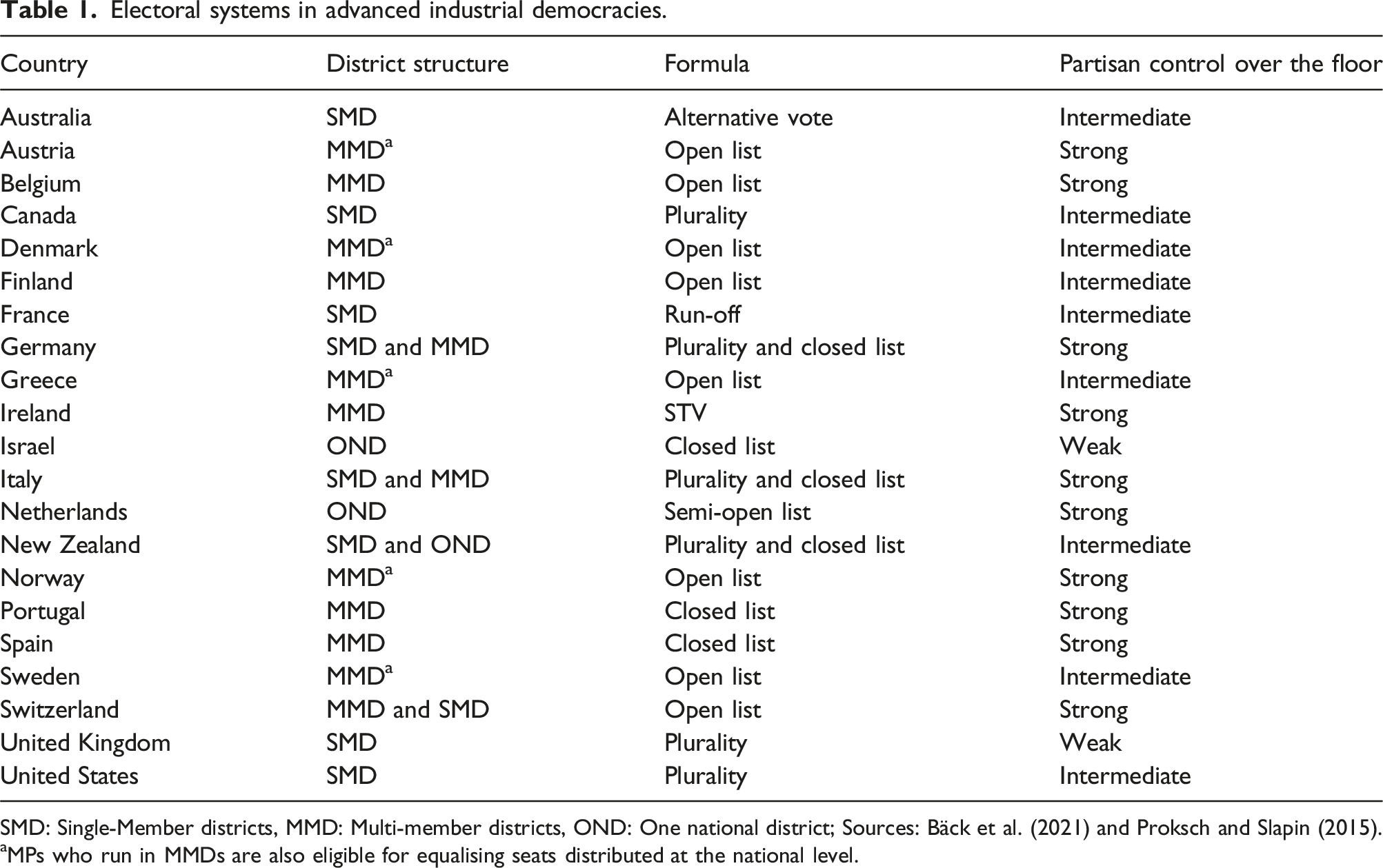
SMD: Single-Member districts, MMD: Multi-member districts, OND: One national district; Sources: Bäck et al. (2021) and Proksch and Slapin (2015).
aMPs who run in MMDs are also eligible for equalising seats distributed at the national level.
Case description
Above we selected the Tweede Kamer as a pathway case where we can see how party leaders allocate speaking opportunities without individual electoral incentives. This does mean that we have to take into account the peculiarities of the Dutch parliament. Four elements deserve attention here: parliamentary debates, the role of spokespersons, the relationship with party leadership, as well as considerations of candidate selection.
The standing orders of parliament lay down the basic rules about parliamentary debates. In general, the parliament decides on its own agenda (Otjes, 2019). The four most common form of debates are ‘legislative debates’, which mostly concern bills proposed by the government, ‘majority debates’, which are used if a parliamentary majority wants to discuss policy with a minister, ‘minority debates’ (‘thirty-member debate’) that can be initiated by members of parliament who wish to discuss an urgent or important issue, and ‘reports of committee meetings’, during which MPs can propose motions on a subject of an earlier committee meeting (Otjes and Louwerse, 2021). All plenary debates are televised and broadcasted on a digital channel. Debates are mostly monitored by the press and interest groups, but important debates can also attract attention to the general audience and are reported on in the press. Given the high levels of party unity, these debates in general do not serve to convince other politicians, although swaying a spokesperson of another party or a minister can determine majorities. Debates are important ways for parties to show their expertise and policy agenda to journalists, interest groups, other parties and voters. Therefore, it is not unreasonable that parties want knowledgeable spokespersons, as a way to signal competence. The rules of procedure allot debate time in the plenary per PPG (Andeweg, 2000); no individual member has guaranteed floor time in debates. Before every debate, MPs who want to speak can request to the Speaker to be put on the list for that debate. That decision is essentially up to MPs. 3 The speaker does not refuse MPs, but MPs who are not on the list are not allowed to speak. The speaker allots every party a set amount of time. For most debates equal time per PPG is allocated, but in some debates the time is regressively proportional to size. If two MPs of the same PPG ask for a speaking opportunity, they both get half the time. Speaking time in ‘legislative debates’ (Dutch: wetgevingsdebat) is unlimited.
Beyond these formal rules, the existing studies of the day-to-day operation of the Dutch parliament emphasise the importance of the division of labour (Andeweg, 2000; Andeweg and Thomassen, 2011; Mickler, 2019; Otjes and Louwerse, 2021; Van Schendelen, 1976). Each MP is the spokesperson of their PPG on a specific policy portfolio. MPs only speak on the issues they are spokespersons for, and are not expected to voice their opinion in parliament outside of their ‘dedicated’ policy area. The spokesperson for a dedicated policy area is the ‘default option’ to speak: PPGs may deviate from this pattern if an MP is absent, if the leadership decides to make an issue ‘Chefsache’ or when there is an overlap in policy areas.
Being a spokesperson entails more than just being allotted speaking time. The spokespersons operate relatively autonomously in their area and set the PPG policy on that issue: they determine their party’s stance on the issue they represent and make decisions such on how their party votes, draft policy documents, submit parliamentary questions and motions, propose amendments, and negotiate support from other parties. They will, in the process of formulating their position, be influenced by, e.g., the PPGs’ previous stance on similar issues, as well as the party manifesto. The notion of dissenting MPs who are speaking out against the party line in parliament is incompatible with the Dutch system (pace Proksch and Slapin, 2015). Their position as spokesperson also determines in which committees they actively participate. This makes the process slightly different from the process in Portugal described by Fernandes et al. (2019) who argued that committees are venues to ‘train’ backbenchers for parliamentary debate. In the Netherlands, committee membership follows the appointment as spokesperson and it is highly unlikely that a speech on a topic within a committee’s jurisdiction is not given by either a member of the committee or a member of the leadership.
PPG leaders often do not have a substantive portfolio themselves but can take over portfolios temporarily from MPs. If the party leadership is unhappy with the performance of an MP, they can reshuffle the portfolios between MPs (Andeweg, 2000; Middel, 2003). The assignment of portfolios at the beginning of the parliamentary term is a crucial moment (Jeekel, 1998; Middel, 2003; Vos, 2011). This is where the bulk of delegation decisions that Proksch and Slapin (2015) describe occurs.
Of course, the delegation possibilities at this point are constrained by the choices that parties make when drafting the list of candidates for the elections. We know that such procedures are “predominantly nonstandardized and unregimented” (Hazan and Rahat, 2010: 4). The method in which party lists are created varies from party to party (Voerman, 2014). Typically, a committee appointed by the party board creates a draft list after conducting interviews with potential MPs. These committees consider candidates’ internal status, their societal engagement, expertise as well as regional factors and strive for a mix of newcomers and experienced MPs. The party leadership may provide input or even have the final say on the draft list. The party members then have the opportunity to approve the list at a convention or through a referendum, but changes are usually minimal. Typically, this approach is hierarchical and it is uncommon for high-level candidates to be included on the list against the party leadership’s preference. The nomination processes fosters a high degree of ideological homogeneity among MPs (Andeweg and Thomassen, 2011). Therefore, while the preferences of MPs from one party will not be identical, they will generally have similar abstract preferences on legislative and political goals. This means that the PPG leader will, unlikely, have to deal with a large group of MPs with high levels of dissent. Yet, this does not imply that there are no disagreements. MPs might, of course, still not fully align with their PPG depending on “intricacies of legislative dynamics and intra-party politics, and the content and timing of specific legislative proposals” (Close and Núñez, 2017: 38).
Methods
Dependent variable
Our key interest is in the question of which MPs speak how much on what issue for the PPG. Therefore, our unit of analysis is an individual MP. The dependent variable is the share of words that an MP has spoken out of all words that were spoken by members of the PPG on a topic. To this end, we analysed all given speeches in each year of the six parliamentary periods between 1998 and 2017. The underlying data on parliamentary debates come from Otjes and Louwerse (2021). In their approach, each speech is classified according to 17 major policy areas (and 108 sub-categories). The 17 issues are roughly similar to the portfolios of ministers. The classification is based on the information of the clerk of the lower house of parliament (Griffie van de Tweede Kamer, see Appendix 1 for a complete list). The coding that the clerk’s office uses is not exclusive: a debate on the working conditions of professional athletes would be coded both ‘sport’ and ‘labour conditions’. This provides us with a very detailed record of how often an MP speaks in parliament on each of these issues.
We analyse these speeches per year. Hence, one entry is, for instance, the share of words that Diederik Samsom (Labour Party) spoke in 2013 on the topic ‘culture’ (out of all the words from Labour Party MPs on this issue). This approach is preferable to analysing the data per parliamentary period for several reasons. Importantly, Proksch and Slapin (2015) assume that PPGs divide speaking opportunities based on past behaviour. MPs that toe the party line in earlier speeches (e.g., the previous year) are given more speaking opportunities. Indeed, the division of labour is largely made at the beginning of the term for the entire parliamentary period, with only minor tweaks in this division during the term. However, an analysis of the data year-by-year enables us to explicitly test the effect of past behaviour concerning positions taken in parliamentary speeches. 4
Independent variables
To test the Reward Hypothesis, we include four different measures of an MP’s standing in their PPG. The first two, distance to the leadership and dissenting votes, measure the degree of ideological dissent among MPs. We elaborated above that it is unlikely that strong and widespread dissent will occur within PPGs due to the way that candidate lists are made. However, we still aim to uncover these variations. The second two (list position and seniority) reflect the internal status of MPs within their group.
Firstly, following Proksch and Slapin (2015), we include a measure of the positions that MPs have taken in parliamentary speeches. This indicates the extent to which an MP, when given the chance to speak in parliament, stayed close to the party line or not. We rely on Wordshoal (Lauderdale and Herzog, 2016), an unsupervised scaling method for legislative speeches, to uncover the level of dissent. Wordshoal has several advantages compared to other scaling techniques. First, as part of its estimation procedure, it scales word use variation in each debate separately, thus accounting for the fact that word use is highly dependent on the topic of the debate. Additionally, previous research (Goet, 2019; Wratil and Hobolt, 2019) has suggested that the method is able to uncover expressed political disagreement (rather than policy preferences). This suits our analytical goal of testing for the effect of dissident behaviour.
For the analysis, we collected the speeches from each MP per debate. We use the ‘quanteda’ package (Benoit et al., 2018) to extract Wordshoal scores from these debate-specific texts. After estimating the positions for each MP, we calculate the absolute distance between an MP’s Wordshoal score and their PPG leader. This provides us with a distance measure of how ‘close’ an MP is to their PPG leadership. Overall, the distribution of scores approximates the expected divergence in PPGs: many MPs are somewhat close to the leader but there is a decline the further we move away. 5 The method of looking at the difference from the leadership comes closest to the argument by Proksch and Slapin (2015) that agreement with the leadership decides on the division of labour. Finally, for the analysis, we use the score that is estimated based on speech data from the previous year (e.g., 2007) to predict the division of labour in the following year (e.g., 2008). This allows us to explicitly test short-term ‘reward’ structures, i.e., whether MPs who have displayed a closer adherence to the party line and the leadership in the previous year will speak more on important issues. 6 Secondly, we use dissenting votes as an alternative measure of ideological distance. In the Dutch parliament, dissenting votes are rare (the average MP votes against his Group 0.07 times per year). Compared to other countries, the Netherlands has very high levels of party unity (Andeweg and Thomassen, 2011). Given the rarity of this behaviour, one could expect a significant reaction from the party leadership in terms of reducing the number of speaking opportunities.
It is important to note that both these measures of ideological dissent are not ideal. Where it comes to the speech-based measure, the key drawback is that it models opportunities to speak as a function of earlier speeches. This makes it difficult to separate out cause and effect. Strictly speaking, our design is in line with Proksch and Slapin’s theory: MPs who deviate from the party line at time x are punished for this at time x + 1. Yet, we know that in the Netherlands the speaking opportunities are handed out not on a case-by-case basis but they are decided at the beginning of the parliamentary term. Therefore, we look at the data organized on a term-by-term basis in the Appendix. This, however, has the drawback that MPs who serve only one term are excluded.
We therefore also include the vote-based measure. This, however, also has drawbacks: as dissenting votes are rare, the distribution of values is skewed. This has theoretical implications. Specifically, given its rarity, it cannot have a strong explanatory power for general patterns. It also has methodological implications: such a lopsided variable can lead to problems with estimation. We run into these problems in the Appendix, where we organize the data on a period-by-period basis. Two models have convergence problems (A27 and A29) as a result of this variable.
Thirdly, we include the position on the party list of the respective election. Earlier research on Dutch PPGs indicated that this factor sometimes carries weight when deciding internal conflicts concerning the distribution of perks between MPs (Mickler, 2019). Since PPGs vary greatly in size, we use the relative list position (depending on the number of seats that the PPG has in parliament), so that in general the first MP and the last MP elected for a party both score zero and one respectively. 7 Scores beyond one describe an MP whose list position was greater than the number of seats that a PPG has. This can be due to one of two scenarios. These MPs either joined the PPG in the course of the parliamentary term or were elected despite their list position due to preference votes. Data for this variable comes from Louwerse and Van Vonno (2021) and the Dutch Electoral Council.
As a last measure of this allocation logic we include parliamentary seniority, i.e. the number of parliamentary terms an MP has served at the start of the legislative period. Data for this variable comes from the Parliamentary Documentation Centre (PDC, 2021).
To test the Reward Interaction Hypothesis, we look at the interaction between each of the variables reflecting internal status (positions taken in speeches, dissenting votes, list position and seniority) and issue priority, i.e. how important an issue is for a party. We base this on the relative saliency of that topic for a party. To measure saliency, we rely on the coding scheme of the Comparative Agenda Project data from Green-Pedersen and Otjes (2019). They have coded all Dutch election manifestos into 200+ subtopics (e.g. higher education). We matched the 200+ subtopics from the CAP to the 17, respectively 108, topics that are used to classify parliamentary speech 8 and then look at the share of the words in the election manifestos that are devoted to a specific policy area. 9
To test the Expertise Hypothesis, we use two indicators of MP’s expertise: their pre-parliamentary educational background and their occupational background. Based on their profiles on the parliament’s website or based on the information on the PDC, we coded the biographies of all MPs using the ISCO-08 classification scheme. Although this coding scheme is primarily designed to classify occupations, the existing codes also fit educational backgrounds. The codes were then matched to the speech topics. As an example, MPs who previously worked in the health sector or studied medicine were coded as having relevant knowledge for topics that concern health policy. As was indicated above, Dutch MPs do consider the expertise of candidates when setting up the list. There is some evidence available that PPGs aim have a mix of various, ‘broader’ types of expertise (i.e., a background in finance and legal matters, see Mickler, 2019) followed by a mix of portfolios to ensure that a wider pool of expertise is available.
To test the External Groups Hypothesis, we need information on the outside linkages that an MP has. As noted above, measuring outlying interests via districts’ preferences is not possible in the Dutch case due to its electoral system. The effect of outside linkages is operationalised as connections to interest groups and other organisations that have a stake in a policy area (see Yordanova, 2009). These were coded via the published list of secondary functions that all MPs are required to declare. Data from this come from the official records of the Dutch Tweede Kamer and, for previous parliamentary periods, from the PDC.
We only coded ancillary activities in the form of official additional positions and functions when the interest could reasonably be considered relevant. Examples concern MPs who sit on the supervisory board of the Dutch Diabetes Research Foundation and were coded as having relevant external connections to the ‘Health’ topic, or the chairman of the supervisory board of large cultural festivals for the ‘Culture’ topic and those who sit on the advisory board for a university or a school for the ‘Education’ topic. This is a binary variable. Descriptive statistics for all variables for the main analysis (17 topics, year-by-year) are shown in the Appendix.
Analytical strategy
Following our approach, the data is structured in triads: MP x word share on an issue 10 × time period. 11 For our main analysis, we use the 17 issue categories per year but conducted additional analyses using all 108 subcategories and with a different time period (see Appendix 3). Multilevel models are necessary because the data is hierarchical, i.e. speeches are clustered by MP, PPGs and also within the respective time period. To account for the nested structure of our dataset, we include three random intercepts (MP, time period, and PPG). A beta regression is required because our dependent variable is a fraction that falls between zero and one. 12 To quantify the magnitude of the effect, we have calculated effect sizes using the ‘effects’ package in R (Fox, 2003).
Results
Regression results.
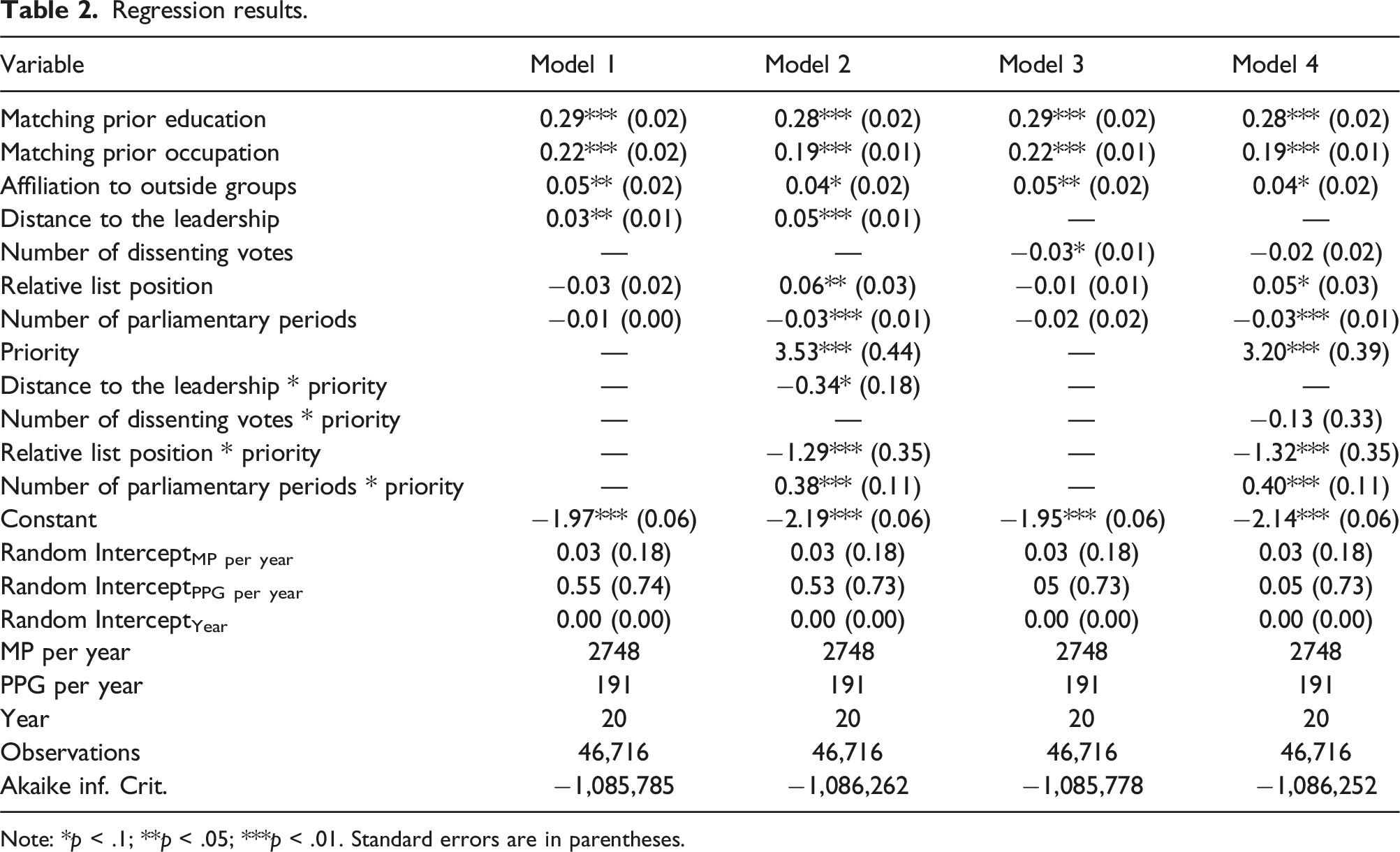
Note: *p < .1; **p < .05; ***p < .01. Standard errors are in parentheses.
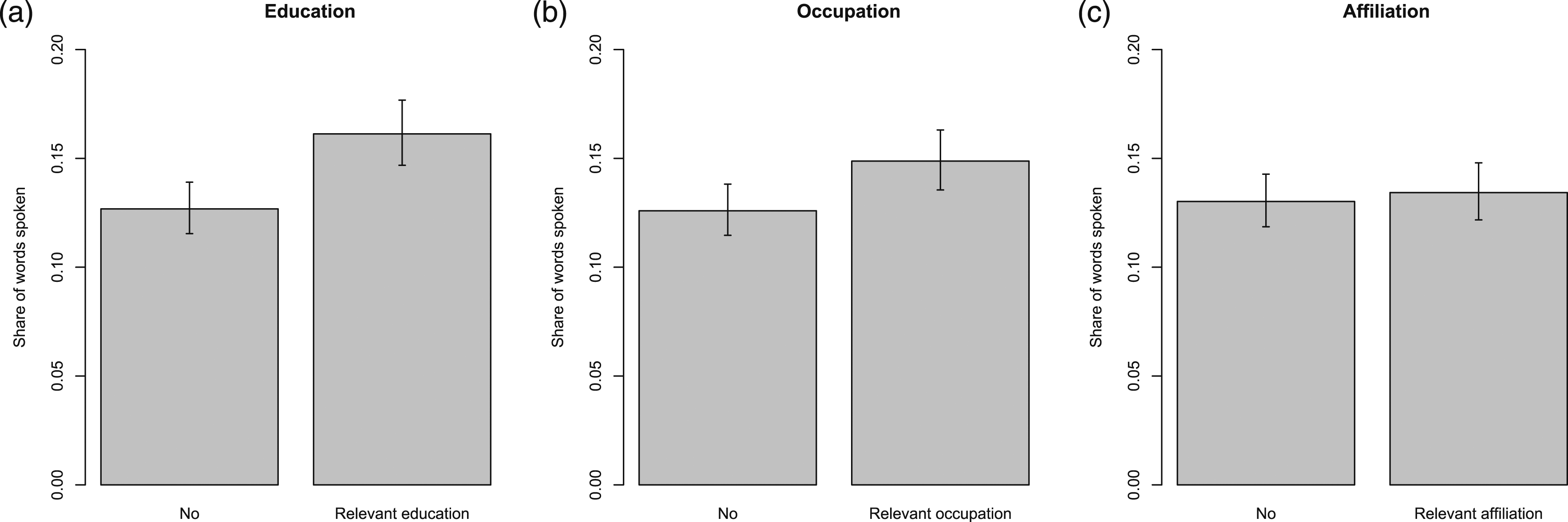
Based on Model 2 in Table 2. Estimates with 95% confidence intervals.
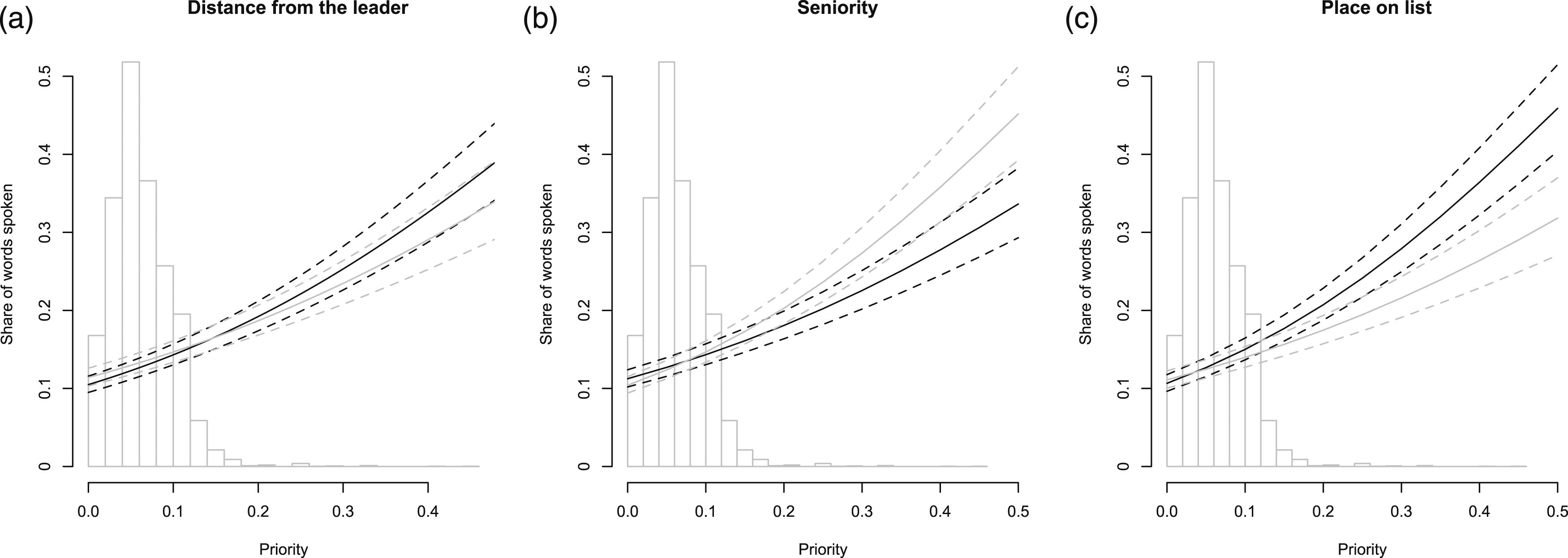
Based on Model 2 in Table 2. Estimates with 95% confidence intervals. Black line: 10% lowest value of distance to the leader/seniority/place on the list; Grey line: 90% lowest value of distance to the leader/seniority/place on the list.
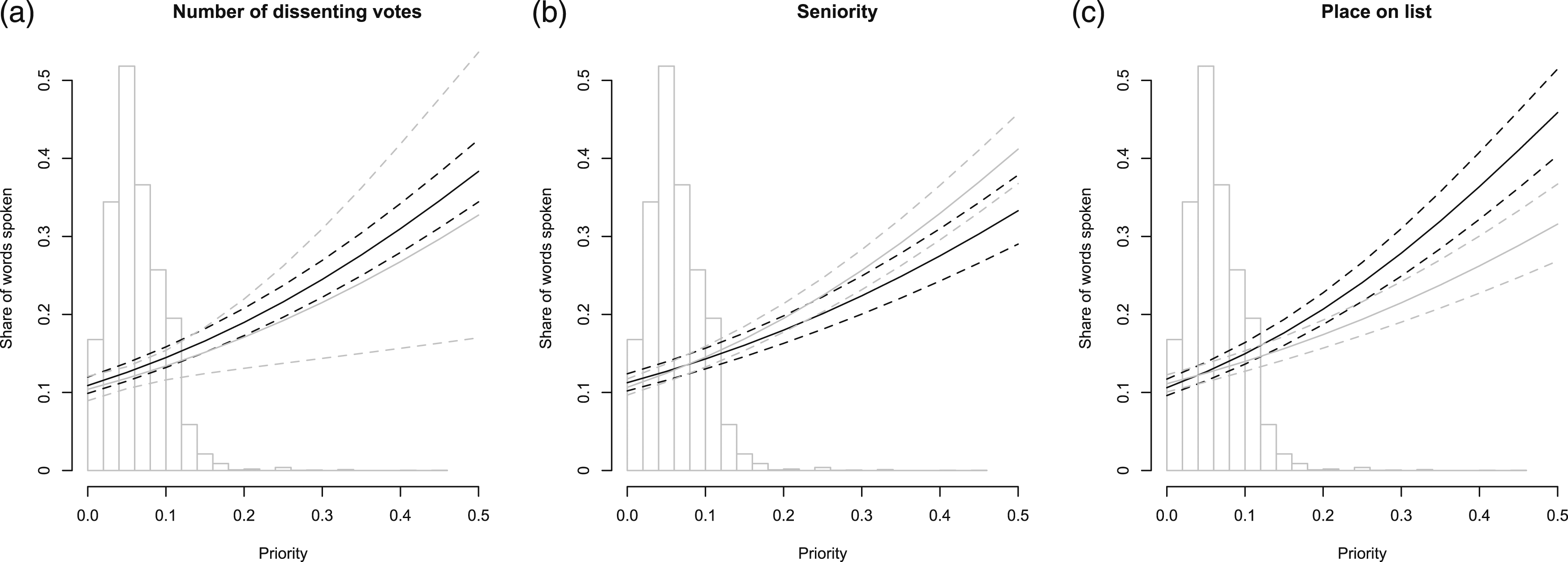
Based on Model 4 in Table 2. Estimates with 95% confidence intervals. Black line: 10% lowest value of distance to the seniority/place on the list and 0.5% lowest value of dissenting voting; Grey line: 90% lowest value of distance to the seniority/place on the list and 99.5% highest value of dissenting voting.
The Reward Hypothesis predicted that PPG leaders tightly control speaking time on ‘important’ issues and assign speaking time more frequently to ‘favourite’ MPs. Based on Model 1 and Model 3 in Table 2 (no interactions), we find no support for each of these forms of partisan favouritism. The only exception is Model 3 which shows a marginally significant effect of voting. MPs who vote against their PPG more often are less likely to speak in parliament. Yet, overall, based on our analysis, there is little evidence that suggests that internal PPG hierarchies matter strongly for who speaks when. Instead, we find that MPs who are more distant from the leadership are more likely to speak.
The Expertise Hypothesis predicts that MPs get to speak on issues they are knowledgeable about, either because of their education (e.g., a person with an economic degree speaking on economic issues) or because of their prior occupation (e.g., those who have worked in the banking sector speaking on finance). We do not include committee membership as an explanatory variable due to the procedures elaborated above (all speakers will be members of the respective committee). We find evidence for both expertise variables (see Figure 1a and 1b, based on Model 2 from Table 2): MPs speak 27% more on issues that they have been educated on and 18% more on issues that they have worked on professionally, compared to those without a relevant educational or relevant professional background. These differences are significant at the 0.01 level. These patterns are consistently supported by each of the robustness tests in the Appendix. Independently of how we model the relationship, MPs are likely to speak more on issues for which they have prior knowledge due to their educational and occupational background.
The External Groups Hypothesis links the share of words on a topic to the outside linkages of MPs. As the Dutch single national district does not have district-based incentives, we examined individual outside linkages through affiliations with interest groups and organizations that have a stake in the policy area that is debated. As can be seen in Figure 1c, we find that MPs speak 3% more on issues for which they have affiliation with an outside group. In the robustness tests in Appendix 4, this effect is consistent in terms of magnitude but varies strongly in significance: the coefficient fails to achieve variance in four out of 23 models. All in all, the evidence for the External Groups Hypothesis is much weaker than the evidence for the other hypotheses.
The Reward Interaction Hypothesis proposes that MPs favoured by the leadership are more likely to speak on issues that the party prioritises. To test this, we look at the interaction between the priority that a party attaches to an issue (in their manifesto) and several measures of internal status. We show these interactions in Model 2 and Model 4. We find the strongest effect for MPs’ list positions: MPs who have a relatively safer list position (i.e., more on top of the list) are more likely to speak on issues which their party prioritises. MPs who have a less secure list position are less likely to speak on issues that are salient to the party. The marked drop in the AIC indicates that the model with these interactions is a better fit for the data than the model without interactions. Figures 2c and 3c display the patterns graphically. As can be seen, on issues that a party does not prioritise, an MP with a list position close to the top (those who had position #2 in a 16 MP PPG) is slightly less likely to speak than an MP with a more precarious list position, i.e., those MPs who had position #18 in a PPG with 16 MPs. 14 The more important an issue is to the party, the more likely it is that MPs with a high list position speak on it: for an issue that is covered by 10% of a PPG’s manifesto, MPs who are highest on the list are 7% more likely to speak. At 20% of the party manifesto, the likelihood of these high-ranked MPs speaking is 16% greater. These differences are significant (at 0.05 level) beyond 16% of the manifesto. The robustness tests generally support this interaction relationship. 15
We find statistically significant – but substantially weaker – effects for seniority and speech-based ideological distance to the leadership. For the latter, we plot the difference between MPs that are in the first decile concerning the distance to the PPG leadership and in the ninth decile. These differences are not statistically significant (at the 0.05 level). For issues that make up 10% of the party’s manifesto, the ideologically closest MPs speak 3% less than the ideological distance MP. However, for topics that make up 20% of the manifesto, the ideologically closest MPs speak 3% more. For seniority, we show the difference between an MP at the first decile and the ninth decile in terms of tenure in parliament: one term and four terms. We find that for issues that make up 10% of the manifesto, more senior MPs speak 2% more; at 20% of the manifesto, more senior MPs speak 12% more. This difference is significant (at the 0.05 level) beyond 24% of the manifesto. The results in the Appendix are mostly in line with these results: we often find statistically significant but not substantively meaningful patterns. Importantly, however, when we look at dissenting votes instead of the difference in speech patterns, we do not find a significant effect. Hence, our second alternative measure of ideological dissent does not explain the variation in speech-making.
The effect of seniority is not consistently replicated in the robustness test (with coefficients in four out of 15 models failing to achieve significance). The effect of ideological distance to the leadership is also not consistently significant (failing to achieve significance in one model) and is not replicated if we replace distance to the leadership with distance to the group mean. Given these robustness tests and the substantive results, we note that when it comes to modelling the political mechanism, the relative list position performs strongest in terms of significance, robustness and effect size. Of the two other variables, the weight of seniority is stronger than the ideological distance in these three accounts (size, significance, robustness).
Conclusion
This study is the first to empirically test competing explanations on the partisan foundations of political speech, i.e., how PPG leaders decide who speaks for the PPG on a specific issue. We thereby extend previous research that has shown the prevalence of an expertise-driven rationale of speechmaking activities (Fernandes et al., 2019). Diving deeper into the various factors that PPG leaders use to distribute this scarce resource is important. Fernandes et al. (2021: 1039), rightfully, argued that “more research is needed on the theory and empirics of legislators’ personal characteristics and their impact on legislative speechmaking”. We proposed that three distinctive rationales could play a role. The first organizational rationale which we tested was that MPs with prior knowledge of an issue (through their pre-existing education or work experience) are more likely to speak on that issue. We find consistent evidence for this mechanism of the division of labour. This is an important addition to the argument that loyal frontbenchers are overrepresented on the speakers’ list in parliaments with party-centred rules of speechmaking (see also Bhattacharya, 2023).
Secondly, building on partisan considerations and the work of Proksch and Slapin (2015), we expected that the leadership of PPGs grants more speaking time to MPs who are in their favour. We examined seniority, distance from the party leadership in speeches and MPs’ list position. We found the strongest effect for list position: MPs with better positions on the party lists tend to speak more on the issues that parties prioritise. The evidence for seniority and distance to the party leadership in speeches is weaker. This shows that, at least in the Netherlands, an MP’s internal status is reflected in their list position: the safety of a seat reflects how much ‘clout’ an MP has. As discussed above, these factors were tested on a group of MPs who have successfully ‘passed’ the candidate selection procedure of their parties before elections. Based on this, the amount of ‘ideologically outlying’ or disloyal MPs is limited. Nevertheless, this is of course not unique to the Dutch case but is the case in many other party-based electoral systems.
A third rationale concerns signalling incentives to groups outside parliament. Our case selection specifically minimized the importance of individual electoral incentives: MPs do not represent a specific geographic constituency that they must cater to. This allowed us to examine the importance of the other rationales more clearly. Still, we tested another form of external pressure by looking at links to organizations that have a stake in the policy area that is debated. Of the three patterns, we find the weakest evidence for the importance of outside ties for speech-making. The results indicate only a relatively small effect that is not significant in every robustness test.
To the existing work by Proksch and Slapin (2015) and the comparative literature on parliamentary speech, we add two important insights: firstly, we uncover the partisan foundations of political speech. How MPs operate, depends on the party they represent. For instance, which speaking opportunities are seen as prestigious and thus are given to high ranking MPs depends on the logic of issue competition: the issues a party owns are the issues that the most high-ranked MPs get to speak on. Secondly, while Proksch and Slapin (2015) emphasize the importance of appealing to voters (through a united brand or with constituency-oriented appeals) competence also matters in parliament: an MP who is knowledgeable about a subject will speak more on a subject than other MPs. Additionally, our work builds further on the insight of Green-Pedersen (2010) that issue competition matters in how parliaments function. Much of this research so far has focused on how political parties operate and to what extent the priorities of their manifesto are manifest in their work in parliament. It appears to be the case that the portfolios that parties prioritise are also prized possessions for individual MPs.
What does this study say beyond the analysed case? The results we find in the Netherlands suggest that competence matters primarily, and party hierarchy secondarily. Therefore, these mechanisms are likely to travel to other systems with strong partisan control over the floor and party-based electoral systems such as Austria, Norway and Spain or similar countries in the Alpine, Scandinavian and Mediterranean regions of Europe. The literature suggests that individual incentives trump hierarchy and specialisation in Commonwealth parliaments. However, the extent to which these factors matter have not been tested yet. Future research may therefore want to further examine these patterns in other countries. Additional comparative studies are needed to allow for a more thorough test of the institutional foundations of parliamentary speech by comparing systems that differ in the strength of party groups and the importance of individual election incentives. In particular, qualitative research methods may be suitable to determine which internal processes underlie the patterns that we find. Beyond the focus on ‘speaking time’ of individual MPs, more research is also needed into the role of designated spokespersons. To this end, research could focus on exemptions to the ordinary course of business, i.e., when these MPs are not allowed to speak on their policy area and by whom they are replaced in these cases. 16 This would provide more detailed insights into the considerations of the PPG leadership on how to manage their business internally.
Supplemental Material
Supplemental Material - The partisan foundations of parliamentary speech. How parliamentary party groups decide who gets to speak for them
Supplemental Material for The partisan foundations of parliamentary speech. How parliamentary party groups decide who gets to speak for them by Charlotte van Kleef, Tim Mickler and Otjes Simon in Party Politics
Footnotes
Author’s note
This paper was presented previously at the ECPR Virtual General Conference 24-28 August 2020.
Acknowledgements
We would like to thank the anonymous reviewers, as well as Tom Louwerse and Rinus van Schendelen, for their feedback on a previous version of this paper.
Declaration of conflicting interests
The author(s) declared no potential conflicts of interest with respect to the research, authorship, and/or publication of this article.
Funding
The author(s) received no financial support for the research, authorship, and/or publication of this article.

Supplemental Material
Supplemental material for this article is available online.
Notes
Author biographies
References
Supplementary Material
Please find the following supplemental material available below.
For Open Access articles published under a Creative Commons License, all supplemental material carries the same license as the article it is associated with.
For non-Open Access articles published, all supplemental material carries a non-exclusive license, and permission requests for re-use of supplemental material or any part of supplemental material shall be sent directly to the copyright owner as specified in the copyright notice associated with the article.
