



Abstract
Social media are important for right-wing parties to communicate with and mobilize potential voters in election campaigns. Our study focuses on the Facebook campaigns of right-wing parties in six European countries and aims to understand which issues are transnationally shared and which ones emphasize national perspectives on the agenda of the populist actors. We ask what context conditions at party and country-levels determine the individual issue agendas. Using structural topic modelling, we analyze the communication of the Austrian FPÖ, the German AfD, the French RN, the Italian Lega, the Polish PiS, and the Swedish SD during the 2019 EP election campaign. To explain their issue agendas, we run logistic regression models testing the influence of country-specific and party-specific factors. Our analyses establish that while right-wing parties across Europe are similar in pushing a few populist issues like blaming elites and immigration, they still engage in campaigning on national politics.
Introduction
Right-wing and populist parties are on the rise in various European countries. Online communication, and social media in particular, have become important channels for these parties to mobilize potential voters. Social media are prime communication venues since they allow right-wing actors to circumvent traditional media as gatekeepers and to set their own issue agenda and tone (Bruns 2005). Therefore, their public speech can concentrate on straight messages without much consideration of legacy media or political contenders. Strategic communication of right-wing parties is likely to concentrate on a rather narrow issue agenda (Backes 2018; Elgenius and Rydgren 2017; Poier et al. 2017) that is most likely to please their own members and supporters and at the same time to attract potential new voters.
The EP election campaign as a context for political mobilization can be seen as a particular situation for parties on the right: On the one hand, it is an opportunity to stimulate nationalist sentiments and roll out the full populist narrative within each country. On the other hand, it is also an opportunity to reach out to parties with similar attitudes across the European Union (EU) and use these networks to establish more stable transnational structures of political communication (Heft et al. 2020). One approach to achieve these goals is building an issue agenda that promises to mobilize likeminded voters within and across each country. Through strategies of agenda-setting and framing in social media, parties are free to flag out their issue preferences that may not only appeal to national voters but also link campaign agendas across EU countries.
Studies have shown that both strategies belong to the repertoire of right-wing parties in Europe (Heft et al. 2022). On the one hand, they push a set of common issues in their EP election campaign thereby fostering a transnational agenda and, on the other hand they emphasize national actors, topics, and interpretations in their social media communication (Heft et al. 2022). This double strategy of campaign communication is the starting point of this study, which focuses on the Facebook communication of right-wing parties in six European countries in the 2019 EP election campaign.
The issue agenda can be discussed from two perspectives. First, in the light of EP elections as “second-order elections” (Reif and Schmitt 1980; Hix and Marsh 2011) we can expect that the issues raised in the campaign are idiosyncratic expressions of national contexts and reflect party competition on the national level. Recent studies show that national issues and contexts are still important for the electoral success of parties in EP elections (Braun 2021) even though European issues have gained importance during campaigning (Maier et al. 2021). The second order elections model is also still valid, as it explains to some degree the success of fringe parties in EP elections (Ehin and Talving 2021). Especially for right-wing parties, the focus on a predominantly national issue agenda is corroborated by their ideological rooting that highlights national identity politics and distancing from other countries, peoples and cultures (Mudde 2007; Engesser et al. 2017).
Second, the EP election campaign provides an opportunity for concerted political action and communication across countries as parties engage in transnational institution-building, networking and efforts of Europeanized campaigning. In the 2019 EP campaign, radical right parties have launched coordinated political events to feature their leaders on a European level. The promotion of a shared issue agenda can be perceived then as a translation of these political strategies into communication with and mobilization of electorates on a transnational level. In this respect, social media communication could function as a motor of Europeanization of public debates (Hänska and Bauchowitz 2019) with respect to right wing agendas. In any case, the specific situation of EP elections as a second order election provides a strategic opportunity for extreme political parties as compared to mainstream parties. They can oscillate in their communication between national and transnational issues. If voters perceive that less is at stake for them in EP elections, they may not expect consistency in the issue agenda or accordance between national and EP election campaigns (McDonnell and Werner 2019). This gives these parties more leeway to stress issues with a particularly populist appeal.
The goal of this study is to determine which issues are put forward by right-wing parties in their Facebook campaign and to analyze which factors explain their campaign agendas. We focus on the opportunity structure and establish which factors on the national and on the party-levels are conducive to promote or prevent a common transnational agenda of the EP election campaign across Europe. Theoretically, we expect that meso- and macro-level factors of the country provide relevant contexts for the parties’ issue agendas on social media. Furthermore, we unravel whether party-level factors such as the political tradition, government roles, and resources of social media advertising are more relevant in explaining the EP campaign agendas than structural macro-factors of the individual country. To this end, we investigate the Facebook communication of right-wing parties in six European countries, namely Austria, Germany, France, Italy, Poland and Sweden, between January and May 2019. The issue agenda is analyzed using structural topic modelling to determine which issues of right-wing parties are salient and to see the commonalities and differences across the six parties. In a further step, we figure out which party- and country-factors explain the national expressions of right-wing issue agendas.
First, we establish the theoretical and empirical framework of the analysis. We discuss the research literature as regards two trajectories of European politics and communication that might explain the salience of topics in the campaigns: (1) the politicization of EU integration and EU skepticism as drivers of right-wing issue agendas; (2) the strategic approach of parties to communicate their messages on social media independently from the gatekeeping of legacy media and party competition. We highlight a number of factors on the country- and the party-level that might explain the issues on the campaign agenda. These factors are integrated in an analytical model of factors that influence the Facebook communication of right-wing parties in six EU countries. We show that right-wing parties are similar in pushing a few populist issues to the fore while still addressing party-specific expressions of national politics (Heft et al. 2022). We also establish that country-specific contexts are better to explain the Facebook issue agendas of right-wing parties than party-specific circumstances.
Theoretical and empirical trajectories to the analysis of right-wing parties issue agendas
The literature focusses on theoretical trajectories and empirical findings of the analysis of right-wing parties’ issue agenda. We highlight context conditions on the country- and party-level, which may turn out to influence the issue preferences of right-wing campaign communication.
Country-level contexts of right-wing parties’ EP campaign communication
The emergence of right-wing parties in Europe has been discussed in the context of long-term political change and its manifestation in the cleavage structures of European democracies (Hutter and Kriesi 2019). Cleavage theory explains the development of party systems and party positions according to long-lasting societal conflict lines (Lipset and Rokkan 1967; Hooghe and Marks 2018). For example, cleavages related to religion (e.g. Minkenberg 2009), class (e.g. Kriesi 1998), or regions (e.g. Pisciotta 2016) have been discussed to be relevant regarding the politicization of issues and changes in party systems. In the context of growing electoral success of radical right-wing and populist parties in Europe, a so-called transnational or demarcation versus integration cleavage has emerged (Hooghe and Marks 2018: 109). As a reaction to these long-term cultural and value changes in post-industrial societies and to globalization and de-nationalization, new challenger parties have emerged on the right which have threatened the established order of mainstream political parties (Norris and Inglehart 2019).
Furthermore, the economic crisis in 2008/09 (Hutter et al. 2018), the refugee crisis and stark migration into the EU have further enhanced the politicization of EU politics in membership countries (Hutter and Kriesi 2019: 1001). As a result, mainstream parties in Northern and Western European countries have lost voters to challenger parties on the right, which mobilized those voters who felt neglected by the mainstream parties. Paradoxically, their strategy of avoidance of European issues in EP elections further helped radical Eurosceptic parties to politicize European issues and polarize electorates (Braun and Grande 2021). Populist challengers took up immigration and EU integration as their prime target issues and seeking alignment with their supporters (McDonnell and Werner 2019). The shift in cleavage structure relates to context conditions that are rooted in economic, cultural, and societal differences of EU member states. We expect that this European cleavage structure affects whether right-wing parties emphasize nationally specific or transnationally shared issues in their campaigns. As transnationally shared issues, we understand issues that are addressed by the majority of right-wing parties in our study.
The rise of right-wing parties goes along with low levels of trust in political institutions. Studies of EU citizens show that only one third has trust in the national government and parliament (European Parliament and European Commission, 2019: 43–44). The declining political trust in EU countries has been accompanied by a long term ‘crisis of public communication’: Media abundance in the aftermath of digital infrastructures and commercial media markets on the one hand and a de-legitimation of public media and a widespread uncertainty about the normative basis and ethical rules of public communication on the other hand characterize this situation (Blumler 2015). Particularly in countries in which right-wing parties are successful, critical attitudes towards the media have increased (Lührmann et al. 2019). It is paradoxical that in countries with strong public media the right-wing parties are granted easy and free access to large audiences during electoral campaigns.
During election campaigns, political parties communicate with a potential (national) audience in mind. Therefore, their strategies build on the perception about public opinion and their potential voters’ attitudes (Kaltwasser and Van Hauwaert 2020; Strömbäck and Kiousis 2014, 117). The politicization of European integration, Euroscepticsm, and immigration constitute critical conditions in various EU countries, on which radical right populist parties align with their supporters (McDonnell and Werner 2019) . In their communication, right-wing parties take up a limited set of critical issues that stress law and order, anti-immigration, anti-islam, anti-communism, anti-EU, anti-globalization, anti-elite (Poier et al. 2017, 83; see also Moreau 2011). Typical narratives relate to the sovereignty of the people, attacking the elites, ostracizing others, invoking the heartland, and advocating for “the people” (Engesser et al., 2017: 1111–1114). In a previous study of the Facebook communication of right-wing parties in six European countries during the 2019 EP election campaign (Heft et al. 2022), we find that the issues of immigration and blaming elites are most salient in the mobilization of potential voters. In addition to this transnationally shared agenda, nationally specific issues are emphasized as we would expect from SOE research (Braun 2021).
Party-level contexts of right-wing parties’ communication strategies
While the political opportunity structure on the country-level sets the stage for the campaign communication, there are also a number of factors on the party-level that might influence which issues are stressed by right-wing parties. Even in EP elections it is a strategic decision for parties whether and to what degree they emphasize EU politics as compared to national interests and issues (Kriesi et al. 2007; Braun and Grande 2021). The nature of EP elections as second order elections (Hix and Marsh 2011) rather speaks for a domestic agenda, particularly if a party is involved in government. In fact, if a right-wing party has achieved political power in national government, it might be of advantage to play down issues of European integration (Braun et al. 2019; Kriesi et al. 2007). Parties that are excluded from political power are most likely to act as issue entrepreneurs and oppose mainstream policy positions (Hobolt and de Vries, 2015; Braun and Grande 2021). We can therefore expect that the political role explains a parties’ focus on either nationally specific or transnationally shared issues.
Another factor that might influence the campaign strategies of political parties refers to their age and tradition. Parties that look back onto a rather long history and a saturated or established position in a party system are bound to their tradition, ideological rooting and political track record in a path-dependent way (Braun et al., 2019; Kriesi et al., 2007). Newcomers are free to define themselves with a new set of issues in the campaign. Moreover, Hobolt and de Vries (2015, 1177) show that the campaign strategy of parties - even of the same (right-wing) party family - vary with respect to their office-holding experience and party tradition. Research shows that challenger parties, and especially newer ones, for example, tend to campaign on issues of European integration and EU skepticism more than established and government parties (Braun et al. 2019; Hutter and Kriesi 2022). Age and tradition of a party play out also with respect to their affiliation with a political fraction in the EU parliament. This also means that they can be referred to in their ideological positions, their political track record of EU decisions as well as their political allies in EU politics. From the membership and belonging to a particular party family and fraction in EU parliament it is most likely that they share attitudes about which issues should be made salient in the campaign (Bressanelli 2012, 751; Klingemann and Budge 2013, 64) – which should in turn influence the overlap in their issue agendas.
From the campaign literature we may also infer that the success of a media campaign depends not least on the resources that are available to engage professional campaigners for communication (Kalsnes 2016, 8; see also Bossetta 2018). This refers not only to the traditional campaign media but also to social media campaign channels such as Facebook (Schwarzbözl et al. 2020). Finally, strategic decisions whether to gear the communication towards leading candidates or whether the party as an organization with particular promises is put into focus, can also affect the issue agenda . Research on the personalization of online communication in the 2009 EP election campaign shows differences in degrees and styles of personalization between parties from different countries with parties from Central European countries using more personalization strategies than others (Hermans and Vergeer 2012, 86). It therefore is a relevant factor for the campaign agenda whether the party strategy focusses on personalization in the campaign, which should result in a higher share of nationally specific issues.
An analytical model of factors influencing right-wing parties’ issue agendas
Research on political communication has shown that right-wing and populist parties campaign on a limited set of issues (Backes 2018; Elgenius and Rydgren 2017; Poier et al. 2017). At the same time, the choice to address certain issues – especially on Facebook, where a direct communication with potential voters is possible – is a strategic decision (Strömbäck and Kiousis 2014). In a previous study of the issues addressed on Facebook by European right-wing parties during the 2019 EP election campaign, we found a common right-wing issue agenda in the sense that almost all analyzed right-wing parties stress populist core issues such as immigration and blaming elites. At the same time, all parties also emphasized nationally specific issues, albeit to different extends. For example, we find that right-wing parties in government (e.g. the Polish PiS and the Austrian FPÖ) address concrete (national as well as European) policies to a larger extent than parties in opposition (Heft et al. 2022). Concluding from the literature we highlight two sets of conditional context factors that affect the strategic decision of right-wing parties to address certain issues in their campaign communication on Facebook (Figure 1 Context factors influencing right-wing parties’ issue agendas.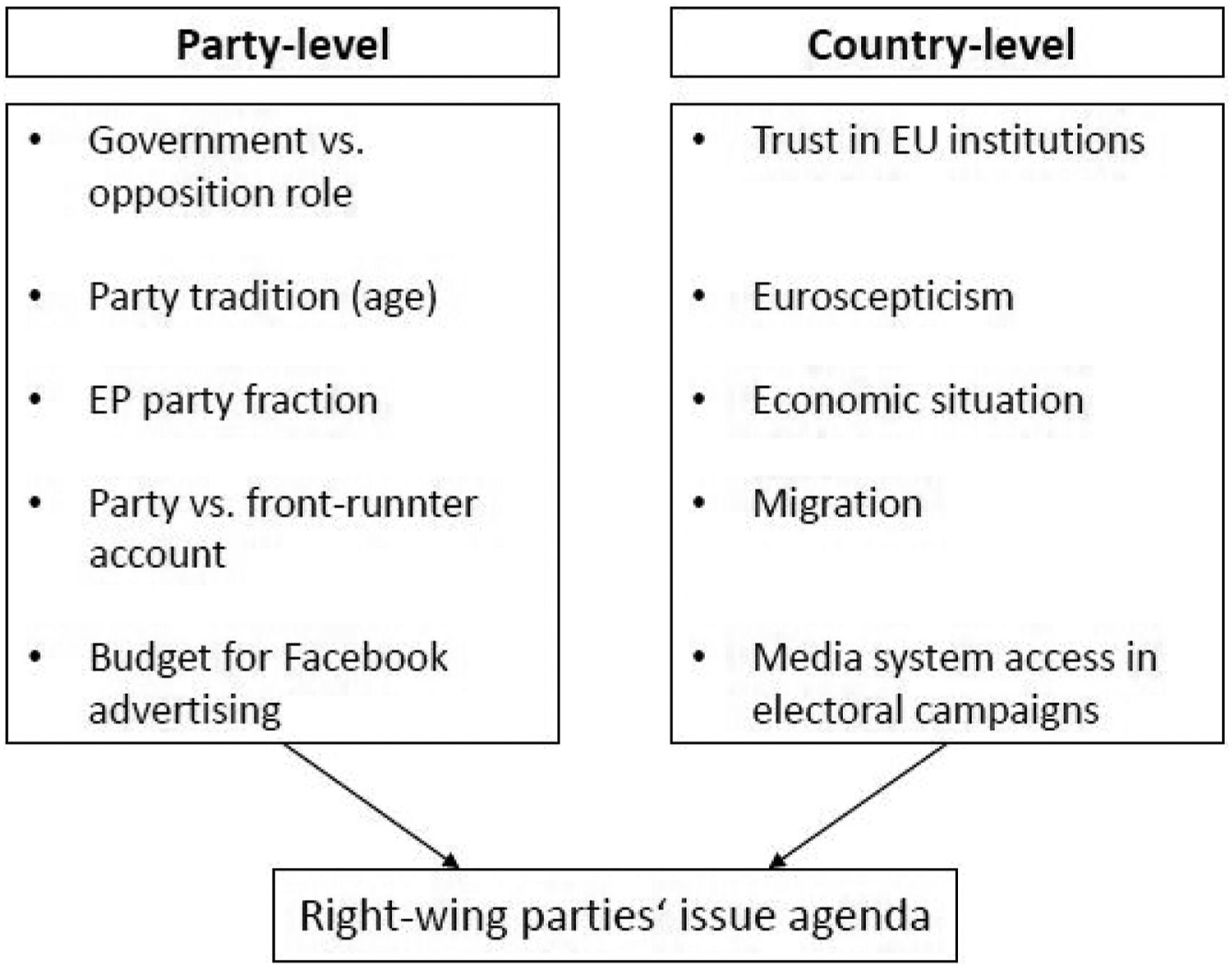
First, regarding the country-level context factors, we hypothesize that the situation of a country as regards (1) migration; and (2) the economic situation influence which issues are made salient in the social media communication of right-wing parties. Moreover, in the context of EU elections (3) the level of Euroscepticism among voters is likely to influence whether challenger parties jump on these issues. Eurosceptic positions are strongly intertwined with populist ideologies and have been shown in previous research to be highlighted by right-wing parties (Heft et al. 2022; Poier et al. 2017). We also hypothesize that the level of (4) trust in political institutions is relevant for the campaign strategy. And finally, we assume that it does play a role for the social media campaign whether (5) the media system of a country may exclude right-wing parties or, to the contrary, generally grant parties access for their campaign messages. We expect that parties without granted access to public media for campaign purposes might turn to Facebook and social media more excessively than parties that have easy access to broadcast media for advertising. If their top priority is social media communication they have leeway to escape from the national debate and engage in transnational issues.
Second, the party-level context factors that might influence the issue agenda of right-wing parties’ campaign communication are (1) a parties’ role in the national political system (i.e. government vs. opposition), (2) the parties’ age in years since its foundation, (3) the EP fraction a party belongs to, (4) whether the messages are posted by the front-runner or whether they come from the official party account, and finally (5) the amount of money spent on Facebook advertising. Some of these factors like the government and front-runner position and the party tradition are prone to bring forth a rather national issue agenda while other factors like the EP affiliation and the abundance of funds for social media communication speaks for a transnational agenda.
The context factors on both levels make up the analytical model that will be tested in the further study. In the next section, the operationalization of indicators is explained in detail.
The following indicators were used:
Trust in institutions. This index is calculated based on Eurobarometer 91 data (European Commission 2019a) that measures the average trust in (1) the EU, (2) the national parliament, and (3) the national government. The index is the sum of the agreement (in %) for all three institutions per country divided by the number of institutions.
Euroscepticism. This index is based on two Eurobarometer questions (European Commission and European Parliament 2019; Eurobarometer 91.1). The first question measures the percentage of people who have doubts about the EU (i.e. percentage of people who answer “doubts” to the question “When you think of the EU, what feeling comes to mind first?“). The second question measures the percentage of people who would vote to leave the EU in a referendum (i.e. “If a referendum was held tomorrow regarding (OUR COUNTRY)’s membership of the EU, how would you vote?“). The index is the mean of both values for each country.
Economic situation. This index is based on (1) the gross domestic product per capita in 2019 (European Commission 2019b; Eurostat online data code: prc_ppp_ind), (2) the employment rates for 2019 in the respective country (Eurostat 2019, online data code: lfsa_ergacob), and (3) the import-export rates for 2019 (Eurostat online data code: egi_tr1).
Migration. This measure indicates the migration situation in a country based on the migration to a country in 2019 (in thousands) (Eurostat online data code: migr_imm12prv).
Campaign media situation. Lastly, this mean index measures whether parties are granted free or paid access to national media for campaigning during elections. The indicators are taken from the Varieties of Democracy data set and refer to campaign media access during the last national election in the countries, respectively (Coppedge et al. 2020; variable codes: v2elfrcamp and v2elpdcamp).
Government versus opposition. This variable is a dummy variable indicating whether a party belonged to the government or the opposition in the national parliament at the time of the 2019 EP election. We included three government parties (FPÖ, Lega, and PiS) as well as three opposition parties in our analysis (AfD, RN, and SD).
Party tradition in years (age). This variable measures the age of the party since its foundation. The tradition of the parties under study varies from 6 years (AfD, founded in 2013) to 64 years (FPÖ, founded in 1955).
EP fraction. This variable is a dummy variable indicating whether a party belongs to the Identity and Democracy fraction in the EP (i.e. 1 = ID, 0 = not ID). The ID fraction in the EP was founded as a new fraction after the 2019 EP elections, which comprises right-wing parties from various European countries.
Party versus front-runner account. The party versus front-runner distinction was included in the analysis as a dummy variable (i.e. 1 = front-runner account, 0 = party account) in order to analyze potential personalization effects in the Facebook communication (Hermans and Vergeer 2012).
Average amount of money spent on Facebook advertising. This variable includes the average amount of money spent on Facebook advertising per post in Euro between January and May 2019 and serves as an indicator for the financial resources available to parties in the 2019 EP election campaign. The data was sampled via the Facebook ads library using the Radlibrary package in R (Fraser and Shank 2020).
Data and methods
The analysis presented here is based on a study of the issue agendas of six radical right-wing parties across Europe: Freiheitliche Partei Österreichs (FPÖ, Austria), Rassemblement National (RN, France), Alternative für Deutschland (AfD, Germany), Lega (Italy), Prawo i Sprawiedliwość (PiS, Poland), and Sverigedemokraterna (SD, Sweden). The selection of countries was meant to include Northern, Central, Eastern, and Southern EU member states in which radical right-wing parties have achieved significant electoral success in national elections. Furthermore, the party selection reflects parties’ age and involvement in government to see whether party specific context conditions affect the issue agendas on Facebook (Heft et al. 2022). The analysis includes all Facebook posts of official party accounts as well as the accounts of the parties’ official front-runners in the EP election in period between January and May 2019. Data collection was accomplished using the Facebook application Netvizz, which was provided by the Digital Methods Initiative (Rieder 2013) and had access to the Facebook API. Due to restrictions of the Facebook API, which allows only posts from public pages to be sampled, the account of the Swedish frontrunner Kristina Winberg, was exchanged for the account of Jimmie Åkesson (Table 1).
Structural topic modelling
The issue agenda of the Facebook communication of right-wing parties was determined using structural topic modelling with the stm package in R (Roberts et al. 2018). Topic modelling is a text-mining algorithm that is able to extract latent topics from text corpora. Estimates about documents’ topical content are made based on frequently co-occurring terms (‘bag of words’, i.e., co-occurrence of words is preserved in the analysis, while the exact order of the words used in the documents is not considered) (Roberts et al. 2016). Preprocessing of texts was accomplished with the quanteda package in R (Benoit et al. 2018) and included tokenization, transferring all text to lower-case, removing punctuation and typical English stopwords (Maier et al. 2018). In order to find the best number of topics K for each country, the statistical fit of models with K = 10, 15, and 20 were compared based on the data-driven approach by Roberts et al. (2016).
1
Topic labels were derived through manual inspection and interpretation of STM results based on the most frequent words and example documents for each topic. Topic labels are thus an inductive labelling of topics based on the text input rather than a quantitative manual coding or categorization. This approach allows us to compare large quantities of texts from various sources while acknowledging country specific differences in the resulting topics. Labels were thus deliberately chosen to reflect overarching categories (e.g. immigration) as well as specific nuances (given in parentheses in Figure 2, e.g. asylum policy). A detailed description including topic proportions and the most important words for each topic is provided in Table 3 in the online supplementary material. Topic proportions (STM results) of transnationally shared and nationally specific issues. Note. Dark grey: transnationally shared issues. Light grey: nationally specific issues.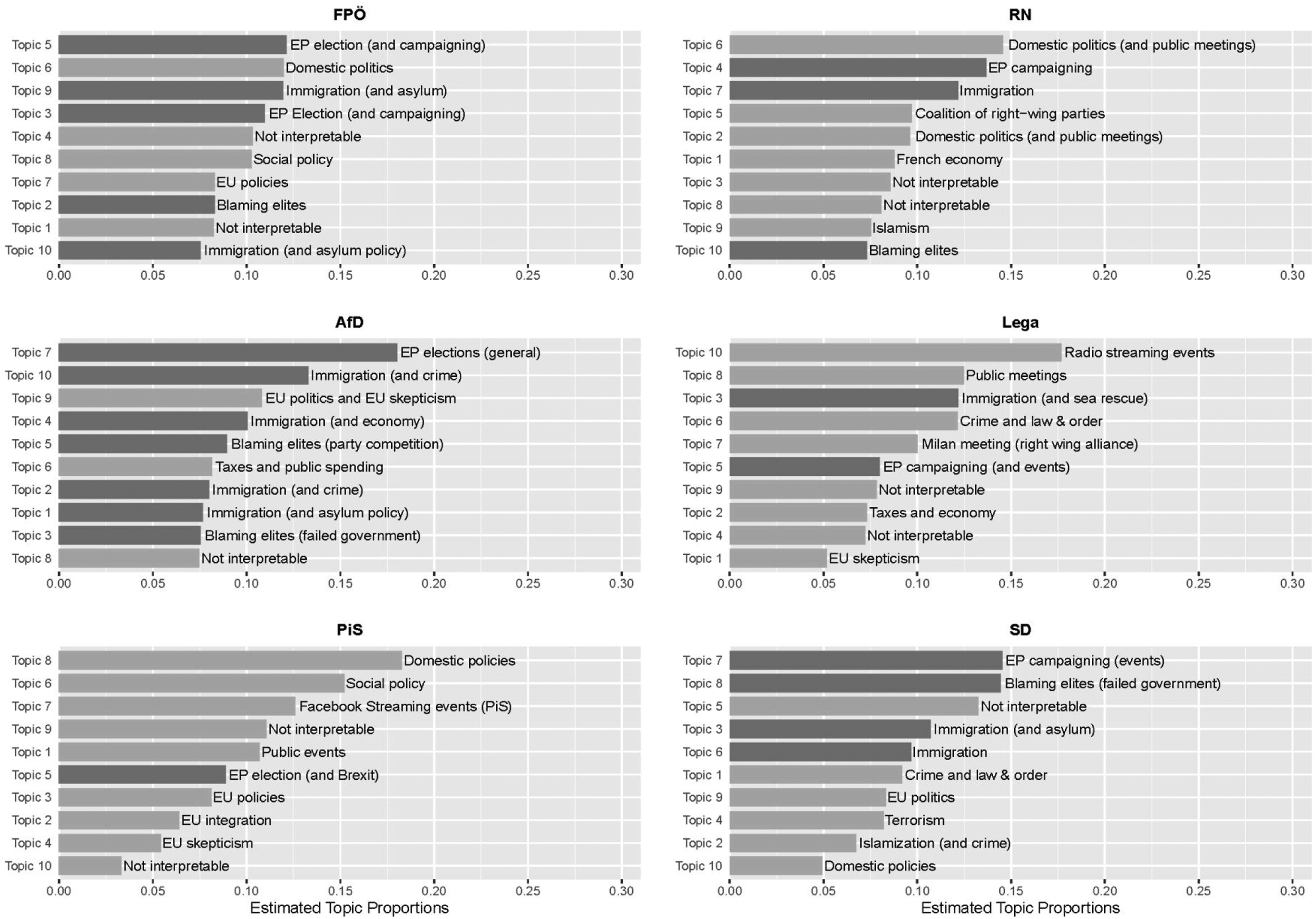
Logistic regression
In order to investigate, which context conditions lead parties to address issues in their Facebook communication, a logistic regression 2 is conducted using the results of the structural topic modelling as the dependent variable. The topics from the STM were recoded into a dummy variable indicating whether a post addresses a transnationally shared or a nationally specific issue. Issues are considered to be transnationally shared when they are addressed by at least four of the six parties in the analysis. These include topics related to EP election and campaigning, elite blaming, and immigration. Figure 2 provides an overview over transnationally shared and nationally specific issues and their respective proportions for each party. Furthermore, all topics were excluded from the analysis that could not be interpreted or that were addressed by only one party (see Figure 2). The independent variables are the indicators discussed above. Two logistic regression models were calculated, one for country-level indicators and one for party-level indicators.
Findings
The issue agendas of right-wing parties in the 2019 EP campaign
In the issue agendas of the Facebook communication of right-wing parties across six European countries, the campaign itself for the parties and for specific candidates takes the center stage among the most salient topics during the 2019 EP election campaign. Figure 2 shows high topic proportions of the EP election and campaigning issue for the parties in Austria, Sweden, Germany. In France, EP campaigning is almost as important as domestic politics in the RN’s issue repertoire. The Lega’s campaigning is more personalized than the other parties’, featuring their leader Salvini prominently in their communication, oftentimes even without direct references to the elections. In Poland, the campaign takes lower priority compared to domestic issues. The PiS and Lega both use digital campaigning more than other parties to promote streaming events of their campaign activities.
That immigration is closely linked to right-wing parties’ ideological core is visible in the fact that immigration is a much-discussed topic by all parties except for the PiS. Asylum and respective policies rank as issues with top salience on the parties’ agenda in most national contexts. However, we also find framings of immigration with particular national colors. The AfD combines immigration with crime (13.28), economic issues (10.04) and also talks about crime connected to border control (8.01), thus showing the highest diversity of frames linked to immigration. By contrast, Lega discusses immigration almost exclusively in connection to sea rescue initiatives (12.19). A notable exception in our study is the PiS in Poland, where immigration is among the least salient topics.
In accordance with populist parties’ communication style, elite-blaming is salient in the parties’ communication, yet only as long as the parties are not in government themselves as it is the case for Lega and PiS. Overall, political elites are focal points of the blame game, which ranges from attacking elites for handling migration issues (RN, AfD), domestic reforms and taxes (FPÖ), to attacking specifically ‘the left’ (AfD, SD).
In addition to these shared issues which emerge in (almost) all countries under study, some parties share specific commonalities in their issue agendas. For example, explicit EU-skepticism is a relevant topic for the AfD (10.83), and to a lesser degree for Lega (5.18) and PiS (5.42) while not occurring as an issue in the other parties’ communication. Both, AfD and Lega, furthermore strongly focus on taxes when it comes to economic issues, whereas the RN rather addresses family and agriculture. Domestic policies play a role for most parties, but the specific issue fields vary across countries. Poland’s PiS focusses on developmental policy, the SD discusses health care issues, and the FPÖ campaigns on work- and health related domestic politics.
As indicated above, crime is linked to immigration by some parties, representing a familiar trope of the far right. In addition, law and order more generally is important in Italy (12.13) and Sweden (9.19). The right-wing coalition in the EP was only a topic for RN (9.70) and Lega (10.70) who promoted an alliance of right-wing forces in the EU following a meeting of party elites in Milan.
Number of FB posts per account.
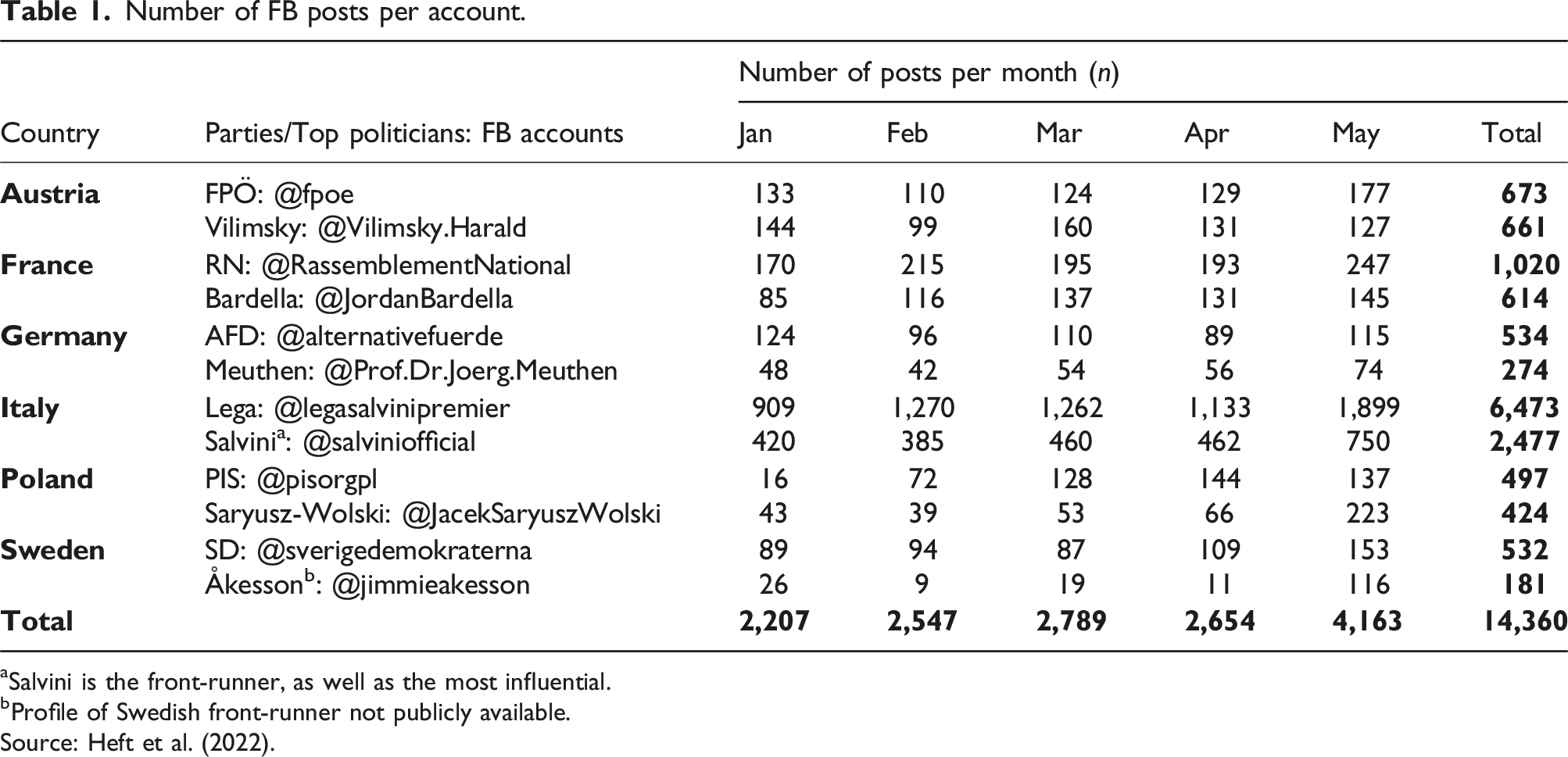
aSalvini is the front-runner, as well as the most influential.
bProfile of Swedish front-runner not publicly available.
Source: Heft et al. (2022).
Explaining right-wing parties’ issue agendas
Results of logistic regression for party- and country-level model.
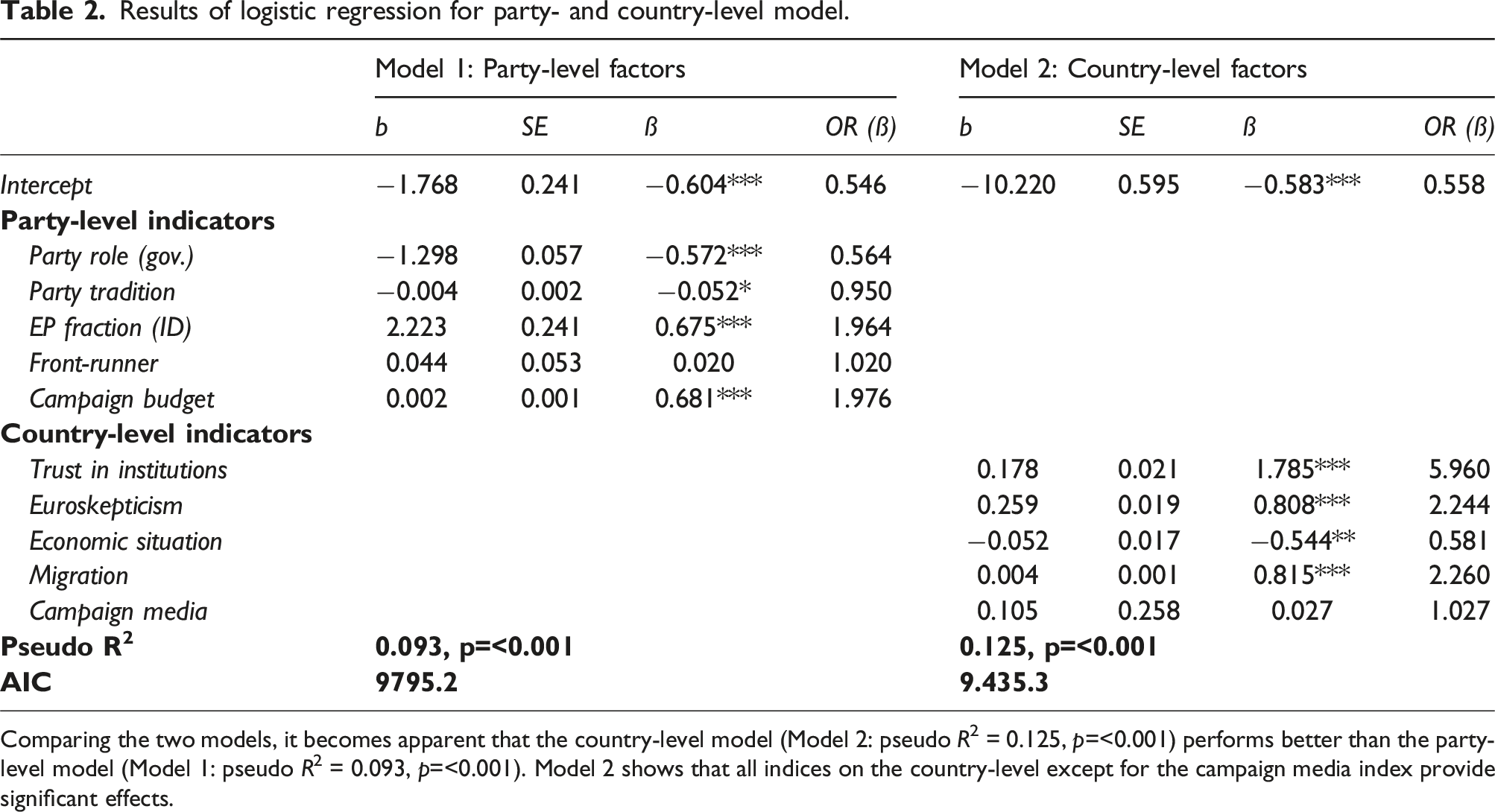
Comparing the two models, it becomes apparent that the country-level model (Model 2: pseudo R2 = 0.125, p=<0.001) performs better than the party-level model (Model 1: pseudo R2 = 0.093, p=<0.001). Model 2 shows that all indices on the country-level except for the campaign media index provide significant effects.
The odds ratios show that especially the trust in institutions, level of Euroskepticism among the electorate, as well as the migration rates in a country play an important role for issue agendas: both indicators show positive effects, meaning that higher trust in institutions as well as higher levels of Euroskepticism in a country all increase the odds that radical right parties focus on populist core issues (i.e. immigration, blaming elites, and EP campaigning). The positive effects of the trust in institutions and Euroskepticism indices are most likely related to increasing levels of elite blaming, indicating that the public opinion about the national and European elites may influence in how far right-wing parties engage in elite blaming. Also, it comes with no surprise that higher level of immigration to a country increases the odds that radical right parties out immigration on their issue agendas.
Secondly, the economic situation index shows a negative effect on populist core issues in radical right parties’ issue agendas: the odds to address shared typical right-wing issues decreases when the economic situation in a country improves. This indicates that good economic stability deprives radical right parties of their typical anti-immigration rhetoric.
Even though model 1 performs slightly worse with regard to pseudo R2 and AIC-value, it provides some significant indicators that are worth looking at in detail. First, only the front-runner versus party distinction did not reach significance in the model, indicating that personalization effects are not at play in the issue agendas of EP campaigns on Facebook. Secondly, two indicators, namely the EP fraction and the campaign budget, turn out to be important factors for the explanation of issue agendas. Parties that belong to the newly formed Identity and Democracy fraction in the European Parliament, such as AfD, FPÖ, Lega and RN, are more likely to communicate about immigration and blaming elites.
Lastly, interesting effects can be found for the government versus opposition distinction: A party in government is more likely to address domestic and party-specific issues instead of focusing on transnationally shared topics of immigration and elite blaming. They are more likely to focus on nationally framed social and domestic policies.
Summing up, the logistic regression shows that both, party- and country-level indicators provide important explanations for the issue agendas of right-wing parties Facebook communication even though country-level factors result in a slightly better model.
Discussion and conclusion
By investigating the issue agenda of right-wing parties across Europe during the EP election campaign we wanted to learn whether social media communication would be conducive to establish a common set of right-wing issues as basis of a larger transnational agenda and at the same time to what degree they feature idiosyncratic political issues of national concern (Heft et al. 2022). Our empirical findings show that the six right-wing parties across Europe were similar in pushing a few populist issues to the fore while still addressing party-specific national politics (Heft et al. 2022). They also used the platform quite typically as a tool for EP election campaigning for instance by talking about campaign events or candidate appearances.
For transnationally shared issues we note that almost all radical right parties except for the Polish PiS, emphasized immigration and elite blaming. The emphasis on elite blaming shows that the common populist rhetoric unites these parties on the European level, even though there are nationally specific elites that are named and shamed. The strongest substantial issue of radical right parties that contributes to a transnational political agenda is immigration, which appears in all social media campaigns except for PiS. Across Europe, immigration is found to closely align radical right populist parties with their supporters (McDonnell and Werner 2019) so it is the most pertinent issue in the communication strategy that mobilizes on the national level and at the same time connects the right populist parties and their supporters on the European level. All in all, blame games and boosting immigration are the signifiers of a transnational communication strategy of radical right parties on social media while Euroscepticism fluctuates not only as a source of appeal to voters (McDonnell and Werner 2019) but also to the parties themselves.
In the light of EP elections as second order elections we found that Facebook is also used to mobilize on idiosyncratic national issues, as our analysis identifies country-level contexts as important determinants of right-wing issue agendas. In particular we see that communication during the EP election campaign was influenced by the economic situation and the citizen’s trust in political institutions. Interestingly enough, the propensity of right-wing parties to mobilize on populist issues such as immigration depends on how they succeed in framing a rather positive economic situation as potentially threatened by the influx of immigrants. In addition, we find that citizens’ trust in institutions influences the salience of issues in right-wing parties’ social media campaigns in the 2019 EP campaign. Obviously, the communication of right-wing parties alludes to the perception of potential voters that they are threatened by globalization and identity politics (Hutter and Kriesi 2019). Our findings are in line with those who argue that social media are venues that allow right-wing parties to fuel particularly those populist attitudes that would be challenged in legacy media (Engesser et al. 2017; Stier et al. 2017).
Our study also comes with some limitations. As we have only investigated six right-wing parties out of many populist organizations all over Europe our findings and conclusions are limited to the particular cases and must not be generalized without further scrutiny. These design decisions also affected the data structure available for analysis which prevented, e.g., using multi-level analysis models. Moreover, our analysis captures a limited time and a particular period in the course of the 2019 EP campaign. It might well be that the contents and function of social media campaigns for right-wing parties take a different shape in national elections. Finally, if we are to draw more general conclusions about social media’s role in agenda building and voter mobilization we need evidence about the campaign strategies and issue agendas not only on the right side of the political spectrum.
Supplemental Material
Supplemental Material - Same, same but different? Explaining issue agendas of right-wing parties’ Facebook campaigns to the 2019 EP election
Supplemental Material for Same, same but different? Explaining issue agendas of right-wing parties’ Facebook campaigns to the 2019 EP election by Barbara Pfetsch, Vivien Benert and Annett Heft in Party Politics
Footnotes
Declaration of conflicting interests
The author(s) declared no potential conflicts of interest with respect to the research, authorship, and/or publication of this article.
Funding
The author(s) disclosed receipt of the following financial support for the research, authorship, and/or publication of this article: This work was supported by the Bundesministerium für Bildung und Forschung (16DII125), Bundesministerium für Bildung und Forschung (16DII135).

Supplemental Material
Supplemental material for this article is available online.
Notes
Author biographies
References
Supplementary Material
Please find the following supplemental material available below.
For Open Access articles published under a Creative Commons License, all supplemental material carries the same license as the article it is associated with.
For non-Open Access articles published, all supplemental material carries a non-exclusive license, and permission requests for re-use of supplemental material or any part of supplemental material shall be sent directly to the copyright owner as specified in the copyright notice associated with the article.
