



Abstract
What determines party strategies in the short run during election campaigns? In this paper, I highlight a novel aspect of party behavior pertaining to the connection between election programs and actual campaign statements issued by party elites in the media. I argue that party leaders may feel compelled to fine-tune their rhetoric and stances during campaigns and thus deviate from their party’s election programs. Nonetheless, their ability to conduct ad-hoc adaptations is limited. The theory I propose posits that two features of party organizations will determine if party leaders can engage in short-term inconsistencies. First, membership-dominated parties will be less likely to be inconsistent because their leaders will fear alienating (the strong) party members and getting punished as a result. Second, parties with strong societal integration—those that maintain strong ties with society and an extensive network of local branches—are more likely to indulge in ideological inconsistency because they establish close bonds with voters based on problem-solving rather than broad ideological principles. I test these dynamics in 14 European democracies between 1972 and 2017 and find strong empirical support. The findings show that intricate party organizations and robust connections with normal citizens influence parties’ short-term strategies during election campaigns.
Introduction
According to the responsible party model, it is desirable that political parties establish policy-based linkages with the voters for democratic representation to be meaningful (Hinich and Munger, 1996; McDonald et al., 2005). To fulfill their roles, political parties take positions on different issues, draft electoral programs in the run-up to elections, and adjust these from one election to the next in response to shifting public opinion (Adams et al., 2004; Ezrow et al., 2011; Janda et al., 1995; Klüver and Spoon, 2016; Spoon and Klüver, 2014). Nevertheless, recent empirical findings demonstrate that there is a loose connection between party platforms and voter perceptions thereof, a finding that brings the process of democratic representation into question (Adams et al., 2011; Fernandez-Vazquez, 2014).
In this study, I suggest that one overlooked factor behind this severed link is that party elites in election campaigns, such as when they speak to voters through the media, do not always strictly commit to their party’s platform but rather respond to ad-hoc challenges and opportunities by adapting their rhetoric to the situation in pre-election debates. Further, I seek to show how central features of party organizations can explain if party elites are likely to indulge in such short-term ideological inconsistencies.
The study of party programs has been paramount in the party politics literature from both theoretical and empirical perspectives (Budge et al., 2001; Janda et al., 1995). Scholars paid close attention to the impact of party programs, the positions they signal, and changes to these policies on party support, what can be named the ‘program-to-performance’ linkage (Abou-Chadi, 2016; Abou-Chadi and Wagner, 2019; Adams et al., 2006; Adams and Somer-topcu, 2009; Crabtree et al., 2020; Ezrow, 2008; Meyer and Wagner, 2013; Spoon, 2011; Tavits, 2007). Scholars have also extensively examined the ‘program-to-policy’ linkage, investigating whether the pledges parties make in their policy programs translate into actual government policy (Costello and Thomson, 2008; Naurin, 2011, 2014; Thomson, 2001; Thomson et al., 2017). Although scholars agree that party programs are esoteric policy documents only attended by a few of the well-informed citizenry, their centrality is founded on the assumption that party elites will build their campaign promises on these central documents. However, the link between the official party programs, on the one hand, and the elites’ behavior and rhetoric during election campaigns, on the other, has gone surprisingly overlooked, not least from a theoretical perspective. More generally, the literature has paid close attention to inter-election party behavior, whereas short-term strategies, such as during the few months leading up to an election, are still mostly unknown (but see Pereira 2020 for a recent exception).
I seek in the current study to introduce and test a new theory speaking to an uncharted aspect of party behavior, what I call the program-to-campaign linkage. Political parties publish election programs in the run-up to national elections which specify “the main message for the campaign and which issues will be particularly stressed.” (Dolezal et al., 2012: p. 874) The issues featured in these programs, as a politician from the Dutch CDA party emphasized, “are image-building issues” (Adams et al., 2011: p. 372) to the party and its elites such that the resulting policy documents are deemed an expression of the party’s identity (Janda et al., 1995) or the ‘original plan’ the party will follow during an election and beyond (Eder et al., 2017). However, uncertainty is a fundamental aspect of politics (Alvarez, 1998; Shepsle, 1972), and party conventions admit their policy platforms a few months before the elections with incomplete information about voter preferences, challenger parties’ strategies, or the events that might happen on the campaign trail. As a result, party leaders can occasionally feel the need to adjust their messaging and stances during election campaigns, departing from the original plan determined upon before to the start of the campaign. The question that arises is what factors might decide whether party leaders will be free to stray from their platform.
The explanation I put out in this paper is based on the idea that party organizations play a key role in influencing the incentives and motives of party leaders, as well as their strategic choices and behavior (Lehrer, 2012; Meyer and Wagner, 2019; Wagner and Meyer, 2014; Schumacher et al., 2013). I expect that fundamental features of party organizations, related to their vertical and horizontal structures, will either constrain or aid party elites in tuning their rhetoric in the short run during the campaign. The theory consists of two parts. First, party elites endeavor to retain the support of two principles: voters, whose support is necessary for achieving electoral success and holding public office, and party loyalists and activists, whose support is necessary for upholding their leadership position within the party and preserving the party’s unity. Second, building on the typology advanced by Giger and Schumacher (2020), I expect that elites of vertically and horizontally integrated parties will face fewer institutional and electoral constraints and, as a result, will enjoy more strategic flexibility. Vertical structures refer to the extent to which party leaders maintain autonomy and power vis-à-vis internal groups such as extra-parliamentary bodies, party members, and loyalists. On the other hand, horizontal structures refer to the degree to which the party is socially embedded; that is, the extent to which it maintains strong connections to different localities through a diverse network of local offices. The maintenance of a robust local presence enables the party to better engage with local politics, which is often characterized by a pragmatic orientation, and to build stronger non-ideological bonds with voters (Geser, 2021), enabling the party to maintain its support even if things did not work in the party’s favor at the national level (Tavits, 2012). I expect that party leaders are more likely to deviate from the party’s platform during campaigns, enjoying greater strategic flexibility, insofar as (1) they have more autonomy over internal decision-making in relation to internal groups and members (vertical integration) and (2) their party maintains strong extrapolitical bonds with voters thanks to a permanent network of nationwide offices (horizontal integration).
To evaluate this theory, I compare party manifestos, drafted a few months before elections, to the actual campaign statements issued by party elites through newspapers during the 2 months preceding national elections. The empirical analysis seeks to examine if basic features of party organizations can explain the divergence between the two. To do so, I connect parties’ election programs from the Comparative Manifesto Project, newspaper coverage of party communication during national election campaigns from the PolDem data on election campaigns, and information on party organization from the V-Party dataset. The resulting dataset covers 64 political parties contesting 75 national elections in 14 European countries from the period 1972–2017. The findings lend strong support to the main hypotheses. They demonstrate that party communication in campaigns deviates significantly from their published election programs to the extent that (1) their leaders have stronger powers regarding internal decision-making and (2) the party maintains direct connections with voters nationwide via a permanent network of local offices.
These findings have far-reaching implications for a wide range of research domains. First, they speak to the literature assuming a consistent connection between manifestos and campaigns. The findings highlight the variation in the degree to which party elites comply with their party programs and reveal how different vertical and horizontal organizational structures could help explain this variation. Second, they also speak to the research on the consequences of party organizations. They demonstrate that party organizational structures do not only influence party success in the long run (Tavits, 2012), but also affect the challenges and opportunities party elites may face in the short run on the campaign trail. Lastly, the findings are also relevant for the studies concerned with the connection between voter perceptions and party programs. The weak connection between the two could be attributed to party and elite behavior, as much as to voter inattention.
Ideological inconsistency during election campaigns
A political party is “any group that presents at elections, and is capable of placing, through elections, candidates for public office.” (Sartori, 1976: p. 64) According to this definition, parties’ quest for votes and political power is their raison d’être (Strøm and Müller, 1999). To achieve this goal, running a successful campaign is crucial. Pre-election campaigns are the time when voters pay the most attention to politics (Andersen et al., 2005; Gelman and King, 1993), and party performance during this time can be fundamental for party success and survival. According to the results of pre-election polls, party support could shift significantly throughout a campaign. For instance, public support for the Labour Party in the United Kingdom climbed from 30 to 42% just within the last month before the general elections in 2017. In a similar vein, support for the Social Democratic Party of Germany (SPD) rose from 17 to 26% between July and September 2021, the month in which the federal elections took place. 1 These numbers indicate that party support in the course of a campaign is not static, but rather subject to fluctuations due to various possible factors and events. As a result, party leaders may feel compelled to respond timely and appropriately. Pereira (2020) is one recent example of how party leaders strategically respond to such challenges. He demonstrates that political parties adjust their ideological stances in response to short-term fluctuations in the results of pre-election polls. When they do well in the campaign, mainstream parties are more likely to moderate their positions. By contrast, niche parties are more likely to moderate when voters turn away from them before elections. With the exception of Pereira (2020), scholars pay the most attention to inter-election party strategies, whereas party behavior in the short run during campaigns is still largely unexplored.
In this paper, I highlight a novel aspect of party strategy on the trail of election campaigns, namely the inconsistency of party messages. A few months before elections, political parties draft election programs, which draw the general line of policy party leaders and candidates should follow during the campaign (Adams et al., 2011; Eder et al., 2017). Dolezal et al. (2012) describe the process of manifesto drafting in Austria, noting that “in all parties, the process begins with the strategic decision about the main message for the campaign and which issues will be particularly stressed. The manifesto is then arranged around these issues.” (Dolezal et al., 2012: p. 874) These documents are distinctive because they are the only official policy documents that have been authorized by a party congress or convention (Budge et al., 2001).
However, uncertainty is a fundamental attribute that characterizes politics (Shepsle, 1972), not to mention during politically salient times such as elections (Alvarez, 1998). Pre-election debates usually witness unexpected events that the party could not have expected a few months earlier while deciding on their general policy plans. These events not only include changes in party support figures, as previously cited, but also actions by rival parties, such as political attacks (Haselmayer et al., 2019; Nai, 2020) or attempts at message distortion (Somer-Topcu and Tavits, 2020). Likewise, parties’ aspirations for office might motivate the leaders to make policy concessions and signal their moderation or flexibility to potential coalition partners to control as many executive portfolios as possible (Strøm and Müller, 1999: p. 5). Overall, the party might face changing circumstances that make it necessary to adapt its initial policy plans and tune its rhetoric to the circumstances of election campaigns. When party leaders deviate significantly from the party’s program, they indulge in what I conceive as short–term ideological inconsistencies.
I contend that parties’ capability to perform ad hoc changes and adaptations to their campaign rhetoric and policy stances is limited. If party leaders change their positions significantly, they risk alienating their core supporters, who might perceive such changes as opportunistic or unprincipled, leading to destructive electoral effects (Tavits, 2007). Likewise, significant deviations from what the party decided might create conflicts and divisions within the party, which can also be costly in elections (Greene and Haber, 2015). The consequence is hard choices party leaders have to make, specifically between sticking to the party’s original plan or tuning their rhetoric during campaigns.
The role of party organization
The preceding discussion raises the following question: When are parties motivated enough to adapt their positions in the course of a campaign despite the risks entailed by such decisions? My primary expectation is that the institutional structure of parties, or how they are organized, will shape the opportunity structure within which their elites behave and, thus, how they act during campaigns. According to Kitschelt, party organizational structure can “directly affect a party’s temporal strategic flexibility vis-à-vis new competitive challenges” (Kitschelt, 1994: p. 208). Empirical studies have established that party organizations can, indeed, shape their electoral strategies (Bischof and Wagner, 2020; Meyer and Wagner, 2019; Schumacher et al., 2013).
Expanding upon the existing literature, I argue that party organizations will wield substantial influence over the short-term behavior of party leaders. In particular, I expect that parties with robust and intricate organizations are more likely to exhibit a greater degree of electioneering flexibility than those with weak organizational structures. Building on the typology advanced by Giger and Schumacher (2020), two dimensions of party organizations are highly relevant, namely their vertical and horizontal structures. I elaborate on these two dimensions and their relevance for the manifesto-campaign linkage below.
Vertical structure
First, vertical integration refers to the party’s institutional hierarchy and the powers exercised by its leadership. The existing literature has conceived the formal rules governing vertical integration as a continuum, with one end representing party leaders exercising near-absolute autonomy and the other featuring intricate decision-making structures where crucial decisions are made by several bodies, groups, or even the entire registered membership. Leadership power has consistently been considered the most important facet of party organization in the research on party strategy (Lehrer, 2012; Schumacher et al., 2013).
I expect that the balance of powers between party leaders, on the one hand, and its members and activists, on the other, will determine if they will strictly commit to the party’s original plan during election campaigns. In leadership-dominated parties, party elites will enjoy more flexibility, and as a result, they are more likely to deviate from the party’s program. In contrast, in membership-dominated parties, elites are less likely to deviate from the central plan, which is more likely to reflect the perspectives and preferences of party activists and members. There are multiple micro-foundations for this expectation which I discuss in detail below.
To begin, I start from the premise that party leaders generally seek to appeal to two ‘principles.’ First, they strive to attract the biggest number of voters possible to maximize their vote gains and reach office (Downs, 1957). Second, besides voters, party leaders are also driven by their desire to maintain their high-status position within party. According to Strøm and Müller (1999: p. 14), “party leaders are motivated above all by a desire to remain party leaders.” As a result, they will need to ensure they do not offend or alienate their rank-and-file. To the extent that party members have powers over internal decision-making, such as selecting party leaders and candidates and deciding on the general policy programs of the party, the leaders will “make a credible effort to act as a faithful agent of their supporters.” (Strøm and Müller, 1999: p. 14) Therefore, party leaders will look over their shoulders while acting in election campaigns, anticipating the consequences of their actions on voters as well as their party’s activists and members.
The main issue that stands out is that, according to May’s ‘special law of curvilinear disparity’, voters, activists, and party leaders have different preferences (May, 1973). Voters are generally moderate and tend to seek modest changes to the status quo. Activists and loyal party members, on the other hand, are more predisposed to favor radical policy solutions. As a result, party leaders, keen on appealing to these two groups, will face the trade-off between adopting more moderate rhetoric to please the median voter and sticking to the party’s core ideology to please loyalists (Strøm and Müller, 1999). Hence, party elites will be constrained by the powers exercised by their rank-and-file: they can pursue electoralist strategies to the extent that they can control internal decision-making in their party. In contrast, their ability to maneuver will wash away when they are vulnerable to internal groups and bodies (Kitschelt, 1989: p. 402). What follows from this discussion is that dominant party leadership can enable the party to swiftly adapt its rhetoric during election campaigns, granting the party a significant degree of ‘strategic flexibility’. In the words of Giger and Schumacher (2020: p. 698), “leadership-domination might depress ideological rigidity.”
On the other hand, the strong and visible party leadership can give the party new grounds for support on a non-ideological basis. Leaders’ competence and charisma have been argued to represent a strong basis for party support. Kitschelt (2000), for example, suggests that charismatic leadership represents one source for voter-party non-ideological linkage. Hence, parties with strong and visible leadership are more likely to be viewed as competent, persuasive, and attractive in the eyes of voters. Furthermore, parties with appealing leaders are more likely to base their campaigns on their leaders’ personalities, increasing the likelihood that attention will be diverted away from their programs. In the 2021 general elections in the Netherlands, the Dutch VVD party used the popularity of their leader, Mark Rutte, and almost entirely focused their campaign on his personality and competence, while other parties emphasized substantive issues relating to the pandemic crisis and the economy. 2
In sum, party elites in leadership-dominated parties will feel less constrained by internal groups. Likewise, they have better chances of building their campaigns on their leaders’ personalities and maintaining a non-ideological basis of support. As a result, I expect that to the extent that parties maintain strong leadership, their rhetoric during the short-term period of the campaign is more likely to deviate from the party’s election program: H1: (Leadership Hypothesis): Parties with strong leadership are more likely to deviate from their manifestos during election campaigns.
Horizontal structure
Second, I posit that parties with a widespread network of local branches are poised to wield greater strategic flexibility than those lacking such infrastructure. I conceive of horizontal integration as the degree to which a party is socially embedded, measured by its strong ties to diverse locales through a robust network of local offices and social organizations. Horizontal structures are relevant for the party’s campaigning strategies of political parties through various channels.
First, the party’s presence in local constituencies will improve its ability to establish direct and practical connections with diverse communities. Local politics is more pragmatic and less programmatic. They are more concerned with getting things done than with broader ideological and abstract ideas. Bartolini et al. (2000: p. 27) envisioned the degree of organizational density of a party as a spectrum ranging from an extensive network of local, social, and cultural branches on the one hand, to ideologically oriented structures that lack any strong organizational ‘vertebration’, on the other. According to him, maintaining corporate mobilization at the constituency level was essential for the social integration of left-wing parties in Europe. Consequently, a party that maintains frequent and strong ties with voters at the grassroots level is better positioned to address the specific problems of their constituency or workplace, rather than relying on more complex and abstract ideas that may require a higher level of political sophistication than the average voter possesses. For instance, in the case of post-WWII left-wing parties that mobilized workers, the “factory enemy” was often seen as closer to home than the capitalist class or the state (Bartolini et al., 2000: p. 274).
Second, a strategic investment in societal integration can transform a political party’s regional sections into dynamic social clubs, fostering engagement from individuals who may not have initially been motivated by political or ideological factors. According to Geser (2021), establishing a network of local branches allows parties to tap into a diverse range of members, building apolitical forms of mobilization that are driven by social gratification and incentives, rather than strictly political purposes. This type of local presence can cultivate what Geser (2021: p. 5) refers to as solidary motivations, eventually making its members more enthusiastic to “cling together even when they expect no personal benefits from the party, and when they do not agree with the encompassing party’s programs, policy or leaders.” As a result, parties with a robust local presence can still secure support “despite unfavorable macroeconomic or macro-political conditions or despite changes in the ideological course of the party” (Tavits, 2012: p. 86). In sum, such a strong local presence ensures that party elites can exercise strategic flexibility without fear of alienating their members or risking significant loss of support.
Finally, investing in widespread local organizations can increase the party’s ability to mobilize support in localities and constituencies, making its messages more tailored to the needs of different constituencies. Past empirical studies demonstrate that parties that maintain a network of local offices and invest in localized mobilization gain more electoral support in national elections (Bartolini et al., 2000; Carty and Eagles, 1999; Pattie and Johnston, 2003; Tavits, 2012). Ware (1992, p. 75), for instance, argues that although modern campaigns rely on capital-intensive communication, such as the television or the press, political parties still need strong presence on the ground “to get their version of the political agenda accepted”. Strong presence at the local level helps the party retain its ‘labor-intensive’ activities during campaigns and secure considerable support for the party on the ground. Therefore, horizontal integration can help the party maintain a stable support base through campaigning, group-targeting, door-to-door canvassing, and other localized political activities.
While the arguments presented above do not suggest that parties can establish non-ideological connections in complete isolation from ideological ones, the primary claim is that the presence of local party branches and close social ties to communities (which may have been built on a combination of political and non-political grounds) can benefit party elites in the event of a contentious campaign, leading to relatively greater flexibility in recalibrating their campaign rhetoric without risking major losses in its membership. H2: (Decentralization Hypothesis): Decentralized parties with a strong network of local offices are more likely to deviate from their manifestos during election campaigns.
Empirical strategy
To put the aforementioned hypotheses to the test, I build a unique dataset that connects three different sources of information about party programs, campaign statements, and party organizations. The resulting dataset includes 64 political parties from 14 advanced European democracies in 75 national election campaigns between 1972–2017. The analysis employs party-election as the main unit of analysis to compare the issue positions expressed in party manifestos to those communicated by party leaders during election campaigns. I explain the data and measurements of the main variables in detail below.
Election programs
First, I rely on the Comparative Manifesto Project (now MARPOR) to retrieve information about parties’ election programs (Volkens et al., 2022). The CMP dataset is constructed by manually breaking party manifestos into quasi-statements and classifying them into one of 56 pre-defined policy categories. There has been heated debates on the reliability and validity of the CMP measures as proxies for parties’ left-right positions (Dinas and Gemenis, 2010; McDonald et al., 2007). Nevertheless, the manifesto data fit the present study’s objectives perfectly because they specifically tap into party stances as articulated in their policy programs. This is the main focus of the theory introduced earlier.
Political competition in Europe is often characterized by two key dimensions, namely economic and cultural divides (Hooghe et al., 2002; Kriesi et al., 2006). The economic dimension pertains to historical debates surrounding economic liberalism and redistribution, while the cultural dimension highlights differences between green, alternative, and liberal values (GAL) and traditional, authoritarian, and nationalist attitudes (TAN). To measure manifesto positions in relation to these dimensions, I have categorized them accordingly as presented in Figure A6 in the Appendix. Manifesto positions are measured following the method employed for computing the manifesto-based left-right (rile) index: I have computed the difference between the sum of left-leaning and right-leaning categories for each dimension, thereby obtaining the manifesto-based positions on the economic and cultural dimensions.
Campaign statements
Second, I obtain information on the campaign statements of the party from the Political Conflict and Democracy in Europe (PolDem) project (Kriesi et al., 2020). This dataset is based on the manual coding of a quality newspaper and a tabloid per country during the 2 months preceding the national elections. As a result, the PolDem data directly capture party messaging during election campaigns. The original dataset employs the core sentence as the unit of analysis and includes two types of observations: (1) actor-to-actor statements featuring party statements regarding other parties or actors; and (2) actor-to-issue featuring party statements on a wide selection of policy issues. For the purpose of this study, only actor-to-issue statements were considered, as the focus is on parties’ policy statements rather than how they discuss their rival parties. Finally, coders assigned each core statement to one of the 17 pre-defined issue categories.
Based on the methodology used for the manifesto data, I applied the same approach to assign the original PolDem policy issues into economic and cultural left-right categories. These categories were then used to construct campaign-based positions on these two dimensions. Figure A6 in the Appendix provides a detailed list of the categories used for each dimension. To estimate party positions, the PolDem coders initially used the core-sentence approach, which employs a directional five-point scale ranging from −1 (if the party opposes the issue) to +1 (if the party supports it). I aggregated the data to the party-election level by calculating the average direction of party positions for each issue. This aggregation resulted in a variable expressing the average campaign-based position on both the economic and cultural dimensions.
Party organization
Lastly, I obtain information about party organization from the Varieties of Party Identity and Organization (V-Party) dataset (Lührmann et al., 2020). This dataset is the result of expert-coded evaluations of several attributes of party identity and organizations, which follows the same protocol as the Varieties of Democracy (V-Dem) project (Coppedge et al., 2016). At least four experts have evaluated each observation. Expert surveys are a widely employed strategy in previous literature to obtain information about party organization (Bischof and Wagner, 2020; Giger and Schumacher, 2020; Lehrer, 2012; Meyer and Wagner, 2019; Schumacher et al., 2013; Wagner and Meyer, 2014).
First, I employ the question on the leadership powers regarding candidate selection to measure the vertical dimension of party organizations. Specifically, experts were asked to evaluate each party with regard to the following question: “Which of the following options best describes the process by which the party decides on candidates for the national legislative elections?” The options range from zero (indicating unilateral decision-making by party leaders) to four (indicating decision-making by all members or even registered voters). To create a variable that indicates stronger leadership powers, I reversed this index so that larger values correspond to greater party leader control. I refer to this variable as leadership powers.
While candidate selection is just one aspect of the decision-making process in political parties, previous studies suggest that parties that exhibit internal democracy in candidate selection tend to apply democratic principles to most of their internal decision-making processes (Bille, 2001). Furthermore, the selection of candidates is an essential component of party strategy in parliamentary democracies (Bille, 2001; Scarrow et al., 2000), where the ability to form a government or participate in a ruling coalition depends on having a sufficient number of competent and ideologically aligned candidates. In this context, party leaders are often keen on playing a critical role in the selection process, as they seek to ensure that the party’s parliamentary group is cohesive and able to advance its agenda effectively. Therefore, nominating homogeneous groups of candidates is crucial since it can “foster easy party management in the short run, and enhances prospects of re-election in the long run.” (Scarrow et al., 2000: p. 134). It is worth mentioning that one potential downside of this measure is its limited ability to capture variations in the leadership authority of individual party leaders within the party. Nonetheless, it represents a more conservative test of the impact of leadership authority, as it lumps together the authority of weaker and stronger leaders. As a result, a more nuanced measurement may reveal more sizable effects.
Second, I employ two questions to measure the features of horizontal structures. The first variable reflects the extent to which the party maintains a permanent network of nationwide local offices. The exact wording of this question reads as follows: “Does this party maintain permanent offices that operate outside of election campaigns at the local or municipal level?” The answers range from zero (if the party usually maintains no local offices) to 4 (if it has permanent local offices in all or almost all municipalities). Second, to tap more directly into the degree of social embeddedness of political parties, I also utilize the following question: “To what extent does this party maintain ties to prominent social organizations?” Similarly, experts are given five options that range from zero (if the party has no ties to social organizations) to 4 (if it controls prominent social organizations). The exact wording of all survey questions can be found in the Appendix.
Control variables
The analysis also accounts for various factors that could explain party rhetoric and behavior on the campaign trail. Firstly, large established parties have more resources, less ambiguous ideological reputation, and receive more media attention. Consequently, certain features of larger parties may influence the dynamics of their campaigning behavior distinctively from their fashion of organizing. Thus, I control for party size, which I measure as the vote share percentage in the most recent election. Similarly, governing parties receive more media attention, and their members may adopt different campaigning strategies. For example, recent empirical evidence shows that opposition parties are more likely to employ negative campaigning than incumbent parties (Walter et al., 2014). Hence, government status (1 for incumbents, 0 for opposition) is included as a control variable.
On the other hand, intraparty disunity may lead to more pronounced messaging inconsistencies or downplaying certain issues during campaigns (Hellström and Blomgren, 2016), and as such, the variable “internal cohesion” from the V-Party dataset is employed as a control variable. V-party experts were asked the following question: “To what extent do the elites in this party display disagreement over party strategies?” Options range from zero (if party elites display almost complete disagreement over party strategies) to four (if they display virtually no disagreement). Similarly, the type of linkage between parties and voters, including clientelism, could affect campaigning strategies (Kitschelt, 2000). Parties employing targeted goods and excludable benefits might care less about ideological messaging. Thus, I account for this aspect by employing the variable “clientelism” from the V-Party dataset. Experts were asked to evaluate the extent to which “the party and its candidates provide targeted and excludable (clientelistic) goods and benefits in an effort to keep and gain votes.” Answers range from zero (if the party does not employ targeted benefits at all) to four (if such strategy represents its main efforts).
Furthermore, the degree of party ‘nicheness’ is also relevant. Niche parties are distinct in their ideological platforms and strategies, focusing on a smaller set of issues, mainly non-economic, and taking more extreme stances (Wagner, 2012). As such, their narrow ideological profile and the nature of their electorate are likely to play out differently with regard to their electoral programs and campaign rhetoric compared to mainstream parties (Meguid, 2005). To account for this factor, the degree of party nicheness, which I measure following the method developed by Bischof (2017), is controlled for. 3 Additionally, I control for issue salience. The higher salience of an issue might force parties to discuss them more frequently, potentially affecting their campaigning strategies (Abou-Chadi et al., 2020). I measure the party system issue saliency as the sum emphasis political parties place on economic and cultural issues in a given election, relying on the policy categories from the CMP dataset. Lastly, the level of country decentralization might affect the organizational structure of parties (Deschouwer, 2006) and the dynamics of party-voter connections (e.g., Lancaster 1999; Schneider 2020). Therefore, I control for the level of decentralization by employing the federalism/unity score from the Comparative Constitutions Project (Elkins and Ginsburg, 2022).
Modeling strategy
To test the empirical expectations of this paper, the empirical analysis will assess the degree of alignment between the statements made by political parties during campaigns and the positions outlined in their manifestos. Furthermore, this analysis will investigate whether the strength of party organizations moderates this relationship, thereby exploring potential differences in the alignment of party manifestos and campaign rhetoric at varying levels of party organizational features as outlined in the theory.
However, comparing the positions based on the manifestos, as coded in the CMP, and newspaper statements, as in the PolDem dataset, can be challenging. This is because both projects rely on different data-generating processes and coding schemes. To be specific, the manifesto project follows an issue emphasis approach whereby coders record the emphasis placed by the party on specific issue categories. In contrast, the PolDem dataset follows a core-sentence method and employs a directional logic where coders have to indicate the direction, rather than the emphasis, of party statements. Therefore, calculating simple differences between the two indexes can be hard to interpret substantively. Additionally, this approach is limited in its ability to capture the statistical correlation between the two variables, and therefore cannot provide information about the strength or direction of the relationship between them.
To overcome these challenges, I rely on an interaction framework. The modeling strategy I employ is designed to test if party programs and campaign rhetoric are strongly and linearly interrelated, and whether features of party organizations significantly moderate this link. This strategy allows for a more nuanced and substantively meaningful analysis of the relationship between party manifestos and campaign rhetoric, leading to better understanding of the extent to which party organization matters. Put simply, the regression models I employ can be simplified in the following equation:

This model, which I estimate via a series of OLS regressions, seeks to test the degree to which party organizations moderate the manifesto-campaign linkage. Therefore, the main terms of interest are β1, indicating the association between manifestos and campaigns’ positions, and the interaction term β3, indicating whether party organizations influence the manifesto-campaign linkage.
Analysis and results
Do parties campaign in line with election programs? I begin the analysis with simple descriptive evidence that seeks to answer this question. Figure 1 shows the correlation between (standardized) manifesto- and newspaper-based positions on the economic and cultural dimensions. The figure shows that economic and cultural positions covered in newspapers strongly correlate with party positions from election programs. However, correlations are not extremely strong: the value of correlation coefficient is 0.65 and 0.6 for the economic and cultural dimensions, respectively. While they show high correlation, still a considerable share of campaign statements does not align with party programs. Therefore, while the general tone of campaign statements fall in line with the party’s election program, a considerable variation is still to be investigated. The association between manifesto and campaign statements. (a) Economic dimension, (b) Cultural dimension. Note:Campaign-based positions (PolDem) are plotted on the vertical axes, and manifesto-based positions (CMP) are plotted on the horizontal axes.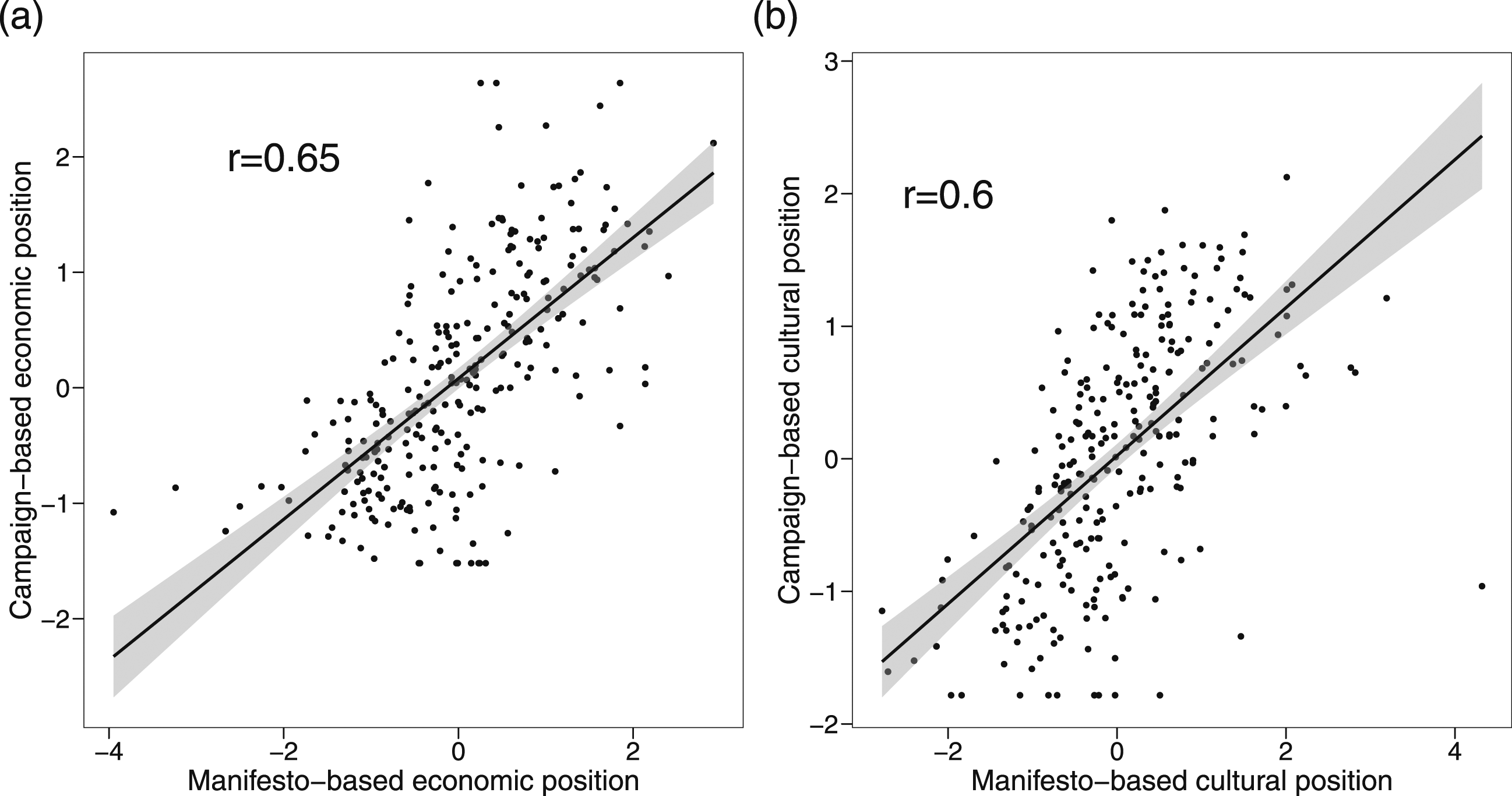
Vertical integration
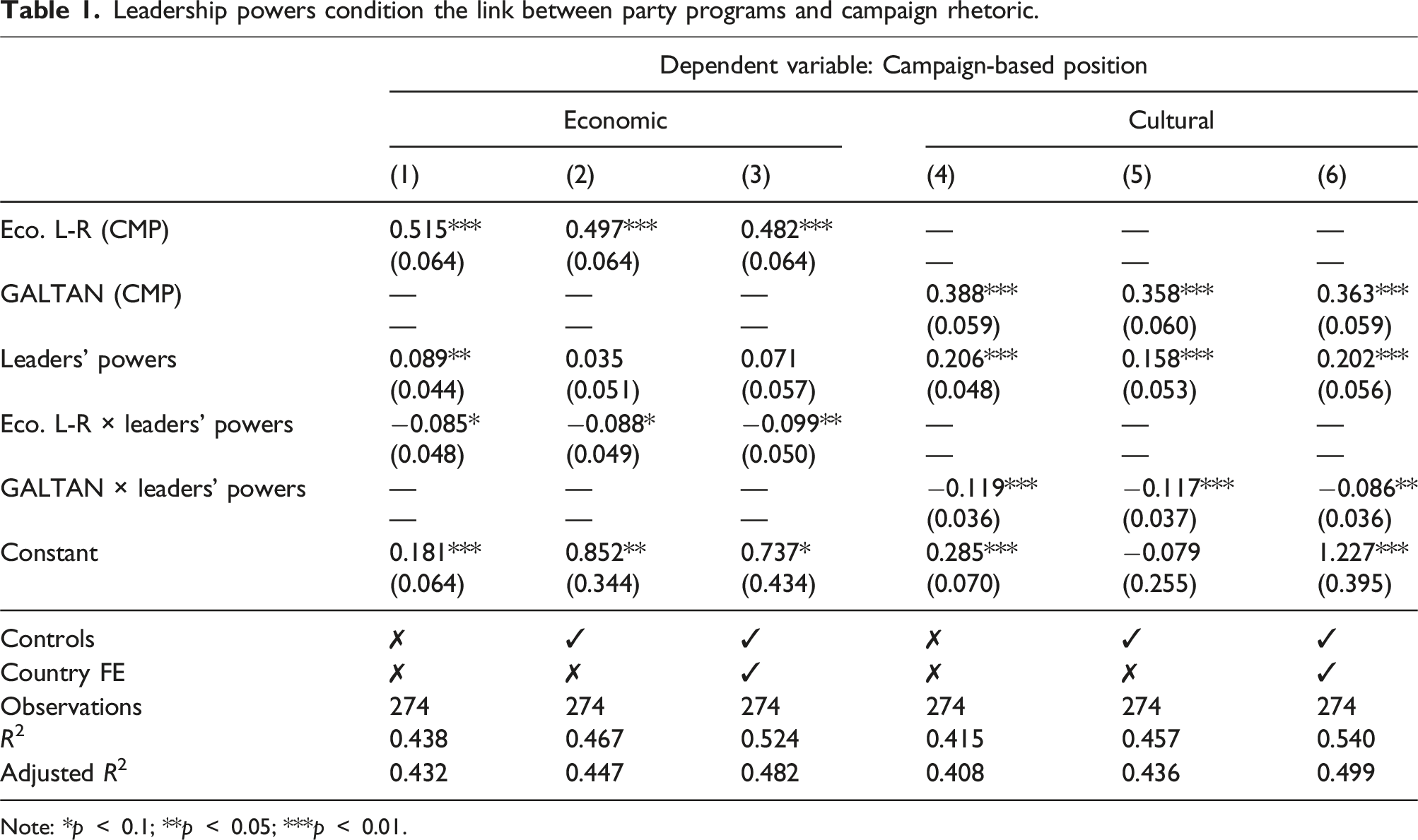
Leadership powers condition the link between party programs and campaign rhetoric.
Note: *p
More importantly, the interaction effects demonstrate that the leadership powers can strongly moderate the link between manifestos and campaigns. Looking at both the economic and cultural dimensions, the interaction term shows that the correlation between the manifesto and the campaign-based rhetoric becomes weaker as leadership powers become stronger. The effect is highly statistically significant and is robust to the inclusion of control variables and country fixed effects. To get a better idea of the effect size, Figure 2 visualizes these findings by showing the marginal effect of manifestos on campaign rhetoric (Y-axis) across the full range of leadership powers (X-axis). At the lowest levels of leadership powers, the effect is positive, large in size, and statistically significant. Hence, the figure indicates that campaign statements are closely aligned with party programs at the lowest levels of leadership powers, or when the authority of party members is prominent. However, the effect gets weaker as we move to higher values of leadership powers, and the correlation approaches zero and becomes statistically insignificant at the highest values of leaders’ powers. This significant change at higher levels of leadership powers indicates that campaign rhetoric becomes less aligned with the manifesto when leaders enjoy considerable powers within their parties. In sum, the results lend support to H1, which applies to both the economic and cultural dimensions. Leadership powers condition the effect of manifesto position on campaign rhetoric. (a) Economic dimension, (b) Cultural dimension. Note: Campaign-based positions (PolDem) are plotted on the horizontal axes, and manifesto-based positions (CMP) are plotted on the vertical axes.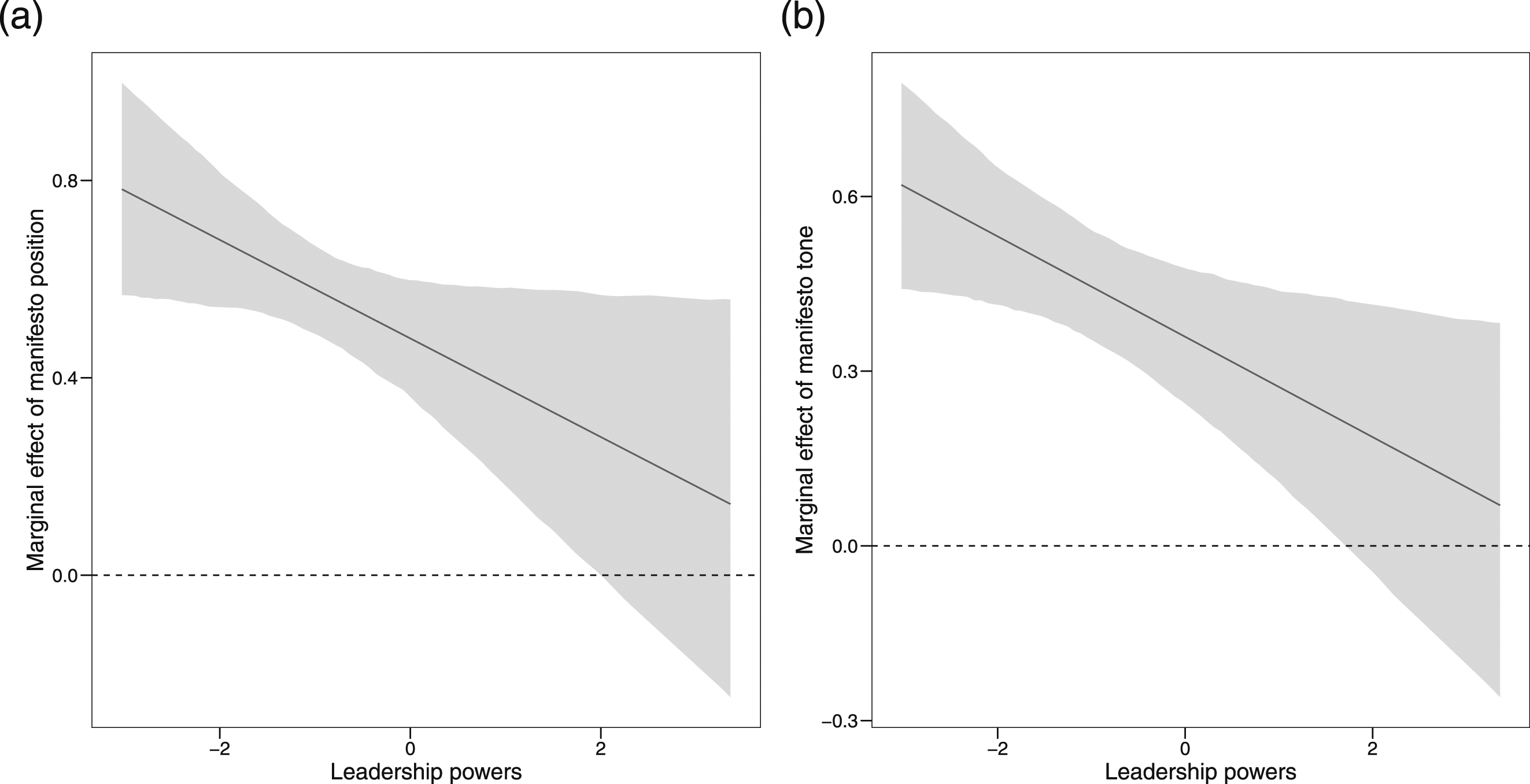
Horizontal integration
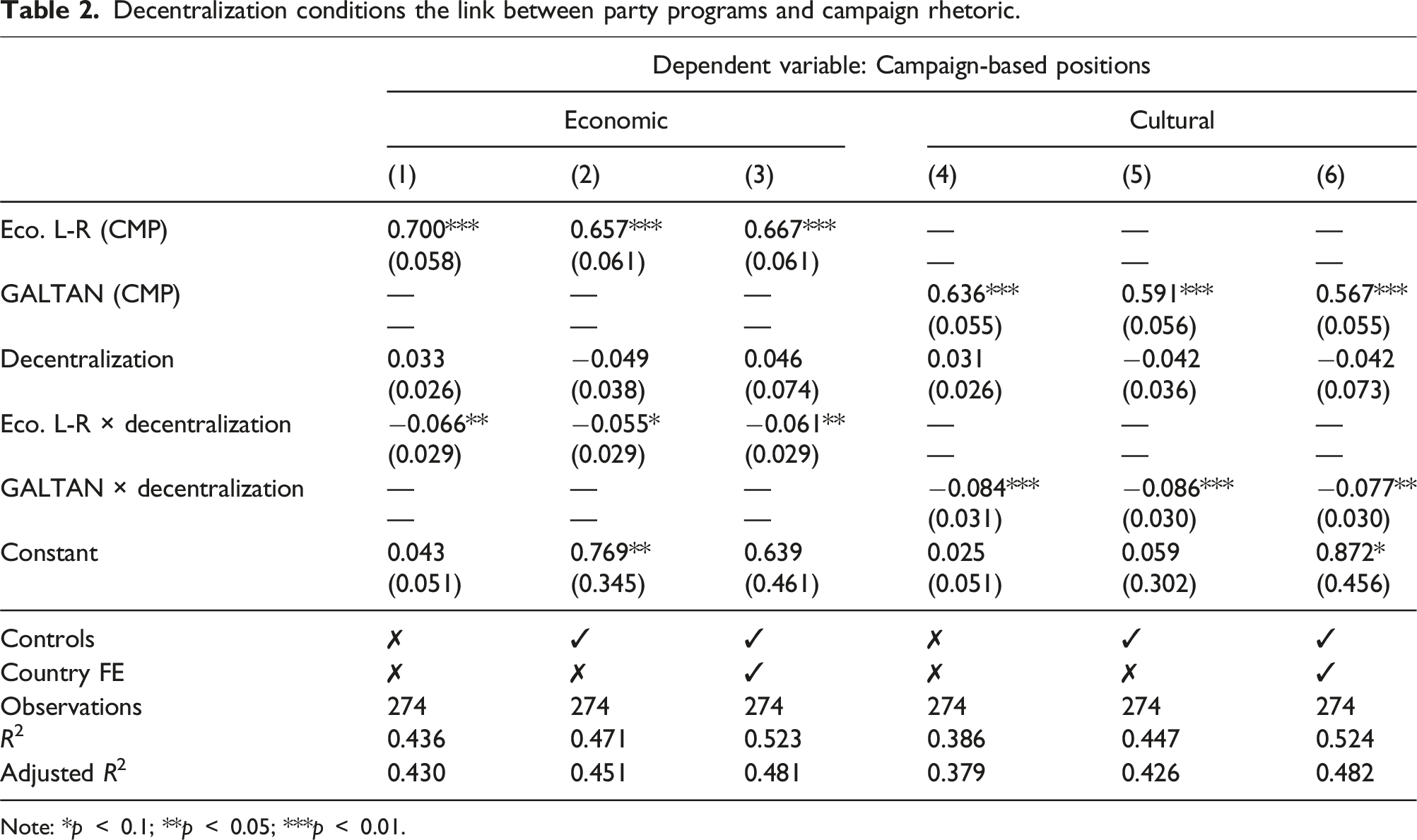
Decentralization conditions the link between party programs and campaign rhetoric.
Note: *p
Figure 3 similarly shows the marginal effect of manifestos on campaigns across levels of decentralization. The figure also shows that the effect of manifestos on campaign statements is strong and positive, but it becomes weaker as the party maintains stronger local branches. Compared to leadership powers, however, the moderating effect of local offices appears to be weaker. At the highest levels of decentralization, there is still significant association between party programs and campaign rhetoric. The degree of decentralization conditions the effect of manifesto position on campaign rhetoric. (a) Economic dimension, (b) Cultural dimension. Note: Campaign-based positions (PolDem) are plotted on the horizontal axes, and manifesto-based positions (CMP) are plotted on the vertical axes.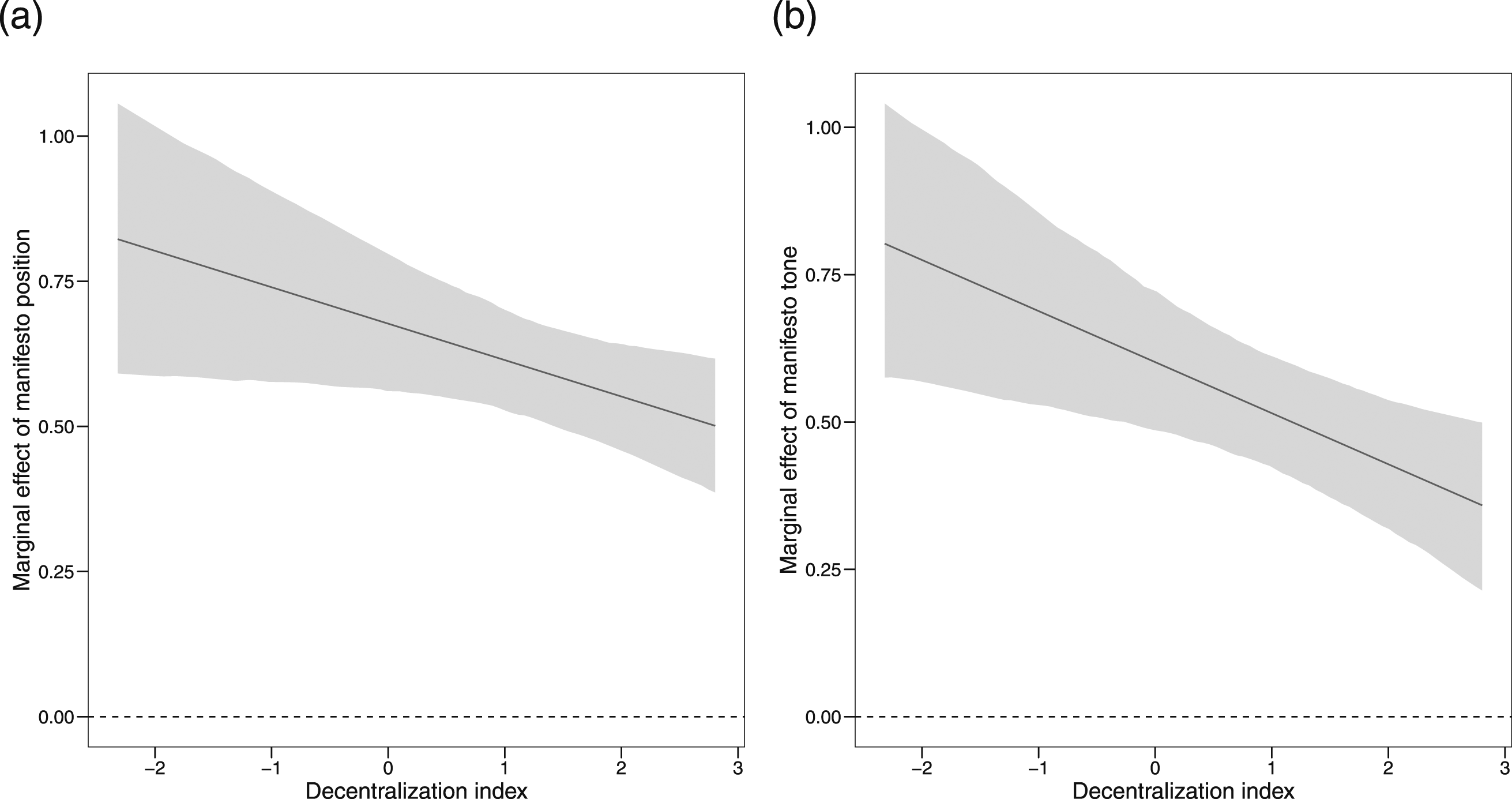
To investigate H2 further, I employ an additional measure of parties’ horizontal integration that taps more directly into the social embeddedness aspect of the party-voter connection. The full report of regression results can be found in the Appendix. However, I present the moderating effect of interest in Figure 4, which employs the strength of ties to social organizations as the moderator. The figure also confirms the results presented previously in Figure 3. It shows that campaign statements align closely with manifestos when the party has weak ties to social organizations. However, this close alignment becomes weaker the more the party preserves strong connections to social organizations. In sum, these findings strongly support H2. They suggest that party programs play a less significant role in the campaigns of parties enjoying robust connections with social organizations. Ties to social organizations condition the effect of manifesto position on campaign rhetoric. (a) Economic dimension, (b) Cultural dimension. Note: Campaign-based positions (PolDem) are plotted on the horizontal axes, and manifesto-based positions (CMP) are plotted on the vertical axes.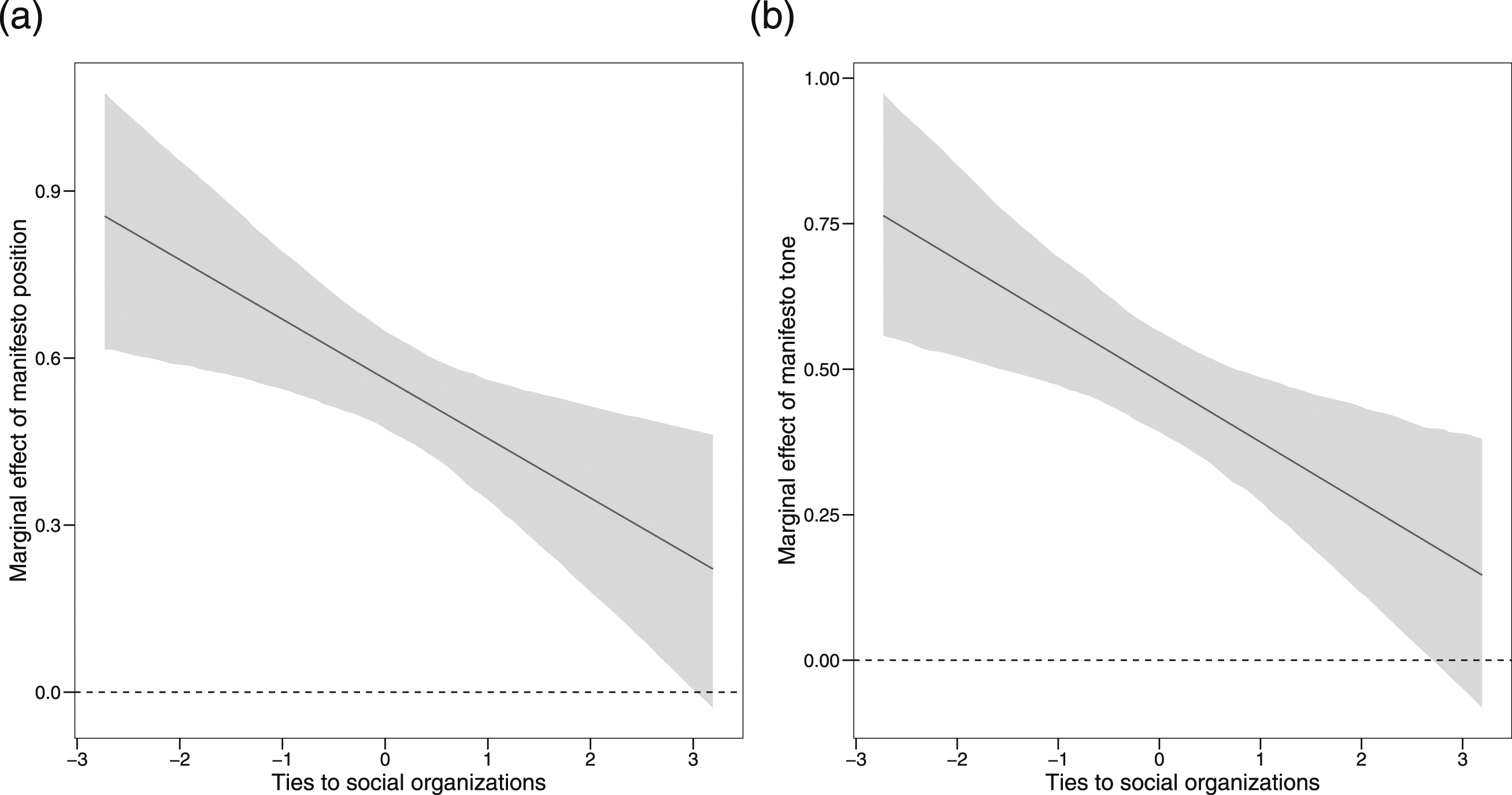
Conclusion and discussion
Political parties draft election programs that summarize their stances on the issues of the day. These programs have received significant scholarly attention since they express the party’s identity. Although party manifestos are commonly considered esoteric policy documents that only a minority of the well-informed citizenry observe and interact with, political scientists expect that parties communicate the policy directions of these documents through the media when they address the public during the few weeks leading up to the national elections. Nevertheless, it is still unknown which parties, and under what conditions, comply closely with their election programs, and which have the liberty to adjust their messages to the circumstances during the campaign.
By investigating this question, this article represents the first attempt to theorize the connection between party programs and elite rhetoric on the trail of election campaigns. The current study paid close attention to one aspect of political parties, namely their organizational characteristics. The empirical evidence presented here suggests that organizationally strong parties, i.e., those with strong leadership and nationally widespread and decentralized structures, are more likely to be flexible in electoral competitions. This empirical evidence is not at odds with earlier research concerned with party organizations. Previous research demonstrates that party organizations can significantly determine parties’ survival and success in national elections (Tavits, 2012). This article sheds new light on the implications of parties’ institutional characteristics. It suggests that one way the party could survive through its organization is that strong institutional structures can allow the party and its leaders more opportunities at politically salient times that parties with weak structures will lack.
One important aspect the current study could not engage with pertains to the distribution of power and authority among individual party leaders within a given party. Specifically, future research could expand on the current study by examining whether leaders endowed with greater levels of power exhibit different campaign behavior than their less influential counterparts. By comparing and contrasting the messaging tactics utilized by leaders occupying different internal party roles, scholars can develop a more comprehensive understanding of the impact of intra-party power dynamics on campaign behavior. To this end, future research could leverage diverse sources of data, such as media interviews, parliamentary debates, or social media platforms, to analyze the rhetorical strategies employed by party leaders of varying degrees of power during election campaigns.
The findings of this study have far-reaching implications for research on party programs and campaign strategies. Previous literature has often assumed a direct and consistent connection between a party’s program and its campaign messaging, without fully considering the complex factors that can shape the behavior of party elites during a campaign. By revealing the variation in the degree to which party elites adhere to their party’s program, this study challenges this simplistic view and highlights the importance of understanding the conditions under which party elites are more or less likely to stick to their programmatic commitments. It also carries important implications for research concerned with the consequences of party organizations. It sheds light on a new consequence of party organizational strength, namely its impact on party behavior in the short run during election campaigns.
By theorizing the link between party programs and behavior during campaigns, this paper opens new avenues for future research. Studying party organizations as a determinant of the program-to-campaign link is not meant as the exclusive explanation of why parties would comply or stray from their election programs. Other factors, too, could contribute to the dynamics of elites’ behavior and messaging before elections. For example, future research could investigate how the dynamics of elections campaigns would require the party to dedicate its resources to addressing other parties’ messages, instead of communicating their own to the public. Factors such as the degree of ideological polarization, negativity of the campaign, and issue salience could play a significant role in this process. It is also worthwhile to investigate how voters – if they observe it – would evaluate parties that adapt their messaging between drafting the program and the actual campaign.
Supplemental Material
Supplemental Material - The program-to-campaign linkage: Party organization and ideological inconsistency during election campaigns
Supplemental Material for The program-to-campaign linkage: Party organization and ideological inconsistency during election campaigns by Mohamed Nasr in Party Politics
Footnotes
Acknowledgments
I would like to thank participants of the ETH Zürich - EUP summer retreat, in July 2022 as well as participants of the Intra- and Inter-party Conflict Workshop at the Humboldt-Universität zu Berlin, in August 2022 for useful comments on earlier versions of the manuscript. Thanks also to Markus Kollberg, Hanspeter Kriesi, Zeynep Somer-Topcu, and Party Politics reviewers for the excellent feedback on the paper. All remaining errors are undoubtedly mine.
Declaration of conflicting interests
The author(s) declared no potential conflicts of interest with respect to the research, authorship, and/or publication of this article.
Funding
The author(s) received no financial support for the research, authorship, and/or publication of this article.

Supplemental Material
Supplemental material for this article is available online.
Notes
Author biography
References
Supplementary Material
Please find the following supplemental material available below.
For Open Access articles published under a Creative Commons License, all supplemental material carries the same license as the article it is associated with.
For non-Open Access articles published, all supplemental material carries a non-exclusive license, and permission requests for re-use of supplemental material or any part of supplemental material shall be sent directly to the copyright owner as specified in the copyright notice associated with the article.
