




Abstract
Our knowledge about how voters decide which candidate(s) to vote for under preferential-list proportional representation (PLPR) systems remains limited. In particular, it is debated whether incumbent MPs enjoy an electoral advantage over outsiders also under PLPR. We argue that such an incumbency advantage critically depends on candidate visibility (in the media) and differs across voters with varying levels of political knowledge. Our empirical analysis combines candidate information with rich individual-level voting data collected via “mock ballots” in the 2014 Belgian PartiRep election study. We show that the vote premium linked to incumbency increases with increasing media visibility, and while high-visibility incumbents outperform incumbents among the entire electorate, low-visibility incumbents enjoy an advantage only among knowledgeable voters. The results contribute to a better understanding of candidate voting and the incumbency advantage in PLPR. They also have implications for campaign strategies and the regulation of media access.
Research on the personalization of elections, and of politics in general, has been burgeoning for more than a decade (Karvonen, 2010; McAllister, 2007; Pedersen and Rahat, 2021). It has highlighted the growing importance of individual politicians in electoral dynamics across established democracies, even though the trend is not uniform across countries (Marino et al., 2022). Personalization has also led scholars to pay more attention to how voters evaluate individual candidates when casting their ballot. In so-called preferential-list proportional representation (PLPR) systems, citizens not only select the party they want to support but also mark preferences for candidates within lists. Such electoral systems are widely used, especially across Europe (in 20 countries for parliamentary elections), and have become even more widespread in Europe in recent years (Renwick and Pilet, 2016: 266-267). They offer perfect settings for understanding candidate choice as they ask voters to choose both a party and one or several politician(s) from within that party. This stands in contrast to single-seat district systems, where party and personal vote are fused and more difficult to separate.
Our knowledge with regard to the dynamics of candidate choice in PLPR systems remains incomplete though. The literature on intra-party competition in such systems exhibits a clear skew to the supply side, i.e. the personal vote-seeking behaviour of politicians (for reviews, see André et al., 2014; Passarelli, 2020; Wauters et al., 2020). The emerging literature on voters’ candidate choices (André et al., 2017), most of which uses aggregate candidate-level vote results, points out that choosing one out of many co-partisan candidates under PLPR constitutes a difficult task for many voters (Coffé and von Schoultz, 2020; von Schoultz and Papageorgiou, 2019). Many citizens have little information about the candidates and therefore rely on low-level cues such as list rank (e.g. Däubler and Rudolph, 2020; Faas and Schoen, 2006; Geys and Heyndels, 2003), gender (e.g. Holli and Wass, 2010), or – where available – candidate information provided on ballot papers, such as residence (Jankowski, 2016; Van Erkel, 2019).
We contribute to this body of knowledge by looking at the combined effect of incumbency and candidates' media visibility on voters’ choice of candidates within lists. Next to the above-mentioned low-level cues about candidates that are available, voters might also obtain information about candidates during the campaign. Candidates who are visible and about whom voters know more have a decisive advantage over their co-partisans. Folke and Rickne (2020), for example, find that candidates who communicate more with their voters tend to attract more preference votes.
Within this logic, we argue that incumbents can benefit from a great advantage over other candidates as they had time and resources to build up a personal reputation and to gain visibility. However, we argue that such an incumbency advantage will by no means be automatic. Voters' political knowledge is crucial here. Among highly knowledgeable voters who are more likely to follow political news, incumbents do indeed have an electoral advantage. But among less knowledgeable voters, the incumbency advantage requires a very high media visibility of the incumbent to be translated into attracting actual votes.
These expectations build on earlier literature on the incumbency bonus in elections, on political knowledge, and on the impact of media visibility in preferential-list PR systems. Some previous research suggests that under PLPR, incumbent candidates are indeed attracting more intra-party votes (e.g. Cheibub and Sin, 2020; Dettman et al., 2017; Górecki and Kukołowicz, 2014; Jankowski, 2016; Maddens and Put, 2013; Maddens et al., 2006; Van Holsteyn and Andeweg, 2012). However, recent work that seeks to isolate the causal effect of incumbency status under PLPR, by drawing on its quasi-random variation between very closely elected and not elected candidates with a regression discontinuity approach, suggests a more complex story. A number of studies establish an incumbency effect on the chance to be re-elected overall (Dahlgaard, 2016; Fiva and Røhr, 2018; Golden and Picci, 2015; but see also Hyytinen et al., 2018). However, further examination suggests that the advantage materializes at the re-nomination stage, when prominent list positions are allocated, rather than at the electoral stage, when voters cast preference votes (Fiva and Røhr, 2018; Golden and Picci, 2015). In any case, studies based on regression discontinuity analysis of aggregate candidate performance cannot tell us much about the mechanisms underlying a potential incumbency advantage at the electoral stage. In addition, we do not know whether such an effect applies equally to all voters. As Eckles et al. (2014: 734) point out regarding the wider literature, “there has been a marked absence of studies that consider whether attributes internal to the voter shape the importance of incumbency” (emphasis in original). 1 This is particularly unfortunate since recent work by Coffé and von Schoultz (2020) has demonstrated that more politically interested and sophisticated voters (in the Finnish PLPR context) were paying attention to a wider variety of candidates’ characteristics, including political experience, when deciding how to cast their preference vote.
In this article, we examine one possible mechanism behind an incumbency advantage and its heterogeneous impact across voter types: candidate visibility in the media during the election campaign. While channels for direct communication with citizens – such as posters, flyers, or online and social media – exist, many voters receive information about politics indirectly. Incumbents may be advantaged when it comes to media coverage, since they have a past record in office, have higher news value (Van Aelst et al., 2008), and might be able to use office-related resources to promote themselves. Media appearances show a positive association with candidates’ electoral success in Belgium (Maddens et al., 2006; Van Erkel et al., 2020). The latter study also finds that it is candidates without prominent list positions who benefit the most from campaign-time coverage. Through the media, incumbents can strengthen name recognition and advertise their record in the run-up to the elections. The impact of such signals should also depend on voters’ ex ante knowledge. As Zaller (1992: 216-253) emphasizes in the US context, voters’ attentiveness (in interaction with partisanship) shapes the reception of incumbents’ and challengers’ campaign messages in US House races. Similarly, Prior (2006) shows that citizens with lower educational attainment were particularly receptive to local TV coverage, which favoured congressional incumbents in the US in the 1960s. Hence, we suggest that incumbents do benefit from media coverage but more strongly so among voters with little knowledge about politics.
Our paper connects to the general framework of the symposium in which this article is published (Put and Coffé, 2023) by studying how politicians’ attributes and behaviour interact with voters’ choices at the electoral stage. Focusing on the link between the incumbency bonus, media visibility, and voters’ political knowledge, it makes several key contributions to different fields of research. For the literature on preference voting, it will provide clearer evidence on why incumbents tend to receive more votes than other candidates. Is this due to their media access, or rather, as other studies suggest, due to their (financial) resources (Maddens et al., 2006) or their activity in parliament (Däubler et al., 2016; Marcinkiewicz and Stegmaier, 2019)? It also feeds into scholarly debates on the personalization of politicians’ behaviours (Rahat and Kenig, 2018). For building their personal reputation, what should politicians prioritize to secure re-election? Is high visibility in the media in the weeks before the elections the key element, or are other activities, before the campaign, more important for incumbents? Finally, our study connects to debates on the role of media in shaping voters’ behaviour. In particular, we directly contribute to research on the influence of media coverage before elections (Druckman, 2005). Is this more important for less knowledgeable or for more knowledgeable voters?
To test our argument, we require information both about candidates and about individual voters. We use survey data covering the 2014 Belgian federal election that includes information on the full pattern of preference votes cast by respondents (Deschouwer et al., 2015). This comes as a great advantage in the Belgian context, where voters may express preferences for as many candidates as found on the list. To measure the visibility of candidates, we augment these data with information on candidates’ newspaper coverage in a 30-day period prior to the election. We then apply conditional logit models to the full choice sets to analyze citizens’ preference voting patterns. 2 Our most important finding is that when candidates are highly visible, the incumbency advantage is present among citizens with low and high levels of political knowledge, while less visible incumbent members of parliament enjoy a personal vote bonus (vis-à-vis less visible non-incumbents) only among more knowledgeable voters. The detected interaction between incumbency, visibility, and citizen knowledge contributes to the understanding of candidate choice under PLPR systems and has implications for campaign strategies and the regulation of media access.
The Belgian electoral system
The Belgian electoral system is a semi-open (or flexible)-list PR system. For the election of the lower house, the Chamber of Representatives, 150 MPs are elected in 11 districts (returning between three and 24 seats). Within each district, seats are first allocated to lists applying the D’Hondt formula, and then to candidates within lists (Renwick and Pilet, 2016: 28). Preference voting is optional. Belgian voters can cast a vote for a party, or they can cast preference votes for one or several candidates on the main or successor candidate list of the chosen party. 3
The allocation of seats to candidates within the list works as follows. On the ballot, candidates are ranked according to the order predetermined by the party. The initial eligibility threshold equals the Droop quota: the number of votes for the party divided by its number of seats plus one. Candidates reaching the eligibility threshold on the basis of their preferential votes are directly elected. To allocate the remaining seats, half of the list votes are first transferred to the best-ranked unelected candidate until (s)he reaches the eligibility threshold. 4 If any list votes remain, these are transferred to the next unelected candidate on the list, and so on for all further candidates. Should the votes for transfer become exhausted before all seats are assigned, the remaining candidates are determined on the basis of their scores in preferential votes, only. The system is clearly working to the advantage of the candidates occupying the top positions on the list. Just around 10 per cent of seats are attributed to candidates who would not have been elected under a closed list (Wauters and Weekers, 2008; Wauters et al., 2004). Few candidates reach the quota on the basis of their preference votes only, and the transfer votes often suffice to secure the election of the highest-ranked candidates, since most parties win fewer than four seats.
Despite its limited effect, a majority of Belgian voters cast at least one preference vote (see Figure 1). In recent elections, around 60 per cent of the electorate decided to mark its preference for candidate(s) within a list. In the latter group, the average number of preference votes cast per voter is around two (see Wauters and Weekers, 2008), although a majority of voters cast a preference vote for a single candidate, only. Percentage of Belgian voters casting a preferential vote in elections to the Chamber of Representatives (based on official election results).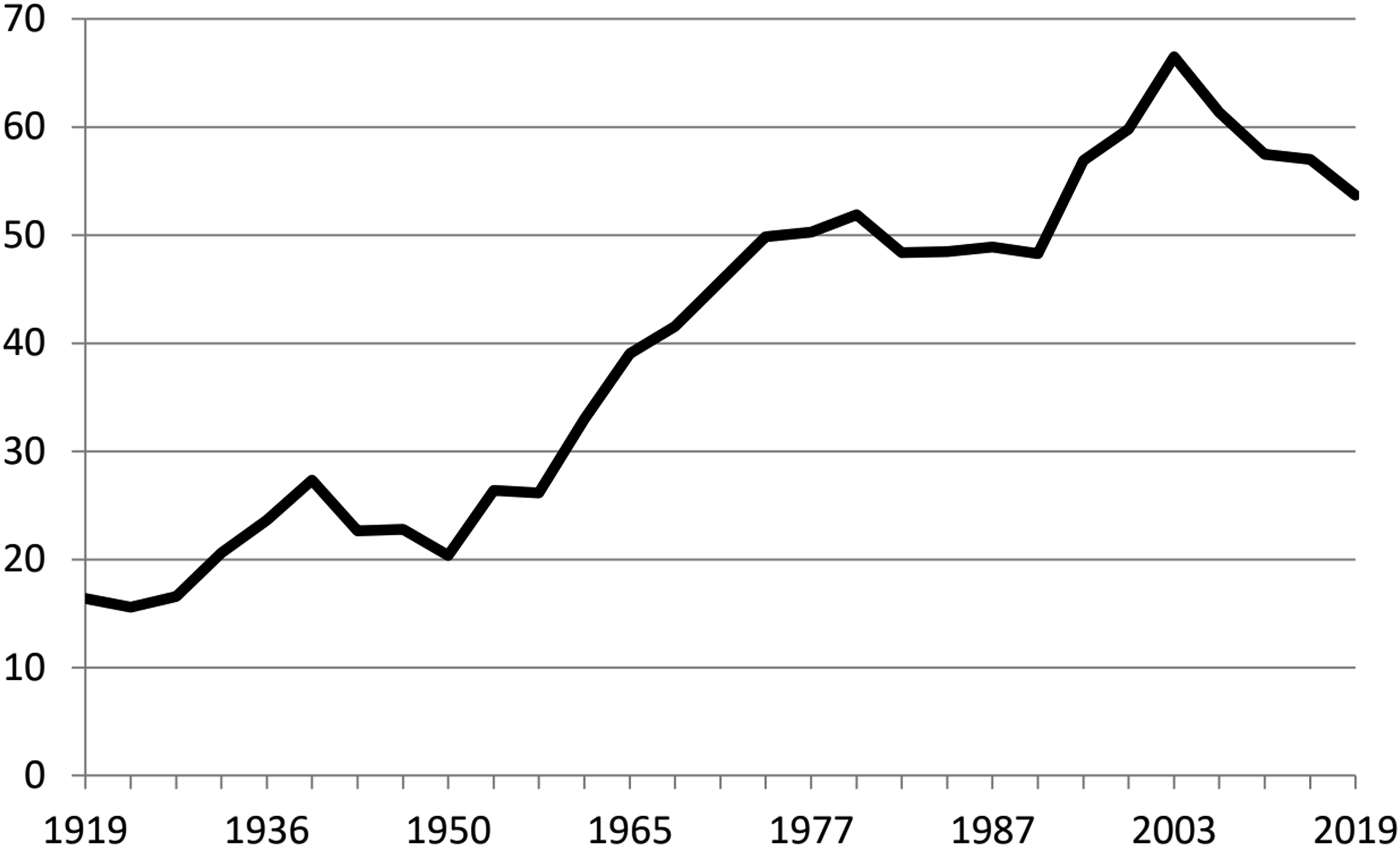
One of the big advantages of the Belgian electoral system when studying voters’ intra-party choice is that casting a preference vote is optional, as it is in 14 European countries (Renwick and Pilet, 2016: 218). This implies that all preference votes we observe are deliberately cast for a candidate, and arguably do not include any party votes in disguise, as in systems that force voters to support a candidate (Marcinkiewicz and Stegmaier, 2015). Hence it offers a unique opportunity to examine more carefully how incumbency affects the personal vote in a narrow sense of this term – something that is more difficult to do in single-seat district systems.
Belgian electoral rules stand out, since voting is compulsory. While this could push voters who are less politically informed to turn out (see Selb and Lachat, 2009), we do not believe that it is a major problem for our study. Voters who would not do so if voting was non-mandatory still have the option to cast a blank ballot (Hooghe et al., 2011). When they vote for a party, they more often vote for a list rather than for specific candidates (Wauters and Devroe, 2018). Since our analyses focus only on voters who support specific candidates, the likelihood of atypical uninformed voters affecting the results is limited.
Theoretical argument
Choosing a candidate in a PLPR system may not be a simple task, particularly in settings like the Belgian one where ballots provide only sparse information. At the ballot box, Belgian voters see the names of the candidates, their party affiliation, and their list rank. The latter may reflect the party’s preferences over candidates, and names can be indicative of the gender, age, and ethnicity of the candidates. 5 Hence, in order to cast a purposive vote for a candidate, citizens require information about the candidates, or they need to resort to a heuristic or prior belief about them.
If no information on the candidates is available, casting a list vote seems to be a reasonable response. If information on candidates is available and ideological preferences are weak, voters might engage in making a full comparison of all available candidates of all parties to determine one (or more) candidates that are most preferred. A third case, which is the one we focus on here, is when some information is available and ideology or partisan ties are strong. In this case, voters will pick a party list based on their party differentials so that the key choice problem boils down to a choice between candidates of the very same party. We would then expect to see voters reflect on which specific candidate or candidates to vote for. 6
When voters are in the ballot booth, the information about candidates that is available to them comprises one of two types. First, as we have argued above, they see the candidates' party affiliation, their first and family names, and their list rank. A candidate name allows for some inference on gender and ethnicity, and the list rank may provide an indication of the candidate’s prominence within the party (Van Erkel and Thijssen, 2016), or the preference of the party (e.g. Faas and Schoen, 2006). 7 Voters may make use of these cues (e.g. Brockington, 2003). What is common to these attributes is that this information is – in the same way and to the same extent – available to all voters at the ballot box.
Second, voters can rely on information about candidates they have gathered before entering the ballot booth: whether they consider someone as an expert on some relevant issues, whether the candidate has integrity, and whether s/he has experience, is deemed to do a “good job”, and deserves credit, and so on. What is decisive here is that whether or not information is actually available at the ballot box varies with both the candidate and the voter. In other words, a candidate’s qualification, experience, or effort in the past pays off only if there is a signal that is sent to voters, and voters are receptive to this signal. Our goal is to explore whether successful information transmission occurs and ultimately pays off.
Obtaining credit for their constituency service relative to their competitors in the very same district is difficult in electoral systems with multi-member districts (Däubler et al., 2016), and even more so when parties are strong and governments are formed by more than one party. To cultivate a personal vote, candidates' experience in political office is a critical advantage, giving rise to – among other things and moderated by other factors – an incumbency advantage. In other cases, preferential votes may be gained by mere name recognition. In any case, assessing individual candidates requires a sufficient amount of information to be received by voters. We focus here on candidates' political experience in office (as a broad definition of incumbency) and argue that the visibility of candidates prior to the election day is key to turning a potential “incumbency” advantage into a preferential vote premium. Candidates are publicly visible in different ways. Election posters will mainly strengthen name recognition and better enable citizens to associate candidates with their political party. Campaign flyers, along with appearances in both traditional and digital media, may provide more information. In any case, candidates who are unknowns and not publicly visible will find it difficult to garner personal votes beyond the narrow circle of their intimates, regardless of whether or not they have political experience.
We should not expect these effects to be uniform. There is also a receiver side. Some voters are more in need of information on candidates' political stance or quality, which they use to update their prior beliefs about the candidate, or they are simply primed, on a subconscious level, by the appearance of candidates in the media (a name recognition effect; see Kam and Zechmeister, 2013). Other voters closely follow politics. They have prior knowledge about candidates and their positions and quality. Coffé and von Schoultz (2020), for instance, demonstrate that politically sophisticated voters are paying attention to a wide variety of candidates’ characteristics, from their political experience to their policy issues and their sociodemographic traits. They don’t need the information provided by media close to the election, nor are they strongly affected by mere media appearance. This is consistent with the findings of Prior (2006), who suggests and provides evidence that exposure to local television (which is assumed to be pro-incumbent on average) is more influential for lower-educated voters than for highly educated ones. In the same way, and similar to Eckles et al. (2014), we argue that the incumbency advantage might arise not only from differences in the availability of information but also from voters' susceptibility to the information.
In sum, we argue that the information a voter has about a specific candidate depends on characteristics both of the candidate and of the voter. On the voter side, the extent of political knowledge s/he has acquired in the past is important. Citizens following politics regularly and attentively should on average also know more about individual politicians. Media appearance of candidates during the campaign will be less effective in terms of fostering a preferential vote in that group. On the politician side, candidates differ in terms of their visibility, which may be high or low. Importantly, we also expect that citizen knowledge and candidate characteristics interact. Highly visible candidates will be “known” to both low-knowledge and high-knowledge voters, so that incumbents can fully benefit from the advantage they have as a consequence of political experience. In contrast, non-visible candidates will only be familiar to more knowledgeable voters who (still) are more likely to recognize their names and know something about their record. We sum up these expectations as follows: H1. The higher their visibility, the more strongly incumbents outperform non-incumbents. H2. Low-visibility incumbents perform better than low-visibility non-incumbents only among knowledgeable voters. H3. Highly visible incumbents perform better than highly visible non-incumbents among both knowledgeable and less knowledgeable voters.
Empirical analysis
Our theoretical arguments focus on how individual voters react to different types of candidates when choosing from a set of intra-party competitors. In Belgium, voters have the opportunity to cast several preference votes if they wish to do so. Therefore, our units of observation are voter-candidate dyads, where each voter making use of the preference vote option is matched with all candidates (on the main or the successor list) of the party s/he has chosen. For each respondent, there will be as many observations as there were candidates in the chosen party, with the dependent variable taking on a value of one (rather than zero) for the politicians s/he supported. The subset of respondents we analyze does not include voters who decide to cast a vote for a party list. Simultaneously analyzing the choice about whether to cast any preference vote, and, if so, for whom, would be desirable, but it raises a number of complex issues that are beyond the scope of this paper. We note that considering preference voters only amounts to a conservative approach in terms of answering our research questions: citizens who have very little knowledge about the candidates are likely to opt out from preference voting by casting a list vote (André et al., 2012). As a consequence, differences between the high and low political knowledge group in the subset of preference voters shrink (Marcinkiewicz and Stegmaier, 2015), which reduces the chances of identifying the hypothesized differences between voter types.
The data we use are sourced from the Belgian “PartiRep Election Study - European, Federal and Regional 2014” (Deschouwer et al., 2015) – a panel with a pre-electoral and post-electoral wave. 8 Data on candidate choice were collected by means of a “mock ballot” paper that was sent to respondents’ homes between the two waves, and which they then used to report their choices in the post-electoral telephone survey. 9 Of the total 1374 respondents, 678 availed themselves of the preference vote opportunity, while 628 completed the mock ballot and are considered below. 10
Respondents in the sample come from all 11 electoral districts. We distinguish candidates, who come from both main and successor lists (total N = 1216), along two dimensions: incumbency, defined as having a previous political record at the non-local level, and media visibility. As in other parliamentary democracies, Belgian ministers are typically recruited from parliament, but government members cease to sit in parliament once they are appointed. We therefore use a broad understanding of previous political record, and consider as incumbents (1) members of government (at the federal, the regional, or the language community level), and (2) members of federal (Chamber and Senate) and regional (Brussels, Flemish, Walloon) parliaments, taking into account the previous legislative period in each case. Among incumbents, we also subsume the party leaders at the time of the election. Data for coding the incumbency variable are sourced from the studies by Seki and Williams (2014) and Dodeigne (2018).
Media visibility is measured on the basis of candidates’ newspaper coverage in the 30-day period prior to the election. For each candidate, we count the number of press articles mentioning her/his name in one of 18 Belgian newspapers, as retrieved from the GoPress media archive. 11 As expected, media data are heavily right-skewed. For 49.5 per cent of the candidates, we cannot find a single hit, and while the average number of mentions is 6.0, the 10 most often named candidates appear in 140 and more newspaper articles. 12 When candidates are frequently mentioned in newspapers, the marginal effect on their visibility is most likely decreasing. As also done by Van Erkel et al. (2020), we therefore measure candidates' visibility using a log-transformation of the newspaper coverage. 13
To distinguish voters on the basis of likely ex ante knowledge about the candidates running, we rely on factual knowledge questions from the pre-electoral wave of the survey. We separate those respondents who answered multiple-choice questions about parties’ federal and regional government membership correctly, from all others. Only about 39 per cent of the preference vote users knew the answers to questions on both federal and regional government membership. 14
As control variables at the candidate level, we consider primarily attributes that can be inferred from the ballot paper: dummy variables for the first list position and the last one; a continuous list rank variable (cardinal number); an indicator for the successor list; separate dummies for gender match between respondent and candidate (female/female and male/male); and an indicator for municipality match (aggregated from the zip codes in the survey and the official candidate register). Supplemental Appendix A presents descriptive statistics for all variables.
Respondents’ political knowledge and number of preference votes cast (row %).
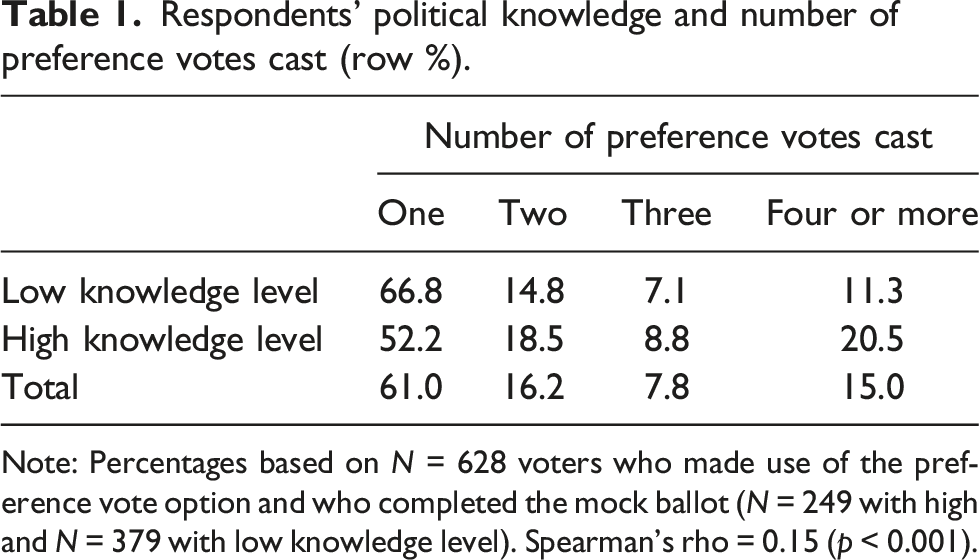
Note: Percentages based on N = 628 voters who made use of the preference vote option and who completed the mock ballot (N = 249 with high and N = 379 with low knowledge level). Spearman's rho = 0.15 (p < 0.001).
Support of different candidate types among low- and high-knowledge voters (% of dyads).
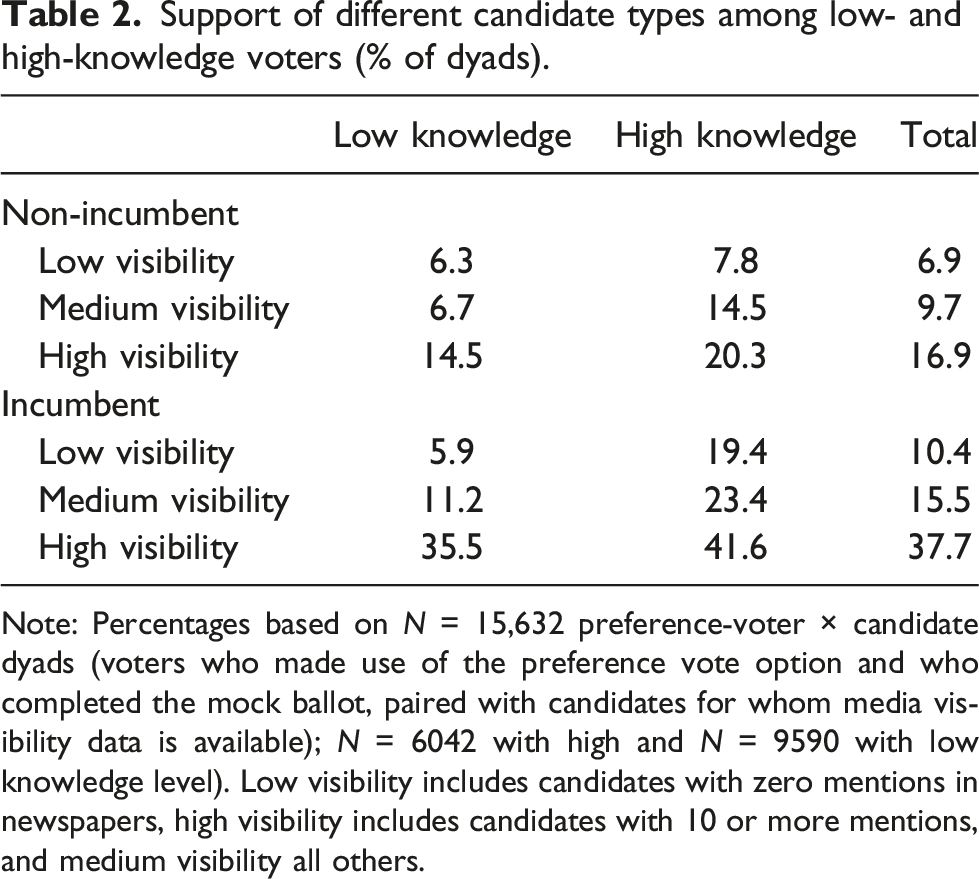
Note: Percentages based on N = 15,632 preference-voter × candidate dyads (voters who made use of the preference vote option and who completed the mock ballot, paired with candidates for whom media visibility data is available); N = 6042 with high and N = 9590 with low knowledge level). Low visibility includes candidates with zero mentions in newspapers, high visibility includes candidates with 10 or more mentions, and medium visibility all others.
Results of conditional logit regression of preference voting (odds ratios).
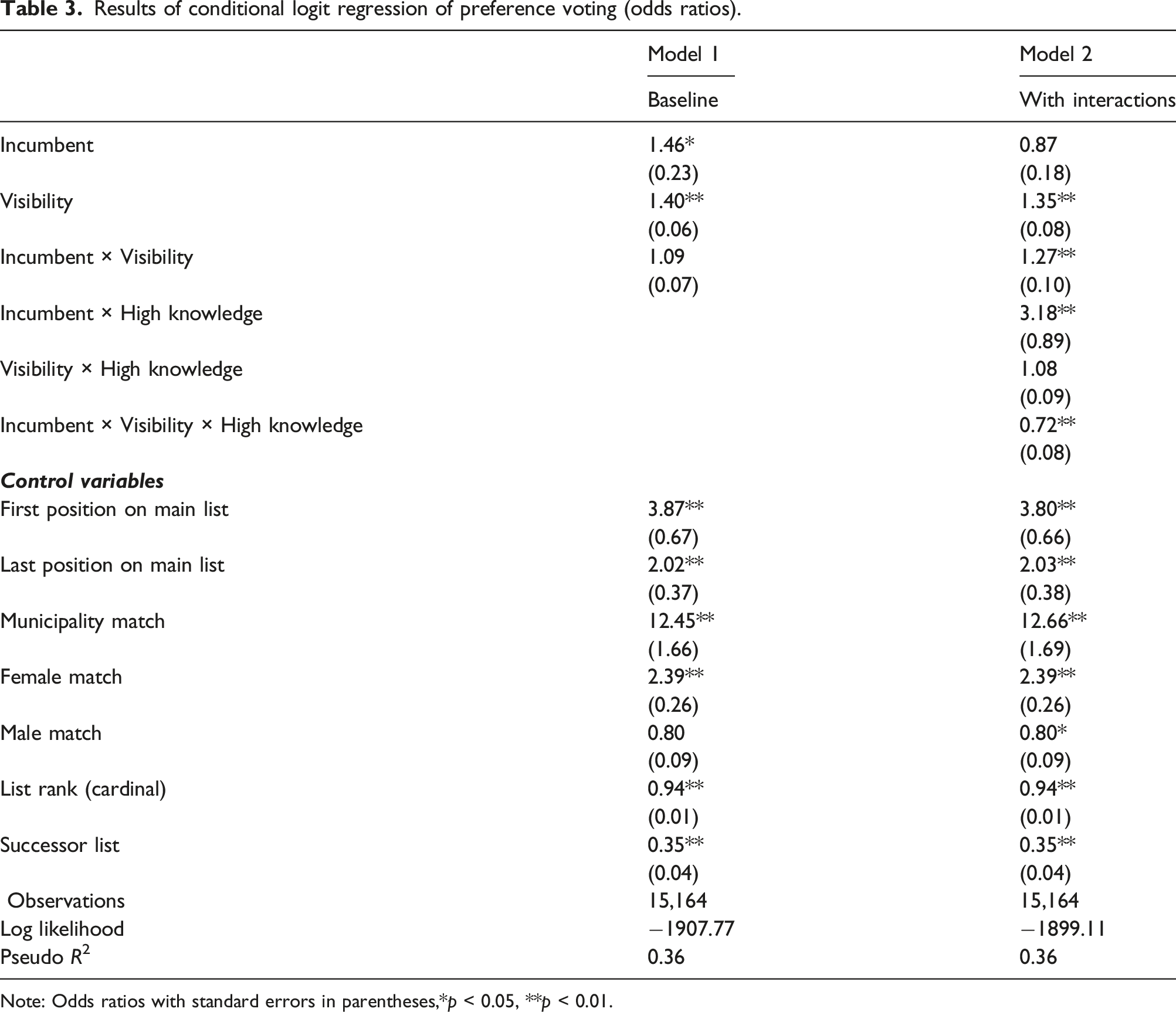
Note: Odds ratios with standard errors in parentheses,*p < 0.05, **p < 0.01.
Our argument stipulates that the effect of candidates' visibility, which moderates the effect of incumbency on vote choice, differs between voters with high and low prior knowledge about candidates. Visibility thus is a “moderated moderator”. Model two allows for such a differential impact of visibility among voters with low and high knowledge levels by including respective three-level interaction terms. Since we are dealing with a non-linear model, not too much should be read into the coefficients and interaction terms (Ai and Norton, 2003, 2003). We can, however, again get an initial idea by looking at the “main effect” of incumbency that refers to the group with less knowledge (and candidates with 0.5 newspaper mentions) and then contrasting these results with the pooled results from Model 1. The pattern is in line with H2, since the odds ratios of the incumbency variables are smaller for the lower-knowledge group (odds ratio 0.87) than for the pooled ones (1.46), and the more visible the incumbents (1.27), the more pronounced the differences, while the unconditional effect was quite small (1.09).
To assess the substantive size and the significance of these effects, we conduct a simulation based on the parameter estimates of Model 2. The methodology is described in more detail in Supplemental Appendix D. The result of this exercise is shown in Figure 2. It shows the advantage that incumbents with different levels of visibility enjoy among voters with higher political knowledge (red) and voters with lower political knowledge (blue). Vote bonus of incumbents by candidate visibility for low (blue/dashed) and high (red/solid) knowledge voters.Note: Bars show the distribution of candidate visibility for incumbents (top) and non-incumbents (bottom). Estimates of vote bonus based on 1000 draws from a multivariate normal distribution using coefficients and variance-covariance matrix from Model 2. Probability is conditional on there being exactly one preference vote cast by each preference vote user. 95% confidence bands based on simulation.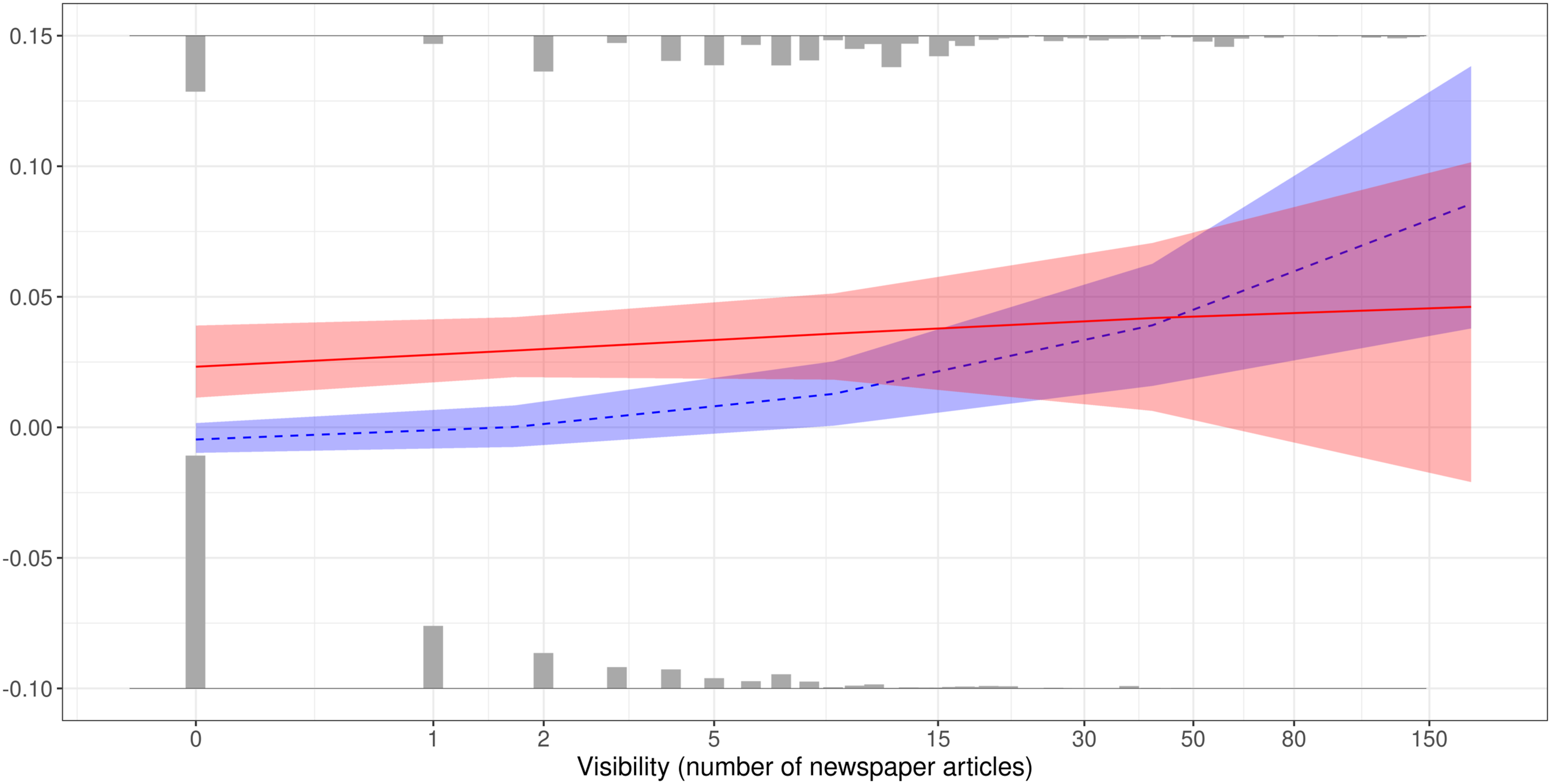
Overall, we find clear evidence for a positive incumbency advantage but with important differences. In line with H1, the vote premium of incumbents is increasing in visibility. The more often they appear in the media, the more strongly incumbents outperform non-incumbents. However, this pattern differs across voters with high versus low knowledge. Three patterns are important. First, when visibility is at the lowest level (no media appearance at all), incumbents do outperform non-incumbents among knowledgeable voters (the vote premium is about 2.5 percentage points) but do not among the less knowledgeable ones. This is perfectly in line with our argument (and hypothesis H2): citizens following politics attentively should on average also know more about individual politicians, including their incumbency status, and recognize their names on the ballot – even if such candidates are barely visible in the media.
Second, the positive effect of visibility on the vote premium of incumbents is more substantial for less knowledgeable voters than for more knowledgeable ones. Third, at higher levels of visibility, at approx. 10 media hits and beyond, the incumbency advantage of less versus more knowledgeable voters does not differ significantly. This supports our argument that both groups of voters are familiar with highly visible candidates: they either closely follow politics and know these politicians ex ante, or their gaps in prior knowledge are filled by news reports. While we simulate and plot predicted vote shares for all levels of visibility in the sample, we should stress that the predictions for very high levels of visibility at the right end of the plot can be estimated with large uncertainties, only. As shown by the histograms (bottom for non-incumbents, top for incumbents), the distribution of candidate visibility is generally right-skewed, and no non-incumbent achieves the same media appearance as the most prominent incumbents. The result is in line with hypothesis H3. Highly visible incumbents enjoy a similar advantage among low and high knowledge voters. However, owing to data limitations, we cannot rule out that low-knowledge voters are even more likely to vote for the most visible incumbents than high-knowledge voters.
Finally, there are also some interesting findings when it comes to our control variables. For most, they confirm earlier studies – for example, by showing that voters are more likely to support candidates positioned higher on the list (especially in the first position) and that women tend to vote for female candidates. Residing in the same municipality as a candidate has a very strong effect on casting a preference vote. This pattern has been identified in a few recent studies (e.g. Put et al., 2020; Van Erkel, 2019), confirming a kind of friends’ and neighbours’ effect in PLPR systems, but the magnitude of the effect in our model remains impressive. This last finding indicates that – in comparison with at-distance media visibility – at-proxy visibility of candidates residing close to voters is considerably more important for preference voting.
Conclusion
In this paper we have analyzed candidate choice by individual voters in a PLPR system, using survey data referring to the Belgian federal election of 2014. Our goal has been to examine the impact of the incumbency advantage and of media visibility on preference voting. The main argument we developed is that the effects of incumbency and of media visibility are different among voters, depending on their political knowledge.
A key finding is that the relative performance of highly visible incumbents does not clearly vary across voter groups, whereas low-visibility incumbent MPs enjoy an electoral bonus over regular candidates only among more knowledgeable citizens. In other words, low-visibility incumbents are not well known among many voters, especially not among those who do not follow politics closely or have difficulties understanding politics. Voters in this group will often not know a candidate’s name, let alone their personal record of activities as an MP. Only among citizens who follow politics closely and have the cognitive capacities to process political information will incumbents be known in this role and possibly even have built up a reputation as an MP who has been active. By contrast, highly visible incumbent politicians perform better than non-incumbents among both voter groups. They benefit both from increased familiarity due to media appearance: voters have become familiar with their name and learned about their incumbency status, which, arguably, is more relevant for citizens with little political knowledge and who use simple voting cues. Highly visible incumbents will also benefit from the increased prominence of their personal record of activities – a mechanism that is arguably more relevant for voters who are knowledgeable and already know the candidates’ names and incumbency status.
We believe this is an interesting result that contributes to a better understanding of voter decision making in the context of candidate choice under PLPR. Information about the candidates is important, and since voters vary in how much they know, they choose differently. This general insight should guide further research about voters’ candidate choice in PLPR systems. It may also contribute to an explanation of why several approaches using the regression discontinuity approach to studying incumbency effects under PLPR do not find any effects for personal votes (Fiva and Røhr, 2018; Golden and Picci, 2015; Hyytinen et al., 2018): closely (non-)elected candidates will often not be very visible.
Our findings also have implications for the personal vote-seeking literature that focuses on the supply side, that is politicians’ behaviour. One particularly relevant question that comes up is whether politicians have an intuition about a knowledge gap among voters, and possibly adjust their representation as well as campaign efforts accordingly. Politicians targeting voters with lower levels of political knowledge have incentives to invest above all in improving their visibility so that their name and face would become familiar to many voters. By contrast, for those politicians whose core constituents are more knowledgeable, what matters more than mere name recognition is their record of activities. They should not only be visible. They ought to distinguish themselves from co-partisans, on the basis of constituency service, parliamentary or governmental activities, and the positions they take. This could potentially lead to inequalities in substantive representation if, for this reason, the preferences of the group of more knowledgeable citizens receive more attention.
These elements could also lead us to reflect upon the role of the media in election campaigns. Earlier research has shown that in parliamentary systems like Belgium, media are reporting much more about established politicians, like incumbents, than about new candidates (Van Aelst et al., 2008). This imbalance in the media appearance of candidates is due to both media and party logics. Our study demonstrates that while this logic could make sense for the media to attract voters’ attention and for parties to boost their party performance, it is less helpful when it comes to the dynamics of intra-party competition. Prominent incumbents should not bother too much about being often in the media during the campaign. They have already established their reputation before the campaign. Those who should really fight to convince their party headquarters to send them on TV or radio, or in the direction of newspaper journalists, are the less prominent incumbents. A parallel can be drawn with regulations concerning media coverage during election campaigns that are in place in several European countries, including Belgium. Such regulations guarantee that all parties are visible in the media and that they are treated relatively equally, irrespective of their number of incumbents. The goal is to make sure that smaller, less well-known parties can become familiar to voters. It may also be useful to draw up similar regulations with regard to the level of candidates, in order to give more space to non-incumbents and to incumbents that are less visible before the campaign. However, such frameworks would likely be complex and at odds with dominant media logics.
Supplemental Material
upplemental Material - Candidate visibility, voter knowledge, and the incumbency advantage in preferential-list PR
Supplemental Material for Candidate visibility, voter knowledge, and the incumbency advantage in preferential-list PR by Thomas Bräuninger, Thomas Däubler and Jean-Benoit Pilet in Party Politics
Footnotes
Acknowledgements
We would like to thank Ertan Bat for his research assistance and GoPress for granting access to their archive of Belgian newspapers.
Declaration of conflicting interests
The author(s) declared no potential conflicts of interest with respect to the research, authorship, and/or publication of this article.
Funding
The author(s) disclosed receipt of the following financial support for the research, authorship, and/or publication of this article: This work was supported by the German Research Foundation [grant number DA 1692/1-1, to TD].

Supplemental Material
Supplemental material for this article is available online.
Notes
Author biographies
References
Supplementary Material
Please find the following supplemental material available below.
For Open Access articles published under a Creative Commons License, all supplemental material carries the same license as the article it is associated with.
For non-Open Access articles published, all supplemental material carries a non-exclusive license, and permission requests for re-use of supplemental material or any part of supplemental material shall be sent directly to the copyright owner as specified in the copyright notice associated with the article.
