




Abstract
In a recent article, Jacobson examines the rise and fall of the incumbency advantage from 1952 to 2014. He shows that the incumbency advantage over this period rose as elections became more localized, and has fallen in recent decades as elections have become more nationalized. In this research note, we examine whether a similar relationship holds when we extend the time-series back to the end of the Civil War. Consistent with earlier work, we find that the scale of the incumbency advantage was much smaller in the period prior to 1952— approximately ranging between 0 and 4 points. However, despite this difference in scale, there remains a very similar negative correlation between the nationalization of elections and the incumbency advantage. We therefore speculate that the nationalization of elections diminishes the relative size of the incumbency advantage, but the overall size of that advantage may also be shaped by other factors, such as technology, institutional reforms, or changes in the media landscape.
Introduction
In a recent article, Jacobson (2015) shows that the rise and decline of the incumbency advantage from 1952 to 2014 closely coincided with the de-nationalization and subsequent re-nationalization of US House elections. According to Jacobson’s theory, when voters’ decisions become decoupled from their evaluations of the national parties—as appeared to happen in the 1960s and 1970s—incumbents find it easier to cultivate the “personal vote” in their district (Ansolabehere et al., 2000; Fenno, 1977; Fiorina, 1989; Mayhew, 1974; Parker and Davidson, 1979). However, in recent decades, voters have increasingly cast their ballots on the basis of national factors—such as the ideological reputation of the national parties (Cox and McCubbins, 2007; Kim and LeVeck, 2013; Snyder and Ting, 2003; Woon and Pope, 2008) or on the parties’ performance in Congress (Jones, 2010). Unfortunately, from the perspective of many House incumbents, this resurgence in nationalized voting has diminished their ability to “develop, through their own locally focused efforts, a personal relationship with constituents that can insulate them from national partisan forces” (Jacobson, 2015: 868).
In this research note, we extend Jacobson’s research by examining whether a similar negative correlation—between the nationalization of elections and the incumbency advantage—also existed in previous eras, going back to the end of the Civil War. While a large number of studies have examined both the nationalization of US House elections 1 and the incumbency advantage 2 prior to WWII, we believe we are the first to examine whether there is a similar relationship between these two variables before and after WWII.
Consistent with earlier work, we find that the scale of the incumbency advantage was much smaller in the period prior to 1952— approximately ranging between 0 and 4 points (Carson et al., 2007; Gelman and King, 1990). However, despite this difference in scale, there remains a very similar negative correlation between the nationalization of elections and the incumbency advantage. We therefore speculate not only that the nationalization of elections consistently diminishes the relative size of the incumbency advantage, but that the absolute size of the incumbency advantage may also be independently shaped by other factors.
Methods and results
Data
To extend Jacobson’s original dataset, we gathered data on every US House of Representatives election in every state from 1866 to 1944 using the CQ Press Voting and Elections Collection. We restrict our analysis to contested elections where the democratic vote share is greater than 0 and less than 100. We also omitted off-year “special elections,” such as elections held due to a House member’s death. Because both our measures (described below) make intra-year comparisons for each district, we do not include years following congressional re-districting. 3
Measuring nationalization
Jacobson (2015) measures the nationalization of elections using the correlation between the district-level two-party vote-share for both congressional and presidential races. Here, we use a different measure that is more readily available for the entire time-period: the variance in the district-level two-party vote swing. This measure was originally proposed by Kawato (1987) and, as we note below, is highly correlated with Jacobson’s measure.
According to Kawato (1987), when districts are highly coordinated by national forces—such as changes in congressional performance (Jones, 2010) or national changes in voter sentiment towards either party’s ideology (Erikson et al., 2002)—vote swings across districts will be highly uniform, and the variance in vote swings will be fairly low. By contrast, the variance in vote swings will be larger if more voters cast their ballot on the basis of local factors that are independent of national-level changes—such as changes in a specific incumbent’s voting record (Ansolabehere and Jones, 2010; Canes-Wrone et al., 2002; Carson et al., 2010) or an influx of district pork that offsets an unfavorable party reputation (Carroll and Kim, 2010). 4
Because raw variances can be hard to interpret, and because they can over-weight outliers, we use the standard deviation in the district vote swing (rather than the variance). 5 To make our measure directly represent relative increases in nationalization (rather than relative decreases), we add a negative sign to the measure. Our measure of nationalization is therefore −sd(dit − dit−2), where dit is the democratic vote-share for district i in year t. 6
Figure 1(a) plots our measure of nationalization for every year from 1866 to 2014, and shows two notable features. Firstly, our measure recapitulates Jacobson’s (2015) finding that elections became less nationalized from 1954 through to the mid-1970s. They then became increasingly nationalized, with 2014 being the most nationalized election since the end of the Civil War. Given that our measure picks up the same trend noted by Jacobson (2015), it is perhaps unsurprising that our measure is highly correlated with Jacobson’s measure during the time-period where both measures are available (r = .79, p < 2.39 × 10⁻⁶). Secondly, there is also significant variation in the level of nationalization prior to 1952, with the least nationalized year occurring in 1878.
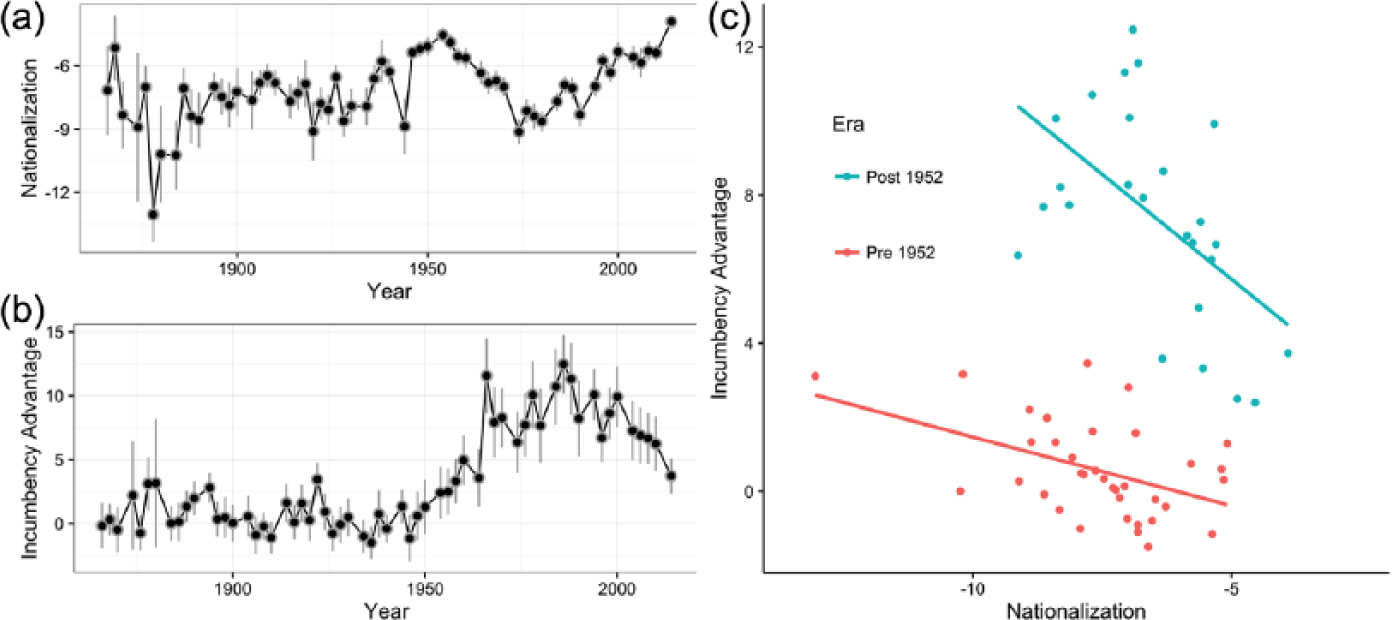
The relationship between the incumbency advantage and the nationalization of elections.
Measuring the incumbency advantage
We use the Gelman–King (1990) measure of the incumbency advantage. This is the electoral advantage received by incumbents after controlling for the two-party vote-share in the previous election and the winning party in a congressional race. Technical details about this measure can be found in the online appendix.
Figure 1(b) plots the incumbency advantage in every year since the Civil War. Similar to prior works (Carson et al., 2007; Gelman and King, 1990), we find that the incumbency advantage was much smaller in the era prior to 1952 (where Jacobson’s analysis starts), ranging from 0 (or effects that are not statistically distinguishable from 0) to about 4 points (which is about one third of the maximum effect, recorded in 1974).
Nationalization and the incumbency advantage
Figure 1(c) illustrates our main finding regarding the relationship between nationalization and the incumbency advantage using a scatterplot, with a separate linear trend line for elections before and after 1952. There is a notable vertical shift in the time-series between the years 1950 and 1954, which corresponds to the well-known finding that the incumbency advantage grew significantly starting in the 1950s (Gelman and King, 1990). However, despite this shift, it is also clear that there is a very similar, negative relationship between the two variables (–.54 post 1952 versus –.46 pre 1952), and we cannot reject the hypothesis that these two correlations are the same (p = .397).
There are two worries that one might have about this finding. Firstly, one might worry that the pre-1952 result is driven by the 1878 election, which, with a nationalization score of −13, is a clear outlier in both Figures 1(a) and (c). However, a similar result holds if we remove this year (r = −0.34, p = .049). The result also holds if we use the Spearman rank correlation, which is much less sensitive to outliers (r = –0.38, p = 0.02). Secondly, given that the least nationalized years follow the end of reconstruction, one might worry that the result is somehow specific to the South emerging from the Civil War. In the online appendix, we show that the result remains the same even if we restrict our analysis to the northern states.
Discussion
The aim of this research note is to add a simple, but interesting finding to the literature. Like Jacobson’s study, we cannot claim that the association we find between the nationalization of House elections and the incumbency advantage is necessarily causal. However, our result is consistent with Jacobson’s argument that the nationalization of elections drives the relative size of the incumbency advantage.
However, our finding also sheds new light on Jacobson’s speculation that other factors—such as additional opportunities to provide constituent service or the rise of local media—were “derivative” and did not exert much of an independent effect on the overall size of the incumbency advantage (2015: 868). Contrary to this proposal, our findings show that the nationalization of elections had a fairly consistent effect on the relative size of the incumbency advantage from the end of the Civil War to present—even though the overall size was dramatically higher after 1952. This suggests that other factors may actually have an independent effect on the baseline level of the incumbency advantage, while changes in the nationalization of elections affect its relative size. For example, the emergence of local media after 1952 might have improved incumbents’ ability to advertise their individual accomplishments (Prior, 2006). Meanwhile, the relative size of this new advantage may have still been tempered by voters’ propensity vote on local factors (like incumbents’ individual accomplishments) instead of more national factors, such as national party brands.
Footnotes
Declaration of conflicting interest
The authors declare that there is no conflict of interest.
Funding
This research received no specific grant from any funding agency in the public, commercial, or not-for-profit sectors.
Supplementary material

Notes
Carnegie Corporation of New York Grant
This publication was made possible (in part) by a grant from Carnegie Corporation of New York. The statements made and views expressed are solely the responsibility of the author.