




Abstract
While the knowledge on how candidate selection happens is flourishing, remarkably little attention has been paid to the selection criteria. Why do selectors prefer some candidates? This study investigates the intricate trade-offs party selectors face when having to compromise between the pursuit of three core party goals: unity, policy, and victory. When candidates score lower on one goal, do selectors favour candidates following the party line, skill for politics or ability to garner votes? Relying on 23 in-depth interviews with party selectors from three Belgian francophone parties (Social Democrats, Greens, and Liberals), this research offers insight into how selectors balance their choices between candidates in a PR list context where the group equilibrium is almost as important as individual assets. I point out the interconnections selectors consider between selection criteria, and hence the need to regard the full picture when studying intra-party competition at the nomination stage.
Introduction
When voters cast their ballot, they only get to choose within the menu defined by political parties (Rahat, 2007). No other option is available if they wish to taste something else. Hence the relevance of the study of who becomes a candidate is brought to the front stage. What kinds of profile are party selectors looking for? While the knowledge on candidate selection processes is rapidly evolving, empirical research on the candidacy stage is critically lacking. Next to how candidates are selected, one should also worry about why candidates are chosen by parties.
This study examines selection criteria through the eyes of party selectors themselves rather than formal criteria (Rehmert, 2020). I provide insights into how selectors hierarchise selection criteria and how these criteria matter at the candidate and aggregated level. Drawing on the party strategic goals’ model (Sjoblom, 1968), I expect selectors to look for candidates who could help them realise core party goals, hence partisan candidates who help the party remain united, popular candidates who help the party win elections and competent candidates who help the party implement policies. Yet, I suspect that candidates meeting all three criteria hardly exist (Frech, 2016). Selectors face intricated trade-offs: for instance, if an aspirant is loyal towards the party but not much appealing to voters, will selectors be willing to select her? In the framework of the current symposium on intraparty competition, this research scrutinizes the nomination stage, where parties develop strategies to balance various interests, sometimes taking voters’ preferences into account, and candidates strive to maximise their own intra-party power and seek support from selectorates.
A qualitative approach allows to uncover mechanisms behind the preferences of politicians, supplementing existing knowledge from quantitative studies, recently chiefly results from conjoint experiments tapping into similar questioning of what selectors are looking for in candidates (e.g., Berz and Jankowski, 2022; Rehmert, 2022) but failing to grasp informal practices or unexpected mechanisms. Collecting data via 23 in-depth interviews with selectors allowed inductive findings to surface.
I study selectors’ trade-offs in Belgium, a flexible list system where candidate selection remains the most decisive factor in explaining who gets elected (almost a closed list system), but where candidates do still compete at the intraparty level for preference votes. I focus on legislative elections, leaving aside both local and European elections where criteria but also selectorates (nature and degree of centralisation) differ (Kelbel, 2020; De Winter et al., 2013). Conversely, regional and federal elections in Belgium follow similar logics (Vandeleene et al., 2016). My findings emanating from three Belgian francophone parties – the Social Democratic party (PS), the Green party (Ecolo) and the Liberal party (MR) – demonstrate the interconnections selectors consider between selection criteria and the need to regard the full picture instead of criteria on their own. I highlight selectors’ balancing strategies according to the list positions by showing that standards might be lowered for candidates unlikely to take seat in Parliament.
Theoretical framework
The candidacy stage of the selection process
Political parties as gatekeepers on the road to Parliament directly influence the quality of elected assemblies: what kind of legislators do we have? Our knowledge is flourishing on candidate selection mechanisms. It started descriptive or classificatory (Gallagher and Marsh, 1988), scholars researching the ‘selectorates’ – the party selecting bodies, according to their inclusiveness and the level of centralisation of the decision (Rahat and Hazan, 2001). Researchers also characterised the candidates by depicting the journey from being eligible, aspirant, candidate and eventually MP (Norris and Lovenduski, 1995). More recent works turned explanatory, drawing on those typologies to focus on determinants or consequences of candidate selection (e.g. Shomer, 2014; Siavelis and Morgenstern, 2008).
Remarkably little attention has been paid to the first stage, candidacy. The first dimension of Hazan and Rahat’s fourfold analytical framework is “the most brutal of dimensions because it has the potential to eliminate an overwhelming majority of the population from the pool of candidates” (2010: 19). While scholars investigated the selection process’ outcome (Vandeleene, 2016; Put, 2015) or the rules constraining selection choices (Krook, 2009; Vandeleene, 2014; Reiser, 2014), the question of the selection criteria as such, “which one might have supposed was central” (King in Stark, 1996: 124) has mostly been neglected.
Selection criteria are first formal. The electoral law usually sets broad eligibility requirements, typically voting eligibility, nationality, age, residence, or incompatibility with other offices (Hazan and Rahat, 2010). Most parties also set formal candidacy requirements (Gallagher and Marsh, 1988) to ensure cohesion (e.g., a minimum length of party membership or a loyalty pledge (Rehmert, 2020; Vandeleene and Van Haute, 2021)) or to assess popularity (e.g., having a position within the party or gathering members or elected representatives’ signatures (Bjarnegård and Zetterberg, 2019)). Parties may ask a financial contribution to cover campaign costs or the settlement of any debts to the party (Hazan and Rahat, 2010).
Nevertheless, as Sartori (1976: 84) emphasized: “the rule maker and the rule addressee largely coincide”, so parties may not always obey their own rules (Kelbel, 2020) specifically when it comes to requirements for potential candidates (Galligan, 2003). If one wants to understand what parties are looking for, research needs to go beyond formal rules. Just like works on quotas may be flawed if restricted to formal party quotas (Reiser, 2014), works on selection criteria benefit from a neo-institutionalist approach.
I study selection criteria not based on formal rules but through the eyes of party selectors themselves. So far, few openly asked selectors why they made these selection choices (or not as the primary data source, see Borghetto and Lisi, 2018). Some investigated it via large-scale surveys. De Winter et al. (2013) asked local selectors about their preferred candidates’ qualities (among local embeddedness, expertise or skills, ideological or party embeddedness and name recognition) and investigated which socio-demographic equilibriums selectors were striving for. Schindler (2021) listed ideological congruence, effectiveness in the field of public relations, life experience outside the party, a high profile among the citizenry and persuasiveness in the candidate’s speech, as selectors’ most important criteria, and whether the aspirant represents the position of the selector’s local party group. Other recent research examined selectors’ preferences based on conjoint experiments (Berz and Jankowski, 2022; Rehmert, 2022).
Unlike existing studies departing from a fixed list of selection criteria, I argue that there is still need to uncover which criteria selectors spontaneously put forward without making them rank predetermined criteria. Moreover, a qualitative approach allows investigating which mechanisms are at play when selectors make compromises between candidates’ profiles.
Party goals and the prioritisation of selection criteria
What are selectors looking for? The literature points to conflicting demands (André et al., 2017; Dodeigne and Teuber, 2019; Frech, 2016). I argue that party selectors will primarily strive to meet core party goals. The largely used framework of policy-office-votes by Müller and Strøm (1999) taps into how party leaders resolve trade-offs between conflicting objectives. Nevertheless it is not specifically applicable to candidate selection decisions, rather to other key party decisions such as entering a government. Sjoblom (1968) developed the strategic goals’ model that better translates into selection criteria. It entails that parties pursue three goals: remain united, win elections, and implement policies. Stark (1996) applied it to party leaders’ selection, and I suggest adapting it to parliamentary candidates' selection.
To achieve unity, victory, and policy, I assume that selectors will respectively look for partisan, popular and competent candidates. One could obviously think of other qualities, essentially related to socio-demographic characteristics (e.g. gender, age, place of residence, ethnic origin, occupation), but these fall beyond the scope of this research intending to study selectors’ overarching preferences, beyond candidates’ individual descriptive characteristics. These, I suggest, could rather serve as predictors of overarching selection criteria, for instance how socio-demographic characteristics impact popularity (Wauters et al., 2020). Such a study would also require another theoretical framework (see for example the homophily theory tested in Rehmert, 2022).
I first make clear what is meant by partisan, popular and competent candidates.
In the internal party arena, selectors value foremost unity. To that end, they look for partisan candidates who have proven in their deeds and words, or are expected, to not hamper party unity (Borghetto and Lisi, 2018). Strategically, selectors favour partisans because of their lower cost. These candidates help the party avoid major negative consequences of intraparty competition (Cheibub and Sin, 2020). They require less monitoring, no rectifying communication is needed when they act on behalf of the party and no sanctions should be enacted in case they damaged the party and its image (Berz and Jankowski, 2022; Hazan and Rahat, 2015). Scholars arguably maintain that recruiting loyal candidates is selectors’ preferred option because ex ante screening is less costly than ex post discipline (Dodeigne and Teuber, 2019; Kam, 2009).
In the electoral arena, parties strive victory. Popular candidates help meet this goal when they can win votes. Selectors prefer candidates with a track record or a potential to be popular among voters (De Winter and Baudewyns, 2015). We know that one’s performance at previous elections pays off at the next one in terms of reselection (André et al., 2017), yet not always tremendously (Put et al., 2021). By (re)selecting popular candidates, selectors please the party’s supporters who would not understand why their preferred politicians are not on the ballot (again).
In the parliamentary arena, parties seek policy impact. To do so, selectors need to find competent candidates who can appropriately function as MPs or, as not all candidates are meant to be elected, who are at least good for the campaign duties. Norris and Lovenduski (1995) identify two main skills for a good politician: communication skills and expertise. Selectors look for show-horses but also for workhorses (Sorace, 2021). For all candidates, being able to communicate is essential (Sheafer and Tzionit, 2006). The second leg of political competence, expertise, is however probably more applicable for future MPs who are expected to be knowledgeable about political issues to be able to work in and outside parliament (Borghetto and Lisi, 2018; Papp and Russo, 2018).
Ideally, selectors would like to select only loyal, electorally popular, and politically competent candidates. Yet, in real life it is likely that the ideal candidate does not exist (Frech, 2016), and even less as many ideal candidates as there are positions to be filled in. Just like for any critical party decision (Müller and Strøm, 1999), selectors face trade-offs, having to compromise on goals when a given aspirant does not perfectly meet all criteria. Will they favour someone who is in line with the party, good at the polls or skilled for political work?
Incumbents are likely to meet all criteria by virtue of their position, hence the incumbency advantage (Däubler et al., 2018). Incumbents could prove selectors their engagement towards the party, their ability to garner votes and their skills to function as a politician. I consequently expect the three criteria to serve primarily for new candidates. Nevertheless, deselection happens (White and Ypi, 2020). Incumbents may deceive, or several incumbents may compete for the most electable positions (e.g., when party magnitude decreases). While this study’s hypotheses concern all candidates, one should consider that incumbents may be one step ahead of their co-partisans.
The literature tackles trade-offs in candidate selection without always naming it. André and colleagues have been calling for interview-based research on “the strategic choices [parties] make balancing conflicting demands” (2017: 598). Some studied the trade-off between popularity and partisanship (Crisp et al., 2013; Dodeigne et al., 2019) or between partisanship and competence (Galasso and Nannicini, 2015). Conjoint experiment research assessed selectors’ preferences, but among a broader set of characteristics including socio-demographics (Berz and Jankowski, 2022; Rehmert, 2022). Frech (2016) examined candidate selection based on the same three party goals as in this study, but her research strongly differs from mine as she investigated reselection, what overlooks all non-elected candidates; she performed a quantitative analysis based on the actual selection outcome and not abstract selectors’ preferences, and, while she mentions the trade-offs in her theoretical framework, she actually studied criteria individually and not their interactions.
In this study, I am interested in selectors’ prioritisation of criteria. What I construe from the existing scholarly knowledge is that selectors are likely to praise partisanship and popularity more than competence. If selectors must compromise on one goal, it will be policy, to safely reach unity and electoral victory. Policy on its own indeed does not help the party succeed on the long term if the other two goals are not met. One needs first to be in state of influencing policy, hence selecting foremost popular candidates helping reach parliament. We could actually consider that competence can be instrumental in a candidate’s popularity. For some candidates, their competence will make them popular – but I argue that selectors select them thanks to their popularity and not because of their intrinsic competence. Second, the party needs to be united to be able to function properly, and so influence policy. A party of free-riders only will not perform in the legislative arena, especially not in the Belgian partitocracy (De Winter 2022).
While scholars repeatedly stress popularity (Crisp et al., 2013; De Winter and Baudewyns, 2015) and partisanship (Galasso and Nannicini, 2015; Kam, 2009; Schindler, 2021) as critical selection criteria, many undertone the relevance of competence in situations where selectors face trade-offs. Parliamentary effort, for instance, would unevenly matter for reselection (Borghetto and Lisi, 2018; Sheafer and Tzionit, 2006; Put et al., 2022), contrarily to party loyalty in parliamentary voting (Galasso and Nannicini, 2015). ‘Experts’ could be selected for specific list positions, less safe, but do not form the core of the ideal candidates selectors are looking for (Rehmert, 2021). While not rejecting competence as a criterion, this reasoning suggests that it would weigh less than popularity and partisanship.
Competence matters less as a selection criterion than popularity and partisanship.
If H1 is correct, we are left with two major selection criteria. In the context of a flexible list system where both parties and voters influence the electoral outcome, both partisanship and popularity are expected to matter. Selectors will take advantage of the closed-list features to select partisans (not per se popular) but will also take the open-list features into account and choose candidates able to garner votes. As a result, when facing a candidate weaker on partisanship, they will look at the candidate’s popularity, and conversely. Failing on one criterion must be compensated by meeting the other one. Parties could indeed be willing to pay the price of unity by selecting popular candidates from whom they accept dissidence, to pursue electoral victory (Crisp et al., 2013; Dodeigne et al., 2019). But candidates without strong electoral assets have at least to prove their loyalty towards the party, for the sake of party unity.
Partisanship and popularity even each other out as selection criteria.
The first two hypotheses tackle selectors’ trade-offs when selecting one candidate. Candidate selection in a list system is however a nested game: one cannot simply consider individual candidates but must pay attention to the bigger picture. Selectors indeed engage in list management strategies (Arter, 2013), such as ticket-balancing, for instance from a socio-demographic perspective (Celis et al., 2014; Put and Maddens, 2013; De Winter et al., 2013), aiming at “casting a wider net” by sending positive signals to a variety of (party) subgroups (Valdini, 2012: 741). In terms of selection criteria as well, one could expect selectors to aim for a balance at the aggregated level rather than having all candidates meet all criteria. Division of labour could occur among candidates with some being especially selected for their popularity, next to others with better policy skills and others for their loyalty to the party. Hereby selectors would ensure electoral success but also efficiency in (parliamentary or campaign) work as well as encouraging party unity. Concretely, selectors will probably strive for a balance of profiles among candidates likely to take up a seat in parliament, hereby anticipating on the composition of the future parliamentary group (Hazan and Rahat, 2010). Besides, they will possibly cast a diverse set of candidates for the entire list, to guarantee a balance of profiles during the campaign. One cannot indeed have workhorses only in parliament nor campaigning with show-horses only (Sorace, 2021).
Partisanship, popularity and competence are striven for at the aggregated level.
Figure 1 schematizes the three-dimensional space where candidate selection takes place and reports the hypotheses developed above. Summary of the three hypotheses.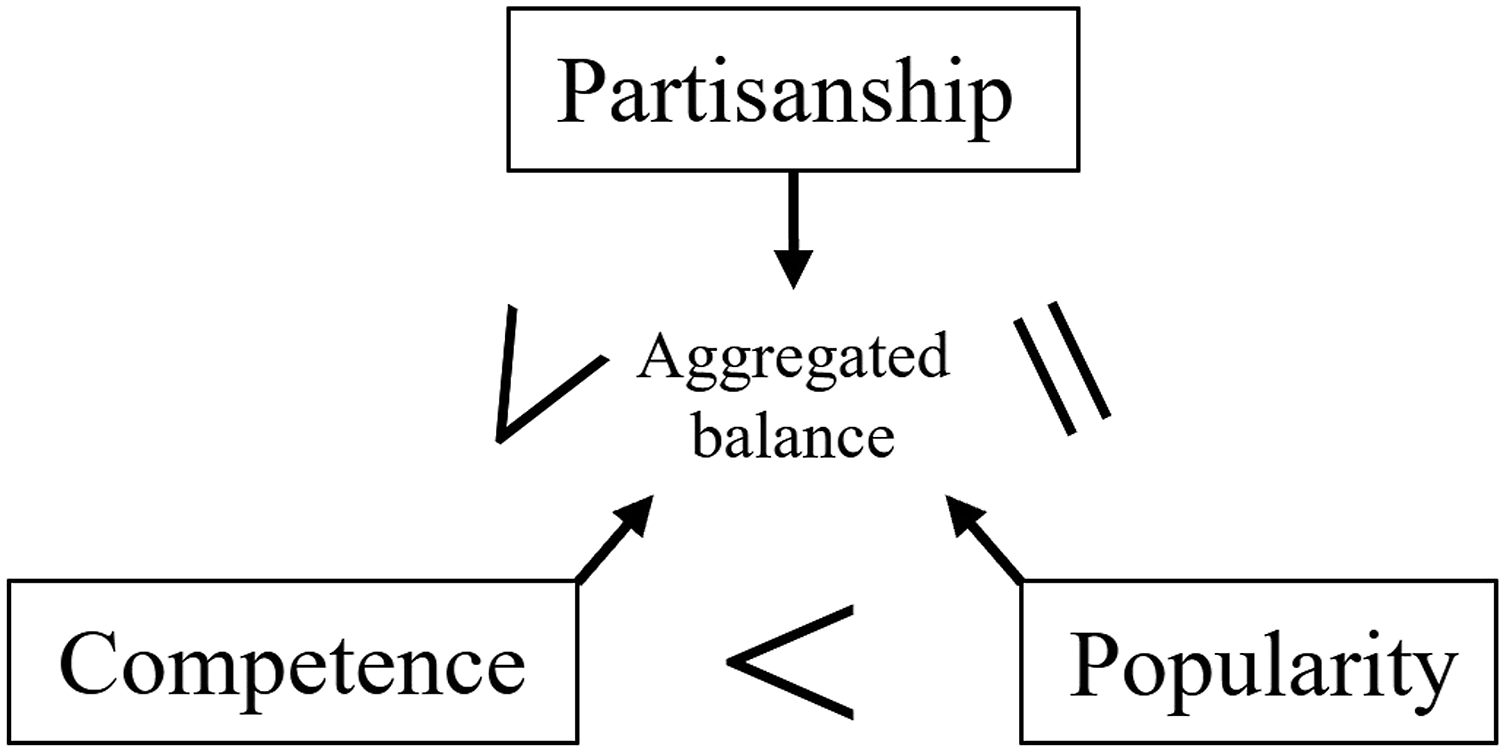
Empirical strategy
Case selection
This research uncovers selectors’ priorities in Belgium, a flexible list system where selectors are extremely powerful in the determination of the future deputies when they define the list rank order. It resembles a closed-list system (Crisp et al., 2013) due to the extreme difficulty to bypass higher ranked candidates (In Belgium: only 1,41% of all elected regional and federal candidates from 1995 until 2014 could do so, according to Cogels, 2020). However, candidates can gauge their popularity thanks to the multiple preference voting system. These electoral features make that some list positions are more eligible than others, although one could get elected from anywhere on the list.
I investigate three Belgian francophone parties: the Green party (Ecolo), the Social Democratic party Parti socialiste (PS – Socialist Party) and the Liberal party Mouvement Réformateur (MR – Reform Movement). They first vary on ideology: Greens, Social Democrats and Liberals may grant importance to individualism in increasing order of appearance, what holds consequences for selection criteria selectors prioritize. They differ also on selection method (Vandeleene, 2018; Vandeleene and Van Haute, 2021). For Ecolo, a list committee pre-selects candidates before party members approve the draft list, scrupulously following written procedures. Respondents of my interviews were all members of a list committee. The Socialist party allows more informalism. Local leaders (among which I picked my respondents) preselect candidates later formally endorsed by a local congress gathering either delegates or rank-and-file members. The MR follows a rather informal process: the head of list is first selected by the central leadership and becomes then in charge of the selection of her co-partisans. My respondents were head of list and/or close to the party central leadership. Who and how candidate selection is organised might impact the kind of criteria used by selectors, hence the relevance of these variations (Rehmert, 2021). In terms of formal selection criteria, these parties set similar nomination requirements (e.g., signing a loyalty pledge) except for mandatory party membership (the liberal party does not formally ask for it) (Vandeleene and Van Haute, 2021). They know diverse levels of electoral success, with PS and MR being major parties in French-speaking Belgium, and Ecolo competing for the third place. All can count on several eligible positions in most electoral districts (party magnitudes vary widely) and may hope for some cabinet posts.
Data and method
Vignettes presented to the interviewees referring to “I would (not) select a candidate who…”.
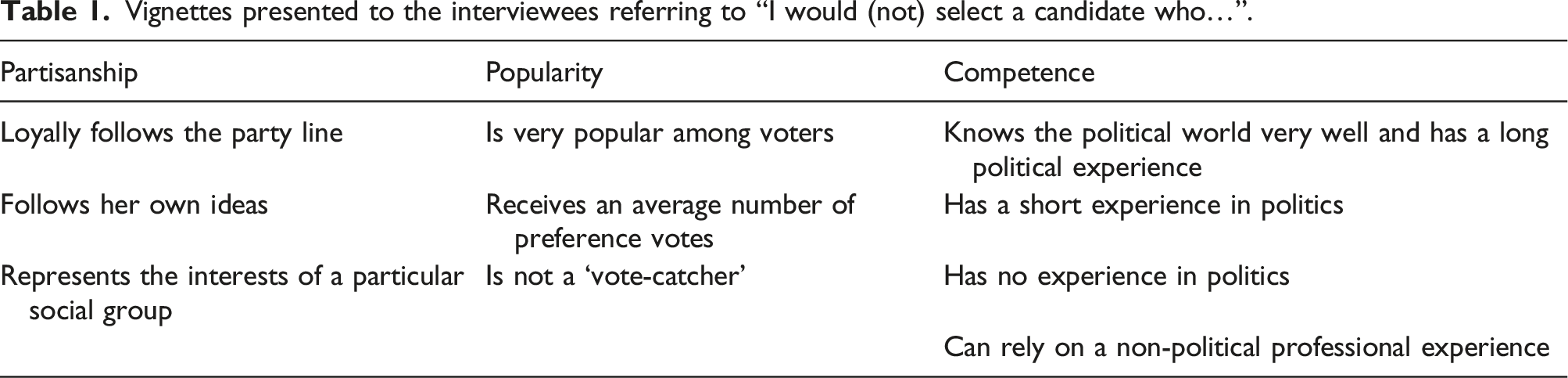
To ensure diversity among selectors (since selectors’ characteristics may affect their preferences (Rehmert, 2022)), I interviewed seven to nine respondents per party (see appendix). All were involved in at least one recent selection process at the regional and/or federal level, and most at the local level. Most have been aspirant or candidate themselves and some have already been elected and/or hold a cabinet position. I selected respondents politically active in various Belgian provinces with varying levels of party success and rural/urban contexts. I interviewed for Ecolo about the same number of women and men, but for PS and MR, more men than women, given the sociology of main selectors. I could count on respondents in their thirties until their sixties.
The interviews were conducted in February-March 2020 face-to-face (for Ecolo) and in May-July 2021 online (for PS and MR). I rely on more than 18 h of interview (average interview duration of 47 min), conducted in French and transcribed by the author or by job students. I undertook a cross-sectional code and retrieve method in NVivo to analyse the data, with an iterative categorisation of chunks of text into thematic nodes corresponding to the main selection criteria (Ritchie and Lewis, 2003). The trade-offs’ perspective handled in this research inductively derived from the data analysis.
Empirical findings
I organise the analysis into two sections. I first investigate how selectors prioritise partisanship, electoral popularity, and political competence (H1 and H2). Second, I examine to what extent these criteria are combined via ticket-balancing strategies (H3).
Priorities among selection criteria
To what extent do selectors care about partisanship, popularity, and competence? While all mentioned electoral popularity and political competence as characteristics of a ‘good candidate’ without having to be prompted, not all interviewees from the Social Democratic and Liberal parties did spontaneously mention partisanship. These parties’ varying attachment to the value of collectivism might explain this variation. This discrepancy is also visible in how selectors conceive party loyalty: liberal selectors tend to favour a trustee kind of candidate and push less for partisans, preferred in the other parties.
Selectors’ trade-offs emerged from the interviews. They emphasize the difficulty to recruit ideal candidates, who meet all desired criteria – labelled ‘rare pearls’ – and hence the need to compromise on criteria when someone does not display all qualities.
First, political competence is often mentioned in relation to other criteria: selectors acknowledge that competence is needed, given the increasing complexity of politics, but the truly competent candidates (“experts”) are portrayed as potentially lacking other major assets. Starting with the trade-off between competence and popularity, the scales are tipped towards the latter. All candidates should be popular. Voters’ support makes that popular candidates democratically deserve the position, even if they might – regrettably for selectors – lack some (other) political skills. “The first quality for a candidate is not to be good, it's not to be potentially an excellent representative, it's not to be a patent jurist because we're going to do legislation, no. The first quality of a candidate is to be well-known. So sometimes you have the last of the idiots who is known a little in the area where he lives and who will be a better candidate than a university researcher who has a lot of intellectual qualities and who could be an exceptional representative but who may not be popular at all.” (M5) “What is difficult is to have to do without the skills of people who are not popular. Because unfortunately, today, it is the rule of the game, it is the popularity that makes the elected representative.” (P7)
Selectors are willing to compromise on competence upon the condition candidates can garner votes. Because not everyone suits the profile of an ideal MP, selectors consider some candidates for their campaigning assets only, i.e., their potential popularity, and apply stricter conditions for candidates on eligible positions. This brings us already to H3: selectors admit a balance between candidates depending on the position: candidates on the safest positions are expected to score high on both popularity and competence, while the list fillers do not per se have to be politically competent. “It's not all about winning. Once we have won, we will have to manage.” (E1) “It is necessary to find a balance between the person who is both electorally legitimate […], but who also has […] a base and a good training to be able to play his or her role correctly and quickly enough to take his or her part in the parliamentary work.” (P4)
Turning to the trade-off between partisanship and competence, selectors overlook competence. Candidates need to be team-players. For the sake of party unity on the long term, selectors may cast-off not loyal but skilful candidates. “I prefer someone who is not as good, but who is eager, to because it's important for the group spirit but also for future investment, because even if you are not elected, I continue to try to work with people who were on the list.” (P3)
The relationship between partisanship and competence is intricated. Partisanship can lead to competence. Being involved in the party life, counting on a local anchorage thanks to a local mandate or being incumbent makes that a candidate becomes skilled for politics. But being a party insider cuts both ways. Active party members have had the opportunity to prove their value within the party, but this experience might not always have taught them how to function as a politician. Both criteria are thus effectively separate concepts that selectors assess on their own. “It is clear that someone who has had a first mandate as a parliamentarian, unless the mandate was catastrophic, […] it is almost certain that the list committee will say: ‘This person has already acquired experience, a certain notoriety, recognition, and has built up networks.’ And not to put him or her at the top of the list would be to say that he or she has done a bad job. That would be disqualifying.” (E4) “We didn't want too many people to come from the machine, from the party apparatus in fact. […] These are easy choices. You know the person. You know his/her value. You've worked with him or her. But it's not actually the same job.” (E6)
As regards H1, political competence is widely considered as a necessary selection criterion. Nevertheless, when facing a trade-off between competence and popularity or partisanship, selectors opt for the latter, but not for all kinds of candidates. Candidates on the safest list positions should score high on competence, while the list fillers could be less politically competent if they are electorally attractive and/or loyal to the party.
This leads us effortless towards the trade-off between partisanship and popularity. Selectors’ accounts reveal that none would be self-sufficient. They like to select party activists whose long party engagement serves as proof of loyalty and testifies their socialisation to the party culture. But if these true loyalists do not display vote-earning capacities, they are however not attractive. An extended party activism is not de facto the panacea. “A place on the list is not a reward for services to the party.” (E5) “It's hard to have to say to people you love, who are real activists: ‘Listen, you've been a candidate 6 times. 6 times you got 69 votes, that's great. The last time you got 42 votes, yes, but you need a bit more to be elected and I'm sad you didn't get elected’. And she says ‘No, I want to continue!’, except that I have a much younger girl who wants to get involved and I have to choose.” (P7)
By contrast, selectors are afraid of vote-catchers not able to abide by the party line. They are doubtful about newcomers, typically celebrity candidates, scoring good on popularity but less on partisanship. In all parties, selectors report to double check non-member candidates’ profile. “When we go looking for [non-member] candidates, what do we expect from them? Which freedom do we give them? What is the contract between them and the party?” (E7) “I wouldn't go and approach someone who is well-known but I'm not sure that […] she shares at least some of my convictions, core values or vision for society. I would have a problem with that.” (P4) “A form of popularity, but one that is complementary. It's not... that alone is not enough.” (E4)
Selectors are aware that one might lose control on extremely popular candidates. Their lack of partisanship might blow back on the party electoral success. Party unity is seen as a(nother) vote maximization mechanism, next to the selection of individual vote-catchers: showing cohesion pleases the party image and might boost electoral results. However, some selectors, mostly liberal, report playing on candidates’ ideological differences to increase the diversity of ideas on the list, and, they believe, its electoral attractiveness. So, the argument can work both ways. “[A candidate who tends to follow his own ideas], it can undermine a whole group and a whole group cohesion and then a whole party credibility and coherence.” (M2) “If this person is popular with the voters, it means that he or she also has a certain profile, a psychological profile, which means that he or she will also seek popularity. And so, it's sometimes people who are more difficult to work with.” (E3)
At the individual level as well, partisanship can lead to popularity, but on the long term. Some not yet popular candidates are selected as a long-term investment, hereby confirming André et al. (2017)’s empirical findings that individual preference votes at previous elections are worth in selectors’ eyes. For newcomers, popularity might not be a prerequisite, but well for more seasoned candidates whose popularity must not weaken. “We position young people. […] the idea is that they can come back at several elections in a row to make themselves known to the wider public.” (P6) “If the score goes up, it's a good sign and we want to take him back. If his score goes down, we may say that his time has passed and that we should think of someone else.” (M6)
Finally, popularity is not only considered quantitatively. In all parties, selectors pointed out that popular candidates are especially relevant when their network is different from the other candidates on the same list, to broaden its popularity. Selectors value candidates able to attract other votes than those that would already be casted in their absence – even if this means that they are quantitatively less popular than other candidates. The quality of popularity would matter more than pure quantity. “For us, it's more like which votes, because if you bring back preference votes, votes that come from the network that all the Greens have, it's not interesting. On the other hand, if you bring back an average number of preference votes in a network that is not close to us. Well, that makes us gain votes in total.” (E5) “It's votes in fact, which, tactically are targeted to be taken away from others, rather than added to our own.” (E6) “I always prefer a candidate who may only get 300 votes but who will win 300 votes that I couldn't get or that someone else couldn't get because that's 300 more votes for us and 300 fewer for the others. If the candidates are eating each other and our electorate, I don't see the point.” (M1)
The second hypothesis stated that partisanship and popularity even each other out. The findings suggest that candidates must score a minimum on both, as selectors report loyalists only to be unhelpful for the party electoral success, but vote-catchers only to be too risky for the party unity. None is enough to be granted a list position but scoring less on one criterion does not automatically impair the candidacy.
Ticket-balancing strategies
Hints in the previous section, focused on aspirants’ individual qualities, pointed towards the fact that selectors value criteria at the aggregated level. Findings highlight the difficulty of recruiting ideal candidates, hence the easier option for selectors to meet their goals at the list level. “We form a team, and, in the team, everyone will play their role according to their qualities and skills.” (P3)
Regarding partisanship, selectors distinguish between candidates following the safeness of the position. Being a partisan is an implicit criterion for future MPs. Selectors mention the high risks of having deviant MPs given the strong party discipline in Belgian parliaments. When selectors are unsure about aspirants, they prefer to grant them less safe positions to start their party socialisation process. These candidates contribute to the popularity of the list, and score less on partisanship. “Thinking that if such a person is elected, I have either a partner or a companion with whom I know we can work well, that's certainly predominant.” (M2) “The people who may be more troublemakers, who may be good candidates for the elections, it's not very serious if we have doubts about their ability to be a good parliamentarian because we know that […] they don't necessarily have the ambition to be a parliamentarian, they have the ambition to sell the message of Ecolo and to convince people to vote.” (E7)
Second, selectors highlight the need for a balance of competences. They anticipate on the future parliamentary group and foresee a healthy balance within the safe positions, but also need distinct political skills among candidates on other positions to cover all campaign needs. “Being experienced or not being experienced is not decisive, but the list as a whole should contain experienced people and newcomers.” (M6)
Third, popularity is striven for not only at the individual, but at the list level, selectors arguing that a balanced list is electorally appealing. Some candidates might be chosen based on their personal profile nicely improving the list balance even if they are not individual vote-catchers. The diversity of socio-demographic characteristics plays here a significant role. “‘Is not a vote catcher.’ That's a bit of a turn-off. Especially for someone who is in a strategic position. I would say that, if he is not in a strategic position, I don't mean that we don't care, but ... almost. That is to say, it's someone who is going to be there so that ... we don't say that the list is not balanced.” (E3)
To conclude, the balance of criteria happens for less safe list positions. Candidates on safe spots have ideally to combine popularity, competence, and partisanship, while other candidates can showcase one or two of these attributes, and even none of them if they are selected to fill the list only to balance socio-demographic profiles. “At the parliamentary level, you certainly need to know the political world well, to act loyally in line, yes, to have a capacity of votes and to be popular, yes, these are essential criteria.” (P6)
Conclusion
How do party selectors choose among aspirants willing to run for office? Based on 23 interviews with selectors in three Belgian parties, I presented how selectors in a flexible list system handle trade-offs between three main selection criteria derived from the party strategic goals’ model (Sjoblom, 1968; Stark, 1996): partisanship, electoral popularity and political competence. Prompted by the question of what is a good candidate, selectors discussed criteria they usually rely on when drafting electoral lists. Making up a group of individuals is not an easy task. Selectors highlighted the intricated trade-offs they face, considering that ideal candidates hardly exist.
The findings reveal that no selection criterion is self-sufficient: an extended party activism does not automatically open the doors to a list position nor a large popularity, which could even ward off selectors if not compensated by proofs of loyalty. Moreover, the aspirant’s political competence is less valued than the aspirant being able to work for party unity or to garner votes. But the story is not as simple: selection criteria are intertwined. Selectors could hardly mention one without referring to another. Partisanship can lead to competence, as party involvement or incumbency often make aspirants acquire the necessary skills to function in politics. Likewise, partisanship contributes to popularity, considering that party unity can foster electoral success. Yet, a central intake from this research is that the balance of profiles on the list is at least as important as candidates’ individual characteristics. Selectors are cautious about a homogeneous list made of good party soldiers only that would lack electoral attractiveness and diversity in the needed skills, therefore work against party success.
My study importantly highlights that compromises between goals do not work the same for all list positions. First, selectors might lower their usual standards in candidates for less prominent positions: being loyal forms a prerequisite for safe positions and is much less relevant for list fillers. Second, selectors consider political competence as a second-rank criterion for unsafe positions but not for candidates likely to enter parliament. Third, popularity is sought at the aggregated level: an electorally successful list combines candidates with several (socio-demographic) profiles.
What this research did not investigate is the factors leading selectors to favour one criterion over another. For instance, in which cases is partisanship preferred to competence? Further research should examine the differentiated impact of party characteristics on the prioritization of selection criteria, such as party culture or kinds of selectorates (see already Rehmert, 2022). My analysis uncovered party differences, especially on the importance of partisanship. Aspirants’ loyalty was clearly more valued for Greens than Liberals or Social Democrats. Similarly, individual electoral popularity was more central for mainstream than for ecologist selectors, still relying on more collective endeavours. Party culture, ideology, and organizational mode (specifically who selects candidates) likely colour the relative importance of selection criteria. This could be quantitatively investigated based on a broader set of cases.
One should also study selection criteria across various electoral contexts, which may influence the kinds of candidates seen as more or less attractive for distinct electoral positions. Selectors themselves pointed to differences in criteria between elections held in Belgium with a flexible or an open list system (local elections, which were not this study’s central focus). The conclusions drawn in this research might differ if selectors were to handle in an electoral environment with other levels of party and voter influence on who is elected. Individual popularity is obviously more relevant the smaller constituencies are, or the more open lists are. Likewise, as my findings show that competence matters more for safer positions, it will be more central in systems where the chances of election of individual candidates are more predictable. The political context may also matter, like parliamentary culture. The high party discipline in parliamentary groups in Belgian parliaments likely fosters the importance of loyalty in my study.
Our journey into selectors’ minds has delivered insightful conclusions, pointing that even at the parliamentary level, it is not so simple to recruit candidates meeting all desired qualities. Selectors may have to cast suboptimal choices, selecting candidates performing less on one criterion. It might be surprising that democracies are not able to provide enough ‘quality’ candidates to fill lists and parliaments, or maybe it is that selectors’ dreams are too big for a too small world.
Footnotes
Acknowledgements
I express my gratitude to Hilde Coffé and Gert-Jan Put who took the initiative to organize an inspiring panel at the ECPR Joint Sessions of Workshops and later coordinated this symposium. Thanks to all participants of the Joint Sessions’ workshop as well as the workshop of the Nordic Political Science Association Congress for the valuable feedback received. I also would like to warmly thank Joana Segonds, Matthias Vandevoort and Brieuc Vandeleene who helped with the transcription of the audio recordings, and Emilie van Haute who made funds available for part of the transcription work. Finally, I’m indebted to all politicians who have devoted some time in their busy agendas to reflect on their experience with candidate selection.
Declaration of conflicting interests
The author(s) declared no potential conflicts of interest with respect to the research, authorship, and/or publication of this article.
Funding
The author(s) disclosed receipt of the following financial support for the research, authorship, and/or publication of this article: This work was supported by the Bijzonder Onderzoeksfonds of Ghent University (Grant BOF.PDO.2018.0032.01) and FWO-FNRS EoS Excellence of Science, project “RepResent” (O026018F (ID: 30431006)).
