



Abstract
We know little about how coalitional strategy affects the electoral fates of political parties in presidential democracy. The literature on coalitions in parliamentary systems shows a negative impact of entering government, while the coattail effects literature on presidential systems suggests some benefits. Combining elements from both approaches, we argue that there is a conditional electoral effect of joining the cabinet under coalitional presidentialism. Even considering presidentialism’s heightened attribution of responsibility to a unipersonal executive, we find that coalition parties do indeed place a meaningful electoral wager whenever they choose to enter the president’s cabinet as identifiable allies. Leveraging data on Brazilian elections held at national and local levels over 24 years and employing an innovative measure of portfolio salience, we show that the payoff of this wager is contingent on control of the most highly-valued cabinet positions and on the popular approval of the president.
Introduction
Does joining the cabinet benefit or hurt the electoral fortunes of parties in multiparty presidential systems? Initially focused on parliamentary democracies, debates on coalition politics traveled to presidential democracies when it became clear that minority presidents would also have incentives to share power to build legislative support. Much of the discussion of presidential cabinet politics to date has focused on “who gets what” and on the effect of power-sharing on the success of the executive’s policy agenda (Altman 2000; Amorim Neto 2006; Chaisty et al. 2018). There is, however, a neglected aspect of coalition membership in presidential systems that is the focus of this article: the potential electoral payoffs to cabinet-represented parties.
For parties, the impact of entering a presidentially-led governing coalition is not obvious. On the one hand, ministries may provide electoral visibility to coalition parties. Occupying a ministry guarantees media visibility, and contributes to the branding of a party label that voters can remember in the next election. Ministers can implement policy decisions that appeal to specific segments of the electorate, and can also use their institutional authority to direct targeted expenditures in order to increase the electoral viability of co-partisans (Martin 2016; Meireles 2019). Cabinet positions, in short, are potentially electorally relevant-and the more important the ministry is, the better.
On the other hand, governing is not without costs (Strom 1990). The voluminous literature on parliamentary democracies suggests that parties in power tend to lose electoral support in subsequent elections. Voters tend to withdraw support from sitting governments, even in good times, and this punishment extends to all parties in the coalition (Paldam 1986, 1991; Paldam and Skott 1995). From this perspective, joining a governing coalition is a risky endeavour.
Both perspectives are logically valid, and neither can provide a consistently reliable guide to parties operating under the separation of powers. Unlike in parliamentary systems, under presidentialism neither the initiation nor the survival of the government depends on the support of parties in the legislature. Moreover, presidents are far from being only the “first among equals” that we see under parliamentarism. If a coalition government is formed under presidentialism, the identity of the formateur is never a surprise-it is always the directly elected president. The president composes and directs the cabinet, enjoys significant legislative and administrative powers, and tends to be seen as responsible for most relevant policy outcomes (Samuels 2004). A key implication of this constitutional format is that responsibility for the government, for better or worse, falls disproportionately on a unipersonal executive.
In this environment of lopsided attribution of responsibility, to what extent are the electoral perspectives of parties that are considering an alliance with the president tied to the performance of the government? We claim that the electoral payoff of coalition membership depends on two things: (1) ongoing public evaluations of the chief executive and (2) the relative importance of the specific portfolios obtained in the cabinet. First, we argue that coalition parties are indirectly affected by presidential popularity. When public approval of the unipersonal executive is high, coalition parties will seek to capitalize on this success; when popularity is low, opposition parties will happily take on the task of identifying coalition parties as passengers on a sinking ship. Second, the electoral performance of cabinet-represented parties is contingent not simply on the number of ministries they control, but on the relative centrality of the respective portfolios. Portfolio salience is a double-edged sword. On the one hand, the greater the value of a ministry, the easier it is for the party to deploy its resources and appeal to the electorate. On the other hand, controlling the most powerful ministries invariably suggests greater proximity to the president, thereby raising the party’s exposure to the risks of presidential popularity. Thus, our two key variables-executive approval and salience-weighted cabinet shares-combine to produce a conditional electoral effect of joining the government under coalitional presidentialism.
Our empirical analysis leverages data on Brazilian elections held at national and local levels to determine the association between electoral results and membership in presidential coalitions over a period of 24 years. We consider government composition in two ways. The first is via a simple comparison between parties in and out of government. The second way adjusts for the observed portfolio allocation strategy, i.e. the relative investment of each party in the government as measured by salience-weighted portfolio shares. For this purpose, we employ a measure of ministerial importance built from the judgment of the legislators involved in the coalition formation process. By examining the electoral consequences of coalitional decisions, we contribute to a new understanding of mechanisms of accountability in multiparty presidential systems. We demonstrate that coalition partners are indeed affected by governmental performance, even considering the notoriously high attribution of responsibility to a unipersonal executive in presidential democracy. This effect, however, is much more pronounced in national elections than in local elections.
The article is organized as follows. In the next section, we discuss party motivations to join a coalition and the electoral implications of such a decision. In the subsequent section, we present our argument of the conditional electoral value of governing. The third section presents the case study and the data and methods employed to test the main hypotheses. A fourth section presents our binary “in/out” analysis, comparing the electoral fortunes of coalition parties and opposition parties. The fifth section of the article overcomes a current bottleneck in the literature: we recast our results when introducing salience-weighted portfolio shares as a more refined indicator of government composition. We then offer our conclusions.
Is governing a blessing or a curse? Electoral implications of entering the cabinet
The literature on party motivations is vast and points to three main goals: political parties may be oriented towards holding office, by the desire to influence policy, or by simple vote maximization. Office, policy, and votes are often, and at least to some extent, competing goals, and parties are not oriented towards a single end, emphasizing different goals when it comes to different decisions (Müller and Strom 2003). What are the motivations of political parties when they decide to join a government coalition?
The politics of coalition entry is perhaps most directly associated with the office-seeking approach, as parties are granted access to cabinet positions in exchange for their legislative support for the governmental agenda (Budge and Laver 1986; Laver 1998). This insight has inspired a long and rich debate on “who gets what” (e.g. Gamson 1961; Cox 2021). Yet a number of leading post-Gamson portfolio allocation models began to incorporate elements of the policy-seeking approach, highlighting ideational factors and portfolio characteristics as key indicators for understanding cabinet entry (Budge and Laver 1986; Laver and Shepsle 1990). Rather than debating the mathematical properties of Gamson’s Law, scholars began to emphasize that political parties care about policy, and about some policies more than others-which in turn shapes their strategic calculus about entering government and their close attention to portfolio salience.
Much of the literature on cabinet politics, therefore, has engaged with two of the three purported motivations for party behavior: office and policy. But what about votes? This is an especially neglected aspect of coalition politics in the literature on comparative presidential democracy. Almost all existing evidence has been drawn from parliamentary systems, wherein the literature on cabinet entry has focused on the so-called “cost of governing.” An empirical regularity observed in many different contexts is that political parties joining a government tend to lose on average about 1.65% of the vote from one election to the next (Paldam 1986, 1991). This erosion of support is also called a “depreciation of the stock of popularity” (Paldam 1991). While the regularity is clear, explanations for this association range from voters’ rational demand for change (Paldam and Skott 1995), to loss aversion (Nannestad and Paldam 2002; Paldam 1986), and to the government’s inability to deliver on its promises (Nannestad and Paldam 2002).
More recent work explores the conditions under which the electoral cost of governing might be minimized. Hjermitslev (2020) shows that the cost of governing is less severe for the formateur party. The argument is that the electoral cost of being in government is unequally distributed among members of the coalition, with the prime minister’s party being relatively insulated from punishment, while junior coalition members incur a larger electoral cost (Hjermitslev 2020). Martin (2016) draws within-party comparisons between politicians who hold a cabinet portfolio and those who do not. His argument is that in contrast with their co-partisans, politicians holding a cabinet post may use the power of the office, especially patronage and targeted distribution, to engage in vote-buying and thereby minimize the electoral cost of governing. Although Martin (2016) presents evidence in favor of his claim using data from Ireland, Ladwig (2019), using data from India, finds no support for this view after correcting for endogeneity issues. Yet it is possible that the “costs of governing” can be offset by capturing the most important posts in the cabinet. This is the argument of Greene et al. (2020), who show that portfolio salience is linked to the electoral fate of parties.
In presidential systems, the president and the legislature have independent electoral fates. However, a longstanding research programme on the United States has shown a positive electoral return from association with the president due to well-known coattail effects in concurrent election years (Calvert and Ferejohn 1983; Ferejohn and Calvert 1984). While these claims are staked on the historical two-party format of American presidentialism, the study of coattail effects in presidential election years has recently traveled to multiparty systems, highlighting the importance of pre-electoral coalitions (Kellam 2017). One notable claim in this new body of work is that, contingent on party size and entry strategy, the coattail effect does not automatically extend to any parties other than the president’s own party. This leads to situations in which other pro-presidential parties may actually be hurt by joining the coalition (West and Spoon 2015).
Borges and Turgeon (2019) have recently argued that presidential coattails are more diffused-they benefit not only the formateur party but also coalition partners, especially those parties considered to be “core supporters” of the president. By defining core supporters as previous coalition partners (i.e. known collaborators of the formateur), Borges and Turgeon connect the dots between the coattail effects literature and longstanding debates about cabinet composition. This is a major step forward, yet the new research programme on presidential coattails still does not address the electoral implications of governing in multiparty presidential systems-the subject of the present article. Coattails are about the possibility of the president offering a platform to parties during the campaign, not about the subsequent fate of these same parties if they end up in government.
In sum, the older literature on parliamentarism tells us that there is a systematic cost of governing that parties will attempt to minimize, even if the mechanisms behind the cost are not entirely clear. The newer literature on presidentialism tells us that the oft-noted independence between the electoral fates of the formateur and allied parties may be attenuated when parties are able to benefit from attaching their brand to the president. The first argument assumes an essentially negative impact of entering government, while the second shows potential benefits of associating with the formateur-yet focuses exclusively on the preelectoral game, not on the consequences of governing in concert with the victorious president. Combining elements from both approaches, we argue that there is a conditional electoral effect of governing in multiparty presidential systems.
The conditional electoral value of governing in multiparty presidential systems
Coalition governments in presidential systems involve an exchange between cabinet seats for legislative support. The presidential side of the bargain has been thoroughly analyzed over the past two decades and given rise a body of work that, although inspired by the older literature on parliamentary systems, has firmly established the basic dynamics of “coalitional presidentialism” across a relatively broad set of contexts (Cheibub et al. 2004; Cheibub 2007; Chaisty et al., 2018). Forming a cabinet coalition is associated with coalition discipline in Congress and passing a legislative agenda (Amorim Neto 2006).
However, what do coalition parties get? Moving beyond the office-seeking approach which holds that coalition parties want cabinet seats for their intrinsic value, we are interested in exploring cabinet seats’ instrumental value. Our focus is on the potential for ministerial portfolios to win votes for coalition parties and thereby secure their political survival. What are the electoral implications of power-sharing arrangements for coalition parties?
Cabinet seats may provide electoral visibility to coalition parties. Occupying a ministry is a position of status. It guarantees a platform, constant access to the chief executive, and association with the image of the president. Also, it provides media space and the branding of a name that voters can remember in the next election. From a policymaking perspective, cabinet ministers have agenda-setting powers: they formulate and implement policy decisions that may appeal to specific parts of the electorate and interest groups. They can also use patronage in the form of political appointments or targeted expenditures as an instrument of distributive politics.
Therefore, cabinet positions may have an electoral value to coalition parties, but this value is also contingent on which cabinet positions they control. High-value portfolios can guarantee more prestige, budget, political appointments, and policy influence. For these reasons, we expect that coalition parties will seek to extract electoral gains from cabinet entry, and the greater the value of the portfolios they control, the greater is the potential return on their investment in the government.
However, coalition governments in presidential systems involve an exchange between unequal parts. Under the separation of powers, responsibility for the government-actual or perceived-is largely in the hands of the president. The personalization of presidential systems means that evaluations of the government are highly contingent on the popularity of one person. “Clarity of responsibility” is extremely high in presidential systems, meaning that voters routinely reward or punish presidents on issues ranging from economic management (e.g. Samuels 2004) to corruption (e.g. Tavits 2007). Does this accountability extend to coalition parties?
We argue that when parties decide to join the government coalition, they attach their electoral fates to the president. Coalition partners cannot reasonably expect to be evaluated by voters separately from the president, due to the centrality of the unipersonal executive in presidential systems. The risks and potential benefits of entering the government are contingent on the president’s popularity and on the value of the cabinet payoffs they receive. This means that joining a coalition involves neither a quasi-automatic electoral penalty nor a guaranteed electoral boost, implying a null average effect of coalition entry on electoral results. The electoral payoff of cabinet entry in multiparty presidential systems is not predetermined-precisely because it is conditional, as we explain below.
The unipersonal “attribution of responsibility” at play in presidentialism has rather straightforward implications for coalition politics. If the president is popular, the cabinet-represented parties will seek to bask in the limelight by credit-claiming for governmental success. If presidential popularity sags, then opposition parties will use this to tarnish the president’s partisan allies. Therefore, our hypothesis is that electoral payoffs to cabinet representation are contingent on the president’s popularity. The conditional aspect of this relationship, however, is central to our argument and it implies that the president’s popularity will affect the electoral fates of parties differently, depending on their coalitional status. In multiparty presidential systems, parties can be the formateur party, an allied party (coalition partner), or in opposition (out of the cabinet). 1 For each of these, we expect a different association between popularity and electoral performance.
We expect that the electoral performance of parties in the cabinet is positively associated with the popularity of the president, while the performance of parties out of the cabinet is negatively associated with the president’s popularity. When the president’s popularity is high, the formateur party and allied parties will improve their electoral performance. However, when the president’s popularity is low, both coalition partners and the president’s party will suffer the consequences. These considerations yield three related hypotheses:
The electoral performance of parties outside of the cabinet (opposition parties) is negatively associated with the popularity of the president.
The electoral performance of coalition partners (non-formateur parties with cabinet representation) is positively associated with the popularity of the president [moderate association].
The electoral performance of the president’s party (formateur party) is positively associated with the popularity of the president [stronger association].
In the last two of these hypotheses, we expect a stronger association for the president’s party than for coalition partners because voters more easily link the popularity of the president to the formateur party than to allied parties. Thus our basic expectations surrounding simple government entry (“in or out of the cabinet”) are very straightforward. Yet a refinement of this argument recognizes that ministerial portfolios are not all alike. Previous contributions have highlighted the role of portfolio salience (Greene et al. 2020) and patronage (Martin 2016) on the ability of parties to extract electoral gains from government participation, but this variation in portfolio salience has not received empirical scrutiny in presidential systems. Why is this variation important? Holding prestigious cabinet positions will naturally increase the party’s association with the president in the minds of voters. For example, the party heading up the Ministry of Finance not only controls one of the most important levers of policymaking, but dominates media coverage of the government as well. Given that the Minister of Finance is likely to appear side by side with the president on something close to a daily basis, the party controlling this ministry will have its brand directly attached to that of the president. Conversely, a party that is occupying one or two minor portfolios is not carrying much presidential baggage, so its brand may operate at a certain degree of removal from the chief executive. Note that if we consider cabinet membership as a “matter of degree” in this way, we may be able to locate the inflection point at which coalition parties begin to be unequivocally affected by association with the president. We therefore expect that salience-weighted control of portfolios will matter to parties’ electoral fates, yet we reiterate the conditional nature of our argument. We hypothesize that the relationship between weighted participation in government and electoral results will be stronger (weaker) when the president’s popularity is higher (lower), as follows:
The higher the degree of weighted participation in the cabinet, the stronger (more positive) the association between presidential popularity and electoral returns to parties.
This argument implies that coalition parties will not have the ability to “free-ride” on their cabinet membership: in other words, they cannot go about making policies and spending money to win votes and at the same time shirk responsibility for overall government performance. Even though responsibility for outcomes falls heavily on the unipersonal chief executive, coalition parties will be affected by how the president is perceived. This means that joining a government is only a “win” for coalition parties when the president is popular (at the time of the election). A key aspect of electoral accountability in presidential systems is that coalition parties are invariably affected by public approval of the president, even when there is little clarity about the precise contribution of each constituent party to specific outcomes.
Case, data, and methods
We use Brazil as a case study to test our hypotheses on the proposed conditional electoral effect of cabinet participation. Data availability and quality are unusually high, justifying a sustained single-case study. Our analysis includes information about cabinet composition and electoral results for 24 years and on three levels-national, state, and municipal. Our three-tiered approach provides with significant leverage since we analyze elections that are both concurrent and nonconcurrent with the presidential contest. Our hypotheses have national dynamics in mind, so we expect them to better describe national and state elections that are held concurrently.
Brazil combines a presidential system with an extremely large number of parties, but these characteristics do not make it an entirely sui generis case. “Coalitional presidentialism” is commonplace in the contemporary world. Nearly two-thirds of democratic regimes now have directly elected presidents, and more than half of these have coalition governments; moreover, while the Brazilian party system is extremely fragmented, party fragmentation is high in presidential systems outside of the United States and rising almost everywhere. Given that we are moving into a “world of minority presidents” (Chaisty et al., 2018), focusing on coalition governments in fragmented presidential systems is far from a niche endeavour.
Coping with their consistently minority status in the legislature, all Brazilian presidents have formed multiparty coalitions since redemocratization in 1985. To govern and pass laws, and also to protect themselves against impeachment trials, presidents have included from 2 to 13 different parties in their cabinets, the largest number of parties in coalitions anywhere in Latin America (Martínez-Gallardo and Camerlo 2017). From this perspective, Brazil is a superb laboratory in which to examine the electoral effects of joining a presidential cabinet.
We first probe our hypotheses using simple indicators of parties’ “in/out” status, i.e. whether they are in the cabinet or not. However, in a second set of specifications we refine the analysis to account for theoretically relevant nuances in cabinet participation. Improving on our dichotomous indicators in two key ways. Our revised indicator first considers the share of cabinet positions controlled by each party and then goes on to weight these shares by the importance of each portfolio. We do this by deploying a recently developed portfolio salience indicator for the Brazilian case (Zucco et al. 2019).
Portfolio salience measures are widespread in the study of coalition politics in parliamentary systems, which tends to focus on older, consolidated democracies. These measures are often designed to capture a conception of salience that is inherently linked to perceived policy relevance for each party. Translating these measures to newer multiparty presidential systems is not straightforward, since many parties in transitional democracies are not programmatic or issue-oriented, parties are often short-lived, and the number of ministerial positions can often be very high. At the same time, taking the extreme view that all such parties are inherently clientelistic or policy-allergic is not an evidence-based assumption.
For this reason, we use a measure of portfolio value that ranks cabinet ministries according to legislators’ perception of their relative worth. Political actors may value cabinet positions for very different reasons, such as the size of the budget, the volume of targeted expenditures, the policy emphasis of their party, the control of contextually relevant policies, the number of jobs that can be used as patronage, media exposure, or even a more general prestige of the position. Due to the many valuable dimensions of each cabinet position, a single “objective” indicator would be too blunt to capture portfolio salience in party systems wherein programmatic and clientelistic parties coexist. For this reason, we use a portfolio salience measure that captures these subjective aspects, focusing on the perceptions of the legislators who are directly involved in the coalition formation process. In this perspective, the Ministry of Finance may be seen as valuable because it makes the most important policy decisions, even though it does not control a large budget or have much patronage potential. On the other hand, the Ministry of Regional Development may be seen as desirable because of its large volume of targeted expenditures at the municipal level, even though this portfolio does not control any high-impact policy decisions.
Our reasoning is that we should not impose a judgment a priori, but rather allow the politicians involved in coalitional bargaining to be the judges of what matters to them. This new portfolio salience measure was derived from a survey of 148 serving legislators fielded in the first half of 2017 during the 8th wave of the Brazilian Legislative Survey (Zucco and Power, 2023). Legislators were presented with various pairs of randomly chosen ministries, and were asked which of the two they would prefer their party to hold. The relative importance of each portfolio was then estimated by applying the Bradley-Terry (BT) model to the survey responses (Bradley and Terry 1952). A total of 37 ministries (the number actually in existence as of 2015) were rated. We note that in 2015 the number of cabinet positions in Brazil reached its peak, with the highest level of portfolio specialization ever recorded. Deploying some reasonable assumptions, we can then combine the scores assigned to narrower portfolios in 2017 in order to estimate the values of umbrella ministries and cognate portfolios that existed during earlier time periods. Table A2 in the Appendix shows the results of this “retrofitting” exercise. 2
According to legislators, the most desirable ministries are Urban Affairs (Cidades), Planning, Finance, Presidential Chief of Staff, Education, Mines and Energy, and Health. Actors may value different attributes when rating a portfolio, and their judgment has to be interpreted with a view to local context, especially with regard to electoral value. For example, the Ministry of Urban Affairs controls a large budget that is typically awarded to local infra structure projects and includes an enormous social housing program with impact throughout the entire country (Bueno et al., 2023). Among the portfolios rated as less desirable by legislators, we see lower-profile ministries such as Sports, Culture, and Fisheries, not to mention some specialized secretariats within the presidency that acquired cabinet status under the left-leaning Workers’ Party (PT) between 2003 and 2016 (e.g. Racial Equality, Advancement of Women). One important limitation of this approach is that we observe only the overall portfolio salience and not the salience of the portfolio to each specific party; given the very large number of parties in Brazil, estimating portfolio values specific to each party would be extremely challenging. Moreover, as we argued earlier, most parties in the system are simply not structured enough or different enough from each other to justify party-specific ratings.
Using the elite survey data, we calculate power distribution within coalition governments by combining the number of ministries controlled by each party with the “worth” of each portfolio. This procedure yields a salience-weighted portfolio share (SWPS) for each cabinet-represented party that we employ in some of the models discussed in the next section.
Estimation
Our unit of analysis is party p at election t. Our data cover 13 election years from 1994 to 2018 and allow us to observe the performance of 43 different parties. We observe each party’s share of the national vote in elections for the lower house (Câmara dos Deputados), for state legislatures (Assembléias Legislativas), and for city councillor candidates (Câmara de Vereadores). All three types of elections are held under very similar PR rules, but only the first two are concurrent with presidential elections (local elections are held halfway through the presidential term). Our dataset therefore incorporates 7 concurrent and 6 nonconcurrent (municipal-only) elections.
3
These contests provide us with the most granular measure of party-level performance, and the least contaminated by personalistic or idiosyncratic factors. The basic model to test the electoral implications of joining the cabinet is

Equation (1) shows the association between the party’s status and electoral performance. Cabinet membership is defined by two dichotomous variables.
As discussed in the previous section, given contradictory theoretical perspectives, we expect a null electoral effect of simple entry into the cabinet. We report these main effect models for the sake of comparison. However, because our argument is conditional, our principal models are those with interaction terms between cabinet composition and the president’s popularity. Hypothesis 1 suggests that the electoral return of joining the cabinet is contingent on the president’s popularity. For each type of election, therefore, we test our Hypothesis 1 by estimating variants of the following basic model
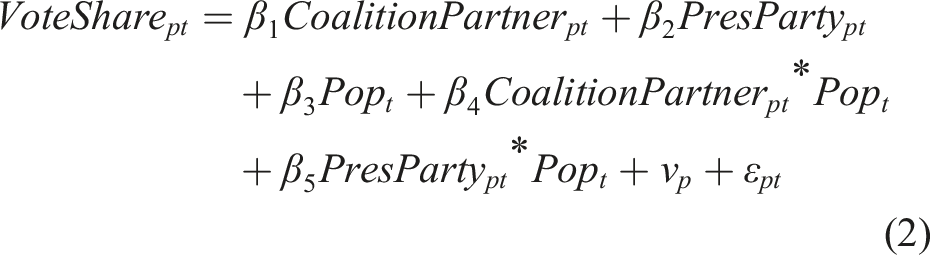
The dichotomous indicators for party status are defined as before.
Simple indicators of cabinet entry are, admittedly, very blunt measures through which to test our hypotheses. They do not adequately depict the degree to which parties are qualitatively “invested” in the coalition. For this reason, in addition to estimating the effects of participating the cabinet, we also estimate variations of equations (1) and (2) employing our salience-weighted portfolio share indicator (SWPS), as discussed above.

Equation (3) shows the basic model, substituting party type for the demeaned salience-weighted portfolio share. We expect a null effect, since our argument is that the electoral implications of cabinet composition depend on the president’s popularity. This null effect would also be observed using the qualitative measure of parties in the coalition, and we show these results for the sake of comparison.
Equation (4) shows our main model using the salience-weighted portfolio share (SWPS) as a granular indicator of cabinet “investment” by parties.

Accounting for the different degrees of involvement of each party in the cabinet, we are able to shed some light on the level of investment at which coalition parties begin to experience significant electoral effects. Is this threshold simply at the point of cabinet entry (i.e. does joining the cabinet automatically affect coalition parties as they are immediately recognized as government members) or is some minimum share of the cabinet necessary before party investment becomes meaningful to voters? As for equation (2), we expect
Ins versus outs: The effect of entering a coalition cabinet
Cabinet entry and electoral results.
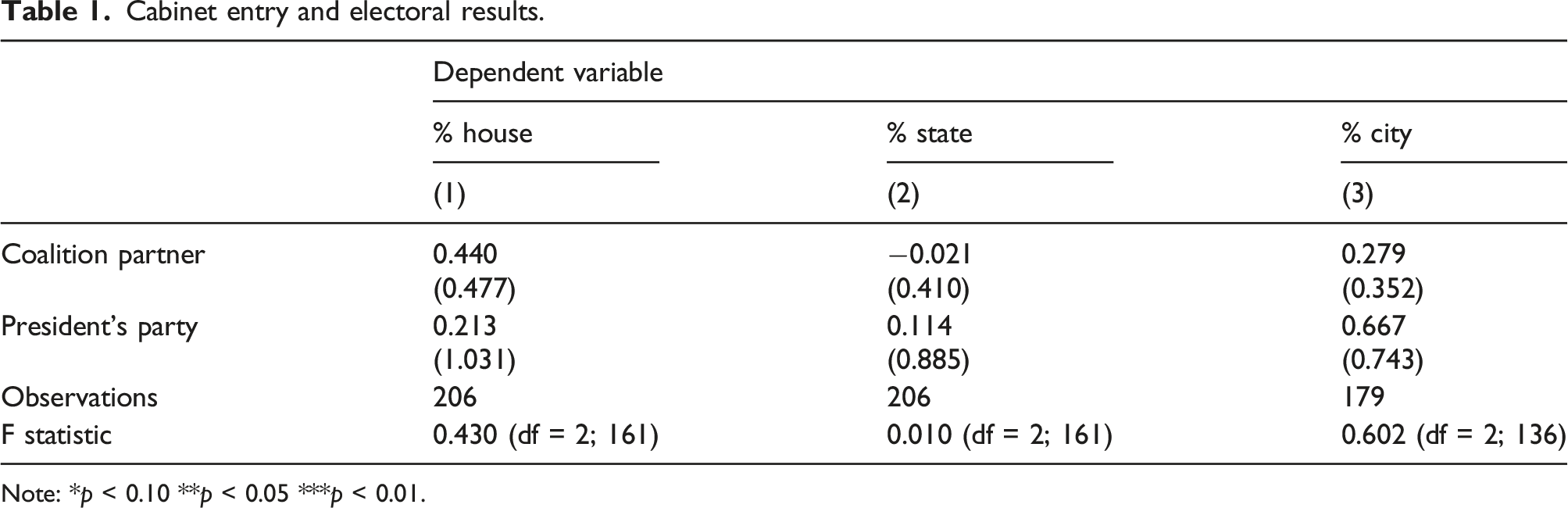
Note: *p < 0.10 **p < 0.05 ***p < 0.01.
Starting with the null effects in models 1, 2, and 3, our interpretation is that voters do not automatically penalize or reward parties simply on the basis of cabinet membership alone. This reward or punishment will depend mainly on voters’ perception of the president, whom they most readily identify as responsible for governmental decisions. This result is, therefore, consistent with our main hypothesis. This also implies that parties cannot easily extract electoral rents from government participation.
The conditional effect of cabinet entry on electoral results.
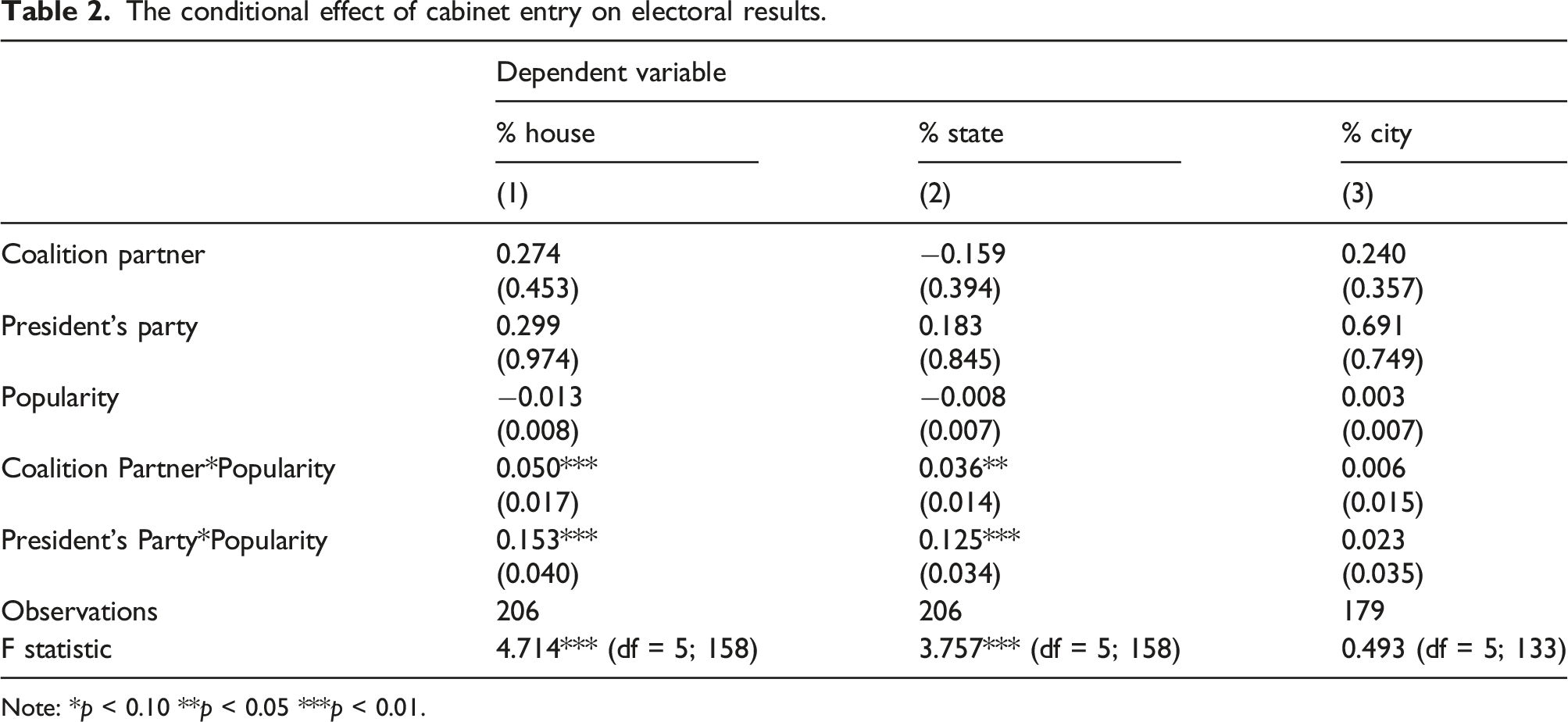
Note: *p < 0.10 **p < 0.05 ***p < 0.01.
Our coefficients of interest here are the interaction terms between coalition membership and popularity. These coefficients indicate the change in the slope of popularity for each party type-opposition, coalition partner, and the president’s party. The coefficients are positive when considering the elections for national and state legislators. In these contests, both the formateur party and allied parties profit electorally as the president’s popularity increases. Not surprisingly, the positive effect is greater for the president’s party than for coalition partners. 8 Yet the results for municipal elections fail to reach statistical significance, suggesting that cabinet-represented parties are somehow escaping the effect of national executive approval. This could be read as suggesting that local elections have qualitatively different determinants, e.g. the relevance of local machines or dynasties, the predominance of city-specific issues, or simply more routinized daily contact between representatives and voters. However, we suspect that local elections are different for a more fundamental reason. Municipal elections in Brazil are nonconcurrent with the presidential contest-in other words, they are mid-term elections with “withdrawn coattails,” a longstanding concept in the US literature (Erikson 1988).
Since interaction terms are often difficult to interpret directly, Figure 1 plots the results visually. The coefficients suggest that the electoral effect of joining the cabinet is conditional on the level of the president’s popularity. The results show a positive and statistically significant effect in national and state elections, yet again we see that in municipal contests the fate of coalition parties is not tied to the polling numbers of the chief executive. The president is nowhere on the ballot in these off-year contests, meaning that the association between party brands and national-level cabinet politics is less salient. Electoral results by party status, conditional on presidential popularity.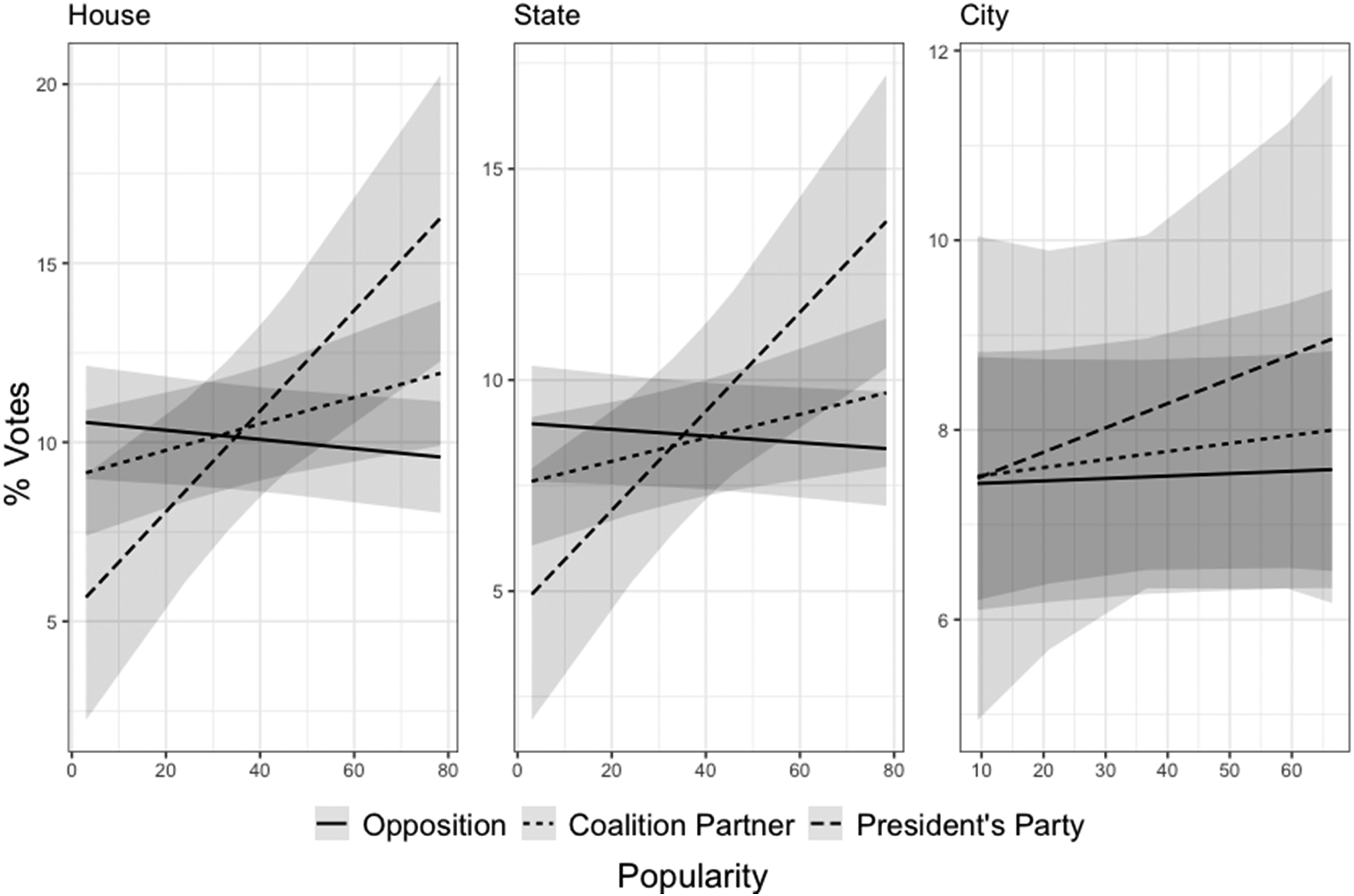
The main results for concurrent elections indicate that the higher the president’s popularity, the greater the electoral reward that government parties will receive, both for the formateur party and the coalition partners. Figure 1 also shows that the performance of “opposition” parties is inversely related to the president’s standing in public opinion. The performance of pro-presidential parties is lower than that of opposition parties when the president’s popularity is low, but notably improves when the president’s popularity recovers. Lastly and unsurprisingly, the performance of the formateur party suffers the most when the president is unpopular but rises sharply when the president’s popularity is healthy.
For national and statewide elections, there is strong evidence in favor of our central hypothesis concerning a conditional electoral payoff for joining a coalition. Combined with Table 1 that showed that joining the cabinet has no direct effect on electoral outcomes, we argue that entering government will benefit coalition parties only when the president is popular. If the president’s poll numbers are sagging, then coalition parties will suffer guilt by association (except in the unique case of local off-year elections). Also, and once again emphasizing the unique institutional design of presidential systems, the electoral boost generated by a popular president redounds far more to the president’s party than to coalition partners.
Degree of cabinet involvement and electoral outcomes
The second part of our argument is that cabinet membership can also be considered a matter of degree and not just in-or-out. Opposition parties are obviously defined as holding no seat at the cabinet table, i.e. 0% of portfolio shares. Allied parties, by definition, hold a nonzero number of portfolios. However, a party of this type may have only a trivial participation in government, holding a minuscule portfolio share, or may become a fundamental ally, holding a large number of high-valued ministries. Coalition parties are not all alike, and simply joining the cabinet does not imply equal power, access to resources, or visibility to voters. This point is especially important in multiparty presidential systems, since the president’s party may choose to withhold a large number of high-value ministries from the portfolio allocation game, producing an exaggerated form of formateur advantage. Figure 2 shows the distribution of salience-weighted portfolio share in cabinets as they appear immediately prior to the elections in our sample. (For information, the unweighted portfolio share is also ghosted in the figure, using dotted lines. We use only the salience-weighted portfolio data in the analyses that follow). Salience-Weighted Portfolio Allocation among Cabinet Parties. Note: only salience-weighted values are used in the model estimations in the main text. Unweighted cabinet shares (dotted lines) shown for information only.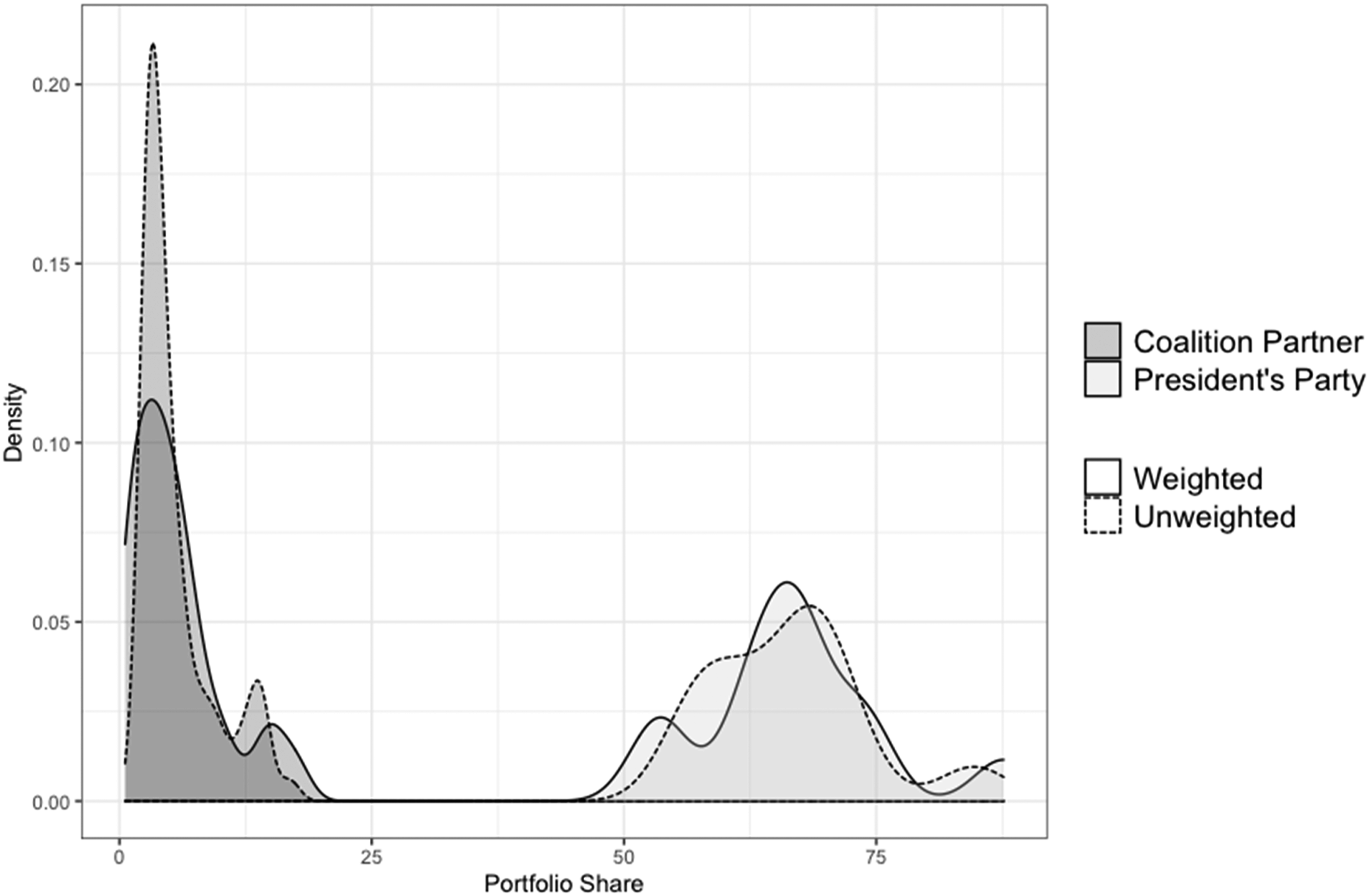
Comparing coalition partners and the president’s party, we can see a stunning contrast. A coalition party usually holds a salience-weighted portfolio share ranging from very small to intermediate (the minimum value is 0.560% and the maximum value is 17.76%). The mean weight of such a party in the government is only 5.90%. On the other hand, the president’s party clearly has a commanding status, holding a minimum of 53.52% of the SWPS, up to a maximum of 87.62%. The mean weighted value for the formateur party is 66.79%, which is more than ten times higher than the average allied party. This descriptive finding had been hitherto ignored and is in and of itself an empirical contribution of this paper. Using simply a dichotomous indicator of cabinet participation would vastly overestimate the importance of allied parties. Figure 2 shows unambiguously that without considering the degree of cabinet involvement, we are far from being able to understand the dynamics of cabinet politics in multiparty presidential systems.
Salience-weighted portfolio share and electoral results.
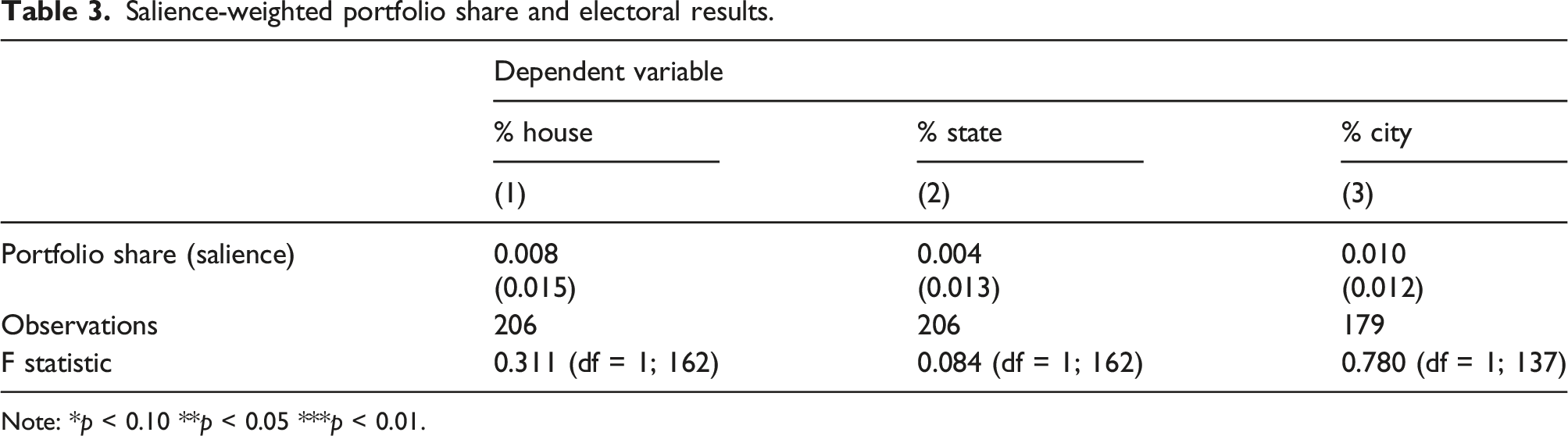
Note: *p < 0.10 **p < 0.05 ***p < 0.01.
Salience-weighted portfolio share, popularity, and electoral results.
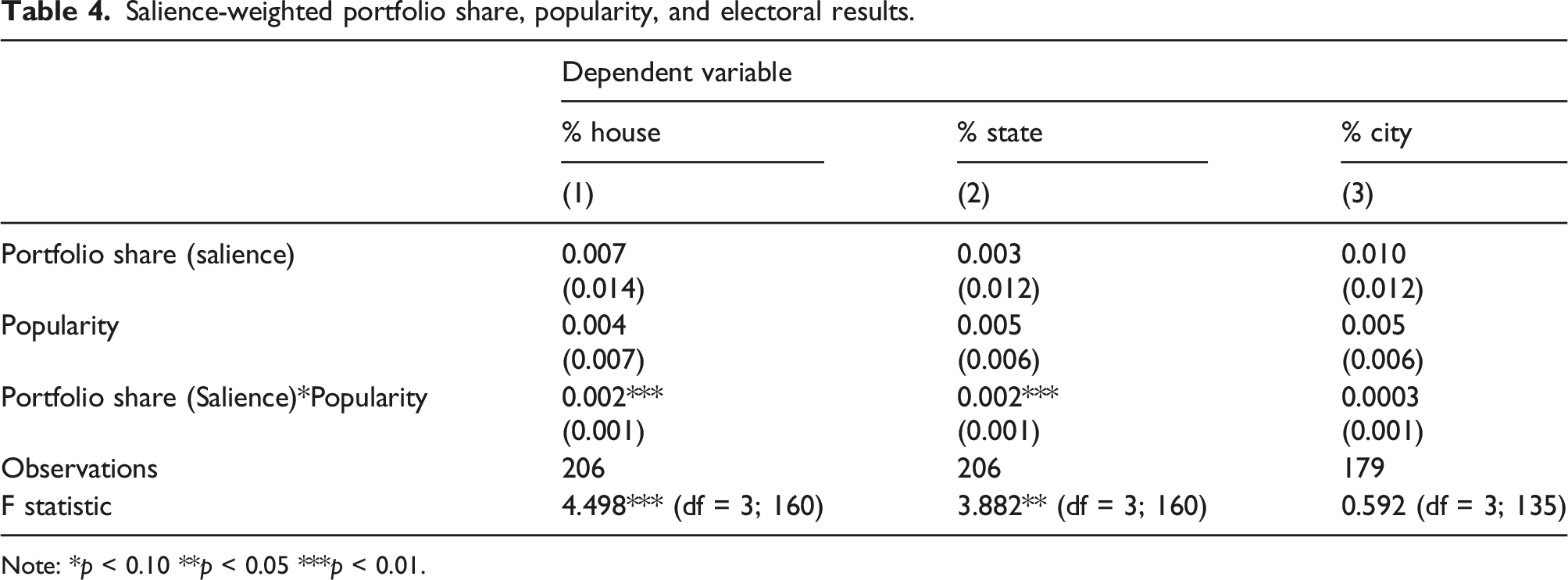
Note: *p < 0.10 **p < 0.05 ***p < 0.01.
We argue that holding cabinet positions-and most importantly, holding cabinet positions of great value-increases the capacity of parties to implement policies and allocate funding so as to improve their own electoral performance. At the same time, higher portfolio salience clearly makes coalition parties more identifiable as government members. This is why when the president’s popularity is low, we see that the higher the degree of “investment” by a party in the government, the worse the electoral performance of the party. Conversely, when president’s popularity increases, so does the electoral payoff of high investment. The magnitude of the coefficients might seem small. However, since the dependent variables are measured as the percentage of the national votes, the effects indicate that holding a share of valuable cabinet positions significantly affects the party’s share of the national votes. These effects are shown in Figure 3. Effect of salience-weighted portfolio share conditional on presidential popularity.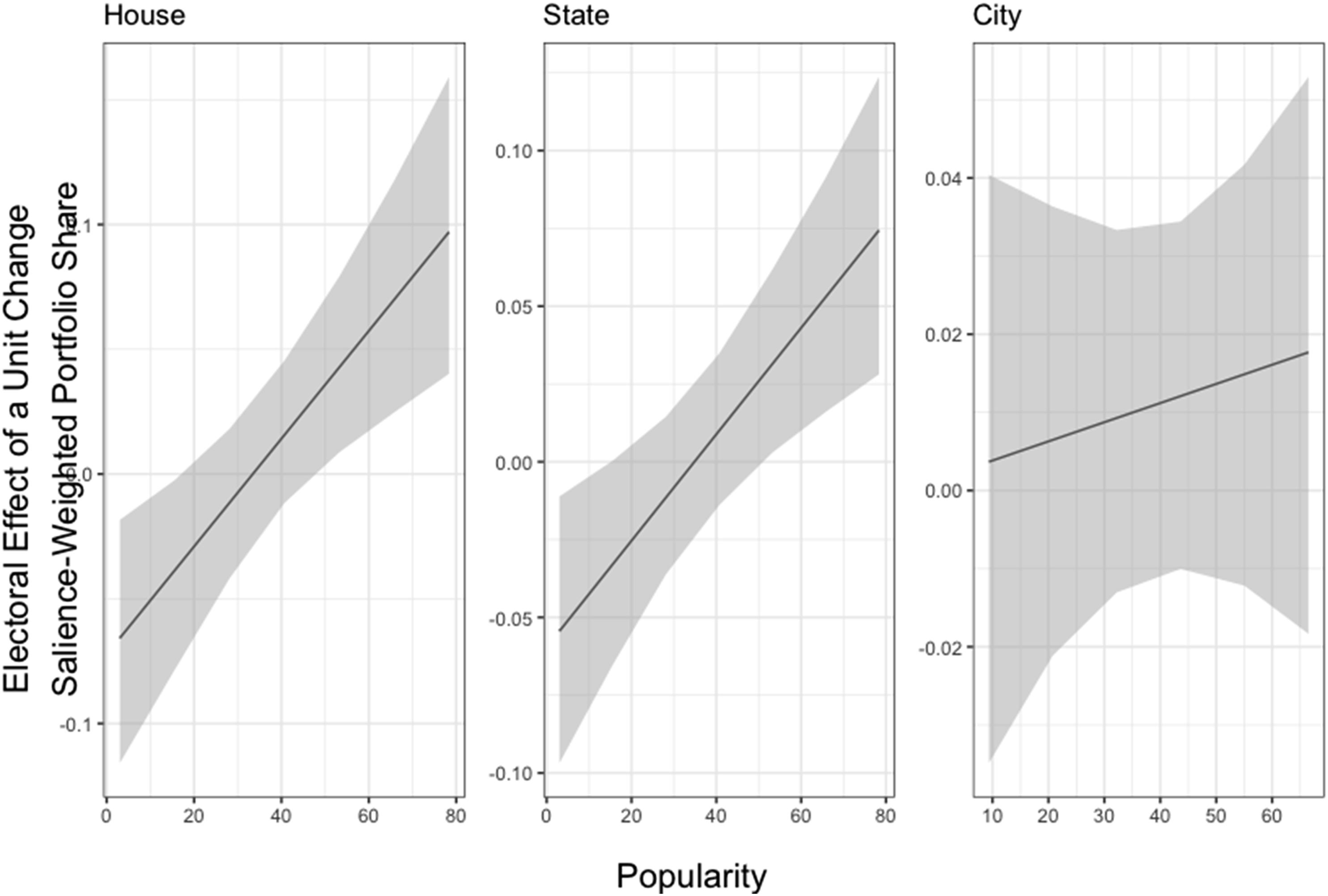
The final step in our analysis is to probe our interaction effects to consider the unequal degree of cabinet involvement within the family of government parties. Does simply joining the cabinet, independently of the degree of participation, automatically affect parties’ electoral fortunes or does it take a specific degree of investment in government to be recognizable?
An answer is suggested in Figure 4, which highlights allied parties. Here we plot the change in the slope of popularity according to the different values of salience-weighted portfolio shares controlled by these pro-presidential parties. The results show that simply joining the cabinet does not automatically tie the fate of allied parties to the president’s popularity. Figure 4 shows that parties with 0% of the salience-weighted portfolio share (i.e. parties outside of the cabinet) are unaffected by a one percentage-point increase in the president’s popularity. However, parties in the cabinet but with a low degree of investment are also not recognizable enough to be electorally affected by the president’s popularity. In concurrent elections, the slope of popularity becomes statistically significant only when a cabinet party surpasses 10% of the salience-weighted portfolio share. This result provides strong evidence in favor of our argument that cabinet participation should be measured as a matter of degree. Effect of Salience-Weighted Portfolio Share Conditional on Presidential Popularity (Allied Parties). Note: SW indicates the value of the salience-weighted portfolio share. The figure shows values of SW in the range observed among coalition partners.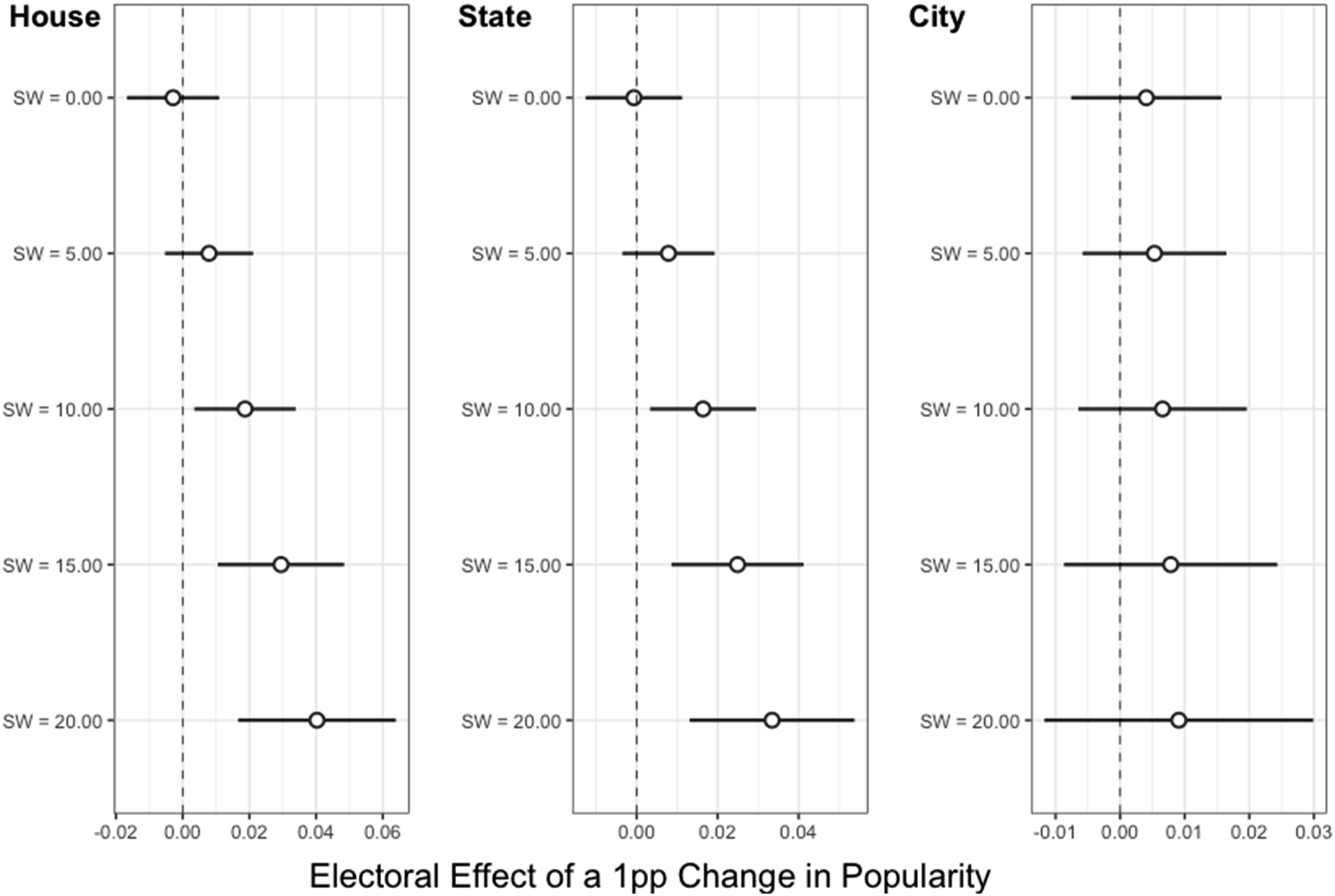
For the sake of comparison, we show in Figure 5 the electoral effect of popularity when considering the degree of cabinet control by the president’s own party (note that the scale is now different from Figure 4, reflecting the far higher values for formateur parties). As seen in Figure 1, the formateur party dominates the salience-weighted portfolio share (from 53% to 88% of the cabinet). Our results show that the president’s party is always affected by the president’s popularity and that the greater the SWPS, the greater the effect of the popularity. Effect of Salience-Weighted Portfolio Share Conditional on Presidential Popularity (Formateur Parties). Note: SW indicates the value of the salience-weighted portfolio share. The figure shows values of SW in the range observed among formateur parties.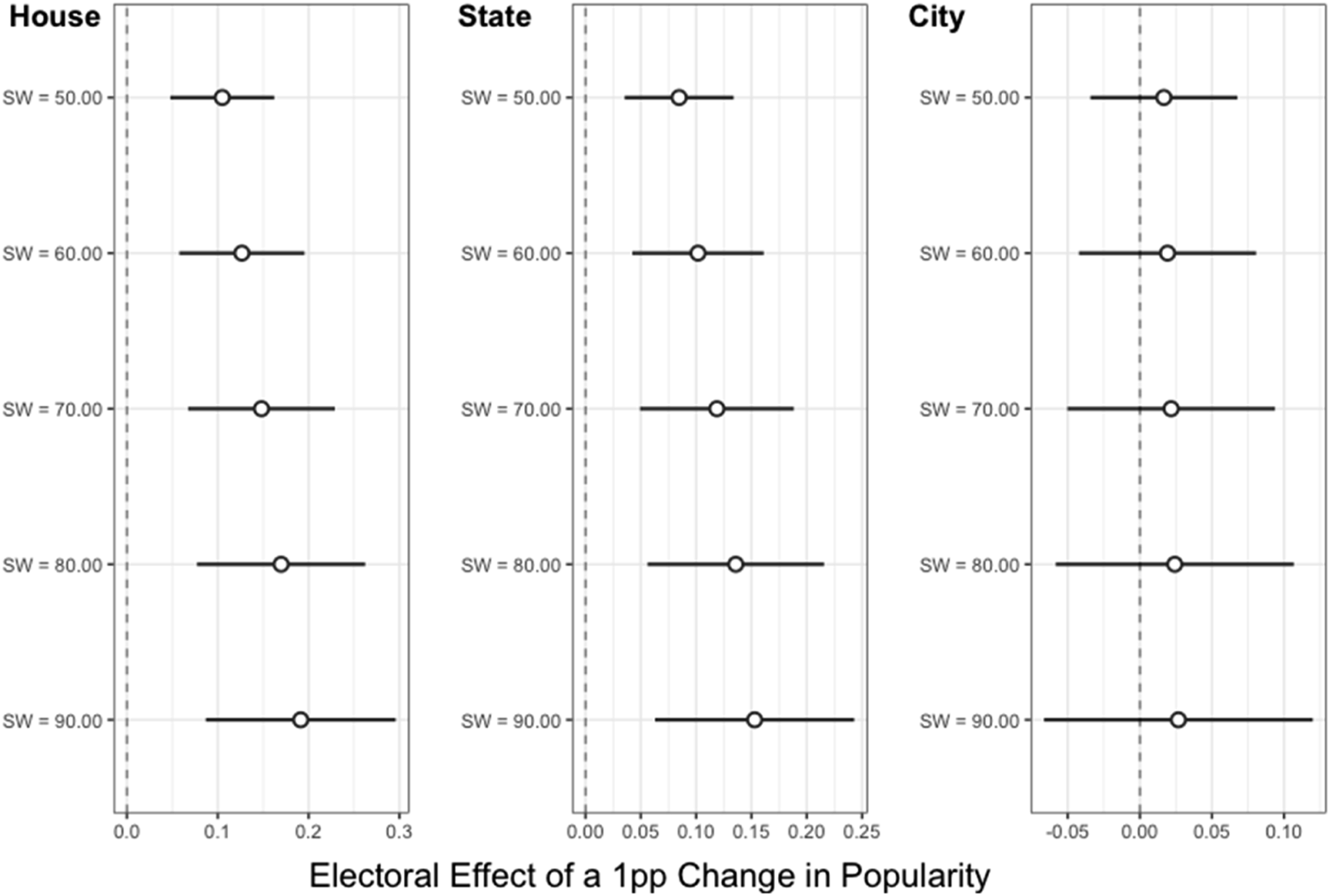
By combining the models using the simple in/out indicator with the models incorporating the variation in cabinet participation, our results indicate a clear electoral implication of holding cabinet posts. There is no automatic penalty for joining the cabinet as has been observed in parliamentary systems. However, there is a conditional electoral effect of cabinet entry, and this is directly linked to public approval of the unipersonal executive. This result is consistent when considering both coalition partners and the formateur party. However, the effects are always larger for the president’s party.
Our expected conditional effect is robust to the adoption of a salience-weighted portfolio share. The payoff of the SWPS rises as the president’s popularity increases, and this result is consistent considering for both national and statewide legislative elections. This finding contributes to our understanding of electoral accountability under the separation of powers.
Conclusion
This article explored a neglected part of coalition politics in presidential systems: its electoral implications. Our goal was to identify if joining a presidential cabinet would benefit or hurt coalition parties and under what conditions. Our study of the case of Brazil analyzed the electoral fates of 43 different political parties over 24 years. The analysis distinguished among opposition, coalition, and the formateur parties and analyzed their electoral performance in national and local elections.
Our results identify an unmistakable conditionality in the attribution of rewards and punishment to coalition parties. There is no systematic “electoral cost of governing,” but cabinet-represented parties cannot generally extract electoral rents without taking responsibility. The key exception applies to local elections in off-years. Given that presidential coattails are withdrawn in municipal election years, cabinet-represented parties competing at the local level are unaffected by the president’s popularity. This has interesting implications for party strategy: for a party seeking to grow mainly at the local level rather than in the national legislature, entering the cabinet entails minimal risk. Leaving aside the unusual circumstances of nonconcurrent elections, joining the government is only good news electorally for coalition parties when the president is highly popular. When voters give low marks to the chief executive, cabinet-represented parties will be punished by association.
We sharpened this analysis by including a powerful new measure of degree of cabinet involvement (an indicator that, regrettably, remains unavailable for most cases of multiparty presidentialism). The higher the SWPS of a party, the greater their electoral performance, conditional on the perceived performance of the president. This result indicates that there is more to coalition politics and its electoral implications than simply comparing parties in and out of government. The degree of investment clearly matters.
The broad implication of this article is that coalition parties are indeed affected by governmental performance, even considering the institutional design of presidential systems that concentrates responsibility in the hands of an individual elected from a single national constituency. In fact, attribution of responsibility to the president might actually be what makes this type of contagion possible. If in parliamentary systems voters evaluate parties separately from their partners, perhaps the fate of each individual party is not directly tied to the overall evaluation of the government as we found to be the case in Brazilian coalitional presidentialism-where the president’s responsibility for performance, whether perceived or real, affects the president’s popularity and indirectly affects the electoral fate of allied parties. Just as coalitional presidentialism binds parties together in a cabinet, it binds them together electorally as well. But for some parties, the bond with the president is tighter than for others. This means that entering the cabinet is an electoral wager, and the payoff of the wager-which rides on presidential popularity-is linked to the size of the bet, i.e. the cumulative worth of the portfolios in play. For ambitious parties, caveat emptor: the value of portfolios may be known in advance, but the president’s popularity is not.
Supplemental Material
Supplemental Material - Be careful what you wish for: Portfolio allocation, presidential popularity, and electoral payoffs to parties in multiparty presidentialism
Supplemental Material for Be careful what you wish for: Portfolio allocation, presidential popularity, and electoral payoffs to parties in multiparty presidentialism by Mariana Batista, Timothy J Power and Cesar Zucco in Party Politics
Footnotes
Declaration of conflicting interests
The author(s) declared no potential conflicts of interest with respect to the research, authorship, and/or publication of this article.
Funding
The author(s) disclosed receipt of the following financial support for the research, authorship, and/or publication of this article: CNPq – National Coucil for Scientific and Technologic Development, grant id (PQ303013/2021-4) and Coordination for the Improvement of Higher Education Personnel - Capes/PrInt, grant id (88887.312041/2018-00).

Supplemental Material
Supplemental material for this article is available online.
Notes
Author biographies
References
Supplementary Material
Please find the following supplemental material available below.
For Open Access articles published under a Creative Commons License, all supplemental material carries the same license as the article it is associated with.
For non-Open Access articles published, all supplemental material carries a non-exclusive license, and permission requests for re-use of supplemental material or any part of supplemental material shall be sent directly to the copyright owner as specified in the copyright notice associated with the article.
